Anmelden

Interview with Brian Asklev Designer of Thirty Years of Misery: The Thirty Years War 1618-1648 from VUCA Simulations
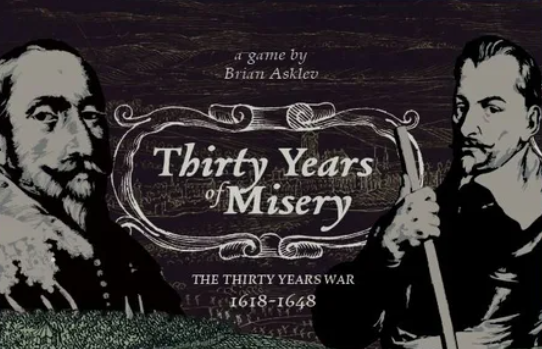
Several months ago, I saw a new pre-order game being offered called Thirty Years of Misery: The Thirty Years War 1618-1648 from VUCA Simulations designed by Brian Asklev (Baltic Empires from GMT Games and 1812: Napoleon’s Fateful March from VUCA Simulations). I was very interested in the game as it takes the Birth of America Series from Academy Games and uses it to tell the history of the Thirty Years War. We reached out to Brian to get some answers to our questions and he was more than interested in working with us.

Grant: What is your newly released game Thirty Years of Misery about?
Brian: Contrary to what many people believe Thirty Years of Misery is not a game about my last marriage, but in fact a game about the Thirty Years War. 
Between 1618 and 1648, Europe was consumed by one of the longest and most destructive conflicts in its history. What began as a rebellion in Bohemia soon engulfed the Holy Roman Empire and drew nearly every major European power into a struggle over religion, dynastic ambition and political supremacy. Millions perished as armies marched across Central Europe, cities were besieged, alliances shifted and entire regions were devastated.
Thirty Years of Misery places the players in command of the major powers that shaped this conflict including the Imperial Habsburgs, the Catholic League, Sweden or France as players fight to reshape Germany through military campaigns, religious influence, political maneuvering and strategic diplomacy.
Grant: Why was this a game that you wanted to design?
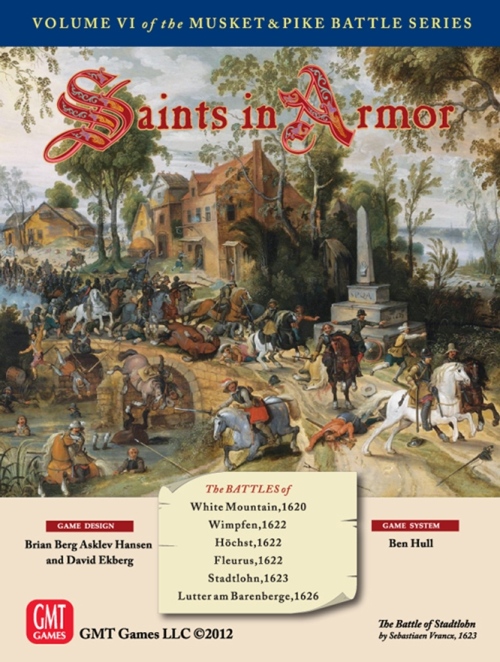
Brian: I have been interested in this conflict for years and one of my first designs was Volume VI of the Musket & Pike Series Saints in Armor from GMT Games, a tactical game on battles in the early stages of the Thirty Years War, so a game on the whole war had always been on my mind.
Grant: What was the Thirty Years War about? What design opportunities does the subject create?
Brian: The Thirty Years War was a mixture of great power politics, local independence struggles and religious war, so as a topic it allows a designer to have it all – the challenge then becomes on what to focus on to keep the game simple and playable and not to get lost in the overwhelming amount of details.
Grant: This is the first volume in a new series called the War Chronicles Series. What are the hallmarks of this series? What mechanics does it focus on?
Brian: The hallmarks of the series are simple, multiplayer (either closely allied teams, loosely allied teams or all against all depending on topic), card driven action with custom dice to resolve combat.
It is very much inspired by the “Birth of” System from Academy Games but has a bit more chrome and more historical event play.
Grant: What other topics might he suitable for inclusion in the series?
Brian: I think most conflicts could be shown in this series and I have designs on topics ranging from 400 BC to AD 1975. It is a very broad-strokes system with a lot of abstractions.
It will likely work best with conflicts with more than 2 distinct factions.
Grant: What did you need to make sure to model from the history of the Thirty Years War?
Brian: I wanted to show the religious war aspect and the ever-escalating nature of the war which started as a local rebellion in Bohemia and ended up with practically all major European powers directly or indirectly involved.
Grant: What sources did you consult to get the historical details correct? What one must-read source would you recommend?
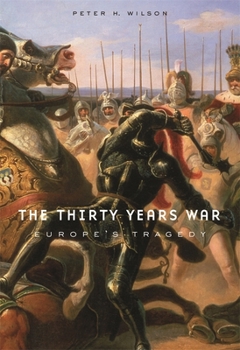
Brian: Too many to mention, and since the level of the game is strategic and with lots of abstractions, I could be less obsessed with details compared to when I was researching specific order of battles for Saints in Armor. Wilson´s Thirty Years War book is the one I would recommend.
Grant: What is your overall design goal and thesis with the game?
Brian: First of all I wanted the game to be simple, fast to play and fun while giving players a broad strokes understanding of the flow of the historical war.
Since the game is inspired by the “Birth of” System lots of the overall structures were already in place.
I wanted more chaos and historical detail, and so there are more historical events and a seeded non-player deck that serves to show the escalating nature of the war as well as the hardship, misery and chaos it brought.
Grant: What is the area covered by the board? What strategic challenges does it present?
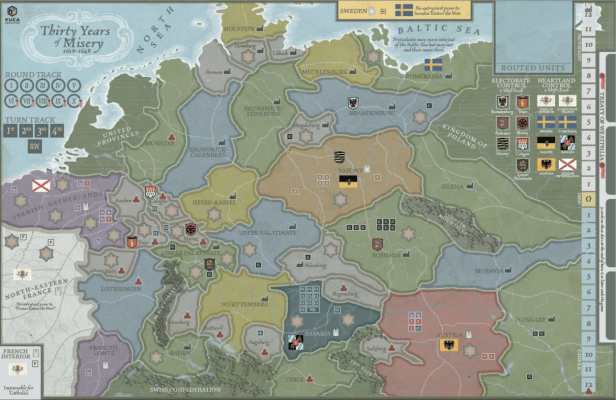
Brian: The map covers the area from eastern France to Poland and the Danish border in the north to Switzerland in the south. For the Catholic players the first half of the game will feel like a game of whack-a-mole as it starts of nice and manageable and then spirals out of control as new areas of Germany joins the rebellion against the emperor and neighboring powers intervene as well. This also neatly allowed me to script the major events of the war and make the players feel how the war is not entirely under their control.
Grant: What are the 4 playable factions and how did you go about differentiating them?
Brian: The Catholic side consists of the Imperial (aka the Habsburgs) faction and the Catholic League (aka Bavaria) faction while the Protestant side consists of France and Sweden who between them also control the various German Protestant forces.
They each have their own deck and set of custom battle dice. The deck serves to highlight their politics, military leaders, religious leaders, diplomatic efforts, elite units and other relevant historical events while their qualities in battle are handled by the dice.
Grant: How does combat work in the design?
Brian: Smooth and simple. You roll a number of custom dice depending on the number and type of units you have present in the battle and the die faces will then tell you if you eliminate an enemy unit, rout with one of yours, miss or can chose to withdraw to a friendly adjacent area.
Players take turns rolling dice and executing effects until only one side is present.
Grant: What is the makeup of the custom battle dice?
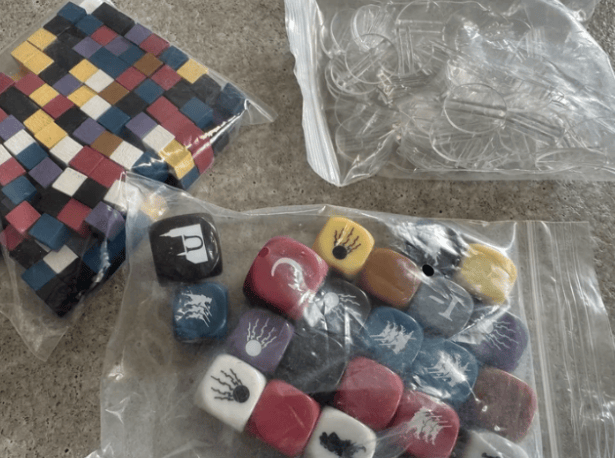
Brian: The exact makeup of the dice depend on the faction. Sweden´s dice hit more and don’t rout while the Saxons and German Protestant dice rout more than the other factions for example.
Grant: What role do fortresses play in battle?
Brian: Fortresses have no effect in large battles but in areas where the defender only has 1 or 2 units (or is reduced to this size during a battle) the defender rolls the fortress die in addition to their normal battle dice. This allows them to ignore all their rout effects and (depending on the roll) also ignore some of the attackers hit results.
Grant: How does the design utilize cards? What different types of cards are included?
Brian: Cards are used to determine how many armies (aka groups of units) a player may move, and how far. This is done by playing a card as your Movement Card at the start of your faction´s turn, which means only the two values on it are used and the event is ignored.
Cards can also be used for their event – each event clearly states when this can happen. Events can affect most aspects of the game – Battles, movement, reinforcements, religious war and victory calculations and timing.
One important aspect of the way this game uses cards that is different from most card driven games is that the deck is never reshuffled, so once a card is played for its event, as a movement card or discarded it is gone forever. If you run out of cards this represents your faction having exhausted its financial means and being forced to only move a single group of units per turn (and only moving 1 area). So players must manage their deck and not just throw cool events around like there is no tomorrow – unless of course they are going for a sudden death victory.
Grant: What is the anatomy and layout of these cards? Can you share a few examples of cards with us and discuss their use?
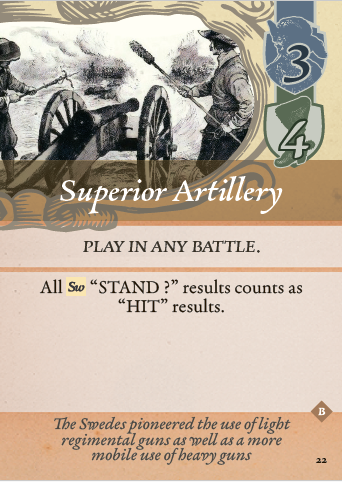
Brian: Here is the Superior Artillery card from the Swedish deck.
It can be played as a movement card and allow the Swedish player to move 3 groups of units up to 4 areas each OR played in any battle where it will modify the results on the Swedish battle dice. This is a very good card as it changes all STAND results to HIT results for the battle that it is played in.
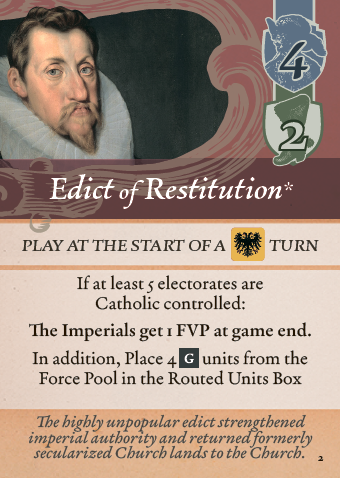
And here is the Edict of Restitution card from the Imperial deck.
When played as a movement card it allows the Imperial player to move 4 groups of units up to 2 areas each OR can be played for the event at the start of the Imperial turn. If played this way it will increase the Imperial players’ FVP (Faction Victory Points). FVP’s are not used to determine which side wins, but instead which faction on the war-winning side that wins the game. As this event actively hurts the Catholic side in the game by giving the Protestants 4 free German Protestant units as reinforcements and putting the Imperial side ahead of their partner, the Catholic Leage, Imperial play of this card will likely not do anything good for the constructive teamwork spirit on the Catholic side.
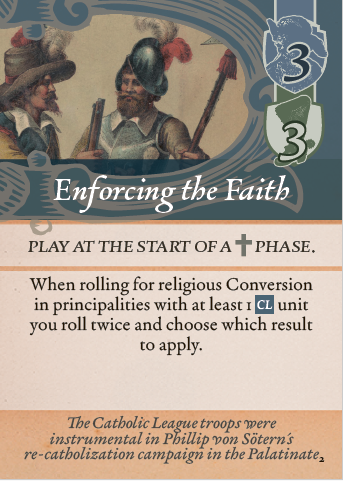
And here is the Enforcing the Faith card from the Catholic League deck.
When played as a movement card it allows the Catholic League player to move 3 groups of units up to 3 areas each OR can be played for the event at the start of the Religious War phase. If played this way it allow the Catholic player to reroll their custom religious war die and thus increase the chance of a positive outcome.
And lastly for completeness, as I have shared 1 card from each of the faction’s decks, I will share this card from the French deck.
Here is the France Triumphant card from the French deck.
When played for the event at the start of the French faction’s turn it allows the French player (and ONLY the French and not their Swedish partner on the Protestant side) to instantly win the game if they fulfill the conditions on the card. This however sounds easier than it is, as the conditions on the sudden death cards (of which there is 1 in each deck) are pretty hard to achieve.
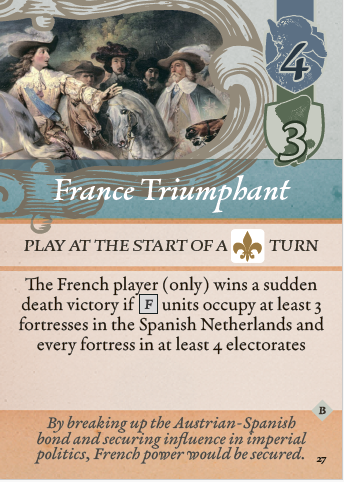
These Sudden Death cards are essential to the game as it creates something that all players have to keep in their mind as the game progresses and causes them to have to carefully plan around them.
Grant: What role do electorates play in the game?
Brian: I wanted to show their importance in the politics of the Holy Roman Empire while simplifying as much as possible (in general I recommend simplifying everything about the inner workings of the Holy Roman Empire in games unless you want your players to suffer :D). Some principalities on the map are designated Electorates (and displaying that principality´s coat of arms on the map as a reminder). Control of each of these are worth 1 extra VP at the end of the game.
In addition, some Event Cards that represent the key political developments during the war are only playable if your side currently controls a majority of the electorates, to represent the need to have a majority of the votes.
Grant: What are the effects of a Protestant or Catholic controlled principality? Can these change?
Brian: Control of a principality allows you to try to convert the religious marker in the principality to your side´s religion. This is done by rolling custom Religious War dice during a special Religious War turn (which together with the 4 factions’s turns are the 5 turns comprising a Round). Some Event Cards modify this either by allowing conversion outside the normal sequence or by modifying the Religious War die.
Grant: How are victory points scored?
Brian: The VP track goes from 12 Catholic to 12 Protestant with the score being the number of one side’s religious status markers on the map minus the other side’s number of religious status markers on the map. This is calculated whenever things change during the game as a sudden death is possible by exceeding the track, as since the current standing is important for play of a couple of events. At the end of the game the VP marker is then shifted for control of electorates and the principalities comprising the major belligerents of the war (called heartlands) to determine the final score.
Grant: What role do Leaders play?
Brian: Originally, I had a LOT of leaders in the game – both military, religious and political which affected certain aspects in the principalities where they were present. During the process this ended up with leaders just being the 5 most iconic commanders of the war, with the rest being streamlined away from the map and into the card deck as events which in most cases also allowed me to better show their contribution to the war.
Grant: What historical Leaders are represented? How are they differentiated?
Brian: Gustavus Adolphus and Torstenson from Sweden, Turenne from France, Tilly from the Catholic League and Wallenstein from the Imperial faction.
They each have their own short unique special rule that reflects their performance in the war. For example Wallenstein allows additional reinforcements to represent his ability to raise armies at his own expense, while Gustavus allows you to roll first in battle and even perform a limited move and fight after winning a battle.
Grant: What is the general Sequence of Play?
Brian: It’s a chit pull game so the order of the 4 factions’ turns and the Religious War turn is randomly determined each Round.
Within each faction turn you start out with drawing your hand back up to 4 cards, then place reinforcements and then play a card for movement.
Grant: What is different with a Religious War?
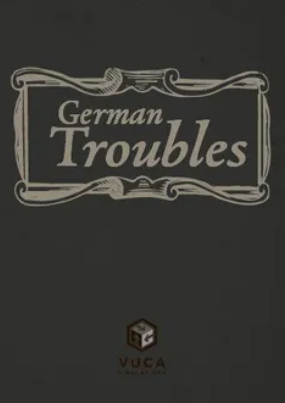
Brian: In a Religious War turn players draw a card from the German Troubles Deck and execute its effects. This deck is semi-seeded and handles most of the interventions in the war from foreign powers and minor German states, outbreaks of disease and other important events of the historical war that I did not want the players to have control over, but instead wanted to script enough to avoid unbalancing the game or allowing it to go too far off the historical rails, but still making it hard for players to know in advance when things will happen. After this players receive reinforcements for the non-player factions (The German Protestants, the Saxons and the Spanish) and then the highlight of the turn: Religious War.
This is conducted in a simple manner with each side having their own custom die that handles all the complexities I wanted to represent.
Players make a roll for each principality they control which does not currently have their side´s religious marker, and can get either Conversion results (exchange the current marker with your religious status marker), Uproot results (remove the enemy religious marker) or no effect. Some of the results on the die are conditional and only works in principalities which had the same starting religious as your side to represent the inherent sympathies in the area of the traditional order.
Grant: How is victory determined?
Brian: Besides the sudden death victory by exceeding 12 on the VP track, or simply having the VP marker on your side at the end of the game after adjusting for electorates and heartlands, the game offers one extra way of winning. Each faction has a Sudden Death Event Card that allows that faction to win the game if they fulfill the (rather ambitious) conditions on the card. This represents their faction having achieved most of their war aims.
When a game does not end in such a sudden death the two factions on the war-winning side (and only them) check to see how many faction victory points they have achieved, which each faction having their own custom list of war aims that give them faction victory points.
The faction on the war-winning side with the most faction victory points is the overall winner of the game.
Grant: What different scenarios are included?
Brian: One short scenario that covers the early part of the war only, one short scenario that covers the late part only and then a scenario that covers the entire war
Grant: What do you feel the design excels at?
Brian: At giving players a broad strokes feel of the entire Thirty Years War in a manageable setting (1 to 4 hours) and with very manageable rules. This is something you can play with non-wargamers or wargamers with zero knowledge of the Thirty Years War and they will likely have a great time and in the process learn a lot about the conflict.
Grant: What other designs are you currently working on?
Brian: WAY too many! 
I am working on a new Operational level game series with Fred Serval which will include little games topics on a vide variety of conflicts in the 1900-1990 time frame. Once we launch this series we will likely be able to put out titles quickly as we already have several games that are ready to go now.
I am co-designing Enlightenment Empires for GMT (the sequel to Baltic Empires) with Roman Rogov. I am both designer and developer on 3 new games in VUCA´s Marshals & Quartermasters Series which currently only consists of 1812: Napoleon’s Fateful March but which will very soon also include 1813: Napoleon’s Struggle for Germany (by me), while games on the 1814 invasion of France (by Pete Manning), 1796 in Italy (by Antonello Salvatucci) and 1812 in Iberia (by me) are also underway.
For Academy Games, I am (hopefully) finalizing games in the “Birth of” Series on the Vietnam War and the 2nd Punic Wars. The latter is a co-design with Jose Rivero.
I am also working on new games in VUCA´s War Chronicles Series I started with Thirty Years of Misery that is just coming out now. One of these will also be a co-design with Jose Rivero on Al-Andalus (medieval Spain).
Lastly, I am also doing final testing on The 38th Parallel in Bellica 3rd Generation’s criminally overlooked Campaign Commander Series.
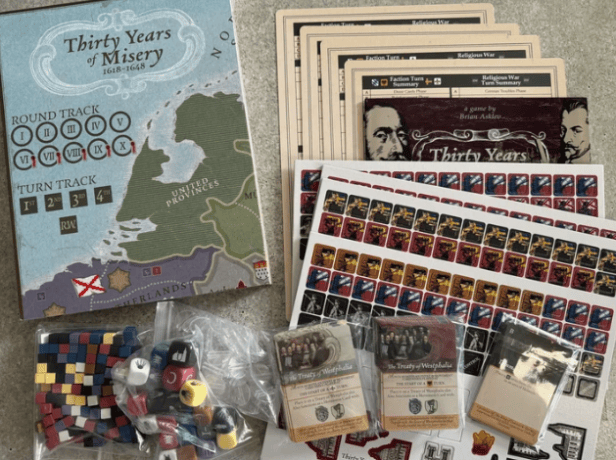
If you are interested in Thirty Years of Misery: The Thirty Years War 1618-1648, you can order a copy from the VUCA Simulations website at the following link: https://vucasims.com/products/30-years-of-misery
-Grant