
Normale Ansicht

Off the Shelf #50: Park and Shop

16. September 2025 um 17:00

It’s the fiftieth post in this Off the Shelf series, where I look at games on my shelf. And today, it’s time for

image by BGG user Meander

Park and Shop is a game designed by Donald Miller and first published by Milton Bradley in 1952. You can play with 2-6 players, and the object of the game is that you have a shopping list that you need to complete before you head home. The first player that does wins.

This was my grandparents’ game. When I was a kid and would visit them, I would often pull this out, set it up, and play by myself. There aren’t solo rules and I wasn’t really playing to win, I just wanted to play. I enjoyed walking around the city, shopping, and seeing how fast I could go through every card in the game. I had fun. When they passed, the game was part of my inheritance. It’s still on my shelf. I hardly ever pull it out because, if I’m being honest, it’s not really a very good game. But it scores high on nostalgia.

The game is played on a big square board, but I’m happy to report that it’s NOT a simple Monopoly ripoff. There’s not one track to move around, but rather a bunch of rectangles representing the streets of this town. Each player starts the game with up to 7 yellow shopping list cards, but everytime we would play, we’d use the whole deck.

You start the game at your house, one of the spots around the edge of the map. You can pic your own spot, and usually you’ll be trying to pick on that’s relatively close to a parking lot. You’ll roll a die and move that many spaces until your car ends up in a lot. At this point, you switch to your pedestrian piece and start rolling two dice every time you want to move? Why? Well, it’s obvious – you roll one die in your car because it only has one engine, but you roll two while walking because you have two feet. I’m not even joking, that is the actual rule.

You’ll look at the top card of your shopping cards, then find it on the map. Sometimes, there are several locations scattered around, but other times, it’s just one. You’ll need to walk there. You don’t need to land on a shop by exact count, but landing there does end your turn. Other standard roll and move rules apply – no backtracking, roll doubles and get an extra turn, but roll three doubles and go to jail, that kind of thing.

There are a bunch of gray spots along your route, and if you land on one, you have to draw a pedestrian card. These can be good (take an extra turn, move directly to your next stop, etc.) or horribly bad (lose a turn, add extra stops to your list, etc). There is an extra turn space in the middle of the board, so you can aim for that if you’re in the vicinity.

Once you have completed all your shopping items, head back to your car. But oh no, even though you were parked in a clearly marked lot, you have received a parking ticket! The parking tickets aren’t really penalties, just an extra task you have to do before heading home. So you’ll drive to that stop (using only one die) and drawing motorist cards for landing on those gray spaces.

Once that’s complete, you can head home. But even though you don’t have to land on shops by exact count, you DO have to land on your home by exact count. That means you can be in the space right next to it, but if you can’t roll a one, you’ll just be sitting there suffering until you finally get lucky enough to park in your own garage. The first one to do so wins.

There is a variant of the game I never played with that uses money – you actually have to pay for stuff. You start the game with $150, and every time you buy something or go somewhere that you’d have to pay, you roll dice to see how much it cost you. With this variant, you can go broke before the game is over because there’s no way to make money.

This game has a lot of problems. First, it’s roll and move, which is definitely an out-of-style mechanism these days. One person is rolling 12s and 11s to get next door while another is rolling 3s and 4s to get all the way across the board. There’s no skill, it’s really all just about rolling better and drawing better. The money variant doesn’t add any choice, just adds the possibility of getting randomly eliminated.

Another big problem is that the game is VERY dated. There’s a cool retro look to it, but some of the cards…

But still, I love the IDEA of this game. It’s a big shopping map, and the idea of moving around from store to store to get what you need is fun. It’s a lot better than just endlessly moving around a track, and I think that with some tweaking, this idea has legs today. Maybe set it in a mall with different obstacles around (survey takers, disruptive youths, security, mall walkers, etc), and you have to visit different stores. I don’t know. But the game concept works for me, it just fails in execution.

My enthusiasm for the game has everything to do with nostalgia, I know. If I hadn’t grown up with it, I’d probably laugh it off and never think about it again. But, it is an extremely important game to me – I even listed it in my old list, The Eleven: Games That Turned Me Into A Gamer. Nevertheless, objectively, I have to put it at #49 on my Off the Shelf rankings. (You may notice that it’s still above Apples to Apples. 😁)

Anyway, that does it for this edition of Off the Shelf. Thanks for reading!
Off the Shelf #50: Park and Shop

16. September 2025 um 17:00

It’s the fiftieth post in this Off the Shelf series, where I look at games on my shelf. And today, it’s time for

image by BGG user Meander

Park and Shop is a game designed by Donald Miller and first published by Milton Bradley in 1952. You can play with 2-6 players, and the object of the game is that you have a shopping list that you need to complete before you head home. The first player that does wins.

This was my grandparents’ game. When I was a kid and would visit them, I would often pull this out, set it up, and play by myself. There aren’t solo rules and I wasn’t really playing to win, I just wanted to play. I enjoyed walking around the city, shopping, and seeing how fast I could go through every card in the game. I had fun. When they passed, the game was part of my inheritance. It’s still on my shelf. I hardly ever pull it out because, if I’m being honest, it’s not really a very good game. But it scores high on nostalgia.

The game is played on a big square board, but I’m happy to report that it’s NOT a simple Monopoly ripoff. There’s not one track to move around, but rather a bunch of rectangles representing the streets of this town. Each player starts the game with up to 7 yellow shopping list cards, but everytime we would play, we’d use the whole deck.

You start the game at your house, one of the spots around the edge of the map. You can pic your own spot, and usually you’ll be trying to pick on that’s relatively close to a parking lot. You’ll roll a die and move that many spaces until your car ends up in a lot. At this point, you switch to your pedestrian piece and start rolling two dice every time you want to move? Why? Well, it’s obvious – you roll one die in your car because it only has one engine, but you roll two while walking because you have two feet. I’m not even joking, that is the actual rule.

You’ll look at the top card of your shopping cards, then find it on the map. Sometimes, there are several locations scattered around, but other times, it’s just one. You’ll need to walk there. You don’t need to land on a shop by exact count, but landing there does end your turn. Other standard roll and move rules apply – no backtracking, roll doubles and get an extra turn, but roll three doubles and go to jail, that kind of thing.

There are a bunch of gray spots along your route, and if you land on one, you have to draw a pedestrian card. These can be good (take an extra turn, move directly to your next stop, etc.) or horribly bad (lose a turn, add extra stops to your list, etc). There is an extra turn space in the middle of the board, so you can aim for that if you’re in the vicinity.

Once you have completed all your shopping items, head back to your car. But oh no, even though you were parked in a clearly marked lot, you have received a parking ticket! The parking tickets aren’t really penalties, just an extra task you have to do before heading home. So you’ll drive to that stop (using only one die) and drawing motorist cards for landing on those gray spaces.

Once that’s complete, you can head home. But even though you don’t have to land on shops by exact count, you DO have to land on your home by exact count. That means you can be in the space right next to it, but if you can’t roll a one, you’ll just be sitting there suffering until you finally get lucky enough to park in your own garage. The first one to do so wins.

There is a variant of the game I never played with that uses money – you actually have to pay for stuff. You start the game with $150, and every time you buy something or go somewhere that you’d have to pay, you roll dice to see how much it cost you. With this variant, you can go broke before the game is over because there’s no way to make money.

This game has a lot of problems. First, it’s roll and move, which is definitely an out-of-style mechanism these days. One person is rolling 12s and 11s to get next door while another is rolling 3s and 4s to get all the way across the board. There’s no skill, it’s really all just about rolling better and drawing better. The money variant doesn’t add any choice, just adds the possibility of getting randomly eliminated.

Another big problem is that the game is VERY dated. There’s a cool retro look to it, but some of the cards…

But still, I love the IDEA of this game. It’s a big shopping map, and the idea of moving around from store to store to get what you need is fun. It’s a lot better than just endlessly moving around a track, and I think that with some tweaking, this idea has legs today. Maybe set it in a mall with different obstacles around (survey takers, disruptive youths, security, mall walkers, etc), and you have to visit different stores. I don’t know. But the game concept works for me, it just fails in execution.

My enthusiasm for the game has everything to do with nostalgia, I know. If I hadn’t grown up with it, I’d probably laugh it off and never think about it again. But, it is an extremely important game to me – I even listed it in my old list, The Eleven: Games That Turned Me Into A Gamer. Nevertheless, objectively, I have to put it at #49 on my Off the Shelf rankings. (You may notice that it’s still above Apples to Apples. 😁)

Anyway, that does it for this edition of Off the Shelf. Thanks for reading!

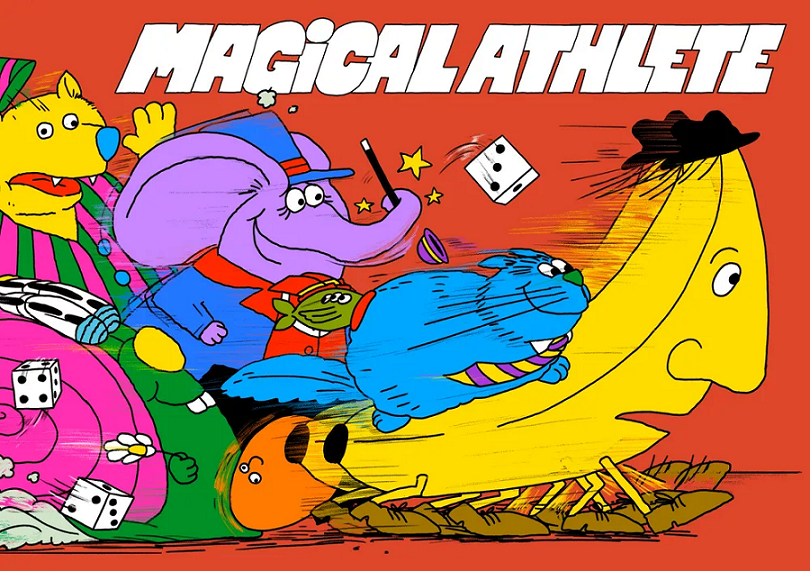
Going the Distance – A Magical Athlete Review

16. September 2025 um 15:00
Takashi Ishida’s Magical Athlete is a quirky game about a cast of misfits in a foot race. First released in 2003 by Z-Man Games, its oddball nature and prototype-level production resulted in a large shrug from audiences. It was the typical Tanga title, dumped on a deep discount website and banished to the shelves of…

Read more →

The Lord of the Rings: Fate of the Fellowship v1

16. September 2025 um 06:42

… and I like less than half of you half as well as you deserve.

Keep it secret! Keep it safe! The Lord of the Rings: Fate of the Fellowship rules & reference!

The Pandemic system has spawned quite a few games now, and while I’m not a big fan of co-operative games, I hoped that The Lord of the Rings: Fate of the Fellowship would be different enough to offer a new and, for me, better, experience. And all the elements are here to make a more compelling game – it just seems that co-ops still aren’t for me.

The Lord of the Rings: Fate of the Fellowship boils the books down to a series of objectives you must complete before the final push to drop the Ring into the Crack of Doom. These can be mixed and matched to create scenarios that concentrate on various parts of the tale – for example, the taking of Isengard and the battles in Rohan – or you can just choose a random set of them. Each player controls two characters and must complete 4 actions with one, and 1 action with the other, on each of their turns. Your hand of region cards has icons on them that allow you to pay for some of those actions or get dice re-rolls. At the end of each player’s turn, a number of shadow cards are drawn according to the threat level, and these cards dictate the movement of troops along battle lines on the board as they head inexorably towards the strongholds of the good guys, or move the Eye of Sauron and the Nazgûl around the map. Occasionally, Skies Darken cards will pop up that, among other things, instruct you to shuffle the shadow card discards and put them back on top of the deck, in true Pandemic fashion.

I appreciate that this game is an interesting and very thematic evolution of the Pandemic system, but unfortunately I find the constant maintenance required by that system – moving the troops around the map in little conga lines, shuffling the cards back on top of the deck – pulls me out of the game’s theme. I sometimes found myself in situations where I had nothing I could do with my characters (probably my poor playing, but still…) Crucially, I simply can’t seem to get excited about winning or losing against a game system rather than real-life opponents. And finally, while the included dice tower is a solid, attractive bit of gimmickry, I found the game’s graphic design lacking a unified direction and a little bit amateurish. So in the end, while I can definitely see why this game has been reviewed so well and why so many people will love it, after a couple of plays, I realised it just wasn’t for me and I decided to sell it on to someone who would enjoy it more.

For more detail, check out my video review! And of course, you can find this summary in my amazing rules app, Tabletop Codex.

❌