
 Anmelden


Media Masters

I’m not the biggest fan of trivia games. Especially those that require players to know a specific answer, and a hundred times those that sporadically stuff me into a locker with an unexpected sports question. “Who soiled his pants while stealing two consecutive homers during the 1914 Cinnamon Bakeaway summer camp?” the question will ask. “Nobody could possibly know that,” I begin, only for my father to scream “Mickey ‘The Dugout Dog’ O’Queefe!” for ten thousand points.
Book Club and Movie Night are teensy-tiny trivia games by Peter Hayward. Each session lasts five minutes, sometimes a run of cards will produce an impossible question, and they’re titles that will prompt the most obnoxious person in your gaming group to insist they’re activities rather than games. For all that, they’re the rarest of beasts: trivia games that put creativity and lateral thinking on the same footing as raw factoid retrieval.
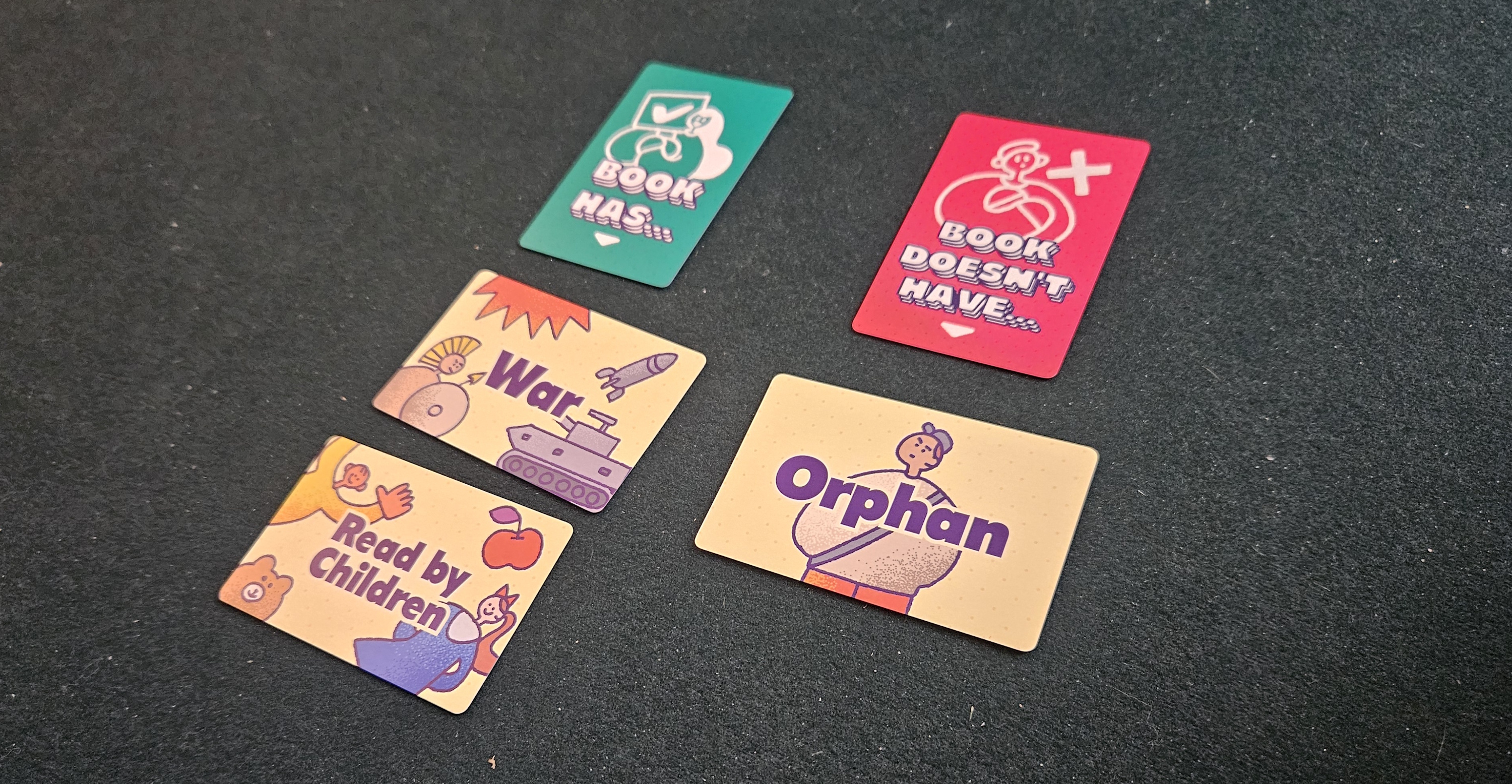
Name a book!
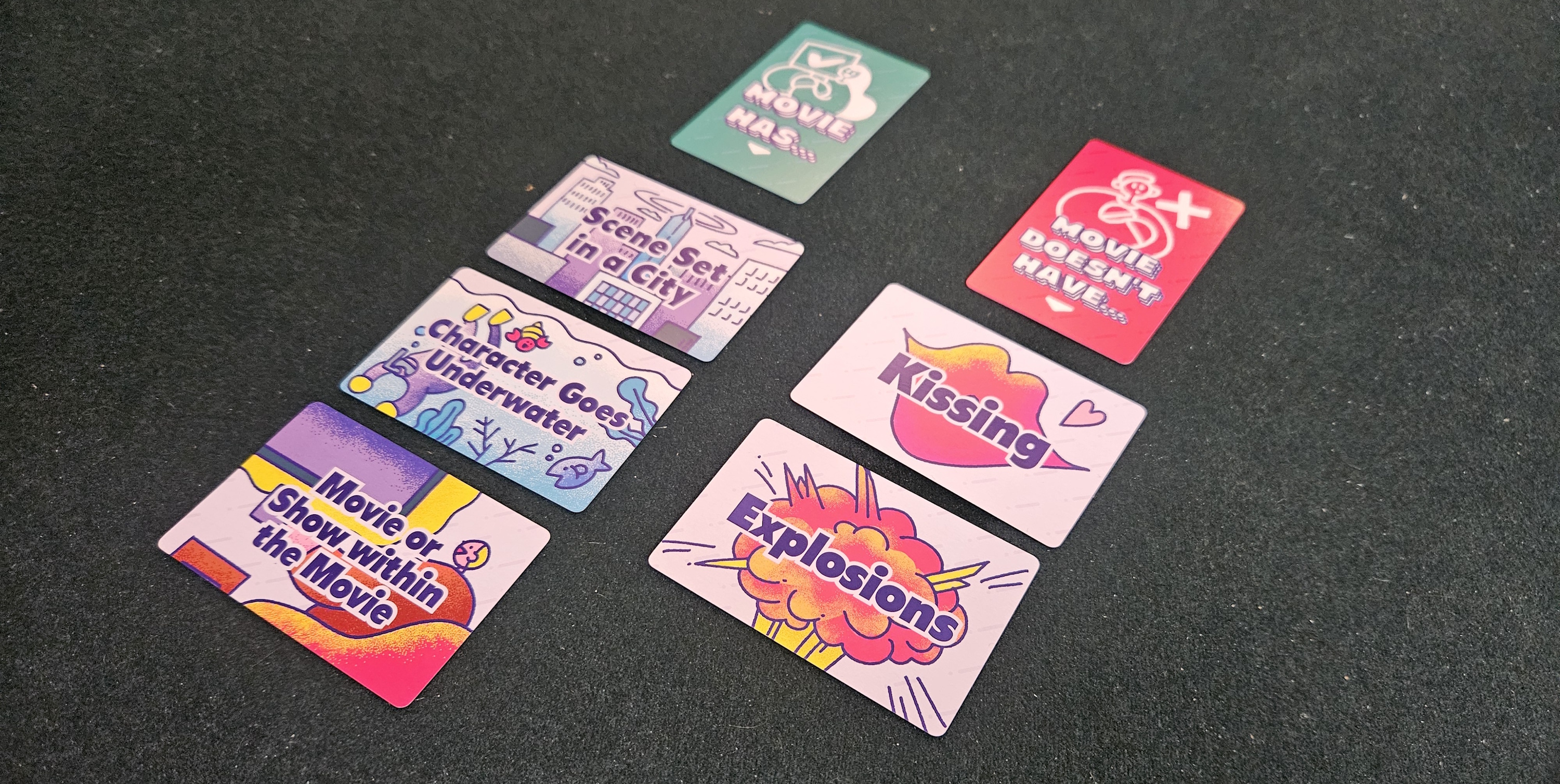
Rather than walk through the rules, let’s open with a demonstration. Movies. We’re guessing movies. So we draw a card. It says “punching.” What’s a movie that includes punching?
Rocky. Sure. Plenty of punching.
Now we draw another card. “Scene set in a city,” it reads.
At this point, we need to take stock. Does Rocky have a scene set in a city? Well, yeah. The whole thing. Philadelphia. There’s a statue. The city even renamed the steps.
So we take that card, “Scene set in a city,” and we move it into the “Movie Doesn’t Have” column. Now we need to come up with a movie that does have punching but doesn’t have any scenes in a city.
“Knockaround Guys!” shouts my friend who always remembers weird movies like Knockaround Guys. That sounds about right. We spend a minute debating whether there’s a city scene near the beginning, but none of us can remember because Knockaround Guys came out in 2001 and it wasn’t a good movie to begin with, apart from that one scene where Vin Diesel really works over that redneck. Eventually we decide that, fine, Knockaround Guys works.
Another card. “Character goes underwater.” Uh oh. Pretty sure nobody goes underwater in Knockaround Guys. (Although maybe. We can’t remember. Knockaround Guys came out in 2001 and none of us saw it more than once. Nobody did.)
So what’s a rural punching movie where somebody goes underwater? Sinners. Of course. Props to Geoff with the contemporary cut.
Fourth card. “Celebration or holiday.” Now the group starts to fracture. Because while Sinners isn’t a holiday movie, it can be argued that the juke joint is a celebration of freedom, and that one scene is a celebration of African heritage, and now we’re debating what “celebration” means in the context of “celebration or holiday.” It matters. Because if we decide that Sinners includes a celebration, our next movie can’t have a celebration, which is a lot easier than naming a rural punching underwater holiday movie.
Phantom Menace, somebody offers, making assumptions about how we’ll rule on the celebration thing, only to be roundly denounced by all the other nerds.
Uncut Gems, my pedantic friend says, which is always a treat. He says it counts for “underwater character” because Adam Sandler is underwater to loan sharks, which is pretty funny and we’re considering it, but then we remember that the whole thing is obviously set in a city. We’d kinda forgotten about that card.
Finding Dory, says the person with kids. Apparently the octopus punches something, and while the movie is basically set in Monterey, there’s some wiggle room whether the fictional version of the Monterey Bay Aquarium should be considered a city or a greater unincorporated beachfront region. Also, since we still haven’t settled the “celebration” issue, this would retroactively put that card in the negative column.
The timer goes off. That’s five minutes.
Name a movie!
Hopefully this demonstration has been helpful. Here are my takeaways.
Perhaps foremost, this is a pedantic sort of game, one where every definition means what it means right until the moment when it behooves someone to argue that it doesn’t. “One-word title.” Hyphenated or not? “Adaptation.” Isn’t almost everything in Hollywood an adaptation? “Break-up.” Does that include friendships? “Snow.” You know somebody’s going to insist that cocaine counts. Personally, I think we all know what “snow” means. But then I propose a movie in Antarctica and now we’re debating whether pack ice really qualifies as snow. Fair enough. The good news is that it’s cooperative, so players don’t often come to loggerheads. You draw a card, squabble over its meaning a bit, and then move onto the next thing.
For all that, the experience it offers is often rather uneven. Sometimes you’ll hit upon a run of cards that’s too easy, and by extension too boring. In the next session you’ll be asked to only name movies with a stand-up comedian in a lead role. Or a book in epistolary form. Or to exclude media with “and” or “the” in the title. My least favorite? Only picking books whose author has an initial in their name. Hope you want to hear a lot of Christian fantasy author suggestions.
Books are harder than movies. Not only because it’s easier to watch a movie than read a book, so most people’s pool of options will be substantially deeper, but also thank the visual nature of the medium. Whether a movie includes a cat is easy enough to answer, even if it strains our gray matter. Recalling whether a book refers to a named character’s death is… well, it’s harder to conjure. At least for me.
For the most part, these textures are compelling, but it would be inaccurate to pretend they don’t sometimes lead to frustration. Riffing on movies is a delight. The same goes for books. But suddenly stretching to recall books-within-books when you’re four cards deep… well, it depends. Everything in Movie Night / Book Club depends.
There’s also a part of me that balks at the games’ size. These are slight things, roughly the size of a deck of playing cards, but at 40 and 34 cards for books and movies respectively, their variety is thinner than I would have preferred. And, look, their real value is in how those cards combine with one another. Even with the same three or four cards, their order can matter, and the appearance of even one other card can make a huge difference. But it’s disappointing all the same to draw a duplicate after only a few sessions.
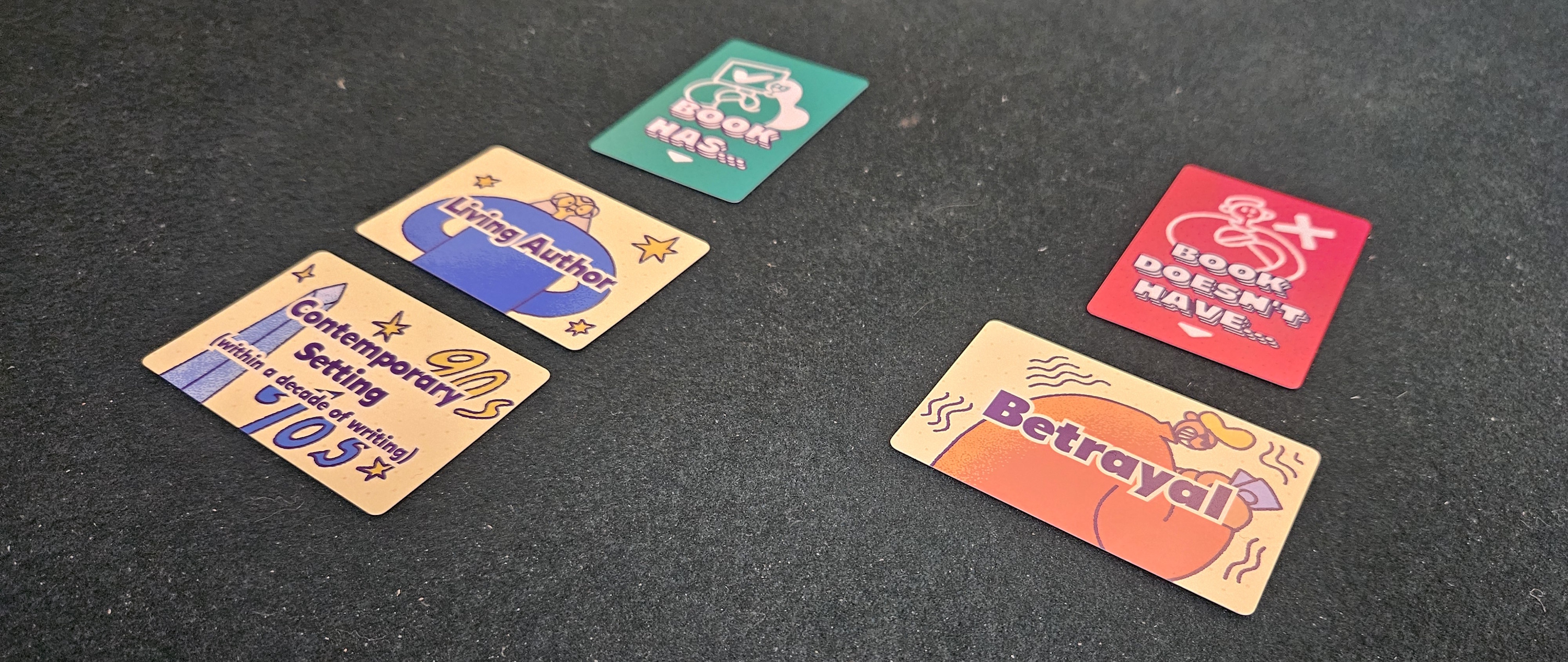
Name a book!
All told, then, Movie Night and Book Club are mixed bags. They’re snack-sized games, good for filling a few minutes, nice as stocking stuffers, but also not especially ambitious or groundbreaking. I hate to say it, but just this once: the absence of a “sports” card from Movie Night might be one of the most telling indications that this party game isn’t quite up to snuff.
Complimentary copies of Book Club and Movie Night were provided by the publisher.
(If what I’m doing at Space-Biff! is valuable to you in some way, please consider dropping by my Patreon campaign or Ko-fi. Right now, supporters can read the next installment in my series Talking About Games, this time tackling the topic of what makes a good list! Naturally, the piece includes a list.)

