Normale Ansicht

Flippin’ Mickey

14. April 2026 um 21:30

this is not an ambigram

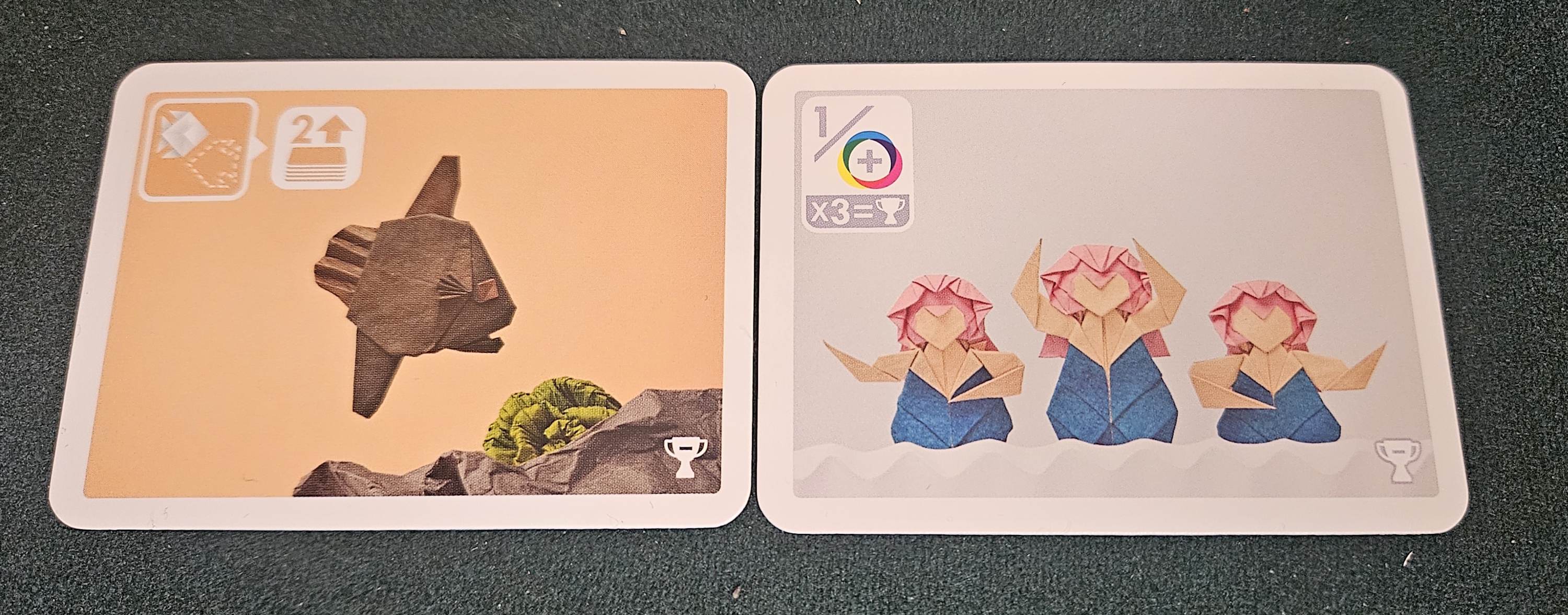
FlipToons was designed by Renato Simões and Jordy Adan, the latter of whom gave us Stonespine Architects and Cartographers, but the real star of the show is Diego Sá, whose animated characters make me want to rate the game significantly higher than I would otherwise. Just look at those little dudes! The camel is two seconds away from winding up a punch. The rabbit wouldn’t feel out of place leaning in for a kiss, only to be rebuffed when the ostrich hides her head in the sand. The sheep is just is out there boppin’ to her tunes.

As a game? Oh, it’s pretty good. Clever at points, nice to play, the usual. My larger reservation is the way it makes me feel during and after a play.
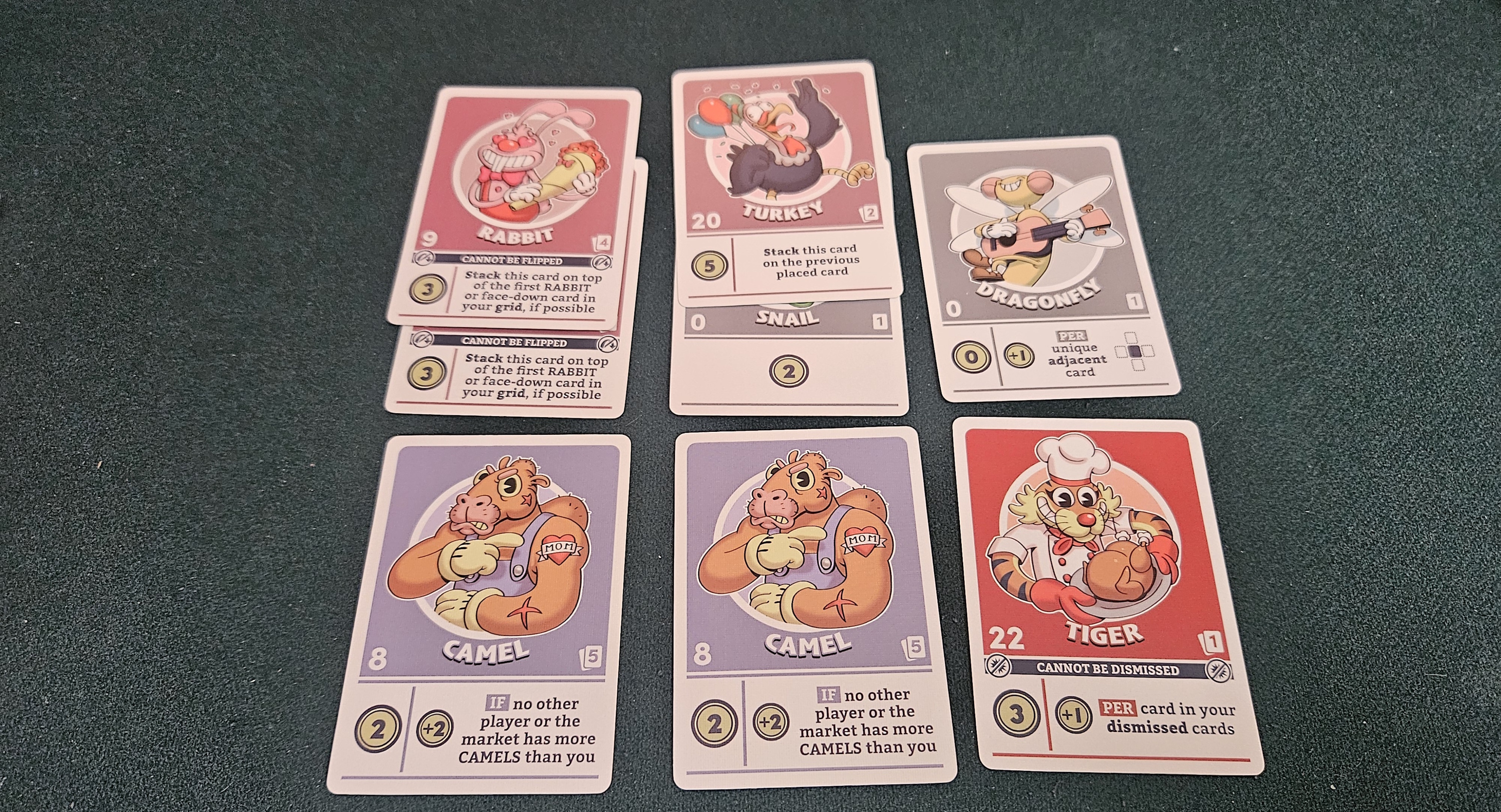
The other day my children were counting a bee's legs and getting mightily confused because it would not stop moving. That's me checking that I have six cards in FlipToons.

Six cards. In theory.

FlipToons is a game of two halves. Two halves which, when hinged like an aquatic bivalve, form into a united whole that conceals an unexpectedly tasty muscle within. Okay, so I skipped breakfast. Point is, FlipToons is hard to discuss holistically without first establishing how its components function apart from one another.

The first part is the deck. When the game begins, you have six cards in total. Two caterpillars, each worth bupkis, but easily dismissed. One skunk, a utility card for winnowing your deck. One bee, worth a single pip of purchasing power. One snail, worth double the bee’s value, making it the single most precious card in your starting lineup. And one dragonfly. Ah, the dragonfly. This guy gives you one point for every unique adjacent card.

What this means requires some explanation. Every round opens with you shuffling your deck and then dealing cards onto the table in front of you to create a three-by-two grid. If you have extra cards, too bad, they remain in your hand. If you have too few cards… well, don’t do that.

Some cards may stack. Rabbits, ostriches, turkeys, these are your chance to get more than six cards into your grid at a time. Others, like sheep or monkeys, trigger benefits if they occupy a particular row or column. Some cards flip, others compare values against other players or the market, and a few, like the pig, are traps that can be gifted to rivals to subtract from their tally.

That tally, then, is taken to the market to shape your deck. Since you’ll only use six-ish cards at a time, keeping your cast trim is a good idea. Fortunately, unlike most deck-builders, the ability to dismiss toons is inbuilt in FlipToons, always available for the low cost of five points.

The toons on display, meanwhile, adjust in cost according to their relative ranking. This ensures that something is always available, and if you’re lucky it’s possible for something unusually precious to slip down in cost. Of course, the opposite often also proves true, with low-value cruft sometimes overwhelming the market.

Regardless, you take your purchases and/or dismissals, shuffle your grid back into your hand, and begin all over again. Bit by bit, your cast improves. That measly starting five to six points becomes twelve, then sixteen, then you break twenty and flip your little tally card to its opposite side. The goal is to score thirty.
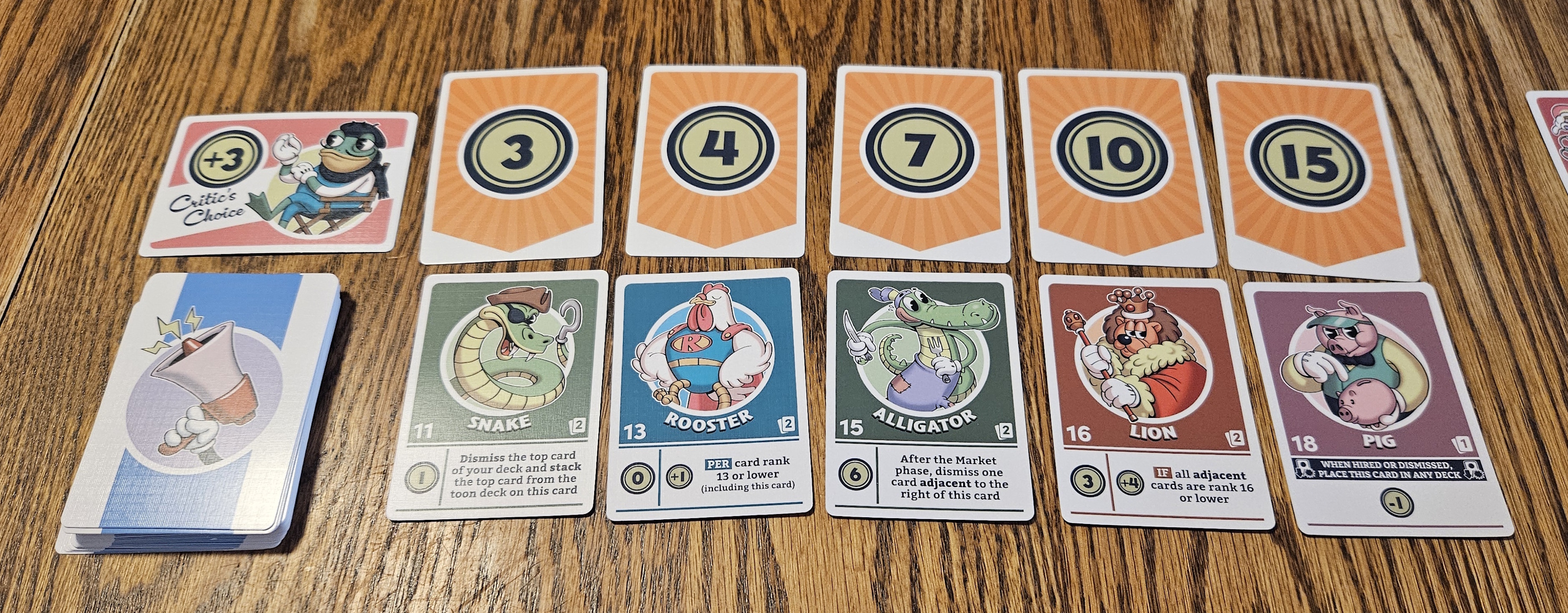
I'm not sure the snake and the alligator can be played well... then again, they're just gambling outright, which is at least fitting.

Costs are adjusted dynamically, which can result in little surprises.

Okay, not quite. Your actual goal is to score the most on the final round. Hitting a tally of thirty is how you trigger the endgame, and there’s a small plus-three advantage if you’re the one to bring it about, but that’s no guarantee luck will be on your side for the last flip. So, then: hit thirty to lock the game into one final pull of the lever, then hit the jackpot.

The slot-machine analogy is apt here. FlipToons is to deck-building what Balatro was to poker. The titular flip of FlipToons is devoid of decision points. You turn cards in order, left to right and top to bottom, until you’ve produced that three-by-two grid.

There’s more going on in the market portion, but these are minor choices rather than a vast menu. There are five cards available at any given moment, and even when you’re flush with cash in the late-game, you’re limited to two purchases. (And dismissing a card from your deck qualifies, so no double-dipping.) This keeps everyone at the table more or less bungee-corded at the hip, which is probably the right decision for such a light game, but also prevents the table from launching the exponential bottle rockets that were Balatro’s core pleasure.

But about those pleasures…

I have my reservations about these sorts of games. The art and market purchases, while pleasant, aren’t far removed from the lights, illusory choices, and “theming” of a slot machine. I remember as a kid on a trip to Vegas, walking past a slot machine that leaped out of the crowd. I think it was based on Aliens, with those sleek oily monsters I had yet to witness on the screen for myself, but which my friends with the cool parents, the ones who let their kids watch R-rated movies in elementary school, spoke of as the scariest things they’d ever seen. My Dad traced the object of my interest and leaned down to whisper, “That’s how they get you.” It was like somebody had roused me from hypnosis. In that moment, my Dad — who suddenly struck me as cooler than those other dads, or at least cannier — had broken through the social programming of that cigarette-reeking hellhole.

And, look, I don’t think FlipToons is some sort of evil artifact. It isn’t the equivalent of a casino, with its fine-tuned odds to ensure the house always wins and your kid’s college fund becomes another rounding error in a billionaire’s high score. But it produces a similar daze, all submersion and dulled perception. It’s a far cry, too, from some of the sharper auto-battler board games, titles like Tag Team, with its emphasis on attention and preemption, or One-Hit Heroes, which requires constant input from its players. Here, the gameplay comes pre-loaded. All you have to do is pull the lever.
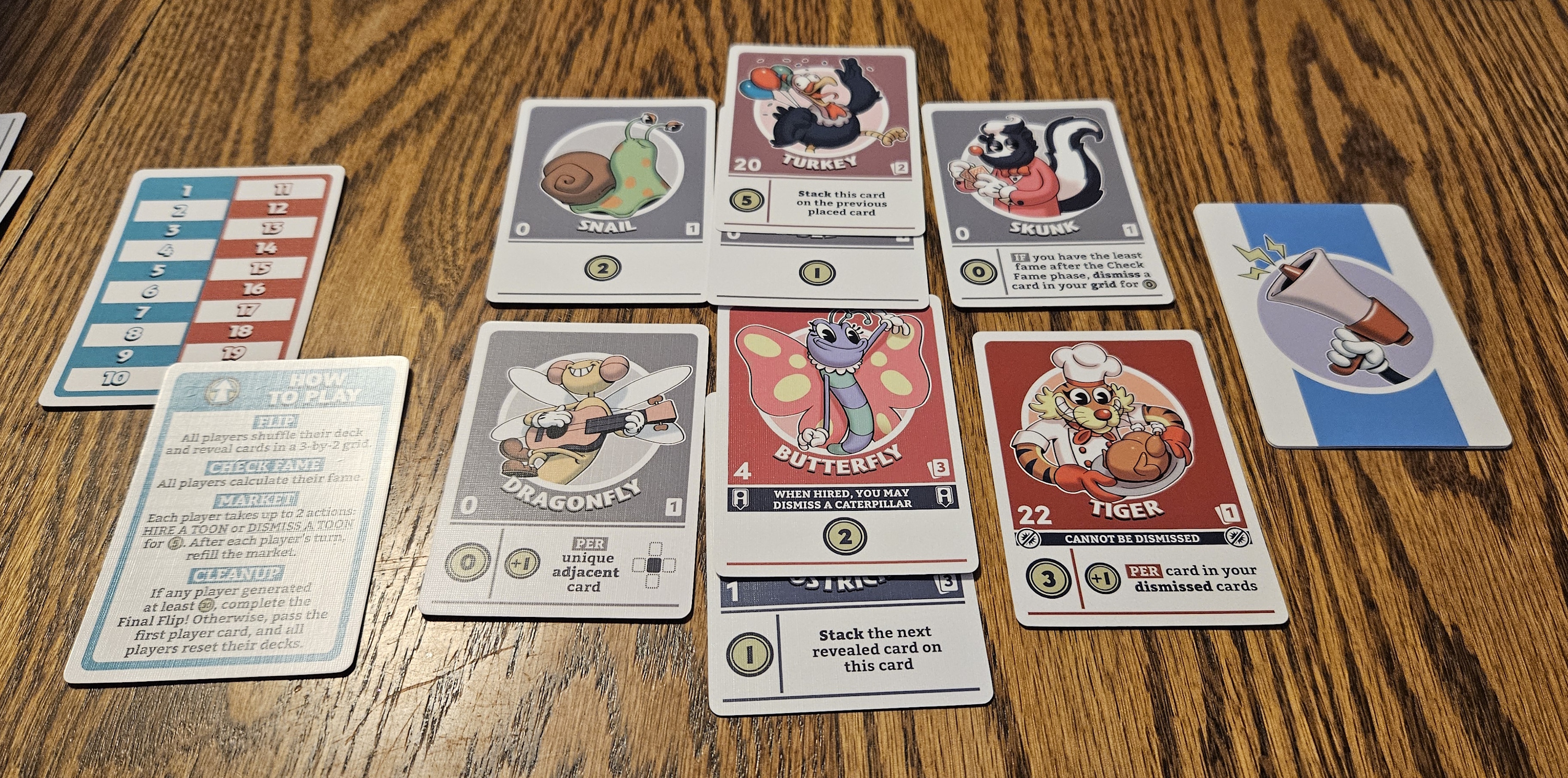
The solo mode is basically a race to hit 30 points while the game discards cards from the market. It's blindingly easy.

It doesn’t always take much effort to reach those 30 points.

I mean, there’s more to it than that. Just not by as much as I would prefer. Certainly not by enough to make me want to play it more.

Because in the end, FlipToons is a pleasant enough diversion. It’s well-crafted, pretty to look at, and feels good to play. When it hits the table, the fugue it offers is dreamy and warm. But when it’s done, I feel like I binged on steakhouse butter in place of an actual filet. It lacks what brought me to the table in the first place. It doesn’t spark my imagination or help me appreciate my friends. It doesn’t teach me anything. It barely even makes a win feel different from a loss. Most of the time, I hardly remember how I spent the past twenty minutes.

But yeah, the art is lovely. Those lovable goofballs. Those scamps. That’s how they get you.


A complimentary copy of FlipToons was provided by the publisher.

(If what I’m doing at Space-Biff! is valuable to you in some way, please consider dropping by my Patreon campaign or Ko-fi. Right now, supporters can read my first-quarter update of 2026: the best board games, movies, books, and more!)


Brine & Origami

14. April 2026 um 00:52

Make an origami of those sticky sea-things that lie on the beach, their sacs bloated and pulsing.

Sea Salt & Paper sure was hot a couple years back, huh? I didn’t think much of this thing the first time I encountered it, perhaps a symptom of having only played it with a single partner; in contrast to some, I find it needs room to stretch out. Perhaps it helps, too, that the expansions, More Salt and More Pepper, both give the game a small kick in its folded shorts.

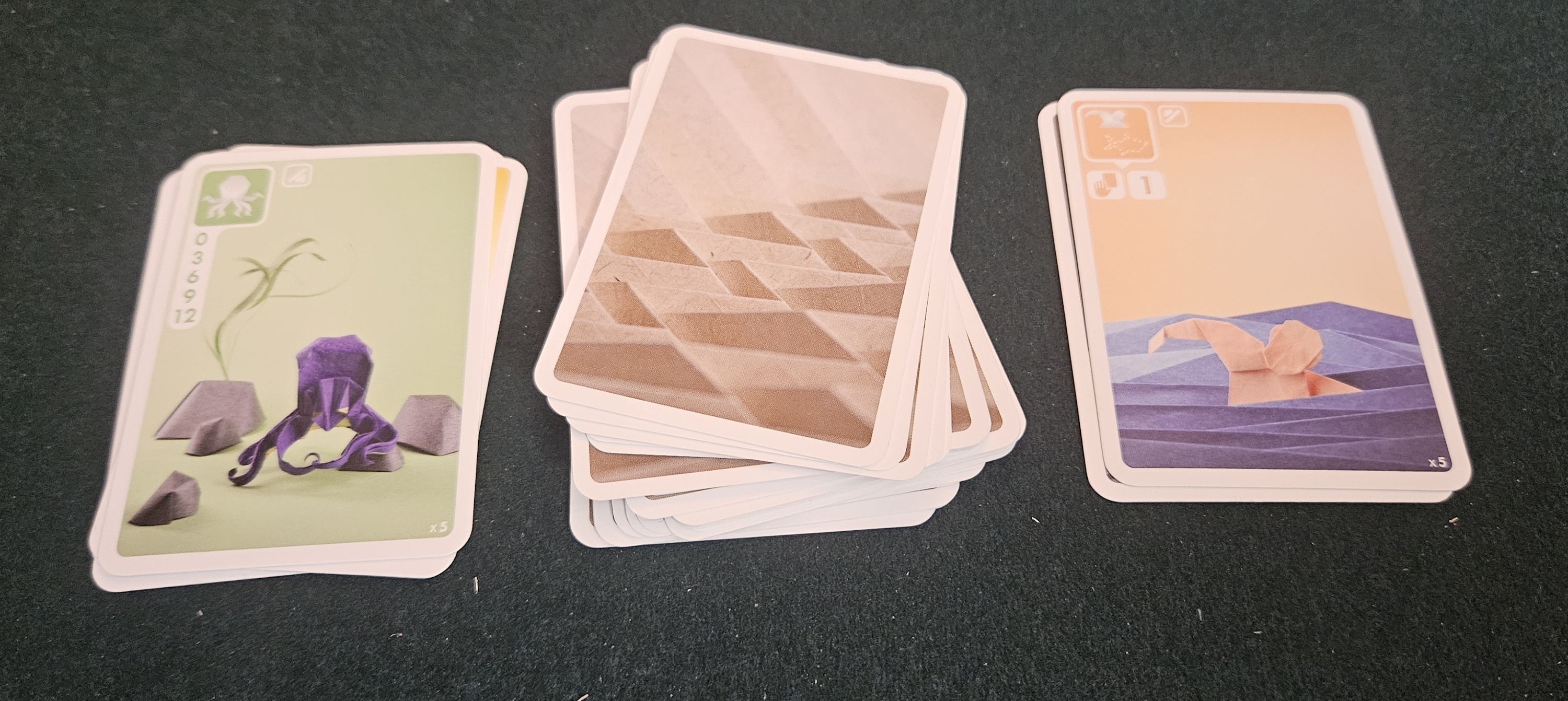
I could have tidied the piles, but this isn't that sort of game.

The basic choice: from where does one draw?

For those who haven’t played Bruno Cathala and Théo Rivière’s small-box card game, Sea Salt & Paper opens with the gentlest of all possible choices: from where to draw? Your options, in this case, are either the deck proper — in which case you’ll draw a pair, keep one, and toss the reminder into either of two discards — or the top offering from one of those castoff piles. Either way, you gain a single card.

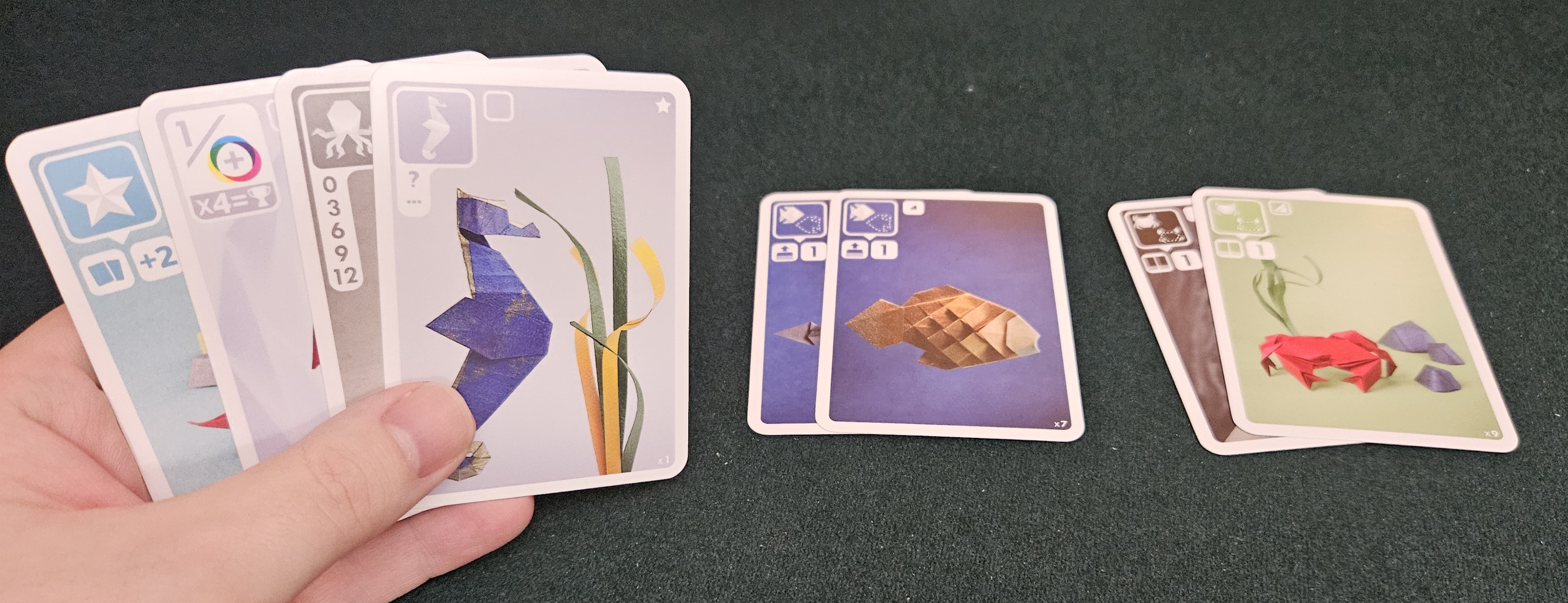
Over the course of multiple turns and multiple sessions, however, this choice begins to take on some depth. First, there’s the possibility of playing a duo. Some cards, when paired with a mate, can be deployed to the table. The pair is worth a point either way, but their coming-out provides some small benefit: crabs that let you dig through a discard pile for something previously buried, boats that start your turn anew, a shark and swimmer that swipe something precious from a rival’s hand.

But while duos are potent, there’s more to your picks than pairing cards. There’s the color of the card, entirely separate from its icon, which can amass points as you gain more of a particular hue. Or there are offerings that pose a risk, like octopuses and penguins, worth nothing at first but gradually accumulating points as you build sets — while, of course, signaling to your opponents that you’re angling for something.

Or there’s the risk of throwing away something worthwhile to the others at the table. More than once, I’ve had to take a worthless shell because Adam, who tends to sit to my left, hoards shells by default. If I throw one out, he’ll nab it for certain. And fortune favoring him, he probably already has three in hand.

This is all to say that Sea Salt & Paper is an unassuming little thing. Its choices are diminutive, but no less crucial for their stature.

Oops, I showed the seahorse twice. You'll see.

Cards in hand are hidden, but vulnerable.

Where the game gets interesting, though, is in its scoring. Played over multiple hands, the objective is to accumulate some number of points. Say, thirty points with four players. But rather than ending any given hand at a certain threshold, here players are allowed to keep playing until somebody elects to go out. And then they’re offered another little choice that bends the proceedings. They can declare the hand is over, at which point everybody scores according to what they’re holding and/or the duos they’ve revealed. Or the goer-outer can announce that they have the high score at the table and nobody can match them.

Aha! The contest is on. And the stakes are high. If the player who went out has the highest score, they earn all their points plus a color bonus, points worth the sum of their highest-held suit. That might be a lot or a little, depending on their priorities that round. Everyone else, meanwhile, earns only a color bonus. Again, that might be a tidy sum, but it will almost certainly be less than their normal score. But if the opposite holds true, the pendulum swings the other way. Everybody else scores their hand points, while the shouty player earns nothing but the color bonus.

Like everything else in Sea Salt & Paper, this decision is understated. But it represents a potentially major swing. I say “potentially” because, well, this is a game of subtle wagers and sudden swings, and it’s entirely possible for somebody to quietly amass a solid bar of colors and come out ahead either way.

This gives it a sleepy atmosphere. I might even call it boring, in a largely pleasant way, the sort of game you play with your grandmother while sharing some light chit-chat. In that regard, it reminds me of something like Mexican Train or countless trick-takers played with a regular deck. It doesn’t exactly knock me out of my socks, but it was never meant for sock-rocking. It’s there for quiet evenings on the seaside, the air heavy with the inrush of atmosphere, a storm coming but still out on the horizon. It’s a bedtime game.

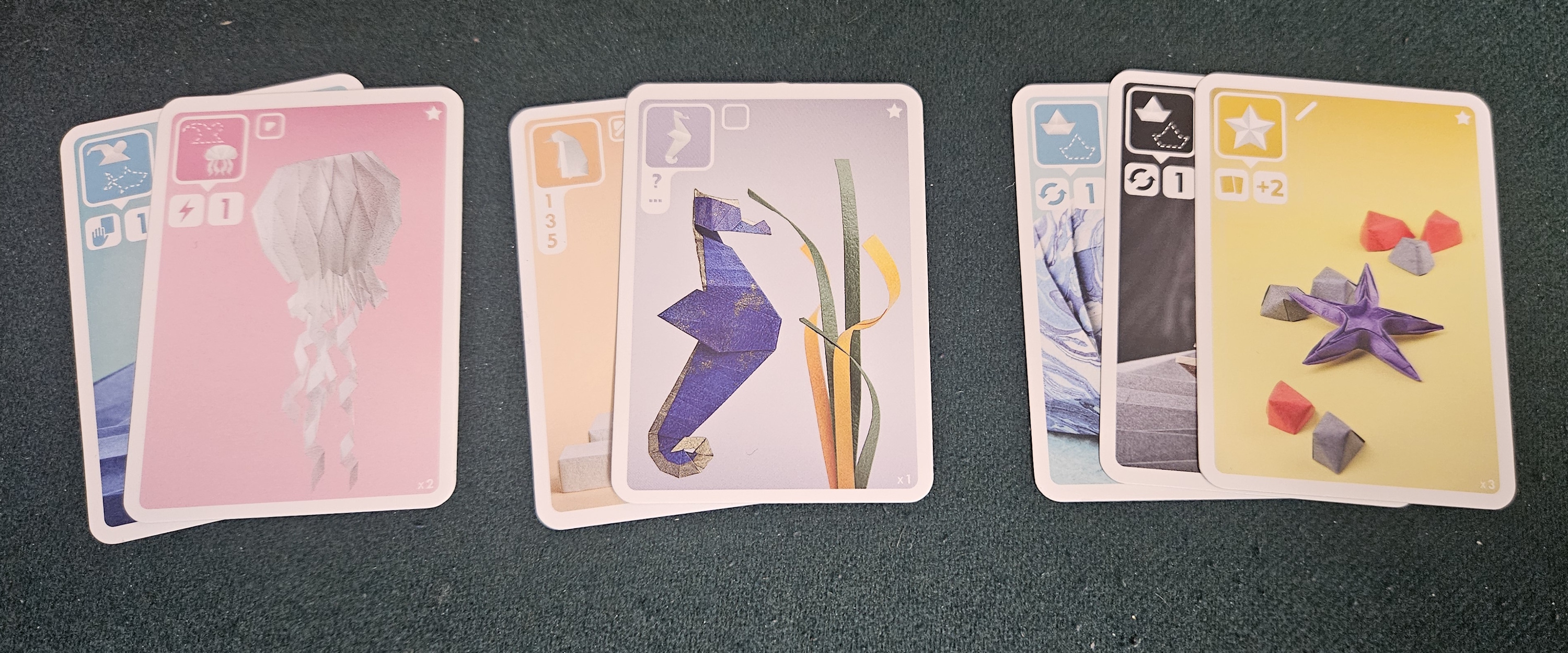
There it is. These pictures weren't even taken on the same night. I guess I just love seahorses. (True.)

Extra Salt adds a few cards.

The expansions give it some much-needed kick. The first, Extra Salt, adds only a few cards, not enough to upset the delicate ecosystem of the original game, but sufficient to add at least a few decisions. Extras like a lobster or a jellyfish pair with previously-obvious offerings to produce new effects, while a seahorse makes certain sets more worthwhile and starfish can be added to a duo to drop their ability in exchange for some extra points. The game is still sleepy, but the decision-space is a little denser.

Next is Extra Pepper, the more interesting offering. Every round, an event card is drawn that alters the proceedings. A change to how a certain set is formed, a higher scoring threshold, only needing three mermaids to win outright rather than the usual four… that sort of thing. Everybody plays according to this altered rule, but then — and this is the smart bit — then the winning or losing player receives the event card as a permanent addition to their repertoire. This varies by card, with handicaps going to trailing players and hurdles to winners. Either way, the game receives a nudge that corrects toward the median ever so slightly. Or, better yet, allows somebody to manipulate the rules in their favor by tanking an early session to nab something ultra-potent.

In both cases, the expansions benefit the core game by adding a little more to the turn-by-turn proceedings. If I had to identify an issue with the game — which, again, I’m not sure this is the sort of game that bears a deep critique — it’s that the decision-making process is so muffled. There’s a gap between good and bad play, but good and great play? Eh. I’m not convinced. To their credit, the expansions offer a few more of those small decisions that make it such a pleasant, if still sleepy, game for late nights.

Assignment: Wee Aquinas origami.

Extra Pepper is more interesting.

On the whole, Sea Salt & Paper is a game that’s nice to play with family, as a filler, or when everybody’s too tired for anything heavier. That’s a crowded field, but, well, this just so happens to be one of the games that’s succeeded in that arena. Call it the king of the sleepers. I doubt Sea Salt & Paper would even take it as an insult.


A complimentary copy of Sea Salt & Paper was provided by the publisher.

(If what I’m doing at Space-Biff! is valuable to you in some way, please consider dropping by my Patreon campaign or Ko-fi. Right now, supporters can read my first-quarter update of 2026: the best board games, movies, books, and more!)
Sejm As It Ever Was

09. April 2026 um 23:20

How I feel when I turn in an article draft to my wife.

Here’s a situation for you. It’s the last decade of the 1700s. Far across the sea, a rebellion has ousted the British from thirteen of their prize colonies, leading to the adoption of a new constitution. Revolutionary fervor is sweeping the continent, throwing France into turmoil and the old regimes into paranoia. Your union, the Polish–Lithuanian Commonwealth, has seen its star faded by entrenched nobility and foreign partition.

And now there’s an opportunity to draft a constitution of your own.

That document — historically the Constitution of 3 May 1791, although you might instead draft any number of parallel constitutions in its place — is the topic of Rex Regnat, Edward Damon’s sharp-as-a-tack title about uncomfortable politics and doomed alliances. Part trick-taker, part parliamentary simulation, and part rumination on a union whose constitution would only last 19 months before it was divided out of existence until the First World War, Rex Regnat is one of the finest political games I’ve played all year.

Hm, where is the WHINING ON 'APOLITICAL' COMEDYBRO PODCASTS issue?

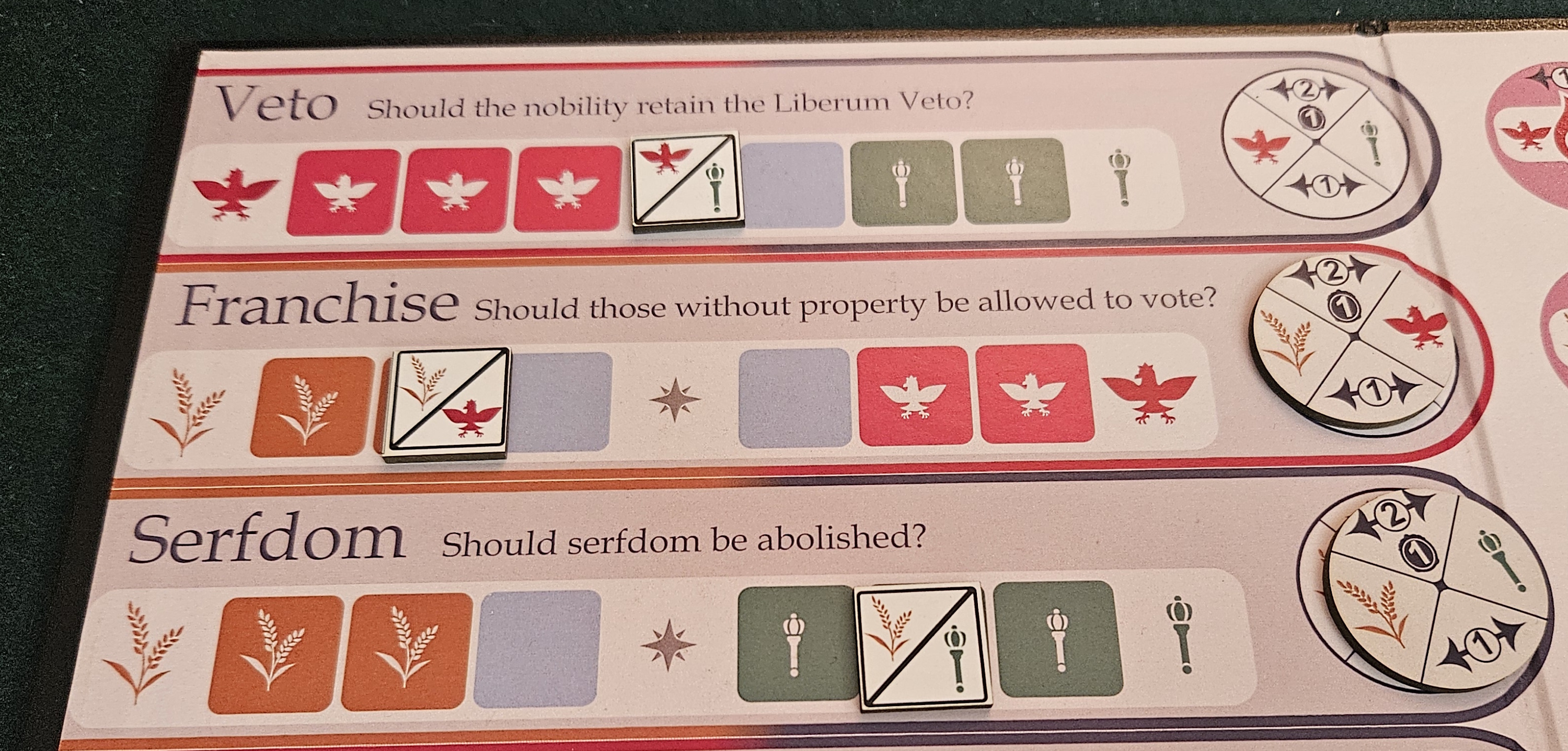
Some of the issues facing the Polish–Lithuanian Commonwealth in the late 1700s.

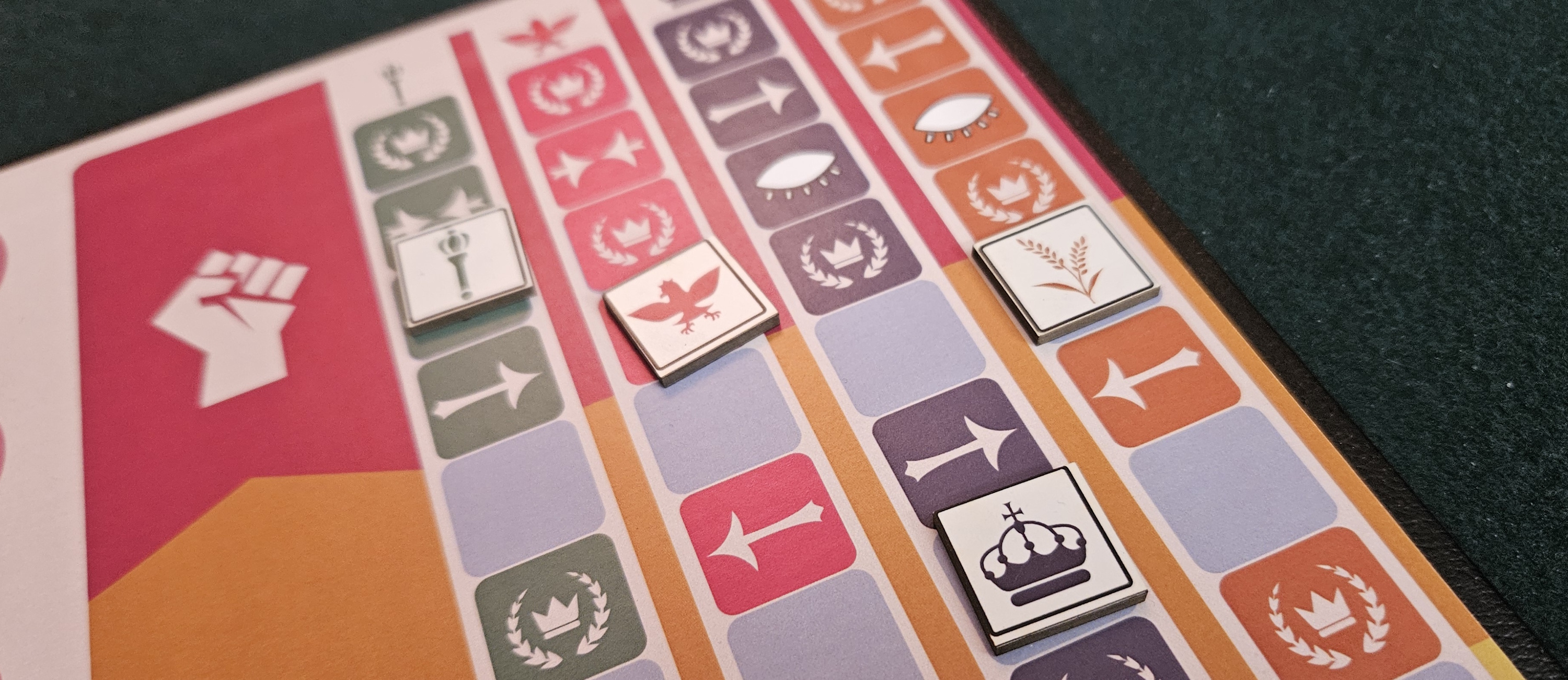
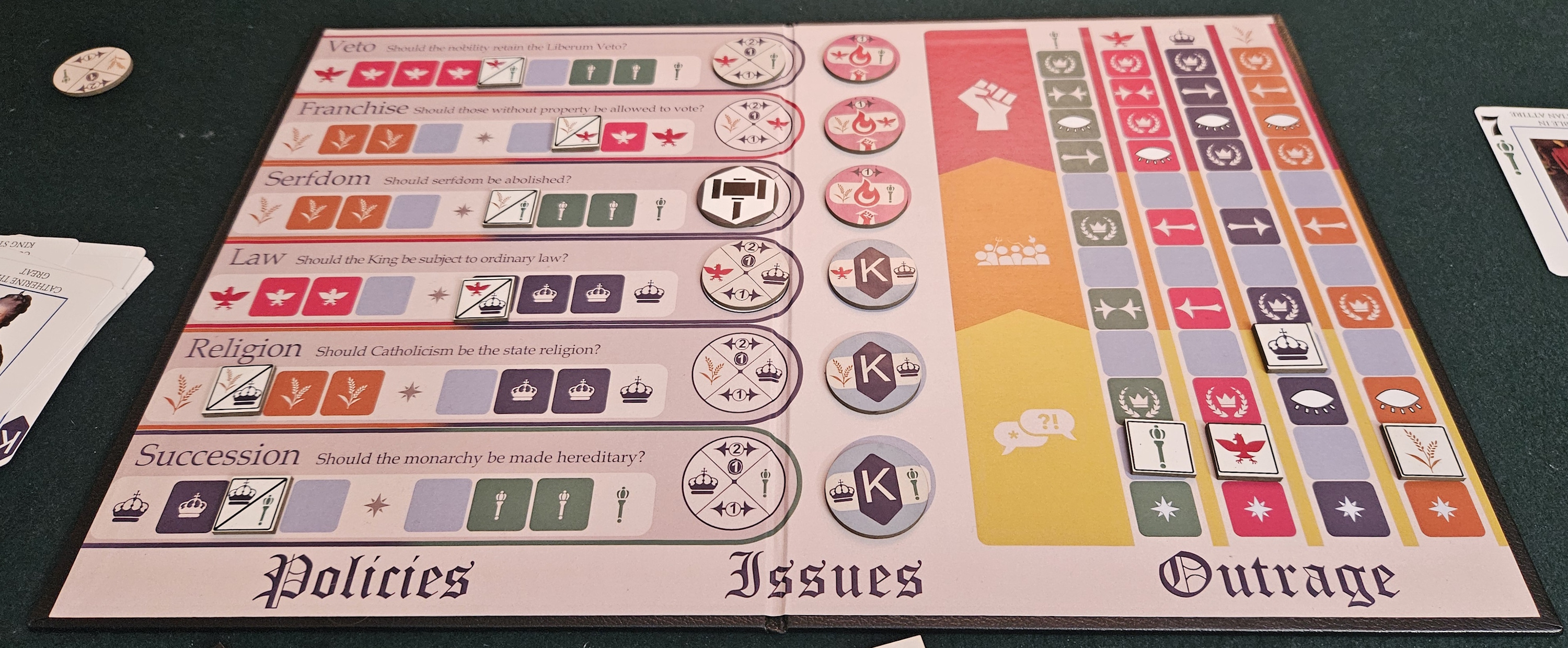
At first glance, Rex Regnat is a game about tracks. The board consists of ten of the things, six for various issues facing the assembled sejm — think “parliament” and you’ll be close enough — and another four for the agitation taking place across Polish–Lithuanian society during the drafting of its constitution.

For the most part, those issues should be familiar to passing students of history. They raise questions about who should be allowed to vote, the status of serfdom, Catholicism as a state religion, and whether the king should be subject to common law. Boilerplate stuff for the Age of Revolution. The two remaining issues are harder to peg without some understanding of this peculiar union’s context. First is the Liberum Veto. This bad boy allowed any deputy of the sejm to nullify the entire legislative proceedings, a terrible idea even in peacetime, but a downright suicidal one when neighboring titans like Russia and Brandenburg could bribe any old noble to veto any reform that might impede their foreign agenda. Next is the hereditary nature of the monarchy. That only makes sense when you realize that kings were elected — and, as a result, tended to function as a stump for their noble electors.

Okay, so the basics are easy enough to understand. You’re one of the factions hoping to mold the constitution to your liking. Handily, the tracks label your intentions. The Regime — which means the nobility and its sway over the monarchy more than the king himself — wants to further entrench their privileges, placing their icons on the right side of the three tracks they care most about. But this can prove slightly deceiving. As those currently hoarding the lion’s share of their country’s power, the Regime would also be content to allow affairs to remain as they already are. Thus they score points for securing their privileges, but also for keeping those tracks — all six of them this time — firmly seated in the middle. This marks them as right-wingers and centrists at the same time. Which is always the case, deep down, but the phenomenon is especially pronounced here.

Opposite the Regime is Reform. This faction wants a constitution that will bring the Commonwealth into the modern world. The Liberum Veto? Out. Serfdom? Out. Total enfranchisement? Hold on a minute. The Reformers aren’t insane. Incremental change, that’s the path forward. Maybe, and this is a maybe here, Reform could grant a few cities free status. Just to prevent the troubles in France from happening here, you understand. But beyond that? Let’s not lose our shirts.

If you’ve ever studied a revolution, you can probably already see the hairline fractures forming at the foundation. Rex Regnat can be played with two players. In such an event, Regime and Reform are the principal actors. But as an experience, Rex Regnat shines with four. That’s because there are two more factions to consider. As ideologies, their role was limited in the historical sejm that oversaw the declining years of the Commonwealth. But they existed, they agitated for their own alterations to Polish–Lithuanian governance, and they played a crucial role, as radicals always do, in popularizing which issues can be discussed in the first place.

I'm outraged that the chits are off-center. But that's my outrage for every game with chits.

Society’s many outraged sectors.

These factions, then, are even further to the right and left than the mainstays. First we have the Radicals, also known as Reform on steroids. Whatever Reform wants, the Radicals want double. Whatever Reform is hesitant to grant, the Radicals are ready to throw a Parisian Moveable Feast to take for themselves. But then there’s their opposite number, Reaction. Think of them as the incel podcasters of the 18th century. They want a stronger monarchy, an empowered military, maybe an alliance with those treaty-breaking Prussians next door. If this should spell annexation… well, reactionary movements have never been especially good at thinking long-term.

Now, you might be thinking that I’m spending a lot of time discussing tracks and factions. True enough. But these dynamics are at the heart of Rex Regnat. Reform and the Radicals, Regime and Reaction; these are the natural alliances, albeit uncomfortable and shoehorned alliances, that dominate the table. They’re Rex Regnat’s version of the Communists, Socialists, and Anarchists from Alex Knight’s Land and Freedom, or the awkward three-way race that defines Mark Herman’s Churchill, or the squabbling powers of Herman and Geoff Engelstein’s Versailles 1919. These comparisons are not ones I invoke lightly. Rex Regnat resembles those games not only because they’re all games with tracks, but also because it intends to put players in the same diplomatic headspace. It’s about trading favors, talking your friends into doing things that benefit you just a little bit more than they benefit them, and maybe, in the end, risking everything on a coup de grace that’s really just a literal coup.

Which is why the tracks are important, but not all-important. Each faction has other aims to consider. The Regime derives most of their points from the tracks, which makes sense, given how badly they want things to remain the same. But they also care about tamping down societal agitation and keeping control of the gavel, the marker that dictates who picks the issue up for debate. Reform, meanwhile, is happy to be included at all, so any issue they win becomes political currency, even those that have nothing to do with them.

The Radicals and Reaction go further, as befits their status as outsiders determined to get a foot in the door. If the Radicals don’t get their way, they can instead foment outrage, possibly leveraging the upset of the people to seize control outright. Reaction, meanwhile, alters its objectives ever so slightly between rounds. In the first half, Reaction wants as many cabinet positions as possible. They’re infiltrating offices. Securing funding. Finding their audience. In the second half, they want to push those outrage tracks up as far as possible. Suddenly, their interests are aligned with the Radicals, but only in the sense that they want a riled-up population. They’re here to co-opt everybody’s justified anger for their own purposes.

ah yeah, it's red robe guy

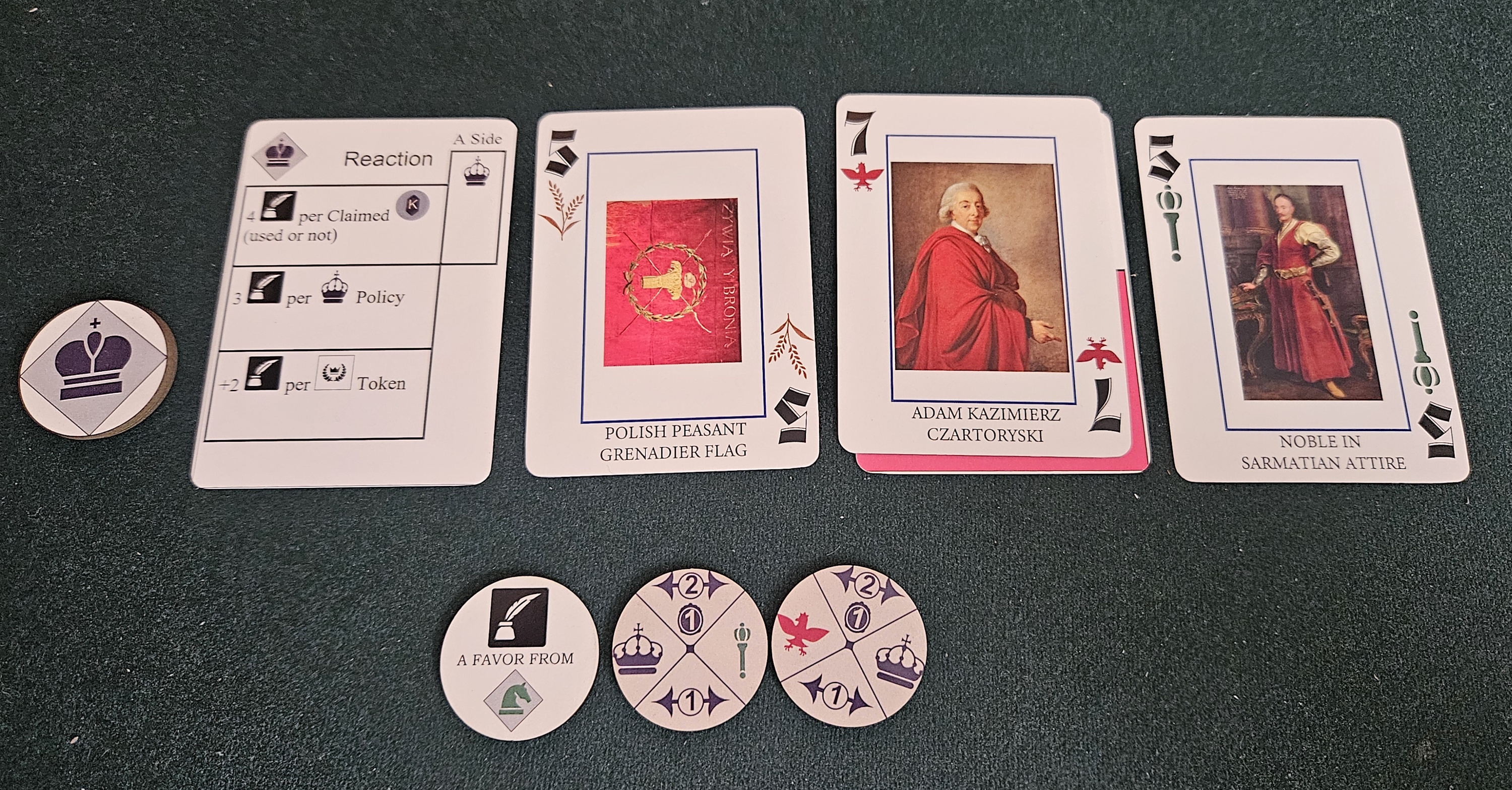
Only the cards on your bench can be played into a trick.

Just as those other political titles I mentioned had their own methods for resolving the debates and issues of the day, Rex Regnat finds its footing in the most expected of places… because, yes, this is a trick-taking game. Another trick-taking game. All I play anymore is trick-taking games.

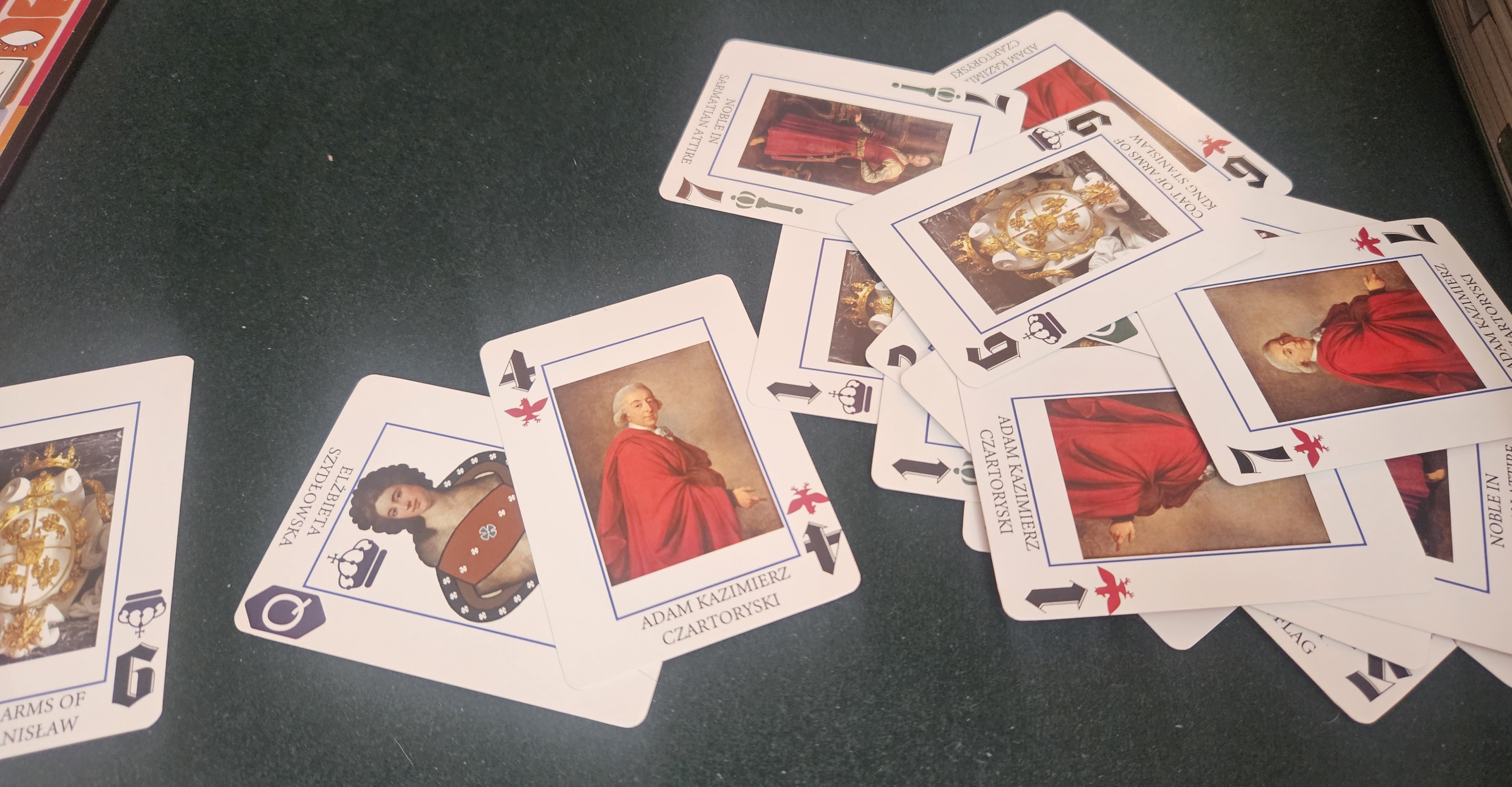
But while Rex Regnat is a trick-taker, it’s quite unlike its peers. The first and most visible difference is that each player always has three face-up cards. This is their “bench,” and these are the only cards they can play into any given trick. Right away, this has a few consequences. The first is that there’s a great deal of manipulation to the proceedings. If I see that you have the highest-ranked card in a particular suit, I’m not likely to initiate a debate over an issue in that suit. Unless, that is, we can come to an agreement.

Or unless I want you to win that issue. First of all, it’s entirely possible to force an opponent to shed a powerful card on an issue that doesn’t really benefit them right now. If you’ve already secured Catholicism as our state religion, letting you expend your strongest card to thump the table about God and Country is a boon that keeps on giving. Go ahead. I don’t mind. Shout about our duty to Christendom. Tell it to the rafters.

But more than that, there are plenty of little overlaps in the scoring conditions, and not only between natural allies. Needling the Regime into stripping the Radicals of an outrage issue is valuable even if it doesn’t benefit me directly. All the better if I can force you to burn a potent card and deprive a leading opponent of their strongest source of points.

But even more than that, precise rankings matter in Rex Regnat. The winner takes and resolves the issue, the natural outcome of any debate. Last place earns the gavel, their backroom politicking letting them dictate the future issue under discussion. But second and third place also get their say, shifting the suit of their played card up on the outrage track. Depending on the sequence — which, again, is often manipulable thanks to the face-up cards on everyone’s bench — it’s possible to ensure that you shift such a track at the precise moment it will confer some advantage. Such as, say, an influence token, worth points to all factions. Or a token that will conceal one of my bench cards, making it all the harder to guess at my next move. Or a shift on an issue track that isn’t directly tied to a debate. No matter the precise debate being undertaken right now, there’s always some way to get ahead.

The result is a form of trick-taking that’s played openly (most of the time) and allows for an unusual degree of control (again, most of the time) and encourages the aforementioned horse-trading and wheedling. While many of the genre’s touchstones are present and accounted for, trump suits and sloughing and tactical tiebreakers, they tend to fade into the backdrop of the game’s politics. Your bench is a set of cards, but it’s also the dignitaries and arguments your faction has ready right now. Your hand becomes blackmail and backrooms deals and side hustles, almost ready for the oven but in need of a bit more leavening. Even smaller incentives, like the royal offices that transform ordinary cards into kings, become opportunities to flex your political clout.

as you can see, red robe guy is a favorite around here

When discards go bad.

I have a great deal of affection for games that use abstraction to speak a deeper truth about the topic they present. I’ve already mentioned a few of them. In Land and Freedom, Alex Knight compressed a complex and drawn-out civil war to a few fronts, some negotiable values, and the squabbles and purges between three factions that couldn’t set aside their differences to save their lives. The result was a game about the shortcomings of revolution and democracy. Churchill’s military fronts were also tracks, linear near-inevitabilities that assume the Axis will collapse, but it’s anybody’s guess who will inherit the world; the outcome was an examination of the war-behind-the-war that produced the remainder of the 20th century. High Treason established its courtroom drama as a series of icons that might or might not be worthwhile, their relative value always slightly out of reach. Justice, Alex Berry argued, was a matter of guesswork and who was seated in the jury box.

With Rex Regnat, Damon pulls a similar trick. Rex Regnat reveals a political system in the throes of reform, but one that might have shambled along for too many decades to carve out a future for itself. Is it possible to pull back from the brink of a monied class that believes its only hope of holding onto its privileges is denying them to anyone else, from electoral power that excludes those it deems too ill-mannered, from foreign interests that incite violence rather than stability? God, I hope so.

That Damon does this without presenting a single map is nothing to sneeze at. Rex Regnat includes design notes, but fewer players will read them than the rules. In place of textual rhetoric, Damon instead has to leverage smaller touches: considered victory conditions, the placement of icons on tracks, an ideological impression rather than a dramatis personae or timeline of events.

I daresay it works, at least in the broad strokes. As a springboard to learning about the Polish–Lithuanian Commonwealth’s final decade, there are none better. Crud, half the people I’ve introduced the game to weren’t even aware that the Polish–Lithuanian Commonwealth existed, let alone that it attempted a series of radical reforms in its final months.

Outrageous! Ahem. Sorry, but I've just written 2000+ words about this game. You'll excuse me for not having another good alt-text.

Taking in the big picture.

But attempt it did, and succeed it did, at least for a time. The 1791 Constitution didn’t last, but it became a model. For the Poland that would recover its independence 123 years later, it became a model of their enduring identity; for the coming constitutions that weren’t throttled in their cradles, it became a model of possibility. In capturing the dynamics of its fraught composition, Rex Regnat offers one of the finest works of abstract ludic history I’ve played in a long while.


I’m adding a note here just in case somebody actually wants to buy this thing, because it’s hard to acquire: you need to go to the Damonic Designs website and email him, at which point he will offer to sell and ship you the game. Yes, this is convoluted.

A complimentary copy of Rex Regnat was provided by the designer.

(If what I’m doing at Space-Biff! is valuable to you in some way, please consider dropping by my Patreon campaign or Ko-fi. Right now, supporters can read my first-quarter update of 2026: the best board games, movies, books, and more!)
Wagering Everything on Bronto

09. April 2026 um 02:36

These are civilized thunder lizards, they would never consume one another mid-race. But you can tell they're thinking about it.

Are wacky races the new zombies of board games? Probably not, but it strikes me as wild that I’ve played four distinct wacky race games within the span of a single year, yet nobody within my circle agrees on which one is the forerunner. Dino Racer, the third of those four, was designed by Marceline Leiman, who gave us the lovely High Tide and Nebular Colors (née Heavenly Bodies). This time, the racers aren’t hot dog mascots or magical athletes. I think you can guess what they are.

(They’re dinosaurs.)

STEGGY. STEGGY. STEGGY.

And down the stretch they come!

When we first played Dino Racer, the whole thing seemed broken. Thanks to a small rules error, the outcome of the races was all but foreordained, the wagers were obvious, and not even Eric Hibbeler’s charming dinosaur portraits could do much to make up the gap.

Okay, so maybe it wasn’t such a “small” error on my part. But the point stands. Even something as minute as reshuffling the deck in between matches, rather than letting it run its course and thus tweak the odds from race to race, was enough to scuttle this one. Fortunately, the right rules transform it into a zany good time — albeit one that might prove too light for some enthusiasts.

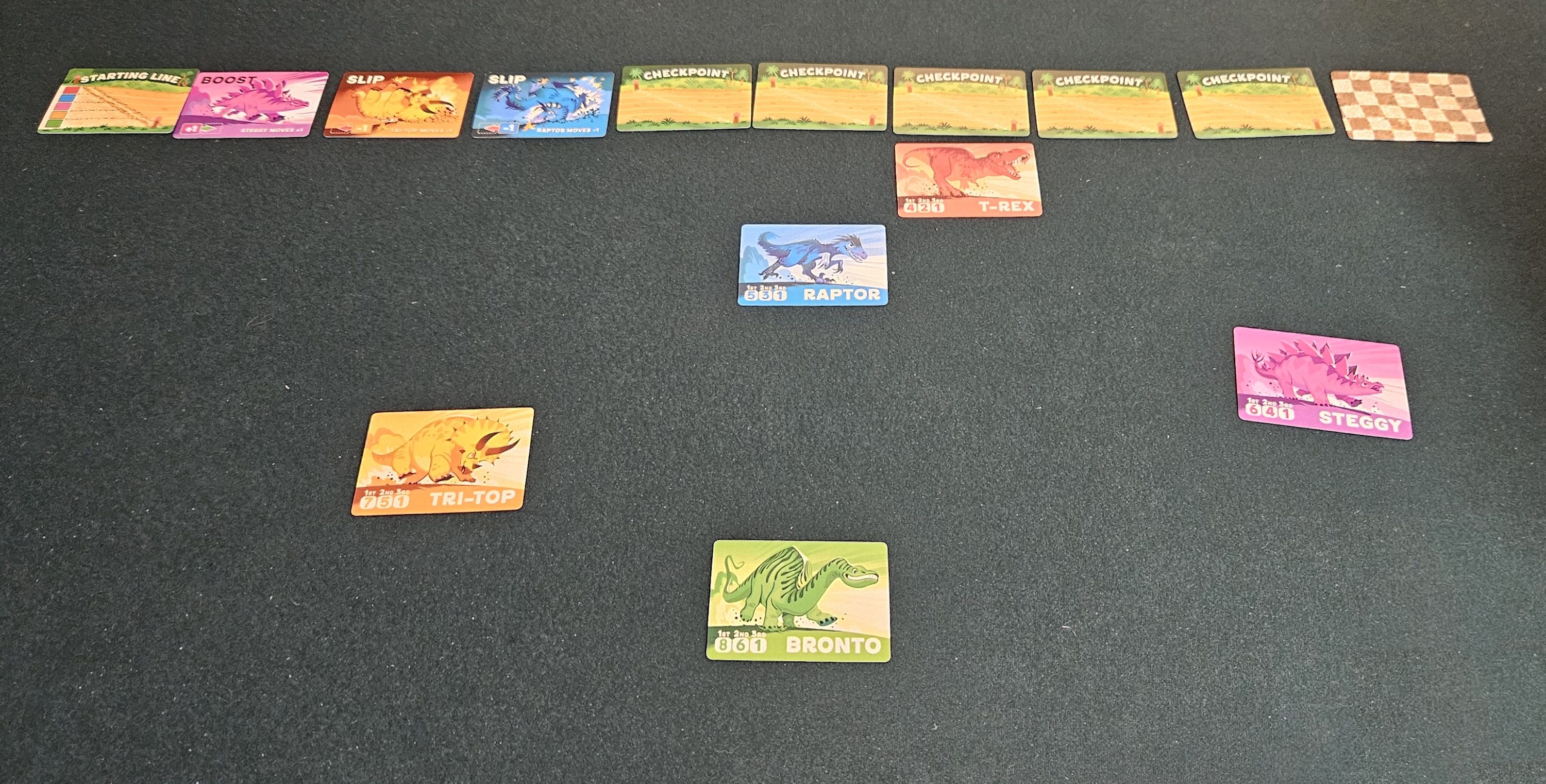
At the outset, Dino Racer seems like as much a spectator sport as its peers in the wacky race club. When the round begins, five dinosaurs stand hip to hip at the starting line. T-Rex has the best stamina, with diminishing probabilities of success for Raptor, Steggy, Tri-Top and Bronto. These odds are represented by each dino’s quantity of cards in the deck, not to mention their relative tiebreaker positions, but they’re close enough that the outcome isn’t wholly set in stone. T-Rex has one more card than Raptor; Raptor has one more than Steggy; and so on down the line. It’s enough to give some dinosaurs a statistical advantage, but such a slender one that upsets aren’t outside the realm of possibility.

The race itself is resolved in much the same manner as those in Jon Perry’s Hot Streak. Somebody picks up the deck, flips a card, and moves the corresponding dino one space closer to the finish line. Some of that game’s possibilities are left by the wayside; there are no trips or reversals, just a steady forward momentum.

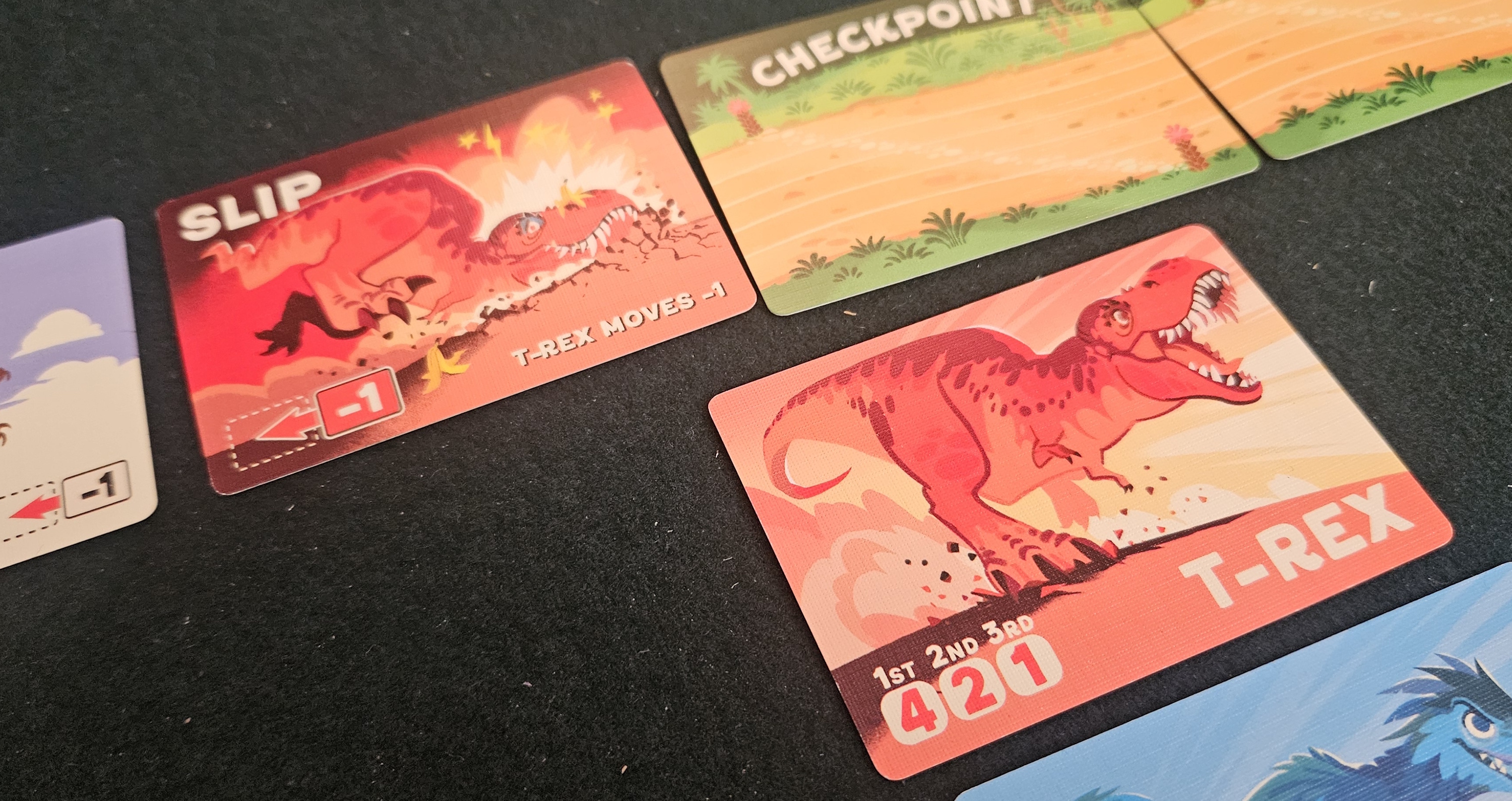
For the most part, anyway. As soon as every dino has reached a column, the checkpoint card at the top of the track gets flipped over. These might produce new opportunities, such as a burst of speed for Steggy, a sudden stumble for Raptor, or a swap between the racers in first and fifth place. What initially seemed like a straightforward foot-race becomes… well, still a straightforward foot race, but one in which the racers’ fortunes are much tightly corded than they previously appeared.

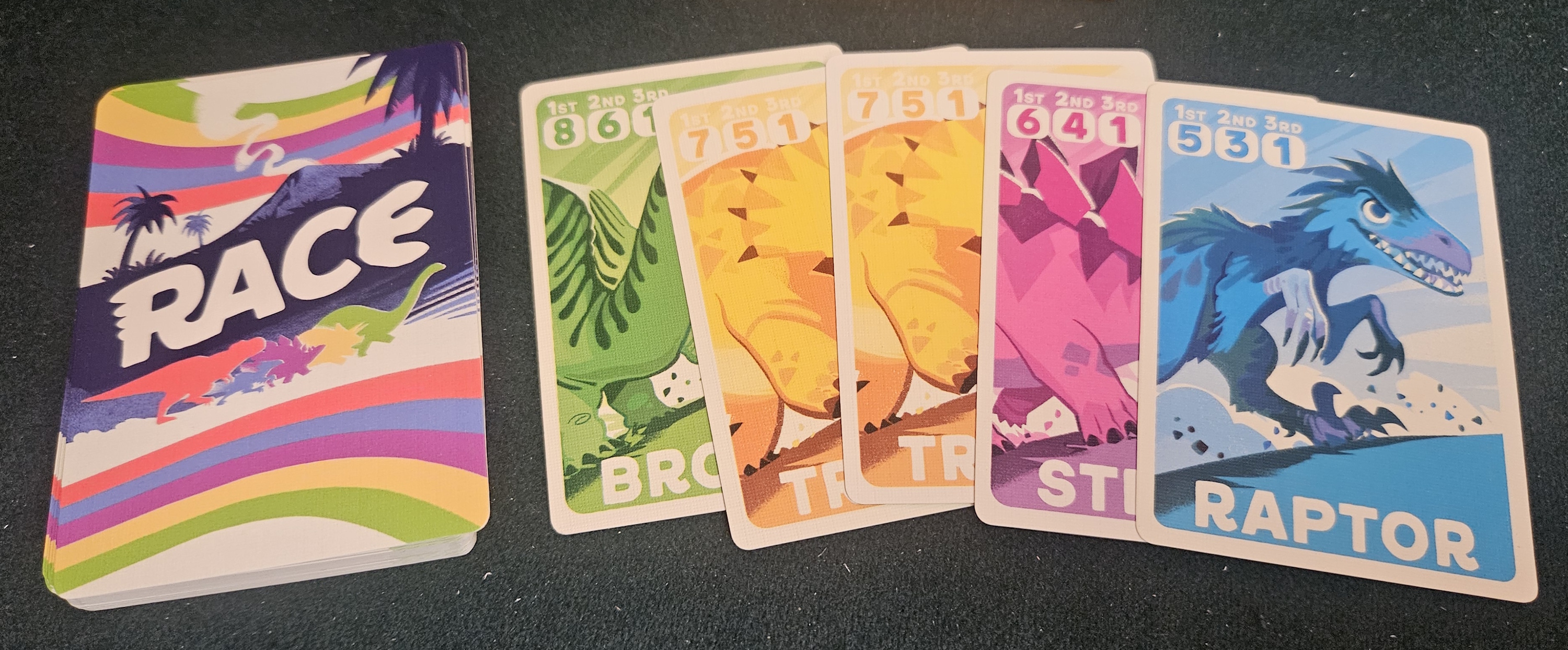
The game’s bigger revelation is that it isn’t a spectator sport at all. Unlike Magical Athlete and Hot Streak, where the bulk of the decision-making occurs before the firing shot, players in Dino Racer are active participants the entire way through. As soon as a certain number of cards have been flipped, the proceedings pause while players take turns selecting from those same cards.

I would call this system Knizian, but I think we've reached the point where that could get me burnt at the stake for blasphemy.

The cards govern both the race and its wagers.

These are the game’s wagers, and they’re informed enough to make smart decisions, but not so settled that you don’t run the risk of losing everything when a loser sprints to the head of the pack. Every detail becomes important. The relative standings between dinos. The cards they’ve burned in previous races. The stronger payouts for less-favored runners. Even the number of remaining checkpoints that are likely to throw the race into disarray. For all that, the way Leiman keeps these decisions constrained to only a few cards — one more than the number of players in the game — prevents anyone from fretting too hard over which dino to pick. It’s possible to play well, but we’re talking about play in aggregate more than turning players into Jurassic match-fixers.

It’s a real holler. Literally. I’ve watched crowds of staid players transform into screamers, bellowing at Steggy to pick up the pace or cheering as another Bronto card flips from the deck. My daughters complained that some of our guests were keeping them up at night; the game under consideration was Dino Racer. A week later, my kiddos gave it a try and screeched like banshees when their favored T-Rex cratered on his snout.

Is it a perfect game? Oh, I have no idea. I’m hesitant to do a compare-and-contrast to its peers. My wife has informed me in no uncertain terms that it’s better than Magical Athlete, which initially struck me as bananas, but I could see preferring it to Hot Streak, which sometimes I favor over Magical Athlete, so at this point it’s all one ouroboros biting precious calories from its own tail.

Because the thing is, these games aren’t actually all that similar. Hot Streak is about obsessive gambling and manipulating the odds. Magical Athlete is about the draft and rolling with the punches. Dino Racer, by contrast, is about placing smart bets, but not especially difficult bets. It’s the lightest of the trio, rules-wise. My kids, aged twelve and six, can play without worrying about special abilities, but there’s still enough for the adults to think about that nobody is getting bored.

It helps, too, that it’s so fast. There’s always something to be said for games that don’t overstay their welcome, and Dino Racer is downright skittish in that regard. Twenty minutes and it’s done. Even if I weren’t in the mood to watch a tableful of people scream at a Triceratops to pick up the pace, it would be over before the headache could form. I don’t even mean that as faint praise. Just, where a session of Magical Athlete means settling in for a while, possibly even a long while if the players settle into a feedback loop, I know what to expect from Dino Racer.

Screaming. That’s what I expect. Provided you get the rules right. Which shouldn’t be a problem, darn it, so I’m not sure why it was that one night. Done right, this game is worth every decibel. It’s cute, it’s fast, and it provides more meat than it might seem from a distance. That’s all good stuff.

UH OH IS THIS GAME POLITICAL (yes)

May it ever be thus to tyrants.

In the end, Dino Racer is about the highest volume one could pack into such a small box, plus a lovely addition to the expanding roster of wacky race games. It displays Leiman in yet another register, all shouts and immediacy, a far cry from the more intimate pleasures of High Tide or Nebular Colors, and even more finely tuned. Just writing about it makes me want to put it on the table all over again. I hope to do so with some regularity.


A complimentary copy of Dino Racer was provided by the designer.

(If what I’m doing at Space-Biff! is valuable to you in some way, please consider dropping by my Patreon campaign or Ko-fi. Right now, supporters can read my first-quarter update of 2026: the best board games, movies, books, and more!)
Business Bazongas

07. April 2026 um 00:56

bring on the Puritans, I say

I like weird games (derogatory) almost as much as I like weird games (complimentary).

Belinda’s Big Bonus is a weird game (weird).

Having your game designed by Amabel Holland sets certain expectations, despite any difficulties in pinning her down to a single genre or register. Similarly, basing a game on an erotic novel series, in this case Belinda Blinked by Rocky Flintstone, also sets certain expectations. Yet Belinda’s Big Bonus isn’t especially erotic. I wouldn’t call it funny, either, although it’s possible I’m just not in on the joke. Neither does it strike me as “so bad it’s good.” Mostly, it’s twice as complicated as one would expect from a licensed game. It reminds me of nothing so much as one of those business guys whose entire life is conducted through Google Calendar invites.

Trekking the World, Third Edition

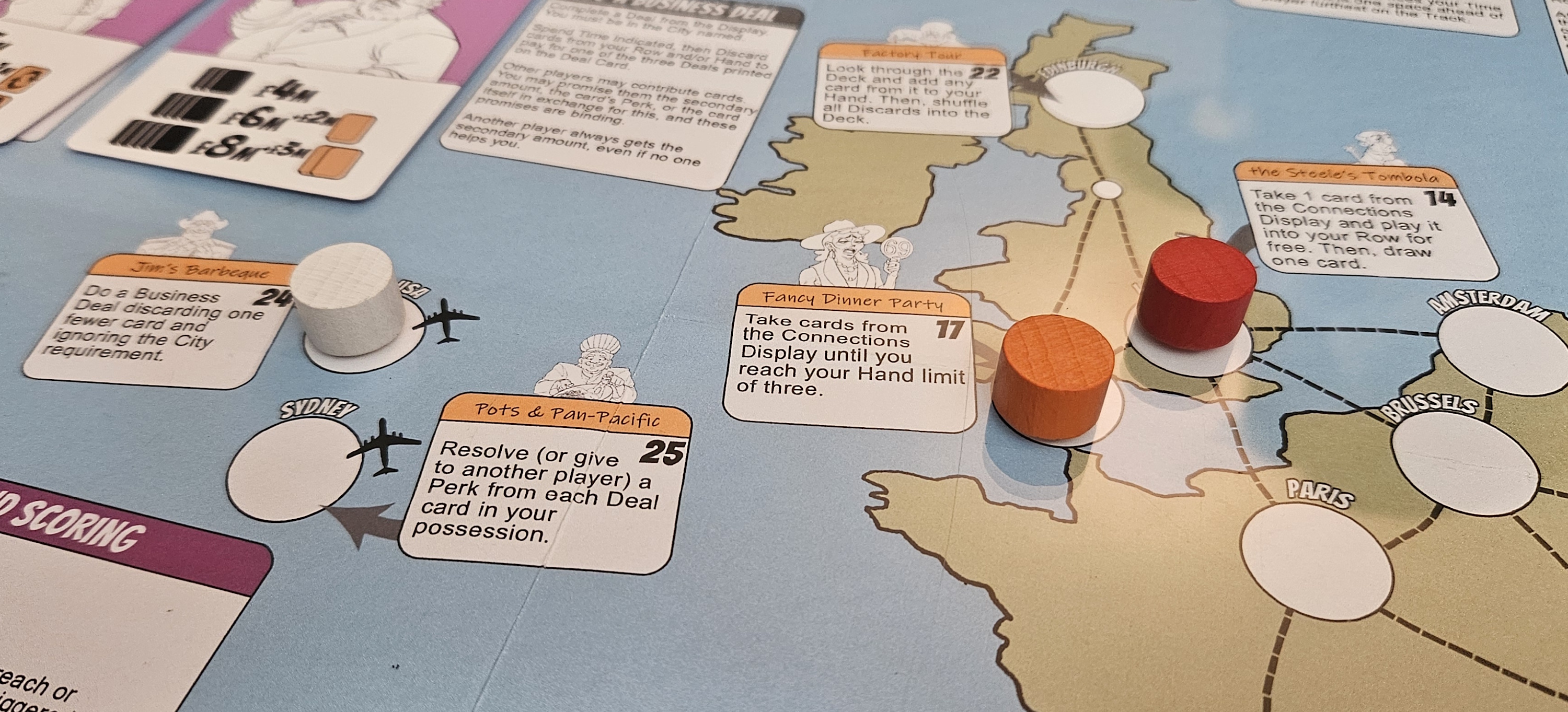
There is travel, but this is not a travel game.

First of all, we should open with a disclaimer. I know very little about Belinda Blinked. I considered reading the first one as research for this review — “research,” I say — but decided against it. Sometimes knowing less is knowing more. That’s our motto here in the United States. It’s written on our dollars and everything. While scant few people are going to play this thing sans foreknowledge, I happen to be one of them, and if there’s any one quality a critic requires, it’s the resolute belief that one’s experiences are valid no matter how uninformed. Here I stand.

Which is to say, perhaps Belinda Blinked is about managing one’s schedule, suffering from jet-lag, and mixing up which actions cost which payment. Maybe. In which case, may I offer my deepest apologies to Holland, Flintstone, and Belinda herself. Forgive this prude, for he knows not what he do.

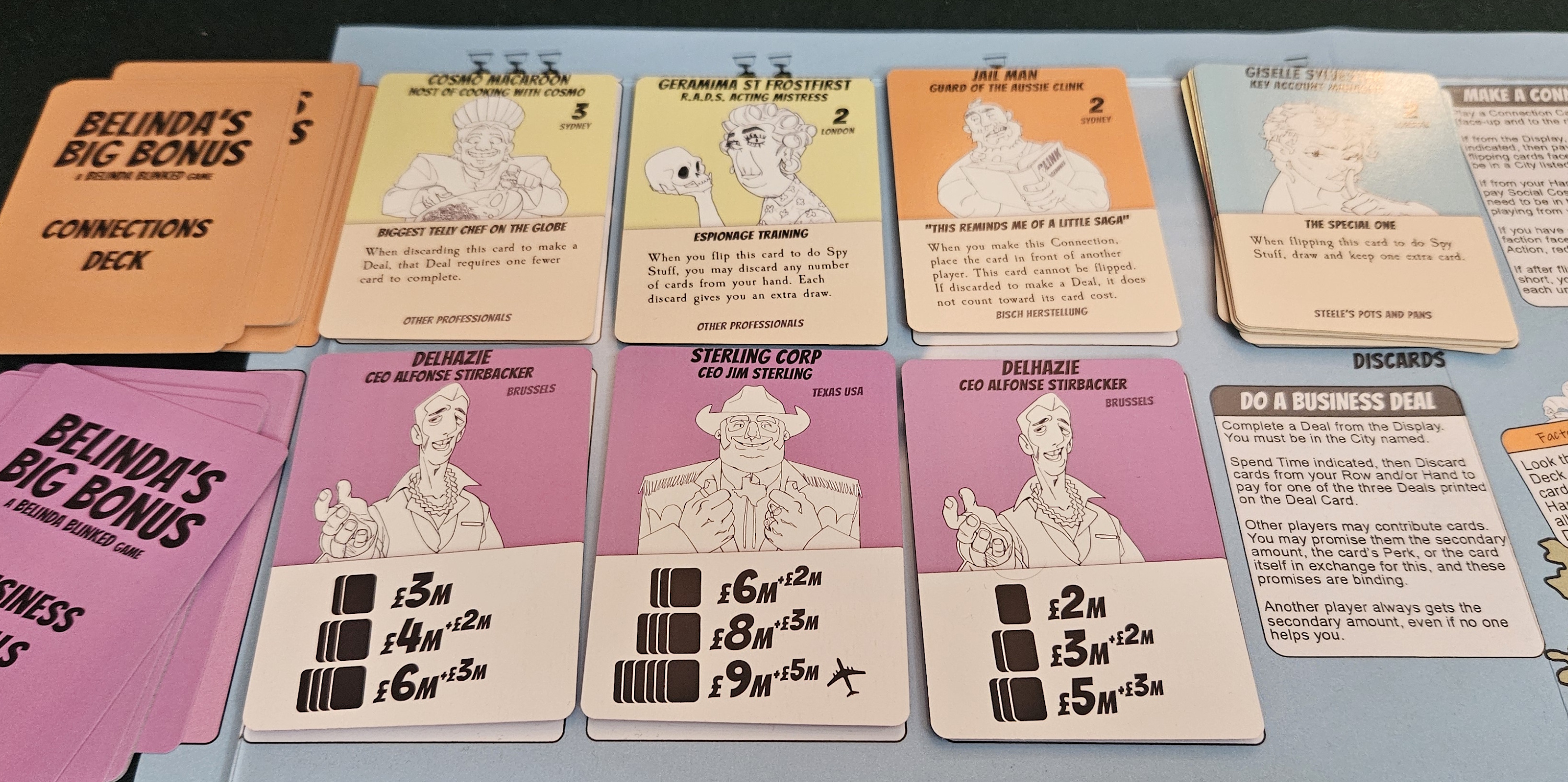
At the game’s outset, players step into the not-yet-broken-in business shoes of interns at Steele’s Pots and Pans. Their task is to earn some millions of pounds for the company. They do this by…

Look, this is the first problem with Belinda’s Big Bonus, and it’s a doozy. As any gaming evangelical knows, it’s hard enough describing a board game to newcomers, and Belinda’s Big Bonus is no board game for newcomers. There are mechanisms aplenty in this trunk, packed together like someone mixed the first-aid kit with the snack bag. There’s a calendar timekeeping system, the kind popularized by Martin Wallace titles, and cards that may exist either in a market, your hand, or a tableau, with interactions dependent on their current source — except sometimes they can be spent from two of those places, and the rulebook is conversational and, although it’s amusing, this doesn’t lend itself to learning the damn thing.

In a dim room somewhere, Martin Wallace nods thoughtfully. He saw this coming. He wanted this to come. Even now, he is thinking about the double entendre of "wanting this to come."

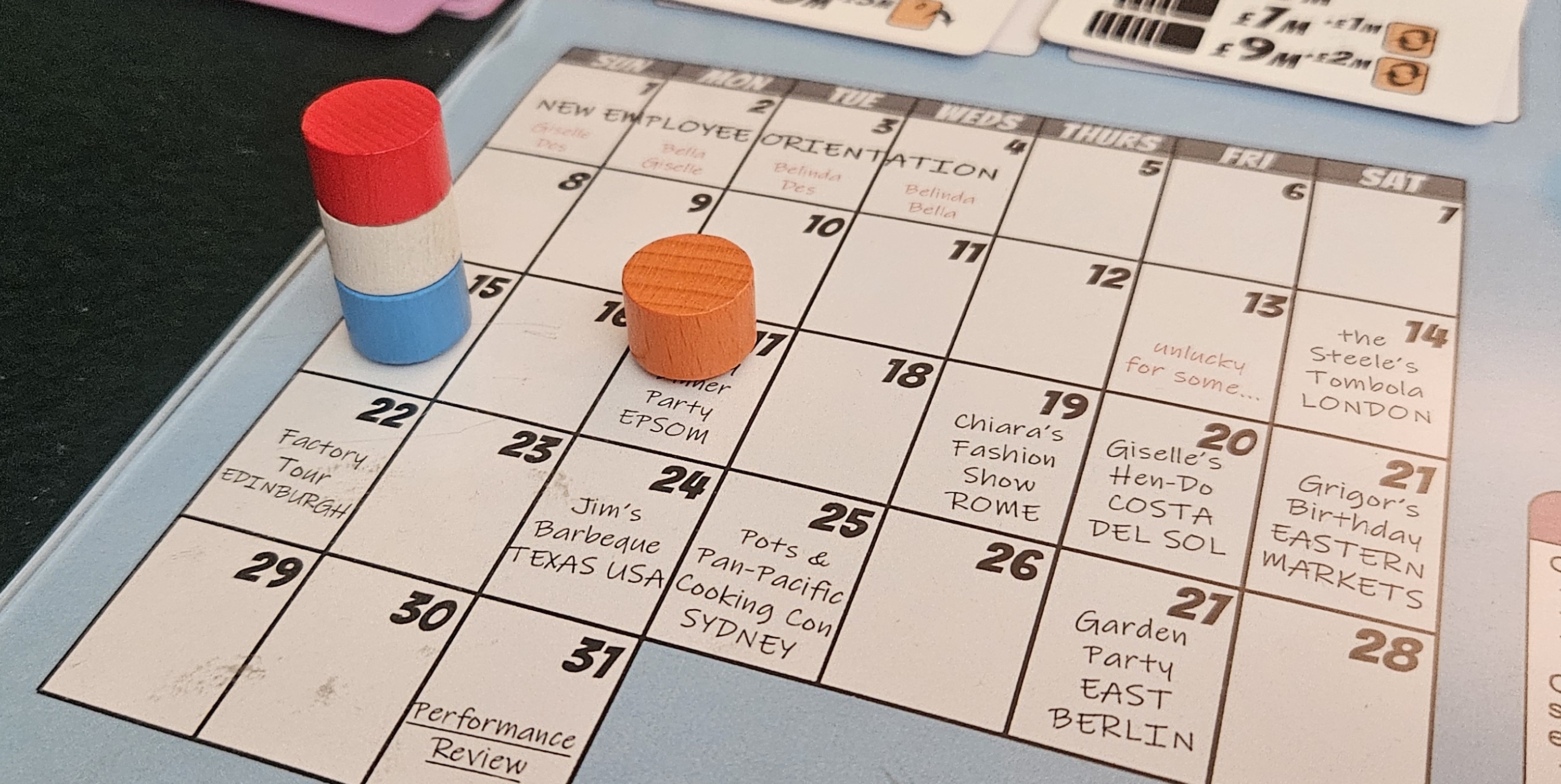
Scheduling, but this is not a scheduling game.

Here’s the short version. Turns are variable, conducted by whomever is farthest back on the calendar. On those turns, you spend some amount of time to make connections — which is to say, put cards into your tableau from either the market or your hand — do spy stuff — gain cards into your hand, from the deck this time — rest to refresh the cards in your tableau, make a business deal by throwing away the cards you painstakingly contacted or spied upon — and, in the process, try to persuade your fellow players to spend some of their cards instead, because these business deals are often collaborative and dole out benefits to multiple players — or perhaps visit a calendar event on the appointed date to gain some advantage.

If that sounds confusing, try teaching it. I’m no stranger to Holland’s more tangled designs, but this one found the most uncomfortable spot on the seesaw between complexity and anticipation: the fulcrum. Belinda’s Big Bonus feels like it should be a light game, looks like a light game, has that licensed light-game air to it, and then, kapow, but a kapow more like a punch to the schnoz than something erotic, it smacks you with a clutter of ideas.

For all that, there is an interesting game in here. The gist is that you need to build out your tableau and hand in order to spend those same cards to make business deals. Along the way, your characters provide something like an engine.

There’s even a narrative to the whole thing. Sir James Godwin makes it easier to attract Bella Ridley to your work group. Meanwhile, James Spooner, the Laird of Gretna Green, brings Cosmo Macaroon into the fold through some act of espionage. Later, your connections to Bella and Cosmo will help you make a deal in Texas, USA for nine million pounds sterling. Unfortunately, that same deal enriches a rival intern by five million pounds, so you try to squeeze some contribution from so-and-so at the table rather than merely handing the commission to whichever competitor is sitting in last place.

I'm friends with ole snarltooth, as you can see

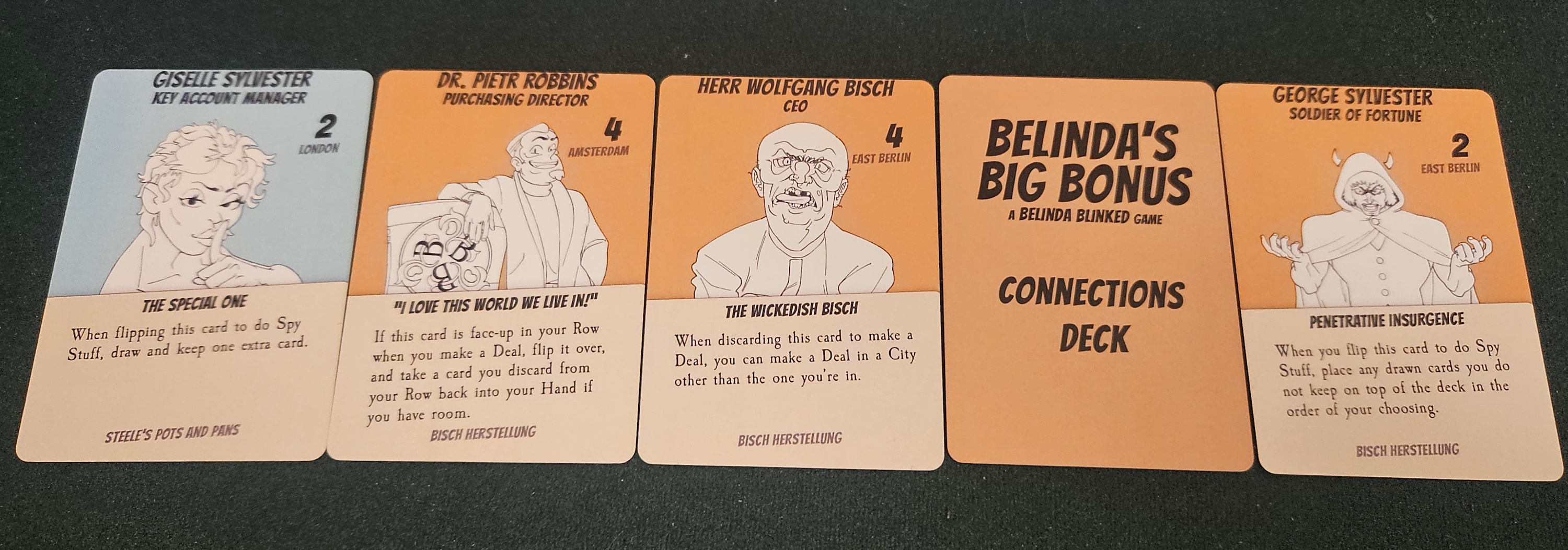
Odd people, but this is not an odd people game… well, scratch that. It’s an odd people game.

Those are genuine dramatic and narrative beats! Along the way, though, Belinda’s Big Bonus is burdened by bloated bits. It’s easy to paint oneself into a corner, for instance, by spending too many cards on an eager deal. This can leave one player sitting around with very little to do but play catch-up. And, hey, that’s their fault, right? If we were playing one of Holland’s cube-rail games, such a possibility would act as evidence of the game’s forthrightness. But here, the possibility comes across less like an honest appraisal of the perils of betting everything on some bad stock tips, and more like an unexpected heel-turn on the game’s part.

Here’s another example. Belinda’s Big Bonus includes the possibility of a traitor moment. When the game concludes, the player in last place might reveal that they now hold the majority of connections to Steele’s rival firm, Bisch Herstellung. This turns them into “the special one” and wins the game in a sudden coup. Cool!

Except, like everything else in Belinda’s Big Bonus, the rules governing the reveal are so text-heavy that it doesn’t feel like an amusing capstone. It’s closer to checking a technical manual to see if you’ve successfully told a joke. It isn’t hard, exactly. Nothing in the game is hard. But it’s less fluid than it ought to be, keeping everybody’s attention on these mismatched processes rather than on the parade of characters and situations strutting across the table.

(derogatory)

Buncha great hangs.

Then again, maybe I’m not in on the joke. Maybe a Belinda Blinked game should be more complicated than most licensed titles. Maybe it should buck common sense by being an erotic game with no eroticism, a business game with no head for business, a whimsy with lots of rules printed on the board. Maybe it should be a big meta-joke at my expense. Maybe this game doesn’t exist for anyone but me, and it was sent to me solely so that everybody could point and laugh and say, ha ha, you took our prank earnestly, you big stupid fool, you moron, you lame-o.

That would be okay. I don’t mind. In the game’s cast of characters, I feel most like the guy anxiously cleaning a stain from his tie. I don’t need to get everything. Sometimes, I even revel in how little I understand. For example, I’ve had a lovely time not understanding Belinda’s Big Bonus. Maybe you’ll have a lovely time not understanding it as well. Just don’t say I didn’t warn you.


A complimentary copy of Belinda’s Big Bonus was provided by the publisher.

(If what I’m doing at Space-Biff! is valuable to you in some way, please consider dropping by my Patreon campaign or Ko-fi. Right now, supporters can read about which films I watched in 2025, including some brief thoughts on each. That’s 44 movies! That’s a lot, unless you see, like, 45 or more movies in a year!)

❌