Normale Ansicht

Lifestyle Content XXX

27. April 2026 um 23:05

Now I need to do the same inverted color thing with Wee Aquinas.

Certain words set my teeth on edge. “Content” is the worst offender. If you want to tell me you don’t care about something, call it content. The other is “influencer.” Michael Barnes, once the finest critic of board games and the source of my first gig writing paid reviews, would sometimes call me an influencer. I never knew what to make of that. I figured he was joking. I hope so.

Wendybuxxx leans into both terms and understands intimately the hard-edged meanings they carry. As a game it’s an enigma. Combine one measure new-media crossover, another bitter satire, and a third earnest arrested metamorphosis, and the slurry would look something like Wendybuxxx. It carries deep redolences to its author’s previous title — that title being Molly House, the author Jo Kelly — but calls to mind sickly-hued films like I Saw the TV Glow and Love Lies Bleeding. It’s a fascinating artifact. Provided you can get past the purposely confounding cardplay, that is.
Live in unrelenting proximity to your significant other's rancid B.O.! Pretend you enjoy squatting on public land! Feel the wind in your hair until the skin of your forehead is pulled taut! Like, share, and subscribe!

Van life! You can poop in a bucket for clout!

Where to begin?

Maybe it begins with a story. Wendybuxxx is the tale of influencers brought to life through strange science to sell necrocurrency, the titular wendybuxxx, at the behest of their grave-digging matron, Wendy Miasma. Over the course of three episodes, they will generate content both positive and negative, court controversy — not so much as to get canceled, not so little as to be perceived as tedious — and ultimately burn out bright, millions of adoring fanatics watching oh so parasocially through smartphone screens across the globe.

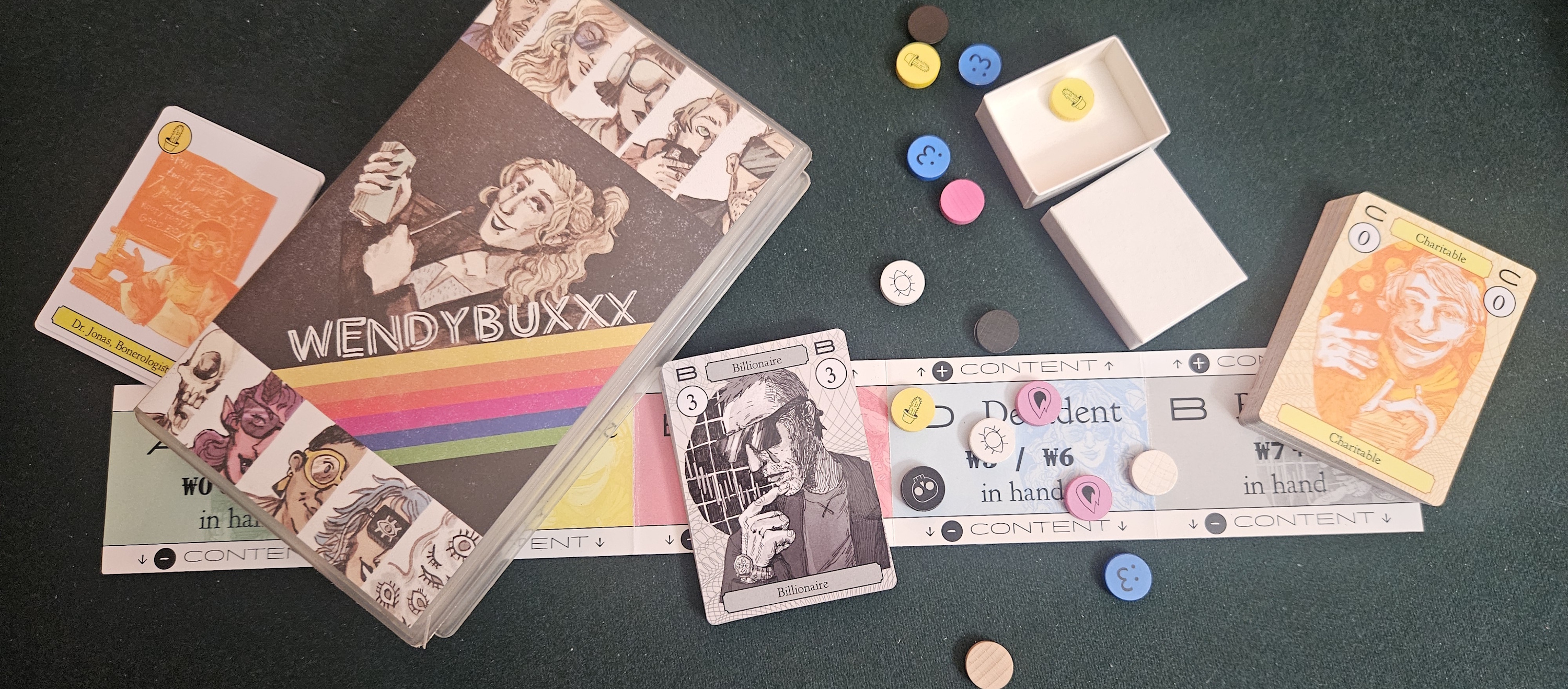
Maybe it begins with outward appearances. Wendybuxxx arrives in an old VHS rental case from peak-epoch Blockbuster, all milky plastic and dulled edges. There are two boards, one folded in half and the other segmented like an accordion, and cards in five colors with the contrast pumped up until they clash like jagged teeth. The characters are embodiments of dislocation. There’s Holly, the Cyber Witch, winking behind cyberpunk-esque shades, and Dr. Jonas, Bonerologist, eagerly describing the wonderful world of boners. The Eyes have seen too much, the Queen of Hell has shaped gender into a razor-edged weapon, and the Skeleton Salesperson reminds me of the old friend from elementary school who asked if he and his wife could have an important conversation with me, then began his sales pitch with a fumbling, “So, you might have noticed that we wear nice clothes and take care to present ourselves in a certain way…” After fifteen minutes of preamble, his embarrassment caught up to him and he refused to tell me what he was selling. I wish I was making this up.

Or maybe it begins with the way Wendybuxxx crosses mediums. This isn’t only a board game. One supposes its fathoms might not even be limited to the ten-track album that accompanies the game. What else is down there, through the mirk? Is this a lifestyle? Is this a pale reflection of who we have become as a culture? No, not that. This is no pale reflection. It’s a direct mirror, sunlight beating through the window, not even a smudge of toothpaste on the glass to distract from the full vision of who we are. We stand naked before the brass, and tremble with the knowledge that were we to see ourselves without the benefit of reflection, our terrible beauty would render us statuary.
Alt-texts are my negative content.

“Positive” and “negative” content all seem the same to me.

Or maybe it begins with a description of how this dang thing functions.

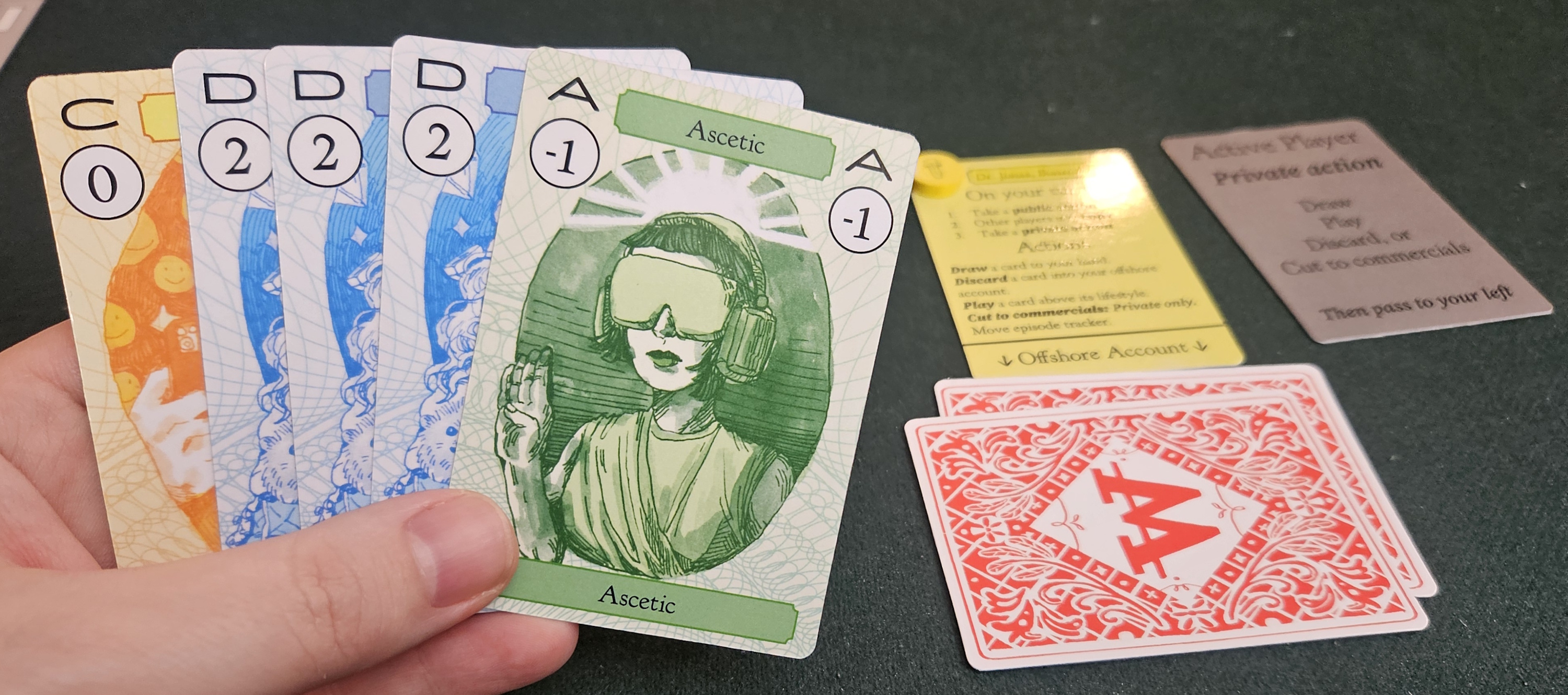
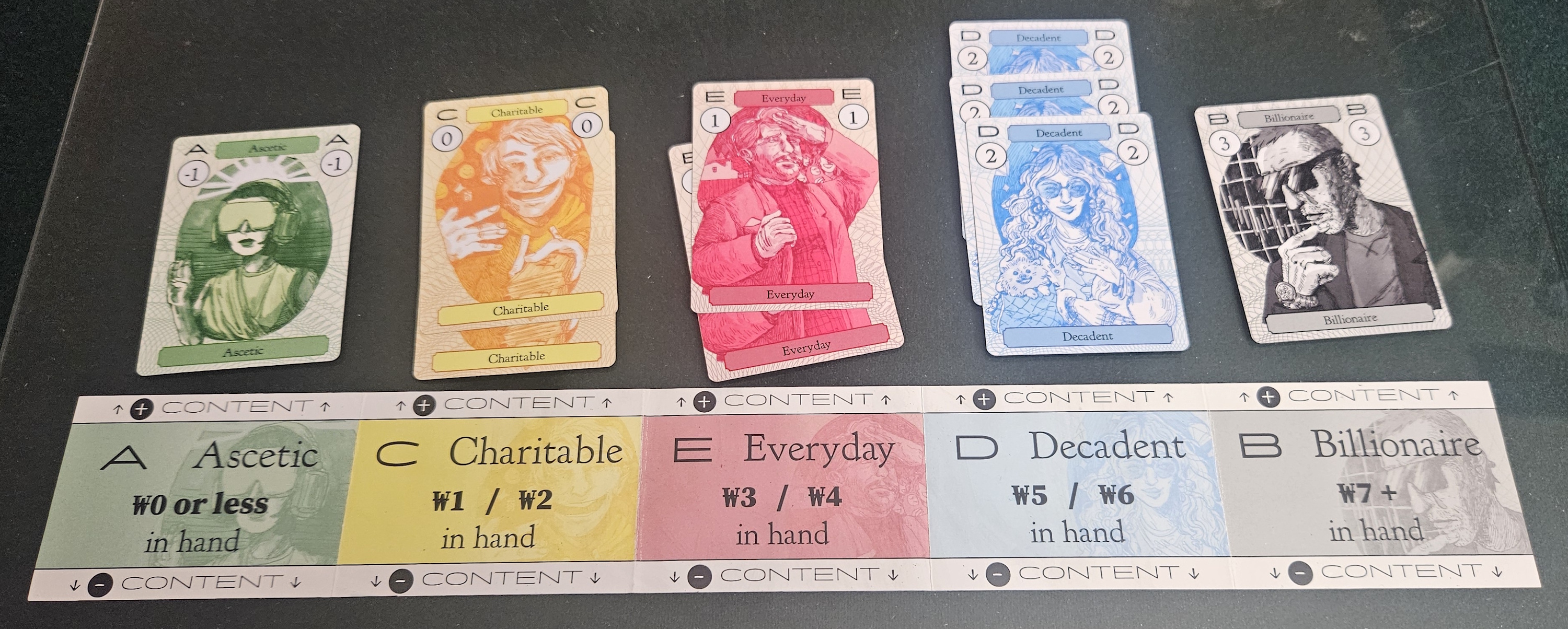
Imagine a hand of cards, their five suits each representing a different form of influencer/content/slop that’s intuitively familiar to we global beings of bytes and filament. There’s Ascetic (poverty porn), Charitable (donation porn), Everyday (tradlife porn), Decadent (glitz porn), and Billionaire (pretending a bottomless bank account does anything other than wring out your soul until it resembles a cactus porn).

These cards govern everything in Wendybuxxx. In your hand, their sum represents the embodiment of your personal brand. (“Brand.” There’s another word I despise.) When played to the “content strip,” they become parcels of content ready for the consumption of the masses. When played to your offshore account, they become negative content. Notably, negative content is only distinct from positive content in how they’re advertised.

Turns are simple, but the life cycle of content is anything but. Turns consist of two actions, one public, which other players are then given the chance to replicate, and the other private, for your lonesome alone. There are only three actions to speak of: one for drawing new content into your hand, another for developing positive content for the numb masses, and a third for concealing negative content in your offshore account.
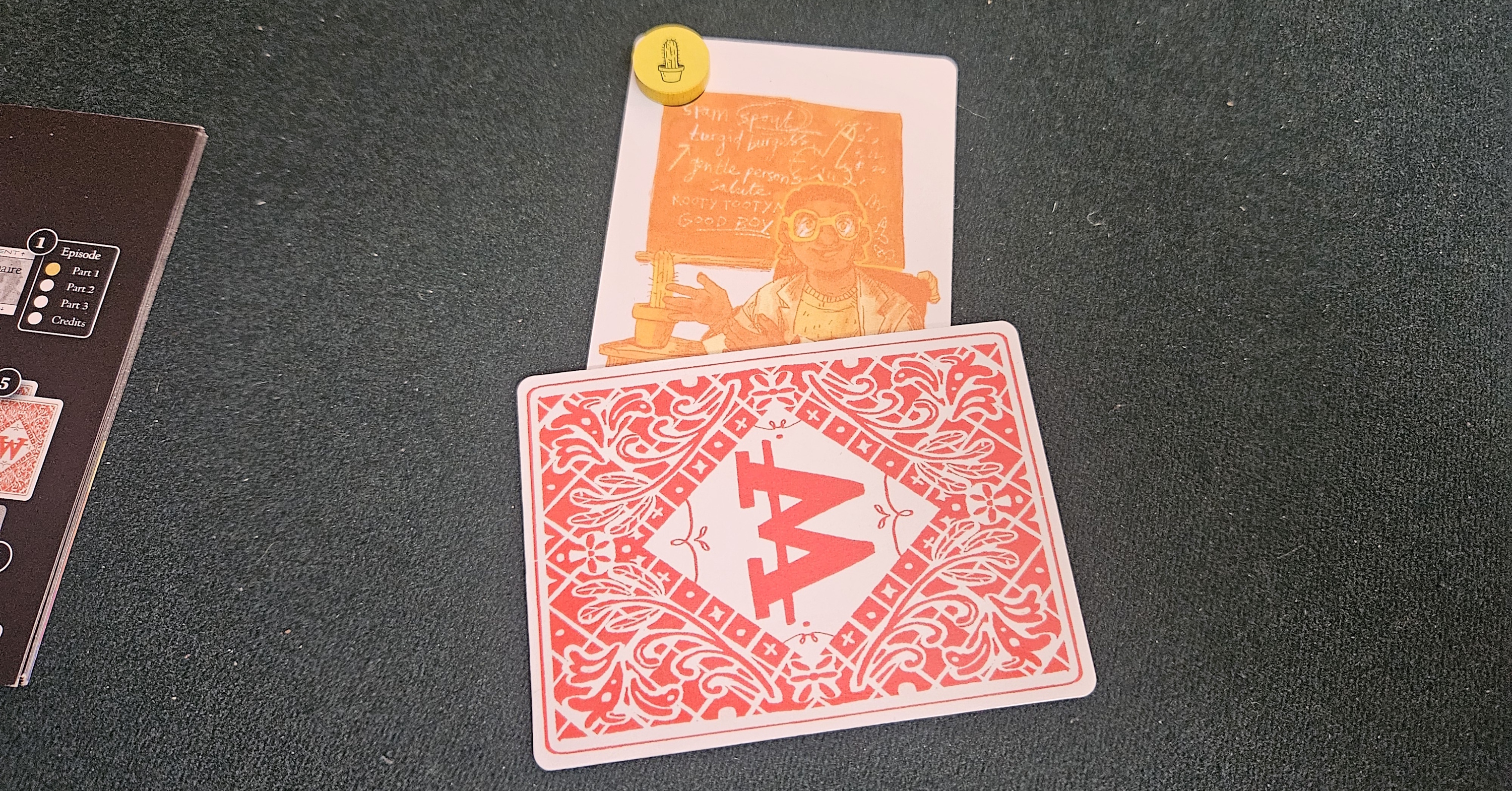
It's the not-yet-boners.

Dr. Jonas, Bonerologist, has a deep dark secret. It isn’t the boners.

The import of these actions requires a few rounds to clarify, which is another way of saying that while Wendybuxxx is dead simple to play, it’s a real beast to play well. I’ve found that it’s easiest to teach in reverse. Like so:

(IV) At a round’s completion, the tally in my hand determines which type of content I’ve made my personal brand. For example, if I’m holding a sum of three to four wendybuxxx, that means I’ve made Everyday content my whole deal. I have remade my image into that of the divine tradwife, perpetually pregnant and clad in fetish sundresses, walking barefoot through campylobacter-ridden chicken dung as I grin toothily through my denim prison bars.

(III) To churn Everyday content into as many millions of followers as possible, I want to ensure the right cards find their way to the corresponding space on the content bar. This is usually done by generating lots of positive content, but in a pinch heaps of negative content will do. Negative content also has the additional bonus of being secret. No meddling from rival influencers!

(II) However, negative content may generate controversy. Although the cards in my offshore account will be added to the content bar alongside the positive stuff, their sum, if too high, will cause me to lose followers. Basically, I did a boo-boo and got canceled. Then again, too little controversy and my followers will ditch me out of boredom. The goal is to walk the tightrope of public opinion. It’s one thing to forget about the father of nine I locked inside an abandoned mall to see if he could survive for a month in exchange for fifty grand, but another thing entirely to share a negative opinion about the latest developments in the Marvel Cinematic Universe.

(I) Turns, then, are all about building a brand that will score high, ensuring you’re holding the right cards to score it, and keeping your controversy levels smack dab in the middle.

See? Easy!
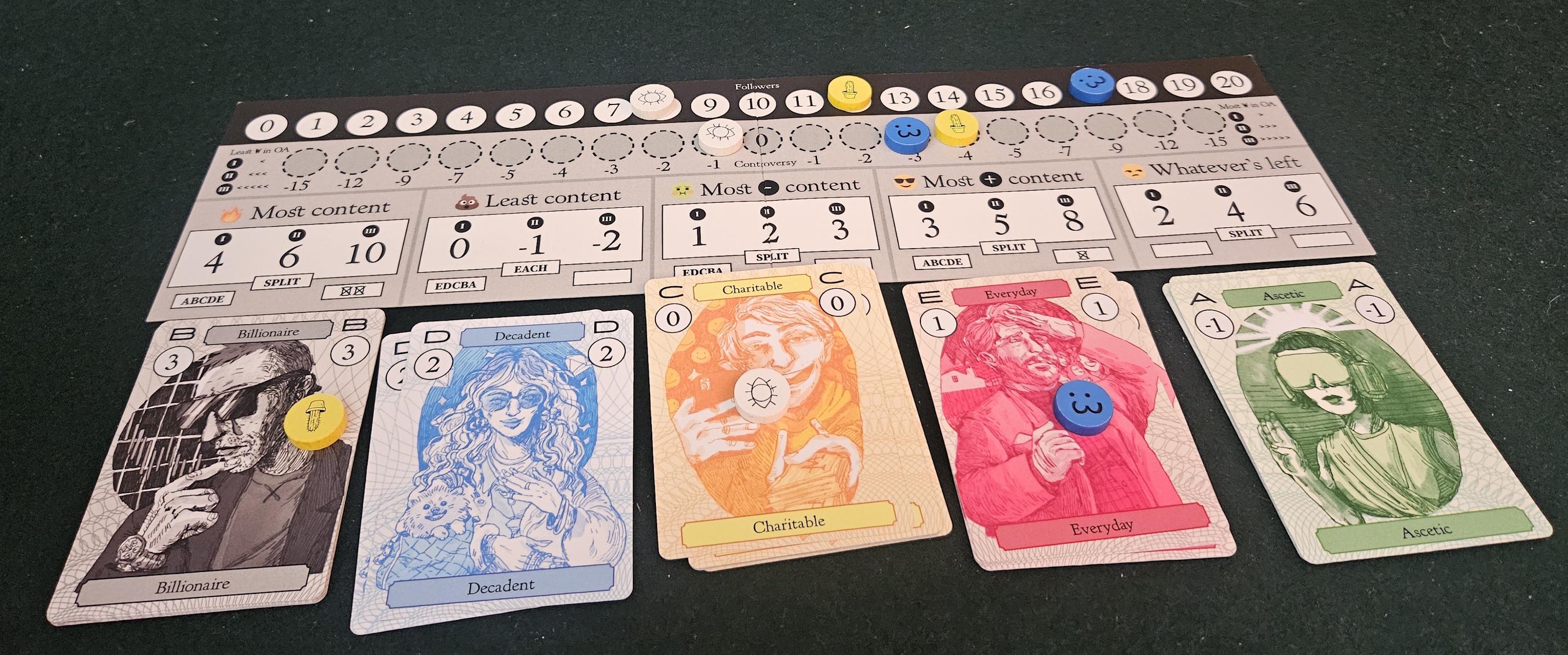
I take so much joy from ensuring decadent is always the least-made content.

Riding the tide of public opinion.

Fine, fine. But while Wendybuxxx isn’t easy to describe, it’s easier than you might think from description alone. Like the card manipulations in Molly House, Wendybuxxx is all about motion. If two influencers are dumping loads of content into the billionaire category, there’s a good chance their hands are stuffed with enough cards to qualify them as billionaires. Maybe you can get in on the fun by scrounging up enough cards to nibble at their extras. Or maybe splitting an audience isn’t your style, so you focus on something totally different, instead blinging yourself out in jewelry. Or maybe it’s time to sabotage their efforts by tweaking the other categories upward, turning billionaire into the social pariah it deserves to be.

Point is, the cardplay in Wendybuxxx takes a few rounds to really wrap your head around, but once you’ve internalized the way the cards move, shifting from place to place in little bids and attacks, the game reveals some unusually sharp gameplay. It’s nasty without being direct. Snitty, even. Which is precisely what it should be, given that it’s basically depicting what would happen if the CrunchLabs guy decided to suffocate Mr. Beast in elephant toothpaste.

(Golly, I hope in twenty years nobody knows what the hell I’m talking about. Wouldn’t that be great.)

This satirical slant is simultaneously Wendybuxxx’s sharpest corner and its bluntest instrument. Rolling around in the muck of online content creation is fine and dandy, but lifestyle influencers are self-satirizing. I know they’re ridiculous. You know they’re ridiculous. The only people who don’t know they’re ridiculous are so far gone that there’s no reaching them, no matter how many board games with ten-track albums we stack on their kitchen table.

Fortunately, while the superficial details are every bit as abrasive as millionaires who pretend to live in repurposed shipping containers in coniferous forests, that isn’t all there is to Wendybuxxx.
scrumptious

CONSUME CONTENT.

At its deeper reaches, this is also a game about remaking oneself. It isn’t enough to forge a personal brand. No matter how solid your initial bid, the game will throw a wrench into your plans. Rivals will bring you down. Controversy will dog your heels. Winning lifestyles will go out of fashion. And so the wheel turns. You are one thing. And then you are another thing. In both cases, the game only permits you to become the wrong thing, another clout-chaser, another hollow person who yearns to feel something but has been brainwashed by the internet and late-stage capitalism to make number go up. Wendybuxxx doesn’t wind up as a cautionary fable about lifestyle influencers. It becomes a question mark. What are you. What will you be. Who is it that you must become. Not on the table. But above it. To play Wendybuxxx is to see your worst self realized again and again.

And, in the seeing — in the playing — maybe Wendybuxxx becomes an opportunity to decide to become something else.

Or maybe not. Maybe Wendybuxxx is none of those things. That’s would also be all right. Because at worst, Wendybuxxx offers some incisive satire, some sharp card-play, and some eerie color in a world where drab people would drain us dry to fill the black holes in their bellies. As a game, it’s worth the effort.

Either way, I hope this content has influenced you. Remember to like, subscribe, and share.

Wendybuxxx will be on Kickstarter tomorrow.


A complimentary copy of Wendybuxxx was provided by the designer.

(If what I’m doing at Space-Biff! is valuable to you in some way, please consider dropping by my Patreon campaign or Ko-fi. Right now, supporters can read my first-quarter update of 2026: the best board games, movies, books, and more!)


Deck-Build with the Devil

23. April 2026 um 17:54

Every time I write about a game with a "demonic theme," somebody comes along to tell me why they won't play games with demons in them. Look, we know why. Because you're a goofball. We get it. It's fine. But that doesn't mean I care to hear about it.

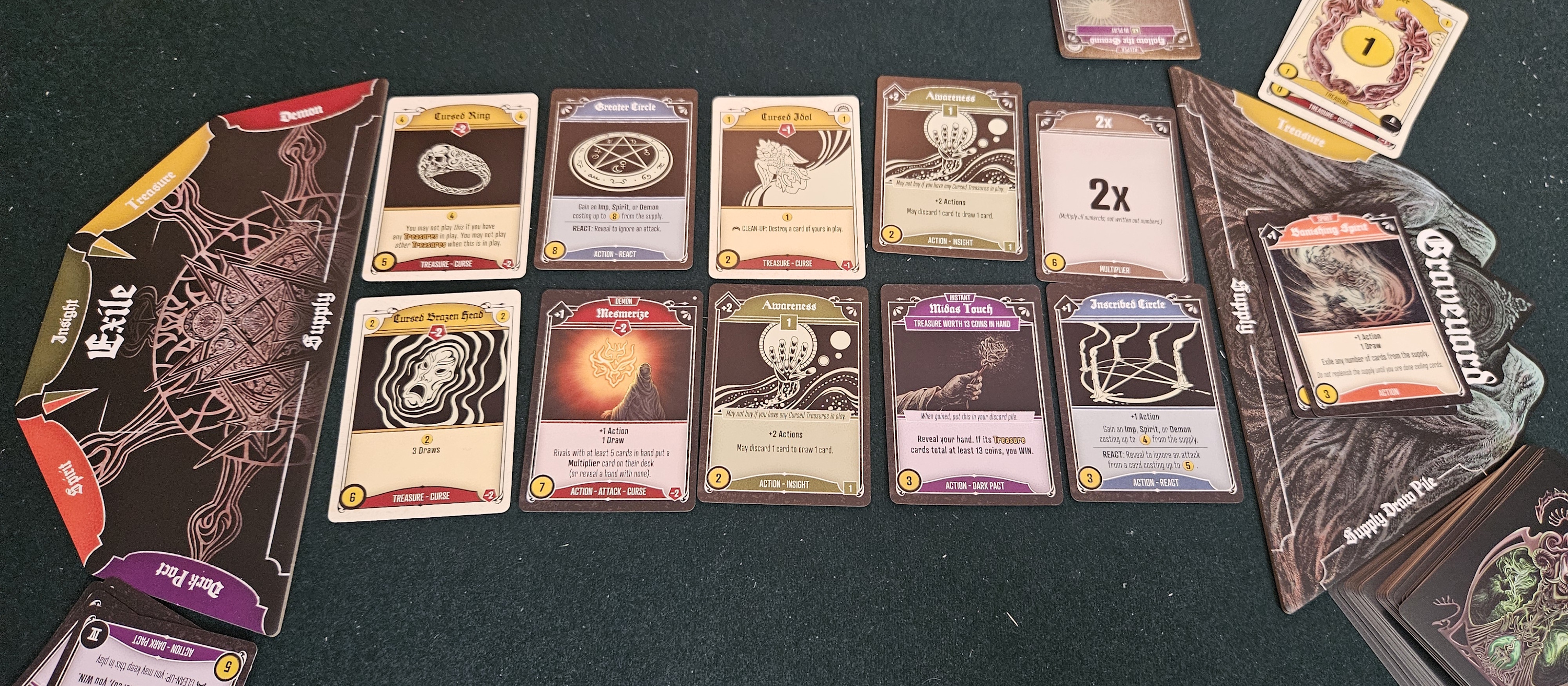
I don’t know what I expected Tom Lehmann to design next, but Dominion on Adderall wasn’t on the list. That’s as short a summary as I can muster for Dark Pact, and it’s a surprisingly apt comparison, right down to the action limits and buy phase that marked Donald X. Vaccarino’s genre-defining title. Like the version of Dominion you’d get if a moody teenager popped a double dose and spent six hours scribbling demons in their spiral-bound notebook.

Is it good? Yeah, it’s good. Is it great? Hm. It sits somewhere near Res Arcana in Lehmann’s ludography, sans that game’s brevity, plus a bit of Justin Gary’s Ascension in its flowing market and excessive tallying. Great might be a stretch. Perhaps it would be fairest to say that it contains moments of greatness.

I think I get especially eye-rolly about the "no demons in games" thing because my mother insisted that face cards were demonic. This was written directly into a doctrinal book that was important to Mormonism, despite it not being canon at any point. This had very little impact on my upbringing except to prevent me from playing trick-takers until I was an adult.

An old-fashioned (but not that old-fashioned) card market.

At a setting level, Dark Pact is about striking a bargain with a demon. I don’t have any experience in such a discipline, but it seems as close to otherworldly binding as Dominion was to Medieval villages. There’s a moment in the game, usually about five minutes into a session, when I can still appreciate Dug Nation’s woodblock-styled illustrations. Five minutes after that, those illustrations have faded from view, along with the remainder of the game’s trappings. All that remains is the machine I’m hopefully streamlining into something aerodynamic enough to drag two dozen cards into motion.

If you’ve played Dominion, you can play Dark Pact. By now the five-card hand has become industry standard, but even a few of Dominion’s other hallmarks return intact. By default you only receive a single action. That’s one card played to the table to activate its effect. Often that card will provide another action. Then its followup provides another two actions and some draws. Then the next card lets you retrieve something from your discard pile and, baby, you’ve got a stew going.

Also returning is Vaccarino’s market phase. After your actions are done, you’re allowed to play as much treasure as you can and purchase new cards. There are a few wrinkles this time around. For one thing, there are none of Dominion’s limited buys. If you want to split up your gold to purchase five cards, well, go nuts. For another, the market is now an ever-shifting offer rather than Dominion’s static display. What you see this turn may well disappear into your opponent’s deck before you get another stab at it.

Except, in Mormonism at least, it turned out that the entire cards-are-demonic thing came from a church leader's desire to stop women from getting together to play bridge — to prevent them from developing a third space that was out of reach of the church's male-dominated structure. There was an element of preventing gambling as well, but the earliest crackdowns and sermons mostly focused on bridge clubs.

Turns eventually spool into madness. Seems fitting.

Unsurprisingly, this is where Lehmann dives in with full gusto. There are cards aplenty to grab, with heaps of effects, and all of them are useful for one objective or another. But there are two in particular that transform Dark Pact from spooky-art Dominion into something that feels distinctly Lehmann-esque.

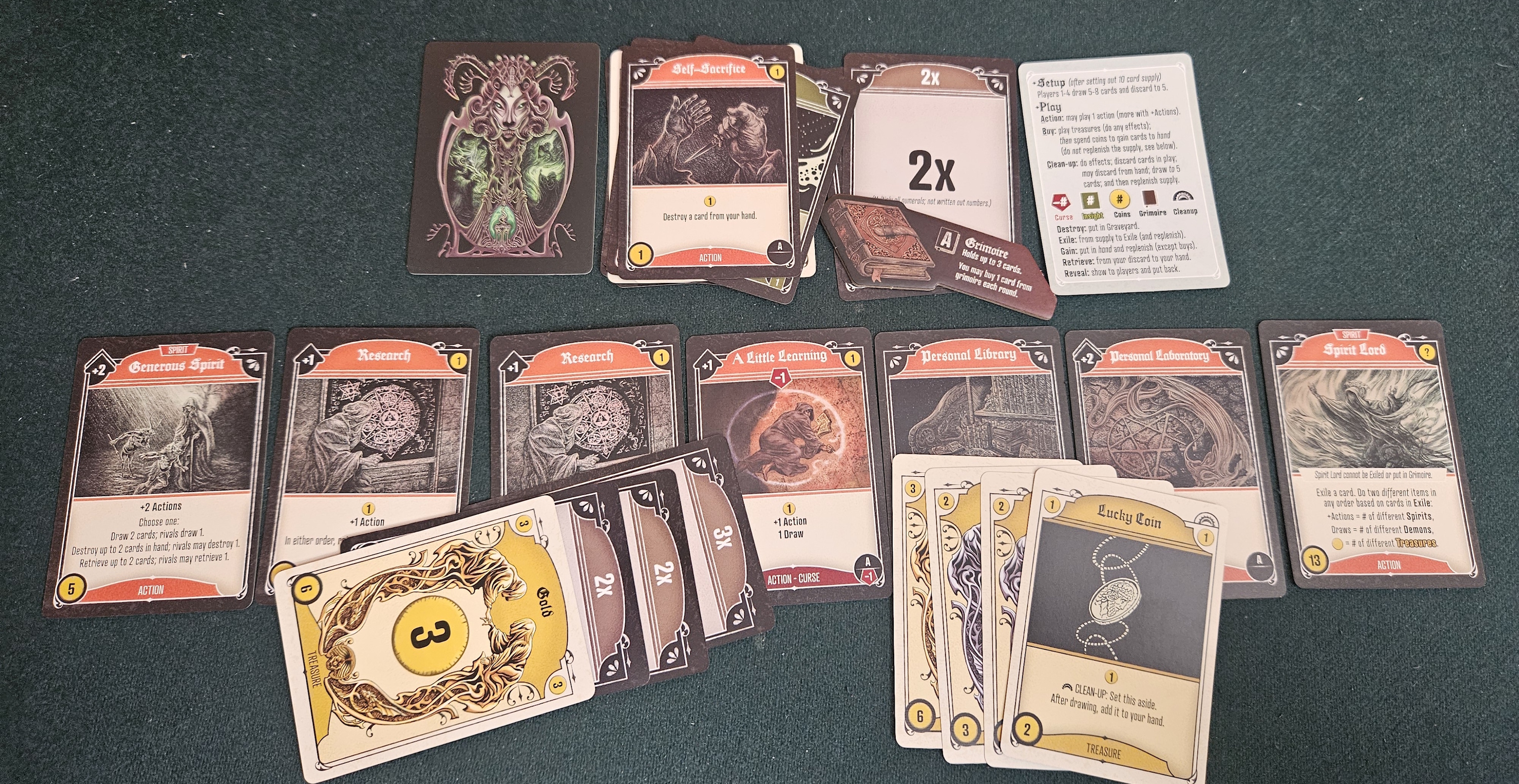
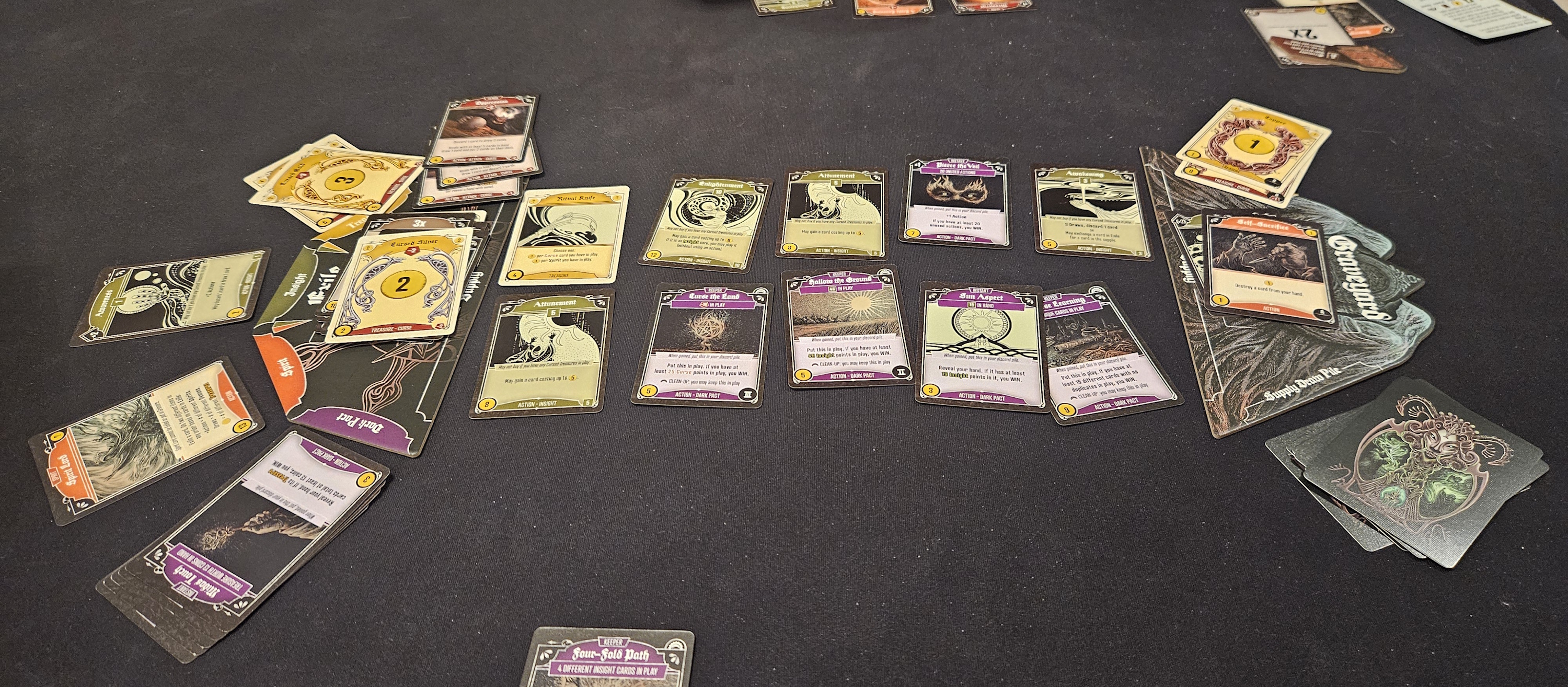
The first is the pacts. The dark pacts. Of Dark Pact fame. There are thirteen in all, all of them shuffled into the deck, and all offering a game-winning condition that initially sounds impossible. You might, in the course of your demonic experimentation, uncover a dark pact called Diverse Learning that will let you win if you have 15 unique cards in play. Or perhaps you’ll pursue Secular Power, the card that wins if you enter the market phase with 40 unspent coins. Or Great Potential. That one wins if you have 19 cards in hand.

For Lehmann-heads, dark pacts aren’t far off from the monuments and places of power in Res Arcana. It’s just that they’re hidden in the deck like your average demon-summoning ritual or cursed ring, get shuffled into your deck, and present conditions that let you win outright rather than offering spills of points. If their targets sound intimidating, that’s deliberate. When the game opens, most dark pacts are well out of reach. Especially, remember, because you only get one action per turn, five cards per draw phase, the usual limitations.

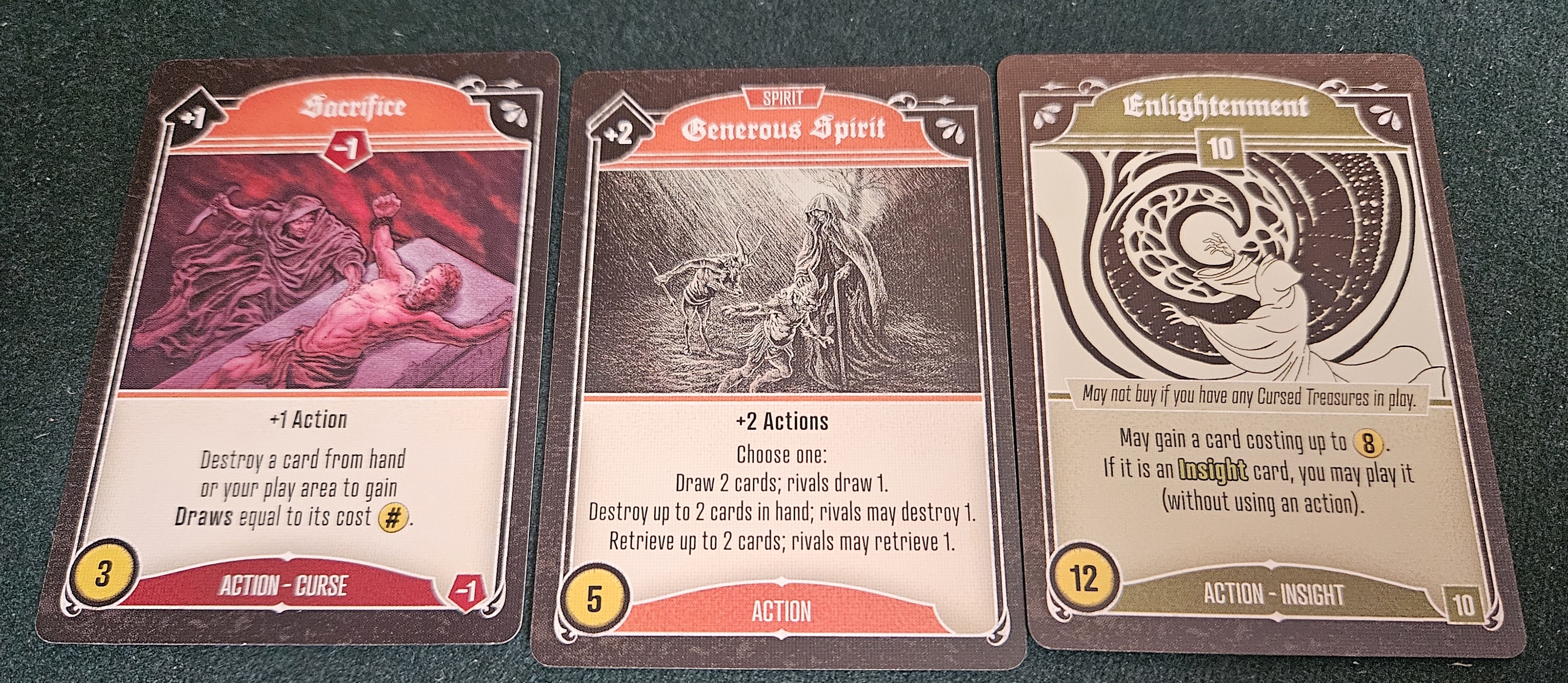
That’s where the second special card comes in: multipliers. They’re… multipliers. No spooky gauze this time. Just a simple 2x or 3x. These also circulate through your deck, and can be attached to any card to amplify the effects of its printed numerals. Gold coin? Now it’s worth two or three times more. Summoning circle? Now you can nab a card worth 16 or 24 coins rather than a measly eight. Generous spirit? Enjoy your six extra actions and nearly your entire discard pile popping back into your hand.

Things really get bonkers when you discover that multipliers multiply multipliers. Before long, some turns are transformed into those obnoxious order-of-operations social media tests. (“Only one in thirty people can solve this equation!”) The effects can be staggering. Thanks to multiple 3x cards stacked atop some silver, I once generated something like 70-ish coins in a turn. I wasn’t even holding the pact that let me win from having so many coins. It was so much that I could have bought out the entire market. I didn’t do it, of course. Winnowing is every bit as worthwhile in Dark Pact as any other deck-builder. It’s possible to over-stuff your card pool, so I reined myself in. But I considered grabbing all ten cards on offer for the lifetime accomplishment award.

This emphasis on niche issues like playing cards or "demonic themes" thus presents an ethical inversion for a faith community. The boundary marker becomes something easy for rank-and-file members of the group to accomplish ("Don't play card games") while the harder tasks ("Feed the poor, clothe the naked, visit the prisoner," etc.) become idealized rather than concrete. It allows the disengaged to feel like they're doing something active, while ignoring the imperatives that were actually requested of them by the faith community's founders and core texts.

Another day at the office.

At its best, these cards result in a deck-builder that’s incredibly familiar, to such a degree that it feels like a throwback to 2008, while also chucking everybody down a slip-n-slide to see who can break the game the fastest. In those moments, Dark Pact is Lehmann in top form. All the broken combos of Res Arcana. All the busted dice-assembling of Dice Realms. All the recursive triggers of Race for the Galaxy. All of it and more, wrapped in a tidy package that barely asks deck-building veterans to learn anything new. Truly, it’s impressive how smoothly the game riffs on the genre’s basics. When I say you can play Dark Pact if you’ve played Dominion, I mean it.

At the same time, Dark Pact sometimes feels one or two elements shy of a summoning ritual.

The biggest issue is duration. Basically, it’s often too slow for its own good. Turns are anything but simple, with one power begetting another, often after drawing from the deck, retrieving from the discard pile, and refreshing a segment of the market, all of which make it difficult to plan during one’s off-turn. It might sound like the exception to have a dozen cards trigger in sequence, but that’s the goal of Dark Pact, which makes turns sprawl more often than not. Even with only two players, the downtime and duration can be formidable. At three or four, they grow interminable. I would play the heck out of this game via an asynchronous app; on the table, it needs optimal conditions to thrive.

Meanwhile, I’m sure much will be made of the card balance. Multipliers are powerful, that goes without saying, and the early game often feels like a race to secure an economic engine that will springboard your longer-term plans. Fortunately, Lehmann offers a few solutions to sidestep the usual deck-building snares. Purchased cards go straight to your hand rather than first cycling through your discard and deck, and everybody begins with a few cards in their own private grimoire that can be purchased at their leisure, including, crucially, a deck’s second 2x multiplier. It’s a clever move that eases the whims of the flowing market without totally erasing what makes it interesting.

Personally, I’m more interested in the dark pacts. These don’t need to be balanced. I would go so far as to say they oughtn’t be. For all I know, they’ve been painstakingly playtested and algorithmically tuned. But some of them feel like a breeze compared to some others. Is this a problem? Only insofar as you make it one. It’s an open bar. If somebody nabs a pact that’s more reasonably completed than one you’ve taken, maybe it’s time to run interference. But there are some, maybe two, that feel so comparatively easy that I’m always going to give them priority. In a game this muscular, even the slightest flab seems especially visible, like a world-class bodybuilder with one sagging boob.

This is relatively common in faith communities over time. Nitpicky "side rules" become emphasized while core tenets atrophy, allowing easier boundary maintenance at the cost of shedding the same identity that is being maintained. BUT ANYWAY card games are cool huh? Play demonic games.

When nobody is sure which pact to buy, the market tends to clog with them.

Sagging boob or no, Dark Pact is fascinating for how Lehmann has taken a familiar formula and made it new again. This is Dominion, but rather than coming across as goofy when the optimal deck consists of seven sentries and four throne rooms, Dark Pact’s flowing market and sheer busted nature make the process feel vibrant and alive. It’s funny to get excited about trashing a card after all this time.

Which is to say, yeah, there are downsides. Some cards feel mistuned. The downtime is considerable. Four players? Forget about it. But Dark Pact once again showcases Lehmann as a master at work. In his hands, cards become more than cardstock. They’re components in a machine, one that sputters to life with every shuffle, draw, purchase, and winnow. The game is its own demon, and whatever dark pact Lehmann has struck to summon so many bangers in one lifetime, let’s hope the price never comes due.


(If what I’m doing at Space-Biff! is valuable to you in some way, please consider dropping by my Patreon campaign or Ko-fi. Right now, supporters can read my first-quarter update of 2026: the best board games, movies, books, and more!)
Nepo Demibabies

21. April 2026 um 20:50

oh yeah, that's the stuff. glaze an amphora for me. I love it.

Yesterday we looked at Pillars of Fate, a kinda-sorta remake of extended family reunion simulator Veiled Fate, and found it wanting for much the same reason as the original. The gods are capricious, everybody knows that, but their fickleness doesn’t exactly make them the most appealing playmates.

But here’s the thing. At the same time Austin Harrison, Max Anderson, and Zac Dixon were designing Pillars of Fate, another remake was, um, remade. On a superficial level, this one, Scales of Fate, resembles its namesakes. As in those other titles, dueling gods intend to deduce the identity of their rival’s offspring, minimize their impact on the world, and elevate their own bastards over everybody else. Basically, it’s a race to promote your nepo babies over everybody else’s at the family tire shop. And that tire shop happens to be the eternal mountain at the root of the world.

And it’s excellent. Scales of Fate just might be one of the tightest, nastiest deduction games out there. That it was built for two players only makes it the more impressive.

I don't really understand why this is Scales of Fate. Maybe they're fish-scales? Is the world a fish? I hope so.

But these are the ones standing on pillars…

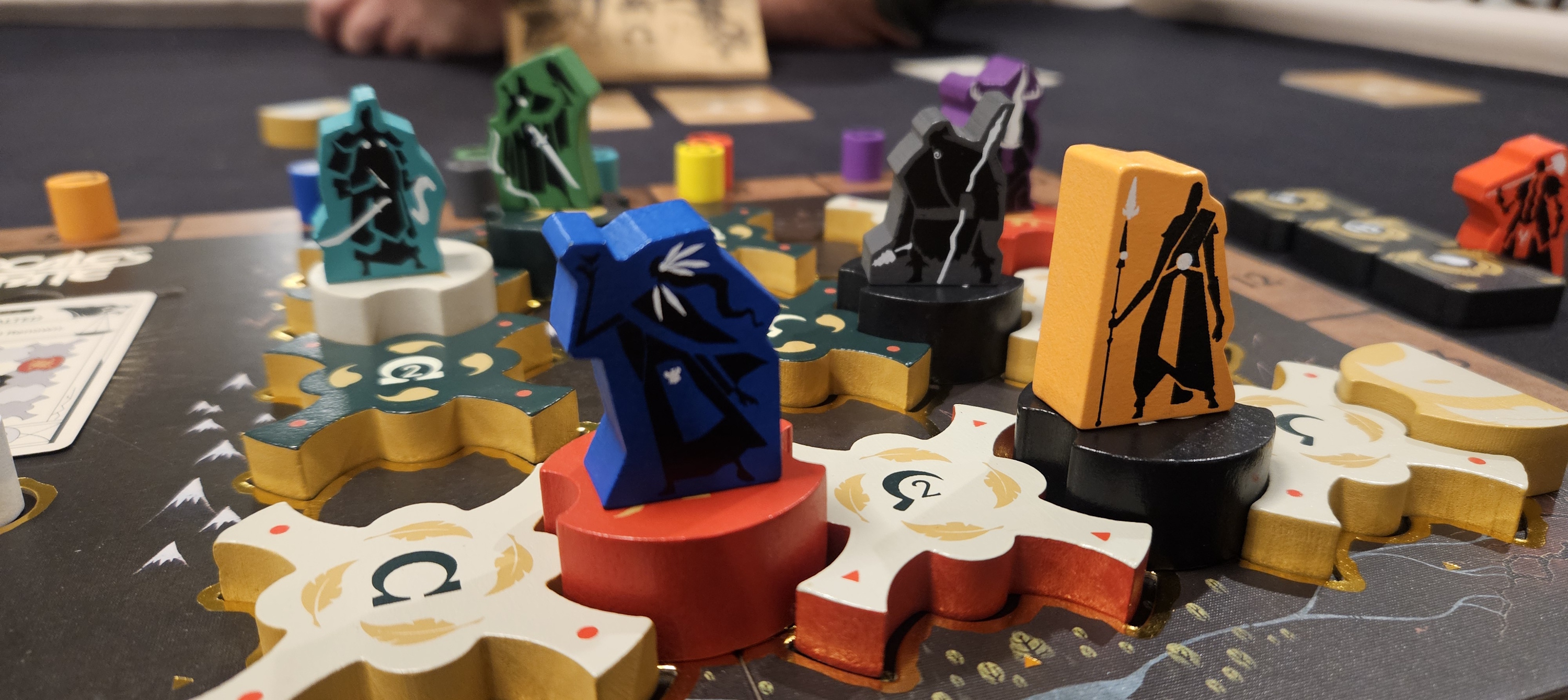
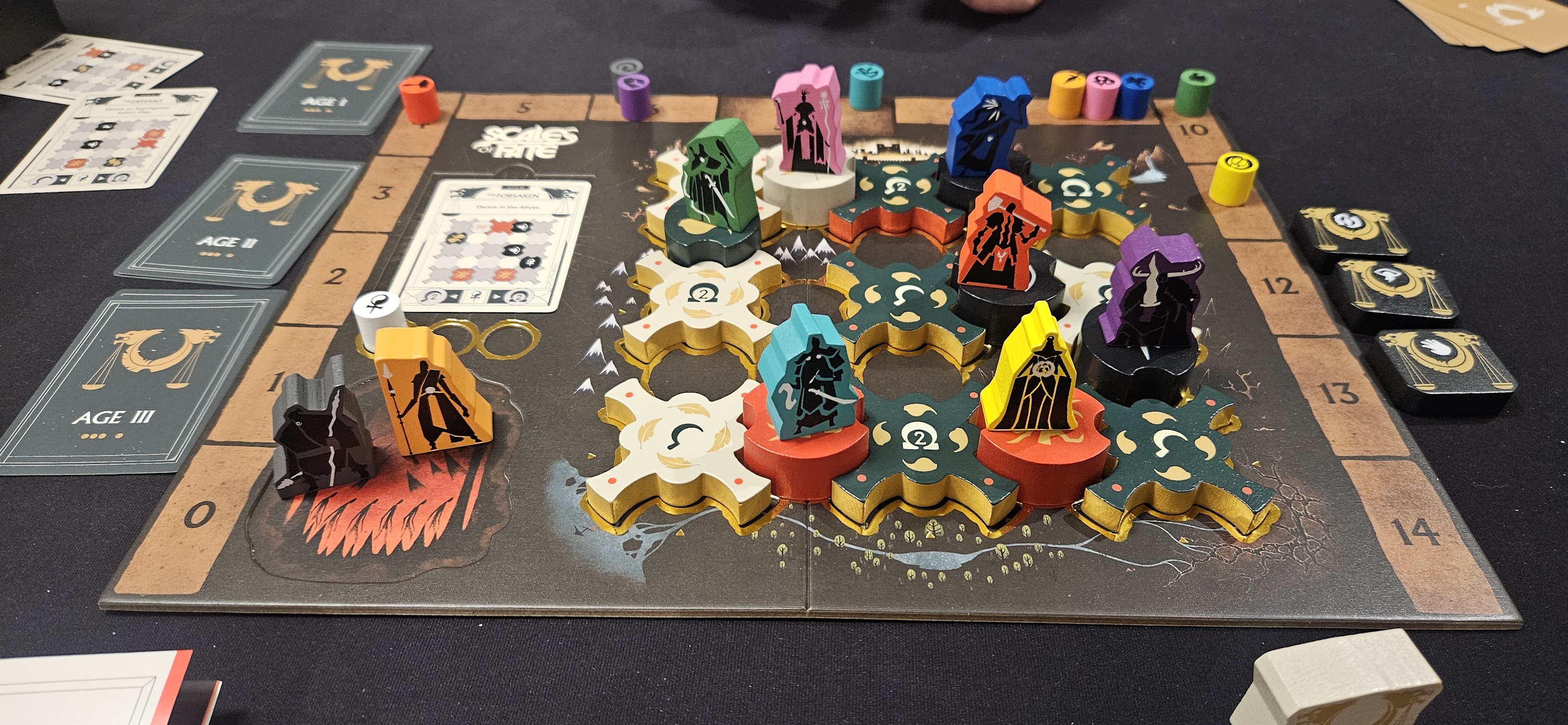
For first-timers, the board presented by Scales of Fate is wonderfully labyrinthine. I say “wonderfully” because just look at it. It’s colorful. The pieces slot together like joined fingers. There’s a topography to the whole thing. You can tell the elevated pieces will be more important than the pieces seated a few millimeters below them. Even when I had no idea what any of these components portended, I wanted to know. Needed to know. Were they gears? Would my demigods traverse them? Veiled Fate presented its map as a wheel. Pillars of Fate offered three lanes. Both are fine. Good, even. But I’ve seen wheels and lanes before. A series of interlocked cogs and risers is something new. That’s a metaphorical depiction of a landscape if ever there was one.

In practice, Scales of Fate is surprisingly easy to get a handle on. Turns consist of three possible actions. One of those, while important, functions more as an exception, an occasional bolt of lightning, than as business as usual.

The main two actions, meanwhile, immediately explain the function of those wonderful cogs and pillars. First, a demigod can be placed atop a pillar to trigger its ability. Whether it’s to smite another demigod down to the underworld to cool their heels, obtain the loyalty of a servant, or… well, that’s it. Rather than offering a wide menu of abilities, there are really only two to keep in mind. Sure, there’s some variety within those categories, but they fall into camps rather than cluttering the decision-space with branching paths.

The second action has to do with those servants. Placed along the edge of the board’s cogs, they trigger the quests that will increase or decrease each demigod’s renown. But to understand what that means, we need to back up a bit.

In this case, those quests made them look like big buffoons. (Also, as in Pillars of Fate, the +/- renown icons could have stood to be slightly different shades.)

A servant sends two demigods on important quests.

Okay, so you’ve fathered/mothered/sea-foamed two half-divine offspring. Their identities are determined in secret at the beginning of the game. Put a pin in that. We’ll come back to it.

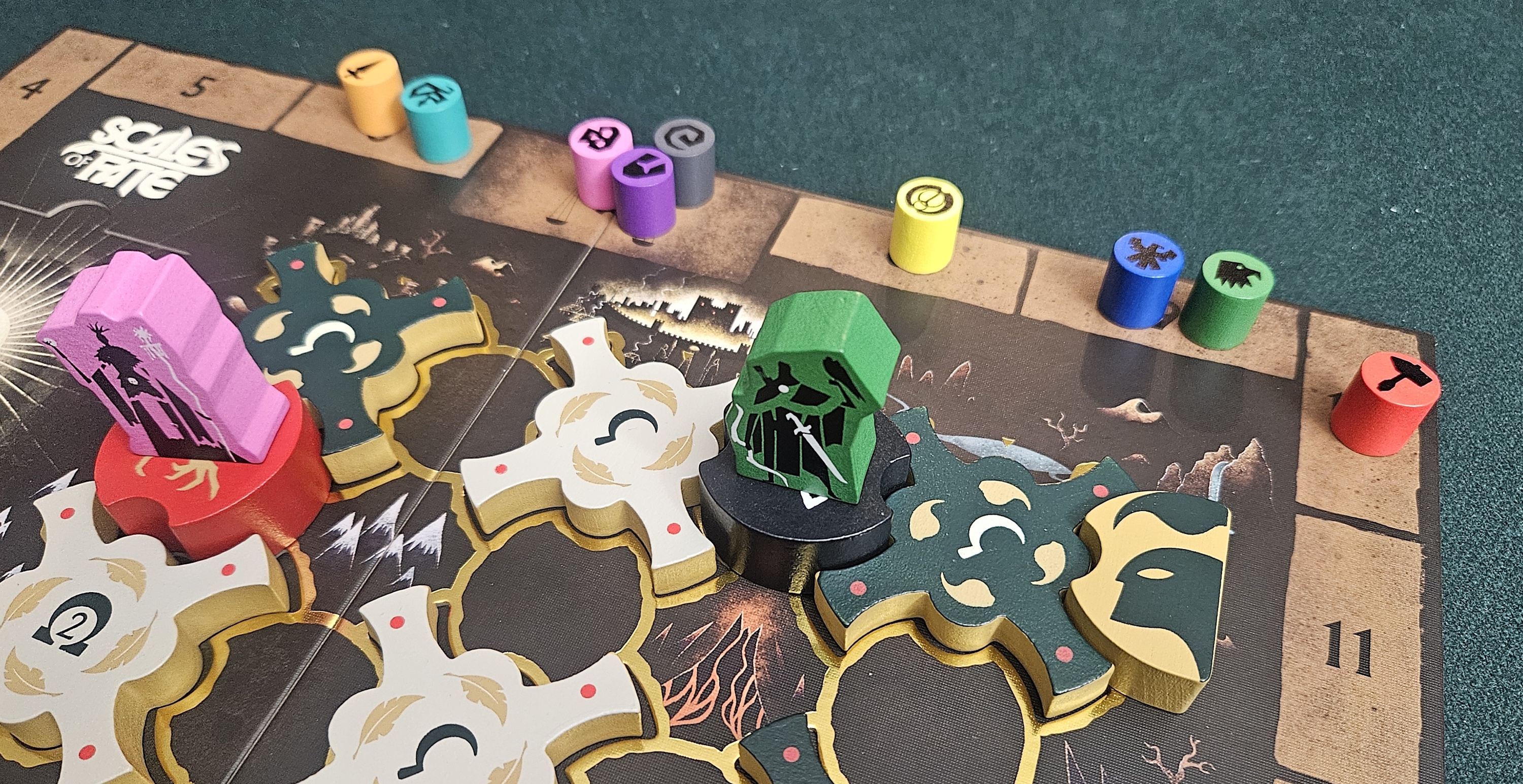
You want to elevate your children. Doing so openly is a surefire way to attract the wrath of your co-pantheonists. So you work in secret. The problem is that every demigod’s current standing is shown on the renown track, visible to both players. When the game begins, all nine demigods share the middle space. That’s seven renown. Even before they’ve done anything interesting, your offspring are worth something by means of their divine parentage.

What will they accomplish? Rather than doing the obvious thing — say, by asking you to push them up the renown track — Scales of Fate makes a tantalizing offer. Your children score points in one of two ways. If they occupy the same renown space when the game ends, they score its value. If both are seated on their starting space, having neither moved up nor down, that means they’ll be worth seven points. That’s respectable. Polite. Not a bad score. But if they move to different spaces on the track, now they score equal to the distance between them. Ticking one child up a single space means their combined value is one point. On the other hand, if your children should do the twin thing by embracing entirely opposite ends of the spectrum, they’ll be worth a whole lot more.

This introduces a wonderful sense of risk and reward to Scales of Fate, not to mention fixes my hangups with Veiled Fate. In that game, players earned points for ensuring their holy bastard earned the most renown. But that made their identity almost trivial. Once any one demigod got too hot for their britches, everyone would work together to take them down a peg. It was simple. Too simple.

Here, their relative standing makes the family tree more tangled. With nine demigods in the world, they’ll be all over the renown track. But what does that mean? Are those clusters on the track actually siblings working in tandem? Are those gods at the farthest edges secretly growing into a hero-villain rivalry that will shake the foundations of the earth?

My one quibble: There are only three cards per age. Gimme more!

Each age provides new clues on your rival’s childrens’ identities.

Of course, this is a deduction game, which means there are tools for producing those deductions. Some of these tools are subtle. With experience, I’ve made a habit of watching my opponent like a hawk and marking whenever they idly touch a piece or linger too long over a move. More often than not, some correlation can be drawn over time, hinting at favoritism or resolute neglect. (Similarly, I’ve developed the habit of studiously avoiding my own offspring. This, I’m sure, is a tell in its own right. If I reach out to tentatively brush the pink demigod, Isabel, before pulling back like my fingers were singed by her presence, you can reliably infer that I have nothing to do with her.)

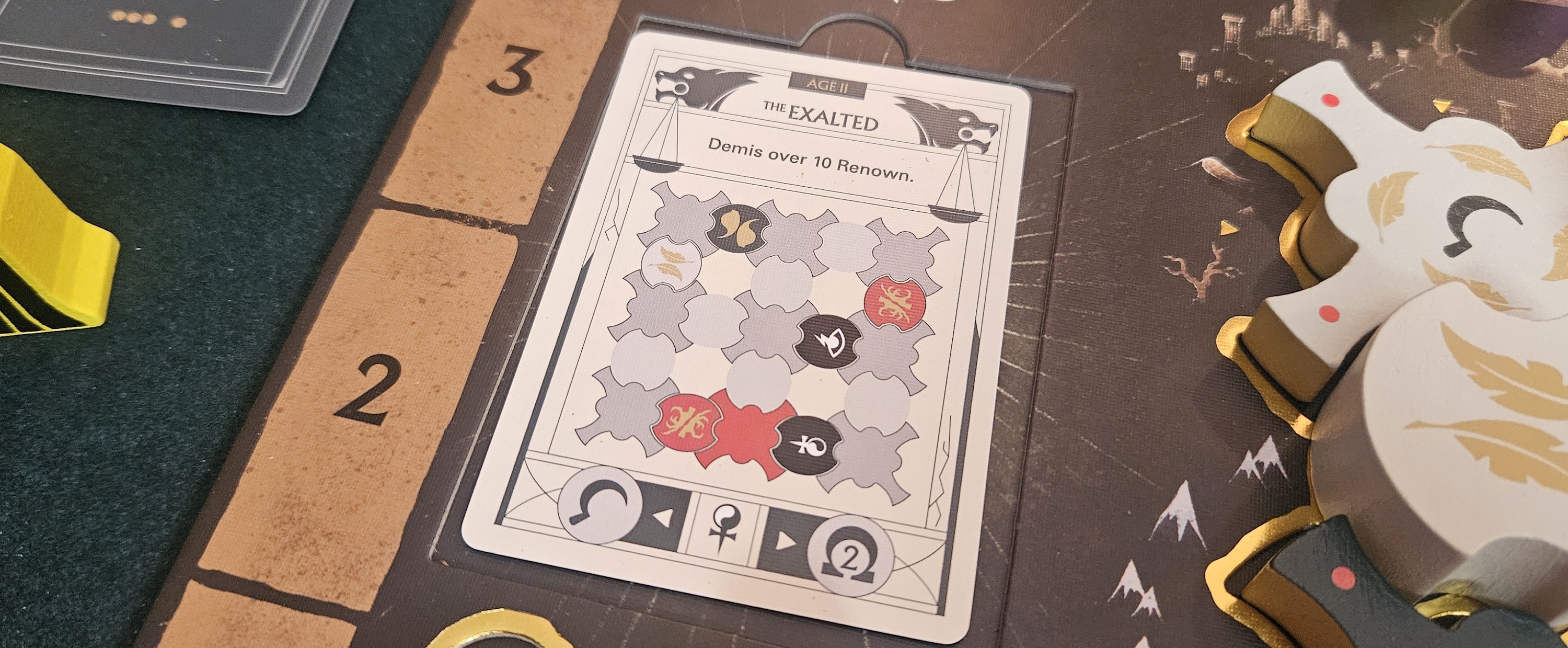
But the game’s more explicit tool is provided each age. Scales of Fate takes place over three rounds, each of which provides a different criterion that will be checked at the round’s end. Early on, for example, you might be required to inform your opponent whether you have any demigods out of play. That means they weren’t sent to the board, whether to trigger actions or because someone blasted them down to the underworld. Later, your suspicions might be confirmed by evidence of divine parentage for any demigod placed on a highlighted action pillar.

Crucially, these cards ask yes/no questions rather than demanding specifics. If you’re clever enough to ensure that only one of your two children meets the current age’s criterion, you can simply say “yes” to their presence without giving too much away. For example, one first-age card asks whether one of your children is still seated at four to six renown on the track. Saying yes is almost worse than saying no, especially if nearly all of the demigods have yet to make a name for themselves.

In the meantime, nearly everything adjusts their standing on the renown track. When servants trigger quests — the cogs that surround the action pillars — the surrounding demigods shift up or down. When sent to the underworld, another action will determine the place’s magma forecast, thus providing feats or humiliations that also adjust their standing. Every little detail matters.

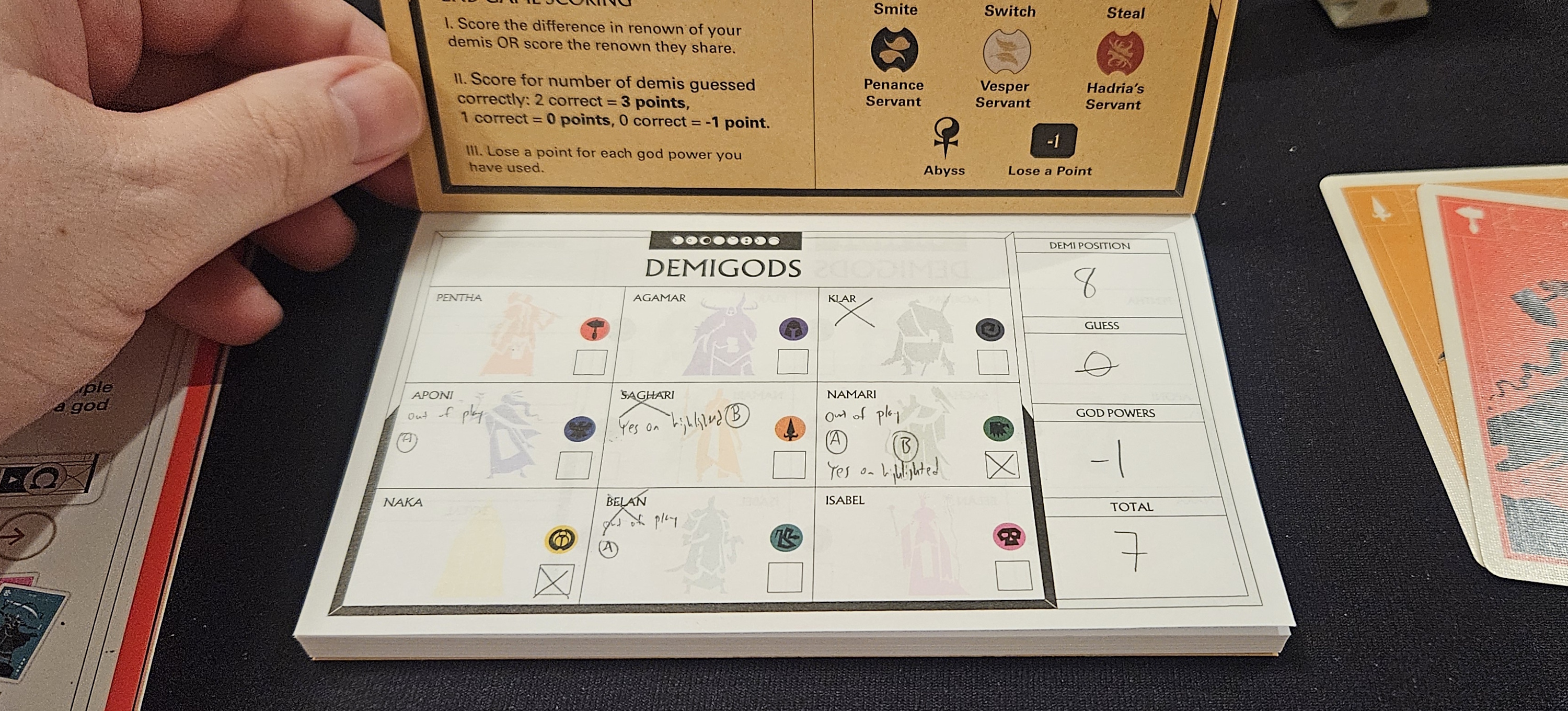
Shown: What my detective notebook would look like. "(A) or (B)! If x is guilty, then y is probably not. Syllogism: ö ≠ ü."

Now that’s nice.

And we still haven’t talked about the game’s cleverest touch. Remember when I mentioned we would return to the question of your children’s parentage? Turns out this pantheon is rocking one big orgy, with all the problems it poses for any paternity/maternity/sea-foam tests.

In most deduction games, including the basic rules for Veiled Fate, holding a card means nobody else is holding it. In Scales of Fate, both sides have their own duplicate deck. Just because your children are Agamar and Saghari doesn’t mean your rival won’t have some personal interest in one of them as well. Maybe even both of them, although that’s unlikely. This adds no small amount of static to the ongoing deductions. When one of your demigods gets bumped off their current space, is that because your rival has figured out that they’re your kid and is trying to mess with you, or are they chasing an ambition of their own? Some of my favorite matches have featured duplicate offspring, and while this calls into question what’s so demi- about these so-called demigods, it’s a brilliant addition to a shared-control deduction game.

That goes for the entire package. To some degree, I wish I could play a version of this game that featured more than two players. The idea behind Veiled Fate was always one that appealed to me, and while it finds its best expression here, there’s a slightness to Scales of Fate that I wish would be transposed into a more robust framework. Of course, it’s entirely possible that this game only functions because its manipulations are so laser-focused. It’s generally possible to figure out your rival’s progeny. At least one of them. I’m not sure that would be the case if we had to keep an eye on three other players rather than staring down only one person.

Along the way, there are other little touches that elevate the experience. Like the game-breaking powers that let you smite anyone or swap two demigods, but subtract points from your final tally. Or the way the end-game deduction rewards a correct genealogical discovery but only penalizes you for not uncovering at least one of your rival’s kids. Like the board’s cogs and pillars, everything locks together into one elegant whole, resulting in a crystallized experience where nothing is out of place.

This is my extended family reunion at this point. We barely know each other, but somebody's gonna bring up that time you did the thing when you were eleven.

Chillin’ with the cousins.

Honestly, it’s such a breath of fresh air. Not only that Scales of Fate is this good, but that it takes such a novel approach to almost every corner of its design. From the non-literal map to the way it uses relative proportions to signify importance, both on the board and between renown trackers. From the clever approach to shared control to the way players might find themselves accidentally co-parenting a demigod. It’s achingly smart.

More than smart, it feels great to handle, to push around, to study a rival and mark down a clue. When I first saw Scales of Fate, I knew I had to figure out how those pieces fit together. The beautiful thing is, their inner workings proved even better than they seemed from afar.


A complimentary copy of Scales of Fate was provided by the publisher.

(If what I’m doing at Space-Biff! is valuable to you in some way, please consider dropping by my Patreon campaign or Ko-fi. Right now, supporters can read my first-quarter update of 2026: the best board games, movies, books, and more!)
Gods in All Their Fickleness

21. April 2026 um 01:49

are those the pillars

Ah, Veiled Fate. It’s been a while since we encountered IV Studio’s game of spurious divine parentage. At the time, it was dearly close to becoming a favorite, but its shortcomings were sufficient that the possibility was as scuttled as my own Olympian provenance. Now the team behind the original game — Austin Harrison, Max Anderson, and Zac Dixon — have revisited the concept via not one but two separate titles.

Today, we’re looking at the one that recasts the whole thing as a lane-battler. What could possibly go wrong?

or maybe it's the literal pillars

I think the lanes are the pillars.

The first time I played Pillars of Fate, it seemed like a stroke of genius. Maybe two strokes of genius folded together into an omelette of genius.

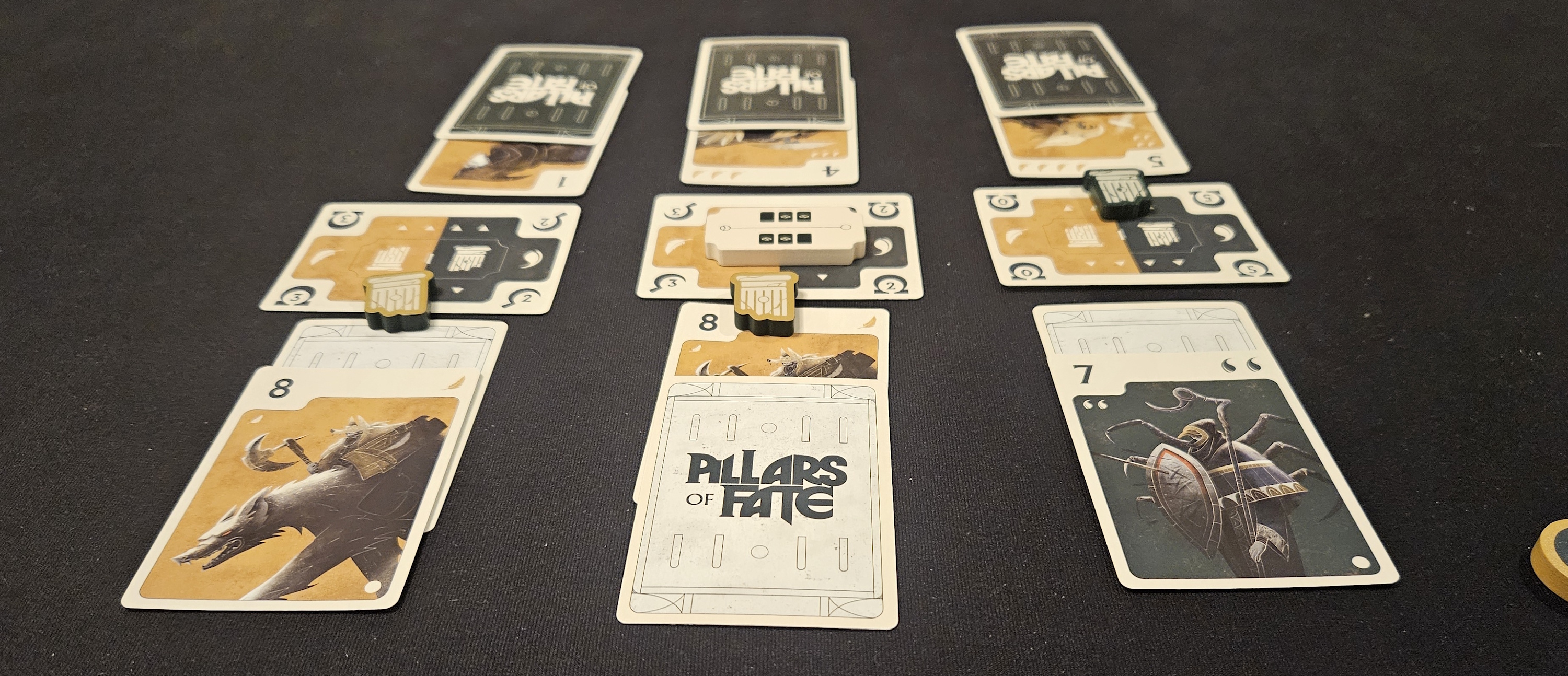
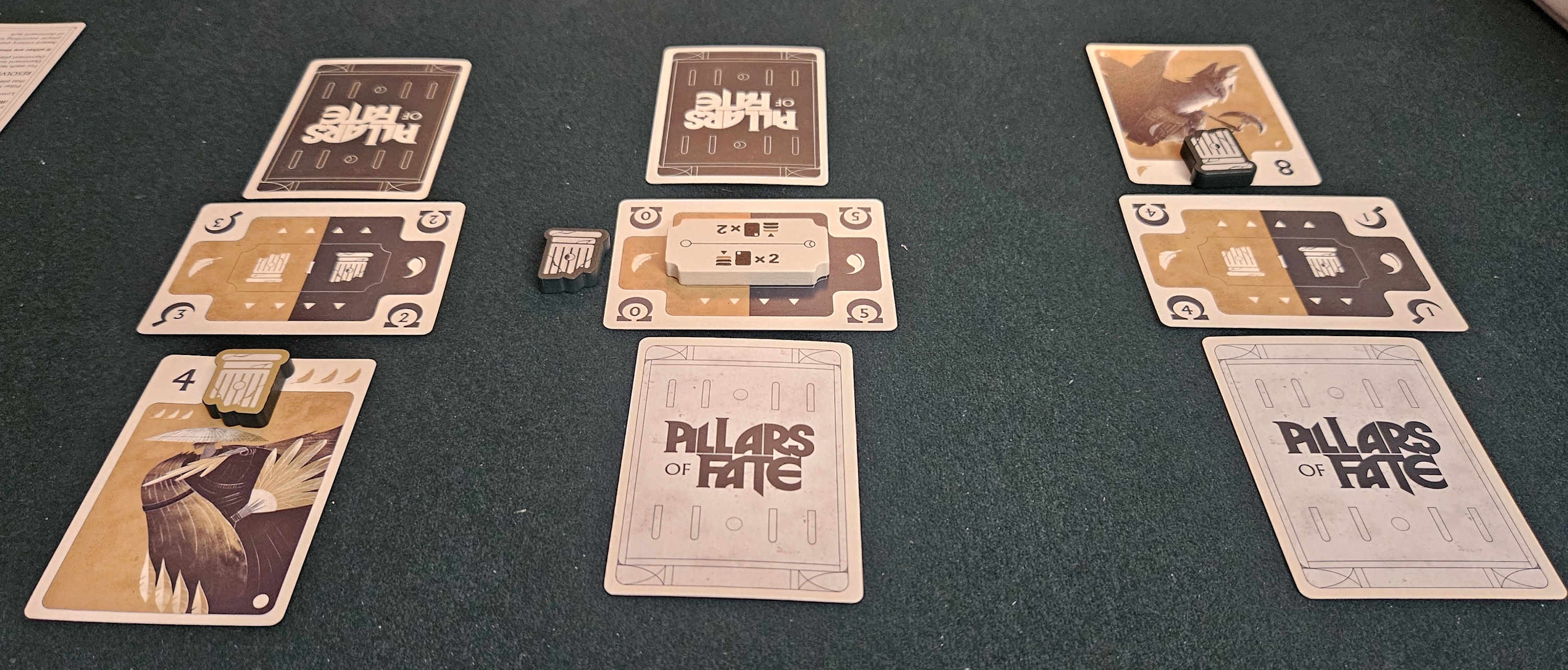
The idea is wonderfully simple. There are three lanes between players. Each lane has two separate scoring values. In all cases, one is higher than the other. Most of the time, the distance between them is so great that the lower range dips into negative points.

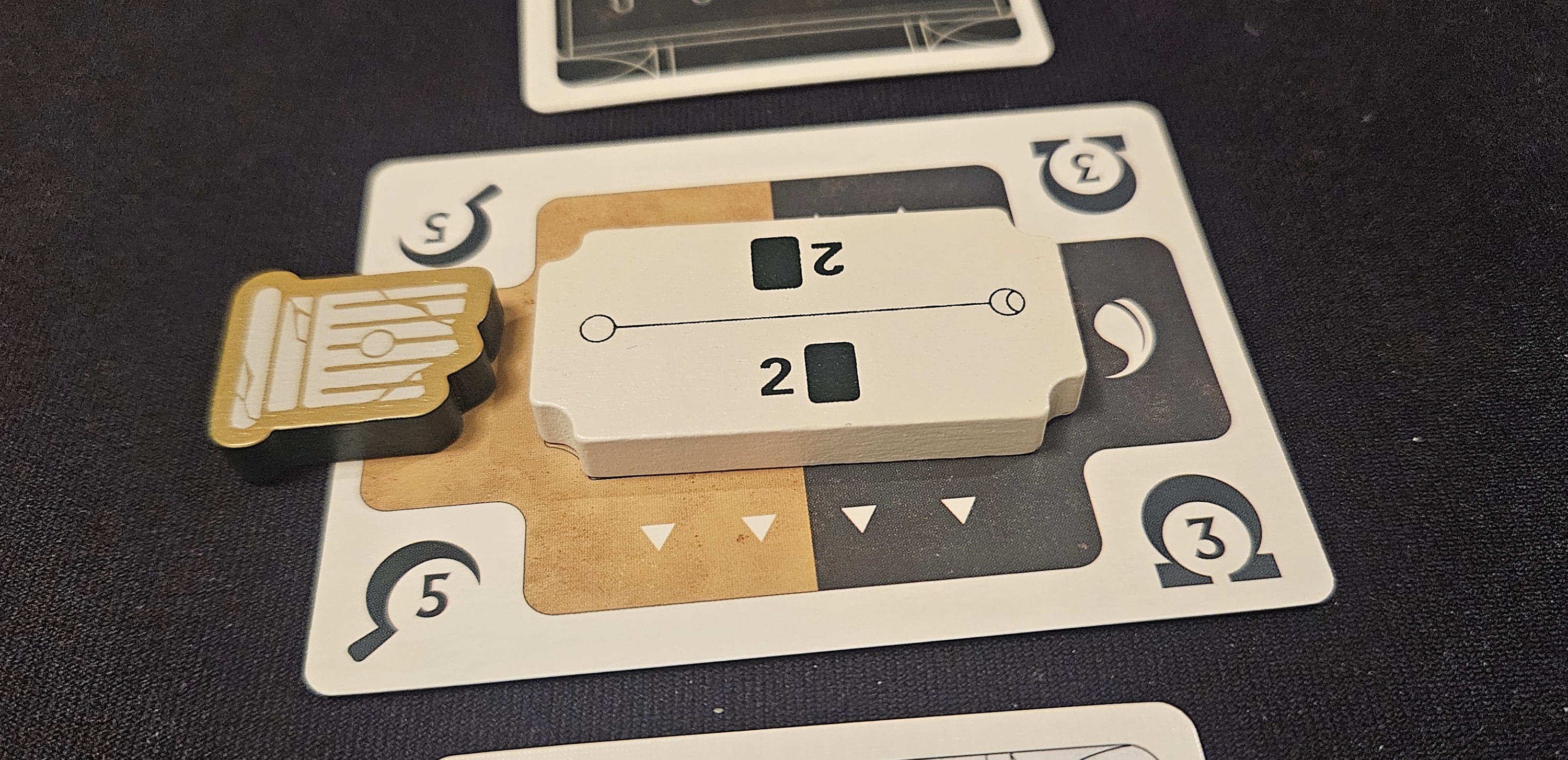
Into these lanes both would-be divinities play cards whose strength determines which side wins the contest. Obviously. So far we’re evoking, what, every lane-battler? What’s less obvious is that those cards also determine which scoring value the lane will trigger. Play feathers, the game’s symbol for its “light side,” and that’s the scoring that’ll be awarded to the stronger player. Conversely, a greater number of scorpions means the stronger player will earn the points on the “dark side” of the card.

To be clear, there’s no hard correspondence between “light” and positive points or “dark” and negative points. It’s entirely possible that feathers will spell negative points and vice versa. This introduces the first and most notable of a few graphical issues. Namely, that the points themselves are not color-coded. Whether feather or scorpion, light or dark, positive or negative, the points are rendered in the lane’s neutral hue. In our experience, it’s a missed step that bore rotten fruit on more than one occasion, making the lanes that much harder to read. And, in some cases, to reach the conclusion of a round and realize we’d made an early misstep in our understanding of a particular lane’s stakes.

Oops. Oh well. That’s on us, I suppose. Back to the grindstone.

I want that guy's hat.

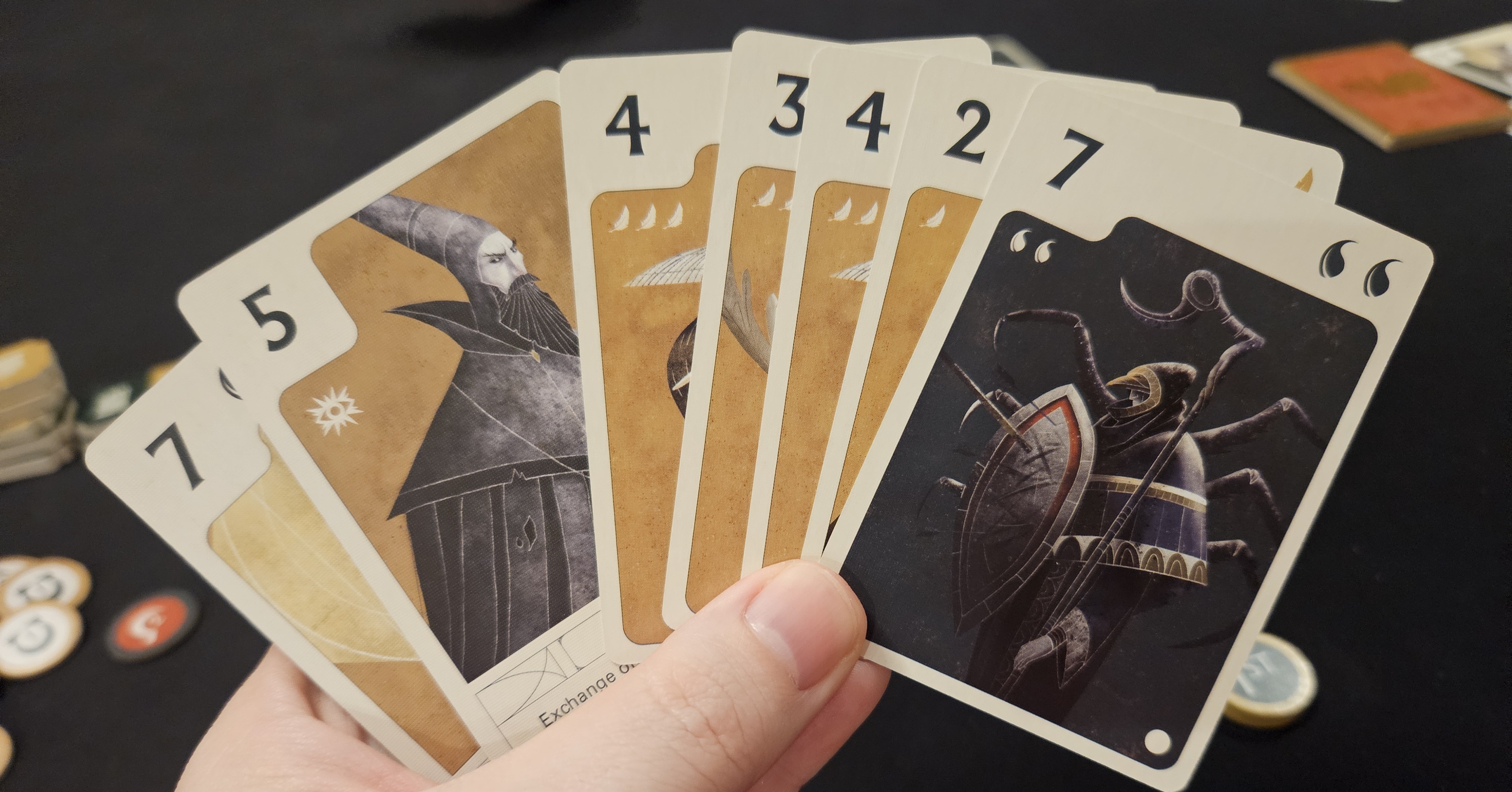
Most cards are simple: strength and suit.

Over the course of three rounds — more epically entitled “ages” — those spills of positive and negative points veer back and forth. Sometimes you win a coup, others you find yourself toppled from heav’n’s lofty pillars.

Again, it initially feels genius. There’s room for subtlety. Each lane can accommodate a face-down card per player, allowing both sides to conceal their motives. Is your opponent trying to win that lane with their best cards, or nudging it toward a negative scoring value in the hopes that you’ll invest all your strength there instead? Most cards are straightforward strength values and feather/scorpion icons, but their possible range — as low as one strength, as high as nine — is enough to ensure some major swings.

And then there are the demigods. There are twenty of these special foil-embossed cards in all. (Although only their backside is so visibly rendered, another misstep of design that makes them a little harder to pick out from the crowd than I would have preferred.) Both players receive three at the beginning of the game, and then, after swapping a couple, can only deploy one per age.

As you might expect, the demigods are potent indeed. There’s the Mother of All, a real jerk who awards ten points if you lose all three lanes in an age — a blow that’s significantly lessened if by “losing” you really mean “your opponent just received thirteen negative points.” Or Naka, a demigoddess who has to be played face-up, but allows your other two lanes to hold two face-down cards instead of only one. So much for your rival’s headspace. Others are dead simple, like Vesper and Penance, both of whom have zero strength but so many feather or scorpion icons to single-handedly determine the status of a lane.

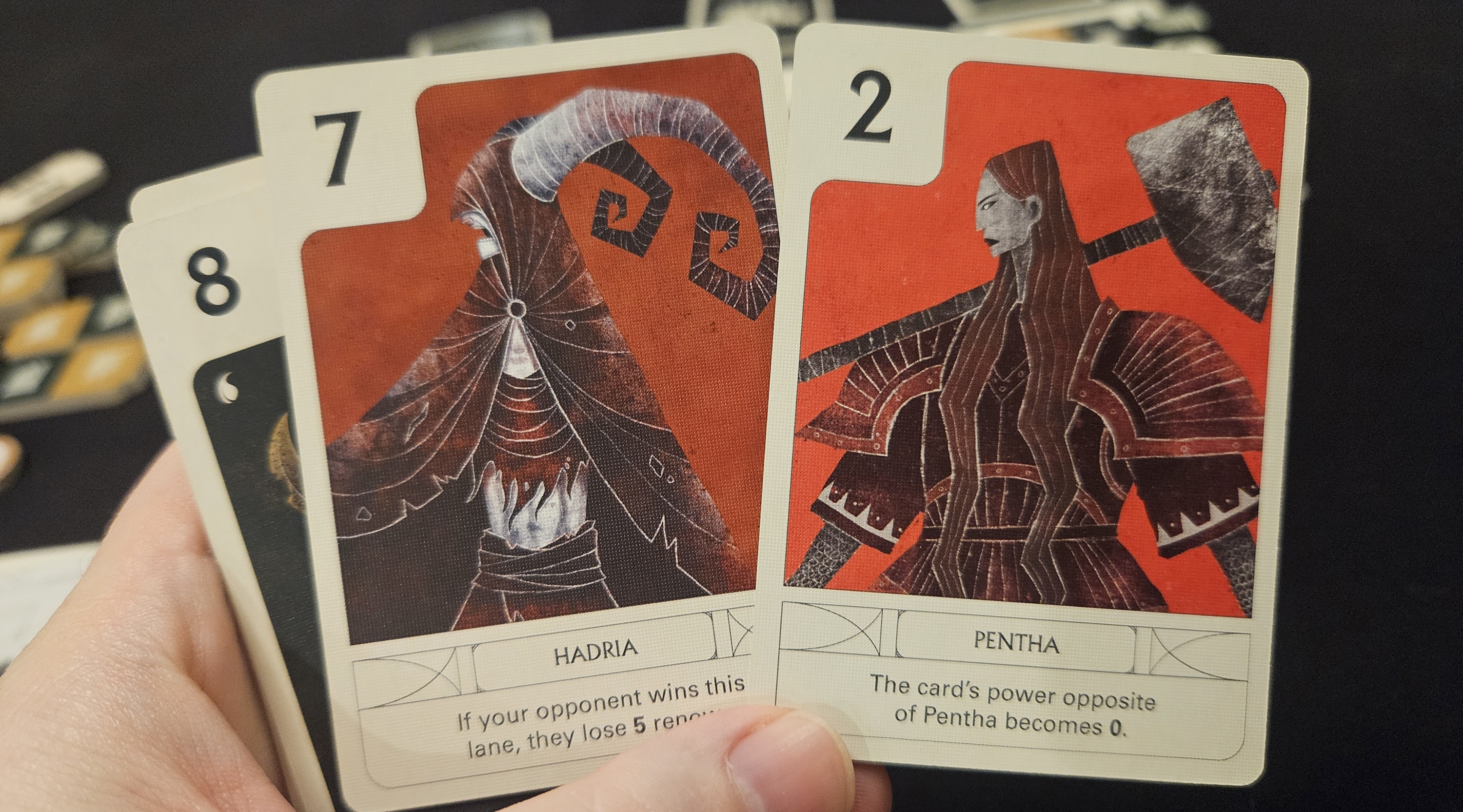
Despite this potency, not every member of this demipantheon is equivalent. Some cards are harder to utilize than others, and how. One, Hadria, dings your opponent five points if they win that lane, but boasts a hefty seven strength, forcing you to measure your other deployments carefully. The Steward alters the scorpion/feather composition of lanes bordering his holy self, but not by very much. These cards are still powerful if deployed smartly, but can also threaten to detonate in your face, making them as mercurial as Hercules was a family man. (Too soon?)

I love the art style, it must be said.

Demigods upend the usual rules.

This probably sounds good. Smart. Possessed of a spirit of genius. It did to me as well.

But there are problems, and not all of them are as minor as the game’s graphical omissions. Take, for example, the way cards are parceled out. Both sides have an identical deck of 32 champions, the little non-demigods that make up the bulk of your army. As noted earlier, the range on these cards is extreme. Some have strength as low as one. Others stretch up to nine. And while there’s some correlation between a card’s strength in battle and its capacity to manipulate the value of a lane, this isn’t always the case.

Put another way, Pillars of Fate is unusually subject to the vagaries of the draw. Missing out on a high card or two can prove disastrous. And that goes double if you find yourself poorly armed and holding the first-player token. Because let me tell you, going first in Pillars of Fate is the pits. Every turn leaks another crucial missive to your rival, letting them play reactively and with such precision that each and every one of your moves becomes Sisyphean. Play a card, watch it get countered. Play a card, watch it get countered. Fill a lane, watch your opponent take their sweet time responding. Really, you’ll almost certainly fill all three lanes in advance of your opponent. This often proves disastrous.

And there are none of the mitigating systems that have found their way into other lane-battlers. There’s no ability to withdraw a bad hand, as in Jon Perry’s Air, Land, & Sea. John Clowdus’s Omen: A Reign of War fills its war-torn cities with so many special units that they’re effectively all demigods, producing wild swings that can’t be entirely countered. Even The Old King’s Crown, itself a freshman design by Pablo Clark, understands this problem, asking players to assign cards to their lanes simultaneously rather than let trailing players repeatedly one-up the leader.

The result is a lane-battler that feels bad as often as it feels brilliant. That makes its face-down cards such potential swings that they’re agony to reveal at the age’s conclusion. That generally goes to whomever held the first-player token least. Somebody will, by the way. Hold that accursed token the least. The game is three ages long, remember. Even something as small as a fourth age might have mitigated the worst of the game’s imbalances.

The feathers/stingers are both curled, sharp-ended icons... which is a bit non-distinct as well.

The components are lovely.

To be clear, these issues don’t ruin Pillars of Fate. The game’s smartest touches are still present and accounted for. In particular there’s the way lanes can be manipulated to turn a rival’s momentum against themself, the points-tallying equivalent of judo. Oh, you’ve deployed your most strong-armed champions to this distant battlefield? Oops, the only prize here is a cornucopia of spoilt meat. In those moments, the game shows itself at its most devious.

At some level, I even feel the same way about the demigods. I wish they had been a little more level, ability-wise, so that some weren’t such obvious picks compared to their siblings. But the game’s restraint in only allowing one per side per age is noteworthy, keeping the contests a little tighter than they might have been otherwise. Sure, the huge gap in their strength — in all units’ strengths — makes outcomes a little harder to preempt and keeps the game’s fickleness intact. But when things are going right, those become strengths rather than frustrations. It’s just hard to know which way the game will go.

My greatest reservation, really, is that there are so many excellent lane-battlers right now. I’d rather play any of the titles I mentioned earlier. I’d rather play Compile. I’d even rather play Riftforce or An Empty Throne. It doesn’t help that Pillars of Fate somehow misses out on its predecessor’s potential. You aren’t a god pushing around progeny. You’re a big dude with an army of your own. That’s fine enough, but as another stab at what made Veiled Fate so interesting, it travels toward an entirely separate heading, and a much less interesting one at that.

Okay, here’s one way in which Pillars of Fate recaptures that spark. If you remember Veiled Fate, you might recall that sometimes its contests were determined by the flip of a coin or the turn of a card. There are no coin-flips in Pillars of Fate, but the wildness of those champion decks and the testiness of its demogods often results in a similar caprice. After all this time, one’s fate might still hinge on whether they’re holding the right cards. And a first-player token.

There's some incentive to play face-up because you earn the tie-breaker pillar. But ties are relatively uncommon.

In the early stages, most cards tend to be concealed.

Here’s the good news: Pillars of Fate isn’t alone. Its sister title, Scales of Fate, offers another attempt to make good on the promise of Veiled Fate. We’ll take a look at that one tomorrow, but I’ll tip my hand right now: that one got it right.

As for this one… well. Despite its flashes of brilliance, sometimes even a genius can prove more trouble than they’re worth.


A complimentary copy of Pillars of Fate was provided by the publisher.

(If what I’m doing at Space-Biff! is valuable to you in some way, please consider dropping by my Patreon campaign or Ko-fi. Right now, supporters can read my first-quarter update of 2026: the best board games, movies, books, and more!)
Hey! A Place I’ve Actually Been!

16. April 2026 um 21:16

I'm still not sure about this preview thing. I think it's useful, but also, this game is unlikely to change between now and production. But is "preview" a warning that the details are subject to change, or a warning that the game isn't available to purchase yet? I'm still not sure.

At this point, it doesn’t seem far-fetched to crown Josh Wood the king of tableau-builders. Yes, yes, like a trampler of horse glue I’m invoking Santa Monica yet again, but the more relevant touchstone today is Let’s Go! To Japan, a lovely, if flawed, game about planning a vacation to Tokyo and Kyoto.

Let’s Go! To France is Wood’s follow-up to that latter title. It tackles every single one of my reservations with that game, and then goes on to produce one of the most delightful, evocative, and grounded tableau-builders I’ve ever played. Maybe it helps that I’ve actually been to France. More likely, it’s that Wood knows precisely what he’s doing with every mechanism, component, and locale.

"Tower" is a good example. I know better than to attempt anything else, even if I can say it correctly. I still get guff for having a jokey pronunciation of "Versailles" in a previous review. So many people earnestly believed that I really pronounce it Ver-sah-ay-LEES. I still get messages about that one.

I can even pronounce some of these words.

It’s going to be hard to not turn this into a comparative review with Let’s Go! To Japan, so let’s open with the basics. Let’s Go! To France is a game about planning and executing a trip. Not just any trip. A two-week trip to Paris and some portion of wider France, undertaken day by day and hour by hour.

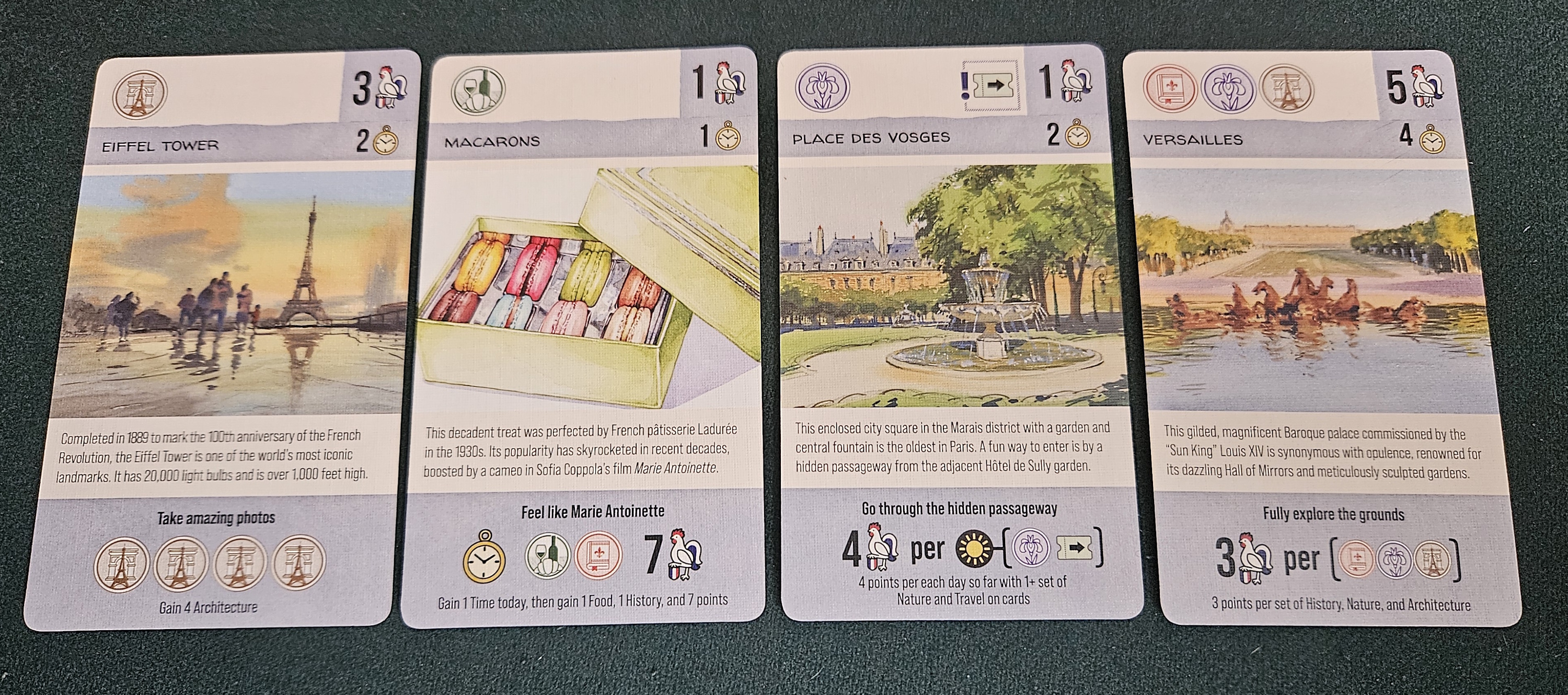
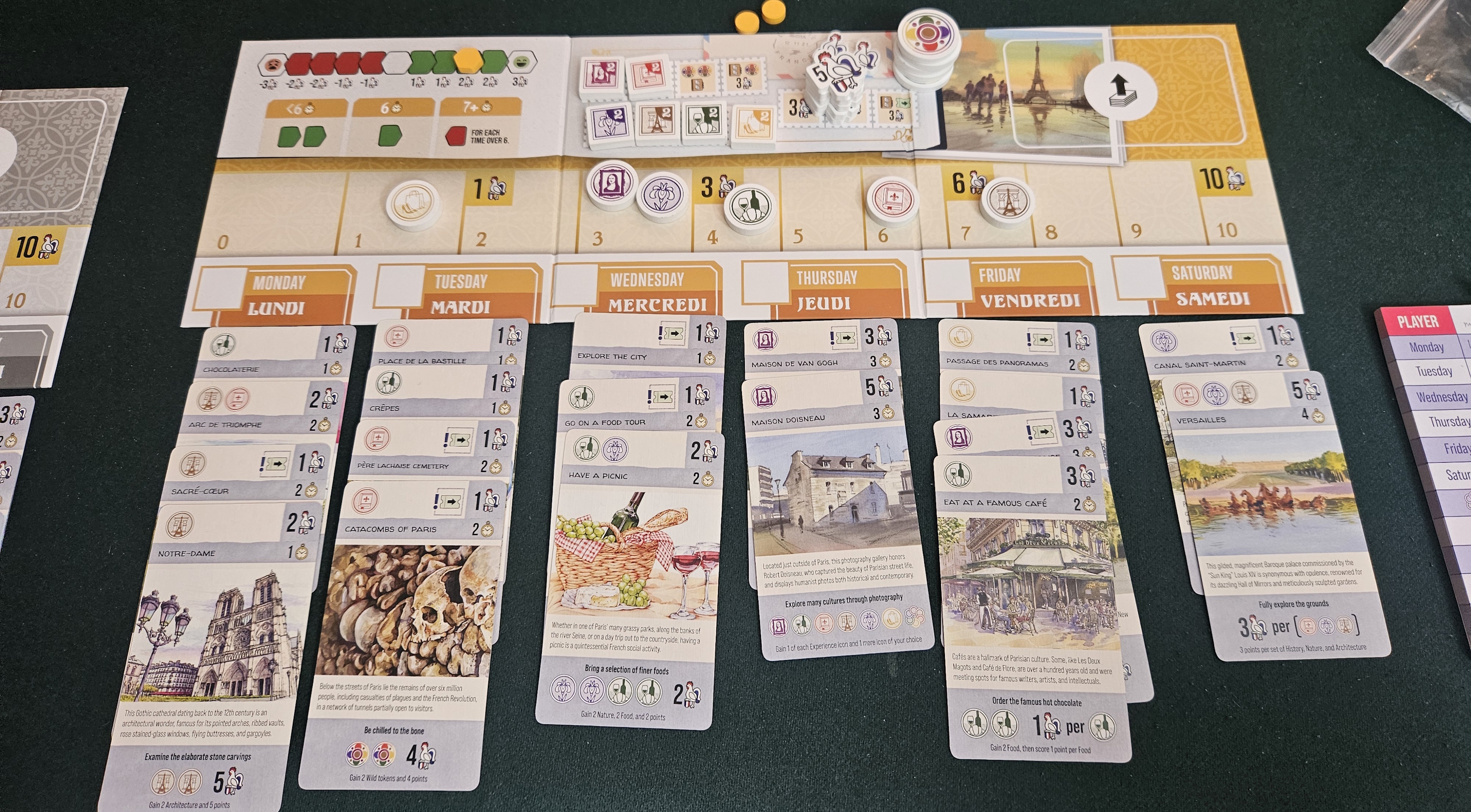
For all that, there’s an elegance to the whole thing. Turns are presented as simple drafts. You receive some cards. One or two of them will get scheduled into your itinerary. The rest are passed around the table. The cards each present a different activity in Paris: visiting a museum, snacking on delicacies, touring a park, shopping at an open-air market, finding an overlooked nook that you’ll boast about to friends for years to come.

Each card has four main components. Victory points — self-explanatory — some icons that increase the appeal of your trip on a numbered track, the amount of time required to fully visit that card, and lastly a scoring opportunity that will only trigger if this is the final event scheduled on any given day. Your objective is largely about optimizing scoring. To offer but one example, visiting the National Archives earns three points for every history icon you placed on that day. That’s a tremendous opportunity if you’ve arranged a day full of tours, but is easily dismissed if you’re planning on shopping or eating instead.

Those other considerations are no slouches, either. It’s possible to absolutely cram a day with activities, but your energy level will suffer, possibly resulting in subtracted points. There are also ideal conditions for each day, earning little bonuses for visiting the park when it’s clear outside or stuffing yourself with pastries on what I imagine is your cheat day. And if nothing appeals, Wood returns with a trick he deployed to great effect previously, letting any card flip to its reverse side to become a generic “Explore the City” activity.

I'm pretty sure some of these are just big cities, but look, if it isn't Paris, it's country, got it?

Spending a week in the country before heading to Paris.

If you’ve played Let’s Go! To Japan, this likely sounds familiar. Indeed, nearly everything here resembles Wood’s previous title, but has become the beneficiary of little tweaks that mark this as the far superior outing.

For instance, there’s the way those Explore the City activities are handled. Previously, exploring Tokyo or Kyoto resulted in your tableau receiving a random card during scoring. This could make or break your day, interjecting some randomness into what was otherwise a carefully structured experience. Here, exploring the city is its own pleasure; one doesn’t need to stumble upon a museum or garden to justify their time spent in Paris. This keeps your tableau in check and feels more appreciative of what makes such a trip worthwhile. Just being here is enough.

Similarly, the ideal conditions for each day are now portrayed as guidelines rather than dictates. It’s worth assigning activities to the corresponding days, but this is only mildly beneficial, and only the first two times you do it. Beyond that, you’re free to schedule your days as you see fit, without worrying that you’re missing out on another drizzle of points. It’s a small thing — basically, you’re earning a benefit just a little earlier than in the previous game — but it goes a long way toward letting you shape your own trip rather than ensuring there’s a history day, a food day, an architecture day, and so forth.

Wait a minute, how dare you name a place Les Invalides? That should be reserved for hospitals and... [touches earpiece] it's a what? Ahem. Never mind.

The tableaux here are much more flexible than those in Let’s Go! To Japan.

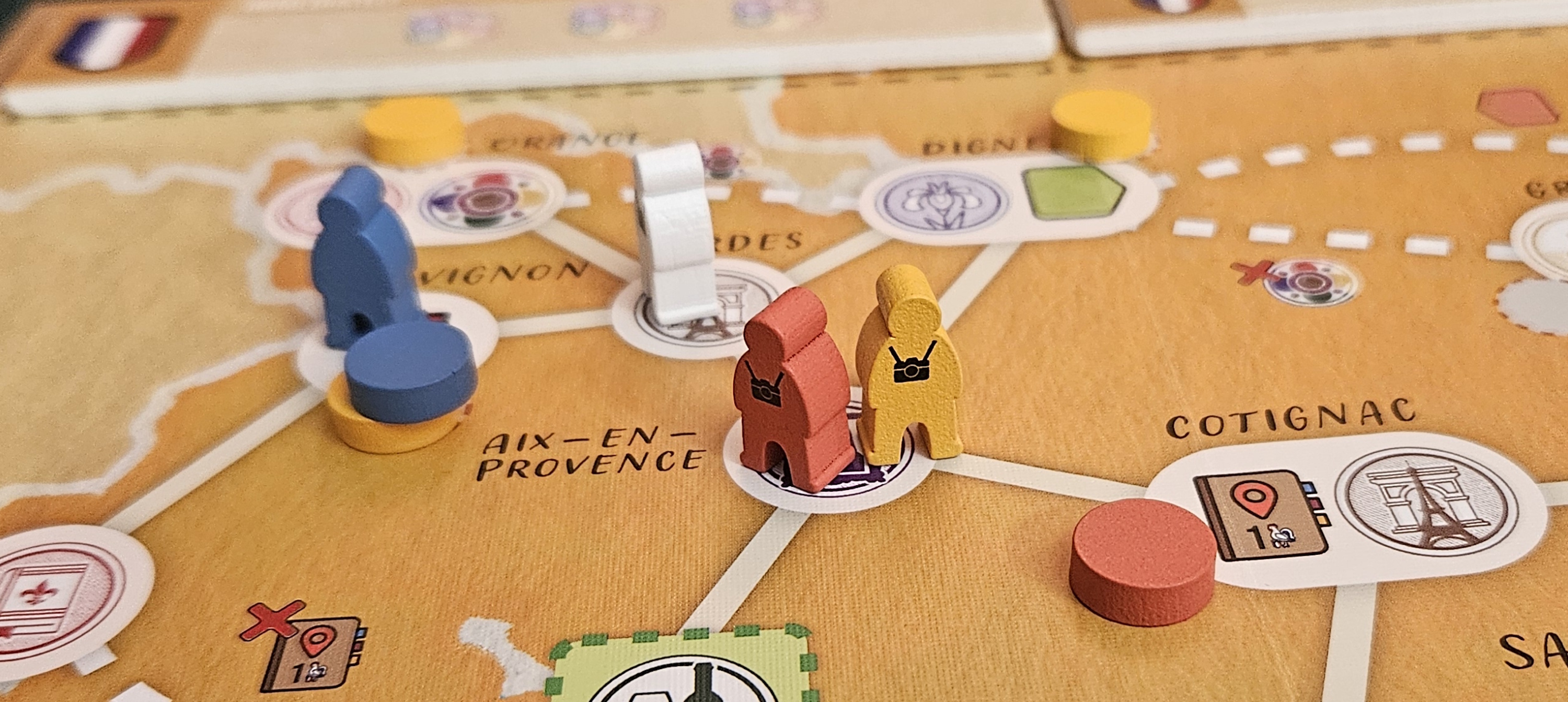
The larger change is more structural. Where the previous game saw your vacationer shifting between Tokyo and Kyoto, a system that demanded its own train-hopping minigame, Let’s Go! To France instead divides its trip into two portions. Your main tableau actually represents the second week of your vacation, resolved during scoring. As you place cards into your tableau, however, you might trigger tickets that move a pawn across the countryside. Depending on your destinations — and which region you’ve chosen for the group to explore — it’s possible to begin your week in Paris having already seen some sights, earned some tokens, or maybe even secured a special scoring condition or two.

At times, there’s a sense of vague translocation. You are, in effect, planning Schrödinger’s Vacation, the cards signifying events in both past and future. But it’s a mild discombobulation at worst, one that lasts maybe five minutes before everything snaps into place. The overall process is much smoother than the previous game’s swapping between cities, and provides ancillary benefits to the game’s usual procession of daily scores.

You might, for example, begin your week in Paris already tuckered out from your time in the Loire Valley, prompting you to take it easy for a couple of days or chow down on some crepes for a sugar rush. Or perhaps you’ll arrive already enculturated by old architecture, letting you take advantage of a daily highlight that requires a certain number of icons before awarding big points. Where previously these objectives would only pay out in the later portion of your trip, it’s now possible to assemble a more robust tableau, one that feels rewarding from start to finish.

a Belinda's Big Bonus, on the other hand? erm.

I appreciate a bonus.

As before, scoring is an active portion of the game, an event in and of itself where players walk through their trip one day at a time, tallying points and keeping track of their relative energy levels. This helps to digest the game’s point-salad fiber, but it plays an even more important role in contextualizing Paris as a geographic space with its own character and identity.

I’ve often praised Santa Monica as an ideal tableau-builder for the way it asks players to not only create a space, but also to inhabit it, to move around in it, to poke around its nooks and crannies. With Let’s Go! To France, Wood replicates the trick, albeit via an entirely distinct set of mechanisms and representations. This is Paris as a location out of time, the city that is at once a tourist trap and timeless. Around every corner there’s something new to see, some fragment of history that has been improbably preserved across the ages.

And that sense is communicated above the table as well. As one friend put it, you could take the deck to Paris as a reminder sheet of everything there is to see and experience. Playing this game, we found ourselves discussing the spots we’d seen and those we hope to see some day yet to come. The overlooked garden with the hidden entrance, where one friend drank wine and conversed with a farmer. The museum that sparked my imagination more than any other I’d ever walked. The sheer looming size of something. The joy of ducking into a random cafe and having one of the finest meals of your life.

I'd try to squeeze in a meal on Saturday, though.

I’d do that.

The effect is magical. In a sense, Wood has created a transposition of his own, a game at once past and future, both reminiscence and future itinerary.

He’s also crafted a game that’s nearly without parallel. That its best comparisons are Wood’s own past creations is a testament to his skill with this particular medium, but also to the city he’s chosen for us to experience all over again. In improving on its predecessor in nearly every way, Let’s Go! To France deserves its peculiar punctuation. Let’s go, indeed.


A prototype copy of Let’s Go! To France was temporarily provided by the publisher.

(If what I’m doing at Space-Biff! is valuable to you in some way, please consider dropping by my Patreon campaign or Ko-fi. Right now, supporters can read my first-quarter update of 2026: the best board games, movies, books, and more!)
❌