 Anmelden


Blood in the Felt
The original Fallout — the original original, the video game, the one from so long ago that they refused to sell it to me at the media section of my local grocery store because it was rated M for mature and as a twelve-year-old they suspected I didn’t qualify — it had a time limit. After a certain number of in-game weeks, the quest failed. Sayonara, Vault 13. Sorry about the terminal dehydration.
You know what else has a time limit? My life. Your life. All of our lives. I was once advertised a wall calendar that would count down the weeks in the average lifespan. It was perhaps the grimmest thing I’ve ever seen, one’s life scratched off week by week. Fallout: Power Play is that ghoulish product in board game form. It is a waste, the subtraction of every minute in its presence keenly felt. If the function of art, as Tarkovsky noted, is to harrow the soul and prepare it for death, then Fallout: Power Play is anti-art. It is a game that makes me unready for the beyond, incurious to receive the answer to the great mystery that awaits us all. It makes me resentful and crabby. It makes me want to claw those minutes back from the felt and stuff them red-nailed into the craw of whichever anonymous designer retched forth this slouching antichrist.
I do not recommend it. Not ironically, not for a sake of a lookie, not to release its carbon back into the atmosphere through combustion. Stay away. The radioactive skeleton has been thus mounted atop the dump, its meaning undeniable. If you enter here, you will leave poorer.
The distant appearance of a lane-battler.
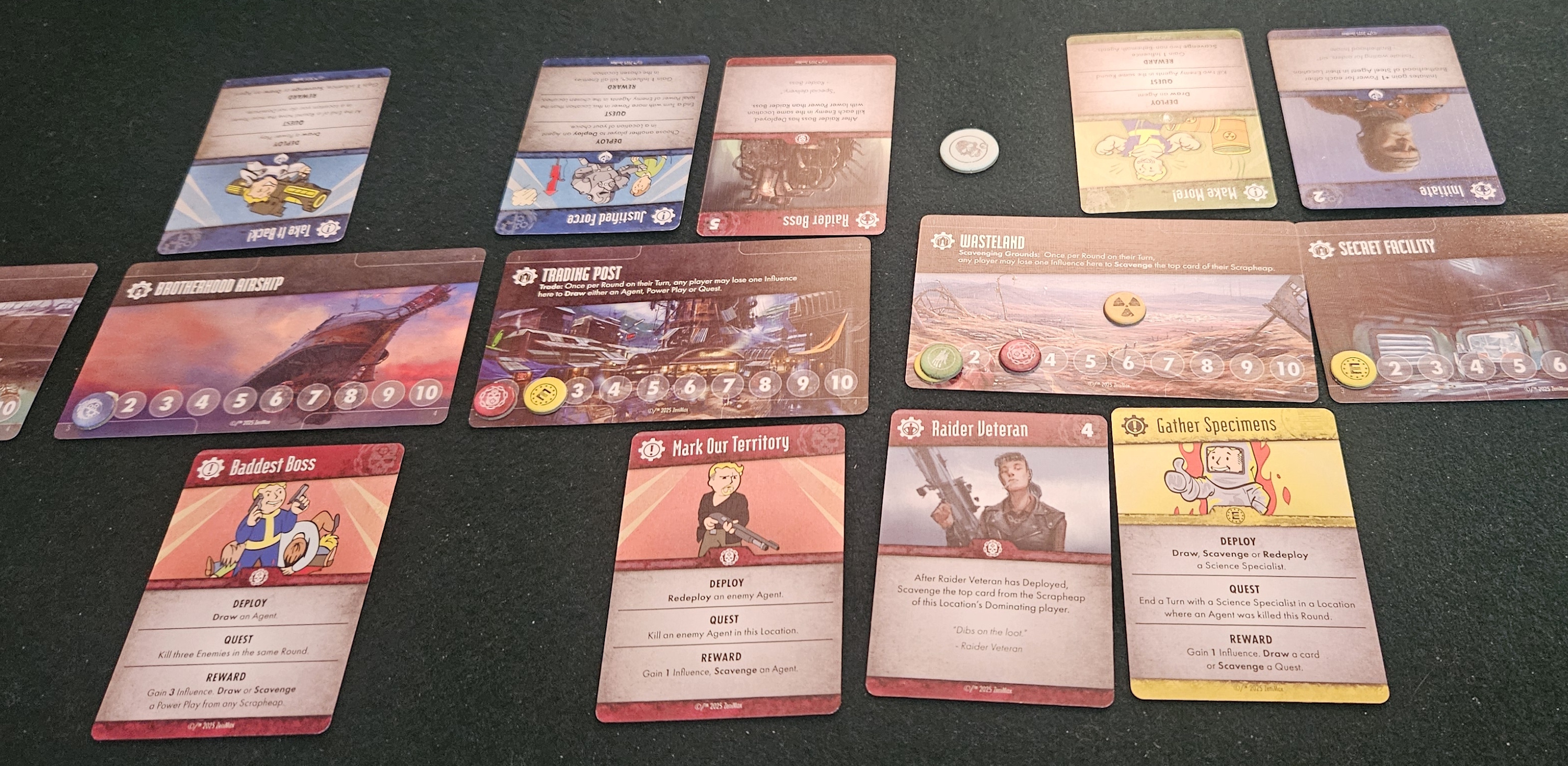
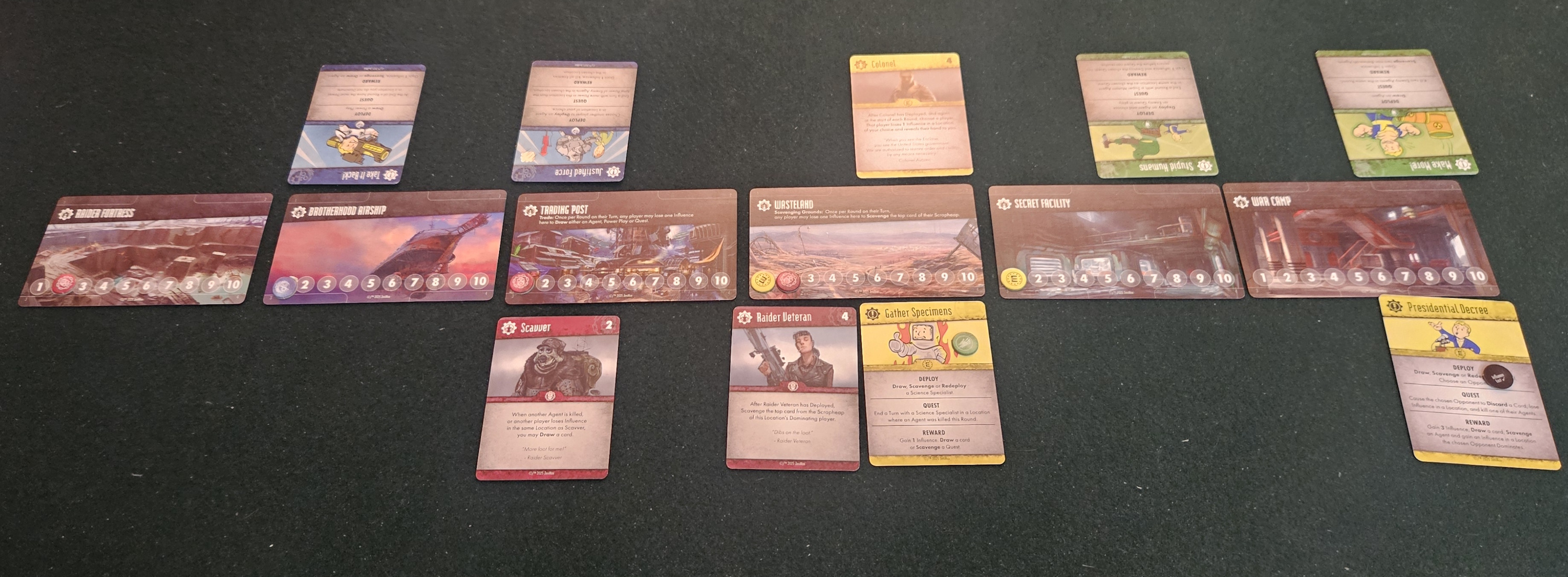
Ostensibly, Fallout: Power Play has the outward appearance of a lane-battler. The wasteland is presented as a series of locales, theme-park destinations like the Brotherhood Airship, the War Camp, the Trading Post. Generic and safe, like every Fallout after the first two and New Vegas, strip-mined for maximum return on investment.
Into these locales you will deploy — you will maybe deploy, but we’ll circle back to that — the populace of your faction. There are four in all. Most familiar even to outsiders is the Brotherhood of Steel, those much-fetishized techno-cultists, in their iron suits that smell of piss and incense. They are matched by the Enclave, the baddies of the series, although only in the sense that they are slightly less nostalgically laden; the Super Mutants, greenskin crazies shorn of the cognitive internality that marked their earliest incarnations in the video games; and the Raiders, who one suspects were included because the designer was running out of ideas but had been tasked with shoehorning in loony-bin scavengers for the sake of marketability.
Ostensibly — there’s that word again — these factions go about the business of deploying their scientists and tin-can warriors and yellow-toothed scavvers and greenskin mooks into these locales, with the aim of securing influence and therefore victory points one pip at a time.
Only, as you might have guessed, this is not what happens. No sir. No ma’am. Not even close. Balance isn’t something I usually fret over. It’s a coward’s concern, the birthright of those mewled into comfort from infancy. Balance? I might as well bellyache about fairness!
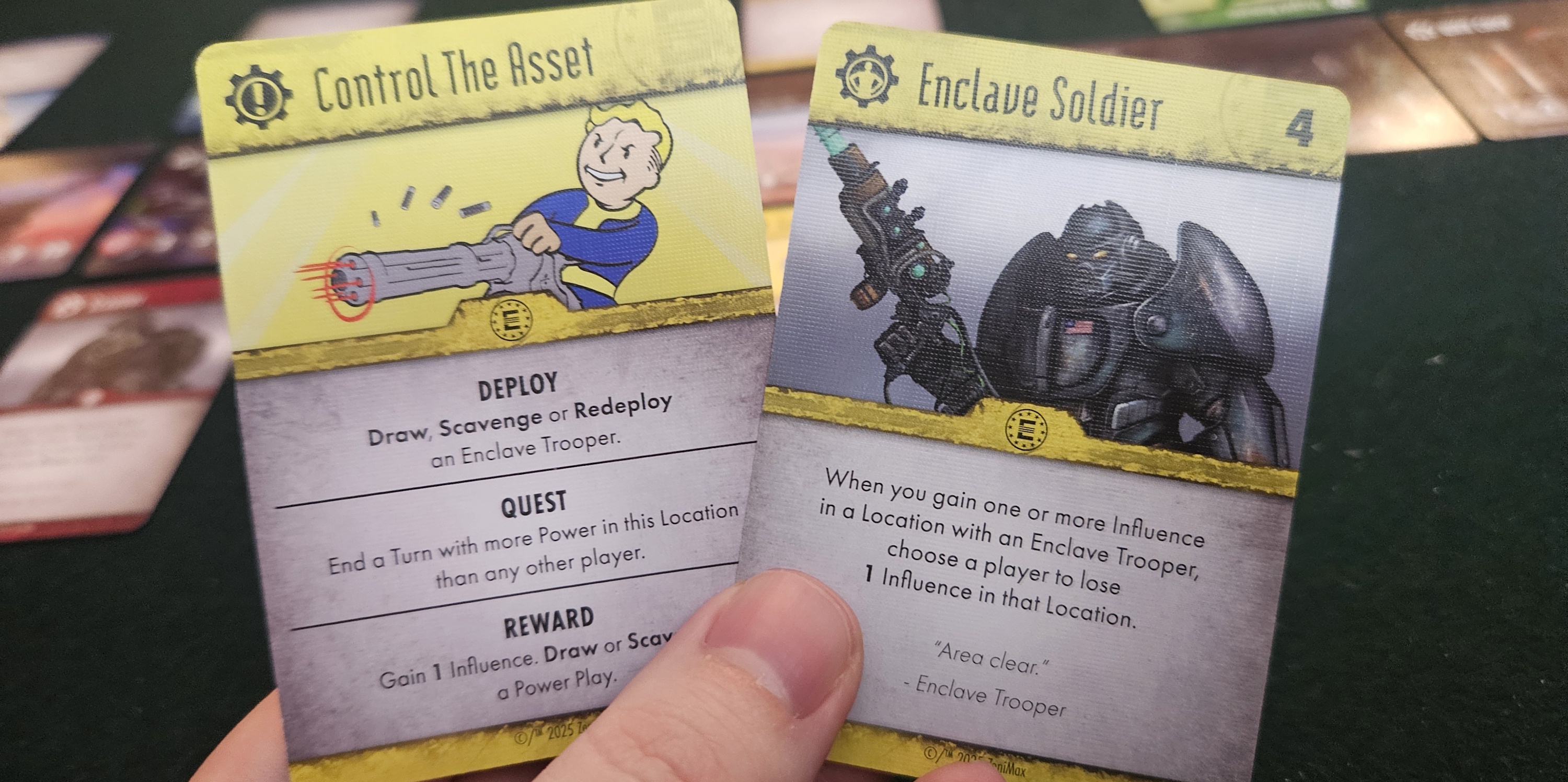
But in Fallout: Power Play, we are reminded of just how good board games have gotten over the past decade. I speak not of the balance between decks, between factions, because it’s impossible to get that far. Rather, the issue is wholly internal. These decks are so lopsided that there are hardly any troops to deploy. Those boots that must be placed on the ground, which indeed are required in order for the game to function, are the exception rather than the norm. In place of manpower, all four decks are top-heavy with everything else. Missions, which seed little objectives that, surprise surprise, require the troops that you only occasionally have access to. Powers, which, what do you know, also riff on the troops you may or may not have deployed to the wasteland’s many sunny destinations.
Signs and signifiers, devoid of the soul.
As a result of this crooked state of affairs, most turns are spent waiting around. Passing. As in, literally telling the table “I pass,” like a kid who forgot their homework, only in this case the teacher neglected to hand it out yesterday, but has, in their cruelty, still insisted that their pupils collectively pass their papers to the front. “I pass,” you say. “Pass,” says the next player. Someone else dumps three troops into a location. Luck of the draw. “I think I will pass,” says the next player, and then, in an attempt to interject some levity into this torment, they add, “But I am choosing to pass. I am not passing because I don’t have any cards to play.”
They are lying. Lying to themselves that this experience could be buoyed. Lying to themselves that they might reclaim these misspent minutes.
Is this a commentary on the unfairness of war? Of how war never changes, parroting the catchphrase that has become self-parody? If only. I might stomach a game that wanted to teach me something, even if it were as badly done as this.
But Fallout: Power Play cannot keep its own story straight. The cards urge their players to trigger activities that are impossible. Bold keywords that go unexplained, their meanings only guessed at, peer back from the cardstock like the unblinking eyes of the abyss. Other cards sport instructions that the game declines to enable or explain, the equivalent of an apocalyptic warlord who amuses himself by playing games with his prey. When the player is told to “choose a quest,” how are we intended to denote such a thing? Memory? A nonexistent token? A tapped card? Do we announce the choosing, or leave it secret? Can we cheat? Can we change our minds? What if the quest is removed? What if upon its removal it reappears? Is there bluffing in this game? Is there a soul, some form-space version only accessible within the sulci of the designer’s mind? If so, how might we access it? Would a surgical drill suffice?
I adore games. Bad games, too. Like bad art — bad films, bad books, bad paintings — there is an earnestness that makes all of human endeavor worthy of investigation, even if only as a means to understand its impulse and methodology. I can play a bad game. I often do such, and have a wonderful time examining what makes the bad game bad, what makes it fall short of what-could-have-been. Even bad games are worth my time.
What I cannot play is a tossed-up wad of cardboard that has been struck before me with the intent to waste my time. I say “intent” because at least then Fallout: Power Play would have been produced with something like intention, something like deliberation, rather than this generated slopmess, this uneager unthinking unplay. I have been pranked by a trickster; that would be better than to have suffered so unwittingly. To unwit, then, the only object of curiosity in the entire package is the absence of the designer’s name. It is there. It can be found. But it is hidden, neither on the box nor attested on BGG. At least that speaks to some measure of dignity. A dignity denied to me, by the way, in the moments Fallout: Power Play has stolen, irrevocable and irretrievable, from the precious span of my life.
1 1000 51 6 500.
I want those minutes back. I am resentful, like the firefighters sent into Chernobyl, the authorities insistent that we are safe, this was a mere accident, the graphite on the ground has only charred our flesh because our lying senses are mistaken, now will we please whittle the oaken heartwood of our limited days on this bounteous Earth down to a flinty toothpick for the sake of somebody else’s error, somebody else’s neglect, and while the shavings pile up at our feet, minutes that will not be reclaimed, but will be stricken from those that might be shared with our children, their faces upturned to adore the parents whose lovemaking gave them life and who bounced them in their exhaustion until they could at last close their eyes and sleep, while those shavings mound to our knees, will this game forget that these objects are meant to be joyous reflections of our birthright as creatures who learn from our frolicking, who test gravity with leaps and who learn songs through atonal screeches that set our hearts afloat despite their assault on our eardrums, and this is life and what it could be, what it was meant to be, and this ungame, this hideous thing, should not be experienced by man nor beast, but consigned to the mulch of the soil until it enriches something for the first time since it was atomically the lignin of a great tree, now whittled to shavings, its compressed heartwood all in fragments on the floor, and there is no gluing together what was carved apart with sharpened iron and thoughtless conception.
Do not play Fallout: Power Play. I challenge you to never play it. I dare you to stay away. I beseech you, I beg thee. There are better ways to exhaust this one life you have been given by god or the universe. Write a poem. Draw a stick-figure. Design a game. But make it yours. Show me what you have made. It will be better than this, and I will receive it with eyes of joy.
A complimentary copy of Fallout: Power Play was provided by the publisher.
(If what I’m doing at Space-Biff! is valuable to you in some way, please consider dropping by my Patreon campaign or Ko-fi. Right now, supporters can read my first-quarter update of 2026: the best board games, movies, books, and more!)