Normale Ansicht

Better Citizens than Netizens

14. Mai 2026 um 03:48

I've been reading the latest book in Adrian Tchaikovsky's Children series, and there's a very good chance it has colored my impression of this game for the better.

Citizens of the Spark feels like it was custom-made with me in mind. It’s a tableau-builder (yes) designed by Philip duBarry and illustrated by Diego Sá (yes) seeded with a small selection from a huge pool of cards (yeeesss) that happens to be populated with anthropomorphic animals (eh, fine). Those animals, it turns out, are not your usual medieval-ish fare, but scientists, scholars, performers, and everything else, jumbled together to form a polis of intersecting interests and vocations.

Which is to say, it brought me around in the end.
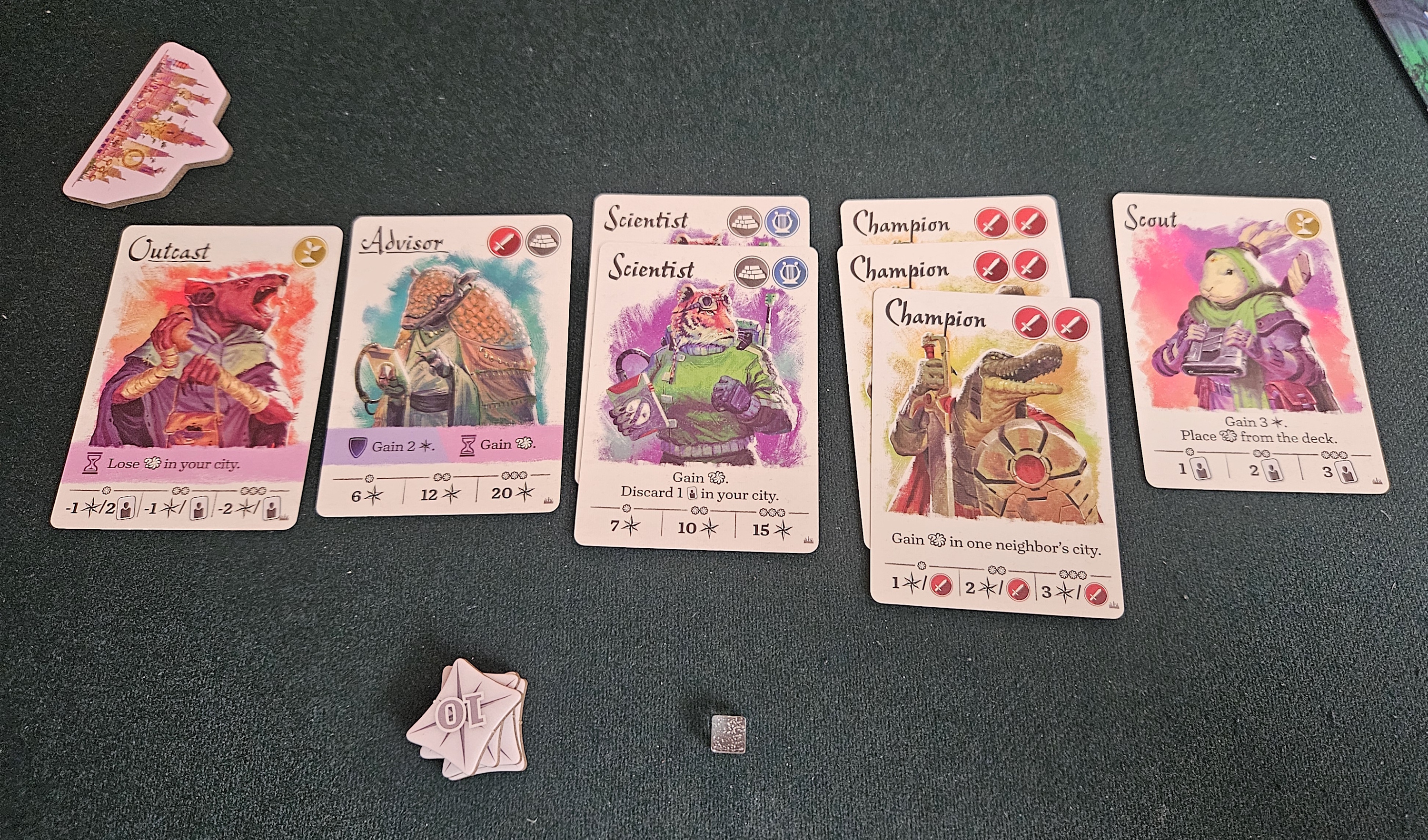
No mantis shrimp? Where is my Cato?

Ah, my pleasant animal polis.

It begins with a shuffle. Such a big shuffle, in fact, that my relatively broad hands ache at the strain of holding so many cards. There are thirty flavors of citizen in the box, a generous spread. Depending on your player count, you’ll take seven to ten of those sets, each set ten cards in size, and riffle them together until your knuckles crack.

And then you try to get them to work together.

Even in its earliest moments, there’s a tinge of something primal to Citizens of the Spark. Not primal in the sense of cavemen striving against the mammoth. Primal in the way the game asks you to create a society from these dissimilar peoples. This is the question that hovers over all of civilization. Can people who don’t see eye to eye live beside one another and strive toward a shared goal? It’s visible in Sá’s artwork. The Judge is a chicken. Not in the sense that she’s a coward hiding behind the bench and his robes. She’s literally a chicken. A hen. A producer of eggs. Tasty in peanut oil. She might share a city with one of her natural predators. An Agitator who happens to be a fanged reptile. A Soldier who is a bear. The tiger Scientist. To thrive, one presumes the city is governed by détente. No eating the judges.

As lovely as those illustrations are, duBarry encodes these dissimilarities into the cards themselves. In any given session, you might be presented with a society of Tyrants and Executioners. Yikes! But those dangerous creatures may soon prove paper tigers in the face of Traders and Politicians. Your task is to take these cards, measure their worth, and try to piece together something functional. There are natural imbalances, of course, but nearly any combination is playable, with the sole exception that you shouldn’t use more than a few underlined citizen sets at once. It’s impressive, both conceptually and as a way to ensure that every session presents a fresh conundrum for players to puzzle over.
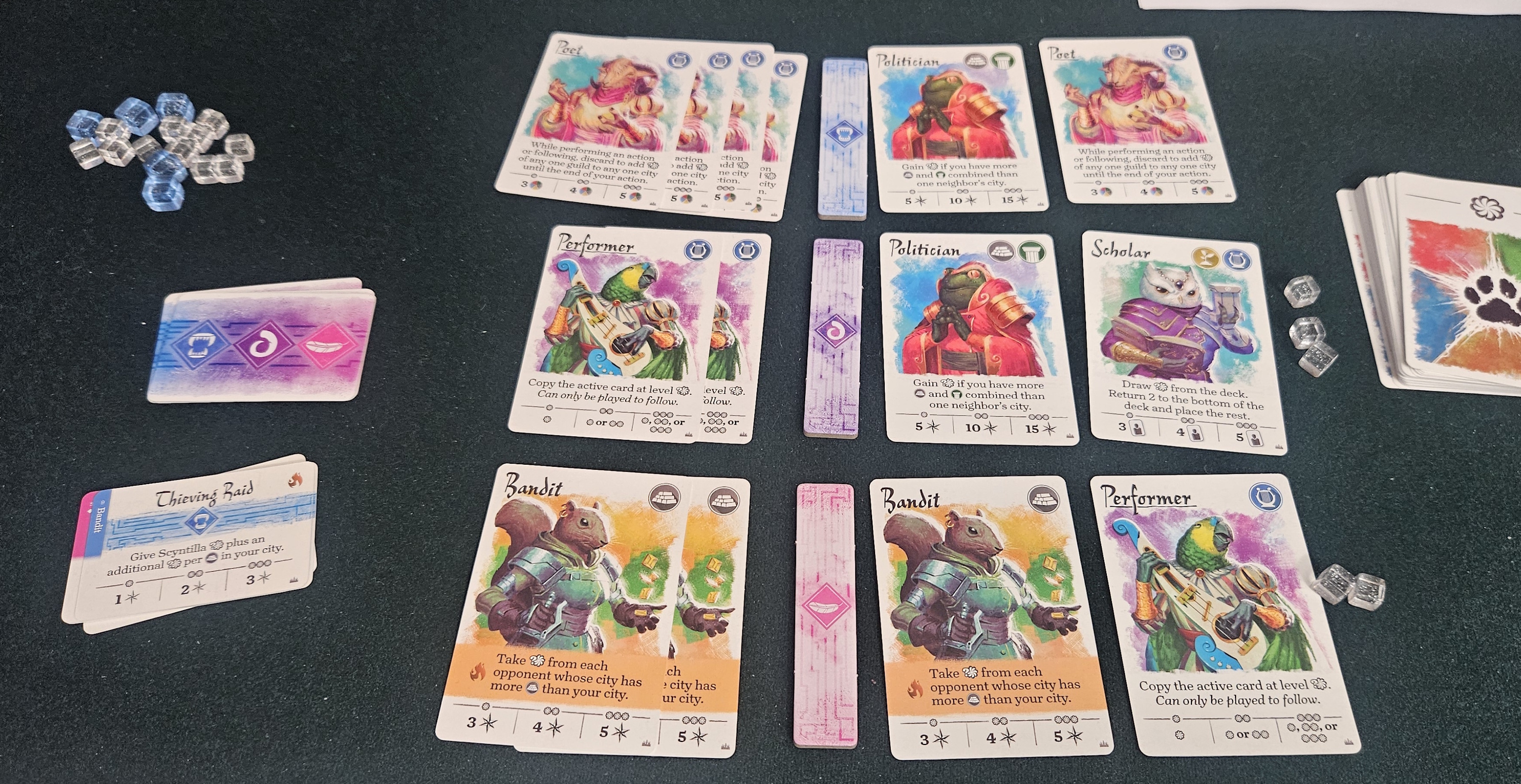
This is the way it appears in the solitaire mode, but it's more interesting, just visually speaking, than the ordinary multiplayer setup.

Cards are drafted from rows that gain more sparks as their denizens are neglected.

For all that, the actual gameplay is snappy and rules-light. First you choose a few creatures to add to your incipient polis. These are offered three rows at a time, each containing two or three cards, again depending on player count. As rows go unclaimed, perhaps because they include cards that don’t boast the same natural synergies as their peers, they accumulate sparks, the game’s currency of victory points. After a while, even outcasts accrue enough value to make them tempting.

As your city swells with citizens, you might want to trigger their actions. There are quite a few of these, attacks and defenses and trades and swaps and conversions, but their one commonality is that every action grows more potent with larger numbers of citizens. Here’s a simple example. If you have a Merchant, you can trigger its action to gain sparks for every brick icon in your city. With only one Merchant, that’s one spark per brick. With the maximum of three Merchants, that’s three sparks.

The limitation, though, is twofold. First, that citizen will depart your city forever. So there’s an element of press-your-luck to the whole thing, a barrage of micro-decisions over whether to activate your citizens right now, or wait until you have a bunch of them to trigger their more powerful effects.

Second, everybody else at the table also gets the chance to activate that citizen type. Sure, maybe we’ve tapped out the supply of Merchants, so I’m eager to earn a few points. But if your city is housing three times as many of the guys, or more of the icons they score with, then it’s entirely possible I’ve just handed you a powerful opportunity on your off-turn. Tradeoffs, tradeoffs.

Cluttering this headspace even further is the fact that the Merchant is about as simple as citizens get. The Scientist functions similarly, earning increasing points with more duplicates. But they also force another citizen to abandon your city entirely. Controversial research, perhaps. The Warrior earns points, but only if your city has greater military strength than a neighbor. The Bandit steals points, but you need to have fewer bricks than your victim; as a complicating factor they also provide the very same brick icon they’re trying to have fewer of.
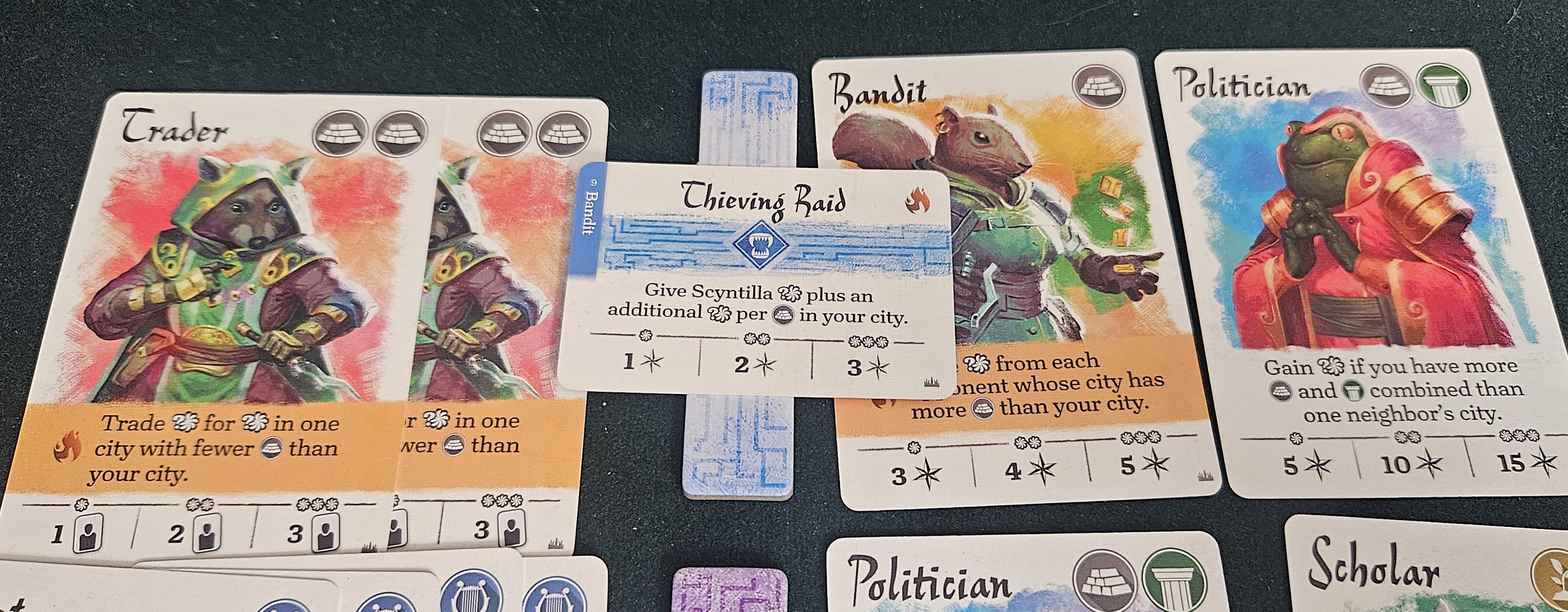
I think I can probably beat it... some day.

The solitaire mode is bastard-hard.

Put together, Citizens of the Spark is the sort of game that’s rife with imbalances, but those imbalances are the very thing that make it so riveting to explore. It’s almost unthinkable that any assemblage of citizens won’t come with at least one or two stinkers. Philosophers who don’t have anyone to philosophize to. Defensive Advisors and Diviners when there are hardly any attacks to defend from. Poets and Outcasts, the gummy citizens that steadfastly refuse to be put to productive use.

But that’s precisely when the game becomes interesting. Maybe everybody will squabble over the most valuable citizens, thus spreading them between too many cities to be valuable. Or maybe a few cards will sit in the offer so long that they become worth quite a bit more than their printed value. I’m already on the record as believing that “balance” is perhaps the most oversung element of board game design. In duBarry’s hands, the imbalances between citizens become the game’s most essential texture.

To be clear, Citizens of the Spark is a subtle game. It isn’t flashy. There are big swings, but they’re swings of points, a card moving from there to here, more points. There are plenty of turns that consist of grabbing cards, glancing at your tableau, and deciding that, y’know what, there aren’t any actions you want to take right now. Similarly, it’s a rather chancy game. Get ready to listen to that guy complain that no good cards are ever available on his turn.

Still, I can’t help but appreciate this one. I like its gentle ebbs and flows. I like how it feels warm despite its cutthroat tendencies. I like how it can wipe out a player’s city in the early stages, then still, more often than not, pave the way for a comeback with some grit and maybe some whining. I even like the solitaire mode, with its card-shifting and ability-triggering meanie of a bot.

Most of all, I like these dang cards. Their imbalances and chanciness, the way they reward focus and diversification at the same time. The fiction of them. They call to mind any number of successful cultures, from Persia to Star Trek to the Panspecificity, that fashioned functional states despite the vast differences between their subjects. Or maybe the most successful city on the table will be a government of predators. That’s how it goes sometimes. I like that, too.
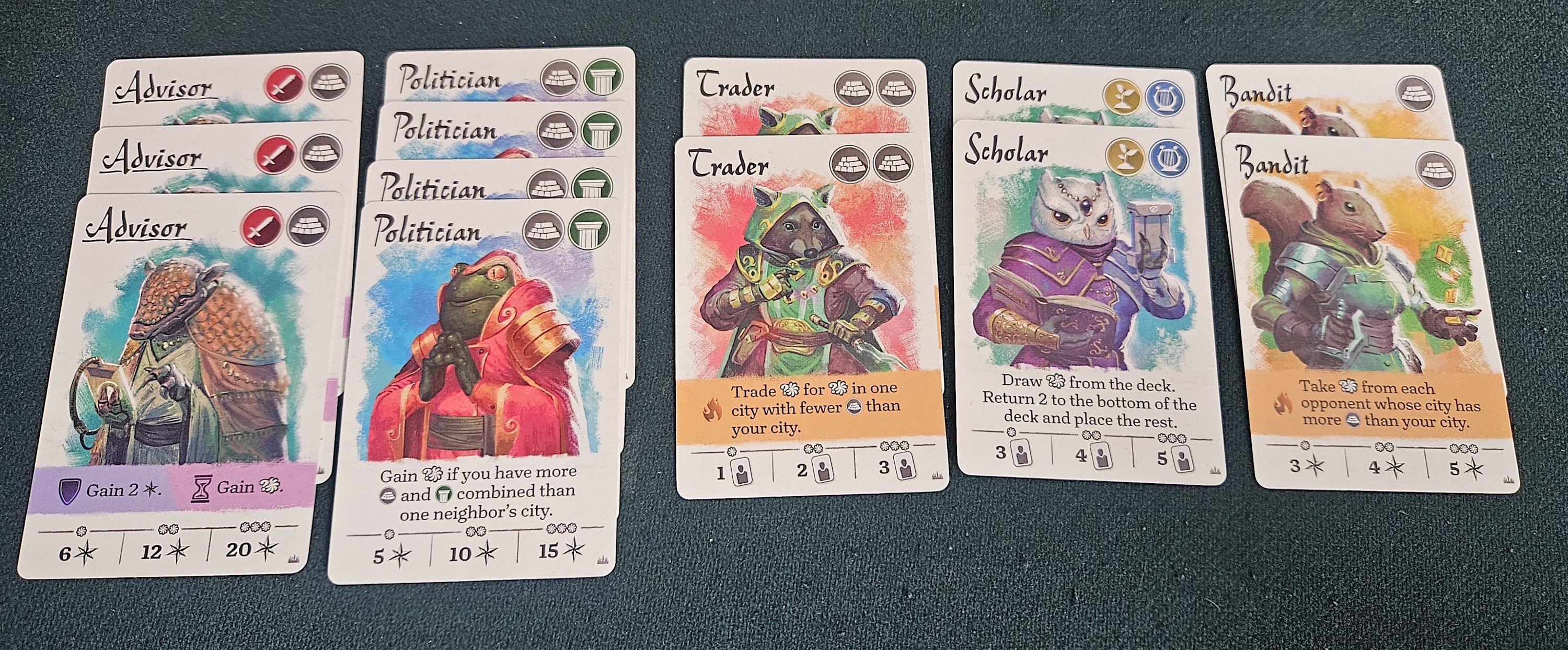
Lots of bricks today. Bricks for miles. Who do we think we are, ancient Sri Lanka?!

It’s a while before repeat combos show up.

Ultimately, Citizens of the Spark is a pleasant little thing, not groundbreaking or liable to show up in every game store, but still a quiet and compelling artifact of play that grows deeper and cleverer with each session. It’s the sort of game that feels like the beginning of something. More citizens? New modes? Another game inspired by this one’s muted success? Who knows. For now, it’s a game I’ll break out when I want to show somebody what can be accomplished with unassuming systems and some imagination.


A complimentary copy of Citizens of the Spark was provided by the publisher.

(If what I’m doing at Space-Biff! is valuable to you in some way, please consider dropping by my Patreon campaign or Ko-fi. Right now, supporters can read my first-quarter update of 2026: the best board games, movies, books, and more!)


Dive Tables

12. Mai 2026 um 06:51

The fish is inside the dive suit. It has become the diver. When it returns to the surface, it will have its vengeance.

Here’s something you probably didn’t know about old Dan Thurot: I’m a scuba diver rated for search and recovery. There aren’t many of us here in the desert, which is probably why I receive unexpected calls to dredge the ponds of local golf courses whenever there’s a Silver Alert. Thus far, I have declined these requests. Those waters are, like, four feet deep. That’s a job for snorklers. Or a tall guy with hip waders.

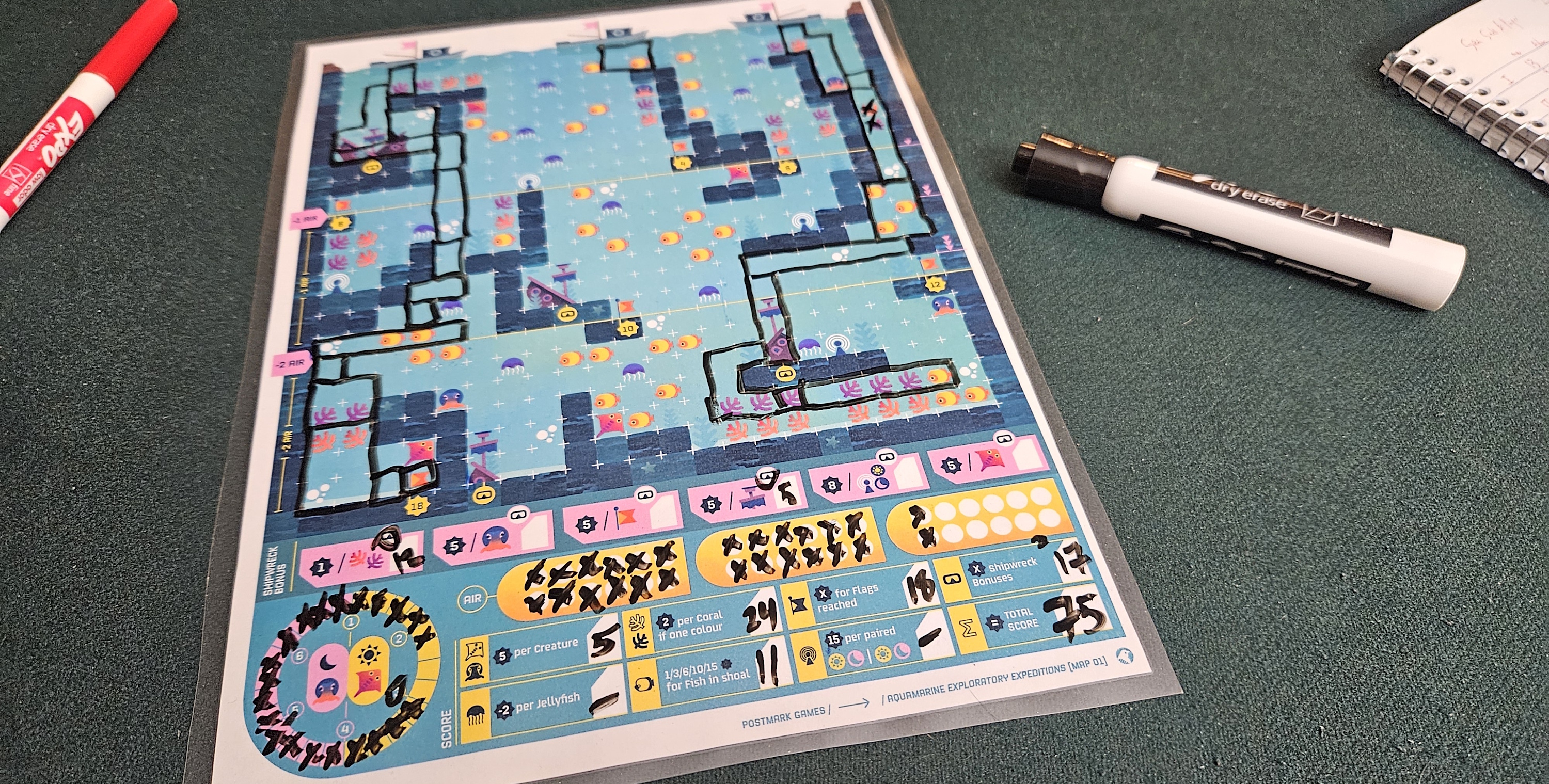
Instead, I mostly use this as qualification to comment on scuba stuff. That cave rescue in Thailand? Legitimate. The roll-and-write shenanigans of Aquamarine? Um. Okay, look, Aquamarine isn’t the most robust scuba simulation. But as another print-and-play title from Postmark Games, it’s a worthy followup to Voyages.

Yes, real scuba divers can use air bubbles from the ocean floor to preserve the contents of their oxygen tank. Anyone who tells you otherwise is trying to keep you in newbspace.

This is exactly what scuba diving is like.

Like Voyages before it, Aquamarine is a dice-heavy game of movement, positioning, and exploration by Matthew Dunstan and Rory Muldoon. Unlike that game, Aquamarine is played with two dice instead of three. What will those loony bastards think of next, a movement game that uses only one die?

(Since I’m late to the party, the answer is “Yes.” But that’ll have to wait till next time.)

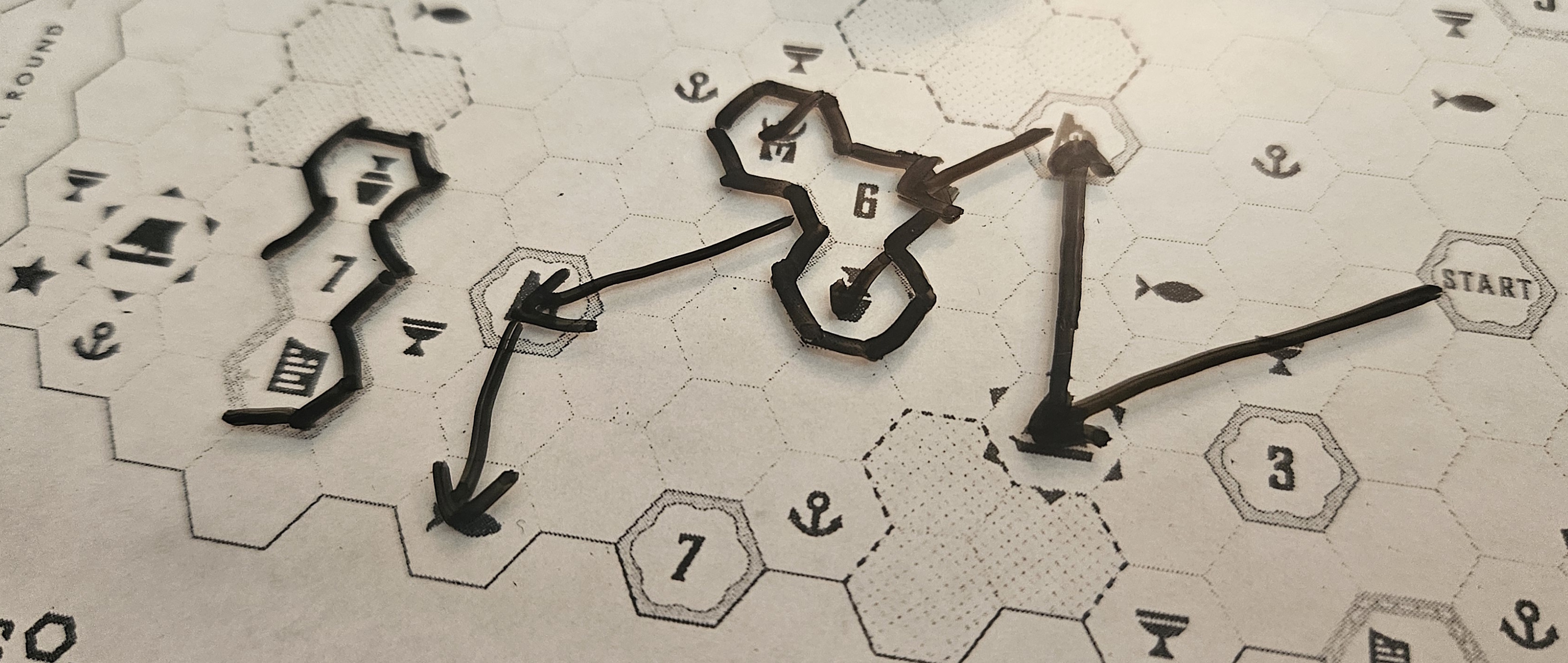
As before, the gist of Aquamarine is elegant in its simplicity. You roll the dice, then use one of them to move your diver. Here those movements are represented as enclosed boxes. Enclosing something — some coral, a school of fish, a stinging jelly — means scoring it when the game ends.

Of course, it couldn’t be that breezy. Dunstan and Muldoon are all about encoding necessary and enlivening limitations into their print-and-plays.

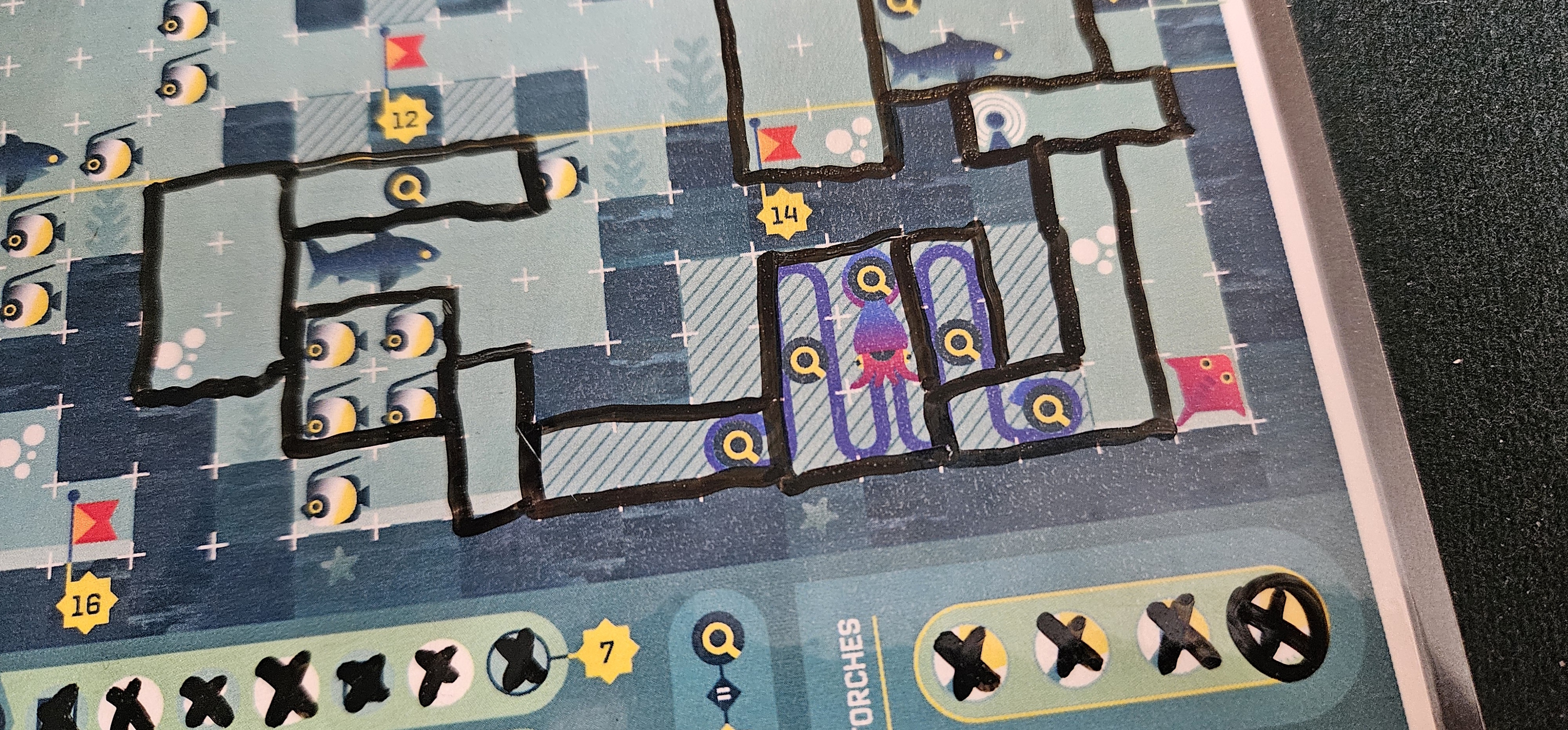
In this case, the first of those limitations is that you only have access to one die out of that rolled pair. Bigger rolls mean bigger enclosed areas, but that also means depleting oxygen equal to the difference between the lower and higher die. So while it might be tempting to use that 6 rather than the piddly 2, covering the larger area means hoovering up four units of precious oxygen. Making matters tougher, deeper dives consume more air, adding time pressure right when the sea’s aquatic life is at its most interesting. Similarly, you’re constrained in which shapes you’re allowed to draw. Mostly long rectangles rather than jagged freeform polyominoes, although there are moments of squiggly liberation that emerge whenever doubles are rolled.

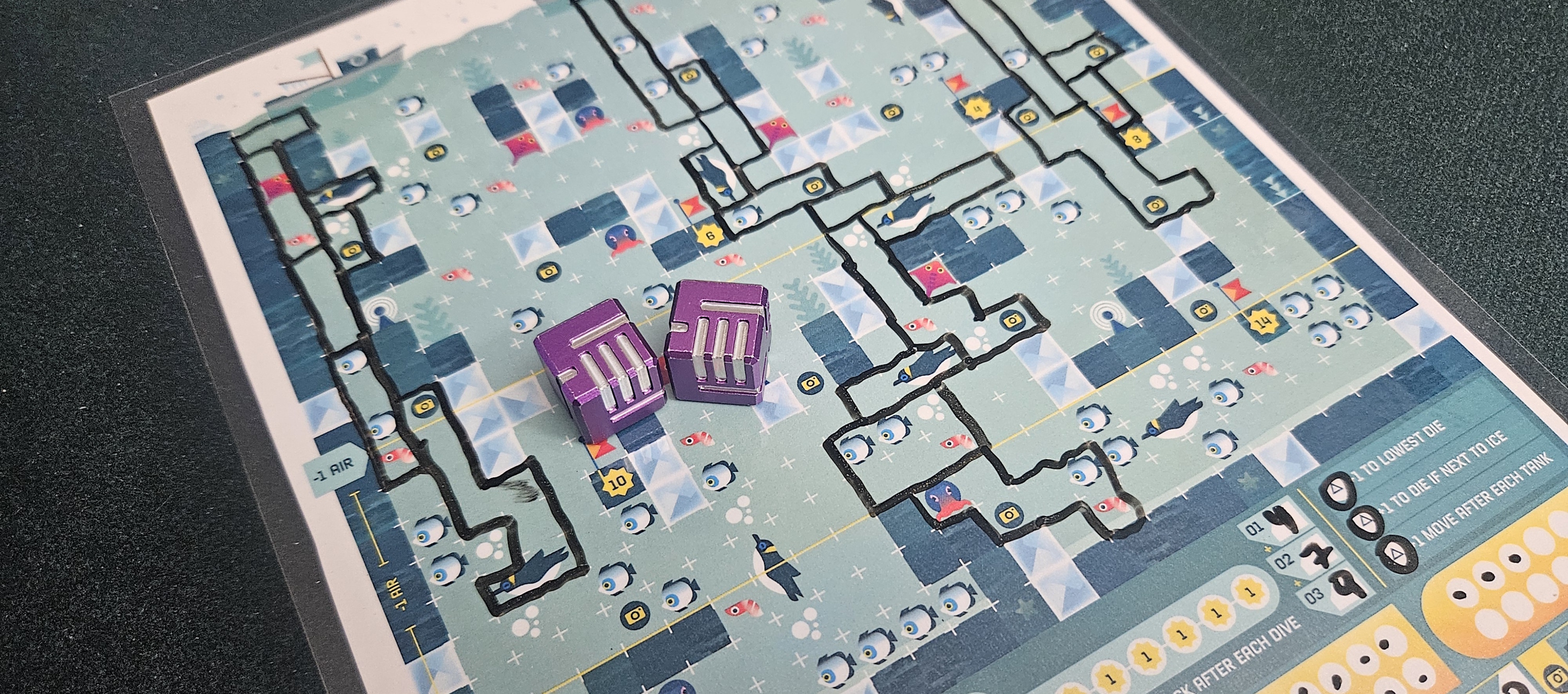
I want to use dice that are appropriate to each game. For Voyages, I played entirely with my cool palm-wood dice. For this one, these goofy aluminum ones. But as for Waypoints... I'm not telling. (Because I don't know yet.)

Weird aluminum dice not included.

These triplet pressures are the shared system underpinning everything in Aquamarine. Much like the headings in Voyages, everything arises from those constraints. Travel too fast or linger too long at depth, and your waning oxygen will force you to start a new dive. Paint yourself into a corner with your shapes, and you might find your next move taking you in the wrong direction.

From there, the game’s selection of maps tinkers with the formula. As before, the inaugural outing sets the template. Schools of fish are worth increasing amounts of points as more of them are enclosed in a box; certain creatures only emerge during daylight or nighttime hours, requiring you to parcel out your time accordingly; special beacons and flags reward those who travel to the corresponding depths.

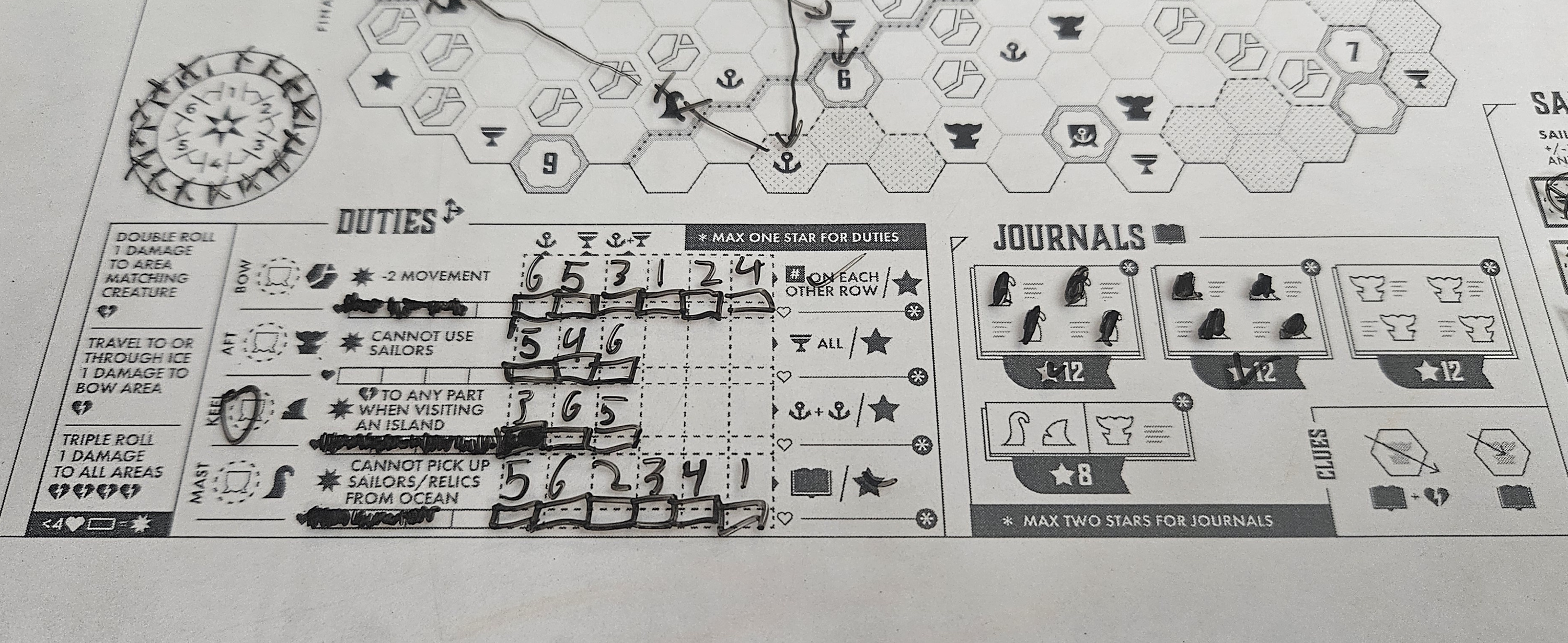
But there’s tremendous variety within that blueprint. My personal favorites are found on the second map and fourth map. In the former case, undersea caverns can be readily explored during daytime, but at night gradually deplete a limited stock of flashlights; meanwhile, researching sharks and giant squids ticks you up along a selection of bonus tracks. And in the latter, arctic ice threatens your air supply, but snapping pictures of frolicking penguins and icon-improving shrimp can net scores of points that keep ramping upward.

This time around, there are troughs to accompany the peaks. In particular, two of the maps — a double-sheet deep-sea excursion and a fossil hunt in ancient waters — are too persnickety for my tastes, asking the player to make minute adjustments that don’t always play well with the need to ration air or count spaces.

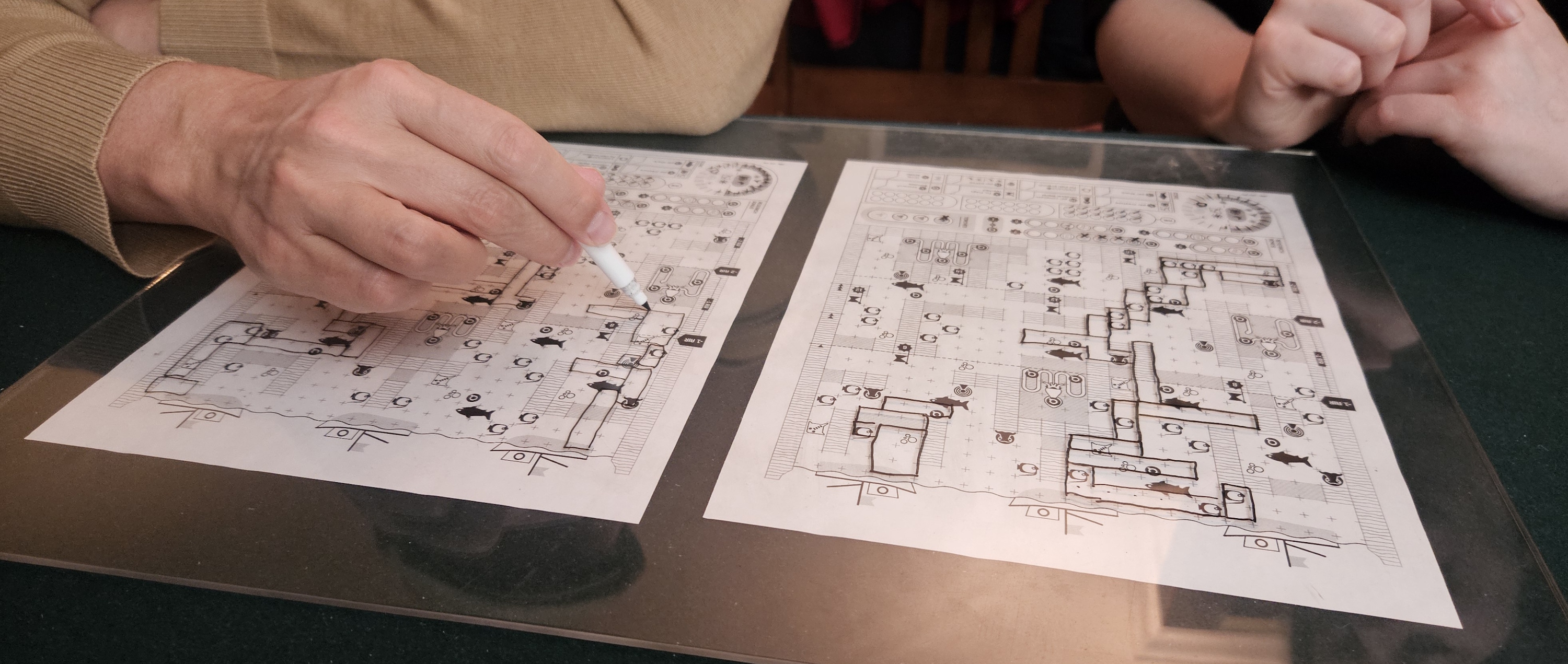
This is how all of my actual sheets look. Many thanks to Rob Cramer for letting me borrow his nicer printed options!

As before, low-ink options are included.

Some of that has to do with the inherent limitations of the game’s movement system. Where Voyages — and our next installment — are more freewheeling with their range allotments, maneuverability in Aquamarine is downright torpid. Unless you’re starting a fresh dive, each box must attach to the previous one. This makes total sense, but also keeps the game more snugly straitjacketed. If I were a generous man, I’d call it more bite-sized; but because these are aquatic adventures — and because I’m not a generous man — they instead come across as suffocating, at least sometimes.

But while Aquamarine is the flimsiest of Dunstan and Muldoon’s roll-and-move trio, it’s hardly a poor example of the form. If anything, it’s another testament to how much can be accomplished with a sheet of paper, a pen or pencil, some lamination or a plexiglass, and dead simple rules. When the game slips into its groove, it’s immensely satisfying.

Especially in multiplayer mode, it should be said. That’s another shortcoming imported from Voyages. Here, the solitaire rules are disappointing, asking you to reach certain depths. Child’s play. The real challenge lies in sitting across from one to ninety-nine partners and seeing who can wring the most out of those shared inputs. In that mode, there’s nothing quite like glancing smugly (or despairingly) at a fellow player’s sheet to see where your routes departed. Who veered parallel to the ocean floor to preserve oxygen, who ventured much on the outcome of future rolls, who spent their dive observing shockingly large schools of fish. Or, in my case, who got stung by a bunch of jellyfish because they thought they were pushing themselves to more rewarding depths, only to tap zero on their dive meter. I’ve never gotten the bends in real life, but I’m pretty sure my diver in Aquamarine has made some testy ascents.

Those hickeys are from my Canadian girlfriend. You wouldn't know her.

I’m making new friends down there.

In short, Aquamarine is a mixed experience compared to its peers, but to evaluate it solely as a comparison misses out on what makes it such a rollicking time. I prefer Voyages; I prefer Waypoints. But given the option between Aquamarine and nothing, this is still exactly what I want from a print-and-play game.


Access to the files to print Aquamarine was provided by the publisher/designer.

(If what I’m doing at Space-Biff! is valuable to you in some way, please consider dropping by my Patreon campaign or Ko-fi. Right now, supporters can read my first-quarter update of 2026: the best board games, movies, books, and more!)
It’s Always the Ides of March Somewhere

05. Mai 2026 um 20:06

... wait, that isn't how time works.

I would describe my feelings toward Regicide as “appreciation,” despite it finding dedicated fans all around me. For years it was in regular rotation on my wife’s phone; my sister-in-law bought the fancy custom deck rather than just using a generic deck of playing cards. My own interest had more to do with the game as an act of repurposement: the clever casting of face cards as mad royals who needed to be put down, the suits transformed into character classes for blocking attacks or repairing injuries.

Regicide Legacy, designed by the same trio as the original — Paul Abrahams, Luke Badger, and Andy Richdale — is very nearly the exact opposite of the original game, at least in terms of form factor. Where the previous Regicide could be played with any old deck scrounged from a vacation bag, this edition is something of a throwback. It’s a genuine legacy title, for one thing: torn cards, stickers, micro-expansions, all of it. Its cooperative/solitaire campaign is generous. Moreover, it’s hard, significantly harder than is the norm in our current obliging hobby. It isn’t uncommon for a chapter to take two, three, half a dozen tries before your band of mercenaries is permitted to move on to their next target.

Now that I’ve wrapped it up, I can squarely say that the ordeal was thrilling, brilliant, and exhausting.

Pretty sure every single character in this game inhabits a polycule.

Hey there. We spotted you from across the bar and liked your vibes.

If you haven’t played the original Regicide… first, maybe give it a try. The rules are freely available, and as noted earlier you can play with a deck of cards that costs five bucks at the supermarket. That’s if you don’t have one handy already.

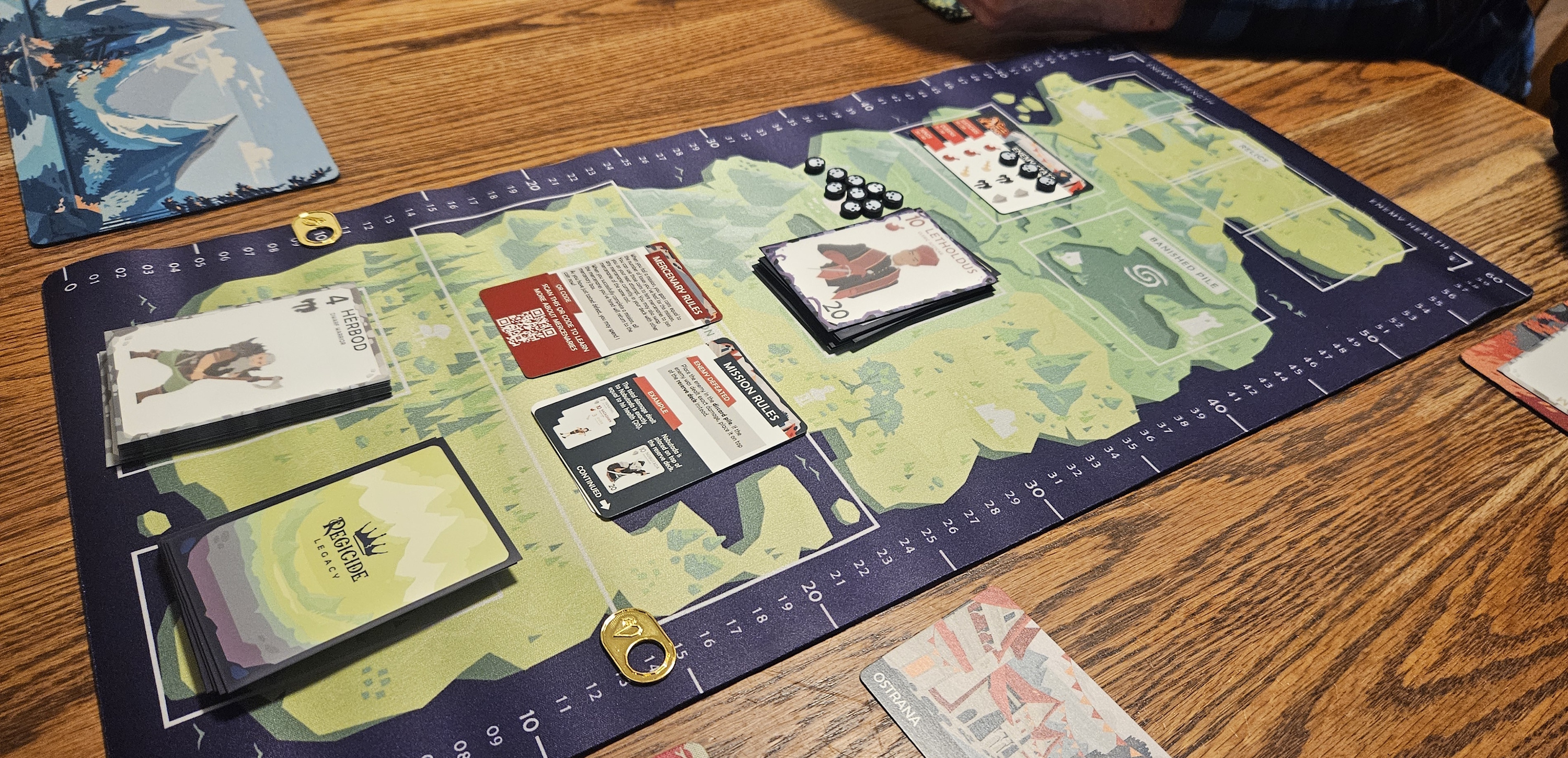
Regicide Legacy begins with Regicide. As in, its first chapter is the base game with only the slightest of modifications. Your crew, a band of adventurers, comprises the forty non-face cards of an ordinary playing deck, plus perhaps one or two goblins depending on player count. Their strength ranges from one (for an ace) to ten, across four classes that have been given their own iconography rather than repeating the regular French suits.

The face cards, meanwhile, become a deck of targets. First you’ll face the jacks, then the queens, then the kings, ideally lining them up for the guillotine. This is no easy feat. Each royal has a sturdy pool of health points, and punches back after each attack, requiring you to spend cards from your hand to absorb the blow.

The cardplay is impressive. Depending on your chosen attacker, your crew avails themselves of an ability. Warriors deal double damage to your target. Paladins block return damage. Clerics cycle discards back into your deck, which Bards then use to refill everybody’s hands. There’s a life cycle to this process. Some cards can be paired, such as aces, here styled as animal companions, or duplicate ranks whose strength would sum to ten or less. Success demands a delicate balance, between offense and defense, between healing and aggression, between risk and caution.

It’s pretty much inevitable that you will lose.

And now there are two more Regicides?! I'm behind the times.

In contrast to the original Regicide, Regicide Legacy is all premium.

That inaugural failure, though, demonstrates the ways that Regicide Legacy intends to depart from its predecessor. Rather than shuffling the cards and giving it another try, you’re invited to open the first of the set’s many boxes. Within, you discover mercenaries: multi-rank cards that can be readily paired with more of their peers than usual, heavy hitters, maybe an extra goblin or two. Each merc has a cost in its corner. One loss means you have one gold to spend.

So you buy a card, add it to your deck, and take another stab at toppling the divine right of kings.

Again, failure is largely inevitable. It’s just a little less inevitable than before. Second loss, two gold. You grab a couple new fighters. Shuffle. Again.

Another loss. That’s three more gold. Now your company is becoming noticeably tougher. Maybe you were struggling with damage output; some extra Warriors will make up the difference. Or perhaps you found it difficult to manage your hand; that’s where Clerics and Bards come in. Whatever your particular weakness, there’s a patch for it.

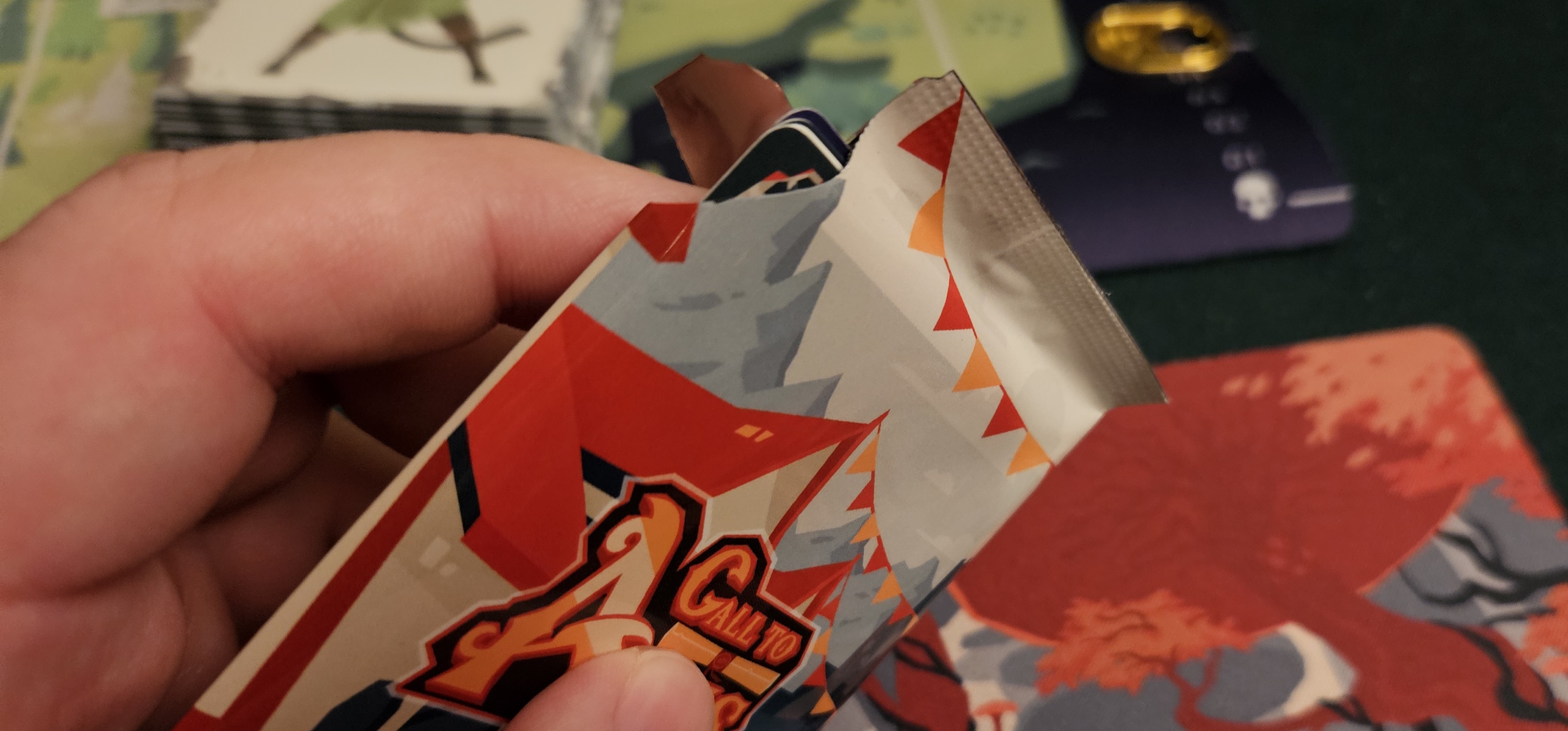
At some point, the odds turn in your favor. Inside the first chapter box there is a sealed booster pack with its own instructions. Your mercenaries depart. New cards are introduced. Another chapter presents a new set of bosses, each tougher than the last.

Seems like this could have been paper, but I won't deny there's a childlike appeal to splitting open a booster.

Opening the post-game expansion pack.

Along the way, a few things become apparent.

First, Regicide Legacy wants you to succeed. Even if only belatedly, after spending heaps of gold on up-powered mercenaries who round out your company’s deficiencies. Where the original game bordered on the misanthropic, booting you back to the beginning at even the slightest trip, the ability to pad your deck with repeat failures is a wonderful tool. Some make it easier to pair cards, or add wild aces, or, eventually, strip even the toughest bosses of their natural immunities to your character abilities.

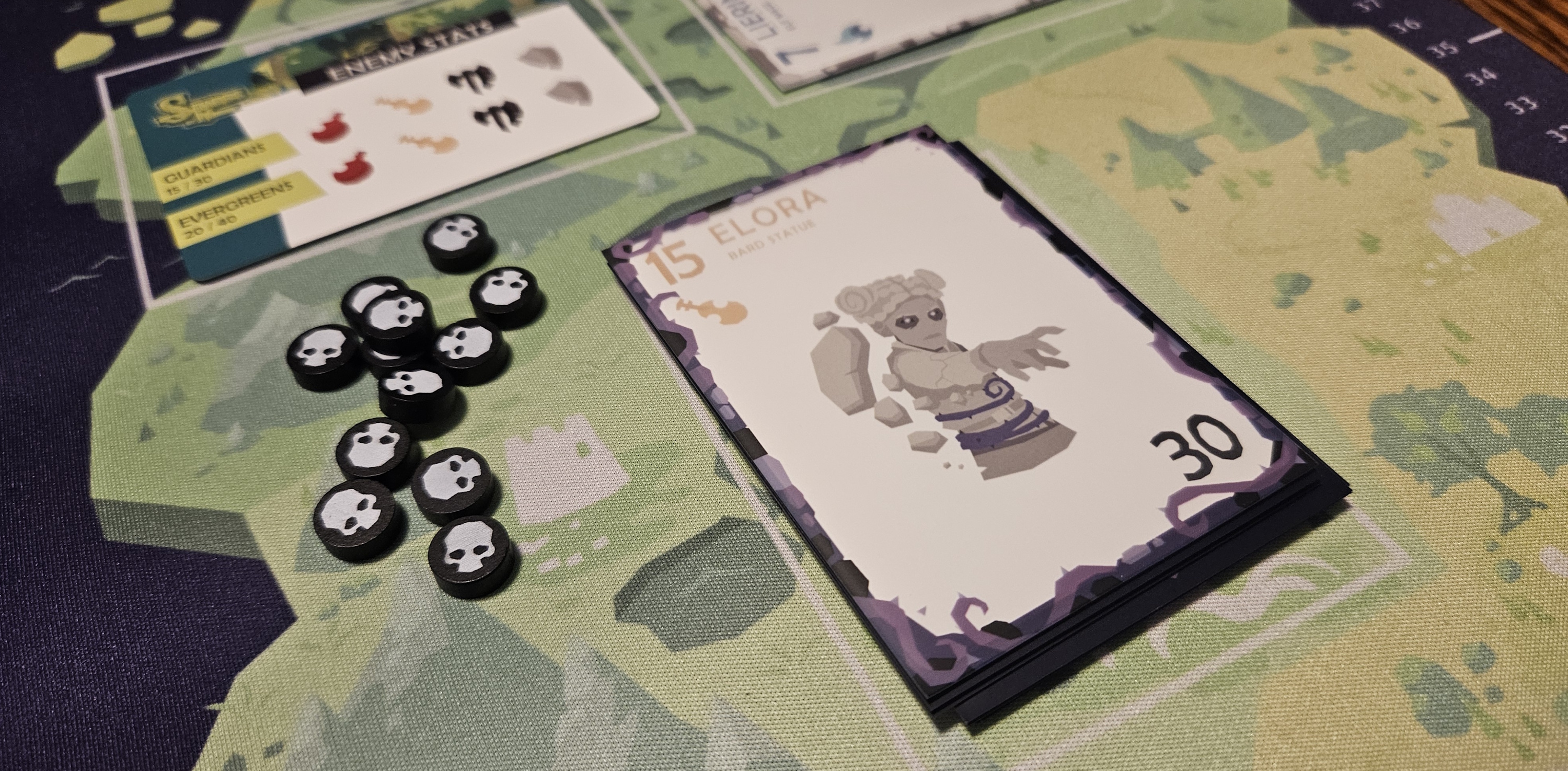
Next, Regicide Legacy earns that second ligature. This is a legacy game through and through. In its earlier stages, this means variable card sleeves. To offer only the lightest of spoilers, the members of your company can become corrupted, adorning themselves in the thorn-framed sleeves usually reserved for royals, and incurring a penalty when played. Not long after that, you’ll encounter more transformative effects. Stickers that dual-class cards, minigames for randomly determining which character succumbs to a story beat, and, yes, eventually the dreaded moment that was so transgressive back in Risk Legacy, the command to rid yourself a card for good.

Go ahead. Tear it up. Don’t let your squeamishness show. Don’t let your fingers tremble. Don’t check how much the reset box costs. Uh oh. You looked. That’s as much as, like, fifteen decks of playing cards. But who would buy that many playing cards? You’re here for the drama, baby, and there’s no drama quite like drama that inflicts lasting damage.

This one happens to like Tal Bachman.

Each boss presents its own conundrums.

The main highlight is the procession of new character classes that are added to your ever-expanding band. To the original four — the original six if you count animal companions and goblin jesters — there’s enough to more than double the roster. I won’t spoil the surprise, but the way your deck morphs from one thing into something else entirely is quite the sight to behold. There’s wild magic to be uncovered, risky operators who might help or hinder your goals, heroes who always seem to show up in the nick of time, and complicated figures who require constant reminders.

Because Regicide Legacy, already a tangled, difficult game, only grows more tangled and more difficult as additional chapters are unlocked. More complicated, too. Sequencing matters. The subtle distinctions between two defensive classes matter. Whether cards are discarded or banished, which abilities a boss blocks, how cards are shifted across the board in this particular scenario — everything matters.

In our case, we played nearly the entire campaign four-handed. There was me, of course, plus my wife and sister-in-law. I doubt I would have survived by excluding the fanatics. We were also joined by my mother-in-law, a veteran of countless trick-takers. Her inclusion highlighted both the game’s strengths and its weaknesses.

Strengths first. Across the duration of the campaign, Regicide Legacy held our interest. Even my mother-in-law’s interest. Even when we were tired from battering ourselves against a particularly difficult chapter. (The worst offender, we discovered, had been nerfed post-release.) At our weekly dinner, the group was eager to see what came next. Not so much in the story, which is the usual fantasy muddle of proper nouns. But in the interplay of cards and abilities. In the composition of our deck. In which sticker would be appended to which character. In the developing shape of the thing.

But these strengths are attended by problems. Foremost, that Regicide Legacy soon gets too big for its britches. My mother-in-law spent the back half of the campaign showing her hand to whichever daughter was seated beside her, effectively requiring someone to play two hands simultaneously. She recalled the starting classes well enough, and even remembered a few of the later outliers. But as for the distinction between a Mage and a Reaver or between a Druid and a Chanter, no player aid was sufficient to fill every gap.

It's so heavy. You could kill somebody by dropping it off a high rooftop. Post-campaign, the rulebook recommends using it as a tool of actual regicide.

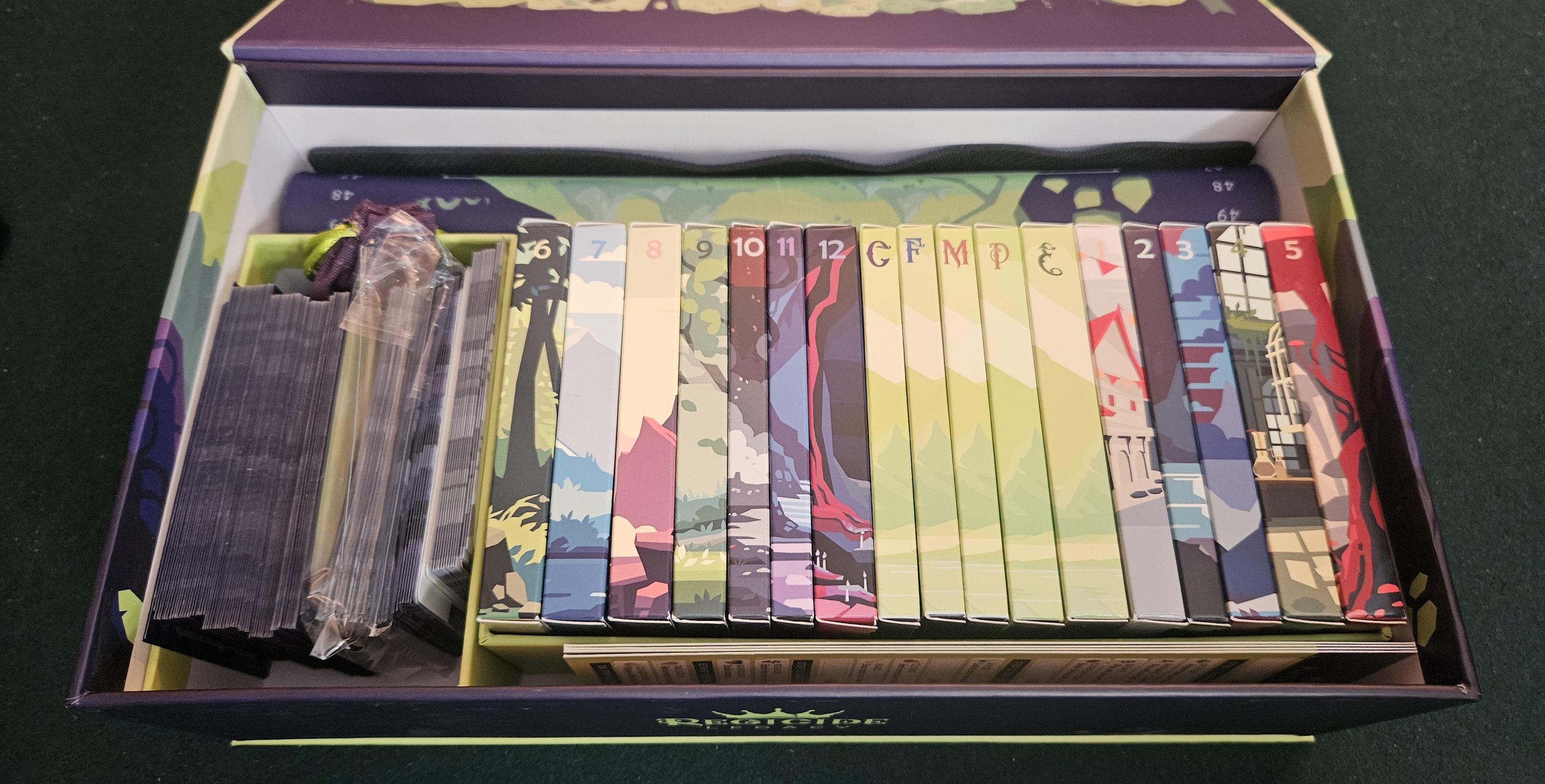
That’s one packed box.

Perhaps this sounds like an issue of age. To some degree, it was, as my mother-in-law would freely admit. But even those of us inured to modern hobby games and RPG classes and this particular brand of cardplay sometimes found our minds snowed in by the game’s avalanche of intersecting triggers. It isn’t only the character classes; there are also the bosses to consider, plus the special rules that govern this chapter, plus, often, the lingering rules from last week’s session, finally cemented in time to be discarded with the previous tuckbox. Most of the time, I had to run the turn-by-turn action, and even then it wasn’t uncommon for someone to stab back that my reminder necessitated a counter-reminder because of such-and-such character or some lingering effect from the scenario instructions.

Is it too much? We finished the campaign. We survived. We succeeded. But we also stumbled along the way. Sometimes we realized two rounds later that we’d flubbed a rule earlier. More than once, we restarted a session altogether, the rules suddenly clear where previously they had been opaque.

Personally, this process was many things. Frustrating at times; exhausting at others.

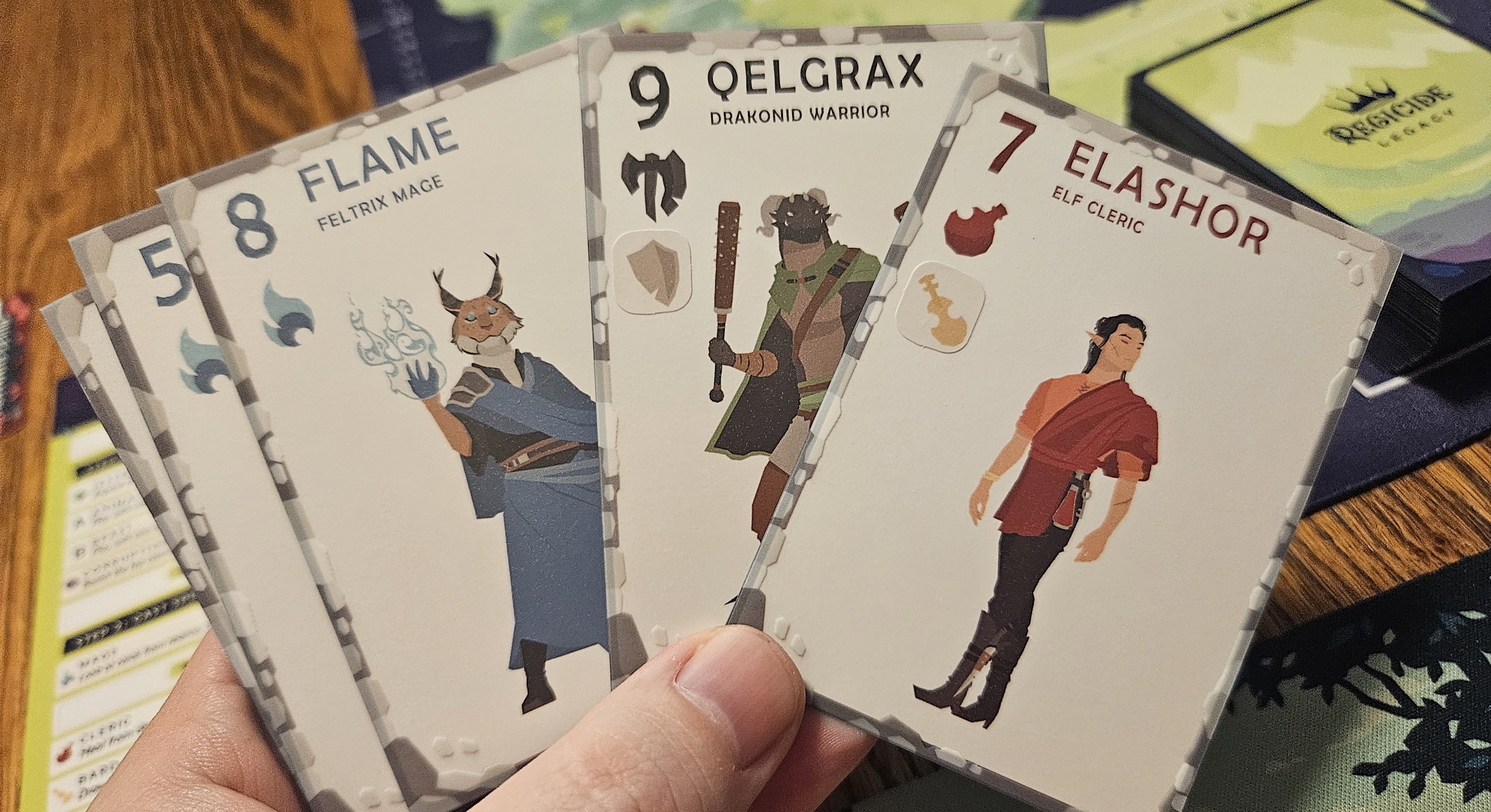
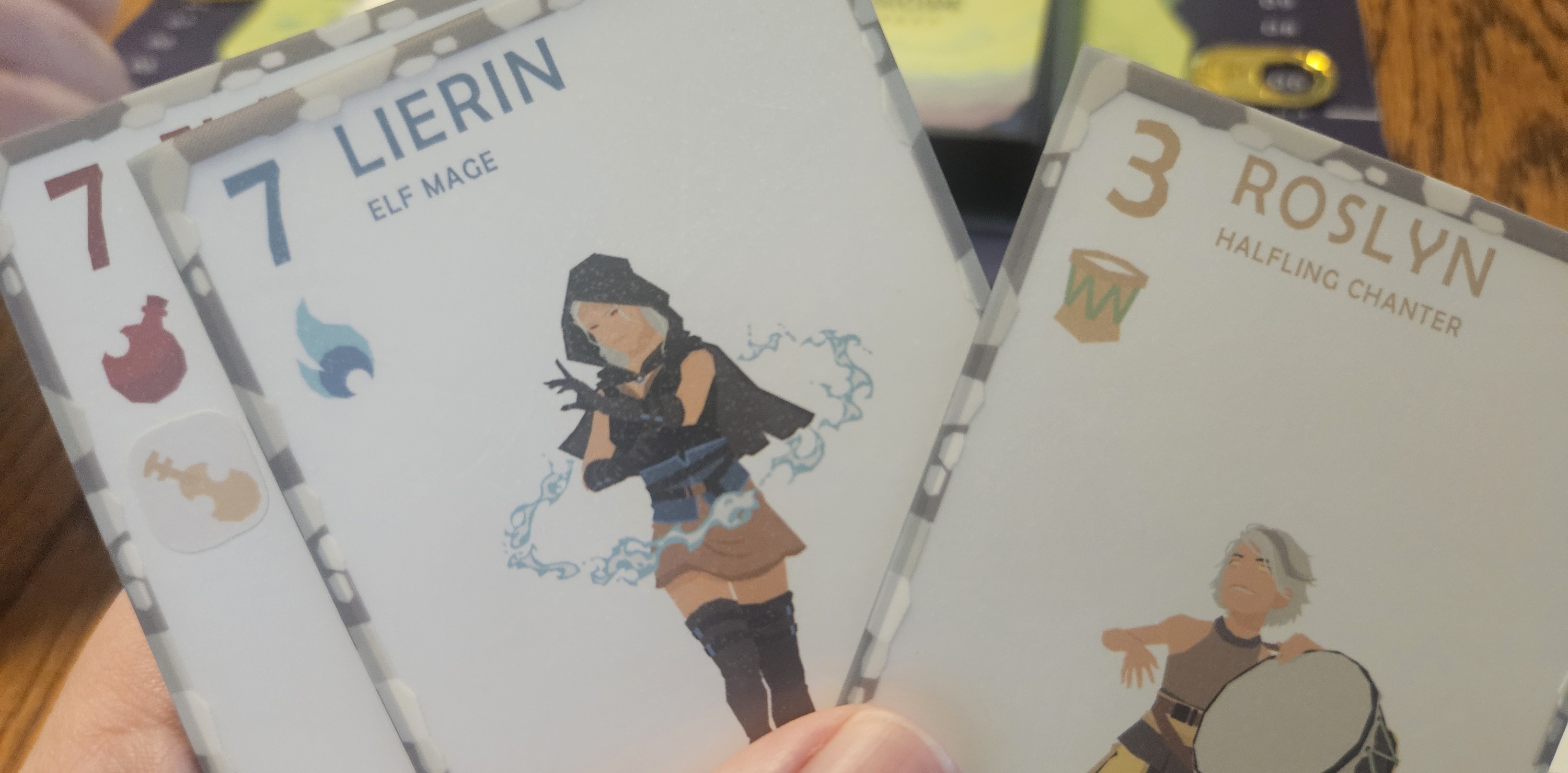
But it was exciting, too, and exciting in a way that very few games have been before. We developed favorites — dual-classed Elashor, Vegarian the Vegetarian, my crush Lierin — and groaned at the appearance of others — Dinky, may you be damned to the underworld for eternity for how often you have betrayed us. We laughed a lot, especially when a new boss crushed us to powder, or when somebody stared at the problem before them, eyes glazed over, only for someone to recall the exact rule that would save us from a doomed situation.

The remaining question is whether we’ll return. Some of us already have; my sister-in-law has launched her second campaign with another group, spreading the good word to unwitting converts. There’s an entire post-game to tackle, justification for the potential waste of a discarded core box, and I can confirm that it’s a smart system, randomly doling out enemies and modifiers and boons that will test the hardy company that was forged over the previous thirty battles.

My secret goal every game was to get Lierin in my hand and then never spend her. I succeeded maybe thrice.

Lierin is my Canadian girlfriend you’ve never met.

So. Will we? Return, that is?

I don’t know. Maybe someday. I plan to keep the box, despite my doubts that we’ll remember the class abilities if we go more than a month without a session. Even if we don’t, I can’t help but regard Regicide Legacy with fondness. I can’t remember a single story beat from the narrative. But the stories it told above the table — the way our deck transformed along with our aptitude as players, the inside jokes we developed, the characters whose named we pronounced five different ways — those are worth keeping around. That’s the real legacy here. That’s what makes me consider Regicide Legacy such an unlikely success. Torn cards? Stickers? Psh. I’m only interested in the stickers of the soul. The torn cards of our feelings.

And with those strained metaphors, I think that’s enough Regicide Legacy for one sitting.


A complimentary copy of Regicide Legacy was provided by the publisher.

(If what I’m doing at Space-Biff! is valuable to you in some way, please consider dropping by my Patreon campaign or Ko-fi. Right now, supporters can read my first-quarter update of 2026: the best board games, movies, books, and more!)
High O’er the Billows We Are Wafted Along

04. Mai 2026 um 20:00

let's make this header as ink-hungry as possible, hmm? because I know some of you readers are PRINTING EVERY SINGLE ARTICLE for some reason.

Let it not be said that I don’t take requests. A number of readers have pointed out that it’s been a long time since I’ve covered any print-and-play games. Too true. But there’s a reason for that. Voyages, the six-map design by Rory Muldoon and Matthew Dunstan and the launchpad title from Postmark Games, is both an illustration of my reticence and a roundhouse kick to that same reticence’s noggin.

nice!

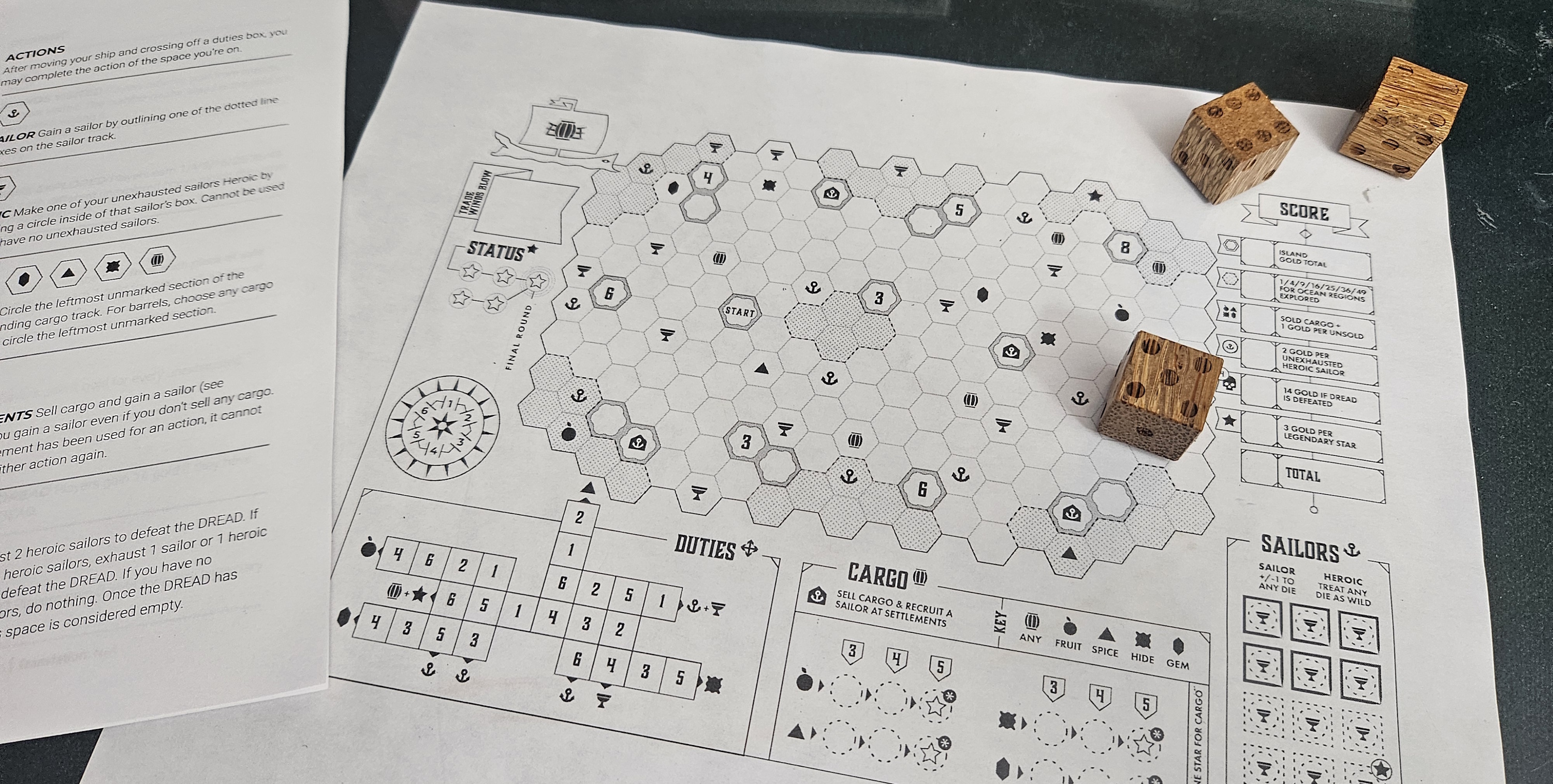
How Voyages really ought to look.

This is how Voyages is supposed to look. Soft hues, perfect for covering with pencil marks. (Or, if you’re a consummate professional, a dry-erase marker.) Weathered at the edges, giving it the feel of a brine-worn map. Crisp, with sharply defined edges, all the better for making out the proper boundaries of everything, from the sea’s hexes to the spaces for tracking the depletion of your sailors.

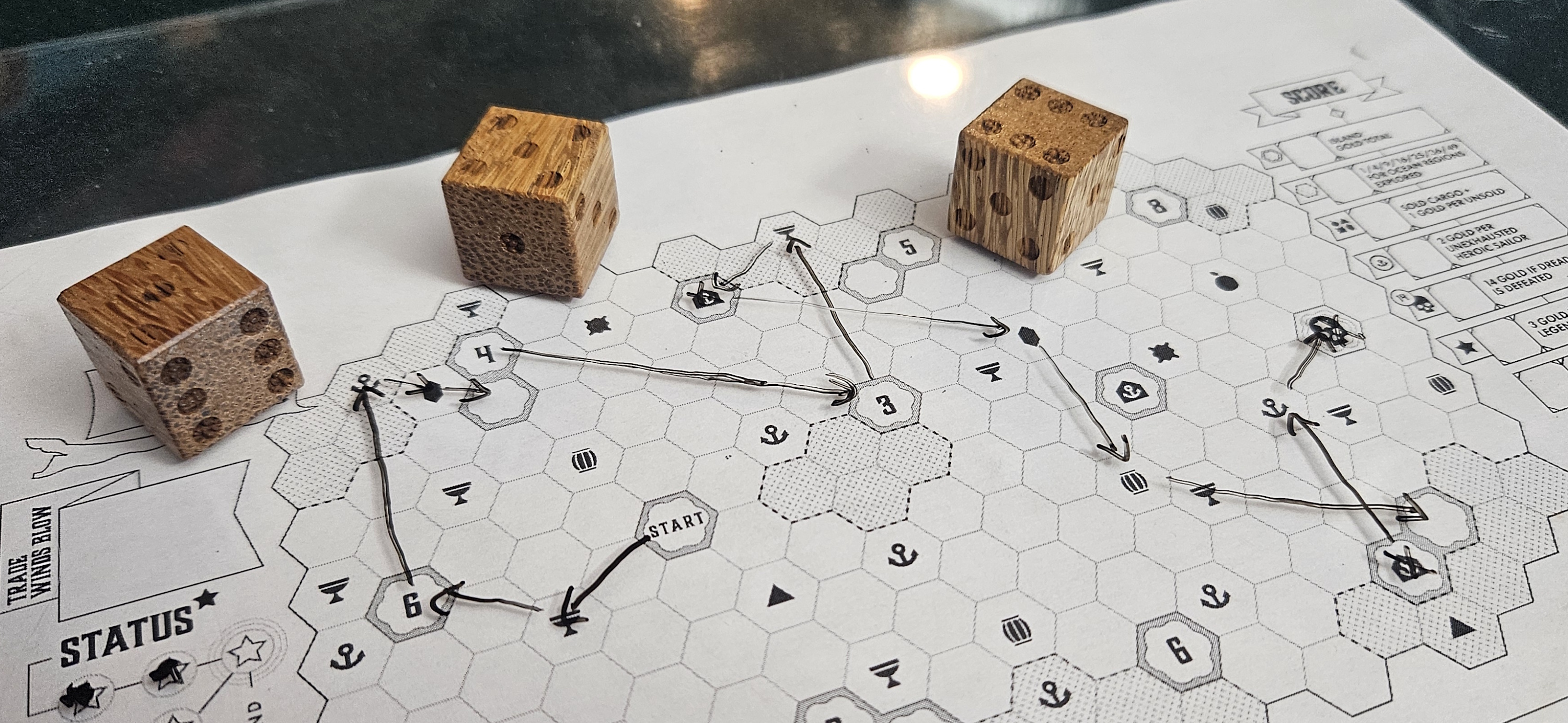
And this is how my version of Voyages looks:

less nice! but in a way I can actually print, so, nice!

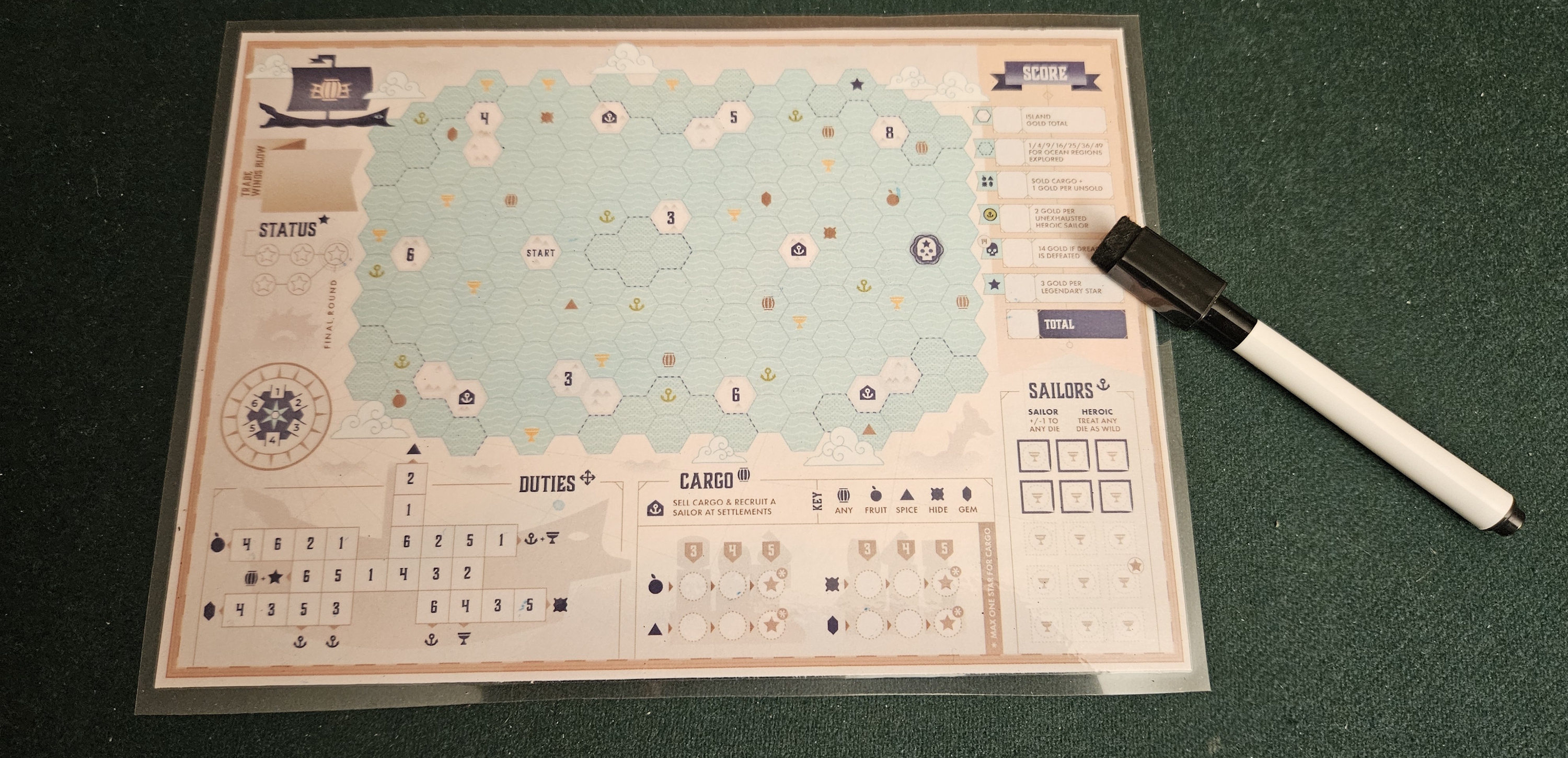
In my hands, how it actually looks.

Gray. Somewhat dull. Concealed beneath a much-abused plexiglass. Dice not included.

This is a very good thing. Because my main hangup with print-and-play games is that I only own a black-and-white printer. It works roughly a quarter of the time. The ink is sold at a premium by a cartel with armed enforcers and semi-legal firmware updates that mark my bootleg cartridges as empty until I bend a plastic doohickey, perform a hard reset, and offer three Our Emperors to the Omnissiah.

Discussing business practices isn’t very sexy. There’s a reason I don’t talk much about the publishers or marketing schemes behind the games I feature here. But in the case of Postmark Games, the business practice is the format. Buying a game gives you access to a Dropbox folder. That folder includes assets for both high- and low-ink printers. It’s as indie as it gets. A little fly-by-night. Shabby, if you’re the sort of person who demands a custom link to everything.

But the beauty of this format is that it’s also easy to use. Even with my wonky printer, I was able to get everything working in about two minutes. After another hard reset, I even had the rules sheet and a few warm maps ready to go.

This is probably the messiest map of the group, but it's deeply impressive how Voyages turns into a light survival horror game.

Sometimes your crew’s duties are tough, such as when you keep plowing into icebergs.

The gameplay, as befits a one-sheet roll-and-write game, is elegantly simple. You roll three dice and then assign them to three roles. One is your ship’s heading, which of six compass directions it will travel. The second is your speed, how far you’ll travel. You know, provided you don’t run aground on an island, hit a reef, or smack into the map’s edge. Between these two assigned dice, you’ll steer around the map to… well, it depends on the map.

Which brings us to that third die. This one governs your crew’s duties. But those duties differ from map to map. In the first map, this is a simple number-crossing game. If your third die shows a 3, you scratch off a 3 on your sheet. If this happens to finish a row or column, you earn a bonus. Easy.

But as the maps progress, the rules grow increasingly tricky. Not hard, exactly. Just tricky. Frankly, it’s impressive how much territory Muldoon and Dunstan are able to cover. Where one map sees your vessel racing to ignite beacons on lonely islands, another becomes a hard-bitten game of survival in arctic waters. The first map has some simple pick-up-and-deliver gameplay. Basic stuff. But another is all about catching the wind to drift between coral arches.

More often than not, these extra rules are handled by the die you assign to your ship duties. Repairing your vessel when it rams into icebergs or gets swatted by a whale. Tacking into the wind. Diving for treasure. Scavenging artifacts.

It’s a lovely system, surprisingly open-ended despite the stark limitation of three dice, and while there’s obviously a great deal of luck involved, it’s open to manipulation thanks to sailors who can be exhausted to ensure you don’t drift endlessly back and forth. More than once, I found myself thinking back to The Guild of Merchant Explorers, another flux-and-write game that threaded the needle between limitation and expression. That’s not exactly a coincidence, given that Dunstan co-designed that one with Brett Gilbert, but it’s notable how Voyages manages to produce an entirely different tale under similar constraints. To sail these waters is to be both buffeted by the winds and master of your own fate. It’s a wonderful paradox.

And dodging as many scoring opportunities as possible, apparently.

Charting invisible islands.

At first, my assumption was that Voyages would be a solitaire game. Because that’s what print-and-play games are for, right? And it is. A solitaire game, I mean.

But the solo mode is merely okay, a race to unlock three objectives (out of five) before sixteen turns have expired. Personally, I found that goal not only achievable, but usually laughable, barring a series of becalmed rolls. Anyway, what’s the fun of rushing all the time? The seas are full of things to discover. I’d rather take the time to poke around a corner before darting off to the next objective-indicating star.

Where Voyages shines is in multiplayer. The race element is still present, with those aforementioned objectives triggering the conclusion of the session, but the emphasis on scoring feels more natural to both the format and the setting. In this mode, there’s room to explore some more, everybody keeping one eye on their own heading and another on their opponents’ progress toward those objective stars. There’s also the pleasure of seeing what someone else did with the same rolls that caused you so much trouble. I was delighted by how quickly Summer picked up those first couple of maps, sailing gracefully from one isle to the next, scooping up sailors from their rafts and weaving between hazards. Compared to my bumbling from one island to the next, it was quite the sight. Also, her dry-erase lines are really sharp. Apparently I smush the felt into the plexiglass like some sort of ape.

If Voyages shines with multiple hands, it really glows when strung together in a campaign. This adds a little bit of everything. There are moonshot objectives to pursue, like visiting every single special zone on a single map or ensuring a half-dozen members of your crew upgrade to elite status. Stars can now be exchanged for upgrades, adding new ways to score points or mitigate a bad roll. And these newfound abilities are offset with the presence of a nemesis that adds increasingly difficult restrictions to the rules.

In the case of our campaign, our nemesis was Scar. Early on, he threatened to snipe any sailors we rescued from the water. Not too bad, given his shoddy marksmanship. But in the campaign’s later stages, he sent us sailing straight through islands rather than stopping automatically and eventually turned our three dice into a measly pair plus a duplicate. At the apex of our power, we found ourselves forced to wring every advantage from our abilities just to make a pit stop or sail the proper currents. The result was another careful dance between limitation and permissibility, stretching the system but never so far that it snapped.

palm wood!

These are my “thematic” dice.

On the whole, I came away deeply impressed. With the business model, with the design, with the way the game actually came out okay on my cartel-operated printer. Crud, even with the way Voyages manages to be a roll-and-write that isn’t just sums and filling in test-sheet bubbles. As much as I enjoy some of those titles, free-ranging movement has its own organic appeal. I’ll go where I want, winds be damned.

Or tacked into, anyway. As I’ve noted before, Voyages is a masterclass in the way board games excel when they lean into the limitations of their medium rather than trying to escape them altogether. Voyages is something special. It seems I’ll be getting back into print-and-play games.


Access to the files to print Voyages was provided by the publisher/designer.

(If what I’m doing at Space-Biff! is valuable to you in some way, please consider dropping by my Patreon campaign or Ko-fi. Right now, supporters can read my first-quarter update of 2026: the best board games, movies, books, and more!)
❌