
Normale Ansicht

Castelnuovo 1539 from Draco Ideas – Action Point 1

Von: Grant
18. Juni 2026 um 14:00

In 1539, a small Spanish garrison of troops numbering 3,500 men held the Albanian village of Castelnuovo for 22 days against the massive Ottoman army consisting of over 54,000 Turk soldiers. This siege took place as a part of the Ottoman-Habsburg struggle for control of the Mediterranean Sea in July 1539 at the walled town of Castelnuovo, which is the location of present-day Herceg Novi, Montenegro. After days of open trench warfare and more than a month of smaller combats, skirmishes, assaults and bombardments from the Turkish navy, the last Spanish defenders fell ending the siege. Castelnuovo 1539 is a wargame that focuses on this siege designed by Francisco Ronco. The defenders are safe behind sturdy walls and battlements but time and continual shelling from the Ottomans will lead to assaults over the walls. The battle is hopeless for the defenders but they can win the game by doing enough damage to the Ottomans to end their campaign and stop them from invading further into the Albania and then onto Spain and the rest of Europe. The game is very well produced using wooden blocks for soldiers, stylized walls, siege trenches and cannon along with ships and the board is also beautifully illustrated. The game is a block wargame where the strength of units are hidden from the opponent and plays pretty quickly in less than 90 minutes and really is a great representation of the battle and its history.

In this series of Action Points, we will first take a look at the beautiful Game Board and its area movement scheme, examine the units available to both sides and compare their relative strengths and weaknesses, take a look at the 5 different types of Command Cards and discuss how they are used, look at the 2 different types of rounds including a Siege Round and an Assault Round and how they differ, take a look at an example of combat and bombardment and finally examine the victory conditions for both sides and how casualties effect this outcome.

Game Board

The Game Board represents the fortified city of Castelnuovo and its surrounding areas, including the Mediterranean Sea to the south and the rolling countryside to the north. The Game Board is divided up into areas which are used to regulate the movement and positioning of the block units. The Game Board is pretty large really measuring in at 29″ x 21″ and is a fully mounted map board and is very nicely illustrated by Paco Arenas and absolutely was a joy to play on.

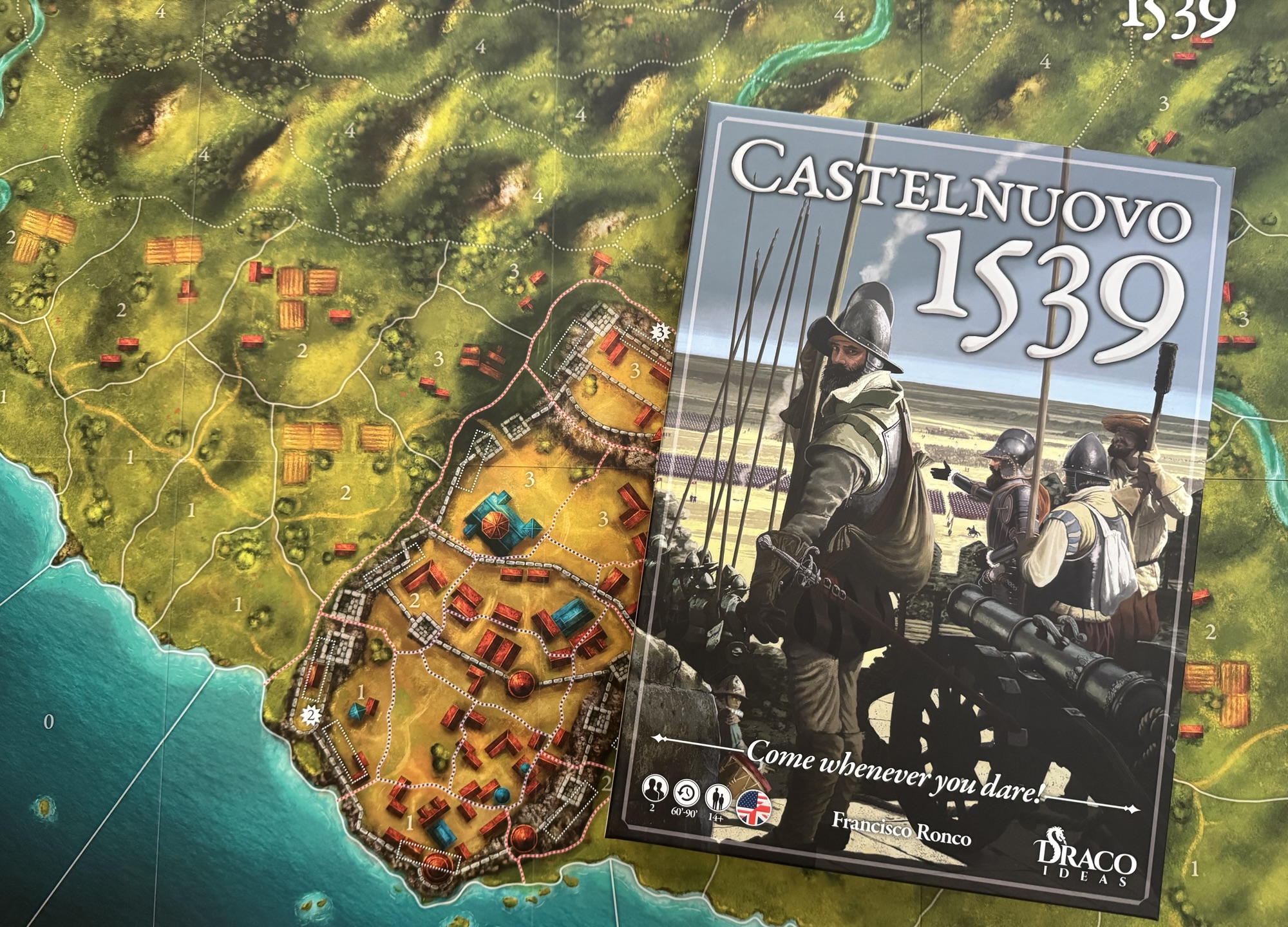
As you look at the Game Board in the picture above you will notice a few things. The areas of the city of Castelnuovo are outlined in red with a dotted line representing the city walls around its perimeter. There are also 4 inner areas of the city itself outlined in purple. Sometimes the game rules make reference to the “Fortress”, which means the 4 areas of the city and the walls surrounding them.

Here is a closeup of the Fortress where you can see the colored lines a bit better. You will also notice that there are rectangular boxes on top of the walls in the Fortress outlined with white dotted lines. These are spaces where the wooden wall segments are placed to represent the Resistance Level of the walls. You will see that in each area of the city that has walls, there is a number found in a white star that represents this Resistance Level. There are areas with both Resistance 1, 2 and 3 inside the Fortress. As the walls are attacked with bombardments from artillery, their Resistance Level will be degraded represented by placing wooden cubes in each area marking the current Resistance Level with 1, 2 or 3 cubes. If an area has 3 Resistance Level and takes a hit, the player will remove one wooden piece indicating that the Resistance points have dropped. Once the Resistance Level reaches 0, the walls are destroyed and the wooden wall pieces are removed from the board. The Ottoman player may then storm the walls and attack the defending units in the city.

There are 2 types of terrain found in the countryside of the Game Board with clear terrain being shown by a solid white outline and rough terrain outlined by a white dotted line. Each area of the map has a Height Level value printed in its location, which indicates the height of the area. The heights are 0 being the lowest, or basically the sea level with a 4 being the highest which represents a mountain level. The height effects the shooting of firearms. In addition, other terrain features are printed on the Game Board including the coastline, which separates the sea areas from the land areas, and also is a landing point for a majority of the Ottoman player’s reinforcement troops. Also, the 3 areas with Resistance Levels of 2 and 3, marked with the white star, are the areas that the Ottoman army must occupy at the end of any round to win the game.

Movement is specifically tied to the type of lines found in the areas of terrain. Units and Leaders can move by playing Action Cards, which allow a group of 1 to 3 units that are in the same area to one or more areas. Activated Infantry units will have 2 movement points and Cavalry have 4 movement points. Moving into a clear terrain area costs 1 movement point while moving into a rough terrain area, which is marked with white dotted
lines will cost 2.

The countryside areas have various depictions of buildings including shacks, storage sheds, houses as well as farm fields. These buildings do not affect combat or movement and are simply illustrative of the surroundings of the city. They are also many trees and bushes drawn on the Game Board with connecting roads also shown.

There are a few pieces that the players will place on the Game Board at the outset of playing including the wall blocks already mentioned as well as the Bastions. These Bastions are used by the Spanish player and are placed at the beginning of the game in any terrain areas outside of the city proper. These Bastions function similarly to the walls of Castelnuovo’s fortifications. Once these are placed, they cannot be moved and will remain on
the board even if their Resistance drops to 0 and they are destroyed. The Ottoman player can destroy them with artillery Bombardments or by spending Trench Points from Command Cards when entering them. These Bastions do not provide defense to the Ottoman player.

The Casualty Track is printed in the bottom left hand corner of the Game Board and is used to keep track of the number of blocks lost by the Ottoman player. In addition, also tracked will be Leaders and the number of Assault Rounds used by the Ottoman player.

The game really is a nicely made production with the Game Board being one of the best parts of the package. It is clear, well laid out and takes little to no time to understand its locations and areas. I think that one of the strengths of this game is that it is not only nicely produced but the rules are very clear and the strategy of what each side should be doing, by taking advantage of their defenses and the terrain.

In Action Point 2, we will examine the units available to both sides and compare their relative strengths and weaknesses.

-Grant
An Impossible War: The First Carlist War in the North, 1834-1838 from Bellica Third Generation – Action Point 1

Von: Grant
14. April 2026 um 14:00

An Impossible War: The First Carlist War in the North, 1834-1838 from Bellica Third Generation is a block wargame that recreates the First Carlist War in the North of Spain which was a civil war between the Carlists who supported the succession of the late king’s brother Carlos de Borbón and the progressive and centralist supporters of the regent Maria Christina acting for Isabella II of Spain who were referred to as the Liberals. The game uses blocks representing units but also includes counters and uses cards. I was able to play the game about a month or so ago with Francisco Ronco who owns the publishing company Bellica Third Generation and very much enjoyed the game and how it represented this interesting struggle.

In this series of Action Points, we will first take a look at the Game Map, discussing the point-to-point movement configuration, the various spaces and the delineation of the Carlist versus the Liberal Zones, as well as explain the use of the Rest of Spain smaller map, examine the units available to both sides and cover the importance of Supply, take a look at the Carlist Uprising Phase and what it means for the game, take a look at the activation system and the use of Action Point Markers, and cover some examples of Battle, focusing on the tactical aspect of combat with the use of the Battlefield Board, as well as an example of a Siege.

Main Game Map

There is a Main Game Map, which is commonly referred to as the Northern Map, shows the northernmost tier of Spain along the coast of the Cantabrian Sea including Navarre, the Basque Provinces and part of Cantabria, Burgos and La Rioja, and a small secondary Game Map that reflects the regions of the rest of the country, where Carlist uprisings break out and the expeditions sent from the North may operate.

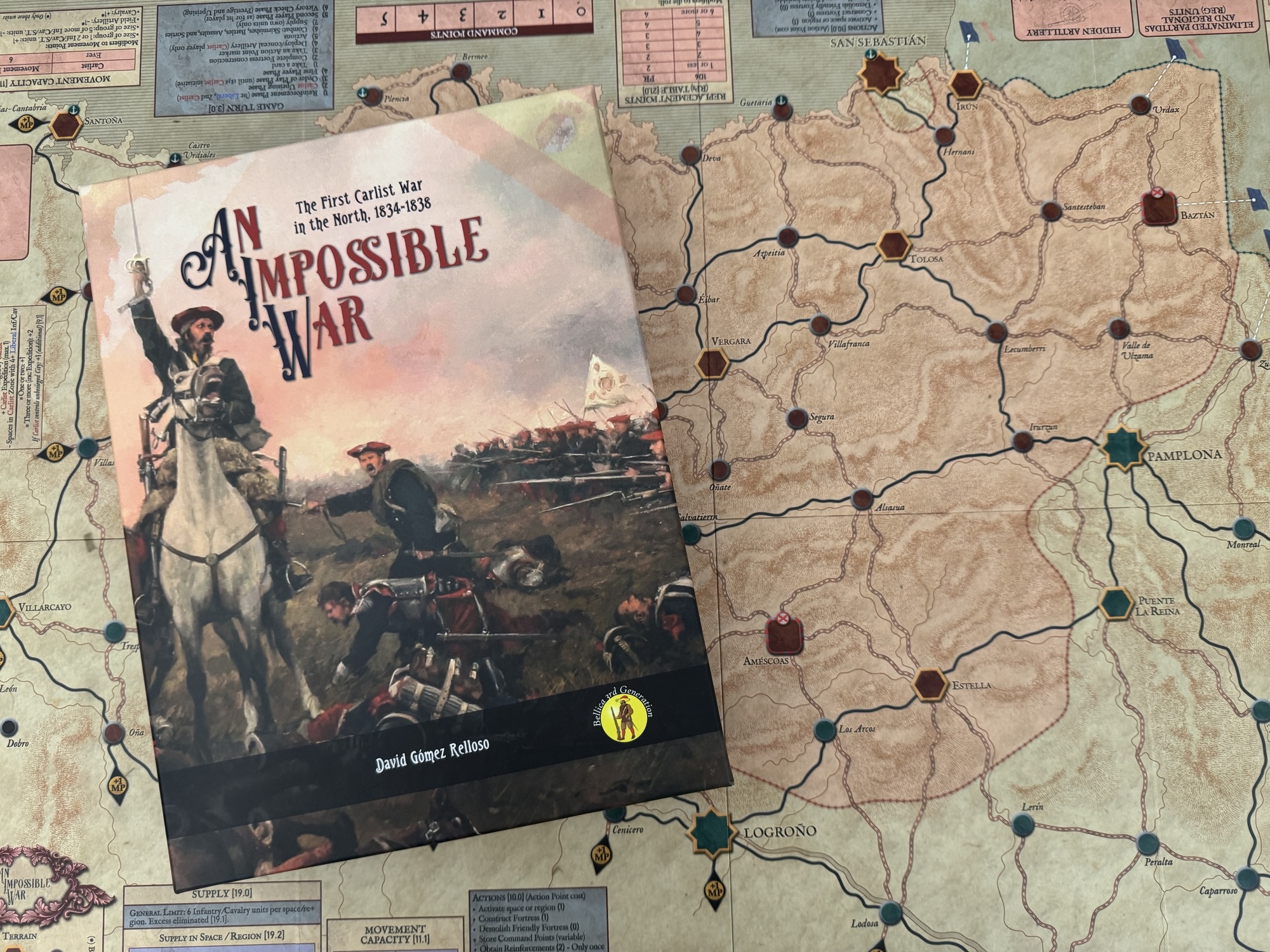
The Main Game Map contains various elements including named settlements, such as Towns and Cities, and also identify key Carlist Refuges and has a clear demarcation of Carlist and Liberal territory. There are locations identified by the name of a settlement or area, which can be of greater or lesser importance and size. There are four types of spaces including Cities, Main Towns, Carlist Refuges and Other Spaces.

Cities

Cities are represented on the Game Map by an octagonal shape and the name of the city is capitalized. If the City is Liberal it will be colored turquoise and if it leans Carlist it is colored red. There are five Cities on the Game Map including Bilbao, San Sebastián, Vitoria, Pamplona, and Logroño. All of them have a permanent Fortress as well as an Intrinsic Garrison marker indicating the controlling side. Also, the Bilbao space has a Port, identified by the anchor symbol, because it is connected to the Cantabrian Sea via the River Nervión. If the Carlist player is besieging Bilbao, or controls or is besieging either of the two spaces located next to the river (Portugalete or Guecho), the Port of Bilbao is cancelled for the purposes of naval transport and supply.

Supply is also determined based on 2 things, a Region and then each of the Cities within that Region. A Region can supply up to 6 Liberal Infantry and Cavalry units. But, a Region does not supply any Carlist units, which must obtain supply from a Supply Train or Knapsack in the Region. Without a Supply Train or a Knapsack, in order for Carlist units to get supply they then must attempt to forage. Each space can supply a certain number of units, depending on whether the space is located in the Carlist or Liberal Zone, the type of space, and the side the units belong to. We will cover this a bit more in Action Point 2 when we discuss units.

A player will gain +3 VP’s for capturing a City during the game. These are the most important ways to score in the game and protecting them is vital to either side. It is also important to keep in mind that if the Carlist player ever gains control of 2 Cities at the same time that were initially held by the Liberal player, that player will immediately gain an automatic victory.

Connecting the various Cities and Towns are the Roads. Units can move along these roads and there are 2 types of Roads including Main Roads and Secondary Roads. The Main Roads are indicated by a continuous thick black line while Secondary Roads are indicated by dashed brown lines. The cost of moving along a Main Road is 1 Movement Point and along a Secondary Road is 2 Movement Points. I found it very important to properly plan out your movements to maximize the distance that you can gain with a single action. These roads are somewhat of a spiderweb connecting points and you can reach all points eventually but finding the best and most efficient route is important. Studying the Game Map and the layout of the roads is key to playing the game well as you can block off the use of certain Main Roads and force your opponent ot move much slower on Secondary Roads frustrating their plans and efforts.

Main Towns

Main Towns are generally populated areas that have some political, economic or strategic importance and are identified on the board with a hexagonal shape that is of a similar size and proportion as the Cities. Also, the name of the town will be capitalized the same as the Cities. If the Main Town is Liberal it will be colored turquoise and if it leans Carlist it is colored red.

A player will gain +1 VP for capturing a Main Town that was held by the other side. These are not as valuable as the Cities but there are more of these on the Game Map than the Cities with 13 Main Towns as compared to only 5 Cities. Prioriting their capture and control is important for many purposes such as Supply, movement and being able to avoid interceptions and

Carlist Refuge

There are 2 Carlist Refuges identified on the Game Map including Améscoas and Baztán. These are spaces where the Carlists are particularly favored by geography and local popular support. Neither player may construct fortresses in these spaces. These Refuges are identified with a square with an X at the top and a dashed brown line.

Carlist Zones and Liberal Zones

The Carlist Zones take up a considerable portion of the Game Map which is denoted with a red shaded background and a dotted red line. All locations within it are considered to be in the Carlist Zone, while all locations outside of it are considered to be in the Liberal Zone. Also, spaces adjacent to the Carlist Zone are spaces belonging to the Liberal Zone, but that are connected via a road to any space within the Carlist Zone.

The Carlist units in the game are tied to specific localities—Navarre, the Basque Provinces, or “Castilians”—rather than a standard, monolithic national army and are numerically outnumbered by the Liberals. As such, they have a clear need to be nimble and move around the board causing difficulties. One of the ways the Carlist player scores Victory Points through the increase in Prestige is by is controlling at least 4 spaces with at least 4 units. If there are at least four Liberal infantry or Cavalry units in the same space in the Carlist Zone 1 is subtracted
from the sum of besieged Cities and active Expedition.

Essentially, the zone embodies the “Impossible War” by forcing the Carlist player to maximize localized, high-quality forces in their home territory against a numerically superior foe. The Carlist player increases their Prestige by besieging cities and launching expeditions. They also benefit from the growing Carlist uprising in the rest of Spain. The Liberal player will be busy countering Carlist Prestige, putting down uprisings, and hunting down expeditions. They have the advantage that, in the long run, war fatigue will affect the enemy.

The terrain is simple with each space containing rough or open terrain, depending on the relief of its area. Much of the northern geography was rugged, which played an important role in favor of Carlism, as it mitigated three of the advantages of government troops: their superiority in numbers, cavalry, and artillery.

The spaces at the western, southern, and eastern ends of the map have connections to regions on the map of the rest of Spain, which can be used to move from one map to another.

Finally, the Game Map includes various game tables (Year, Turn, Initiative, Victory Points, Carlist Prestige, etc.), as well as a lot of information about commonly used rules, so players don’t need to consult the rulebook that often.

Rest of Spain Smaller Map

The map of the Regions of Spain is smaller and simpler. It consists of nine large regions that cover large territories. This map’s purpose is to record the spread of the Carlist uprisings, to enable Carlist expeditions to operate and for the Liberal player to hunt them down. We will take a closer look at the Carlist Uprising Phase in a later post but I wanted to show you the map so you understand its layout.

I very much enjoyed An Impossible War, even though I played just a few turns of a smaller scenario with Francisco Ronco. He was a master at the game, as obviously as the publisher and a playtester he is intimately familiar with the rules and strategies, and I learned a lot from him about how the game should be played. I am looking forward to future plays as the game is just very good and has some interesting aspects that create a very tense and interesting game of maneuver and strategy. The Game Map is very well done, from an aesthetic perspective as well as functionally, and the board makes playing the game easier.

In Action Point 2, we will examine the units available to both sides and cover the importance of Supply.

-Grant

❌