I've been playing board games since the 1970s, and playing what are considered hobby games since the 1980s. (Yes, I am that old.) I've also played many RPGs in that time, and even a few wargames. I've seen many changes over the years, especially regarding the treatment of women in the hobby. Thankfully, things have improved greatly for women in gaming since those long ago days.
It was once the case that a woman just had to accept sexist remarks, inappropriate jokes, and offensive artwork as part of the gaming experience. Even after demonstrating interest and ability, many women were dismissed or belittled. Now, attitudes in many spaces have changed, and it is easier to find groups and shops that not only welcome women but embrace the different perspectives we bring to the hobby.
But…
As the saying goes, "The more things change, the more they stay the same." Unfortunately, even in the year 2026 CE, I still encounter more than a few casual assumptions about women who play and buy board games.
I don't bring this up to bash anyone, or to throw an entire gender under the bus. As I said, things have improved greatly. Learning is happening, and positive change is all around. There are some…
Am I actually the person acting like a jerk right now?
I participate in a wide variety of discussions on the internet (mostly in relation to tabletop games), and on occasion I will find myself responding to some aggravating comments. It’s in those moments when I’m pounding away at the keyboard that I try to step back and ask myself, “Wait, am I being a jerk?”
Sometimes the answer is no. But sometimes, sure enough, my response isn’t kind (or at least neutral), and that is directly counter to my goal of building community. Regardless of how the other person is acting, I have control over my own behavior.
There are various versions of this question; here are some others that I ask myself (and often wish others would ask themselves):
Would I speak differently if the other person was a friend or if I was face to face with them?
Is the phrasing of my question, request, or post aligned with the outcome I’m hoping to achieve? (i.e., if I start a conversation by calling a game “a total joke”, I shouldn’t be surprised when the ensuing conversation ignores my more salient points)
Is this an opportunity to ask a question instead of assuming or declaring? (i.e., it’s really important to get the facts straight before forming conclusions. See also this open letter to the internet.)
Am I addressing the right person for this criticism or question? (i.e., if I have a question about a game in a specific language or digital format, am I asking the correct publisher/developer?)
What if everyone requested this or asked this privately? (i.e., if 1,000 people asked this same question, would that be fair to the person I’m asking? See also the value of public questions.)
I truly believe that the internet would be a better place if we more consistently asked ourselves a self-awareness question. So I asked Stonemaier ambassadors to see if any of them had a question along these lines, and they had some great responses beyond those listed above. Here are a few of the 100+ questions they shared:
art from Origin Story
Am I participating in this discussion to be helpful or I just have something to prove?
Does this affect my daily life? If so, is there anything I can do about it?
Is this helping or hurting?
Will this comment help anything/anyone?
What am I trying to achieve?
Am I treating this person like a person, or like a symbol of something I dislike?
Am I responding to what they actually said or to the worst interpretation of it?
Am I expecting others to think the way I do?
Deep breath, how would I want someone to respond to me on this?
Does my comment add value to the conversation?
Would I be happy with what I wrote if I come back to the thread and reread it in the future?
If I did not know me and my intentions, what would be my first reaction to reading what I wrote?
Is my response furthering a meaningful discussion or just adding fuel to the fire?
Is my comment on topic?
Is this really worth letting someone who has no real impact on my life get me upset?
What am I actually upset about that is provoking this reaction from me?
What am I missing?
What implicit bias do I have that is making me react this way?
What is driving my need to respond right now?
What is the right thing to do/say?
What would my mom/spouse think if they saw me acting this way?
Would I do/say this in a professional setting?
Do you have a go-to self-awareness question that helps you be the best version of yourself on the internet? Let me know in the comments.
Die Pferdeherren bekommen nach über 20 Jahren endlich neue Modelle für die zentrale Einheit der Fraktion: die Reiter. Grund genug, nicht nur die neuen Modelle einmal genau unter die Lupe zu nehmen. Wir schauen uns die gesamte Armee von Rohan an – mit allen Vor- und Nachteilen.
Warhammer: The Old World bekommt endlich ein Grundset für zwei Spielende. Und dazu noch eine sehr spannende Kombination aus dem Großkaiserreich Cathay und den Kriegern des Chaos. Wir werfen für euch einen kurzen Blick in die große Box und zeigen euch, was euch alles erwartet.
Whenever I go on vacation or travel for any reason, I always pack a few board or card games. When we go out in our RV I can pack some full sized games (I tend to stick with the theme and pack games like Parks or Trekking the National Parks), but when we travel by plane, ship or car, you can be sure there are some card games or small board games crammed in the corners of my luggage. Even some big-box games get stripped down and their components stuffed in a makeup bag or small storage box. (And then I keep them there because oversized boxes are such a waste, but that's a topic for another article.)
People often ask me, "If you're going on vacation, why take games? You're going somewhere to do things you can't/don't do at home. Why not enjoy those things and save the gaming for when you're stuck at home?"
Here are six reasons why my games hit the road with me.
1. Meet new people
We started by playing games on camping trips as a way to unwind at the end of the day. We'd set up outside on the picnic table (by the campfire in season) and have…
Award-winning board game store owner Matthew Mičetić says independent tabletop retailers can no longer rely on product sales alone, as rising costs, tariff uncertainty and changing consumer behaviour continue to reshape the hobby retail landscape.
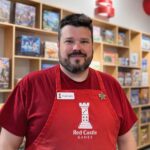
Mičetić was named Oregon Small Business Person of the Year last week by the US Small Business Administration, celebrating the 16-year growth of Portland-based Red Castle Games from a small neighbourhood game store into a vibrant space offering organised play, youth camps, community events and an on-site cafe.
He told BoardGameWire the complexity of running a game store had increased dramatically since the store opened in 2010 – but added that widening the venue’s scope had been a key ingredient in Red Castle’s success.
Mičetić said, “Competing solely on product selection and price has become increasingly difficult in a world where customers can order almost anything online and have it delivered to their door.
“What independent game stores can offer that online retailers cannot is community. We can provide places for people to learn, play, compete, socialize, and build friendships. The retail sales often follow from those relationships.”
He continued, “We aren’t just retailers anymore. We’re event organizers, community managers, educators, food service operators, e-commerce businesses, and increasingly technology companies as well.
“The encouraging part is that the core mission hasn’t changed. People still want places to gather, play games, make friends, and feel like they belong.
“The stores that continue to succeed are the ones that adapt to the changing business environment while never losing sight of the community they’re there to serve.”
Mičetić’s drive has seen that community expand from traditional hobby gamers and TCG players to include young people, families and more casual gamers keen to dip their toes into the hobby – something he believes is one of the biggest opportunities for game stores today.
He said, “Some of our most successful recent initiatives have been our youth programs, including Dungeons & Dragons, Magic: The Gathering, and Pokémon camps and after-school programs.
“Parents are looking for opportunities that help kids build friendships, creativity, problem-solving skills, social-emotional skills, and confidence. Tabletop games are uniquely positioned to provide that.
“We’ve also had success reaching beyond the traditional hobby audience. There are a lot of people who can benefit from what tabletop gaming offers who may never have considered walking into a game store.
“That means being willing to experiment, try new things, and sometimes fail. Not every idea works, and that’s okay. The important thing is to learn from it, make adjustments, and keep moving forward.
“I’ve always believed in looking for 1% improvements. Small improvements compound over time. If you can make your store, your programs, your customer experience, and your operations just a little bit better every day, those gains add up to something significant over the course of years.”
He added, “While retail is still the foundation of the business, these complementary activities have become increasingly important both financially and strategically. They reinforce one another.
“Someone might discover us through a D&D camp, become a regular event participant, buy games and accessories, meet friends through the community, and eventually become a long-term customer.
“The café, events, camps, and retail operation all work together to create a stronger overall ecosystem. For independent game stores, I think that’s one of the biggest lessons of the last decade. The future isn’t just about selling products, it’s about creating reasons for people to keep coming back.”
Organised play remains a “core pillar” of the store’s financial prosperity, Mičetić told BoardGameWire, while Magic remains its strongest offering and continues to be a cornerstone of organised play.
Mičetić receiving his Oregon Small Business Person of the Year award
He added, “One Piece has been one of the biggest success stories of the last several years, drawing strong participation. Star Wars Unlimited has also developed a passionate local community and has exceeded our expectations.
“Beyond TCGs, Dungeons & Dragons continues to be a major driver of participation through campaigns, youth programs, and camps. Board game events, painting nights, and miniature gaming also contribute meaningfully to overall attendance, even if they don’t always attract the same numbers as the largest TCG communities.
“What excites me most isn’t any individual game. It’s the diversity of the community. I believe the healthiest stores aren’t dependent on a single title. They’re places where someone can come in for Pokémon, discover D&D, try a board game, join a painting event, and ultimately find multiple ways to engage with the hobby.”
Speaking about current growth areas on the retail side – and areas which could be in decline – Mičetić told BoardGameWire TCGs continue to be the strongest growth category in the hobby, while oversaturation in higher-price point board games was beginning to show strain.
He said, “Magic remains a powerhouse, Pokémon continues to bring in new players, and we’ve seen strong engagement from newer games [such as One Piece and Warlord] as well.
“That said, I do worry that we’re in a boom cycle. I don’t know when it will happen, but historically every collectible market experiences corrections and I think it’s wise for retailers to plan accordingly.
“In board games, I think we’re seeing softness at the higher end of the market. For years, the industry benefited from an explosion of new releases and crowdfunding projects, but I also think the market became oversaturated.
“Self-publishing and crowdfunding lowered barriers to entry, which brought some fantastic games to market, but also a tremendous number of mediocre ones. Consumers have more choices than ever and less time to play them.
“Where I’ve seen the most consistent strength is in smaller board and card games, particularly titles under about $25. At that price point, they’re an easy impulse purchase and a lower-risk way for customers to try something new.
“RPGs are interesting. Product sales have slowed somewhat for us, but organized play and events remain strong. People still want to gather around a table and tell stories together, even if they’re buying fewer books than they once did.
“Miniatures remain a challenging category outside of Games Workshop. Many lines have passionate fan bases, but Games Workshop continues to outperform expectations and demonstrates the power of consistent support, organized play, and strong intellectual property.
“As for crowdfunding, we’ve largely stepped away from it as a retailer. There are certainly successful projects, but we’ve experienced too many delays, failures, and fulfillment issues over the years.
“Tying up cash and shelf space for products that may arrive years late, or not at all, has become increasingly difficult to justify.”
Mičetić said that on the distribution side, relationships had become both more important and more complicated since 2020, with the pandemic having exposed just how dependent the industry is on supply chains and allocation systems.
Mičetić said distribution relationships had become more complicated since the pandemic – and more important
He said, “In many categories, especially TCGs, we spent years dealing with product shortages, allocations, delayed releases, and uncertain restocks. More recently, while still dealing with those allocation issues, we’ve added questions around tariffs, pricing, inventory levels, and market demand.
“The underlying challenge remains the same, uncertainty. At the same time, retailers are being asked to make increasingly complex purchasing decisions with limited capital and shelf space.
“When talking with distributors today, my primary focus is predictability and partnership. I don’t expect every product to be available in unlimited quantities, but I do want transparency around allocations, release schedules, and restock expectations.
“The better information we have, the better decisions we can make. I also spend a lot of time discussing breadth versus depth. Every distributor wants retailers to carry more products, but shelf space, cash flow, and staff attention are finite resources.
“We’re increasingly focused on products that have strong community support, organized play opportunities, or demonstrated demand rather than simply chasing every new release.”
Mičetić’s award recognition follows a turbulent series of challenges in recent years, ranging from navigating the Covid-19 pandemic to enduring ten break-ins over a twenty-month period – a spate of crimes which resulted in more than $250,000 in losses and property damage.
He told BoardGameWire that while the experience was “frustrating and demoralizing”, he was “not willing to let a handful of criminals determine [Red Castle’s] future” – adding that the show of support from customers following the break-ins had helped reinforce why the store exists in the first place.
Mičetić said, “The primary targets were trading card games, particularly sealed Pokémon and Magic products, along with Games Workshop product. Unfortunately, those products are small, portable, and have a well-established secondary market, which makes them attractive targets for theft.
“The financial losses were significant but the larger challenge was the operational and emotional toll. Every break-in meant dealing with police reports, emergency repairs, damaged property, disrupted operations, and the uncertainty of whether it would happen again.
“There were periods when it felt like we were spending almost as much time thinking about security as we were thinking about growing the business.”
He advised other hobby retailers to “invest in security before you need it”, adding that the experience had changed his own understanding of risk.
Mičetić said, “Small businesses often operate on relatively thin margins and repeated criminal activity can have an outsized impact.
“It’s a reminder that when people talk about crime affecting businesses, they’re not just talking about stolen merchandise, they’re talking about the time, money, stress, and opportunity cost that comes with recovering from it over and over again.”
Speaking of his SBA award win, which recognises business owners who demonstrate outstanding business growth, innovation, resilience, and contributions to their communities, Mičetić said, “This recognition is incredibly meaningful because it reflects the community that built Red Castle Games.
“Every customer, staff member, volunteer, and supporter has played a role in our success. This award belongs to all of them.”
This is the second part of my three-part series on getting back into board gaming after a long absence. In Part One, I looked at ways to rebuild your gaming muscles. (If you want to skip ahead, you can go to Part Three (Coming Soon!) to read about the games that brought me back into gaming.) As with any hobby, a long time away can result in skill loss. Your ability to strategize and quickly learn rules can atrophy. The good news is, it's pretty easy to get those skills back with a little practice.
What's not as easy to regain is a lost group of board gaming buddies. My five-year layoff from gaming began with Covid and continued through a cascading series of family issues. By the time everything was somewhat back to normal, I'd lost all of my gamer friends. Covid destroyed my gaming groups, and caregiving for my parents left no time for games. When I looked around several years later, all of my gaming friends had moved on, either to new places, new hobbies, or new responsibilities.
Not being an extrovert, it's not easy for me to find new people to play with. However, I know that if I want to keep board gaming as a hobby, I have to gather my courage and get out…
I spent the last 4 days at Geekway to the West, an absolutely incredible game convention in St. Louis. Today I’ll share some of my highlights and observations through three lenses: Jamey as a publisher, designer, and gamer.
Publisher Jamey
Stonemaier Games participates in a few ways at Geekway: We donate a lot of games to their play-and-win section, which has proven year after year to be a great way to share our games with people who haven’t tried them.
We also have a booth in their vendor hall (Geekway primarily focuses on casual gaming, but they do have vendor space too) run by my coworker Dave and staffed by an amazingly generous demo team. Our main intent at the booth is simply for people to have fun and learn about our games, and it’s a nice bonus if we sell some games too (this year it looks like our booth revenue was around $16k, and people could also place orders on our webstore and pick up their order at Geekway since our warehouse is located in St. Louis).
I like that Geekway provides publishers a lot of different options. You can have a booth if you want, but you could also have a demo table through Double Exposure, you could just put games in play-and-win, or you can just wander around and connect with people (or scout games to potentially publish).
I’ll also add that having several years of t-shirt and hoodie sales provides a really nice way for me to look around any room at Geekway and identify people who know Stonemaier Games. The warm hoodies were particularly helpful, as the main hall at Geekway was quite cold this year.
Dark Heists
Designer Jamey
There are two sides to Designer Jamey at conventions: past and future. For games I’ve already designed, it’s immensely gratifying to see people playing them. I don’t think I’m alone, as I saw other designers checking in on people playing their games (this happened to me while playing the card game Oopsy Poopsy). I taught and played Euphoria Essential and Origin Story, and I had a great time learning the game Dark Heists from the designer, Moe Poplar.
Then there are the games I have yet to to design. I love playing a variety of published games at Geekway to learn from them. This year I played 14 new-to-me games and 6 games I already knew (it’s nice to revisit games to look at them from a fresh perspective).
Geekway provides several opportunities for designers to get feedback about unpublished games, including the clever Playtest to Win area.
Last, I’m so grateful for everyone who either played a game with me or just came up to me to say hi. Those moments and that time means the world to me. As someone who has social anxiety about approaching people, seeing others do it to me gives me the courage to do the same for others. Thank you for the inspiration!
Empires of the Void
Gamer Jamey
While Geekway is part work for me, it’s also part play. I love playing games with delightful people, and Geekway is full of them. In total I played 20 different games at Geekway (plus a round of disc golf) with around 60 people. I spent most of my time in a smaller ballroom in the first floor of the connected hotel–it was a much quieter in there (and warmer) than the main convention hall. Thanks to everyone who took the time to play with me!
I appreciate play-and-win as a gamer too, as it helps me narrow down which games to play out of so many options (though I did also check out both Blood Rage and The King Is Dead from the main library to revisit them). Without play-and-win, I wouldn’t have discovered the delightful game 3 Chapters, experienced the whimsy of the cat game Oopsy Poopsy, or delved into the strategic cleverness of Galileo Galilei.
While Geekway does have a few events people can sign up for, the vast majority of the convention is casual gaming. This, I’ve found, is my preferred structure for a convention, as I like the fluid nature of going from game to game at my own pace, remaining flexible as to what I play and how long I play. I’m grateful to Geekway for embracing this format, and I’m always open to suggestions for other similar conventions!
***
If you were at Geekway to the West this weekend (or you’ve attended a gaming event in 2026), I’d love to hear a few of your highlights!
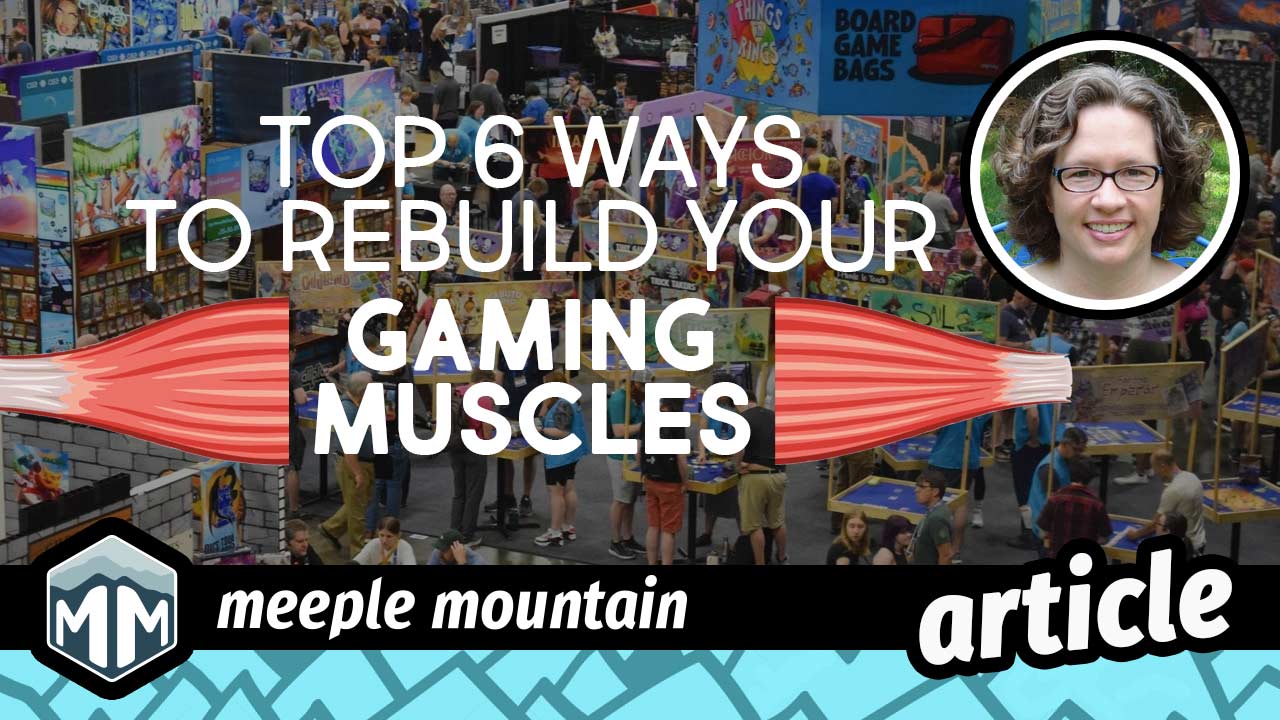
This is the first part of a three-part series on getting back into board gaming after an extended absence. (If you want to skip ahead, you can go to Part Two to read about rebuilding your gaming groups, and Part Three to see the games that brought me back to gaming.) Today we're looking at ways to re-build your gaming muscles (thinking strategically and logically, understanding mechanisms and how they interact, puzzle solving, etc.) that may have atrophied during a long hiatus from gaming.
My long hiatus began with Covid cancelling all in-person gaming and then swan-dived into three years of caregiving for my parents. When the storm abated, I looked around and realized that I had barely touched a board game in five years. Between having no time or mental bandwidth for games, my game shelf was covered in dust and, even more worrying, my gaming skills had atrophied.
I first tried to play Trollhalla, one of my favorite games. I felt stupid and slow. The game isn't difficult, but my ability to remember the rules and work through a strategy was shot. Five years of too much doomscrolling, constant stress, and lack of sleep did a number on my ability to think clearly. I tried other games with much the same results. It was depressing and…
I attended a fundraising trivia night over the weekend where every table had a theme chosen by the attendees. Our table was Wingspan & bird themed: Most of us wore bird shirts, there were dessert nests with candy eggs, we had two huge owl statues, and I brought a random Wingspan Americas bird card for each of the 10 of us.
The fundraiser was entirely unrelated to tabletop games–it was for the St. Louis roller derby team–but several people stopped by to say how much they loved Wingspan. One comment stood out: “I love Wingspan. It’s the only game I play.”
You might glance at your vast collection of games as you read this and wonder why this person hasn’t tried other great games, but think back to when you got into modern gaming. For me, Catan was the only game I played for a few years, followed by Agricola. The mentality was, “Why would we play something else when we already know–and enjoy–this game?”
Eventually I started exploring other games (Fresco, Dominion, Stone Age, etc), but I would bet that a not-insignificant number of people are “lifestyle gamers”–they pick a game, and that’s the only game they play. They might go deep into a modern game like Wingspan, a classic game like chess, or a trading/living card game like Magic.
I love when someone finds a game that they want to play over and over again. As a publisher, I want to support the things that bring people joy. Here are a few ways I try to support those who choose to play a specific Stonemaier game over and over:
community support: If I go deep into a game, I like to talk about the game on online forums (especially BoardGameGeek and Facebook). I try to help people feel welcome when they venture into the comments for our games, as it can be intimidating to show up in a group of 20,000 people and not know how your first question/comment will be received. Part of community support also includes supporting and encouraging fan creations (e.g., Wingspan’s bird promo packs or expansions like Scythe: The Wind Gambit).
content creators: Here’s a little secret about why we send so many games to reviewers (all games in our catalog, not just the new hotness): It’s just as much to get people excited about the games they already play/own as it is about informing people who don’t already have the game.
digital versions: The tabletop experience is awesome, but it isn’t always an option. We work with developers to bring our games to life digitally so the person who plays Wingspan once a month in person but wants to play every day in between online can do that.
accessories/expansions/promos/merch: For the two games I played over and over for several years (Catan and Agricola), we literally had one copy of the game among us. At a certain point, those of us who didn’t own the game felt the desire to contribute. We bought expansions, upgraded tokens, and promos; we might even have bought Agricola t-shirts if we had thought of it.
spinoffs/sequels: There are certainly many people who just want more Wingspan or more Scythe. But there are some who want different-Wingspan or different-Scythe; hence Wyrmspan, Finspan, and Expeditions.
gift giving: My first few games after Catan and Agricola were all gifts. I’m sure I would have eventually started buying other games myself, but I’m so grateful that people gave me that nudge by giving me Dominion, Stone Age, and Fresco. We have a gift guide at Stonemaier Games, but as I write this, I think it might be helpful to bridge the gap between popular non-Stonemaier games and our games. For example, if someone you know loves Carcassonne, they might also enjoy Between Two Castles. That sort of thing.
Did you–or do you still–have a game that you play over and over? In what ways has the publisher supported your passion for that game?
I spent the last weekend hosting friends at the Gamers Ranch, a gaming-focused vacation property in the middle of Missouri. I had an amazing time, and I loved seeing the power of the tabletop community in action, especially in seeing different gaming friends intermingle.
As I reflected on the weekend, I realized that among the dozens of games played, there were 5 games that hit the table more than any others. I thought I’d briefly look at each of those games to see what made them work particularly well for events and conventions, which can sometimes be the difference for a game to break out.
Moon Colony Bloodbath: I taught and played this 6 times over the weekend, and nearly everyone played again later. Even though it’s heavier than the other games on this list, the single deck of cards (flip a card and everyone does what it says) helps a teacher to guide everyone through the first few turns. It’s also entirely simultaneous, so there’s no downtime. There’s also the dark humor of the theme and the bold name, which seemed to attract curiosity from those who hadn’t played.
Lord of the Rings Trick-Taking: The cooperative nature of this game creates a sense of camaraderie; camaraderie is often a primary motivator for someone to attend a gaming event. Also, the short playing time and the variety of each chapter–all based on a simple core system–created a “just one more game” mentality.
Bomb Busters: I’ll continue what I said above about the Lord of the Rings trick-taking game, as this applies to both: I’ve noticed at gaming events that many people are hesitant to commit to a 3-hour game, yet they’ll end up playing short, escalating, cooperative games like Bomb Busters for hours. I love the idea of breaking a longer game into bite-size pieces.
Magical Athlete: Everything about the product design of this whimsical racing game lends itself to events. While it asks players to make a key decision before the game starts (which characters you select in the draft), the rules are so bare-bones that this isn’t a problem. I noticed that people seemed to gravitate towards this game after playing a heavier game, as it’s a great brain break.
Mindbug: This snappy two-player dueling game has a unique hook that seemed to intrigue people (twice per game when your opponent plays a card, you can claim it as your own instead). An accessible, quick 2-player game is really nice for an event when a few people are waiting for longer, larger-group games to finish.
Also note that all of these games are super fast to set up.
One other commonality between these games is that they all had someone championing them. This can make a huge difference at an event or convention: If there’s someone visibly excited to play a game they already know, people will gravitate towards that game.
Have you noticed a game spreading like wildfire at events or conventions? What is it about that game or the situation that resulted in the game returning to the table over and over?
Leute, diese Abstimmung hat mich schon Nerven gekostet, weil alte Kalauer gewählt wurden. Sie haben mich gezwungen, hier Brettspiele zu prämieren, die ich selbst nicht wirklich mochte. *Hust Flügelschlag und Mischwald*. Und es gab regelrechte Wettrennen um Platz 1, weil ihr als Community in Wellen gewählt habt und entsprechend Titel auf- und abrutschten. Dieses Jahr...

 Anmelden