

Normale Ansicht

Gods’ Will Game Review

Gods' Will showed up in my social media feed, comparing itself to Resistance: Avalon like a new kid on the first day of school telling everyone he used to be popular somewhere else. I have heard this pitch. I have reviewed this pitch twice, from Witch Hunt and Human Punishment, two games that made the same promises and delivered the same disappointing results. So when Gods' Will came knocking with the same marketing aura, I had to open the door with at least one eyebrow raised. Maybe I’m just addicted to disappointment, who knows.

After half a dozen plays, I can say with a bit of confidence that Gods' Will is doing more right than wrong here. More importantly, it earns it by fixing the real problems with its predecessors rather than just the ones that look good in a Kickstarter pitch.

A Skeptic Walks Into a Kickstarter

Like 90% of social deduction games that have ever existed, there are two teams: Light and Dark. There is also a loner faction, a third party whose goals shift depending on player count and whose presence ensures that the ride from start to finish won’t ever be a smooth one. Every player is a God with a public special ability…

The post Gods’ Will Game Review appeared first on Meeple Mountain.

LUZ Game Review

With a title like LUZ, Spanish and Portuguese for “light,” you’d expect this Taiki Shinzawa trick-taking game to have a bit more clarity. Silly you. Silly me! LUZ is a game of shadows and half-knowns, a trick-taker that casts a shadow of uncertainty.

Given that Shinzawa is responsible for the likes of Ghosts of Christmas, a trick-taker in which you play three or four must-follow tricks at the same time while the trump suit shifts with player behavior, I should clarify that LUZ isn’t that opaque. It’s all relative. If Ghosts of Christmas is a few standard deviations outside the mean, LUZ is safely within the bell part of the curve.

This is a must-follow trick-taking game where players bid before the hand begins. You have the choice of making an exact bid, which requires you to hit the nail squarely on the head in order to score, or a more forgiving bid that gives you one trick’s worth of wiggle room in exchange for scoring half the points. Higher risk, higher reward.

This doesn’t sound so different from whist, other than the room for some wiggle in your wager. The opacity comes from the last two rules: the back of each card indicates what suit that card belongs to, and you never know the values of your…

The post LUZ Game Review appeared first on Meeple Mountain.
Masters of Crime: Mosquito Game Review

Yeah…we’re back on track.

After a so-so run with Masters of Crime: Incognito—the fourth game in the KOSMOS one-shot mystery game series—I waited a few months before attacking the fifth game, Masters of Crime: Mosquito. My wife and I carved out a Friday night, grabbed a laptop, and sent the kids off to bed early. Would Masters of Crime continue a downward trend with Mosquito, or would the road to recovery be lined with gold?

I’m happy to report—so, so happy to report—that Masters of Crime: Mosquito sits comfortably alongside the other three exceptional MoC titles, Vendetta, Rapture, and Shadows. And, like Shadows, Mosquito has an ace up its sleeve, by serving as both a murder mystery AND an adventure game by extending into two solid halves that features plenty of puzzles in a wide range of difficulties alongside a story that riffs on many great films of the last 30-40 years.

KOSMOS now sells all five of these titles as a five-pack. While Incognito is a bump in the road, it’s still worth buying all five of these titles at once if you are new to the series. Masters of Crime is the best one-shot cooperative mystery series on the market.

I’ll share a few thoughts below in this spoiler-free review.

Masters of Crime: Mosquito Game Review appeared first on Meeple Mountain.
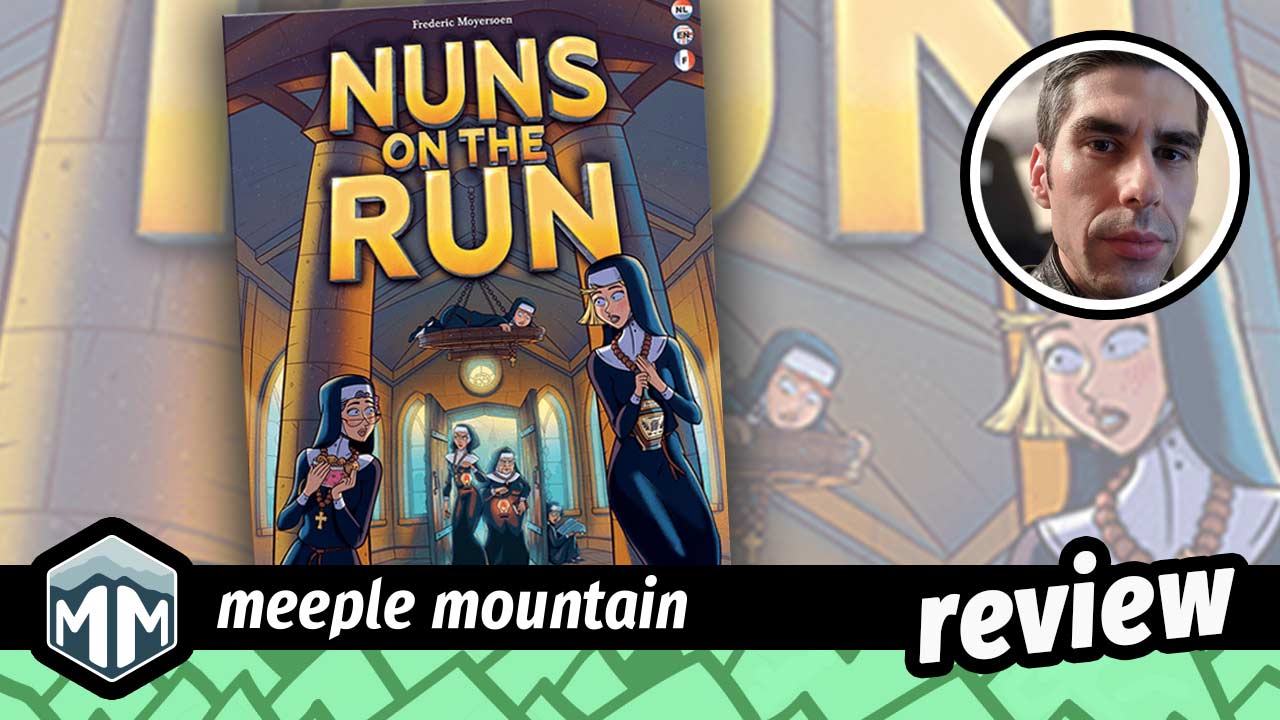
Nuns on the Run (Second Edition) Game Review

Hidden movement games occupy a strange corner of the tabletop world. Compared to juggernauts like deckbuilding, worker placement, and engine building, the genre feels like it has been locked in the crypt, occasionally rattling the door to remind everyone it still exists.

Nuns on the Run is a perfect example of that. Originally released in 2010, the game flipped the typical hidden movement structure on its head. Instead of many players hunting one, a single player searches for several invisible ones. Throw in a genuinely charming religious theme that somehow manages to poke fun without punching down, and you have something worth paying attention to.

The Lord’s Work This is Not

Our story starts with life in the abbey not going quite as planned. Most players are novice nuns who have very clearly not yet grasped what life in the cloth actually demands of them. Locked away somewhere in the abbey is a relic of their former life: a love letter, a bottle of booze, a box of cookies. The goal is simple: sneak out of bed, grab the key, retrieve their precious contraband, and make it back before anyone notices they are gone.

Standing between the novices and their contraband are the two nun pieces, both controlled by…

The post Nuns on the Run (Second Edition) Game Review appeared first on Meeple Mountain.

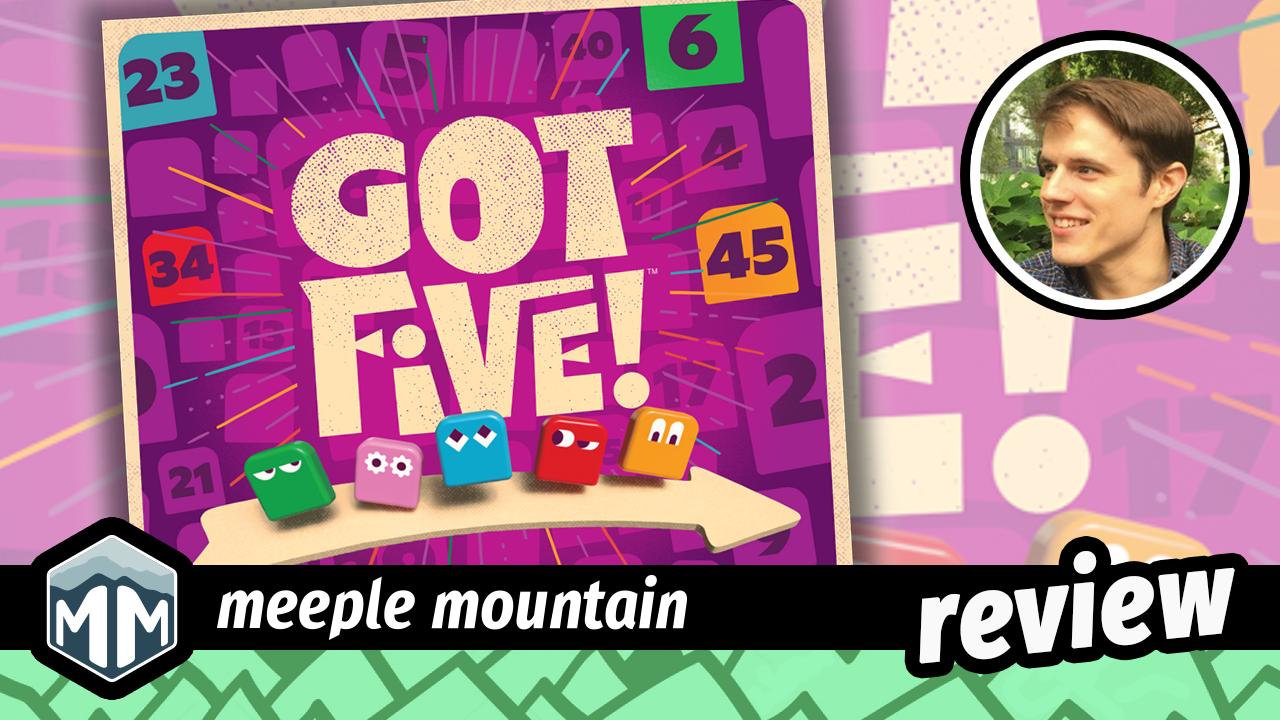
Got Five! Game Review

Every now and then, I sit down to play a game with no expectations whatsoever. I anticipate neither excitement nor despair. I am absolutely ambivalent, a perfect blank slate. I think of this as a true neutral response, but it occurs to me that I generally enjoy trying new games, so ambivalence is in fact a moderately negative response. I’ll process this on my own time.

Ambivalence was very much the case with Got Five!, a deduction game from designer Yoann Levet and publisher Blue Orange. I picked up a review copy because it was the slow season, I knew it wouldn’t take long to play, and I liked the tiles. I don’t know which of the two credited artists, Mathieu Clauss and Simon Douchy, is responsible for them, but those colorful bakelite tombstones with expressive eyes are hard to resist.

Don’t be fooled. Their friendly exteriors harbor terrible secrets, by which I mean numbers between 1 and 60. If you think that doesn’t sound so bad, you probably like math. During setup, each player takes one tile in each of the five colors and stands them up so the numbers are visible to everyone else at the table. It is extremely important that you not see the numbers on your own tiles, since the goal of the game…

The post Got Five! Game Review appeared first on Meeple Mountain.

Winnie the Pooh: Serious Detective Game Review

Yes…this is a review of a game called Winnie the Pooh: Serious Detective.

As almost anyone who remembers Winnie the Pooh books as a kid will tell you, there ain’t nothin’ serious about Winnie the Pooh. Nothing resembling detective work. Usually, the only “crime” that needed solving was on what page Winnie would be found sitting in the Hundred Acre Wood with a pot full of honey. Rabbit, Piglet, Eeyore, Owl, Kanga, Roo, and of course, Christopher Robin…check, check, check.

In other words, there shouldn’t be any mysteries at all. But when I saw that the folks at CrowD were releasing a Winnie the Pooh game FOR ADULTS, I set my sights on grabbing a copy at SPIEL Essen last fall. Because I only approached publishers for review copies on the Sunday of that show, I came up empty in Germany because CrowD had sold all copies of the game earlier that weekend. A few months later, I reached out to get a copy by mail, and one arrived a few weeks ago.

My wife and I have played—which means I have written about—dozens of “one shot” mystery/escape room-style games, so I consider myself a bit of an expert in the category. Winnie the Pooh: Serious Detective’s description lined up with my interests: three cases, each of…

The post Winnie the Pooh: Serious Detective Game Review appeared first on Meeple Mountain.

❌