Normale Ansicht

Wilhelm Marx (Weimar Chancellor Ratings, #2)

26. Juli 2026 um 17:49

We’ve been assessing the merits of political leaders in (more or less) democratic countries on this blog for a few years now. Today, we’re looking at the longest-serving chancellor of the Weimar Republic, Germany’s first attempt at parliamentary government – Wilhelm Marx. And which game could be more appropriate for him than Weimar (Matthias Cramer, Capstone Games/Skellig Games/Spielworxx)?

If you want to read more ratings of historical leaders like this, I strongly recommend you subscribe to the blog – all new posts in your inbox right when they go live!

The Rating System

Some caveats ahead: The chancellors will be rated by the knowledge of their time. If they or their contemporaries could not have known about the effects of something, I will not use my hindsight to mark it as a mistake of theirs. The assessment is focused on their conduct as chancellor.

Now, to the system itself: There are three policy field categories (foreign, domestic, and economic policy) and three more general ones (vision, pragmatism, integrity). A chancellor can earn from one to five stars in each category (for a total sum of up to 30). In detail, the chancellor is assessed as follows:

Foreign policy: Did the chancellor increase German influence in the world and the security of Germans at home? Did the chancellor wield German power responsibly and with positive results for the regions affected?

Domestic policy: Did the chancellor increase the liberty of Germans to express themselves and to participate in the political process? Did the chancellor promote domestic security and shape the framework for fair justice dealing with offenses?

Economic policy: Did the chancellor facilitate the prosperity and economic security of Germans (including in the mid- and long-term)? Was the chancellor’s economic policy based on mutual benefit of those involved or did it unduly burden one side?

Vision: Did the chancellor have an idea of what Germany and Europe (the latter counting for more in times of German influence being great) should look like beyond the immediate future? Did the chancellor’s policies steer Germany (and, if applicable, Europe) in this direction?

Pragmatism: Did the chancellor succeed in seeing their policy through from inception to completion? How well did the chancellor manage the support from parliament, society, the administration, the media?

Integrity: Did the chancellor understand the office as a means to benefit themselves, special interest groups, the entire country, or another community? Did the chancellor respect the boundaries of the office?

Note: If you have read my UK prime minister or US president ratings, you will remember that I rated them on the global impacts of their vision as well. As the rating system is only really applicable to democratic leaders and no democratic German leader ever had the chance to conduct a truly global policy, I only assess their vision on national and European grounds.

Early Life: The Catholic Man of Duty

Wilhelm Marx was born in 1863 in Cologne, then a part of the Rhine Province of the Kingdom of Prussia, soon to be part of the united Germany. No one could have foreseen in his boyhood that he would rise to the chancellorship – he was the son of a mere schoolteacher, and a part of the Catholic minority which was always suspected of possibly disloyalty by the Protestant Prussian state. The young Wilhelm Marx was one of many who set out to prove that he could be just as patriotic as any Protestant: He studied law and entered public service. His Catholic faith, however, would always be the guiding star in his life.

He was first elected to the Prussian parliament in 1899 on the ticket of the Catholic Zentrum (Center) party – one of the four player factions in Weimar. By the time Marx was elected, he had been active for nine years in the Volksverein für das katholische Deutschland (People’s Association for Catholic Germany), an organization dedicated to improving the social conditions especially of the poorer Catholics. Social and cultural issues, especially the expansion of Catholic schooling, would remain close to his heart: In 1910, he founded the Katholische Schulorganisation (Catholic School Organization), a grassroots lobbying organization dedicated to the matter.

The same year, he was elected to the German parliament – his first electoral success on the national level after two campaigns in hopeless districts with very few organized Catholics which he had only undertaken out of duty to the party. In parliament as well as in his electoral campaigns, he aimed to form an alliance with the Protestant bourgeois parties against the burgeoning SPD (Sozialdemokratische Partei Deutschlands, Social Democratic Party of Germany), the second player faction of Weimar. However, this strategy failed when cross-confessional bourgeois solidarity eroded in the more confrontational cultural climate from 1911 on.

World War and Revolution

These divisions faded into the background with the beginning of World War I. Despite the pre-eminence of military and diplomatic action then, Marx’s political activity remained limited to domestic issues. From his papers, we cannot discern if he even formed an opinion on many of the pressing issues in those other realms (say, unrestricted u-boat warfare). He did, however, change his mind about cooperation with the SPD, with whom the Zentrum (and the liberal parties) partnered from 1917 on in their quest to place the imperial government on a more parliamentary basis.

While the National Assembly was no breakout for Marx, it established him as one of the more experienced politicians of the Zentrum. Card “National Assembly in Weimar”, ©Capstone Games/Skellig Games/Spielworxx.

The revolution of 1918/1919 took Marx by surprise. Once more, he placed his powers at the disposal of his party, and was elected to both the Prussian and the German constitutional assemblies. The National Assembly in Weimar developed a constitution which included many long-held dreams of his, as the Catholic church, Catholic associations, and individual Catholics finally had their rights guaranteed. The short period of cooperation with the Social Democrats (and, to a lesser degree, the progressive liberals of the DDP (Deutsche Demokratische Partei, German Democratic Party) had achieved what years of negotiation with the Protestant conservatives of the Empire had not. This early alliance between Zentrum and SPD is the starting point of any Weimar game.

Yet the new German republic was unpopular with the numerous conservative, monarchist Zentrum members, and cooperation with the Social Democrats doubly so. Marx thus spent much of his political energy advocating for the constitution among his fellow Catholics.

At the time, Marx considered leaving politics altogether in favor of focusing on social work: From 1919 to 1921, he acted as director for the Volksverein (but proved unsuited to implement the sweeping changes necessary to improve the Volksverein’s faltering popularity in the Catholic milieu).

The Zentrum‘s base were rural Catholic voters, conscious of their second-class citizen status in Imperial Germany, but often personally conservative. The rapid changes of democratization and industrialization put a strain on party unity. Card “Keeper of Tradition”, ©Capstone Games/Skellig Games/Spielworxx.

Parliamentary Leader in the Republic

Yet once more duty called: As many of the old Zentrum parliamentary leaders died, Marx was one of the most experienced politicians his party could field. And his conciliatory, even-handed manner was just what the Zentrum needed when the party was so deeply divided against itself on the question of supporting the republic or restoring the monarchy as well as if to cooperate with the Social Democrats or the Protestant nationalists of the DNVP (Deutschnationale Volkspartei, German Nationalist People’s Party), the third Weimar player faction.

Marx was thus called on to hold the diverging wings together: He was elected head of the parliamentary group of the Zentrum and then also party chairman in late 1921. As the Zentrum’s governing partner SPD merged with the more left-leaning USPD (Unabhängige Sozialdemokratische Partei Deutschlands, Independent Social Democratic Party of Germany), Marx advanced a closer cooperation with the two liberal parties DDP (in government) and DVP (Deutsche Volkspartei, German People’s Party, in opposition) – the two minor parties which the Zentrum can control in Weimar. Yet Chancellor Joseph Wirth’s attempt to entice the DVP into a government of all democratic parties (a Grand Coalition) failed in late 1922. As a consequence, the SPD left the government as well. The parliamentary basis for the government shrunk.

The following year, Germany was shaken by the French occupation of the Ruhr which exacerbated the already galloping inflation. Under these circumstances, the Grand Coalition of all democratic parties became reality, led by DVP chancellor Gustav Stresemann. While it tackled these huge tasks rather successfully, the government could not maintain its internal cohesion: The right wing of the DVP (under its parliamentary leader Ernst Scholz) wanted to use the crisis to abolish the eight-hour workday and expand the government to the right by including the DNVP. The SPD refused and left the government. Marx’s conciliating manner helped with bringing both of them back to the negotiating table and a new Grand Coalition was formed.

This one was even shorter-lived: When federal forces broke up the socialist state governments of Saxony and Bavaria, but (doubting the loyalty of the army) refused to act against the right-wing coup in Bavaria, the SPD once more went into opposition. Without a parliamentary majority, Stresemann was soon unseated as chancellor. As the SPD’s appetite for government responsibility was sated, a bourgeois minority cabinet would be formed. That would be straight-up impossible in Weimar – unlike left-wing or right-wing coalitions, the Weimar Coalition (with SPD and Zentrum as the player factions and the DDP as a minor party which is always attached to one of the two) cannot refuse to govern, and so SPD and Zentrum are often stuck with each other if they want it or not. Historically, the SPD was not quite as keen on governing as the party is in Weimar.

To get anything done without a parliamentary majority would require special skills at winning friends and not making enemies. Marx, the skilled mediator, was just the right man for the time. He was elected chancellor on November 30, 1923. The weighty issues facing him were Bavaria’s continued insurrection, the implementation of the measures against hyperinflation, and an agreement with the Allies on the reparations issue which had set off the entire crisis of 1923.

A full hand of cards, leading the government (chancellor token in the top left), both liberal minor parties aligned (bottom right) – a comfortable situation for the Zentrum in Weimar, but not so much in history.

The First and Second Chancellorships

Marx’s cabinet nominations sent a signal to Bavaria that he was willing to improve the relationship between the fractious state and the Reich: He made the Bavarian Eduard Hamm (DDP) Minister for the Economy, and, for the first time in the history of the republic, included a member of the BVP (Bayerische Volkspartei, Bavarian People’s Party) whose more radical members had been behind the coup in Bavaria (Erich Emminger as Minister of Justice). His discreet negotiations with the Bavarian coupists would come to fruition in spring 1924: They resigned and opened the way for parliamentary government again. Bavaria, however, would retain some special privileges and be exempt from federal oversight.

The BVP had played an ambiguous role in the anti-republican insurrection in Bavaria. While the party cooperated with the Zentrum in national politics, its leader Gustav von Kahr had also been behind the coup of September 1923. This playtest version of the “Bayerische Volkspartei” card strengthens the Zentrum in parliament, but also allows the DNVP to recruit a dissolved unit – the latter effect was removed in the final version of the game.

Both the reparations negotiations with the Allies and the massive financial and economic reform package which would solidify the end of inflation required Marx to gather parliamentary support far beyond his minority coalition’s meager base. As there were constitutional changes involved (for example, in merging the various state railway companies into a federal railway), he even needed a two-thirds majority. Marx’s parliamentary skills and his reputation as an honest broker who would not abuse his power came together in securing an Enabling Act which would allow his government to gain the respective legislative powers despite their parliamentary minority. Equipped with such power, Marx set out to do the necessary, but unpopular steps forward. The cuts to public expenses which were to flank the currency reform massively reduced the number and salary of public employees and all but expropriated most pensioners.

The bitter taste of Marx’s domestic reforms was lessened by the negotiations with the Allies. Not even France had the stomach to force another confrontation after the chaos of 1923. They were thus inclined to negotiate a payment schedule which suited both sides. American bankers were to provide the loans with which Germany would cover a large part of the payments.

The electorate, however, was unimpressed. In the May 1924 parliamentary elections, Marx’s Zentrum held firm, but his DDP and DVP partners collapsed, as did the SPD. The right-wing parties were triumphant. Yet with no viable alternative to the bourgeois minority coalition, Marx was soon confirmed for his second chancellorship.

Unlike most other foreign policy cards, the Dawes Plan does not strengthen the DNVP when the government attempts to negotiate it – only upon success. This may reflect the DNVP’s internal divisions over supporting the plan. Card “Dawes Plan”, ©Capstone Games/Skellig Games/Spielworxx.

In the second tenure, he concluded the negotiations with the Allies. The final agreement would become known as the Dawes Plan after the chief Allied negotiator, American banker Charles G. Dawes. Once more, Marx needed a broad parliamentary majority. In addition to his government coalition, the SPD was sure to support the plan. The DNVP publicly railed against the Dawes Plan (which confirmed the infamous war guilt clause of the Treaty of Versailles), but DNVP chairman Oskar Hergt offered his support in return for policy concessions and the DNVP’s inclusion in government. Otherwise, he threatened that the Dawes Plan would fail in parliament. Marx, however, knew that the DNVP was internally divided on the matter and that a large number of DNVP members of parliament either saw the necessity of the plan for German economic revival or at least did not want to take the blame for the failure. Thus, he called the parliamentary vote without giving in to Hergt’s demands. The motion passed, as most DNVP members abstained.

Marx’s policy successes had not broadened his parliamentary base. As he kept refusing the DNVP’s inclusion in government in favor of a more centrist approach, new elections were called for December 1924. These did not change the parliamentary balance of power much. Marx resigned and was succeeded by Hans Luther, who formed a technocratic government based on the centrist and right-wing parties including the DNVP.

Parliament includes a lot of Zentrum members… but not enough for a majority.

Prussian Intermezzo, Presidential Election

Marx could not enjoy being relieved of his duties for long. When the Prussian DVP, as much a loose cannon as its federal counterpart, forced the end of the Grand Coalition in Prussia, Germany’s largest state, and demanded a right-wing government including the DNVP like in the Reich, Marx was called on to solve the government crisis. He was elected Prussian Prime Minister with the votes of the Weimar Coalition (SPD, Zentrum, DDP) on February 18, 1925, yet just two days after was toppled when renegades in his own party refused to support him in a parliamentary vote of confidence. Marx resigned, his appetite for politics lessened and his trust in the party damaged.

No-confidence votes toppled many national and state governments of the Weimar Republic… though most of them lasted longer than two days. The respective card in Weimar can cut a round short and thwart the plans of anyone who planned on big moves with their Party Cards late in the round. Card “No-Confidence Vote”, ©Capstone Games/Skellig Games/Spielworxx.

Still, Marx was one of the few Zentrum politicians who were well-known and had a good enough reputation to field in national elections. When President Friedrich Ebert (SPD) died, he was thus the natural candidate for the next presidential elections. The death of Ebert is a turning point in many Weimar games: The office allows its holder to play one card per round for two uses instead of just one. So, it is in essence a one-card bonus. As you normally only hold five cards, this is a huge boon. The presidential elections will thus be hotly contested and usually also serve as a check on who seems to be in the lead and must be reined in… sometimes in surprising coalitions.

In the first round, Marx gained 14% of the vote, the third-best showing after Duisburg mayor Karl Jarres (DVP, 39%) and the new Prussian prime minister Otto Braun (SPD, 29%). Now the coalition-building began. The SPD withdrew Braun, knowing that bourgeois voters almost never supported a working-class candidate in runoff elections. Instead, Marx was nominated as the joint candidate of the Weimar Coalition parties (People’s Bloc). Together, their candidates had received 49% of the vote in the first round. The right-leaning parties knew that Jarres, a man with no national standing, stood no chance in the second round. However, it was legal to field a candidate in the second round who had not stood in the first. They produced the old imperial field marshal Paul von Hindenburg – the “Victor of Tannenberg”.

Now the bickering for support in the second round begins! Unlike in history, parties in Weimar may support candidates which are ideologically opposed to them (usually to prevent a runaway leader or as part of a bigger political deal).

Marx might have been a more attractive candidate for centrist and bourgeois voters than Braun, but he still failed to attract votes beyond the Weimar Coalition. Conservative Protestants did not vote for him, and even his more conservative Catholic brothers and sisters in faith deserted him in favor of Hindenburg. Despite their Catholic fundament and Bavarian particularism, the BVP supported the Protestant Prussian marshal. Hindenburg was elected on April 26, 1925, with 48% of the vote (Marx carried 45%).

The Third and Fourth Chancellorships

The centrifugal forces within the Zentrum intensified. The party’s right wing blamed the defeat at the presidential election on Marx’s refusal as chancellor to form a coalition with the DNVP. The existing coalition under Luther fell apart when the DNVP refused to consider an agreement with the Allies which would confirm the post-Versailles borders in Western Europe. In December 1925, Luther formed a bourgeois minority coalition supported by Zentrum, DVP, DDP, and BVP in which Marx headed both the Ministry of Justice and the Ministry for the Occupied Territories.

The next inevitable call of duty came when Chancellor Luther resigned in May 1926. When the Zentrum once more turned to Marx to fill the post, he wrote to his wife, “Now they’ve found their idiot again”. Like the first two times, Marx’s cabinet based on Zentrum, DVP, DDP, and BVP had no parliamentary majority, so he had to look for outside support. While the SPD bumbled in the Princes’ Expropriation campaign, it could be relied upon to continue the foreign policy of rapprochement with the Allies, and thus Marx was able to negotiate the admittance of Germany into the League of Nations in 1926 – in Weimar, one of the most difficult, but also most valuable foreign policy successes of a government.

Four Victory Points, two Prosperity markers, and two crisis rolls for the DNVP (which will likely take the DNVP’s gains from the upper part of the event away) – getting Germany into the League of Nations is a crowning achievement for any Weimar government. Card “Germany in the League of Nations”, ©Capstone Games/Skellig Games/Spielworxx.

Marx’s government was toppled by a vote of no confidence over the military’s secret cooperation with the Soviet Union in February 1927. By now, the right wing of the Zentrum was clearly ascendant, and the party pushed for a coalition with the DNVP. Marx opposed the notion, but felt compelled to give in to his party’s wishes. Thus, his fourth cabinet included DNVP ministers for the first time – no fewer than four of them. Despite this new right-wing bent, the new government implemented a major piece of social security with the introduction of unemployment insurance.

Marx’s special ability in Weimar allows him to swap two issues on the debate track: He might, for example, bring the attractive Unemployment Insurance issue to the Zentrum area of the track – and instead give the SPD the Stab in the Back issue which would have them face the dilemma between either weakening their own position or strengthening the DNVP.

However, infighting increased both in the Zentrum (between its republican and its conservative wings) and the government coalition at large. Marx attempted to pacify the former by pushing for legislation which would please both by appealing to their shared Catholicism – and which was dear to his own heart: A federal school law should codify the equality of confessional schools (with religious instruction only in the corresponding faith) with “simultaneous schools” (with both Protestant and Catholic religious instruction on offer). While that improved cohesion in the Zentrum, it put a strain on the coalition: The liberal parties DVP and DDP opposed the measure. Marx was unable to find a compromise. As the coalition disintegrated and the Zentrum’s right-wing gained ever more traction, the subsequent electoral defeat of May 1928 was almost a relief for Marx. A new Grand Coalition, led by chancellor Hermann Müller (SPD), was formed.

After Politics

After the election, Marx withdrew from politics. His centrist course was abandoned by his ever more right-leaning party which ended the Grand Coalition in 1930, operated a minority cabinet without parliamentary support strictly via presidential emergency decrees, and finally even voted in favor of the Enabling Act of 1933 which transferred the legislative power on the freshly elected Nazi government.

Marx himself limited his public activities to umbrella organization of Catholic student associations which he chaired. When the organization was to be Nazified in 1933, he let himself be pushed aside without a fight.

Marx’s old acquaintances shunned him after the Nazi takeover, as nobody wanted to be perceived to be close to an exponent of the democratic system. He lived a private life on very limited means and was fortunate to be left alone by the Nazis. When the post-war political system was formed in Germany, Marx joined the CDU (Christlich-Demokratische Union, Christian Democratic Union), the new cross-confessional Christian party. Soon after, Wilhelm Marx died on August 5, 1946.

Weimar Germany’s longest-serving chancellor is today all but forgotten.

The Rating

Foreign Policy

Marx’s foreign policy was neither original – Hermann Müller had outlined it as foreign minister and chancellor in the early 1920s – nor entirely his own – Gustav Stresemann, who served as foreign minister in all of Marx’s cabinets, carried out a good deal of it. It was, however, successful, as both the Dawes Plan and the admittance to the League of Nations show. Sometimes, the soft-spoken, conciliatory Marx also enjoyed advantages over the brash Stresemann – tough talk would not have finalized the Dawes Plan.

Rating: 4 out of 5.

Domestic Policy

Marx had been reared to champion the cause of Catholic cultural equality from his early years on. His tragedy is that most of the disadvantages Catholics faced in the Protestant German Empire were removed by the Weimar Constitution, and those which remained – for example, that Catholic civil servants were less likely to be promoted – had no simple legislative solutions. Yet such solutions Marx kept pursuing, as with his ill-fated school law (despite the fact that 85% of Catholic schoolchildren already attended Catholic confessional schools). This practical non-issue has not even made it into the Weimar game – neither as an event card nor as a debate issue. Marx squandered political capital in the pursuit of an object which was neither useful nor attainable.

Rating: 1 out of 5.

Economic Policy

The ambitious anti-inflation reforms of 1923 and 1924 had been initiated by Stresemann, a friend of decisive action. Yet their actual implementation fell to the more measured Marx – probably a lucky stroke. Neither of them attempted to curtail the social effects of the reforms, and thus many pensioners and former as well as current civil servants fell into poverty, often alienating them from the republic.

Winning the “Rentenmark” issue will remove all inflation markers and prevent them being added in the future, but it also adds two poverty to the board. Political successes in Weimar rarely come without a price. Card “Rentenmark”, ©Capstone Games/Skellig Games/Spielworxx.

Similarly, the introduction of unemployment insurance was a great step forward for social security – but it was underfunded in the relatively prosperous years of the beginning, and when unemployment and thus costs exploded after the crash of 1929, the system proved to be both a burden on the national budget and insufficient to alleviate the hardship of the many.

Rating: 4 out of 5.

Vision

Marx was content to be placed wherever his party or the country needed him and do what he thought was required of him. He did not shape politics as much as answer to calls of duty.

Rating: 1 out of 5.

Pragmatism

Considerable parliamentary skill and his negotiation as an honest broker allowed Marx to gain him the majorities for his Enabling Act (1923) as well as the ratification of the Dawes Plan (1924). His mastery in that mere year contrasts unfavorably with his constant inability (despite his best attentions and efforts) to control the direction of his party (or at least keep the renegades under control), most markedly in the Prussian fiasco of 1925. His willingness to go along with any situation and answer any call of duty weakened his negotiating power, and forced him to repeatedly carry out political operations with whose premises he did not agree.

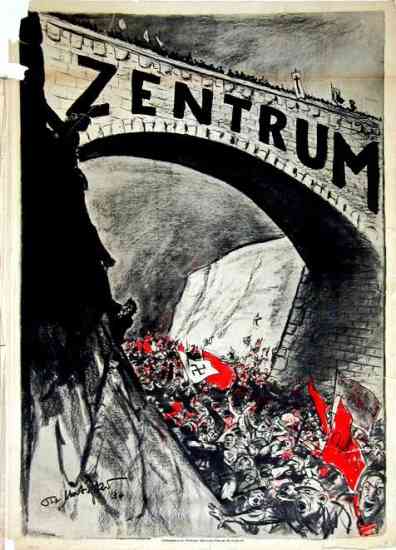
The Zentrum, a firm bridge over the abyss of extremists fighting (you can see the whole election poster here). While the poster used for the card is from 1930, this kind of centrist messaging would have resonated with Marx who spent much of his time in politics to align DVP and DDP more closely to the Zentrum (the topmost effect of this agenda card). Card “We Are the Center”, ©Capstone Games/Skellig Games/Spielworxx.

Rating: 3 out of 5.

Integrity

Marx was personally incorruptible. He managed to be both a committed party man, but govern with all of his country in mind. However, the Enabling Act set a dangerous precedent for the erosion of the constitution.

Rating: 4 out of 5.

Overall

In his first and second chancellorship, Wilhelm Marx rose to the challenge of implementing the solutions to the great crisis of the republic. In his later tenures, he performed markedly worse despite the much-improved situation. His biggest successes are holding the course in foreign and economic policy in 1924, his biggest failure his inability to develop and implement a long-term plan for his party and the republic.

  1. Abraham Lincoln 28/30
  2. Franklin D. Roosevelt 25/30
  3. Friedrich Ebert 25/30
  4. Winston Churchill 25/30
  5. Robert Walpole 24/30
  6. Willy Brandt 23/30
  7. Konrad Adenauer 22/30
  8. Harry S. Truman 21/30
  9. John F. Kennedy 17/30
  10. Hermann Müller 17/30
  11. Wilhelm Marx 17/30
  12. Ludwig Erhard 12/30
  13. Paul von Hindenburg 10/30

How would you rate Marx? Let me know in the comments!

Further Reading

For short overview essays on all German chancellors from Bismarck on, see Sternburg, Wilhelm von: Die deutschen Kanzler. Von Bismarck bis Merkel [The German Chancellors. From Bismarck to Merkel], Aufbau-Verlag, Berlin 2006 (in German).

The only full-length biography of Marx is Hehl, Ulrich von Wilhelm Marx: 1863—1946. Eine politische Biographie [Wilhelm Marx: 1863—1946. A Political Biography], Matthias-Grünewald-Verlag, Mainz 1987. Its somewhat dry style is made up for by its detailed, source-rich research.

For the broader context, see: Herbert, Ulrich: A History of Twentieth-Century Germany, Oxford University Press, Oxford 2019.

Friedrich Ebert (German President Ratings, #2)

23. Februar 2025 um 16:10

We’ve been assessing the merits of political leaders in (more or less) democratic countries on this blog for a few years now – UK prime ministers, US presidents, German chancellors. Today, we’re returning to German presidents, looking at Friedrich Ebert. And which game could be more appropriate for him than Weimar (Matthias Cramer, Capstone Games/Skellig Games/Spielworxx)?

The Rating System

Some caveats ahead: The presidents will be rated by the knowledge of their time. If they or their contemporaries could not have known about the effects of something, I will not use my hindsight to mark it as a mistake of theirs. The assessment is focused on their conduct as president.

Now, to the system itself: There are three policy field categories (foreign, domestic, and economic policy) and three more general ones (vision, pragmatism, integrity). A president can earn from one to five stars in each category (for a total sum of up to 30). In detail, the president is assessed as follows:

Foreign policy: Did the president increase German influence in the world and the security of Germans at home? Did the president wield German power responsibly and with positive results for the regions affected?

Domestic policy: Did the president increase the liberty of Germans to express themselves and to participate in the political process? Did the president promote domestic security and shape the framework for fair justice dealing with offenses?

Economic policy: Did the president facilitate the prosperity and economic security of Germans (including in the mid- and long-term)? Was the president’s economic policy based on mutual benefit of those involved or did it unduly burden one side?

Vision: Did the president have an idea of what Germany and Europe (the latter counting for more in times of German influence being great) should look like beyond the immediate future? Did the president’s policies steer Germany (and, if applicable, Europe) in this direction?

Pragmatism: Did the president succeed in seeing their policy through from inception to completion? How well did the president manage the support from parliament, society, the administration, the media?

Integrity: Did the president understand the office as a means to benefit themselves, special interest groups, the entire country, or another community? Did the president respect the boundaries of the office?

Note: If you have read my UK prime minister or US president ratings, you will remember that I rated them on the global impacts of their vision as well. As the rating system is only really applicable to democratic leaders and no democratic German leader ever had the chance to conduct a truly global policy, I only assess their vision on national and European grounds.

In all other ratings (UK prime ministers, US presidents, German chancellors) the subject’s life after holding the office is also assessed (for they are still seen as ex-office holders, but as a secondary consideration). This does not apply here, as – spoiler! – both Weimar Republic presidents died in office.

In Ebert’s special case, I will not only assess his conduct as president, but also as chancellor before, as he held the post at a time when Germany did not have a head of state.

Ebert’s Life

From Saddler to Chancellor

Friedrich Ebert was born on February 4, 1871, as the son of a tailor. He learned the trade of a saddler and became involved with the workers’ movement during his journeyman years. In 1891, he settled down in Bremen, where he ran a pub while working for the trade union. Ebert’s political work in the trade union and the Social Democratic Party (Sozialdemokratische Partei Deutschlands, SPD) assumed ever more importance. He was elected to the Bremen city council (1899) and became a full-time trade union secretary. In the following years, Ebert rose to national prominence: He was elected to the SPD national party committee (1905) and to the Reichstag, the national parliament of Germany (1912). One year later, he became one of the leading Social Democrats in Germany when he was elected co-chairman of the SPD.

The Social Democrats faced their crucible at the outbreak of World War I. Ebert successfully advocated supporting the government’s war efforts (instead of attempting to forge an international workers’ coalition against the war). In the later years of the war, more and more Social Democrats took up a strict anti-war stance, forming up as Independent Social Democrats (Unabhängige Sozialdemokratische Partei Deutschlands, USPD). Ebert maintained his previous stance and kept most of his allies within the party (now known as Majority Social Democrats (Mehrheitssozialdemokratische Partei Deutschlands, MSPD), yet tried to mediate between workers protesting and striking against the war and the government (notably during the January Strike of 1918).

When the military situation looked grim for Germany in fall 1918, de facto military dictator Erich von Ludendorff resigned and pushed for a new government to assume responsibility for the impending defeat. Ebert joined a parliamentary government and became its interim chancellor on the day that emperor William II was forced to abdicate. Two days later, Germany and the Allies agreed on the Armistice which ended the fighting on the Western Front.

The Armistice at Compiègne serves as Weimar‘s setup card: The new government will have to deal with a lot of threats, from poverty and unrest to the British blockade and Communist agitation in Munich. ©Capstone Games/Skellig Games/Spielworxx.

Chancellor in the Revolution

Many socialists, especially from the USPD, now pressed for a full-scale political and social revolution based on the workers’ and soldiers’ councils sprouting up everywhere. Ebert, who abhorred the Russian Revolution, wanted to bring about gradual change which would transform Germany into a democracy by parliamentary means. The sweep of revolution brought MSPD and USPD together in an uneasy government alliance. The opposition between moderate and radical socialists provides the basis for the SPD and KPD (Kommunistische Partei Deutschlands – Communist Party of Germany) players’ relationship in Weimar (all forms of radical socialism are subsumed under the umbrella of the KPD (which was historically only founded in January 1919) in the game). The USPD is a minor party in the game which can be aligned with either SPD or KPD (starting in the latter’s camp) and which provides more gumption for actions in the street and sizable parliamentary bonuses in the early game.

The USPD gives additional seats in parliament in the first four rounds of the game as well as a bonus point in the reserve each round (on the board to the left of the card). If the SPD can wrest the party away from KPD control early, that usually results in a large democratic majority under SPD leadership.

In the heady first days of the revolution, MSPD co-chairman Philipp Scheidemann proclaimed the German Republic (Ebert had opposed it and wanted Germany to become a parliamentary monarchy). The new government also proclaimed wide-ranging individual liberties and promised sweeping economic and social reforms (ranging from the eight-hour work day over housing programs to social security) as well as democratic elections in which both men and women would have the right to vote – here Ebert and the USPD agreed in substance, yet not in process: The USPD regarded the consent of the workers’ and soldiers’ councils as enough legitimation; Ebert insisted to carry out the reforms through a parliamentary process. Ebert outfoxed the USPD by having the Reich Councils’ Congress agree to hold parliamentary elections at the earliest possible date.

While Ebert outmaneuvered his rivals on the left, he also secured his right flank. Millions of German soldiers streamed back from the frontlines after the armistice. They needed to be demobilized in an orderly fashion, and, most of all, the threat of a military coup against the nascent republic needed to be warded off. Ebert thus struck a bargain with the army’s conservative leadership: The army would not act against the republic. In return, the new government would forgo the democratization of army structures. The deal already paid off for Ebert by December 1918: When the conflict of the government with the left-leaning People’s Naval Division over outstanding pay and the choosing of its commander escalated, Ebert had the Division dissolved by armed force. The same fate awaited the singularly ill-prepared Spartacus Uprising of January 1919.

A revolution makes for strange bedfellows: Social Democrat Ebert is inspecting German troops in the illustration of the “Pact with the Old Powers” event card. The event is extremely powerful under the right circumstances. Note that the SPD player could also use it to suppress a right-wing insurgency!

When the National Assembly had been elected in January 1919, Ebert’s MSPD was by far the strongest party. Its allies, the Catholic Zentrum (Center), and the progressive-liberal DDP (Deutsche Demokratische Partei, German Democratic Party) also fared well at the ballot box. Due to the armed unrest in Berlin, the National Assembly was convened in the quiet provincial town of Weimar, thus providing the common name for the first German republic (and, consequently, also for the alliance of SPD, Zentrum, and DDP – the “Weimar Coalition”). The Assembly elected Ebert the first president on February 11, 1919.

The Parliamentary President

The National Assembly established wide-ranging rights for the president in the constitution. Yet Ebert interpreted these as powers to be used in emergencies. In his view, the president was a steward whose role was to guard the constitution and integrate the nation. Thus, Ebert only rarely got involved in the day-to-day business of the cabinet, now headed by Philipp Scheidemann – for example, when the Allies presented Germany with the Treaty of Versailles, Ebert remained publicly non-committal.

Even when the republic as such was threatened, the president was not always the first to respond: The right-wing power grab by Wolfgang Kapp and Walther von Lüttwitz was stopped by a general strike. While Ebert’s name appeared on the pamphlet calling for the strike, it is likely that he was in fact not involved in the move. Ebert’s main contribution to the failure of the coup was of a different kind: When the coup leaders occupied Berlin, the federal civil service refused to do their bidding. Even though most of the civil servants had been hired under the emperor and felt attached to the monarchy, they had come to respect Ebert and would not enable the coup against his lawful government.

Symptomatic: It is the KPD as the stand-in for radical organized labor which is best positioned to stave off the Kapp-Lüttwitz Coup in Weimar, not the parties of the Weimar Coalition. ©Capstone Games/Skellig Games/Spielworxx.

The 1920 parliamentary elections dealt the (M)SPD and its allies a heavy blow. They lost their parliamentary majority. Ebert advocated for a “grand coalition” which would include not only the parties of the Weimar Coalition, but also the pro-business, national liberal DVP (Deutsche Volkspartei, German People’s Party). His counsel was not heeded. Instead, Zentrum and DDP formed a bourgeois minority government.

Ebert was the most imposing political figure of the early Weimar Republic. While his integrative approach did much to wed the more moderate workers to the Republic (they would remain its most steadfast defenders till the very end), his suppression of revolutionary activities also alienated the more radical workers… thus the “Red Emperor” event card (showing Ebert at his presidential desk) can cut both ways, placing either an SPD- or a KPD-aligned worker marker on the society track.

As the government had no parliamentary majority, the president might have assumed a greater role. Ebert, however, maintained his interpretation of the presidency as a stewardship, detached from party politics and the day-to-day decisions of the cabinet. In economic and social matters, Ebert retained his representative role, mediating at times in collective bargaining struggles. In foreign policy, the president’s constitutional role was larger, and while Ebert generally supported the general foreign policy of the bourgeois minority governments, he was left out of the actual decision-making. In the meantime, Ebert tirelessly lobbied for cooperation among all democratic parties. It took a plunge into catastrophe for the young republic to heed his counsel.

When Germany reduced the reparation payments to the Allies in January 1923, France occupied the industrial heartland on the Ruhr. The German government called on the workers of the Ruhr not to collaborate with the occupation force in extracting the reparations in kind (“passive resistance”). That required the government to pay out ersatz wages to millions of people, accelerating inflation to a ludicrous degree. By August 1923, prices compared to January had multiplied by 100 (!), and France was still occupying the Ruhr. With Ebert’s support, all democratic parties from the SPD to the DVP formed a grand coalition under chancellor Gustav Stresemann.

Stresemann ended the ruinous passive resistance. While economically sound, this blow to German national sentiment caused backlash: The Bavarian state government declared a state of emergency, aiming to build a new authoritarian system in Bavaria (equivalent to the establishment of a right-wing regime in Weimar) and then exporting it to the Reich as a whole. In response, SPD-KPD state governments formed in Saxony and Thuringia (both in the path for a “March on Berlin” from Munich).

Once more, Ebert suppressing a leftist challenge to the republic. The Reichsexekution placed Saxony and Thuringia under federal control.

Ebert used the constitutional emergency powers granted to the president to depose the Saxon and Thuringian state governments. Federal troops quelled the unrest there before any uprising had even materialized. Yet while the army would march against leftist challenges to the republic, it was notoriously unwilling to confront right-wing movements (as Ebert knew from the Kapp-Lüttwitz coup). Thus, while Ebert formally put the army’s commander Hans von Seeckt in charge of Bavaria, he did not order any concrete action. In the end, the authoritarian government of Bavaria was overthrown from the fringe of the right-wing movement – Germany’s erstwhile military dictator Ludendorff and an ambitious demagogue named Adolf Hitler took the key government players captive and called for a march on Berlin. It was stopped within its first kilometer by 130 policemen. After that, the authoritarian government collapsed. The republic had been saved.

Lots to deal with: The Weimar Republic was close to collapse in 1923 – in game terms, approaching its seventh threat marker in the Deutsches Reich box.

While the Weimar Republic stabilized, Ebert fought for the dignity of his office. He had been smeared by enemies of the republic from the beginning of his term. When Ebert had visited a beach town in 1919, a local photographer had snapped a picture of him in swimming trunks. The monarchists bought that picture and kept circulating it, often contrasting the half-naked president with one of the emperors of the old Germany in full regalia.

The nationalist DNVP begins the game as the weakest of the four parties. One strategy for them is to erode the democratic majority – for example, by attacking the SPD’s parliamentary standing with the President in Swimming Trunks event.

Ebert’s detractors also attacked his conduct. Most famously, they attacked him for his role in the January Strike in 1918. A court found those calling Ebert a “traitor to his country” for his participation in the strike guilty of defamation, but added that they were factually correct – symptomatic for the monarchist leanings of the Weimar courts, still staffed with jurists from the ancien régime. The court’s ruling was only overturned in 1931. Ebert would not live to see it. He had put off surgery for appendicitis due to the trial and died of the resulting peritonitis on February 28, 1925. He was only 53 years old.

As not all Timeline Cards will be dealt in a game of Weimar, it is possible that Ebert will remain alive until the end of the game (so, up to 1933). A delicious historical what-if! Otherwise, chances are that the SPD will not be able to retain the presidency. ©Capstone Games/Skellig Games/Spielworxx.

Ebert’s death is a watershed moment in a Weimar game. As long as the Ebert token occupies the Reichspräsident spot, the presidency is neutral, and nobody gains any benefits from it. When Ebert dies, an election is held in which the parties’ popularity with the voters is measured. Each party fields a candidate. The two candidates with the most votes advance to the second round, in which the two parties whose candidates have been eliminated can pledge their votes to any of the remaining candidates. That is a crucial moment to make deals, to forge alliances, to exact promises in return for the votes, and, more often than not, to pivot away from an ally who has become too strong. (I have seen my Social Democratic candidate defeated by a very grand coalition of the other three parties – Nationalists, Conservatives, and Communists.) From then on, the party holding the presidency can play a card both for the event/actions and for a debate once per round, effectively giving the party one more party card (which, as you typically only draw three of them per round, is huge). This less restrained approach to the presidency reflects the presidential activism of Ebert’s successor Paul von Hindenburg.

The four contenders (clockwise from top left): Ernst Thälmann (KPD), Otto Braun (SPD), Paul von Hindenburg (DNVP), Wilhelm Marx (Zentrum). ©Capstone Games/Skellig Games/Spielworxx.

The Rating

Foreign Policy

Even though foreign policy was the area in which the president’s role was constitutionally confirmed, Ebert followed rather than led. While he – much like his head of government Philipp Scheidemann –  personally found the terms of the Versailles Treaty unacceptable, he stayed on when Scheidemann resigned, displaying a keen sense of duty and order. Ebert supported the various governments in their unpopular, but necessary fulfilment of the stipulations of the Versailles Treaty and their orientation toward the western powers. At times, he was entirely sidelined, as when chancellor Joseph Wirth and foreign minister Walther Rathenau forged the Treaty of Rapallo with the Soviet Union.

Rating: 3 out of 5.
An agreement between the two pariahs of Europe – Weimar Germany and the Soviet Union. In the game, the Treaty of Rapallo is most beneficial to the DNVP: Not only does the party get two bases (as it typically does for Foreign Policy actions), the added army units can also be “turned to the dark side”, i.e., become aligned with the DNVP which is otherwise often short of units. ©Capstone Games/Skellig Games/Spielworxx.

Domestic Policy

Ebert’s achievements in this realm lie during his tenure as chancellor. His Proclamation (Nov 12, 1918) ushered in an unprecedented era of personal liberty and social equity, exemplified in the commitment to freedom of the press and women’s suffrage. Ebert’s integration of the army into the new republic avoided a civil war. Later, his uneven use of force dealing with the uprisings of 1923 was pragmatically understandable, but failed to conciliate the political right with the republic or make the army more accountable to the political leadership.

Rating: 4 out of 5.
Women’s Suffrage is a typical Weimar party card composed of several effects (a very beneficial society marker and small bonuses to party bases and public opinion). While the sum of these effects is very nice, you will often be tempted to play the card for actions/debate in order to use its points concentratedly in one area (for example, to deal with a threat like a local uprising). ©Capstone Games/Skellig Games/Spielworxx.

Economic Policy

The Proclamation of November 12, 1918 laid the foundation for the eight-hour work day, a milestone for the working population of Germany. An overlooked contribution of Ebert’s to economic development is his advocacy for the “grand coalition” – only this broad alliance could bring about the far-reaching currency reform which ended hyperinflation in 1923. That Ebert’s calls to alleviate the social hardships which came as a side effect to the currency reform went unheeded by the bourgeois minority government which followed the grand coalition is symptomatic for the limited power of the presidency in the realm of economic and social policy.

Rating: 4 out of 5.
The currency reform to end inflation comes at the price of poverty (and a reduced trust in the government). ©Capstone Games/Skellig Games/Spielworxx.

Vision

Ebert has often been criticized from the left as too cautious, not able or not willing to dream big. And indeed, in hindsight his thought and practice seems much less imaginative than his critics’ utopias of socialist republics based on grassroots councils. Yet in 1918, the thought of a liberal, parliamentary Germany – the realization of the dream of 1848 – was revolutionary, and, most importantly, it was achievable. Ebert helped to bring about the German democracy and guided it into calmer waters during his tenure.

Rating: 5 out of 5.
If Ebert (pictured in the background of the election poster) played Weimar, he’d select this agenda card every round.

Pragmatism

Ebert made it possible for the bourgeois politicians, the army, and the civil service to get along with a Social Democratic government. While this was an impressive feat in itself, his pleas for cooperation were often not heeded – neither from his own party nor from those he sought as allies. His natural inclination to compromise veils his deft handling of his political opponents: The USPD joined the provisional government on equal footing in November, yet ended up entirely outmaneuvered by January – its moderates falling in with Ebert’s call for elections as soon as possible, its radicals reduced to a singularly ill-advised attempt at armed uprising.

Rating: 4 out of 5.
The Council of People’s Deputies was a collective body, but Ebert (second from the right) dominated it from the start. As the USPD’s bonuses are better in the early game, playing this card for the event on the first round can be huge! ©Capstone Games/Skellig Games/Spielworxx.

Integrity

Ebert is the rare politician who, presented with the opportunity to make wide-reaching decisions with a free hand, refused it. His belief that a freely elected parliament must make the important choices guided him during the revolution. Later, Ebert understood himself as a steward of the republic, a president of all Germans, and was unwilling to use his office for the gain of particular individuals or groups. He used the wide-ranging emergency powers assigned to the president in the constitution only when presented with a grave crisis. His thoughtful wielding of power becomes ever more apparent in comparison with his successor’s liberal use of the emergency powers which contributed to the fall of the republic.

Rating: 5 out of 5.
Opposite approaches: Ebert was a parliamentary president, his successor Paul von Hindenburg tried everything to sideline parliament and rule by executive orders. ©Capstone Games/Skellig Games/Spielworxx.

Overall

Friedrich Ebert took on the highest duty in tumultuous times. He wielded power responsibly, with the best of intentions, and remarkable success. His restraint and willingness to compromise were admirable in themselves, but sometimes emboldened the enemies of the republic he had helped to create.

  1. Abraham Lincoln 28/30
  2. Franklin D. Roosevelt 25/30
  3. Friedrich Ebert 25/30
  4. Winston Churchill 25/30
  5. Robert Walpole 24/30
  6. Willy Brandt 23/30
  7. Konrad Adenauer 22/30
  8. Harry S. Truman 21/30
  9. John F. Kennedy 17/30
  10. Hermann Müller 17/30
  11. Wilhelm Marx 17/30
  12. Ludwig Erhard 12/30
  13. Paul von Hindenburg 10/30

How would you rate Ebert? Let me know in the comments!

Further Reading

For a short introduction to Ebert (and all other German chancellors in history), see: Sternburg, Wilhelm von (ed.): Die deutschen Kanzler. Von Bismarck bis Merkel [The German Chancellors. From Bismarck to Merkel], Aufbau, Berlin 2007, pp. 187—210 [in German].

The standard scholarly biography remains Mühlhausen, Walter: Friedrich Ebert. 1871—1925. Reichspräsident der Weimarer Republik [Friedrich Ebert. 1871—1925. Reichspräsident of the Weimar Republic], Dietz, Bonn 2007 [in German].

For the broader context, see: Herbert, Ulrich: A History of Twentieth-Century Germany, Oxford University Press, Oxford 2019.

❌