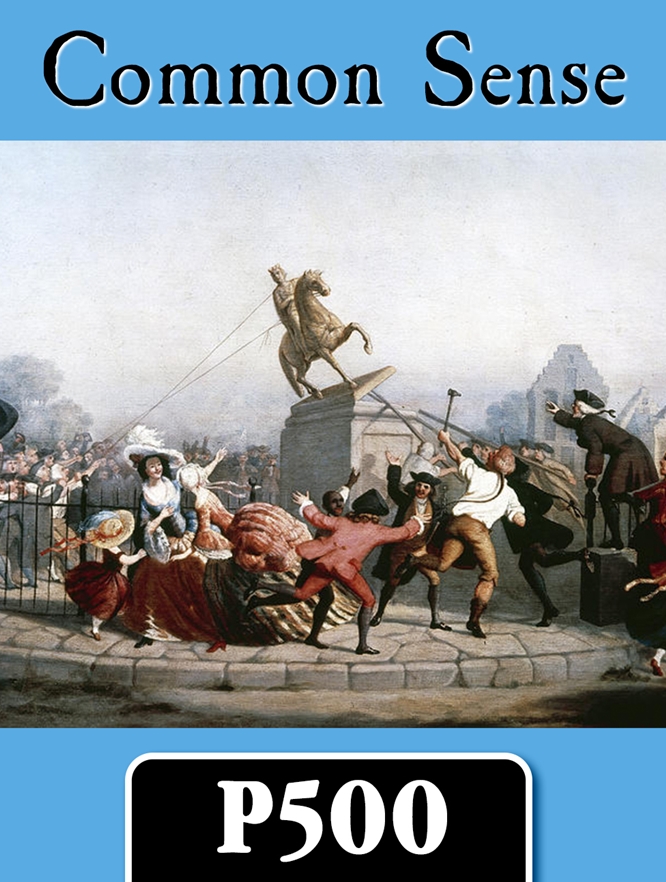
In November 2024, while attending the SDHistCon, we sat down with designer Sam London to play his upcoming game called Common Sense (it was originally called Absolved from All Allegiance), which was announced on GMT Games P500 last year. The game is an American Revolutionary War Strategic Level game that uses trick taking and is a struggle over the Will to Fight Track that measures the level of commitment by both sides to the fight. We recently reached out to Sam to get some more details to share about the design and he was very glad to oblige our request.
*Keep in mind that the design is still undergoing playtesting and development and that any details or component pictures shared in this interview are for prototype purposes and will definitely change prior to final publication as they enter the art department.
Grant: Sam welcome back to the blog. How are your other announced game projects coming along?
Sam: Thanks for having me back! Things are going well. I am hands off on Firefight Tactical at this point. All of the content art is complete and we are just working on things like rulebook layouts. I am very much looking forward to getting it out the door and into people’s hands. Microverse has most of the art complete. I am doing a few tweaks to the bot still to get it to a point I am happy with it, but in truth it is not tracking far behind Firefight Tactical. They both have been wonderful experiences from a development and production stand point and I cannot speak highly enough of the various teams I have worked with at GMT on these games.
Grant: How have you changed as a designer over the past few years?
Sam: This is an awesome question and I am grateful to be asked it as it forced me to do some introspection. To explain I will have to make some references to film making. As I have stated previously I have been designing games for a couple of decades at this point and only started trying to get my designs out there after Covid. The truth is that while this gave me lots of opportunities to refine my design chops, it was ultimately just me learning in a bubble. Coming into the hobby as a designer rather than a gamer, I fancied myself as a sort of auteur designer. For those not familiar with the term in the context of film making, this is an approach to creative endeavor where everything is made to conform precisely to one person’s specific vision. After getting to work with so many fantastic people, decidedly outside of my bubble, I have taken a bit of a 180. While I still own the ultimate vision, I now recognize that the odds that I understand the optimal route to get to that destination are unlikely, and that pretending I do will often result in an inferior game. This isn’t to say that I am going to incorporate every bit of feedback I receive into my designs. It does mean that I am more able to recognize weaknesses in my designs as conceived and solicit feedback from others to get around my blind spots.
Grant: What specific lessons have you learned about design?
Sam: The big one would be about systems pruning. Most people, myself included, understand academically that design complexity for complexity’s sake is not good. Putting that principle into practice, especially retroactively, is far more challenging. Every mechanism in the game has to serve the player’s enjoyment without making the cost of entry too daunting. This can often mean cutting mechanisms that I am particularly passionate about, but for which I am the sole audience (or close to it). This is especially difficult for me because I consider myself a systems designer, and I virtually always approach the mechanics of a design first.
Grant: What is your newest project Common Sense about?
Sam: Common Sense: An American Revolution, 1775-1783 is a card driven strategic level wargame covering the American Revolution. It attempts to offer a comprehensive view of the conflict, all the way from the battlefield to the halls of the Continental Congress and British Parliament.
Grant: Why was this a subject that drew your interest?
Sam: I always knew I would want to do an American Revolution game. The problem was that I needed a system that would fit my thesis of the conflict. A few years back I was working on a Barbarossa game and every step of the way I was thinking I would rather do that system in the American Revolution. The more passionate I became about that, the more I started to flesh out the system in ways that didn’t make sense for Barbarossa. Eventually that game ended up in the trash bin and Common Sense got my attention instead. I think the American Revolution is such a fascinating subject because it’s a real David and Goliath story. I of course am keenly aware that in reality it was more of David vs Goliath while Goliath is arm wrestling another giant while also trying to solve a Rubik’s cube, but there is still a lot of inherent heroic optimism to that history. Also, everyone loves a good underdog story.
Grant: What is your design goal with the game?
Sam: My design goal for the system was to see how much personality I could give to the belligerents without making their asymmetries require too much rules overhead. We have all played asymmetrical games where you feel like after you read your rulebook you need to read the other player’s rulebook to have a comprehensive understanding of the game. Here, while there are some mechanisms that are specific to each side, the asymmetry is more in terms of each player’s strategic concerns rather than their tools to execute upon them. All of these relate back to this unifying concept of “resolve” which is an abstraction that allows us to relate the varying strategic concerns into a single mechanism.
Grant: How did you focus on creating asymmetry on each side? What are some basic examples of these differences?
Sam: As noted above, I viewed each side in terms of what was unique about their concerns and what was unique about their tools to address them. For the British as an example, they are tremendously constrained by supply. It isn’t just a supply line (though it is that too), it’s a currency they spend to move and battle with units. Obviously historically supply was a concern for the Colonials as well, but it did not hamstring them to the same degree, so the Colonials don’t have to worry about it at all. What’s more, this opens up strategic opportunities for the Colonial player to attack the British in other areas to force the British player to split their limited resources. An example for the Colonial player is Attrition Combat. Each time the Colonials battle in a space they control on their turn, they have the option to resolve Attrition Combat, in which they cede control of that space to the British but as a result can resolve the battle without risking return fire. At the beginning of the game this must be used strategically and sparingly, but as certain key personalities in the Colonial Deck, from George Washington to Francis Marion enter play it becomes far more powerful.
Grant: How does the game use trick taking? Why was this a good choice for your vision of the game?
Sam: I am actually trying to get away from that term, as I think it causes people to think that Common Sense is a lighter game than it is. It invokes pithy card games rather than sweeping strategic affairs played out on a map. The final rulebook will likely make no reference to standard trick taking terms. I chose it as a core mechanism though for a variety of reasons. One I will cover in a future question, but the other reason is because I became very interested in the question of card balance. If I have a card driven game with a variety of card effects, and I want them to vary in their power, they have to be balanced in some way. The most common way this is handled in game design is to make them have a proportionate cost to play using some in-game currency. I was more interested in making the powerful cards more difficult to play. In fact, I wanted to take a step beyond that and say that not only are they more difficult to play, but they are never guaranteed. This gave me a simple way to inject far more personality into the cards and make some have a tangible weight to them when they manage to enter play. “Ha ha, I play King George. You’re in trouble now.” Trick taking was a natural fit for this as the rules overhead for it is comparatively light and the cards come with their own intrinsic value based on the ease with which they can be used to win tricks.
Grant: What is the makeup of the cards? Can you share a few examples with us and explain their use?
Sam: Each year players will begin their turn with a ten card hand. They can perform a strategic mulligan of up to 5 cards each year. This is not in case a player got a “bad hand” but rather so they can try to postpone getting cards that do not fit their strategic objectives at the start of the year. The year is then played out over a series of ten “clashes” in which the initiative player plays a card face up and then the other player does the same. The initiative player’s card sets the suit for the clash and the non-initiative player must follow the suit of that played card if able. Then the player who played the card with the higher initiative value (ties going to the non-initiative player) resolves their card.
In this example (all placeholder art at this point in the game’s development by the way), the Colonial player has initiative and plays the Artemis Ward card into the clash who is a 6 value of the Battle suit. The British player then plays Battle of Quebec into the clash which is a 7 value of the Battle suit. Battle of Quebec then resolves.
The British player immediately gains a supply (the orange wagon in the upper right corner). This is a special bonus effect present on some cards. The equivalent effect for the Colonials is to go up on the Continental Congress Track. They now have the option to cancel the resolution of the card to perform any one of their available actions. If they choose to continue to resolve the card they resolve its event first. Battle of Quebec’s event is of the type “special action,” which offers additional effects to the action on the card. In this case, if the Battle action is used to resolve a battle north of the Winter Line, the Colonial player must reroll all their successful hit dice once. The last piece is the yellow star under the Battle suit icon which indicates Battle has “advantage” over the Special suit. This means that if the non-initiative player does not have a card of the clash’s suit to play into the clash, any Battle card will always beat a Special card.
Grant: What different suits are included? What use does each have for players?
Sam: There are three common suits which are universals and one special suit which is player specific. The three common suits are March, Battle, and Recruit. March is used to move armies about the board, Battle is used to fight, and Recruit is used to get more units to fight with. There are asymmetries in how these resolve but the goals of their use are the same, which is why they are considered the common suits.
Grant: What is different about the Special Suit? How does it benefit players?
Sam: The Special suit is different for a couple of reasons. First all of the actions contained in the Special suit cards are unique to that player. The Colonial player can train their militia units into the Continental Army and negotiate with the French, eventually bringing in and performing actions with French pieces once they enter the conflict. The British player can recruit, move, fight, and raid with Native units and move and battle with the British navy. A lot of the flavor of the two sides are contained in the Special suit. The other thing that is different about the suit is that the Special suit allows you to resolve any combination of these actions. For example a Battle x 3 card allows you to resolve up to three Battle actions. A Colonial Special x 3 on the other hand will allow them to perform a mix of any 3 train and French actions which offers flexibility.
Grant: What is the purpose of the Resolve Track?
Sam: I mentioned the Resolve Track earlier when I was describing how most of the asymmetrical concerns of the players coalesce into a singular concept. The Resolve Track serves three purposes. Firstly, it is the game clock. While the game can end in the event that you completely resolve the year 1783, it will more commonly end when the British and Colonial Resolve markers cross. Each player’s Resolve marker starts on opposite ends of the track and moves towards the other end as they lose resolve. Once they cross, the year is completed and final scoring occurs.
Grant: How do players manipulate this track? What benefits or detriments does it provide to players?
Sam: This is where the other functions of the Resolve Track come in. The second purpose is that many of the points for determining final score and victory come from the Resolve Track. Finally, resolve has a tremendous impact on both sides’ ability to recruit new units, the Colonials in particular. This is another demonstration of the game’s asymmetries actually, as the Colonials are far more impacted by resolve loss both from a scoring perspective and a recruitment perspective than the British. In regards to how the track is manipulated, common track manipulations only cause a loss of resolve. There are several ways resolve is regained, but they are all due to specific card effects. The British primarily lose resolve by losing British Regulars in battle and by being overcommitted to the American conflict at the expense of their other global conflicts. They can also lose resolve by overusing Hessian mercenaries, who are good and reliable but cost money that parliament is loath to spend. The Colonials on the other hand will lose resolve mostly due to the British seizing control of colonies, Winter Attrition, and failure of the Continental Congress to offer a believable alternative as a governing power to the crown.
Grant: What is dynamic about the initiative system?
Sam: I said I would come back to this when I was describing why I went with trick taking as a core mechanism. Essentially, you are the active (initiative) player for as long as you continue to win subsequent clashes. For the duration the other player is what I would consider a “reactive” player. They still have choices to make of course, for example which card to play into clashes, whether to resolve combat as a siege or not in fortified spaces, how much supply to commit to a protracted battle, etc. The point however is that while by sheer odds you are guaranteed to eventually get your turns in, the duration of the runs of turns is strongly connected to the skill of the player and their familiarity with the game. This is very much a game where a player will become far better after repeated plays. The other cool thing about this is that the events on cards require skill and forethought to combo them together. You may have the thought that if cards A, B, and C resolve in order you will have all but won the game, only to lose the clash for card C and have to pivot. This dynamism does a lot to keep the game fresh and challenging rather than thinking “I have cards A, B, and C so I already know how I will play this out.”
Grant: What different unit types does each player have access to? How does each type benefit them?
Sam: Again pursuing asymmetry I wanted to give each unit type its own character. Each unit has a potency and a resilience but this is just the tip of the iceberg. Militia are able to pop up virtually anywhere and are able fire first in battles where they are the aggressor, but they are poorly trained and can’t leave where they are recruited unless they are picked up by an army. British navies can contribute to naval sieges and amphibious assaults while they are also required end points for British supply lines. French regulars are able to operate as a distinct force while also being able to launch coordinated actions with the Continental Army, offering them incredible command flexibility. British Field Artillery is powerful, but is unable to retreat quickly when the battle is lost, meaning it will be commandeered by the Colonials (and may exchange hands several times over the course of the war). There are also Continental Army, Native Warband, Hessian Mercenary, French Navy, Tory Loyalist, Colonial Artillery, and British Ranger units. Each has its own complement of traits to figure out how to employ them optimally.
Grant: How does combat work in the design?
Sam: As I have alluded to, there are a variety of special combat resolutions possible like Attrition Combat, Sieges, Naval Bombardment, Raids, and Surprise Attacks. I will just be describing the standard battle procedure here though. Each unit has a number of dice they grant during battles. The British player will have to pay a supply for each unit they want to activate to gain dice this way. Players then roll all their dice simultaneously. Dice come in three flavors, red, white, and blue (see what I did there?). Red dice hit on 3 or better, blue on 4 or better, and white on 5 or better. No matter the die color, a 6 counts as 2 hits. The other player then takes as many dice as they have incoming hits (at this point color doesn’t matter) and rolls them. For each 6 they roll, they discard the lowest die among their rolled dice. They then go from their lowest rolled die to their highest, assigning dice to their units if possible. Each unit has a limited range of dice values they can be assigned which represents their morale. For example, the British and French Regulars are a professional army and so they can only be assigned 1s and 2’s. The Colonial Militia and Tory Loyalists on the other hand can be assigned anything from a 1 to a 4. After all dice have been assigned or there are no more rolled dice that can be assigned to any units legally, all units with a die assigned to them are eliminated. Then, if the resolving card grants additional Battle actions, the initiative player can choose to either resolve another round of battle in this space, or not, potentially beginning to resolve another battle in a different space. If no further battle rounds will occur in the current space, the total number of casualties is compared. If one side took fewer casualties and did not control the space, they gain control of the space. Then, if the side that took more casualties lost at least as many units as half the size of their army (stack), they are forced to retreat from the space.
Grant: What is the British Commitment Check? How does it work?
Sam: The British player uniquely tracks the number of clashes they win each year on their own “British Perception” Track. At the end of the year, they add their current level on this track to the number of British Regular and Navy units outside of the American Colonies available to fight the French and the Spanish. If this total is less than 10, they lose 1 level of resolve for each point of shortfall. This means that if they have run the table the entire year, they are free to overcommit to the colonies, thematically because the optics are good back home. If however they have a rough year, they may have to hold some forces back to avoid the war being cut short by Parliament because opinions have turned against it.
Grant: What is the Continental Congress Level? How does it work?
Sam: On average, every card in the Colonial deck is one initiative value lower than every card in the British deck. However, every card in the Recruit suit grants the Colonial players levels on the Continental Congress Track. Levels can be spent from the track as cards are played to increase the initiative value of the played card. The problem is that at the end of the year, the Colonial player is expected to have an ever increasing level on the Continental Congress track or they will lose resolve equal to the shortfall. This obligation is an even bigger potential headache for the Colonial player as the Continental Congress isn’t just a track on the board, it’s also a piece on the map. If the Continental Congress is forced to relocate (retreat) because their current space falls into British control, the Continental Congress levels reset to 0. Done later in the war this can be devastating to the Colonial player. Even worse, if the Continental Congress would have to retreat, but it has no valid place to do so since it is surrounded by British Controlled spaces, the Congress surrenders and the Colonial player loses the game outright with no points counted.
Grant: I have seen where you describe the game as a sandbox. What does this mean and how does it benefit the design?
Sam: I think this can best be demonstrated by the card I showed earlier, Battle of Quebec. Now of course, the Battle of Quebec occurred when Richard Montgomery and Benedict Arnold attempted to siege Quebec City on December 31, 1775. The Colonials suffered heavy losses and were soundly defeated by the elements as well as the British. Nowhere in that card does it specify that the battle needs to occur on a specific date, or at a specific location, just that it must be north of the Winter Line for the event to have an effect. There have been plenty of times in playtests where the card has been resolved in 1775 in Canada, but also many times where it hasn’t. This approach enables me to inject historicity into the game without shackling the player to recreate historical decisions. I think many historical gamers want experiences where they can recreate history, but they are not obligated to do so. Roughly paraphrasing what Gene Billingsley said about the game, “all the events are there, all the major players, and the outcomes, even though potentially very different from history, are entirely conceivable.” Put differently, it’s like the game hands you a toy box filled with American Revolution action figures to play with as you will. There will of course be some players who will miss some rigidity holding them to a more strictly historical course. However, I think this sandbox approach offers an opportunity to sink your teeth into the history and better appreciate the moving parts by seeing the different ways they could have fit together.
Grant: What are some general strategies for both sides?
Sam: From a general strategy perspective things are very historical. The British want a quick war. The fastest way to do this is to take the more valuable northern colonies which will tank the Colonial resolve and secure most of the significant strategic locations. By doing this they can force the Continental Army to suffer brutal winters away from the cities and put enough pressure on the Continental Congress that their resolve rapidly drains and they are forced to surrender. The Colonials want the opposite. They just want to hold out long enough using delaying tactics to organize a proper army, get the French into the war, and retake whatever key fortified locations they ceded to the British in the early war so they can force the British to the bargaining table.
Grant: What is the layout of the board?
Sam: Again, this map is placeholder art. The game uses point to point movement, with some spaces representing precise fortified locations and some representing large tracts of land (even entire colonies in some cases). Spaces are grouped into colonies that each have an associated hit to Colonial resolve if they are lost. There is also a British “in Europe” area and a number of tracks tied to the various game mechanics.
Grant: Why did you feel point to point movement was best?
Sam: The only two contenders here were point to point vs area based movement. Given the level of abstraction the system uses, any sort of hexed based representation was never an option. I decided to go with point to point because the game’s focus is really on the narrative more than anything else. An area based map would have forced me to have the visual importance of areas be at least somewhat to scale by the size of the colony. Instead by doing point to point I can give a colony as many spaces and fortifications as are thematically appropriate for the importance of that colony in the actual conflict.
Grant: What type of an experience does the game create?
Sam: The game is punchy. It is very competitive and intentionally so. You are only able to achieve so much on a given turn, and at the end of each turn you have another clash and a chance for your opponent to seize the initiative. The elation when the other player plays a card out and you realize you can beat it and put out Benjamin Franklin when you thought you weren’t going to get a turn for at least 2 more clashes is fantastic. It also plays very quickly for a game of its weight. Most games between players who know how to play will be under 2 hours.
Grant; What are you most pleased about with the design?
Sam: I would say three things. First, because it’s top of mind as I just finished it, the solo play. I knew how I wanted the solo to feel, but I wasn’t quite sure how I was going to make it happen mechanically. I will be putting out some videos soon showing how it works, but suffice it to say for the moment that I am very pleased with it. Second, every game I design, I design to create stories at the table. If it always tells the same story it isn’t memorable. If there are never any surprises it isn’t memorable. Common Sense succeeds in both of these areas to a tremendous degree. Each time I catch up with a player I have played Common Sense with before they are able to remind me of our whole game by invoking strange or exciting moments from our game a year ago like it happened yesterday. Finally, when I design a new game I generally try to think about what aspects of it are specific to the topic and which could be modified slightly to make it work for other topics. I have my own plans for a Vietnam War version of this system that I am very excited about. What surprised me though was how many great designers have been inspired by the system and want to do their own designs with it. At the moment I am only at liberty to say that Ananda Gupta wants to do a French Revolution game with the system, which is such an incredible honor since Twilight Struggle is the primary inspiration for it.
Grant: What other designs are you working on?
Sam: I am always working on something. I have a non-historical game I am working on that has been picked up but I cannot talk about it yet. I have a train game that I may be able to talk about more publicly soon and an American Civil War game that I will be debuting at HistCon North. Oh, and I have a Sengoku Jidai wargamer’s party game that I am tooling around with. There are more, but that’s enough of a teaser. Thanks for the interview!
Thank you Sam for your thoughts on your game and for the effort you have obviously put into it. Having played the game while attending SDHistCon ta few years ago, I can say that we had a great time with the game, felt all of the aspects you discussed and very much enjoyed the way cards were played, how the initiative kept with the winner and the various frustrations of the asymmetry of each of the sides. I think that this one will be a winner and I look forward to playing it further in the future!
For a bit more information, we posted a quick video interview with Sam while at SDHistCon and you can view that at the following link:
We’ve been assessing the merits of political leaders in (more or less) democratic countries on this blog for a few years now. Today, we’re looking at the longest-serving chancellor of the Weimar Republic, Germany’s first attempt at parliamentary government – Wilhelm Marx. And which game could be more appropriate for him than Weimar (Matthias Cramer, Capstone Games/Skellig Games/Spielworxx)?
If you want to read more ratings of historical leaders like this, I strongly recommend you subscribe to the blog – all new posts in your inbox right when they go live!
Some caveats ahead: The chancellors will be rated by the knowledge of their time. If they or their contemporaries could not have known about the effects of something, I will not use my hindsight to mark it as a mistake of theirs. The assessment is focused on their conduct as chancellor.
Now, to the system itself: There are three policy field categories (foreign, domestic, and economic policy) and three more general ones (vision, pragmatism, integrity). A chancellor can earn from one to five stars in each category (for a total sum of up to 30). In detail, the chancellor is assessed as follows:
Foreign policy: Did the chancellor increase German influence in the world and the security of Germans at home? Did the chancellor wield German power responsibly and with positive results for the regions affected?
Domestic policy: Did the chancellor increase the liberty of Germans to express themselves and to participate in the political process? Did the chancellor promote domestic security and shape the framework for fair justice dealing with offenses?
Economic policy: Did the chancellor facilitate the prosperity and economic security of Germans (including in the mid- and long-term)? Was the chancellor’s economic policy based on mutual benefit of those involved or did it unduly burden one side?
Vision: Did the chancellor have an idea of what Germany and Europe (the latter counting for more in times of German influence being great) should look like beyond the immediate future? Did the chancellor’s policies steer Germany (and, if applicable, Europe) in this direction?
Pragmatism: Did the chancellor succeed in seeing their policy through from inception to completion? How well did the chancellor manage the support from parliament, society, the administration, the media?
Integrity: Did the chancellor understand the office as a means to benefit themselves, special interest groups, the entire country, or another community? Did the chancellor respect the boundaries of the office?
Note: If you have read my UK prime minister or US president ratings, you will remember that I rated them on the global impacts of their vision as well. As the rating system is only really applicable to democratic leaders and no democratic German leader ever had the chance to conduct a truly global policy, I only assess their vision on national and European grounds.
Early Life: The Catholic Man of Duty
Wilhelm Marx was born in 1863 in Cologne, then a part of the Rhine Province of the Kingdom of Prussia, soon to be part of the united Germany. No one could have foreseen in his boyhood that he would rise to the chancellorship – he was the son of a mere schoolteacher, and a part of the Catholic minority which was always suspected of possibly disloyalty by the Protestant Prussian state. The young Wilhelm Marx was one of many who set out to prove that he could be just as patriotic as any Protestant: He studied law and entered public service. His Catholic faith, however, would always be the guiding star in his life.
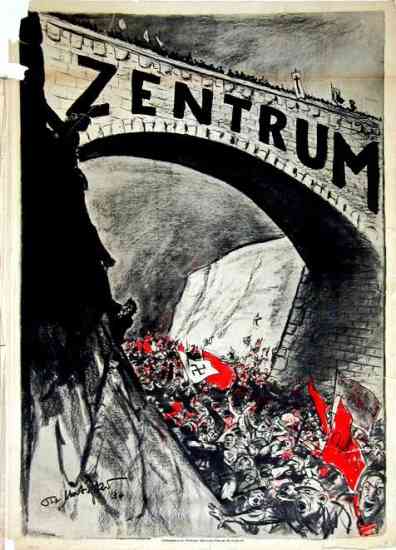
He was first elected to the Prussian parliament in 1899 on the ticket of the Catholic Zentrum (Center) party – one of the four player factions in Weimar. By the time Marx was elected, he had been active for nine years in the Volksverein für das katholische Deutschland (People’s Association for Catholic Germany), an organization dedicated to improving the social conditions especially of the poorer Catholics. Social and cultural issues, especially the expansion of Catholic schooling, would remain close to his heart: In 1910, he founded the Katholische Schulorganisation (Catholic School Organization), a grassroots lobbying organization dedicated to the matter.
The same year, he was elected to the German parliament – his first electoral success on the national level after two campaigns in hopeless districts with very few organized Catholics which he had only undertaken out of duty to the party. In parliament as well as in his electoral campaigns, he aimed to form an alliance with the Protestant bourgeois parties against the burgeoning SPD (Sozialdemokratische Partei Deutschlands, Social Democratic Party of Germany), the second player faction of Weimar. However, this strategy failed when cross-confessional bourgeois solidarity eroded in the more confrontational cultural climate from 1911 on.
World War and Revolution
These divisions faded into the background with the beginning of World War I. Despite the pre-eminence of military and diplomatic action then, Marx’s political activity remained limited to domestic issues. From his papers, we cannot discern if he even formed an opinion on many of the pressing issues in those other realms (say, unrestricted u-boat warfare). He did, however, change his mind about cooperation with the SPD, with whom the Zentrum (and the liberal parties) partnered from 1917 on in their quest to place the imperial government on a more parliamentary basis.
The revolution of 1918/1919 took Marx by surprise. Once more, he placed his powers at the disposal of his party, and was elected to both the Prussian and the German constitutional assemblies. The National Assembly in Weimar developed a constitution which included many long-held dreams of his, as the Catholic church, Catholic associations, and individual Catholics finally had their rights guaranteed. The short period of cooperation with the Social Democrats (and, to a lesser degree, the progressive liberals of the DDP (Deutsche Demokratische Partei, German Democratic Party) had achieved what years of negotiation with the Protestant conservatives of the Empire had not. This early alliance between Zentrum and SPD is the starting point of any Weimar game.
Yet the new German republic was unpopular with the numerous conservative, monarchist Zentrum members, and cooperation with the Social Democrats doubly so. Marx thus spent much of his political energy advocating for the constitution among his fellow Catholics.
At the time, Marx considered leaving politics altogether in favor of focusing on social work: From 1919 to 1921, he acted as director for the Volksverein (but proved unsuited to implement the sweeping changes necessary to improve the Volksverein’s faltering popularity in the Catholic milieu).
Yet once more duty called: As many of the old Zentrum parliamentary leaders died, Marx was one of the most experienced politicians his party could field. And his conciliatory, even-handed manner was just what the Zentrum needed when the party was so deeply divided against itself on the question of supporting the republic or restoring the monarchy as well as if to cooperate with the Social Democrats or the Protestant nationalists of the DNVP (Deutschnationale Volkspartei, German Nationalist People’s Party), the third Weimar player faction.
Marx was thus called on to hold the diverging wings together: He was elected head of the parliamentary group of the Zentrum and then also party chairman in late 1921. As the Zentrum’s governing partner SPD merged with the more left-leaning USPD (Unabhängige Sozialdemokratische Partei Deutschlands, Independent Social Democratic Party of Germany), Marx advanced a closer cooperation with the two liberal parties DDP (in government) and DVP (Deutsche Volkspartei, German People’s Party, in opposition) – the two minor parties which the Zentrum can control in Weimar. Yet Chancellor Joseph Wirth’s attempt to entice the DVP into a government of all democratic parties (a Grand Coalition) failed in late 1922. As a consequence, the SPD left the government as well. The parliamentary basis for the government shrunk.
The following year, Germany was shaken by the French occupation of the Ruhr which exacerbated the already galloping inflation. Under these circumstances, the Grand Coalition of all democratic parties became reality, led by DVP chancellor Gustav Stresemann. While it tackled these huge tasks rather successfully, the government could not maintain its internal cohesion: The right wing of the DVP (under its parliamentary leader Ernst Scholz) wanted to use the crisis to abolish the eight-hour workday and expand the government to the right by including the DNVP. The SPD refused and left the government. Marx’s conciliating manner helped with bringing both of them back to the negotiating table and a new Grand Coalition was formed.
This one was even shorter-lived: When federal forces broke up the socialist state governments of Saxony and Bavaria, but (doubting the loyalty of the army) refused to act against the right-wing coup in Bavaria, the SPD once more went into opposition. Without a parliamentary majority, Stresemann was soon unseated as chancellor. As the SPD’s appetite for government responsibility was sated, a bourgeois minority cabinet would be formed. That would be straight-up impossible in Weimar – unlike left-wing or right-wing coalitions, the Weimar Coalition (with SPD and Zentrum as the player factions and the DDP as a minor party which is always attached to one of the two) cannot refuse to govern, and so SPD and Zentrum are often stuck with each other if they want it or not. Historically, the SPD was not quite as keen on governing as the party is in Weimar.
To get anything done without a parliamentary majority would require special skills at winning friends and not making enemies. Marx, the skilled mediator, was just the right man for the time. He was elected chancellor on November 30, 1923. The weighty issues facing him were Bavaria’s continued insurrection, the implementation of the measures against hyperinflation, and an agreement with the Allies on the reparations issue which had set off the entire crisis of 1923.
A full hand of cards, leading the government (chancellor token in the top left), both liberal minor parties aligned (bottom right) – a comfortable situation for the Zentrum in Weimar, but not so much in history.
The First and Second Chancellorships
Marx’s cabinet nominations sent a signal to Bavaria that he was willing to improve the relationship between the fractious state and the Reich: He made the Bavarian Eduard Hamm (DDP) Minister for the Economy, and, for the first time in the history of the republic, included a member of the BVP (Bayerische Volkspartei, Bavarian People’s Party) whose more radical members had been behind the coup in Bavaria (Erich Emminger as Minister of Justice). His discreet negotiations with the Bavarian coupists would come to fruition in spring 1924: They resigned and opened the way for parliamentary government again. Bavaria, however, would retain some special privileges and be exempt from federal oversight.
The BVP had played an ambiguous role in the anti-republican insurrection in Bavaria. While the party cooperated with the Zentrum in national politics, its leader Gustav von Kahr had also been behind the coup of September 1923. This playtest version of the “Bayerische Volkspartei” card strengthens the Zentrum in parliament, but also allows the DNVP to recruit a dissolved unit – the latter effect was removed in the final version of the game.
Both the reparations negotiations with the Allies and the massive financial and economic reform package which would solidify the end of inflation required Marx to gather parliamentary support far beyond his minority coalition’s meager base. As there were constitutional changes involved (for example, in merging the various state railway companies into a federal railway), he even needed a two-thirds majority. Marx’s parliamentary skills and his reputation as an honest broker who would not abuse his power came together in securing an Enabling Act which would allow his government to gain the respective legislative powers despite their parliamentary minority. Equipped with such power, Marx set out to do the necessary, but unpopular steps forward. The cuts to public expenses which were to flank the currency reform massively reduced the number and salary of public employees and all but expropriated most pensioners.
The bitter taste of Marx’s domestic reforms was lessened by the negotiations with the Allies. Not even France had the stomach to force another confrontation after the chaos of 1923. They were thus inclined to negotiate a payment schedule which suited both sides. American bankers were to provide the loans with which Germany would cover a large part of the payments.
The electorate, however, was unimpressed. In the May 1924 parliamentary elections, Marx’s Zentrum held firm, but his DDP and DVP partners collapsed, as did the SPD. The right-wing parties were triumphant. Yet with no viable alternative to the bourgeois minority coalition, Marx was soon confirmed for his second chancellorship.
In the second tenure, he concluded the negotiations with the Allies. The final agreement would become known as the Dawes Plan after the chief Allied negotiator, American banker Charles G. Dawes. Once more, Marx needed a broad parliamentary majority. In addition to his government coalition, the SPD was sure to support the plan. The DNVP publicly railed against the Dawes Plan (which confirmed the infamous war guilt clause of the Treaty of Versailles), but DNVP chairman Oskar Hergt offered his support in return for policy concessions and the DNVP’s inclusion in government. Otherwise, he threatened that the Dawes Plan would fail in parliament. Marx, however, knew that the DNVP was internally divided on the matter and that a large number of DNVP members of parliament either saw the necessity of the plan for German economic revival or at least did not want to take the blame for the failure. Thus, he called the parliamentary vote without giving in to Hergt’s demands. The motion passed, as most DNVP members abstained.
Marx’s policy successes had not broadened his parliamentary base. As he kept refusing the DNVP’s inclusion in government in favor of a more centrist approach, new elections were called for December 1924. These did not change the parliamentary balance of power much. Marx resigned and was succeeded by Hans Luther, who formed a technocratic government based on the centrist and right-wing parties including the DNVP.
Parliament includes a lot of Zentrum members… but not enough for a majority.
Prussian Intermezzo, Presidential Election
Marx could not enjoy being relieved of his duties for long. When the Prussian DVP, as much a loose cannon as its federal counterpart, forced the end of the Grand Coalition in Prussia, Germany’s largest state, and demanded a right-wing government including the DNVP like in the Reich, Marx was called on to solve the government crisis. He was elected Prussian Prime Minister with the votes of the Weimar Coalition (SPD, Zentrum, DDP) on February 18, 1925, yet just two days after was toppled when renegades in his own party refused to support him in a parliamentary vote of confidence. Marx resigned, his appetite for politics lessened and his trust in the party damaged.
Still, Marx was one of the few Zentrum politicians who were well-known and had a good enough reputation to field in national elections. When President Friedrich Ebert (SPD) died, he was thus the natural candidate for the next presidential elections. The death of Ebert is a turning point in many Weimar games: The office allows its holder to play one card per round for two uses instead of just one. So, it is in essence a one-card bonus. As you normally only hold five cards, this is a huge boon. The presidential elections will thus be hotly contested and usually also serve as a check on who seems to be in the lead and must be reined in… sometimes in surprising coalitions.
In the first round, Marx gained 14% of the vote, the third-best showing after Duisburg mayor Karl Jarres (DVP, 39%) and the new Prussian prime minister Otto Braun (SPD, 29%). Now the coalition-building began. The SPD withdrew Braun, knowing that bourgeois voters almost never supported a working-class candidate in runoff elections. Instead, Marx was nominated as the joint candidate of the Weimar Coalition parties (People’s Bloc). Together, their candidates had received 49% of the vote in the first round. The right-leaning parties knew that Jarres, a man with no national standing, stood no chance in the second round. However, it was legal to field a candidate in the second round who had not stood in the first. They produced the old imperial field marshal Paul von Hindenburg – the “Victor of Tannenberg”.
Now the bickering for support in the second round begins! Unlike in history, parties in Weimar may support candidates which are ideologically opposed to them (usually to prevent a runaway leader or as part of a bigger political deal).
Marx might have been a more attractive candidate for centrist and bourgeois voters than Braun, but he still failed to attract votes beyond the Weimar Coalition. Conservative Protestants did not vote for him, and even his more conservative Catholic brothers and sisters in faith deserted him in favor of Hindenburg. Despite their Catholic fundament and Bavarian particularism, the BVP supported the Protestant Prussian marshal. Hindenburg was elected on April 26, 1925, with 48% of the vote (Marx carried 45%).
The Third and Fourth Chancellorships
The centrifugal forces within the Zentrum intensified. The party’s right wing blamed the defeat at the presidential election on Marx’s refusal as chancellor to form a coalition with the DNVP. The existing coalition under Luther fell apart when the DNVP refused to consider an agreement with the Allies which would confirm the post-Versailles borders in Western Europe. In December 1925, Luther formed a bourgeois minority coalition supported by Zentrum, DVP, DDP, and BVP in which Marx headed both the Ministry of Justice and the Ministry for the Occupied Territories.
The next inevitable call of duty came when Chancellor Luther resigned in May 1926. When the Zentrum once more turned to Marx to fill the post, he wrote to his wife, “Now they’ve found their idiot again”. Like the first two times, Marx’s cabinet based on Zentrum, DVP, DDP, and BVP had no parliamentary majority, so he had to look for outside support. While the SPD bumbled in the Princes’ Expropriation campaign, it could be relied upon to continue the foreign policy of rapprochement with the Allies, and thus Marx was able to negotiate the admittance of Germany into the League of Nations in 1926 – in Weimar, one of the most difficult, but also most valuable foreign policy successes of a government.
Marx’s government was toppled by a vote of no confidence over the military’s secret cooperation with the Soviet Union in February 1927. By now, the right wing of the Zentrum was clearly ascendant, and the party pushed for a coalition with the DNVP. Marx opposed the notion, but felt compelled to give in to his party’s wishes. Thus, his fourth cabinet included DNVP ministers for the first time – no fewer than four of them. Despite this new right-wing bent, the new government implemented a major piece of social security with the introduction of unemployment insurance.
Marx’s special ability in Weimar allows him to swap two issues on the debate track: He might, for example, bring the attractive Unemployment Insurance issue to the Zentrum area of the track – and instead give the SPD the Stab in the Back issue which would have them face the dilemma between either weakening their own position or strengthening the DNVP.
However, infighting increased both in the Zentrum (between its republican and its conservative wings) and the government coalition at large. Marx attempted to pacify the former by pushing for legislation which would please both by appealing to their shared Catholicism – and which was dear to his own heart: A federal school law should codify the equality of confessional schools (with religious instruction only in the corresponding faith) with “simultaneous schools” (with both Protestant and Catholic religious instruction on offer). While that improved cohesion in the Zentrum, it put a strain on the coalition: The liberal parties DVP and DDP opposed the measure. Marx was unable to find a compromise. As the coalition disintegrated and the Zentrum’s right-wing gained ever more traction, the subsequent electoral defeat of May 1928 was almost a relief for Marx. A new Grand Coalition, led by chancellor Hermann Müller (SPD), was formed.
After Politics
After the election, Marx withdrew from politics. His centrist course was abandoned by his ever more right-leaning party which ended the Grand Coalition in 1930, operated a minority cabinet without parliamentary support strictly via presidential emergency decrees, and finally even voted in favor of the Enabling Act of 1933 which transferred the legislative power on the freshly elected Nazi government.
Marx himself limited his public activities to umbrella organization of Catholic student associations which he chaired. When the organization was to be Nazified in 1933, he let himself be pushed aside without a fight.
Marx’s old acquaintances shunned him after the Nazi takeover, as nobody wanted to be perceived to be close to an exponent of the democratic system. He lived a private life on very limited means and was fortunate to be left alone by the Nazis. When the post-war political system was formed in Germany, Marx joined the CDU (Christlich-Demokratische Union, Christian Democratic Union), the new cross-confessional Christian party. Soon after, Wilhelm Marx died on August 5, 1946.
Weimar Germany’s longest-serving chancellor is today all but forgotten.
The Rating
Foreign Policy
Marx’s foreign policy was neither original – Hermann Müller had outlined it as foreign minister and chancellor in the early 1920s – nor entirely his own – Gustav Stresemann, who served as foreign minister in all of Marx’s cabinets, carried out a good deal of it. It was, however, successful, as both the Dawes Plan and the admittance to the League of Nations show. Sometimes, the soft-spoken, conciliatory Marx also enjoyed advantages over the brash Stresemann – tough talk would not have finalized the Dawes Plan.
Rating: 4 out of 5.
Domestic Policy
Marx had been reared to champion the cause of Catholic cultural equality from his early years on. His tragedy is that most of the disadvantages Catholics faced in the Protestant German Empire were removed by the Weimar Constitution, and those which remained – for example, that Catholic civil servants were less likely to be promoted – had no simple legislative solutions. Yet such solutions Marx kept pursuing, as with his ill-fated school law (despite the fact that 85% of Catholic schoolchildren already attended Catholic confessional schools). This practical non-issue has not even made it into the Weimar game – neither as an event card nor as a debate issue. Marx squandered political capital in the pursuit of an object which was neither useful nor attainable.
Rating: 1 out of 5.
Economic Policy
The ambitious anti-inflation reforms of 1923 and 1924 had been initiated by Stresemann, a friend of decisive action. Yet their actual implementation fell to the more measured Marx – probably a lucky stroke. Neither of them attempted to curtail the social effects of the reforms, and thus many pensioners and former as well as current civil servants fell into poverty, often alienating them from the republic.
Similarly, the introduction of unemployment insurance was a great step forward for social security – but it was underfunded in the relatively prosperous years of the beginning, and when unemployment and thus costs exploded after the crash of 1929, the system proved to be both a burden on the national budget and insufficient to alleviate the hardship of the many.
Rating: 4 out of 5.
Vision
Marx was content to be placed wherever his party or the country needed him and do what he thought was required of him. He did not shape politics as much as answer to calls of duty.
Rating: 1 out of 5.
Pragmatism
Considerable parliamentary skill and his negotiation as an honest broker allowed Marx to gain him the majorities for his Enabling Act (1923) as well as the ratification of the Dawes Plan (1924). His mastery in that mere year contrasts unfavorably with his constant inability (despite his best attentions and efforts) to control the direction of his party (or at least keep the renegades under control), most markedly in the Prussian fiasco of 1925. His willingness to go along with any situation and answer any call of duty weakened his negotiating power, and forced him to repeatedly carry out political operations with whose premises he did not agree.
Marx was personally incorruptible. He managed to be both a committed party man, but govern with all of his country in mind. However, the Enabling Act set a dangerous precedent for the erosion of the constitution.
Rating: 4 out of 5.
Overall
In his first and second chancellorship, Wilhelm Marx rose to the challenge of implementing the solutions to the great crisis of the republic. In his later tenures, he performed markedly worse despite the much-improved situation. His biggest successes are holding the course in foreign and economic policy in 1924, his biggest failure his inability to develop and implement a long-term plan for his party and the republic.
How would you rate Marx? Let me know in the comments!
Further Reading
For short overview essays on all German chancellors from Bismarck on, see Sternburg, Wilhelm von: Die deutschen Kanzler.Von Bismarck bis Merkel[The German Chancellors. From Bismarck to Merkel], Aufbau-Verlag, Berlin 2006 (in German).
The only full-length biography of Marx is Hehl, Ulrich von Wilhelm Marx: 1863—1946.Eine politische Biographie [Wilhelm Marx: 1863—1946. A Political Biography], Matthias-Grünewald-Verlag, Mainz 1987. Its somewhat dry style is made up for by its detailed, source-rich research.
For the broader context, see: Herbert, Ulrich: A History of Twentieth-Century Germany, Oxford University Press, Oxford 2019.
With this My Favorite Wargame Cards Series, I hope to take a look at a specific card from the various wargames that I have played and share how it is used in the game. I am not a strategist and frankly I am not that good at games but I do understand how things should work and be used in games. With that being said, here is the next entry in this series.
#87: Proletarian Revolution from The Republic’s Struggle: Battle for the Republic, Spain 1931-1939 from NAC Wargames
The Republic’s Struggle is a thematic Card Driven Game that tells the story of the historical events that took place in Spain after the resignation to the throne of King Alfonso XIII, and the proclamation of the II Spanish Republic in 1931. With the creation of the new regime, the struggle for power between the different social, political and ideological sectors increased, which gave rise to continuous changes of political power, alterations of public order, armed uprisings and violent acts, carried out by the numerous ideological factions of the moment; which culminated in 1936, in a failed military uprising. The failure of this coup d’état was the origin for the Spanish Civil War.
The Republic’s Struggle is based on Twilight Struggle from GMT Games and uses the same concepts of area control while adding in some actual combat with units represented on the board. During the game, the Republican player and the National player, will be able to recreate events of the period to increase their popularity in the localities by carrying out political propaganda, recruiting troops or militias, generating revolts or assaults, establishing diplomatic relations or carrying out bombardments. All this will be done by playing their hand of cards in an alternative way, either by using the events or by playing the action points or icons to perform any of the other actions available to the players.
One of the interesting parts of the design is that each player has what is referred to as a Special Card that is included in their hand from the start of the game and can be played during their turn. These cards don’t count towards the maximum number of cards that each player can have in their hand at the beginning of each turn. The 2 cards are Military Uprising, which is given to the Nationalist player and Proletarian Revolution, which is given to the Republican player. These cards are single-use event cards and can only be used during the first 4 turns of the game, or in other words during the period referred to as Phase 1 – The Republic. If, after this phase, these cards have not been played, they must be discarded and removed from the game. Both players can choose to use their Special Card in an Action round, instead of using one of the cards from their hand. These cards are played like the rest of the Operation Cards either using their Operations Value or applying the effects of the printed Event. Once played, the card will be removed from the game so it is use it or lose it.
Both cards are very powerful but have some fairly difficult criteria that must be met to fully realize the value of the printed Event. In the case of our featured card Proletarian Revolution, the top part of the card first gives the player the chance to downgrade the European Status Quo Track by 2 levels. The European Status Quo Track allows players to appeal to and in some ways manipulate the stance of the other European Nations regarding their view on the Spanish Civil War. It also is the determining factor in how Victory Points are awarded for the crucial Armed Actions aspect of the game. At the end of each turn, if the number of Armed Actions carried out by a player equals or exceeds the current level of the European Status Quo, that player will score 3 Victory Points. Also, as long as the European Status Quo Track is set on level 2, players cannot carryout any action using the Operations Points of cards played to advance in the Diplomatic Relations Track. So this is another tied result to the card as if the level is 1, no cards can be played to advance the Diplomatic Relations Track.
But, remember I said that to fully realize the effects of the card, the Republican player would need to control Barcelona, Madrid, Valencia and every Naval Base Location or every Air Base Location. If this is the case when the card is played, then the Republican player will earn an automatic victory. Frankly, this is next to impossible, but has a sliver of possibility depending on how diligent and attentive the Nationalist player is as well as the hand of cards that are drawn by the Republican player. If they draw certain other events, as well as have a hand full of higher Operations Point value cards, they can make a run at this but it is not necessarily recommended. The card also has a very useful secondary use as if the condition isn’t met, they will get to place out on the board 1 combatant cube, representing one of their combat units, and also remove all of the influence of the Nationalist player in the Catalonia and Valencia Regions. This literally means all of the Nationalist influence in these regions which each has several locations. In order for the card to be used in this manner though the Republican player will have had to previously play the Defense Committees card.
The proletarian revolution in the Spanish Civil War refers to the widespread social revolution that erupted in the summer of 1936. Triggered by the failed military coup of July 17, workers spontaneously armed themselves, taking control of factories, collectivizing agriculture, and establishing anti-fascist militias primarily in Catalonia, Aragon, and Andalusia. When General Francisco Franco and conservative military officers attempted to overthrow the democratically elected Second Spanish Republic, the working class retaliated by launching a massive wave of grassroots social reorganization. This proletarian movement aimed to permanently dismantle capitalist structures and the influence of the conservative elite and the Catholic Church.
In major industrial hubs like Barcelona, workers’ committees seized factories, transport networks, and public utilities, shifting control directly to the trade unions. In the countryside, particularly in the region of Aragon, peasants seized large agricultural estates. They abolished private property and reorganized land into self-sustaining collectives operating under libertarian socialist or communist principles. Instead of relying on a traditional military hierarchy, fighting forces were formed as democratic workers’ militias led by trade unions and political parties like the CNT (anarcho-syndicalist) and the POUM (Marxist).
The suppression of the revolutionary movement divided the Republican forces. Deprived of its radical grassroots momentum and lacking support from Western democracies, the Republican cause lost ground to Franco’s well-equipped Nationalist army (which was heavily backed by Nazi Germany and Fascist Italy). The Spanish Revolution was ultimately defeated in 1939, leading to the collapse of the Second Republic and the beginning of Franco’s 36-year dictatorship.
Here is a link to our full video review of the game:
In the next entry in this series, we will take a look at National American Woman Suffrage Association from Votes for Women from Fort Circle Games.
With this My Favorite Wargame Cards Series, I hope to take a look at a specific card from the various wargames that I have played and share how it is used in the game. I am not a strategist and frankly I am not that good at games but I do understand how things should work and be used in games. With that being said, here is the next entry in this series.
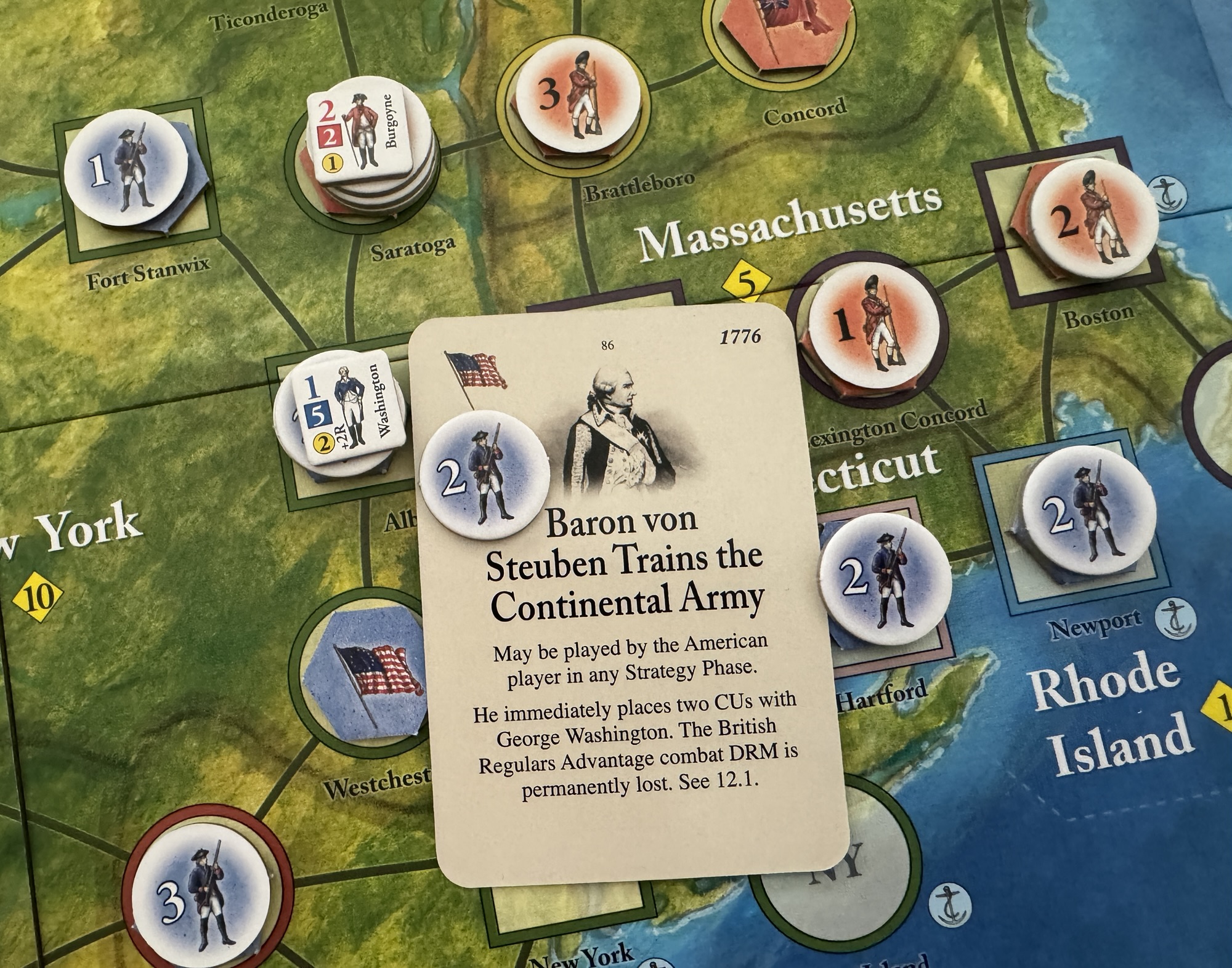
#81: Baron von Steuben Trains the Continental Army from Washington’s War from GMT Games
Washington’s War is a war game, make no mistake about that. But, it is virtually impossible to win the game by focusing only on the field of battle. For that to happen, the Patriots need to completely drive the British forces out of the 13 colonies or the British need to wipe the American forces off the map. Both are extremely difficult and I would be surprised if any more than 1 out of 30 games ended in such a way. Rather, the ultimate goal of the game is to have political control of the colonies. If at the end of the game the Patriots control 7 colonies, while holding the British to control of less than 5, they win. If not, the British win. Simple as that. So, you can see that battle is not the main goal but control is. And more importantly political control.
I really like this about the design and feel that the real core of the American Revolution was the groundswell of patriotism and the desire to live free from the shackles of an overseas monarch who cared little for the American way of life. This desire led great men of the time to sacrifice themselves, their livelihood and their families to further the true cause of liberty and build a truly free and democratic nation where individual liberty and freedom was prioritized over anything else. And yes, I realize that this nation was not perfect, not without contradiction but the concept of liberty helped to form a country that would lead to the ultimate freedom of all people.
Washington’s War is a Card Driven Game, and as such, relies on cards to provide to players the actions needed to play the game. The cards contain OPS Points which can be used to drive various actions, including such things as activating leaders, who in turn will then move with forces to attack, and also contain written text in the form of events. These events can be played only by the side they are intended for and if drawn and played by the opposing side, they can only be thrown away while granting a few possible actions, such as placing or removing Political Control markers.
In today’s entry, I have chosen this card to showcase one of my favorite events from the history of the American Revolution. The card for today is called Baron von Steuben Trains the Continental Army and has a dual focus. It will add Combat Units or CU’s to go along with General Washington but most importantly changes the balance of the game for battles. The card text reads “May be played by the American player in any Strategy Phase. He immediately places two CU’s with George Washington. The British Regulars’ Advantage combat DRM is permanently lost”. Now don’t get me wrong, gaining a free injection of 2 CU’s worth of fighting forces is a nice bonus for the Patriots but the real benefit of the card is that it changes the game. At the start of the game, the British receive a +1 Dice Roll Modifier (DRM) in all battles until what is called the British Regulars’ Advantage is lost. The British Regulars’ Advantage will be lost immediately if the British lose 3 or more CU’s in a single battle and of course, the British may also lose the British Regulars’ Advantage as a result of the play of this card. I very much like this card and it is very important for the hopes of the rebellion. I have found that the +1 DRM is really difficult to overcome for the Patriots and I found that my hopes in combat at the beginning of the game are almost always a 50/50 proposition. But once this card is played, that changes and I feel like the Patriots can better go on the offensive and openly hunt down and attack the British with confidence.
I have always been impressed with the Patriot effort to bring in professional soldiers from Europe to assist them in training and leading the Continental forces. Names like Marquis de Lafayette (France), Baron von Steuben (Prussia), Casimir Pulaski (Poland), Tadeusz Kościuszko (Poland) and Baron de Kalb (Bavaria) to name just a few. These European Generals had experience and knowledge, which were commodities that the Patriots didn’t have a lot of.
Friedrich Wilhelm August Heinrich Ferdinand Fresher von Steuben was a Prussian-born army officer who played a leading role in the American Revolutionary War by reforming the Continental Army into a disciplined and professional fighting force. His contributions marked a significant improvement in the performance of Patriot troops and he is consequently regarded as one of the fathers of the United States Army.
Born into a military family, Steuben was exposed to war from an early age; at 14 years old, he observed his father directing Prussian engineers in the 1742 siege of Prague. At age 16 or 17, he enlisted in the Prussian Army, which was considered the most professional and disciplined in Europe. During his 17 years of military service, Steuben took part in several battles in the Seven Years’ War, rose to the rank of captain, and became aide-de-camp to King Frederick II of Prussia, who was renowned for his military prowess and strategy. Steuben’s career culminated in his attendance at Frederick’s elite school for young military officers, after which he was abruptly discharged from the army in 1763, allegedly by the machinations of a rival.
In 1775, as the American Revolution had begun, Steuben saw a reduction in his salary and sought some form of military work; unable to find employment in peacetime Europe, he joined the Patriot war effort through mutual French contacts with American diplomats, most notably ambassadors to France being Silas Deane and Benjamin Franklin. Due to his military exploits in Europe, and his willingness to serve the Americans without compensation, Steuben made a positive impression on both Congress and General George Washington, who appointed him as temporary Inspector General of the Continental Army.
Appalled by the state of Continental forces, Steuben took the lead in teaching soldiers the essentials of military drills, tactics, and discipline based on Prussian techniques. He wrote Regulations for the Order and Discipline of the Troops of the United States, which remained the army’s drill manual for decades, and continues to influence modern U.S. army manuals. Steuben also addressed widespread administrative waste and graft, helping save desperately needed supplies and funds. As these reforms began bearing fruit on the battlefield, in 1778, on Washington’s recommendation, Congress commissioned Steuben to the position of Inspector General with the rank of major general. He served the remainder of the war as Washington’s chief of staff and one of his most trusted advisors.
Baron von Steuben drilling American recruits at Valley Forge in 1778 by Edwin Austin Abbey.
According to Peter Stephen Du Ponceau, Steuben’s personal secretary and interpreter, “The Baron loved to speak of…his sansculottes (radical partisans, urban laborers, and common people of the lower classes during the French Revolution), as he called us. Thus the denomination was first invented in America…when, it could not be foreseen, that the name which honoured the followers of Washington would afterwards be assumed by the satellites of a Marat and a Robespierre”.
After the war, Steuben was made a U.S. citizen and granted a large estate in New York in reward for his service. In 1780, he was elected a member of the American Philosophical Society, a learned society that included many of the nation’s most prominent Founding Fathers.
Here is a link to our full video review of the game:
With this My Favorite Wargame Cards Series, I hope to take a look at a specific card from the various wargames that I have played and share how it is used in the game. I am not a strategist and frankly I am not that good at games but I do understand how things should work and be used in games. With that being said, here is the next entry in this series.
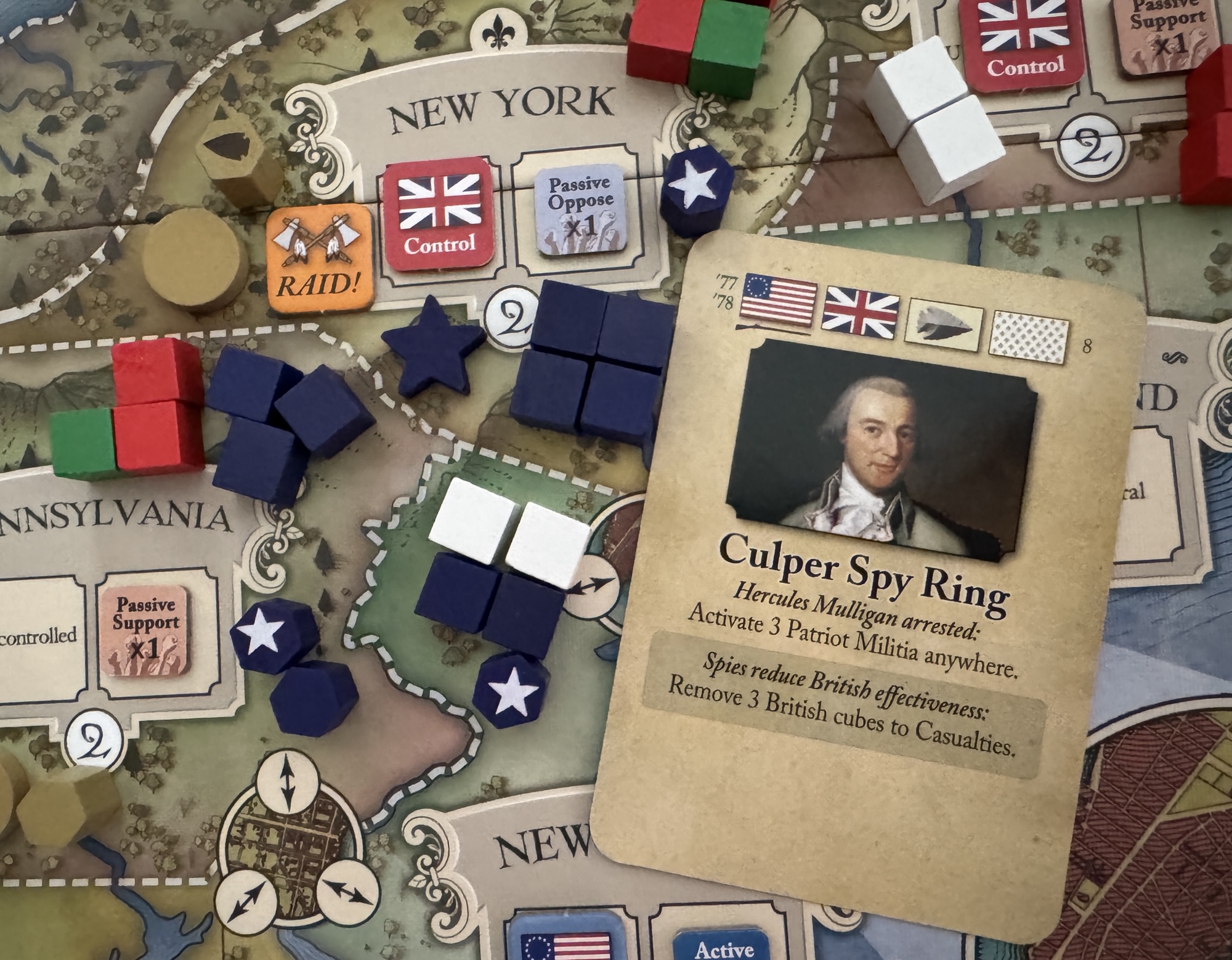
#79: Culper Ring from Liberty or Death: The American Insurrection from GMT Games
In case you didn’t know, I love Liberty or Death: The American Insurrection! This is my 2nd favorite volume in the COIN Series and is such a fantastic game filled with the history of my favorite historical period the American Revolutionary War. Liberty or Death was the COIN Series’ first foray into non-modern warfare and takes us to the 18th Century and the days of the Brown Bess musket, the 18 pound siege cannon and nice and tidy formations better suited for a gentleman’s war. The focus of the game is the struggle of the American Patriots against their mother British government as they have made their intentions clear to become independent with the Declaration of Independence. The game is a multi-faction treatment of the American Revolution, which includes the Patriots and their allies the French against the British and their reluctant allies the Indians.
Liberty or Death is a 1 to 4 player game focused on all aspects of the struggle including financing operations with Rabble Rousing, infiltrating British held cities to Skirmish, blockading major cities with the mighty French fleet, Raiding the frontiers with the Indian nations, the spread of propaganda to build support for the revolution, fort building and small scale battles. So, with this short description you can see that this game is not a “traditional” wargame but does contain some armed conflict. So a game about the American Revolution that isn’t focused on battle you say? How can that be? Well, I will tell you that this game is probably a perfect representation of the multifaceted struggle that wasn’t necessarily decided on the field of combat, but by the little actions of many behind the scenes characters. Yes battle will decide the control of major areas of the board and decide the fate of troops as they must be concerned about being in supply through a network of forts but the game is so much more than just rolling some dice and consulting a CRT!
In today’s entry, we are going to take a look at a very interesting card called Culper Spy Ring. I very much enjoy the connection of this card to the history of the American Revolution as it deals with one of the more important aspects of the war being that of reconnaissance and spying to gain intel on the enemy’s plans and the makeup and disposition of their forces. The Culper Spy Ring card allows the British/Indian players to Activate 3 Patriot Militia pieces anywhere on the board. These pieces do not have to be located together in the same space but can be in 3 different spaces if the players chooses. This is a very powerful event as the Patriot Militia are generally only able to perform their actions if they are Underground meaning hidden from the British. Typically their Commands and Special Activities for things such as Rabble Rousing (create Opposition to Crown rule), Persuasion (get Resources) and Partisans (attack Royalist pieces), require at least 1 Underground Militia piece be in the space and typically requires that they be Activated or turned face up with their embossed star icon showing. The process of turning up these Militia pieces normally involves a British March Command into a space with Underground Militia but the process of removing them requires an additional step by taking either a Skirmish Special Activity or a Battle Command. This card allows for these turncoats to be discovered and then removed in a later action. If you also read the card above the action description you will notice that it says “Hercules Mulligan arrested”. Hercules Mulligan was an Irish-American tailor, spy, and founding member of the Sons of Liberty. Operating in British-occupied New York City, he used his high-end tailor shop to befriend British officers, gather critical intelligence, and covertly pass military secrets to General George Washington. Mulligan is credited with twice saving General Washington from capture or ambush. He sent secret messages, often via his trusted assistant Cato, warning Washington of planned British traps. I love the history here and am very glad that the design and development team gave a shout out to this little known American hero who risked his life to perform these spy activities in New York City.
The bottom half of the event is for the Patriot/French player and has an immediate powerful effect that can change the odds of an upcoming Battle or wrest control of a key province from the British at an inopportune time. The event simply allows the removal of 3 British Cubes from the board, consisting of British Regulars or Tories, and then placing them into the Casualties Box. This is a key action because it can cause the shifting of the delicate balance for the British between Combined Rebellion Casualties (CRC) versus Combined British Casualties (CBC). This difference is 1 of the 2 parts of the British Victory Condition and the CRC must be higher than the CBC. I also love the text above this benefit as it states “Spies reduce British effectiveness”. This is an homage to the critical work of these spy rings as they often lead to more beneficial and favorable Patriot outcomes to Battles as they were better prepared or knew the British plans before the battle event took place.
Major Benjamin Tallmadge.
The Culper Spy Ring was an American intelligence network established in 1778 by Major Benjamin Tallmadge and General George Washington. Operating primarily in British-occupied New York City and Setauket, Long Island, the ring provided vital reconnaissance on British troop movements, notably exposing Benedict Arnold’s treasonous plot to surrender West Point. The network utilized a chain of trusted individuals rather than trained military spies from all walks of life. Some of the more famous spies in this vital ring included:
Agent 355: An anonymous female member within the ring whose true identity remains unknown, though she is credited with providing crucial insights
Benjamin Tallmadge (alias “John Bolton”): The spymaster and director of intelligence who managed the flow of information.
Abraham Woodhull (alias “Samuel Culper Sr.”): The primary gatherer of intelligence in Setauket, who oversaw the ring’s daily operations.
Robert Townsend (alias “Samuel Culper Jr.”): A Manhattan merchant and journalist who operated within British circles, collecting firsthand intelligence on the enemy.
Caleb Brewster: A daring whaleboat captain who transported the messages across the treacherous Long Island Sound.
Austin Roe: A Setauket tavern keeper who acted as the primary courier, frequently riding the 55 miles between Setauket and New York City.
The Culper Spy Ring is widely considered one of the most successful intelligence networks of the American Revolution. Its greatest achievements included preventing a surprise British ambush on incoming French forces in Rhode Island and securing the intelligence that led to the capture of British spy master John André. The secrecy maintained by Tallmadge was so effective that the true identities of the spies were not discovered by historians until the 20th century.
This Culper spy network was the feature of a television series on AMC called TURИ: Washington’s Spies that aired from April 2016 through August 2017 and spanned a total of 40 episodes.
The story of the drama covers events from 1776 to 1781 and features a farmer from Setauket, New York and his childhood friends who form an unlikely group of spies called the Culper Ring, which eventually helps to turn the tide during the American Revolutionary War. The series begins in October 1776, shortly after British victories, including the recapturing of Long Island and the Port of New York for the Crown, leaving General George Washington’s army in dire straits. The first episode opens with the following introductory text:
Autumn 1776. Insurgents have declared war against the Crown. Following a successful naval landing, His Majesty’s Army has forced Washington’s rebels into the wilderness. New York City serves as a military base of operations for the British. The Loyalists of nearby Long Island keep vigilant watch out for sympathizers and spies.
I very much enjoyed the tv show and loved watching each episode to see the hidden historical details of the Culper Spy Ring be revealed that have been discovered over the past few hundred years since the events of the American Revolution. Just an amazing example of a grass roots and loosely organized group of Patriots who risked their lives and families to ensure that the cause of Liberty prevailed.
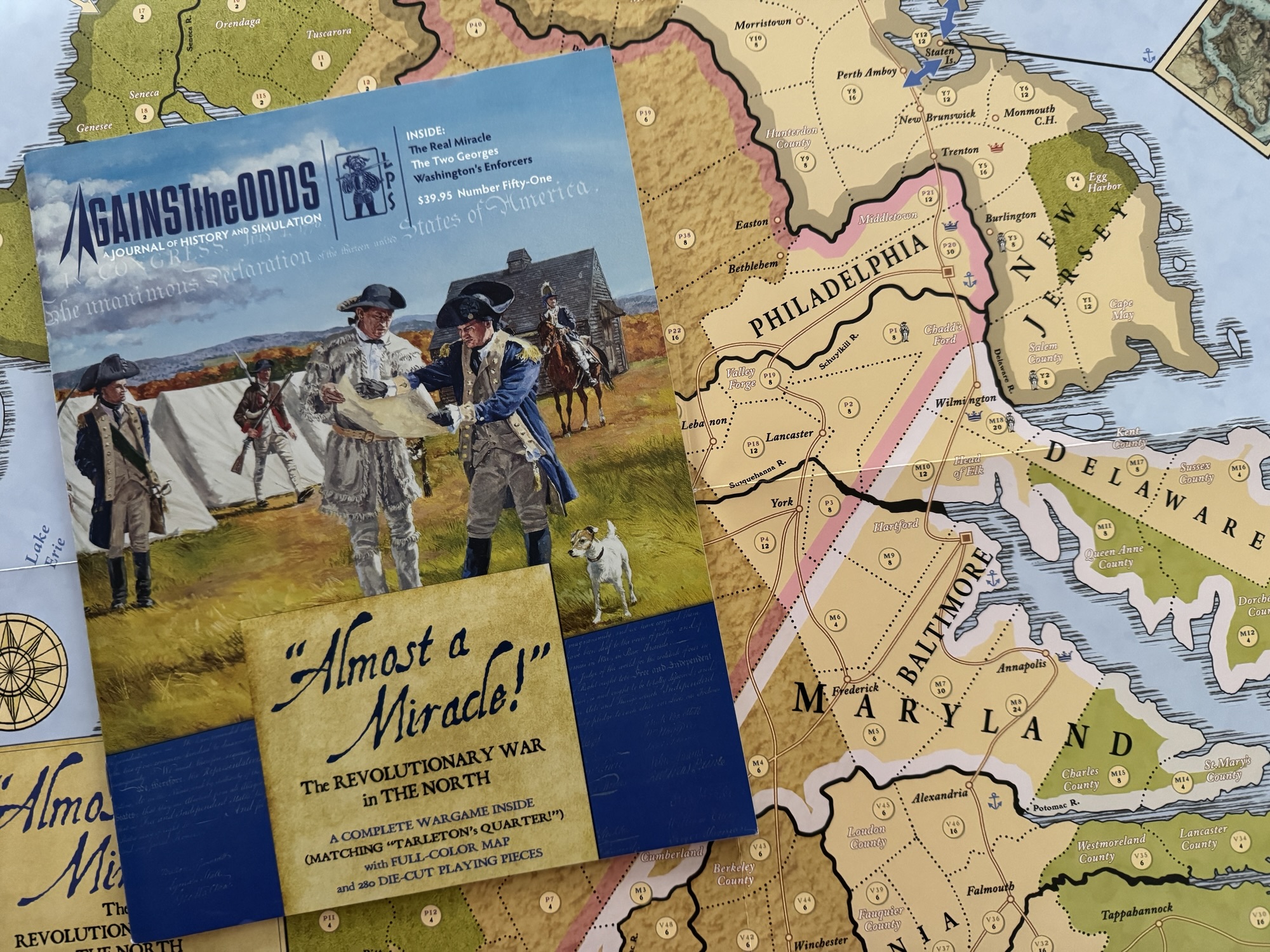
Continuing along in this series devoted to the best looking boards found in the wargaming world where I will highlight the art and layout of a different board in a wargame that we have played to show you the various talents of the artists and graphic designers involved. In my humble opinion, a well designed and attractive board can make all the difference in the world to me enjoying a wargame. Don’t get me wrong, the game has to be good, but if it’s also good looking it always is a better experience. A board can draw me in. Can make me feel that I’m there. Can set the stage for the thematic immersion that we all crave. And I have found many of these type of boards and I want to make sure that I share them with you.
In this entry in the series, we will be taking a look at the fantastic looking board for Almost a Miracle!: The Revolutionary War in the North found in Against the Odds Magazine #51 from LPS, Inc. The board is illustrated by the very talented Mark Mahaffey whose board from Stilicho: Last of the Romans we have already covered in this series. Now typically, Magazine Wargames are nothing special. Both in their game play but also in their component quality and in the area of art and graphic design. But LPS takes great pride in the games found in their flagship magazine Against the Odds. And Almost a Miracle is such a beautiful example of great graphic design and art but also the board is absolutely a piece of art worthy of being framed and hung on a wall.
The board is illustrated by Mark Mahaffey who is a very accomplished full time artist who has done art for nearly 200 games including Celles: The Ardennes, December 23-27, 1944 (2012) from Revolution Games, The Dark Valley (2013) from GMT Games and Stilicho: Last of the Romans (2020) from Hollandspiele to name just a few. I think that Mark has a real talent for making a board coherent, easy to reference upon first glance and pleasing to look at during play, but I would not say that a lot of his boards are over the top beautiful but that is definitely the case with his effort for Almost a Miracle!.
The board represents mostly the Northern Theater of the American Revolutionary War but also includes Virginia and Maryland in addition to Pennsylvania, New Jersey, Delaware, New York and an area identified as New England which encompasses Massachusetts, New Hampshire and Connecticut. Canada is also represented at the top of the board. The map comes in 2 separate parts that join together in New England and that measures 22″ x 51″ total when combined. The interesting thing about these 2 maps is that one is significantly smaller than the other one. I would say about 75% of the playable board is found on the larger of the 2 sections with the northern tier only covering 25%.
My only real issue with the 2 parts of the board is that they join together fine but the way the map was folded created a really defined white seam in the board that really stands out. You can see it located to the right of the words New England and it runs from Penobscot to the top of the board ending in Canada around the top of Acadia. Not a huge issue but more of a distraction from the beauty that the board offers.
But the board is really quite beautiful and really provides a fantastic backdrop for the game itself. As you can see, the color palette chosen focuses on various shades of green and brown and they really give the game a natural and wild feel to it. With these American Revolutionary War games, I always keep in mind that the majority of the area of each colony, outside of a few larger population centers such as New York City, Baltimore and Philadelphia, are farmland and wilderness timber. Not a lot of development and definitely a land rich in natural resources in the form of wild game, furs, fish, lumber and ore. This “natural” color scheme of greens and browns really sets the tone of the period and provides a ready conduit into the theme and setting of the war.
Let’s focus on the southern portion of the board that includes Virginia, Maryland, Delaware, Pennsylvania and New Jersey. First off, I very much love the inclusion of the title box in the bottom left hand corner of the board with the game title and the various contributors including the designer David Jones and Mike Joslyn (who designed Tarleton’s Quarter which covers the Southern Theater) and the graphic design and art teams. These additions are always nice as they feel period to me and almost as if I am looking at a map of the region created at the time.
One thing that I want to point out is the use of lines to mark the various counties in each of the colonies. These lighter dotted lines are not as prominent as the other more important colony boundaries, roads and rivers. You will also notice that each of the colony boundaries are a different color because they touch and are easier to differentiate with the use of colors. Pennsylvania’s boundary is pink as it comes into contact with New York, New Jersey, Maryland and Virginia. Then the boundary of New Jersey is gray and New York is brown as they both touch Pennsylvania. This was a very nice touch and is important to understand the colony boundaries for recruitment and reinforcement purposes. This visually aids in distinguishing the various locations and to assist in grounding you in the geography.
Foraging is also a major part of the game and when troops are out campaigning they rely on baggage trains and supply depots for food and ammunition but also can forage the countryside which is hit or miss. These foraging results are found on a table and are influenced by the terrain type that the troops are located in. So knowing what the terrain in any given area is important and these colors quickly identify the type.
The other very nice feature on the board is the use of lines to mark the shorelines of the various bodies of water including lakes, bays and oceans. In the picture below, we get a look at the shoreline of New Jersey, Delaware, Maryland and Virginia and you can see the deft use of these horizontal dark lines to mark the water as it comes in contact with the shoreline. I also really like the small islands that are sprinkled in the midst of these lines and they add some real depth to the feature. You can also see in this picture the names of each of the counties in each of the colonies. You may also notice the nice use of the silhouettes of soldiers on the boards in some of these counties. These are the starting positions for your forces and I very much like the way they did this.
You may also notice the blue crown icons found on the board near major cities. In this picture you can see the blue crown icon at several places including: Wilmington in Delaware and Annapolis in Maryland. These blue crown icons denote the capitals of each of the colonies and some of the larger ones have multiple capitals. This has to do with victory at the end of the game for the British as if they control the colony capitals and there are no Colonial Regulars or Militia present in the colony they can then place the Colonial Governor and declare “the King’s Peace” in at least 2 colonies to end the campaign game.
As we move to the north of the map, and enter the less populated and definitely more wild areas of the colonies, including northern Massachusetts and the wilderness of Canada, the board changes quite a lot as there are less roads, less markings and frankly more green on the board. It still looks really good and the use of lines for water features is continued particularly in several of the larger lakes in the area.
In the picture above, you can see a good example of the Holding Boxes for troops in the larger metropolitan areas. Here we get a look at the Montreal Holding Box and I very much like the way that they have drawn the outline of the city itself with some of the streets, buildings and homes. This is a very nice touch to the board itself and there are several of these Holding Boxes found on the board including those shown in the picture below such as the Newport Holding Box, New York Holding Box and Staten Island Holding Box. These are very nice additions to the board itself and they look really good and add a layer of depth as well as playability to the game.
The game aids and tracks that are printed directly onto the board are very useful and well done. These use calligraphy like cursive writing that really feels period and adds to the thematic immersion of the player into the American Revolutionary War period. These boxes include the Continental Baggage Train Box and the British Baggage Train Box and shows the game’s focus on Supply. In these boxes, there is an available and an expended section that are used. There also is a Prisoners of War Track that is very period as well as these pitched battles were never fights to the death but represented the fighting style of the period which lead to many different forms of losses including deaths, injuries and prisoners taken.
Finally, there are Captured Boxes for Continental and British Leaders that aid the players in playing the game. These administrative aids are very well done from a graphics standpoint but I love that this game included them on the very large board as it eases play and cuts down on the need to continually refer back to the rules.
Almost a Miracle! was a game chosen for our Shelf of Shame Dust-Off Event in 2024 and we very much enjoyed the game and the history. The game is focused on the American Revolutionary War in the North and is named Almost a Miracle! because when asked about it years after the war ended, George Washington said that the American victory was “little short of a standing miracle.” Almost a Miracle! uses the Tarleton’s Quarter!System as a game engine starting point to bring the Northern “half” of the American Revolution into play.
I think that the best part of this game though is the board. It is just gorgeous and is an odd shape to take into account the entire northern colonies. I think that one of the strengths of this game is that it truly shows the difficulty of maneuvering armies around the colonies and the terrain as well as having to search for forage to feed those armies.
If you are interested, here is a link to our video review:
The next board that we will take a look at in the series is Great Campaigns of the American Civil War: Thunder On the Mississippi: Grant’s Vicksburg Campaign, April-July, 1863 from Multi-Man Publishing.
Here are links to the previous entries in the series:
We’ve been assessing the merits of political leaders in (more or less) democratic countries on this blog for a few years now. Today, we’re returning to German chancellors… but not the way you know it. After a few chancellors from the Federal Republic of Germany (founded in 1949), we’re assessing for the first time a chancellor from the Weimar Republic, Germany’s first attempt at parliamentary government – Hermann Müller. And which game could be more appropriate for him than Weimar (Matthias Cramer, Capstone Games/Skellig Games/Spielworxx)?
The Rating System
Some caveats ahead: The chancellors will be rated by the knowledge of their time. If they or their contemporaries could not have known about the effects of something, I will not use my hindsight to mark it as a mistake of theirs. The assessment is focused on their conduct as chancellor.
Now, to the system itself: There are three policy field categories (foreign, domestic, and economic policy) and three more general ones (vision, pragmatism, integrity). A chancellor can earn from one to five stars in each category (for a total sum of up to 30). In detail, the chancellor is assessed as follows:
Foreign policy: Did the chancellor increase German influence in the world and the security of Germans at home? Did the chancellor wield German power responsibly and with positive results for the regions affected?
Domestic policy: Did the chancellor increase the liberty of Germans to express themselves and to participate in the political process? Did the chancellor promote domestic security and shape the framework for fair justice dealing with offenses?
Economic policy: Did the chancellor facilitate the prosperity and economic security of Germans (including in the mid- and long-term)? Was the chancellor’s economic policy based on mutual benefit of those involved or did it unduly burden one side?
Vision: Did the chancellor have an idea of what Germany and Europe (the latter counting for more in times of German influence being great) should look like beyond the immediate future? Did the chancellor’s policies steer Germany (and, if applicable, Europe) in this direction?
Pragmatism: Did the chancellor succeed in seeing their policy through from inception to completion? How well did the chancellor manage the support from parliament, society, the administration, the media?
Integrity: Did the chancellor understand the office as a means to benefit themselves, special interest groups, the entire country, or another community? Did the chancellor respect the boundaries of the office?
Note: If you have read my UK prime minister or US president ratings, you will remember that I rated them on the global impacts of their vision as well. As the rating system is only really applicable to democratic leaders and no democratic German leader ever had the chance to conduct a truly global policy, I only assess their vision on national and European grounds.
Müller’s Early Life
Hermann Müller was born in Mannheim (in the southwest of Germany) on May 18, 1876. His father ran a small sparkling wine company, but died when Hermann was still a teenager. Thus, instead of taking over the company or going to university, the young Hermann Müller trained to become a clerk. He soon became involved with the socialist movement and joined the Social Democratic Party of Germany (SPD) in 1893. After some years working for social democratic newspapers, he was elected to the leadership board of the SPD in 1906. Müller was often charged with liaisons to other socialist parties in Europe – including a doomed trip to Paris in July 1914, trying to negotiate a joint refusal of French and German socialists to support their respective countries’ impending war with each other.
Müller was elected to Imperial Germany’s parliament in a by-election in 1916. Soon after, the German Social Democrats split between the Majority Social Democrats (MSPD, including Müller) who supported the war effort, and the Independent Social Democrats (USPD), who did not. When the war was lost in November 1918 and the monarchy swept away by revolutionary soldiers and workers, the MSPD soon took control of the revolution and steered a moderate course towards parliamentary democracy.
The revolution of 1918/1919 transformed the (M)SPD from the pariah party of Imperial Germany to the most important pillar of the new republic. As the Social Democrats were no longer barred from the positions of power, they needed scores of cadres to fill them. The general upswing also brought a promotion for Müller, who was elected co-chairman of the MSPD in 1919. Government came with its own challenges: The lost war, the ongoing Allied naval blockade, and the weak position of the new government made it imperative to conclude a peace treaty with the Allied powers. The provisions of the Treaty of Versailles, with which the Allies presented Germany, seemed unacceptable to most Germans – including many Social Democrats. Chancellor Philipp Scheidemann resigned rather than take responsibility for the treaty. He was succeeded by Gustav Bauer (also SPD) whose new administration Müller joined as foreign minister in June 1919. In this role, it fell to him to sign the treaty. From there, Müller sketched the outlines of a new foreign policy – one in which Germany would cooperate with the Allies, use its economic and cultural rather than its military strength to influence world events, and thus overturn the harsh provisions of the Treaty of Versailles.
The Bauer administration resigned after the Kapp-Lüttwitz coup of March 1920. Müller took over the chancellorship as a caretaker – elections were scheduled for June 1920. He was unable to tackle most of the many challenges which beset Germany (chiefly the agreement with the Allies on the details of the German reparations, the tensions over the German-Polish border, and the threat of right-wing terrorism and insurgency (as in the Kahr coup in Bavaria)). The only crisis which was dispelled during his time in office was the dissolution of the Red Ruhr Army, a left-wing militia which had formed in opposition to the Kapp-Lüttwitz coup and, after its failure, had continued their struggle for a council republic on the Ruhr. Their uprising was put down by army and Freikorps units and over a thousand workers (with more or less connection to the uprising) summarily executed.
The Red Ruhr Army can give the Communists a powerful push in the game… and make the Republican parties more forgiving of the Nationalists taking over army units (black units in Essen).
The first one and a half years of democratic government in Germany had proven a disappointment for many voters, including those who generally were in favor of the new republic. The three government parties (the SPD, the Catholic Center (Zentrum), and the liberal German Democratic Party (DDP)) all suffered heavy losses in the 1920 election. The SPD was particularly hard hit, as its handling of the Kapp-Lüttwitz coup and the Ruhr Uprising disenchanted many left-leaning workers. Both the USPD and the pro-business, conservative-liberal German People’s Party (DVP) gained a lot of votes.
With the majority for the government coalition lost, Müller attempted to broaden the government by including the USPD. Due to his handling of the aftermath of the Kapp-Lüttwitz coup, he was brusquely rebuffed. As he did not see potential to cooperate with the DVP, he led the SPD into opposition.
The Opposition agenda card in Weimar strengthens the SPD in parliament and allows the party to (re-)gain a minor ally (the USPD or DDP).
Opposition and Return to Government
Müller’s own inclination was to return to government responsibility, but he prioritized first the reunification of the SPD with the USPD (concluded in 1922) and then the prevention of another rupture. However, the SPD supported the bourgeois minority government (Zentrum, DDP, and DVP) in matters of foreign policy, which was conducted by the guidelines which Müller had laid out as foreign minister and chancellor in 1919 and 1920.
The reparations issue, however, remained unresolved. As tensions over it with the Allies heated up, France occupied the Ruhr again, to which the government responded with encouraging the population of the Ruhr to cease cooperation with the occupiers. This “passive resistance” relied on the national government funding the livelihood of millions of people and thus fueled inflation. As these interconnected crises escalated, it became clear that the government did not have the parliamentary and public support to deal with them. Government needed to rest on a broad basis. The first “Grand Coalition”, led by DVP chancellor Gustav Stresemann and including SPD, Zentrum, DDP, and DVP was inaugurated in August 1923. Four Social Democrats became ministers. Hermann Müller, however, was none of them as he was deemed indispensable to maintain control of the fractious SPD parliamentary group (whose vote to join the government had been on the narrowest of margins).
Stresemann’s re-roll ability makes him an excellent ally in any kind of crisis – coups, foreign policy, presidential elections.
While the Stresemann government successfully ended both the passive resistance (and French occupation) and the inflation crisis, the way there was rocky. It included challenges from both the left wing in Saxony and Thuringia (which were put down by the armed forces once the Communist Party entered a parliamentary government) and the right wing (a nationalist power grab in Bavaria was left unanswered as the loyalty of the army to the republic seemed suspect; an attempt to radicalize Bavaria even further led by a young demagogue named Adolf Hitler collapsed when it met resistance by the nationalist authorities). This uneven treatment convinced the SPD to leave government after only three months. Stresemann, thus without a majority, soon was toppled as chancellor, but remained foreign minister.
The SPD, despite being the largest party in parliament (and being confirmed in this status in 1924), would spend the next five years in opposition. Attempts to form another Grand Coalition failed in 1924 and 1925 (because the DVP preferred to cooperate with the nationalist DNVP and the new, monarchist, president Paul von Hindenburg), and in 1926, because Müller’s SPD engaged in the fool’s quest of pursuing a plebiscite to expropriate the former princes – the plebiscite failed to meet the quorum as expected, but it set the SPD on a path of confrontation with the bourgeois parties which ruled out any cooperation with them.
That did not mean that cooperation was impossible: The SPD continued to back the cooperative-revisionist foreign policy of the government, and also supported budget compromises. Thus, the party agreed to a budget for the year 1928 which included a first payment for new armored cruisers to modernize the navy. It then campaigned for the March 1928 elections on the slogan “Meals for Children instead of the Armored Cruiser”. The electorate returned the SPD with its best showing since 1919. Müller was able to form a government (once more including Zentrum, DDP, and DVP) and was elected chancellor for the second time.
Müller at work in his preferred arena – that of parliamentary debate, not of street action. His event often allows the SPD player to shift the issues decisively in their favor.
The Second Chancellorship
The contradiction between parliamentary action and campaign promises immediately backfired for Müller. The budget for the new fiscal year was due, and as agreed, included funds for the naval modernization. Müller belatedly realized that the decision had been made already, that the SPD had agreed to it, and that his government partners would expect the SPD to stick to its previous course. While Müller and the SPD ministers voted in favor of the budget in cabinet, the SPD parliamentary group revolted against the budget and forced them to vote against it in parliament. It did the rebels no good, as they could not find another majority for an alternative budget, but the revolt was a catastrophe for Müller’s authority.
The economic situation was similarly unpromising: When the trade unions of the Ruhr heavy industry proposed a pay raise by 15 pennies per hour, the employers responded by pre-emptively handing hundreds of thousands of workers their notice. Unions and employers then agreed on mediation, but when the employers did not like the result, they backtracked and disputed the legality of the process. Thus, 240,000 iron workers were laid off. Müller had a second mediator make a new proposal, which was suitably employer-friendly (with pay raises ranging from one to six pennies per hour). The employers contentedly saw that playing hardball paid off. Their confrontational stance would increase with the growing unemployment after the 1929 stock market crash.
For the time being, Müller enjoyed the greatest success of his tenure: He negotiated a new reparations agreement (without Stresemann, who died in October 1929), the Young Plan (named after Owen D. Young, who represented the American side). The negotiations were a great step forward for Germany (as the reparations were much reduced and payment put on a realistic basis), but a mixed blessing for Müller: On the one hand, the agreement was very unpopular (as it stipulated German payments for the next 58 years) and thus maligned by the right wing (which campaigned against it on the slogan “Enslaved for three generations). On the other, the combination of the undoubted necessity of the negotiations and their unpopularity meant that the moderate right-wing parties held off their assault on Müller for the moment, as they wanted him to take the blame.
The combo of the Young Plan and the petition against it may place up to three new crisis markers on the board. Müller really threaded the needle by successfully negotiating the reparations agreement and then fending off the referendum against it.
It was only a short reprieve. By January 1930, the Young Plan negotiations were concluded. The same month, the DVP, not being held back by the pro-government Stresemann anymore, had secretly decided to break the coalition if the SPD did not agree to radical pro-business reforms. The party had received encouragement from president Hindenburg, who also intimated to Zentrum leader Heinrich Brüning that he would support a Brüning-led bourgeois minority cabinet with presidential executive orders.
The showdown came in March 1930 over the reform of unemployment insurance. Müller had negotiated a compromise with Paul Moldenhauer (DVP), the minister of finance. However, the DVP parliamentary group refused to accept the compromise. Müller then tasked Brüning to work out another proposal which would be acceptable to all parties in government. Brüning’s suggestion – which would have postponed the issue by another year without solving it – found agreement in the DVP, Zentrum, and DDP parliamentary groups, but, despite Müller’s urging, not that of the SPD. The second Müller administration thus ended on March 27, 1930.
Müller had hoped that president Hindenburg would support an SPD-led minority government with executive orders. Instead, Hindenburg turned to Brüning whose chancellorship began the slide into government not backed by parliamentary majorities. The SPD, however, supported Brüning on key issues of economic and foreign policy lest the president find excuses to turn even more authoritarian. It was to no avail: Hindenburg and his camarilla got tired of Brüning in 1932 and replaced him in turn with Franz von Papen and Kurt von Schleicher who enjoyed even less parliamentary support, before it seemed like a smart move to them to ally their nationalist elites to the popular movement of the Nazis in January 1933, ending German democracy altogether. Müller did not live to see his democratic republic destroyed: He had never been of strong health, had campaigned and governed against the advice of his doctors who counselled rest, and died on March 20, 1931.
The Rating
Foreign policy
Müller developed Weimar’s foreign policy in his first term in government (as foreign minister and chancellor), which aimed at proving to the Allies by faithful cooperation that Germany was willing to do its part in reconciliation (but had economic limits in what it could do) and would thus be re-admitted on an equal footing to the international community, which would allow the country to revise key portions of the Treaty of Versailles. While the theory was sound, its application ran into practical problems – for Müller as well as the other chancellors and foreign ministers of the Weimar Republic: French revisionism of the Treaty (France felt short-changed in the matters of annexations and would have liked to incorporate the entire left bank of the Rhine as under Napoleon), and the constant charges from the German right that international cooperation under the Treaty of Versailles was akin to betrayal of the nation.
Müller never gave much attention to the existing inequities during his two terms as chancellor. That he was aware of them is proven by his record as foreign minister, in which he massively overworked the diplomatic service (which had been almost exclusively staffed by nobles heretofore), opening it for applicants from all backgrounds. Similar reforms of the judiciary or the military, two other institutions still personally and mentally clinging to Imperial Germany, did not make it to Müller’s chancellor agenda, even though the atrocities committed on the Ruhr in 1920 while the army could not be used to deal with the Bavarian regime at all showed the necessity of these institutional changes.
Müller’s handling of economic policy was incremental and cooperative – a bad fit to deal with his counterparts in business and the government (DVP) who wanted radical changes through confrontation. Müller’s stance may have been the more reasonable. But Müller lost.
Rating: 2 out of 5.
Vision
Müller’s vision of a Germany based on constructive parliamentary debate and government compromise, cooperating with other countries on an equal footing, is compelling. However, Müller was not always successful in advancing these goals, as he prioritized party unity over compromise with others at times.
Müller failed to see most of his policy initiatives through. He kept neither his coalition nor his own parliamentary group in check. However, Müller prevented another rupture of his party, and as a skilled electoral campaigner, achieved the first place for the SPD in every national election with him at the helm of the party.
Müller was fair and even-handed in his conduct as a chancellor. As a Social Democrat, he considered the workers his natural constituency, but was always willing to include the interests of other groups in the compromises he forged. His only fault was to hope for the a-parliamentary executive order minority government which, in the end, was given not to him, but Brüning.
Rating: 4 out of 5.
Overall
Hermann Müller’s chancellorship is traditionally considered a failure based on the collapse of the Weimar Republic soon after. Yet the Republic did not end with his tenure, and it was destroyed not by his actions, but by those of others. Müller’s most enduring contribution was the invention of the Weimar formula of foreign policy, his biggest weakness his inability to impose authority on his friends, partners, rivals, and foes. He failed because he was a middling chancellor in a hostile world.
How would you rate Müller? Let me know in the comments!
Further Reading
For short overview essays on all German chancellors from Bismarck on, see Sternburg, Wilhelm von: Die deutschen Kanzler. Von Bismarck bis Merkel[The German Chancellors. From Bismarck to Merkel], Aufbau-Verlag, Berlin 2006 (in German).
The only full-length biography of Müller is Reichel, Peter: Der tragische Kanzler [The Tragic Chancellor], dtv, Munich 2018 (in German). Unfortunately, the book suffers from the author’s misguided attempt to assign blame for the end of the republic on the SPD for an alleged lack of willingness to compromise, which runs through the entire book.
A revisionist, but insightful short treatment of Müller is Behring, Rainer: Hermann Müller (1876—1931) und die Chancen der Weimarer Republik [Hermann Müller (1876—1931] and the Chances of the Weimar Republic], in: Brandt, Peter/Lehnert, Detlef: Sozialdemokratische Regierungschefs in Deutschland und Österreich. 1918—1983, Dietz, Bonn 2017 (in German).
For the broader context, see: Herbert, Ulrich: A History of Twentieth-Century Germany, Oxford University Press, Oxford 2019.
May is here and the grass is growing, birds and bees are out busily going about their lives and summer is just around the corner. And with all of this change, there are tons of new games that are appearing on both pre-order and as new releases that I am looking forward to getting on my table. Now, if I could only have more time or discover a time manipulation method! This month for the Wargame Watch, I was able to find 25 games (including the 5 games from our sponsor Sound of Drums). I was also able to find 4 games being offered on Crowdfunding through Kickstarter.
This month we have a sponsor for the Wargame Watch feature in Sound of Drums who has made some really great games over the past few years including their History of the Ancient Seas Trilogy (HOTAS: HELLAS, HOTAS: DIES IRAE and HOTAS: MARE NOSTRUM), 1793: Patriots & Traitors, Eylau 1807 and a few others. Sound of Drums really has a great approach to game design and they also are committed to high quality production with great components, fantastic art and really sharp graphic design. They are definitely a publisher to keep an eye on and you should give their games a try!
Most recently, they released the first volume in their Napoleonic Wars tactical level Battle Commander Series designed by Card Paradis called Battle Commander Volume I – Napoleon’s Italian Campaigns. The Battle Commander Series recreates historical 18th-19th century battles and features a fresh framework focused on providing two key aspects: command decision and maximum playability. In Volume I, the player takes on the role of an Army Commander in a series of six dramatic Battles fought during Napoleon’s two Italian campaigns. Volume II will cover engagements of the Second and Third Coalitions, including the Battle of Austerlitz and the Battle of the Pyramids.
In Carl’s own words, here is what the game is focused on and attempting to model:
The system is at Brigade/Division scale, is very playable, with no downtime or complex computations or mechanics. I am a game component maniac, so the package will be super-deluxe, using a very large box, allowing the 2-sided mounted maps to be folded only once (think of the 70’s Avalon Hill flatboxes maps), game pieces will be painted-on wood blocks of different shapes, so no annoying stickers to apply, you’ll have a couple dozen blocks per side in a game, often less. Also, no dice, almost no markers, the emphasis is on the gameplay!
The crux of the game engine will be ( 1 ) the deck of event cards, that will also take care of all the combat results and other dice functions, and ( 2 ), the cube-pull mechanism, that will manage player unit activations, but also turn end, when combat and rally happens, and other similar game happenstances. It’s all a very granular affair. The whole package has a definite “Kriegspiel” look, with all the graphics done in a contemporary Napoleonic style, with a very different way of maneuvering units on the field of battle compared to other Napoleonic games.
They also recently released the Assault Sicily ’43 – Primosole BridgeExpansion for the Assault Sicily ’43 base game. We got a chance to play a scenario from this one with the designers Wolfgang Klein and Erich Rankl while attending Essen Spiel last fall and we had a great time with the new innovations and mechanics as well as the beautiful new production of the expansion.
The big new game that Sound of Drums is offering on pre-order at this time is the Designer Edition of No Retreat! The Russian Front 1941-1945 from designer Carl Paradis.
I am very much looking froward to this one as we have played the Deluxe Edition from GMT Games several years ago and very much enjoyed the system and its narrative on this titanic confrontation on the Eastern Front of World War II. I am interested to see what they change, both mechanically and graphically, and how the final product turns out. The cover though is simply amazing and shows off the skill of their graphic designer Marc von Martial and new artist Wouter Schoutteten.
From the Sound of Drums website, we read the following:
No Retreat! The Russian Front – Designer’s Edition is the definitive evolution of Carl Paradis’ acclaimed Eastern Front wargame.
Building upon the original 2008 release and its later Deluxe editions, this new version refines gameplay, streamlines core systems, expands the Event Card deck to a full 70 cards, enhances solitaire play, and introduces upgraded visuals by renowned artists Marc von Martial and Wouter Schoutteten.
With dual maps, optional historical-symbol counters, dual layered Army Mats, and deluxe player aids, the Designer’s Edition represents Paradis’ final, authoritative vision for his landmark design.
This isn’t just a reprint. It’s the version the designer always dreamed of — crafted after 45 years of studying the Russian Front.
They also have lots of games in the oven and we got a look at a few of them at Essen Spiel including Operation Valkyrie, which is a solitaire game that simulates the events immediately after the attempt to assassinate Hitler on July 20, 1944 and The Great Escape, which is a cooperative game about the escape attempt from the infamous Stalag Luft III POW Camp during WWII. Both look amazing and there are preview pages already published on Gamefound so I would expect them to kickoff sometime in the near future.
As you can see, Uwe Wallentin and his team at Sound of Drums are busy working on some great projects and I cannot wait to see where they go and what they attempt to tackle in the future.
But now onto the games for May!
Pre-Order
1. Foxes and Lions: Renaissance City-States in the Age of Machiavelli from GMT Games
We have played all of the games in the series designed by Ed Beach, including Here I Stand (multiple times), Virgin Queen (multiple times but not as many as HIS) and Tanto Monta (once) with our most recent play being a full 5-player game in March while attending Buckeye Game Fest, and the series is just special. The card driven mechanic simply makes the series and it really is a bit of a sandbox as you can win in various and sundry ways. Recently, GMT announced the fourth entry in the series called Foxes and Lions:Renaissance City-States in the Age of Machiavelli designed by the duo of Paul Wright and Liz Davidson. This one looks to be epic and is set during the Italian Wars. I am very keen on a new addition to the series and look forward to diving in and learning more about the game over the next year or so.
From the game page, we read the following:
Foxes and Lions: Renaissance City-States in the Age of Machiavelli is the next game in the series that includes Here I Stand, Virgin Queen, and Tanto Monta. Focused on the warring city-states and dominions of Renaissance Italy during the era known as the “Italian Wars” (specifically, the period from 1494 to 1527), this game zooms in on the Italian peninsula. Unlike many other games on the Italian Wars, Foxes and Lions puts the focus on Italian experiences of this era of enormous upheaval, which also saw some of the greatest cultural splendors that we now associate with the period known (not without controversy) as the Renaissance. The game depicts the political, military, economic, religious, and cultural affairs of five key Italian powers brought to life by players (Florence, Milan, Naples, the Papacy, and Venice).
Players will struggle to create political legitimacy for themselves while contending with both Italian rivals and external great powers intent on conquest of their own objectives in Italy (France, Spain, the Holy Roman Empire, and the Ottoman Empire). For those who have played other series games, much will be familiar mechanically, but there are many new concepts and mechanics to enjoy, including experimenting with different government types, managing local sentiment, and gathering precious florins to pay for mercenaries and their fickle condottieri captains.
Furthermore, players will be faced with the possibility of collective defeat to the great powers. Players will individually pursue Virtù Points, drawing on Machiavelli’s famously pliable conception of political ability and military strength, while at the same time striving to avoid collective defeat by loss of Italian Virtù. Dwindling Italian Virtù embodies Machiavelli’s abiding fear of great power domination of Italy. Players will each attempt to win without Italy falling into the subjection that was historically its fate, and should they fail to prevent that, the game ascribes blame to the specific players viewed as the scourge of Italy and the new lapdog of the great powers. Can you thread the needle between your Italian rivals’ ambitions and the threat posed by the great powers of Europe?
In case you thought that maybe they are squishing a square peg into a round hole or just copying the tried and true system then you will be glad to find out there is lots of new to explore in the design.
Concepts and Features New to the Series
Political traditions—These are the governments (current and past) that define the political character of any given space in the game (featuring merchant republics, feudal aristocracies, princedoms, theocracies, tribute states, and vassals). In keeping with Machiavelli’s respect for founders of institutions, lawgiving will be an available action that permits you to attempt to alter governments in your dominion. Each space under your control may have a very different political arrangement, which affects its prosperity, unit construction capability, and many other things. Your central government (that of your capital) may also change over time.
Sentiment—This captures the current attitude of the local population to the government overseeing it. The scale of sentiment reflects Machiavelli’s own terminology, ranging from “Hated” to “Feared,” to “Feared and Loved” (the latter an ideal Machiavelli thought hard to achieve, opting instead for being “Feared” whenever a choice between fear and love was unavoidable).
New unit types—Regulars are split into citizen militia and feudal levies, alongside a more detailed look at mercenaries (with elite variants including the Swiss reisläufer and the Imperial landsknechte).
Condottieri captains—Twenty of the colorful, talented, and sometimes treacherous mercenary captains of the era will be available to players in competitive blind bidding for their services, with each captain reflecting unique battlefield abilities, vulnerabilities, and other surprising game impacts. Captains are essential to success in the game, and if not properly paid and retained, will go up for auction again; they may even be suborned and taken from you by nefarious rival actions. Among the captains are the infamous Cesare Borgia, Fabrizio Colonna, Giovanni delle Bande Nere, and “El Gran Capitán” himself, Gonzalo Fernández de Córdoba.
Money economy—Alongside the high-level political capital of command points (CP) already familiar to CDG players, Foxes and Lions features the cold, hard cash that mercenaries and dominions crave. Florins are collected by a trade action connected to the prosperity of the various governments in one’s dominion. The florin economy will be necessary not only to pay or bribe mercenaries and captains, but also for espionage, government maintenance, and more. Player treasuries are hidden behind a screen, so no one is ever quite sure of a rival’s wealth. Should you run out of florins for a required or desired expenditure, the banks will be available to lend to you at exorbitant interest rates, and failure to repay may cost you dearly.
Espionage available from turn one—Nefarious measures are available to players from the outset of the game, including familiar operations from Virgin Queen like Gain Intel and Assassination, now supplemented with Pacification, Foment Rebellion, Sabotage Fortifications, and Suborning others’ employed condottieri to your cause.
New patronage systems and figures—For those familiar with Virgin Queen, patronage now features three tracks (artists, scientists, and humanists) with 10 figures of each type. Patronage targets may now be selected rather than randomly drawn, and each affords unique game effects. Among the 30 patronage subjects are figures such as Michelangelo, Da Vinci, Botticelli, Copernicus, Pacioli, Paracelsus, Machiavelli, Manutius, and even a prying poet-courtesan, Tullia d’Aragona.
New ruler dynamics—Each player will have an often-volatile lineup of rulers who will transition based on circumstances in the game (26 rulers in total across five player powers). In the case of the Papal States, a conclave procedure involving all five players will determine the next pope whenever the current pope dies (however mysteriously).
Variable impulse order—Players may bid their florins to change the impulse order for a given turn, creating dynamic opportunities for surprising your enemies—or lying in deadly wait for them.
More opportunities to declare war mid-action phase—No game about Machiavelli’s era would be complete without the temptations and risks of back-stabbing rivals, even erstwhile allies, including in the middle of a turn. Great coalitions (like the historical “Holy League”) may form, but no alliance is ever truly safe.
2. Chariots of the Gods: A Module for the Great Battles of History Chariots of Fire Game from GMT Games
My experience with the Great Battles of History Series is not very deep. I own SPQR Deluxe Edition and have played it and enjoyed it and it is a beautiful monster with around 6 full counter sheets and 6 double sided maps with 19 scenarios. There is a lot of game here in each of the volumes in the series! The series is really very deep and there are a lots of rules and exceptions based on the different units that are included in each scenario. The game system really emphasizes the important role of command on the ancients battlefield. Leaders are the most important counters in the game and consequently without leader’s order, the player will find that their very powerful and important phalanx and legions will not be able to take any actions, even moving closer to the enemy. There is a new expansion module that was recently announced that deals with Ancient India covering the period of 1700 to 1800 BCE called Chariots of the Gods.
From the game page, we read the following:
Chariots of the Gods (CG) simulates tactical-level combat in the period of India’s ancient Vedic era. Covering a period extending from roughly 1700 to 800 BCE, the age of Vedic India was one of sweeping battles between great kingdoms for supremacy over northern India. This was the age of the chariot-knight, whose prowess with the compound bow from his speeding war-car inspired legends. Often the bravery of the charioteer, whose skill in commanding the vehicle safely through the chaos and danger of the ancient battlefield was no less legendary.
Given the heroic nature of the age, the Chariots of Fire Heroes rules have been expanded to portray the fighting styles in the Vedic poems. All scenarios feature Heros and Heroic Challenges. Rather than Heroes engaging in personal combat only on foot, the Vedic heroes duel each other from a moving chariot wielding their bows. The Hero counter represents not only the Hero, but his Charioteer, and his Chattra (banner) all of which may be hit by his opponent.
CG introduces three new unit types:
Javelin Infantry: Javelin/light spear armed troops with no armor and no missile capability, fighting in loose formations. These units provide the shock power for most of the tribes.
Dismounted Chariots: Noted on the reverse side of the CH-2 counter, these are the knights on foot rather than in their chariots. This mode is mostly useful for traversing rivers and other non-chariot favorable terrain.
Lance Armed Cavalry: Early light cavalry armed with lances with limited Shock capability.
There are special rules for river crossings, strongholds, and given the coalition type armies in the larger battles, rules for Tribal Flight.
Battles included in the Module
Hariyupiya River (ca. 1660), the Anu vs. the Vrcivans
Invasion of the Purus (ca. 1540), the Puru-Bharata vs. the Turvasha-Yadu
Battle of the Dasyus (ca. 1500), the Puru-Bharata vs. the Dasyus
Khandava Expedition (ca. 1415) the Bharata vs. the Kikatas
Parushni River (ca. 1400), Tritsu and Bharata vs. the Kings of the Puru Confederation
Yamuna River (ca. 1400), Tritsu and Bharata vs. the Kings of the Puru Confederation
The typical tribal army consists of mixture of Chariots, bow armed infantry, and javelin armed infantry with minimal shock capability. The Vrcivans, Dasyu, and Kikatas are infantry armies composed of Shock or Barbarian infantry along with bow armed infantry. The battles against the Daysu and Kikatas play out on rough terrain which tends to neutralize the Chariots mobility. The Vrcivans, on the other hand, need to force their way across a river and then contest the chariots in open terrain. The other three battles are set piece affairs occurring on mostly chariot friendly terrain showcasing the full capabilities of that weapons system and the dueling Heroes of legend.
If you are interested in Chariots of the Gods: A Module for the Great Battles of History Chariots of Fire Game, you can pre-order a copy for $37.00 from the GMT Games website at the following link: https://www.gmtgames.com/p-1230-chariots-of-the-gods.aspx
3. Liberty! A Military History Survey of the American Revolution from GMT Games
In our travels to several gaming conventions over the years we have made some great friends, which include gamers, designers, publishers, other content creators, etc. While attending the World Boardgaming Championships a few years ago, we had the chance to interview Mark Miklos who is the creator of the Battles of the American Revolution (BoAR) Series. We also have interviewed Mark several times for new volumes in the BoAR Series, including for Volume XI: The Battle of Green Spring: Prelude to Yorktown, July 6, 1781, Vol. X Battle of White Plains as well as play several of the games in the series at WBC and SDHistCon including Savannah and Germantown. Mark is a very enthusiastic student of the American Revolution and has now taken all of that knowledge and written a book on the subject that was offered up for pre-order by GMT Games this past month called Liberty! A Military History Survey of the American Revolution.
From the page, we read the following:
War has been defined in many ways; as a continuation of politics by other means, as the locomotive of history, and as Hell. Whatever your definition, war is undeniably a spectacle. And in all the spectacle of war, the conflict variously known as the American Revolution, the Revolutionary War, or the War of American Independence has seldom been equaled for its cosmopolitan nature or for the allure it has on the popular imagination.
Here the Ancient Regime, the New World, and the world of the indigenous First Nations collided across oceans and in forest depths, in urban centers and on the frontier, atop mountains, on fertile plains, and across great rivers. Faith and great doctrines were tested. This was the Age of Reason which saw a reexamination of politics, economics and science and, with the vigor of a fledgling leaving its nest, took umbrage against the constraints of a still-enduring older social order.
What began as an assertion of the rights of Englishmen transformed into a movement for independence that ultimately led to a second world war in as many decades. An erudite debate that included statements such as, “Those who would give up essential liberty, to purchase a little temporary safety, deserve neither liberty nor safety,” or, “If this be treason, make the most of it,” led to a sanguine test of arms and yet fully one third of the people in the American colonies simply asked to be left alone to live a common life as it had commonly been led.
Just in time to help celebrate the 250th anniversary of American Independence, Mark Miklos, in his new book, Liberty! A Military History Survey of the American Revolution presents us with the arc of this epic story, a story of the quest for Liberty. Alternating between a 20,000-foot overview and comprehensive detailed analysis, this book informs what you may not know and refreshes what you may already know about the military perspective of the American Revolution.
Anchored on the original essays that appeared in his Battles of the American Revolution Series by GMT Games, Mark has expanded upon his original work to include new chapters, summaries, and transitions which present a compelling and cogent story. Mark has researched the most comprehensive chronological listing of over 600 battles, sieges, engagements, skirmishes, raids, ambush and sanguine quarrels across the nine-year duration of the war which provide context for the primary chapters.
The book features a foreword by Harold Buchanan, designer of GMT Games’ Liberty or Death and the creative force behind the SDHistCon franchise, as well as appendices, comprehensive endnotes, a bibliography, twenty four maps and dozens of illustrations.
As Mark writes, “The dawn of the American Revolution was a period much like others in human history. There was famine and plenty, avarice and charity, misery and joy. Yet something else unique and profound was manifesting, the spark of Liberty.”
Follow that journey in quest of Liberty. Revisit the great battlefields. Renew your acquaintance with heroes, villains and scoundrels along the way, and enjoy the story as Mark takes you on the journey in Liberty! A Military History Survey of the American Revolution.
4. Cuba Libre: Castro’s Insurgency, 1957-1958 5th Printing from GMT Games
Any time a game is on its 5th Printing that should tell you something right there. The game is interesting. The game is fun to play. The game teaches some really great history. Well, in the case of Cuba Libre, all of the before are true and then some. The 2nd game in the COIN Series, Cuba Libre is the smallest of the series in map spaces although All Bridges Burning comes close. This game is usually put forward as a good starting point for the series for new players and we would wholeheartedly agree with that, although I would say even above that is that you should have a passion and interest in the history first and foremost.
From the game page, we read the following:
Following up on GMT Games’ Andean Abyss, the COIN Series next volume, Cuba Libre, takes 1 to 4 players into the Cuban Revolution. Castro’s Marxist “26 July Movement” must expand from its bases in the Sierra Maestra mountains to fight its way to Havana. Meanwhile, anti-communist student groups, urban guerrillas, and ex-patriots try to de-stabilize the Batista regime from inside and out, while trying not to pave the way for a new dictatorship under Castro. Batista’s Government must maintain steam to counter the twin insurgency, while managing two benefactors: its fragile US Alliance and its corrupting Syndicate skim. And in the midst of the turmoil, Meyer Lansky and his Syndicate bosses will jockey to keep their Cuban gangster paradise alive. Cuba Libre will be easy to learn for Andean Abyss players—both volumes share the same innovative COIN system. Like Volume I, Cuba Libre is equally playable solitaire or by multiple players up to 4—and with a shorter time to completion than Andean Abyss. But Cuba Libre’s situation and strategic challenges will be new.
Here is a link to our most recent COIN Series Ranking Video:
5. Panzer: The Game of Small Unit Actions and Combined Arms on the Eastern Front 4th Printing from GMT Games
Panzer is a well regarded system that I have personally never played even though I like tactical games and combined arms is always fun because you get to use tanks. That is sad but one day I will get to it. GMT recently announced a new 4th Printing of the game and maybe this is my chance.
From the game page, we read the following:
Panzer is a complete game system designed for small unit actions from platoon to battalion-sized formations in World War II. The primary focus is Armored Warfare simulation, but Leg (Infantry) and Towed units are also part of the game. Each 7/8” double-sided counter represents a single vehicle, towed gun or aircraft. The 5/8″ double-sided leg unit counters represent squads, half-squads and sections, including their attached weapons.
It’s a modular rules system with Basic, Advanced and Optional rules, which the players can mix and match according to taste – you can keep it simple or make it as complex as desired. All Unit data is included on the full-color Data Cards. The streamlined chit-based command system moves the action along at a brisk pace.
The base game comes with 10 Scenarios, some of which are aimed at new players and use only the Basic rules.
Note on 4th Printing: This will be a straight reprint of the previous printing, with any known errata corrected.
If you are interested in Panzer: The Game of Small Unit Actions and Combined Arms on the Eastern Front 4th Printing, you can pre-order a copy on the GMT Games P500 game page for $65.00 at the following link: https://www.gmtgames.com/p-1228-panzer-4th-printing.aspx
6. Combat! Blitzkrieg from Compass Games
Compass has been churning out new volumes for the Combat! Series over the past few months with volumes focused on Crete, Arnhem and the Eastern Front. I love that there is such a variety in the topics and settings of these solitaire tactical level wargames and look forward to seeing how the system branches out to involve other historical conflicts but also to see how they innovative and make each volume feel like it belongs to the period with new mechanics and unit types. This month, they announced the newest volume in the series called Combat! Blitzkrieg. This volume focuses on squads of Polish, French, or early-war German soldiers and the fighting ranges from the open fields of Poland to the snowy woods of Norway, to the villages and cities of Belgium and France. The game comes with 11 scenarios, 6 bonus Armor scenarios, a competitive 2-player mode, a comprehensive Random Scenario Generator which is always a good innovation to add variety to any game, a Campaign Game and the ability to combine with other 2nd-generation Combat! Series volumes.
From the game page, we read the following:
Combat! Blitzkrieg is a stand-alone solitaire game of man-to-man combat in World War II. This game depicts the countless squad-level actions that were fought as part of the first campaigns of the war, with the player commanding a squad of Polish, French, or early-war German soldiers in those engagements.
In the 11 scenarios, the fighting rages from the open fields of Poland to the snowy woods of Norway, to the villages and cities of Belgium and France. It is bursting with value, whether enjoyed on its own or combined with other games in the series, such as Combat! Eastern Front, Combat! Tunisia & Sicily, or Combat! Crete. The comprehensive Random Scenario Generator (and Campaign Game) further expands your gaming possibilities. With this tool, players can generate a limitless supply of unique scenarios for Combat! Blitzkrieg.
Combat! Blitzkrieg also includes new easy-to-use Armor rules, along with 6 extra Armor scenarios. Tanks, anti-tank guns, and infantry anti-tank weapons are included for the French, Poles, and Germans, as well as the Italians, British, Soviets, and Americans, for use with previous series games.
One of the things that I do like about this system and the various volumes is that it is not just cookie cutter churning out new games but each game has their own unique elements modeled into the game play as special rules or changes to account for the history of the setting. Here is a look at the changes in this new volume:
Other new features in Combat! Blitzkrieg include:
New Terrain types, including a Steeple, Graveyard, Fence, and Barricades.
Flamethrowers for use against enemy defenses.
Competitive Play rules for head-to-head battles!
Combined rulebook containing the special rules from previous Combat! volumes.
Plus, you get rules for air support, fortifications, city fighting, light mortars, weather, fire, and much more, making this the most comprehensive Combat!volume yet published!
7. Iberian Tide: The Spanish Civil War from Compass Games
Recently, we have been playing a lot games on the Spanish Civil War. It is a fascinating period of history leading up to the start of World War II and we have really played some great games on the subject including most recently Crusade & Revolution from Compass Games and The Republic’s Struggle from NAC Wargames. The Tide Series is the brain child of Gregory M. Smith and he is now working with a newer designer in Michael Vitale to tell the story of the Spanish Civil War in a Card Driven Game with the newest volume in the series called Iberian Tide: The Spanish Civil War.
From the game page, we read the following:
Iberian Tide is a 2-player operational-level game that places you in command of either the Nationalists (Franco and his German/Italian support) or the Republicans (Government troops and their Soviet/International support) during the Spanish Civil War. Many would point to this conflict as a ‘warm-up’ for World War II.
Starting with “Viva La Muerte” in 1936, the Nationalists try to quickly knock out the Government by attempting to capture Madrid, all while each side tries to organize amidst the chaos of the Coup.
Each turn, or ‘Block’ is about 3-6 months long, during which multiple card plays occur. These give the players movement, combats, ‘Dug-In’ positions, units and other actions or items. At the end of each Block, players must make critical decisions on which cards to re-buy in an attempt to win the game. Iberian Tide is based on the popular, action-packed “Tide” system of card-driven games (Pacific Tide, Imperial Tide, Rebel Tide, Desert Tide), with many combat and strategic decisions to challenge players in just a single evening’s game.
While the game is probably best as a 2-player game, there is a dedicated solitaire mode.
While Iberian Tide is designed as a 2-player experience, an additional option for solitaire play is provided by the inclusion of a Solitaire Bot. This “Bot” creates action priorities for the non-human player, and has the advantage of being simple enough to implement without spending an inordinate amount of time as the non-player
8. To Kyiv! The Russian Invasion of Ukraine from Compass Games
I know that many designers and publishers have a strict “no current ongoing war designs allowed” policy. I also understand that not all games are for all gamers and that is fine. With that being said, with the events in Ukraine over the past 4+ years, it is just a matter of time before we get several of these designs (this being the 3rd I am aware of with the other 2 games being 2022: Ukrainefrom Conflict Simulations Limited and Defiance: 2nd Russo-Ukrainian War 2022-? from GMT Games). The situation in Ukraine is a study in modern warfare and I for one am glad that this game is coming to light. The newest game to tackle this ongoing conflict is To Kyiv! The Russian Invasion of Ukraine from Compass Games designed by Ivan Notario.
From the game page, we read the following:
A Card-Driven Wargame of the 2022 Russian Invasion of Ukraine. On February 24, 2022, the Russian Federation launched a full-scale invasion of Ukraine, aiming to rapidly seize Kyiv and replace the country’s government. The campaign soon stalled in the face of determined Ukrainian resistance, exposing deep flaws in Russian planning and logistics.
To Kyiv! simulates this modern conflict at the brigade level, covering the chaotic early months of the invasion and the prolonged struggle that followed. Players alternate playing event and action cards that drive military, political, and logistical developments across the theater of war.
The game features variable turn lengths, reflecting the fluctuating tempo of operations, from rapid breakthroughs to extended periods of stalemate. Success requires balancing offensive ambition with the hard realities of supply, morale, and international support.
Designed as a serious historical simulation, To Kyiv! seeks to model the strategic and operational dynamics of the war as faithfully and respectfully as possible. It does not glorify or justify the conflict, but rather aims to help players better understand its complexity and consequences.
I am very much looking forward to this design and to see how it explores a conflict that has so recently been, and continues to be, in the headlines! I also love a good CDG and this one looks very promising.
I normally don’t highlight non-wargames in this Wargame Watch but this next game is just too juicy looking to not share. Do you love a good pirate game? With broadsides, walking the plank, scurvy, boarding parties and booty? Well, you are not alone and there will soon be another great game on the market to quench that thirst for mayhem and adventure with Pirate Hunter: 1718 designed by Joe Carter. I think that the best part about this game is that it is a solitaire game and Joe Carter is a very good designer who is doing a lot of them great titles.
I do own the first game in this series called Golden Age of Piracy: 1718 but have not had a chance to get it played yet as it sits atop my very high and ever growing pile of “to be played” games. A shame really as it looks amazing!
From the game page, we read the following:
Pirate Hunter: 1718 is a solitaire, tactical-level, open-ended sandbox game—being part wargame, part adventure game, and part RPG. As captain of a Royal Navy ship during the year 1718, you are tasked with hunting down and defeating pirates, with your ultimate goal being to attack and shut down the notorious pirate town of Nassau!
Ship-to-ship combat, boarding parties, and the search for buried treasure are to name but a few of the adventures that await you on your patrols across the high seas. But beware of lurking dangers such as the destructive Kraken or the haunting Ghost Ship, all the while you sail the crystal blue waters in pursuit of marauding pirates, fame, and fortune.
10. Rebel Tide: The U.S. Civil War, 1861-1865 from Compass Game Currently on Kickstarter
There is no secret that we really enjoy Gregory M. Smith designs and we also count him as a close friend so take that for what it is worth. He is a great designer and has put together some of our favorite narrative-driven solitaire wargames, such as Silent Victory, The Hunters and The Hunted, but also has done some great 2-player strategic level games on various historical periods including Imperial Tide, covering WWI, and Pacific Tide, taking on the Pacific Theater of WWII. His new game in the Tide Series deals with the American Civil War and is called Rebel Tide.
From the game page, we read the following:
Rebel Tide: The U.S. Civil War, 1861-1865 is a two-player strategic level game that places you in command of either the USA (Union) or CSA (Confederacy) during the Civil War. Each turn consists of a year, during which multiple card plays occur. These give the players movement, combats, entrenchments, and other actions. At the end of each year, players must make critical decisions on which cards to re-buy in an attempt to win the war outright or to win by placing the other side in a disadvantageous position by 1865. Rebel Tide is based on the popular, action-packed Imperial Tide/Pacific Tidegame system by Gregory M. Smith, with many combat and strategic decisions to challenge players in just a single evening’s game.
The core of the game is the unique card re-buy system, in which players take their annual production (adjusted for blockades and blockade runners) and decide which cards they need for the upcoming year. Cards not only provide for reinforcements, but allow for movement, combat, and entrenchment. Which cards to rebuy is without question one of the key decisions the player must make to prepare for next year’s operations.
The game has infantry units for all of the major participants, cavalry, and artillery units. Naval operations are mainly abstracted, although the Confederate player must worry about Farragut invading a port from the sea. Besides the focus on card play, the game features a small footprint (one standard map) and also is designed to be played in just a single evening – estimated at 3 hours for experienced players to fight the entire war.
But don’t worry because the game is not just a reskin of the same system used in those other two games, although the system is really interesting, but instead attempts to create new mechanics and elements to tell the proper story of the struggle for the soul of the country in the 1860’s.
One new mechanic in Rebel Tide is the Political Track, which is an abstract measure of the support of England and/or France to the Confederacy. If this track reaches the maximum early in the war, it can trigger an early CSA victory.
Another new key mechanic in the game system is the addition of historical Leaders, who range in ability from excellent (5) to poor (2). Bad leaders may be “sacked” and removed from the game and randomly replaced by the expenditure of a movement action. Leaders are vital in advancing after combat and also can add strength to an attack’s total combat power.
While attending WBC a few summers ago, we had a chance to sit down with Gregory M. Smith to cover a few of his upcoming designs and Rebel Tide was included in that discussion. Here is a look at our video interview with Greg:
As of May 1st, the Kickstarter campaign has funded and raised $9,098 toward its $2,500 funding goal with 101 backers. The campaign will conclude on Monday, May 4, 2026 at 10:00am EDT.
11. Battle Box – Age of Sail from Feral Wizard Currently on Kickstarter
Small and unique wargames are a rare commodity in our hobby of large and bloated 1,000 counter and multiple map monster games. Nothing wrong with bloated but sometimes it is nice to have a simple and quick to set-up game that is interesting and fun to play. Well, I found this offering on Kickstarter called Battle Box – Age of Sail and it simply looks amazing. It fits into a mint tin and seems to have a lot of flexibility and interest.
From the game page, we read the following:
Battle Box – Age of Sail is a complete naval wargame within a small tin box that fits in your pocket, perfect for a quick game on the go or even full naval campaigns.
The game in full display.
Battle Box – Age of Sail includes ships, battle mat, dice, scenarios, and cards for in-game effects such as critical hits and special ship rules.
4 ships and tracking tokens in different colors.
3 double-sided sections of a hexagonal grid battle mat; with open sea on one side and terrain features such as coastline, island and shoals on the other side.
4 dice and 1 set of rules to play in under 30 minutes while capturing the tactics and flavour of age of sail warfare.
18 cards with ship status tracking, critical effects, ship upgrades, narrative scenarios based on real events, a wind rose (plus wind token), and advanced rules for frigate duels.
And all of it fits within a small and neat tin box!
The set of 4 ships, each of a different colour, are used to represent generic men-of-war and merchant ships. The status, crew quality, ship upgrades, and critical hits on each ship are tracked by means of cards and a token matching the ship’s colour.
Ship Cards – Track ships status and bonuses/penalties deriving from it, such as an eager crew aboard a frigate, or a merchant ship so damaged that can’t sail effectively.
Upgrade Cards – Special rules that can be assigned to each ship for special scenarios, such as a fighting captain or a weatherly ship.
Critical Effect Cards – Attached to a ship as reminder of the critical conditions she is suffering, such as a raging fire or a mast going down.
As of May 1st, the Kickstarter campaign has funded and raised $10,175 toward its $270 funding goal with 230 backers. The campaign will conclude on Thursday, May 21, 2026 at 9:01am EDT.
12. Old School Tactical Volumes II and III: The Pacific and WestReprint from Flying Pig Games
Old School Tactical from Flying Pig Games is a tactical combat system that focuses on World War II to date. The game focuses on the simulation of small unit combined arms engagements where historical units, weapons, armor and vehicles will duke it out on a beautifully crafted board full of hexes. During a turn, players will go back and forth using an Impulse Point System to activate units to either Move, Assault Move or Fire. The players will play through a predetermined amount of rounds and at the end, victory points and casualty points will determine which side is the victor.
The first volume in the series was Old School Tactical Volume 1 Eastern Front 1941/1942 and focused on battles between the Russians and Germans. Old School Tactical Volume 2 West Front 1944/1945 was a follow-up effort and focused on the titanic struggle in Europe following the D-Day landings in 1944 with battles between the Americans and Germans. Then came Old School Tactical Volume 3 Pacific 1942/1945 which includes battles between the Japanese and their Special Naval Landing Force and the American Marine Corps. Since that time they have done Volume 4: The Italian Theater and Volume 5 German invasion of France during 1940. But, they are now doing a reprint campaign for Volumes II and III and it is currently on Kickstarter.
From the game page, we read the following:
War is often remembered in sweeping movements across maps and history books, but it is decided in far smaller moments—when a single squad holds the line, when a machine gun nest refuses to fall, or when a bold maneuver turns confusion into opportunity. Old School Tactical is built to capture those moments. It is a squad-level system that places you in direct command of infantry, leaders, heavy weapons, and armored support, where every decision carries weight and every action can alter the course of a battle.
This Kickstarter brings together four outstanding entries in the acclaimed Old School TacticalSeries: two core games and two expansions that span the European and Pacific Theaters of World War II. Together, they offer a complete and deeply immersive tactical experience built on a system known for its accessibility, tension, and replayability.
At the heart of Old School Tactical is a design philosophy focused on clarity and engagement. The rules are streamlined without sacrificing meaningful decision-making, allowing players to quickly grasp the system while still exploring its tactical depth. Each turn is driven by an impulse-based structure that keeps both players involved, eliminating downtime and ensuring that every moment at the table feels active and consequential. The system emphasizes maneuver, firepower, leadership, and timing—core elements of battlefield command—while remaining intuitive and fast-playing.
This reprint Kickstarter offers four different games including Vol. III: Pacific War 1942–1945, Hell Bent Expansion, Vol. II: West Front 1944–1945 and Ghost Front Expansion.
Here are links to some of our content on these 2 fine games.
Video: So What is Old School Tactical? – A Look at the Old School Tactical System from Flying Pig Games:
Video Review: Old School Tactical Volume II with Airborne Expansion:
For my part, I think that Old School Tactical is one of the finest tactical systems out there. Its ability to generate the gory details of close quarters squad level combat while keeping the game rules relatively lite and intuitive is quite miraculous. We love it and I would definitely highly recommend the system to anyone that hasnt tried it.
As of May 1st, the Kickstarter campaign has funded and raised $62,668 toward its $12,000 funding goal with 280 backers. The campaign will conclude on Tuesday, May 5, 2026 at 12:00 noon EDT.
13. Blitz Creed – The Card Game from Blitzcreed Currently on Kickstarter
I love a good card based wargame. They are definitely a change of pace and a lot of the times are really great experiences. This past week, I found a new and interesting looking card based wargame called Blitz Creed – The Card Game on Kickstarter and wanted to make sure to share it with you.
From the game page, we read the following:
In the wake of global conflict, powerful countries fight for supremacy. Territories shift hands, alliances crumble and soldiers await their commands. Enter Blitz Creed where players engage in intense battles and use their wits to emerge victorious in this world of relentless warfare.
Blitz Creed is a fast-paced, military-themed card game where players battle for global dominance. Set in a world of strategic warfare, players control countries and deploy soldiers to engage in battles and conquer regions. The game combines elements of military strategy, outsmarting opponents and anticipating the moves of others in a contest of wits and power.
In Blitz Creed, you use a deck of 110 cards that include countries, soldiers, dispute cards and reinforcements. You’ll strategically play your cards to deploy soldiers, attack other countries while protecting your regions. Each country has a strength which determines it’s ability to win or lose a battle. There are also special cards like Regional Strike, which let you unleash powerful attacks on your enemies.
The goal is simple: conquer and secure 3 regions by collecting the required number of countries. The first player to secure 3 regions becomes world leader & wins the game.
As of May 1st, the Kickstarter campaign has funded and raised $4,346 toward its $2,625 funding goal with 75 backers. The campaign will conclude on Thursday, May 21, 2026 at 6:54am EDT.
14. Cry Havoc– Medieval Man to Man Combat from Footsore Miniatures & Games Currently on Kickstarter
Nostalgia is a real thing and we have it for many of the things from our childhood. Sometimes that nostalgia is kind of like fool’s gold, meaning that we see something differently than it really was and have a favorable memory of it because it might have been one of our first tries of something that we love. But, nostalgia doesn’t always mean that those feelings are not real and true. Well, I recently came across one of these “nostalgia grab” wargame Kickstarters for a game that originally published in 1981 called Cry Havoc – Medieval Man to Man Combat from Footsore Miniatures & Games. I have looked into this one, even though I didn’t play it during my formative years, and have jumped on the bandwagon and backed the project. Word of warning though. The Kickstarter page is quite sparse and you really cannot get a good feel for what the game is other than a few beautiful pictures of what appears to be lovingly hand drawn boards and art.
From the game page, we read the following:
The original game of medieval combat returns in a fantastic remastered edition, featuring new art from Gary Chalk. Time to bring dramatic clashes of mail-armored knights to your tabletop.
The original 1981 edition of Cry Havoc
In 1981, Gary Chalk and Standard Games collaborated to create Cry Havoc!, combining simple rules with gorgeous hand-drawn art and compelling narrative scenarios. The game became the introduction to wargaming for many gamers worldwide, and the original version can still be found on many tabletops, a testament to the game’s quality and presentation.
Fast forward to 2026, and Gary has collaborated with his friend Mark Farr at Footsore Miniatures to clean up and remaster the original game with new artwork, maps and tokens. The game remains the same classic wargaming experience, and is completely compatible with the original 1981 version (if you’ve still got one on your shelf or tucked away in an attic).
I love the look of this one and even if the game is lacking having the beautiful boards and art in my possession will be worth the $80 I will pay for the game.
As of May 1st, the Kickstarter campaign has funded and raised $50,162 toward its $20,267 funding goal with 624 backers. The campaign will conclude on Sunday, May 3, 2026 at 1:14pm EDT.
New Release
1. A Mad Endeavor: The Fight for Stoney Point, July 16, 1779 from High Flying Dice Games
With this year being the 250th Anniversary of the Declaration of Independence and the start of the American Revolutionary War here in America, I would expect to see a bunch of Am Rev focused wargames being released and to date this year we have seen 3 new ones (Trying Men’s Souls from Against the Odds Magazine and Battle of Pensecola 1781 from Strategy & Tactics Magazine) with the most recent of the bunch being A Mad Endeavor: The Fight for Stoney Point from High Flying Dice Games. I ordered a copy of this one and it arrived last week and looks to be a pretty good little game. Paul Rohrbaugh specializes in these little known and smaller scale battles throughout history and he uses an interesting card activation system that adds some of the unknown to the game and keeps it lite and interesting.
From the game page, we read the following:
The British outpost at Stony Point along the Hudson River prevented any movement by the Americans along this crucial waterway. It also allowed the British nearly unfettered transit that could cut off the New England colonies from the rest of United States. Such a position had to be taken and reduced. To that end, General Washington ordered General “Mad” Anthony Wayne to assemble a strike force to take Stoney Point by assault. What ensued was one of the most daring assaults in the Revolutionary War.
Can you as the British player hold off the Rebel’s attack at Stony Point? Will you as the Americans take the Loyalist stronghold to help secure New England’s position in the revolution? Learn and enjoy!
If you are interested in A Mad Endeavor: The Fight for Stoney Point, July 16, 1779, you can order a copy for $18.95 from High Flying Dice Games website at the following link: https://www.hfdgames.com/stoney.html
2. Cuius Regio: The Thirty Years War 1618-1648 from GMT Games
We have been collaborating with Francisco Gradaille a bit over the past few years as we have posted interviews for his first published design Plantagenet: Cousins War for England, 1459-1485, Onoda from Salt & Pepper Games as well as some other more generic game design and scenario articles. He now has a new game being fulfilled at the end of May called Cuius Regio: The Thirty Years War 1618-1648.
From the game page, we read the following:
Cuius Regio explores the operational military aspects of the pivotal period in European history called The Thirty Years War and focuses on the maneuvers and battles that shook Europe for three decades.
The Thirty Years War unfolded in four main phases: the Bohemian Revolt from 1618 to 1625, the Danish intervention from 1625 to 1630, the Swedish intervention from 1630 to 1635, and the French intervention from 1635 to 1648. It concluded with the Peace of Westphalia in 1648, which finally established a new status quo in Europe, the concept of the sovereignty of states, and shifted the focus of continental politics from southern Europe to the northern states.
The game is an operational scale game and contains all the grandeur you would expect on such an interesting and compelling conflict.
For two players, Cuius Regio is played on an operational-strategic scale. Each turn covers one year, and each hex is approximately nine miles across. Infantry and Cavalry strength points represent approximately 1000 men each, and an Artillery strength point is approximately five guns. Each leader has a Leadership Rating that affects how many troops he can lead and his effectiveness as a leader. Players maneuver their leaders and their armies around Central Europe, conquering cities, engaging in battles, gathering supplies, and preparing armies for yearly campaigns to gain control of the cities of the Holy Roman Empire.
The game includes scenarios covering the Bohemian Revolt, the Danish intervention, the Swedish intervention, the French intervention, and a Thirty Years War campaign of 31 turns lasting from 1618 to 1648. Each scenario has a unique character, and the game can be played in as little as an hour and a half (for a short scenario) or can be a multi-session game for the full campaign.
The turns are divided into two seasons (summer and winter), and each turn has a variable duration that depends on the number of armies activated. In addition, armies can conduct operations several times but become less effective as they accumulate fatigue during each action.
Combat is an integrated system for field battles and sieges and is resolved by a die roll, modified by each army’s leadership, composition, and condition, on a simple Battle Results Table.
If you are interested in Cuius Regio: The Thirty Years War 1618-1648, you can order a copy for $71.00 ($45.00 if you order quickly before they are shipped near the end of May) from the GMT Games website at the following link: https://www.gmtgames.com/p-971-cuius-regio-the-thirty-years-war.aspx
3. Empire of the Sun, 5th Printing from GMT Games
If you have followed us for long you know that we really love Empire of the Sun and have played it several times. The game is simply fantastic and really implements the CDG mechanic perfectly with the events of the Pacific Campaign of World War II. Furthermore, if a game is on its 5th Printing now especially with the 4th Printing having been announced at the end of 2020, that says something about it.
From the game page we read the following:
Empire of the Sun is Mark Herman’s third card driven design since he introduced the system to the hobby in We The People. EotS is a strategic level look at the entire War in the Pacific from the attack on Pearl Harbor until the surrender of Japan. EotS is the first card driven game (CDG) to move the system closer to a classic hexagon wargame, while retaining all of the tension and uncertainty people have come to expect from a CDG. Players are cast in the role of MacArthur, Yamamoto, Nimitz, and Mountbatten as you direct your forces across the breadth of the globe from India to Hawaii and from Alaska to Australia. This is represented on a single map based on a 1942 equal area projection of the entire theater of conflict.
As in other games using the CDG system, players try to maximize the impact of their cards even as they hide their intentions and traps from their opponent. The player is faced with a wide set of clear strategic choices. The focus of EotS is on directing major offensive axes of advance. The Japanese early in the game are challenged to achieve their historical expansion as Allied forces battle the clock to react with their in-place forces trying to achieve maximum damage to the hard-to-replace Japanese veteran units.
If you don’t have this one, you need to get it now. Not only is the price right but the game is simply amazing. And it will be in a near perfect form with the 5th Printing.
We have lots of content on our blog and channel for you to choose from but here are a few of those pieces.
Empire of the Sun – Basic Training Episode 1 – Card Anatomy Video:
Empire of the Sun – Basic Training Episode 2 – Counter Anatomy Video:
If you are interested in Empire of the Sun: The Pacific War, 1941-1945, 5th Printing, you can order a copy for $88.00 ($56.00 if you order quickly before they are shipped near the end of May) from the GMT Games website at the following link: https://www.gmtgames.com/p-1114-empire-of-the-sun-5th-printing.aspx
4. The British Way: Counterinsurgency at the End of Empire 2nd Printing from GMT Games
I have said it before but Stephen Rangazas is a rockstar! Plain and simple. He has done some yeomen’s work over the past few years with games like Fall of Saigon: A Fire in the Lake Expansion, Sovereign of Discord: A Fire in the Lake Expansion and the recently released The British Way. The British Way is a really clean and quick playing 2-player COIN in a quad pack and we just love it. And it is now getting a 2nd Printing.
The British Way: Counterinsurgency at the End of Empire covers four British counterinsurgency campaigns during the process of decolonization immediately following World War II. These include campaigns against larger insurgencies that sought to contest territory and topple colonial rule through armed conflict, such as in Kenya and Malaya, but also smaller more clandestine armed groups that sought to wear down British prestige to force a withdrawal as in Cyprus and Palestine.
From the game page, we read the following:
The British Way: Counterinsurgency at the End of Empire is the first of several COINSeries Multipacks, containing four separate games exploring a series of thematically related insurgencies. Between 1945 and 1960, the British fought four major “emergencies,” as they referred to their counterinsurgency campaigns, each trying to manage their retreat from empire. The four games in this pack focus on exploring British counterinsurgent responses to a variety of different opponents, including communist insurgents in Malaya, militant nationalists in Kenya, and smaller and more clandestine terrorist organizations in Palestine and Cyprus. The games adjust the core COIN Series mechanics to provide a compelling new way of handling two-player conflicts, while also streamlining several mechanics to quicken gameplay. The British Way offers an approachable introduction to the COIN Series for new players, while presenting experienced players with four mechanically distinct games to explore and compare.
The four games in one box is a tried and true method as in the old SPI Quads and recently has had somewhat of a return with not only this new COIN Series Multipack format but with other publishers such as Compass Games and Brief Border Wars I, Brief Border Wars II and Brothers at War: 1862.
The British Way and the COIN Series Multipack has the following highlights:
Four full games in one box: Explore four different conflicts set during the twilight of the British Empire in the 1940’s and 1950’s. Each game uses a unique ruleset building on the same general mechanical structure, ensuring that they are easy to pick up while still offering a distinctive experience.
A new adaptation of the classic COIN system: Improved two-player sequence of play and a versatile Political Will track for determining victory.
Unique mechanisms reflecting the British approach to each conflict: New Villages in Malaya, the ‘Pipeline’ in Kenya, Curfews in Cyprus, and Mass Detention in Palestine.
Small board footprint with quick-but-deep gameplay: Each game plays in under 90 minutes and takes place on a single 17×22” board.
An “End of Empire” Campaign: A campaign scenario allowing players to play the four games in a linked series with a cumulative scoring system, random ‘external’ events relating to British decolonization, and new mechanics to integrate each game into the campaign.
As you know, I love the COIN Series, and this new multi-pack format is very exciting as it provides us more access to smaller, lesser gamed subjects that are fast playing. It also provides to us as players a comparable view at different types of conflict and how they affect the populace and the overall success of these efforts. I think this type of approach won’t work with every conflict and many conflicts will be better served in the framework of the larger COIN Series as their own standalone games. In speaking with Stephen on this very subject, he has shared that his “…hope is that a series of multipacks might provide new ways for wargamers to think about conflict and help cover some topics that would be difficult to design or sell as standalone products”.
5. The British Way: Enemy of My Enemy from GMT Games
In April 2024, we got the announcement that the first entry in the COIN Series Multi-PackThe British Way got a new expansion called The British Way: Enemy of My Enemy and more than that there were to be variants for the existing conflicts covered in the game.
From the game page, we read the following:
The British Way: Enemy of My Enemy is an expansion for The British Way, including two entirely new games on “prequel” conflicts using the Malaya and Palestine maps and expanding the base game experience with new variants for all four conflicts originally covered. The British Way: Japanese Occupation puts the British and the Malayan Communist Party (MCP) on the same side in their efforts to resist the Japanese occupation of Malaya during World War II. The British Way: Arab Revolt allows players to explore the brutal suppression of the Arab Revolt (1936-1939) that preceded the Jewish insurgency covered by the original Palestine game. The two new games involve entirely new mechanics to capture the unique features of each conflict and can each be linked to the original Palestine and Malaya games, which also allows them to feed into the “End of Empire” Campaign Scenario. The two new games in the expansion allow players to explore how British attempts to combat earlier threats to colonial rule involved collaborating with local armed groups that they would later end up fighting against (Jewish paramilitary groups in Palestine and the MCP in Malaya), ironically strengthening and preparing these groups for two of the conflicts featured in the The British Way.
So 2 new games in The British Way: Japanese Occupation and The British Way: Arab Revolt that use 2 of the existing boards. But there is more. The variants to me seem like the most interesting part as they add new elements to all of the 4 base games. For Palestine, they are adding a free functioning Lehi insurgency that does some neat looking things (I am not sure if these are a type of Bot or if it is controlled by the player). In Malaya, they add additional Jungle bases for the insurgents that make them harder to get to and the British get SAS units that can do that job, plus an additional 4 new Event Cards. In Kenya, we get a new British Detention Deck and the Mau Mau get a few leaders. And finally in Cyprus, are added some new Turkish group cell pieces to hinder the British. These expanded elements look very interesting and I think continue the focus of the game on studying the types and form of insurgency/counterinsurgency at the end of the British Empire across the world. Just fantastic!
If you are interested in The British Way: Enemy of My Enemy Expansion, you can order a copy for $67.00 ($42.00 if you order quickly before they are shipped near the end of May) from the GMT Games website at the following link: https://www.gmtgames.com/p-1107-the-british-way-enemy-of-my-enemy.aspx
6. Air & Armor: V Corps, Tactical Armored Warfare in Europe from Compass Games
Another Cold War Gone Hot game. A look at 1985. This topic always makes for a fantastic wargame as there is lots of armor, aircraft and support technologies that pits the United States and NATO against Russia and the Warsaw Pact powers in the late Cold War period in 1985. It seems there have been lots of these games come out in the last few years or so and I always welcome a new one. Air & Armor: V Corps, Tactical Armored Warfare in Europe is an entry in the Operational Air & Armor Series that specifically focuses in on the the famed U.S. V Corps.
From the game page, we read the following:
Air & Armor is a highly realistic game system designed to simulate modern warfare at a grand tactical level. In the Cold War Series, set in 1986, players simulate a hypothetical Soviet attack on NATO forces in West Germany. V Corps depicts the collision of two Soviet armies, the 28th Army and the 1st Guards Tank Army, with the famed U.S. V Corps in ferocious battles from Fulda to Frankfurt. The U.S. 3rd Armored and 8th Infantry Divisions, covered by the 11th Armored Cavalry Regiment, attempt to halt the advance of four Warsaw Pact motor rifle divisions and five tank divisions in a titanic struggle for the approaches to Frankfurt.
Air & Armor employs a highly interactive game system with asymmetric rules, modeling each alliance’s different command-and-control capabilities. The game simulates all major aspects of modern warfare, including reconnaissance, combined arms operations, air, helicopter, and artillery strikes, chemical and electronic warfare, and combat engineering. Multiple levels of hidden intelligence produce a true “fog of war” experience and provide plenty of opportunities for deception, surprise, and ambush. Play this game to experience what it would have been like to command a Cold War division in battle.
V Corps includes 12 scenarios, each depicting a unique battle situation, most of which are playable in a single sitting. Players can choose to play the game in Open Mode or Hidden Mode. In Open Mode, each player knows his own unit strengths but cannot see his opponent’s. In Hidden Mode, unit strengths remain a mystery to both players until the moment of contact. Hidden Mode makes for highly entertaining solitaire play.
As usual, thanks so much for reading along and sticking with me this month as I navigated through the many websites and game pages looking for new and interesting games to share.
Finally, thanks once again to this month’s sponsor Sound of Drums!
The Soviet Union was one of the great dictatorships of the 20th century. It applied an immense amount of coercion on its own citizens as well as many of its neighboring countries. Yet the almost seventy years between the Soviet Union’s founding from the ashes of the Russian Civil War in 1922 and its fragmentation into 15 nation-states in 1991 are no monolith of unfreedom. There were two distinct periods of liberalization around a generation apart from each other – one that began under General Secretary Nikita Khrushchev in the 1950s, and one that began under General Secretary Mikhail Gorbachev in the 1980s. Let’s look at them, beginning with Khrushchev’s thaw, in terms of domestic, foreign, and economic policy. The post on Gorbachev’s reforms will follow in two weeks. As always, there will be board games along the way.
Freedom of Thought, Speech, and Political Expression
Joseph Stalin’s Soviet Union curtailed its citizens’ expression dramatically. Historiography has recounted Stalin’s reign of terror in detail, yet the best-known expression of the totalitarian control to which the Soviet Union aspired from the 1930s on is George Orwell’s dystopian novel 1984: Its one-party state does not only control citizens’ access to information (they are being exposed to constant propaganda and expected to keep up with its frequently changing, often contradictory contents), but demands active participation in the daily reconstruction of the system, ranging from institutionalized “two-minute hate” against political enemies to unlimited devotion to the “Big Brother” at the top of the pyramid.
The Soviet equivalent to the “Big Brother,” of course, was Stalin who was exalted in an official cult of personality as a wise and infallible leader, working tirelessly for the security and well-being of the Soviet Union. Whatever went wrong on the Soviet Union’s inexorable march of progress was the fault of an inept underling or a shadowy enemy.
When Stalin died, his lieutenants fought briefly, but viciously over his succession. Nikita Khrushchev emerged victorious. Khrushchev had been as loyal to Stalin as his chief rivals and immediatly used Stalinist methods to depose Lavrentiy Beria, the powerful Minister of Internal Affairs (and thus chief of the domestic security services). Beria was charged with treason, put through a mock trial, and executed.
Khrushchev’s skillful power politics could also swing the other way, though. He prepared a report on Stalin’s crimes which he delivered to a stunned audience at the 20th Congress of the Communist Party of the Soviet Union on February 25, 1956. For four hours, Khrushchev detailed Stalin’s party purges, his deportation of whole peoples deemed unloyal, and, most of all, how Stalin had established a cult of personality in which he was almost worshipped like a god.
Khrushchev’s de-Stalinization drive did not stop at mere proclamations. The late 1950s and early 1960s saw a lessening of censorship: Alexander Solzhenitsyn was allowed to publish his Gulag novel One Day in the Life of Ivan Denisovitch.
There were limits, however: Criticism of Stalin’s Gulags was one thing, criticism of the October Revolution another. Boris Pasternak’s Doctor Zhivago was not published in the USSR. When Pasternak won the Nobel Prize in literature for it, he and his family were threatened by agents of the state. Cowed, Pasternak did not travel to Stockholm to accept the prize.
Still, Khrushchev’s pivot represented an important turn in the state’s relationship with violence. While Soviet citizens were still routinely surveilled and subjected to coercion, it was neither with the overwhelming force of Stalinism nor with its unpredictability. The age of escalating purges, in which the accusers of today would be the accused of tomorrow was over.
Peaceful Coexistence and Khrushchev’s Many Other Schemes
Khrushchev’s 1956 speech was meant to remain secret, known only to its direct recipients and the allied Communist governments in Eastern Europe, but a member of the Polish Communist party smuggled a copy abroad via the Israeli embassy in Warsaw. From there, it soon gained wide circulation, and while Khrushchev had intended it to be a domestic power play only (it delegitimized his rivals Georgy Malenkov and Vyacheslav Molotov), he now also reaped benefits abroad: The post-Stalinist Soviet Union was naturally a more attractive ally and role model for both the socialist movements in Europe and the decolonizing and freshly independent nations in Africa and Asia.
This unintended benefit is the focus of the foreign-policy heavy Twilight Struggle‘s De-Stalinization card: The Soviet player may move up to four points of influence around on the globe. That may seem like a zero-sum game – after all, the influence is not added, but only moved. But the Soviet Union typically has a lot of spare influence in Eastern Europe after the first one or two turns, and De-Stalinization is the earliest and best way to gain access to faraway continents, chiefly South America (and, to a lesser degree, Africa).
Even before Khrushchev’s speech was leaked, his approach to foreign policy markedly differed from Stalin’s last years. When the relationship with the Soviet Union’s erstwhile allies had deteriorated after the end of World War II, Stalin had adopted a confrontational stance based on the assumption that the world was split in two hostile camps. Khrushchev, on the other hand, approached the western powers under the new motto of peaceful coexistence. Socialism and capitalism could both inhabit the same world. Of course, Khrushchev as a convinced Communist believed that his system would eventually triumph. Until then, peaceful coexistence would not only foster peace, but also make socialism more attractive, and free up resources for economic development and consumer goods (more on that below).
The economic (factory icon) and especially ideological (socialist – man with flat cap icon) bonuses are nice, but what sets the Peaceful Coexistence event in Wir sind das Volk! – 2+2 (Richard Sivél/Peer Sylvester, Histogame) apart is the ability to advance peace (dove icon) – indispensable when the world is sliding toward nuclear war!
Khrushchev was always better at initiating things than at seeing them through. Peaceful coexistence gave way to other projects – be that the support of nationalist movements in the global south or a re-newed competition with the West over Central Europe. And while Khrushchev thought that the Soviet Union and the western powers could live next to one another, that tolerance did not extend to heterodox socialist ideas within his own sphere of influence: When the Hungarian Socialist Workers’ Party announced to withdraw the country from the Warsaw Pact and hold free elections, Khrushchev had the reform movement quashed by Soviet tanks.
The Soviet economy under Stalin had been tuned to increase heavy industrial output to achieve a fast industrialization on the one hand and provide the basis for the country’s military security. This approach was validated by the country’s survival of the Nazi invasion and its eventual military victory in 1945. The proponents of this economic policy which usually went together with ideological mobilization and a confrontational foreign policy were called to adhere to politika. Yet after Stalin’s death, the rival faction of tekhnika gained ground: Its advocates favored a less aggressive foreign policy, less ideological mobilization, and, most of all, more market elements in the economy which would then produce more consumer goods.
Khrushchev positioned himself in the middle: Heavy industry would have priority (the Soviet Union was in a nuclear arms race with the United States whose economy was around three times as large as the Soviet, after all), but more attention would be given to consumer goods than before. Soviet citizens enjoyed a limited amount of prosperity with radios, washing machines, and sometimes even cars. Khrushchev saw this also as an instrument in the systemic competition of the Cold War: Material comfort and personal lifestyles would influence people’s allegiances as much as military strength or ideological treatises.
Khrushchev’s confidence in that regard led him to agree with the United States on mutual national exhibitions which would showcase their respective country to the citizens of the other. The confidence, however, was not quite justified: The Soviet exhibition in New York aroused curiosity, but the American one in Moscow was positively overrun. It also produced one of the iconic pictures of the Cold War with Nikita Khrushchev and US Vice President Richard Nixon debating the merits of their respective systems surrounded by American household appliances – the “Kitchen Debate.”
Some Soviet citizens might have dreamed of living in America, but their personal lifestyles already became more akin to those of Americans under Khrushchev. Even more important than the new consumer goods were their living conditions: Housing in big Soviet cities had been dominated by kommunalkas – large apartments from pre-revolutionary times which had been split to accommodate several families, each living in a single room and sharing the kitchen and bathroom with the others. These crammed living spaces afforded their inhabitants no privacy whatsoever. Only the elites of Stalin’s Soviet Union had apartments to themselves. Khrushchev started an ambitious housing program based on prefabricated, concrete-paneled apartment buildings which allowed millions of Soviet citizens to move into an apartment just for their own family for the first time.
As with foreign policy, Khrushchev started more economic reform projects than he saw through. The ambitious “Virgin Lands” campaign which aimed at alleviating Soviet food shortages by cultivating vast swathes of Siberia and northern Kazakhstan petered out after a few years. His scheme to introduce an Iowa-style corn belt fared even worse, discrediting both corn and Khrushchev in the Soviet Union.
Khrushchev’s Ouster
The economic starts and shifts of Khrushchev’s tenure undermined his position, as did his foreign policy unpredictability ranging from arms control to confronting the United States over Cuba. Most damaging to him, however, were his constant shuffles in the Communist Party. Disaffected cadres who feared they might lose their offices overthrew Khrushchev in October 1964. They installed the less fickle Leonid Brezhnev as new General Secretary of the Communist Party of the Soviet Union. The conservative Brezhnev would tone down some of Khrushchev’s domestic reforms, resulting in a more restricted cultural and literary climate, but stuck with Khrushchev’s economic reforms and conducted foreign policy along the lines of détente with the West.
Not everything about Khrushchev was as cuddly as this bear which he received when visiting an East German electronics factory, but his rule made the Soviet Union a better place to live and furthered its international power and prestige. Image from Wir sind das Volk! – 2+2.
In the end, Khrushchev himself was one of the beneficiaries of the liberalization he had pushed: Unlike the victims of the purges of the 1930s (or even Beria), he was not subjected to a mock trial and executed. Instead, he officially resigned for health reasons and was allowed to live out his days at a comfortable dacha in the countryside.
The authoritative biography remains Taubman, William: Khrushchev. The Man and His Era, Norton, New York City, NY 2004.
A magisterial mosaic of Soviet social, economic, and cultural life is Schlögel, Karl: The Soviet Century. Archaeology of a Lost World, Princeton University Press, Princeton, NJ 2023.
On the suppression of the Hungarian revolution and its impact on Soviet and western foreign policy, see Békés, Csaba: The 1956 Hungarian Revolution and World Politics, (Cold War International History Project Working Paper No. 16), Washington, D.C. 1996.
On the politika/tekhnika split, see Priestland, David: Cold War Mobilization and Domestic Politics: the Soviet Union, in: Leffler, Melvyn P./Westad, Odd Arne (eds.): The Cambridge History of the Cold War. Volume I. Origins, 5th edition, Cambridge University Press, Cambridge 2013, pp. 442-463.
The Soviet Union was one of the great dictatorships of the 20th century. It applied an immense amount of coercion on its own citizens as well as many of its neighboring countries. Yet the almost seventy years between the Soviet Union’s founding from the ashes of the Russian Civil War in 1922 and its fragmentation into 15 nation-states in 1991 are no monolith of unfreedom. There were two distinct periods of liberalization around a generation apart from each other – one that began under First Secretary Nikita Khrushchev in the 1950s, and one that began under General Secretary Mikhail Gorbachev in the 1980s. Let’s look at them, beginning with Khrushchev’s thaw, in terms of domestic, foreign, and economic policy. The post on Gorbachev’s reforms will follow in two weeks. As always, there will be board games along the way.
Freedom of Thought, Speech, and Political Expression
Joseph Stalin’s Soviet Union curtailed its citizens’ expression dramatically. Historiography has recounted Stalin’s reign of terror in detail, yet the best-known expression of the totalitarian control to which the Soviet Union aspired from the 1930s on is George Orwell’s dystopian novel 1984: Its one-party state does not only control citizens’ access to information (they are being exposed to constant propaganda and expected to keep up with its frequently changing, often contradictory contents), but demands active participation in the daily reconstruction of the system, ranging from institutionalized “two-minute hate” against political enemies to unlimited devotion to the “Big Brother” at the top of the pyramid.
The Soviet equivalent to the “Big Brother,” of course, was Stalin who was exalted in an official cult of personality as a wise and infallible leader, working tirelessly for the security and well-being of the Soviet Union. Whatever went wrong on the Soviet Union’s inexorable march of progress was the fault of an inept underling or a shadowy enemy.
When Stalin died, his lieutenants fought briefly, but viciously over his succession. Nikita Khrushchev emerged victorious. Khrushchev had been as loyal to Stalin as his chief rivals and immediatly used Stalinist methods to depose Lavrentiy Beria, the powerful Minister of Internal Affairs (and thus chief of the domestic security services). Beria was charged with treason, put through a mock trial, and executed.
Khrushchev’s skillful power politics could also swing the other way, though. He prepared a report on Stalin’s crimes which he delivered to a stunned audience at the 20th Congress of the Communist Party of the Soviet Union on February 25, 1956. For four hours, Khrushchev detailed Stalin’s party purges, his deportation of whole peoples deemed unloyal, and, most of all, how Stalin had established a cult of personality in which he was almost worshipped like a god.
Khrushchev’s de-Stalinization drive did not stop at mere proclamations. The late 1950s and early 1960s saw a lessening of censorship: Alexander Solzhenitsyn was allowed to publish his Gulag novel One Day in the Life of Ivan Denisovitch.
There were limits, however: Criticism of Stalin’s Gulags was one thing, criticism of the October Revolution another. Boris Pasternak’s Doctor Zhivago was not published in the USSR. When Pasternak won the Nobel Prize in literature for it, he and his family were threatened by agents of the state. Cowed, Pasternak did not travel to Stockholm to accept the prize.
Still, Khrushchev’s pivot represented an important turn in the state’s relationship with violence. While Soviet citizens were still routinely surveilled and subjected to coercion, it was neither with the overwhelming force of Stalinism nor with its unpredictability. The age of escalating purges, in which the accusers of today would be the accused of tomorrow was over.
Peaceful Coexistence and Khrushchev’s Many Other Schemes
Khrushchev’s 1956 speech was meant to remain secret, known only to its direct recipients and the allied Communist governments in Eastern Europe, but a member of the Polish Communist party smuggled a copy abroad via the Israeli embassy in Warsaw. From there, it soon gained wide circulation, and while Khrushchev had intended it to be a domestic power play only (it delegitimized his rivals Georgy Malenkov and Vyacheslav Molotov), he now also reaped benefits abroad: The post-Stalinist Soviet Union was naturally a more attractive ally and role model for both the socialist movements in Europe and the decolonizing and freshly independent nations in Africa and Asia.
This unintended benefit is the focus of the foreign-policy heavy Twilight Struggle‘s De-Stalinization card: The Soviet player may move up to four points of influence around on the globe. That may seem like a zero-sum game – after all, the influence is not added, but only moved. But the Soviet Union typically has a lot of spare influence in Eastern Europe after the first one or two turns, and De-Stalinization is the earliest and best way to gain access to faraway continents, chiefly South America (and, to a lesser degree, Africa).
Even before Khrushchev’s speech was leaked, his approach to foreign policy markedly differed from Stalin’s last years. When the relationship with the Soviet Union’s erstwhile allies had deteriorated after the end of World War II, Stalin had adopted a confrontational stance based on the assumption that the world was split in two hostile camps. Khrushchev, on the other hand, approached the western powers under the new motto of peaceful coexistence. Socialism and capitalism could both inhabit the same world. Of course, Khrushchev as a convinced Communist believed that his system would eventually triumph. Until then, peaceful coexistence would not only foster peace, but also make socialism more attractive, and free up resources for economic development and consumer goods (more on that below).
The economic (factory icon) and especially ideological (socialist – man with flat cap icon) bonuses are nice, but what sets the Peaceful Coexistence event in Wir sind das Volk! – 2+2 (Richard Sivél/Peer Sylvester, Histogame) apart is the ability to advance peace (dove icon) – indispensable when the world is sliding toward nuclear war!
Khrushchev was always better at initiating things than at seeing them through. Peaceful coexistence gave way to other projects – be that the support of nationalist movements in the global south or a re-newed competition with the West over Central Europe. And while Khrushchev thought that the Soviet Union and the western powers could live next to one another, that tolerance did not extend to heterodox socialist ideas within his own sphere of influence: When the Hungarian Socialist Workers’ Party announced to withdraw the country from the Warsaw Pact and hold free elections, Khrushchev had the reform movement quashed by Soviet tanks.
The Soviet economy under Stalin had been tuned to increase heavy industrial output to achieve a fast industrialization on the one hand and provide the basis for the country’s military security. This approach was validated by the country’s survival of the Nazi invasion and its eventual military victory in 1945. The proponents of this economic policy which usually went together with ideological mobilization and a confrontational foreign policy were called to adhere to politika. Yet after Stalin’s death, the rival faction of tekhnika gained ground: Its advocates favored a less aggressive foreign policy, less ideological mobilization, and, most of all, more market elements in the economy which would then produce more consumer goods.
Khrushchev positioned himself in the middle: Heavy industry would have priority (the Soviet Union was in a nuclear arms race with the United States whose economy was around three times as large as the Soviet, after all), but more attention would be given to consumer goods than before. Soviet citizens enjoyed a limited amount of prosperity with radios, washing machines, and sometimes even cars. Khrushchev saw this also as an instrument in the systemic competition of the Cold War: Material comfort and personal lifestyles would influence people’s allegiances as much as military strength or ideological treatises.
Khrushchev’s confidence in that regard led him to agree with the United States on mutual national exhibitions which would showcase their respective country to the citizens of the other. The confidence, however, was not quite justified: The Soviet exhibition in New York aroused curiosity, but the American one in Moscow was positively overrun. It also produced one of the iconic pictures of the Cold War with Nikita Khrushchev and US Vice President Richard Nixon debating the merits of their respective systems surrounded by American household appliances – the “Kitchen Debate.”
Some Soviet citizens might have dreamed of living in America, but their personal lifestyles already became more akin to those of Americans under Khrushchev. Even more important than the new consumer goods were their living conditions: Housing in big Soviet cities had been dominated by kommunalkas – large apartments from pre-revolutionary times which had been split to accommodate several families, each living in a single room and sharing the kitchen and bathroom with the others. These crammed living spaces afforded their inhabitants no privacy whatsoever. Only the elites of Stalin’s Soviet Union had apartments to themselves. Khrushchev started an ambitious housing program based on prefabricated, concrete-paneled apartment buildings which allowed millions of Soviet citizens to move into an apartment just for their own family for the first time.
As with foreign policy, Khrushchev started more economic reform projects than he saw through. The ambitious “Virgin Lands” campaign which aimed at alleviating Soviet food shortages by cultivating vast swathes of Siberia and northern Kazakhstan petered out after a few years. His scheme to introduce an Iowa-style corn belt fared even worse, discrediting both corn and Khrushchev in the Soviet Union.
Khrushchev’s Ouster
The economic starts and shifts of Khrushchev’s tenure undermined his position, as did his foreign policy unpredictability ranging from arms control to confronting the United States over Cuba. Most damaging to him, however, were his constant shuffles in the Communist Party. Disaffected cadres who feared they might lose their offices overthrew Khrushchev in October 1964. They installed the less fickle Leonid Brezhnev as new First Secretary of the Communist Party of the Soviet Union (an office soon to be re-named to General Secretary, like under Stalin). The conservative Brezhnev would tone down some of Khrushchev’s domestic reforms, resulting in a more restricted cultural and literary climate, but stuck with Khrushchev’s economic reforms and conducted foreign policy along the lines of détente with the West.
Not everything about Khrushchev was as cuddly as this bear which he received when visiting an East German electronics factory, but his rule made the Soviet Union a better place to live and furthered its international power and prestige. Image from Wir sind das Volk! – 2+2.
In the end, Khrushchev himself was one of the beneficiaries of the liberalization he had pushed: Unlike the victims of the purges of the 1930s (or even Beria), he was not subjected to a mock trial and executed. Instead, he officially resigned for health reasons and was allowed to live out his days at a comfortable dacha in the countryside.
The authoritative biography remains Taubman, William: Khrushchev. The Man and His Era, Norton, New York City, NY 2004.
A magisterial mosaic of Soviet social, economic, and cultural life is Schlögel, Karl: The Soviet Century. Archaeology of a Lost World, Princeton University Press, Princeton, NJ 2023.
On the suppression of the Hungarian revolution and its impact on Soviet and western foreign policy, see Békés, Csaba: The 1956 Hungarian Revolution and World Politics, (Cold War International History Project Working Paper No. 16), Washington, D.C. 1996.
On the politika/tekhnika split, see Priestland, David: Cold War Mobilization and Domestic Politics: the Soviet Union, in: Leffler, Melvyn P./Westad, Odd Arne (eds.): The Cambridge History of the Cold War. Volume I. Origins, 5th edition, Cambridge University Press, Cambridge 2013, pp. 442-463.
The overall blog statistics are pretty meaningless – both last year and this year are skewed by WordPress sending my Farewell 2024 – Historical Fiction! post out to a bajillion people (from Dec 26 to Jan 8), which makes it easily the most popular post of each year (providing more than a fourth of my total views this year). If you factor that out, 2025 has been a good year on the blog, but slightly behind the (organic) record of 2023.
The posts doing particularly well have been the usual suspects, that is, the Most Anticipated Historical Board Games post in January, and the evergreen strategy posts for several games published over the last year. It was nice to see that a few of my research-intensive posts in the American Revolution and the Wallenstein series also did well.
Most of my readers come from the United States (also skewed by the Historical Fiction anomaly, but not entirely), as well as other Anglophone (UK, Canada, Australia) or European (Germany, the Netherlands, Spain, and France) countries. Especially the Dutch have made a leap up… maybe because of my post on the history of Amsterdam? Welkom, anyway.
New arrivals in the top 10 of the countries from which most views stem are Sweden and Poland in a joint Baltic effort.
If you compare views with population numbers, there are possibly no more loyal readers of this blog than the fine people of Ireland, closely followed by Hong Kong, whose views eclipse those of huge countries like Japan, Brazil, or India. The Irish have been devoted to history, board games, and history in board games for some years now, for which I am grateful. The Hongkongers are new in their excitement for the blog – welcome! If you are from Hong Kong, leave a comment below!
I can only speculate what brought people to this blog (but maybe you can enlighten me with a comment, especially if read this blog, but don’t comment often or ever). Here is, however, what I think was the finest which I published this year – as per usual, with six instead of three entries, and without crowning a winner. Let’s go!
Most of the history articles on this blog are about what people in the past did – the politicians, merchants, soldiers of times past. Yet I also like to dwell on what they thought, and thus I’m very happy to have written this post on the political philosophy of the American Revolution, its core value of liberty, and the promise and limitation of that idea. It was also an opportunity to engage with the still-compelling documents of the Revolution – Common Sense and the Declaration of Independence.
It’s been a wild year politically. Almost forgotten by now is the Great Tariff Rollercoaster of April 2025, in which the American federal government announced tariffs on imports from almost all other countries and then engaged in a flurry of raising, lowering, and holding off on them that made everyone’s head spin. By now, the 145% tariff on Chinese goods imported by US buyers is long gone, but at the time it seemed like an existential threat to US board game companies manufacturing their games in China (so, almost all of them), and given that the current US administration will still be in office for another three years, one worth revisiting.
This blog often gives me the opportunity to learn about new subjects. Wallenstein was one of them. I approached the post about his life with not more than a general knowledge about his role in the Thirty Years’ War… and then was sucked into a research rabbit hole in which I read over 2,000 pages about the guy. The result is a four-part series and the longest, most detailed board game assisted biography I have ever written about anyone.
…and this blog also allows me to re-visit topics and games with which I have engaged for years (and sometimes decades) now. Frederick II of Prussia is such a person, and Friedrich (Richard Sivél, Histogame) such a game. Reflecting on their insights on Frederick’s campaigns, the command and control exercised, and Frederick’s psychology was a delight.
Amsterdam is one of the iconic cities of the world. It is a symbol of art, commerce, and progress, and unique in its canal-structured urban layout. Unsurprisingly, these characteristics have also inspired board game designers. I have told Amsterdam’s 750-year history through the lens of the many board games set in Amsterdam – which gives a glimpse into what the city stands for in the popular imagination. As both this and my earlier Venice post were so much fun to write, I should do more city histories!
One of my brighter new ideas was to link historical board games to period music. Of course, that works particularly well from the 20th century on – the age of the music record. I started with an immersive playlist for your next game of Weimar (Matthias Cramer, Capstone Games/Skellig Games/Spielworxx), full of everything that was hot at the time – from traditional songs to jazz, from movie tunes to workers’ songs. It will surely not remain the only such playlist.
And thus concludes the year 2025 on this blog. I hope you had as much fun reading it as I had writing.
I wish you all an excellent year 2026, full of joy, health, and success!
The overall blog statistics are pretty meaningless – both last year and this year are skewed by WordPress sending my Farewell 2024 – Historical Fiction! post out to a bajillion people (from Dec 26 to Jan 8), which makes it easily the most popular post of each year (providing more than a fourth of my total views this year). If you factor that out, 2025 has been a good year on the blog, but slightly behind the (organic) record of 2023.
The posts doing particularly well have been the usual suspects, that is, the Most Anticipated Historical Board Games post in January, and the evergreen strategy posts for several games published over the last year. It was nice to see that a few of my research-intensive posts in the American Revolution and the Wallenstein series also did well.
Most of my readers come from the United States (also skewed by the Historical Fiction anomaly, but not entirely), as well as other Anglophone (UK, Canada, Australia) or European (Germany, the Netherlands, Spain, and France) countries. Especially the Dutch have made a leap up… maybe because of my post on the history of Amsterdam? Welkom, anyway.
New arrivals in the top 10 of the countries from which most views stem are Sweden and Poland in a joint Baltic effort.
If you compare views with population numbers, there are possibly no more loyal readers of this blog than the fine people of Ireland, closely followed by Hong Kong, whose views eclipse those of huge countries like Japan, Brazil, or India. The Irish have been devoted to history, board games, and history in board games for some years now, for which I am grateful. The Hongkongers are new in their excitement for the blog – welcome! If you are from Hong Kong, leave a comment below!
I can only speculate what brought people to this blog (but maybe you can enlighten me with a comment, especially if read this blog, but don’t comment often or ever). Here is, however, what I think was the finest which I published this year – as per usual, with six instead of three entries, and without crowning a winner. Let’s go!
Most of the history articles on this blog are about what people in the past did – the politicians, merchants, soldiers of times past. Yet I also like to dwell on what they thought, and thus I’m very happy to have written this post on the political philosophy of the American Revolution, its core value of liberty, and the promise and limitation of that idea. It was also an opportunity to engage with the still-compelling documents of the Revolution – Common Sense and the Declaration of Independence.
It’s been a wild year politically. Almost forgotten by now is the Great Tariff Rollercoaster of April 2025, in which the American federal government announced tariffs on imports from almost all other countries and then engaged in a flurry of raising, lowering, and holding off on them that made everyone’s head spin. By now, the 145% tariff on Chinese goods imported by US buyers is long gone, but at the time it seemed like an existential threat to US board game companies manufacturing their games in China (so, almost all of them), and given that the current US administration will still be in office for another three years, one worth revisiting.
This blog often gives me the opportunity to learn about new subjects. Wallenstein was one of them. I approached the post about his life with not more than a general knowledge about his role in the Thirty Years’ War… and then was sucked into a research rabbit hole in which I read over 2,000 pages about the guy. The result is a four-part series and the longest, most detailed board game assisted biography I have ever written about anyone.
…and this blog also allows me to re-visit topics and games with which I have engaged for years (and sometimes decades) now. Frederick II of Prussia is such a person, and Friedrich (Richard Sivél, Histogame) such a game. Reflecting on their insights on Frederick’s campaigns, the command and control exercised, and Frederick’s psychology was a delight.
Amsterdam is one of the iconic cities of the world. It is a symbol of art, commerce, and progress, and unique in its canal-structured urban layout. Unsurprisingly, these characteristics have also inspired board game designers. I have told Amsterdam’s 750-year history through the lens of the many board games set in Amsterdam – which gives a glimpse into what the city stands for in the popular imagination. As both this and my earlier Venice post were so much fun to write, I should do more city histories!
One of my brighter new ideas was to link historical board games to period music. Of course, that works particularly well from the 20th century on – the age of the music record. I started with an immersive playlist for your next game of Weimar (Matthias Cramer, Capstone Games/Skellig Games/Spielworxx), full of everything that was hot at the time – from traditional songs to jazz, from movie tunes to workers’ songs. It will surely not remain the only such playlist.
And thus concludes the year 2025 on this blog. I hope you had as much fun reading it as I had writing.
I wish you all an excellent year 2026, full of joy, health, and success!
We’ve been assessing the merits of political leaders in (more or less) democratic countries on this blog for a few years now – UK prime ministers, US presidents, German chancellors. Today, we’re returning to German presidents, looking at Friedrich Ebert. And which game could be more appropriate for him than Weimar (Matthias Cramer, Capstone Games/Skellig Games/Spielworxx)?
The Rating System
Some caveats ahead: The presidents will be rated by the knowledge of their time. If they or their contemporaries could not have known about the effects of something, I will not use my hindsight to mark it as a mistake of theirs. The assessment is focused on their conduct as president.
Now, to the system itself: There are three policy field categories (foreign, domestic, and economic policy) and three more general ones (vision, pragmatism, integrity). A president can earn from one to five stars in each category (for a total sum of up to 30). In detail, the president is assessed as follows:
Foreign policy: Did the president increase German influence in the world and the security of Germans at home? Did the president wield German power responsibly and with positive results for the regions affected?
Domestic policy: Did the president increase the liberty of Germans to express themselves and to participate in the political process? Did the president promote domestic security and shape the framework for fair justice dealing with offenses?
Economic policy: Did the president facilitate the prosperity and economic security of Germans (including in the mid- and long-term)? Was the president’s economic policy based on mutual benefit of those involved or did it unduly burden one side?
Vision: Did the president have an idea of what Germany and Europe (the latter counting for more in times of German influence being great) should look like beyond the immediate future? Did the president’s policies steer Germany (and, if applicable, Europe) in this direction?
Pragmatism: Did the president succeed in seeing their policy through from inception to completion? How well did the president manage the support from parliament, society, the administration, the media?
Integrity: Did the president understand the office as a means to benefit themselves, special interest groups, the entire country, or another community? Did the president respect the boundaries of the office?
Note: If you have read my UK prime minister or US president ratings, you will remember that I rated them on the global impacts of their vision as well. As the rating system is only really applicable to democratic leaders and no democratic German leader ever had the chance to conduct a truly global policy, I only assess their vision on national and European grounds.
In all other ratings (UK prime ministers, US presidents, German chancellors) the subject’s life after holding the office is also assessed (for they are still seen as ex-office holders, but as a secondary consideration). This does not apply here, as – spoiler! – both Weimar Republic presidents died in office.
In Ebert’s special case, I will not only assess his conduct as president, but also as chancellor before, as he held the post at a time when Germany did not have a head of state.
Ebert’s Life
From Saddler to Chancellor
Friedrich Ebert was born on February 4, 1871, as the son of a tailor. He learned the trade of a saddler and became involved with the workers’ movement during his journeyman years. In 1891, he settled down in Bremen, where he ran a pub while working for the trade union. Ebert’s political work in the trade union and the Social Democratic Party (Sozialdemokratische Partei Deutschlands, SPD) assumed ever more importance. He was elected to the Bremen city council (1899) and became a full-time trade union secretary. In the following years, Ebert rose to national prominence: He was elected to the SPD national party committee (1905) and to the Reichstag, the national parliament of Germany (1912). One year later, he became one of the leading Social Democrats in Germany when he was elected co-chairman of the SPD.
The Social Democrats faced their crucible at the outbreak of World War I. Ebert successfully advocated supporting the government’s war efforts (instead of attempting to forge an international workers’ coalition against the war). In the later years of the war, more and more Social Democrats took up a strict anti-war stance, forming up as Independent Social Democrats (Unabhängige Sozialdemokratische Partei Deutschlands, USPD). Ebert maintained his previous stance and kept most of his allies within the party (now known as Majority Social Democrats (Mehrheitssozialdemokratische Partei Deutschlands, MSPD), yet tried to mediate between workers protesting and striking against the war and the government (notably during the January Strike of 1918).
When the military situation looked grim for Germany in fall 1918, de facto military dictator Erich von Ludendorff resigned and pushed for a new government to assume responsibility for the impending defeat. Ebert joined a parliamentary government and became its interim chancellor on the day that emperor William II was forced to abdicate. Two days later, Germany and the Allies agreed on the Armistice which ended the fighting on the Western Front.
Many socialists, especially from the USPD, now pressed for a full-scale political and social revolution based on the workers’ and soldiers’ councils sprouting up everywhere. Ebert, who abhorred the Russian Revolution, wanted to bring about gradual change which would transform Germany into a democracy by parliamentary means. The sweep of revolution brought MSPD and USPD together in an uneasy government alliance. The opposition between moderate and radical socialists provides the basis for the SPD and KPD (Kommunistische Partei Deutschlands – Communist Party of Germany) players’ relationship in Weimar (all forms of radical socialism are subsumed under the umbrella of the KPD (which was historically only founded in January 1919) in the game). The USPD is a minor party in the game which can be aligned with either SPD or KPD (starting in the latter’s camp) and which provides more gumption for actions in the street and sizable parliamentary bonuses in the early game.
The USPD gives additional seats in parliament in the first four rounds of the game as well as a bonus point in the reserve each round (on the board to the left of the card). If the SPD can wrest the party away from KPD control early, that usually results in a large democratic majority under SPD leadership.
In the heady first days of the revolution, MSPD co-chairman Philipp Scheidemann proclaimed the German Republic (Ebert had opposed it and wanted Germany to become a parliamentary monarchy). The new government also proclaimed wide-ranging individual liberties and promised sweeping economic and social reforms (ranging from the eight-hour work day over housing programs to social security) as well as democratic elections in which both men and women would have the right to vote – here Ebert and the USPD agreed in substance, yet not in process: The USPD regarded the consent of the workers’ and soldiers’ councils as enough legitimation; Ebert insisted to carry out the reforms through a parliamentary process. Ebert outfoxed the USPD by having the Reich Councils’ Congress agree to hold parliamentary elections at the earliest possible date.
While Ebert outmaneuvered his rivals on the left, he also secured his right flank. Millions of German soldiers streamed back from the frontlines after the armistice. They needed to be demobilized in an orderly fashion, and, most of all, the threat of a military coup against the nascent republic needed to be warded off. Ebert thus struck a bargain with the army’s conservative leadership: The army would not act against the republic. In return, the new government would forgo the democratization of army structures. The deal already paid off for Ebert by December 1918: When the conflict of the government with the left-leaning People’s Naval Division over outstanding pay and the choosing of its commander escalated, Ebert had the Division dissolved by armed force. The same fate awaited the singularly ill-prepared Spartacus Uprising of January 1919.
A revolution makes for strange bedfellows: Social Democrat Ebert is inspecting German troops in the illustration of the “Pact with the Old Powers” event card. The event is extremely powerful under the right circumstances. Note that the SPD player could also use it to suppress a right-wing insurgency!
When the National Assembly had been elected in January 1919, Ebert’s MSPD was by far the strongest party. Its allies, the Catholic Zentrum (Center), and the progressive-liberal DDP (Deutsche Demokratische Partei, German Democratic Party) also fared well at the ballot box. Due to the armed unrest in Berlin, the National Assembly was convened in the quiet provincial town of Weimar, thus providing the common name for the first German republic (and, consequently, also for the alliance of SPD, Zentrum, and DDP – the “Weimar Coalition”). The Assembly elected Ebert the first president on February 11, 1919.
The Parliamentary President
The National Assembly established wide-ranging rights for the president in the constitution. Yet Ebert interpreted these as powers to be used in emergencies. In his view, the president was a steward whose role was to guard the constitution and integrate the nation. Thus, Ebert only rarely got involved in the day-to-day business of the cabinet, now headed by Philipp Scheidemann – for example, when the Allies presented Germany with the Treaty of Versailles, Ebert remained publicly non-committal.
Even when the republic as such was threatened, the president was not always the first to respond: The right-wing power grab by Wolfgang Kapp and Walther von Lüttwitz was stopped by a general strike. While Ebert’s name appeared on the pamphlet calling for the strike, it is likely that he was in fact not involved in the move. Ebert’s main contribution to the failure of the coup was of a different kind: When the coup leaders occupied Berlin, the federal civil service refused to do their bidding. Even though most of the civil servants had been hired under the emperor and felt attached to the monarchy, they had come to respect Ebert and would not enable the coup against his lawful government.
The 1920 parliamentary elections dealt the (M)SPD and its allies a heavy blow. They lost their parliamentary majority. Ebert advocated for a “grand coalition” which would include not only the parties of the Weimar Coalition, but also the pro-business, national liberal DVP (Deutsche Volkspartei, German People’s Party). His counsel was not heeded. Instead, Zentrum and DDP formed a bourgeois minority government.
Ebert was the most imposing political figure of the early Weimar Republic. While his integrative approach did much to wed the more moderate workers to the Republic (they would remain its most steadfast defenders till the very end), his suppression of revolutionary activities also alienated the more radical workers… thus the “Red Emperor” event card (showing Ebert at his presidential desk) can cut both ways, placing either an SPD- or a KPD-aligned worker marker on the society track.
As the government had no parliamentary majority, the president might have assumed a greater role. Ebert, however, maintained his interpretation of the presidency as a stewardship, detached from party politics and the day-to-day decisions of the cabinet. In economic and social matters, Ebert retained his representative role, mediating at times in collective bargaining struggles. In foreign policy, the president’s constitutional role was larger, and while Ebert generally supported the general foreign policy of the bourgeois minority governments, he was left out of the actual decision-making. In the meantime, Ebert tirelessly lobbied for cooperation among all democratic parties. It took a plunge into catastrophe for the young republic to heed his counsel.
When Germany reduced the reparation payments to the Allies in January 1923, France occupied the industrial heartland on the Ruhr. The German government called on the workers of the Ruhr not to collaborate with the occupation force in extracting the reparations in kind (“passive resistance”). That required the government to pay out ersatz wages to millions of people, accelerating inflation to a ludicrous degree. By August 1923, prices compared to January had multiplied by 100 (!), and France was still occupying the Ruhr. With Ebert’s support, all democratic parties from the SPD to the DVP formed a grand coalition under chancellor Gustav Stresemann.
Stresemann ended the ruinous passive resistance. While economically sound, this blow to German national sentiment caused backlash: The Bavarian state government declared a state of emergency, aiming to build a new authoritarian system in Bavaria (equivalent to the establishment of a right-wing regime in Weimar) and then exporting it to the Reich as a whole. In response, SPD-KPD state governments formed in Saxony and Thuringia (both in the path for a “March on Berlin” from Munich).
Once more, Ebert suppressing a leftist challenge to the republic. The Reichsexekution placed Saxony and Thuringia under federal control.
Ebert used the constitutional emergency powers granted to the president to depose the Saxon and Thuringian state governments. Federal troops quelled the unrest there before any uprising had even materialized. Yet while the army would march against leftist challenges to the republic, it was notoriously unwilling to confront right-wing movements (as Ebert knew from the Kapp-Lüttwitz coup). Thus, while Ebert formally put the army’s commander Hans von Seeckt in charge of Bavaria, he did not order any concrete action. In the end, the authoritarian government of Bavaria was overthrown from the fringe of the right-wing movement – Germany’s erstwhile military dictator Ludendorff and an ambitious demagogue named Adolf Hitler took the key government players captive and called for a march on Berlin. It was stopped within its first kilometer by 130 policemen. After that, the authoritarian government collapsed. The republic had been saved.
Lots to deal with: The Weimar Republic was close to collapse in 1923 – in game terms, approaching its seventh threat marker in the Deutsches Reich box.
While the Weimar Republic stabilized, Ebert fought for the dignity of his office. He had been smeared by enemies of the republic from the beginning of his term. When Ebert had visited a beach town in 1919, a local photographer had snapped a picture of him in swimming trunks. The monarchists bought that picture and kept circulating it, often contrasting the half-naked president with one of the emperors of the old Germany in full regalia.
The nationalist DNVP begins the game as the weakest of the four parties. One strategy for them is to erode the democratic majority – for example, by attacking the SPD’s parliamentary standing with the President in Swimming Trunks event.
Ebert’s detractors also attacked his conduct. Most famously, they attacked him for his role in the January Strike in 1918. A court found those calling Ebert a “traitor to his country” for his participation in the strike guilty of defamation, but added that they were factually correct – symptomatic for the monarchist leanings of the Weimar courts, still staffed with jurists from the ancien régime. The court’s ruling was only overturned in 1931. Ebert would not live to see it. He had put off surgery for appendicitis due to the trial and died of the resulting peritonitis on February 28, 1925. He was only 53 years old.
Ebert’s death is a watershed moment in a Weimar game. As long as the Ebert token occupies the Reichspräsident spot, the presidency is neutral, and nobody gains any benefits from it. When Ebert dies, an election is held in which the parties’ popularity with the voters is measured. Each party fields a candidate. The two candidates with the most votes advance to the second round, in which the two parties whose candidates have been eliminated can pledge their votes to any of the remaining candidates. That is a crucial moment to make deals, to forge alliances, to exact promises in return for the votes, and, more often than not, to pivot away from an ally who has become too strong. (I have seen my Social Democratic candidate defeated by a very grand coalition of the other three parties – Nationalists, Conservatives, and Communists.) From then on, the party holding the presidency can play a card both for the event/actions and for a debate once per round, effectively giving the party one more party card (which, as you typically only draw three of them per round, is huge). This less restrained approach to the presidency reflects the presidential activism of Ebert’s successor Paul von Hindenburg.
Even though foreign policy was the area in which the president’s role was constitutionally confirmed, Ebert followed rather than led. While he – much like his head of government Philipp Scheidemann – personally found the terms of the Versailles Treaty unacceptable, he stayed on when Scheidemann resigned, displaying a keen sense of duty and order. Ebert supported the various governments in their unpopular, but necessary fulfilment of the stipulations of the Versailles Treaty and their orientation toward the western powers. At times, he was entirely sidelined, as when chancellor Joseph Wirth and foreign minister Walther Rathenau forged the Treaty of Rapallo with the Soviet Union.
Ebert’s achievements in this realm lie during his tenure as chancellor. His Proclamation (Nov 12, 1918) ushered in an unprecedented era of personal liberty and social equity, exemplified in the commitment to freedom of the press and women’s suffrage. Ebert’s integration of the army into the new republic avoided a civil war. Later, his uneven use of force dealing with the uprisings of 1923 was pragmatically understandable, but failed to conciliate the political right with the republic or make the army more accountable to the political leadership.
The Proclamation of November 12, 1918 laid the foundation for the eight-hour work day, a milestone for the working population of Germany. An overlooked contribution of Ebert’s to economic development is his advocacy for the “grand coalition” – only this broad alliance could bring about the far-reaching currency reform which ended hyperinflation in 1923. That Ebert’s calls to alleviate the social hardships which came as a side effect to the currency reform went unheeded by the bourgeois minority government which followed the grand coalition is symptomatic for the limited power of the presidency in the realm of economic and social policy.
Ebert has often been criticized from the left as too cautious, not able or not willing to dream big. And indeed, in hindsight his thought and practice seems much less imaginative than his critics’ utopias of socialist republics based on grassroots councils. Yet in 1918, the thought of a liberal, parliamentary Germany – the realization of the dream of 1848 – was revolutionary, and, most importantly, it was achievable. Ebert helped to bring about the German democracy and guided it into calmer waters during his tenure.
Rating: 5 out of 5.
If Ebert (pictured in the background of the election poster) played Weimar, he’d select this agenda card every round.
Pragmatism
Ebert made it possible for the bourgeois politicians, the army, and the civil service to get along with a Social Democratic government. While this was an impressive feat in itself, his pleas for cooperation were often not heeded – neither from his own party nor from those he sought as allies. His natural inclination to compromise veils his deft handling of his political opponents: The USPD joined the provisional government on equal footing in November, yet ended up entirely outmaneuvered by January – its moderates falling in with Ebert’s call for elections as soon as possible, its radicals reduced to a singularly ill-advised attempt at armed uprising.
Ebert is the rare politician who, presented with the opportunity to make wide-reaching decisions with a free hand, refused it. His belief that a freely elected parliament must make the important choices guided him during the revolution. Later, Ebert understood himself as a steward of the republic, a president of all Germans, and was unwilling to use his office for the gain of particular individuals or groups. He used the wide-ranging emergency powers assigned to the president in the constitution only when presented with a grave crisis. His thoughtful wielding of power becomes ever more apparent in comparison with his successor’s liberal use of the emergency powers which contributed to the fall of the republic.
Friedrich Ebert took on the highest duty in tumultuous times. He wielded power responsibly, with the best of intentions, and remarkable success. His restraint and willingness to compromise were admirable in themselves, but sometimes emboldened the enemies of the republic he had helped to create.
How would you rate Ebert? Let me know in the comments!
Further Reading
For a short introduction to Ebert (and all other German chancellors in history), see: Sternburg, Wilhelm von (ed.): Die deutschen Kanzler. Von Bismarck bis Merkel [The German Chancellors. From Bismarck to Merkel], Aufbau, Berlin 2007, pp. 187—210 [in German].
The standard scholarly biography remains Mühlhausen, Walter: Friedrich Ebert. 1871—1925. Reichspräsident der Weimarer Republik [Friedrich Ebert. 1871—1925. Reichspräsident of the Weimar Republic], Dietz, Bonn 2007 [in German].
For the broader context, see: Herbert, Ulrich: A History of Twentieth-Century Germany, Oxford University Press, Oxford 2019.
Three years ago, I have inaugurated a new irregular series on my blog assessing the merits of UK prime ministers (illustrated through the lens of a single board game each). The rating system seemed robust enough to apply it to other countries/leaders (at least if they are more or less democratic). Thus, we branched out to American presidents and German chancellors. Today’s subject is the rare German president with political power – Paul von Hindenburg, the second and last president of the Weimar Republic. And which game could be more appropriate for him than Weimar (Matthias Cramer, Capstone Games/Skellig Games/Spielworxx)?
The Rating System
Some caveats ahead: The presidents will be rated by the knowledge of their time. If they or their contemporaries could not have known about the effects of something, I will not use my hindsight to mark it as a mistake of theirs. The assessment is focused on their conduct as president.
Now, to the system itself: There are three policy field categories (foreign, domestic, and economic policy) and three more general ones (vision, pragmatism, integrity). A president can earn from one to five stars in each category (for a total sum of up to 30). In detail, the president is assessed as follows:
Foreign policy: Did the president increase German influence in the world and the security of Germans at home? Did the president wield German power responsibly and with positive results for the regions affected?
Domestic policy: Did the president increase the liberty of Germans to express themselves and to participate in the political process? Did the president promote domestic security and shape the framework for fair justice dealing with offenses?
Economic policy: Did the president facilitate the prosperity and economic security of Germans (including in the mid- and long-term)? Was the president’s economic policy based on mutual benefit of those involved or did it unduly burden one side?
Vision: Did the president have an idea of what Germany and Europe (the latter counting for more in times of German influence being great) should look like beyond the immediate future? Did the president’s policies steer Germany (and, if applicable, Europe) in this direction?
Pragmatism: Did the president succeed in seeing their policy through from inception to completion? How well did the president manage the support from parliament, society, the administration, the media?
Integrity: Did the president understand the office as a means to benefit themselves, special interest groups, the entire country, or another community? Did the president respect the boundaries of the office?
Note: If you have read my UK prime minister or US president ratings, you will remember that I rated them on the global impacts of their vision as well. As the rating system is only really applicable to democratic leaders and no democratic German leader ever had the chance to conduct a truly global policy, I only assess their vision on national and European grounds.
In all other ratings (UK prime ministers, US presidents, German chancellors) the subject’s life after holding the office is also assessed (for they are still seen as ex-office holders, but as a secondary consideration). This does not apply here, as – spoiler! – both Weimar Republic presidents died in office.
Hindenburg’s Life
Paul von Beneckendorff und Hindenburg was born in 1847, when Prussia was still an absolute monarchy. Like most men in his family, he opted for a military career and had his baptism of fire in Prussia’s wars of unification: He fought at Königgrätz (Sadowa) against the Austrians at age 18, at Sedan against the French three years later. The socialist Paris Commune which had been formed against both the Prussian siege of Paris and the liberal French government filled him with a horror of civil war and revolution which would influence him all his life. Back from the wars, Hindenburg enjoyed a successful career as an officer, culminating in his promotion to (full) general in 1905. In the forty years between the victory over France in 1871 and his retirement (aged 63) in 1911 he would not fight another war.
Hindenburg was recalled into active service shortly after the outbreak of World War I and placed at the head of the 8th Army, the only German force dealing with Russia’s invasion of East Prussia. At the advice of his energetic chief of staff Erich Ludendorff, Hindenburg opted for a daring counter-attack which annihilated one of the two Russian invasion armies. The actual execution of the plan was left to Ludendorff. Hindenburg’s main contribution was to remain steadfast when Ludendorff wanted to abandon the plan in the middle of the operation during one of his nervous fits – a pattern which would become characteristic for the rest of the war. Hindenburg and Ludendorff had won the most significant German victory of the early weeks of the war, and they had done so on German soil. The fundament for the myth of Hindenburg was in place.
While Hindenburg, now the commander-in-chief of the German forces on the Eastern Front, had suddenly become the most admired and revered German, the ambitious Ludendorff also urged him to demand greater influence over the course of the entire war. That embroiled the duo Hindenburg-Ludendorff in a continued rivalry with the OHL (Oberste Heeresleitung, Supreme Army Command) under Erich von Falkenhayn. Hindenburg, brought up with the values of a Prussian officer, was now routinely insubordinate to his military superior Falkenhayn, until Emperor Wilhelm II sacked Falkenhayn in August 1916 and replaced him with Hindenburg. Of course, it was once more Ludendorff, who (now as First Quartermaster General) pulled the strings.
Hindenburg and Ludendorff widely sidelined the emperor and ran Germany as a quasi-military dictatorship. However, their double role of political and military decision-makers did not come with increased effectiveness: What the politicians Hindenburg and Ludendorff demanded (a victorious peace, vast annexations, a German hegemony over Europe), the generals Hindenburg and Ludendorff could not deliver. And while the military leadership of the German armies remained strong, the political decisions lacked judgment – unlimited submarine warfare drew the United States into the conflict on the Allied side in 1917; the mishandling of relations with post-revolutionary Russia tied down German forces in the east. Hindenburg and Ludendorff gambled on a last offensive in the west in 1918 – and lost. The reserves were spent now. As the Allied armies pressed forward in a counter-offensive, making peace seemed like the best option to Germany’s military dictators.
They applied to US President Woodrow Wilson for peace – in the hope that a lenient peace based on the Fourteen Points could be obtained. Wilson, however, remained firm: On the one hand, he insisted on parliamentary government for Germany (and thus the end of the OHL dictatorship); on the other, the territorial losses and military restrictions to be applied to Germany seemed dishonorable to Hindenburg and Ludendorff. One way or the other, their desire to remain responsible for the country waned – they complained in bitter terms how they had been “stabbed in the back” by a non-supportive home front. In the end, Ludendorff resigned, but Hindenburg stayed on as the head of the OHL – but complemented with a chancellor whose power base was the German parliament. Their attempt to save the German monarchy with an orderly transition out of the war was quickly swept away by the revolting masses in the revolution of November 1918.
Now Hindenburg showed remarkable pragmatism. While the revolution was made by the Social Democrats, pariahs under the monarchy to which Hindenburg was so attached, his dislike for them was outweighed by his horror of civil war. Together with Ludendorff’s successor, general Wilhelm Groener, he placed the German army at the disposal of the new government led by Social Democrat Friedrich Ebert… with the understanding that it would be used to quell any Bolshevik unrest. The (Majority) Social Democrats thus were able to complement their political dominance over the more left-leaning Independent Social Democrats with the hard power of the army and usher in a parliamentary republic.
The pact between Ebert and Groener allowed them to put down socialist revolutionaries. Note that the game event (which is a SPD card) could also be used against a right wing uprising!
As with Ludendorff, Hindenburg let Groener fill the active role in their partnership while providing the myth surrounding his person. Groener and he made sure that the army, still spread out from France to Ukraine, returned in an orderly fashion. When the Treaty of Versailles was offered to the German government, Hindenburg personally understood that there was no alternative to it – Germany could not have renewed the war with the Allies. As he felt the Treaty was humiliating, though, he left it to Groener to advise the government to accept.
The “stab-in-the-back myth” contributed to the re-legitimation of the German right wing after World War I.
Once the Treaty was signed, Hindenburg retired to private life, but remained immensely popular, a beacon of the anti-republican Germany. When he stated at the parliamentary committee of inquiry dealing with the end of the war that the German army, “undefeated in the field” had been “stabbed in the back,” (by whom exactly, he did not specify – listeners felt free to fill in the blank with their preferred choice of enemy, usually “the Jews” or “the Socialists”) it gave the myth a quasi-official sanctioning.
His relationship with the German right, however, was rather complicated. Hindenburg was close with some members of the DNVP (Deutschnationale Volkspartei – German National People’s Party), but never became a party member. He did join the ideologically similarly inclined Stahlhelm (Steel Helmet) association of former soldiers, though. He condemned both major right-wing coup attempts of the early Weimar Republic – reluctantly in the case of Kapp and Lüttwitz, forcefully in the case of his former partner Ludendorff with the upstart demagogue Adolf Hitler.
When president Friedrich Ebert died in 1925, lesser men had to fill his shoes. None of the various candidates running in the first round of the presidential election came close to a majority by themselves. Coalition building was the order of the day now. The pillars of the republican order (Social Democrats, (Catholic) Center, and left-leaning Liberals) would put the Center candidate Wilhelm Marx forward as a joint candidate. While the right-leaning Liberal candidate Karl Jarres had received the most votes in the first round, the parties of the right feared that he would not be able to stand against a united republican camp. The constitution, however, allowed for candidates to be entered in the second round who had not been running in the first. And which candidate would, on merit of his personality, have a better chance than the old war hero, the victor of Tannenberg?
Hindenburg electrified a certain part of the electorate. Others criticized his closeness to the old monarchy (Hindenburg had sought approval from the exiled Wilhelm II before running, but denied this), his lack of experience with parliamentary politics, and his age (he was 77 already, and would be 84 by the end of his term). Hindenburg was elected in the second round with a plurality of the votes.
Hindenburg has the best chances to be elected president in Weimar – and will give the slow-starting DNVP a great boost when in office.
The election of a Reichspräsident is one of the turning points in a game of Weimar: The winner receives the very powerful Reichspräsident card which allows the player to use one of their cards twice every turn. As you only hold five cards each turn, being president thus guarantees you to be 20% more effective! In the game, Hindenburg acts as the candidate for the DNVP (which is an amalgam of various nationalist groups extending beyond the DNVP proper). His chances to win are typically pretty good, as the DNVP has many opportunities to place more party bases early in the game… and, as the DNVP typically does not score a lot of points in the early game, other players might also be more likely to cast their votes for Hindenburg in the second round of the election.
Early in his term, Hindenburg surprised many of his critics: Despite his background, he kept within the confines of the republican constitution (and declared publicly that he did not seek a return to monarchy), despite his inexperience, he immediately found a role in the political process (for example, it was his stern intervention that brought the quarrelling parties to form a government in 1926), and despite his age, he did not seem to lack vigor.
Hindenburg even showed his trademark pragmatism: When Hans von Seeckt, the chief of the German army, invited a Prussian prince to an army exercise, Hindenburg promptly sacked him to avoid tensions with the Allies. And when the Social Democrats won the 1928 parliamentary elections and formed a “grand coalition” government with the Center and the Liberals, Hindenburg worked well with them.
Yet his old networks persisted, and in the eyes of the monarchists, the military men, the aristocratic magnates of the old Prussia, it was clear that the Social Democrats, no, the whole parliamentary system needed to go. As Hindenburg grew older and relied more on his advisers (chief of them his son Oskar and Kurt von Schleicher from the Army Ministry), his attachment to the parliamentary, constitutional system lessened. When the Social Democratic Chancellor Hermann Müller opposed an agricultural aid package from which the aristocratic magnates would benefit most, Hindenburg decided it was time for a change in government. Together with Oskar and Schleicher, he sounded out the parties on the political right to form a minority government which would not act through parliament, but through presidential emergency decrees. They were intrigued.
The last Weimar Republic government which had a parliamentary majority broke apart in 1930 – ostensibly over a rather minor disagreement regarding the budget for unemployment insurance (by then, Germany was in the throes of the Great Depression). The schemers behind the scenes quickly put up a new minority government led by Heinrich Brüning from the right wing of the Center. Brüning would spend the next two ears trying to combat the crisis with a deflationary policy exacerbating the economic woes of the country. The Social Democrats opposed Brüning and, when he couldn’t get a majority for his budget, forced new elections in September 1930. Neither they nor the government succeeded at the polls, though – instead, the Nazi Party leaped from a fringe group to the second-strongest force in parliament (behind the Social Democrats). Brüning continued his minority government based on presidential executive orders.
Hindenburg and Schleicher regarded the Brüning experiment with ever less enthusiasm, and sought to push the government to the right – but they could not find the partners for such an enterprise yet: The DNVP refused to join the government coalition, and Hindenburg dismissed the Nazi Party because of his assessment of Hitler as too vulgar (understandable) and socialist (confusing his positions with those of the “national revolutionaries” in the Nazi Party). Hindenburg even gave in to Brüning’s and Groener’s (now Army Minister) pressure to outlaw the SS and SA Nazi paramilitary forces to stop the ever-increasing political violence in the streets.
After the seven years of his first term ended, Hindenburg, now aged 84, stood for re-election 1932. His main opponent would be Hitler. The parties who had supported Marx in his failed bid of 1925 had no candidate who could match the charisma of the other two – and so the left-leaning and centrist democratic parties rallied around Hindenburg. One would suppose that this would ensure a blowout victory – yet most of Hindenburg’s old supporters on the political right, concentrated in the rural, Protestant areas of Germany, defected to Hitler. Hindenburg won 53% of the vote in the second round and remained president.
Schleicher then pushed for a new, entirely non-parliamentary government, and when Brüning proposed a plan to settle derelict agricultural land in the east with the unemployed (to the detriment of the aristocratic owners), Hindenburg agreed that it was time for change. He dismissed Brüning, and, advised by Schleicher, appointed Franz von Papen (no party affiliation) chancellor. Papen was to govern with a cabinet of aristocrats which had no parliamentary basis whatsoever – the Cabinet of Barons.
Papen and Schleicher both courted the Nazis, but disagreed on the methods: Schleicher wanted to split the Nazis by allying with its “national revolutionary” wing; Papen (supported by Hindenburg) lifted the ban on SS and SA, ostensibly to decrease political tensions. The opposite happened: Nazi paramilitaries started a riot with Communist supporters in the working-class Hamburg suburb of Altona in which several people were killed. The fear of political violence provided a pretext for forceful government action: When there was no government majority after the state elections in Prussia, Hindenburg authorized Papen by executive order to depose the acting state government of the democratic parties (an open breach of the constitution).
Papen, however, had maneuvered himself into a dead end. His attempt of governing detached from parliament ignored the political will of the German people: Some of them might prefer the Nazis, others the Social Democrats, the Communists, or the Center – but barely anyone supported Papen, as the parliamentary election of November 1932 showed. Hindenburg sounded out all parties from the Nazis to the Liberals (but not the Social Democrats or the Communists), but failed to find a workable government.
Another solution had to be found. Schleicher convinced Hindenburg to sack Papen and took over as chancellor himself. His attempt to form a cross-ideological front of the army, the trade unions, and the “national revolutionary” Nazis made the established elites uneasy. Papen took his revenge by agreeing with Hitler on a coalition government – headed by Hitler, but with only a few Nazi ministers. Papen convinced Hindenburg that this was the way to tame the Nazis: Use their popular support while demystifying them as they got bogged down in the minutiae of government. On January 30, 1933, Hindenburg swore Hitler in as chancellor.
In Weimar, Nazi parliamentary rule would end the game – with all players losing. Hindenburg, playing with people of flesh and blood, rather than with wooden meeples, also seemed defeated after the Nazi takeover. He ceased resistance to Hitler and stood by him at the old church of the Potsdam Garrison in a symbolic merger of the old and the new national movement. In the meantime, the Nazis dismantled the democratic order. Paul von Hindenburg died on August 2, 1934. No new president was elected. Instead, Hitler acted as joint head of state and government – Führer und Reichskanzler.
The Rating
Foreign Policy
Hindenburg generally supported the government position on foreign policy, which aimed at shedding the restrictions of the Versailles Treaty and re-admittance of Germany as a fully equal great power. He did misjudge at times how to achieve these goals – for example, he thought that the League of Nations would put additional shackles on Germany (unlike foreign minister Stresemann, who realized the League’s potential to adjudicate conflicts which were before handled directly between Germany and the Allies).
Hindenburg was not particularly interested in domestic policy and left it largely to the chancellors and their ministers. Whenever he did get involved, however, it was to detriment of the freedom of the German people: His initial refusal to outlaw SS and SA contributed to the rise of political violence, as did his speedy cancellation of the ban after only three months. The subsequent Strike on Prussia was the most obscene breach of the constitution before the Nazis dismantled it altogether – without encountering resistance from Hindenburg, whose credibility with the military, administrative, and business elites might have prevented their walkover.
Once more, Hindenburg largely went along with the policies of his chancellors. In the case of Brüning’s attempt to combat the recession with the tightening of spending, that was catastrophic. Whenever Hindenburg attempted to leave his own mark, it was in favor propping up the failing system of East Elbian agriculture in a lucrative way for the old aristocratic elites.
What did Hindenburg eventually want? – He favored monarchy over republic, but did not seek a return to it in office. He swore an oath to the constitution, but treated it ever more casually the longer he ruled. His preferences for governing with, against, or beside parliament shifted according to his chancellors and advisors. He attempted to include or exclude the Nazis at times, and eventually was swallowed by them.
Hindenburg started strong in this regard: He was instrumental in the formation of governments and got along well with parties as different as the Social Democrats and the German National People’s Party. He also got his way in the change of governments from 1930 on (even though a good deal of this was conceived rather by his son and Schleicher). Yet these tactical strokes did not lead to strategic gains, and in the end, Hindenburg outmaneuvered himself with the Nazi-led coalition government.
Hindenburg attached great importance to be regarded as above the parties, as a representative of all Germans. Yet in practice, he played favorites, most notably in his economic policy which was shaped by his close connection with the East Elbian agricultural magnates. Hindenburg could also be petty, as when he refused to visit the Rhineland and Westphalia in 1930 because the Stahlhelm had been outlawed there for their breaches of the Versailles Treaty. On a grander scale, Hindenburg tested the limits of the constitution from 1930 on with his various non-parliamentary governments… and in the end, attacked the constitution frontally in the Strike on Prussia.
Overall: Hindenburg played a complex role in the Weimar Republic. While his age and his tendency to let others plot the course of action excuse him from some of the blame, he crucially contributed to the extension of the economic woes and political violence which engulfed the republic, and directly aided the steady erosion of parliamentary rule from 1930 on. Hindenburg enters the list at the very bottom.
How would you rate Hindenburg? Let me know in the comments!
Further Reading
Hindenburg has found surprisingly little attention in recent English-language scholarship. The standard scholarly biography in German is Pyta, Wolfram: Hindenburg. Herrschaft zwischen Hohenzollern und Hitler [Hindenburg. Rule between the Hohenzollern and Hitler], Siedler, Munich 2007.
A shorter, more accessible treatment is Rauscher, Walter: Hindenburg. Feldmarschall und Reichspräsident [Hindenburg. Field Marshal and Reich President], Ueberreuter, Vienna 1997.
For the broader context, see: Herbert, Ulrich: Herbert, Ulrich: A History of Twentieth-Century Germany, Oxford University Press, Oxford 2019.

 Anmelden