Die Eupherban-Akten: Berichte aus dem Süden ist ein Ergänzungsband und enthält eine Vielzahl unterschiedlichster Artikel über den myranischen Süden. Er enthält zahlreiche Orte, Personen, Speziesbeschreibungen, ein Glossar und Abenteueraufhänger in den Landen der Bansumiter, der menschlichen Völker in diesem Landstrich.
Es muss nicht immer die übergroße und ebenso teure Neuheit sein, die begeistern kann. Zoch verkauft sein taktisches Geschicklichkeitsspiel aus Holz für den Messepreis von 14 Euro. Dabei braucht es sich nicht hinter Backsack & Co verstecken. Hier bekommt Ihr für kleines Geld eine flott gespielte Herausforderung, die auf jeden Tisch und in jede Spieletasche passt. Auf der Neuheitenschau der SPIEL 2026 Essen wurde mir das Spiel, übrigens „Made in Germany“, kompetent erklärt und die Besonderheiten vom Autor ergänzt. Hört in das zweigeteilte Audio-Interview rein.
Holzspiele müssen teuer sein und meist unhandlich groß und schwer. Pocket Pisa ist anders, kann zudem mit einigen spielerischen Kniffen aufwarten und so ein interaktives Push-your-Luck Bauspiel im Kompaktformat bieten. Für den vergünstigten Messepreis im Zoch-Shop konnte ich nicht vorbeigehen und ist deshalb auch meine Messe-Mitbringempfehlung in bewährter Zoch-Qualität, bei der Ihr keine Abstriche machen braucht.
With this My Favorite Wargame Cards Series, I hope to take a look at a specific card from the various wargames that I have played and share how it is used in the game. I am not a strategist and frankly I am not that good at games but I do understand how things should work and be used in games. With that being said, here is the next entry in this series.
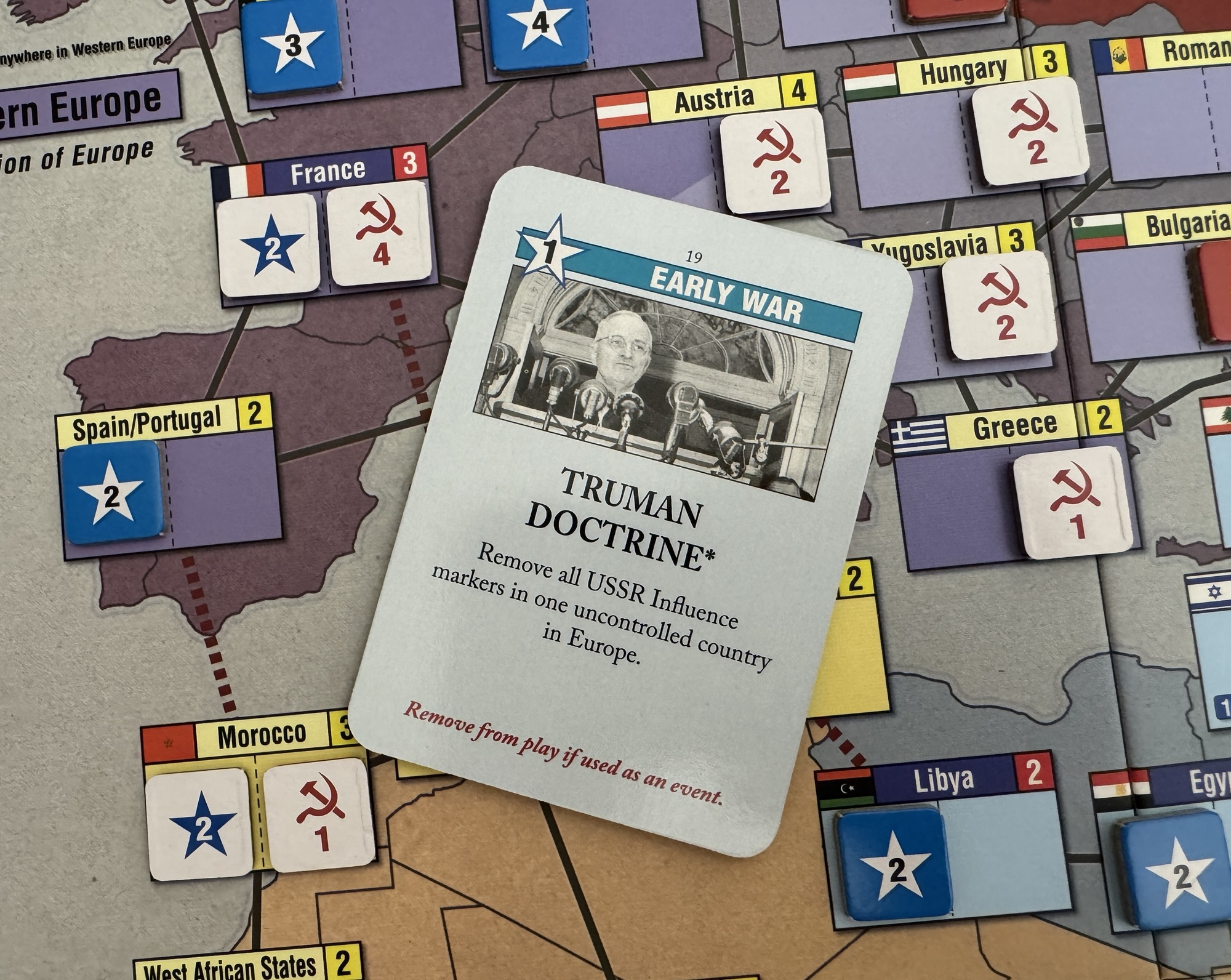
#99: Truman Doctrine from Twilight Struggle: The Cold War, 1945-1989 from GMT Games
Twilight Struggle is a 2-player game simulating the forty-five year ideological struggle known as the Cold War between the Soviet Union and the United States which can be played in 2-3 hours. The entire world is the stage on which these two countries “fight” to make the world safe for their own ideologies and way of life. The game starts right after the end of World War II in the midst of the ruins of Europe as the two new “superpowers” of the world squabble over what is left and ends in 1989, when only the United States remained standing.
The map is a world map of the period, where players abstractly move units and exert influence through the placing of Influence Markers in an attempt to build local support and gain allies and control for their superpower. The beauty of the CDG system used here is that each decision of whether to use a card for the event or the operations value is a struggle as if it is the other side’s event, it might go off hurting you very badly. There are mechanics to allow for the ignoring or cancelling of some of the best cards for your opponent in a side game within the game called The Space Race as well as nuclear tensions, with the possibility of game-ending global thermonuclear war (Shall we play a game, anyone?). I have played TS about 30 times and love it more and more with each sitting. The game makes me sweat, cringe, jump with joy and bite my fingernails. To me, a game that can do all of that in one sitting is worth the price.
The Truman Doctrine is an Early War U.S. 1 Op Event Card that removes all Soviet Influence from a single country in Europe where the U.S. has presence. This means that the U.S. at least has 1 Influence in a space and the space must be uncontrolled. I think that players should be judicious and patient with this card and do not rush to play early in the game on Turn 1 or Turn 2 if Europe is stable and the USSR has minimal presence there. The best way to use the card is to wait for a window where you can do the most damage in a key Battleground space where each side has been fighting for control by placing Influence there such as in France or West Germany on the last action round of a turn or playing the card during the Headline Phase to wipe out stacked Soviet Influence as a precursor to bumping up your own Influence there for control. The Truman Doctrine card is such a nice booby trap in many ways and the proper use of it can be very efficient and give you a leg up in Europe.
The Truman Doctrine was a United States foreign policy established by President Harry S. Truman on March 12, 1947, which pledged that the U.S. would provide political, military, and economic assistance to democratic nations threatened by external or internal authoritarian forces. President Harry S. Truman asked for $400 million in military and economic assistance for Greece and Turkey. “It must be the policy of the United States to support free peoples who are resisting attempted subjugation by armed minorities or by outside pressures,” Truman declared. “If we falter in our leadership, we may endanger the peace of the world — and we shall surely endanger the welfare of our own nation.”
In asserting that the U.S. would intervene in faraway conflicts, President Truman dramatically reoriented U.S. foreign policy. The writing of this ground-breaking message went through multiple stages. In his memoir, Truman noted that the State Department’s first draft of the speech “was not at all to my liking.” Rather than asserting a new foreign policy doctrine, the State Department writers had “made the whole thing sound like an investment prospectus.” Truman returned the draft to Secretary of State Dean Acheson “with a note asking for more emphasis on a declaration of general policy.”
The State Department complied, and included a general policy statement in the next draft. But Truman was not satisfied. “It seemed to me half-hearted,” he recalled. President Truman “scratched out” what he deemed equivocations. For example, Truman replaced “should” with “must” in a key sentence that read “I believe that it should be the policy of the United States…” According to Truman, “I wanted no hedging in this speech.” Because this speech “was America’s answer to the surge of expansion of Communist tyranny,” it “had to be clear and free of hesitation or double talk.” A total of eight drafts of Truman’s speech to Congress are featured on the Truman Library’s website. Many include handwritten comments and corrections. Combined, they give readers a sense of the tremendous effort that went into drafting the Truman Doctrine as well as the importance a single word can make when crafting foreign policy.
Truman delivered his address on March 12, 1947. Over the next several weeks, Congress debated the merits of Truman’s proposed foreign policy. On April 22nd, the Senate approved the legislation to provide assistance to Greece and Turkey. The House followed suit, approving the bill on May 9th. On May 22, 1947, Truman signed the bill into law. According to President Truman, the enactment of his bill “served notice that the march of Communists would not be allowed to succeed by default.”
Einblicke in ein zersplittertes Reich voller Magie, die Welt der Sturmlicht-Chroniken oder über 40 Jahre an deutscher Rollenspiel-Geschichte: Auf der SPIEL Essen 2026 präsentiert Ulisses Spiele wieder einige neue Hintergrundbände und Szenarien von verschiedenen Systemen. Welche Bandbreite der Verlag wieder im Gepäck hat, erfahrt ihr hier.
Der Wald von Mysteria ist ein Brettspiel aus dem Hause Moses. Autoren sind Carlo Emanuele Lanzavecchia, Luca Bellini, Luca Borsa und Walter Obert, zusammengefasst als BLOB (meine Auffassung). Illustriert wurde…
Vom 07.-09.08.2026 fand die jährliche Hauscon RatCon von Ulisses statt. Auch diesmal wurden wieder viele Neuheiten aus der Welt des Schwarzen Auges angekündigt. Vieles erscheint noch in diesem Jahr, aber auch der Ausblick auf das kommende Jahr lässt viele Fanherzen höherschlagen.
With this My Favorite Wargame Cards Series, I hope to take a look at a specific card from the various wargames that I have played and share how it is used in the game. I am not a strategist and frankly I am not that good at games but I do understand how things should work and be used in games. With that being said, here is the next entry in this series.
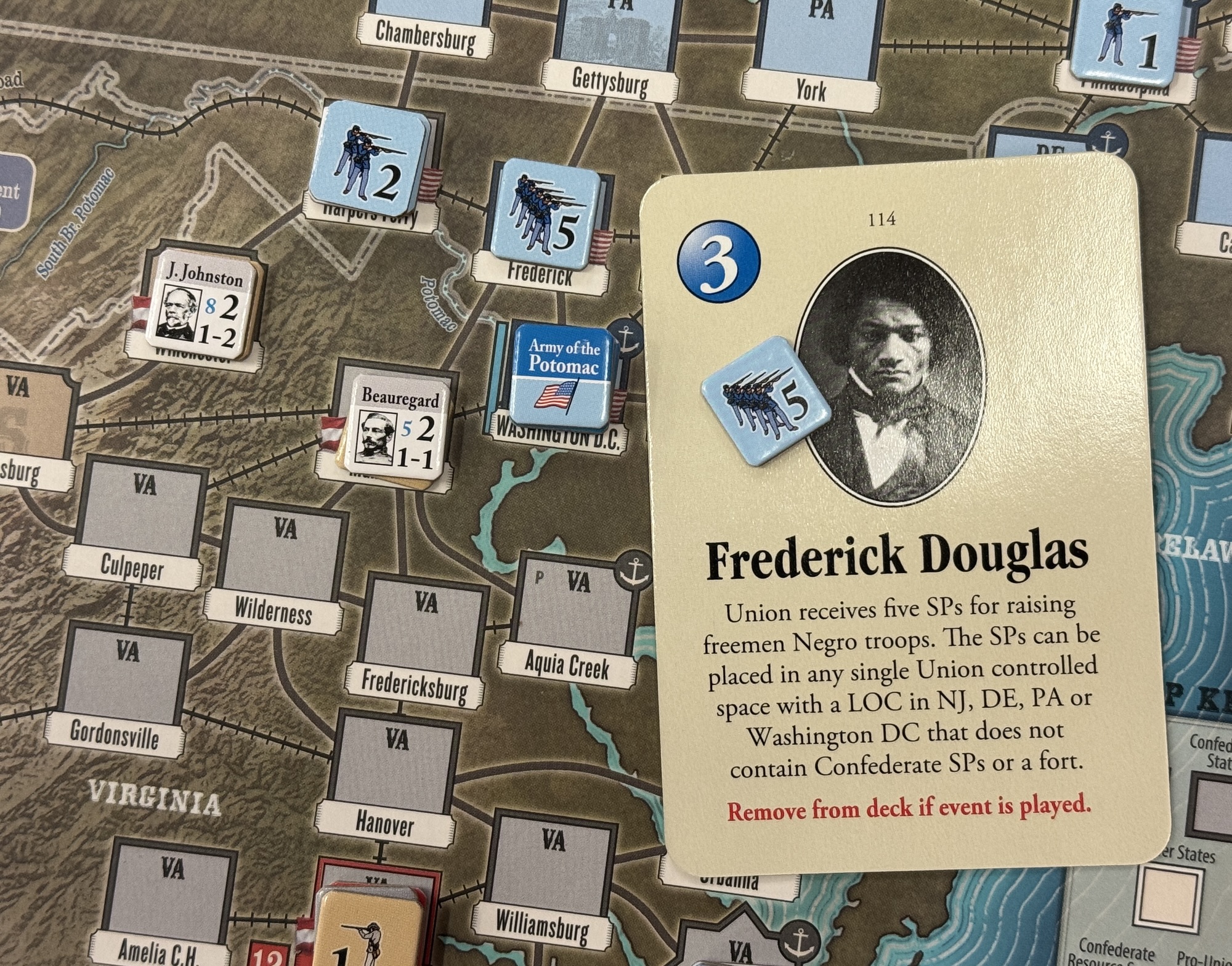
#89: Frederick Douglas from For the People 25th Anniversary Edition from GMT Games
For the People is a strategic level Card-Driven wargame about the whole 4+ years of the American Civil War covering the conflict from Texas to Pennsylvania, from the firing on Fort Sumter to the end of the war at Appomattox Court House. Players take on the role of either President Abraham Lincoln or President Jefferson Davis and command armies, promote and relieve generals, conduct amphibious assaults, dispatch cavalry raids, and even battle incompetency and political intrigue among members of your own cabinet.
As a Card Driven Game, For the People includes a deck of strategy cards that are used for conducting campaigns and incorporating the many events and personalities of the war. The Confederate player can build ironclads, naval mines (torpedoes), submarines, conduct overseas purchases and work towards foreign intervention. The Union player can build up his naval blockade, his ironclad fleet, fight draft riots, secure the Border States and issue the Emancipation Proclamation. The cards are used in the classic sense of a CDG for either the Operations Points to fuel various actions or for the printed event. According to the designer Mark Herman, “The cards are designed to present the player with his political and operational options. The use of Strategy Cards as political instruments will slow the operational tempo of military operations. The converse is also true. Both sides spent the first year of the war, 1861, mobilizing and organizing their war efforts.
The game is extremely interesting and I recently had my first experience with it and very much enjoyed what it was that I was doing even though I really had little idea about my proper strategy for the Union and what it is that I should be focused on in the game.
The Frederick Douglas card from For the People really is a bit misnamed. While Frederick Douglas was a major influence for abolitionist activities as well as progressive thinking amongst the politicians of the North, the card really should have been named for the Negro soldiers who gave so much, their lives, their backs and their families, to volunteer and fight on the side of the Union during the American Civil War. The card’s text reads “Union receives five SP’s for raising freemen Negro troops. The SP’s can be placed in any single Union controlled space with an LOC in NJ, DE, PA or Washington, D.C. that does not contain Confederate SP’s or a fort”. This card gives a huge boost to the Union side especially if it comes up early in the game as Union SP’s on the board are spread out and defense of Washington is not as stout as it needs to be. In my recent play, I got this card in my opening hand and was able to place the 5 SP into Frederick, Maryland to add to the already existing 5 SP there. Along with the Army of the Potomac and its SP stationed in Washington, D.C. this effectively discouraged the CSA from invading the North and attempting to go for a capture of the capital. You will notice that the card is a 3 OP’s card, which is very valuable in and of itself, as most of the Union Generals at the start of the game, with the exception of Burnside, have a 3 Strategy Rating and require a 3 OP’s card to activate.
The issues of emancipation and military service were intertwined from the onset of the Civil War. News from Fort Sumter set off a rush by free black men to enlist in U.S. military units. They were turned away, however, because a Federal law dating from 1792 barred Negroes from bearing arms for the U.S. army (although they had served in the American Revolution and in the War of 1812). In Boston disappointed would-be volunteers met and passed a resolution requesting that the Government modify its laws to permit their enlistment.
The Lincoln administration wrestled with the idea of authorizing the recruitment of black troops, concerned that such a move would prompt the border states to secede. When Gen. John C. Frémont in Missouri and Gen. David Hunter in South Carolina issued proclamations that emancipated slaves in their military regions and permitted them to enlist, their superiors sternly revoked their orders. By mid-1862, however, the escalating number of former slaves, the declining number of white volunteers, and the increasingly pressing personnel needs of the Union Army pushed the Government into reconsidering the ban.
As a result, on July 17, 1862, Congress passed the Second Confiscation and Militia Act, freeing slaves who had masters in the Confederate Army. Two days later, slavery was abolished in the territories of the United States, and on July 22nd President Lincoln presented the preliminary draft of the Emancipation Proclamation to his Cabinet. After the Union Army turned back Lee’s first invasion of the North at Antietam, MD, and the Emancipation Proclamation was subsequently announced, black recruitment was pursued in earnest. Volunteers from South Carolina, Tennessee, and Massachusetts filled the first authorized black regiments. Recruitment was slow until black leaders such as Frederick Douglass encouraged black men to become soldiers to ensure eventual full citizenship. Volunteers began to respond, and in May 1863 the Government established the Bureau of Colored Troops to manage the burgeoning numbers of black soldiers.
By the end of the Civil War, roughly 179,000 black men (10% of the Union Army) served as soldiers in the U.S. Army and another 19,000 served in the Navy. Nearly 40,000 black soldiers died over the course of the war. Black soldiers served in artillery and infantry and performed all noncombat support functions that sustain an army, as well. Black carpenters, chaplains, cooks, guards, laborers, nurses, scouts, spies, steamboat pilots, surgeons, and teamsters also contributed to the war cause. There were nearly 80 black commissioned officers. Black women, who could not formally join the Army, nonetheless served as nurses, spies, and scouts, the most famous being Harriet Tubman, who scouted for the 2nd South Carolina Volunteers.
With this My Favorite Wargame Cards Series, I hope to take a look at a specific card from the various wargames that I have played and share how it is used in the game. I am not a strategist and frankly I am not that good at games but I do understand how things should work and be used in games. With that being said, here is the next entry in this series.
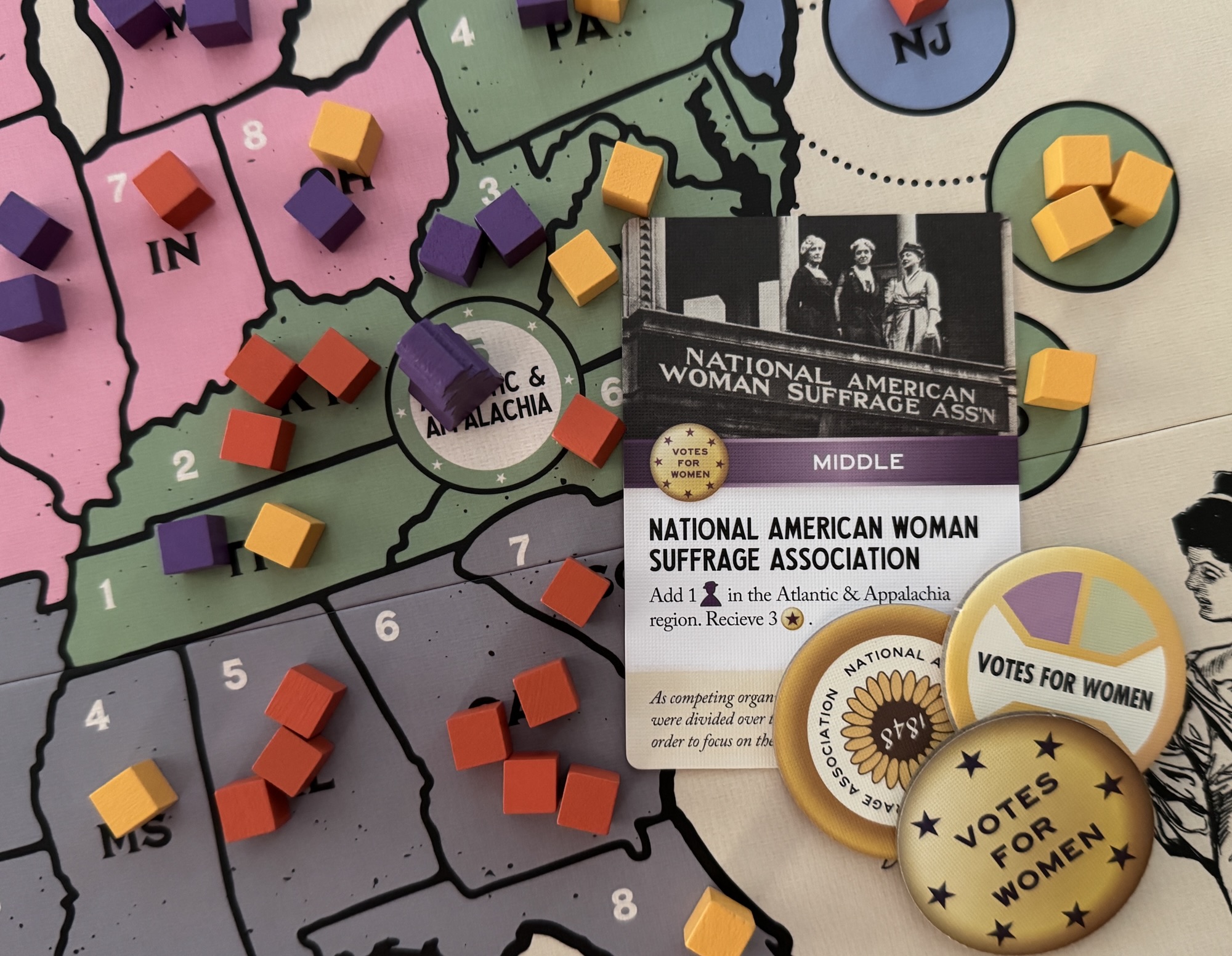
Card #88: National American Woman Suffrage Association from Votes for Women from Fort Circle Games
Votes for Women is a very interesting card-driven game that covers the American Women’s Suffrage Movement from 1848-1920, culminating in the ratification of the Nineteenth Amendment which granted women the right to vote. The game is a 2-player game, that has a fully developed solitaire mode with an “Oppobot” and offers a cooperative mode for those who don’t wish to play as they Opposition. The Suffragist player will have to push Congress to propose the Nineteenth Amendment, and then focus on campaigning to have a minimum of 36 states to ratify the Amendment. The Opposition side will try to prevent Congress from proposing the amendment and failing that to have 13 states reject the amendment.
The game uses cards in a fairly traditional CDG way as there are events that can be be taken or the cards can be played to do things like Campaign, Organize or Lobby Congress. Each card has a specific Card Era that is used to create of the each players’ Draw Decks. Late cards will be on the bottom of the deck, Middle cards will be in the middle of the deck and Early cards will be on the top of the deck. The Suffragist and Opposition decks each have one Start card that will be placed in the player’s hand at the start of the game. Some Event Cards have a prerequisite and some of the cards require a player to roll a 6-sided die and only take the the action on a roll of 3-6. Otherwise, the Event Card is discarded with no effect. The cards in this game are also steeped in historical details, from the name of the events that tie back to specific individuals or happenings, to major moments in the struggle. This game is about the history of the struggle for the right to vote and it is very good!
One of the more interesting aspects about the mechanics of the game is the use of Campaigners to go about trying to influence the attitude of the people and legislators regarding the Nineteenth Amendment through the Campaign Action. When a card is played for a Campaign Action, the player rolls a die, either a 6-sided or 8-sided die depending on what cards have been activated, for each Campaigner they have in play. The player then gets to take the dice and their results, which range from 1-8, and assign a specific die to each of their Campaigners. Each Campaigner may then place the corresponding number of cubes, matching the Campaigner’s color, in the States within the region that the Campaigner is located in. The player may spend a Button to move the Campaigner to a different region, but all of the corresponding cubes must be put into the same region. This is a great way to get a lot of influence out on the board to begin taking control of various States for the final vote in the game. This also is a very efficient way of doing this as you will be rolling 2-3 dice for your Campaigners and then spamming the States. With that in mind, today’s card is the National American Woman Suffrage Association and it provides the Suffragist player with a new Campaigner (purple) to place out specifically into the Atlantic & Appalachia Region that includes the States of Kentucky, Tennessee, West Virginia, Pennsylvania, Virginia, North Carolina, Maryland and Delaware. The card also grants the Suffragist player with 3 Buttons that can be used as described above to relocate a Campaigner from one state to another. This card is very helpful and should be played for the Event 9 times out of 10 and will make a huge difference in the outcome of the game. Once a 2nd or 3rd Campaigner is deployed, I tend to take Campaign Actions rather than some of the less intensive placement options or Events.
The National American Woman Suffrage Association (NAWSA) was an organization formed on February 18, 1890, to advocate in favor of women’s suffrage in the United States. It was created by the merger of two existing organizations, the National Woman Suffrage Association (NWSA) and the American Woman Suffrage Association (AWSA). Its membership, which was about 7,000 at the time it was formed, eventually increased to 2 million, making it the largest voluntary organization in the nation. It played a pivotal role in the passing of the Nineteenth Amendment to the United States Constitution, which in 1920 guaranteed women’s right to vote.
Helen Hamilton Gardener, Maud Wood Park and Carrie Chapman Catt at Suffrage House in Washington, D.C.
Susan B. Anthony, a long-time leader in the suffrage movement, was the dominant figure in the newly formed NAWSA. Carrie Chapman Catt, who became president after Anthony retired in 1900, implemented a strategy of recruiting wealthy members of the rapidly growing women’s club movement, whose time, money and experience could help build the suffrage movement. Anna Howard Shaw’s term in office, which began in 1904, saw strong growth in the organization’s membership and public approval.
After the Senate decisively rejected the proposed women’s suffrage amendment to the U.S. Constitution in 1887, the suffrage movement had concentrated most of its efforts on state suffrage campaigns. In 1910 Alice Paul joined the NAWSA and played a major role in reviving interest in the national amendment. After continuing conflicts with the NAWSA leadership over tactics, Paul created a rival organization, the National Woman’s Party.
Here is a link to our full video review of the game:
I love a different style and focus of wargame. A game that takes a look at an important but somewhat obscure or rarely addressed historical topic, such as espionage or intelligence, and creates a gaming experience tailored around the events to highlight and evoke the difficulties and tension that would have been present. In January 2026, GMT Games announced such a game in Checkpoint Charlie, which is a solo or cooperative game focused on SIS espionage missions in Berlin in the 1960’s designed by Russell Brown. We have posted an interview with Russel and it was very well received and he has now agreed to create a series of History Behind the Cards to highlight the events of the 1960’s Cold War struggle in West Germany but also to share aspects about the game play and how it models the history.
*Note: The cards highlighted in this series and their event text, as well as any pictures used showing any of the various components, are still in the design and development process and as such event effects and text might still change prior to final development and publication.Also the art and layout of the cards are only for playtest purposes at this point and the game will enter the art department as it nears publication.
History Behind the Cards – Checkpoint Charlie from GMT Games – Card #3: Demonstrations
West Berlin, and West Germany as a whole, spawned a number of large, very active student demonstration organizations in the late 1960’s. These were generally in response to a perceived return to very traditional German authoritarian government, and specifically as a reaction to former members of the Nazi party, like Chancellor Kiesinger, serving in the Bonn government.
However, during the slightly earlier time period of Checkpoint Charlie (early 1962 to late 1963), demonstrations were not as organized. They were spontaneous and in response to specific events, like the Speigel Affair (Card #16) and President Kennedy’s Visit (Card #7). As with those later, more organized movements, they consisted primarily of young Germans, and the universities acted as catalysts and staging areas. Even during the period of this game, marches and demonstrations were common enough to warrant an event card.
As a side note, Chancellor Keisinger, who’s Nazi affiliation spawned some of those later protests, was replaced as Chancellor of West Germany in 1969 by Willie Brandt, who was mayor of West Berlin during the period of Checkpoint Charlie. Mayor Brandt has his own token in the game and plays a role in a few of the missions.
The Demonstrations Event Card places a special Demonstrations marker in one of the West Berlin locations on the map. Demonstrations could last for hours, or even days, so this marker generally remains on the City Map for the rest of the mission. East Berlin locations are not eligible because the Stasi secret police, along with the confinement imposed by the Berlin Wall, had effectively suppressed any open opposition in the East. In game terms, the Demonstrations marker provides some cover for assets, increasing their chances of passing both detection and compromise saves.
In the next article in this series, we will take a look at Faceoff with the Soviets when East German police placed barbed wire barriers to stop East Germans from defecting.
In my opinion, this game looks extremely interesting and I am very much excited to learn more about it. I am appreciative to Russell and his efforts to bring us these cards and to write these entries to share with our readers. I am also very glad that this topic is being covered in a game and look forward to playing this one day soon.
With this My Favorite Wargame Cards Series, I hope to take a look at a specific card from the various wargames that I have played and share how it is used in the game. I am not a strategist and frankly I am not that good at games but I do understand how things should work and be used in games. With that being said, here is the next entry in this series.
#86: LRRP from Fire in the Lake: Insurgency in Vietnam from GMT Games
The COIN Series uses cards in a very different way from other CDG’s. These cards are not necessarily the driver of the action but more assistive to the actions of the players by setting eligibility and also providing powerful events. The Event Cards are more often than not, very powerful. They either give you a continuing bonus on future Operations and Special Activities (as in the case of the volumes that include the various Capabilities) or allow you to take Operations and Special Activities more times that round than you would normally have been able to had you not chosen the Event and more often than not, at no cost! Also, because of the power of the cards and their ties to one or more factions, you can take the Event which allows you a huge advantage, only to see that very powerful Event reversed with the next Event or with a regular Operation. This is very frustrating but is one of the major reasons that I love the card-assisted element of the COIN Series. Today we are going to take a look at the LRRP Event Card.
The LRRP Event Card, with LRRP standing for Long-Range Reconnaissance Patrol, allows the US player to place 3 Irregulars outside the South then conduct a free Air Strike, that also allows for the removal of Bases first. Keep in mind that Irregulars are US Special Forces pieces, which are the hexagonal shaped cylinders not ARVN Rangers. “Outside the South” means any Laos or Cambodia Provinces. Seems pretty pedestrian but it is important to note that this card changes the rules when played as normally all other units in a space must be removed before Bases can be removed. A very powerful card that typically will be played by the US player when it comes up. But keep in mind that Air Strikes are a dual edged sword as you get rid of pesky enemy pieces but it will result in shifts of Support/Opposition but can also Degrade the Trail. On the bottom of the card, the text allows the VC or NVA to ambush these LRRP”s and remove 3 Irregulars from the map to Casualties. Then it gives an added benefit of shifting each space these removed Irregulars were in 1 level toward Active Opposition.
Image courtesy of Boxxer’s Blog.
A Long-Range Reconnaissance Patrol, or LRRP, is a small, well-armed and nimble recon team that is tasked with patrolling deep into enemy territory to identify or destroy key targets and gain recon on the enemy. The concept of scouting forces such as LRRP’s dates back to ancient warfare but also has been used in more modern and contemporary wars such as the French & Indian War where specialized Rangers, such as Rogers’ Rangers, were tasked with raiding Indian settlements, disrupting supply lines and reporting back to command on troop disposition and movement.
In Vietnam, veteran or specially trained forces often augmented with Vietnamese irregulars usually carried out Long Range Reconnaissance Patrols into enemy territory. The Studies and Observation Group (SOG) was the ground element of the US air war against the Ho Chi Minh Trail as illustrated by Project Tiger that spotted for and marked enemy trail activity for elimination by US air assets.
Here is a link to a very interesting summary of an LRRP and its mission on a Vietnam veteran run blog called Boxxer’s Blog: From the seat of a motorcycle: LRRPs: “—doing the impossible for the ungrateful.”
When the Portuguese charted the island of Taiwan, they named it Ilha Formosa, “beautiful island.” That’s the background behind the board game Formosa Formosa, which — and I’m not sure designer Kirk Beiser is aware of this — translates to “beautiful beautiful.” Kind of like when somebody calls a monster a were-person, which just means man-person, except “beautiful beautiful” is even more duplicative.
Appropriately, Formosa Formosa doubles down on its namesake. Designed by someone who has lived in Taiwan for fifteen years, printed in Taiwan, and ultimately about Taiwan, this is a drop-and-write game that’s as charming as it is combo-heavy.
This is how I look when a drop doesn’t go my way.
Welcome to Taiwan. Island of scenic waterfalls, breathtaking hikes, soaring shrines, and… dirty beaches. I’m not one hundred percent sure what we’re doing in Formosa Formosa, but it seems like a combination of sightseeing trip, litter collection, and greenhouse gas management. Travel across the island, but not too often. Visit the surrounding islets, but only sparingly. Hold your emissions while enjoying this scenic vista. Yes, those emissions as well, sir or madam.
For all its silliness, this isn’t all that far out for the genre, which often suffers from some disconnect where settings are concerned. And the puzzle it produces is a solid one, even when we interrupt our vacation to enthusiastically hoover up so much litter that we earn another jaunt up the nearby mountain.
At its most basic, Formosa Formosa is about ticking boxes. So far, so very roll/flip-and-write.
Right away, though, Beiser carves out a somewhat more unique identity than most of his game’s mechanical peers. Rather than rolling dice or flipping cards, selecting actions is all about chucking a bunch of cubes into the box lid. This produces a menu of potential destinations across the island’s four compass directions.
These destinations matter because you only occupy a single space at a time. You might, for example, be sitting pretty in the south, waiting for another chance to visit a shrine, only for the toss to result in a resplendency of activities everywhere but where you’re stationed. Bah, you might say. Bah and ruin, another hike. Another damnable waterfall. More beaches to clean.
Dropped cubes determine which actions are available in which regions.
Except… therein lies the game’s central conundrum. You can travel to another locale, although this produces points-draining pollution. But you can also fulfill other activities, like the aforementioned beach cleanup or perhaps some island-hopping — itself a rather polluting activity — in order to generate bonus actions. These bonuses might then check off that all-important shrine. Or, after some consideration, see you abandoning that objective altogether for something more productive.
The result is a pleasant experience, one where every tick matters, but doesn’t matter so much that it detracts from the twenty or so minutes that it takes to complete the game. Clever players can parlay those cubes into self-replicating turns, one free action spilling into another. These sequences are breezy to track, certainly easier than some of the flip-and-writes we’ve covered here, while still allowing for the occasional turn where somebody absentmindedly chews on the end of their dry-erase pen (yuck) while contemplating their next mark.
If I haven’t made it clear, Formosa Formosa is a light experience all around. It occupies the same design space as any number of shorter something-and-writes, more about the joy of getting to pen three or four marks on the board instead of only two, rather than, say, mathing out the best possible move or even preempting the input. Because here there is no preempting the input. Sometimes a region will receive no cubes at all. Other times, nearly everything will cluster together in one spot. That’s the game, and while it lends a certain soothing air to the experience, one where no decision is your fault and the best you can do is ride it out, it shouldn’t be mistaken for decision-dense.
Still, there’s a lot to like here. The clever use of both the lid and the box bottom, one for the drop and the other for assigning the resultant spill to an action menu. The animal pawns that are used for tracking your location. The tension between shared contests and a personal goal. Again, this isn’t extreme tension. It’s a pleasant friction at best, a gentle tickle. But it’s enough to offer Formosa Formosa as an ultra-light clatter-and-write that doesn’t overstay its welcome.
Bus bonus!
Ultimately, Formosa Formosa offers a nice experience. It’s a bit straightforward, even somewhat forgettable. Like a back rub, I suppose, or a comfort movie. But also like a back rub, it’s warm and tingly and pleasant, and it’s a great deal more fun to chuck some cubes than roll dice or flip cards. For all I won’t remember it in a month, I’m happy to accept one in the moment.
A complimentary copy of Formosa Formosa was provided by the publisher.
(If what I’m doing at Space-Biff! is valuable to you in some way, please consider dropping by my Patreon campaign or Ko-fi. Right now, supporters can read the next installment in my series Talking About Games, this time tackling the topic of what makes a good list! Naturally, the piece includes a list.)
In Episode 8 springen wir vor die Zeit des Amerikanischen Bürgerkriegs und blicken auf den Hauptauslöser eben dieses Krieges: Die Sklaverei in den USA und die beiden unterschiedlichen politischen Bewegungen, die eben dafür oder dagegen waren.
Alleine das Thema macht dieses Spiel schon sehr besonders. Doch auch die Mechaniken wissen zu überzeugen, obwohl sie so oder so ähnlich aus anderen Spielen bekannt sind, machen sie hier ganz eigene Dinge.
Nachdem wir einige Jahre Midgard gespielt und nebenher immer auch Inspiration in anderen Regelwerken gesucht und gefunden haben, entschlossen wir (Wilhelm Klippel aka „Fiomall“ und ich) uns 1994 dazu unser eigenes Regelwerk zu schreiben. Unter tätiger Mitwirkung von Simone (Arne), Patty (Dulmer) und Uwe (Haplo), aber auch weiteren Mitspielern, wie u. a. André. Wir waren mit einigen Aspekten von Midgard und auch anderen uns bekannten Systemen unzufrieden.
Das war der Beginn von Mag Mor, Rollenspielsystem und gleichzeitig auch Welt, auf der dieses System spielt. Und selbst nach 32 Jahren haben wir immer noch nicht die ganze Welt erkundet und auch unsere Regeln werden nach wie vor ständig erweitert, verfeinert und natürlich auch verbessert.
Mit über 600 echten verschiedenen Zaubersprüchen (plus Runenmagie) und über 110 Fertigkeiten ist unser Spielsystem sicher eines der umfangreichsten überhaupt. Da wir uns aber viel bei anderen System bedient haben und uns von D&D, Midgard, Palladium, MERS, Runequest, Das schwarze Auge etc. haben inspirieren lassen, wird Mag Mor wohl nie außerhalb unserer Spielerunde das Licht der Welt erblicken. Aber das war auch nie unser Ziel.
Inspiration haben wir auch immer aus den Fantasyromanen von Alan Dean Foster, R. A. Salvatore, Ed Greenwood, Karl Edward Wagner, Robert E. Howard, Lyon Sgrague de Camp, Fletcher Pratt, Robert Asprin, Marion Zimmer Bradley, Trudi Canavan und vielen vielen mehr gezogen.
Wir spielen nach wie vor mehrmals im Jahr und diskutieren dann auch immer wieder Aspekte unseres Regelwerks und bauen es um. Und obwohl es eine typische Fantasywelt mit Elfen, Zwergen, Trollen, Drachen und jeder Menge Magie ist haben wir versucht viele Aspekte unseres Regelwerkes möglichst nah an der Realität zu halten, wie z. B. der Reichweite und Durchschlagskraft von Langbögen, den Reisegeschwindigkeiten (wenn sie hier denn keine Magie zum Einsatz kommt), den Auswirkungen von Nahrungs- und Flüssigkeitsmangel und so weiter.
Nebenher wir auch immer wieder viel Zeit in die Beschreibung der Welt Mag Mor gesteckt, was vor allem in den vielen Kampagnen passiert ist, die wir dort schon gespielt haben. Es gab und gibt aber auch immer wieder Ausflüge in andere Welten. Aktuell sind wir in unserer Kampagne zum Beispiel auf Aventurien unterwegs. Das liegt auch viel daran, dass wir fertige Abenteuer (seien es nun Fanabenteuer oder Kaufabenteuer) verwenden und diese mal mehr, mal weniger für unser System anpassen. Manchmal verlegen wir die Handlung dabei nach Mag Mor und manchmal spielen wir auf der beschriebenen Welt. Mit Magie ist das ja alles kein Problem.
Auch nach mittlerweile 42 Jahren haben wir nicht die Lust am Spielen verloren. Dabei hat sich unser Fokus von Kämpfen und Looten, aus den Frühtagen mit D&D, doch sehr in Richtung Geschichten erleben, Rätsel lösen und Lösungen für vertrackte Situationen finden, verlagert.
Und es gibt noch sehr viel zu erkunden auf der Welt Mag Mor.
Es begann alles am 6. Oktober des Jahres 1984. Damals war die 1. Auflage des D&D Basis Set gerade mal 11 Monate auf Deutsch erhältlich. Einige Interessierte trafen sich im Bücherwurm, in Bad Camberg, um einen ersten Einblick in die Welt des Fantasy-Rollenspiels zu bekommen. Heute, mehr als 40 Jahre später, spielen einige von Ihnen immer noch dieses Spiel und Ihre Begeisterung dafür hat nicht nachgelassen.
Dies ist auch der Grund für meinen Internet-Nickname NATOKH. Natokh war einer meiner ersten Charaktere in einem Fantasy-Rollenspiel und die Figur die ich am längsten gespielt habe. Der Name geht auf eine Kurzgeschichte aus dem Conan-Universum von Robert E. Howard zurück. Dort war der dunkle Zauberer Natohk (Thugra Khotan) ein Gegenspieler von Conan.
Aber vielleicht sollte ich erst einmal kurz erläutern, worum es sich bei Fantasy Rollenspielen überhaupt handelt. Eigentlich ist es ganz einfach. Eine Gruppe von Spielern, nach unserer Erfahrung mindestens 3 aber höchstens 4-5, versuchen mit fiktiven Charakteren, welche nur auf dem Papier existieren, Aufgaben zu lösen, welche Ihnen ein Spielleiter stellt. Eine Aufgabe kann zum Beispiel das Erretten einer Prinzessin aus den Klauen eines bösen Drachen sein oder aber Detektivarbeit à la Sherlock Holmes oder vielleicht auch nur Metzeln und Looten in der Art eines Dungeon Crawlers. Der PHANTASIE sind hierbei keine Grenzen gesetzt, bzw. nur die des Spielleiters.
Zuerst beginnt man damit sich einen Charakter zu erstellen. Im ersten Schritt werden einige Attribute des Charakters ermittelt, zumeist mit Hilfe von Würfeln, dies sind z.B. die Stärke, das Aussehen, die Intelligenz oder aber das Zaubertalent. Aufgrund der Attributswerte muss sich nun der Spieler eine passende Profession für die Figur aussuchen. Hier gibt es unter anderem den Dieb, den Krieger oder einen Magier. Außerdem legt man fest, welche Rasse man spielen möchte. Neben Menschen gibt es da zum Beispiel Halblinge, Zwerge oder Elfen. Allerdings sollte man für nichtmenschliche Rassen schon etwas Spielerfahrung mitbringen, da es beim Spiel noch einige Besonderheiten und Verhaltensweiten der jeweiligen Rasse zu berücksichtigen gilt.
Hat der Spieler nun die Attribute, Rasse und Profession seines Charakters ermittelt muss er sich an dessen Beschreibung machen. Ist die Figur feige oder mutig, ist sie Links- oder Rechtshänder, ist sie hilfsbereit oder ein grenzenloser Egoist, liebt sie das Glücksspiel oder ist sie ein enthaltsamer Asket. Dies alles ist später wichtig, da der Spieler seine Figur entsprechend spielen soll, er wird also zum Schauspieler, zumindest verbal.
Hat man nun eine Gruppe von Charakteren entworfen beginnt das Spiel. Der Spielleiter übernimmt hierbei die Rolle der Welt sowie aller darin befindlichen Lebewesen. Die Gruppe agiert in dieser Welt. Dies geschieht zum Teil mit dem Einsetzen ihrer Fertigkeiten, wie z.B. dem Stehlen, dem Wirken von Zaubersprüchen und ihren Waffenfertigkeiten, dem Wissen über Kräuter und Gifte usw., zum anderen aber mit der PHANTASIE der Spieler.
Nachdem wir eine Zeit lang das D&D System gespielt haben sind wir relativ schnell zu Midgard gewechselt, dem ersten deutschen Rollenspiel, da uns einiges am D&D Regelwerk gestört hat. Midgard erschien bereits 1981, also 2 Jahre bevor D&D das Licht des deutschen Rollenspielmarktes erblickte und 3 Jahre vor dem Schwarzen Auge, welches 1984 veröffentlicht wurde.
Wir haben dann einige Jahre Midgard gespielt. Da entstand auch mein Zauberer Natokh. Damals haben wir uns fast jede 2 Woche zum Spielen getroffen. Zwischendurch haben wir uns aber auch immer andere Rollenspielsysteme angeschaut. So haben wir auch ein paar Runden Sternengarde gespielt (sozusagen D&D im Weltraum), haben uns Regelwerke wie MERS (Mittelerde Rollenspiel), Runequest, Pathfinder oder Palladium. Wir haben auch ein paar Mal In nomine Satinis gespielt. Ein besonders abgefahrenes Pen & Paper Rollenspiel in dem man Dämonen spielt, mit übernatürlichen Kräften und zum Teil sehr seltsamen Phobien, wie der Angst vor Kindern oder Colaautomaten. Man spielt einen Diener des Teufels und erledigt Aufträge in seinem Namen. Das Spielsystem ist sehr satirisch und nimmt sich nicht Ernst. Wer auf schwarzen Humor und Gemetzel steht, der ist hier genau richtig. Wir haben allerdings nie eine Kampagne gespielt sondern immer nur Einzelabenteuer.
Als Gegenpol gab bzw. gibt es Magna Veritas. Hier spielt man einen Engel und ist natürlich im Auftrag Gottes unterwegs. Das habe ich jedoch nie gespielt. Überhaupt habe ich mir sehr viele Rollenspielbücher nur gekauft, um mir daraus Inspiration zu holen. Was uns zu unserer nächsten großen Veränderung führt.
Anfang der 90er, begannen wir nämlich damit unser eigenes Regelwerk zu schreiben und die Welt Mag Mor aus der Taufe zu heben. Aber das erzähle ich euch beim nächsten Mal.
Episode 6 hat Votes for Women zum Thema. Matthias und Markus unterhalten sich über Frauenrechte im Allgemeinen und das Frauenwahlrecht im Besonderen. Sie gehen darauf ein, wie das Spiel den Kampf der Suffragetten im 19. und 20. Jahrhundert in den USA abbildet und wie aktuell dieses Thema noch heute ist.
In Episode 5 sprechen Matthias und Markus über Churchill - Big Three Struggle For Peace. Wir schauen uns sehr genau an, wie der Zweite Weltkrieg politisch beendet und die Weichen für die Zukunft der Welt gestellt wurden. Wir versetzen uns dabei in die mächtigsten politischen Anführer der Zeit und debattieren mit unseren Stabsmitarbeitern, um den Einfluss auf das zukünftige Weltgeschehen.
In Episode 4 unterhalten wir uns über Comanchería von Joel Toppen. Wir tauchen in die Kultur, das Leben und die Lebensumstände der Comanche ein. Dabei stellen wir wieder einmal fest, dass einfache Pappcounter und ein paar Karten einen unheimlichen Sog auslösen können und uns Spieler*innen in bisher ferne Welten ziehen.
Three years ago, I have inaugurated a new irregular series on my blog assessing the merits of UK prime ministers (illustrated through the lens of a single board game each). The rating system seemed robust enough to apply it to other countries/leaders (at least if they are more or less democratic). Thus, we branched out to American presidents and German chancellors. Today’s subject is the rare German president with political power – Paul von Hindenburg, the second and last president of the Weimar Republic. And which game could be more appropriate for him than Weimar (Matthias Cramer, Capstone Games/Skellig Games/Spielworxx)?
The Rating System
Some caveats ahead: The presidents will be rated by the knowledge of their time. If they or their contemporaries could not have known about the effects of something, I will not use my hindsight to mark it as a mistake of theirs. The assessment is focused on their conduct as president.
Now, to the system itself: There are three policy field categories (foreign, domestic, and economic policy) and three more general ones (vision, pragmatism, integrity). A president can earn from one to five stars in each category (for a total sum of up to 30). In detail, the president is assessed as follows:
Foreign policy: Did the president increase German influence in the world and the security of Germans at home? Did the president wield German power responsibly and with positive results for the regions affected?
Domestic policy: Did the president increase the liberty of Germans to express themselves and to participate in the political process? Did the president promote domestic security and shape the framework for fair justice dealing with offenses?
Economic policy: Did the president facilitate the prosperity and economic security of Germans (including in the mid- and long-term)? Was the president’s economic policy based on mutual benefit of those involved or did it unduly burden one side?
Vision: Did the president have an idea of what Germany and Europe (the latter counting for more in times of German influence being great) should look like beyond the immediate future? Did the president’s policies steer Germany (and, if applicable, Europe) in this direction?
Pragmatism: Did the president succeed in seeing their policy through from inception to completion? How well did the president manage the support from parliament, society, the administration, the media?
Integrity: Did the president understand the office as a means to benefit themselves, special interest groups, the entire country, or another community? Did the president respect the boundaries of the office?
Note: If you have read my UK prime minister or US president ratings, you will remember that I rated them on the global impacts of their vision as well. As the rating system is only really applicable to democratic leaders and no democratic German leader ever had the chance to conduct a truly global policy, I only assess their vision on national and European grounds.
In all other ratings (UK prime ministers, US presidents, German chancellors) the subject’s life after holding the office is also assessed (for they are still seen as ex-office holders, but as a secondary consideration). This does not apply here, as – spoiler! – both Weimar Republic presidents died in office.
Hindenburg’s Life
Paul von Beneckendorff und Hindenburg was born in 1847, when Prussia was still an absolute monarchy. Like most men in his family, he opted for a military career and had his baptism of fire in Prussia’s wars of unification: He fought at Königgrätz (Sadowa) against the Austrians at age 18, at Sedan against the French three years later. The socialist Paris Commune which had been formed against both the Prussian siege of Paris and the liberal French government filled him with a horror of civil war and revolution which would influence him all his life. Back from the wars, Hindenburg enjoyed a successful career as an officer, culminating in his promotion to (full) general in 1905. In the forty years between the victory over France in 1871 and his retirement (aged 63) in 1911 he would not fight another war.
Hindenburg was recalled into active service shortly after the outbreak of World War I and placed at the head of the 8th Army, the only German force dealing with Russia’s invasion of East Prussia. At the advice of his energetic chief of staff Erich Ludendorff, Hindenburg opted for a daring counter-attack which annihilated one of the two Russian invasion armies. The actual execution of the plan was left to Ludendorff. Hindenburg’s main contribution was to remain steadfast when Ludendorff wanted to abandon the plan in the middle of the operation during one of his nervous fits – a pattern which would become characteristic for the rest of the war. Hindenburg and Ludendorff had won the most significant German victory of the early weeks of the war, and they had done so on German soil. The fundament for the myth of Hindenburg was in place.
While Hindenburg, now the commander-in-chief of the German forces on the Eastern Front, had suddenly become the most admired and revered German, the ambitious Ludendorff also urged him to demand greater influence over the course of the entire war. That embroiled the duo Hindenburg-Ludendorff in a continued rivalry with the OHL (Oberste Heeresleitung, Supreme Army Command) under Erich von Falkenhayn. Hindenburg, brought up with the values of a Prussian officer, was now routinely insubordinate to his military superior Falkenhayn, until Emperor Wilhelm II sacked Falkenhayn in August 1916 and replaced him with Hindenburg. Of course, it was once more Ludendorff, who (now as First Quartermaster General) pulled the strings.
Hindenburg and Ludendorff widely sidelined the emperor and ran Germany as a quasi-military dictatorship. However, their double role of political and military decision-makers did not come with increased effectiveness: What the politicians Hindenburg and Ludendorff demanded (a victorious peace, vast annexations, a German hegemony over Europe), the generals Hindenburg and Ludendorff could not deliver. And while the military leadership of the German armies remained strong, the political decisions lacked judgment – unlimited submarine warfare drew the United States into the conflict on the Allied side in 1917; the mishandling of relations with post-revolutionary Russia tied down German forces in the east. Hindenburg and Ludendorff gambled on a last offensive in the west in 1918 – and lost. The reserves were spent now. As the Allied armies pressed forward in a counter-offensive, making peace seemed like the best option to Germany’s military dictators.
They applied to US President Woodrow Wilson for peace – in the hope that a lenient peace based on the Fourteen Points could be obtained. Wilson, however, remained firm: On the one hand, he insisted on parliamentary government for Germany (and thus the end of the OHL dictatorship); on the other, the territorial losses and military restrictions to be applied to Germany seemed dishonorable to Hindenburg and Ludendorff. One way or the other, their desire to remain responsible for the country waned – they complained in bitter terms how they had been “stabbed in the back” by a non-supportive home front. In the end, Ludendorff resigned, but Hindenburg stayed on as the head of the OHL – but complemented with a chancellor whose power base was the German parliament. Their attempt to save the German monarchy with an orderly transition out of the war was quickly swept away by the revolting masses in the revolution of November 1918.
Now Hindenburg showed remarkable pragmatism. While the revolution was made by the Social Democrats, pariahs under the monarchy to which Hindenburg was so attached, his dislike for them was outweighed by his horror of civil war. Together with Ludendorff’s successor, general Wilhelm Groener, he placed the German army at the disposal of the new government led by Social Democrat Friedrich Ebert… with the understanding that it would be used to quell any Bolshevik unrest. The (Majority) Social Democrats thus were able to complement their political dominance over the more left-leaning Independent Social Democrats with the hard power of the army and usher in a parliamentary republic.
The pact between Ebert and Groener allowed them to put down socialist revolutionaries. Note that the game event (which is a SPD card) could also be used against a right wing uprising!
As with Ludendorff, Hindenburg let Groener fill the active role in their partnership while providing the myth surrounding his person. Groener and he made sure that the army, still spread out from France to Ukraine, returned in an orderly fashion. When the Treaty of Versailles was offered to the German government, Hindenburg personally understood that there was no alternative to it – Germany could not have renewed the war with the Allies. As he felt the Treaty was humiliating, though, he left it to Groener to advise the government to accept.
The “stab-in-the-back myth” contributed to the re-legitimation of the German right wing after World War I.
Once the Treaty was signed, Hindenburg retired to private life, but remained immensely popular, a beacon of the anti-republican Germany. When he stated at the parliamentary committee of inquiry dealing with the end of the war that the German army, “undefeated in the field” had been “stabbed in the back,” (by whom exactly, he did not specify – listeners felt free to fill in the blank with their preferred choice of enemy, usually “the Jews” or “the Socialists”) it gave the myth a quasi-official sanctioning.
His relationship with the German right, however, was rather complicated. Hindenburg was close with some members of the DNVP (Deutschnationale Volkspartei – German National People’s Party), but never became a party member. He did join the ideologically similarly inclined Stahlhelm (Steel Helmet) association of former soldiers, though. He condemned both major right-wing coup attempts of the early Weimar Republic – reluctantly in the case of Kapp and Lüttwitz, forcefully in the case of his former partner Ludendorff with the upstart demagogue Adolf Hitler.
When president Friedrich Ebert died in 1925, lesser men had to fill his shoes. None of the various candidates running in the first round of the presidential election came close to a majority by themselves. Coalition building was the order of the day now. The pillars of the republican order (Social Democrats, (Catholic) Center, and left-leaning Liberals) would put the Center candidate Wilhelm Marx forward as a joint candidate. While the right-leaning Liberal candidate Karl Jarres had received the most votes in the first round, the parties of the right feared that he would not be able to stand against a united republican camp. The constitution, however, allowed for candidates to be entered in the second round who had not been running in the first. And which candidate would, on merit of his personality, have a better chance than the old war hero, the victor of Tannenberg?
Hindenburg electrified a certain part of the electorate. Others criticized his closeness to the old monarchy (Hindenburg had sought approval from the exiled Wilhelm II before running, but denied this), his lack of experience with parliamentary politics, and his age (he was 77 already, and would be 84 by the end of his term). Hindenburg was elected in the second round with a plurality of the votes.
Hindenburg has the best chances to be elected president in Weimar – and will give the slow-starting DNVP a great boost when in office.
The election of a Reichspräsident is one of the turning points in a game of Weimar: The winner receives the very powerful Reichspräsident card which allows the player to use one of their cards twice every turn. As you only hold five cards each turn, being president thus guarantees you to be 20% more effective! In the game, Hindenburg acts as the candidate for the DNVP (which is an amalgam of various nationalist groups extending beyond the DNVP proper). His chances to win are typically pretty good, as the DNVP has many opportunities to place more party bases early in the game… and, as the DNVP typically does not score a lot of points in the early game, other players might also be more likely to cast their votes for Hindenburg in the second round of the election.
Early in his term, Hindenburg surprised many of his critics: Despite his background, he kept within the confines of the republican constitution (and declared publicly that he did not seek a return to monarchy), despite his inexperience, he immediately found a role in the political process (for example, it was his stern intervention that brought the quarrelling parties to form a government in 1926), and despite his age, he did not seem to lack vigor.
Hindenburg even showed his trademark pragmatism: When Hans von Seeckt, the chief of the German army, invited a Prussian prince to an army exercise, Hindenburg promptly sacked him to avoid tensions with the Allies. And when the Social Democrats won the 1928 parliamentary elections and formed a “grand coalition” government with the Center and the Liberals, Hindenburg worked well with them.
Yet his old networks persisted, and in the eyes of the monarchists, the military men, the aristocratic magnates of the old Prussia, it was clear that the Social Democrats, no, the whole parliamentary system needed to go. As Hindenburg grew older and relied more on his advisers (chief of them his son Oskar and Kurt von Schleicher from the Army Ministry), his attachment to the parliamentary, constitutional system lessened. When the Social Democratic Chancellor Hermann Müller opposed an agricultural aid package from which the aristocratic magnates would benefit most, Hindenburg decided it was time for a change in government. Together with Oskar and Schleicher, he sounded out the parties on the political right to form a minority government which would not act through parliament, but through presidential emergency decrees. They were intrigued.
The last Weimar Republic government which had a parliamentary majority broke apart in 1930 – ostensibly over a rather minor disagreement regarding the budget for unemployment insurance (by then, Germany was in the throes of the Great Depression). The schemers behind the scenes quickly put up a new minority government led by Heinrich Brüning from the right wing of the Center. Brüning would spend the next two ears trying to combat the crisis with a deflationary policy exacerbating the economic woes of the country. The Social Democrats opposed Brüning and, when he couldn’t get a majority for his budget, forced new elections in September 1930. Neither they nor the government succeeded at the polls, though – instead, the Nazi Party leaped from a fringe group to the second-strongest force in parliament (behind the Social Democrats). Brüning continued his minority government based on presidential executive orders.
Hindenburg and Schleicher regarded the Brüning experiment with ever less enthusiasm, and sought to push the government to the right – but they could not find the partners for such an enterprise yet: The DNVP refused to join the government coalition, and Hindenburg dismissed the Nazi Party because of his assessment of Hitler as too vulgar (understandable) and socialist (confusing his positions with those of the “national revolutionaries” in the Nazi Party). Hindenburg even gave in to Brüning’s and Groener’s (now Army Minister) pressure to outlaw the SS and SA Nazi paramilitary forces to stop the ever-increasing political violence in the streets.
After the seven years of his first term ended, Hindenburg, now aged 84, stood for re-election 1932. His main opponent would be Hitler. The parties who had supported Marx in his failed bid of 1925 had no candidate who could match the charisma of the other two – and so the left-leaning and centrist democratic parties rallied around Hindenburg. One would suppose that this would ensure a blowout victory – yet most of Hindenburg’s old supporters on the political right, concentrated in the rural, Protestant areas of Germany, defected to Hitler. Hindenburg won 53% of the vote in the second round and remained president.
Schleicher then pushed for a new, entirely non-parliamentary government, and when Brüning proposed a plan to settle derelict agricultural land in the east with the unemployed (to the detriment of the aristocratic owners), Hindenburg agreed that it was time for change. He dismissed Brüning, and, advised by Schleicher, appointed Franz von Papen (no party affiliation) chancellor. Papen was to govern with a cabinet of aristocrats which had no parliamentary basis whatsoever – the Cabinet of Barons.
Papen and Schleicher both courted the Nazis, but disagreed on the methods: Schleicher wanted to split the Nazis by allying with its “national revolutionary” wing; Papen (supported by Hindenburg) lifted the ban on SS and SA, ostensibly to decrease political tensions. The opposite happened: Nazi paramilitaries started a riot with Communist supporters in the working-class Hamburg suburb of Altona in which several people were killed. The fear of political violence provided a pretext for forceful government action: When there was no government majority after the state elections in Prussia, Hindenburg authorized Papen by executive order to depose the acting state government of the democratic parties (an open breach of the constitution).
Papen, however, had maneuvered himself into a dead end. His attempt of governing detached from parliament ignored the political will of the German people: Some of them might prefer the Nazis, others the Social Democrats, the Communists, or the Center – but barely anyone supported Papen, as the parliamentary election of November 1932 showed. Hindenburg sounded out all parties from the Nazis to the Liberals (but not the Social Democrats or the Communists), but failed to find a workable government.
Another solution had to be found. Schleicher convinced Hindenburg to sack Papen and took over as chancellor himself. His attempt to form a cross-ideological front of the army, the trade unions, and the “national revolutionary” Nazis made the established elites uneasy. Papen took his revenge by agreeing with Hitler on a coalition government – headed by Hitler, but with only a few Nazi ministers. Papen convinced Hindenburg that this was the way to tame the Nazis: Use their popular support while demystifying them as they got bogged down in the minutiae of government. On January 30, 1933, Hindenburg swore Hitler in as chancellor.
In Weimar, Nazi parliamentary rule would end the game – with all players losing. Hindenburg, playing with people of flesh and blood, rather than with wooden meeples, also seemed defeated after the Nazi takeover. He ceased resistance to Hitler and stood by him at the old church of the Potsdam Garrison in a symbolic merger of the old and the new national movement. In the meantime, the Nazis dismantled the democratic order. Paul von Hindenburg died on August 2, 1934. No new president was elected. Instead, Hitler acted as joint head of state and government – Führer und Reichskanzler.
The Rating
Foreign Policy
Hindenburg generally supported the government position on foreign policy, which aimed at shedding the restrictions of the Versailles Treaty and re-admittance of Germany as a fully equal great power. He did misjudge at times how to achieve these goals – for example, he thought that the League of Nations would put additional shackles on Germany (unlike foreign minister Stresemann, who realized the League’s potential to adjudicate conflicts which were before handled directly between Germany and the Allies).
Hindenburg was not particularly interested in domestic policy and left it largely to the chancellors and their ministers. Whenever he did get involved, however, it was to detriment of the freedom of the German people: His initial refusal to outlaw SS and SA contributed to the rise of political violence, as did his speedy cancellation of the ban after only three months. The subsequent Strike on Prussia was the most obscene breach of the constitution before the Nazis dismantled it altogether – without encountering resistance from Hindenburg, whose credibility with the military, administrative, and business elites might have prevented their walkover.
Once more, Hindenburg largely went along with the policies of his chancellors. In the case of Brüning’s attempt to combat the recession with the tightening of spending, that was catastrophic. Whenever Hindenburg attempted to leave his own mark, it was in favor propping up the failing system of East Elbian agriculture in a lucrative way for the old aristocratic elites.
What did Hindenburg eventually want? – He favored monarchy over republic, but did not seek a return to it in office. He swore an oath to the constitution, but treated it ever more casually the longer he ruled. His preferences for governing with, against, or beside parliament shifted according to his chancellors and advisors. He attempted to include or exclude the Nazis at times, and eventually was swallowed by them.
Hindenburg started strong in this regard: He was instrumental in the formation of governments and got along well with parties as different as the Social Democrats and the German National People’s Party. He also got his way in the change of governments from 1930 on (even though a good deal of this was conceived rather by his son and Schleicher). Yet these tactical strokes did not lead to strategic gains, and in the end, Hindenburg outmaneuvered himself with the Nazi-led coalition government.
Hindenburg attached great importance to be regarded as above the parties, as a representative of all Germans. Yet in practice, he played favorites, most notably in his economic policy which was shaped by his close connection with the East Elbian agricultural magnates. Hindenburg could also be petty, as when he refused to visit the Rhineland and Westphalia in 1930 because the Stahlhelm had been outlawed there for their breaches of the Versailles Treaty. On a grander scale, Hindenburg tested the limits of the constitution from 1930 on with his various non-parliamentary governments… and in the end, attacked the constitution frontally in the Strike on Prussia.
Overall: Hindenburg played a complex role in the Weimar Republic. While his age and his tendency to let others plot the course of action excuse him from some of the blame, he crucially contributed to the extension of the economic woes and political violence which engulfed the republic, and directly aided the steady erosion of parliamentary rule from 1930 on. Hindenburg enters the list at the very bottom.
How would you rate Hindenburg? Let me know in the comments!
Further Reading
Hindenburg has found surprisingly little attention in recent English-language scholarship. The standard scholarly biography in German is Pyta, Wolfram: Hindenburg. Herrschaft zwischen Hohenzollern und Hitler [Hindenburg. Rule between the Hohenzollern and Hitler], Siedler, Munich 2007.
A shorter, more accessible treatment is Rauscher, Walter: Hindenburg. Feldmarschall und Reichspräsident [Hindenburg. Field Marshal and Reich President], Ueberreuter, Vienna 1997.
For the broader context, see: Herbert, Ulrich: Herbert, Ulrich: A History of Twentieth-Century Germany, Oxford University Press, Oxford 2019.
Nach Mozartfestspielen, Mozartfilmen, Rap über Mozart, Mozartkugeln und Mozartmüsli nun auch noch ein Brettspiel? In Lacrimosa geht es um die Vollendung von Wolfgang Amadeus Mozarts letztem Stück. Ob das funktioniert untersuchen Sophie Sczepanek und Philipp Wilhelm Kranemann.

 Anmelden


 Die Eupherban-Akten: Berichte aus dem Süden ist ein Ergänzungsband und enthält eine Vielzahl unterschiedlichster Artikel über den myranischen Süden. Er enthält zahlreiche Orte, Personen, Speziesbeschreibungen, ein Glossar und Abenteueraufhänger in den Landen der Bansumiter, der menschlichen Völker in diesem Landstrich.