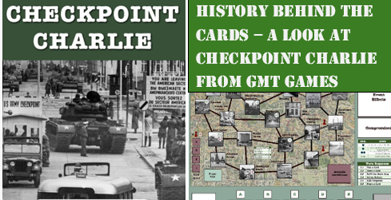
I love a different style and focus of wargame. A game that takes a look at an important but somewhat obscure or rarely addressed historical topic, such as espionage or intelligence, and creates a gaming experience tailored around the events to highlight and evoke the difficulties and tension that would have been present. In January 2026, GMT Games announced such a game in Checkpoint Charlie, which is a solo or cooperative game focused on SIS espionage missions in Berlin in the 1960’s designed by Russell Brown. We have posted an interview with Russel and it was very well received and he has now agreed to create a series of History Behind the Cards to highlight the events of the 1960’s Cold War struggle in West Germany but also to share aspects about the game play and how it models the history.
*Note: The cards highlighted in this series and their event text, as well as any pictures used showing any of the various components, are still in the design and development process and as such event effects and text might still change prior to final development and publication.Also the art and layout of the cards are only for playtest purposes at this point and the game will enter the art department as it nears publication.
History Behind the Cards – Checkpoint Charlie from GMT Games – Card #1: Cousins Operation
The British SIS wasn’t the only intelligence agency operating in Berlin in the 1960’s, not by a longshot. The Potsdam Agreement of 1945 had divided Germany into allied occupation zones, with West Berlin itself divided into British, French and American sectors for administration and military presence, but those boundaries in no way restricted the activities of intelligence organizations in the city. The US Central Intelligence Agency had the largest presence.
The remarkably close relationship between US and British intelligence was formalized in 1946 under the British-US Communications Intelligence Agreement (BRUSA). It became the UKUSA agreement in 1955, including Canada, New Zealand and Australia (the “Five Eyes”), and still stands today. The term “cousins” was used within the British and American intelligence communities to refer to their counterparts from the other agencies, in reference to their longstanding Special Relationship. There were notable examples of not just coordination, but cooperation among the agencies, like Operation Gold – a joint operation in the 1950’s to tunnel beneath the city and tap into the landline communication of the Soviet Army headquarters in Berlin.
This relationship was formalized in the rules of a much earlier version of Checkpoint Charlie, with a specific step in the turn sequence when SIS assets could call upon the CIA for assistance, though with increased risk of detection. However, even with liaison officers and daily intelligence briefings between the two agencies, it was impossible to inform the other service of every aspect of day-to-day activities, let alone coordinate at a task level, so I removed that interaction.
This card represents a CIA operation in one of the locations in the city that has come to the attention of the KGB and was unknown to SIS case officers. This card places a marker that makes it more difficult for SIS assets to operate in the location, as indicated by the negative detection save modifier, and also draws a KGB Agent closer to that location.
In the next article in this series, we will take a look at the Cuban Missile Crisis and how the status of Berlin, even though it is located halfway around the world, effected things on the world stage.
In my opinion, this game looks extremely interesting and I am very much excited to learn more about it. I am appreciative to Russell and his efforts to bring us these cards and to write these entries to share with our readers. I am also very glad that this topic is being covered in a game and look forward to playing this one day soon.
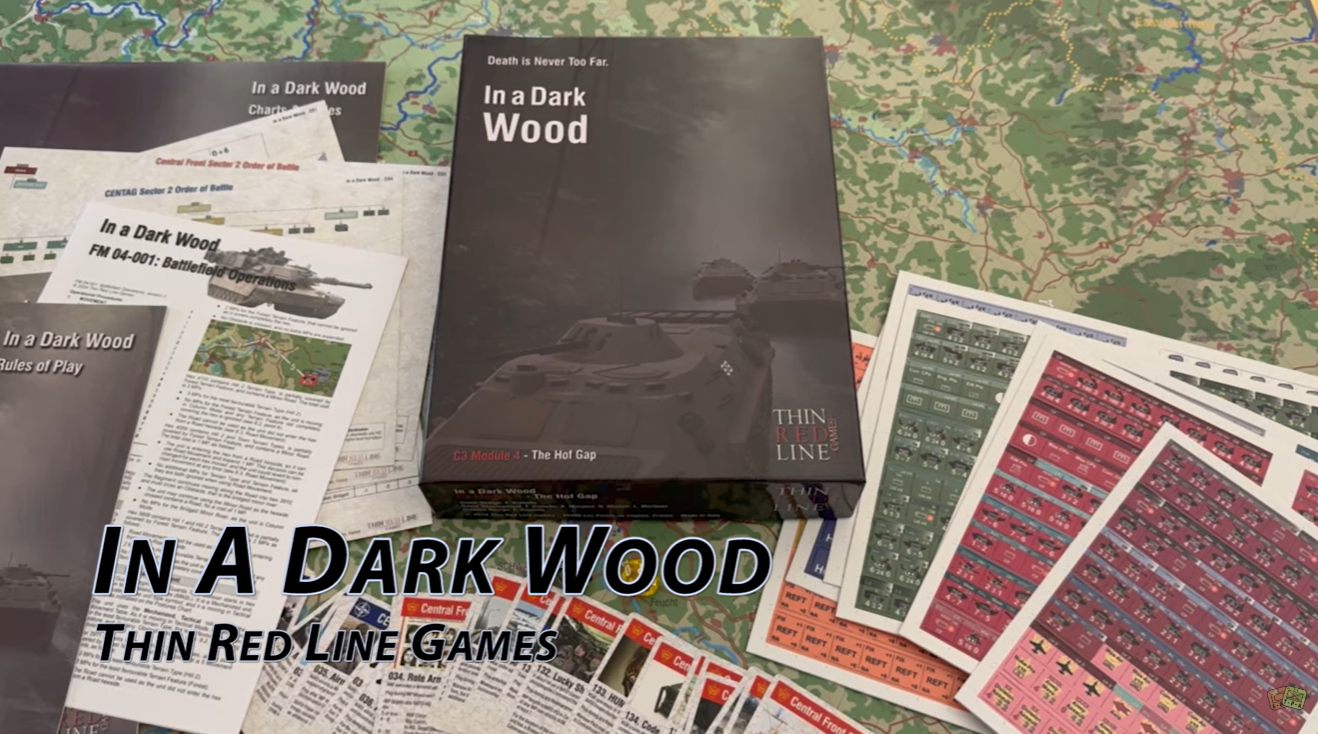
Taking its roots from SPI’s Central Front and NATO: Division Commander, In a Dark Wood is the fourth module of the C3 series, focused on Command, Control and Communication and pioneered by Less Than 60 Miles – one of the five nominees for the 2019 Charles Roberts Awards as Best Post-WW2, Cold War, & Hypothetical Era Board Wargame.
Several typical wargame mechanics have been reinterpreted, and both sides must fight three equally dangerous foes: the enemy, their own plan and time. Even a simple action can quickly turn into a disaster when facing an opponent using more efficiently the real key to victory: the OODA Loop theorized by John Boyd in the early ‘80s and used today as the basis for several military doctrines.
With this My Favorite Wargame Cards Series, I hope to take a look at a specific card from the various wargames that I have played and share how it is used in the game. I am not a strategist and frankly I am not that good at games but I do understand how things should work and be used in games. With that being said, here is the next entry in this series.
#69: Blockade from Twilight Struggle: The Cold War, 1945-1989 from GMT Games
Twilight Struggle is a 2-player game simulating the forty-five year ideological struggle known as the Cold War between the Soviet Union and the United States which can be played in 2-3 hours. The entire world is the stage on which these two countries “fight” to make the world safe for their own ideologies and way of life. The game starts right after the end of World War II in the midst of the ruins of Europe as the two new “superpowers” of the world squabble over what is left and ends in 1989, when only the United States remained standing.
The map is a world map of the period, where players move units and exert influence in attempts to gain allies and control for their superpower. The beauty of the CDG system used here is that each decision of whether to use a card for the event or the operations value is a struggle as if it is the other side’s event, it might go off hurting you very badly. There are mechanics to allow for the ignoring or cancelling of some of the best cards for your opponent in a side game within the game called The Space Race as well as nuclear tensions, with the possibility of game-ending global thermonuclear war (Shall we play a game, anyone?). I have played TS about 30 times and love it more and more with each sitting. The game makes me sweat, cringe, jump with joy and bite my fingernails. To me, a game that can do all of that in one sitting is worth the price.
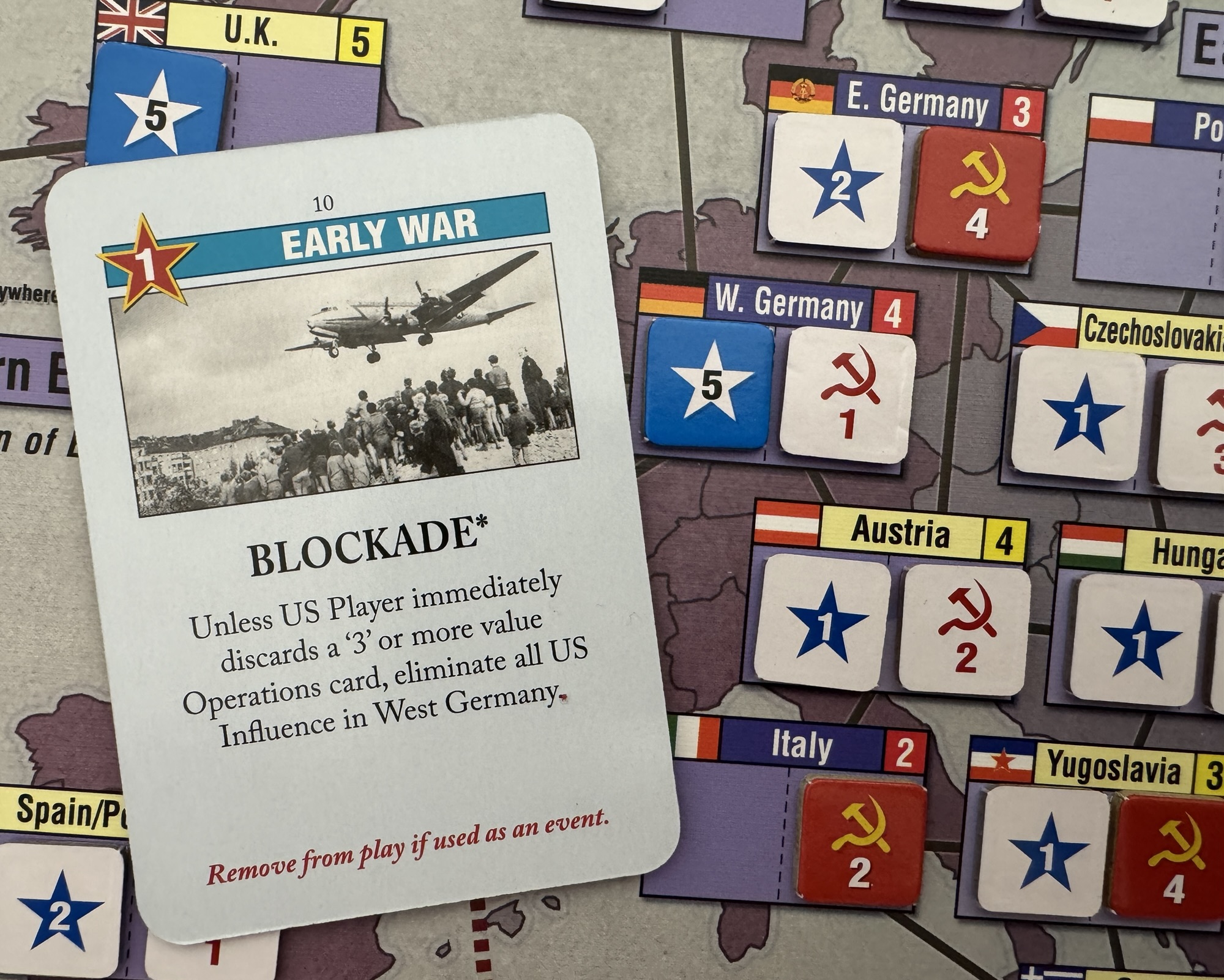
One of my favorite type of cards from the game are those that force an action upon your opponent, such as discarding a card, reducing the Ops from card plays or causing them to have to make other plans than what they were working toward. These type of cards are more reactionary but definitely cause issues and mimic the various non-military focused strategies and tactics used during the Cold War. One of the most famous events from the early history of the Cold War is that of the Berlin Blockade. And there is a specific card that pays homage to the event in the game called Blockade. Blockade is an Early War Soviet Card that has an Ops Value of 1, which makes the card more valuable to be used for the printed event versus for the Ops.
When played, the card requires the US Player to immediately discard a 3 Ops or more value card from their hand or the consequence of not doing so will see all US Influence being removed from West Germany. This is a tough choice. Being early in the game, it is possible for the US to rebuild in West Germany and replace the lost influence over time if they do not wish to discard such as high value card. But, herein lies the real key to the Blockade cards use. The Soviet Player, who should be paying attention to not only their hand but also the card plays of the US Player, should try to use this card later in a turn once the US Player has played a majority of their cards in order to ensure that the event text can be realistically be achieved. If played quickly during a turn, the chances of the US Player being able to discard the required 3 Ops or great value card is higher and the card play will not generate any meaningful difference on the board state. I also would recommend a 2 card strategy here as the Soviet Player should be holding in their hand a high Ops card to be able to follow up this action with the placement of Influence into West Germany on their very next play. But, the real value to a card such as Blockade is that it forces the US Player to consider what cards are out there and to play around their negative effects as much as possible. Due to the nature of the game, and the randomness of card draws, having an expendable high Ops card ready and able to be discarded just in case of the play of Blockade is not really feasible. Also, remember that in Twilight Struggle that opponent events on cards that you play will go off and Blockade being drawn by the US Player can be bad as it will require them to play the event as you cannot discard a 1 Ops card to get rid of its negative effect in the Space Race Track due to the minimum requirement being a 2 Ops card. So the moral of the story here is that both players need to consider and plan for the play of or the mitigation of damage from Blockade.
The Berlin Blockade, which lasted from June 1948–May 1949, was a major Cold War crisis where the Soviet Union blocked all land and water access to West Berlin to attempt to force Western Allies out. The Soviet Union was taking this action as a means of retaliation against the introduction of the new Deutschmark currency. The US and Britain responded with the massive Berlin Airlift, flying over 2.3 million tons of food, fuel and supplies to the city. At the peak of the Airlift, a plane landed in West Berlin every 30 seconds. The blockade failed and the Soviets lifted it on May 12, 1949, after realizing the Allied Airlift could sustain the city for an extended period of time, marking a significant victory for the West in the ideological struggle. This event led to the acceleration of the division of Germany into East and West and the deepening of Cold War tensions.
Some caveats ahead: The chancellors will be rated by the knowledge of their time. If they or their contemporaries could not have known about the effects of something, I will not use my hindsight to mark it as a mistake of theirs. The assessment is focused on their conduct as chancellor, but includes their life after holding the office (in which they will still be regarded in the public eye as (ex-)chancellors).
Now, to the system itself: There are three policy field categories (foreign, domestic, and economic policy) and three more general ones (vision, pragmatism, integrity). A chancellor can earn from one to five stars in each category (for a total sum of up to 30). In detail, the chancellor is assessed as follows:
Foreign policy: Did the chancellor increase German influence in the world and the security of Germans at home? Did the chancellor wield German power responsibly and with positive results for the regions affected (the latter counting for a greater deal in times of German power being great)?
Domestic policy: Did the chancellor increase the liberty of Germans to express themselves and to participate in the political process? Did the chancellor promote domestic security and shape the framework for fair justice dealing with offenses?
Economic policy: Did the chancellor facilitate the prosperity and economic security of Germans (including in the mid- and long-term)? Was the chancellor’s economic policy based on mutual benefit of those involved or did it unduly burden one side?
Vision: Did the chancellor have an idea of what Germany and Europe (the latter counting for more in times of German influence being great) should look like beyond the immediate future? Did the chancellor’s policies steer Germany (and, if applicable, Europe) in this direction?
Pragmatism: Did the chancellor succeed in seeing their policy through from inception to completion? How well did the chancellor manage the support from parliament, society, the administration, the media (the latter counting for more in more recent years)?
Integrity: Did the chancellor understand the office as a means to benefit themselves, special interest groups, the entire country, or another community? Did the chancellor respect the boundaries of the office?
Note: If you have read my UK prime minister or US president ratings, you will remember that I rated them on the global impacts of their vision as well. As the rating system is only really applicable to democratic leaders and no democratic German leader ever had the chance to conduct a truly global policy, I only assess their vision on national and European grounds.
Brandt’s Life
Willy Brandt was born on December 18, 1913, as Herbert Frahm. He adopted the name under which he would become famous in his Norwegian exile, after he had fled Germany to escape the Nazi persecution of socialists. Brandt returned to Germany after World War II – and also to German politics. He was elected a member of German parliament in 1949 and mayor of Berlin in 1957.
As mayor, Brandt was on the frontline of the Cold War. He weathered the Berlin Crisis of 1958 and the building of the Berlin Wall in 1961, each time acting as a symbolic bulwark of liberty against Soviet encroachment. His party, the Social Democratic SPD, nominated him for the chancellorship in the elections of 1961 and 1965. While Brandt lost each time to the Christian Democratic incumbent (first Konrad Adenauer, then Ludwig Erhard), the SPD’s share of the vote increased each time he ran.
When the coalition between the Christian Democrats and the pro-business Liberals fell apart in 1966, Brandt’s Social Democrats finally entered the federal government as part of a “grand coalition” with the Christian Democrats. Brandt became vice chancellor and foreign minister. Three years later, after another strong Social Democratic showing at the election, Brandt formed a coalition with the Liberals and was elected chancellor – the first Social Democrat since the late days of the Weimar Republic.
The new alliance with the Liberals was based on two pillars: First, both parties sought domestic reform after two decades of socially conservative Christian Democratic chancellors which had been increasingly out of touch with their modernizing, sometimes rebellious, society. Brandt was particularly sensitive to these social currents and incorporated them into his administration’s agenda, labelled “Mehr Demokratie wagen” (Take a Chance on More Democracy).
Second, Brandt had a less misty-eyed look at the division of Germany and Germany’s post-war situation than many of his contemporaries. He accepted the division as an undeniable fact and the German territories incorporated into the Soviet Union and Poland after World War II as irretrievably lost. On this basis, he sought a new understanding with the Soviet Union and East Germany as well as Poland, Nazi Germany’s first victim in World War II. This new approach – (Neue) Ostpolitik ((New) Eastern Policy), as it was called – was to bring tangible benefits to the inhabitants of both German states and effect a long-term change, which would keep the door for German reunification open and help to re-admit Germany into the international community. Brandt accompanied the treaties he made with symbolic gestures – most spectacularly, his kneeling at the Memorial of the Warsaw Ghetto Uprising, widely understood to be a recognition of Germany’s guilt, symbolically taken on by a man who had not been personally guilty.
Brandt’s new foreign policy was controversial. The Christian Democratic opposition charged him with selling out the fatherland for his recognition of Germany’s post-war territorial losses. They motioned for a vote of no confidence, but failed to rally a parliamentary majority around their preferred candidate for chancellor, Rainer Barzel. Brandt called for snap elections which he turned into a plebiscite on him and his foreign policy. The electorate responded enthusiastically. Both Social Democrats and Liberals fared better than in 1969, and Brandt was returned as chancellor with an enlarged majority.
The 1972 was the high-water mark of Brandt’s chancellorship. Disagreement in the coalition about economic and fiscal policy after the end of the Bretton Woods system, during which Brandt seemed to be aloof even though two ministers of finance resigned (eventually, the ambitious Helmut Schmidt took the post), was exacerbated by the 1973 oil crisis. The increased energy costs further fueled inflation (which had been high before already), and the resulting demands for wage hikes threatened to send the country into a wage-price spiral (and, in the case of West Germany’s millions of public employees, directly affect public spending).
The coup de grace for Brandt’s chancellorship came from another direction, though. When Brandt’s aide Günter Guillaume was exposed as an East German spy, Brandt resigned on May 6, 1974. His cabinet ministers and the SPD parliamentary group did not lift a finger to stop him. Helmut Schmidt was elected chancellor, continuing the coalition with the Liberals.
Brandt remained chairman of the Social Democratic Party, in which he was still tremendously popular, until 1987. He was elected Chairman of the Socialist International in 1976 and revived this forum of the democratic socialist parties of the world.
Brandt’s foreign policy as chancellor would see itself crowned with success when the Berlin Wall came down in 1989 and Germany was reunited the year after. The intra-German détente had been instrumental in the East German leadership’s decision to quietly step down instead of cracking down on the protests as the Chinese Communists had done. Brandt was content to see it. He died on October 8, 1992, in the united Germany he had helped bring about, in the democratic Germany he had shaped.
The Rating
Foreign policy:
Brandt’s Ostpolitik was equally daring and successful. He threw out tenets of West Germany foreign policy like the iron rule of no direct talks with the East German government and the claim to the former eastern territories of Germany and instead established a new foreign policy world of German negotiations across Cold War borders. Brandt’s approach tangibly improved the life of Germans on both sides of the Wall through eased transit regulations while laying a foundation for further peaceful exchange – borders were declared inviolable (but not immutable!) – which kept the door for reunification open. At the same time, Brandt improved West Germany’s standing in the world, which helped with the country’s admittance to the United Nations in 1973 and netted Brandt the Nobel Peace Prize in 1971. Finally, Brandt re-started the Franco-German Rapprochement which resulted in the enlargement of the European Community (1973) and paved the way for the founding of the European Union.
Brandt’s far-reaching domestic reform program was ambitious. Some of his more notable projects:
The legal (and voting) age was lowered from 21 to 18, levelling the gap between civic rights and civic duties (the conscription age had already been 18)
Divorce did not require assigning guilt to one spouse anymore
Abortion was decriminalized (while technically still forbidden), a delicate compromise which persists until today
Democracy was extended from the purely political to other spheres of life, most notably by strengthening institutionalized labor representatives in companies (Betriebsräte, work councils)
The reform agenda did not only increase civic liberties, it was also crucial for integrating most of the rebellious youth of 1968 into German society. The few that turned to revolutionary violence were successfully opposed by Brandt with the centralization of the police which was instrumental to the arrest of the first generation of the RAF terrorists. In some respects, Brandt’s measures to defend democracy against radicals went too far, though: His “Radicals Decree” mandated extensive background checks on all (prospective) public servants. While theoretically ideologically neutral, the decree targeted only leftists in practice and was in stark contrast to the many former Nazi officials who had continued their careers with nary a dent after 1945.
Brandt’s economic record is mixed: On the one hand, his strengthening of labor representation in companies contributed to West Germany weathering the crisis of the mid- to late 1970s better than most other industrialized economies, and with fewer rifts in the social fabric. This mixed record is neatly exemplified by the cards representing the 1970s steel crisis on the one hand and the boom of the German car industry on the other – West Germany’s economy in the 1970s can go either way!
Despite this overall success, Brandt’s individual economic decisions were not always sound: He expanded public expenses when classical liberal, budding monetarist, and even Keynesian economics would have called for budget cuts to combat inflation. Germans were haunted by the specter of 1923. He meddled in collective bargaining, calling on the trade unions to forgo wage increases in an age of high inflation and high corporate profit increases (and, unsurprisingly, failed, further damaging his reputation in 1974).
Brandt’s economic policy is best captured in his decision to flexibilize the retirement age: While that improved the well-being of those able to retire earlier (and would help to keep unemployment in check in the economically anemic 1970s and 1980s), it put a cost on the working population and the taxpayers who had to shoulder higher expenses for pensions.
Brandt, however, offered a vision out of the economic woes: In his 1972 inauguration address, he favored improving the “quality of life” over growth or GDP numbers. This post-materialistic outlook was ahead of its time.
Rating: 3 out of 5.
Vision:
Brandt envisioned a broadly democratic, unified Germany. His domestic reform agenda helped to bring the former closer to perfection; his foreign policy laid the groundwork for the latter. Neither would have been realistically imaginable to an observer in the 1960s.
Brandt enjoyed a complex relationship with his sources of power. As West Germany’s first real media chancellor, he enjoyed a veritable hype during his first term, before the press dropped him in the second. He was popular with the electorate and able to form a lasting government coalition (which endured for another eight years after his resignation), but could not hold on to the reins under pressure: He left challenges to his leadership from the SPD parliamentary party and his ministers unchecked, something which his challengers interpreted as weakness. When he needed allies during the Guillaume affair, he had none willing to fight for him.
Rating: 2 out of 5.
Integrity:
Brandt earnestly attempted to improve life for all Germans on both sides of the Wall. His government engaged in fewer give-and-take with the traditional interest groups of West Germany (the farmers’ associations, the churches, the employers, and even the traditional trade union allies of the Social Democrats) than those of his predecessors. Still, the increased public spending of his government enabled many left-leaning liberals to carve out a niche for themselves at state-sponsored projects dear to their heart. Even though Brandt had been harshly attacked by his political opponents for having been in exile and was left in the lurch by his allies, he treated his political partners reliably and collegially, careful not to exceed the boundaries of his office. When they went low, he went high.
Rating: 4 out of 5.
Summary
Brandt’s impact much exceeds his relatively short time in office. His domestic reforms let Germany catch up with the social changes, his new foreign policy was quietly extended even by the Christian Democrats after their return to power. His shortcomings, especially his casual handling of the office, precluded a longer Brandt chancellorship and thus his chance to fully shape an era. He thus places in the top group of ranked leaders, but slightly behind the leaders of the pack.
How would you rate Brandt? Let me know in the comments!
Further Reading
For short overview essays on all German chancellors from Bismarck on, see Sternburg, Wilhelm von: Die deutschen Kanzler. Von Bismarck bis Merkel[The German Chancellors. From Bismarck to Merkel], Aufbau-Verlag, Berlin 2006 (in German).
A concise biography of Willy Brandt is Marshall, Barbara: Willy Brandt. A Political Biography, Macmillan, London 1997.
For the context of Germany’s tumultuous history, see Herbert, Ulrich: A History of Twentieth-Century Germany, Oxford University Press, Oxford 2019.
Some caveats ahead: The chancellors will be rated by the knowledge of their time. If they or their contemporaries could not have known about the effects of something, I will not use my hindsight to mark it as a mistake of theirs. The assessment is focused on their conduct as chancellor, but includes their life after holding the office (in which they will still be regarded in the public eye as (ex-)chancellors).
Now, to the system itself: There are three policy field categories (foreign, domestic, and economic policy) and three more general ones (vision, pragmatism, integrity). A chancellor can earn from one to five stars in each category (for a total sum of up to 30). In detail, the chancellor is assessed as follows:
Foreign policy: Did the chancellor increase German influence in the world and the security of Germans at home? Did the chancellor wield German power responsibly and with positive results for the regions affected (the latter counting for a greater deal in times of German power being great)?
Domestic policy: Did the chancellor increase the liberty of Germans to express themselves and to participate in the political process? Did the chancellor promote domestic security and shape the framework for fair justice dealing with offenses?
Economic policy: Did the chancellor facilitate the prosperity and economic security of Germans (including in the mid- and long-term)? Was the chancellor’s economic policy based on mutual benefit of those involved or did it unduly burden one side?
Vision: Did the chancellor have an idea of what Germany and Europe (the latter counting for more in times of German influence being great) should look like beyond the immediate future? Did the chancellor’s policies steer Germany (and, if applicable, Europe) in this direction?
Pragmatism: Did the chancellor succeed in seeing their policy through from inception to completion? How well did the chancellor manage the support from parliament, society, the administration, the media (the latter counting for more in more recent years)?
Integrity: Did the chancellor understand the office as a means to benefit themselves, special interest groups, the entire country, or another community? Did the chancellor respect the boundaries of the office?
Note: If you have read my UK prime minister or US president ratings, you will remember that I rated them on the global impacts of their vision as well. As the rating system is only really applicable to democratic leaders and no democratic German leader ever had the chance to conduct a truly global policy, I only assess their vision on national and European grounds.
Erhard’s Life
Ludwig Erhard was born on February 4, 1897. His parents owned a clothing store in Fürth, a city in the south of Germany. Erhard was initially destined to follow them in the business, but came back from World War I badly wounded and unable to stand for an extended period of time (as we would have had to as a store owner). He thus turned to academia and studied business. After graduating, he managed his parents’ store for a short time before it went bankrupt in 1928. Erhard then succeeded in following his academic aspirations and worked at various institutes and universities. Erhard was no supporter of the Nazi regime which took power in 1933, but conducted advisory research for them. In 1942, he failed in a bid to head his university’s institute for economics (losing to a member of the Nazi party) and was soon after forced out of the institute. He then set up his own one-man think tank, writing on how to re-build Germany’s economy after the war.
These studies – and Erhard’s relative distance from the Nazi regime – recommended him to the post-war authorities. After quick stints on the local and regional level, he was appointed Head of the Special Office for Money and Credit (and soon after Director of Economics) of the Anglo-American occupation zone in Germany. When he was informed by the Allied authorities of their decision to introduce a new currency (the Deutsche Mark) in the three western occupation zones, Erhard went ahead and also announced the lifting of price-fixing and production controls for most goods.
Economically speaking, the monetary reform and abolition of state control over the economy were not an immediate success. Prices shot up (while wages were still fixed) and unemployed quadrupled to 12%, thus, unrest (leading to a general strike) spread in West Germany. However, the abolition of price-fixing all but abolished the previously ubiquitous black markets. Erhard’s reputation thus was stellar, and the newly formed big-tent center-right party CDU (Christlich-Demokratische Union, Christian Democratic Union) invited Erhard to join forces with them. Erhard, who personally was more of a classical liberal than a conservative, joined with the intent of committing a large party to his ideas of free markets, and successfully ran for parliament on the CDU ticket in West Germany’s first national elections in 1949. Erhard then became Minister for the Economy in the new administration, a post he would hold for the next fourteen years.
Early in Erhard’s tenure, economic success blossomed: The outbreak of the Korean War in 1950 re-committed the American economy to war production – and West Germany seized the opportunity to produce the civilian goods not made in America anymore. The West German economy boomed. Unemployment fell. Wages rose. Exports grew manifold. And Erhard, who steadfastly (but not always successfully) defended his liberal economic principles against any attempts to introduce more state intervention, became the lucky charm of the German “economic miracle”.
Erhard’s corresponding popularity made him a natural contender for the succession of West Germany’s first chancellor Konrad Adenauer. When Adenauer finally resigned in 1963 (aged 87), the CDU and its allies in government elected Erhard as the new chancellor. Erhard, never a politician’s politician, refrained from domestic initiatives. His foreign policy was based on the attempt to align West Germany closer with the United States and Great Britain at the expense of the cordial Franco-German relationship his predecessor had built. Erhard won a resounding electoral victory in 1965, but his relationship with his own party remained frail. When a mild recession hit West Germany and the budget was threatened by Erhard’s earlier commitment to payments to the United States and Britain to make up for the spending of their troops stationed in Germany (the “offset arrangement”), his government broke down (1966). Erhard was forced to resign. The new government which was based on the CDU and the long-time oppositional Social Democrats elected Kurt Georg Kiesinger as his successor. Erhard retired to a quiet life, but remained a member of parliament until his death on May 5, 1977.
The Rating
Foreign policy:
Erhard’s only field of ambition during his chancellorship – and also the area of his most obvious failure. His pivot away from France damaged the Franco-German relationship and European integration (which he, against his general economic principles, did not seek anyway). On the other hand, Erhard could not make good on his aim to improve German-American relationships – his professed dislike for France took any kind of lever out his hand, and his willingness to accede to American demands (like promising full payment in the offset arrangement) did not result in any favors in return from the United States (the key prize would have been if America had continued to seek a Multilateral Force with nuclear weapons – which would have resulted in Germany’s nuclear sharing).
Erhard did not start any domestic policy initiatives and ignored the growing societal pressures beyond his favorite topic of the economy. In the rare cases that such topics were forced onto him, Erhard, to his credit, deviated from the previous course of German policy which had been to largely ignore the Nazi crimes: When he found out that his Minister for Displaced Persons, Refugees, and War Victims had been an active Nazi party functionary, Erhard forced his resignation (in a striking difference to his predecessor Adenauer, who kept his Chief of Staff for ten years despite the man’s well-known involvement in drafting the Nazis’ laws prosecuting German Jews).
As German law knew a statute of limitation preventing criminal prosecution after twenty years, all Nazi crimes would have gone unpunished from 1965 on. Erhard was in the minority of government members who wanted to extend the period of prosecution. Parliament passed an extension with a mixed-party majority – Erhard, however, had nor been able to convince his own government colleagues and was not instrumental in securing this majority.
Rating: 2 out of 5.
Economic policy:
Another policy field of Erhard inaction – this time, however, by design. Erhard’s liberal economic credo kept him from intervening in the economy. That was defensible in the narrow view – economic activity in the short term – but defective otherwise: Erhard knew (more than a year before the budgetary crisis of 1966) that the economic downswing lowered public revenue while his promises concerning the offset arrangement would raise expenses. Erhard thus brought the budgetary crisis, over which he’d fall, onto himself. In the longer term, Erhard’s torpedoing of European integration denied the German economy export markets and delayed the innovation stimulus of increased competition.
Rating: 2 out of 5.
Vision:
Erhard’s overarching vision in life was to allow free individuals to pursue their ambitions in a market economy – but when he entered office, he felt the preconditions for that were already achieved (a debatable claim). Thus, his policy mostly consisted of staying the course. He did pitch a foreign policy plan to refuse the Soviet Union loans and then “buy” German reunification when the Soviet economy collapsed, but was met with (justified) bewilderment by both his domestic and foreign interlocutors. Domestically, his only contribution which went beyond the immediate needs was his idea of a “Formed-Up Society” in which both egoism and pluralism would be overcome – an idea that he brought up during the 1965 election campaign and did not return to afterward.
Rating: 2 out of 5.
Pragmatism:
Likely Erhard’s weakest suit. While he did not attempt much, what he attempted usually fell flat because Erhard was unable to secure support for it (or because he wavered and dropped it in the face of resistance). He had lost his own party’s support for his foreign policy within his first year in office. Their support for his domestic activities (or, rather, the lack thereof) withered soon after. Particularly instructive is the aftermath of Erhard’s 1965 electoral victory: Erhard squandered this testament of his popularity with the voters within weeks. He had intended to downsize the cabinet (and thus to get rid of ministers appointed by his predecessor and unfriendly to him) but waited too long to begin that process. In the end, the parliamentary parties of the coalition partners CDU, its Bavarian sister party CSU, and the pro-business FDP prevailed in securing all the posts for ministers they wanted. Erhard was forced to accept a virtually unchanged cabinet. Only one year after his electoral victory, the remainder of his political capital was spent and he resigned.
Rating: 1 out of 5.
Integrity:
Erhard came into office planning to abolish his predecessor’s “democracy of favors” which was based on securing the support of powerful interest groups like the churches, the farmers’ associations, the employers’ associations, or the trade unions by passing legislation and channeling government funding in their favor. While Erhard was not above combatting European economic integration (against his liberal credo of open markets and the benefits of competition) to protect the German farmers from their French competitors, he doled out distinctly fewer favors than his predecessor. He also confined himself to the limits the constitution spelled out and did not attempt to shape the state offices to his liking (as Adenauer had done when he tried to move from the chancellorship into the presidency – but, of course, turning the presidency into the more important office). Finally, Erhard’s more collegial government style confirmed that Germany had moved beyond authoritarianism.
Rating: 4 out of 5.
Erhard is the rare case of a politician not defined by the highest office he attained: He took the decisive action of his life as Director of Economics for the Bizone. He is best remembered by the public as Minister for the Economy. Looking at his chancellorship, it’s easy to see why: During this short period in office, Erhard did not attempt much, and what he attempted usually failed. His successors were left to respond to pressures resulting from the changing civil society and to repair the damage done to Franco-German relations (only achieved around ten years later). Erhard positions himself on the lower rungs of the leaders rated.
How would you rate Erhard? Let me know in the comments!
Further Reading
For short overview essays on all German chancellors from Bismarck on, see Sternburg, Wilhelm von: Die deutschen Kanzler. Von Bismarck bis Merkel[The German Chancellors. From Bismarck to Merkel], Aufbau-Verlag, Berlin 2006 (in German).
For a recent English-language biography (or, rather, a hagiography), see Mierzejewski, Alfred C.: Ludwig Erhard. A Biography, University of North Carolina press, Chapel Hill, NC 2005.
The standard, primary-source based, scholarly biography (which is a bit vitriolic, but generally sound in its judgment) is Hentschel, Volker: Ludwig Erhard. Ein Politikerleben [Ludwig Erhard. A Politician’s Life], Olzog, Munich 1996 (in German).

 Anmelden