❌

Normale Ansicht

My Favorite Wargame Cards – A Look at Individual Cards from My Favorite Games – Card #100: KSM from Labyrinth: The War on Terror, 2001-? from GMT Games

Von: Grant
28. Oktober 2026 um 13:00

With this My Favorite Wargame Cards Series, I hope to take a look at a specific card from the various wargames that I have played and share how it is used in the game. I am not a strategist and frankly I am not that good at games but I do understand how things should work and be used in games. With that being said, here is the next entry in this series.

#100: KSM from Labyrinth: The War on Terror, 2001-? from GMT Games

Labyrinth: The War on Terror, 2001-? from GMT Games is a 2-player asymmetrical Card Driven Game that pits the mighty and powerful United States military and all of its various antiterrorist agencies against the Jihadists in the Middle East whose sole goal is to spread terror, sow the seeds of deceit and ultimately destroy Western civilization. The game is a Card Driven Game where the cards contain Operation Points or Events and each turn the player must strategize and use their cards to their best ability in order to effect the state of the board and further their individual and asymmetric victory conditions. But the game is raw and is tied to the actual events of the early 2000’s as the United States was reeling to recover from the terrorist attacks in New York.

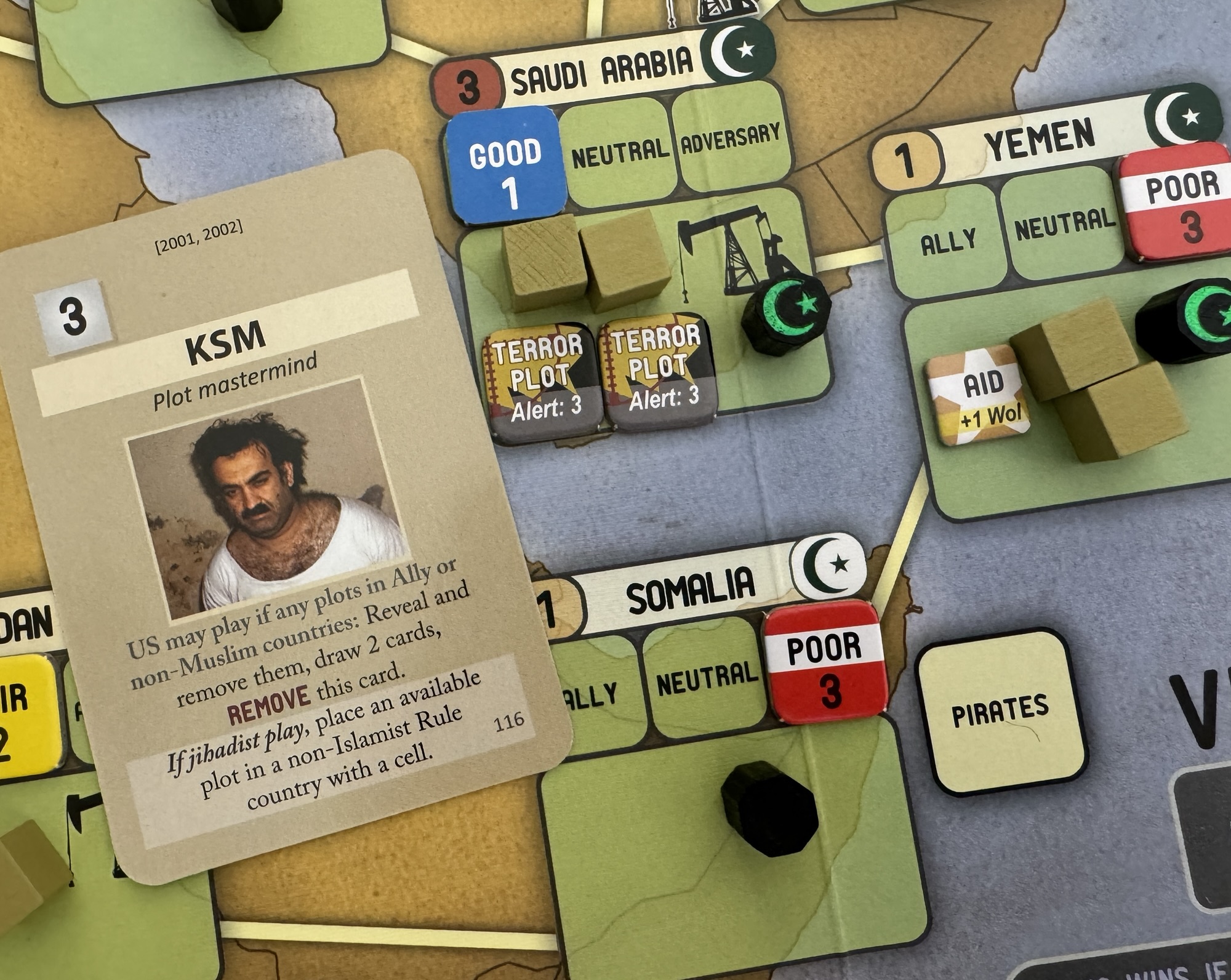
In the game, the Jihadist player is working to destabilize the Middle East through a series of clandestine activities such as destroying stability, toppling governments and forcing the US to react to their actions. One of their biggest strategies is to work to place what are called Plots out on the board in order to destabilize but also to generate local support and funding for their activities from the populace. If left alone, these Plots will go off at the end of a round and cause trouble that will then have to be cleaned up by the US player over the next turn. In order to uncover these Plots, the US player will have to play a 3 Ops card to take the Alert Action and different from most other actions there is no die roll required and the the Plot removal is automatic. But, the cost is steep as a 3 Ops card is pretty rare and spending it on this action is very painful. Jihadists use these Plots to force the US player to have to stamp out fire after fire rather than working to reform and stabilize governments to create allies. And when these Plots appear, the player’s long-term strategy will have to be put aside and a focus will have to change from managing regime change and the Global War on Terror (GWOT) posture to dealing with urgent plots. The KSM card is a very powerful tool in this game as it allows for the US player to remove Plots from an Ally or non-Muslim country but also to replace this investment with drawing 2 cards to replace it. This is specifically tied to the intel that was obtained from the capture of Khalid Sheik Mohammad and how it was then used to defuse several ongoing plots. The Jihadist player also gains a pretty large benefit as they will be allowed to place a Plot Marker into a non-Islamist Rule country with a cell. The process of successfully placing a Plot can be very challenging for the Jihadist player as it takes the play of a card for Operations points, uncovering a cell in a country and then rolling a die equal to or less than that country’s Governance Level to then place a face-down Plot Marker. This takes the need for a roll away and makes the placement of a Plot an automatic success.

I think that one of the other important distinctions and differences with the KSM card is that it is a 3 Ops Neutral Card that can be played by either side but when played by the US player for the event, it will be removed from the game while when being played for the Jihadist portion of the event it will remain and be able to be used in a later turn when it is drawn again. This reflects the important role that KSM played in al-Qaeda’s plans and if allowed to stay at large he will continue to plan and execute plots across the globe.

Khalid Sheik Mohammed was a member of Osama bin Laden’s militant organization al-Qaeda, and was specifically in charge of leading al-Qaeda’s propaganda operations from around 1999 until late 2001. Mohammed was captured on March 1, 2003 in the Pakistani city of Rawalpindi by a combined operation of the U.S. Central Intelligence Agency (CIA) and Pakistan’s Inter-Services Intelligence (ISI). Immediately after his capture, Mohammed was taken to secret CIA prison sites in Afghanistan, then Poland, where he was interrogated by U.S. operatives. By December 2006, he had been transferred to military custody at Guantanamo Bay detention camp. Sensationally nabbed in Pakistan, alleged 9/11 mastermind Khalid Sheikh Mohammed was photographed for the
world in a disheveled state immediately after his capture—symbolizing an apparent laying low of the once mighty al-Qaeda network. According to his US captors, he later provided information that thwarted other attacks.

Mohammed is widely regarded as the chief planner of the September 11 attacks. The United States government has alleged that he further participated in planning Richard Reid’s shoe bombing attempt to attack an airliner, the 2002 Bali bombings in Indonesia, the 1993 World Trade Center bombing, the murder of Daniel Pearl and various foiled attacks as well as numerous other crimes. These claims have been criticised by others, such as military prosecutor Moe Davis and journalist Andrew Brown, as inadmissible due to being obtained through torture. He was charged in February 2008 with war crimes and murder by a U.S. military commission at the Guantanamo Bay detention camp, which could carry the death penalty if convicted. A 2008 decision by the United States Supreme Court had also drawn into question the legality of the methods used to gain such admissions and the admissibility of such admissions as evidence in a criminal proceeding.

This image shows Khalid Sheikh Mohammed, the self-proclaimed mastermind of the September 11 terrorist attacks, photographed shortly after his capture during a joint raid in Rawalpindi, Pakistan, on March 1, 2003.

In the next entry in this series, we will take a look at Constantinople Sends Aid Core Event from The Shores of Tripoli from Fort Circle Games.

-Grant
My Favorite Wargame Cards – A Look at Individual Cards from My Favorite Games – Card #99: Truman Doctrine from Twilight Struggle: The Cold War, 1945-1989 from GMT Games

Von: Grant
20. Oktober 2026 um 14:00

With this My Favorite Wargame Cards Series, I hope to take a look at a specific card from the various wargames that I have played and share how it is used in the game. I am not a strategist and frankly I am not that good at games but I do understand how things should work and be used in games. With that being said, here is the next entry in this series.

#99: Truman Doctrine from Twilight Struggle: The Cold War, 1945-1989 from GMT Games

Twilight Struggle is a 2-player game simulating the forty-five year ideological struggle known as the Cold War between the Soviet Union and the United States which can be played in 2-3 hours. The entire world is the stage on which these two countries “fight” to make the world safe for their own ideologies and way of life. The game starts right after the end of World War II in the midst of the ruins of Europe as the two new “superpowers” of the world squabble over what is left and ends in 1989, when only the United States remained standing.

The map is a world map of the period, where players abstractly move units and exert influence through the placing of Influence Markers in an attempt to build local support and gain allies and control for their superpower. The beauty of the CDG system used here is that each decision of whether to use a card for the event or the operations value is a struggle as if it is the other side’s event, it might go off hurting you very badly. There are mechanics to allow for the ignoring or cancelling of some of the best cards for your opponent in a side game within the game called The Space Race as well as nuclear tensions, with the possibility of game-ending global thermonuclear war (Shall we play a game, anyone?). I have played TS about 30 times and love it more and more with each sitting. The game makes me sweat, cringe, jump with joy and bite my fingernails. To me, a game that can do all of that in one sitting is worth the price.

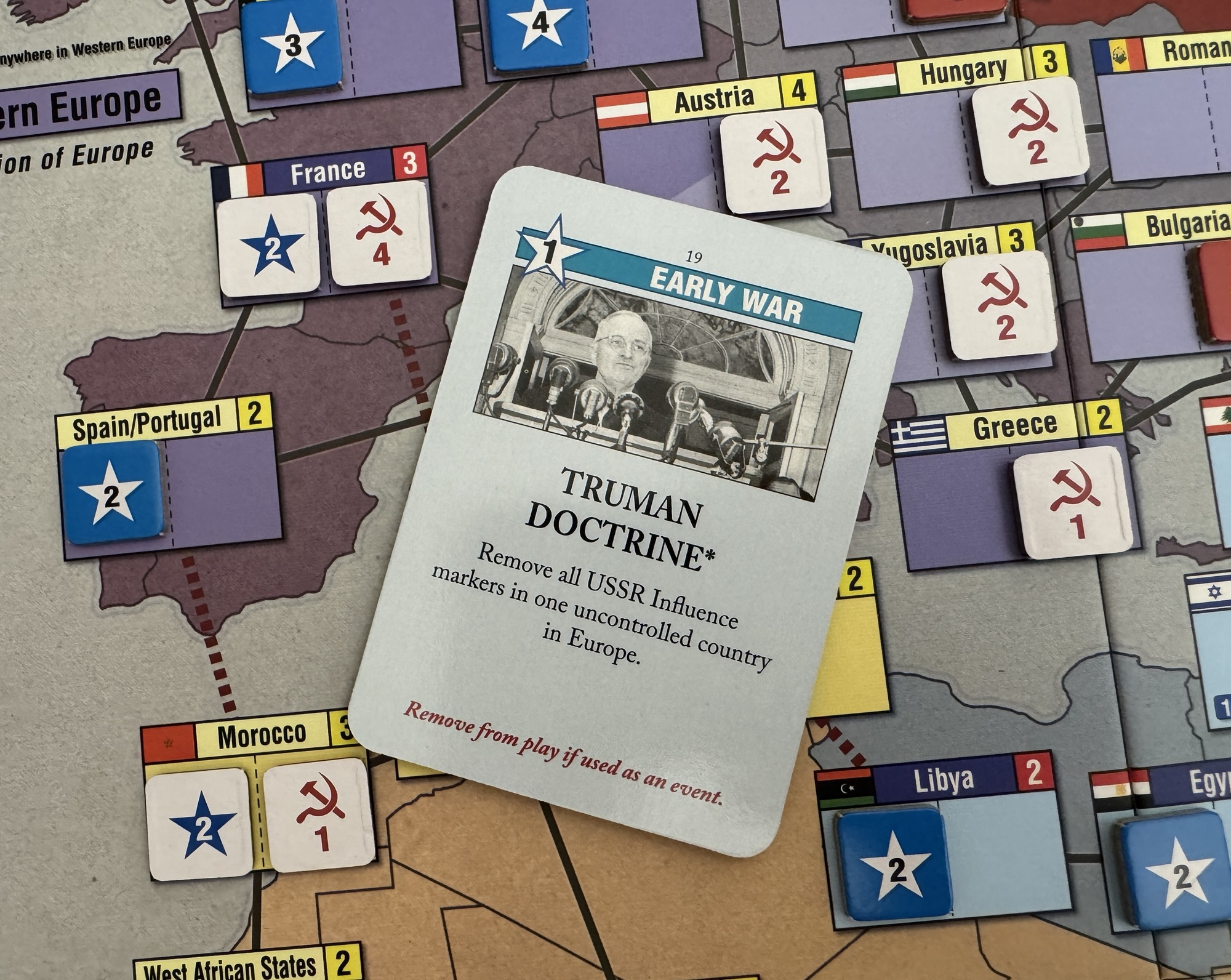
The Truman Doctrine is an Early War U.S. 1 Op Event Card that removes all Soviet Influence from a single country in Europe where the U.S. has presence. This means that the U.S. at least has 1 Influence in a space and the space must be uncontrolled. I think that players should be judicious and patient with this card and do not rush to play early in the game on Turn 1 or Turn 2 if Europe is stable and the USSR has minimal presence there. The best way to use the card is to wait for a window where you can do the most damage in a key Battleground space where each side has been fighting for control by placing Influence there such as in France or West Germany on the last action round of a turn or playing the card during the Headline Phase to wipe out stacked Soviet Influence as a precursor to bumping up your own Influence there for control. The Truman Doctrine card is such a nice booby trap in many ways and the proper use of it can be very efficient and give you a leg up in Europe.

The Truman Doctrine was a United States foreign policy established by President Harry S. Truman on March 12, 1947, which pledged that the U.S. would provide political, military, and economic assistance to democratic nations threatened by external or internal authoritarian forces. President Harry S. Truman asked for $400 million in military and economic assistance for Greece and Turkey. “It must be the policy of the United States to support free peoples who are resisting attempted subjugation by armed minorities or by outside pressures,” Truman declared. “If we falter in our leadership, we may endanger the peace of the world — and we shall surely endanger the welfare of our own nation.”

In asserting that the U.S. would intervene in faraway conflicts, President Truman dramatically reoriented U.S. foreign policy. The writing of this ground-breaking message went through multiple stages. In his memoir, Truman noted that the State Department’s first draft of the speech “was not at all to my liking.” Rather than asserting a new foreign policy doctrine, the State Department writers had “made the whole thing sound like an investment prospectus.” Truman returned the draft to Secretary of State Dean Acheson “with a note asking for more emphasis on a declaration of general policy.”

The State Department complied, and included a general policy statement in the next draft. But Truman was not satisfied. “It seemed to me half-hearted,” he recalled. President Truman “scratched out” what he deemed equivocations. For example, Truman replaced “should” with “must” in a key sentence that read “I believe that it should be the policy of the United States…” According to Truman, “I wanted no hedging in this speech.” Because this speech “was America’s answer to the surge of expansion of Communist tyranny,” it “had to be clear and free of hesitation or double talk.” A total of eight drafts of Truman’s speech to Congress are featured on the Truman Library’s website. Many include handwritten comments and corrections. Combined, they give readers a sense of the tremendous effort that went into drafting the Truman Doctrine as well as the importance a single word can make when crafting foreign policy.

Truman delivered his address on March 12, 1947. Over the next several weeks, Congress debated the merits of Truman’s proposed foreign policy. On April 22nd, the Senate approved the legislation to provide assistance to Greece and Turkey. The House followed suit, approving the bill on May 9th. On May 22, 1947, Truman signed the bill into law. According to President Truman, the enactment of his bill “served notice that the march of Communists would not be allowed to succeed by default.”

In the next entry in this series, we will take a look at KSM from Labyrinth: The War on Terror, 2001-? from GMT Games.

-Grant

My Favorite Wargame Cards – A Look at Individual Cards from My Favorite Games – Card #98: The Balkan Wars from Imperial Elegy: The Road to the Great War 1850-1920 from VUCA Simulations

Von: Grant
13. Oktober 2026 um 14:00

With this My Favorite Wargame Cards Series, I hope to take a look at a specific card from the various wargames that I have played and share how it is used in the game. I am not a strategist and frankly I am not that good at games but I do understand how things should work and be used in games. With that being said, here is the next entry in this series.

#98: The Balkan Wars from Imperial Elegy: The Road to the Great War 1850-1920 from VUCA Simulations

Imperial Elegy: The Road to the Great War 1850-1920 is a massive card driven game that blends diplomacy, warfare, and statecraft and feels a bit akin to games like Here I Stand and Virgin Queen from GMT Games, which are both grand scale sweeping epics that play multiplayers and take a day to play. Players play as 1 of 6 major powers in the game including Germany/Prussia, the United Kingdom, France, Austria-Hungary, Russia and the Ottoman Empire. The game is quite grand and ambitious as it covers 70 years near the end of the Victorian Era and the Progressive Ear and sees quite a lot of global change and competition between the great powers of the time. The game is a Card Driven Game and uses Action Cards as a type of currency to spend for their Command Points or the printed event to take actions such as recruiting armies and navies, industrialize, moving fleets and armies around the globe, influencing minor powers and establish colonies in Africa, India and the Pacific Ocean. The cards are all tied to the history of the period but the game can be played very much as a sandbox allowing players to explore strategies by trailblazing new horizons or following history.

Before we dive into today’s chosen card The Balkan Wars, I want to first make sure you know about Mandatory Event Cards in the game and how they work as they work slightly differently from normal Action Cards. Mandatory Event Cards are all lime green colored and bear a large block “M” just under the CP Value listed in the upper left hand corner. Mandatory Events, as the name suggests, must be played for their events. However, when playing a Mandatory Event Card, players trigger the event and also receive the CP to spend on various actions. The events on Mandatory Event Cards are always resolved first before the CP are utilized. If a Mandatory Event Card is discarded, the event will immediately trigger. There is no way around these cards and they are included in the game to drive the action historically and interject the various special circumstances that drove the rise and decline of these Victorian Age empires. The player that discarded the card resolves the event as if they were the active player. If two such Mandatory Event Cards are discarded in the same impulse the events are resolved in turn order.

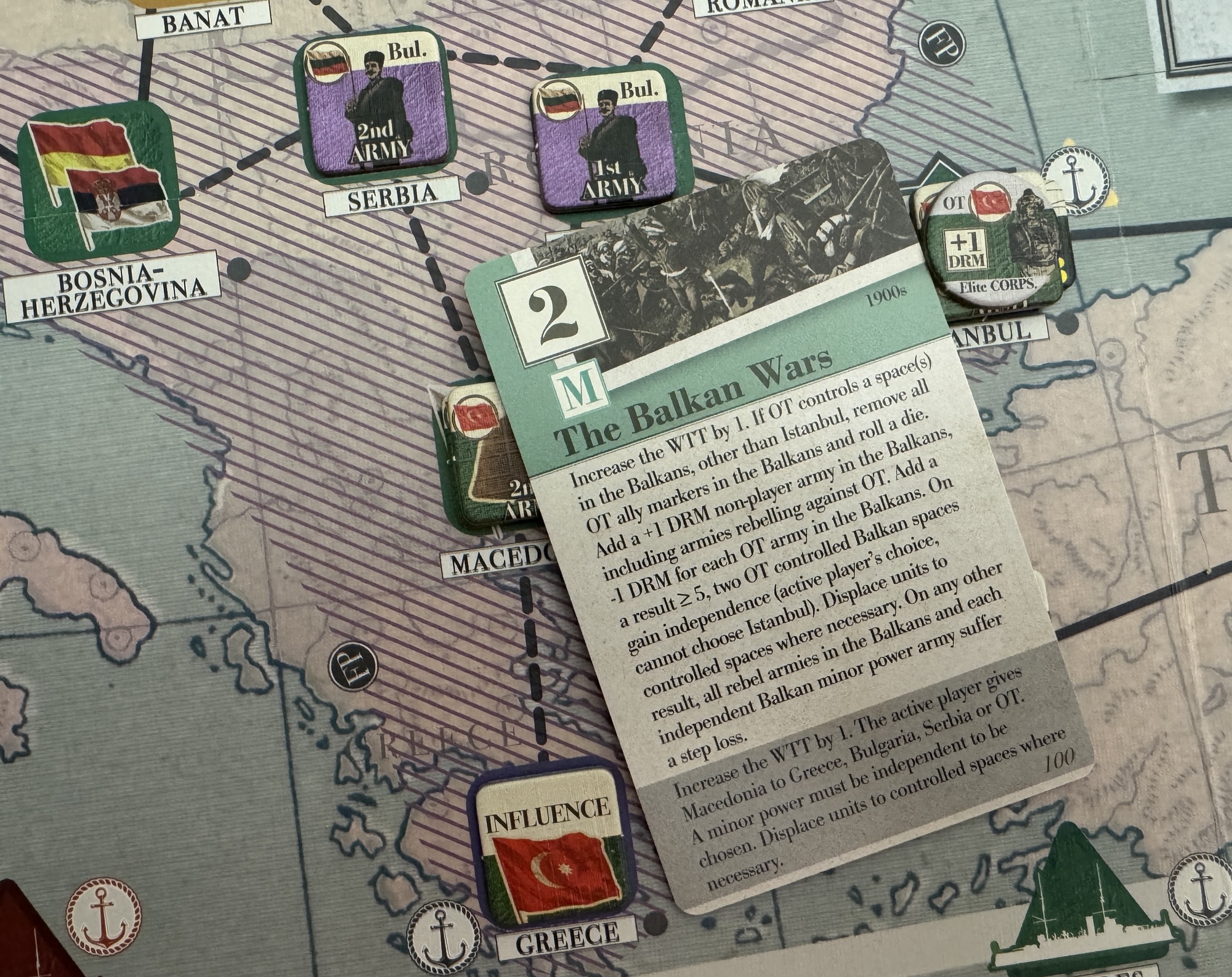
Some of the events that occurred historically prior to 1914 were ultimately precursors to The Great War in many ways. The Balkan Wars were two conflicts fought in 1912 and 1913 that stripped the Ottoman Empire of almost all its remaining European territory and directly set the stage for World War I. The Balkan Wars saw similar levels of carnage as machine guns and artillery equipped with hydraulic recoil mechanisms were used in large numbers. Politically, they highlight the volatile nature of international politics in the Balkan Peninsula and are included as a Mandatory Event to ultimately drive up the World Tension Track on a path toward the outbreak of World War I. When played, the World Tension Track will increase by +1 and if the Ottoman player controls any territory in the Balkans other than Istanbul, or has Diplomatic Influence with countries, they will have a chance to lose their control there as a result of the chaos of the First and Second Balkan Wars. If these checks fail, and they will incur a -1 DRM for each Ottoman Army that is located anywhere in the Balkans, non-player armies will be placed in those locations and will increase the difficulty for the Ottomans to gain a foothold in this area. According to the designer Michael Lorino, mechanically this event causes all kinds of trouble in the Balkans, as intended. Similar to the Mandatory Event Card Empire of the Sun, the original event was a bit more involved and had players fight an actual war. In an effort to keep the game in the playable zone, he decided to abstract these wars through a die roll.

I very much enjoy the concept of a Mandatory Event, although they are never convenient for someone at the table as they typically have negative effects for at least 1 faction. But I very much like the approach taken here with The Balkan Wars with the -1 DRM for control of a territory and its thematic connection with the Ottoman Empire’s presence in the region generating tension and setting off these Balkan Wars.

A Bulgarian postcard depicting the Battle of Lule Burgas.

The Balkan Wars were two conflicts that took place in the Balkan states in 1912 and 1913. In the First Balkan War, the four Balkan states of Greece, Serbia, Montenegro and Bulgaria declared war upon the Ottoman Empire and defeated it, in the process stripping the Ottomans of their European provinces, leaving only Eastern Thrace under Ottoman control. In the Second Balkan War, Bulgaria fought against the other four combatants of the first war. It also faced an attack from Romania from the north. As a result of these wars, the Ottoman Empire lost the bulk of its territory in Europe. Although not involved as a combatant, Austria-Hungary became relatively weaker as a much enlarged Serbia pushed for union of the South Slavic peoples. The Balkan Wars set the stage for the July Crisis of 1914 and was a prelude to the First World War.

We have put out several pieces of content covering Imperial Elegy and find it to be a fantastic game. These include written posts and videos. You can visit those by following the links below:

Unboxing Video:

Video Review:

Summary of Solitaire Bots presented by our friend James:

Written First Impressions Post on the blog: https://theplayersaid.com/2026/05/06/first-impressions-imperial-elegy-the-road-to-the-great-war-1850-1920-from-vuca-simulations/

In the next entry in this series, we will take a look at Truman Doctrine from Twilight Struggle: The Cold War, 1945-1989 from GMT Games.

-Grant

My Favorite Wargame Cards – A Look at Individual Cards from My Favorite Games – Card #97: Prudence from 1989: Dawn of Freedom from GMT Games

Von: Grant
06. Oktober 2026 um 14:00

With this My Favorite Wargame Cards Series, I hope to take a look at a specific card from the various wargames that I have played and share how it is used in the game. I am not a strategist and frankly I am not that good at games but I do understand how things should work and be used in games. With that being said, here is the next entry in this series.

#97: Prudence from 1989: Dawn of Freedom from GMT Games

1989: Dawn of Freedom is a fast paced game simulating the end of the Cold War in 1989 as the Berlin Wall fell under pressure from the people as during this year a series of democratic revolutions ended the 40 year Soviet empire in Eastern Europe. 1989 simulates the political, social and economic aspects of these revolutions using a card-driven system similar to Twilight Struggle. I have really very much enjoyed my plays of 1989 and those plays are increasing as the game has been placed on the very cool and user friendly online platform Rally the Troops!

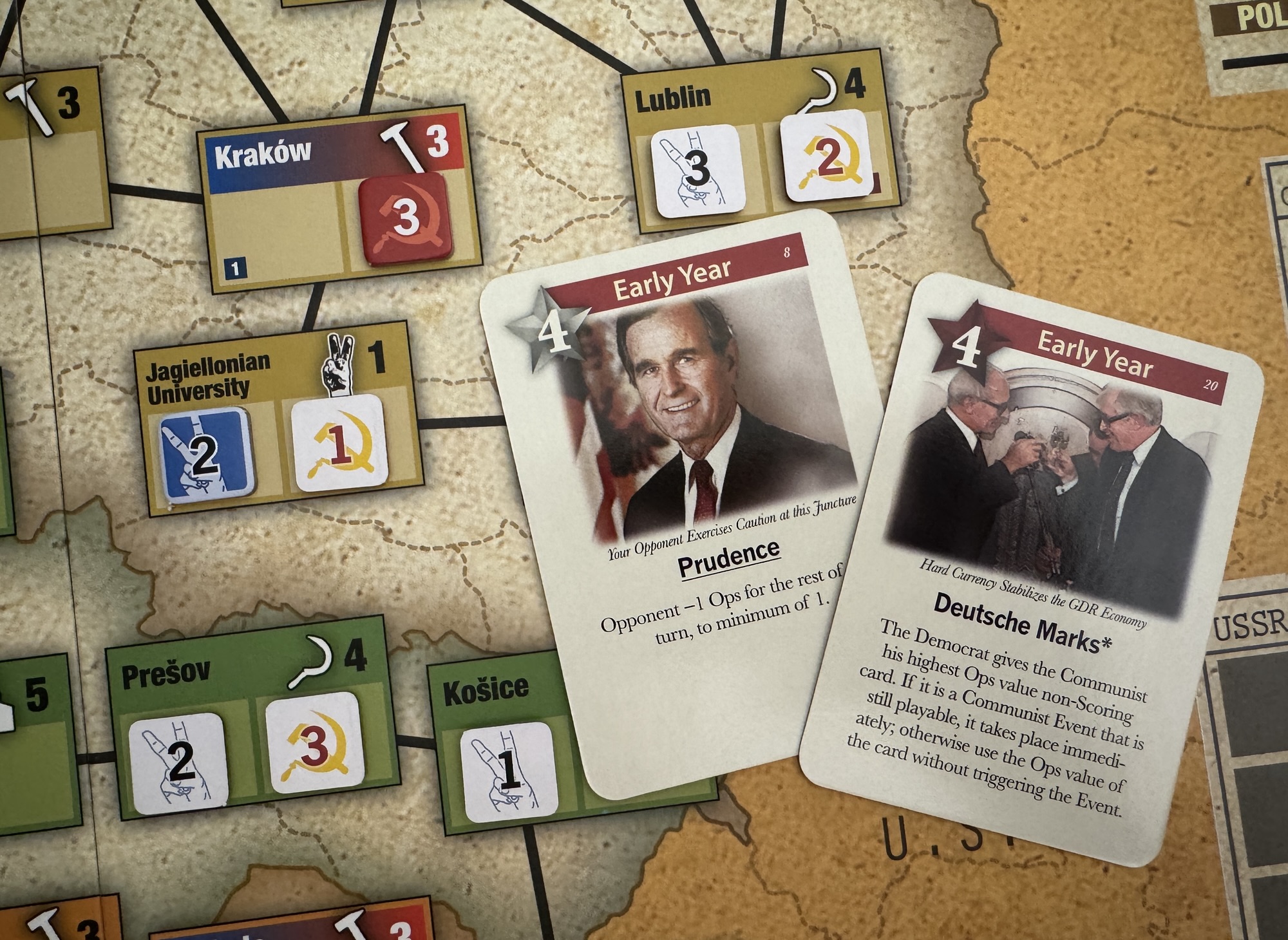
Any game that has cards is focused somehow on attacking those cards or at least minimizing access to them or to taking a turn away from your opponent by causing them to have to discard one of their cards or to do something else with that card. But there are some type of cards that will limit your opponent’s cards and their effectiveness by imposing a penalty on them. That is the case with our next card in this series from 1989: Dawn of Freedom called Prudence. The card is very simple as it imposes a -1 Ops penalty on all cards played by your opponent for the Operations Points for the remainder of the turn. All cards still will retain at least a 1 Op value but others will be reduced. The play of this card as an Event or for the juicy 4 Ops that it conveys is a real choice and players need to understand the value in the card. If played as the first card play of a turn, the penalty can impose up to a -6 Ops loss to your opponent over the course of the turn. So you have to somewhat do a cost-benefit analysis when you play the card and decide if it is best played for the Event or for the Ops. The later the turn goes, the less impact and utility the Event will have and you must gain a return from this valuable card if used for the Event. 4 Ops cards are rare and you must come out on top or your game will suffer.

President George H.W. Bush frequently used the word “prudence” to describe his cautious, restrained approach to foreign policy during the historic collapse of the Soviet bloc and the end of the Cold War. Prudence meant calculating risks and weighing long-term consequences rather than reacting with flashy, immediate emotion. When the Berlin Wall fell in 1989, Bush famously refused to publicly dance on the wall or gloat, despite pressure from political rivals like Senator George Mitchell. This was a measured and conscious choice to deescalate the tensions and fall out from the fall of the Berlin Wall as Bush feared that openly humiliating Soviet leaders or the Soviet military might provoke a hardline backlash or cause Moscow to halt troop withdrawals from Eastern Europe.

As you may know, comedian Dana Carvey popularized a famous caricature of George H.W. Bush on Saturday Night Live, using the catchphrase “Not gonna do it. Wouldn’t be prudent” to lampoon the President’s cautious speech patterns and deliberate style. While critics sometimes mocked his caution as a lack of a grand vision and understanding of his place as the Leader of the free world, historians often credit his prudent diplomacy with managing a peaceful transition out of the Cold War.

I very much enjoy the thematic connection of this card with the Event. The play of this card, which is a choice as it has a 4 Ops value and could be used in a different manner to forward the player’s interests on the game board, mimics the restraint and choices before President Bush. I think that in today’s world, this type of restraint is sorely lacking and if present at the time of the fall of the Berlin Wall, could have sparked further decades of struggle as the Cold War would have continued to freeze the 2 Super Powers into an ongoing and pointless ideological fight.

We posted a full review video and you can watch that at the following link:

In the next entry in this series, we will take a look at The Balkan Wars from Imperial Elegy: The Road to the Great War 1850-1920 from VUCA Simulations.

-Grant

My Favorite Wargame Cards – A Look at Individual Cards from My Favorite Games – Card #96: Henry Knox Continental Artillery Commander from Washington’s War from GMT Games

Von: Grant
29. September 2026 um 14:00

With this My Favorite Wargame Cards Series, I hope to take a look at a specific card from the various wargames that I have played and share how it is used in the game. I am not a strategist and frankly I am not that good at games but I do understand how things should work and be used in games. With that being said, here is the next entry in this series.

#96: Henry Knox Continental Artillery Commander from Washington’s War from GMT Games

Washington’s War is a war game, make no mistake about that. But, it is virtually impossible to win the game by focusing only on the field of battle. For that to happen, the Patriots need to completely drive the British forces out of the 13 colonies or the British need to wipe the American forces off the map. Both are extremely difficult and I would be surprised if any more than 1 out of 30 games ended in such a way. Rather, the ultimate goal of the game is to have political control of the colonies. If at the end of the game the Patriots control 7 colonies, while holding the British to control of less than 5, they win. If not, the British win. Simple as that. So, you can see that battle is not the main goal but control is. And more importantly political control.

I really like this about the design and feel that the real core of the American Revolution was the groundswell of patriotism and the desire to live free from the shackles of an overseas monarch who cared little for the American way of life. This desire led great men of the time to sacrifice themselves, their livelihood and their families to further the true cause of liberty and build a truly free and democratic nation where individual liberty and freedom was prioritized over anything else. And yes, I realize that this nation was not perfect, not without contradiction but the concept of liberty helped to form a country that would lead to the ultimate freedom of all people.

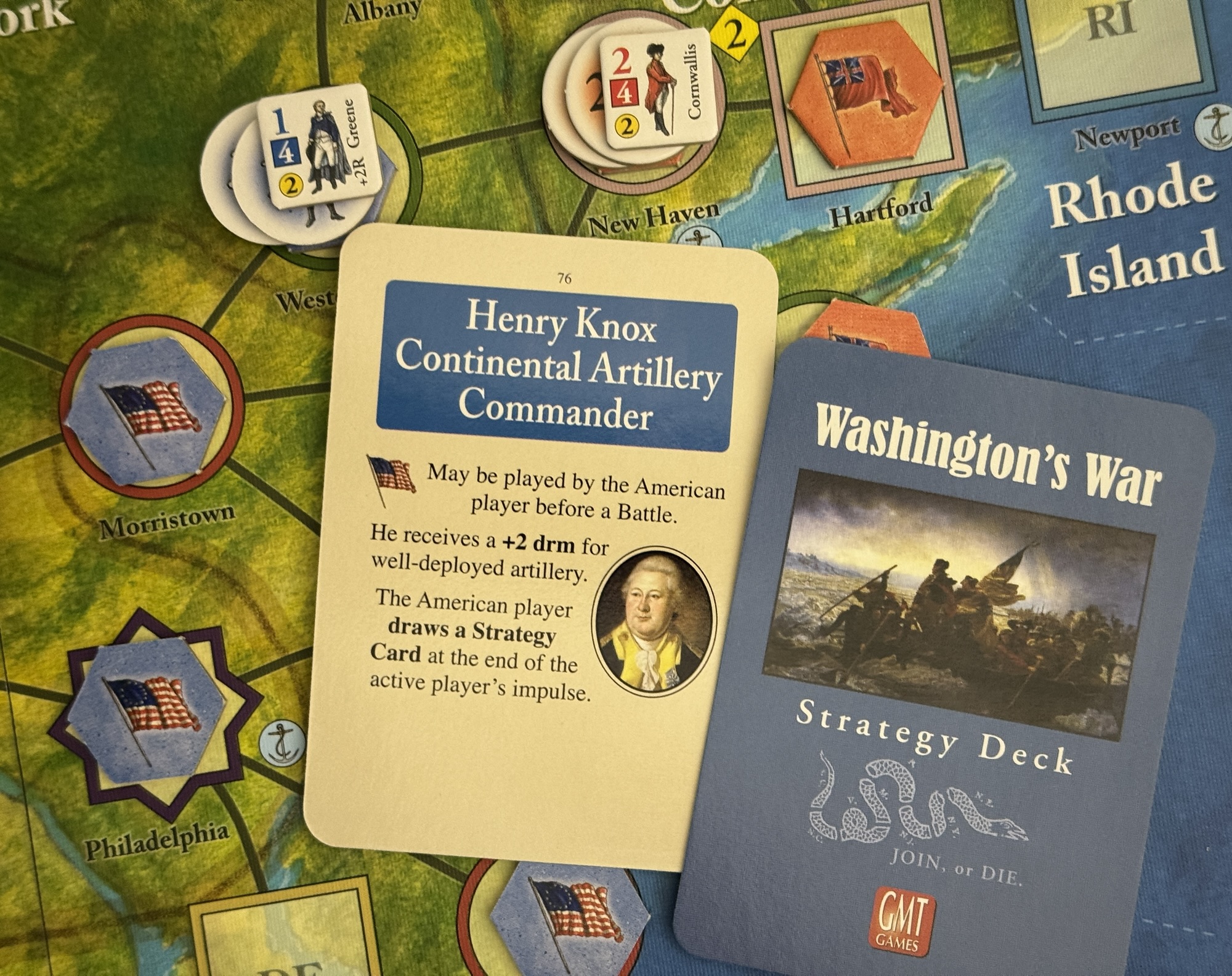
Washington’s War is a Card Driven Game, and as such, relies on cards to provide to players the actions needed to play the game. The cards contain OPS Points which can be used to drive various actions, including such things as activating leaders, who in turn will then move with forces to attack, and also contain written text in the form of events. These events can be played only by the side they are intended for and if drawn and played by the opposing side, they can only be thrown away while granting a few possible actions, such as placing or removing Political Control markers.

In Washington’s War, the Strategy Card Deck contains several different type of cards of which one is Battle Cards. Battle Cards are special event cards that provide a powerful +2 Die Roll Modifier (DRM) during combat and allow the user to draw a replacement card at the end of the turn. All of the Battle Cards offer a +2 DRM but each of them are tied to a different historical character or event. In this instance, the card’s effects reflect the work of Henry Knox who was a prominent Continental Artillery Commander during the Revolutionary War. There are only 9 total Battle Cards in the 110-card deck with the Patriot side having 5 cards, while the British side only has 4. I also want to point out that when these cards are used, they allow the using player to draw a replacement card at the end of the active player’s turn, keeping your hand size strong and not forcing you to sacrifice a card. And due to the fact that they swing combat odds significantly and also replace themselves with a draw, they are heavily prized and typically are saved in a player’s hand for those critical campaign-deciding clashes.

Henry Knox was an American military officer, politician, bookseller, and a Founding Father of the United States. Knox, born in Boston, became a senior general of the Continental Army during the Revolutionary War, serving as chief of artillery in all of George Washington’s campaigns. Following the war, he oversaw the War Department under the Articles of Confederation from 1785 to 1789. Washington appointed him the nation’s first Secretary of War, a position which he held from 1789 to 1794. He is well known today as the eponym of Fort Knox in Kentucky.

During the siege of Boston, the idea arose that cannon recently captured at the fall of forts Ticonderoga and Crown Point in upstate New York could have a decisive impact on its outcome. Knox is generally credited with suggesting the prospect to Washington, who placed him in charge of an expedition to retrieve them even though Knox’s commission as an officer had not yet arrived. Reaching Ticonderoga on December 5, 1775, Knox commenced what came to be known as the “noble train of artillery”, hauling 60 tons of cannon and other armaments by horse-drawn and ox-drawn sleds across some 300 miles of ice-covered rivers and snow-draped Berkshire Mountains to the Boston siege camps.

The region was lightly populated and Knox had to overcome difficulties hiring personnel and draft animals. On several occasions, cannon crashed through the ice on river crossings, but the detail’s men were always able to recover them. In the end, what Knox had expected to take just two weeks actually took more than six, and he was finally able to report the arrival of the weapons train to Washington on January 27, 1776. Historian Victor Brooks writes that this was “one of the most stupendous feats of logistics” of the entire war, and Knox’s effort is commemorated by a series of plaques marking the Henry Knox Trail in New York and Massachusetts.

The cannon were immediately deployed to fortify the Dorchester Heights recently taken by Washington. The battery’s position over Boston harbor led the British to evacuate Boston for Halifax, Nova Scotia. With the siege ended, Knox undertook the improvement of defenses in Connecticut, Rhode Island and New York in anticipation of a possible British assault. In New York he became friends with Alexander Hamilton, commander of the local artillery. He also established a close friendship with Massachusetts general Benjamin Lincoln.

A team of oxen hauls captured artillery toward Boston as part of the 1775-76 “Noble train of artillery”.

Here is a link to our full video review of the game:

In the next entry in this series, we will take a look at Prudence from 1989: Dawn of Freedom from GMT Games.

-Grant

My Favorite Wargame Cards – A Look at Individual Cards from My Favorite Games – Card #95: Flying Ace from The Republic’s Struggle: Battle for the Republic, Spain 1931-1939 from NAC Wargames

Von: Grant
22. September 2026 um 14:00

With this My Favorite Wargame Cards Series, I hope to take a look at a specific card from the various wargames that I have played and share how it is used in the game. I am not a strategist and frankly I am not that good at games but I do understand how things should work and be used in games. With that being said, here is the next entry in this series.

#95: Flying Ace from The Republic’s Struggle: Battle for the Republic, Spain 1931-1939 from NAC Wargames

The Republic’s Struggle is a thematic Card Driven Game that tells the story of the historical events that took place in Spain after the resignation to the throne of King Alfonso XIII, and the proclamation of the II Spanish Republic in 1931. With the creation of the new regime, the struggle for power between the different social, political and ideological sectors increased, which gave rise to continuous changes of political power, alterations of public order, armed uprisings and violent acts, carried out by the numerous ideological factions of the moment; which culminated in 1936, in a failed military uprising. The failure of this coup d’état was the origin for the Spanish Civil War.

The Republic’s Struggle is based on Twilight Struggle from GMT Games and uses the same concepts of area control while adding in some actual combat with units represented on the board. During the game, the Republican player and the National player, will be able to recreate events of the period to increase their popularity in the localities by carrying out political propaganda, recruiting troops or militias, generating revolts or assaults, establishing diplomatic relations or carrying out bombardments. All this will be done by playing their hand of cards in an alternative way, either by using the events or by playing the action points or icons to perform any of the other actions available to the players.

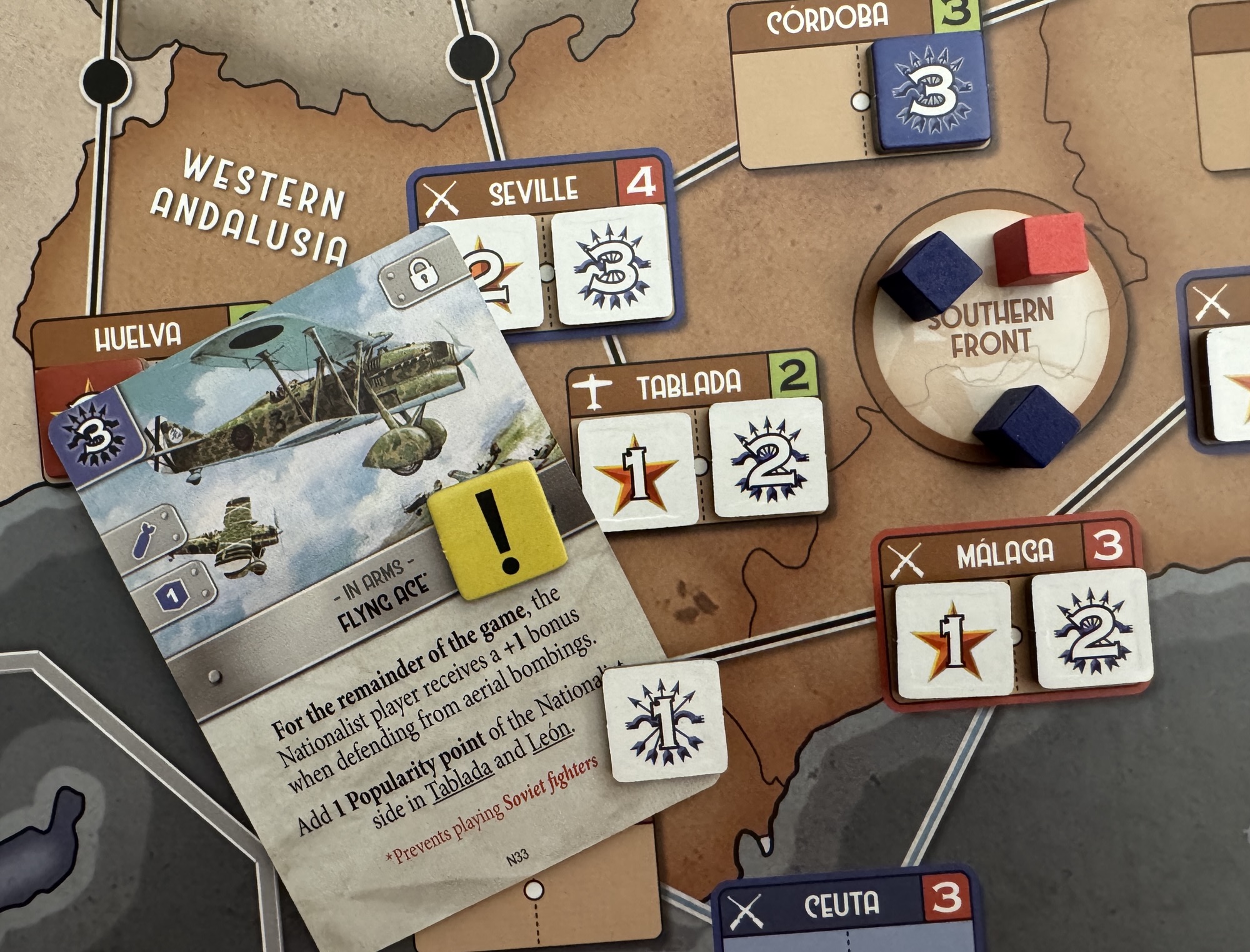
As you probably know, the Spanish Civil War was a bloody and vicious affair. With the advent of air planes and advancement of other weapons technology there was no army that couldn’t be touched. In The Republic’s Struggle players can use their cards and Operation Points to perform an aerial bombing on enemy units that are found on the various fronts. The Bombardment Process is executed by spending the Operation Points (OP’s) of a card, provided the card features a special bomb icon in the upper left hand corner near the Op Points. If a card displays both a bomb icon and a combatant cube icon, you may only choose to execute one of the options and not both. These Bombings target combatants located in specific Fronts, which are represented by circular spaces where army cubes may be placed through card play. In order to perform an aerial bombing, the player must have control of n Air Base Location on the Front that they wish to attack. The attacking player will add the Operation Points of the card played and adds a D6 while the defender will also roll a D6 but will add in the Defense Value that was determined at the outset of the turn by the play of a card and +1 for each of their cubes in the Front. If they have played a card such as Flying Ace, they will get to add a +1 to this total and then results are compared and a winner is determined and losses are the difference between the Attack and Defense Value.

That is the real power in the Flying Ace card as this +1 can be a huge boon in these aerial bombings and allow them to put up a stiffer defense and hold onto more of their units on these Fronts. The game instructs players to utilize the Exclamation Point markers to remind themselves of these type of benefits as the player should place the played card in front of them with the marker to be able to remember the benefit later in that turn.

But the Flying Ace Card provides another smaller but important benefit as it allows the Nationalist player to place 1 Popularity Point in Tablada and León to continue to build their influence and control of these key regions for scoring purposes. And finally, another benefit is that the play of the Flying Ace Card will prevent the Republican player from being able to play their Soviet Fighters Card which has a similar benefit. The thinking here is that the first player to get this card out controls the skies and has air superiority.

Aerial bombing during the Spanish Civil War marked a dark turning point in military history, serving as a lethal testing ground for the aerial terror tactics later unleashed in World War II. An estimated 15,000 people died from air raids during the conflict, with the vast majority of victims being civilians targeted by Nationalist forces backed by Nazi Germany and Fascist Italy. One of these horrific events was that of the Bombing of Guernica on April 26, 1937. Carried out by Nazi Germany’s Condor Legion and Fascist Italy’s Aviazione Legionaria, this raid destroyed a massive portion of the Basque town and killed hundreds of civilians. It became the ultimate global symbol of the brutality of war, immortalized by Pablo Picasso’s famous painting Guernica.

In the next entry in this series, we will take a look at Henry Knox Continental Artillery Commander from Washington’s War from GMT Games.

-Grant

My Favorite Wargame Cards – A Look at Individual Cards from My Favorite Games – Card #94: Hamet’s Army Created from The Shores of Tripoli from Fort Circle Games

Von: Grant
15. September 2026 um 14:00

With this My Favorite Wargame Cards Series, I hope to take a look at a specific card from the various wargames that I have played and share how it is used in the game. I am not a strategist and frankly I am not that good at games but I do understand how things should work and be used in games. With that being said, here is the next entry in this series.

#94: Hamet’s Army Created from The Shores of Tripoli from Fort Circle Games

I have never played a historical wargame on the First Barbary War, which if you didn’t know was one of the first major wars the young United States of America participated in that was situated far outside their sphere of influence in North and South America. Shortly after the end of the American Revolutionary War, commercial vessels of the United States were being attacked and raided by the pirates of the Barbary coast in the Mediterranean Sea. In 1801, newly inaugurated President Thomas Jefferson was eager to put an end to this threat and sent a “squadron of observation” to the Mediterranean to deal with the threat. The Shores of Tripoli covers this conflict and does so using a card driven game mechanic that works really well in this instance. The game is a little deceiving, as at first it appears to be pretty introductory with simple rules and mechanics, but the depth for the game lies in the strategy for each side and the fact that their victory conditions are asymmetric.

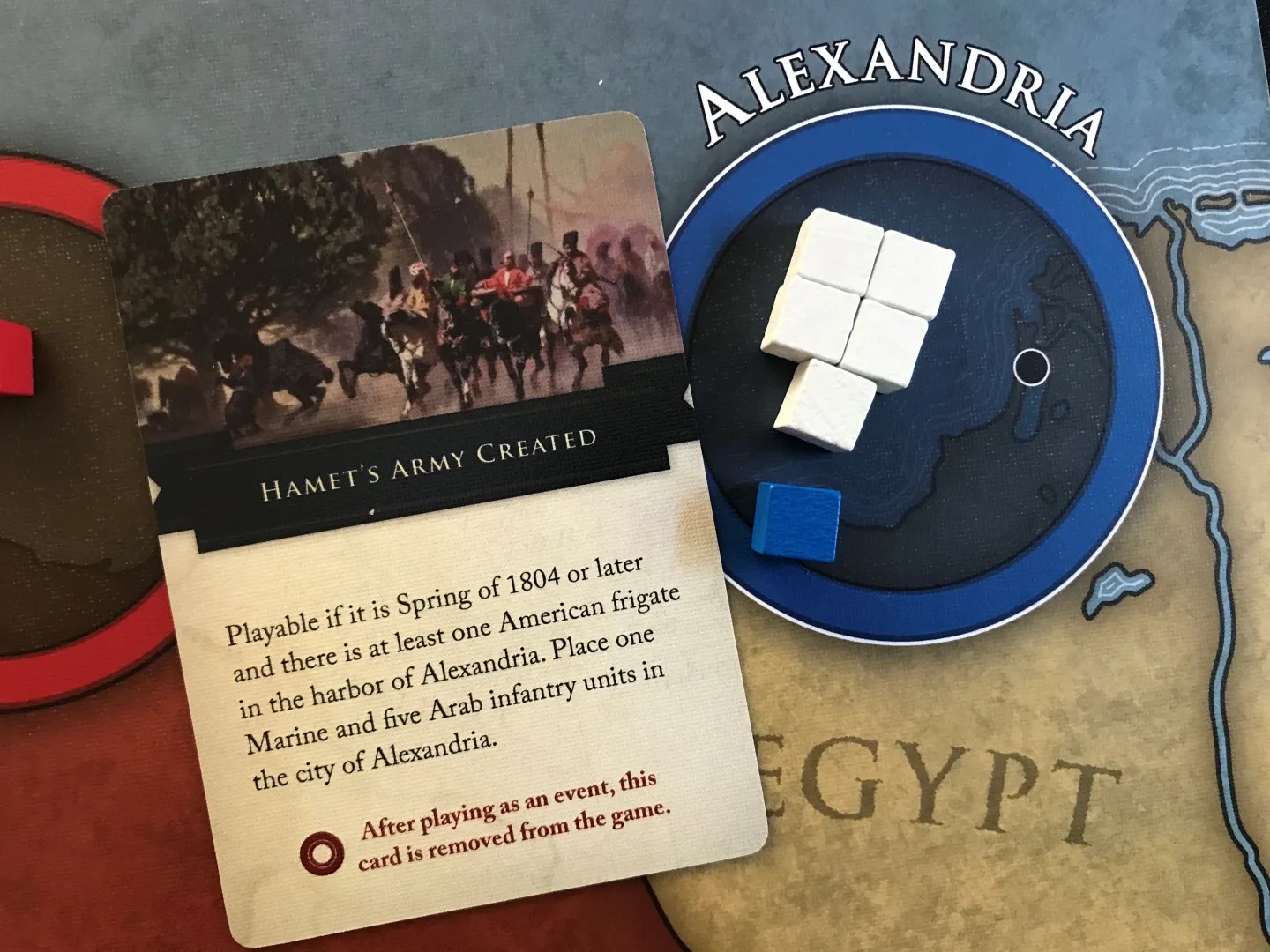
While the main combatants in the game are naval units, there are ground units as well that must be used to try and take Tripoli to win the game. The American ground units consist of Hamet’s Army, which is a combined force of Arab and American infantry units that are dedicated to the mission of installing the pro-American Hamet Qaramanli on the Tripolitan throne. These ground units consist of white cubes that represent the Arab Infantry and blue cubes that represent American Marines. In Ground Combat, each Infantry unit rolls one die and it takes one hit for them to be eliminated.

Hamet’s Army will be created if the United States player plays the card Hamet’s Army Created for the Event. There are several conditions to the card being played though as it must be the Spring of 1804 or later and there has to be at least one American Frigate located in the Alexandria harbor. Once played to bring on Hamet’s Army the card is removed from the game and placed in the box. The newly created army will have to fight their way through 2 locations, Derna and Benghazi, for a final confrontation at Tripoli. I think that I very much enjoy this card because it is a necessary step in the game that the player has to plan for and be prepared to play when it does reveal itself. The player must be ready by using a portion of their limited actions to move at least 1 American Frigate to the harbor of Alexandria and then play this card for the printed event. Keep in mind that this is just the start though as there is a long way to go from here and many more things that must be completed to setup the final showdown.

Hamet Qaramanli’s army was a mixed mercenary force of several hundred Arab and Berber fighters, European cannoneers, and Greek infantry led by U.S. Army Captain William Eaton and U.S. Marine Lieutenant Presley O’Bannon during the First Barbary War. The goal of the expedition was to successfully march across the North African desert, capture the city of Derna, and depose the ruling Pasha of Tripoli, Yusuf Qaramanli in favor of his exiled older brother Hamet Qaramanli. In early 1805, the force marched roughly 500 to 600 miles across the Libyan Desert from Egypt to the Tripolitan border. The force consisted of 8 U.S. Marines, a small group of U.S. sailors, 26 Greek volunteers, a company of cannoneers and roughly 1,000 Arab and Berber mercenaries loyal or allied to Hamet. On April 27, 1805, aided by U.S. Navy warship bombardments, the force successfully stormed and captured the strategic port city of Derna in the Battle of Derna. But before Hamet’s army could advance further toward Tripoli, the United States signed a peace treaty with Yusuf Qaramanli, abandoning Hamet’s claim to the throne in exchange for freed American prisoners and an end to tributes.

Lieutenant O’Bannon and Marines advancing toward Tripoli. (Image from Merrill L. Bartlett and Jack Sweetman, The U.S. Marine Corps: An Illustrated History, (Naval Institute Press, Annapolis, MD: 2001), 30–31.)

In the next entry in this series, we will take a look at Flying Ace from The Republic’s Struggle: Battle for the Republic, Spain 1931-1939 from NAC Wargames.

-Grant

My Favorite Wargame Cards – A Look at Individual Cards from My Favorite Games – Card #93: German Home Card Otto von Bismarck from Imperial Elegy: The Road to the Great War 1850-1920 from VUCA Simulations

Von: Grant
09. September 2026 um 14:00

With this My Favorite Wargame Cards Series, I hope to take a look at a specific card from the various wargames that I have played and share how it is used in the game. I am not a strategist and frankly I am not that good at games but I do understand how things should work and be used in games. With that being said, here is the next entry in this series.

#93: German Home Card Otto von Bismarck from Imperial Elegy: The Road to the Great War 1850-1920 from VUCA Simulations

Imperial Elegy: The Road to the Great War 1850-1920 is a massive card driven game that blends diplomacy, warfare, and statecraft and feels a bit akin to games like Here I Stand and Virgin Queen from GMT Games, which are both grand scale sweeping epics that play multiplayers and take a day to play. Players play as 1 of 6 major powers in the game including Germany/Prussia, the United Kingdom, France, Austria-Hungary, Russia and the Ottoman Empire. The game is quite grand and ambitious as it covers 70 years near the end of the Victorian Era and the Progressive Ear and sees quite a lot of global change and competition between the great powers of the time. The game is a Card Driven Game and uses Action Cards as a type of currency to spend for their Command Points or the printed event to take actions such as recruiting armies and navies, industrialize, moving fleets and armies around the globe, influencing minor powers and establish colonies in Africa, India and the Pacific Ocean. The cards are all tied to the history of the period but the game can be played very much as a sandbox allowing players to explore strategies by trailblazing new horizons or following history.

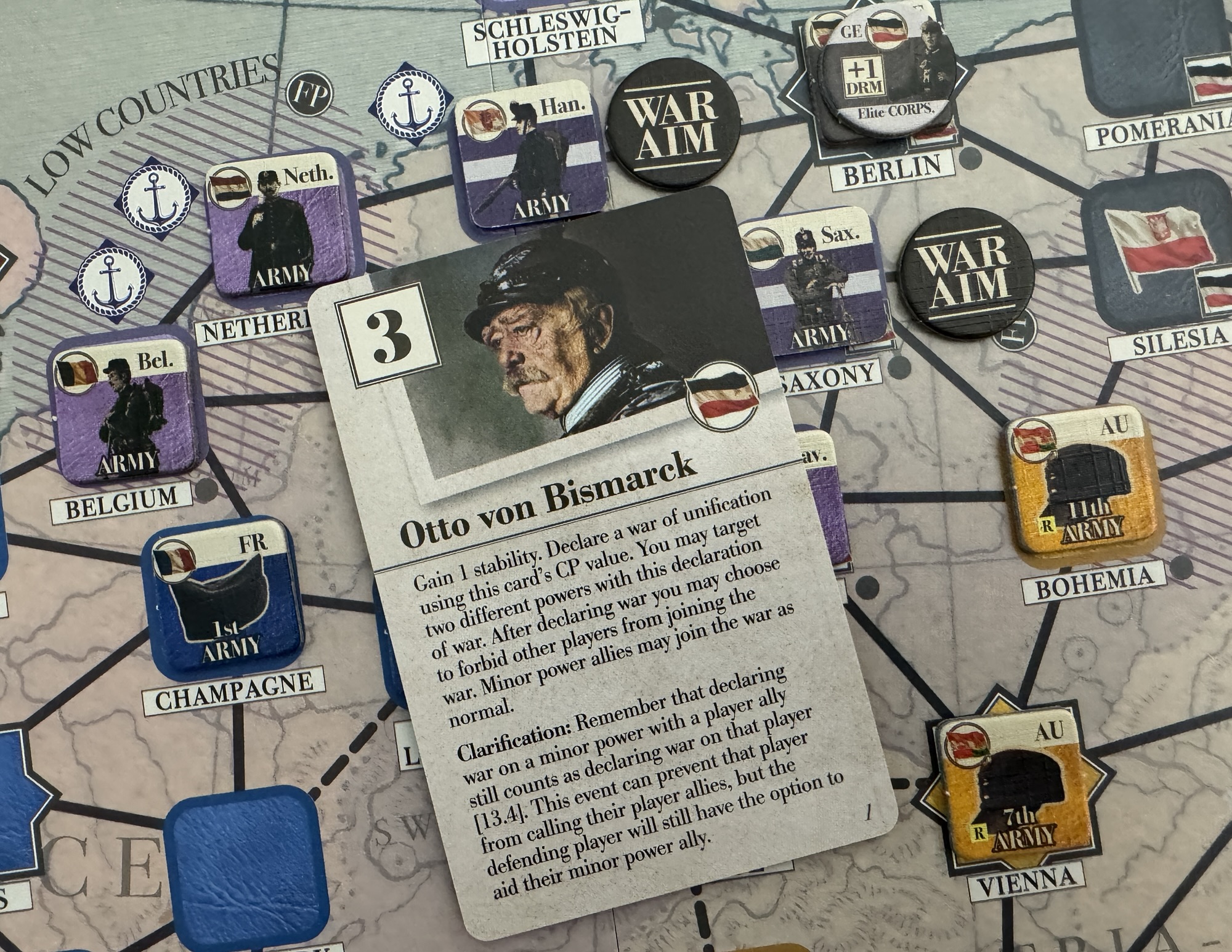
In Imperial Elegy: The Road to the Great War 1850-1920, the Otto von Bismarck Card is a powerful and extremely important German Home Card. Rather than being shuffled into the common Action Card Deck, it belongs exclusively to the Prussian/German player’s unique toolkit to represent the historical trajectory of German state-building. The card is mechanically tied to the first few turns of the grand 7-decade timeline and acts as a get started quickly card for the German player as they begin the long and somewhat difficult task of attempting to unify the Germanic peoples under one banner. The German player can choose to execute it on Turn 1 to abstractly simulate Bismarck’s rapid real-world rise to power and kickstart early diplomatic maneuvers or wars. Playing as Germany, the player should be focused on attempting the Unification of Germany and will most likely choose the Unification National Goal card as a standard at the beginning of games. The Bismarck Home Card is the primary historical vehicle used to achieve this unification and simulates driving the annexations or alliances needed to claim crucial minor regions including Saxony, Schleswig-Holstein, Denmark and Alsace Lorraine. And like standard Action Cards in Imperial Elegy, the card presents a choice. The German player can either choose between using its high Command Point (CP) Value of 3 for a massive push focusing on industrial development or military actions, or using the card for its printed Event text. One of the really nice parts of the card is the way that it effects Stability in the game. Stability is a core national resource and rating that measures a major power’s internal political health, structural integrity and capacity to wage war or absorb setbacks such as economic downtown and social upheaval. Typically, when you declare war, your Stability will degrade but not in the case of a War of Unification. And with Bismarck, Germany will gain 1 Stability when they declare a War of Unification. This is such a powerful effect for the early game as it will allow the German state to build up their capacity and increase Stability to be able to perform later in the game.

1871 portrait of Otto von Bismarck, the first Chancellor of the German Empire. He is depicted wearing his signature Prussian military uniform, including the distinct Pickelhaube (spiked helmet).

Otto Eduard Leopold, Prince of Bismarck, Duke of Lauenburg, known as Otto von Bismarck, was a conservative German statesman who masterminded the unification of Germany in 1871 and served as its first chancellor until 1890, in which capacity he dominated European affairs for two decades. He had previously been Minister President of Prussia from 1862–1890 and Chancellor of the North German Confederation from 1867–1871. He provoked three short, decisive wars, against Denmark, Austria, and France.

Following the victory against Austria, he abolished the supranational German Confederation and instead formed the North German Confederation as the first German national state, aligning the smaller North German states behind Prussia, and excluding Austria. Receiving the support of the independent South German states in the Confederation’s defeat of France, he formed the German Empire – which also excluded Austria – and united Germany.

With Prussian dominance accomplished by 1871, Bismarck skillfully used balance of power diplomacy to maintain Germany’s position in a peaceful Europe. To historian Eric Hobsbawm, Bismarck “remained undisputed world champion at the game of multilateral diplomatic chess for almost twenty years after 1871, and devoted himself exclusively, and successfully, to maintaining peace between the powers”. However, his annexation of Alsace-Lorraine (Elsaß-Lothringen) gave new fuel to French nationalism and Germanophobia. Bismarck’s diplomacy of Realpolitik and powerful rule at home gained him the nickname the “Iron Chancellor”. German unification and its rapid economic growth was the foundation to his foreign policy. He disliked colonialism but reluctantly built an overseas empire when it was demanded by both elite and mass opinion. Juggling a very complex interlocking series of conferences, negotiations and alliances, he used his diplomatic skills to maintain Germany’s position.

A master of complex politics at home, Bismarck created the first welfare state in the modern world, with the goal of gaining working-class support that might otherwise go to his Socialist opponents. In the 1870s, he allied himself with the low-tariff, anti-Catholic Liberals and fought the Catholic Church in what was called the Kulturkampf (“culture struggle”). He lost that battle as the Catholics responded by forming the powerful German Centre Party and using universal male suffrage to gain a bloc of seats. Bismarck then reversed himself, ended the Kulturkampf, broke with the Liberals, imposed protective tariffs, and formed a political alliance with the Centre Party to fight the Socialists. A devout Lutheran, he was loyal to his king, Wilhelm I, who argued with Bismarck but in the end supported him against the advice of his wife Queen Augusta and his heir Crown Prince Frederick William. While Germany’s parliament was elected by universal male suffrage, it did not have much control of government policy. Bismarck distrusted democracy and ruled through a strong, well-trained bureaucracy with power in the hands of a traditional Junker elite that consisted of the landed nobility in eastern Prussia. He largely controlled domestic and foreign affairs, until he was removed by the young new headstrong Kaiser Wilhelm II. He retired to write his memoirs.

This historic image shows Chancellor Prince Otto von Bismarck (center) with diplomatic envoys and plenipotentiaries of the Federal Council (Bundesrat) inside the Berliner Reichstag in 1889.

We have put out several pieces of content covering Imperial Elegy and find it to be a fantastic game. These include written posts and videos. You can visit those by following the links below:

Unboxing Video:

Video Review:

Summary of Solitaire Bots presented by our friend James:

Written First Impressions Post on the blog: https://theplayersaid.com/2026/05/06/first-impressions-imperial-elegy-the-road-to-the-great-war-1850-1920-from-vuca-simulations/

In the next entry in this series, we will take a look at Hamet’s Army Created from The Shores of Tripoli from Fort Circle Games.

-Grant
My Favorite Wargame Cards – A Look at Individual Cards from My Favorite Games – Card #92: Castelnau and Voie Sacrée from Verdun 1916: Steel Inferno from Fellowship of Simulations

Von: Grant
02. September 2026 um 14:00

With this My Favorite Wargame Cards Series, I hope to take a look at a specific card from the various wargames that I have played and share how it is used in the game. I am not a strategist and frankly I am not that good at games but I do understand how things should work and be used in games. With that being said, here is the next entry in this series.

#92: Castelnau and Voie Sacrée from Verdun 1916: Steel Inferno from Fellowship of Simulations

Over the past several years, we have played quite a few World War I games with our focus on the Guns of August events every summer. We have really played some fantastic games including some of the true classics on the genre such as Paths of Glory from GMT Games and The Lamps are Going Out from Compass Games but also some real hidden gems like At All Costs from Hollandspiele, Devil Dogs from Worthington Publishing and Decisive Victory 1918: Soissons from Legion Wargames. A game that we very much liked was Verdun 1916: Steel Inferno from Fellowship of Simulations. The game is a Card Driven Game that uses cards with events and operation points to tell the grim story of the year long fighting around the French city of Verdun. The game uses a bucket of dice approach to the initial bombardments in a battle and then players choose whether to follow that with an infantry assault that doesn’t use any dice to determine hits. The game is very much a wargame but I think the cover highlights a key fact about the game by calling it a “Strategy Game” namely that it is a game as there are wildly powerful events based in history, with lots of dependence on dice not just for bombardments but also for playing certain offensives Event Cards where Victory Points are earned based on the higher numbers rolled. The game is very well done, is truly interesting and surprisingly deep with its tactical choices and decisions. 

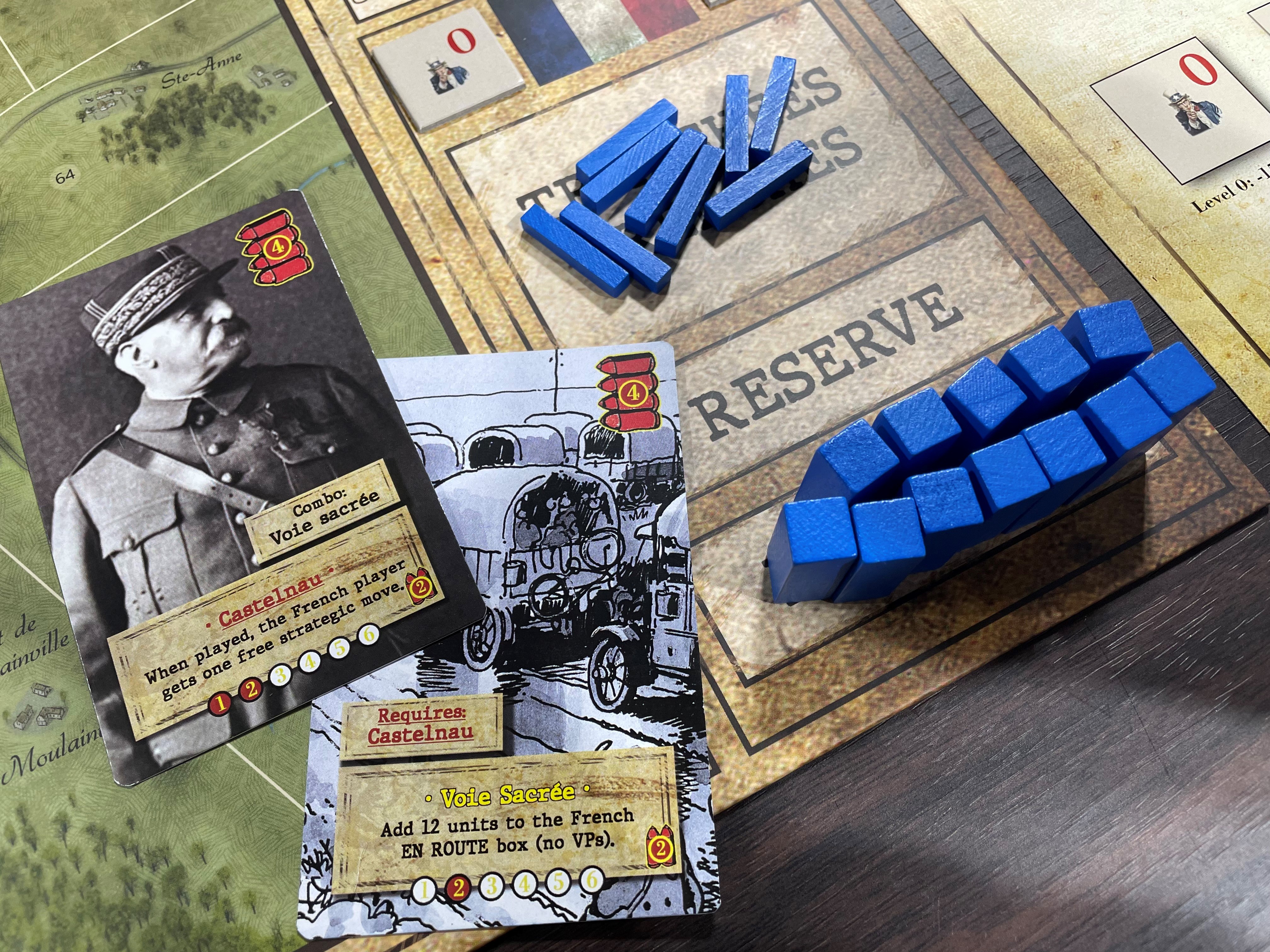
Some cards cannot be played as an Event until a specific named card has been played by the player. This is indicated on the card with a small “requires” box above the title of the card which shows the card that must already be in play as a Permanent Event to allow the new event to be triggered. Also, these Required Cards also have a small “combo” box above the title of the card to remind players which card they will allow to be played as a Permanent Event. Sometimes this concept of Combos must be planned for and may take a few rounds to get lined up to be able to play.

A perfect example of this is the Castelnau/Voie Sacrée Combo. Castelnau is an Event Card that must be played down on the table as a Permanent Event and is available during Turns 1 and 2. Once it is played, then that unlocks the play of Voie Sacrée and allows a very powerful Combo to go into effect by allowing the French player to place 12 units into the En Route Box on the board meaning they will be available for placement during the next Turn. This is so very powerful as in order to get that many units to use, the French player has to sacrifice a total of 12 VP (1 VP per unit added as Reinforcements). With this Combo, you sacrifice no VP’s and get 12 units to place on the board to plug the inevitable holes that will be created by the powerful German Barrages and assaults. There are other Combos as well including several specified Offensives (Russian Offensives and the Somme Offensive) that take several Turns to accomplish with multiple cards to get an opportunity to roll dice to gain VP’s. This was a very novel idea for the CDG mechanic and really worked well to create some portion of the game that required planning and an investment.

The Voie Sacrée, which is French for Sacred Way or Sacred Road, is a road that connects Bar-le-Duc to Verdun, France. It was given its name because of the vital role it played during the Battle of Verdun in World War I. After March 1916, along the 45 miles of the Voie Sacrée, transport vehicles were on the move day and night, ferrying troops, armaments, and supplies to the Verdun battlefield. During the initial crisis of February 21st through March 22nd, 600 trucks per day had already delivered 48,000 tons of ammunition, 6,400 tons of other materiel and 263,000 men to the battlefield. Beginning on February 21st, all horse-drawn traffic and troop movements on foot had been ordered off the road, leaving it open for truck and motorcar traffic only. After March 1916, one truck passed every 14 seconds, submitting the road to considerable wear and tear. Quarries had to be opened nearby to supply the road with crushed stone. Over the course of ten months, 16 labour battalions worked to keep the road in good shape and order. The road had been recognised since 1915 as the only reliable vehicular road that remained in existence to supply Verdun safely. All the standard-gauge railway lines that could reach Verdun had already been interrupted by German forces in late 1914. To compensate for this precarious situation, the road had been widened to 23 ft during 1915, so it could accommodate the continuous up and down flow of two lines of truck traffic. This preemptive roadway improvement in 1915, plus success in organizing the transport system on the road (a mission supervised by Colonel Maurice de Barescut, the Chief of Staff of the French Second Army), is what ultimately saved Verdun in 1916.

The Voie Sacrée still exists, but it has been paved over and is now an active secondary road. In 2006, the route was renumbered RD1916, a reference to the road’s most critical year. From 1923, the Voie Sacrée was marked by a borne every kilometer along the route. Each borne is topped with a sculpture of an Adrian helmet, the helmet worn by French soldiers during the Battle of Verdun.

The town hall in the village of Souilly, on the Voie Sacrée, served as headquarters to Generals Philippe Pétain and Robert Nivelle during the Battle of Verdun. A large, well-preserved, two-story stone building fronting on the Voie Sacrée, the Souilly town hall is still in official use today. Several plaques on its facade remind the visitor of the historic role it played in 1916 during the Battle of Verdun and, later in 1918, during the Meuse–Argonne offensive.

In the next entry in this series, we will take a look at the German Home Card Otto von Bismarck from Imperial Elegy: The Road to the Great War 1850-1920 from VUCA Simulations.

-Grant

My Favorite Wargame Cards – A Look at Individual Cards from My Favorite Games – Card #91: DoD Contractors from Andean Abyss: Insurgency and Counterinsurgency in Colombia from GMT Games

Von: Grant
25. August 2026 um 14:00

With this My Favorite Wargame Cards Series, I hope to take a look at a specific card from the various wargames that I have played and share how it is used in the game. I am not a strategist and frankly I am not that good at games but I do understand how things should work and be used in games. With that being said, here is the next entry in this series.

#91: DoD Contractors from Andean Abyss: Insurgency and Counterinsurgency in Colombia from GMT Games

The first game in the COIN Series called Andean Abyss is a 1-4 player multifaction treatment of the campaign for control of Colombia with different factions such as the the Government, FARC (Fuerzas Armadas Revolucionarias de Colombia), AUC (Autodefensas Unidas de Colombia) and the Cartels. The game focuses on all of the facets of the conflict including guerrillas and police, kidnapping and the drug war, military sweeps and terror. The factions deploy distinct capabilities and tactics to influence Colombian affairs and achieve differing goals. Andean Abyss creates an opportunity to get a feel for this model of insurgency and counterinsurgency in Colombia.

In this entry, we will take a look at the interesting and fairly powerful DoD Contractors. The card pays homage to the efforts by the Department of Defense to pay independent contractors to provide pilots for crop spraying over FARC-held territory and for reconnaissance flights to pinpoint the locations of guerrillas and their bases of operation. Patrolling FARC guerrillas in 2003 shot down one such flight along the western slopes of Caquetá and took three US personnel hostage, setting off a Colombian Army manhunt. The event gives the Government player the opportunity in a single Department to Activate all underground Guerillas and also to remove all Cartels Bases. Typically, to perform this type of action is a multi-turn investment with the Government having to mobilize and move Troops and Police into a Department and then perform a Sweep operation to uncover them. Then on a following turn, they can Assault and do things likes Air Strikes to attempt to eliminate these units. But this is very hard to do as the FARC and Cartel player can just use their next action to send their units back Underground or to Rally additional units in the space to safeguard their assets and Bases. On the other side, the Insurgents can use the event to remove up to 3 Government Troop Cubes and also mark both the Government and FARC ineligible through the next turn which means they will lose a turn. This effect is tied to the manhunt by the Government looking for the downed hostages as their resources and efforts are tied up preventing them from taking their normal actions. This can be really powerful and allow the insurgents to recover and get their units on the move or bring in more. Depending upon the time of the game that this is played, and around whatever circumstances are going on, this can really be a powerful card either way and I love how it reflects the US efforts to smoke out these drug lords in their war on drugs.

In 1978, Baton Rouge pilot Barry Seal, who flew commercial jets for TWA, is recruited by CIA case officer Monty Schafer. He asks Seal, who has been smuggling Cuban cigars into the country to make a little money, to fly reconnaissance missions over Central America using an Aerostar 600, outfitted with aerial surveillance cameras. Seal accepts the job, but hides it from his wife, Lucy.

In the 1980’s, Schafer asks Seal to act as a courier between the CIA and General Noriega in Panama. During a mission, the Medellín Cartel picks Seal up and asks him to fly cocaine on his return flights to the US. Seal accepts and flies the cartel’s cocaine to Louisiana, airdropping the drug in the countryside.

The CIA turns a blind eye to the drug smuggling, but the DEA tracks Seal down. To avoid the authorities, Seal and his family relocate to Mena, Arkansas and his wife comes to accept the wealth generated by his side job. The small town becomes wealthy as the hub of US cocaine trafficking.

Later, Schafer asks Seal to run guns to the Nicaraguan Contras in Honduras. Realizing the Contras are not serious about the war and just want to get rich, Seal starts trading the guns to the cartel. The CIA sets up a Contra training base in Mena and Seal flies the Contras in, but many of them escape as soon as they arrive.

Seal makes so much money he buries it in suitcases in the backyard. The FBI catches wind of the sudden exuberance on the streets of Mena. Eventually, the CIA shuts down the program and abandons Seal, who is arrested by the FBI, DEA, ATF and Arkansas State Police simultaneously.

Seal escapes prosecution by making a deal with the White House, which wants evidence of the Sandinistas being drug traffickers. They ask him to get photos that tie the Medellín Cartel to the Nicaraguan Sandinistas. Seal manages to get them, but the White House releases them as propaganda against the Sandinistas. Seal is prominently shown in the pictures, which leads to his indictment by the crusading state attorney general and the cartel plotting revenge.

Seal is convicted but sentenced to only 1,000 hours of community service. Moving from motel to motel making video recordings detailing his experiences, Seal expects an explosion any time he starts his car. As his community service is performed at the same Salvation Army building every night, Seal cannot hide from the cartel and is shot dead by an assassin. The CIA destroys all evidence connecting them to Seal and continues smuggling, instead using Iran to get guns to the Contras, as proposed by Schafer.

While this example is a bit more than crop dusting, the operation is part of the same deal and shows the US Government’s reliance on private commercial aircraft pilots during the war on drugs.

In the next entry in this series, we will take a look at Castelnau and Voie Sacrée from Verdun 1916: Steel Inferno from Fellowship of Simulations.

-Grant

My Favorite Wargame Cards – A Look at Individual Cards from My Favorite Games – Card #90: Mob from Time of Crisis: The Roman Empire in Turmoil, 235-284 AD from GMT Games

Von: Grant
18. August 2026 um 14:00

With this My Favorite Wargame Cards Series, I hope to take a look at a specific card from the various wargames that I have played and share how it is used in the game. I am not a strategist and frankly I am not that good at games but I do understand how things should work and be used in games. With that being said, here is the next entry in this series.

#90: Mob from Time of Crisis: The Roman Empire in Turmoil, 235-284 AD from GMT Games

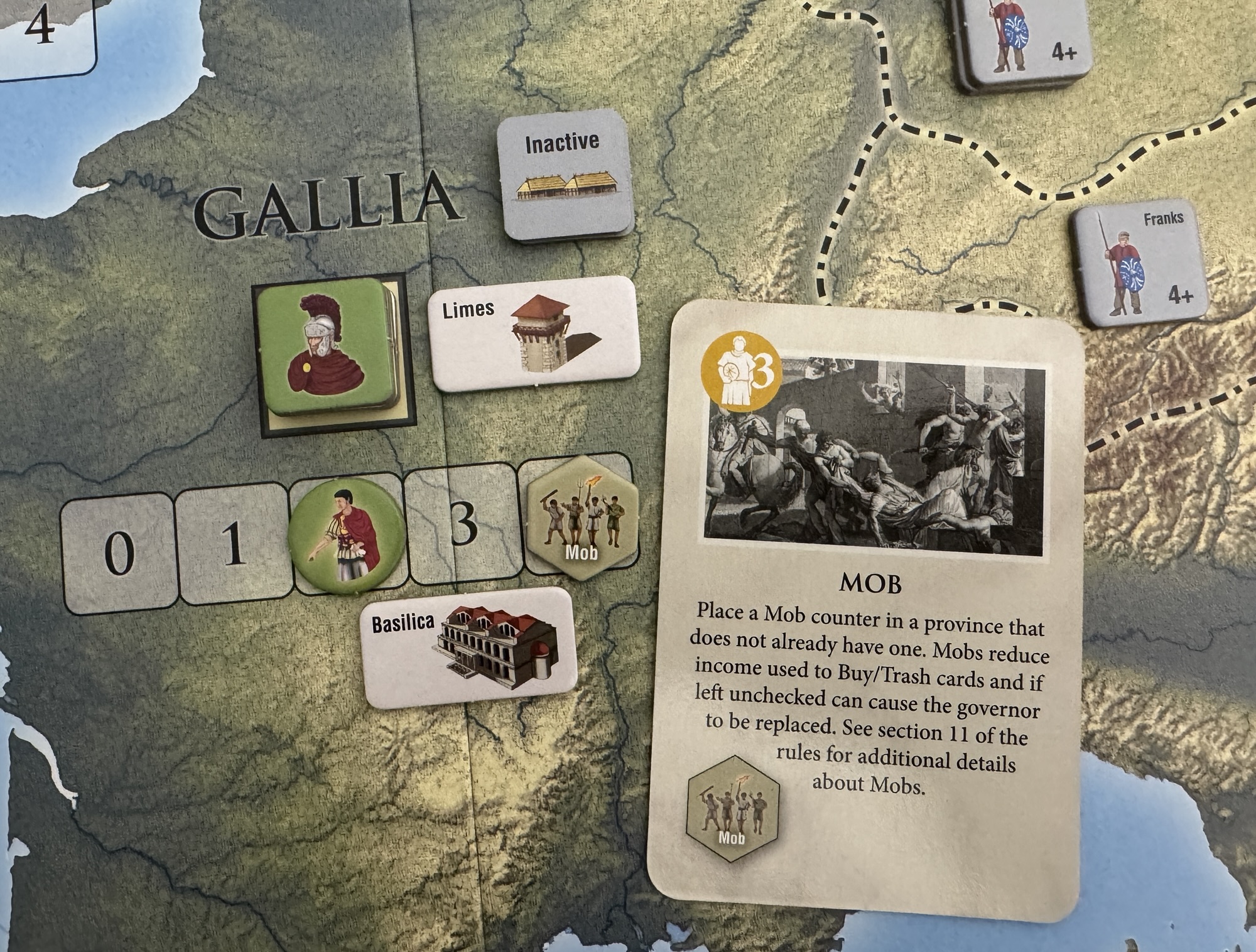
I really love Time of Crisis from GMT Games. This is a very light, introductory wargame that is just plain fun to play. I have been playing it a ton on the Rally the Troops! online platform and really enjoy it no matter what the outcome of those games are. One card that I enjoy using is called Mob, which is a 3 value Populace Card that really can be a devious way to usurp your enemies. Populace cards are intended to be used to increase the support level for your reign in various local senates, recruit militias to assist in the defense of the local populace, to remove Mob counters through the process of holding games and to build various improvements that provide various benefits such as a Basilica, Amphitheater or Limes. You will be unable to control your local provinces without the support of the people and the Populace cards will help you to build that support. But with the Mob card, this is an offensive focused Populace card that can be used to begin undermining your opponents hold on provinces.

When played, the card allows you to place a Mob counter in a province on the board that doesn’t currently have a Mob counter. Mob counters represent rioting and instability in the provincial capital of a province. The Mob in the province will reduce its income generation by the number of Mob counters in the province but also will grow if not dealt with. During the Support Check Phase, if the number of Mob counters in a province equals or exceeds the province’s support level the Governor is replaced with a Neutral Governor with a support level of 1. During the End of Turn Phase, one Mob counter is added to each governed provinces that already has a Mob counter and no Amphitheater. The presence of an Amphitheater doesn’t stop Mob counters from being added from the play of the Mob card but will stop them from growing. Remember, one of the maxims of Ancient Rome was bread and circuses, which is panem et circenses in Latin. It was coined around 100 AD by the Roman poet Juvenal in his Satires. The phrase criticizes how the Roman public traded their political freedom and civic duties for free grain and massive public spectacles.

The Mob card can be quite effective as it reduces the income of your opponents which is used to to purchase additional and more powerful cards but also forces them to spend their card values on suppressing the mobs, through military force with the Suppress Mob action or through placation with the Hold Games action. Both will be a thorn in the side of your opponents and will cause them to have to change their plans temporarily to deal with the issues you have caused them. A fun and delightful “take that” type of card.

Mobs in ancient Rome were powerful, volatile groups of urban plebeians, freedmen and workers who heavily influenced politics, food supplies and public safety. Driven by economic hardship, political gangs, and grain shortages, these crowds routinely rioted, burned government buildings and forced emperors or senators to heed their demands. Ancient Roman writers, politicians, and historians viewed the urban mob (plebs) with a mixture of fear, contempt and fascination, often describing crowds as volatile, lawless and easily swayed by demagogues. One of the more well known quotes from history comes to us by way of Titus Livy when he said, “Indeed, that is the nature of crowds: the mob is either a humble slave or a cruel master.” Livy also wrote: “As for the middle way of liberty, the mob can neither take it nor keep it with any respect for moderation or law.”

1799/1810 copperplate engraving titled The Death of Clodius (or Clodius killed by Milo’s mob) was drawn by the Polish-born French artist Silvestre David Mirys (1750–1810) as part of his series Figures de l’histoire de la république romaine.

If you are interested, I wrote a full review for Time of Crisis and you can read that at the following link: https://theplayersaid.com/2017/09/04/the-most-recent-fruits-of-wargame-hybridization-a-review-of-time-of-crisis-the-roman-empire-in-turmoil-235-284-ad-from-gmt-games/

We also posted a full review video and you can watch that at the following link:

In the next entry in this series, we will take a look at DoD Contractors from Andean Abyss: Insurgency and Counterinsurgency in Colombia from GMT Games.

-Grant

My Favorite Wargame Cards – A Look at Individual Cards from My Favorite Games – Card #89: Frederick Douglas from For the People 25th Anniversary Edition from GMT Games

Von: Grant
11. August 2026 um 14:00

With this My Favorite Wargame Cards Series, I hope to take a look at a specific card from the various wargames that I have played and share how it is used in the game. I am not a strategist and frankly I am not that good at games but I do understand how things should work and be used in games. With that being said, here is the next entry in this series.

#89: Frederick Douglas from For the People 25th Anniversary Edition from GMT Games

For the People is a strategic level Card-Driven wargame about the whole 4+ years of the American Civil War covering the conflict from Texas to Pennsylvania, from the firing on Fort Sumter to the end of the war at Appomattox Court House. Players take on the role of either President Abraham Lincoln or President Jefferson Davis and command armies, promote and relieve generals, conduct amphibious assaults, dispatch cavalry raids, and even battle incompetency and political intrigue among members of your own cabinet.

As a Card Driven Game, For the People includes a deck of strategy cards that are used for conducting campaigns and incorporating the many events and personalities of the war. The Confederate player can build ironclads, naval mines (torpedoes), submarines, conduct overseas purchases and work towards foreign intervention. The Union player can build up his naval blockade, his ironclad fleet, fight draft riots, secure the Border States and issue the Emancipation Proclamation. The cards are used in the classic sense of a CDG for either the Operations Points to fuel various actions or for the printed event. According to the designer Mark Herman, “The cards are designed to present the player with his political and operational options. The use of Strategy Cards as political instruments will slow the operational tempo of military operations. The converse is also true. Both sides spent the first year of the war, 1861, mobilizing and organizing their war efforts.

The game is extremely interesting and I recently had my first experience with it and very much enjoyed what it was that I was doing even though I really had little idea about my proper strategy for the Union and what it is that I should be focused on in the game.

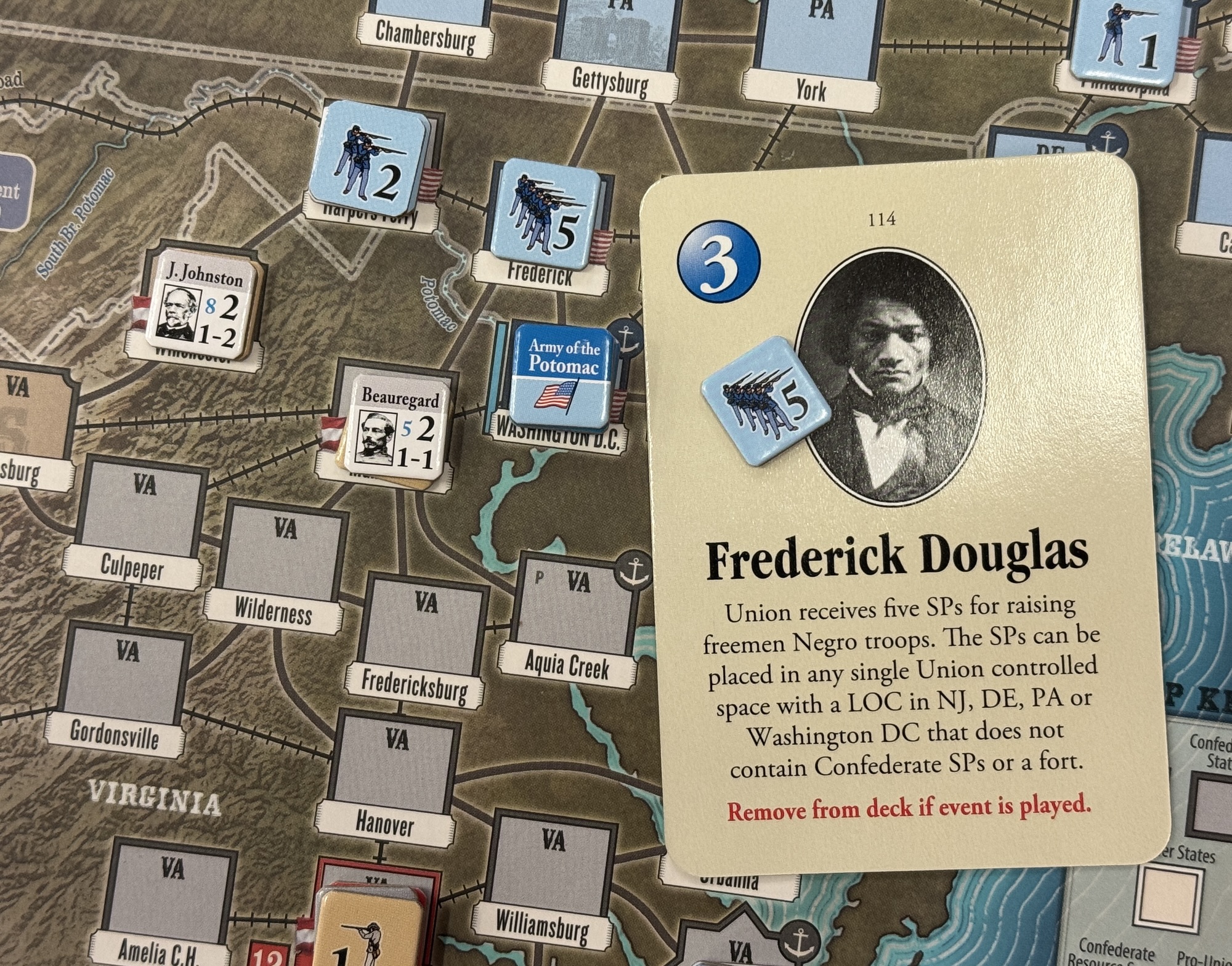
The Frederick Douglas card from For the People really is a bit misnamed. While Frederick Douglas was a major influence for abolitionist activities as well as progressive thinking amongst the politicians of the North, the card really should have been named for the Negro soldiers who gave so much, their lives, their backs and their families, to volunteer and fight on the side of the Union during the American Civil War. The card’s text reads “Union receives five SP’s for raising freemen Negro troops. The SP’s can be placed in any single Union controlled space with an LOC in NJ, DE, PA or Washington, D.C. that does not contain Confederate SP’s or a fort”. This card gives a huge boost to the Union side especially if it comes up early in the game as Union SP’s on the board are spread out and defense of Washington is not as stout as it needs to be. In my recent play, I got this card in my opening hand and was able to place the 5 SP into Frederick, Maryland to add to the already existing 5 SP there. Along with the Army of the Potomac and its SP stationed in Washington, D.C. this effectively discouraged the CSA from invading the North and attempting to go for a capture of the capital. You will notice that the card is a 3 OP’s card, which is very valuable in and of itself, as most of the Union Generals at the start of the game, with the exception of Burnside, have a 3 Strategy Rating and require a 3 OP’s card to activate.

The issues of emancipation and military service were intertwined from the onset of the Civil War. News from Fort Sumter set off a rush by free black men to enlist in U.S. military units. They were turned away, however, because a Federal law dating from 1792 barred Negroes from bearing arms for the U.S. army (although they had served in the American Revolution and in the War of 1812). In Boston disappointed would-be volunteers met and passed a resolution requesting that the Government modify its laws to permit their enlistment.

The Lincoln administration wrestled with the idea of authorizing the recruitment of black troops, concerned that such a move would prompt the border states to secede. When Gen. John C. Frémont in Missouri and Gen. David Hunter in South Carolina issued proclamations that emancipated slaves in their military regions and permitted them to enlist, their superiors sternly revoked their orders. By mid-1862, however, the escalating number of former slaves, the declining number of white volunteers, and the increasingly pressing personnel needs of the Union Army pushed the Government into reconsidering the ban.

As a result, on July 17, 1862, Congress passed the Second Confiscation and Militia Act, freeing slaves who had masters in the Confederate Army. Two days later, slavery was abolished in the territories of the United States, and on July 22nd President Lincoln presented the preliminary draft of the Emancipation Proclamation to his Cabinet. After the Union Army turned back Lee’s first invasion of the North at Antietam, MD, and the Emancipation Proclamation was subsequently announced, black recruitment was pursued in earnest. Volunteers from South Carolina, Tennessee, and Massachusetts filled the first authorized black regiments. Recruitment was slow until black leaders such as Frederick Douglass encouraged black men to become soldiers to ensure eventual full citizenship. Volunteers began to respond, and in May 1863 the Government established the Bureau of Colored Troops to manage the burgeoning numbers of black soldiers.

By the end of the Civil War, roughly 179,000 black men (10% of the Union Army) served as soldiers in the U.S. Army and another 19,000 served in the Navy. Nearly 40,000 black soldiers died over the course of the war. Black soldiers served in artillery and infantry and performed all noncombat support functions that sustain an army, as well. Black carpenters, chaplains, cooks, guards, laborers, nurses, scouts, spies, steamboat pilots, surgeons, and teamsters also contributed to the war cause. There were nearly 80 black commissioned officers. Black women, who could not formally join the Army, nonetheless served as nurses, spies, and scouts, the most famous being Harriet Tubman, who scouted for the 2nd South Carolina Volunteers.

In the next entry in this series, we will take a look at Mob from Time of Crisis: The Roman Empire in Turmoil, 235-284 AD from GMT Games.

-Grant

My Favorite Wargame Cards – A Look at Individual Cards from My Favorite Games – Card #88: National American Woman Suffrage Association from Votes for Women from Fort Circle Games

Von: Grant
05. August 2026 um 14:00

With this My Favorite Wargame Cards Series, I hope to take a look at a specific card from the various wargames that I have played and share how it is used in the game. I am not a strategist and frankly I am not that good at games but I do understand how things should work and be used in games. With that being said, here is the next entry in this series.

Card #88: National American Woman Suffrage Association from Votes for Women from Fort Circle Games

Votes for Women is a very interesting card-driven game that covers the American Women’s Suffrage Movement from 1848-1920, culminating in the ratification of the Nineteenth Amendment which granted women the right to vote. The game is a 2-player game, that has a fully developed solitaire mode with an “Oppobot” and offers a cooperative mode for those who don’t wish to play as they Opposition. The Suffragist player will have to push Congress to propose the Nineteenth Amendment, and then focus on campaigning to have a minimum of 36 states to ratify the Amendment. The Opposition side will try to prevent Congress from proposing the amendment and failing that to have 13 states reject the amendment.

The game uses cards in a fairly traditional CDG way as there are events that can be be taken or the cards can be played to do things like Campaign, Organize or Lobby Congress. Each card has a specific Card Era that is used to create of the each players’ Draw Decks. Late cards will be on the bottom of the deck, Middle cards will be in the middle of the deck and Early cards will be on the top of the deck. The Suffragist and Opposition decks each have one Start card that will be placed in the player’s hand at the start of the game. Some Event Cards have a prerequisite and some of the cards require a player to roll a 6-sided die and only take the the action on a roll of 3-6. Otherwise, the Event Card is discarded with no effect. The cards in this game are also steeped in historical details, from the name of the events that tie back to specific individuals or happenings, to major moments in the struggle. This game is about the history of the struggle for the right to vote and it is very good!

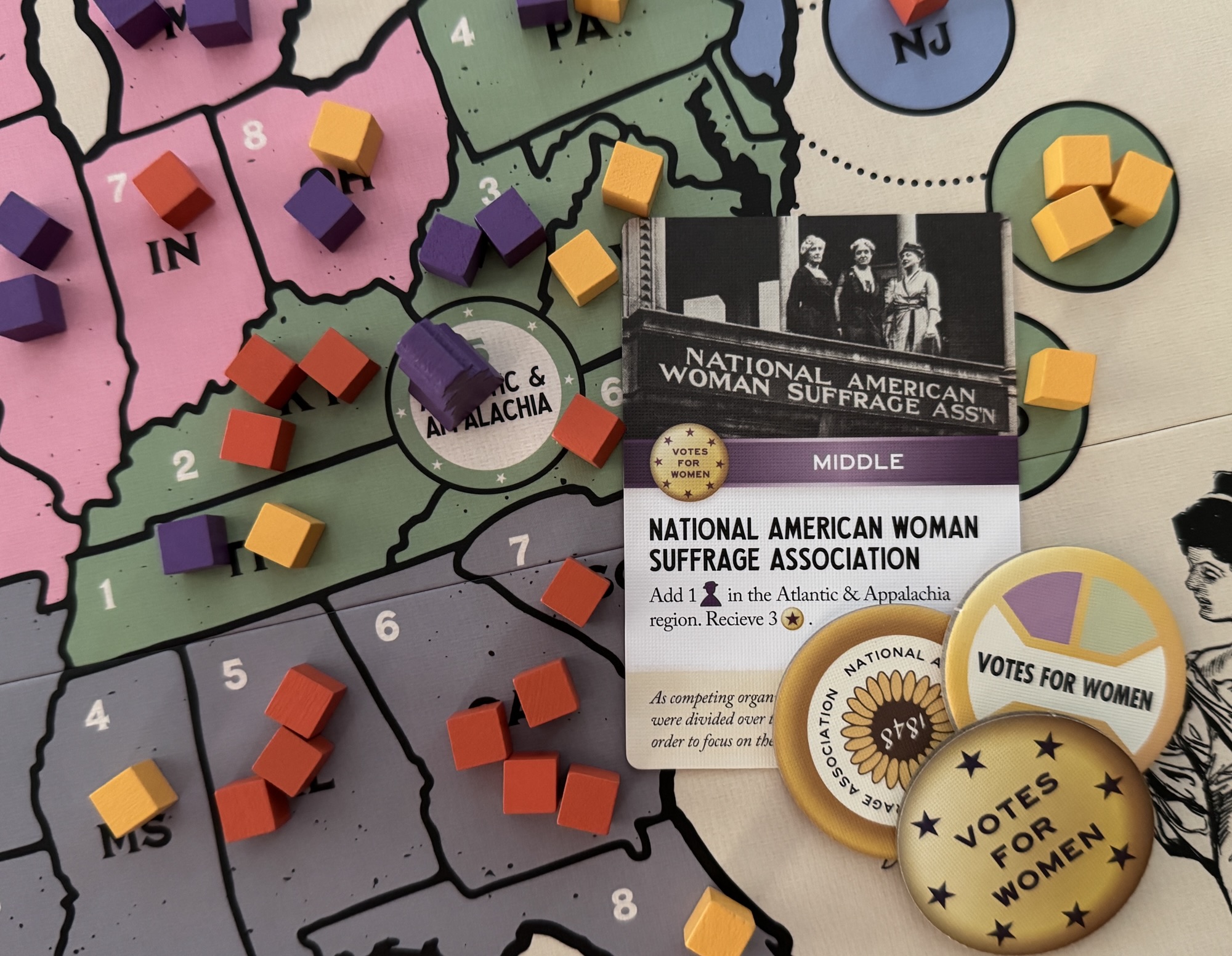
One of the more interesting aspects about the mechanics of the game is the use of Campaigners to go about trying to influence the attitude of the people and legislators regarding the Nineteenth Amendment through the Campaign Action. When a card is played for a Campaign Action, the player rolls a die, either a 6-sided or 8-sided die depending on what cards have been activated, for each Campaigner they have in play. The player then gets to take the dice and their results, which range from 1-8, and assign a specific die to each of their Campaigners. Each Campaigner may then place the corresponding number of cubes, matching the Campaigner’s color, in the States within the region that the Campaigner is located in. The player may spend a Button to move the Campaigner to a different region, but all of the corresponding cubes must be put into the same region. This is a great way to get a lot of influence out on the board to begin taking control of various States for the final vote in the game. This also is a very efficient way of doing this as you will be rolling 2-3 dice for your Campaigners and then spamming the States. With that in mind, today’s card is the National American Woman Suffrage Association and it provides the Suffragist player with a new Campaigner (purple) to place out specifically into the Atlantic & Appalachia Region that includes the States of Kentucky, Tennessee, West Virginia, Pennsylvania, Virginia, North Carolina, Maryland and Delaware. The card also grants the Suffragist player with 3 Buttons that can be used as described above to relocate a Campaigner from one state to another. This card is very helpful and should be played for the Event 9 times out of 10 and will make a huge difference in the outcome of the game. Once a 2nd or 3rd Campaigner is deployed, I tend to take Campaign Actions rather than some of the less intensive placement options or Events.

The National American Woman Suffrage Association (NAWSA) was an organization formed on February 18, 1890, to advocate in favor of women’s suffrage in the United States. It was created by the merger of two existing organizations, the National Woman Suffrage Association (NWSA) and the American Woman Suffrage Association (AWSA). Its membership, which was about 7,000 at the time it was formed, eventually increased to 2 million, making it the largest voluntary organization in the nation. It played a pivotal role in the passing of the Nineteenth Amendment to the United States Constitution, which in 1920 guaranteed women’s right to vote.

Helen Hamilton Gardener, Maud Wood Park and Carrie Chapman Catt at Suffrage House in Washington, D.C.

Susan B. Anthony, a long-time leader in the suffrage movement, was the dominant figure in the newly formed NAWSA. Carrie Chapman Catt, who became president after Anthony retired in 1900, implemented a strategy of recruiting wealthy members of the rapidly growing women’s club movement, whose time, money and experience could help build the suffrage movement. Anna Howard Shaw’s term in office, which began in 1904, saw strong growth in the organization’s membership and public approval.

After the Senate decisively rejected the proposed women’s suffrage amendment to the U.S. Constitution in 1887, the suffrage movement had concentrated most of its efforts on state suffrage campaigns. In 1910 Alice Paul joined the NAWSA and played a major role in reviving interest in the national amendment. After continuing conflicts with the NAWSA leadership over tactics, Paul created a rival organization, the National Woman’s Party.

Here is a link to our full video review of the game:

We also published an interview on the blog with the designer Tory Brown and you can read that at the following link: https://theplayersaid.com/2020/09/07/interview-with-tory-brown-designer-of-votes-for-women-from-fort-circle-games-currently-on-kickstarter/

In the next entry in this series, we will take a look at Frederick Douglas from For the People 25th Anniversary Edition from GMT Games.

-Grant

My Favorite Wargame Cards – A Look at Individual Cards from My Favorite Games – Card #87: Proletarian Revolution from The Republic’s Struggle: Battle for the Republic, Spain 1931-1939 from NAC Wargames

Von: Grant
23. Juli 2026 um 14:00

With this My Favorite Wargame Cards Series, I hope to take a look at a specific card from the various wargames that I have played and share how it is used in the game. I am not a strategist and frankly I am not that good at games but I do understand how things should work and be used in games. With that being said, here is the next entry in this series.

#87: Proletarian Revolution from The Republic’s Struggle: Battle for the Republic, Spain 1931-1939 from NAC Wargames

The Republic’s Struggle is a thematic Card Driven Game that tells the story of the historical events that took place in Spain after the resignation to the throne of King Alfonso XIII, and the proclamation of the II Spanish Republic in 1931. With the creation of the new regime, the struggle for power between the different social, political and ideological sectors increased, which gave rise to continuous changes of political power, alterations of public order, armed uprisings and violent acts, carried out by the numerous ideological factions of the moment; which culminated in 1936, in a failed military uprising. The failure of this coup d’état was the origin for the Spanish Civil War.

The Republic’s Struggle is based on Twilight Struggle from GMT Games and uses the same concepts of area control while adding in some actual combat with units represented on the board. During the game, the Republican player and the National player, will be able to recreate events of the period to increase their popularity in the localities by carrying out political propaganda, recruiting troops or militias, generating revolts or assaults, establishing diplomatic relations or carrying out bombardments. All this will be done by playing their hand of cards in an alternative way, either by using the events or by playing the action points or icons to perform any of the other actions available to the players.

One of the interesting parts of the design is that each player has what is referred to as a Special Card that is included in their hand from the start of the game and can be played during their turn. These cards don’t count towards the maximum number of cards that each player can have in their hand at the beginning of each turn. The 2 cards are Military Uprising, which is given to the Nationalist player and Proletarian Revolution, which is given to the Republican player. These cards are single-use event cards and can only be used during the first 4 turns of the game, or in other words during the period referred to as Phase 1 – The Republic. If, after this phase, these cards have not been played, they must be discarded and removed from the game. Both players can choose to use their Special Card in an Action round, instead of using one of the cards from their hand. These cards are played like the rest of the Operation Cards either using their Operations Value or applying the effects of the printed Event. Once played, the card will be removed from the game so it is use it or lose it.

Both cards are very powerful but have some fairly difficult criteria that must be met to fully realize the value of the printed Event. In the case of our featured card Proletarian Revolution, the top part of the card first gives the player the chance to downgrade the European Status Quo Track by 2 levels. The European Status Quo Track allows players to appeal to and in some ways manipulate the stance of the other European Nations regarding their view on the Spanish Civil War. It also is the determining factor in how Victory Points are awarded for the crucial Armed Actions aspect of the game. At the end of each turn, if the number of Armed Actions carried out by a player equals or exceeds the current level of the European Status Quo, that player will score 3 Victory Points. Also, as long as the European Status Quo Track is set on level 2, players cannot carryout any action using the Operations Points of cards played to advance in the Diplomatic Relations Track. So this is another tied result to the card as if the level is 1, no cards can be played to advance the Diplomatic Relations Track.

But, remember I said that to fully realize the effects of the card, the Republican player would need to control Barcelona, Madrid, Valencia and every Naval Base Location or every Air Base Location. If this is the case when the card is played, then the Republican player will earn an automatic victory. Frankly, this is next to impossible, but has a sliver of possibility depending on how diligent and attentive the Nationalist player is as well as the hand of cards that are drawn by the Republican player. If they draw certain other events, as well as have a hand full of higher Operations Point value cards, they can make a run at this but it is not necessarily recommended. The card also has a very useful secondary use as if the condition isn’t met, they will get to place out on the board 1 combatant cube, representing one of their combat units, and also remove all of the influence of the Nationalist player in the Catalonia and Valencia Regions. This literally means all of the Nationalist influence in these regions which each has several locations. In order for the card to be used in this manner though the Republican player will have had to previously play the Defense Committees card.

The proletarian revolution in the Spanish Civil War refers to the widespread social revolution that erupted in the summer of 1936. Triggered by the failed military coup of July 17, workers spontaneously armed themselves, taking control of factories, collectivizing agriculture, and establishing anti-fascist militias primarily in Catalonia, Aragon, and Andalusia. When General Francisco Franco and conservative military officers attempted to overthrow the democratically elected Second Spanish Republic, the working class retaliated by launching a massive wave of grassroots social reorganization. This proletarian movement aimed to permanently dismantle capitalist structures and the influence of the conservative elite and the Catholic Church.

In major industrial hubs like Barcelona, workers’ committees seized factories, transport networks, and public utilities, shifting control directly to the trade unions. In the countryside, particularly in the region of Aragon, peasants seized large agricultural estates. They abolished private property and reorganized land into self-sustaining collectives operating under libertarian socialist or communist principles. Instead of relying on a traditional military hierarchy, fighting forces were formed as democratic workers’ militias led by trade unions and political parties like the CNT (anarcho-syndicalist) and the POUM (Marxist).

The suppression of the revolutionary movement divided the Republican forces. Deprived of its radical grassroots momentum and lacking support from Western democracies, the Republican cause lost ground to Franco’s well-equipped Nationalist army (which was heavily backed by Nazi Germany and Fascist Italy). The Spanish Revolution was ultimately defeated in 1939, leading to the collapse of the Second Republic and the beginning of Franco’s 36-year dictatorship.

Here is a link to our full video review of the game:

In the next entry in this series, we will take a look at National American Woman Suffrage Association from Votes for Women from Fort Circle Games.

-Grant
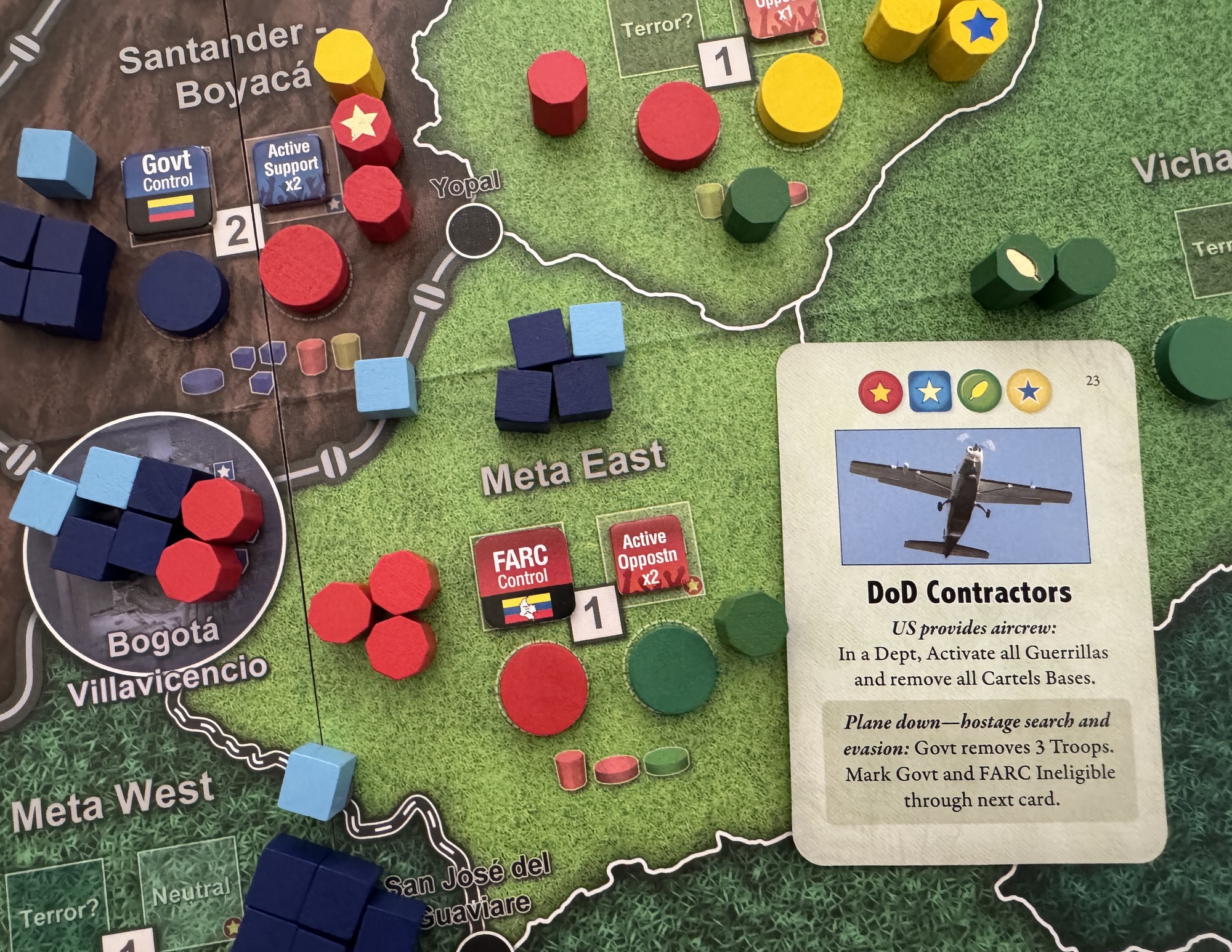
My Favorite Wargame Cards – A Look at Individual Cards from My Favorite Games – Card #85: Hydraulic Recoil from Imperial Elegy: The Road to the Great War 1850-1920 from VUCA Simulations

Von: Grant
07. Juli 2026 um 14:00

With this My Favorite Wargame Cards Series, I hope to take a look at a specific card from the various wargames that I have played and share how it is used in the game. I am not a strategist and frankly I am not that good at games but I do understand how things should work and be used in games. With that being said, here is the next entry in this series.

#85: Hydraulic Recoil from Imperial Elegy: The Road to the Great War 1850-1920 from VUCA Simulations

Imperial Elegy: The Road to the Great War 1850-1920 is a massive card driven game that blends diplomacy, warfare, and statecraft and feels a bit akin to games like Here I Stand and Virgin Queen from GMT Games, which are both grand scale sweeping epics that play multiplayers and take a day to play. Players play as 1 of 6 major powers in the game including Germany/Prussia, the United Kingdom, France, Austria-Hungary, Russia and the Ottoman Empire. The game is quite grand and ambitious as it covers 70 years near the end of the Victorian Era and the Progressive Ear and sees quite a lot of global change and competition between the great powers of the time. The game is a Card Driven Game and uses Action Cards as a type of currency to spend for their Command Points or the printed event to take actions such as recruiting armies and navies, industrialize, moving fleets and armies around the globe, influencing minor powers and establish colonies in Africa, India and the Pacific Ocean. The cards are all tied to the history of the period but the game can be played very much as a sandbox allowing players to explore strategies by trailblazing new horizons or following history.

As you might imagine, the game contains combat and wars of both unification and conquest as each of these empires attempt to grow and expand their borders and the game can end with the outbreak of the Great War. These combats are referred to as Land Battles or Sea Battles. Combat is a very well designed part of the game and involves lots of maneuvering of troops on the board to get into position to have a powerful 2 unit stack be the lead attack but also to be supported by adjacent armies providing strength in the land battle. Each nation has a limited number of armies and also has access to what are referred to as Elite Corps and Expeditionary Forces that can be used to supplement goals of conquest. These Elite Corps units are represented by circular counters and are placed atop an army counter they are attached to and provide a +1 Dice Roll Modifier in combat.

When the game hits the 1880’s, which is turn 4, the Hydraulic Recoil Mandatory Event Card will be added to the deck. When this card is drawn and played, the Mandatory Event will go off and become a permanent change to how combat works. First off, the asterisk and double asterisk printed on the Combat Results Table will now be in effect. The asterisks referenced are summarized as follows from the rules:

Only apply the * and ** portions of the combat results if the Hydraulic Recoil Mandatory Event has been played. *The victor may opt to inflict +1 loss to both sides. ** Both sides take +1 loss.

But other than just the additional losses and choices about how best to use them, there are other big changes that come as a result of the Hydraulic Recoil Mandatory Event. After its play, machine guns give non-rebel units a minimum die roll of a 3 in Land Battles (in other words, rolls of 1 or 2 are now 3’s). But also anytime an Elite Corps and its +1 DRM is used in a land battle, that unit will be eliminated. This automatic elimination cannot be taken as a loss inflicted by the CRT but is in addition to those losses. Big guns equipped with new hydraulic recoil mechanisms were, by far, the number one killer during the Great War, and machine guns made most pre-war tactics obsolete. Coupled together these two technologies made combat much more deadly and far less “swingy”. These mechanics are meant to model these technological shifts on a strategic level.

The hydraulic recoil mechanism in machine guns was pioneered by inventor Sir Hiram Stevens Maxim in the 1880’s. He developed it as part of his 1883 and 1884 patents for the world’s first fully automatic, recoil-operated machine gun called the Maxim gun. The Maxim gun has been called “the weapon most associated with imperial conquest” by historian Martin Gilbert and was heavily used by colonial powers during the “Scramble for Africa”. Afterwards, Maxim guns also saw extensive usage by different armies during the Russo-Japanese War, the First and Second World Wars, as well as in contemporary conflicts.

The Maxim gun featured one of the earliest recoil-operated firing systems in history. Energy from recoil acting on the breech block is used to eject each spent cartridge and insert the next one. Maxim’s earliest designs used a 360-degree rotating cam to reverse the movement of the block, but this was later simplified to a toggle lock. This made it vastly more efficient and less labor-intensive than previous manually operated rapid-firing guns, such as the manually cranked Mitrailleuse of 1851, the Gatling gun of 1861, the Gardner gun of 1874, or the Nordenfelt gun of 1873. The Maxim gun is water cooled, allowing it to sustain its rate of fire far longer than air-cooled guns. The extra weight and complexity this added, however, made it heavier and less flexible in use.

Trials demonstrated that the Maxim can fire 600 rounds per minute (equal to 60 riflemen at the time). Compared to modern machine guns, the Maxim is heavy, bulky, and awkward. A lone soldier can fire the weapon, but it was usually operated by a team of men, usually 4 to 6 in number. Apart from the gunner, other crew are needed to speed reload, spot targets, and carry and ready ammunition and water. Several men are needed to move or mount the heavy weapon.

The Maxim gun was greatly influential in the development of other machine guns, and it has multiple variants and derivatives, such as the Vickers, PM M1910 and MG 08. Some are still in service to the present-day, such as in the Russo-Ukrainian War.

In the next entry in this series, we will take a look at LRRP from Fire in the Lake: Insurgency in Vietnam from GMT Games.

-Grant

❌