❌

Normale Ansicht

My Favorite Wargame Cards – A Look at Individual Cards from My Favorite Games – Card #92: Castelnau and Voie Sacrée from Verdun 1916: Steel Inferno from Fellowship of Simulations

Von: Grant
02. September 2026 um 14:00

With this My Favorite Wargame Cards Series, I hope to take a look at a specific card from the various wargames that I have played and share how it is used in the game. I am not a strategist and frankly I am not that good at games but I do understand how things should work and be used in games. With that being said, here is the next entry in this series.

#92: Castelnau and Voie Sacrée from Verdun 1916: Steel Inferno from Fellowship of Simulations

Over the past several years, we have played quite a few World War I games with our focus on the Guns of August events every summer. We have really played some fantastic games including some of the true classics on the genre such as Paths of Glory from GMT Games and The Lamps are Going Out from Compass Games but also some real hidden gems like At All Costs from Hollandspiele, Devil Dogs from Worthington Publishing and Decisive Victory 1918: Soissons from Legion Wargames. A game that we very much liked was Verdun 1916: Steel Inferno from Fellowship of Simulations. The game is a Card Driven Game that uses cards with events and operation points to tell the grim story of the year long fighting around the French city of Verdun. The game uses a bucket of dice approach to the initial bombardments in a battle and then players choose whether to follow that with an infantry assault that doesn’t use any dice to determine hits. The game is very much a wargame but I think the cover highlights a key fact about the game by calling it a “Strategy Game” namely that it is a game as there are wildly powerful events based in history, with lots of dependence on dice not just for bombardments but also for playing certain offensives Event Cards where Victory Points are earned based on the higher numbers rolled. The game is very well done, is truly interesting and surprisingly deep with its tactical choices and decisions. 

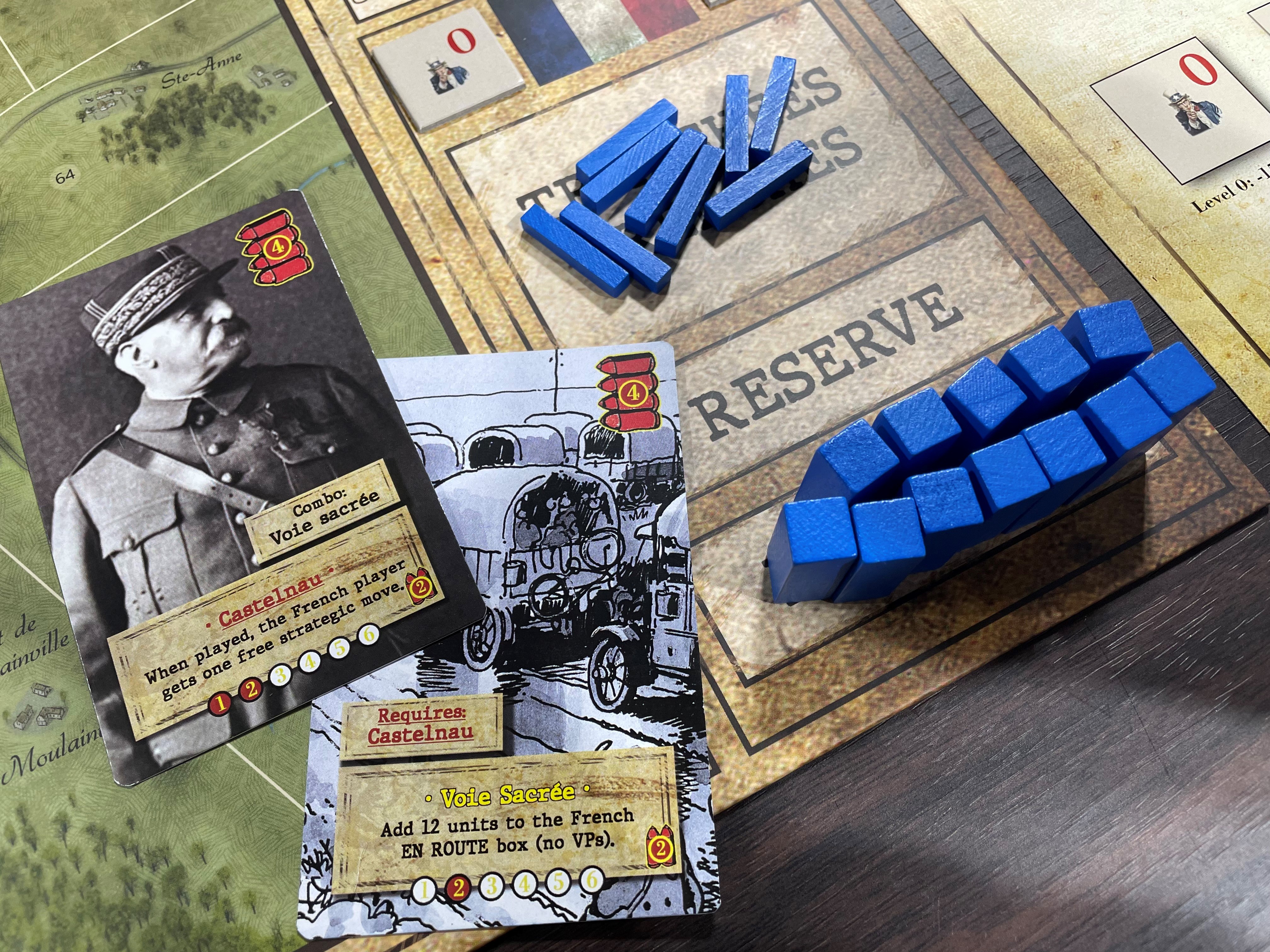
Some cards cannot be played as an Event until a specific named card has been played by the player. This is indicated on the card with a small “requires” box above the title of the card which shows the card that must already be in play as a Permanent Event to allow the new event to be triggered. Also, these Required Cards also have a small “combo” box above the title of the card to remind players which card they will allow to be played as a Permanent Event. Sometimes this concept of Combos must be planned for and may take a few rounds to get lined up to be able to play.

A perfect example of this is the Castelnau/Voie Sacrée Combo. Castelnau is an Event Card that must be played down on the table as a Permanent Event and is available during Turns 1 and 2. Once it is played, then that unlocks the play of Voie Sacrée and allows a very powerful Combo to go into effect by allowing the French player to place 12 units into the En Route Box on the board meaning they will be available for placement during the next Turn. This is so very powerful as in order to get that many units to use, the French player has to sacrifice a total of 12 VP (1 VP per unit added as Reinforcements). With this Combo, you sacrifice no VP’s and get 12 units to place on the board to plug the inevitable holes that will be created by the powerful German Barrages and assaults. There are other Combos as well including several specified Offensives (Russian Offensives and the Somme Offensive) that take several Turns to accomplish with multiple cards to get an opportunity to roll dice to gain VP’s. This was a very novel idea for the CDG mechanic and really worked well to create some portion of the game that required planning and an investment.

The Voie Sacrée, which is French for Sacred Way or Sacred Road, is a road that connects Bar-le-Duc to Verdun, France. It was given its name because of the vital role it played during the Battle of Verdun in World War I. After March 1916, along the 45 miles of the Voie Sacrée, transport vehicles were on the move day and night, ferrying troops, armaments, and supplies to the Verdun battlefield. During the initial crisis of February 21st through March 22nd, 600 trucks per day had already delivered 48,000 tons of ammunition, 6,400 tons of other materiel and 263,000 men to the battlefield. Beginning on February 21st, all horse-drawn traffic and troop movements on foot had been ordered off the road, leaving it open for truck and motorcar traffic only. After March 1916, one truck passed every 14 seconds, submitting the road to considerable wear and tear. Quarries had to be opened nearby to supply the road with crushed stone. Over the course of ten months, 16 labour battalions worked to keep the road in good shape and order. The road had been recognised since 1915 as the only reliable vehicular road that remained in existence to supply Verdun safely. All the standard-gauge railway lines that could reach Verdun had already been interrupted by German forces in late 1914. To compensate for this precarious situation, the road had been widened to 23 ft during 1915, so it could accommodate the continuous up and down flow of two lines of truck traffic. This preemptive roadway improvement in 1915, plus success in organizing the transport system on the road (a mission supervised by Colonel Maurice de Barescut, the Chief of Staff of the French Second Army), is what ultimately saved Verdun in 1916.

The Voie Sacrée still exists, but it has been paved over and is now an active secondary road. In 2006, the route was renumbered RD1916, a reference to the road’s most critical year. From 1923, the Voie Sacrée was marked by a borne every kilometer along the route. Each borne is topped with a sculpture of an Adrian helmet, the helmet worn by French soldiers during the Battle of Verdun.

The town hall in the village of Souilly, on the Voie Sacrée, served as headquarters to Generals Philippe Pétain and Robert Nivelle during the Battle of Verdun. A large, well-preserved, two-story stone building fronting on the Voie Sacrée, the Souilly town hall is still in official use today. Several plaques on its facade remind the visitor of the historic role it played in 1916 during the Battle of Verdun and, later in 1918, during the Meuse–Argonne offensive.

In the next entry in this series, we will take a look at the German Home Card Otto von Bismarck from Imperial Elegy: The Road to the Great War 1850-1920 from VUCA Simulations.

-Grant

The Shortest Nineteenth Century

13. August 2026 um 02:33

The coloration makes me kinda see this in ANN IHI LAT ION mode. REV OLUT IONS.

According to one of my uncles, the terms “right” and “left” derive from the fact that conservatism is correct while liberalism is wrong. You know, because we say “that’s right” to mean “that’s correct” and “that’s left” when we’ve suffered a serious brain hemorrhage and don’t remember how words work.

In actuality, the right/left divide comes to us from the French Revolution of 1789, when the members of the National Assembly who supported the Ancien Régime would sit to the king’s right, while those in favor of the revolution sat to the left. Presto blammo: a rubric that would confuse dumb uncles for the next 240 years.

Still, it’s a helpful formulation for the rest of us, if often an overly simplistic one. When I introduce the five factions from Laurent Rix’s exceptional Revolutions: France 1820-1880, I lay them out from right to left. All the easier to explain their objectives. Often, players appreciate this gesture, especially for the factions in the middle, whose aims might seem alien to our modern minds. And some people say you can’t learn history from a board game.

There were no race cars yet.

I play on a big board with my wife.

The second thing I usually explain when teaching Revolutions is the timing of the whole thing. There are certain dates that stand out in the memory — the existence of the 1812 Overture is a good reminder that the game begins after Napoleon’s removal from power, but not everybody has internalized that particular mnemonic. And it makes sense that not everybody in my very American group would recognize this particular string of dates. 1820 to 1880? What even happened in there?

Why, these are the middle decades of the Long Nineteenth Century! Which is to say a whole lot happened, but it isn’t the sort of stuff that’s often taught in history classes in the United States, where Manifest Destiny and the Civil War loom large over everything else.

In our case, Revolutions casts us as five major factions, all of whom seized and held some measure of power over those six decades. Even if, for one of them, the furthest expression of that power was limited to two months in Paris.

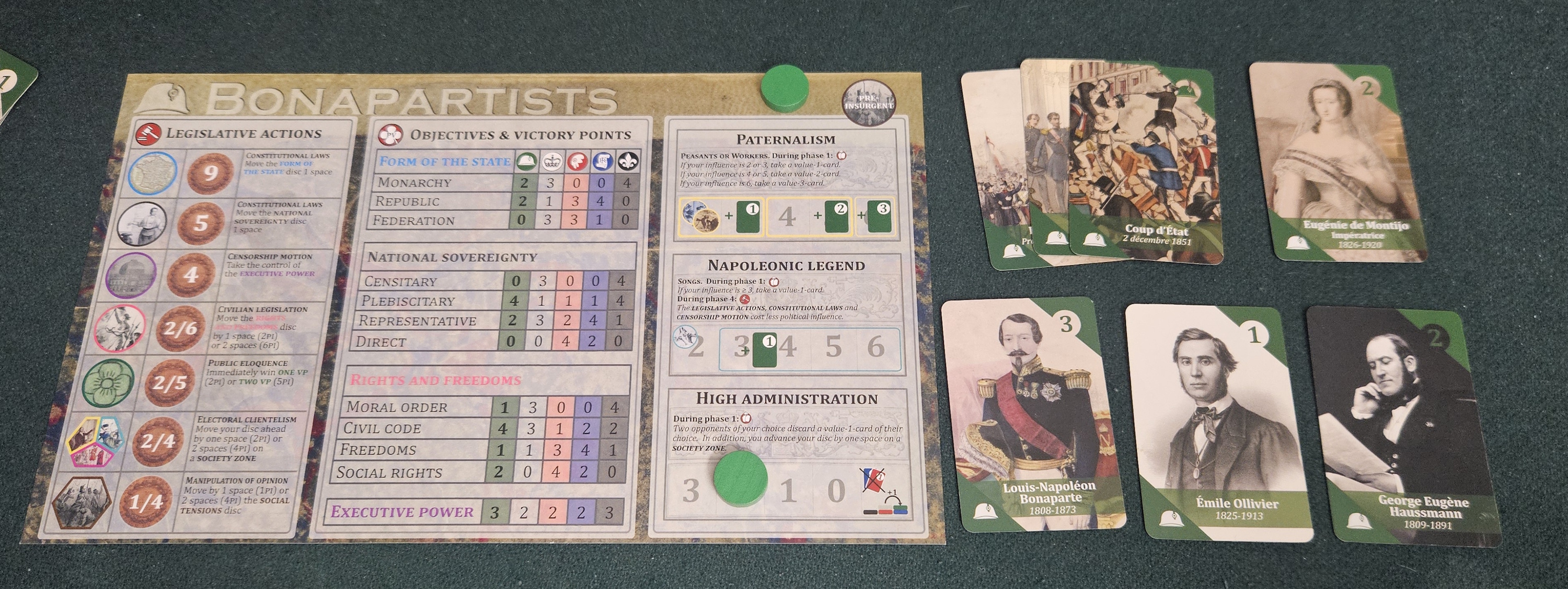
Like how this faction, the Dorkasses, keep doing coups until the people just elect them to the presidency. ... uh oh

Each faction has their own objectives and perks.

Thus, our dramatis personae, from right to left:

First we have the Ultras, who are, as their name suggests, rather extreme in their dedication to a reconstituted monarchy and suppression of everything the previous revolution and eventual empire stood for.

A few centimeters to their left stand the Orleanists, willing to fly the Tricolor and speak the revolutionary tongue, but still invested in tradition and moral order.

The cult-of-personality Bonapartists make up the middle children of this family squabble; they appreciate a good monarch, but only when it’s their own guy on the throne, and will allow a few concessions to modern liberalism while also brutally suppressing it.

The Republicans are next, with their lofty ideals about freedoms and voting, not to mention a willingness to engage with urban populations and newspapers.

But even they pale next to the more extreme Socialists, who are about as far away from our starting point as it’s possible to get without earning a thinkpiece from the Atlantic about how they and the Ultras are really the same at heart.

Now that the cast has been listed, it’s time to… well, to debate, mostly.

The socialists are very very good at doing both. Sometimes. When they remember to stop fighting with their natural allies.

Sometimes you tally votes… and sometimes you count bullets.

What makes Revolutions special is the way Rix covers six decades of history, both legislative and revolutionary, without missing a beat. As board games go, this is a longue durée history that teases out the unlikely alliances, concessions, and sometimes bloodbaths that marked those years.

Most of the time, your faction wants to secure votes. Let’s say you’re a brash young Republican in the middle of a reconstituted monarchy enforced by a foreign Coalition. What exactly is your recourse? Early on, your goal will probably be to secure some measure of legislative power. So you curry favor, both on the table by bidding influence cards to various sectors of French society, and above it by trying to persuade your natural allies — the Socialists for now, but also the Bonapartists and maybe Orleanists, especially if the Ultras have spent too long on the throne — that it would be prudent to make a few adjustments to how votes are cast, who receives representation, or which privileges will be granted to citizens. Together you create a voting bloc, earn some political influence, and then squabble over whether to flex your limited power to enforce a plebiscitary or representative government.

But then, disaster. After all that effort, perhaps the Ultras will veto your motion. They’re quite happy with the vote going to the richest landholders, thank you very much. But this veto sets the streets of Paris into a flurry. Now, with social tensions on the rise, you begin to agitate.

Gawrsh, I love the art choices here.

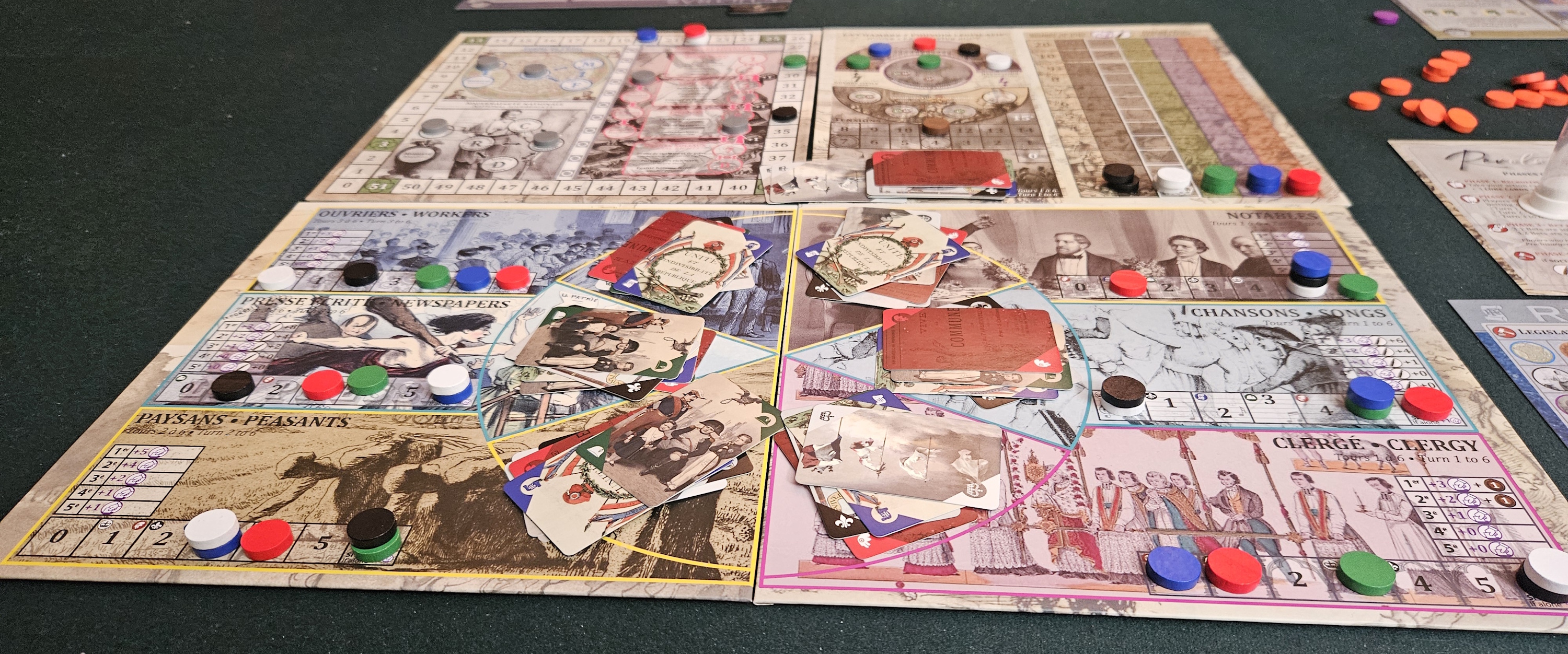
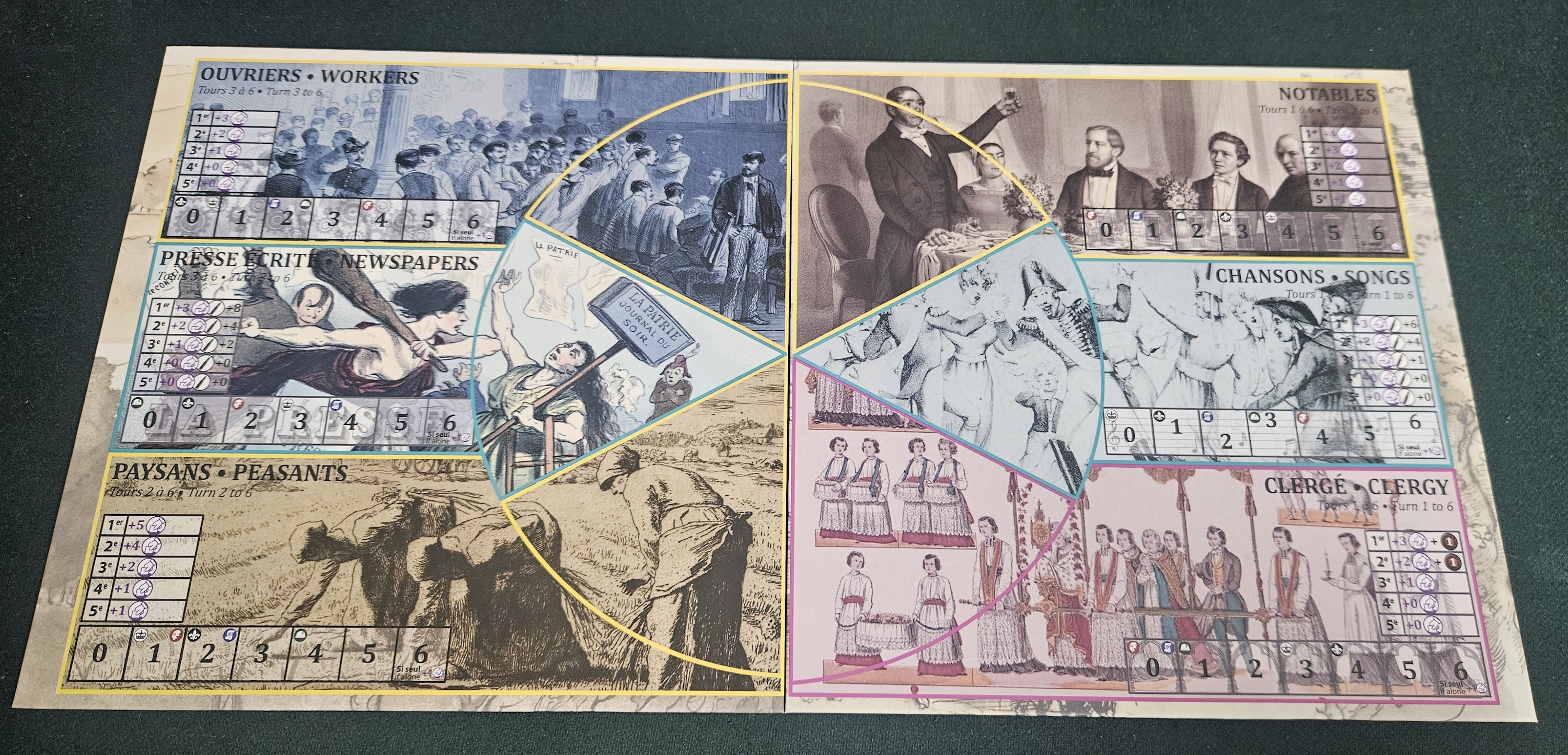
The six sectors that can eventually be manipulated for political advantage.

Over time, the political landscape undergoes seismic transformation. Rural populations become reachable. Newspapers begin to carry the public voice even more resoundingly than song. The working class begins to wake up to the fact that it’s a whole deal. Did I mention that Rix has folded the century’s gradual urbanization into his game? It’s quite the thing to behold. When Revolutions opens, the only people who can really be influenced are the notables and the clergy, and you can bet they aren’t taking calls from anyone grumbling about freedom of religion. But over the course of ensuing decades, new sectors open up, throwing the old order into a disarray from which it will never recover.

To be clear, Revolutions is never whiggish. Progress isn’t the straight line some would have us believe. When the peasantry enters the game, they’re hot for more Bonapartism, for the glory of the old days, not for equal representation. Newspapers, like tavern songs, can be written by gray-haired reactionaries as well as by sexy young revolutionaries.

Still, it becomes increasingly difficult for monarchism to keep its cold fingers wrapped around the national throat. There’s an arc here, even if it doesn’t have a foreordained slant.

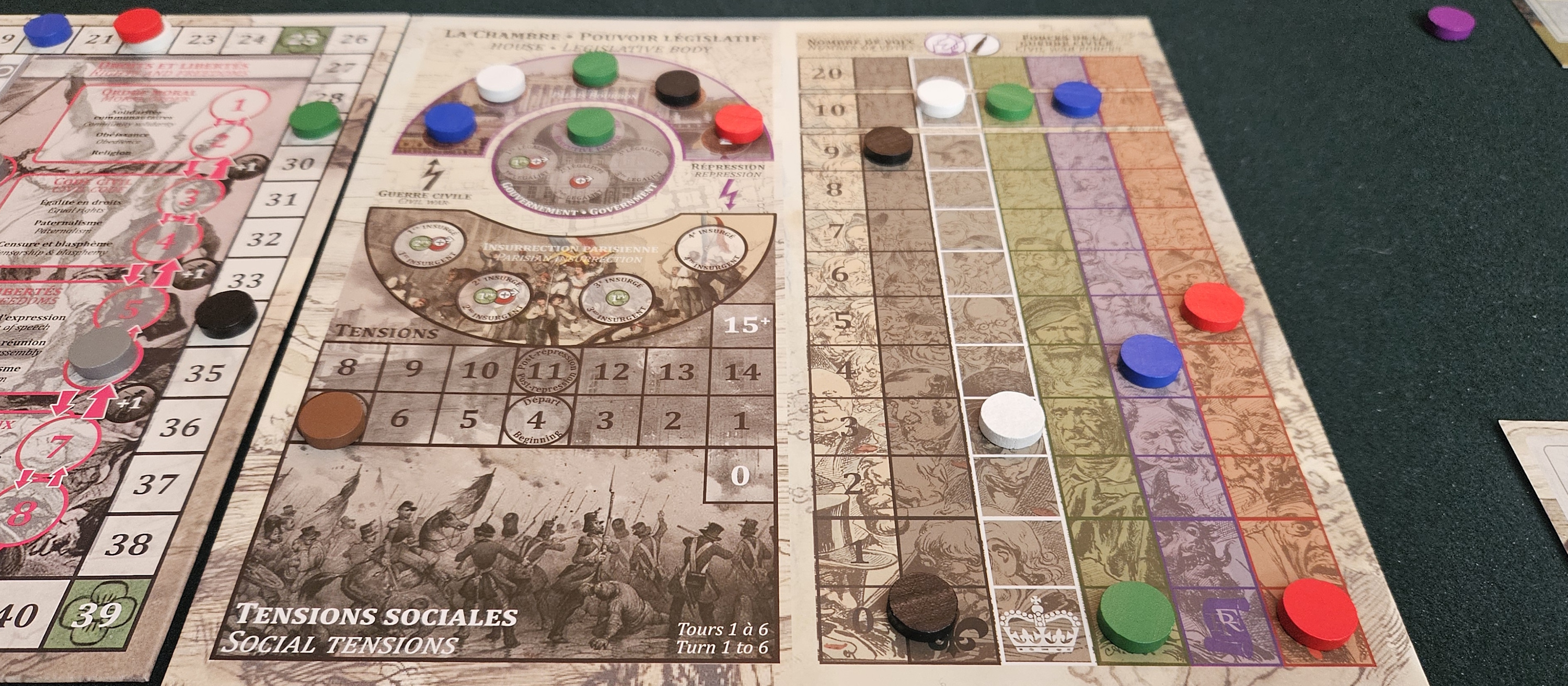
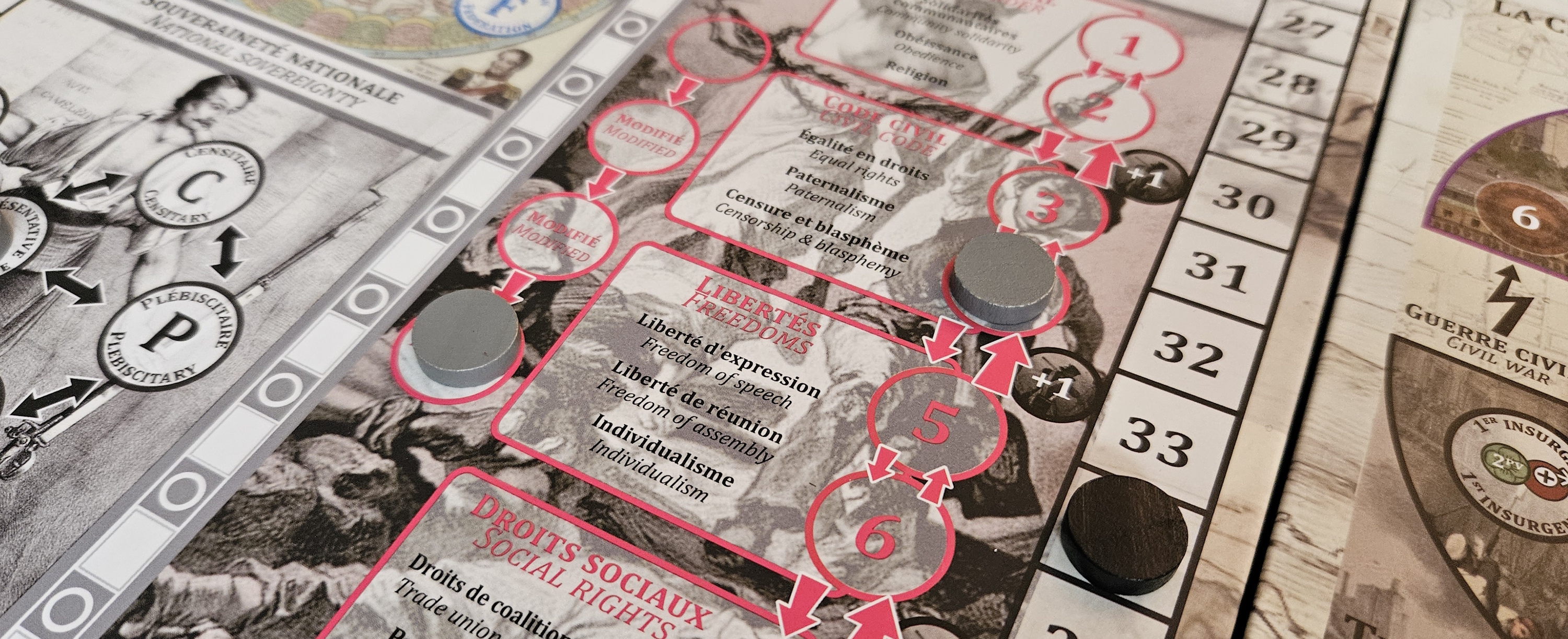
So you agitate. Eventually, the frustration of the population boils over into a full-blown conflict. Now factions are forced to pick sides, either sidling up to the established order in hopes of earning a concession or two, or joining the revolutionary bandwagon in an attempt to reshape society more dramatically. Like everything else in Revolutions, these are handled slickly. Tallying votes is as easy as checking everybody’s position on the game’s six tracks; counting manpower is much the same, with a few extra steps for those who are willing to erode their popular support to throw additional bodies at the problem. Revolutions are tense, but they’re never complicated.

The game suffers a little from sometimes being a little too countable. The events mostly help with that by giving everybody a little bit of hidden information that they can spring on the table when it benefits them.

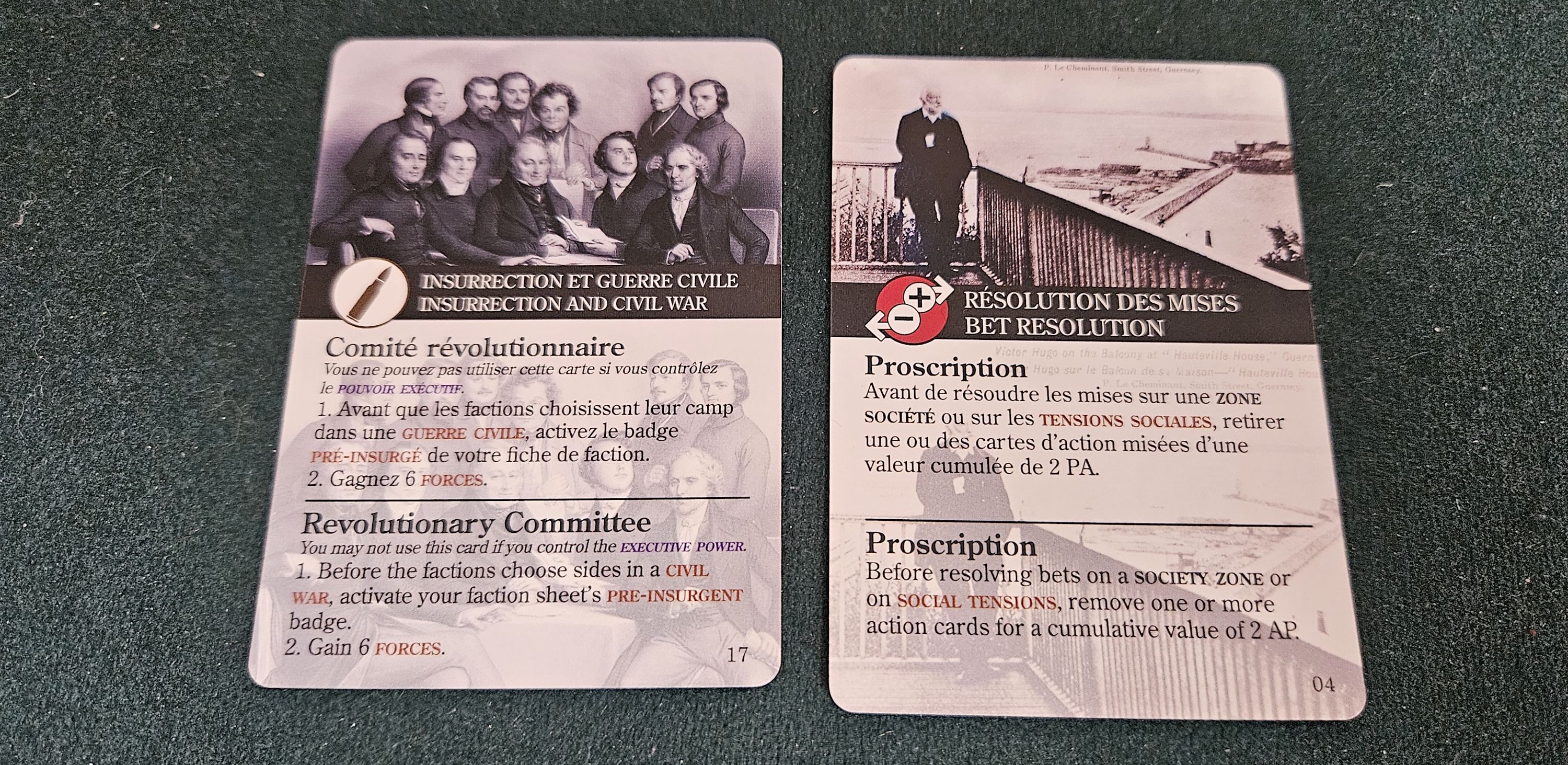
Event cards are optional, but add a lot to the experience.

Playing Revolutions is an illuminating experience. It calls to mind a few other titles, exemplars like Geoff Engelstein and Mark Herman’s Versailles 1919, with its uncomfortable alliances and shifting priorities, and Alex Knight’s Land & Freedom, about partners whose petty squabbles are so urgent that they argue themselves to death rather than combining to face a superior threat.

Like those games, Revolutions takes place in subtle theaters. One might even call them abstract. There are no battlefields here. Your successes and failures are measured on tracks, both those that measure your appeals to France’s social spheres and those that gauge the current status of national sovereignty and which rights are held by the people. Wars are a question of numerical superiority. Whichever side has the bigger number wins. Simple. Functional.

For all that, it’s gripping from start to finish. Rix imbues his social model with little eurekas. In our last session, we saw uncomfortable coalitions form, especially when factions who wouldn’t normally deign to spit on their rival’s flaming culottes were suddenly brought together to oppose a runaway tyrant. We also saw the peasantry undergo a shift in attitude after dear leader sacrificed them so casually to quell the next uprising. We watched as newspapers shifted from suspicious new media, the tool of republican rabble-rousers, to another appendage of the moneyed class. We observed how the erosion of rights could be accomplished in steps so that the populace only grumbled a little at a time.

Meanwhile, these occurrences required very little overhead. Like many new-wave historical titles, Revolutions prides itself not only on its model of culture in transition, but also on ease of play. For the most part, gameplay consists of bidding cards, tallying votes, and then spending influence to enact changes. Or, when that doesn’t work, mustering your forces for a bash in the streets of Paris. There are subtleties to these processes, but they never tip the scales into unnecessary chrome. Instead, the rules get out of the way, letting you focus on which side of the latest political headwind you want to tack into.

I will not stop advocating for greater human rights until I'm allowed to become an alien's kidney if that's my choice.

Keep pushing! Never stop pushing!

All told, Revolutions: France 1820-1880 is one of the finest examinations I’ve ever seen of a new society struggling to be born. In many ways it’s a game about not only history, but the way history is formed, the way people begin to see themselves as agents of history and authors of history, the way ideas are transmitted or obscured, the way change is enacted or smothered. It’s about the many birth pangs and postpartum twinges that accompany any transformation. Hopefully, it’s a reminder that the world can be recast into a new shape yet again.


A complimentary copy of Revolutions: France 1820-1880 was provided by the publisher.

(If what I’m doing at Space-Biff! is valuable to you in some way, please consider dropping by my Patreon campaign or Ko-fi. Right now, supporters can read the next installment in my series Talking About Games, this time tackling the topic of what makes a good list! Naturally, the piece includes a list.)

Unboxing Video: Vendée 93 from Fellowship of Simulations

Von: Grant
19. Juli 2026 um 14:00

At the beginning of 1793, after the execution of King Louis XVI, France was drawn into a war against a coalition of most European monarchies. On 24 February, the National Convention decreed the mass draft of 300,000 men to defend the eastern borders. Throughout the country, revolts broke out against this conscription, everywhere they were brutally repressed with success. However, an insurgent territory, called the “Vendée Militaire” resisted. Determined to engage in a trial of strength with the new revolutionary regime, the Vendéens gradually organized themselves until they formed a “Catholic and Royal Army”.

Vendée 93, a card driven two player wargame, takes you back to this particularly epic period in the French history, which pitted the young French Republic against the Royalist insurgents from March to October 1793.

“White” or “Blue”, choose your cause and take command of your troops! “White”: you will have to take the advantage quickly at the risk of seeing the Republican forces inexorably strengthen, forcing you into a sinister “Virée de Galerne”. “Blues”: time is on your side, resist the first assaults of the “brigands” to then be able to face the hell of the bocage in order to definitively extinguish the insurrection.

We published an interview with the designers of the game including Pascal Toupy and Jean-Philippe Barcus and you can read that at the following link: https://theplayersaid.com/2025/03/10/interview-with-pascal-toupy-and-jean-philippe-barcus-designers-of-vendee-93-from-fellowship-of-simulations-coming-to-kickstarter-soon/

-Grant

❌