Patrick Stewart prägte mit seiner Darstellung von Captain Picard eine ganze Generation an Science-Fiction-Fans. Nun ist er auf seine letzte Reise gegangen. Mit 86 Jahren verstarb er nun nach kurzer schwerer Krankheit in Los Angeles. Zeit, innezuhalten für einen der Großen unserer Zeit.
With this My Favorite Wargame Cards Series, I hope to take a look at a specific card from the various wargames that I have played and share how it is used in the game. I am not a strategist and frankly I am not that good at games but I do understand how things should work and be used in games. With that being said, here is the next entry in this series.
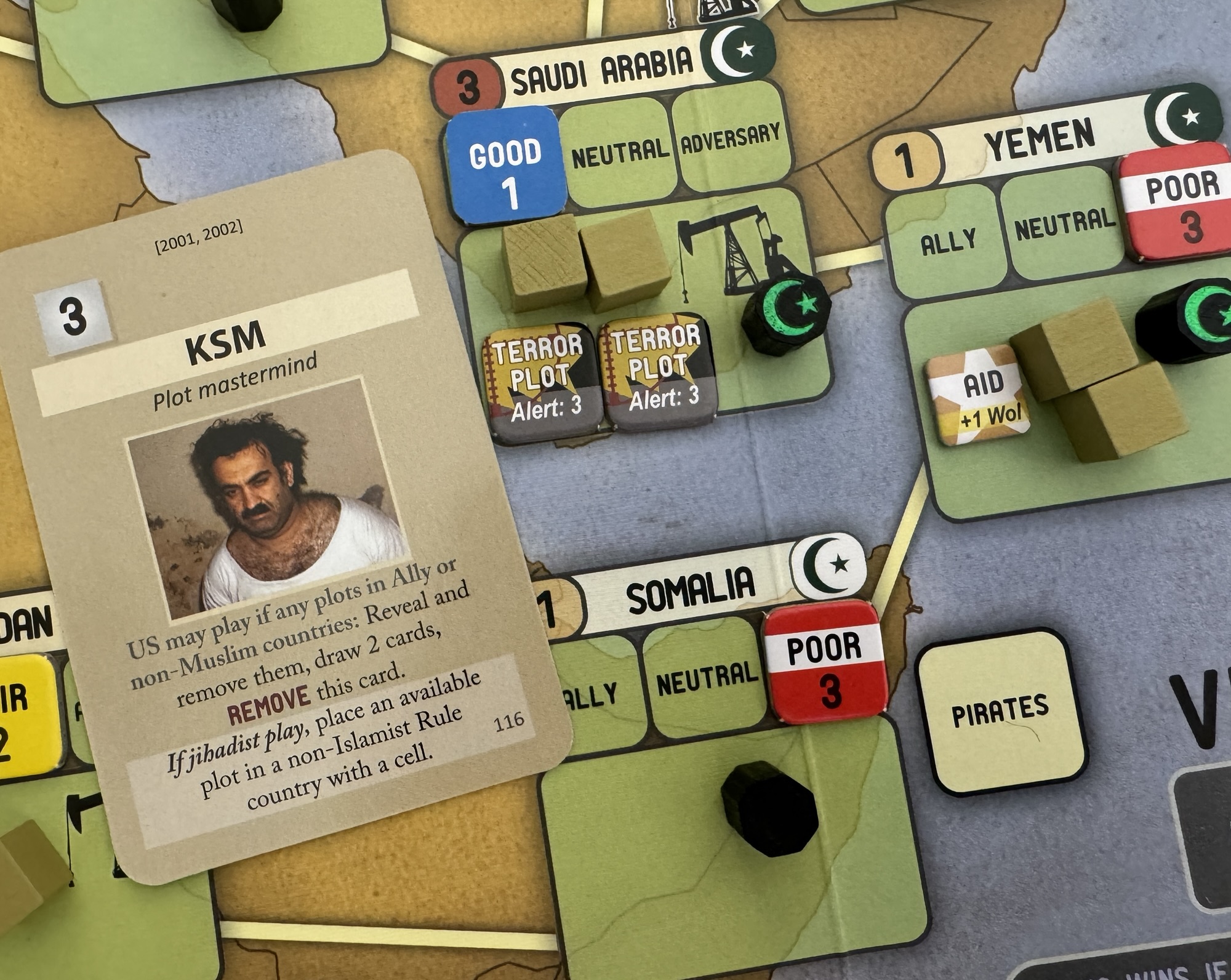
#100: KSM from Labyrinth: The War on Terror, 2001-? from GMT Games
Labyrinth: The War on Terror, 2001-? from GMT Games is a 2-player asymmetrical Card Driven Game that pits the mighty and powerful United States military and all of its various antiterrorist agencies against the Jihadists in the Middle East whose sole goal is to spread terror, sow the seeds of deceit and ultimately destroy Western civilization. The game is a Card Driven Game where the cards contain Operation Points or Events and each turn the player must strategize and use their cards to their best ability in order to effect the state of the board and further their individual and asymmetric victory conditions. But the game is raw and is tied to the actual events of the early 2000’s as the United States was reeling to recover from the terrorist attacks in New York.
In the game, the Jihadist player is working to destabilize the Middle East through a series of clandestine activities such as destroying stability, toppling governments and forcing the US to react to their actions. One of their biggest strategies is to work to place what are called Plots out on the board in order to destabilize but also to generate local support and funding for their activities from the populace. If left alone, these Plots will go off at the end of a round and cause trouble that will then have to be cleaned up by the US player over the next turn. In order to uncover these Plots, the US player will have to play a 3 Ops card to take the Alert Action and different from most other actions there is no die roll required and the the Plot removal is automatic. But, the cost is steep as a 3 Ops card is pretty rare and spending it on this action is very painful. Jihadists use these Plots to force the US player to have to stamp out fire after fire rather than working to reform and stabilize governments to create allies. And when these Plots appear, the player’s long-term strategy will have to be put aside and a focus will have to change from managing regime change and the Global War on Terror (GWOT) posture to dealing with urgent plots. The KSM card is a very powerful tool in this game as it allows for the US player to remove Plots from an Ally or non-Muslim country but also to replace this investment with drawing 2 cards to replace it. This is specifically tied to the intel that was obtained from the capture of Khalid Sheik Mohammad and how it was then used to defuse several ongoing plots. The Jihadist player also gains a pretty large benefit as they will be allowed to place a Plot Marker into a non-Islamist Rule country with a cell. The process of successfully placing a Plot can be very challenging for the Jihadist player as it takes the play of a card for Operations points, uncovering a cell in a country and then rolling a die equal to or less than that country’s Governance Level to then place a face-down Plot Marker. This takes the need for a roll away and makes the placement of a Plot an automatic success.
I think that one of the other important distinctions and differences with the KSM card is that it is a 3 Ops Neutral Card that can be played by either side but when played by the US player for the event, it will be removed from the game while when being played for the Jihadist portion of the event it will remain and be able to be used in a later turn when it is drawn again. This reflects the important role that KSM played in al-Qaeda’s plans and if allowed to stay at large he will continue to plan and execute plots across the globe.
Khalid Sheik Mohammed was a member of Osama bin Laden’s militant organization al-Qaeda, and was specifically in charge of leading al-Qaeda’s propaganda operations from around 1999 until late 2001. Mohammed was captured on March 1, 2003 in the Pakistani city of Rawalpindi by a combined operation of the U.S. Central Intelligence Agency (CIA) and Pakistan’s Inter-Services Intelligence (ISI). Immediately after his capture, Mohammed was taken to secret CIA prison sites in Afghanistan, then Poland, where he was interrogated by U.S. operatives. By December 2006, he had been transferred to military custody at Guantanamo Bay detention camp. Sensationally nabbed in Pakistan, alleged 9/11 mastermind Khalid Sheikh Mohammed was photographed for the world in a disheveled state immediately after his capture—symbolizing an apparent laying low of the once mighty al-Qaeda network. According to his US captors, he later provided information that thwarted other attacks.
Mohammed is widely regarded as the chief planner of the September 11 attacks. The United States government has alleged that he further participated in planning Richard Reid’s shoe bombing attempt to attack an airliner, the 2002 Bali bombings in Indonesia, the 1993 World Trade Center bombing, the murder of Daniel Pearl and various foiled attacks as well as numerous other crimes. These claims have been criticised by others, such as military prosecutor Moe Davis and journalist Andrew Brown, as inadmissible due to being obtained through torture. He was charged in February 2008 with war crimes and murder by a U.S. military commission at the Guantanamo Bay detention camp, which could carry the death penalty if convicted. A 2008 decision by the United States Supreme Court had also drawn into question the legality of the methods used to gain such admissions and the admissibility of such admissions as evidence in a criminal proceeding.
This image shows Khalid Sheikh Mohammed, the self-proclaimed mastermind of the September 11 terrorist attacks, photographed shortly after his capture during a joint raid in Rawalpindi, Pakistan, on March 1, 2003.
In the next entry in this series, we will take a look at Constantinople Sends Aid Core Event from The Shores of Tripoli from Fort Circle Games.
I love a different style and focus of wargame. A game that takes a look at an important but somewhat obscure or rarely addressed historical topic, such as espionage or intelligence, and creates a gaming experience tailored around the events to highlight and evoke the difficulties and tension that would have been present. In January 2026, GMT Games announced such a game in Checkpoint Charlie, which is a solo or cooperative game focused on SIS espionage missions in Berlin in the 1960’s designed by Russell Brown. We have posted an interview with Russel and it was very well received and he has now agreed to create a series of History Behind the Cards to highlight the events of the 1960’s Cold War struggle in West Germany but also to share aspects about the game play and how it models the history.
*Note: The cards highlighted in this series and their event text, as well as any pictures used showing any of the various components, are still in the design and development process and as such event effects and text might still change prior to final development and publication.Also the art and layout of the cards are only for playtest purposes at this point and the game will enter the art department as it nears publication.
History Behind the Cards – Checkpoint Charlie from GMT Games – Card #9 Daily Military Train
This is one of the cards I added to Checkpoint Charlie based on conversations with my local coffee shop spy, John (see Card #7). I had assumed most significant traffic from West Germany to Berlin used the autobahn corridor from Checkpoint Alpha at Helmstedt, across East Germany, to Checkpoint Bravo in Berlin. However, the military trains, of which there were three – American, French and British – ran every day, back and forth along roughly the same corridor as the automobile traffic. The US Military Duty Train, which my friend John rode, let out at the station in Charlottenburg and is the basis for this Event Card. It was primarily used by US military personnel, but other people associated with the military could get permission to ride.
Cars full of East German police, or vopos, kept vigilant watch over the autobahn access route, but it was more difficult to keep track of the train and whether western passengers were jumping off illegally somewhere in East Germany, or East German citizens were boarding the train as it slowed for one of its scheduled stops along the way, getting free passage into West Berlin. To solve this problem, all doors on the train were chained and padlocked for the duration of the four-hour journey across East Germany. In Checkpoint Charlie, the Daily Military Train Event assumes that the KGB has been tipped off to the arrival of some interesting person or item on the next train and move to intercept. Charlottenburg Safehouse is placed under surveillance and the Nugget Marker, already detected, is placed there. This can be a useful diversion for your assets, or it can draw KGB agents right into the center of your mission.
The Berlin Military Train operated by the Royal Corps of Transport.
In the next article in this series, we will take a look at Moscow Rules.
In my opinion, this game looks extremely interesting and I am very much excited to learn more about it. I am appreciative to Russell and his efforts to bring us these cards and to write these entries to share with our readers. I am also very glad that this topic is being covered in a game and look forward to playing this one day soon.
With this My Favorite Wargame Cards Series, I hope to take a look at a specific card from the various wargames that I have played and share how it is used in the game. I am not a strategist and frankly I am not that good at games but I do understand how things should work and be used in games. With that being said, here is the next entry in this series.
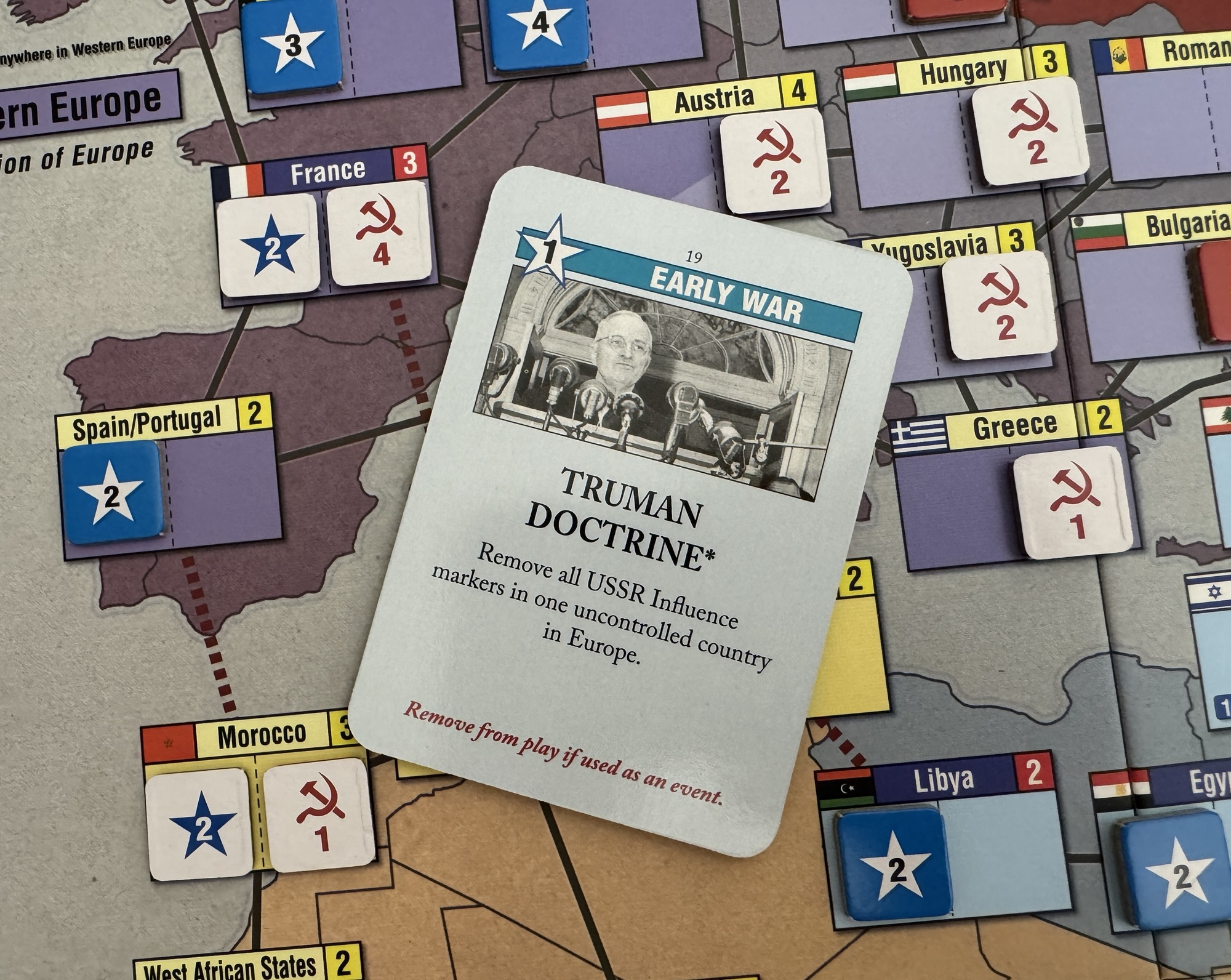
#99: Truman Doctrine from Twilight Struggle: The Cold War, 1945-1989 from GMT Games
Twilight Struggle is a 2-player game simulating the forty-five year ideological struggle known as the Cold War between the Soviet Union and the United States which can be played in 2-3 hours. The entire world is the stage on which these two countries “fight” to make the world safe for their own ideologies and way of life. The game starts right after the end of World War II in the midst of the ruins of Europe as the two new “superpowers” of the world squabble over what is left and ends in 1989, when only the United States remained standing.
The map is a world map of the period, where players abstractly move units and exert influence through the placing of Influence Markers in an attempt to build local support and gain allies and control for their superpower. The beauty of the CDG system used here is that each decision of whether to use a card for the event or the operations value is a struggle as if it is the other side’s event, it might go off hurting you very badly. There are mechanics to allow for the ignoring or cancelling of some of the best cards for your opponent in a side game within the game called The Space Race as well as nuclear tensions, with the possibility of game-ending global thermonuclear war (Shall we play a game, anyone?). I have played TS about 30 times and love it more and more with each sitting. The game makes me sweat, cringe, jump with joy and bite my fingernails. To me, a game that can do all of that in one sitting is worth the price.
The Truman Doctrine is an Early War U.S. 1 Op Event Card that removes all Soviet Influence from a single country in Europe where the U.S. has presence. This means that the U.S. at least has 1 Influence in a space and the space must be uncontrolled. I think that players should be judicious and patient with this card and do not rush to play early in the game on Turn 1 or Turn 2 if Europe is stable and the USSR has minimal presence there. The best way to use the card is to wait for a window where you can do the most damage in a key Battleground space where each side has been fighting for control by placing Influence there such as in France or West Germany on the last action round of a turn or playing the card during the Headline Phase to wipe out stacked Soviet Influence as a precursor to bumping up your own Influence there for control. The Truman Doctrine card is such a nice booby trap in many ways and the proper use of it can be very efficient and give you a leg up in Europe.
The Truman Doctrine was a United States foreign policy established by President Harry S. Truman on March 12, 1947, which pledged that the U.S. would provide political, military, and economic assistance to democratic nations threatened by external or internal authoritarian forces. President Harry S. Truman asked for $400 million in military and economic assistance for Greece and Turkey. “It must be the policy of the United States to support free peoples who are resisting attempted subjugation by armed minorities or by outside pressures,” Truman declared. “If we falter in our leadership, we may endanger the peace of the world — and we shall surely endanger the welfare of our own nation.”
In asserting that the U.S. would intervene in faraway conflicts, President Truman dramatically reoriented U.S. foreign policy. The writing of this ground-breaking message went through multiple stages. In his memoir, Truman noted that the State Department’s first draft of the speech “was not at all to my liking.” Rather than asserting a new foreign policy doctrine, the State Department writers had “made the whole thing sound like an investment prospectus.” Truman returned the draft to Secretary of State Dean Acheson “with a note asking for more emphasis on a declaration of general policy.”
The State Department complied, and included a general policy statement in the next draft. But Truman was not satisfied. “It seemed to me half-hearted,” he recalled. President Truman “scratched out” what he deemed equivocations. For example, Truman replaced “should” with “must” in a key sentence that read “I believe that it should be the policy of the United States…” According to Truman, “I wanted no hedging in this speech.” Because this speech “was America’s answer to the surge of expansion of Communist tyranny,” it “had to be clear and free of hesitation or double talk.” A total of eight drafts of Truman’s speech to Congress are featured on the Truman Library’s website. Many include handwritten comments and corrections. Combined, they give readers a sense of the tremendous effort that went into drafting the Truman Doctrine as well as the importance a single word can make when crafting foreign policy.
Truman delivered his address on March 12, 1947. Over the next several weeks, Congress debated the merits of Truman’s proposed foreign policy. On April 22nd, the Senate approved the legislation to provide assistance to Greece and Turkey. The House followed suit, approving the bill on May 9th. On May 22, 1947, Truman signed the bill into law. According to President Truman, the enactment of his bill “served notice that the march of Communists would not be allowed to succeed by default.”
Die deutsche Rollenspielszene ist vielfältig und bunt, was man auf zahlreichen Messen bewundern kann. Auf der SPIEL Essen dürfen wir aber jedes Jahr trotzdem über den zugegebenermaßen hohen Tellerrand gucken und die internationale Welt der Rollenspielverlage mit aktuellen Produkten und Klassikern zu Gast haben. Diese Neuheiten stellen wir hier vor.
I love a different style and focus of wargame. A game that takes a look at an important but somewhat obscure or rarely addressed historical topic, such as espionage or intelligence, and creates a gaming experience tailored around the events to highlight and evoke the difficulties and tension that would have been present. In January 2026, GMT Games announced such a game in Checkpoint Charlie, which is a solo or cooperative game focused on SIS espionage missions in Berlin in the 1960’s designed by Russell Brown. We have posted an interview with Russel and it was very well received and he has now agreed to create a series of History Behind the Cards to highlight the events of the 1960’s Cold War struggle in West Germany but also to share aspects about the game play and how it models the history.
*Note: The cards highlighted in this series and their event text, as well as any pictures used showing any of the various components, are still in the design and development process and as such event effects and text might still change prior to final development and publication.Also the art and layout of the cards are only for playtest purposes at this point and the game will enter the art department as it nears publication.
History Behind the Cards – Checkpoint Charlie from GMT Games – Card #8: Loudspeaker Wars
The Berlin Wall in the 1960’s was an interesting place. When approaching from the west (actually the south if you were at Checkpoint Charlie), you could walk right up to the wall and peer over. There are stories of East Berliners parking their cars against the wall because a small strip on the western side was actually still in Soviet Territory, and the West Berlin police couldn’t give them a parking ticket. If you were an East Berliner, approaching within fifty meters of the wall would probably get you shot. In either case, if you were close enough to the wall to see over it, you were likely to see propaganda from the other side. Most of this was billboards and banners on the eastern side, but the west had its fair share of slogans supporting democracy and the allies.
The Loudspeaker Wars card commemorates the times when this war of propaganda became audible as well as visual. An ongoing battle between vans equipped with high-powered speakers began when East Germany rolled them up to the wall and began blasting propaganda at deafening volumes. When formal complaints failed, the west responded with their own loudspeakers at the wall, making it almost impossible to carry on a conversation anywhere near them. This became known as the “Noise Offensive,” or the “Loudspeaker Wars.” It continued, on and off, for years.
In Checkpoint Charlie, this card makes intelligence operations at the wall very difficult (removing all Intel Cubes there) and also attracts a crowd of gawkers in the form of a Demonstrations Marker. In addition, if Mayor Brandt is active in the mission, he immediately moves to the wall to take part in the back and forth.
In the next article in this series, we will take a look at Daily Military Train.
In my opinion, this game looks extremely interesting and I am very much excited to learn more about it. I am appreciative to Russell and his efforts to bring us these cards and to write these entries to share with our readers. I am also very glad that this topic is being covered in a game and look forward to playing this one day soon.
With this My Favorite Wargame Cards Series, I hope to take a look at a specific card from the various wargames that I have played and share how it is used in the game. I am not a strategist and frankly I am not that good at games but I do understand how things should work and be used in games. With that being said, here is the next entry in this series.
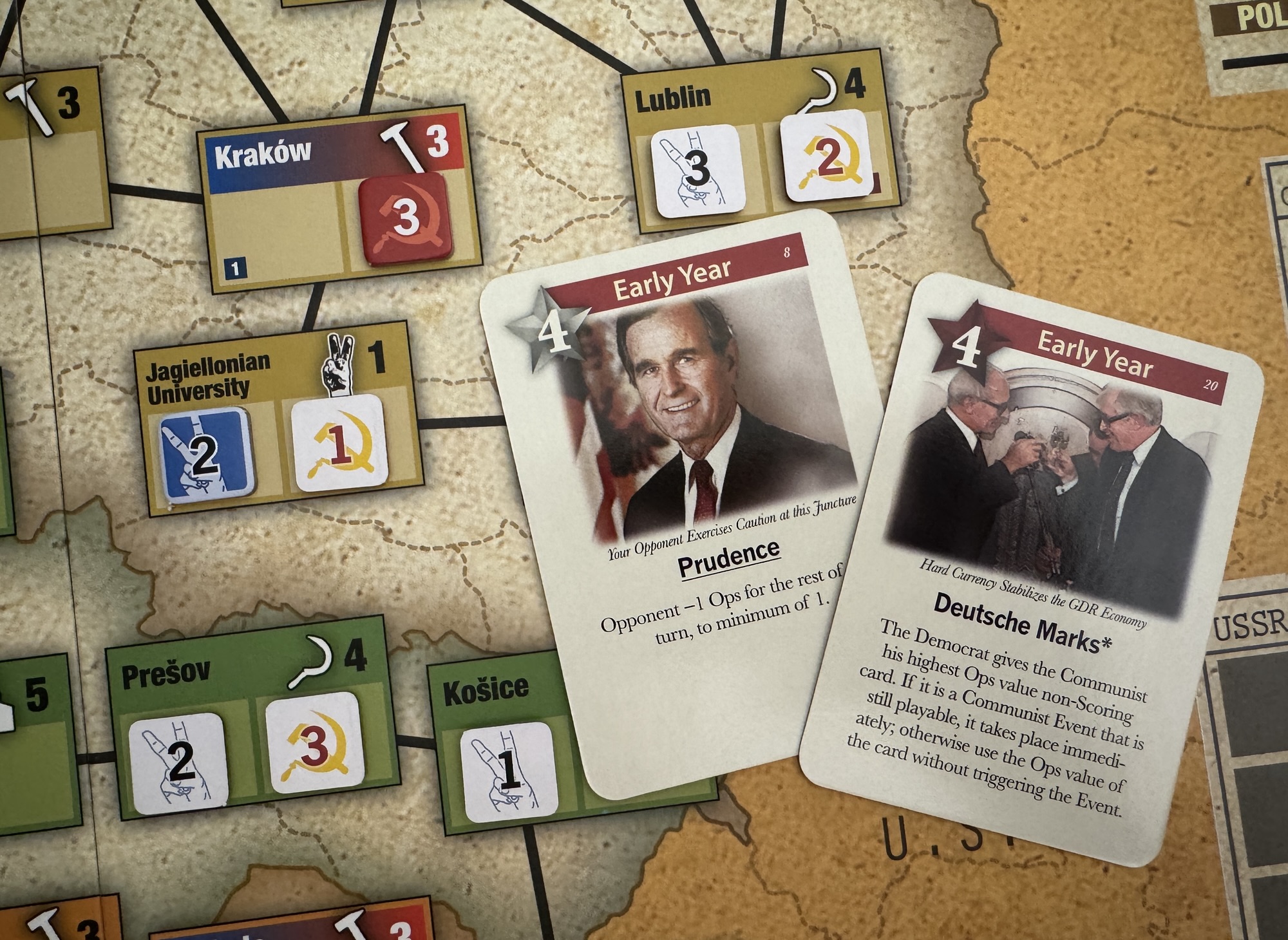
#97: Prudence from 1989: Dawn of Freedom from GMT Games
1989: Dawn of Freedom is a fast paced game simulating the end of the Cold War in 1989 as the Berlin Wall fell under pressure from the people as during this year a series of democratic revolutions ended the 40 year Soviet empire in Eastern Europe. 1989 simulates the political, social and economic aspects of these revolutions using a card-driven system similar to Twilight Struggle. I have really very much enjoyed my plays of 1989 and those plays are increasing as the game has been placed on the very cool and user friendly online platform Rally the Troops!
Any game that has cards is focused somehow on attacking those cards or at least minimizing access to them or to taking a turn away from your opponent by causing them to have to discard one of their cards or to do something else with that card. But there are some type of cards that will limit your opponent’s cards and their effectiveness by imposing a penalty on them. That is the case with our next card in this series from 1989: Dawn of Freedom called Prudence. The card is very simple as it imposes a -1 Ops penalty on all cards played by your opponent for the Operations Points for the remainder of the turn. All cards still will retain at least a 1 Op value but others will be reduced. The play of this card as an Event or for the juicy 4 Ops that it conveys is a real choice and players need to understand the value in the card. If played as the first card play of a turn, the penalty can impose up to a -6 Ops loss to your opponent over the course of the turn. So you have to somewhat do a cost-benefit analysis when you play the card and decide if it is best played for the Event or for the Ops. The later the turn goes, the less impact and utility the Event will have and you must gain a return from this valuable card if used for the Event. 4 Ops cards are rare and you must come out on top or your game will suffer.
President George H.W. Bush frequently used the word “prudence” to describe his cautious, restrained approach to foreign policy during the historic collapse of the Soviet bloc and the end of the Cold War. Prudence meant calculating risks and weighing long-term consequences rather than reacting with flashy, immediate emotion. When the Berlin Wall fell in 1989, Bush famously refused to publicly dance on the wall or gloat, despite pressure from political rivals like Senator George Mitchell. This was a measured and conscious choice to deescalate the tensions and fall out from the fall of the Berlin Wall as Bush feared that openly humiliating Soviet leaders or the Soviet military might provoke a hardline backlash or cause Moscow to halt troop withdrawals from Eastern Europe.
As you may know, comedian Dana Carvey popularized a famous caricature of George H.W. Bush on Saturday Night Live, using the catchphrase “Not gonna do it. Wouldn’t be prudent” to lampoon the President’s cautious speech patterns and deliberate style. While critics sometimes mocked his caution as a lack of a grand vision and understanding of his place as the Leader of the free world, historians often credit his prudent diplomacy with managing a peaceful transition out of the Cold War.
I very much enjoy the thematic connection of this card with the Event. The play of this card, which is a choice as it has a 4 Ops value and could be used in a different manner to forward the player’s interests on the game board, mimics the restraint and choices before President Bush. I think that in today’s world, this type of restraint is sorely lacking and if present at the time of the fall of the Berlin Wall, could have sparked further decades of struggle as the Cold War would have continued to freeze the 2 Super Powers into an ongoing and pointless ideological fight.
We posted a full review video and you can watch that at the following link:
A new series, and we have seen how well series have done at GMT Games, a new designer and a new concept to wargaming (lane battler), I think that this game has great potential and it happens to be focused on one of my most favorite wars to game – the Vietnam War. Iron Triangle: Search and Destroy Operations in the Vietnam War is designed by Darren McGuire and takes a look at the struggle between the United States military and the Viet Cong insurgents as they fight over control of three key “lanes” or regions. I am very much excited about this one and reached out to designer Darren McGuire for some additional information.
*Note: The pictures used in this interview showing the various components and cards, are still in the design and development process and as such rules,event effects and text might still change prior to final development and publication.Also the art and layout of the cards are only for playtest purposes at this point and the game will enter the art department as it nears publication.
Grant: Darren welcome to our blog. First off please tell us a little about yourself. What are your hobbies? What’s your day job?
Darren: Hi Grant, I live not too far from Glasgow in Scotland, which is a board gamer’s delight, by which I mean, plenty of rainy days and dark evenings. By day, I work as a Quantity Surveyor (Cost Engineer) on major water infrastructure projects, dealing with cost control, commercial management and contractual disputes, so it’s excitement all round! Away from work, my wife and four children keep me more than busy.
As you may have guessed, my main hobby is board gaming, which has now expanded into board game design. Unfortunately, my best ideas seem to arrive in the middle of the night rather than at my desk. When I’m not thinking about games, you’ll usually find me following Glasgow Celtic, the best football (soccer) team in the world…well, Scotland at least. Other interests include noodling away on my guitar and getting out for the occasional hike.
Grant: What motivated you to break into game design? What have you enjoyed the most about the experience thus far?
Darren: I am relatively new to board gaming, having played regularly for only four or five years. My growing interest in historical games was sparked by Rodney Smith’s discussion of Cuba Libre in the Discovering the COIN series. After learning and playing the game, and later watching a documentary on the Cuban Revolution, I became fascinated by how game mechanics can represent the political, military and social dimensions of historical events.
This experience led me to appreciate game design not just as entertainment but as a way of communicating history. My interest in creating games developed further through roleplaying games, particularly the Basic Roleplaying system, which inspired me to write and run a Second World War-themed scenario. Seeing others enjoy something I had created was highly rewarding and encouraged me to pursue game design more seriously.
What I enjoy most about design is the iterative process, watching an idea evolve through testing, refining it based on feedback, and carrying lessons learned from one project into the next.
Grant: What is your upcoming Game Iron Triangle about?
Darren: Iron Triangle is a 2-player card battler game about the struggle between US and Viet Cong forces in the III Corps region of South Vietnam during the Vietnam War. Players compete across a series of Operations while also managing the wider military, political and social factors that shaped the conflict.
The US player must balance military success with the need to maintain stability and support for the South Vietnamese government. The VC player, meanwhile, seeks to undermine government authority through guerrilla warfare, hidden infrastructure, and the careful preparation of the Tet Offensive. While battles are fought over individual Operations, success ultimately depends on how effectively players manage resources, control territory, influence Public Opinion and pursue their broader strategic objectives.
Rather than focusing solely on military confrontation, Iron Triangle aims to capture the asymmetrical nature of the war, where political legitimacy could be just as important as success on the battlefield. The result is a fast-paced experience in which decisions can have consequences beyond the immediate fight.
Grant: Why was this a subject that drew your interest?
Darren: I have always been fascinated by David versus Goliath conflicts, where a seemingly weaker side challenges a much stronger opponent. The Vietnam War particularly captured my interest because it was a conflict I initially knew very little about. Like many people, my early perceptions were shaped largely by Hollywood films, but after becoming interested in historical conflict through board gaming, I began to realize there was far more nuance and complexity to the war than popular culture suggests. The more I explored the subject, the more intrigued I became by the political, military and human factors that shaped the conflict.
Grant: What is your design goal of the game?
Darren: My goal is to create a fun and engaging game that feels thematic within what is traditionally quite an abstract genre. I want the mechanics and player decisions to reflect the realities of the conflict, so that the theme is expressed through gameplay rather than simply through artwork or historical flavor text.
Beyond providing an enjoyable experience, I hope players come away with a greater appreciation of the unique challenges faced by both sides in this part of the Vietnam War. The conflict was not decided solely by battlefield success. Political support, public opinion, hidden infrastructure and competing strategic priorities all played important roles. Capturing these tensions within an accessible and entertaining game has been one of the central objectives of the design.
Grant: What from Search and destroy missions in Vietnam was most important to model?
Darren: Two aspects were at the forefront of my mind. The first was capturing the cat-and-mouse nature of search and destroy operations through the card play. These missions were rarely straightforward engagements; instead, they involved a constant struggle to locate, pursue and evade the enemy.
Equally important was ensuring that the tactical outcomes of these operations were connected to their wider political and societal consequences. In Vietnam, success on the battlefield did not always translate into strategic success. Capturing that tension between military achievement and its broader impact on public opinion, political will, and the course of the war was therefore a key design objective.
Grant: What sources did you consult about the details of the history? What one must read source would you recommend?
Darren: The principal sources I consulted were:
The Vietnam War: An Intimate History by Geoffrey C. Ward and Ken Burns
Vietnam: An Epic Tragedy, 1945-1975 by Max Hastings
The Tunnels of Cu Chi by Tom Mangold and John Penycate
Of these, I would recommend The Tunnels of Cu Chi as essential reading. The book argues that the Cu Chi tunnel network became one of the most powerful symbols of Viet Cong resilience and ingenuity, demonstrating why overwhelming American military superiority alone could not guarantee victory. That theme had a significant influence on the design of the game. Mechanics such as tunneled cards, Tunnel Bases, and the creation and use of caches are intended to reflect the hidden infrastructure that enabled the Viet Cong to survive, recover and at times overwhelm a conventionally stronger opponent. Capturing this asymmetry between military power and insurgent resilience was one of the central goals of the design.
Grant: What is the goal of the game?
Darren: The VC player seeks to undermine the local population’s trust in the South Vietnamese government. To achieve this, they must win Operations, carefully manage their resources, and, most importantly, plan and execute a successful Tet Offensive.
The US player, meanwhile, has two paths to victory. The first is through attrition, exposing and neutralizing enemy forces. The second is through pacification, placing pacification chits on regional tracks to strengthen government influence. Whichever strategy they pursue, they must contend with the fallout of scorched-earth tactics, maintain control of pacified areas and disrupt the enemy’s Tet Offensive preparations whenever possible.
Grant: What is the layout of the board?
Darren: The operations are divided across three regions, with players contesting one operation in each region during every round. Running alongside these battles is a strategic layer represented on the board, which tracks the overall situation across the theatre. This includes the level of control within each region, regional stability, public opinion, and refugee generation. As a result, success in individual operations can have far-reaching consequences, forcing players to balance short-term military objectives against their broader strategic and political impact.
Grant: What are the “lanes” and how do they work?
Darren: The three lanes represent the key operational regions north of Saigon: War Zone C, War Zone D and the Iron Triangle. Each lane contains a dedicated deck of Operation Cards representing historical Search and Destroy missions conducted in that region during the period.
During each round, players will contest one Operation from each region, fighting simultaneous battles across all three lanes. The outcome of these Operations will influence the wider conflict, affecting the various tracks and areas of the main board. Success on the battlefield can shift regional control, impact public support, alter available resources and shape each side’s broader strategic objectives.
Grant: How does the game use cards? How are the player decks asymmetrical?
Darren: Each player commands a unique deck of cards representing the units, tactics and capabilities available to their side. These cards are committed to Operations, where players compete for control and the rewards those Operations provide. Every card has a strength value and a special action that can be utilized when played.
The game’s real asymmetry lies in how the VC player can deploy their cards. VC cards may be played in one of three states: Exposed (face-up), Concealed (face-down) or Tunnelled (face-down and rotated). This system forces the VC player to balance protection against flexibility. A Tunnelled card, for example, is much harder for the US player to expose and inflict attrition upon, but it requires additional effort from the VC player to reveal and activate its ability.
These mechanics give the VC player multiple strategic options. They can bluff with hidden forces, launch surprise attacks, prepare units for future engagements or hide powerful cards for the decisive end-of-round reveal. The US player, meanwhile, is rarely certain of the strength or composition of the forces they are facing, creating a constant risk that an attack may not go as planned.
To counter this uncertainty, the US player can resort to scorched-earth tactics, exposing and neutralising enemy forces through attrition. However, this approach has consequences. Such actions generate refugees, a resource that can ultimately be exploited by the VC player to advance their own objectives.
The card system is therefore central to how the game’s theme is reflected in its mechanics. Through hidden information, bluffing and the constant tension between searching for the enemy and avoiding detection, it captures the cat-and-mouse nature of the conflict and the uncertainty faced by US forces throughout the war.
Grant: What different type of cards are included?
Darren: There are several types of cards in the game. The Operation Decks form the core of the conflict, with each card detailing the rewards available for successfully completing that mission. These rewards can include gaining regional control, destroying enemy caches or bases, reducing public opinion or generating refugees, all of which contribute to the wider strategic situation on the main board.
Each faction also has its own unique deck containing units and tactics, with cards featuring different strength values and special abilities. These decks reflect the contrasting approaches employed by the US and VC forces and provide players with meaningful tactical decisions throughout the game.
Currently in development are Commander Cards, which can be employed throughout the course of the game. Each commander provides powerful advantages but also introduces specific drawbacks, requiring players to carefully consider who is best suited to lead their forces at any given stage of the conflict.
Also in development is a dedicated solo mode, being designed by Joe Dewhurst. This system includes a bespoke bot deck for each faction, aiming to deliver a challenging and thematic opponent that captures the strategic priorities and character of both sides.
Grant: Can you show us a few examples of cards and describe how they work?
Darren: Here are a few examples that highlight the key decisions and interactions players will encounter during a round.
Operation Cards
Players battle over three Operation cards during each round. The rewards gained depend on the final Strength differential between the opposing sides.
For example, on the Operation shown above, if the VC player ends the round with a Strength differential of 3 or more, they move the control marker on the Warzone C Region Track one space toward Saigon and remove one US Firebase.
Action Cards
Infrastructure symbols indicate that the Operation takes place in a populated area. When the US player uses Scorched Earth actions, such as Zippo Raids, Refugees are generated as a result of the destruction.
In this example, the Zippo Raids Card generates two Refugees for each Infrastructure symbol shown on the Operation Card and allows the US player to destroy two Caches from the VC supply.
The card also gives the US player the option of playing it rotated to its lower-strength Pacification side. When played this way, the US player may place one Pacification chit on a Region Track if the Tet Offensive has not yet occurred, or two Pacification chits if it has.
This creates an important strategic decision for the US player. They can use the card’s high Strength value to help win the Operation, potentially generating Refugees that the VC can later exploit, or they can focus on Pacification to reduce the effectiveness of VC Tax actions and move closer to their alternative victory condition.
The Ambush Card from the VC Deck illustrates the different states in which a card can be played. It may be played face-down (Concealed or Tunnelled) or face-up (Exposed).
The Attrition symbol represents a key objective for the US player, who seeks to expose and exploit these cards as part of their Attrition victory condition. The US Activation symbol indicates that the card’s action may also be triggered when it is exposed by a US card effect.
This gives the VC player meaningful agency. They can play the card face-up to gain the action immediately, play it face-down and activate it later in the round, or use it as a bluff to lure the US player into exposing it.
These are just a few examples of how the decks interact. The game includes numerous ways for players to influence and counter each other’s cards. K9 Units can negate the US Activation effect, Hueys can move cards and place Firebases, Tunnel Rats can flush out Tunnelled cards and locate Caches, Booby Traps can eliminate Tunnel Rats and Supply cards can place Caches on Operations to increase Strength.
Together, these layered interactions ensure that every card choice can have lasting consequences, creating a tense and highly interactive contest between the US and VC players.
Grant: How are the cards concealed by the VC player? What does this represent?
Darren: VC cards feature symbols indicating whether they can be played face up, face down, or either. Face-down cards represent concealed forces, while rotated cards represent units operating through tunnel networks.
The VC player must use Action Cards, such as Manoeuvre, to flip or rotate cards already committed to a lane. This creates a constant balancing act between revealing powerful effects, such as Ambushes and Night Raids, and protecting the valuable Attrition symbols contained on those cards.
These mechanics also enable bluffing. For example, a low-value Booby Trap Card can be tunnelled, encouraging the US player to believe it is a high-strength Support Card with significant Attrition potential. The uncertainty forces the US player to carefully consider where to commit resources and when to challenge concealed threats.
The VC player must also decide whether to play a card face up and immediately benefit from its effect but exposing it to US attack, or instead commit it face down from the outset and save its reveal for a decisive moment later in the round. This flexibility reflects the hidden nature of VC operations and rewards careful planning and deception.
Grant: What challenges for the US are created by this concealment?
Darren: Attrition is a key US victory path, but many VC Attrition symbols remain hidden on concealed or tunnelled cards. To succeed, the US player must reveal and engage these forces while making difficult decisions with incomplete information, risking costly overcommitment if hidden threats prove stronger than expected.
Military operations can expose VC units, destroy bases and uncover caches, but they often generate Refugees, which the VC can exploit to gain cards, add Tet tokens or reduce Regional Stability. As a result, the US player must constantly balance immediate military success against longer-term political consequences. These mechanics create a tense contest of information and deception, with the VC concealing their strength while the US works to uncover and eliminate hidden assets before they can affect the wider war.
Grant: What is the Tet Offensive draw bag? How is it built?
Darren: The Tet Offensive was the watershed moment of the Vietnam War. Although it did not bring the conflict to an immediate end, it fundamentally altered US strategy and set the conditions for the gradual withdrawal of American forces. Capturing the importance of this moment was a key design goal.
The Tet Bag is one of the most important systems in the game. Following recent design changes, it no longer acts as a simple end-game decider but instead serves as a mechanism that can greatly influence the course of the war. At the start of each round, the VC player secretly decides whether to launch the Tet Offensive by selecting one of two cards: one commits to the Offensive and the other acts as a bluff. This creates uncertainty from the outset of the round, as the US player must react without knowing whether a major offensive is truly imminent. The VC player may retract their decision during the round, but doing so becomes increasingly expensive as the cost in Caches rises with each turn that passes.
The bag begins with three US tokens and two VC tokens, but its contents constantly evolve throughout the game. The VC can add tokens through Infiltrate actions and by exploiting Refugees created by US operations. The US player, meanwhile, can remove tokens through Round-Up actions and through Attrition in an attempt to limit the impact of any future Offensive.
The primary way for the VC to influence the draw is through the accumulation of Caches. These can be generated through Tax Actions or received as end-of-round supply from the North. When the offensive is launched, the number of available Caches determines how many Tet tokens can be added to the bag, while Tunnel Bases deployed to region tracks act as multipliers, increasing the number of tokens generated from those Caches. Control of key regional spaces provides additional opportunities, with certain track positions allowing a player to add Tet tokens at the end of a round if the Offensive is launched.
If the VC player commits to the Tet Offensive, the appropriate tokens are added to the bag at the end of the round and five tokens are drawn at random. Each VC token drawn reduces Public Opinion by one step, while each US token drawn increases Attrition by one step. This can create a dramatic swing in the strategic situation. Even if neither victory condition is immediately met, the outcome of the draw can significantly alter the state of the war and shape the decisions available to both players in subsequent rounds.
The timing of the Offensive is therefore a critical consideration. The VC player must decide whether to launch early with limited preparation or delay in order to strengthen the bag’s odds while risking discovery or disruption. The US player, meanwhile, must balance efforts to contain the insurgency on the ground against the need to manage the growing threat represented by the Tet Bag. This creates a constant strategic tension that mirrors the historical conflict.
Grant: What is Public Opinion? How is it changed?
Darren: Public Opinion represents the local population’s perception of the South Vietnamese Government and, by extension, the effectiveness of the US-backed war effort. Managing Public Opinion is crucial, as it forms one of the key strategic battlegrounds in the game.
The primary driver of Public Opinion is Regional Stability, which is determined by the position of Control markers on the regional tracks. As the VC expands its influence and gains control across a region, Stability declines, reflecting a population that increasingly doubts the government’s ability to maintain order and security. Conversely, government control and stability reinforce confidence in the existing regime.
Beyond regional control, both players have additional means of influencing Public Opinion. The VC can erode support for the government by achieving decisive victories in key Operations, demonstrating its strength and undermining confidence in official authority. A successful Tet Offensive can also significantly damage Public Opinion, representing the political shock caused by the scale and visibility of the attacks.
The US player is not without tools of their own. Through Pacification actions, they can improve conditions within contested areas, securing spaces on the regional tracks and creating opportunities to increase Public Opinion. By achieving key objectives and restoring Stability, the US player can demonstrate progress and strengthen support for the South Vietnamese Government.
Grant: What is urban infiltration?
During the build-up to the Tet Offensive, the Viet Cong infiltrated towns and cities across South Vietnam, embedding cadres among the local population. These operatives remained hidden until called upon to conduct terror attacks, sabotage missions, or support the wider offensive once it began. Their ability to operate covertly within urban areas was a key factor in the scale and surprise of the 1968 Tet Offensive.
This aspect of the conflict is represented in the game through a dedicated VC Action card. When played, the card allows the VC player to add a Tet token to the Tet Bag, reflecting the gradual preparation and expansion of the underground network in advance of the Offensive. While the immediate effect may seem modest, repeated use of these actions can significantly alter the balance of the eventual draw.
Grant: How are bases used and what benefits do they bring?
Darren: Bases are another important asymmetrical element of the game. While both factions use bases to influence control of the battlefield, there are significant differences between VC Tunnel Bases and US Fire Bases that reflect their distinct approaches to the war.
In general, bases are deployed to a Regional Track adjacent to a Control marker through the use of Action Cards. Once in play, they allow a player to either reinforce their position or exploit success in an Operation.
A base can be placed defensively on a Region Track between the player and the Control marker. In this position, it acts as a buffer against enemy advances. If the opposing player wins an Operation and would move the Control marker towards their side of the track, the base absorbs one of those control shifts before being removed and returned to its home space. This allows players to protect hard-won gains and makes regional control more difficult to reverse.
Alternatively, a base can be deployed aggressively between the Control marker and an opponent’s side of the track. This represents a player anticipating success and positioning assets to exploit a breakthrough. If the Operation is won, the Control marker effectively leapfrogs the base, allowing it to advance further than it otherwise would. In this role, the base accelerates territorial gains, helping a player press their advantage.
When a VC Tunnel Base is used offensively, it is flipped to its exposed side, representing increased activity and a greater risk of detection. Exposed bases are significantly easier for the US player to locate and destroy.
This creates an important strategic dilemma for the VC player. Tunnel Bases are not only valuable for influencing regional control but also contribute to the Tet Offensive system by acting as multipliers for Tet tokens generated through Caches. Committing them aggressively can produce short-term gains on the board, but doing so risks losing assets that could have a major impact on a future Tet Offensive. The VC player must therefore balance the need to consolidate territorial gains against the benefits of preserving their network for a decisive political strike later in the war.
Grant: What role do refugees play in the game?
Darren: Refugees represent one of the key consequences of the counterinsurgency strategies employed during the war. Population displacement was frequently used to separate the VC from the rural population and disrupt their support networks, creating both military opportunities and political challenges.
The US player has access to powerful Scorched Earth Action Cards. These are high-strength cards that can be used to destroy VC Caches and generate Attrition, helping the US pursue one of its victory conditions. However, such operations can also displace civilians, creating Refugees as local communities are caught up in the fighting.
When a Scorched Earth Card is played, Refugees are generated based on the concentration of the local population in the targeted area, represented by infrastructure symbols on the Operation cards. For each Refugee generated, a Refugee token is placed in Saigon.
While these operations can successfully disrupt VC activity, the resulting Refugees create opportunities for the VC player. On their turn, Refugee tokens can be spent in several ways:
Recruit – Draw additional cards,
Infiltrate – Add a Tet token to the Tet Bag, helping prepare future offensives.
Destabilise – Reduce Regional Stability, further undermining confidence in the South Vietnamese Government.
This creates a difficult strategic dilemma for the US player. Aggressive operations may achieve important military objectives by destroying enemy resources and inflicting Attrition, but they can also generate conditions that the VC can exploit for political and organisational gain.
To counter this, the US player has access to Resettlement Action Cards, which reduces the number of Refugees in Saigon. These actions represent efforts to restore stability, provide support for displaced civilians, and mitigate the wider consequences of military operations.
The Refugee mechanic reinforces one of the game’s central themes: success on the battlefield does not always translate into strategic success. Players must consider not only the immediate impact of their actions, but also the longer-term political and social consequences that can shape the course of the war.
Grant: How is victory achieved?
Darren: For the VC, victory is achieved by reducing Public Opinion to the bottom space of its track. This is accomplished through the rewards gained from winning Operations and by successfully planning and executing the Tet Offensive.
The US player has two possible routes to victory. The first is Attrition, achieved by exposing VC forces, revealing Attrition symbols on their cards, and capitalising on those symbols. Successfully pacifying individual regions and repelling the Tet Offensive also support this strategy.
The second route is Pacification. If the US player can fill all the spaces on the lower half of each regional track with Pacification chits, they have successfully stabilised the countryside and strengthened support for the South Vietnamese government. Achieving this level of security and political control results in a US victory.
Grant: What type of experience does the game create?
Darren: The aim is to create a fast-paced and tense experience in which both players must balance the military, political and social aspects of the conflict. While Operations provide the focus for direct confrontation, victory depends on managing a range of competing priorities rather than simply overpowering an opponent.
The game is not intended to be a straightforward tug-of-war over territory. Players must constantly weigh short-term gains against long-term objectives, deciding when to commit resources, when to accept setbacks, and when to focus on the wider strategic situation. Success comes from understanding how the different systems interact and adapting to an ever-changing battlefield, creating a game that rewards careful planning while still maintaining a constant sense of pressure and uncertainty.
Grant: What are you most pleased with about the design?
Darren: I am most pleased with how I have taken a relatively abstract style of game and made it as thematic as possible, capturing not only the military aspects of the conflict but also the political and social factors that shaped it. I am also very happy with the recent design changes, which have expanded the game’s scope and increased the decision space for both players. In particular, turning the Tet Offensive into a flexible strategic option rather than a fixed endgame event has created more meaningful choices for the VC player, while adding greater uncertainty and tension throughout the game. Overall, these changes have made for a richer and more engaging experience without losing sight of the historical themes I wanted to explore.
Grant: What other designs are you working on?
Darren: I have several other card battler designs at various stages of development, covering topics such as the Eastern Front, the Arctic Convoys of the Second World War, the Napoleonic Wars, and the Russo-Chechen War, the latter of which served as a precursor to Iron Triangle. Each design approaches its subject in a very different way, and I am hopeful that the lessons I have learned during the development of Iron Triangle will help me refine and strengthen these projects.
I’d just like to finish by saying thanks for taking the time to reach out and for the opportunity to talk about Iron Triangle.
With this My Favorite Wargame Cards Series, I hope to take a look at a specific card from the various wargames that I have played and share how it is used in the game. I am not a strategist and frankly I am not that good at games but I do understand how things should work and be used in games. With that being said, here is the next entry in this series.
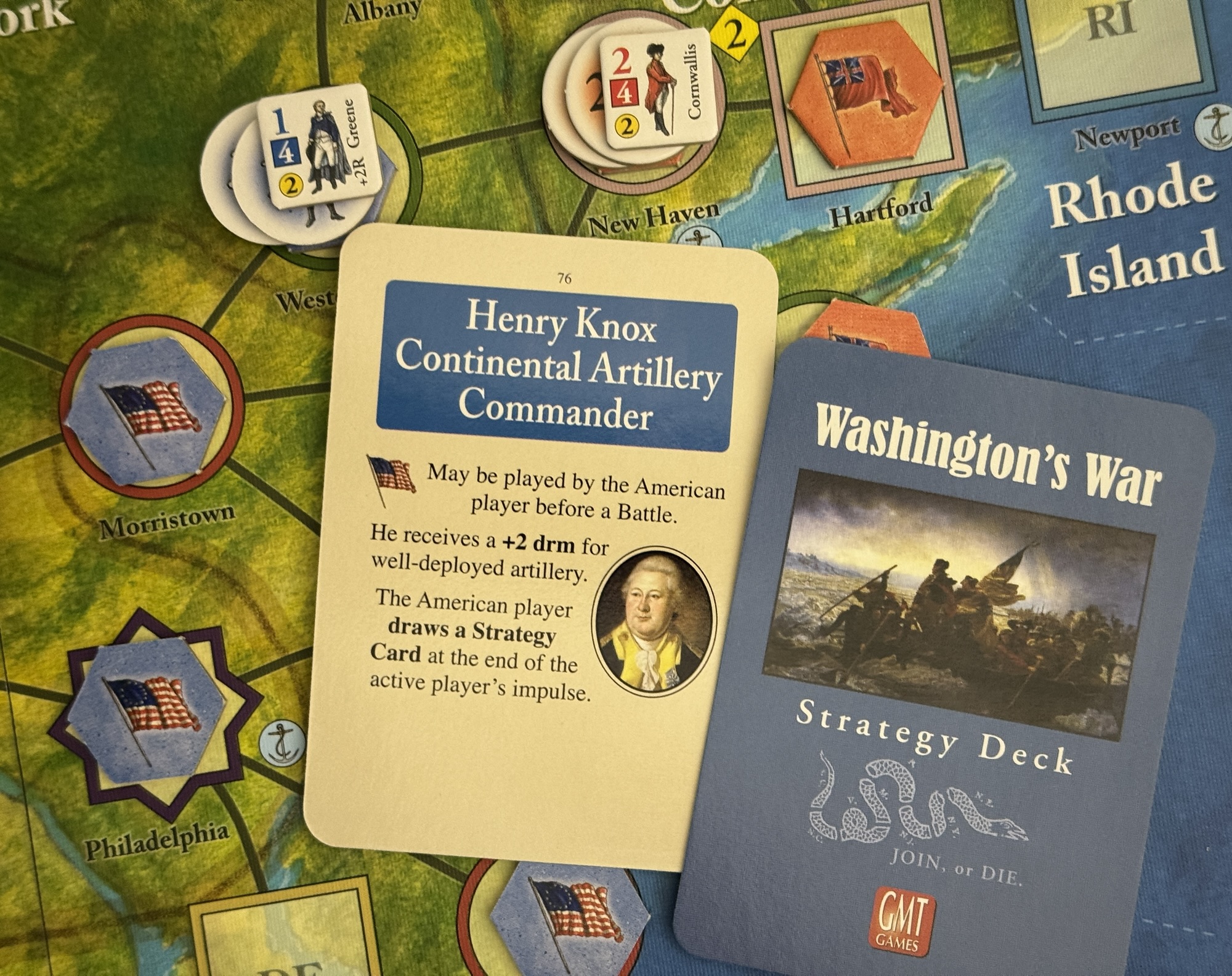
#96: Henry Knox Continental Artillery Commander from Washington’s War from GMT Games
Washington’s War is a war game, make no mistake about that. But, it is virtually impossible to win the game by focusing only on the field of battle. For that to happen, the Patriots need to completely drive the British forces out of the 13 colonies or the British need to wipe the American forces off the map. Both are extremely difficult and I would be surprised if any more than 1 out of 30 games ended in such a way. Rather, the ultimate goal of the game is to have political control of the colonies. If at the end of the game the Patriots control 7 colonies, while holding the British to control of less than 5, they win. If not, the British win. Simple as that. So, you can see that battle is not the main goal but control is. And more importantly political control.
I really like this about the design and feel that the real core of the American Revolution was the groundswell of patriotism and the desire to live free from the shackles of an overseas monarch who cared little for the American way of life. This desire led great men of the time to sacrifice themselves, their livelihood and their families to further the true cause of liberty and build a truly free and democratic nation where individual liberty and freedom was prioritized over anything else. And yes, I realize that this nation was not perfect, not without contradiction but the concept of liberty helped to form a country that would lead to the ultimate freedom of all people.
Washington’s War is a Card Driven Game, and as such, relies on cards to provide to players the actions needed to play the game. The cards contain OPS Points which can be used to drive various actions, including such things as activating leaders, who in turn will then move with forces to attack, and also contain written text in the form of events. These events can be played only by the side they are intended for and if drawn and played by the opposing side, they can only be thrown away while granting a few possible actions, such as placing or removing Political Control markers.
In Washington’s War, the Strategy Card Deck contains several different type of cards of which one is Battle Cards. Battle Cards are special event cards that provide a powerful +2 Die Roll Modifier (DRM) during combat and allow the user to draw a replacement card at the end of the turn. All of the Battle Cards offer a +2 DRM but each of them are tied to a different historical character or event. In this instance, the card’s effects reflect the work of Henry Knox who was a prominent Continental Artillery Commander during the Revolutionary War. There are only 9 total Battle Cards in the 110-card deck with the Patriot side having 5 cards, while the British side only has 4. I also want to point out that when these cards are used, they allow the using player to draw a replacement card at the end of the active player’s turn, keeping your hand size strong and not forcing you to sacrifice a card. And due to the fact that they swing combat odds significantly and also replace themselves with a draw, they are heavily prized and typically are saved in a player’s hand for those critical campaign-deciding clashes.
Henry Knox was an American military officer, politician, bookseller, and a Founding Father of the United States. Knox, born in Boston, became a senior general of the Continental Army during the Revolutionary War, serving as chief of artillery in all of George Washington’s campaigns. Following the war, he oversaw the War Department under the Articles of Confederation from 1785 to 1789. Washington appointed him the nation’s first Secretary of War, a position which he held from 1789 to 1794. He is well known today as the eponym of Fort Knox in Kentucky.
During the siege of Boston, the idea arose that cannon recently captured at the fall of forts Ticonderoga and Crown Point in upstate New York could have a decisive impact on its outcome. Knox is generally credited with suggesting the prospect to Washington, who placed him in charge of an expedition to retrieve them even though Knox’s commission as an officer had not yet arrived. Reaching Ticonderoga on December 5, 1775, Knox commenced what came to be known as the “noble train of artillery”, hauling 60 tons of cannon and other armaments by horse-drawn and ox-drawn sleds across some 300 miles of ice-covered rivers and snow-draped Berkshire Mountains to the Boston siege camps.
The region was lightly populated and Knox had to overcome difficulties hiring personnel and draft animals. On several occasions, cannon crashed through the ice on river crossings, but the detail’s men were always able to recover them. In the end, what Knox had expected to take just two weeks actually took more than six, and he was finally able to report the arrival of the weapons train to Washington on January 27, 1776. Historian Victor Brooks writes that this was “one of the most stupendous feats of logistics” of the entire war, and Knox’s effort is commemorated by a series of plaques marking the Henry Knox Trail in New York and Massachusetts.
The cannon were immediately deployed to fortify the Dorchester Heights recently taken by Washington. The battery’s position over Boston harbor led the British to evacuate Boston for Halifax, Nova Scotia. With the siege ended, Knox undertook the improvement of defenses in Connecticut, Rhode Island and New York in anticipation of a possible British assault. In New York he became friends with Alexander Hamilton, commander of the local artillery. He also established a close friendship with Massachusetts general Benjamin Lincoln.
A team of oxen hauls captured artillery toward Boston as part of the 1775-76 “Noble train of artillery”.
Here is a link to our full video review of the game:
With this My Favorite Wargame Cards Series, I hope to take a look at a specific card from the various wargames that I have played and share how it is used in the game. I am not a strategist and frankly I am not that good at games but I do understand how things should work and be used in games. With that being said, here is the next entry in this series.
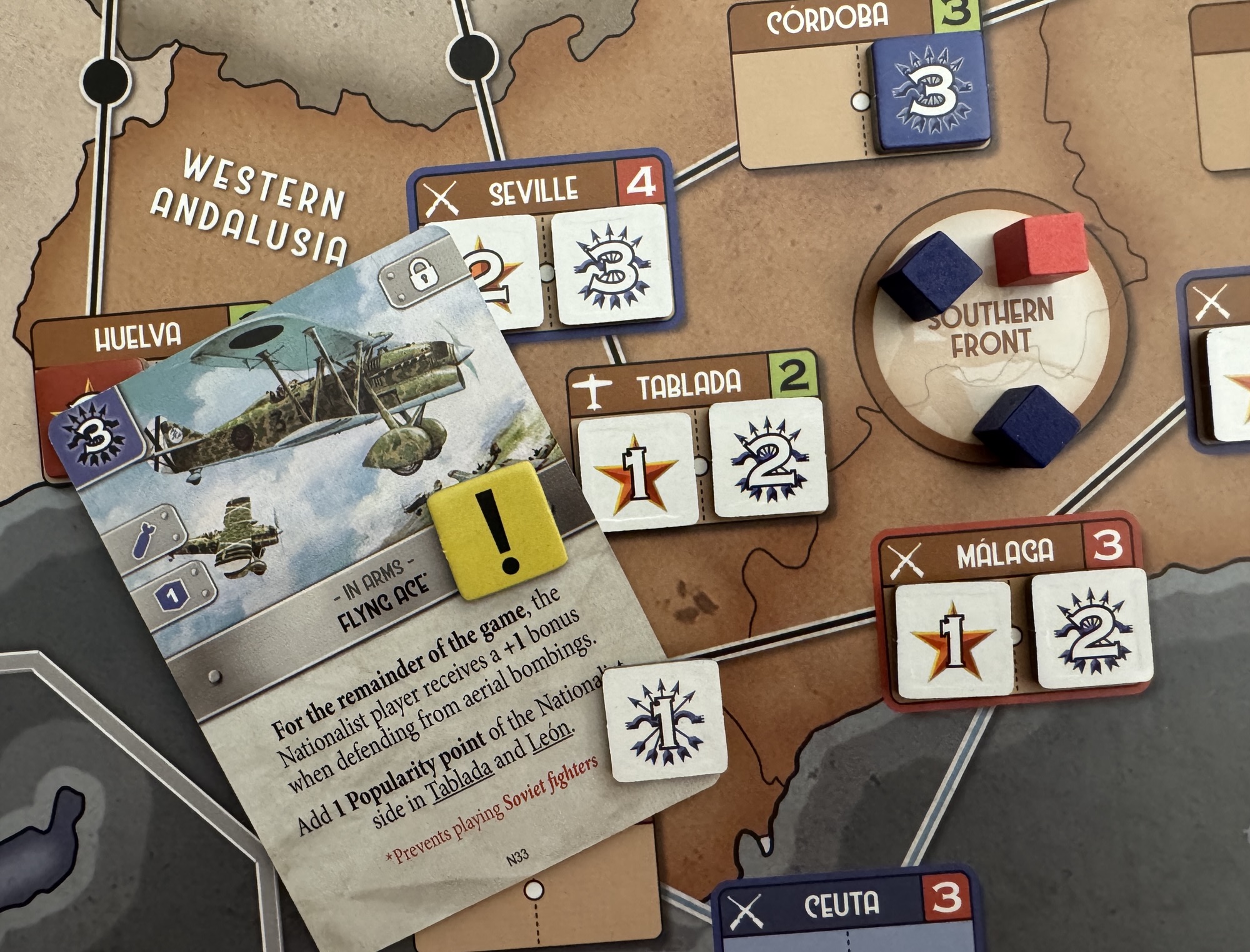
#95: Flying Ace from The Republic’s Struggle: Battle for the Republic, Spain 1931-1939 from NAC Wargames
The Republic’s Struggle is a thematic Card Driven Game that tells the story of the historical events that took place in Spain after the resignation to the throne of King Alfonso XIII, and the proclamation of the II Spanish Republic in 1931. With the creation of the new regime, the struggle for power between the different social, political and ideological sectors increased, which gave rise to continuous changes of political power, alterations of public order, armed uprisings and violent acts, carried out by the numerous ideological factions of the moment; which culminated in 1936, in a failed military uprising. The failure of this coup d’état was the origin for the Spanish Civil War.
The Republic’s Struggle is based on Twilight Struggle from GMT Games and uses the same concepts of area control while adding in some actual combat with units represented on the board. During the game, the Republican player and the National player, will be able to recreate events of the period to increase their popularity in the localities by carrying out political propaganda, recruiting troops or militias, generating revolts or assaults, establishing diplomatic relations or carrying out bombardments. All this will be done by playing their hand of cards in an alternative way, either by using the events or by playing the action points or icons to perform any of the other actions available to the players.
As you probably know, the Spanish Civil War was a bloody and vicious affair. With the advent of air planes and advancement of other weapons technology there was no army that couldn’t be touched. In The Republic’s Struggle players can use their cards and Operation Points to perform an aerial bombing on enemy units that are found on the various fronts. The Bombardment Process is executed by spending the Operation Points (OP’s) of a card, provided the card features a special bomb icon in the upper left hand corner near the Op Points. If a card displays both a bomb icon and a combatant cube icon, you may only choose to execute one of the options and not both. These Bombings target combatants located in specific Fronts, which are represented by circular spaces where army cubes may be placed through card play. In order to perform an aerial bombing, the player must have control of n Air Base Location on the Front that they wish to attack. The attacking player will add the Operation Points of the card played and adds a D6 while the defender will also roll a D6 but will add in the Defense Value that was determined at the outset of the turn by the play of a card and +1 for each of their cubes in the Front. If they have played a card such as Flying Ace, they will get to add a +1 to this total and then results are compared and a winner is determined and losses are the difference between the Attack and Defense Value.
That is the real power in the Flying Ace card as this +1 can be a huge boon in these aerial bombings and allow them to put up a stiffer defense and hold onto more of their units on these Fronts. The game instructs players to utilize the Exclamation Point markers to remind themselves of these type of benefits as the player should place the played card in front of them with the marker to be able to remember the benefit later in that turn.
But the Flying Ace Card provides another smaller but important benefit as it allows the Nationalist player to place 1 Popularity Point in Tablada and León to continue to build their influence and control of these key regions for scoring purposes. And finally, another benefit is that the play of the Flying Ace Card will prevent the Republican player from being able to play their Soviet Fighters Card which has a similar benefit. The thinking here is that the first player to get this card out controls the skies and has air superiority.
Aerial bombing during the Spanish Civil War marked a dark turning point in military history, serving as a lethal testing ground for the aerial terror tactics later unleashed in World War II. An estimated 15,000 people died from air raids during the conflict, with the vast majority of victims being civilians targeted by Nationalist forces backed by Nazi Germany and Fascist Italy. One of these horrific events was that of the Bombing of Guernica on April 26, 1937. Carried out by Nazi Germany’s Condor Legion and Fascist Italy’s Aviazione Legionaria, this raid destroyed a massive portion of the Basque town and killed hundreds of civilians. It became the ultimate global symbol of the brutality of war, immortalized by Pablo Picasso’s famous painting Guernica.
I love a different style and focus of wargame. A game that takes a look at an important but somewhat obscure or rarely addressed historical topic, such as espionage or intelligence, and creates a gaming experience tailored around the events to highlight and evoke the difficulties and tension that would have been present. In January 2026, GMT Games announced such a game in Checkpoint Charlie, which is a solo or cooperative game focused on SIS espionage missions in Berlin in the 1960’s designed by Russell Brown. We have posted an interview with Russel and it was very well received and he has now agreed to create a series of History Behind the Cards to highlight the events of the 1960’s Cold War struggle in West Germany but also to share aspects about the game play and how it models the history.
*Note: The cards highlighted in this series and their event text, as well as any pictures used showing any of the various components, are still in the design and development process and as such event effects and text might still change prior to final development and publication.Also the art and layout of the cards are only for playtest purposes at this point and the game will enter the art department as it nears publication.
History Behind the Cards – Checkpoint Charlie from GMT Games – Card #7: Ich Bin Ein Berliner
In the summer of 1963, the Berlin Wall had been in place for almost two years, the reality of a city split between east and west, between Soviet and Western influence, was impossible to deny. Politicians, military leaders, and the people living day-to-day in Berlin continued to argue about the lack of forceful response from the west, particularly the Americans, when the wall went up. Other than a modest buildup of US forces within and around the city, there had been precious little action to re-assure the people of Berlin that the west hadn’t abandoned them.
In June of that year, President Kennedy hoped to change that perception by personally visiting this western city in the center of Soviet-controlled East Germany. He received the reception and the reaction he was hoping for, driving through the city to crowds of cheering West Berliners, and giving his famous speech on the steps of the Rathhaus Shöneberg to a gathered crowd of over one hundred thousand. In a calculated risk, he referred to the city as West Berlin, officially acknowledging the split created by the wall. He introduced his “Fellow Americans” and at the mention of General Clay (Card #6), the crowd interrupted the speech for some heartfelt cheering for the man that saved their city during the Berlin Airlift. Kennedy’s famous line of solidarity, “Ich bin ein Berliner,” — I am a Berliner — came at the end of the speech and may have been a bit off-script.
So how would Kennedy’s speech affect a mission in Checkpoint Charlie? I’m going to answer that with a story.
I spend a lot of time at a wonderful coffee shop near my home, so much time that my iPhone has labeled the location as my “work.” The baristas there know me, and one day one of them asked me what I was working on. “Right now,” I said, I’m working on a board game about spies in Berlin in the 60’s.”
He laughed. “Have you met John?” He pointed to an older customer at one of the tables. “He was a spy in Berlin in the 60’s.” It was true.
Since then, I’ve had many conversations with John about his time in Berlin. He was Army Intelligence, keeping track of what was going on in the city. He was there when the wall went up. He interviewed the refugees that, for a time, still managed to find a way into West Berlin. And he was there during Kennedy’s speech.
I asked him about the speech and said that in the game it resulted in crowds (a Demonstrations marker) near Tempelhof. He shook his head. “Everywhere. Crowds everywhere. All over the city.”
I’m sorry to report that I’ve restrained the effects of this card and the speech for gameplay reasons, but I haven’t ignored John in every case. The Daily Military Train event (Card #9) exists solely because of his stories, and after removing the Refugees event (Card #13) from the game because I assumed the flow of refugees disappeared after the wall went up, I put it back in because John assured me that they were still coming – he had met and interviewed hundreds of them.
In the next article in this series, we will take a look at the ongoing propaganda efforts from both sides of the Berlin Wall with Loudspeaker Wars.
In my opinion, this game looks extremely interesting and I am very much excited to learn more about it. I am appreciative to Russell and his efforts to bring us these cards and to write these entries to share with our readers. I am also very glad that this topic is being covered in a game and look forward to playing this one day soon.
With this My Favorite Wargame Cards Series, I hope to take a look at a specific card from the various wargames that I have played and share how it is used in the game. I am not a strategist and frankly I am not that good at games but I do understand how things should work and be used in games. With that being said, here is the next entry in this series.
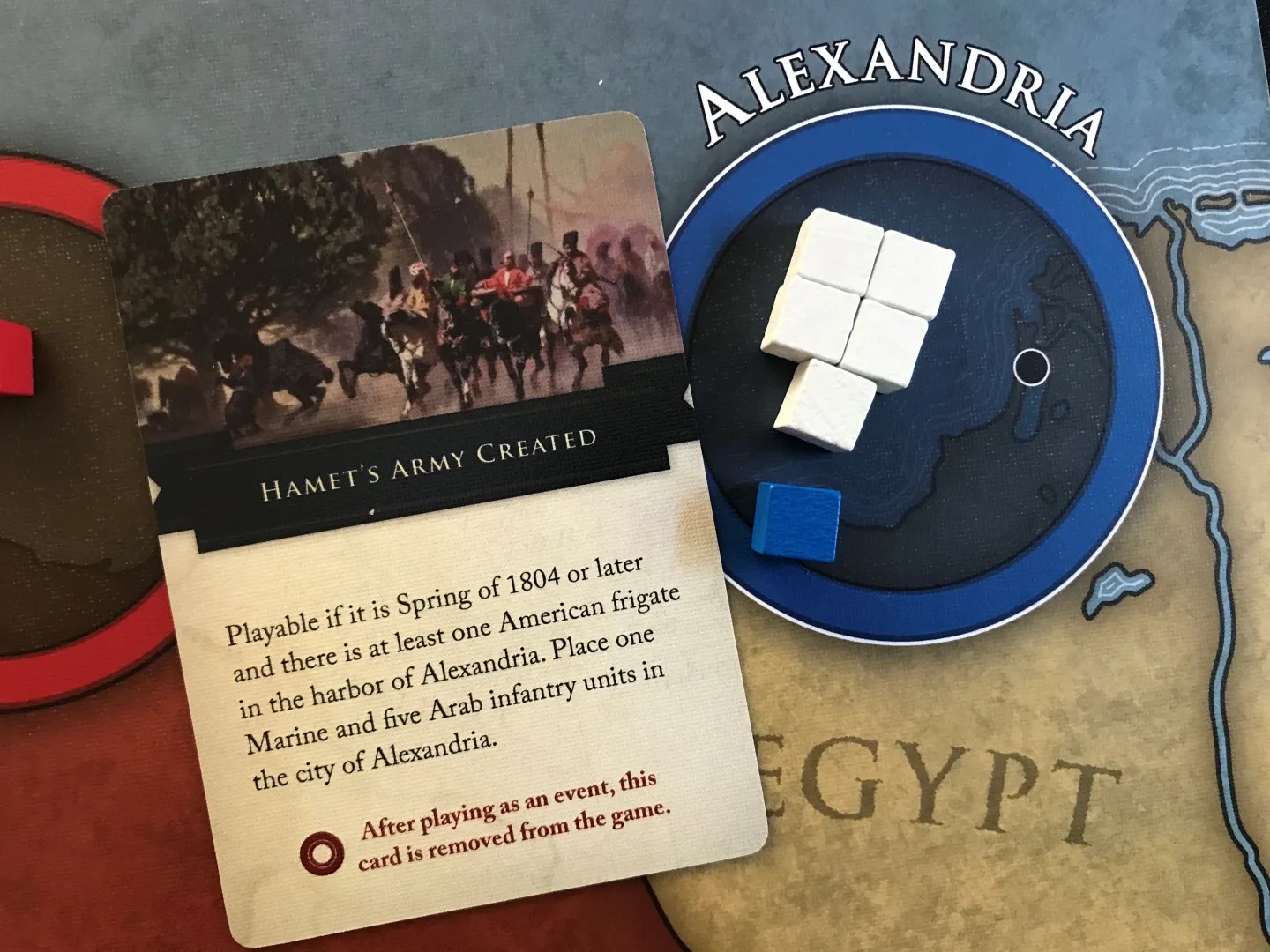
#94: Hamet’s Army Created from The Shores of Tripoli from Fort Circle Games
I have never played a historical wargame on the First Barbary War, which if you didn’t know was one of the first major wars the young United States of America participated in that was situated far outside their sphere of influence in North and South America. Shortly after the end of the American Revolutionary War, commercial vessels of the United States were being attacked and raided by the pirates of the Barbary coast in the Mediterranean Sea. In 1801, newly inaugurated President Thomas Jefferson was eager to put an end to this threat and sent a “squadron of observation” to the Mediterranean to deal with the threat. The Shores of Tripoli covers this conflict and does so using a card driven game mechanic that works really well in this instance. The game is a little deceiving, as at first it appears to be pretty introductory with simple rules and mechanics, but the depth for the game lies in the strategy for each side and the fact that their victory conditions are asymmetric.
While the main combatants in the game are naval units, there are ground units as well that must be used to try and take Tripoli to win the game. The American ground units consist of Hamet’s Army, which is a combined force of Arab and American infantry units that are dedicated to the mission of installing the pro-American Hamet Qaramanli on the Tripolitan throne. These ground units consist of white cubes that represent the Arab Infantry and blue cubes that represent American Marines. In Ground Combat, each Infantry unit rolls one die and it takes one hit for them to be eliminated.
Hamet’s Army will be created if the United States player plays the card Hamet’s Army Created for the Event. There are several conditions to the card being played though as it must be the Spring of 1804 or later and there has to be at least one American Frigate located in the Alexandria harbor. Once played to bring on Hamet’s Army the card is removed from the game and placed in the box. The newly created army will have to fight their way through 2 locations, Derna and Benghazi, for a final confrontation at Tripoli. I think that I very much enjoy this card because it is a necessary step in the game that the player has to plan for and be prepared to play when it does reveal itself. The player must be ready by using a portion of their limited actions to move at least 1 American Frigate to the harbor of Alexandria and then play this card for the printed event. Keep in mind that this is just the start though as there is a long way to go from here and many more things that must be completed to setup the final showdown.
Hamet Qaramanli’s army was a mixed mercenary force of several hundred Arab and Berber fighters, European cannoneers, and Greek infantry led by U.S. Army Captain William Eaton and U.S. Marine Lieutenant Presley O’Bannon during the First Barbary War. The goal of the expedition was to successfully march across the North African desert, capture the city of Derna, and depose the ruling Pasha of Tripoli, Yusuf Qaramanli in favor of his exiled older brother Hamet Qaramanli. In early 1805, the force marched roughly 500 to 600 miles across the Libyan Desert from Egypt to the Tripolitan border. The force consisted of 8 U.S. Marines, a small group of U.S. sailors, 26 Greek volunteers, a company of cannoneers and roughly 1,000 Arab and Berber mercenaries loyal or allied to Hamet. On April 27, 1805, aided by U.S. Navy warship bombardments, the force successfully stormed and captured the strategic port city of Derna in the Battle of Derna. But before Hamet’s army could advance further toward Tripoli, the United States signed a peace treaty with Yusuf Qaramanli, abandoning Hamet’s claim to the throne in exchange for freed American prisoners and an end to tributes.
Lieutenant O’Bannon and Marines advancing toward Tripoli. (Image from Merrill L. Bartlett and Jack Sweetman, The U.S. Marine Corps: An Illustrated History, (Naval Institute Press, Annapolis, MD: 2001), 30–31.)
Pen-and-Paper bedeutet, gemeinsam Geschichten zu erleben, Grauzonen auszuloten und manchmal auch unangenehme Themen zu behandeln. Gewalt, Horror, Diskriminierung oder persönliche Ängste können solche Runden bereichern, aber auch nahe gehen. Awareness schafft den Raum für offene Kommunikation, gegenseitigen Respekt und die Sicherheit, jederzeit eigene Grenzen und die anderer wahren zu können.
With this My Favorite Wargame Cards Series, I hope to take a look at a specific card from the various wargames that I have played and share how it is used in the game. I am not a strategist and frankly I am not that good at games but I do understand how things should work and be used in games. With that being said, here is the next entry in this series.
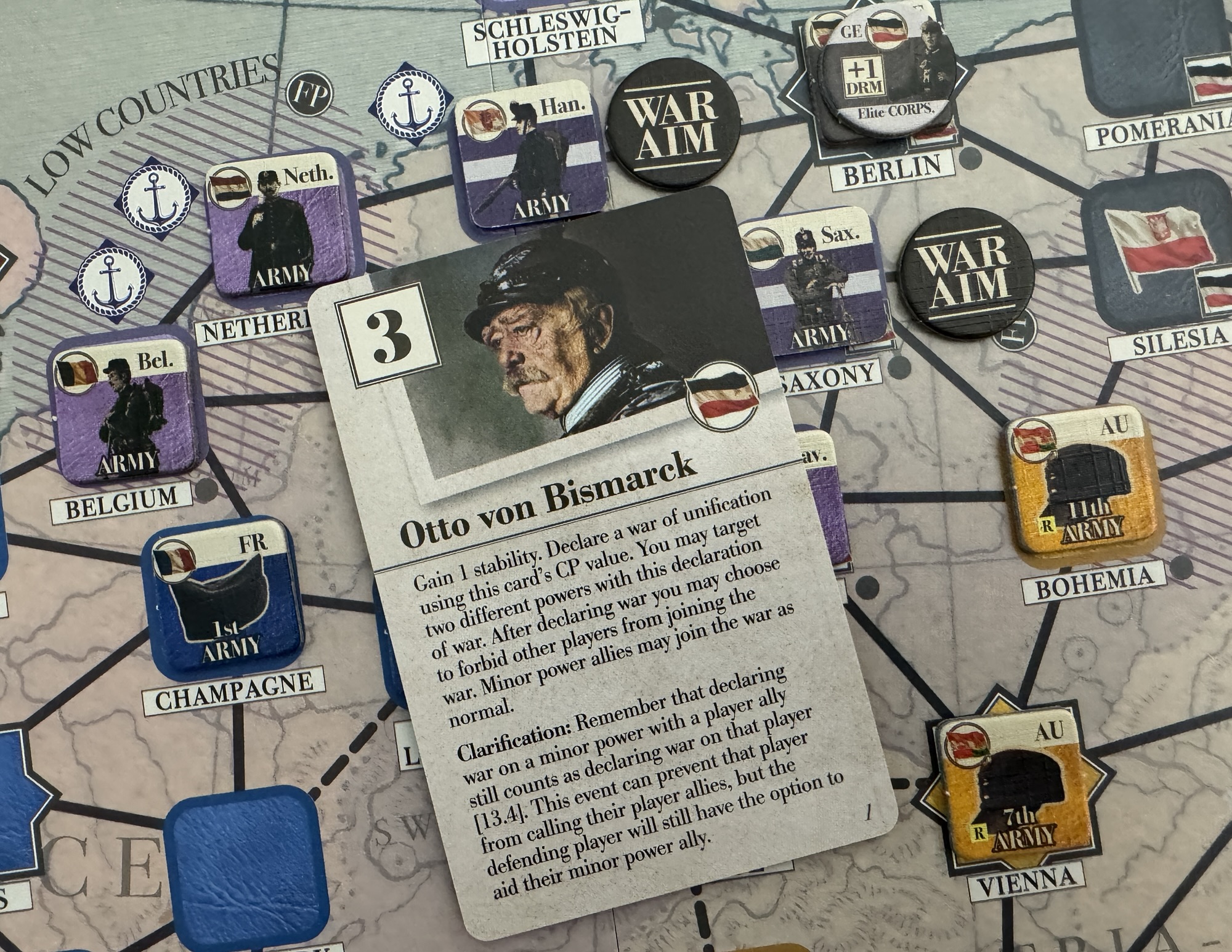
#93: German Home Card Otto von Bismarck from Imperial Elegy: The Road to the Great War 1850-1920 from VUCA Simulations
Imperial Elegy: The Road to the Great War 1850-1920 is a massive card driven game that blends diplomacy, warfare, and statecraft and feels a bit akin to games like Here I Stand and Virgin Queen from GMT Games, which are both grand scale sweeping epics that play multiplayers and take a day to play. Players play as 1 of 6 major powers in the game including Germany/Prussia, the United Kingdom, France, Austria-Hungary, Russia and the Ottoman Empire. The game is quite grand and ambitious as it covers 70 years near the end of the Victorian Era and the Progressive Ear and sees quite a lot of global change and competition between the great powers of the time. The game is a Card Driven Game and uses Action Cards as a type of currency to spend for their Command Points or the printed event to take actions such as recruiting armies and navies, industrialize, moving fleets and armies around the globe, influencing minor powers and establish colonies in Africa, India and the Pacific Ocean. The cards are all tied to the history of the period but the game can be played very much as a sandbox allowing players to explore strategies by trailblazing new horizons or following history.
In Imperial Elegy: The Road to the Great War 1850-1920, the Otto von Bismarck Card is a powerful and extremely important German Home Card. Rather than being shuffled into the common Action Card Deck, it belongs exclusively to the Prussian/German player’s unique toolkit to represent the historical trajectory of German state-building. The card is mechanically tied to the first few turns of the grand 7-decade timeline and acts as a get started quickly card for the German player as they begin the long and somewhat difficult task of attempting to unify the Germanic peoples under one banner. The German player can choose to execute it on Turn 1 to abstractly simulate Bismarck’s rapid real-world rise to power and kickstart early diplomatic maneuvers or wars. Playing as Germany, the player should be focused on attempting the Unification of Germany and will most likely choose the Unification National Goal card as a standard at the beginning of games. The Bismarck Home Card is the primary historical vehicle used to achieve this unification and simulates driving the annexations or alliances needed to claim crucial minor regions including Saxony, Schleswig-Holstein, Denmark and Alsace Lorraine. And like standard Action Cards in Imperial Elegy, the card presents a choice. The German player can either choose between using its high Command Point (CP) Value of 3 for a massive push focusing on industrial development or military actions, or using the card for its printed Event text. One of the really nice parts of the card is the way that it effects Stability in the game. Stability is a core national resource and rating that measures a major power’s internal political health, structural integrity and capacity to wage war or absorb setbacks such as economic downtown and social upheaval. Typically, when you declare war, your Stability will degrade but not in the case of a War of Unification. And with Bismarck, Germany will gain 1 Stability when they declare a War of Unification. This is such a powerful effect for the early game as it will allow the German state to build up their capacity and increase Stability to be able to perform later in the game.
1871 portrait of Otto von Bismarck, the first Chancellor of the German Empire. He is depicted wearing his signature Prussian military uniform, including the distinct Pickelhaube (spiked helmet).
Otto Eduard Leopold, Prince of Bismarck, Duke of Lauenburg, known as Otto von Bismarck, was a conservative German statesman who masterminded the unification of Germany in 1871 and served as its first chancellor until 1890, in which capacity he dominated European affairs for two decades. He had previously been Minister President of Prussia from 1862–1890 and Chancellor of the North German Confederation from 1867–1871. He provoked three short, decisive wars, against Denmark, Austria, and France.
Following the victory against Austria, he abolished the supranational German Confederation and instead formed the North German Confederation as the first German national state, aligning the smaller North German states behind Prussia, and excluding Austria. Receiving the support of the independent South German states in the Confederation’s defeat of France, he formed the German Empire – which also excluded Austria – and united Germany.
With Prussian dominance accomplished by 1871, Bismarck skillfully used balance of power diplomacy to maintain Germany’s position in a peaceful Europe. To historian Eric Hobsbawm, Bismarck “remained undisputed world champion at the game of multilateral diplomatic chess for almost twenty years after 1871, and devoted himself exclusively, and successfully, to maintaining peace between the powers”. However, his annexation of Alsace-Lorraine (Elsaß-Lothringen) gave new fuel to French nationalism and Germanophobia. Bismarck’s diplomacy of Realpolitik and powerful rule at home gained him the nickname the “Iron Chancellor”. German unification and its rapid economic growth was the foundation to his foreign policy. He disliked colonialism but reluctantly built an overseas empire when it was demanded by both elite and mass opinion. Juggling a very complex interlocking series of conferences, negotiations and alliances, he used his diplomatic skills to maintain Germany’s position.
A master of complex politics at home, Bismarck created the first welfare state in the modern world, with the goal of gaining working-class support that might otherwise go to his Socialist opponents. In the 1870s, he allied himself with the low-tariff, anti-Catholic Liberals and fought the Catholic Church in what was called the Kulturkampf (“culture struggle”). He lost that battle as the Catholics responded by forming the powerful German Centre Party and using universal male suffrage to gain a bloc of seats. Bismarck then reversed himself, ended the Kulturkampf, broke with the Liberals, imposed protective tariffs, and formed a political alliance with the Centre Party to fight the Socialists. A devout Lutheran, he was loyal to his king, Wilhelm I, who argued with Bismarck but in the end supported him against the advice of his wife Queen Augusta and his heir Crown Prince Frederick William. While Germany’s parliament was elected by universal male suffrage, it did not have much control of government policy. Bismarck distrusted democracy and ruled through a strong, well-trained bureaucracy with power in the hands of a traditional Junker elite that consisted of the landed nobility in eastern Prussia. He largely controlled domestic and foreign affairs, until he was removed by the young new headstrong Kaiser Wilhelm II. He retired to write his memoirs.
This historic image shows Chancellor Prince Otto von Bismarck (center) with diplomatic envoys and plenipotentiaries of the Federal Council (Bundesrat) inside the Berliner Reichstag in 1889.
We have put out several pieces of content covering Imperial Elegy and find it to be a fantastic game. These include written posts and videos. You can visit those by following the links below:
Unboxing Video:
Video Review:
Summary of Solitaire Bots presented by our friend James:
I love a different style and focus of wargame. A game that takes a look at an important but somewhat obscure or rarely addressed historical topic, such as espionage or intelligence, and creates a gaming experience tailored around the events to highlight and evoke the difficulties and tension that would have been present. In January 2026, GMT Games announced such a game in Checkpoint Charlie, which is a solo or cooperative game focused on SIS espionage missions in Berlin in the 1960’s designed by Russell Brown. We have posted an interview with Russel and it was very well received and he has now agreed to create a series of History Behind the Cards to highlight the events of the 1960’s Cold War struggle in West Germany but also to share aspects about the game play and how it models the history.
*Note: The cards highlighted in this series and their event text, as well as any pictures used showing any of the various components, are still in the design and development process and as such event effects and text might still change prior to final development and publication.Also the art and layout of the cards are only for playtest purposes at this point and the game will enter the art department as it nears publication.
History Behind the Cards – Checkpoint Charlie from GMT Games – Card #6: General Clay Steps In
US General Lucious D. Clay was appointed as military governor of the United States zone of Berlin from 1945 until 1949. He was best known, especially to the people of Berlin, as the person responsible for the Berlin Airlift, which fed and supplied the people of Berlin from the air when the Soviets cut off all access to the city for eleven months, from June 1948 to May 1949. Without the airlift, the west would have been left with two terrible options – allow West Berlin to be starved into submission and annexation, or invade East Germany to open a supply corridor, almost certainly starting an all-out war with the Soviets.
In the early 1960’s, US President Kennedy turned to the now retired General Clay and called on him to deal with serious issues that arose in Berlin, like the faceoff between tanks at Checkpoint Charlie (card #4). Clay understood Berlin and had the respect of its people, so Kennedy brought him along on his famous visit to the city, during which the president gave his “Ich bin ein Berliner” speech (card #7).
The General Clay Steps In card in Checkpoint Charlie represents the retired general being sent by Kennedy to resolve issues in West Berlin. Playing the card removes an event marker from the city and is the only way many of the event markers can be removed during a mission. It is especially useful for removing the Faceoff marker or a troublesome Stasi Stakeout.
In the next article in this series, we will take a look at Ich bin ein Berliner Speech by President John F. Kennedy.
In my opinion, this game looks extremely interesting and I am very much excited to learn more about it. I am appreciative to Russell and his efforts to bring us these cards and to write these entries to share with our readers. I am also very glad that this topic is being covered in a game and look forward to playing this one day soon.
With this My Favorite Wargame Cards Series, I hope to take a look at a specific card from the various wargames that I have played and share how it is used in the game. I am not a strategist and frankly I am not that good at games but I do understand how things should work and be used in games. With that being said, here is the next entry in this series.
#92: Castelnau and Voie Sacrée from Verdun 1916: Steel Inferno from Fellowship of Simulations
Over the past several years, we have played quite a few World War I games with our focus on the Guns of August events every summer. We have really played some fantastic games including some of the true classics on the genre such as Paths of Glory from GMT Games and The Lamps are Going Out from Compass Games but also some real hidden gems like At All Costs from Hollandspiele, Devil Dogs from Worthington Publishing and Decisive Victory 1918: Soissons from Legion Wargames. A game that we very much liked was Verdun 1916: Steel Infernofrom Fellowship of Simulations. The game is a Card Driven Game that uses cards with events and operation points to tell the grim story of the year long fighting around the French city of Verdun. The game uses a bucket of dice approach to the initial bombardments in a battle and then players choose whether to follow that with an infantry assault that doesn’t use any dice to determine hits. The game is very much a wargame but I think the cover highlights a key fact about the game by calling it a “Strategy Game” namely that it is a game as there are wildly powerful events based in history, with lots of dependence on dice not just for bombardments but also for playing certain offensives Event Cards where Victory Points are earned based on the higher numbers rolled. The game is very well done, is truly interesting and surprisingly deep with its tactical choices and decisions.
Some cards cannot be played as an Event until a specific named card has been played by the player. This is indicated on the card with a small “requires” box above the title of the card which shows the card that must already be in play as a Permanent Event to allow the new event to be triggered. Also, these Required Cards also have a small “combo” box above the title of the card to remind players which card they will allow to be played as a Permanent Event. Sometimes this concept of Combos must be planned for and may take a few rounds to get lined up to be able to play.
A perfect example of this is the Castelnau/Voie Sacrée Combo. Castelnau is an Event Card that must be played down on the table as a Permanent Event and is available during Turns 1 and 2. Once it is played, then that unlocks the play of Voie Sacrée and allows a very powerful Combo to go into effect by allowing the French player to place 12 units into the En Route Box on the board meaning they will be available for placement during the next Turn. This is so very powerful as in order to get that many units to use, the French player has to sacrifice a total of 12 VP (1 VP per unit added as Reinforcements). With this Combo, you sacrifice no VP’s and get 12 units to place on the board to plug the inevitable holes that will be created by the powerful German Barrages and assaults. There are other Combos as well including several specified Offensives (Russian Offensives and the Somme Offensive) that take several Turns to accomplish with multiple cards to get an opportunity to roll dice to gain VP’s. This was a very novel idea for the CDG mechanic and really worked well to create some portion of the game that required planning and an investment.
The Voie Sacrée, which is French for Sacred Way or Sacred Road, is a road that connects Bar-le-Duc to Verdun, France. It was given its name because of the vital role it played during the Battle of Verdun in World War I. After March 1916, along the 45 miles of the Voie Sacrée, transport vehicles were on the move day and night, ferrying troops, armaments, and supplies to the Verdun battlefield. During the initial crisis of February 21st through March 22nd, 600 trucks per day had already delivered 48,000 tons of ammunition, 6,400 tons of other materiel and 263,000 men to the battlefield. Beginning on February 21st, all horse-drawn traffic and troop movements on foot had been ordered off the road, leaving it open for truck and motorcar traffic only. After March 1916, one truck passed every 14 seconds, submitting the road to considerable wear and tear. Quarries had to be opened nearby to supply the road with crushed stone. Over the course of ten months, 16 labour battalions worked to keep the road in good shape and order. The road had been recognised since 1915 as the only reliable vehicular road that remained in existence to supply Verdun safely. All the standard-gauge railway lines that could reach Verdun had already been interrupted by German forces in late 1914. To compensate for this precarious situation, the road had been widened to 23 ft during 1915, so it could accommodate the continuous up and down flow of two lines of truck traffic. This preemptive roadway improvement in 1915, plus success in organizing the transport system on the road (a mission supervised by Colonel Maurice de Barescut, the Chief of Staff of the French Second Army), is what ultimately saved Verdun in 1916.
The Voie Sacrée still exists, but it has been paved over and is now an active secondary road. In 2006, the route was renumbered RD1916, a reference to the road’s most critical year. From 1923, the Voie Sacrée was marked by a borne every kilometer along the route. Each borne is topped with a sculpture of an Adrian helmet, the helmet worn by French soldiers during the Battle of Verdun.
The town hall in the village of Souilly, on the Voie Sacrée, served as headquarters to Generals Philippe Pétain and Robert Nivelle during the Battle of Verdun. A large, well-preserved, two-story stone building fronting on the Voie Sacrée, the Souilly town hall is still in official use today. Several plaques on its facade remind the visitor of the historic role it played in 1916 during the Battle of Verdun and, later in 1918, during the Meuse–Argonne offensive.
With this My Favorite Wargame Cards Series, I hope to take a look at a specific card from the various wargames that I have played and share how it is used in the game. I am not a strategist and frankly I am not that good at games but I do understand how things should work and be used in games. With that being said, here is the next entry in this series.
#91: DoD Contractors from Andean Abyss: Insurgency and Counterinsurgency in Colombia from GMT Games
The first game in the COIN Series called Andean Abyss is a 1-4 player multifaction treatment of the campaign for control of Colombia with different factions such as the the Government, FARC (Fuerzas Armadas Revolucionarias de Colombia), AUC (Autodefensas Unidas de Colombia) and the Cartels. The game focuses on all of the facets of the conflict including guerrillas and police, kidnapping and the drug war, military sweeps and terror. The factions deploy distinct capabilities and tactics to influence Colombian affairs and achieve differing goals. Andean Abyss creates an opportunity to get a feel for this model of insurgency and counterinsurgency in Colombia.
In this entry, we will take a look at the interesting and fairly powerful DoD Contractors. The card pays homage to the efforts by the Department of Defense to pay independent contractors to provide pilots for crop spraying over FARC-held territory and for reconnaissance flights to pinpoint the locations of guerrillas and their bases of operation. Patrolling FARC guerrillas in 2003 shot down one such flight along the western slopes of Caquetá and took three US personnel hostage, setting off a Colombian Army manhunt. The event gives the Government player the opportunity in a single Department to Activate all underground Guerillas and also to remove all Cartels Bases. Typically, to perform this type of action is a multi-turn investment with the Government having to mobilize and move Troops and Police into a Department and then perform a Sweep operation to uncover them. Then on a following turn, they can Assault and do things likes Air Strikes to attempt to eliminate these units. But this is very hard to do as the FARC and Cartel player can just use their next action to send their units back Underground or to Rally additional units in the space to safeguard their assets and Bases. On the other side, the Insurgents can use the event to remove up to 3 Government Troop Cubes and also mark both the Government and FARC ineligible through the next turn which means they will lose a turn. This effect is tied to the manhunt by the Government looking for the downed hostages as their resources and efforts are tied up preventing them from taking their normal actions. This can be really powerful and allow the insurgents to recover and get their units on the move or bring in more. Depending upon the time of the game that this is played, and around whatever circumstances are going on, this can really be a powerful card either way and I love how it reflects the US efforts to smoke out these drug lords in their war on drugs.
In 1978, Baton Rouge pilot Barry Seal, who flew commercial jets for TWA, is recruited by CIA case officer Monty Schafer. He asks Seal, who has been smuggling Cuban cigars into the country to make a little money, to fly reconnaissance missions over Central America using an Aerostar 600, outfitted with aerial surveillance cameras. Seal accepts the job, but hides it from his wife, Lucy.
In the 1980’s, Schafer asks Seal to act as a courier between the CIA and General Noriega in Panama. During a mission, the Medellín Cartel picks Seal up and asks him to fly cocaine on his return flights to the US. Seal accepts and flies the cartel’s cocaine to Louisiana, airdropping the drug in the countryside.
The CIA turns a blind eye to the drug smuggling, but the DEA tracks Seal down. To avoid the authorities, Seal and his family relocate to Mena, Arkansas and his wife comes to accept the wealth generated by his side job. The small town becomes wealthy as the hub of US cocaine trafficking.
Later, Schafer asks Seal to run guns to the Nicaraguan Contras in Honduras. Realizing the Contras are not serious about the war and just want to get rich, Seal starts trading the guns to the cartel. The CIA sets up a Contra training base in Mena and Seal flies the Contras in, but many of them escape as soon as they arrive.
Seal makes so much money he buries it in suitcases in the backyard. The FBI catches wind of the sudden exuberance on the streets of Mena. Eventually, the CIA shuts down the program and abandons Seal, who is arrested by the FBI, DEA, ATF and Arkansas State Police simultaneously.
Seal escapes prosecution by making a deal with the White House, which wants evidence of the Sandinistas being drug traffickers. They ask him to get photos that tie the Medellín Cartel to the Nicaraguan Sandinistas. Seal manages to get them, but the White House releases them as propaganda against the Sandinistas. Seal is prominently shown in the pictures, which leads to his indictment by the crusading state attorney general and the cartel plotting revenge.
Seal is convicted but sentenced to only 1,000 hours of community service. Moving from motel to motel making video recordings detailing his experiences, Seal expects an explosion any time he starts his car. As his community service is performed at the same Salvation Army building every night, Seal cannot hide from the cartel and is shot dead by an assassin. The CIA destroys all evidence connecting them to Seal and continues smuggling, instead using Iran to get guns to the Contras, as proposed by Schafer.
While this example is a bit more than crop dusting, the operation is part of the same deal and shows the US Government’s reliance on private commercial aircraft pilots during the war on drugs.
I love a different style and focus of wargame. A game that takes a look at an important but somewhat obscure or rarely addressed historical topic, such as espionage or intelligence, and creates a gaming experience tailored around the events to highlight and evoke the difficulties and tension that would have been present. In January 2026, GMT Games announced such a game in Checkpoint Charlie, which is a solo or cooperative game focused on SIS espionage missions in Berlin in the 1960’s designed by Russell Brown. We have posted an interview with Russel and it was very well received and he has now agreed to create a series of History Behind the Cards to highlight the events of the 1960’s Cold War struggle in West Germany but also to share aspects about the game play and how it models the history.
*Note: The cards highlighted in this series and their event text, as well as any pictures used showing any of the various components, are still in the design and development process and as such event effects and text might still change prior to final development and publication.Also the art and layout of the cards are only for playtest purposes at this point and the game will enter the art department as it nears publication.
History Behind the Cards – Checkpoint Charlie from GMT Games – Card #5: Berlin Film Festival
Every summer since 1951, Berlin had hosted the international Berlin Film Festival (the Berlinale) and awarded the Golden Bear to the best film in each of five categories. Venues in both East and West Berlin were used for screening of films. As summer approached in 1962, Berlin found itself cut in two by the Berlin Wall amid growing tensions between East and West. It seemed there were any number of events that could trigger a war over the city. And yet, the Film Festival was held, entirely in West Berlin this time. The festival drew thousands of visitors to the city, including Hollywood stars like Jimmy Stewart and Tony Curtis. Screenings took place in venues throughout the city and, we can assume, brought a much-needed sense of normalcy and continuity to the residents of West Berlin and perhaps a sense of what was lost to those in the east.
The festival took place every year throughout the Cold War, and after reunification it once again began film screenings in the former East Berlin. The festival continues and this year the Golden Bear award for best film went to “Yellow Letters.”
The Berlin Film Festival card in Checkpoint Charlie assumes the Berlin Hilton is full up with visitors and cannot function as a Honey Trap. The card also assumes that the extra traffic in the city, including thousands of additional pedestrians trying to get a glimpse of celebrities, negates any Ongoing Card Effects that allow additional movement during the Movement step.
In the next article in this series, we will take a look General Clay Steps In as he is appointed by President Kennedy to resolve issues in West Berlin.
In my opinion, this game looks extremely interesting and I am very much excited to learn more about it. I am appreciative to Russell and his efforts to bring us these cards and to write these entries to share with our readers. I am also very glad that this topic is being covered in a game and look forward to playing this one day soon.
With this My Favorite Wargame Cards Series, I hope to take a look at a specific card from the various wargames that I have played and share how it is used in the game. I am not a strategist and frankly I am not that good at games but I do understand how things should work and be used in games. With that being said, here is the next entry in this series.
#90: Mob from Time of Crisis: The Roman Empire in Turmoil, 235-284 AD from GMT Games
I really love Time of Crisis from GMT Games. This is a very light, introductory wargame that is just plain fun to play. I have been playing it a ton on the Rally the Troops! online platform and really enjoy it no matter what the outcome of those games are. One card that I enjoy using is called Mob, which is a 3 value Populace Card that really can be a devious way to usurp your enemies. Populace cards are intended to be used to increase the support level for your reign in various local senates, recruit militias to assist in the defense of the local populace, to remove Mob counters through the process of holding games and to build various improvements that provide various benefits such as a Basilica, Amphitheater or Limes. You will be unable to control your local provinces without the support of the people and the Populace cards will help you to build that support. But with the Mob card, this is an offensive focused Populace card that can be used to begin undermining your opponents hold on provinces.
When played, the card allows you to place a Mob counter in a province on the board that doesn’t currently have a Mob counter. Mob counters represent rioting and instability in the provincial capital of a province. The Mob in the province will reduce its income generation by the number of Mob counters in the province but also will grow if not dealt with. During the Support Check Phase, if the number of Mob counters in a province equals or exceeds the province’s support level the Governor is replaced with a Neutral Governor with a support level of 1. During the End of Turn Phase, one Mob counter is added to each governed provinces that already has a Mob counter and no Amphitheater. The presence of an Amphitheater doesn’t stop Mob counters from being added from the play of the Mob card but will stop them from growing. Remember, one of the maxims of Ancient Rome was bread and circuses, which is panem et circenses in Latin. It was coined around 100 AD by the Roman poet Juvenal in his Satires. The phrase criticizes how the Roman public traded their political freedom and civic duties for free grain and massive public spectacles.
The Mob card can be quite effective as it reduces the income of your opponents which is used to to purchase additional and more powerful cards but also forces them to spend their card values on suppressing the mobs, through military force with the Suppress Mob action or through placation with the Hold Games action. Both will be a thorn in the side of your opponents and will cause them to have to change their plans temporarily to deal with the issues you have caused them. A fun and delightful “take that” type of card.
Mobs in ancient Rome were powerful, volatile groups of urban plebeians, freedmen and workers who heavily influenced politics, food supplies and public safety. Driven by economic hardship, political gangs, and grain shortages, these crowds routinely rioted, burned government buildings and forced emperors or senators to heed their demands. Ancient Roman writers, politicians, and historians viewed the urban mob (plebs) with a mixture of fear, contempt and fascination, often describing crowds as volatile, lawless and easily swayed by demagogues. One of the more well known quotes from history comes to us by way of Titus Livy when he said, “Indeed, that is the nature of crowds: the mob is either a humble slave or a cruel master.” Livy also wrote: “As for the middle way of liberty, the mob can neither take it nor keep it with any respect for moderation or law.”
1799/1810 copperplate engraving titled The Death of Clodius (or Clodius killed by Milo’s mob) was drawn by the Polish-born French artist Silvestre David Mirys (1750–1810) as part of his series Figures de l’histoire de la république romaine.
Africa’s longest-running board game convention is hoping to use its tenth anniversary to put more direct support behind the continent’s emerging designers, with plans for a new grant programme if its latest crowdfunding campaign reaches $20,000.
The November 27 and 28 event in Abuja will include prototype playtesting, workshops, industry discussions, networking and a marketplace alongside its consumer-facing game demonstrations and tournaments, according to organiser NIBCARD Games.
But potentially more significant for Africa’s developing board game industry are the additions AB Con hopes to unlock if the campaign moves beyond its base target.
Reaching $20,000 would launch an AB Con Designers Grant, providing financial support and mentorship to African tabletop designers to develop prototypes, improve their games and showcase them at future editions of the convention.
A $22,000 stretch goal would introduce an Impact Award recognising people and organisations helping develop the continent’s tabletop ecosystem, while $30,000 would extend this year’s convention from two days to three.
The campaign describes the designer grant as an attempt to create “more opportunities for African games to reach local and international audiences”.
That represents another step in a decade-long attempt by AB Con and organiser NIBCARD to build infrastructure around what was an extremely small modern tabletop design community when the convention began.
AB Con says there were fewer than 10 known indigenous tabletop games and only three published game designers in Nigeria before it launched in 2016, with few places available for people to regularly play modern board games.
BoardGameWire reported last year that the number of known modern games from Nigerian designers had since passed 100, while the number of designers had grown to 25.
AB Con has provided a crucial meeting point and catalyst during that expansion, bringing together designers and publishers alongside manufacturers, retailers, educators and players.
Gamers, publishers, designers and organisers at AB Con 2025 || Photo Credit: AB Con
Nigerian board game company NIBCARD’s role in developing that ecosystem was recognised with the Diana Jones Award for Excellence in Gaming in 2021.
The award committee described the company as being “the multi-faceted company at the heart of the nascent Nigerian games industry”, highlighting its work publishing games, manufacturing for other companies, mentoring designers, running a game café and organising AB Con.
NIBCARD itself says it has now designed more than 70 tabletop games since being founded in 2013, while its activities have expanded across publishing, manufacturing, education and digital games.
While those efforts have proved a pillar of the region’s hobby gaming growth, NIBCARD and AB Con founder Kenechukwu ‘KC’ Ogbuagu told BoardGameWire there were still large challenges around getting Nigerian and African designers and games to break into North American and European markets.
He said, “It’s a combination of several factors, but I would highlight visibility, access, finance, and market access.
“There is a significant lack of visibility for African games and designers. Publishers often don’t get to see the games being created here, while designers have very limited opportunities to meet and build relationships with publishers.
NIBCARD and AB Con founder Kenechukwu ‘KC’ Ogbuagu
“I have experienced this personally. I once received fully funded support to attend Spiel Essen, but was denied a visa. Last year, I was invited to GothCon on a fully funded trip, but I couldn’t even secure an interview date for my visa application.
“Finance is another major barrier. Even when a game is ready, designers need money to market it, work with content creators and reviewers, attend international conventions, and run crowdfunding campaigns such as Kickstarter or Gamefound.
“And for those who choose to self-publish, international shipping can make African games extremely expensive and difficult to compete with in global markets.”
He added, “One of our mission is to see African designers creating games that are enjoyed globally and, ultimately, seeing African-designed games recognised among the best games in the world.
“We have already started working towards this. Last year, with support from the Spiel Foundation, we showcased games from three African designers at SPIEL Essen 2025. We also started a game studio as a way to bring African games to light.
“But even as we build, from over 10 years of experience doing this, a lot of the impact are limited due to lack of funding.
“We are intentionally building AB Con to become a platform where African designers, games, publishers, distributors, and international industry professionals can connect.
“We want publishers from North America and Europe to see AB Con as a place to discover new designers and games from Africa, explore licensing and publishing partnerships, and build long-term relationships with the African tabletop industry.
“This is one reason we are committed to maintaining a two-day convention going forward, with the goal of eventually growing it into a four-day event. We want to create enough time and space for meaningful meetings, playtesting, networking, showcases, and publisher scouting.”
The growing scope of AB Con has repeatedly run up against the economics of staging the convention, however.
Its new $14,000 base target represents another substantial increase. Organisers said the higher figure reflects both inflation and the cost of restoring AB Con’s two-day format, and will be used for venue and production costs, volunteer support, logistics, marketing, accessibility and expanded programming.
Nigeria continues to experience significant price increases, despite inflation having eased substantially from the levels that prompted AB Con’s return to crowdfunding.
The country’s National Bureau of Statistics currently reports annual consumer price inflation of 15.9% – down markedly from an almost 30-year high of 34% when AB Con launched its 2024 campaign.
Last year’s AB Con campaign was initially intended to support ambitions for as many as 3,000 attendees, compared with roughly 1,300 at the 2024 event and about 1,000 in 2023. The 2025 convention ultimately took place as a one-day event on November 29.
At least seven Nigerian designers showcased projects at the 2025 convention, according to Nigeria’s Independent newspaper, while participating publishers included Althra Games, ICE Game and Jesus Native Games.
AB Con founder and lead convener Kenechukwu ‘KC’ Ogbuagu said, “When we hosted the first AB Con in 2016, our dream was bigger than organizing an event – we wanted to help build an industry.
“Ten years later, we’ve seen designers launch original games, communities grow across Africa, and more people recognize games as powerful tools for learning, culture, business, and connection.
“This anniversary is not only a celebration of how far we’ve come but an invitation for the world to help shape what comes next.”
The AB Con Kickstarter is live now, with the convention scheduled to take place in Abuja, Nigeria on November 27 and 28.

 Anmelden


 Patrick Stewart prägte mit seiner Darstellung von Captain Picard eine ganze Generation an Science-Fiction-Fans. Nun ist er auf seine letzte Reise gegangen. Mit 86 Jahren verstarb er nun nach kurzer schwerer Krankheit in Los Angeles. Zeit, innezuhalten für einen der Großen unserer Zeit.