Board game crowdfunding major Awaken Realms has made its first acquisition of another publisher by acquiring Darwin’s Journey maker Thundergryph Games.
Thundergryph will operate under its own brand following the deal, with company founder Gonzalo Aguirre Bisi continuing to lead its creative direction in his new role of game director at Awaken Realms.
The publishers said the tie-up will allow Thundergryph to focus exclusively on game design and development, with Awaken Realms taking on responsibility for operational necessities such as logistics, manufacturing, fulfillment and worldwide distribution.
The move broadens Awaken Realms’ publishing portfolio beyond the large-scale, narrative-driven and miniature-heavy titles for which it is best known, such as the hugely lucrative Nemesis series, Tainted Grail and ISS Vanguard.
Acquiring Thundergryph adds a catalogue which includes eurogames such as the highly regarded Darwin’s Journey, Tang Garden and Etherstone – and indicates an appetite from Awaken Realms to expand out into different styles of game.
Awaken Realms founder and CEO Marcin Świerkot said, “We were really impressed by the Thundergryph portfolio and how they managed to create very interesting and beautiful games over and over again.
Awaken Realms CEO Marcin Świerkot
“Because they are so different from what we usually do at AR (with all our dark and gritty taste), we believe it is a perfect fit to make our portfolio broader.”
Awaken Realms would not confirm to BoardGameWire if the acquisition represented the first of multiple M&A deals in the pipeline, but did say it sees value in “building a broader publishing ecosystem, but only if it respects each brand’s identity”.
A spokesperson for Awaken Realms told BoardGameWire, “Right now, our focus is fully on making this partnership successful and supporting the Thundergryph Team in the best possible way.
“More broadly, we are always open to opportunities that make strategic and creative sense, especially where we can help talented teams focus more on making great games while Awaken Realms supports them with production, logistics, fulfillment, and global infrastructure.
“Thundergryph is a particularly strong fit because its portfolio is different from what Awaken Realms is best known for. Their light and medium-weight games, strong visual identity, and elegant production values complement our existing line-up very well.”
He added, “In general, Awaken Realms is interested in areas that can strengthen our ability to create, produce, and deliver great games to players around the world. That can include publishing, operational infrastructure or other strategic areas.”
Discussions for the Thundergryph acquisition began more than a year ago, company founder Bisi told BoardGameWire, adding that such an arrangement was something he had been thinking about for some time.
Thundergryph founder Gonzalo Aguirre Bisi
He said, “Years ago, I had much more time to focus on game development, art direction, and product creation. As Thundergryph grew from a small publisher into a medium-sized company, the amount of organization and administration required increased significantly.
“I realized that I wanted to return to the aspects of the job I enjoy most: creating games and helping bring them to life.”
Awaken Realms says its infrastructure has delivered more than 700,000 games worldwide to date, and believes that support will allow Thundergryph to scale without adding further management burden to its creative team.
The company also retains close ties with crowdfunding platform Gamefound, which began life as part of Awaken Realms before becoming a separate entity with Ravensburger as its majority shareholder. Marcin Świerkot, the co-founder of both Awaken Realms and Gamefound, remains CEO of both businesses.
Bisi added that Thundergryph’s future if it hadn’t agreed the takeover deal would have been one “with fewer games and less time dedicated to nurturing and developing them to the standard we aspire to achieve”.
He said, “The people designing the games, developing the gameplay, creating the visual identity, and interacting with the community are still here. Our creative vision, our passion, and our commitment to making unique games remain unchanged.
“This agreement gives us the opportunity to dream bigger while staying true to what made Thundergryph special in the first place.
“It allows us to combine Thundergryph’s creative strengths with the resources and infrastructure needed to bring even more ambitious projects to life.”
Those projects will begin with Galileo’s Truth, a game by designers Virginio Gigli and Flaminia Brasini, which is set to launch on Gamefound on July 7.
Canadian board game publisher Off the Page Games is expanding beyond its comic book roots with the launch of a new imprint focused on original IP.
The company, which has built its reputation adapting indie comics into tabletop games such as Mind MGMT, has unveiled Off the Page Games Unbound, which will publish games not tied to existing comic book licences.
In a reversal of Off the Page’s previous strategy, the company said it had hired award-nominated comic book creator Chris Schweizer and illustrator Rocio Ogñenovich for Unbound to create a series of comics based on The Seekers.
The Seekers, published by Off the Page Games Unbound
Schweizer previously collaborated with the publisher to turn his graphic novel series The Creeps into a family-weight board game, which is due for release this autumn.
The Seekers webcomic will be released weekly leading up to the crowdfunding campaign for the board game, with physical copies included with the final product.
Cormier said, “I’m excited to continue converting my favourite comics into cool board games, but I’m also pumped to bring some other surprises that aren’t tied (…or bound!) to any specific comic.”
Cormier launched Off the Page in 2019 by publishing Mind MGMT, based on the Dark Horse comic book series created by Matt Kindt.
The publishers subsequent titles have included Harrow County and Corps of Discovery, while Cormier’s designs with other publishers include Junk Art, co-created by Sen-Foong Lim, and In the Hall of the Mountain King, which was designed alongside Graeme Jahns.
The Tokyo Game Market has long been a hotbed of innovation, especially where trick-takers are concerned. Sometimes the games don’t work entirely as intended, but, hey, that’s what it takes to transform the world one small iteration at a time. The bricks of the forum weren’t laid in a day.
Case in point: Fractal Tricks, the hybrid trick-taker by Jason Lee, doesn’t always function to specifications. Oh, sometimes it does, and in those moments it’s one of the tightest two-player trickers I’ve seen. But even at its worst, when one participant is rumbling the other — or more often, when both players are still fumbling through the implications of their moves — it’s still an engrossing look at how much remains to be discovered in this eldest of genres.
From this simple set of rules, infinite complexity shall be born…
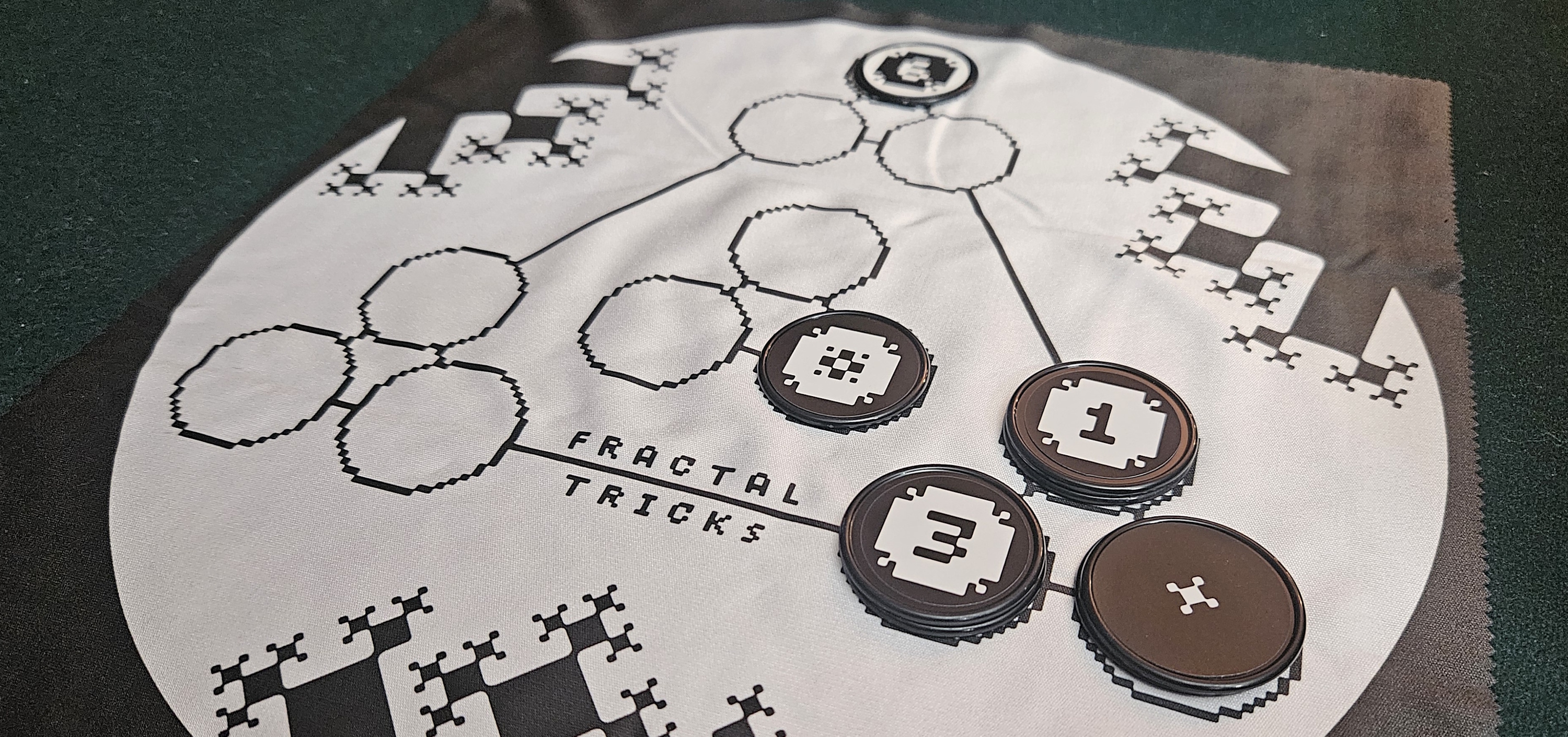
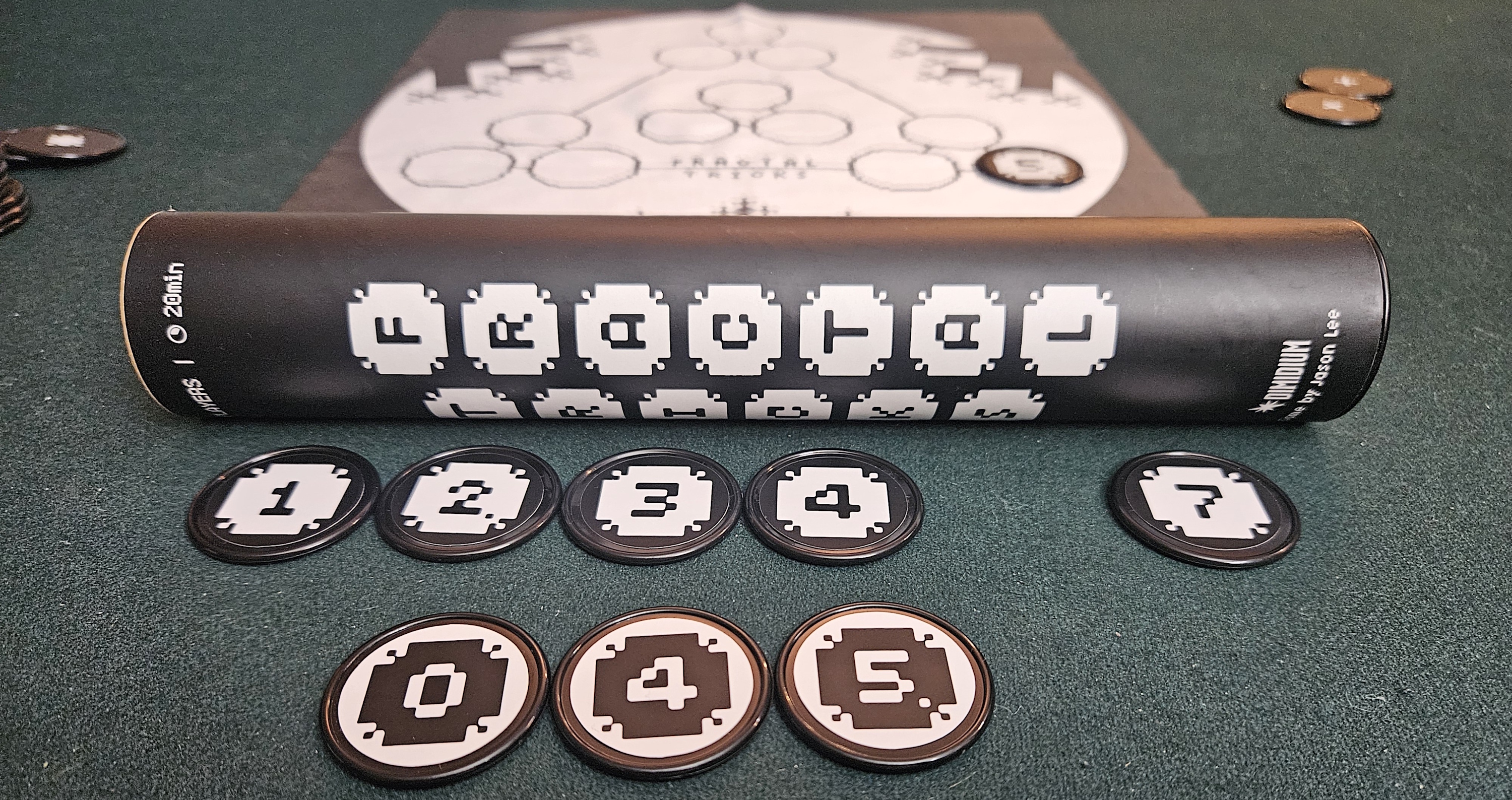
It begins with some simple rules. There are only two suits. Black on white, white on black. Technically black on white on black and white on black on white, but let’s not get carried away. There’s also a mat. Three connected segments, each comprising three spaces, plus another segment in the middle.
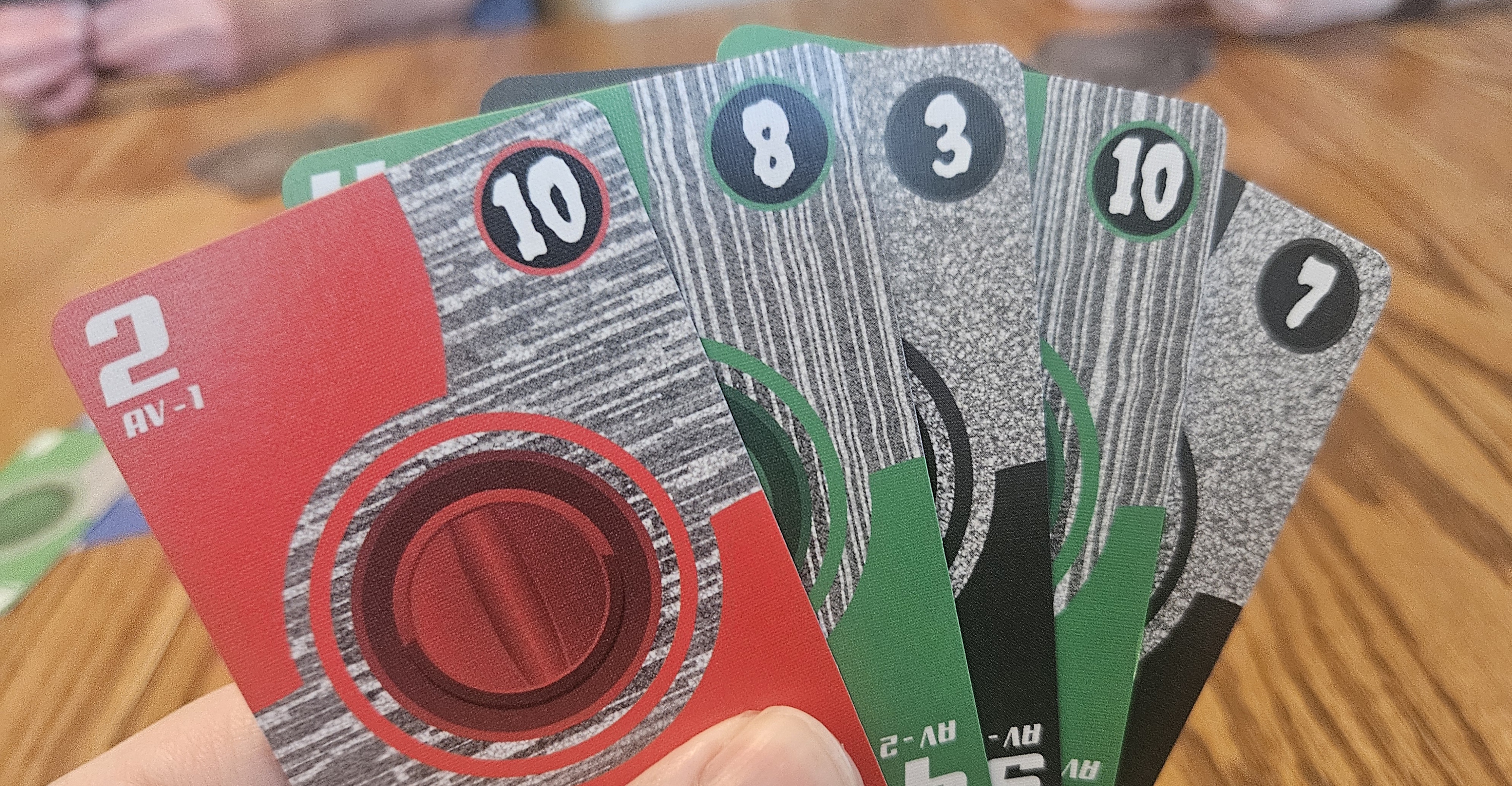
As I’ve noted, this is a trick-taking game. For the most part, the rules are familiar. One player places a chip. Their opponent then responds with a chip of their own, sticking to the same suit if possible. High rank wins.
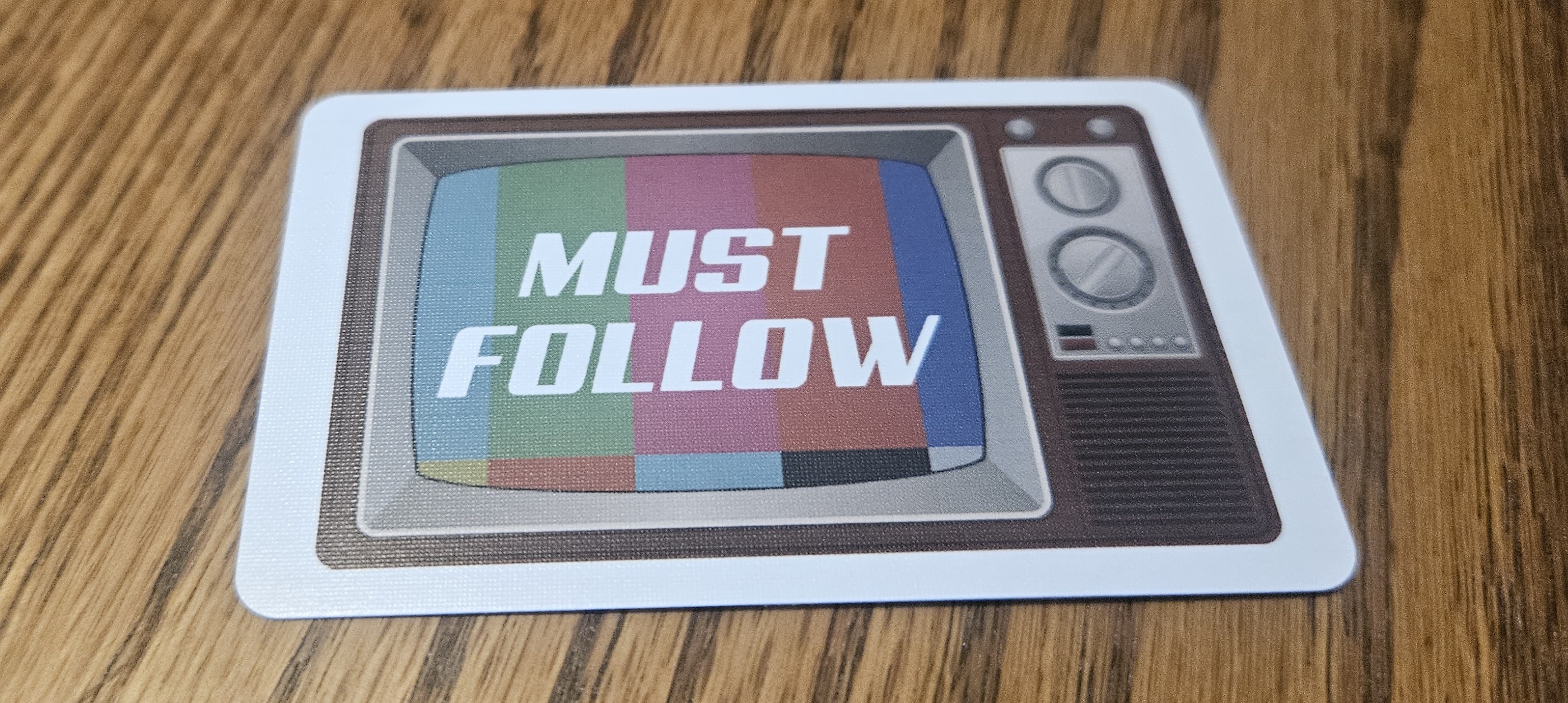
Except there are… adjustments that must be made. First of all, not all tricks are equal. Normally the high rank wins, but if the two chips have different suits, then the low rank takes it. Oh, and there are one or two exceptions to the must-follow rule. For example, if both chips sum to a total of nine, you can use the opposite suit, unexpectedly changing the calculus from high to low.
Secondly, the import of these tricks is hard to understand right at first. The participants in Fractal Tricks are no ordinary players. They’re cosmic forces. One of them, Cosmos — who I usually just call Order — indicates their wins on the mat by keeping the chips face-up. The other, Chaos, flips them face-down.
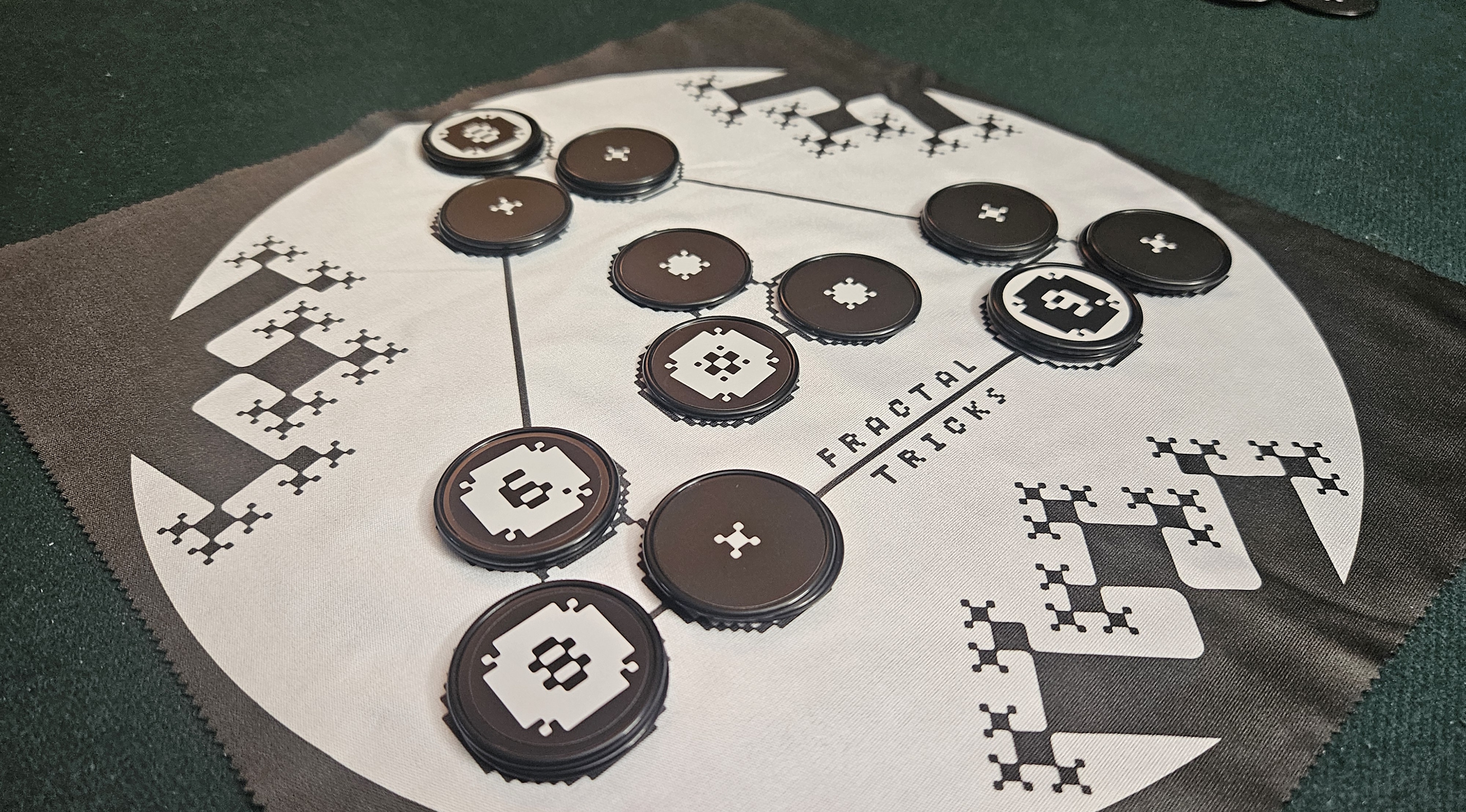
As soon as one of those little triangles has been filled in, the winner of the set places a corresponding victory chip in the middle of the board. To give a concrete example, if I’m Cosmos and I win two of those three tricks, the corresponding chip will therefore be white-on-black. If you win, now it’s a darker hue. Around we go, filling in all three sets of three tricks, nine in total, until the entire board is filled.
But flipping as many tricks as possible to our side isn’t our ultimate objective. Our real goal depends on our side of this entropic conflict. Cosmos wants to match a pattern on the edges with the one in the middle. Chaos wants to prevent that. Whichever side accomplishes their goal then claims the victory chips in the middle — but only the ones that correspond to their color.
Hiding my chips from my opponent.
It’s a bit of a mind-burn, not to mention difficult to describe in text. Here’s the gist: one side wants to create a pattern, the other wants to prevent it.
Which very quickly sets the tone for the entire game. Early on, it’s tempting to win every trick. But as any seasoned tricker can tell you, trick-taking is often about the tricks you decline to take just as much as it’s about those you claim. That’s never been truer than in Fractal Tricks. The battleground is created on the fly according to your successes and failures, thrusts and feints. Often, winning a trick is the worst possible thing you can do, smothering a potential pattern in the cradle. Or, sure, breathing life into its lungs if you happen to be on the side of entropy. And the stakes only grow higher as new patterns form at the edges, gradually informing the one at the mat’s center.
To be clear, this is one of those titles that really demands repeat play. Its first session is a curiosity. Its second sees the rules begin to click. But it’s only on the third, fifth, tenth that its tactical breadth becomes apparent. With only those two suits and twenty chips, the game’s “card”-counting is as easy as it gets, paving the way for cautious play and bitter moments of zugzwang. But from that simple ruleset arises unexpected and emergent outcomes, especially as hands are increasingly depleted. There’s nothing quite like deliberately losing a battle so you can win the war.
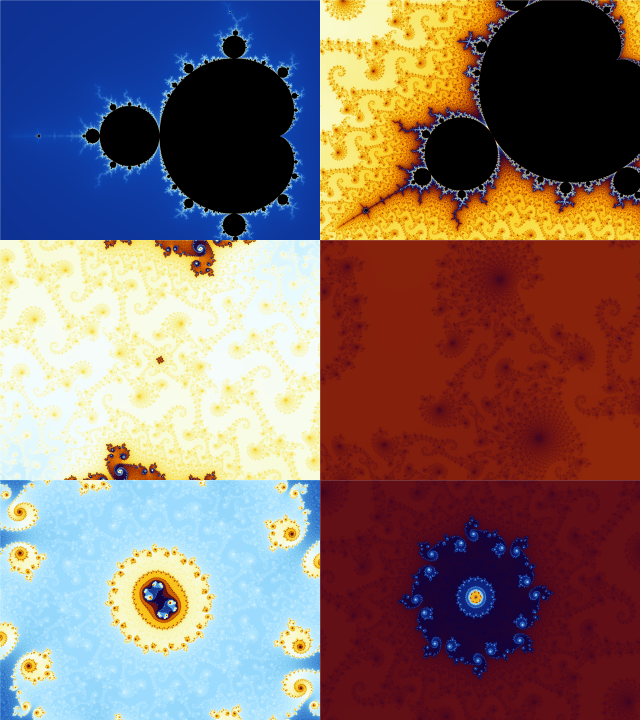
Simple rules begetting boundless emergence — it tickles me to see a game embody its central conceit so fully. Focused on only those nine input cells, Fractal Tricks swoops in like it’s examining the Mandelbrot Set. Here those rules can be manipulated, but never quite broken. Which makes for a tense standoff indeed.
Pop quiz: Who scores? And how many points?
Like I mentioned at the beginning, Fractal Tricks doesn’t always work as intended. This is entirely a user error, a failure to really grasp both the game’s possibilities and its boundaries. But it’s a common error, a forgivable one, one that bears making and remaking.
I wouldn’t have it any other way. Even in the middle of a flubbed session that concludes after two brief rounds when one player bodies the other, Fractal Tricks is fascinating to handle. With some experience, it opens up. Or perhaps it undergoes magnification. Whatever the specific operation, the result is a game that’s simple on the surface, roiling in the depths, and eager to lure its participants ever deeper.
A complimentary copy of Fractal Tricks was provided by the designer/publisher and carried across the ocean by a different designer/publisher.
(If what I’m doing at Space-Biff! is valuable to you in some way, please consider dropping by my Patreon campaign or Ko-fi. Right now, supporters can read the next installment in my series Talking About Games, this time tackling the topic of what makes a good list! Naturally, the piece includes a list.)
Award-winning board game store owner Matthew Mičetić says independent tabletop retailers can no longer rely on product sales alone, as rising costs, tariff uncertainty and changing consumer behaviour continue to reshape the hobby retail landscape.
Mičetić was named Oregon Small Business Person of the Year last week by the US Small Business Administration, celebrating the 16-year growth of Portland-based Red Castle Games from a small neighbourhood game store into a vibrant space offering organised play, youth camps, community events and an on-site cafe.
He told BoardGameWire the complexity of running a game store had increased dramatically since the store opened in 2010 – but added that widening the venue’s scope had been a key ingredient in Red Castle’s success.
Mičetić said, “Competing solely on product selection and price has become increasingly difficult in a world where customers can order almost anything online and have it delivered to their door.
“What independent game stores can offer that online retailers cannot is community. We can provide places for people to learn, play, compete, socialize, and build friendships. The retail sales often follow from those relationships.”
He continued, “We aren’t just retailers anymore. We’re event organizers, community managers, educators, food service operators, e-commerce businesses, and increasingly technology companies as well.
“The encouraging part is that the core mission hasn’t changed. People still want places to gather, play games, make friends, and feel like they belong.
“The stores that continue to succeed are the ones that adapt to the changing business environment while never losing sight of the community they’re there to serve.”
Mičetić’s drive has seen that community expand from traditional hobby gamers and TCG players to include young people, families and more casual gamers keen to dip their toes into the hobby – something he believes is one of the biggest opportunities for game stores today.
He said, “Some of our most successful recent initiatives have been our youth programs, including Dungeons & Dragons, Magic: The Gathering, and Pokémon camps and after-school programs.
“Parents are looking for opportunities that help kids build friendships, creativity, problem-solving skills, social-emotional skills, and confidence. Tabletop games are uniquely positioned to provide that.
“We’ve also had success reaching beyond the traditional hobby audience. There are a lot of people who can benefit from what tabletop gaming offers who may never have considered walking into a game store.
“That means being willing to experiment, try new things, and sometimes fail. Not every idea works, and that’s okay. The important thing is to learn from it, make adjustments, and keep moving forward.
“I’ve always believed in looking for 1% improvements. Small improvements compound over time. If you can make your store, your programs, your customer experience, and your operations just a little bit better every day, those gains add up to something significant over the course of years.”
He added, “While retail is still the foundation of the business, these complementary activities have become increasingly important both financially and strategically. They reinforce one another.
“Someone might discover us through a D&D camp, become a regular event participant, buy games and accessories, meet friends through the community, and eventually become a long-term customer.
“The café, events, camps, and retail operation all work together to create a stronger overall ecosystem. For independent game stores, I think that’s one of the biggest lessons of the last decade. The future isn’t just about selling products, it’s about creating reasons for people to keep coming back.”
Organised play remains a “core pillar” of the store’s financial prosperity, Mičetić told BoardGameWire, while Magic remains its strongest offering and continues to be a cornerstone of organised play.
Mičetić receiving his Oregon Small Business Person of the Year award
He added, “One Piece has been one of the biggest success stories of the last several years, drawing strong participation. Star Wars Unlimited has also developed a passionate local community and has exceeded our expectations.
“Beyond TCGs, Dungeons & Dragons continues to be a major driver of participation through campaigns, youth programs, and camps. Board game events, painting nights, and miniature gaming also contribute meaningfully to overall attendance, even if they don’t always attract the same numbers as the largest TCG communities.
“What excites me most isn’t any individual game. It’s the diversity of the community. I believe the healthiest stores aren’t dependent on a single title. They’re places where someone can come in for Pokémon, discover D&D, try a board game, join a painting event, and ultimately find multiple ways to engage with the hobby.”
Speaking about current growth areas on the retail side – and areas which could be in decline – Mičetić told BoardGameWire TCGs continue to be the strongest growth category in the hobby, while oversaturation in higher-price point board games was beginning to show strain.
He said, “Magic remains a powerhouse, Pokémon continues to bring in new players, and we’ve seen strong engagement from newer games [such as One Piece and Warlord] as well.
“That said, I do worry that we’re in a boom cycle. I don’t know when it will happen, but historically every collectible market experiences corrections and I think it’s wise for retailers to plan accordingly.
“In board games, I think we’re seeing softness at the higher end of the market. For years, the industry benefited from an explosion of new releases and crowdfunding projects, but I also think the market became oversaturated.
“Self-publishing and crowdfunding lowered barriers to entry, which brought some fantastic games to market, but also a tremendous number of mediocre ones. Consumers have more choices than ever and less time to play them.
“Where I’ve seen the most consistent strength is in smaller board and card games, particularly titles under about $25. At that price point, they’re an easy impulse purchase and a lower-risk way for customers to try something new.
“RPGs are interesting. Product sales have slowed somewhat for us, but organized play and events remain strong. People still want to gather around a table and tell stories together, even if they’re buying fewer books than they once did.
“Miniatures remain a challenging category outside of Games Workshop. Many lines have passionate fan bases, but Games Workshop continues to outperform expectations and demonstrates the power of consistent support, organized play, and strong intellectual property.
“As for crowdfunding, we’ve largely stepped away from it as a retailer. There are certainly successful projects, but we’ve experienced too many delays, failures, and fulfillment issues over the years.
“Tying up cash and shelf space for products that may arrive years late, or not at all, has become increasingly difficult to justify.”
Mičetić said that on the distribution side, relationships had become both more important and more complicated since 2020, with the pandemic having exposed just how dependent the industry is on supply chains and allocation systems.
Mičetić said distribution relationships had become more complicated since the pandemic – and more important
He said, “In many categories, especially TCGs, we spent years dealing with product shortages, allocations, delayed releases, and uncertain restocks. More recently, while still dealing with those allocation issues, we’ve added questions around tariffs, pricing, inventory levels, and market demand.
“The underlying challenge remains the same, uncertainty. At the same time, retailers are being asked to make increasingly complex purchasing decisions with limited capital and shelf space.
“When talking with distributors today, my primary focus is predictability and partnership. I don’t expect every product to be available in unlimited quantities, but I do want transparency around allocations, release schedules, and restock expectations.
“The better information we have, the better decisions we can make. I also spend a lot of time discussing breadth versus depth. Every distributor wants retailers to carry more products, but shelf space, cash flow, and staff attention are finite resources.
“We’re increasingly focused on products that have strong community support, organized play opportunities, or demonstrated demand rather than simply chasing every new release.”
Mičetić’s award recognition follows a turbulent series of challenges in recent years, ranging from navigating the Covid-19 pandemic to enduring ten break-ins over a twenty-month period – a spate of crimes which resulted in more than $250,000 in losses and property damage.
He told BoardGameWire that while the experience was “frustrating and demoralizing”, he was “not willing to let a handful of criminals determine [Red Castle’s] future” – adding that the show of support from customers following the break-ins had helped reinforce why the store exists in the first place.
Mičetić said, “The primary targets were trading card games, particularly sealed Pokémon and Magic products, along with Games Workshop product. Unfortunately, those products are small, portable, and have a well-established secondary market, which makes them attractive targets for theft.
“The financial losses were significant but the larger challenge was the operational and emotional toll. Every break-in meant dealing with police reports, emergency repairs, damaged property, disrupted operations, and the uncertainty of whether it would happen again.
“There were periods when it felt like we were spending almost as much time thinking about security as we were thinking about growing the business.”
He advised other hobby retailers to “invest in security before you need it”, adding that the experience had changed his own understanding of risk.
Mičetić said, “Small businesses often operate on relatively thin margins and repeated criminal activity can have an outsized impact.
“It’s a reminder that when people talk about crime affecting businesses, they’re not just talking about stolen merchandise, they’re talking about the time, money, stress, and opportunity cost that comes with recovering from it over and over again.”
Speaking of his SBA award win, which recognises business owners who demonstrate outstanding business growth, innovation, resilience, and contributions to their communities, Mičetić said, “This recognition is incredibly meaningful because it reflects the community that built Red Castle Games.
“Every customer, staff member, volunteer, and supporter has played a role in our success. This award belongs to all of them.”
Asmodee’s recently-launched party games studio Moodbox Games has unveiled its first four releases, with Guess the Mess, Link Out Loud, Photo Dump and Who Says? Friends set to hit retail shelves in July.
The announcement marks the first product reveal from the women-led studio, which Asmodee launched last October as part of a push to reach players beyond traditional hobby gamers.
Moodbox says its games are designed around a philosophy that “playing games should feel like a dose of serotonin”, with a focus on approachable rules, social interaction and creating memorable shared experiences for families and friend groups.
Moodbox head Kelli Schmitz said, “The goal with Moodbox Games is to create experiences that instantly bring energy, laughter, and connection to the table.
“This first lineup reflects the kind of social play we know people are craving right now — games that are approachable, highly interactive, and memorable whether you’re playing with family, close friends, or a large group.”
The initial range draws on a mix of established and emerging tabletop design talent, including Happy Salmon co-designer Ken Gruhl, his Mantis co-creator Jeremy Posner, Word on the Street designer Jack Degnan and first-time published designer Annika Wierichs.
Guess the Mess is a family party game for ages eight and up from Degnan and development studio Hedyverse, which challenges players to decipher deliberately chaotic clues in a race against their opponents.
Link Out Loud || Photo Credit: Asmodee
Link Out Loud, designed by Posner and Gruhl and also developed by Hedyverse, is a team-based word association and communication game in which players attempt to make connections and relay them to teammates under pressure.
Photo Dump, designed by Wierichs and developed by Hedyverse, takes a co-op approach, using players’ own photos as clues in a storytelling-focused experience.
The fourth title, Who Says? Friends, is a quote-guessing game designed by Lloyd Mintz and developed by Bolt Games, with players aiming to identify memorable lines and pop-culture references either individually or in teams.
Moodbox highlighted that Guess the Mess, Link Out Loud and Photo Dump were developed, edited and published by teams of women, describing the process as a “collaborative and inclusive creative approach from concept to shelf”.
The studio is led by former Catan Studio director of brand development Kelli Schmitz and long-time young adult-focused book editor Shaina Olmanson, who joined Asmodee as an operations and communications manager in May last year.
Prior to leading Moodbox Schmitz spent a year working on inventor relations for Asmodee’s social games in the US market, across its family game studio Zygomatic, quiz and party games-focused Bezzerwizzer Studio, and Dotted Games, which Asmodee launched in 2024 to create new LEGO board games.
Moodbox’s development partner Hedyverse was co-launched in 2024 by Jessica Aceti – who previously helped establish Seattle-based game design collective Prospero Hall, was VP of business development, marketing and licensing at board game design studio Forrest-Pruzan Creative, and helped launch Funko Games after Funko acquired Forrest-Pruzan Creative in 2019.
It followed that a month later by picking up the rights to party game Time’s Up! from R&R Games, continuing an expansion push predicated on social games being the fastest growing category of the board games market.
Asmodee said at the time of the ATM acquisition that it expects a compound annual growth rate (CAGR) for social games of between 4% and 8% between 2025 and 2030, compared to about 4% for the wider board games market, citing mass market sales research for the US and ‘main European countries’ conducted by Arthur D Little.
Ready for a confession? I didn’t love Balatro, the roguelike poker deck-building game from a couple years back. Don’t get me wrong, the number-go-up part of my brain adored Balatro. But the rest, the foam of consciousness so certain it’s in control of the mammalian beast, the me suspicious of anything hypnotic, found the whole process incredibly off-putting. Which, of course, is why I played it for (oh no) 76.9 hours, about which I cannot tell you a single anecdote. Which, incidentally, is also why I hate it.
Rolling Deep is the forthcoming solitaire board game by Peter C. Hayward. Given his explicit efforts to emulate Balatro, which he’s detailed at length in a series of design diaries, one might suppose that Rolling Deep is not my jam. The Anti-Dan, as it were. But having played it a handful of times, I’ve come away with the opposite impression. Yes, this is more or less Balatro: The Board Game. But it’s so much more than that.
It’s better than Balatro, for one thing.
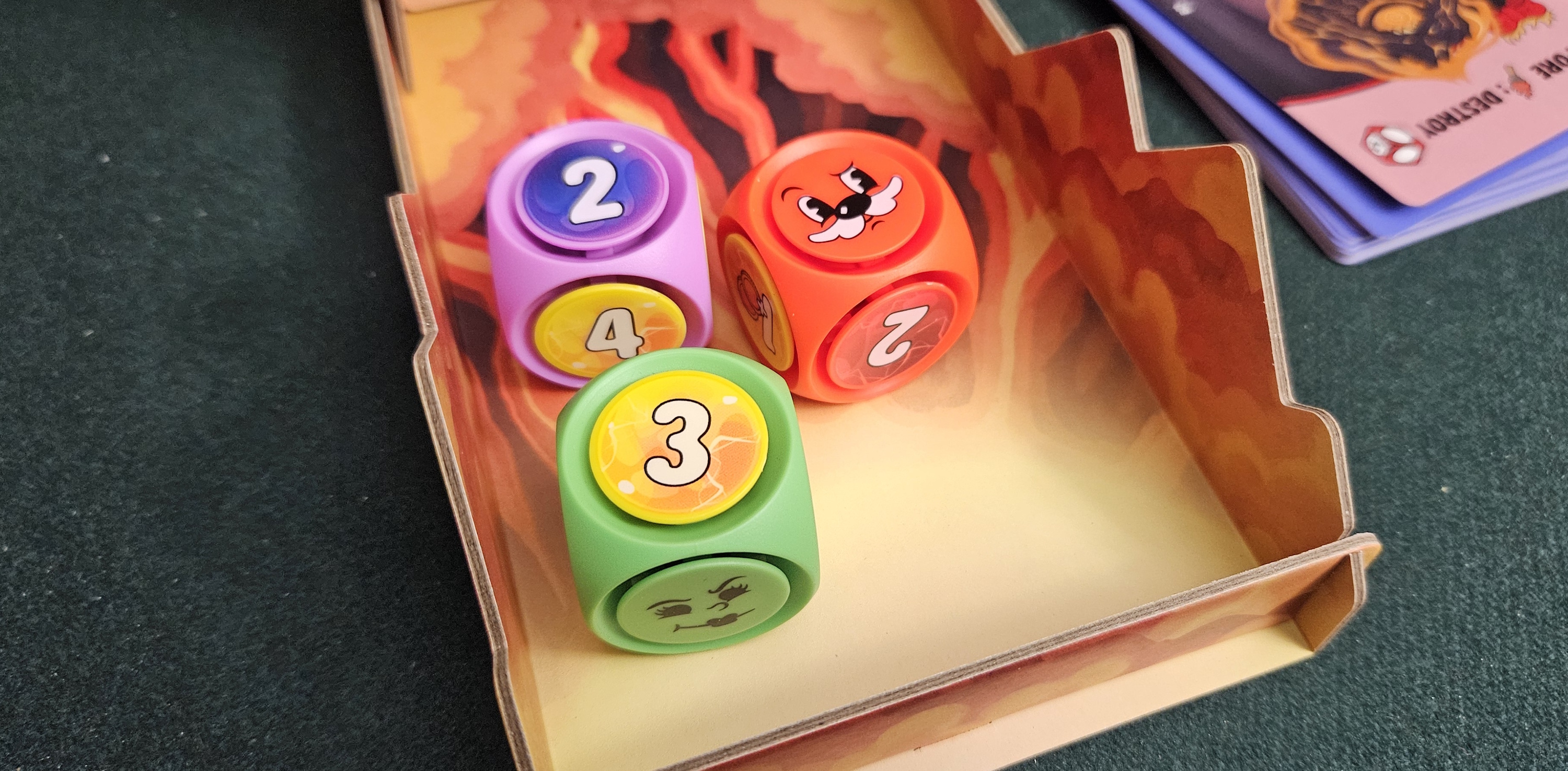
Gosh, I love being able to change a die’s faces.
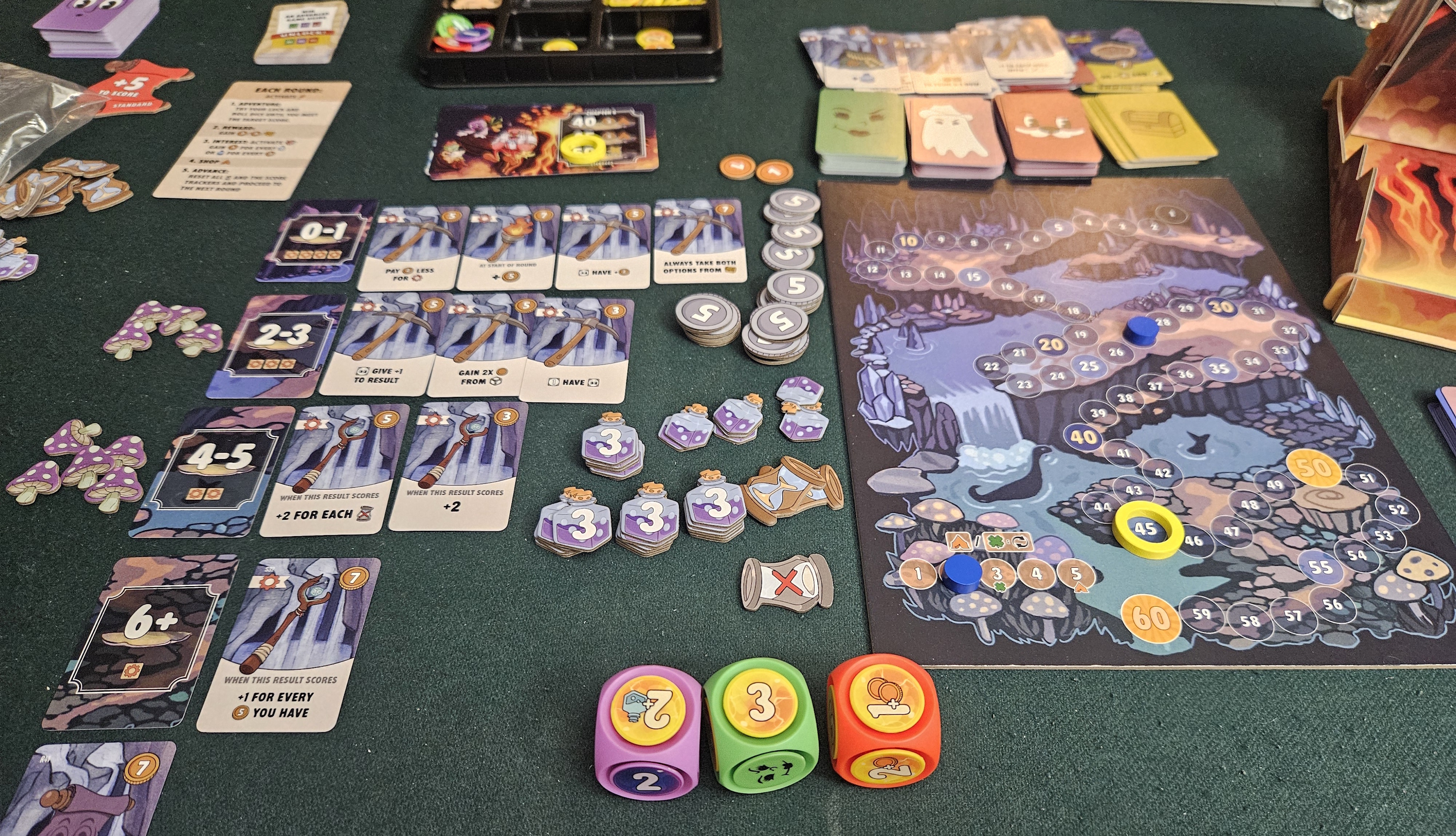
What so many people in this medium call “theme” is a funny old thing. Rolling Deep is the sort of game with a “theme,” in the sense of being this discrete veil divorced from and layered atop the game’s mechanisms. What is that theme? It doesn’t matter. I mean, it matters in the sense that it provides some context for the game’s actions, looks pleasant with its Cuphead-esque homage to early Disney and Fleischer Studios animation, and justifies a portion of the game’s budget. But it simultaneously doesn’t matter to the story being told by the artwork or the proper nouns in the rulebook. At no point did I flip a card and say, “Oh no! An evil mushroom!” Instead, the story is wholly mechanistic. At the card’s turn, I would say, “Oh no! How am I going to deal with this new probabilistic conundrum?”
That might sound like a bad thing, especially given my usual emphasis on the stories that arise when we play games. But, to be clear, this is a story. It just doesn’t happen to be a story about how three dice-headed adventurers reached the center of the Earth.
Instead, Rolling Deep is the story of how I transformed three meager dice into powerhouses that rolled seventy-nine in a single go. This moment was a triumph of careful resource management, broken combo-building, sly damage mitigation, and no small amount of luck. It was exciting, tangible, and, in the game’s sharpest departure from its inspiration, memorable.
Each boss sets the tone for the round.
Every round in Rolling Deep goes like this. You’re facing a challenge that happens to be a number. Say, twenty-three. Last round, the number was lower. Twenty. Next round, it will be higher. Twenty-seven. Steadily it climbs, round by round, increasing the pressure at a steady pace, like a numerical hyperbaric chamber.
You have three rolls, all summed together, to meet that number.
But there’s a problem. At the game’s outset, reaching those later targets is impossible. These dice, you see, have rather low digits. At best, you can roll a 2. More likely, you’ll roll a 1 or even a 0, albeit perhaps a 1 or 0 that also grants you a coin or a reroll potion. Over three rolls, that means you can maybe hit a target of eighteen. And that’s with some pretty extreme luck.
Fortunately, there are two solutions to this problem.
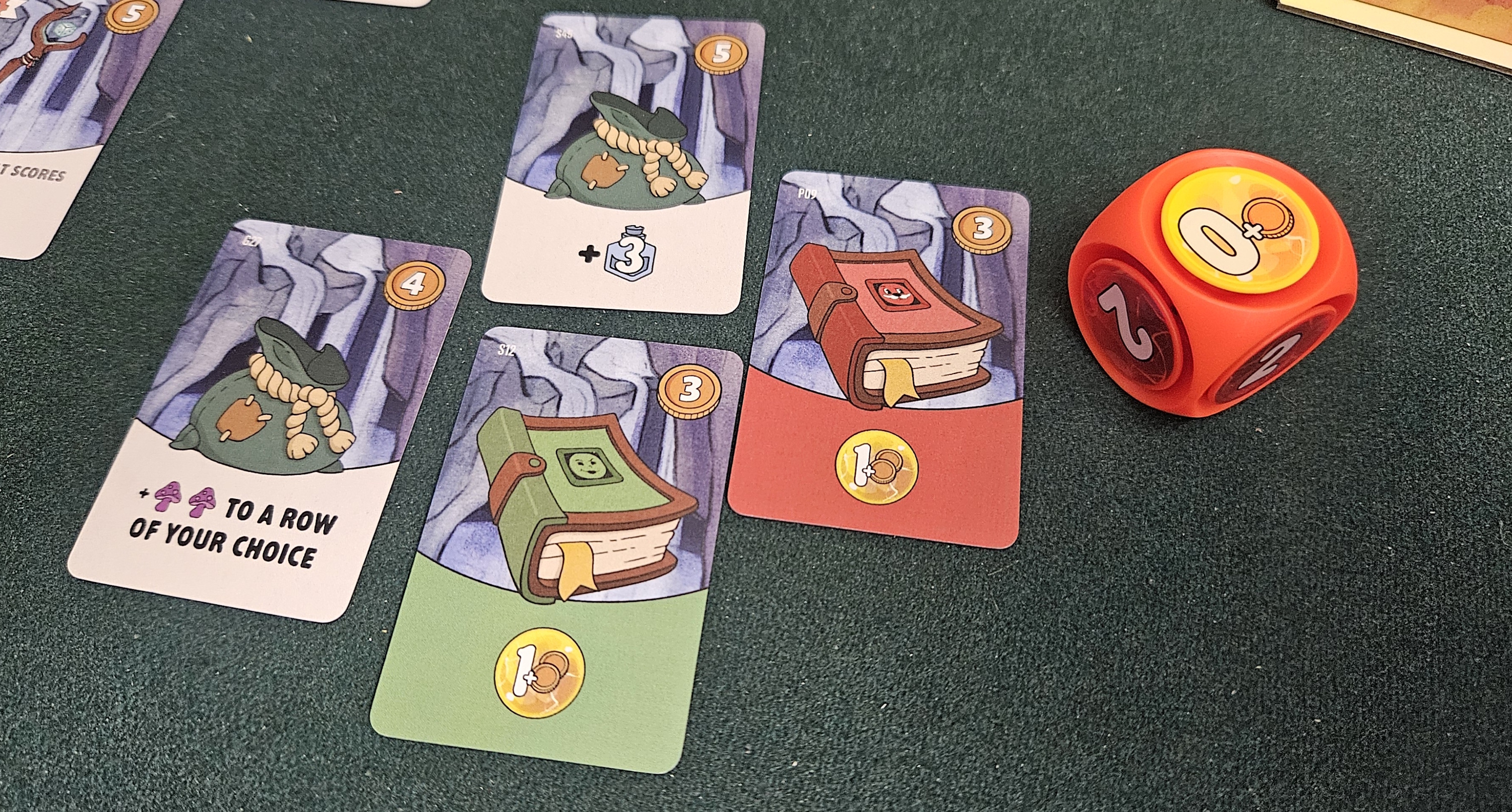
First, the faces of your dice have custom faces that can be swapped out. Picture the dice from Tom Lehmann’s Dice Realms, but way easier to handle, without the weird LEGO-breaker tool for prying faces away from the frame. Here everything clicks into and out of place with a breezy snap. Out with the 0, in with a 2 plus a potion. Click. Sayonara 1 with a pity coin, hello whopping 5. Click. Oops, now you’re rolling too high — yes, that might be a thing — so let’s turn that 5 into a 3 with a coin. Click.
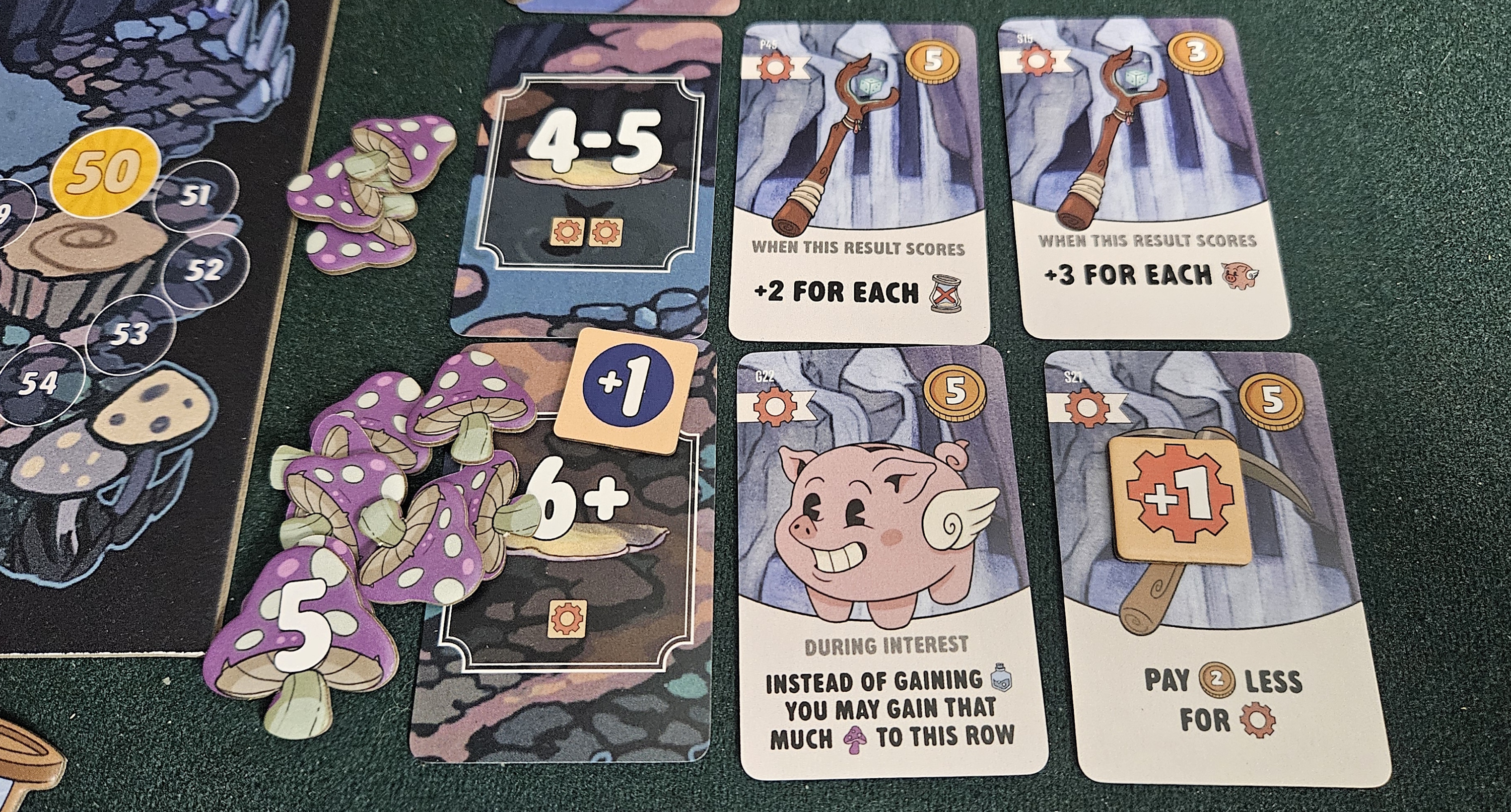
Second, the way you purchase these new faces also offers a way to improve your performance by other means. By a lot of means. You could purchase an upgrade that gives a permanent +2 to every roll. That’s the easy stuff. You might also earn a wand that only triggers with a natural roll of 4-5, and awards +3 for every piggy bank ability. Now you have a synergy going. That wand, plus as many piggy banks you can afford from the market.
Little by little, your cards produce an engine. (Hopefully.)
Thus the game’s irresistible tempo. You roll, perhaps spend potions or use your upgrades to massage the numbers, and add that total to your sum. If you reach the target number after three tries, you gain a prize, earn interest on any leftover cash and potions, reveal and purchase upgrades from the market, and then do it all over again with a higher target number.
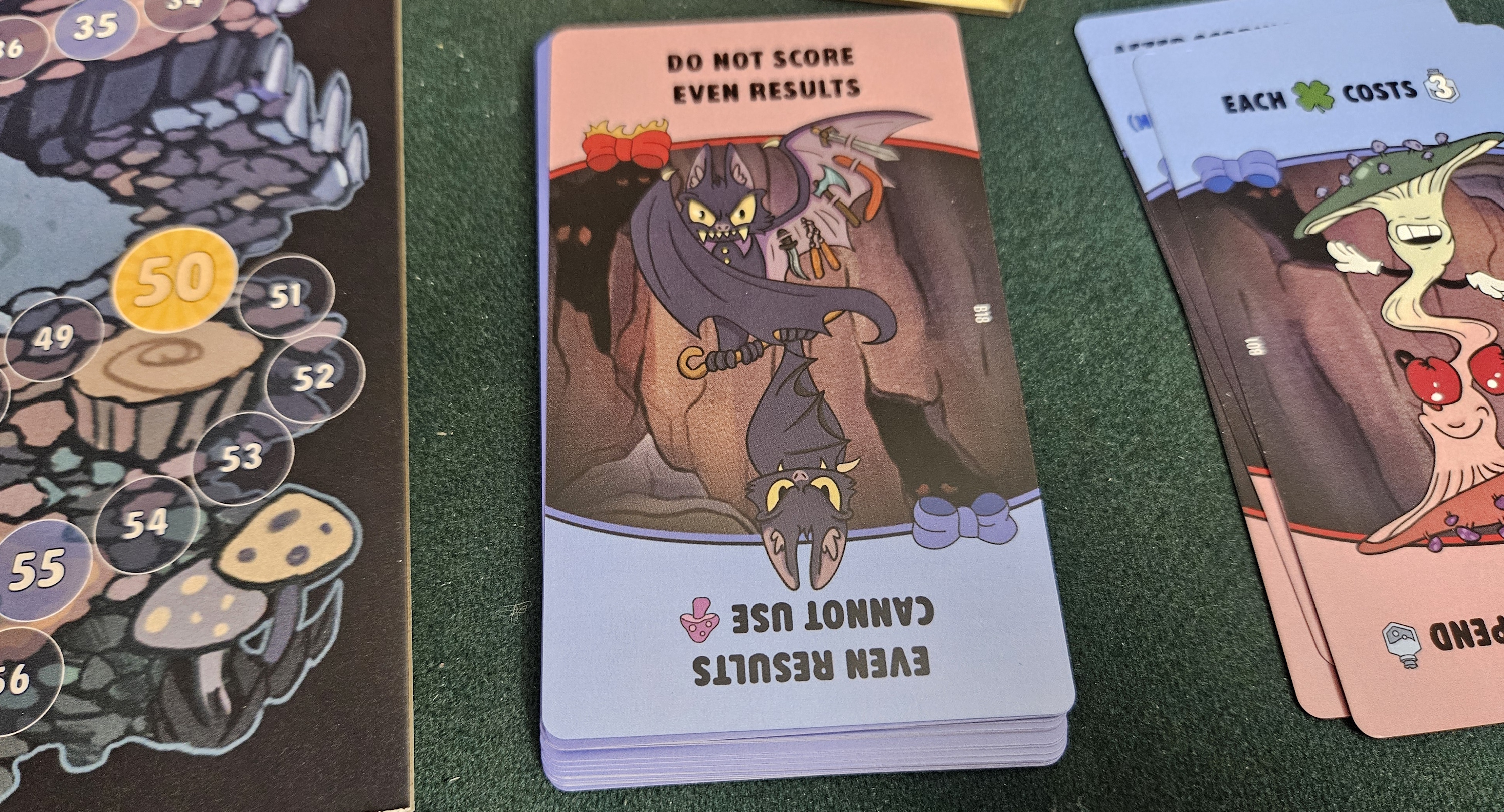
Every third round, you face a boss with an obnoxious special ability. Like, for example, a cartoon bat who prevents you from scoring results that are even. Or a cartoon mushroom that makes it harder to spend potions for crucial rerolls. Or a different cartoon mushroom that destroys some of your upgrades. Nasty stuff, but nasty stuff you see coming for a couple rounds before it hits you. Nasty stuff you can prepare for.
If this sounds like Balatro — well, look, Hayward isn’t concealing Rolling Deep’s influences. The dice faces are your poker deck. The upgrades are jesters. The mushrooms that boost your sum before withering are… I guess multipliers? There aren’t actual multipliers in Rolling Deep, probably because the game’s numerical targets increase linearly rather than exponentially. The possibility of expanding how many upgrades you can hold are akin to Balatro’s spectral cards. It’s all familiar. It even has achievements and unlocks. Beat the game on easy mode, you earn access to tougher delves. Break the game in one way, you gain tools that are a little weirder than the starting kit. I won’t spoil the wilder unlocks, but they’re in there for the sickos.
But if this is all so familiar, why do I say it’s better than Balatro? I knew you’d ask.
Buying new options at the market.
For one thing, the medium itself demands a very different sort of attention from a digital game. Where Balatro hypnotizes, Rolling Deep focuses. Sure, I suppose I could zone out. But as soon as I’m asked to shift my tally along the target track, flip some upgrade cards, or shift resource tokens from one place to another, my feet are given purchase on solid ground again. If that doesn’t do it, sure as shooting the alteration of a die face will. Click.
This breeds an entirely different headspace. At no point did I awaken from a three-hour binge. Instead, the processes — the ones that are concealed behind the dazzling lights of Balatro — are entirely my responsibility. I must count the numbers or nothing happens. I must pay attention to my bonuses lest I lose them. There’s no option to glaze over and make number go up. Every upgrade must be considered, weighed against my tableau’s current strengths and gaps, and ultimately purchased or discarded. Very quickly, the physical actions that are automated in a video game become loci of concentration and even pleasure. It helps that Hayward has developed this game until it’s smooth as cream. But the remaining points of friction, some of them inherent to the medium, give me purchase in the real world.
And that extends to the gameplay itself. Because Rolling Deep is more grounded in the real, its challenges are presented as tangible, applied things, rather than wholly abstract. It’s the difference between being told some measurements and shown them against the wall or along the motor’s belt. When I assess my odds, I physically heft one of those chunky plastic dice and turn it around in my fingers. When determining where to slot an upgrade, I slot the card into a physical representation of where my rolls have aggregated. The medium becomes the gameplay and vice versa.
It helps, too, that Rolling Deep’s limited format gives it a more intimate edge. It never disappears into n-space, its numbers beyond intuitive human comprehension. My dumb animal brain grasps the gap between 23 and 41 better than that of 23,749,011 out of 41,000,000, even though they’re fundamentally similar. By scrapping the sky-high escalations of Balatro, Hayward turns Rolling Deep into a puzzle that doesn’t slide off the brain like so much oil.
For such a wild game, Rolling Deep never spirals into too much complexity.
And it is memorable. I mean that. Not as much as a story, not as much as something with characters or relatable confrontations. But thinking back on my sessions with Rolling Deep, I can remember specific problems and the solutions I forged to face them. I could never tell you what had happened in any given session of Balatro even a few minutes after it ended. Something about a banana? Getting a shiny joker? Opening a few card packs?
Rolling Deep is excellent. It’s a very particular kind of excellent, to be sure, a mathematical solitaire game that’s long on odds and probabilities and sums rather than story beats. But within that window, it not only matches the ambition of its inspirations, but exceeds them. Balatro who? This is Rolling Deep, baby.
A prototype copy of Rolling Deep was temporarily provided by the publisher.
(If what I’m doing at Space-Biff! is valuable to you in some way, please consider dropping by my Patreon campaign or Ko-fi. Right now, supporters can read the next installment in my series Talking About Games, this time tackling the topic of what makes a good list! Naturally, the piece includes a list.)
Tabletop gaming’s most eclectic prize, the Diana Jones Award, has unveiled the latest clutch of finalists for its annual celebration of excellence in the field of gaming.
Price Johnson, the new CEO of Gloomhaven publisher Cephalofair, is among the five finalists for this year’s award, as are miniatures game Trench Crusade and Minnesota-based game retailer Mischief Toy Store.
TTRPG designer and journalist Rob Wieland
They are joined by Jo Kelly and Cole Wehrle’s board game Molly House, which explores the joy and fear experienced by gender-defying Londoners in 18th century society, and Rob Wieland, a much-loved TTRPG designer and journalist who died last October aged 47.
Price Johnson’s nomination comes less than two months after the long-time Cephalofair COO was promoted to CEO at the publisher – with Isaac Childres, the company founder and designer of its runaway successes Gloomhaven and Frosthaven, stepping back to focus exclusively on game design at the company.
Johnson has been a high-profile voice in campaigning against tariffs imposed by US President Donald Trump over the last year, aiming to highlight the heavy financial burden it has placed on tabletop game publishers – many of which rely on Chinese manufacturing for their titles.
The Diana Jones nominations committee praised that work, saying Johnson’s appearance on multiple national news outlets, “consistently and clearly explained how the tariffs posed an existential danger to many companies in the adventure gaming industry”.
Mischief Toy Store in the Twin Cities was also selected for its involvement in a lawsuit against the US tariffs last year, as well as its work battling activity from anti-immigration ICE agents.
The committee said that hours after criticizing ICE in a TV interview the store was targeted with a surprise audit, but resisted turning over their employee records to DHS.
It added, “They have been printing ICE OUT posters to distribute as fast as they can and have organized a network of 3D printing hobbyists to distribute thousands of ICE whistles.
“Amid the chaos in Minnesota, they had to suspend online ordering, and their website directed folks to support local immigrant rights organizations instead. They work hard to make space at the gaming table for everyone.”
Trench Crusade, which focuses on an alternate 1914 in which humans have been battling the forces of hell for 800 years, was picked out by the committee as “a triumph of community and creativity”.
The Factory Fortress-published title was built around initial sketches and lore created by artist Mike Franchina, who later teamed up with sculptor James Sherriff and game designer Tuomas Pirinen to design the game.
Diana Jones’ nominations committee described Rob Wieland as “a relentless advocate and promoter for the entire tabletop gaming community for years”.
It said, “He served as a mentor to countless others, and he brought the industry to wider and greater awareness through his work with Forbes and other publications.
“In addition, he regularly hosted on-stage sessions of The Extraordinary Adventures of Baron Munchausen at conventions to raise money for charity.”
The 2026 Diana Jones Award ceremony will be held in Indianapolis on July 29 at its annual gathering of tabletop games industry professionals, marking the unofficial kick-off of Gen Con.
The original Diana Jones Award trophy, which was lost in the post several years ago
The award aims to celebrates “everything that’s the best about gaming”, with previous winners across the award’s 26-year run having included Blood Rage designer Eric Lang, Nigerian games industry publisher and evangelist NIBCARD, and the entire ‘actual play’ movement of people livestreaming and podcasting roleplaying games.
Last year’s award resulted in a tie between Daybreak, the climate change-themed board game designed by Matt Leacock and Matteo Menapace, and Rose Estes, an early TSR employee who went on to write the Endless Quest series of choose-your-own-adventure game books.
The original Diana Jones award trophy was a clear lucite pyramid containing the burned remains of an Indiana Jones roleplaying game from the 1980s – one element of which spelled ‘Diana Jones’ after the preceding letters were burned away.
That trophy was lost in the post six years ago during the traditional handover from one winner to another, never to be recovered – but a replacement trophy has now been created by the organisation.
The Diana Jones Award also runs a separate emerging designer programme prize, which aims to help up-and-coming creators via a $6,500 prize package that includes an all-expenses trip to Gen Con.
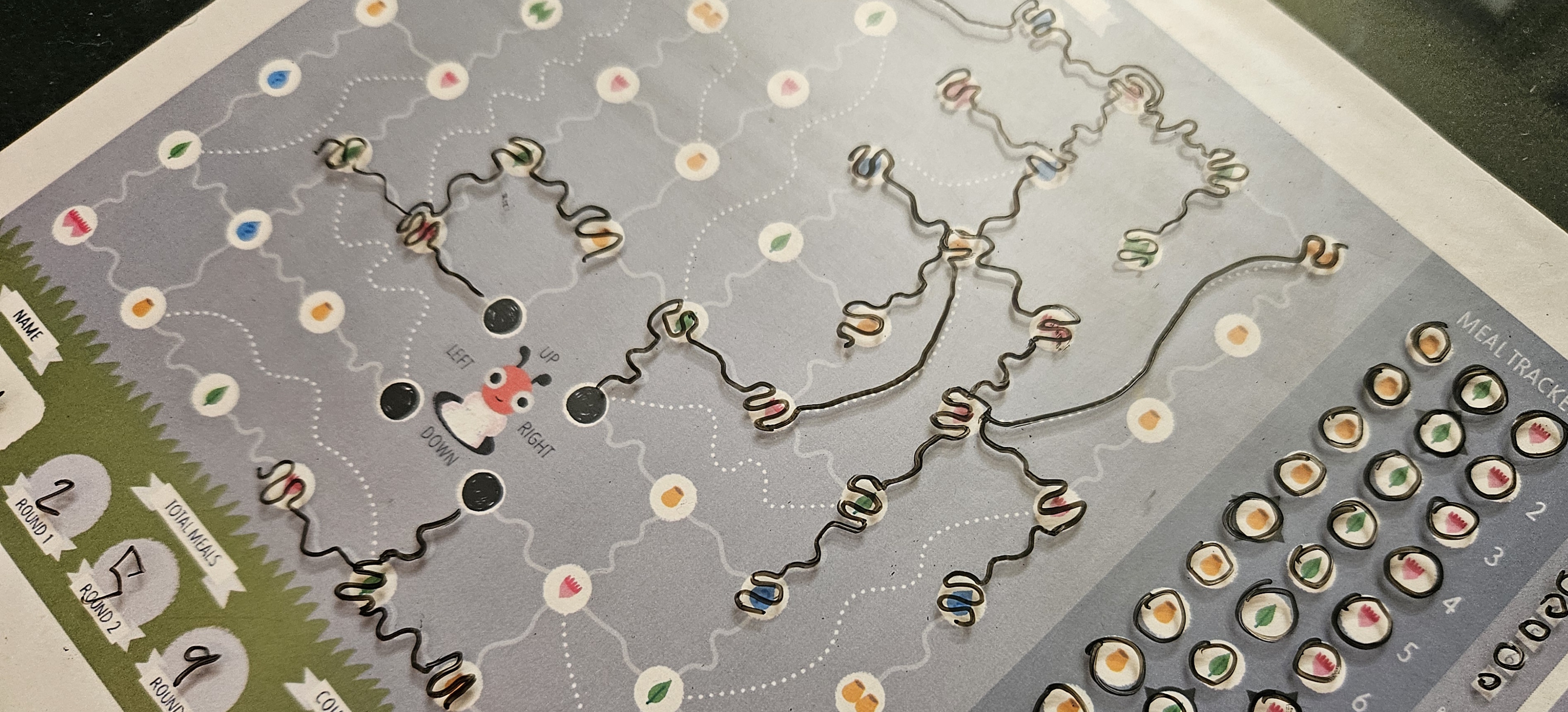
Zenith isn’t an easy game to classify. Part set collection, part lane-battler, even part paxgame, it’s full of tight contests and nasty tug-of-wars. (Tugs-of-war?) Really, though, it’s more than the sum of its parts, a strange but wonderful artifact by Grégory Grard and Mathieu Roussel that doesn’t play quite like anything else.
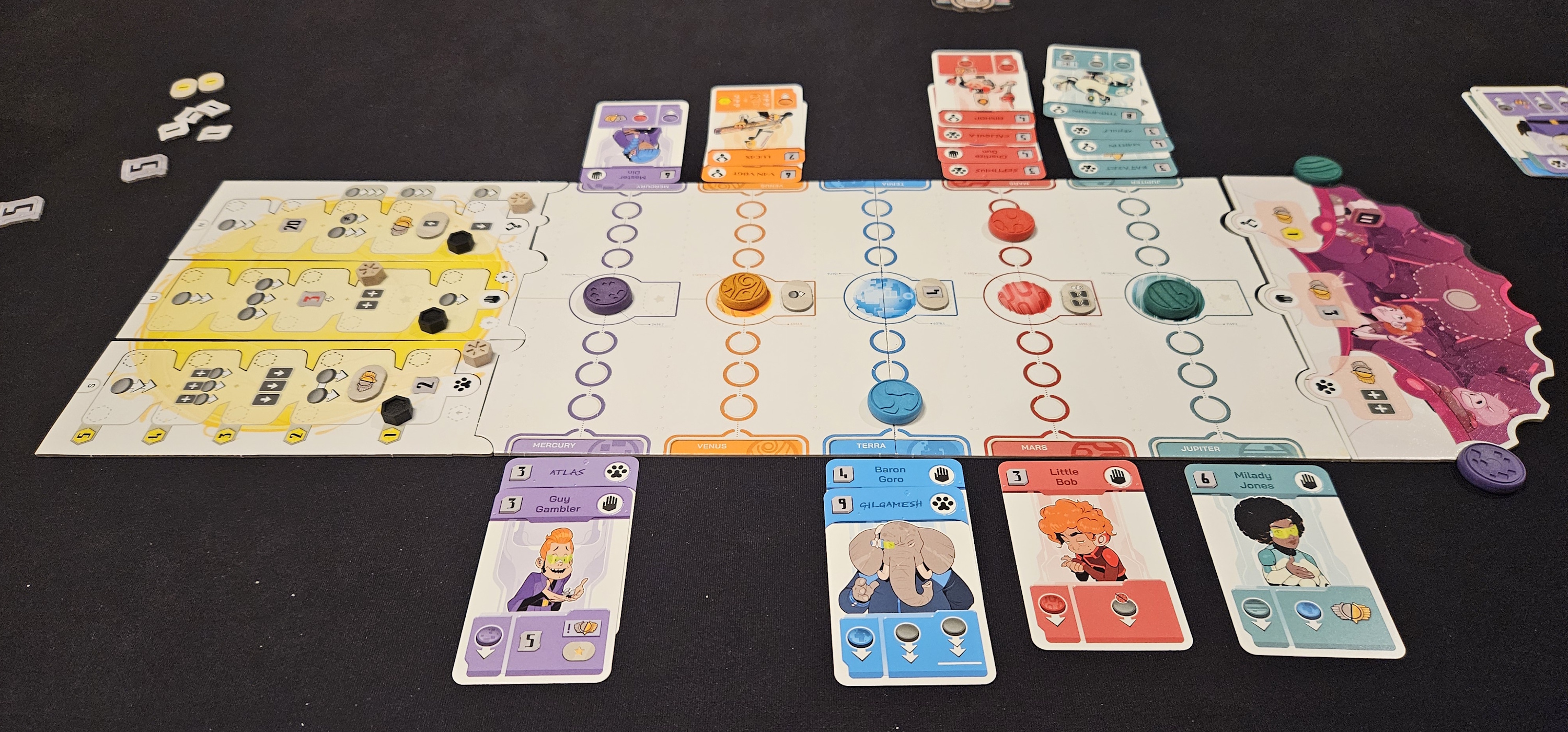
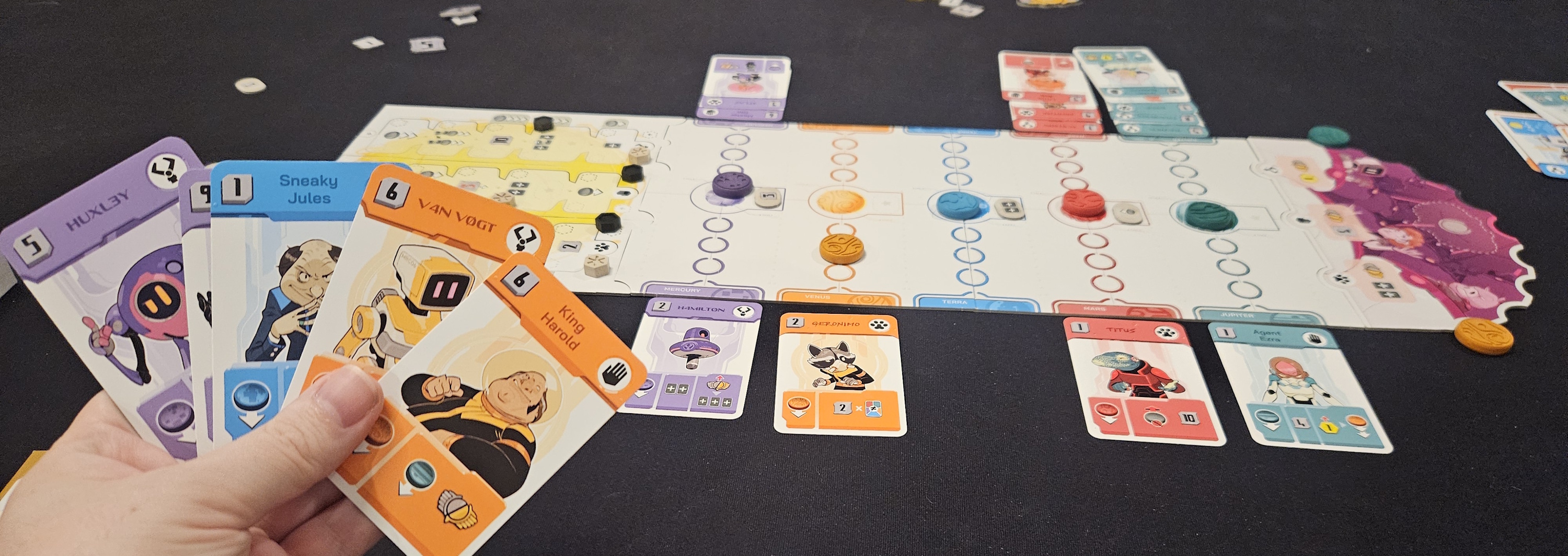
The presence of lanes does not imply a lane-battler. But this might be a lane-battler.
Let me introduce you to the solar system. In the far future, humankind has spread into its… well, not its farthest reaches, but pretty far. All of the inner planets are settled, and Jupiter as well. I would’ve thought we’d beeline to Saturn’s largest moon for all those juicy hydrocarbons, but hey, clearly this isn’t my roadshow.
For one thing, humanity has split into three distinct species. There are humans (filthy baselines), robots (job-stealing clankers), and animods (uplifted animals, the cool kids of the bunch). Furthermore, those three types are spread across five color-coded factions that correspond to the settled planets.
Both type and color matter. Type, because humans, robots, and animals can be spent for different bonuses, and color because while this duel is a knock-down drag-out affair, nobody is willing to leave their favored planet.
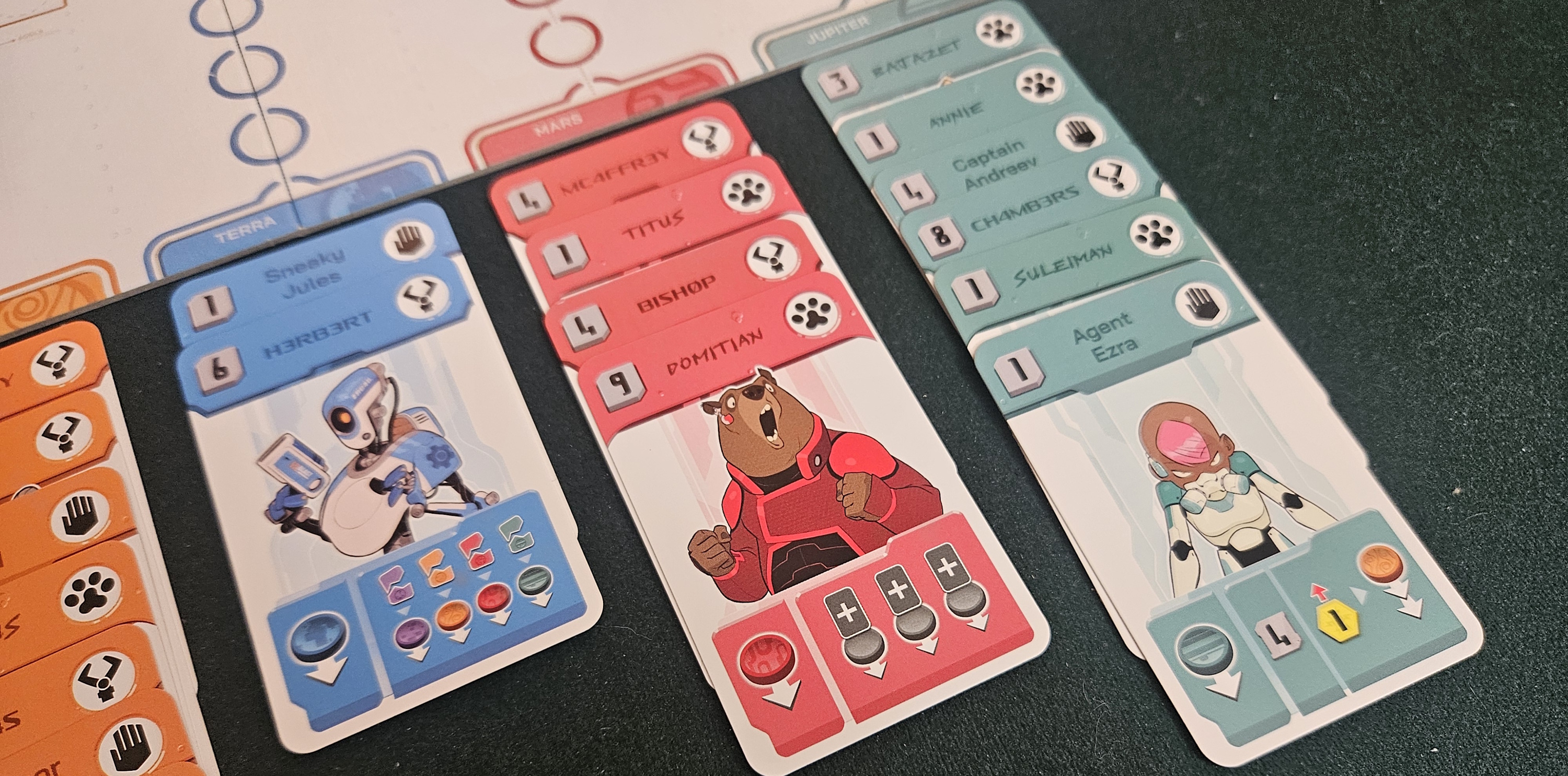
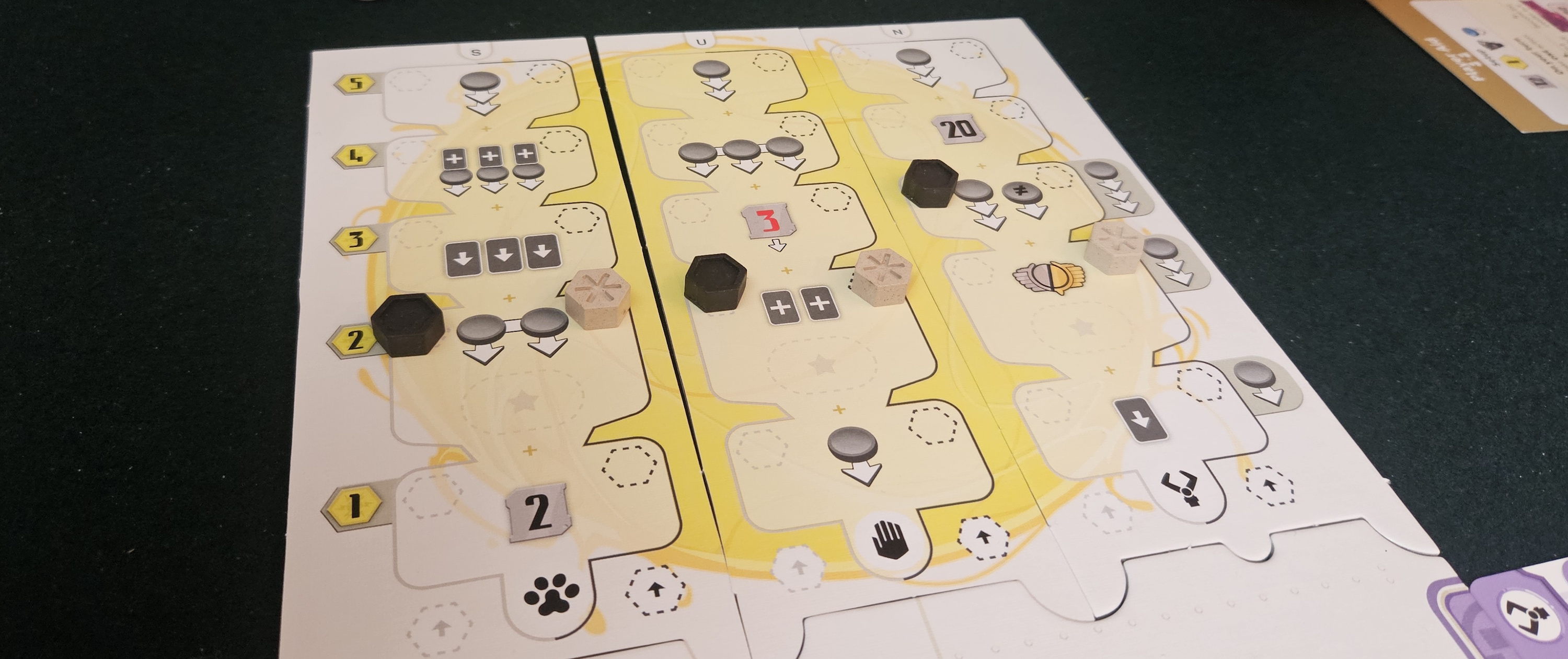
Every turn sees you spending a card. Usually one, sometimes more, but never zero. That card can be used in three ways. One, it can be recruited to its home planet as an agent. This is the most common action by far, and it’s one we’ll return to momentarily. Two, it can be discarded to gain a small bonus — some credits, some zenithium (this universe’s unobtainium), or a couple of freebie cards. Three, it can tick your faction along one of three tech trees. Yes, there’s one for animods, one for humans, one for you get the gist.
Cards become cheaper thanks to the presence of other cards.
Each of these possibilities is considerably more interesting than they initially sound.
Take, for example, those tech trees. Early on, the perks offered here are fairly minor. Two credits for animod research? That’s downright unethical! But each step along a tech tree awards not only its current bonus, but every single bonus you’ve already gained. The second level, then, influences two planets and gives you that pair of credits. Level three does the same, plus steals a trio of cards. Level four does everything plus shifts even more planets. Benefits scale in such a way that those meager early offerings suddenly look like smart investments.
Or there’s the whole “discard a card for some resources” option. This is the dump action, right? What you do when you don’t have anything better going? And, sure, it is that. But it’s also a chance to claim the badge. And the badge is a big deal because it’s the one thing in the game that will increase your hand size. Normally, upon completing your turn, you draw to four cards. With the badge, you draw to five. If you claim the badge while already holding the badge, you flip it to its upgraded size. Now you draw to six cards. In a game where mining the shared deck for powerful agents is a significant part of the strategy, that’s a potentially game-swinging advantage. Suddenly, the dump action is considerable. Even necessary.
Then there’s the big one. Playing a card to the main board. This always pulls the corresponding planet toward you, engaging in the tug-of-war that is Zenith’s principal contest. Your overall goal is to secure a certain number of planets. The exact quantity is variable. Three of the same planet, four different planets, or five mixed planets. That’s a win. There’s no escaping the need to play agents to the middle section, then. The more the better.
But even this action is smarter than it first appears. For one thing, cards are expensive. Not all of them, obviously. There are a few that cost only one or two credits. But some cost, say, ten credits. That’s a lot of scratch. But every agent costs one fewer credit for every card already in its planet slot. This means there’s a sharp ramp in what players can afford. Early on, there’s nothing stopping you from playing a powerful card. It’s just that it might wipe out your finances. With a few cards in that slot, however, things get affordable fast. It isn’t long before the big guys come out swinging, and often.
The tech tree is… fine.
The protein in this particular salad is that everything in Zenith is something of a Shepard tone, always ascending, always jangling both players’ nerves. To put it more blandly, this is about as good as multi-use cards get. Even a crummy draw can provide an advantage somewhere, if only because anything can be thrown away for a few resources and access to the game’s principal means of drawing more and better cards.
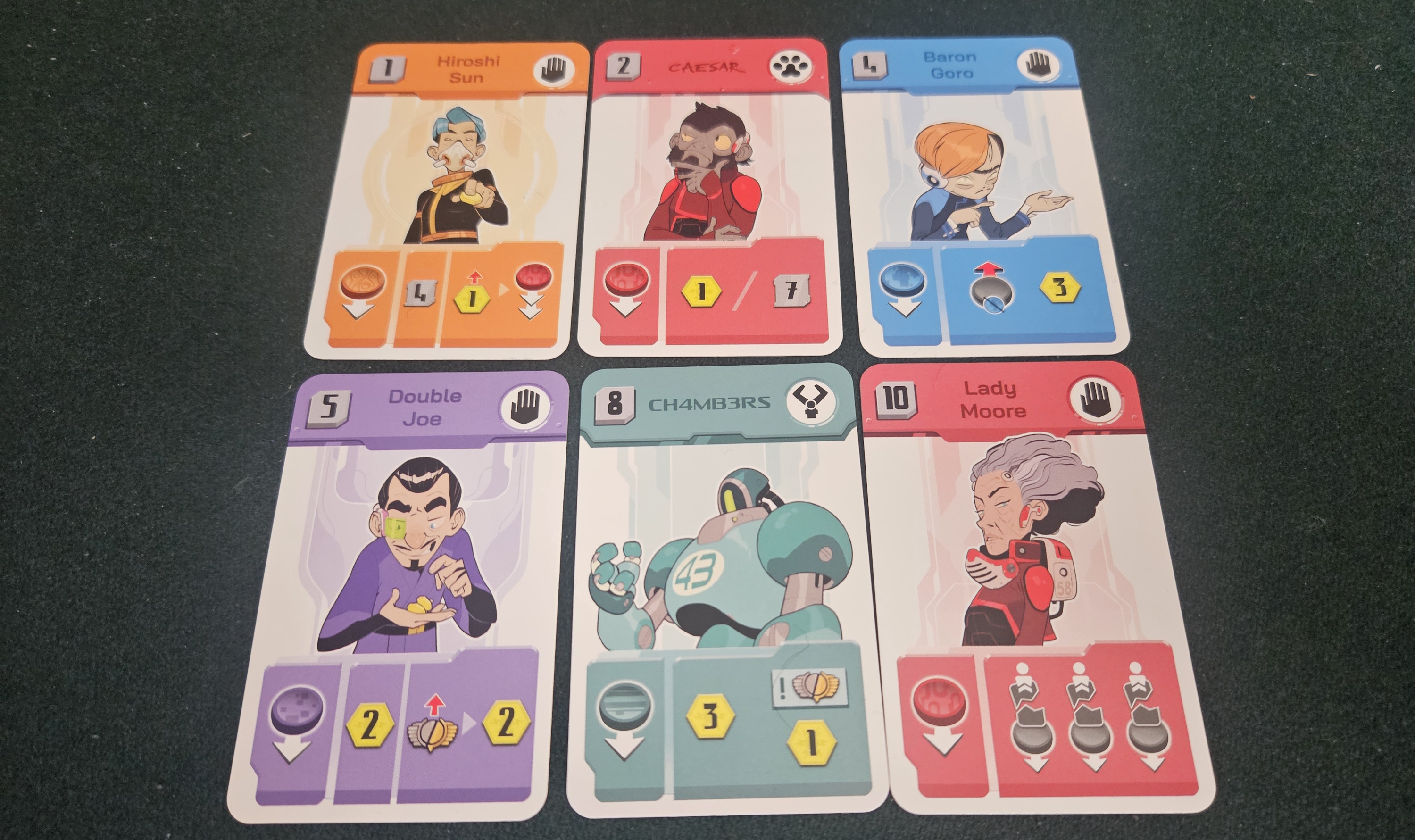
Its sense of escalation is truly something to behold, especially once the contest really gets going. I mentioned that Zenith bears some resemblance to paxgames, and that’s true whether or not Grard and Roussel have ever played one. That’s entirely thanks to the way cards are allowed to flex their powers. There are some wild abilities hidden in the deck, game-hinging swings and economic powerhouses and free techs and everything else, although the strongest require some preparation before they’re affordable. Not only in terms of cash, though, sure, there’s always cash. But also in the sense that some require you to be holding the badge, or to shift planets according to certain limitations, or yield a crucial resource to your opponent before triggering that card’s most potent ability.
This is what makes Zenith special. Or at least it’s one more brick in the powerhouse of its specialness. As a game, it’s full of genuinely hard decisions. How to spend cards. When to spend them. Where to spend them. Whether to be proactive or reactive. How to best undermine the engine your rival is assembling piston by piston.
Just a few of the game’s many cards.
If I went dredging for downsides, I suppose I would say that this openness means it’s easy to get lost a bit. More than once, I’ve watched somebody — usually myself — flub a session because they were so focused on getting more resources or moving up the tech tree that they lost sight of the ground war. Similarly, I don’t much care for the tech tree. Its look, more than its actual utility. Zenith is a handsome game, but its appeal lies in its color palette and illustrations rather than its minimalist board, and the three-pronged tech tree, which is pronged for a reason, since you can flip any of its tracks to their opposite side for some variety, still comes across as a bit chintzy.
Really, though, this is about as close to my jam as a game can get without breaking the mold. I’ve always had a preference for “falling with style” games, those that hand me a mismatched bag of tools and then ask me to make do with what I’ve got. Construct a biplane with this old rotor, a busted gas-guzzler from an old Ford, and a hyperbaric chamber? You got it, boss.
Zenith excels in this theater. I’m sure some will consider it an issue. There’s no marketplace. Everything is drawn blindly from the deck. This produces a degree of chanciness that can indeed make or break the game, although there are sufficient mitigating tools that I’d be surprised if that happened more than once in a dozen sessions. There’s always some way to get ahead. Stealing cards from your opponent. Shifting up the tech tree. Crud, just grabbing the badge and drawing more cards is a good choice when falling behind. If Zenith weren’t so tight, I’d venture to call it something of a sandbox game. It isn’t quite that, but it carries similar helices in its genetic code.
Ah. Lanes. My first love.
Taken as a whole, Zenith feels like a gift from an alternate timeline, one where lane-battlers look very different from ours and multi-use cards are radical innovations rather than perfunctory inclusions. I love this game’s textures, its swings, its vibrant colors, the clarity of its objectives and the ease with which they get lost against the backdrop of the game’s smaller struggles.
Zenith, indeed.
(If what I’m doing at Space-Biff! is valuable to you in some way, please consider dropping by my Patreon campaign or Ko-fi. Right now, supporters can read the next installment in my series Talking About Games, this time tackling the topic of what makes a good list! Naturally, the piece includes a list.)
At this point, the civilization genre needs an intervention. We could all sit in a circle on folding chairs we borrowed from the local church. Set out a little tray of cheeses and olives. Have plenty of tissues on hand for everyone. Speak in that voice we reserve for serious moments. “Hey,” someone would say, breaking the ice. “I’ve noticed you’ve been in a rut lately.”
Rising Cultures, designed by Aske Christiansen and Francesco Testini, almost begs to be described entirely via comparisons. It’s a lower-fidelity Imperium, a blown-out Ancient Realm. Clash of Cultures in how closely it sticks to an inherited form, as far as possible from Arcs on the personal-to-longue-durée matrix. Not as good as any of the bests, but neither so bad that it’s worth observing for its missteps.
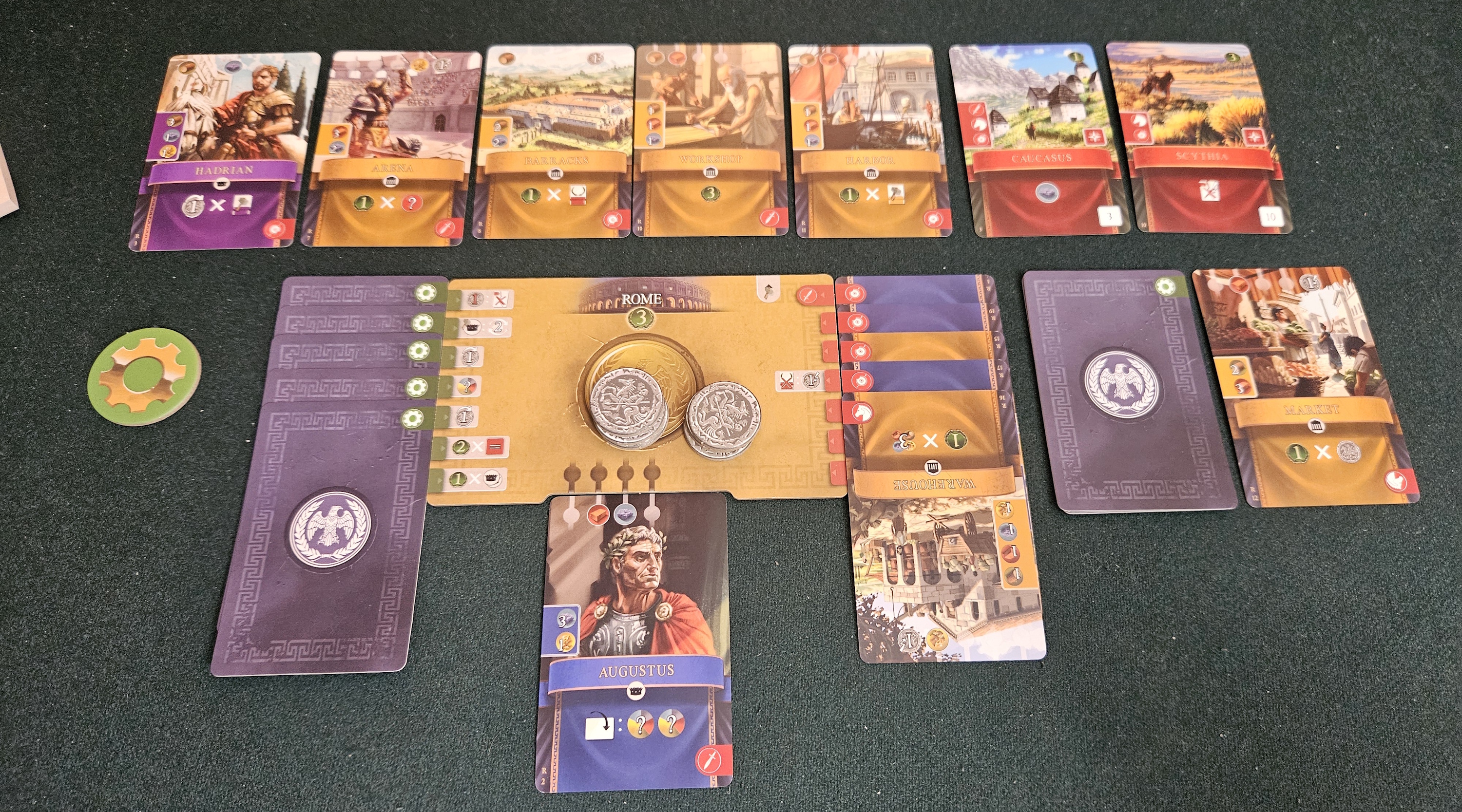
What have the Romans done for this tableau?
No sooner is its lid cracked than Rising Cultures reveals a few inborn limitations. There are four civilizations to helm, three of which are Egypt, Rome, and Persia, those old standbys that aren’t exactly going to blow anybody’s hair back. The experience is two-player-only. No solitaire, although what follows will be mostly solitary in nature, nor welcoming of a third or fourth player, although it feels like the designers could have pushed it to those heights had they really wanted to.
Also, there are heaps of icons. So many icons, in fact, that each civilization comes with its own fold-out crib sheet that translates every single line of the boards and every single card. Oh, and sometimes explains concepts in eight-point font that must be scraped from the surrounding info-spatter. Transcribing these details calls to mind City of Six Moons, another civilization game Rising Cultures is very much unlike.
From there, the gameplay grumbles into action. And it’s good action. Each round sees players figuring the best use for the four cards they’ve drawn from their hand. Scratch that; three of them will be used, the fourth will return to the top of the deck to reappear on the next go. The action economy is thus strictly limited. Three cards per round. Seven rounds per game. Nominally, that’s twenty-one actions in total.
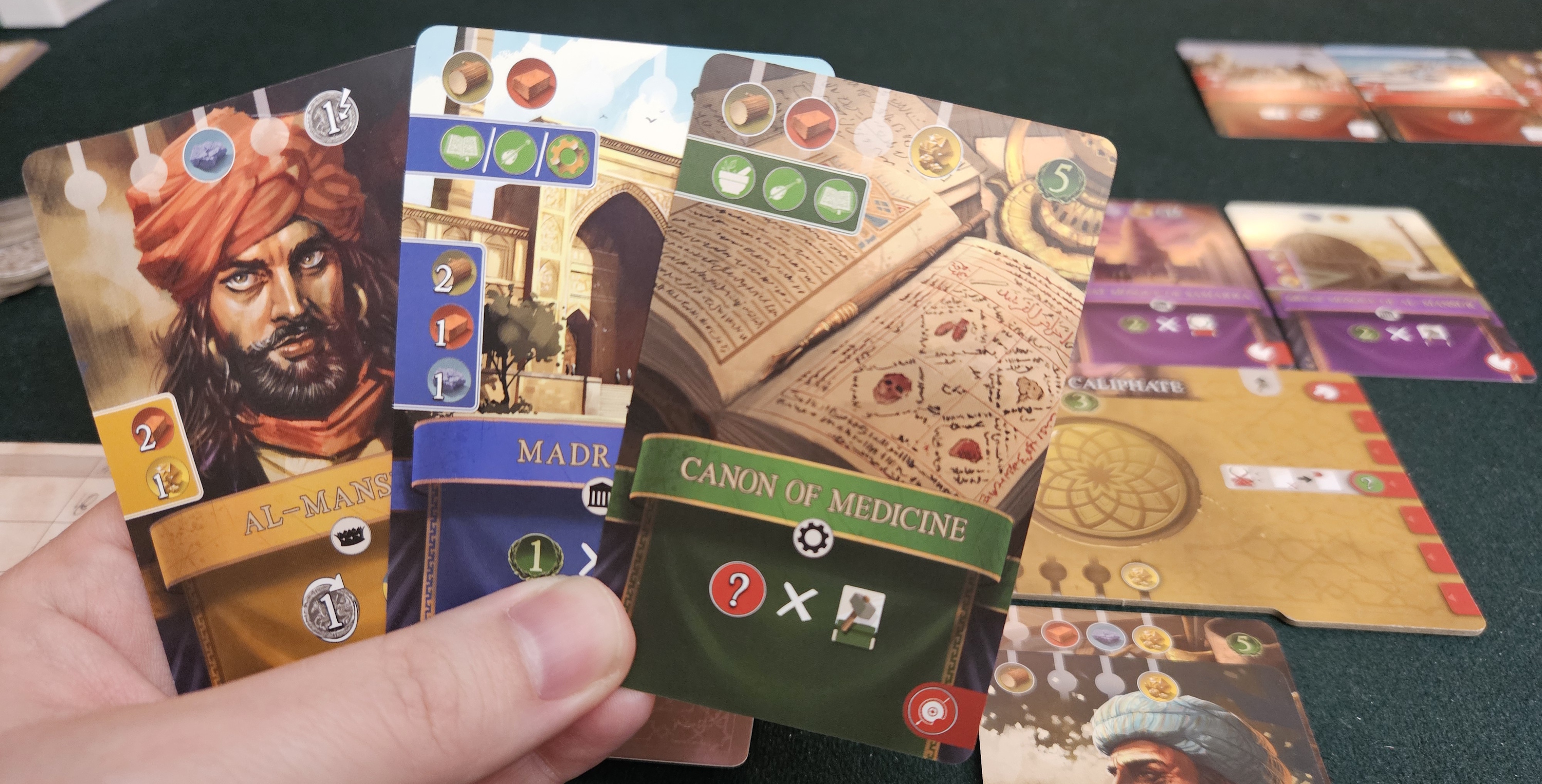
Of course, there are plenty of ways to break this rubric, although Rising Cultures isn’t quite as combo-tastic as some of its peers. At any given time, there are four main uses for each card. First — and flimsiest — you can discard it to pick up two coins. This always feels like a defeat. Second, you can slot it into your empire as resources, the bricks and stone and so forth necessary to, third, build cards into your tableau. This is the most durable option, permanently earning access to that card’s best benefits, whether scoring abilities or ongoing perks. Fourth, any card can enter your military. More on that in a moment.
Each turn revolves around a few cards.
As processes go, this is good stuff. Interesting stuff. Compelling stuff. Cards aren’t quite multi-use, in the sense that they might tempt players to wander distinct avenues. If possible, you’d probably want all of them in your main tableau. But that isn’t possible, and anyway there’s a clever tradeoff whenever you build a card. Basically, you’re given the option of flipping the bottommost resource onto your civilization board, unlocking further abilities but decreasing your overall wealth. It’s a smart move, one that goes a long way toward preventing players from falling into a formula where they spend their first few cards on resources and then keep building everything afterward.
Little by little, your civilization takes shape. That shape, naturally, is largely predetermined by whichever faction you’re playing at the moment. The Romans go to war a lot. The Egyptians must manage the ebb and flow of the Nile. The whole thing feels a lot like Imperium, except you’re going through a deck once rather than cycling through and improving it over multiple stages.
At points, players are invited to glance at one another across the table. Usually this happens when gearing up for the fight that caps each round, when some province will be awarded to only one side depending on whichever civilization has assembled the most suitable army. In rare cases — okay, one case — a civilization offers bonus actions to its rival. Beyond that, this is a heads-down affair.
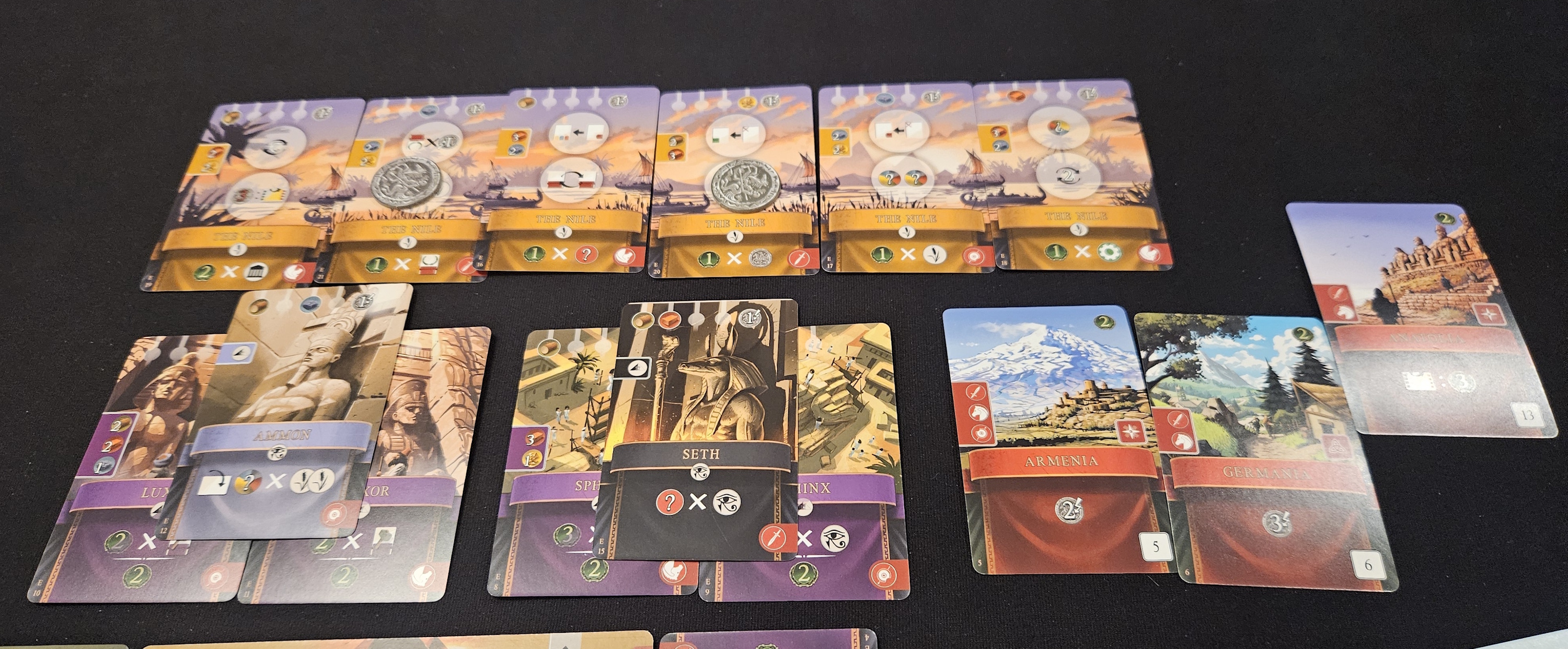
Which is fine. I’m not slamming multiplayer solitaire. But I am left wondering where Rising Cultures’ identity might be found. Its four civilizations each play like their own puzzle. With their cards jumbled together, all those natural synergies out of order, can you assemble them into a points engine that outpaces your opponent’s? Maybe. It depends. On the shuffle, sure, but also on whichever faction sits before you. Some are more complicated than others. Egypt has that shared Nile row going both for and against it. The Abbasid Caliphate requires some strict sequencing in order to usher in its era of science, which is notably tougher than the slapdash approaches available to Rome and Persia.
The Egyptians are in the Nile about this game.
What it never manages, unfortunately, is to stand apart. At its best, it feels like a microgame that got too big for 18 cards, or like a less generous and less flexible version of Imperium with half as many civilizations and a stricter play count. It isn’t weird or experimental, but neither is it especially standard, in the sense that it might appeal to someone who’s looking for an unvarnished civgame. The result is a middle-of-the-road title that says and accomplishes little. I don’t expect it to survive the test of time.
A complimentary copy of Rising Cultures was provided by the publisher.
(If what I’m doing at Space-Biff! is valuable to you in some way, please consider dropping by my Patreon campaign or Ko-fi. Right now, supporters can read the next installment in my series Talking About Games, this time tackling the topic of what makes a good list! Naturally, the piece includes a list.)
Remember those bad years when every other board game was a deck-builder? Solar Titans reminds me of that.
It’s not that Solar Titans is bad. Just that it’s perfunctory. This is a deck-builder the same way everything back then was a deck-builder. Its identity as a deck-builder makes zero sense. Its deck-builder systems run contrary to its fiction. It even commits the capital sin of deck-builders by letting each hand’s composition matter so much that everything else becomes secondary.
But let’s back up. Solar Titans. What’s it about, eh?
That’s a solar titan there. Yep.
On paper, Solar Titans ought to be my jam. My site is called Space-Biff!, for heaven’s sake, named for gigantic spaceships lasering and rocketing and otherwise exposing one another’s pressurized interiors to the hard vacuum beyond their eggshell hulls. So when Solar Titans claims to be about building and then ripping apart spaceships, I’m down to wrassle in the mud.
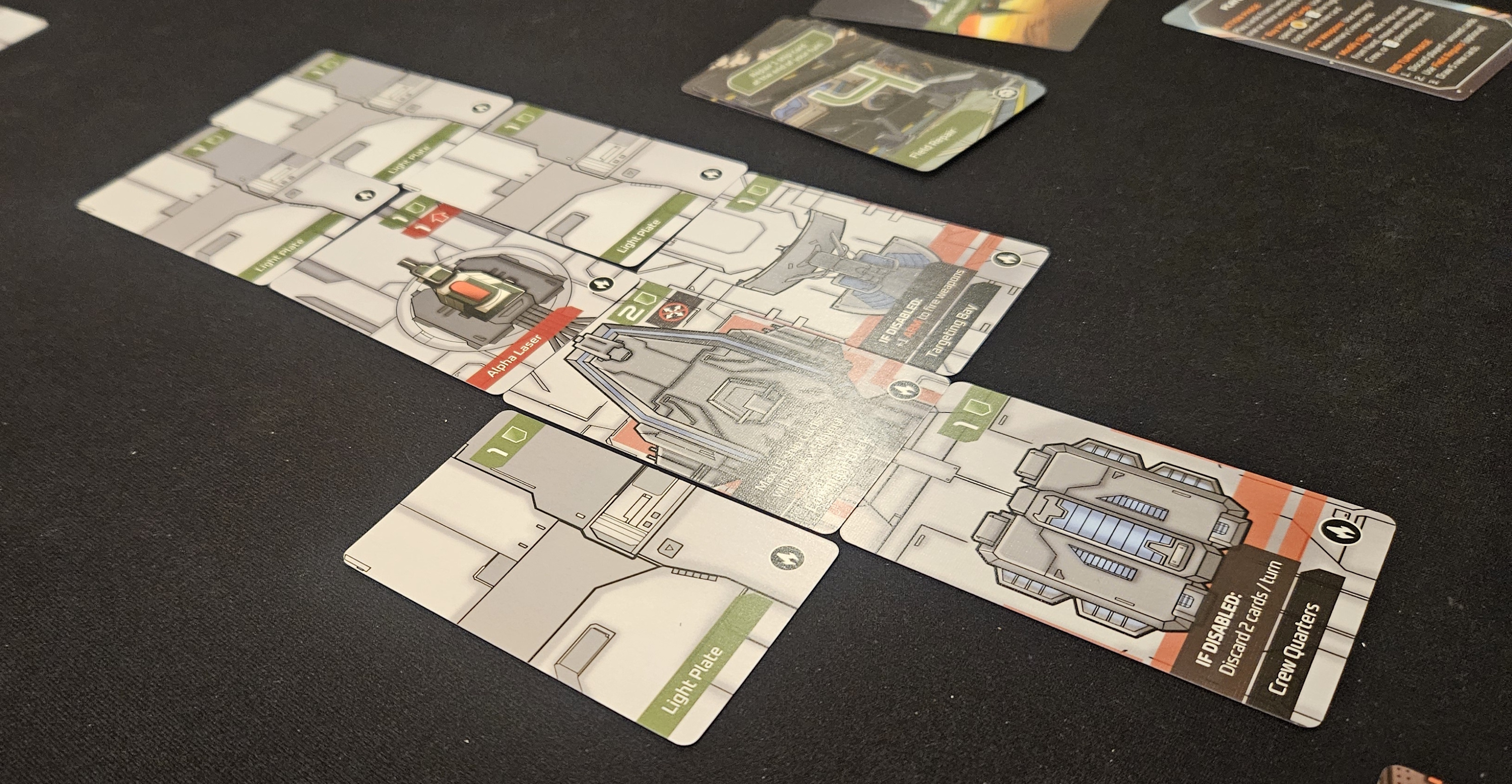
When the game opens, there’s nothing amiss. Players begin with a basic ship that includes the bare minimum systems to keep flying. There’s your command deck; sacrifice that and it’s curtains for your entire vessel. Crew Quarters, mostly there to keep your hand at a healthy size. The Targeting Bay, a really bad thing to lose if you want to continue pelting any enemy ship(s). One Alpha Laser, a basic weapon that will soon be more useful as armor. Finally, a few segments of light plating, the thin line between your squishy interior and the instant death beyond.
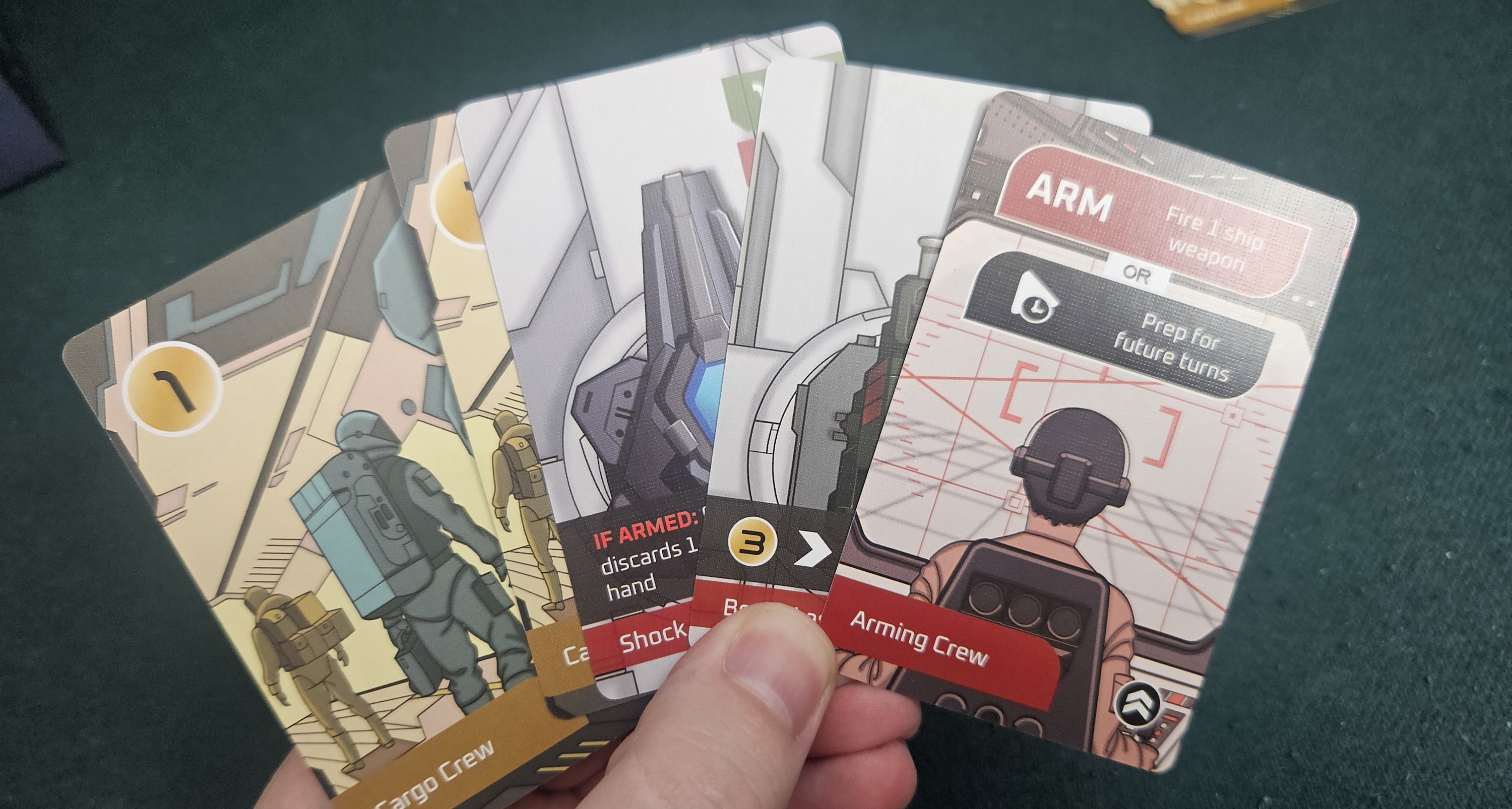
Cue the actual space-biffing. Procedurally, Solar Titans has a comfortable familiarity to it. Turns consist of playing cards. Early on, this takes two main forms. Arming Crew heats up your weapons, thus discharging your vessel’s arsenal at the opposing ship and flipping some portion of it face-down. Cargo Crew give you cash. Cash that you then spend on a variety of other ship components.
Those components make up the bulk of your decision space, and the marketplace that sells them is really two slightly separate offerings. The first is a static pool of reliable standbys, mercenaries for firing your lasers more often and better crewmembers that wield greater purchasing power. The second is more dynamic, a river of ever-changing cannons and armors that can be bolted onto your ship to improve its abilities mid-battle. By attaching the best katana beams, jammer plates, salvage crews, and other greebles to your ship, the odds that you’ll emerge victorious grow steadily greater.
This is an unusually exciting hand for Solar Titans.
As a game, Solar Titans works well enough. The deck-building and -cycling are functional, if not inspiring. There are no big ruptures in its fuel lines. But it still carries layered issues that prevent it from making that crucial jump to light speed.
Perhaps most superficially, I prefer to know what we’re doing in a game, to see the ways the actions on the player aids are reflected in the fiction and vice versa. So when our ships sprout entire missile pods mid-duel, there’s a part of me that recoils. It isn’t as though the HMS Surprise sprouted a fresh deck of cannons right before a broadside at the Acheron. Then again, this is the future. Maybe it’s nano-something. Quantum-whatever. Fine. I can live with that.
But making peace with the game’s fictive tempo doesn’t alleviate its drumbeat on the table. Buying a card means adding it to your discard pile. Only then will it eventually cycle through your deck to your hand, at which point it may bud onto your vessel like a spring blossom. This is the norm for almost everything in Solar Titans, but when it comes to ship components, it transfers the sum of your player agency to the whims of the deck. Will your phase cannon come online in time? Can you armor that essential section before it crumbles under enemy fire? Will your crew aim your whatever-beam before the enemy’s such-and-such plate grows to block the shot you’ve lined up? These are questions of which side draws the proper card in time.
Which might be palatable if only the game bothered to provide interesting verbs. Here, though, those verbs are limited to shooting and buying. Sure, there are varieties of cannons. Some smack the enemy vessel head-on. Others snake in from the side. Some are delayed. Others unleash pronged attacks that hit two sections of armor at the same time. But for the most part, damage is damage is damage. There’s none of the cleverness that marks space combat in fiction or other games. You’ll never reposition your ship. You’ll never set life support aflame. You’ll never deplete a vessel’s reactor. There are cards that gesture at such occurrences. Boarding pods. Energy beams. Nano-whatevers. But their results are damage, countered with repairs, back and forth until one side or the other chances upon the right combination of market cards and deck draws to carry the day.
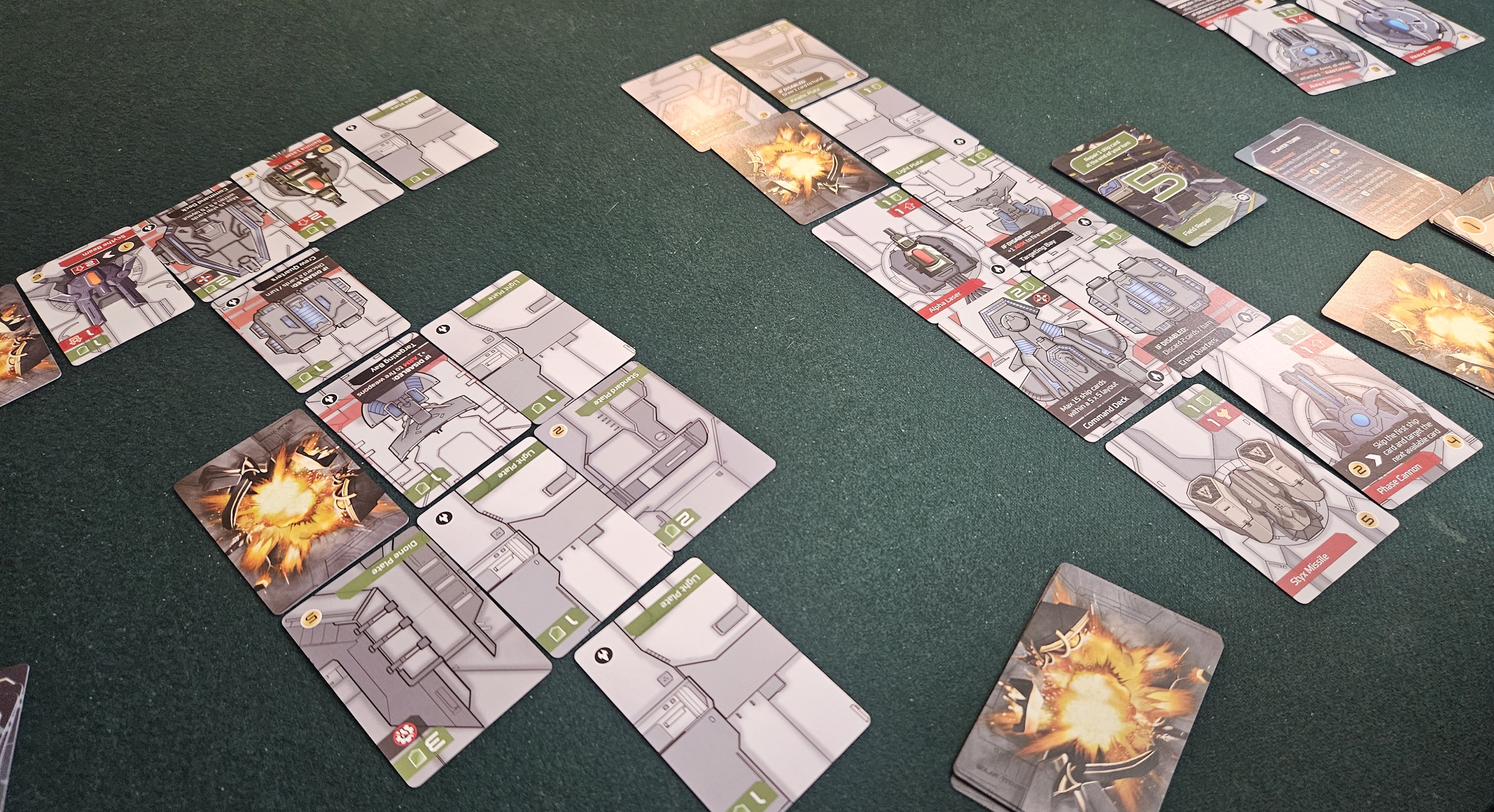
Two solar titans really pounding each other.
It’s a shame. There’s a great deal of creativity on display here, including different play modes that see partnerships ganging up on mega-vessels. But it’s all funneled through such a filter that the result is an evolutionary dead end. This is no space-biff. Maybe a space-paff. And nobody’s going to name their website Space-Paff.
A complimentary copy of Solar Titans was provided by the designer/publisher.
(If what I’m doing at Space-Biff! is valuable to you in some way, please consider dropping by my Patreon campaign or Ko-fi. Right now, supporters can read the next installment in my series Talking About Games, this time tackling the topic of what makes a good list! Naturally, the piece includes a list.)
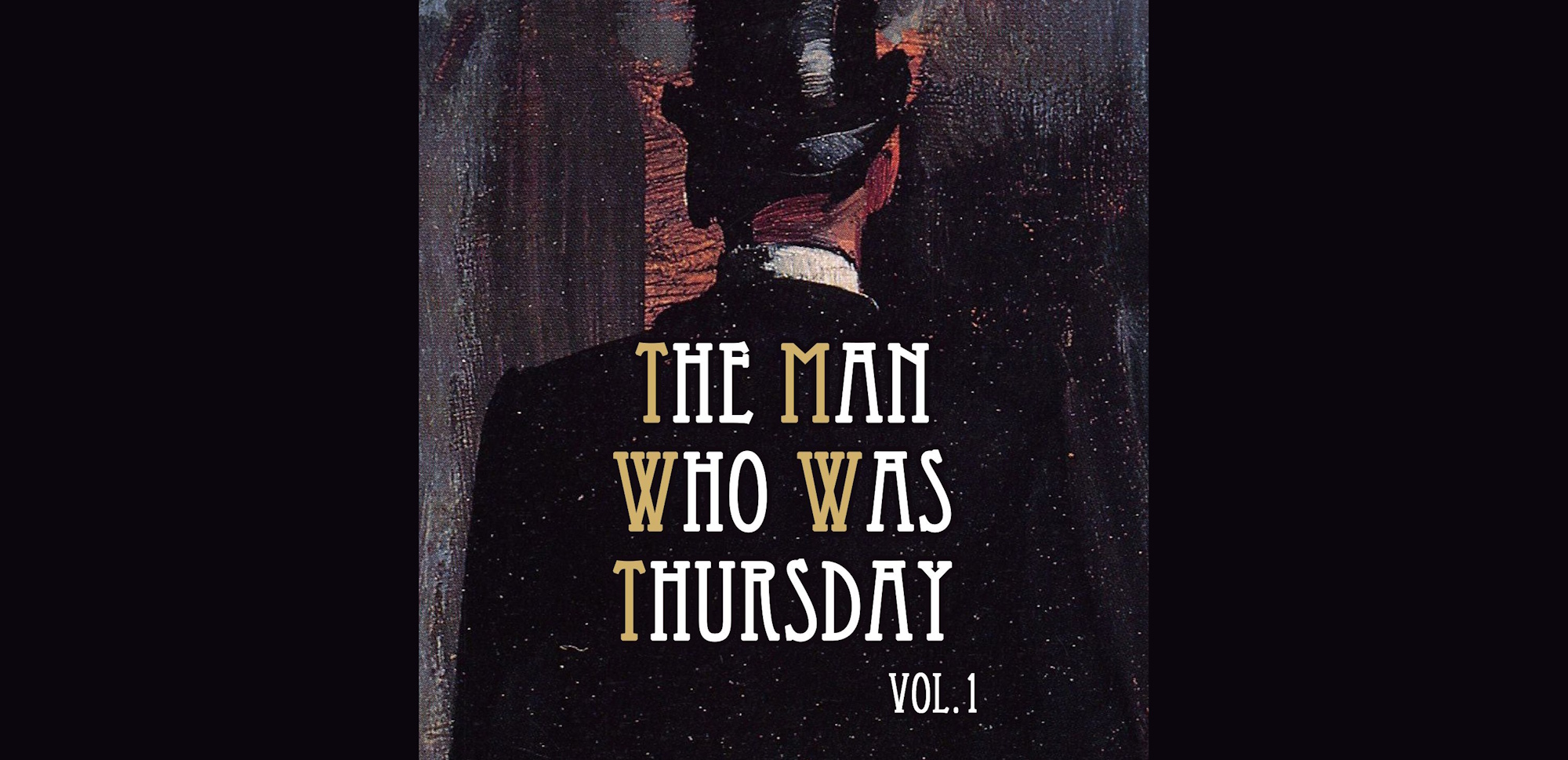
I wouldn’t go as far as to say that G.K. Chesterton’s The Man Who Was Thursday saved my life. Probably it would be more accurate to say it built my life. The novel arrived at a pivotal moment in my adolescence. I was seventeen. Dumb with hormones, dumb with culture, just plain dumb. Still deciding who I was. Who I was going to be. I found it through the unlikeliest of sources, snippets of text in the video game Deus Ex, and felt like an investigative researcher when I obtained a copy from the bookstore I haunted like a ghost that summer.
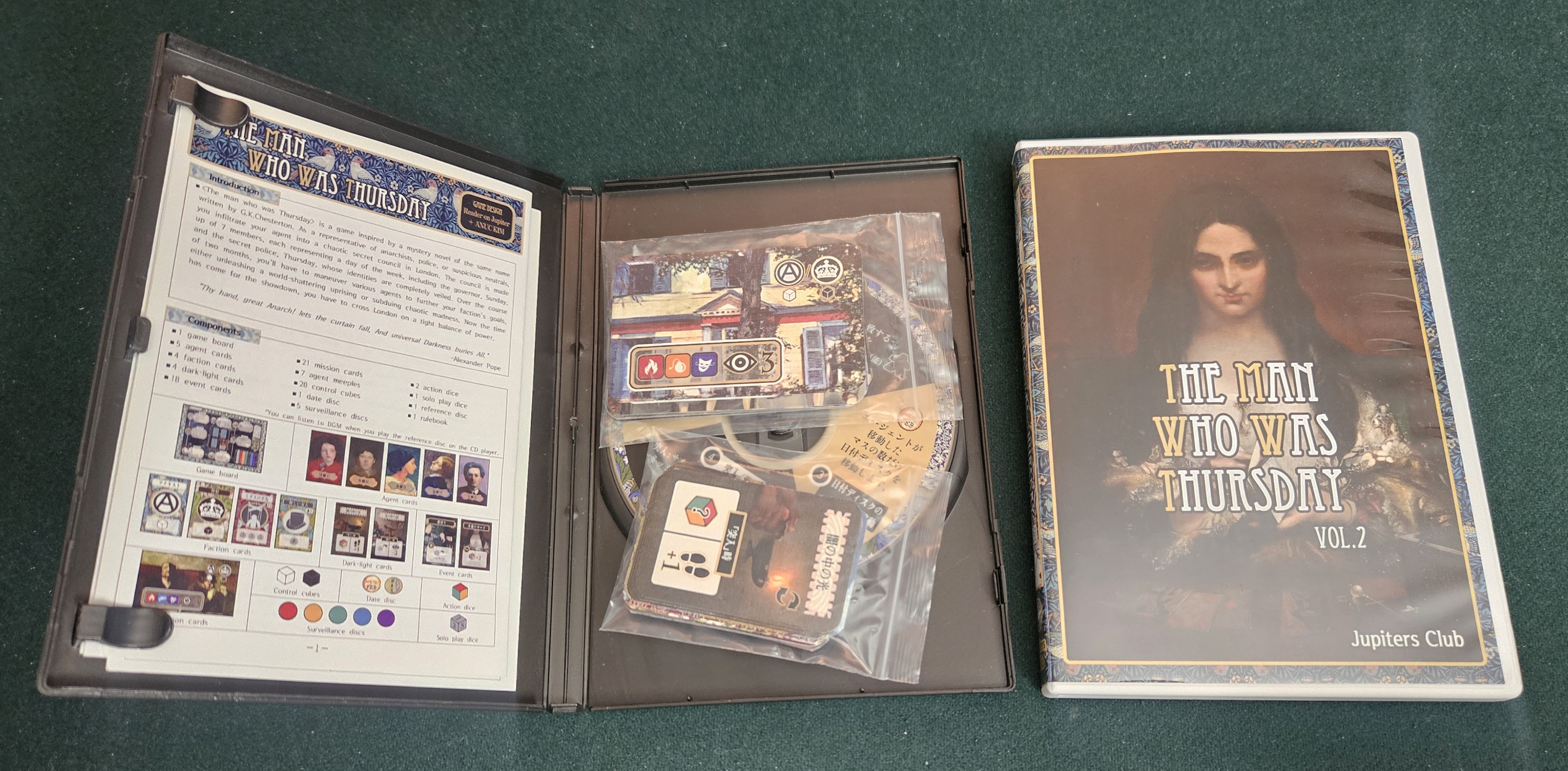
The Man Who Was Thursday is also a board game. A very unlikely board game. Created by a designer from South Korea who goes by the nom de ludens Reader on Jupiter, it arrives folded within twin DVD cases. Arrived. Past tense. It’s profoundly out of print, although its author claims there will be another use for the system sometime in the future.
Honestly, it isn’t the system I’m interested in. It’s the adaptation. This is the board game version of a book that was one of the cornerstones in building who I am today. I cannot see it impartially. Only intimately, like an old friend straining to express something important. Straining to express a revelation.
The perilous streets of Europe.
It begins with the conspiracy.
Written in 1908, when Chesterton was yet a Protestant, and in the period when anarchists and nationalists alike flung bombs at monarchs, a vocation that would soon spark the War to Begin All Wars, The Man Who Was Thursday opens with an undercover policeman, Gabriel Syme, on a quest to stop a council of bomb-throwers from completing their most daring, most damaging undertaking yet.
He is elected to the position of Thursday. That is, one of seven members of the anarchist committee. The committee is headed by Sunday, a monstrous, massive presence who seems unbeatable at every turn. Syme is initially shown as dashing and clever, worming his way into the anarchist committee through poetic debates, mistimed oaths of secrecy, and inflamed speeches. Seated before Sunday, he is transformed into a sweating plaything, certain that the anarchist of anarchists sees straight through him.
It’s a tale of isolation, at least in part. Thursday is one of those stories that reflects the eye of the reader. Some have argued that it’s the antecedent for the coming storm of espionage thrillers. The critic Adam Gopnik argued that it was the turning point between the earlier nonsense fantasies of Lewis Carroll and Edwin Lear and the latter horror fantasies of Franz Kafka and Jorge Luis Borges, the moment when the fever dream grew truly nightmarish. More than one theological treatise has argued that it’s a retelling of the Book of Job, with its senseless morality. It’s easy to see why. The world of Thursday is broken, pessimistic, heavy with suffering.
And at its heart is a man who doesn’t see a path through to the end. Or, in my case, its heart is a teenager on the verge of adulthood, flirtatious with fascism but honestly too sensitive for jackboots, with an ear for the numinous but too questing to be considered faithful, and only barely smart enough to know he doesn’t know a single damn thing worth knowing.
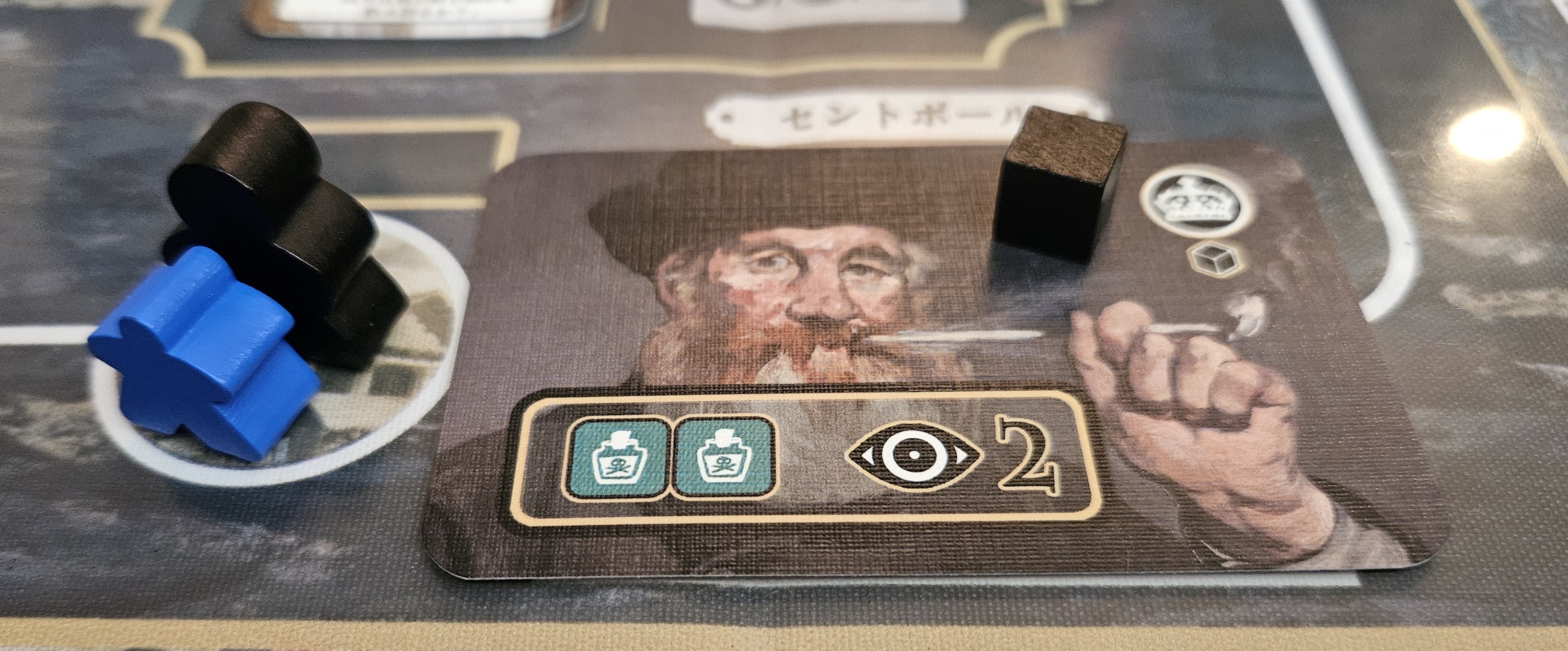
For the good of humankind, we’re gonna poison this guy.
Adaptation is one the most difficult arts of all. Partly because, when done well, it will be invisible.
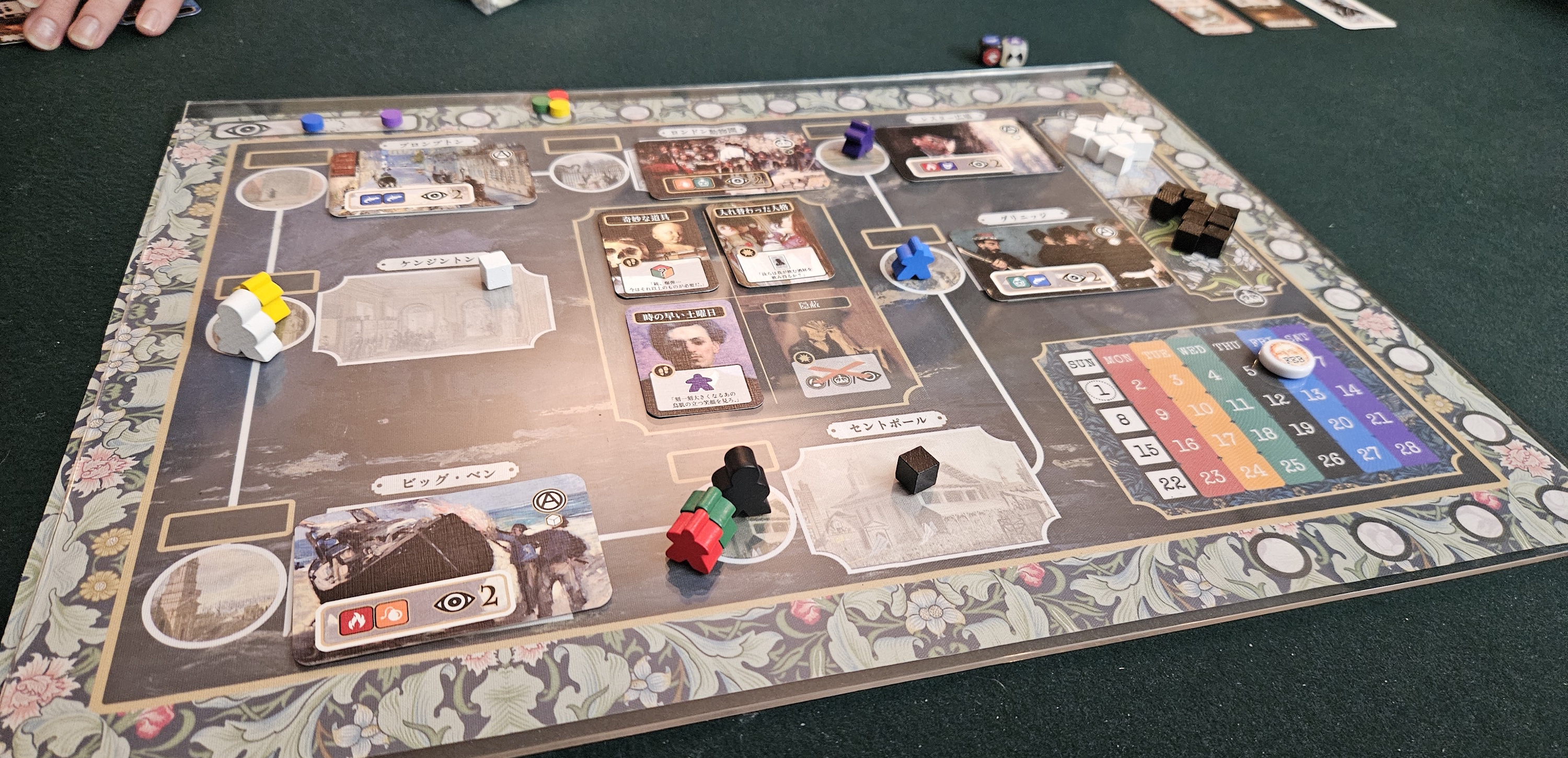
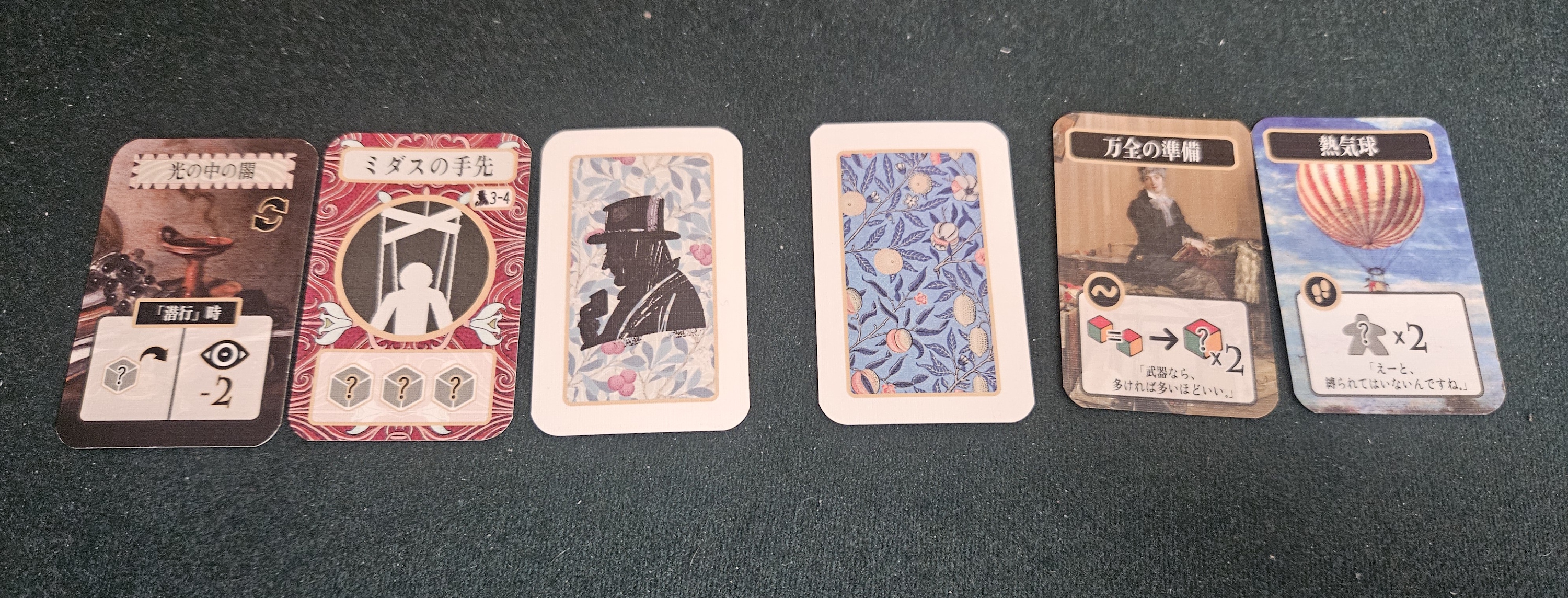
Thursday the board game adapts Thursday the novel by thrusting players into a tangle that they can only vaguely see the outlines of. Everyone is a member of the Council of Days with a double identity. The first of those identities is visible, an objective to fill the spaces of the board with some number or color of cubes. Perhaps you’ll be tasked with placing a bunch of anarchist cubes, or entrusted to make sure there are more police cubes than anarchists in as many spaces as possible, or even instructed to sow chaos by commingling white and black across the entire board.
Your second identity, however, is concealed. This is your position on the Council of Days. Perhaps you’ll be purple, Saturday, or red, Monday. The only options barred to you are Sunday, the avatar of anarchy, and Thursday, representing the police.
These dual identities are never far from mind, tied as they are to the game’s victory conditions. Your first goal is accomplished by undertaking missions that add cubes to the board. But your second, that of your hidden identity, requires you to steer clear of those same missions lest you fall under suspicion. This functions as a tiebreaker, but ties are common enough that your relative standing can never be neglected, causing players to go out of their way to keep their player token clear of any major plots.
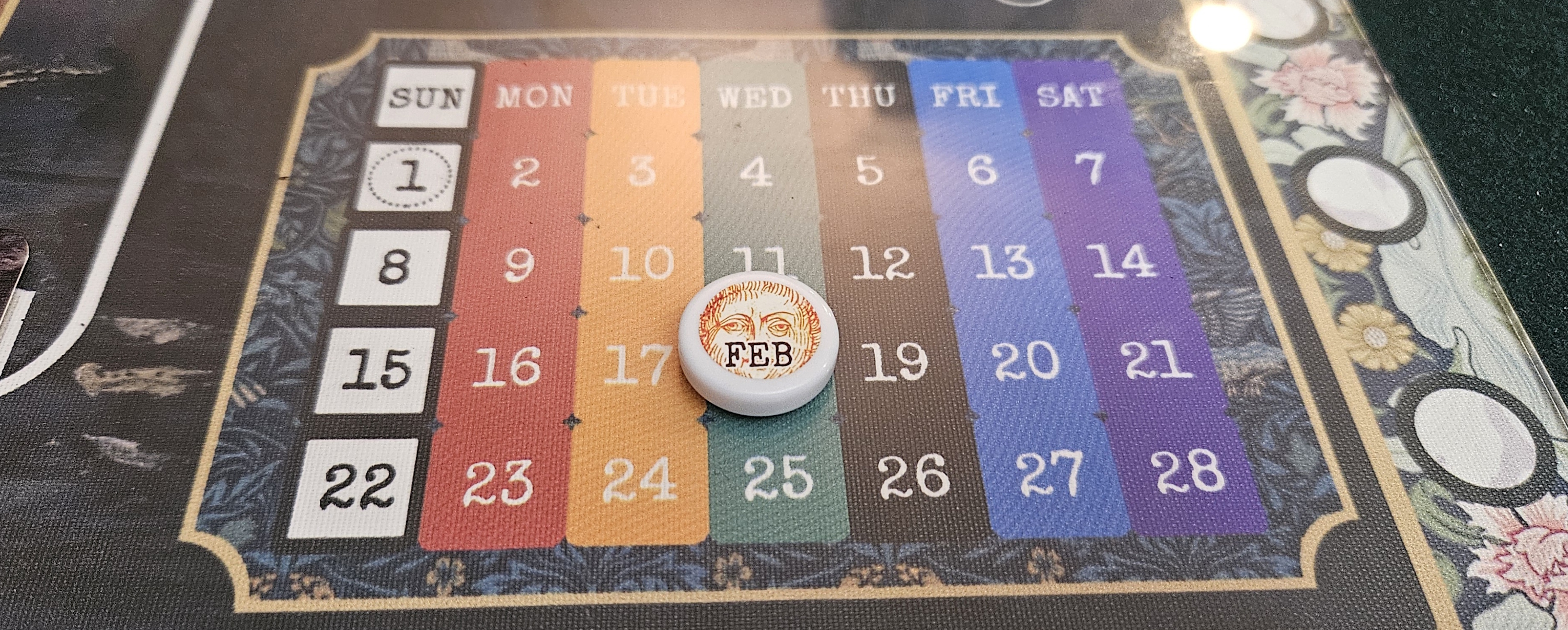
This is made doubly challenging by the fact that you never command your avatar directly. Instead, your current token is determined by a calendar that shifts forward in response to everybody’s moves. You’re Monday, but today is Wednesday, so rather than moving your red piece, you’re given control of green. Along the way, you pick up Friday (blue) to fling a bomb at some minister, causing green and blue to gain suspicion, but also leading everybody at the table to suspect that your real identity is tied to neither of those colors. The calendar ticks forward three days because you moved three spaces. The next player glares at you because it seems like they’re always moving Saturday.
The timekeeping calendar is lovely.
Out of the corner of my eye, I can regard the game with some sliver of critical impartiality. There are flaws here. Missions are accomplished through a combination of dice faces and token colors. Theoretically, this forces players to make do with what they’re given, some combination of whichever color the calendar has assigned them this turn, the colleague they pick up en route to their mission, and any dice results and/or bonuses they have handy. But missions are too easy to complete, rendering entire portions of the design vestigial. There’s an option, for instance, to lay low rather than to complete a mission, cooling off some suspicion or tweaking the position of previously placed cubes. But this is rare, an outside exception, especially the first few times the game hits the table.
Similarly, the objectives struggle to find their balance. Some, like the one that sees you filling spaces with the maximum three cubes, are far easier than those that pit anarchy and the police against one another. With some experience, the gameplay opens up. You learn how to speed up the calendar when you’re ahead, or use the bigger Sunday and Thursday tokens to alter the outcome of a mission, or take advantage of the game’s many special abilities to alter the game from its icon-matching core into more of an area control contest. The Man Who Was Thursday can be played well, can overcome certain of its limitations. But even at its best, it remains a flawed system.
As an adaptation, it fares better. There’s still an incompleteness to the presentation here, as one might expect of a board game, which by its nature presents a snapshot rather than a definite narrative arc. This is, in a sense, the middle act of Thursday, the conspiracy of isolated individuals, after Syme’s infiltration but before the absurdities begin to overwhelm the tale. I’m reluctant to spoil any details, itself something of an absurdity for a novel that’s nearly 120 years old, but… well, that’s on you. Sorry. You’ve had your entire life to read it.
The question of your identity is always under investigation.
The novel gradually transforms, shedding its guise as a political spy thriller. For a time it becomes a meditation on isolation and the power of companionship, with Syme discovering that the various members of the Council of Days are all undercover policemen like himself who have been set against one another. In its final chapters, it shifts into the cosmic realm of Job’s behemoth and whirlwind, Sunday fleeing atop an elephant, then via hot air balloon. When the conspirators at last corner the anarchist of anarchists — a state of affairs that sees him at the height of his power, not laid low as one might presume — they grill him. Why have they suffered so much? Why must everything on earth contend against every other thing? Why does even God hide His face?
This is when Syme, at the moment of theophany, understands. The suffering is also the justification for its own existence. If only the wicked suffered, then their complaint against God would be correct in labeling Him a tyrant. It’s only in the wildness of suffering, in its untamed nature, in the way the lion might gaze lazily at you or consume you, in how every living thing is pressed into service as an anarchist, that true goodness becomes possible.
Do I buy it? Eh. About as much as I buy any explanation for why we suffer. Okay, that isn’t true. I buy it more than any prosperity gospel. But I bought it as a teenager. I bought it, and decided that we were indeed heroes disguised as anarchists, everyone alone, everybody hurting, and that, as Chesterton wrote, the best we could do was to try to find the people who were hidden like us and make allies of them. In his words, “There are no words to express the abyss between isolation and having one ally. It may be conceded to the mathematician that four is twice two. But two is not twice one; two is two thousand times one.”
What a strange, wonderful artifact this is.
This version of Thursday doesn’t arrive at that final confrontation. It remains quagmired in the issue of concealed identity. It’s entirely possible, even likely, that players won’t know one another’s color until they arrive at the game’s conclusion.
But it succeeds in its own confrontation, that moment when everyone’s identity is revealed and any ties are broken. This parting of the curtain is a delight, all the preceding machinations suddenly laid bare. And, by extension, it succeeds in the small moments of relief it provides. When someone at the table eases the suspicion cast on your pawn. When a fellow trailing player collaborates to break someone’s winning state. When at last the game is tallied and packed away and we return again to the table, free of the magic circle, no longer strangers, once again friends.
A complimentary copy of The Man Who Was Thursday was provided by the designer/publisher.
(If what I’m doing at Space-Biff! is valuable to you in some way, please consider dropping by my Patreon campaign or Ko-fi. Right now, supporters can read the next installment in my series Talking About Games, this time tackling the topic of what makes a good list! Naturally, the piece includes a list.)
Every so often, I’ll write something that receives a weird amount of hostility. The most emblematic example is Foucault in the Woodland, my series examining Cole Wehrle’s Root through the lens of Michel Foucault. This is especially weird because Wehrle has been rather open with his design intentions there, including his desire to wrap some philosophical talking points in the garb of fable. In other words, some of the points I’ve written about Root aren’t even subtext; they’re explicit rhetoric spelled out by the game’s author.
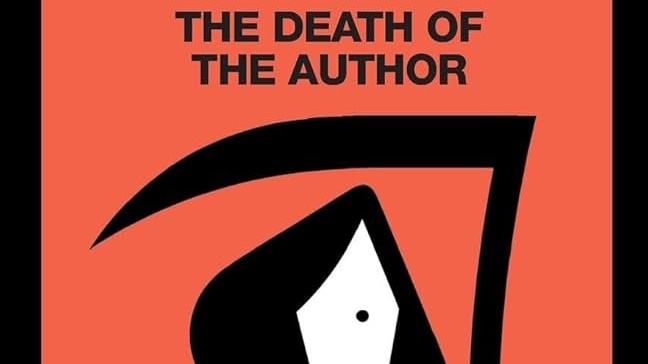
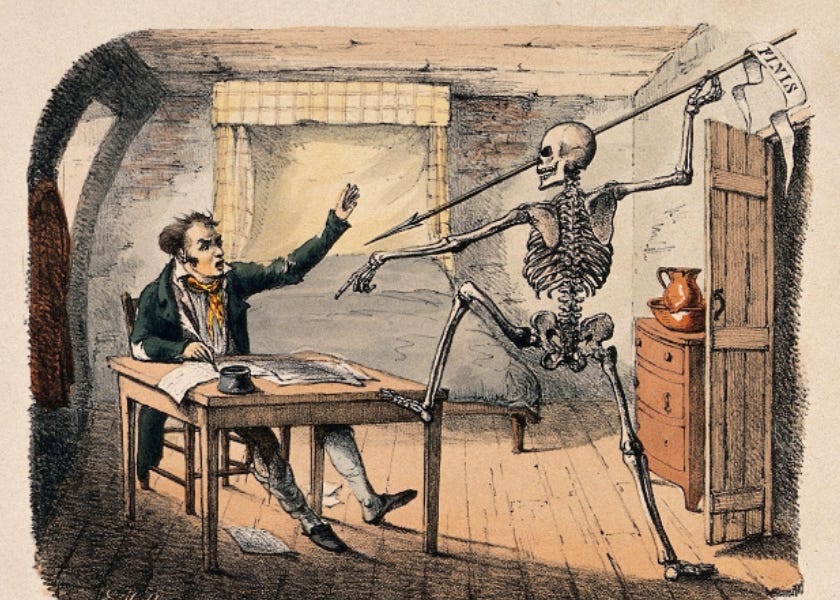
But this raises a tangential (and frankly more interesting) question than whether I’m stretching when I insert theories about biopower, state surveillance, and sexual deviancy into the factions of Root. How much should it matter whether Wehrle has left his imprimatur on Root as a game that could be read through a Foucauldian perspective? Thanks the Death of the Author, shouldn’t we be free to talk about any game through any lens that occurs to us, as readers and/or players of that game? Or, as Roland Barthes might put it, as conversants in the same language the designer used to create it in the first place? In playing these things, aren’t we creating their meaning as resolutely as their designers did in the first place?
Today I want to talk about the Death of the Author, Roland Barthes, and the tension that exists between two halves of the way I evaluate games. But in order to do that, first we need to talk about the Bible. That’s right, the Holy one. I’m so sorry.
This one. And no other.
I. Originalism and Reception
As some of my long-time readers may know, I have a background in Bible. My education is primarily in Christian history, which necessarily touches on a pretty wide range of topics, if only because Christianity has been with us for a couple thousand years now. There’s the usual stuff, patristics and theology and orthodoxy and schisms and bad popes and whatnot. But there’s also the stuff that students are surprised to discover. Like the changing Christian treatment of women over the centuries, or the involvement of priests in both colonialism and revolution alike, or how certain brands of literary theory simply wouldn’t exist without bored dudes (they’re almost always dudes) sitting around and thinking about how to critically read a text.
The dominant strain of critical reading is what we call originalism. This is the study of what meaning an author intended to convey when they first (originally) jotted down their words and thoughts and sermons and prayers and personal correspondences. It probably won’t surprise you to discover that this more or less grows out of Bible studies, specifically when it comes to figures like Jesus or Paul.
Especially Paul! Because that dude was all over the map. He’s the one who says that women shouldn’t lead in church, that they should cover their heads, that they’re meant to submit to their husbands, all those zingers. But he’s also the one who praises women as leaders and missionaries and, in one glaring case that was gendered out of the New Testament for a long time, as an apostle.
A few hundred years back, a few of those bored dudes recognized that some of what Paul was laying down didn’t line up with itself. So they began asking questions and coming up with different theories to square the circle that was Paul. This resulted in a range of answers. Some bored dudes decided that maybe Paul was calling on women to thread a particular needle; that they needed to be leaders and submissive and missionaries and that’s a lot of work for women, but tough. Other bored dudes recognized that sometimes Paul’s language changed, so maybe some of his statements on women had been inserted into the original text to alter its meaning (fancy word: interpolated), or maybe even entire epistles were forged by later authors (fancy word: pseudepigrapha). Cluttering this even further, other bored dudes decided to lean into Paul’s most hostile utterances about women, while women scholars rehabilitated Paul as a proto-feminist who was working within the rather strict gender format of Ancient Roman times. Sometimes multiple of these theories coexisted within the same headspace.
In each of these cases, however our bored dudes (and eventually bored women) were deciding to interpret Paul, their intent was generally to arrive at what this ancient Christian originally meant to say. This tendency to assess the Bible as a bundle of original meanings that could be deciphered eventually noodled its way from the religion department to the literature department, where classicists and historians and theater nerds started to subject their own subject matter to the same treatment. The rest is history, right up to our current predicament where Dan McClellan and TikTok theobros spend their every waking moment debunking each other.
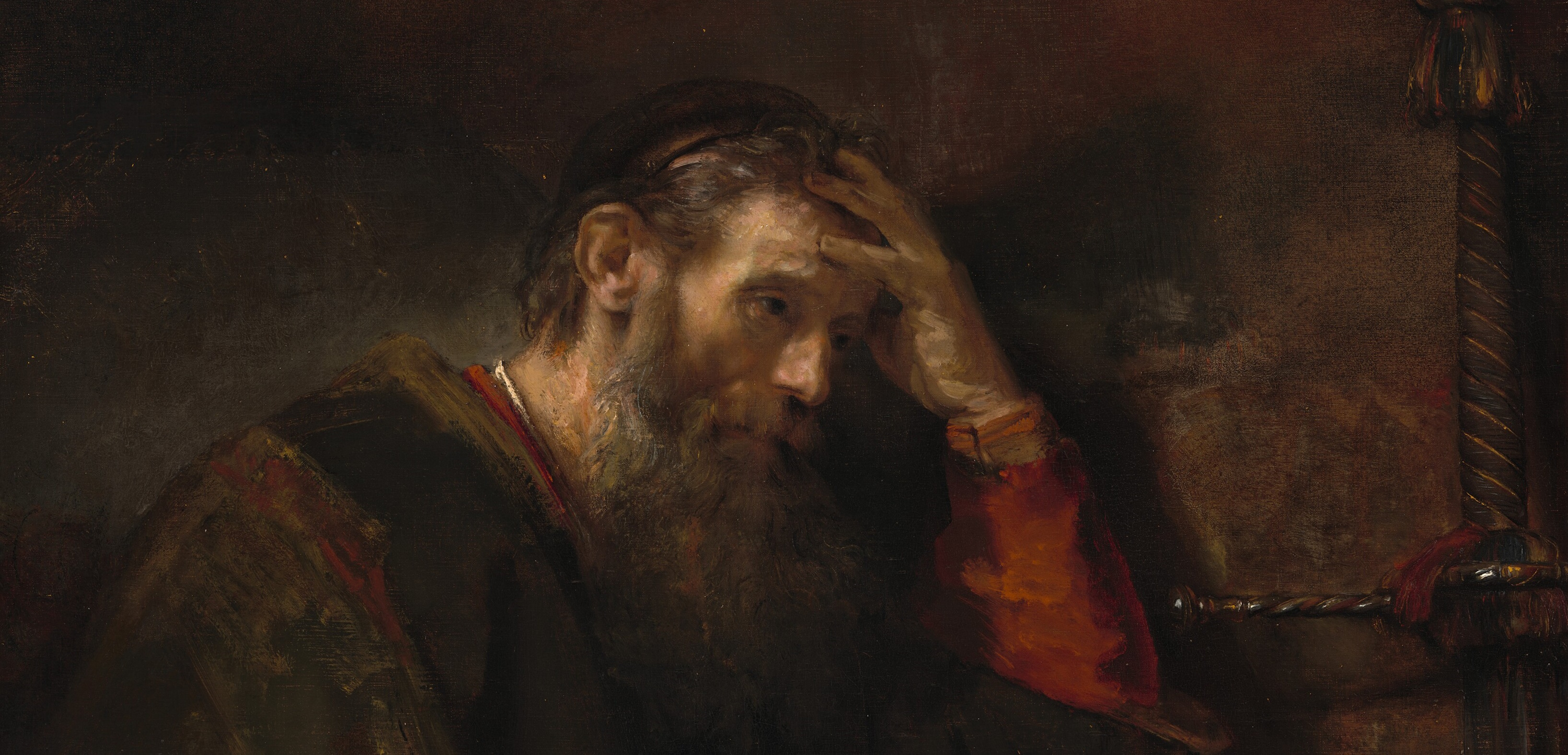
Dan McClellan in an earlier incarnation. Ha ha, it’s actually Paul via Rembrandt.
Only there was a problem. A big one. A lead stinker of a problem. And it went like this:
So what?
Why should we care what Paul said about women? He lived in olden times. They argued about dietary restrictions and whether Jesus was an alien hologram. They also cooked everything over open fires and died young when their teeth wore out. Maybe, these new bored dudes (and bored women) argued, maybe we should care less about what people like Paul originally said and more about what religion can do for us right now.
To be clear, not all of these statements were wholly conscious. Most of the people making these arguments were believers themselves, so they weren’t trying to throw out the entire Bible. It’s just that original meaning isn’t the only meaning. Maybe Jesus and Paul and all these other Bible authors were pointing toward a deeper truth.
Here’s one place where the issue came to a head: slavery. Paul talked about slavery. There’s an entire epistle (his shortest) devoted to the issue. But that text, a letter to the master of an escaped slave, isn’t really about slavery so much as it is about Christian fellowship. Basically, Paul asks Philemon, the master, to accept Onesimus, his escaped slave, back into his household, but to treat him as a brother. It’s a beautiful piece of work, expressing Paul’s hope that Christian identity will override any other.
The problem, though, is that Paul doesn’t exactly liberate Onesimus. He’s still sending the guy back to his master. So we get these bored dudes debating the meaning of this epistle. Is Paul saying that slavery ought to be ended? Or is Paul saying that slavery is good, but that slaves should be treated well? And what exactly does “treated well” mean? Like a brother? Like a pet? Like a child who doesn’t know what’s best for them?
Or is it possible that abolition isn’t something that could occur to a first-century thinker in the first place?
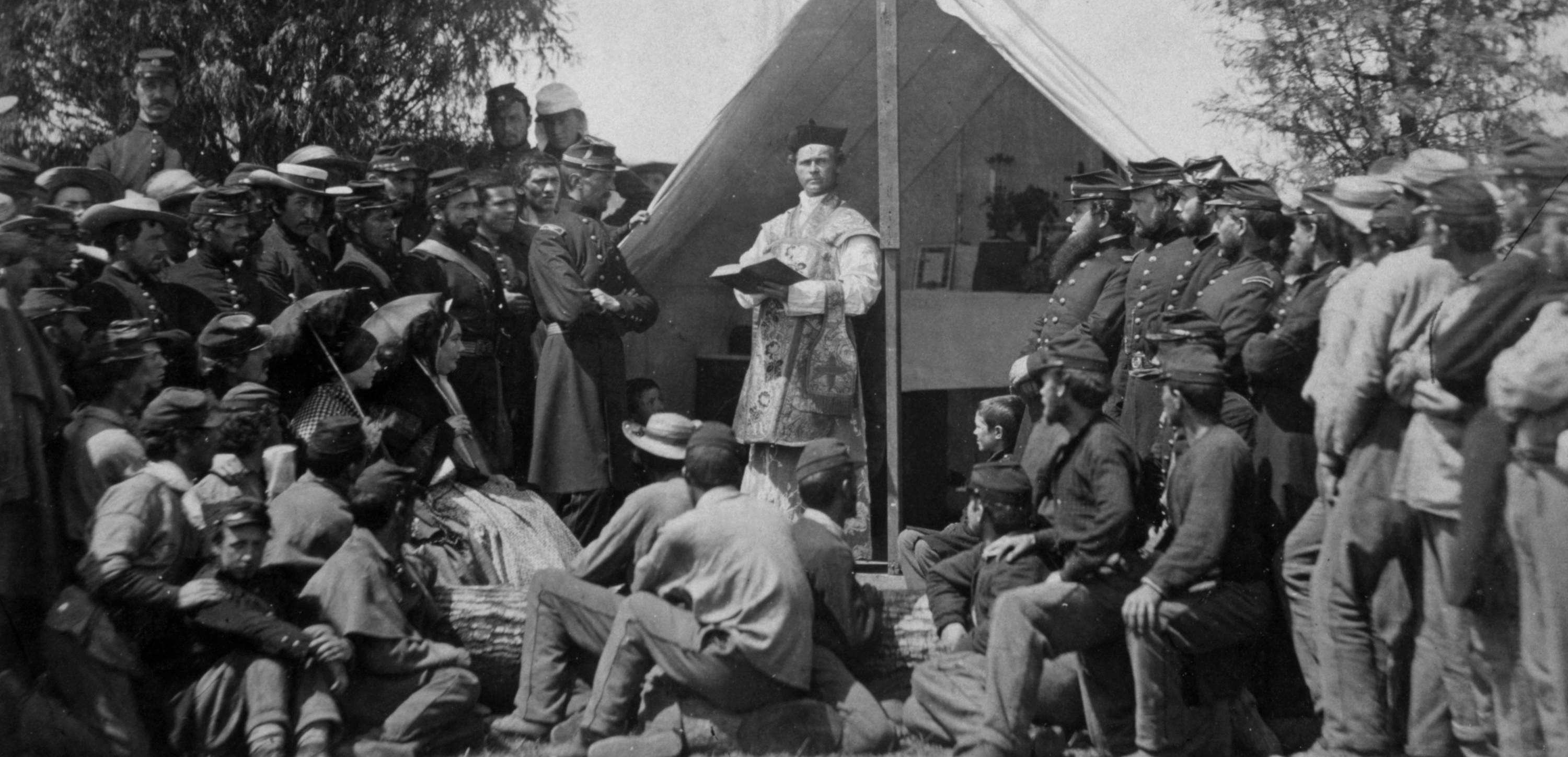
Catholic Mass during the American Civil War.
So our bored dudes started debating what Paul means by this epistle. And their underlying disagreement wasn’t solely over what he originally meant. It was over the meaning behind the meaning. Paul never saw the cotton gin. He never saw industrial slavery. He never saw slave ships packed with human meat. This isn’t to say that Roman slavery was super fun. It sucked. But it was the background noise of Paul’s day. Maybe, if this long-dead authority figure could be whisked into an 18th-century context, he would see the factories and the cane fields and free-market capitalism and agree that slavery had run its course and ought to be done away with. Maybe he’d become a Marxist. Maybe he’d die of future shock. It all depends on who you ask.
(Meanwhile, of course, a few people were beginning to point out that maybe we shouldn’t rely on long-dead authority figures. But that’s a tangent we shan’t explore today.)
This is where we get a very different strand of understanding texts. These people start to realize that some things, including a lot of things that a lot of Christians care a lot about, aren’t a function of those original meanings. They’re new. And these new things are maybe just as important as the original stuff.
Like, for example, abolition. Or the creole blending of Christianity with native faiths. Or how women might participate in a modern church. Or how to handle texts that clash with archaeological discoveries and scientific theories. Or the role of priests in resisting authoritarian governments. Or the role of priests in supporting authoritarian governments — because, look, these innovations weren’t always positive.
The need to adapt to changing circumstances prompts a very different method for reading texts. This is called reception. The idea is that the reader’s context is every bit as important as the original context. Maybe even more so. After all, Paul has been dead for a while. Let the dead bury the dead, someone once said.
Like originalism, this new idea of reception trickled from the religion department over to its neighbors, spurring disagreement even between critical theorists. The question looks like this:
Which matters more: the original meaning or the new meaning?
Roland Barthes, looking very sexable today.
II. The Life-Death of the Author
According to French philosopher, critic, and semiotician Roland Barthes, the thing that matters most is the new meaning. The reception of the work by its readers, not the original meaning intended by the author. Although in his case, he would probably label it the old meaning.
Ask your average lit-kid to sum up Barthes’ seminal essay “The Death of the Author” in one sentence and, first of all, they’ll insist it can’t be done in fewer than a few paragraphs. But stand firm and you’ll probably get something like this: “The author’s intentions and biography aren’t what matters when it comes to interpreting a work of art.” Easy, right?
Not quite. For one thing, it’s useful to actually read the essay in question. I know, it’s super long. 2200 words! That’s a little bit longer than this piece up to this point!
But the Barthes who argues for the death of the author is speaking in stronger terms still. To him, the author is a new concept entirely. “The author is a modern figure,” he writes, “no doubt produced by our society as it emerged from the Middle Ages, inflected by English empiricism, French rationalism, and the personal faith of the Reformation, thereby discovering the prestige of the individual, or, to put it more nobly, of the ‘human person.’ Hence it is logical that in literary matters it should be positivism, that crown and conclusion of capitalist ideology, which has accorded the greatest importance to the author’s ‘person.’”
Now, you might note an irony here. When Barthes attributes the birth of the author in part to the “personal faith of the Reformation,” isn’t he talking about the same bored dudes who developed the idea that reception matters more than originalism? The answer is… kinda-sorta. Remember, our bored dudes were so bored that they spent all their mental energy arguing with other bored dudes. Pinning them down to a single consistent perspective is tough. Even more importantly, we’re entering a dissimilar realm of thought. Barthes is not a historian. He’s a philosopher. And while there’s quite a bit of overlap between our history and philosophy departments, they’re different enough that the rubric that applies to one might not easily fit into the other.
For one thing, Barthes seems blind to at least two possibilities. First, that it isn’t only the Author who has been created by modern society, but Readers as well. And two, that our art has always been subject to some degree of authorial shenaniganry. In Barthes’ quasi-historical telling, art was previously relayed by mediators — shamans, orators, village elders — who were effectively putting on performances rather than functioning as a tale’s sole arbiter of meaning. But it doesn’t take much effort to observe that there have been plenty of shamans, orators, and polemicists throughout history who have gladly declared what any given work of art really means. And this isn’t limited to tradency, in the sense that orators will sometimes leave their own stamp on a story. Biblical authors and editors went of their way to establish their biographies or clarify a text’s original intentions, sometimes overwriting poetry or inserting themselves under someone else’s name. (Remember our fancy words from earlier!) It’s as natural as storytelling to re-imprint oneself on the text. To edit or translate, even to relay, is to author.
Which, it should be noted, draws these two disparate threads closer to fashioning an actual knot. Because if editing, translating, and relaying make authors of readers, then so too does the mere act of reading. When you read a text, you mediate its meaning by reinterpreting it within your own context. This transforms you into an author. A very different type of author from the Author that Barthes intends to throw down from his pillar. But an author all the same.
Oh! This jacket designer thought Barthes meant it literally.
Okay, we’re all authors, lower-case rather than capital-letter god figures. Great. We get it. But what’s so bad about the original Author’s intentions and context anyway?
To understand that, we need to investigate the context that Barthes was operating in. Which is at least ironic, maybe even something of a trap, since we’re now trying to strike at the man’s original meaning as opposed to its received understanding. And, oh, I ought to note that some literary theorists have indeed argued that Barthes was imposing an irony-trap by crafting a theory that would force its adherents to strive to understand his original meaning and thus paradox themselves to death. This strikes me as the sort of prank Jacques Derrida was more prone to, but consider yourself informed. Let’s spring the trap, if only to investigate its hinges and springs.
To begin with, Barthes argues that the Author isn’t quite as much of an author as they would like to think. He writes, “We know now that a text consists not of a line of words, releasing a single ‘theological’ meaning — the message of the Author-God — but rather a multidimensional space in which several meanings are married and contested, none of which is original. The text is a fabric of quotations, resulting from a thousand sources of culture.”
Whoa, cool it, Roland! In simpler terms, language and culture are so potent that the Author is passing along meaning more than they are inventing it. While the Author might want to claim ownership of their ideas, they’re merely handling it. They’re closer to those shamans and orators, tradents of ideas rather than originators of them.
Even Barthes was swimming in his own culture. As plenty of commentators have pointed out, other critics were beginning to argue something similar to what Barthes argued in “The Death of the Author.” Short version, nobody is as original as they would prefer to think.
But there’s another element of culture at play, one that goes a long way toward explaining the strength of Barthes’ language. The dominant strain of literary criticism of his day was downright obsessed with originalism. According to prevailing wisdom, critics were intended to decipher art’s original meaning, usually by studying an author’s biography or, when possible, by simply having the author clarify a work’s intended meaning. It’s time to drop an over-long quote on you, but I’ll put it in a breakout box to add some visual flair:
The author still reigns in manuals of literary history, in biographies of writers, magazine interviews, and in the very consciousness of litterateurs eager to unite, by means of private journals, their person and their work. The image of literature found in contemporary culture is tyrannically centered on the author, his person, his history, his tastes, his passions. Criticism still largely consists in saying that Baudelaire’s oeuvre is the failure of the man Baudelaire, Van Gogh’s his madness, Tchaikovsky’s his vice. Explanation of the work is still sought in the person of its producer, as if, through the more or less transparent allegory of fiction, it was always, ultimately, the voice of one and the same person, the author, which was transmitting his confidences.
An author being kill’t.
Whoa, cool it, Roland! What’s the problem, anyway? To Barthes, a man who cares very much about art and about the meanings it transmits, the problem is that it makes art perishable. It puts a period on a single examination of the work. The task of criticism becomes that of a codebreaker. You look at art and you say, “What is the one singular meaning that this work of art must have?”
Once that has been done, any other meaning is rendered meaningless. Barthes is offering a critique of his day’s critical apparatus. And in suitable unoriginal fashion (which, remember, Barthes is defending!), his critique stems from the Marxist argument that capital has transformed art into one more product to be extracted and expended. There’s no reason to dwell on a painting for one’s entire life. Once the painting has been understood, it can be fed to the bonfire so you can purchase another. There’s no need to reread a book at different stages of your life to witness how its meaning transforms because you have transformed. The only meaning that matters is the one passed down by the Author. There’s no need for a song to blossom from springtime excitement to nostalgia. There are other albums for that.
By killing the Author, by permitting every reader to be as much an author as those who put pen to paper, Barthes argues that art becomes freer, greater, more open to all. “To assign an Author to a text is to impose a brake on it, to furnish it with a final signification, to close the writing,” he notes. “Once the Author is distanced, the claim to ‘decipher’ a text becomes entirely futile.”
It’s revolutionary. In the literal, rhetorical sense. Barthes isn’t just declaring that the Author is dead. He’s rolling the guillotine over to traditional literary criticism and laying out the head-basket.
Vive la revolution.
Review this soap, if you would.
III. Shrödinger’s Historio-Critic
But there’s a quandary to be had, because in contravention to how the Death of the Author has been received by some adherents, Barthes isn’t arguing for the death of context. The death of the Author as tyrant, yes. The death of art as a perishable grocery, yes. The death of context, research, or external meaning, not so much.
Here’s some context of our own. In the 1950s, Barthes made an early name for himself by writing essays for Les Lettres Nouvelles that assessed objects of popular culture — wine, professional wrestling, soap detergent, Einstein’s brain, Charlie Chaplin — as modern mythmaking. Eventually compiled into a single book, Mythologies, these essays were short, fewer than a thousand words a pop, but they sought to cut to the heart of the ways even seemingly innocuous cultural productions like advertisements were in fact engaged in cultural storytelling. (Usually, it turns out, bourgeoisie storytelling.) This requires a great deal of context on Barthes’ part. When he examines how the Romans are depicted in film, it requires him to stay grounded in contemporary cinema to note how every Roman’s hair is fringed, but also to venture into actual Ancient Roman imagery, where plenty of people were bald. He sidesteps any reliance on authorial authority — yes, those words have the same root, the Latin auctor for “originator” — but spends quite a number of his limited word count on contextualizing the meaning of these new myths.
In one essay, he also derides critics who “proclaim their helplessness” when it comes to understanding meaning. “Critics often use two rather singular arguments,” he writes. “The first consists in deciding that the true subject of criticism is ineffable, and that criticism, as a consequence, is unnecessary. The other, which also appears periodically, consists in confessing that one is too stupid, too unenlightened, to understand a book reputedly philosophical.” He mock-quotes such a perspective with a poisoned barb: “I don’t understand, therefore you are idiots.”
What does this have to do with authorship? First of all, if I had a nickel for every time somebody told me that their perspective is as good as any other because the Author is Dead, I would have at least three dollars. Such a degree of solipsism is very much in line with the “blind and dumb criticism” that Barthes cannot stand. He asks of the critic, “To understand, to enlighten, that is your profession, isn’t it?” Not every meaning is equivalent. There are better and worse interpretations, low-effort and try-hard interpretations, and everything in between. The Death of the Author isn’t raw solipsism. It still demands context. It’s just that it wants that context to be far-ranging, not limited to the author’s interpretation.
Onesimus, a slave, and in some traditions the Bishop of Byzantium.
If that isn’t enough, we can ask the more probing question. This is, incidentally, the same question raised by the bored dudes who questioned their predecessors’ assumptions:
So what?
So what if Barthes prefers that I don’t pay any mind to the author? I’m a critic, sure, but I’m also a historian. While the former role does well to disentangle itself from total authorial control over a text, the latter is still interested in documentation, attribution, and preservation.
One component of that preservation is the utterances of the designer. Most board games throughout the centuries have been anonymously designed. But it’s a very silly perspective indeed to think of this as a positive state of affairs. We may not know who first pushed cowrie shells around in the sand, but it enriches our understanding of mancala to learn that its popularity can be mapped to the bellies of slave ships and displaced populations, that one of its most crucial components is its absence of formal components. We may not be speaking about a singular author, but this is still a question of authorship-as-transmission. Of course, this isn’t to say that every design that uses mancala as an underlying system needs to pay homage to that. But as critics, the more context we glean, the better our understanding and therefore the better our critique. Because, as with those Bible scholars and the many victims of Barthes’ Mythologies, many of these stories are passed along through the cultural subconscious rather than stated outright. When a designer engages with a tradition, they may pass along fragments of that tradition if only by accident or assumption. They are authors, but lower-case authors, an authority on their work, if never its final authority.
Which is to say, there’s a very real tension in my work between Critic and Historian. Navigating that tension isn’t always easy. At any given time, I’m trying to assess board games as artifacts that exist independently of their creators, while also trying to preserve their authorial voices. There isn’t a single easy solution to that tension.
Oh, Roland. I asked you to stop making bedroom eyes at me.
But I do think it’s possible for these errant stands to be drawn into a knot. In his time, Barthes offered the Death of the Author as a corrective to an overly straitjacketed and commercial critical apparatus. In the decades since, the Death of the Author has become an axiom in its own right — a terrible irony, but not one that’s surprising to any student of history. Today’s heterodoxy becomes tomorrow’s orthodoxy. So it goes.
The irony brings along a great opportunity for the ride. This is the great but under-served task of modern criticism. Not merely to say “Here is my interpretation of this game, and it is as good and precious as any other.” That way lies a new incarnation of Barthes’ “blind and dumb” criticism.
Rather, the task is to develop an individual perspective that’s literate in where our tabletop games come from, which wider conversations they engage with, what their authors intended and how they succeed or fail, and where they engage with the wider culture at play. Criticism begins as a buyer’s guide, transforms into personal expression, but may, with practice and a radical engagement in the medium, transform yet again into true cultural critique, one that is simultaneously subjective and universal, that speaks about truth without surrendering to the notion that there can only be One True Thing. Such a process is fraught, but I believe it’s the next essential step in realizing a medium that has only recently stepped out of its infancy.
Vive la revolution, baby. Sorry. Vive la revolution, adolescent.
(If what I’m doing at Space-Biff! is valuable to you in some way, please consider dropping by my Patreon campaign or Ko-fi. Right now, supporters can read the next installment in my series Talking About Games, this time tackling the topic of what makes a good list! Naturally, the piece includes a list.)
It’s safe to say that The Guerrilla Generation is the wargame I’ve been looking forward to the most since its announcement on the heels of The British Way. Like that title, this is a multipack by Stephen Rangazas, once again using Volko Ruhnke’s COIN System to examine four different conflicts over the course of the 20th century. This time, our destination is Latin America.
And it all begins with a comparatively small urban insurgency in Uruguay.
Ah, my favorite bastion of Marxist corruption.
If you’ve played even one COIN game before, the basic arrangement of their maps have probably solidified themselves in your mind. There are typically three types of spaces: rural zones, drawn in green or brown depending on the terrain being represented; urban centers, portrayed as gray bubbles where the country’s population is most concentrated; and lines of communication, the highway or rail networks that string everything together.
What sets the Uruguay scenario apart from every other map is that it all takes place within one of those concrete-hued bubbles. Unlike most of the insurgencies depicted by the series, this game’s revolutionaries, the Tupamaros, have confined most of their activities to Montevideo. Right away, this presents both advantages and disadvantages. In the former column, there’s no denying that it’s much easier to traverse a single city than an entire country. Acts of sabotage and intimidation take place where their impact will be greatest. The state’s juiciest targets — the armory, the prison, the university — are all right there. It helps, too, that it’s easy to blend in among the million-plus population.
But there are some stark disadvantages as well, and it’s here that Rangazas pulls the system in two contrasting directions. As with The British Way’s anti-colonial movements, The Guerrilla Generation examines how its four insurgencies differed in operation, ideology, and outcome. For their part, the Tupamaros are relatively restrained. This isn’t to say they’re nonviolent, like some Latin American analogue of the Indian National Congress from Gandhi. Installations will still be sabotaged. Key figures will still be kidnapped and held hostage in a roving prison. Soldiers and policemen will still be assassinated. But limiting the insurgency’s activities to Montevideo means there’s less opportunity for the revolutionary fires to fan out of control.
Indeed, that’s one of the core questions asked of the Tupamaros player. Founded in the wake of Fidel Castro’s successful takeover of Cuba — as presented in the second COIN volume, Cuba Libre — the urban nature of the Tupamaros reflected the ideals of their core membership. This was a middle- and upper-class movement, staffed principally with students and tradesmen rather than farmers and day laborers. At the outset, it’s impossible to overlook the lone insurgent cell situated comfortably within the university.
Thus, a tension is presented. Should the Tupamaros confine their activities to their original vision or expand their base? Neither option is perfect. Keeping the message focused restricts the manpower the Tupamaros can bring to bear, a problem that only grows more pressing as increasing numbers of revolutionaries are imprisoned. But the instant the organization expands its recruitment pool, rogue cells might spark violent actions that disgust Montevideo’s populace and sway their sympathies toward the regime. It’s a familiar conundrum for students of revolutionary history, but to my recollection it’s the first time we’ve seen it presented so clearly in the COIN Series.
Events pull triple duty this time around.
This is only the first of the small touches that Rangazas deploys to great effect in the Uruguay scenario. The Tupamaros — who, it must be said, receive the module’s most interesting toys — are also the recipients of two other tweaks that speak to their urban nature.
First, supplies. At various points, the Tupamaros draw chits that represent the tools of their trade. Rather than being presented as generic “supplies,” here they’re delineated into distinct types that influence how the Tupamaros operate. Arms, for example, double how many sabotage markers their attacks place on the map, while escape vehicles make it easier to disappear after an operation. These chits are interesting, not to mention a great deal of fun to handle during gameplay, but their real advantage is that they imbue the Tupamaros with a certain materiality that has sometimes gotten lost in the COIN System’s sky-high perspective. Not to go all Marxist on anybody, but the organization’s material conditions inform its practice. (Or “praxis,” if we really want to lean into the forthcoming accusations.) Basically, you’re more likely to jump in guns blazing if you have guns. Or expand your organization if you have a bunch of order chits for bullying around your new recruits. Or lean into hostage-taking if the People’s Prison already has a few high-profile captives under lock and key.
While this gives the Tupamaros an ideological edge that’s missing from many of the more counter-insurgent-focused volumes of the COIN Series, an alteration to the function of the game’s event cards solves a very different issue. At the end of each turn, after both sides have had their chance to act, an event takes place. Not the usual event, the one that might be capitalized upon by either faction, but an unconnected occurrence in the third box at the foot of each card. This represents something happening beyond the reach of either the Tupamaros or the Government. An escape from a women’s prison, perhaps, or a worker’s strike somewhere in the city. (Or, in a subtle piece of humor, the United States Senate might denounce torture in Uruguay after sending advisors to teach proper torture techniques. The outcome of this denunciation: “No effect.”)
This makes the Uruguay scenario the most event-heavy of the COIN titles thus far, but also resolves one of the series’ underlying tensions — namely, the false perception that these particular actors would be all-powerful were it not for their rivals’ meddling. Here, it’s possible for things to occur that are simply beyond your control. Perhaps a new poll will show that the military has high approval ratings. Is that good or bad? Hard to say. It might be rather impactful indeed. Or it might not matter in the slightest. But it’s something that happens without the participation of the game’s factions. They can suppress the news, whether through propaganda or censorship, but either way they are thrust into a world in which they are major actors, but not the only actors.
Guns, cars, hostages… the Tupamaros get all the fun stuff.
For the most part, the Uruguay scenario’s increased resolution suits both the history and the gameplay. The Tupamaros in particular are presented as a lively bunch, if also ill-equipped to effect sweeping change.
But this tighter focus also shows a COIN System straining at its limits. Peculiarities gnaw at the foundations, concessions to balance that are probably necessary to make the game function as intended, but present as artificial constraints on the pieces sitting on the map. Insurgent cells spring across the city at will, while Government police cubes trundle from one district to another. Intel chits pad the Government’s actions, doled out as a result of interrogated prisoners, but the system feels ancillary at worst, and a less enthusiastic version of the Tupamaros’ supply chits at best. I don’t have any strong feelings on the game’s balance, as I’ve seen both factions emerge victorious, but the Government is a drag to play compared to their more freewheeling countrymen.
Fortunately, these quibbles fade alongside the scenario’s grander accomplishments. Historically, the Tupamaros lost the war but won the long-term moral conflict. The Government, pressed to their limit, eventually called in the military to subdue the insurgency. The operation was successful, shattering the organization and holding its ringleaders hostage in squalid conditions for twelve years.
The Guerrilla Generation portrays this turn of events as well. On their own, the Government is unlikely to quell the uprising, especially if the Tupamaros player cleverly manages their supplies and balances their organization’s expansion and control. The Government is therefore presented with the option to call in the military. This bolsters their numbers dramatically, adding darker-hued cubes to the map that are immune to the petty intimidation tactics that have been the insurgents’ stock in trade. Once deployed, it’s almost guaranteed that the military will crush the revolution.
But this sets off a different victory tally. Now the Government is faced with the prospect of a fatal coup d’état. If their legitimacy drops below that of the military, they lose the game outright. In theory, in the moment, this also looks like a Tupamaros failure. Thanks to hindsight, Rangazas presents it as a victory for the underdogs. Yes, the coming years will see civic governance gradually phased out in favor of military rule. Yes, Tupamaros leadership will languish in prison. But eventually military overreach will pave the way for democratic reform and amnesty for the captives. Presumably, such an outcome places the game’s conclusion not in 1973 with the military coup, but in 2010 with the Tupamaro and twelve-year captive José Mujica being sworn in as the country’s 40th constitutional president.
Deploying the military is likely the death knell of the Uruguayan regime.
There’s a certain reading of this outcome that might regard it as rose-tinted, perhaps even accelerationist in nature. Positioning a victory for the Tupamaros as more or less identical to their abject failure is a stark authorial choice. By no means was the civic-military dictatorship of Uruguay guaranteed to conclude in democratic reform.
Then again, I’d be more sympathetic to such a perspective if events had not, in fact, shaken out that way. All wargames are built on hindsight, through necessity if nothing else, and this is probably as close to true success as the Tupamaros were likely to get.
Either way, Uruguay provides a sterling entry point to The Guerrilla Generation. Its insurgency is a far cry from what we’ve seen from the series thus far, an urban uprising that struggled to obtain broad appeal, but made enough of a nuisance of itself to incite the suicide of the regime it opposed. We’ll see if the next three insurgencies are able to ride the tide of historical chance to similar highs. Spoiler: Don’t get your hopes up.
A complimentary copy of The Guerrilla Generation was provided by the publisher.
(If what I’m doing at Space-Biff! is valuable to you in some way, please consider dropping by my Patreon campaign or Ko-fi. Right now, supporters can read my first-quarter update of 2026: the best board games, movies, books, and more!)
For the most part, that’s fine by me. Sometimes, too much of a good thing makes for a real tummy ache, and while it’s a rare week that doesn’t see me tackling at least one of the hobby’s elder statesmen, nothing makes a board game quite like a board. I will admit, though, there’s always the siren call of the latest pure tricker. “Come back to the table,” it sings, except in, I dunno, Greek. Calling me. Haunting me.
Dead Channels, for example. This is the latest title by Daniel Newman, whose designs we’ve tussled with once or twice.
Test signals.
In the fashion of elder trick-takers — modern ones still do this, but older ones too — this is one of those trickers where the designer mines untapped veins from the minutest of changes. The idea is that every card shows two states. One of those states is colorful, like the tuning image you’d get on an old television. The other is fuzzed gray with static. As you play, these states flip back and forth, informing everything about how the hand is played.
This isn’t the first time we’ve seen a trick-taker alternate hand functions. But what sets apart Dead Channels is the way your cards flip from one state to the other. When the channel is tuning, this is an ordinary must-follow trick-taker. If I play red, you have to play red if at all possible. The highest card in the led suit wins. Normal stuff.
But when someone plays off-suit, the game changes. Now everybody splays their cards the other direction and begins playing a must-not-follow game. If I play red, you better not touch the stuff. Only the high card among those that are eligible — as in, non-following — are permitted to win.
Of course, this might also become impossible before too long, forcing us to flip the channel back to tuning, then back to static, and so on until the hand concludes. Flip. Flip. Flip.
Like some of Newman’s games, Dead Channels feels haunted.
That’s simple enough, but what makes Dead Channels fascinating is that you’re always wrestling against your hand. It would have been easy to overclutter this one, but instead Newman sticks to a simple rubric. You want two tricks. That’s it. Two per player. Naturally, more tricks than that will be awarded, making this a razor-edged proposition. But that’s the idea. If you earn two tricks, you net zero points. For every trick you’re off, whether up or down, you earn a point. Points are bad.
What’s noteworthy about Dead Channels is the way this produces such a well-rounded experience with very little in the way of overhead. I’ll be the first to tell you that trick-takers are a fraught proposition. Between the card counting, goofball terminology (sloughing? really?), and the damoclean threat of contract bidding, this has always been a dense genre, one that’s simple enough on the surface but sharp with gravel once you go more than two inches deep. Dead Channels relies on a little bit of foreknowledge. Like plenty of other trickers, you can explain the rules to veterans with a flurry of jargon. But for the most part it’s as accessible as these things get, devoid of the extra bells and whistles that have been normalized in past years.
Is it the next great thing? The next Schadenfreude? I doubt it has such pretensions. But it’s nice to come back now and then, to see how clever designers are still adjusting the format in small ways that only seem obvious in retrospect. By embracing both must-follow and must-not-follow, Dead Channels effectively becomes two trick-takers in one — although, of course, the challenge lies in how you navigate that liminal space between them, flipping between one mode and the other.
Static still corresponds to suits. Don’t you see the fuzz lines?
I don’t play nothing but trick-takers these days. But like I say, it’s nice to circle back for a visit. In that sense, Dead Channels feels like coming home for a reunion only to make a new pal instead. Could have gone worse.
A complimentary copy of Dead Channels was provided by the designer/publisher.
(If what I’m doing at Space-Biff! is valuable to you in some way, please consider dropping by my Patreon campaign or Ko-fi. Right now, supporters can read my first-quarter update of 2026: the best board games, movies, books, and more!)
Hello readers! Mike Didymus-True here, the editor of BoardGameWire.
I wanted to post a quick message to apologise for an upcoming week or two quiet patch for the site – I’m being unexpectedly admitted for surgery tomorrow, and will likely be out of action for at least 7 to 14 days while I recover. And as BoardGameWire remains a one-person operation, which I squeeze into my spare time around my day job and my two kids, unfortunately that means a very brief hiatus for the site!
Please do continue to email me with your news and such in the mean time, and I’ll do my best to get reporting again as soon as possible! I’m on mike@boardgamewire.com
If this hiatus makes you think “Hmm, I wonder where I’ll get my board game industry news from now”, might I recommend the excellent W Eric Martin over at Board Game Beat, who sometimes has crossover with the kind of things I tend to cover here.
And if this hiatus has also made you think “Hmm, I really do find BoardGameWire and its reporting useful, that Mike really does do a pretty good job covering things that don’t get written about elsewhere – I would very much like to support that kind of thing financially” – that would be lovely! You can pledge a variety of amounts through the BoardGameWire Patreon, or by choosing a paid subscription to our regular newsletter.
Despite being the creation of John Rudolph Drexler, Colossi reminds me of an early John Clowdus design. At really every point, come to think of it. There’s the shape of the thing: a lane-battler packed with powerful abilities that constantly reform its contests into new shapes. Or its illustrations, here produced by Sean Thurlow, but not all that distant from the brushstrokes that fill Omen: A Reign of War. The form factor is also approximate; the box isn’t tiny, but it isn’t much larger than Omen’s second edition. Even the game’s willingness to surprise feels redolent of one of our hobby’s under-celebrated innovators.
If I wasn’t sufficiently clear, this should be taken as an enormous compliment. Colossi has a few shortcomings — another parallel with certain Clowdus titles — but it’s such a gust of fresh air that I dearly hope Drexler has a few more in the chamber.
Three lanes.
As mentioned, Colossi is a lane-battler. Through blurred eyes, it might even seem overly familiar. Players are presented with three lanes at any given time, each host to an existential battle. Yawn, am I right?
Except it takes all of five seconds before Colossi drops its own beat. The first riff is that it handles up to four players, and every count is as smooth as the others. The second is that each lane is strikingly different from those to its right or left. This is thanks to the way Drexler builds out each one via a combination of an environment and up to three items.
The former, environments, are the game’s main objective. Win three of them and you’re declared the victor. In addition to that, each one is entirely unique. Some are simple enough, like the Desert, which prohibits water cards from being played into its lane. Others are more transformative, like the Impulse Isle, which turns the usual phased play — one card per player at a time, around and around until everybody passes — into massive plays that have each player deploy every card and ability at once before passing to their neighbor. Or the Chaos Fissure, where everybody is required to prepare an equal number of cards, shuffle them together, and then deal them at random to all participants. Or the Magnetic Maar, a zone where preparing cards is strictly forbidden, forcing players to get creative in order to secure it.
Those last two environments won’t make sense without some explanation. Cardplay in Colossi is broken into two separate but interconnected phases. First, players prepare cards by seeding them face-down into those three lanes. Once an environment meets a threshold of cards, somebody is allowed to trigger a battle there. The game then shifts into its second phase. Everybody adds the cards they’ve prepped in that lane to their hand and then duke it out for control of that single environment. Once that battle is dusted, a new environment is added to the gap and the game returns to the preparation phase.
Back and forth it goes. Preparation, preparation, preparation, preparation, HUGE BATTLE, preparation, preparation, HUGE BATTLE, preparation, preparation…
Each lane features both an environment and one to three items.
Along the way, Drexler shows off a number of small touches that elevate Colossi from a good idea to an impressive execution. I mentioned items. Each environment hosts one to three of the things, depending on how far the game has progressed. Rather than deploying a card into a battle, you’re allowed to discard something from your hand to claim these babies. Like the larger environments, they’re transformative in their own right, adding perks or adjusting the parameters of the current fight.
Of course, none of this would spark to life without the right selection of powers. Here Colossi flexes a more familiar muscle to fans of the genre, starting everyone off with an identical deck of twenty-four cards that deforms as the session progresses. First-timers may find the selection intimidating at first, especially since the myriad types cancel or boost one another like a seven-pronged Roshambo. Divine Gifts add more cards to your hand. Electricity makes Divine Gifts more expensive to play and is empowered by Water. Fire is powerful and blocks Beasts, but gets nerfed by Water. Beasts mess with rival hands, while Colossi do… all sorts of things. Acolytes grow stronger in bulk.
Your cards, meanwhile, aren’t necessarily going to stay your cards for very long. One of the Colossi, the Curse, wanders over to the opposing side of battle to decrease their strength. Then, like a kid deciding it prefers its neighbor’s house, it sticks around afterward, filling up their deck with a card they probably don’t want. One of the Beasts abducts a rival card into your deck, potentially stealing their best cards outright.
Over the course of a half-dozen or so battles, this gives each deck its own topography. One player becomes weak with Fire, and therefore vulnerable to Beasts, but finds a way to use their multiple Colossi to swing fights their way. Another gains so many Acolytes that their hand becomes a cultist’s paradise, winning through sheer manpower. A third starts lighting everything on Fire and hoping nobody has the necessary bulk of Water cards to douse the flames.
The result is as subtle as it is brash, especially once the table remembers that the battles are just, well, battles. The bigger picture, the war, is what matters here. It’s easy to lose sight of that, especially in the midst of a drawn-out fight. Often, it’s smarter to bait an opponent into using too many cards, then withdraw to other environments for a jump start on the fight that will soon engulf them as well. But why play it smart when you have a one-in-ten chance to draw exactly the card you need in order to swing this thing?
Battles can turn into real pile-ups.
Sure, I have quibbles. Some battles get too summy for their own good, especially once Water starts fudging the value of Fire and Electricity. Certain environments have obnoxious or burdensome effects. Similarly, some of the powers are touch-and-go, especially those that allow someone to draw extra cards in the middle of a fight. Then again, the little imbalances between suits are also what make the game formidable. When somebody drops their Inferno card, everybody notices.
On the whole, Colossi is a superb debut. It’s hard-hitting, vicious, subtle, and so much cleverer than it seems at first glance. More than that, it produces a heretofore unseen take on the lane-battler, one that goes beyond the usual trappings to prove itself a new creature indeed. No — a new colossus.
A complimentary copy of Colossi was provided by the designer/publisher.
(If what I’m doing at Space-Biff! is valuable to you in some way, please consider dropping by my Patreon campaign or Ko-fi. Right now, supporters can read my first-quarter update of 2026: the best board games, movies, books, and more!)
The company has been one of tabletop crowdfunding’s biggest success stories over the past decade, raising tens of millions of pounds across campaigns based on major video game licences such as Resident Evil, Monster Hunter, Horizon Zero Dawn and Elden Ring.
About a third of the company’s employees are estimated to have been affected by this year’s restructure according to multiple sources who spoke to BoardGameWire on condition of anonymity – mirroring the scale of a previous round of redundancies Steamforged embarked on in 2023.
They said the staff cuts affected a range of departments across the business, including the creative, game design, production, project management, QA, marketing and commercial teams – adding that they feared the cutbacks would lead to problems delivering long-term projects.
Steamforged would not confirm the scale of the latest redundancies to BoardGameWire, but a spokesperson described the staff reduction as “carefully considered”, adding that the company “retain[s] both the internal resource and the external capabilities needed to deliver on our commitments”.
When asked for reassurance that those campaigns would be fulfilled despite the redundancies and strategic shift, a spokesperson for Steamforged told BoardGameWire, “Steamforged has never failed to fulfil a crowdfunding campaign, even during difficult times, or to make tough choices to deliver on commitments.
“Right now, 6: Siege – The Board Game is entering the final stages of production and will start shipping to supporters in July.”
Steamforged confirmed to BoardGameWire that the redundancies were part of a decision to “reduce new board game crowdfunding activity for the moment” amid the surging growth of Warmachine, the miniatures wargame line it bought from Privateer Press two years ago alongside P3 Paints and the Iron Kingdoms roleplaying series.
Warmachine miniatures || Photo credit: Steamforged Games
The spokesperson said Steamforged had tripled Warmachine and P3 Paints revenue in the last 21 months, despite facing significant stock constraints in the first year due to heavy demand.
They told BoardGameWire, “Demand has been high and we’ve scaled production to meet it. Our US production capacity for Warmachine has increased by 70% since last March, with a 25% increase in Europe since August and new production facilities introduced in the UK in February 2026.”
The spokesperson added, “Steamforged has always had two strong sides, both retail and crowdfunding, and was originally founded as a miniatures game company. Warmachine’s growth has shown clear demand over and above expectations and has become a core focus to support that growth.
“Our board game crowdfunding projects are currently in various stages of production with the vast majority of creative work complete.
“Our intention to reduce new board game crowdfunding activity for the moment while we focus on supporting Warmachine’s growth meant we needed to restructure accordingly, which included a confidential redundancy process in Q1 of 2026 that’s now complete.”
When asked how the strategic shift towards Warmachine would affect previously announced future crowdfunds such as Tyrant, the spokesperson said, “Steamforged has always looked several years into the future and our internal roadmaps reflect that.
“As with any company, particularly one that works with other studios the way we have, that means many potential projects have been put on ice over the years as opportunities change and emerge. Some of those came to fruition later, and others didn’t.
“Tyrant was an early announcement and was always intended to be a slow build. Given our strategic focus, it’s not something we intend to move forward with in the foreseeable future.”
Asked what they expected Steamforged Games to look like as a business over the next couple of years, the spokesperson concluded, “Over the next two years, we expect Warmachine will continue its strong growth supported by our dedicated team and launch plans in the miniatures and hobby categories.”
The Diana Jones Award committee has picked a trio of TTRPG creators as the latest winners of its emerging designer program, who will each receive a $6,500 prize package that includes an all-expenses trip to Gen Con.
Glaiza Champion
Glaiza Champion, J Strautman and Kodi Gonzaga will also receive one-year memberships to trade bodies GAMA and the Tabletop Game Designers Association through the award, as well as prizes including prototyping credit at The Game Crafter, an online badge to Protospiel and a game demo spot on Gen Con TV.
The emerging designer program, now in its sixth year, seeks to amplify the voices of up-and-coming tabletop creators, with a particular focus on designers from marginalized communities.
Filipino-American designer Glaiza Champion describes themself as a ‘third-culture’ kid whose experiences span Brunei, Cambodia, the Philippines and Korea.
Champion is a game designer, writer, performer, podcaster and variety streamer, whose work is rooted in tabletop roleplaying games and storytelling – with designs to date including Beef, Missing Month and Meet Your GelCub.
J Strautman
Toronto-based RPG designer J Strautman, who also works under the name Yes No Goodbye, combines game design with a career as a professional musician.
Strautman has released the GM-less zine-sized RPGs Contact and Insatiable Cravings, and in 2025 co-released A Fool’s Errand through Planet Arcana Games.
Alongside their design work, Strautman tours internationally as a professional bass player, and co-hosted, and scored and edited the tarot-infused science fantasy actual play podcast Planet Arcana.
Los Angeles-based designer Kodi Gonzaga began designing games in 2018, and has since created a growing catalogue of tabletop RPGs including Extra Ordinary, Misfits & Mayhem SRD, Down the Road Through the End of the World, Voxinn: A Firebrands Hack and In This Echoing World.
Kodi Gonzaga
Gonzaga is also a creative writer, actual play performer, Big Bad Con POC Scholar and former IGDN convention coordinator.
Other finalists in this year’s competition included Wyrmspan and Apiary designer Connie Vogelmann, Cretaceous Rails designer Ann Journey, and Elijah Djan – the co-creator of FinMaster, a game designed to help teach families about investing and enable positive discussions about money.
Also making the list of finalists this year was board game designer Gene Koo, who works to promote tabletop game designers based in the Washington DC metropolitan area.
Speaking to BoardGameWire after being selected last year, Leiman said the award had enabled her to attend Gen Con at a time when financial pressures and industry uncertainty would otherwise have made the trip impossible.
“Gen Con is an incredibly important convention for freelance designers to get their work noticed and signed,” Leiman said. “This amazing opportunity for underrepresented and underprivileged folks represents a great step in equalizing this dream of a creative field for all.”
The Diana Jones emerging designer award program was launched in 2021, with Jeeyon Shim picking up the inaugural award.
That award is presented to the person, product, company, event, movement, concept or any other thing that has, in the opinion of its committee, best demonstrated the quality of “excellence” in the world of hobby-gaming in the previous year – and is traditionally hugely wide-ranging in its choice of candidates.
Previous winners across the award’s 22-year run have included Blood Rage designer Eric Lang, Nigerian games industry publisher and evangelist NIBCARD, and the entire ‘actual play’ movement of people livestreaming and podcasting roleplaying games.
Last year’s Excellence in Gaming award was deemed a tie between author Rose Estes and the climate action-themed board game Daybreak, designed by Matt Leacock and Matteo Menapace.
Frosted Games, the German-language publisher of titles including Too Many Bones and Endeavor: Deep Sea, has brought in board game industry veteran Michael Kränzle to lead its marketing operations – and hired a board game podcaster as its sales head.
Kränzle has a storied history within the German tabletop market, having previously spent more than a decade working in editorial and marketing for Pegasus Spiele, followed by another five leading marketing efforts at HeidelBÄR Games.
He replaces Jörg Hopfengarten, who has left Frosted to become project director for fair management at Spiel Essen.
Frosted Games CEO Benjamin Schönheiter, who worked with Kränzle at Pegasus Spiele in the early 2010s, told BoardGameWire, “I know Michael from way back in the day at Pegasus Spiele – and I was always impressed with his ability to create a strong brand awareness both offline and online.
“I want him to bring that same drive and success to Frosted Games to help us build on our twice in a row nomination (and our previous win) at the Kennerspiel des Jahres this year.
“We are still only a small publisher, and not known to many players. And there is none better to change that.”
Frosted launched in 2015 with the announcement it would publish a board games advent calendar, with each door revealing a different small expansion for a popular hobby board or card game.
Rebirth, designed by Reiner Knizia || Photo credit: Frosted Games
Alongside Kränzle’s arrival Frosted has also appointed Dennis Oettershagen as sales manager – a figure best known in German board game circles as a host of the Board Game Theory podcast.
He joins Frosted from barefoot shoe manufacturer Wildling, and previously spent more than a decade working for furniture giant IKEA.
Schönheiter said, “While Frosted Games wants to have a much stronger and better retail presence and experience – we are very much focused on a tight relationship with our players.
“…Dennis has exactly that experience from his previous job at Wildling shoes, a barefoot shoes pioneer. His main focus in 2026 will be to solidify our retail presence while overhauling our e-commerce platform and direct to consumer channels.”
Schönheiter added, “In general, I want to keep doing in 2026 what we have always been doing – creating and delivering phenomenal games with partners around the world.
“Our tag line is ‘We love games’. What seems like a foregone conclusion in an industry mainly driven by the hearts and souls of players that create games, it was nevertheless important to me to make that statement.
“And I want Frosted Games to publish games we love, not games that ‘just sell well’. And I want to keep investing in every single game, to give it the attention it needs and deserves always as a first thought – as a dedication, not a business model first.
“And I think that I have a great team that lets me achieve this goal, and I can see that the industry appreciates this as well.”
Titles set for release by Frosted this year include the German language version of Entropy, designed by Tommaso Battista, Simone Luciani and Nestore Mangone.
Last summer BoardGameWire reported that Frosted had signed a deal with industry heavyweight Asmodee to expand its distribution across Germany, Austria and Switzerland.
That deal came just over a year after Frosted ended its years-long distribution deal with Germany’s Pegasus Spiele, saying at the time that as a niche publisher of small print runs, “the wholesale route was no longer financially viable without either drastically increasing the prices of our games or making massive cuts somewhere in the production chain”.
My odyssey through Postmark’s catalog of single-sheet print-and-play games continues. This week’s titles are none other than Scribbly Gum and Koala Rescue Club, both designed and illustrated by Phil and Meredith Walker-Harding.
You can tell we’ve reached the really good games when I’m covering them two at a time. Although this makes for a good twist, because one of them is pretty dang solid. For babies. I mean that in a good way.
Scribbles!
Scribbly Gum
For those of us who slept through botany class — huh? this school offers botany? — Scribbly Gum refers to the Eucalyptus haemastoma tree, whose colloquial name is derived from the lovely “scribbles” left behind by the chewing of the Ogmograptis moth in its larval stage. In this one, you’re chewing this way and that through the tree’s soft bark to secure meals that will permit you to grow from non-lepidopterophobia-triggering larvae into the Ogmograptis‘s hideous adult form.
The concept couldn’t be simpler. You roll two dice, then choose one of the results to permit movement. The rubric is straightforward. A roll of one lets you move up, two moves you down. Three and four correspond to left and right. Five, meanwhile, lets you follow a rare dotted line, usually forging a shortcut. Sixes are dead rolls, but don’t worry about rolling two of the things, because any double is a wild move that lets you go anywhere.
Turns, then, consist of rolling dice, choosing a direction to move, and securing the nut, blossom, leaf, or water in the space you just reached. Little by little, you spread across the page, leaving behind cutesy scribbles.
There’s a little more to it than that, but not by much. Certain spaces on the food track permit extra moves, and there are optional scoring bonuses for meeting little thresholds. These vary by map, but they usually conform to “eat a certain number of blossoms” or “chew up every space on the left side of the sheet.” It’s simple stuff. Baby’s first roll-and-write.
Even more scribbles!
That might sound like faint praise, but when I used Scribbly Gum in its intended fashion by plopping it in front of my twelve-year-old, she was so charmed that we played all four maps in a single sitting.
Now, she isn’t quite a baby, and this isn’t her first time around the block. She’s played a few games of this ilk before. Paper Dungeons is a favorite, and her official review of Flip Pick Towers was “It’s like Paper Dungeons but not as good.” Reasonable marks coming from her.
But Scribbly Gum caught on because its rules are so darn simple that they get out of the way almost immediately. Which in my daughter’s case, meant she could get down to the serious business of triggering free actions with alarming frequency. Oh, and making her scribbles nice and cute.
This is a minor offering from Postmark, especially compared to its opening trio by Rory Muldoon and Matthew Dunstan. But it’s a pleasant minor offering, a gentle experience that doesn’t burn brains or exclude the little ones. While I’d rather tackle the seas, whether above or below, or a scenic hike, it wasn’t as though I begrudged my time in the presence of these squirmy art-bugs.
Those koalas, on the other hand…
Saving some horrible koalas.
Koala Rescue Club
Koalas are horrible creatures, their natural cuteness belying some truly awful biological processes that I shan’t elaborate here. Koala Rescue Club dresses you into the high-visibility vest of a volunteer planting eucalyptus trees and rehoming the little guys, which would be a wonderful objective if the game weren’t so dull.
This is, once again, a game that opens each turn with a rolled die, although here that roll signifies which shape you can place on your sheet. It’s polyomino placement, in a sense, with the caveat that you’re really placing each shape twice. Once for the trees, another time for the koalas who will dozily munch their leaves. This results in tidy rows of circles: a big one for the tree itself, a smaller one within the tree for the koala.
As with Scribbly Gum, there are bonuses to be chased. Filling a column or row with koalas awards a perk. Extra trees and koalas are the norm, useful for filling in spaces earlier left blank. Volunteers allow you to adjust the value of the roll. Skybridges travel across the road to neighboring eucalyptus groves. And koala hospitals earn points. Or in the later maps, trigger bonuses of their own. Optional merit badges offer a few extra points for, say, planting all the trees in Grove C or building all the skybridges.
Like all of Postmark’s productions, it does look nice.
Koala Rescue Club is suitably cute, but the problem is that it isn’t very interesting. In the opening turns, before you have volunteers for adjusting rolls or extra groves for placing any larger shapes that won’t fit among your starting trees, you’re more or less beholden to the roll of a single die. This makes the early stages listless, like one of those games where everybody takes a matching move in the opening turn or two.
Affairs improve as more options are unlocked, but not so much that it often feels like you’re being confronted with hard tradeoffs. The shapes are so simple that matching them into a space is generally a trivial task. The merit badges are unexciting and nearly always repeat themselves. Even the possibility that this might be used as an educational game is somewhat let down by the two-layered shape placement. Where Scribbly Gum could pass for baby’s first roll-and-write, I harbor doubts about Koala Rescue Club.
The upside, I suppose, is that in solitaire it’s a nice enough way to kill a few minutes. Unlike most of the Postmark catalog, where the solitaire mode comes across as an afterthought, here it seems like the right way to play. Maybe that’s because my twelve-year-old declared it boring after one play and insisted we tackle Scribbly Gum again. Still, my few solitaire sessions were markedly more enjoyable than watching her put her head down on ink-marked plexiglass.
In other words, Koala Rescue Club needed rescuing. But who rescues the koala rescuers? I dunno. I just needed an outro.
Access to the files to print Scribbly Gum and Koala Rescue Club was provided by the publisher.
(If what I’m doing at Space-Biff! is valuable to you in some way, please consider dropping by my Patreon campaign or Ko-fi. Right now, supporters can read my first-quarter update of 2026: the best board games, movies, books, and more!)

 Anmelden