There are two board game mechanisms you just can’t escape, they’re on everyone’s mind, flooding the discourse. That’s combat, and card draw mitigation. Everyone won’t stop talking about them. So we had to weigh in too, not just with what we feel are the best examples of games that have done them best, but some other quirky takes on them too. Before we mitigate our card draws, we talk about Rolling Deep, Eureka!, dnup, and Grinivil.
If you don’t want to miss an episode, please subscribe on Apple Podcasts/Google Podcasts/Stitcher/Spotify, or add our RSS feed to your favourite app. Reviews and subscriptions really help us and would be greatly appreciated! To download the episode directly, click here.
If you’d like to discuss anything in the episode, please do so in the comments below, visit our BoardGameGeek guild, join our Discord, or Facebook Group! Any feedback is also always helpful. If you’d like to show your support for the show, we also have a Patreon with some fun rewards, and a merch store!
Timecodes:
03:59 – Rolling Deep 15:12 – Eureka! 16:48 – dnup 24:48 – Grinivil 40:10 – Combat mechanisms 41:07 – Kemet 45:00 – Dune 48:40 – Shogun 52:42 – Forbidden Stars 53:51 – Dead Reckoning 54:48 – Gloomhaven 55:12 – Card draw mitigation 56:09 – Dark Pact 57:19 – La Granja 58:26 – Glory to Rome 59:58 – Through the Ages: A New Story of Civilization 1:02:07 – Race for the Galaxy 1:02:57 – 7 Wonders Duel 1:06:28 – The Vale of Eternity
Thank you to Heart Society for generously letting us use What’s On Your Mind, Kid? from their album Wake the Queens.
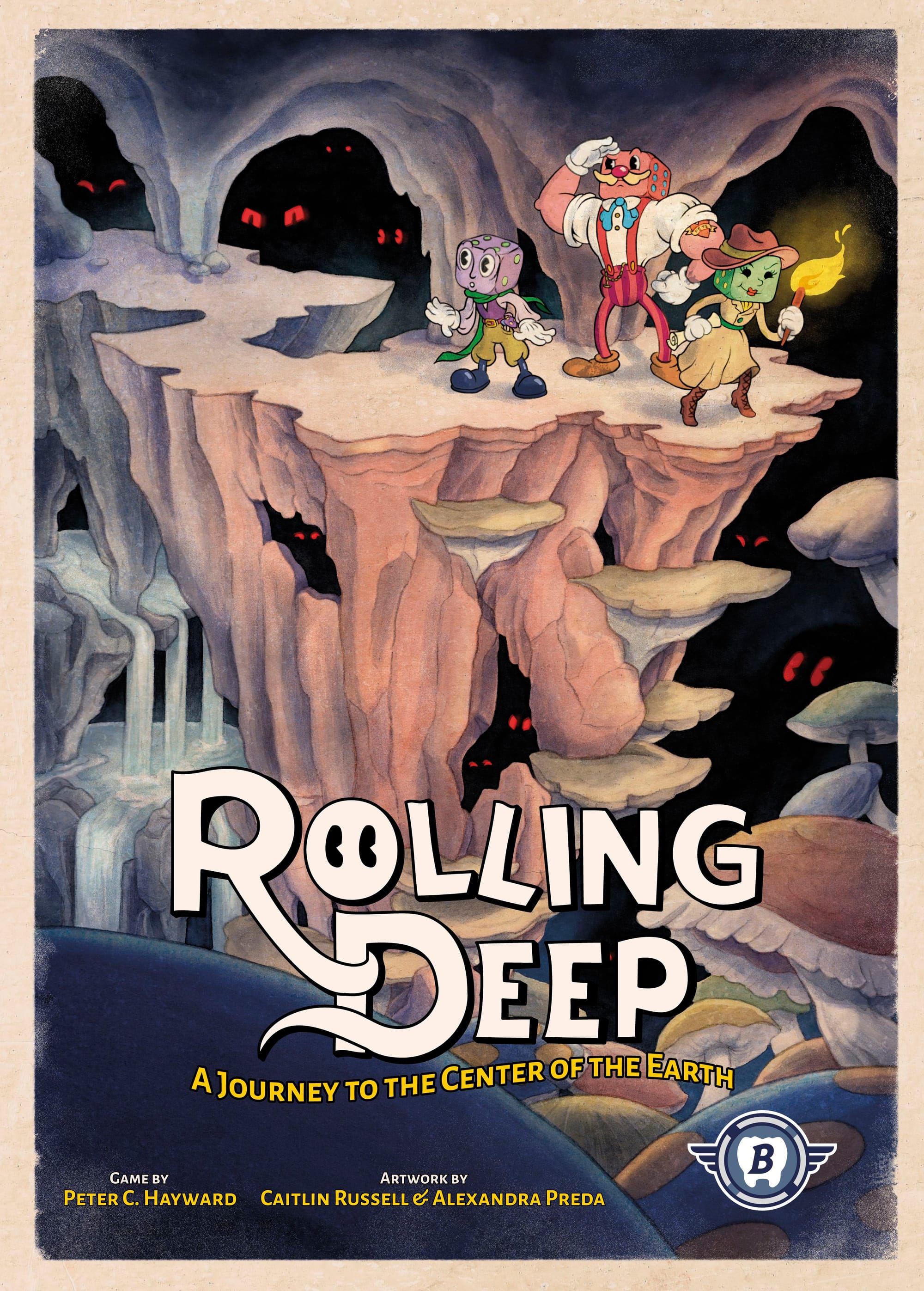
Rolling Deep ist ein reines Solospiel und ein Balatro-inspiriertes Würfel-Roguelike: Sie führen ein Trio von Würfelkopf-Abenteurern durch einen unruhigen Vulkan hinab zum Erdmittelpunkt. Auf Kickstarter hat der US-Verlag Bitewing Games sein Finanzierungsziel schon um rund das 25-Fache übertroffen. Hinter der Hype-Zahl steckt allerdings vor allem ein Dice-Building, bei dem Sie Ihre Würfel über viele Läufe Stück für Stück umbauen.
Eckdaten
Spielerzahl: 1 (reines Solospiel)
Spielzeit: 45 Minuten (Verlagsangabe)
Alter: ab 10 Jahren
Komplexität (BGG-Gewicht): 2,5 von 5
Designer: Peter C. Hayward
Illustration: Alexandra Preda, Caitlin Russell
Verlag: Bitewing Games
Erscheinung: 2027
Was Sie im Spiel tun
Jede Runde würfeln Sie mit den Würfeln Ihres Teams, die für dessen Aktionen beim Abstieg stehen. Sie entscheiden, wann Sie handeln, also einen Wurf werten, und wann Sie es auf einen neuen Versuch ankommen lassen. Mit Reroll Potions werfen Sie einzelne Würfel neu, bevor Sie sich festlegen. Werten Sie einen Wurf, bringt sein Wert Sie näher an die Zielpunktzahl der aktuellen Etappe. Zwei Ressourcen steuern Ihr Vorgehen: Zeit legt fest, wie viele Wertungen Ihnen pro Runde bleiben, Reroll Potions bestimmen, wie oft Sie Ihr Glück herausfordern dürfen. Das ist klassisches Push Your Luck, denn das Scheitern kennt nur eine Richtung: Verfehlen Sie in einer Runde die Zielpunktzahl, verlieren Sie sofort (Sudden Death). Dieses ständige Abwägen kennen Solo-Fans etwa aus Mini Rogue: The Council, einem weiteren Solo-Roguelike mit Push Your Luck.
Kapitel, Bosse, Shop
Der Abstieg gliedert sich in fünf Kapitel mit je drei Runden. Mit jedem Kapitel steigt die Schwierigkeit, und die letzte Runde eines Kapitels ist ein Boss, der die Regeln genau dieser Runde verändert. Solche Bossbegegnungen, die mitten im Lauf die Regeln umschreiben, kennt man auch von Solo-Titeln wie Jason and the Argonauts. Zwischen den Runden besuchen Sie den Shop. Dort geben Sie Münzen für zweierlei aus: für permanente Würfel-Upgrades, die einzelne Würfelseiten verändern, etwa indem sie neue Werte zeigen oder beim Werten Münzen und Reroll Potions erzeugen, sowie für Verbrauchs-Ausrüstung. Wer alle fünf Kapitel übersteht und den finalen Boss bezwingt, erreicht den Kern des Vulkans und gewinnt.
Dice-Building als Herzstück
Strategisch lebt Rolling Deep von eben diesem Umbau der eigenen Würfel. Über viele Läufe hinweg formen Sie aus Standardwürfeln eine Maschine, die Münzen, Neuwürfe und Punkte aufeinander abstimmt. Konkret tauschen Sie etwa eine schwache Würfelseite gegen eine, die beim Werten Münzen abwirft, und finanzieren damit im nächsten Shop das nächste Upgrade; oder Sie setzen auf Seiten, die Reroll Potions erzeugen, und spielen dadurch aggressiver auf hohe Würfe. Über Achievements schalten Sie nach Verlagsangabe Hunderte weiterer Karten frei. Die Tiefe eines einzelnen Laufs bleibt dabei überschaubar; der Wiederspielreiz entsteht laut Verlag vor allem aus diesem wachsenden Fundus an Karten und Herausforderungen. Genau diese Verzahnung aus Würfelwürfen, Risikoabwägung und langfristigem Aufbau ist die Anleihe bei der Videospiel-Vorlage Balatro.
Der Verlag
Bitewing Games wurde von den beiden Zahnärzten Nick Murray und Kyle Spackman gegründet; der Name spielt auf eine zahnmedizinische Röntgenaufnahme an. Der Verlag fiel zuvor mit Titeln wie Trailblazers und dem von Reiner Knizia gestalteten Zoo Vadis auf. Designer Peter C. Hayward hat sich zuvor vor allem mit kompakten, ideenreichen Spielen einen Namen gemacht. Rolling Deep ist der erste Titel der neuen Solo-Reihe Table for One.
Zwei Spiele in einer Kampagne
Die Kampagne bündelt zwei eigenständige Solospiele. Neben Rolling Deep steckt mit Eureka! ein zweites, laut Verlag Yahtzee-inspiriertes Würfelspiel in den Pledges, in dem Sie Edelsteine schürfen und Ihren Würfelvorrat verwalten. Für Rolling Deep selbst gibt es zudem die Erweiterung Rolling Deeper, die in den Premium-Pledges enthalten ist und laut Verlag vor allem zusätzliche Karten und Achievements ergänzt.
Pledges: Was bringt welche Stufe?
Wichtig vorab: Der mit 15 US-Dollar günstigste Eintrag ist ein reiner Händler-Pledge (Retailer) und kein Einstieg für normale Unterstützer. Für Backer beginnt es so:
Eureka! allein: ab 25 US-Dollar.
Rolling Deep als Basisspiel: ab 59 US-Dollar, inklusive des gratis Swip Swap Promo Packs und der Kickstarter-exklusiven Ultimate Achievement Box.
Standard-Bundle beider Spiele: 84 US-Dollar, also vor allem der Zugewinn eines kompletten zweiten Spiels.
Red Hot Edition: 129 US-Dollar. Spielerisch zählt hier die enthaltene Erweiterung Rolling Deeper; der Rest (Deluxe-Upgrade-Pack, Deluxe-Würfelturm, Metallfolien-Box) ist Komponenten-Aufwertung.
All-In 2-Game Deluxe Bundle: 149 US-Dollar, die Red Hot Edition plus Eureka! Diese Stufe wählten mit Abstand die meisten Unterstützer.
Die Zusatzinhalte trennen sich damit sauber: spielverändernd sind die Erweiterung Rolling Deeper, das Swip Swap Promo Pack und die über Achievements freigeschalteten Karten; rein kosmetisch sind die Deluxe-Komponenten und die Metallfolien-Box.
Finanzierung mit Augenmaß
Seit dem 23. Juni 2026 ist die Kampagne live. Stand 28. Juni 2026 stehen 375.586 US-Dollar von 3.104 Unterstützern zu Buche, rund 2.500 Prozent des mit 15.000 US-Dollar bewusst niedrig angesetzten Ziels. Mitgründer Nick Murray feierte den Auftakt als den nach eigener Aussage größten Launch-Tag in der Geschichte des Verlags. Laut Kampagne schaltete eine Vormerk-Marke von 8.000 Followern die Ultimate Achievement Box frei, die nun gratis und Kickstarter-exklusiv in allen Rolling-Deep-Pledges liegt. Die Kampagne läuft noch bis Mitte Juli 2026. Weitere laufende Kampagnen sammeln wir in unserer Crowdfunding-Wochenschau.
So beeindruckend die Zahlen sind: Eine hohe Finanzierungsquote belegt Nachfrage, nicht Qualität. Rolling Deep ist noch nicht erschienen, eine unabhängige Wertung steht aus.
Für Solo-Fans im DACH-Raum
Eine deutsche Ausgabe ist bislang nicht angekündigt; BGG führt allein eine englische Edition. Die Kampagne läuft auf Englisch, Bitewing versendet weltweit. Für Solo-Fans aus Deutschland, Österreich und der Schweiz heißt das: ausreichende Englischkenntnisse und internationalen Versand einplanen.
Ready for a confession? I didn’t love Balatro, the roguelike poker deck-building game from a couple years back. Don’t get me wrong, the number-go-up part of my brain adored Balatro. But the rest, the foam of consciousness so certain it’s in control of the mammalian beast, the me suspicious of anything hypnotic, found the whole process incredibly off-putting. Which, of course, is why I played it for (oh no) 76.9 hours, about which I cannot tell you a single anecdote. Which, incidentally, is also why I hate it.
Rolling Deep is the forthcoming solitaire board game by Peter C. Hayward. Given his explicit efforts to emulate Balatro, which he’s detailed at length in a series of design diaries, one might suppose that Rolling Deep is not my jam. The Anti-Dan, as it were. But having played it a handful of times, I’ve come away with the opposite impression. Yes, this is more or less Balatro: The Board Game. But it’s so much more than that.
It’s better than Balatro, for one thing.
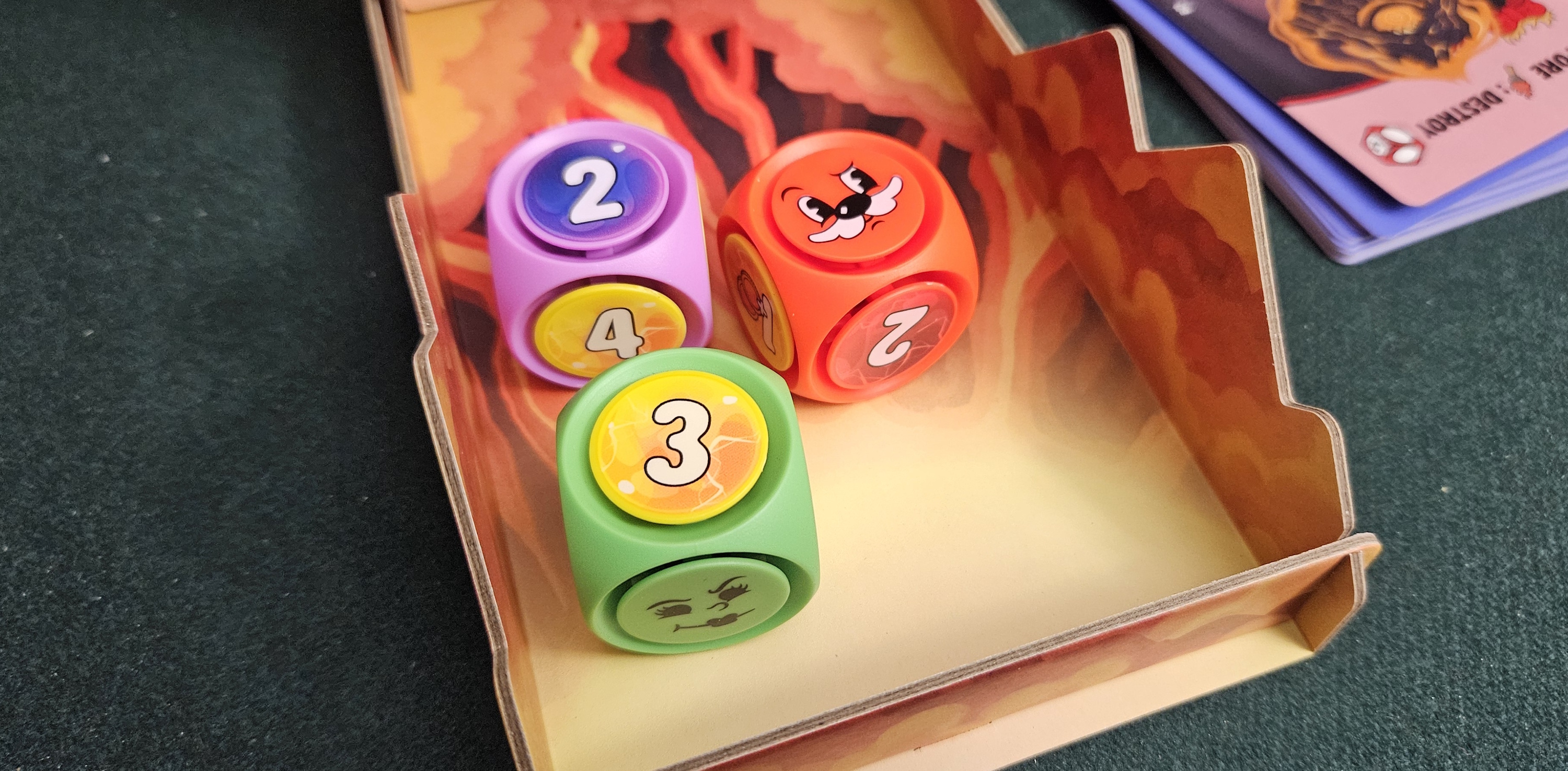
Gosh, I love being able to change a die’s faces.
What so many people in this medium call “theme” is a funny old thing. Rolling Deep is the sort of game with a “theme,” in the sense of being this discrete veil divorced from and layered atop the game’s mechanisms. What is that theme? It doesn’t matter. I mean, it matters in the sense that it provides some context for the game’s actions, looks pleasant with its Cuphead-esque homage to early Disney and Fleischer Studios animation, and justifies a portion of the game’s budget. But it simultaneously doesn’t matter to the story being told by the artwork or the proper nouns in the rulebook. At no point did I flip a card and say, “Oh no! An evil mushroom!” Instead, the story is wholly mechanistic. At the card’s turn, I would say, “Oh no! How am I going to deal with this new probabilistic conundrum?”
That might sound like a bad thing, especially given my usual emphasis on the stories that arise when we play games. But, to be clear, this is a story. It just doesn’t happen to be a story about how three dice-headed adventurers reached the center of the Earth.
Instead, Rolling Deep is the story of how I transformed three meager dice into powerhouses that rolled seventy-nine in a single go. This moment was a triumph of careful resource management, broken combo-building, sly damage mitigation, and no small amount of luck. It was exciting, tangible, and, in the game’s sharpest departure from its inspiration, memorable.
Each boss sets the tone for the round.
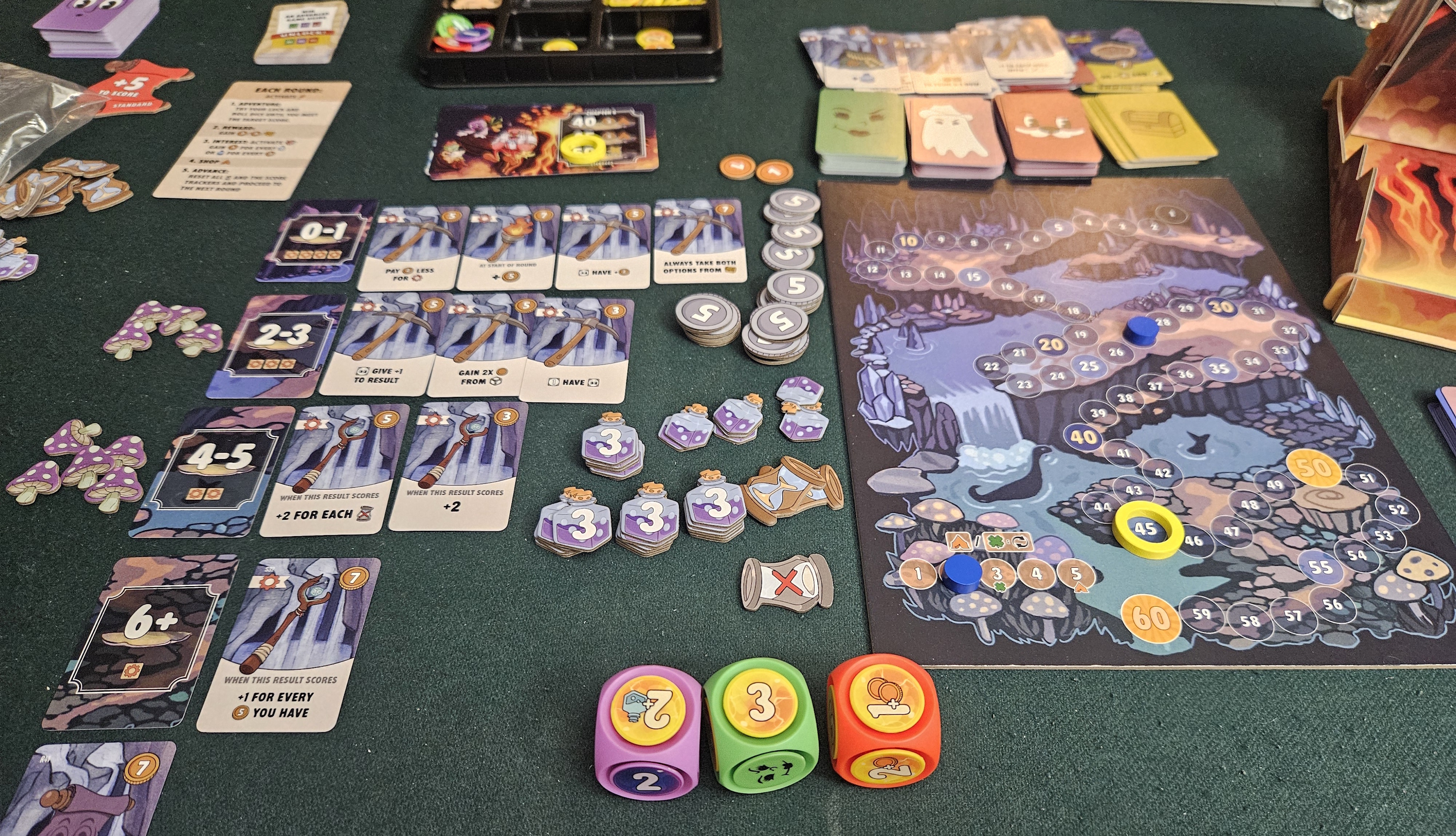
Every round in Rolling Deep goes like this. You’re facing a challenge that happens to be a number. Say, twenty-three. Last round, the number was lower. Twenty. Next round, it will be higher. Twenty-seven. Steadily it climbs, round by round, increasing the pressure at a steady pace, like a numerical hyperbaric chamber.
You have three rolls, all summed together, to meet that number.
But there’s a problem. At the game’s outset, reaching those later targets is impossible. These dice, you see, have rather low digits. At best, you can roll a 2. More likely, you’ll roll a 1 or even a 0, albeit perhaps a 1 or 0 that also grants you a coin or a reroll potion. Over three rolls, that means you can maybe hit a target of eighteen. And that’s with some pretty extreme luck.
Fortunately, there are two solutions to this problem.
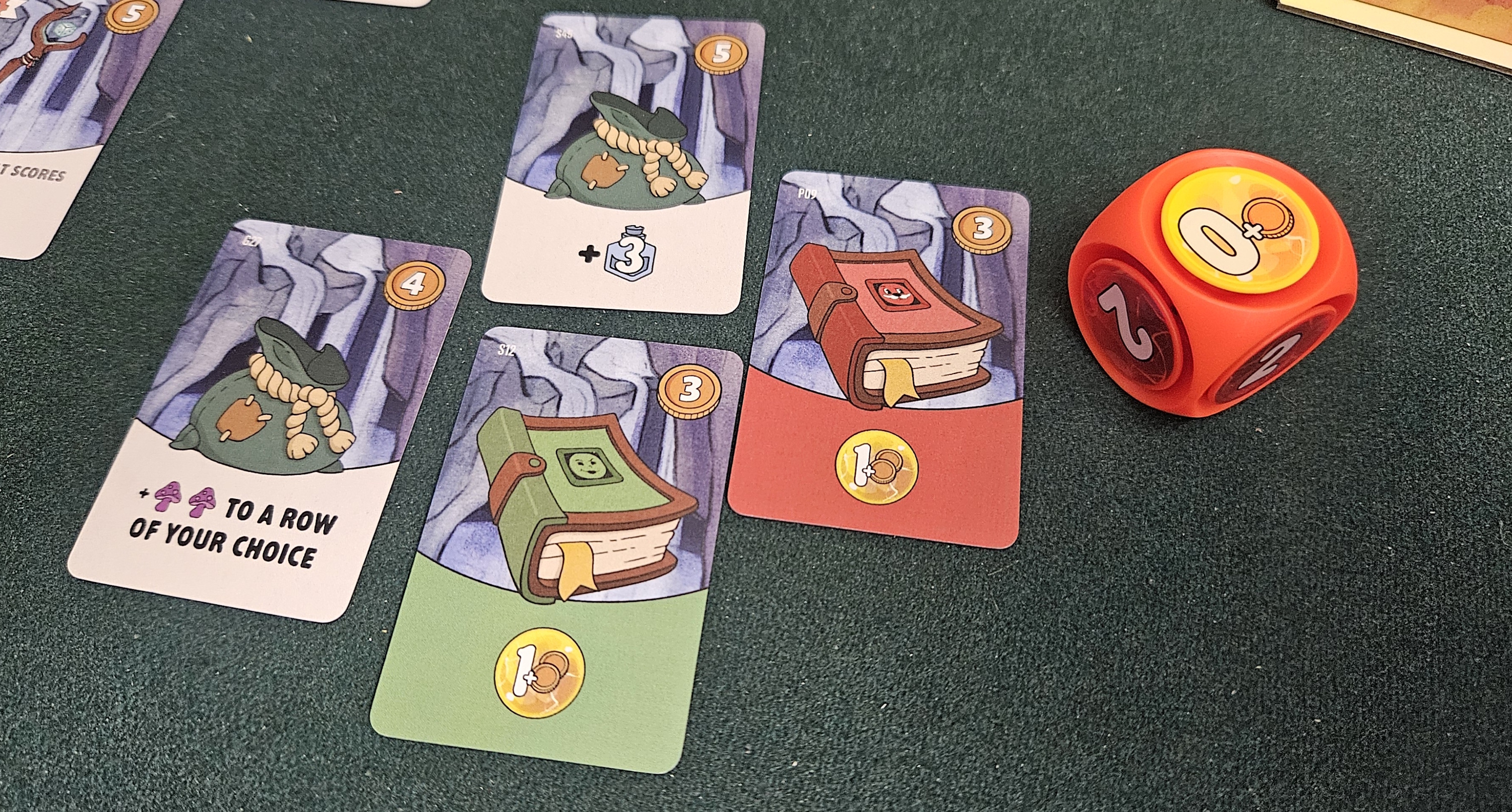
First, the faces of your dice have custom faces that can be swapped out. Picture the dice from Tom Lehmann’s Dice Realms, but way easier to handle, without the weird LEGO-breaker tool for prying faces away from the frame. Here everything clicks into and out of place with a breezy snap. Out with the 0, in with a 2 plus a potion. Click. Sayonara 1 with a pity coin, hello whopping 5. Click. Oops, now you’re rolling too high — yes, that might be a thing — so let’s turn that 5 into a 3 with a coin. Click.
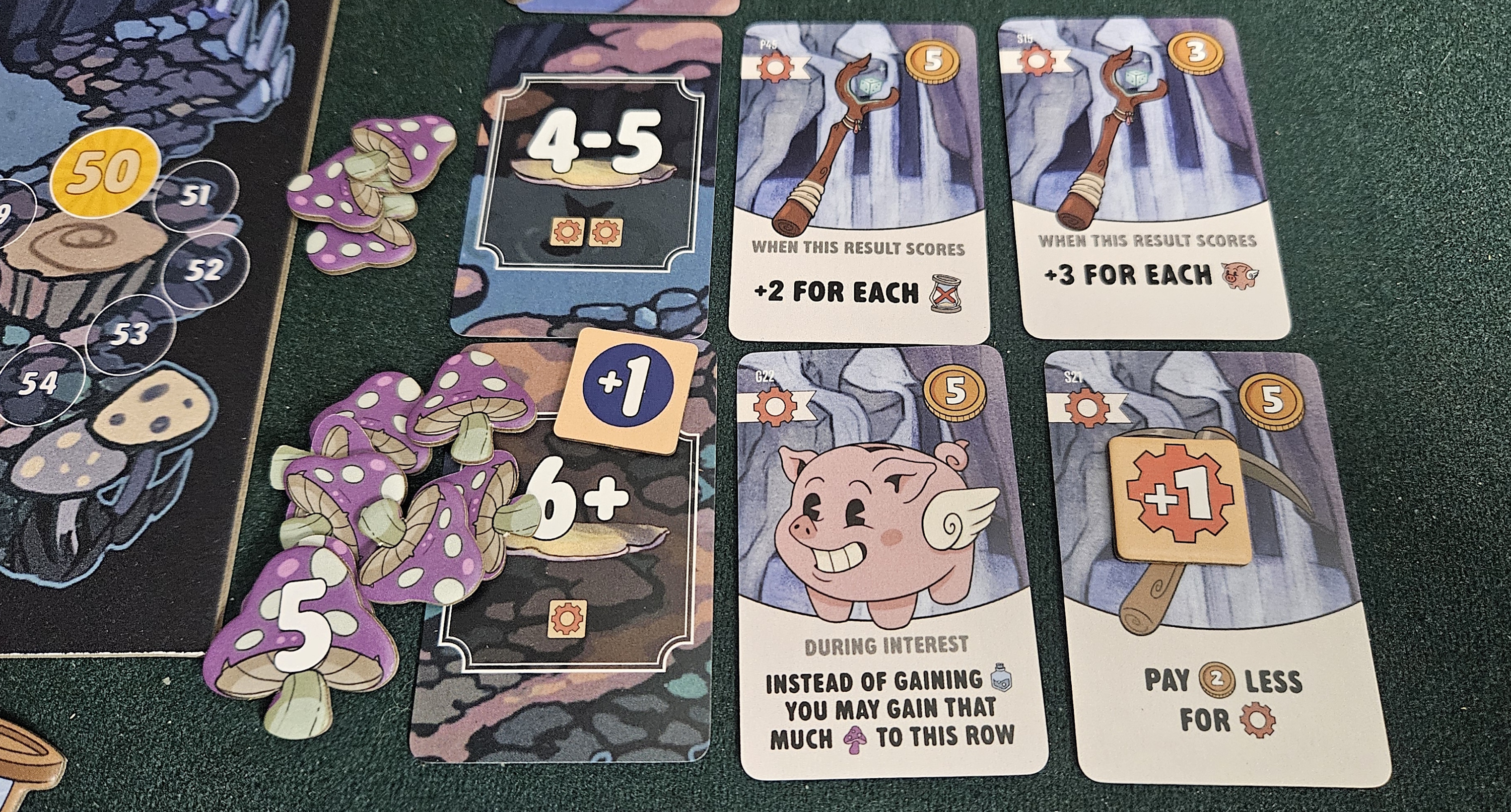
Second, the way you purchase these new faces also offers a way to improve your performance by other means. By a lot of means. You could purchase an upgrade that gives a permanent +2 to every roll. That’s the easy stuff. You might also earn a wand that only triggers with a natural roll of 4-5, and awards +3 for every piggy bank ability. Now you have a synergy going. That wand, plus as many piggy banks you can afford from the market.
Little by little, your cards produce an engine. (Hopefully.)
Thus the game’s irresistible tempo. You roll, perhaps spend potions or use your upgrades to massage the numbers, and add that total to your sum. If you reach the target number after three tries, you gain a prize, earn interest on any leftover cash and potions, reveal and purchase upgrades from the market, and then do it all over again with a higher target number.
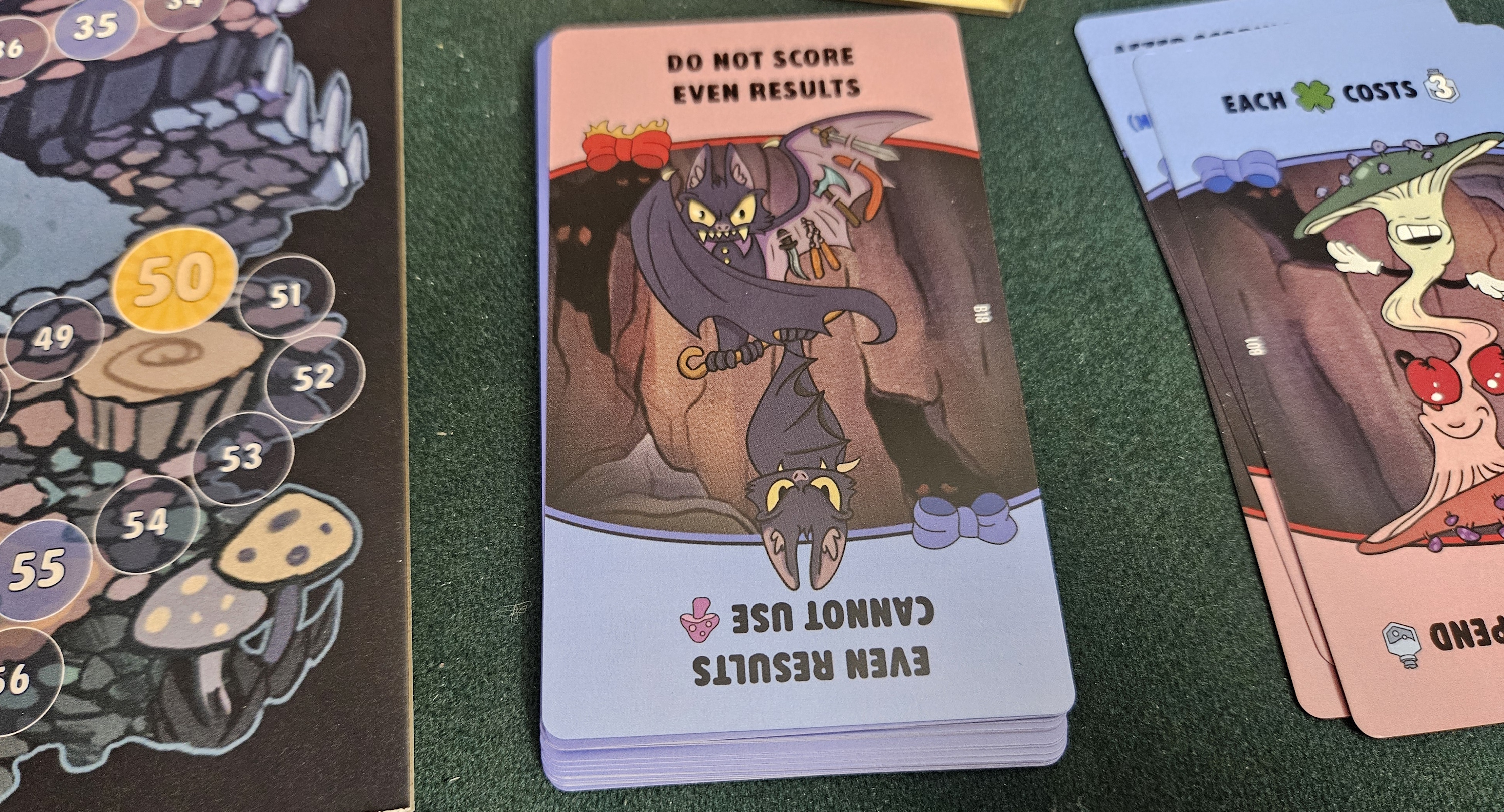
Every third round, you face a boss with an obnoxious special ability. Like, for example, a cartoon bat who prevents you from scoring results that are even. Or a cartoon mushroom that makes it harder to spend potions for crucial rerolls. Or a different cartoon mushroom that destroys some of your upgrades. Nasty stuff, but nasty stuff you see coming for a couple rounds before it hits you. Nasty stuff you can prepare for.
If this sounds like Balatro — well, look, Hayward isn’t concealing Rolling Deep’s influences. The dice faces are your poker deck. The upgrades are jesters. The mushrooms that boost your sum before withering are… I guess multipliers? There aren’t actual multipliers in Rolling Deep, probably because the game’s numerical targets increase linearly rather than exponentially. The possibility of expanding how many upgrades you can hold are akin to Balatro’s spectral cards. It’s all familiar. It even has achievements and unlocks. Beat the game on easy mode, you earn access to tougher delves. Break the game in one way, you gain tools that are a little weirder than the starting kit. I won’t spoil the wilder unlocks, but they’re in there for the sickos.
But if this is all so familiar, why do I say it’s better than Balatro? I knew you’d ask.
Buying new options at the market.
For one thing, the medium itself demands a very different sort of attention from a digital game. Where Balatro hypnotizes, Rolling Deep focuses. Sure, I suppose I could zone out. But as soon as I’m asked to shift my tally along the target track, flip some upgrade cards, or shift resource tokens from one place to another, my feet are given purchase on solid ground again. If that doesn’t do it, sure as shooting the alteration of a die face will. Click.
This breeds an entirely different headspace. At no point did I awaken from a three-hour binge. Instead, the processes — the ones that are concealed behind the dazzling lights of Balatro — are entirely my responsibility. I must count the numbers or nothing happens. I must pay attention to my bonuses lest I lose them. There’s no option to glaze over and make number go up. Every upgrade must be considered, weighed against my tableau’s current strengths and gaps, and ultimately purchased or discarded. Very quickly, the physical actions that are automated in a video game become loci of concentration and even pleasure. It helps that Hayward has developed this game until it’s smooth as cream. But the remaining points of friction, some of them inherent to the medium, give me purchase in the real world.
And that extends to the gameplay itself. Because Rolling Deep is more grounded in the real, its challenges are presented as tangible, applied things, rather than wholly abstract. It’s the difference between being told some measurements and shown them against the wall or along the motor’s belt. When I assess my odds, I physically heft one of those chunky plastic dice and turn it around in my fingers. When determining where to slot an upgrade, I slot the card into a physical representation of where my rolls have aggregated. The medium becomes the gameplay and vice versa.
It helps, too, that Rolling Deep’s limited format gives it a more intimate edge. It never disappears into n-space, its numbers beyond intuitive human comprehension. My dumb animal brain grasps the gap between 23 and 41 better than that of 23,749,011 out of 41,000,000, even though they’re fundamentally similar. By scrapping the sky-high escalations of Balatro, Hayward turns Rolling Deep into a puzzle that doesn’t slide off the brain like so much oil.
For such a wild game, Rolling Deep never spirals into too much complexity.
And it is memorable. I mean that. Not as much as a story, not as much as something with characters or relatable confrontations. But thinking back on my sessions with Rolling Deep, I can remember specific problems and the solutions I forged to face them. I could never tell you what had happened in any given session of Balatro even a few minutes after it ended. Something about a banana? Getting a shiny joker? Opening a few card packs?
Rolling Deep is excellent. It’s a very particular kind of excellent, to be sure, a mathematical solitaire game that’s long on odds and probabilities and sums rather than story beats. But within that window, it not only matches the ambition of its inspirations, but exceeds them. Balatro who? This is Rolling Deep, baby.
A prototype copy of Rolling Deep was temporarily provided by the publisher.
(If what I’m doing at Space-Biff! is valuable to you in some way, please consider dropping by my Patreon campaign or Ko-fi. Right now, supporters can read the next installment in my series Talking About Games, this time tackling the topic of what makes a good list! Naturally, the piece includes a list.)

 Anmelden