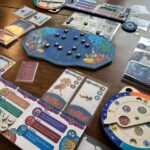
Crowdfunded eurogames from smaller board game publishers had a banner year at the latest Dice Tower Awards, accounting for half of the wins at the high-profile prize ceremony.
The biggest success of the night was Kinson Key Games’ Galactic Cruise, which was crowned game of the year in addition to picking up gongs for best strategy game and best game from a new designer.
Galactic Cruise, designed by TK King, Dennis Northcott and Koltin Thompson
Fellow indie publisher Paverson Games was also a standout winner in this year’s Dice Tower Awards, with its classical music-inspired title Luthier picking up awards for best theme, best production and best game from a small publisher.
Other crowdfunded titles honoured by the awards were mid-weight euro Critter Kitchen for best artwork thanks to the work of Sandara Tang, and 20 Strong: Tanglewoods Red for best solo game – the latter the only one which raised money through Gamefound rather than Kickstarter.
The string of crowdfunded successes is significant given the notable shifts which have taken place on Kickstarter and Gamefound in recent years, with a rise in larger publishers using the sites, and more campaigns focused around big-budget releases, miniatures heavy projects, deluxified components and major licensed IP.
CMYK scored a second success in this year’s awards with Hot Streak, which won best party game, while Stonemaier Games took the most innovative game prize with Vantage and Tag Team won best 2-player game.
Presented annually during Gen Con, the Dice Tower Awards are among the board game hobby’s highest-profile jury-voted honours, given the winning titles gain exposure with the veteran reviews giant’s more than 360,000 YouTube subscribers.
Winners are selected from the previous year’s games by a panel of more than 60 Dice Tower contributors, reviewers and content creators. The awards celebrates its 20th anniversary next year.
Word association party game JinxO has been crowned the winner of this year’s hugely influential Spiel des Jahres award, on a night which also saw legendary game designer Reiner Knizia make history with his Kennerspiel award win.
Indonesia-based Ang’s victory underscored the growing internationality of the venerable German award, which until last year’s triumph by Hisashi Hayashi’s Bomb Busters had never been won by an Asian designer.
The 2026 ceremony also delivered a historic first for veteran designer Reiner Knizia, whose tile-laying title Rebirth claimed the higher complexity Kennerspiel des Jahres prize.
JinxO designer Martin Ang with his Spiel des Jahres award || Photo Credit: Spiel des Jahres
That win made Knizia the first designer in history to complete the full set of Spiel des Jahres, Kinderspiel des Jahres and Kennerspiel des Jahres wins, having previously picked up awards for Keltis and the children-focused Whoowasit? in 2008.
Morty Sorty Magic Shop designer Markus Slawitscheck narrowly missed matching that feat this year after finishing runner up to JinxO, following his 2023 Kennerspiel victory with Challengers! and 2024 Kinderspiel win for Magic Keys.
The children-focused Kinderspiel award this year was won by Florian Sirieix’s Mooki Island, ahead of his co-design with Benoit Turpin, Boo Party, and Verflixt Verzaubert, a localisation of Thomas Dagenais-Lespérance’s Mimose & Sam et le Voleur de Fruits.
Winning the Spiel des Jahres can transform the fortunes of games, designers and publishers alike, with Pegasus Spiele co-founder Karsten Esser previously telling BoardGameWire the award can increase sales by 10 to 20 times in the months following the ceremony, thanks to huge exposure in Germany’s mainstream retail market ahead of Christmas.
Receiving his trophy at the ceremony in Berlin, Ang thanked Swiss publisher Game Factory “for really believing in Dito! [the German-language localisation of JinxO] and in us”.
JinxO || Photo Credit: Tabletoys Games
He dedicated the victory to supporters across Asia, adding: “Thank you also to all the friends and publishers from Asia, especially from southeast Asia… finally we made it, and this is all for you also.”
Speaking separately during the ceremony, Ang said the game’s origins lay in Indonesia’s enthusiasm for social games.
“We made a party game because in Indonesia people really love to play party games,” he said. “It’s really famous in Indonesia right now and a lot of people like it, even the gamers also like it.”
Spiel des Jahres Association chairman Harald Schrapers said Ang’s success reflected the awards’ increasingly international reach.
He said, “We have had nominees from Japan and New Zealand in past years, but we always had a blind spot on the world map. We have never had a nominated author from the global south here on stage, and we are very proud of our Indonesian game author.
“Maybe there will also be a game from Africa or South America in the future. That is the great thing about playing – we play the same games here in Germany as they play in Indonesia.”
That geographic expansion has not been similarly reflected in the gender of nominated designers, however, with non-male designers once again heavily underrepresented.
The Spiel des Jahres jury looked at a record 571 games for this year’s awards – but just 2.3% of those games were from women designers, with male creators making up 94% of the cohort, and the rest being designed by mixed teams.
That figure has barely moved in recent years, having stood at 2% in 2025 and 2.6% in 2024 – an ongoing lack of diversity highlighted in great detail in this excellent feature by Wargamer’s Mollie Russell earlier this year.
The 440 titles reviewed across the Spiel and Kennerspiel categories was up 14% on last year, while the 92 games considered for the Kinderspiel marked a roughly 50% rise compared to the 61 from 2025. Another 39 titles were considered by judges across both the Spiel and Kinderspiel awards.
Number of games reviewed in recent Spiel des Jahres years – red is Spiel and Kennerspiel, blue is Kinderspiel, and purple is games which span both segments
JinxO’s victory marked a milestone for Zurich-based publisher Game Factory, which claimed its first Spiel des Jahres 18 years after being founded.
Game Factory previously won the Kinderspiel category with Magic Keys in 2024, and was also shortlisted for this year’s Kinderspiel through Verflixt Verzaubert.
The publisher had picked up a nominated for the Kennerspiel last year with viking-themed resource gathering game Looot.
Accepting the award, Knizia – dressed in a kilt and tartans to reflect the Scottish map in Rebirth – paid tribute to his wife Margaret, whom he described as “the love of my life” and thanked for “giving me the space to fill my life with games”, before highlighting the importance of playtesters in modern game development.
Rebirth designer Reiner Knizia || Photo Credit: Spiel des Jahres
“Developing games, you cannot do alone,” he said. “You can’t develop games without playing them. No matter how much experience you have, you have to play, play, play.”
He added that his Munich testing group had made “a very significant contribution” to the game, saying playtesters should not be underestimated because “without them nothing is possible”.
Knizia also praised Rebirth’s graphic designers, who he said made a major contribution to designing the game – “it is about haptics, it is about the visuals” – and the game’s original, Malta-based publisher Mighty Boards.
He said, “We are not publishers, we create one handmade prototype, and then we need somebody who puts this into practice very professionally and who makes the game even better.
“And now you will ask me, ‘why do you then pick a publisher on Malta? What can they sell on Malta?’ Well, today things are different, today we have many localisation partners across the world – that said, it doesn’t really matter where the original publishing house is located.”
Knizia closed his long speech by urging players not to overlook the other nominees.
“In the end, it doesn’t matter who wins, because we carry the message about good games out to the people,” he said.
“There has to be one on top, but the top is amongst equals… Buy the other games, play them and honour the authors and all the contributors as much as the winners.”
The 2025 Spiel des Jahres Awards longlists:
Spiel des Jahres
WINNER: JinxO – designed by Martin Ang (Published by Game Factory / Tabletoys Games)
Recommended Hot Streak by Jon Perry (Strohmann Games / CMYK) Meister Makatsu by Reiner Knizia (Amigo) Take Time by Alexi Piovesan and Julien Prothière (Libellud) Toriki by Wojciech Grajkowski (Mirakulus / Lucky Duck Games) Toy Battle by Paolo Mori and Alessandro Zucchini (Repos Production) Wilmot’s Warehouse by David King, Ricky Haggett and Richard Hogg (CMYK)
Kennerspiel des Jahres
WINNER: Rebirth – Reiner Knizia (Frosted Games / Mighty Boards)
Nominated: Boss Fighters QR – Michael Palm and Lukas Zach (Pegasus Spiele) Nominated: Moon Colony Bloodbath – Donald X Vaccarino (Alea / Rio Grande Games)
Recommended Artengarten (Sanctuary) by Mathias Wigge (Feuerland / Capstone Games) Frosted Blooms by Bruno Cathala and Ludovic Maublanc (Elznir Games / Synapses Games) Grundstein von Metropolis (Foundations of Metropolis) by Emerson Matsuuchi (Kobold Spieleverlag / Arcane Wonders) Tag Team by Gricha German and Corentin Lebrat (Kosmos / Scorpion Masqué)
Kinderspiel des Jahres
WINNER: Mooki Island – Florian Sirieix (Kosmos / Scorpion Masqué)
Nominated: BOO PARTY -Florian Sirieix and Benoit Turpin (Loki) Nominated: Verflixt verzaubert – Thomas Dagenais-Lespérance (Game Factory / Locomuse)
Recommended Kleiner Stinker (Little Stinker) by Elan Lee, Ken Gruhl and Quentin Weir (Kitten Games) Magische Spiegel (Half-and-Seek) by Kseniya Kuznetsova (Ravensburger / Red Cat Games) Paleolino by Marco Teubner and Peter Rustemeyer (Hans im Glück)
Berlin / Bayreuth, 12. Juli 2026 – Die Würfel sind gefallen: Das strategische Legespiel Rebirth von Star-Autor Dr. Reiner Knizia wurde von der Jury „Spiel des Jahres“ mit dem begehrten Titel Kennerspiel des Jahres 2026 ausgezeichnet. Bei der feierlichen Verleihung im Berliner nhow-Hotel setzte sich das Brettspiel des Bayreuther Verlags am Abend gegen starke Konkurrenz durch. Für die Verlage Frosted Games und dem maltesischen Orginalverlag Mighty Boards markiert dieser Gewinn einen historischen Meilenstein ihrer Zusammenarbeit. Frosted Games schafft als erster Spieleverlag den Gewinn in zwei aufeinander folgenden Jahren! Autor Dr. Reiner Knizia hat damit zudem als erster Autor überhaupt die Auszeichnung in allen drei Kategorien Kennerspiel, Kinderspiel und Spiel des Jahres gewonnen.
Ein Meilenstein für das moderne Brettspiel
Im eleganten Legespiel Rebirth von Dr. Reiner Knizia bauen die Spielenden in einem fiktiven Schottland der Zukunft nachhaltige und zukunftssichere Technologien der Energie- und Nahrungsgewinnung auf geschichtsträchtigen Ruinen. Die Illustrationen von Anna Przybylska und Vesna Redesiuk zeichnen dabei ein farbenfrohes Bild des fiktiven Nordens Großbritanniens und Irlands im Wiederaufbau und das in moderner Solarpunk Optik. Das Spiel für 2-4 Spieler:innen hat eine Spielzeit von 30-60 Minuten und besticht durch Zugänglichkeit, schnelle Spielzüge und hohe Interaktion, ohne dass dabei strategisches Planen oder die Spieltiefe auf der Strecke bleibt.
Stimmen zur Auszeichnung
Geschäftsführer Benjamin Schönheiter zum Back-to-back-Sieg:
„Mir fehlen die Worte, dass wir tatsächlich zweimal nacheinander ausgezeichnet wurden, etwas das seit 30 Jahren niemandem und beim Kennerspiel des Jahres noch nie einem Verlag gelungen ist! Ich fühle mich absolut sprachlos, dass uns diese Ehre zuteil wird, und was das für das ganze Team bedeutet, so ausgezeichnet worden zu sein. Es ist vor allem die beste Motivation für die Zukunft und ein riesiger Ansporn, unseren Weg, mit Herzblut, Liebe und absoluter Hingabe Spiele umzusetzen, konsequent weiterzugehen.“ sagt Benjamin Schönheiter, Verlagsleiter von Frosted Games
Auch Spieleautor Dr. Reiner Knizia als frisch gebackener Triple Gewinner der Jury Spiel-des-Jahres ist überglücklich:
„Das ist so ein wunderbarer Erfolg und das mit ganz wunderbaren Verlagen, Frosted Games und Mighty Boards, als ausgezeichnete Partner. Das es nun das Triple geworden ist, freut mich persönlich natürlich sehr und bedeutet mir auch tatsächlich viel.“ so Dr. Reiner Knizia auf der Preisverleihung, bei der zudem den Wert des Brettspielens und aller Spiele und ihrer Autoren hervorhob.
Die abermalige Nominierung und Auszeichnung als Gewinner beim Kennerspiel des Jahres unterstreicht die Bedeutung der redaktionellen Arbeit von Frosted Games und die von Rebirth als das herausragende Spiel des Kennerspiel-Jahrgangs 2025/2026. Im Vorjahr hatte Frosted Games bereits mit dem Titel Endeavor: Die Tiefsee den Preis für das Kennerspiel des Jahres 2025 damals noch gemeinschaftlich mit Partner Boardgamecircus erringen können.
Durch die Erfahrung aus dem Vorjahr ist man bei Frosted Games zudem bestens auf die Zusammenarbeit mit dem nun zusätzlich einsetzenden Handelsgeschäft vorbereitet. Neben den zuletzt intern ausgebauten Ressourcen wie der Einstellung des neuen Verkaufsleiters Dennis Oettershagen zeigt man sich in Bayreuth gerüstet. Und durch die enge Vertriebspartnerschaft mit asmodee Deutschland wird zudem eine sehr gute Verfügbarkeit für alle Handelspartner gesichert sein.
Editor’s note: GAMA is one of the sponsors of the BoardGameWire newsletter
The Origins Awards, one of tabletop gaming’s longest-running prizes voted on by industry professionals, has crowned its latest group of winners after whittling them down from 120 nominees.
Jon Perry’s Hot Streak continues to live up to its name as far as award wins go, adding party game of the year to a pair of Golden Geek Award wins, casual game of the year in the American Tabletop Awards, and a ‘recommended’ accolade in the Spiel des Jahres.
Railroad Tiles, designed by Hjalmar Hach and Lorenzo Silva, took Gateway Game of the Year, while Will Thompson’s Winter Rabbit was named Light Strategy Game of the Year at the award ceremony, which took place at Origins Game Fair last month.
Railroad Tiles, designed by Hjalmar Hach and Lorenzo Silva
The awards also recognised Matt Brown and Zara Reid’s conservation-themed board game Kavango with a Sustainability Award, which aim to celebrate games with thoughtful production and publishers which “have taken strides towards sustainable manufacturing to reduce the impact on the natural environment”.
Outside the board game categories, James Parks and Ben Costa’s Land of Eem won Roleplaying Game of the Year, while in the trading card and collectible game categories Riftbound: Proving Grounds won Fixed Constructible Game of the Year, while the Gudnak: Expansion Bundle took the Randomized Constructible Game award.
Goblin Hobbies’ Stampin’ Plates claimed the Paint/Hobby Accessory award, while Luis Silva’s TCG design Shard Bugs claimed Fan Favorite Game of the Year, voted on by Origins attendees.
GAMA made an effort to rectify that error with its announcement of the award winners, including not only the names of the designers but also the artists who worked on each title.
The Origins awards, which were first presented in 1975, have been in heavy flux over the past few years, going from 10 categories in 2019 to 24 in 2024 – with the make-up of those categories significantly shaken up from year to year.
GAMA briefly introduced categories in 2024 which represented its membership having expanded beyond just retailers, publishers and wholesalers – including recognition for artists, writers and media.
But those segments were quickly dropped again in 2025, with categories cut including Best Media Production, Best Game Related Writing and Best 2D Artwork – although the miniatures segment was expanded from two categories to three, covering games, the miniatures themselves, and paint and accessories.
Separate from the main slate of awards, the trade organisation also revealed its hall of fame entrants this year, awarded – like the Origins Awards – by its division the Academy of Adventure Gaming Arts and Design.
AAGAD describes itself as “a peer based network of gaming industry professionals whose mission is to promote innovation and excellence in design and production of games and game related materials”.
Individuals inducted into the hall of fame this year include Richard Borg, famous for his design of the Command and Colors system used by games including Memoir ’44, and Antoine Bauza, the creator of designs including 7 Wonders, Hanabi and Tokaido.
Magic: The Gathering, Pathfinder RPG and Dungeons & Dragons artist Wayne Reynolds was also inducted into the hall of fame.
Origins Awards 2026 – Full Results
Gateway Game of the Year Railroad Tiles Publisher: Horrible Guild Designers: Hjalmar Hach and Lorenzo Silva Artists: Francesco De Benedittis and Barla Tranquilli
Party Game of the Year Hot Streak Publisher: CMYK Designer: Jon Perry Artist: Cécile Gariépy
Light Strategy Game of the Year Winter Rabbit Publisher: Absurdist Productions Designer: Will Thompson Artists: Kindra Swafford and Jonni Ketcher
Heavy Strategy Game of the Year Speakeasy Publisher: Eagle-Gryphon Games Designer: Vital Lacerda Artist: Ian O’Toole
Cooperative/Solo Game of the Year The Lord of the Rings: Fate of the Fellowship Publisher: Z-Man Games Designer: Matt Leacock Artists: Jared Blando and Cory Godbey
Roleplaying Game of the Year Land of Eem Publisher: Exalted Funeral Designed & Written by: James Parks and Ben Costa Artists: Justin Gerard, Sean Kiernan, Anneliese Mak, Sam Mamei, Rosario Mendez and Rob Gatto
Roleplaying Game Supplement of the Year Call of Cthulhu: The Sutra of Pale Leaves – Twin Suns Rising Publisher: Chaosium Designers/Authors: Yukihiro Terada, Jason Sheets, Damon Lang, and Andrew Logan Montgomery
Miniatures Game of the Year Blood Bowl Third Season Edition Publisher: Games Workshop
Miniature of the Year Warhammer: Age of Sigmar – Festus, The Leech Lord Publisher: Games Workshop
Paint/Hobby Accessory of the Year Goblin Hobbies Stampin’ Plates Producer: Goblin Hobbies Designed by: Brent Amberger and Casey Alden
Fixed Constructible Game of the Year Riftbound: Proving Grounds Publisher: UVS Games & Riot Games Designers: David Smith and Jon Moormann
Randomized Constructible Game of the Year Gudnak: Expansion Bundle Publisher: Chaotic Great Games Designer: Tim O’Brien and Ian Oliver Artist: Vittoria Pompolani
Fan Favorite Game of the Year Shard Bugs Publisher: Shard Bugs LLC Designer: Luis Silva Artists: Ray of Sand, Nelygibi, Julio E. Jácome Paz, María Ayuso, Alma Faustica, Pietro Desirò, Ninamarie, Steve Ozminkowski, Erick Mezart
Alexi Piovesan and Julien Prothière’s design fought off competition from Florian Maas’ citybuilding game Project Skyline and Hjalmar Hach and Lorenzo Silva’s Railroad Ink sequel Railroad Tiles to take the 2026 Spiel der Spiele award.
Take Time publisher Libellud previously won the Austrian game prize’s family game award for Dixit in 2010, while the title’s co-designer Julien Prothière won the family game category with Featherweight Fiesta in 2024, and the ‘friends game of the year’ award with March of the Crabs the same year.
The Austrian Game Academy, which runs the Spiel der Spiele award each year, picked out Jon Perry’s Hot Streak as the winner of its ‘friends game of the year’ prize this year, while the expert game award went to Saltfjord, designed by Kristian Amundsen Østby and Eilif Svensson.
Hot Streak has been on a run of award wins this year, with the chaotic mascot racing game having picked up best party game and light game of the year in BoardGameGeek’s Golden Geek Awards, casual game of the year in the American Tabletop Awards, and a ‘recommended’ accolade in the Spiel des Jahres.
Boss Fighters QR, by Michael Palm and Lukas Zach, was named ‘trend’ game of the year for its innovative use of QR codes in-game, while the 2026 best kids game prize went to Emanuele Briano’s Beast Selfie.
Austria’s Spiel der Spiele has been handed out since 2001, when it was won by Catan designer Klaus Teuber’s colonisation game Entdecker: Exploring New Horizons – a reworking of his 1996 design Entdecker.
Tabletop gaming’s most eclectic prize, the Diana Jones Award, has unveiled the latest clutch of finalists for its annual celebration of excellence in the field of gaming.
Price Johnson, the new CEO of Gloomhaven publisher Cephalofair, is among the five finalists for this year’s award, as are miniatures game Trench Crusade and Minnesota-based game retailer Mischief Toy Store.
TTRPG designer and journalist Rob Wieland
They are joined by Jo Kelly and Cole Wehrle’s board game Molly House, which explores the joy and fear experienced by gender-defying Londoners in 18th century society, and Rob Wieland, a much-loved TTRPG designer and journalist who died last October aged 47.
Price Johnson’s nomination comes less than two months after the long-time Cephalofair COO was promoted to CEO at the publisher – with Isaac Childres, the company founder and designer of its runaway successes Gloomhaven and Frosthaven, stepping back to focus exclusively on game design at the company.
Johnson has been a high-profile voice in campaigning against tariffs imposed by US President Donald Trump over the last year, aiming to highlight the heavy financial burden it has placed on tabletop game publishers – many of which rely on Chinese manufacturing for their titles.
The Diana Jones nominations committee praised that work, saying Johnson’s appearance on multiple national news outlets, “consistently and clearly explained how the tariffs posed an existential danger to many companies in the adventure gaming industry”.
Mischief Toy Store in the Twin Cities was also selected for its involvement in a lawsuit against the US tariffs last year, as well as its work battling activity from anti-immigration ICE agents.
The committee said that hours after criticizing ICE in a TV interview the store was targeted with a surprise audit, but resisted turning over their employee records to DHS.
It added, “They have been printing ICE OUT posters to distribute as fast as they can and have organized a network of 3D printing hobbyists to distribute thousands of ICE whistles.
“Amid the chaos in Minnesota, they had to suspend online ordering, and their website directed folks to support local immigrant rights organizations instead. They work hard to make space at the gaming table for everyone.”
Trench Crusade, which focuses on an alternate 1914 in which humans have been battling the forces of hell for 800 years, was picked out by the committee as “a triumph of community and creativity”.
The Factory Fortress-published title was built around initial sketches and lore created by artist Mike Franchina, who later teamed up with sculptor James Sherriff and game designer Tuomas Pirinen to design the game.
Diana Jones’ nominations committee described Rob Wieland as “a relentless advocate and promoter for the entire tabletop gaming community for years”.
It said, “He served as a mentor to countless others, and he brought the industry to wider and greater awareness through his work with Forbes and other publications.
“In addition, he regularly hosted on-stage sessions of The Extraordinary Adventures of Baron Munchausen at conventions to raise money for charity.”
The 2026 Diana Jones Award ceremony will be held in Indianapolis on July 29 at its annual gathering of tabletop games industry professionals, marking the unofficial kick-off of Gen Con.
The original Diana Jones Award trophy, which was lost in the post several years ago
The award aims to celebrates “everything that’s the best about gaming”, with previous winners across the award’s 26-year run having included Blood Rage designer Eric Lang, Nigerian games industry publisher and evangelist NIBCARD, and the entire ‘actual play’ movement of people livestreaming and podcasting roleplaying games.
Last year’s award resulted in a tie between Daybreak, the climate change-themed board game designed by Matt Leacock and Matteo Menapace, and Rose Estes, an early TSR employee who went on to write the Endless Quest series of choose-your-own-adventure game books.
The original Diana Jones award trophy was a clear lucite pyramid containing the burned remains of an Indiana Jones roleplaying game from the 1980s – one element of which spelled ‘Diana Jones’ after the preceding letters were burned away.
That trophy was lost in the post six years ago during the traditional handover from one winner to another, never to be recovered – but a replacement trophy has now been created by the organisation.
The Diana Jones Award also runs a separate emerging designer programme prize, which aims to help up-and-coming creators via a $6,500 prize package that includes an all-expenses trip to Gen Con.
The Diana Jones Award committee has picked a trio of TTRPG creators as the latest winners of its emerging designer program, who will each receive a $6,500 prize package that includes an all-expenses trip to Gen Con.
Glaiza Champion
Glaiza Champion, J Strautman and Kodi Gonzaga will also receive one-year memberships to trade bodies GAMA and the Tabletop Game Designers Association through the award, as well as prizes including prototyping credit at The Game Crafter, an online badge to Protospiel and a game demo spot on Gen Con TV.
The emerging designer program, now in its sixth year, seeks to amplify the voices of up-and-coming tabletop creators, with a particular focus on designers from marginalized communities.
Filipino-American designer Glaiza Champion describes themself as a ‘third-culture’ kid whose experiences span Brunei, Cambodia, the Philippines and Korea.
Champion is a game designer, writer, performer, podcaster and variety streamer, whose work is rooted in tabletop roleplaying games and storytelling – with designs to date including Beef, Missing Month and Meet Your GelCub.
J Strautman
Toronto-based RPG designer J Strautman, who also works under the name Yes No Goodbye, combines game design with a career as a professional musician.
Strautman has released the GM-less zine-sized RPGs Contact and Insatiable Cravings, and in 2025 co-released A Fool’s Errand through Planet Arcana Games.
Alongside their design work, Strautman tours internationally as a professional bass player, and co-hosted, and scored and edited the tarot-infused science fantasy actual play podcast Planet Arcana.
Los Angeles-based designer Kodi Gonzaga began designing games in 2018, and has since created a growing catalogue of tabletop RPGs including Extra Ordinary, Misfits & Mayhem SRD, Down the Road Through the End of the World, Voxinn: A Firebrands Hack and In This Echoing World.
Kodi Gonzaga
Gonzaga is also a creative writer, actual play performer, Big Bad Con POC Scholar and former IGDN convention coordinator.
Other finalists in this year’s competition included Wyrmspan and Apiary designer Connie Vogelmann, Cretaceous Rails designer Ann Journey, and Elijah Djan – the co-creator of FinMaster, a game designed to help teach families about investing and enable positive discussions about money.
Also making the list of finalists this year was board game designer Gene Koo, who works to promote tabletop game designers based in the Washington DC metropolitan area.
Speaking to BoardGameWire after being selected last year, Leiman said the award had enabled her to attend Gen Con at a time when financial pressures and industry uncertainty would otherwise have made the trip impossible.
“Gen Con is an incredibly important convention for freelance designers to get their work noticed and signed,” Leiman said. “This amazing opportunity for underrepresented and underprivileged folks represents a great step in equalizing this dream of a creative field for all.”
The Diana Jones emerging designer award program was launched in 2021, with Jeeyon Shim picking up the inaugural award.
That award is presented to the person, product, company, event, movement, concept or any other thing that has, in the opinion of its committee, best demonstrated the quality of “excellence” in the world of hobby-gaming in the previous year – and is traditionally hugely wide-ranging in its choice of candidates.
Previous winners across the award’s 22-year run have included Blood Rage designer Eric Lang, Nigerian games industry publisher and evangelist NIBCARD, and the entire ‘actual play’ movement of people livestreaming and podcasting roleplaying games.
Last year’s Excellence in Gaming award was deemed a tie between author Rose Estes and the climate action-themed board game Daybreak, designed by Matt Leacock and Matteo Menapace.
Astrolabe, a Persian folklore-inspired game which tasks players with hunting and binding demons using the titular instrument, has won this year’s Cardboard Edison Award celebrating unpublished board game designs.
The debut design from Iranian video game veteran Yasaman Farazan was praised by judges for its “genius” action selection system, which makes use of a physical ‘astrolabe’, calling it “thematic, toyetic, and an absolute joy to engage with”.
2026 Cardboard Edison Award winner Yasaman Farazan
Farazan’s design took first place out of a record 396 entries this year – a total which has almost quadrupled since Cardboard Edison unveiled its debut award winners a decade ago.
Part of that growth has been down to the competition’s pedigree of winners that have gone on to be published by well-known studios.
They include Winter, published by Devir, Castell from Renegade Game Studios and Umbra Via from Pandasaurus Games, as well as 2023 champion Diatoms, which followed a successful Kickstarter campaign with retail publication by 25th Century Games in partnership with Ludoliminal.
Second place in this year’s competition was Limelight, a push-your-luck deckbuilder by Cameron Fleming about staging a Broadway show, while third place went to Luke Wolyncewicz’s Braggin’ Wranglers, which sees players attempting to catch wooden animal meeples using an adjustable lasso.
Hatchlings, a game by Alan Leduc in which players try to get baby sea turtles to the ocean using “unique and clever” movement queue mechanism, placed fourth.
Braggin’ Wranglers, designed by Luke Wolyncewicz
This year’s 20 finalists also included a magnet-based vertical castle-building game and a medium-weight strategy title centred around wedding planning.
The game, designed by former Ravensburger game development intern Sammy Salkind, puts players in the shoes of startup founders battling to build their internet startups during the dot-com bubble of the late 1990s.
Cardboard Edison was launched in 2012 as a board game design studio and hub, which has since expanded from a well-read industry blog into a vast repository of information for board game designers.
Suzanne Zinsli created the Cardboard Edison Award a decade ago with the help of fellow Cardboard Edison founder Chris Zinsli.
All of the finalists from this year, and the pitch videos of their designs, can be viewed below this article.
Winner: Astrolabe by Yasaman Farazan 2-5 players 45-90 minutes Players are exorcists in a Persian folklore world, using astrolabes to read the stars, hunt demons, and bind them into artifacts. Each round, players secretly rotate their astrolabe to choose an action, a number, and a time of day, then reveal and resolve actions in ascending order. Pitch video
2nd Place:Limelight by Cameron Fleming 3-6 players 45 minutes Limelight is a push-your-luck deckbuilder about staging a Broadway show. Over three Acts, you’ll audition talent, hire crew, and rehearse your show, trying to achieve the perfect mix of cards on Opening Night. Pitch video
3rd Place: Braggin’ Wranglers by Luke Wolyncewicz 2-8 players 15 minutes Braggin’ Wranglers sees players catching animals to score points using a unique adjustable lasso—but there’s a twist! Turn order is decided by your lasso size, which you secretly set at the start of each round! Pitch video
4th Place:Hatchlings by Alan Leduc 2-5 players 30 minutes You’re a Nature Spirit with one job. Get your baby sea turtles out of their comfortable nest, across the beach, and into the water where they belong, thus earning praise from Mother Nature. It would be easy if it weren’t for the relentless bully Steven Seagull and the other Spirits competing for glory. Pitch video
Other finalists:
Black Ruth of Dogtown by Keith DeViere Donaldson 1-4 players 30 minutes Black Ruth of Dogtown is a procedural oracle system driven by a circular mancala drafting mechanism, where players construct a three-by-three grid to optimize set collection and speculative scoring in service of a final narrative divination resolution. Pitch video
Catacombes de Paris by Nicholas Henning 2-5 players 70-110 minutes In Catacombes de Paris, players take on the solemn duty of transporting the remains of millions through the bustling streets of 18th-century Paris to build their personal ossuary in the famed Catacombs. This highly thematic experience combines a strategic pick-up-and-deliver system with an engaging polyomino mini-game for building out your ossuary board. Pitch video
Deductive Seasoning by Eric Ledger 2-5 players 20-40 minutes Deductive Seasoning is a family-friendly deduction card game where you are a food scientist who has concocted a dish using a secret ingredient from the Periodic Table of Flavor. You must figure out other players’ secret ingredient through careful play and observation. Pitch video
Goa Kranti by Andy Desa 2-4 players 60-90 minutes A cooperative game about an overlooked chapter in history: Goa’s struggle for independence from Portugal (1932-1961). Players embody historical freedom fighters choosing between violent resistance and peaceful satyagraha. Core mechanisms include push-your-luck resource gathering, deck improvement, and bag-building for a pivotal mid-game check when India gains independence. Pitch video
Hybrid Hijinks by Jena Keesee 3-5 players 60 minutes A competitive game, creating hybrid creatures and utilizing variable, configurable player powers to impress visitors and earn the most approval for shifting prowess. Pitch vide
Ladybugs by Michael Posada 1-4 players 30 minutes Push your luck by rolling dice that represent a colony of ladybugs flying over a field of flowers. Your rolls determine which flowers you add to your garden, which scoring conditions you unlock, and how many points you earn. Pitch video
Match Patch by Jack Rosen 3-5 players 20 minutes Match Patch is a game about the benefits of farming using companion planting methods. Mechanically, it is a card-matching race game where players try to diversify their harvested crops. Pitch video
Midnight Spawn by Jayson Farrell 1-4 players 60 minutes Midnight Spawn is a game about the mysterious and incredible deep sea. In this game you’re a researcher in your deep-submergence vehicle, or DSV. You’ll discover strange creatures and observe them eat or move other creatures, manipulating the shared board. You can also upgrade your DSV with tech cards or boost your score with research cards. Pitch video
Moonforge by Pawel Owsianka 1-4 players 90 minutes In Moonforge, players command large space facilities capable of capturing asteroids, extracting valuable resources (energy, metal and minerals), and upgrading their operations with new modules and functions. Resources can be sold for currency points, while depleted asteroids contribute material toward the creation of a new moon. Pitch video
PiramiDuel by Guillermo Viciano 2 players 20-30 minutes A game for two players where you will explore Ancient Egypt, fighting to claim the most influential pyramids. Pitch video
Possessions by Dan Nichols 2-4 players 60-90 minutes Possessions is a competitive strategy game where you play as ghosts with one hour to finish your unfinished business and fulfill your final wishes. As the clock ticks down, strive to get the most value from your secret ambitions by possessing your family’s last living heirs. Pitch video
StrongHolds by Nelson de Castro 2 players 40-60 minutes StrongHolds is a competitive castle-building game featuring magnetic tiles that allow players to build vertically unlike any other game. Harness your creativity and vision as a Medieval Architect, while sabotaging your opponent by tossing and sliding siege tiles to topple their progress. Pitch video
The Leftovers by Larry Ted McBride 2-4 players 25 minutes The Leftovers is a cooperative trick-taking game of community deck-building, resource management, strategy, and story. With your party of magical foodfolk, you will work together to complete objectives and avoid vicious food fiends as you explore the abandoned halls of the Enchanted Ladle. Pitch video
The Roots of All Evil by Dean Burry 2-4 players 15-20 minutes Be the first animal cultist to summon the tree demon Blackthorn by creating ever-expanding rings of root cards in which to place your sacred offerings. Pitch video
The Wedding Planner by Jose Lema 2-4 players 60-90 minutes You just got engaged! Now you have 12 months to plan the wedding of your dreams. The Wedding Planner is a medium-weight strategy game that captures the authentic pressure of the process: an overwhelming workload, finite resources, and the constant tension between vision and reality. Pitch video
Wunderkammer by Rosco Schock 2-4 players 45 minutes Wunderkammer is a set collection style game with a unique simultaneous silent auction acquisition mechanism. Each curiosity that you collect also has two attributes so the scoring of your collection is scored in each dimension. Pitch video
Board game designers Reiner Knizia and Markus Slawitscheck both have a shot of completing an unprecedented series of wins at this year’s Spiel des Jahres – widely considered the highest profile awards in board gaming – after the 2026 nominations were unveiled earlier today.
The pair have already won two of the awards’ three categories in prior years – and the nominations of Slawitscheck’s Morty Sorty Magic Shop for the main prize, and Knizia’s Rebirth for the higher complexity Kennerspiel, could see either or both become the first designers in the awards’ 47-year history to complete the set.
Morty Sorty Magic Shop is up against Corey Konieczka’s Cozy Stickerville and Martin Ang’s Dito! – the German version of Jinxo – for this year’s Spiel des Jahres, while Rebirth is contending with Michael Palm and Lukas Zach design Boss Fighters QR and Donald X Vaccarino’s Moon Colony Bloodbath for the Kennerspiel.
Spiel des Jahres Association chairman Harald Schrapers said in a nominations livestream today that the jury looked at a record 571 games for this year’s awards, underscoring the sheer mass of games being released through retail.
The 440 titles reviewed across the Spiel and Kennerspiel categories was up 14% on last year, while the 92 games considered for the Kinderspiel marked a roughly 50% rise compared to the 61 from 2025. Another 39 titles were considered by judges across both the Spiel and Kinderspiel awards.
Number of games reviewed in recent Spiel des Jahres years – red is Spiel and Kennerspiel, blue is Kinderspiel, and purple is games which span both segments
Despite those record numbers, Schrapers pointed out that just 2.3% of the games were from women designers, with male creators making up 94% of the cohort, and the rest being designed by mixed teams.
That figure has barely moved in recent years, having stood at 2% in 2025 and 2.6% in 2024 – an ongoing lack of diversity highlighted in great detail in this excellent feature by Wargamer’s Mollie Russell earlier this week.
Schrapers also emphasised that this year’s judging process had been a particularly frustrating one, with glaring flaws being present in even the standout designs.
He said, “It was a lot of fun, but there were also real shortcoming in many games.
“There are deficiencies in some games every year, of course – there are so many, not all of them are really good. Many are good, but as I said, not all of them.
But this time we noticed, especially with the outstanding games, i.e. the 10% best – I would say there were various games where there were various quite serious flaws. There were so many that I even wrote them down.”
He presented a list which included incomplete, ambiguous, and contradictory rules of the game, a lack of summaries, blatantly incorrect age information on boxes, and components which fail to function well in poor light or after a handful of games.
Schrapers said in a separate blog post about the process, “Despite these shortcomings, some titles made it onto the jury’s shortlist because the flaws were not so significant in relation to the outstanding gameplay.
“However, there were probably more than one work that failed to secure a majority in the jury vote due to such a deficiency.”
Spiel des Jahres deputy chairman Christoph Schlewinski, left, and chairman Harald Schrapers, right, with this year’s Spiel des Jahres nominees
The livestream also drew attention to the nomination of Boss Fighters QR, and the long-listed design Toriki: The Castaway Island, as notable for requiring an app in order to play.
When asked by Spiel des Jahres deputy chairman Christoph Schlewinski whether that signified a growing trend within the hobby, Schrapers said, “No, I don’t think that’s a trend.
“They are two games that work very well with an app… the thing is that the app supports the analogue feeling in such a game. That’s why it’s an addition.”
He added, “I’m really sure that even in ten years, 90% or even more of all board games will work without a digital integration, because that’s exactly what people like.
“But an app also draws new people into this game. We notice it especially with young people that they often find this very , very good, it creates additional tension – and you can see that such a board game can also open up new audience groups.”
Hisashi Hayashi’s co-operative bomb disposal game Bomb Busters won last year’s Spiel des Jahres, beating the much-fancied push-your-luck card game Flip 7 to the high-profile award.
That victory meant the Spiel des Jahres has now been won by a co-operative game design in five out of the past seven years, following successes for Just One in 2019, MicroMacro: Crime City in 2021, Dorfromantik: The Board Game in 2023 and Sky Team last year.
Cozy Stickerville is the only nominee for the main prize this year which is a cooperative title.
Last year’s Kennerspiel des Jahres was won by Endeavor: Deep Sea – which also features a prominent co-op mode as a way to play the game – while the winner of the 2025 Kinderspiel was Wolfgang Warsch’s Topp die Torte.
Winning the Spiel des Jahres can explode sales by hundreds of thousands of copies for the winner – and by thousands of copies for the nominees.
While publishers tend to keep tight-lipped about actual sales figures, Pegasus Spiel co-founder Karsten Esser told BoardGameWire in a 2023 interview that winning the main prize can boost a game’s sales by 10x to 20x in the months following, due to a slew of exposure across mainstream German shopping outlets in the run-up to Christmas.
That kind of boost can be hugely impactful for publishers and designers alike – and is particularly important to smaller publishers in the fight to stand out amid an increasingly competitive industry which sees thousands of releases each year.
The winners of this year’s Spiel des Jahres awards are set to be announced on July 12.
Tomáš Holek’s space exploration eurogame SETI has surged past 100,000 copies sold, following a triumphant 2025 in which it cleaned up across a string of major board game awards.
SETI publisher Czech Games Edition told BoardGameWire it had ordered bigger than usual, more frequent print runs than it initially planned for the Spiel 2024 release, after the title picked up early widespread praise from reviewers and impressed visitors at gaming conventions across last year.
That swell of interest translated to a rash of awards, including heavy game of the year and best thematic game in the Golden Geeks – voted on by BoardGameGeek users – and a trio of wins at last year’s Dice Tower Awards, where it was named game of the year and best strategy game, while designer Tomáš Holek was named best new designer.
SETI designer Tomáš Holek
CGE said, “We knew the game was good. But the reality has definitely exceeded our expectations.”
It added that the speed at which SETI became popular was comparable to its 2020 release and fellow multi-award winner Lost Ruins of Arnak, with SETI’s sales numbers “much higher than for our other recent heavy game releases” such as the well-received Kutná Hora and Deal With the Devil.
Asked whether the high-profile awards success across 2025 was a big contributor to SETI’s sales performance, a CGE spokesperson said, “This is very hard to evaluate, especially with the number of awards SETI has won.
“There probably wasn’t a noticeable bump thanks to a particular award, but they definitely help bring more eyes to the game. Awards like Golden Geek or The Dice Tower Awards help guide the community to what games are worth checking out, and that leads to increased sales.
SETI’s rapid success is striking following a year which has seen many publishers pivoting to smaller box titles over more heavyweight designs, as a response to economic factors such as US tariff volatility, as well as gamers having less money to spend due to inflation and general cost of living struggles.
CGE told BoardGameWire the colossal success of its 2015 release Codenames had been critical in putting the Prague-headquartered publisher in a financial position where it can take a chance on heavy titles like SETI from previously unpublished designers.
Titles from the relaunched version of Codenames, which was unveiled in 2025
Codenames had sold more than 16 million copies as of May last year, has been translated into more than 45 languages, and has just undergone a relaunch with new art, packaging, a re-tuned word selection and simplified rulebook, with CGE looking to keep the evergreen title flying off shop shelves.
The CGE spokesperson said, “We can now experiment more than in the past. However, we’ve also made quite smart decisions overall and chose really strong titles recently (Arnak, SETI) – and we’ve built a really strong position on the market throughout the years.”
They continued, “SETI’s success is a combination of theme, art, and game design. When we showed the game at UK Games Expo, people geeked out seeing various projects.
“That’s where a good part of SETI’s success lies – the inspiration in real science and space exploration. It’s hard to find a chunky space-themed game that would be more grounded in reality, while also being visually stunning.
“The beautiful art is not only on the box, but also on the board, cards, and other components. On top of that, the innovative spinning board always manages to draw attention.”
They added that they believed the game “scratched an itch” for fans of successful games like Terraforming Mars, providing a heavy strategy title with gameplay that “can be explained in a digestible manner, making the game quite accessible”.
They added, “Players also often think about how they’ll approach it differently when they play again. Because of this, SETI gets to the table more often than some heavier titles. Players feel like there are truly more ways to explore the galaxy.
“When the game is played more often, it reaches more people, and it gets organic lift through discussions on forums, groups, etc. This also leads to more favorable reviews and posts on BGG, where SETI has quickly climbed the charts over the last year.”
CGE’s 2026 release slate revealed to date includes Drillers, from first-time designer Roman Bednář and Project L co-creator Adam Španěl, as well as a Critical Role-themed co-op reworking of Codenames and several Codenames expansion packs, focused on themes such as sci-fi, fairy tales and ‘cute critters’.
Arcs, the hybrid trick-taking wargame from Root and Oath designer Cole Wehrle, has won game of the year in the ioGioco Awards, which were created in 2021 to celebrate Italian-language board games and their designers.
This year’s award for best aesthetic and production quality went to Michele Morosini’s The Breach, published by Ludus Magnus Studio, while best two-player game went to Paolo Mori and Alessandro Zucchini’s design Toy Battle.
Nominees are picked by the editorial staff at Italian tabletop gaming magazine ioGioco from all of the titles published in Italy in the previous year, with the winners decided by public vote via the magazine’s website.
The Breach, from designer Michele Morosini and Ludus Magnus Studios
ioGioco said the tabletop gaming sector continues to prove “particularly vibrant”, with the market in Italy seeing a 27% rise in value last year compared to 2024 according to data from research company Circana.
Trading card games were a huge driver of that figure, the research shows, with sales of tabletop games outside of that category growing 3% year-on-year. More than new 800 titles were released in the country last year, ioGioco added.
Last year’s ioGioco game of the year award was won by fantasy deckbuilding and strategy game Black Rose Wars: Rebirth, which was designed by Andrea Colletti, Diego Fonseca and Marco Montanaro.
ioGioco Awards 2025 – full results
BOARD GAME
Winner: Arcs, designed by Cole Wehrle – published in Italy by MS Edizioni Ants, Renato Ciervo, Andrea Robbiani Bomb Busters, Hisashi Hayashi The Lord of the Rings: Fate of the Fellowship, Matt Leacock Star Wars – Battle of Hoth, Richard Borg, Adrien Martinot
GAME DESIGNER
Winner: Paolo Mori Gregory Grard Hisashi Hayashi Reiner Knizia Matt Leacock
LIGHT & FAMILY GAME
Winner: The Lord of the Rings: The Fellowship of the Ring – Trick-Taking Game, Bryan Bornmueller – Asmodee Italia Bomb Busters, Hisashi Hayashi Castle Combo, Grégory Grard, Mathieu Roussel Cities, Steve Finn, Phil Walker-Harding Flip 7, Eric Olsen
WARGAME
Winner: Memoir’ 44 (New Edition), Richard Borg – Asmodee Italia Battlefields of the Napoleonic Wars, Paolo Mori, Alessandro Zucchini Pocket Air War: Definitive Edition, Carlo Amaddeo An Impossible War: The First Carlist War in the North, 1834-1838, David Gómez Relloso Wunderwaffen, Walter Obert)
CHILDREN’S GAME
Winner: Splendor Kids, Marc André, Catherine André – Asmodee Italia Jurassic Valley, Davide Panizza My Puzzle Adventure: Ochre Land, Antonin Boccara, Romaric Galonnier, Fabrice Lamouille, Mathilde Malburet Redwoods, Gary Kim, Yohan Goh, Hope S Hwang Opération Noisettes, Emilie Soleil, Jérôme Soleil
AESTHETIC AND PRODUCTION QUALITY
Winner: The Breach, Michele Morosini – Ludus Magnus Studio Cyclades: Legendary Edition, Bruno Cathala, Ludovic Maublanc Galactic Cruise, TK King, Dennis Northcott, Koltin Thompson Koi, Rosaria Battiato, Massimo Borzì, Martino Chiacchiera Runar, Diego Fonseca)
AESTHETIC AND PRODUCTION QUALITY – ROLE-PLAYING GAME
Winner: Mörk Borg, Pelle Nilsson, J Yamil – Need Games Daggerheart Elder Mythos, Laura Fontanella, Marta Palvarini Magus et Oraculum – New Edition, Momatoes, Oscar Biffi Pilgrims of the Murk Dome, Pelle Nilsson, J Yamil
SOLITAIRE GAME
Winner: Gloomhaven: Buttons & Bugs, Joe Klipfel, Nikki Valens – Asmodee Italia Final Girl Season 2, Evan Derrick, AJ Porfirio Hispania, Miguel Marqués Too Many Bones, Josh J Carlson, Adam Carlson Voidfall, Nigel Buckle, Dávid Turczi
TWO-PLAYER GAME
Winner: Toy Battle, Paolo Mori, Alessandro Zucchini – Asmodee Italia Duel for Cardia, Faouzi Boughida, Mathieu Rivero Agent Avenue, Christian Kudahl, Laura Kudahl Memoir’ 44 – New Edition, Richard Borg Zenith, Grégory Grard, Mathieu Roussel
BOARD GAME EXPANSION
Winner: The White Castle – Matcha, Sheila Santos, Israel Cendrero – Devir Dune: Imperium – Bloodlines, Phil Amylon, Andy Clautice, Paul Dennen, Caleb Vance Food Chain Magnate: The Ketchup Mechanism & Other Ideas, Jeroen Doumen, Joris Wiersinga Talisman: Nemesis – Call of the Hunt, Craig Van Ness Twilight Imperium: Fourth Edition – Thunder’s Edge, Dane Beltrami, James Kniffen
ROLE-PLAYING GAME
Winner: Daggerheart – Acheron Games DIE: The Roleplaying Game, Kieron Gillen Marvel Multiverse Roleplaying Game, Matt Forbeck, Marty Forbeck Triangle Agency, Caleb Zane Huett, Sean Ireland Wilderfeast, Federico Corbetta Caci, KC Shi
ROLE-PLAYING GAME SUPPLEMENT
Winner: The One Ring: Realms of the Three Rings, Michele Garbuggio, Marco Maggi, Francesco Nepitello, Gabriele Quaglia – Need Games Dolmenwood Campaign Book Dungeons & Dragons 5.5e: Dungeon Master’s Guide Outgunned Adventure, Simone Formicola, Riccardo Sirignano Tal’Dorei Reborn, James JHaeck, Matthew Mercer, Hannah Rose
GAMEBOOK
Winner: Un altro passo nella neve, Manuele Giuliano – Ingenioso Hidalgo 15 Mondi da Cana, Stefano Tartarotti Chi è stato? 1 – La Casa degli Automi, Michele Buonanno Fiabe Oscure 2 – Aurora, Valentina Ceciliato The Freedom Finders – Beak Your Chains, Emily Conolan
The American arm of high IQ society Mensa has unveiled the latest crop of board games winning its Mensa Select seal, which are voted on by hundreds of organisation members during an annual four-day gaming marathon.
Alex Cutler and Peter C Hayward both saw two of their creations win the seal this year, including their co-design Critter Kitchen, Hayward’s Things in Rings and Cutler’s A Place for All My Books – which he co-created with Michael Mihealsick.
Things in Rings publisher Allplay also saw its title Twinkle Twinkle, designed by Ammon Anderson, pick up a Select seal, while other winners this year included Matthew O’Malley and Ben Rosset’s Fromage, Yoann Levet’s Got Five and Tomáš Holek design Galileo Galilei.
Entries to the annual Mensa Mind Games are judged on aesthetics, instructions, originality, play appeal and play value, Mensa says, with the award aiming to highlight games that are original in concept, challenging and well-designed.
Not all games released during the past year are eligible for the award, however – entries carry a fee of several hundred dollars each, and games up for consideration need to have an average play time of 90 minutes or less.
Barnes & Noble and other major retailers have previously given special consideration to games bearing the Mensa Select seal, while winning games are also featured by American Mensa’s official online retailers and on its website.
Fromage is the most decorated of this year’s seal winners, having previously won the Origins Award for best light strategy game, as well as picking up nominations for medium game of the year, most innovative game and best artwork in the 2024 Golden Geek Awards.
Fromage, designed by Matthew O’Malley and Ben Rosset
Things in Rings was previously nominated in both the Golden Geeks and Origins Awards in the best party game category.
Co-op fantasy adventuring game Arydia: The Paths We Dare Tread has scored six nominations in the 20th annual Golden Geek Awards, which are selected and voted on by BoardGameGeek users.
Cody Miller’s “green legacy” design, which can be fully reset after each dozens-of-hours-long campaign, is up for heavy game of the year, most innovative game and best thematic game, as well as for the best artwork, solo game and co-op game categories.
Fellow open-world exploration game Vantage, designed by Scythe and Viticulture creator Jamey Stegmaier, is challenging across five categories this year, as is Pandemic creator Matt Leacock’s spin-off design The Lord of the Rings: Fate of the Fellowship.
Both those titles will battle it out for the Medium Game of the Year prize, which is also being contested by popular releases including Galactic Cruise, Eternal Decks and fellow Stonemaier Games title Finspan.
Eternal Decks, a limited communication co-op game designed by Hiroken, has picked up four nominations
The Golden Geeks is one of board gaming’s highest profile awards, as well as being among the earliest of the major competitions to unveil its winners each year – with the Dice Tower Awards falling in May, the Spiel des Jahres in July and Deutscher Spiel Priese in October.
Notable awards which have already named their winners this year include France’s highest-profile board game prize, the As d’Or, which picked Paolo Mori and Alessandro Zucchini’s Toy Battle in its main prize for 2026.
Toy Battle is nominated in two categories in the Golden Geeks: best two-player game and best wargame. The latter category will see the title go up against a huge variety of different designs, including Memoir ’44-inspired Star Wars: Battle of Hoth, whist-themed English civil war strategy title A Very Civil Whist, and heavyweight GMT Games releases such as Congress of Vienna and Seljuk: Byzantium Besieged, 1068-1071.
As well as published board games, the Golden Geeks also features categories for best print and play design, best board game app and best podcast.
Voting will be undertaken by BoardGameGeek users who have paid an annual support fee in any year, who pay a one-time 20 GeekGold fee, or who have purchased an avatar on the site. They will rank nominees in individual categories, with voting set to end on April 30.
Last year’s Golden Geeks saw Arcs, the hybrid trick-taking wargame from Root and Oath designer Cole Wehrle, win a trio of awards, while fellow space-themed game SETI notched up a pair of wins.
This year’s Golden Geek Awards nominations in full:
Another year has passed, and it's once more time to announce the winner of Tabletop Games Blog's highly sought-after and extremely prestigious Top Table Award of 2025. The top slot for this year will join the hall of fame alongside previous years' board games that made it to the number 1 spot on the podium. The winner of the 2025 award will be in the company of Charms, Enemy Anemone, Pax Pamir: Second Edition and others.
This feels strange. I’m usually late with my yearly list, taking my sweet time until January or February to catch up on all of the noteworthy releases. This was a quieter year. Some would say weaker than most. There are still several standout titles, and it did prove a bit of a struggle to narrow…
For the fourth time we have awarded our annual Most Popular New Game Award. This year the award went to Johan Benvenuto for his game Harmonies!
This year the award could not be handed over at Spiel, so it was send to the designer in France.
Congratulations to the winner Harmonies, designer Johan Benvenuto, and the whole team behind creating this game!
Harmonies box with the BG Stats award and a golden BG Stats button
How is the winner of the Award determined?
Games that are released in 2024 are eligible. The popularity of the game is determined as follows: we looked at the unique users that logged at least one play of a game between 7 October 2024 and August 2025. The new game that was logged by the most unique users, Harmonies in this case, won. This means it doesn’t matter how many times a user played the game, or how many people were in the game.

 Anmelden