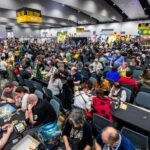
Australia’s biggest gaming convention is growing its tabletop exhibition space yet again amid the ongoing global boom in TCGs.
Pax Aus has featured tabletop games since the Melbourne-based con was launched in 2013, with the segment having grown over the years to take up a significant share of the show’s floor space.
The convention’s event director Lauren Luciani told BoardGameWire Pax Aus is expanding its dedicated tabletop hall by 7% for this year’s show, which takes place from October 9 to 11 – adding that even with that extended footprint, a waiting list had emerged for tabletop exhibitors.
Luciani said about 70% of exhibitors from last year’s show were returning for 2026 – although she would not reveal overall exhibitor numbers, or even an overall attendance for last year’s event, describing both figures as “confidential”.
Pax Aus’ announcement of this year’s show was once again dominated by major TCG publishers, underscoring the huge and growing popularity of a swell of different collectible card games over the past few years.
Asmodee ran a large booth at last year’s show, while other stands included board game distributors Let’s Play Games and Asmodee-owned VR Distribution (which rebranded to Asmodee in Australia last September), as well as a first-ever appearance from Warhammer publisher Games Workshop.
Other board game publishers with dedicated booths were few and far between in 2025, however, with much of the remaining tabletop section made up of retailers and a handful of stands for media outlets.
The event does include a large area for indie game developers on both the video and tabletop sides, however, called Pax Rising – expected to host more than 80 independent creators this year.
The Pax Rising section of Pax Aus 2025
That segment also includes an Indie Showcase competition to highlight games from Australia’s independent design scene.
When asked by BoardGameWire whether Pax Aus now sees TCGs as the primary growth area for the convention, Luciani said, “The trading card game category continues to experience significant growth globally, and PAX Aus is committed to reflecting the interests and passions of our community in the content and experiences we deliver.
“While TCG will have a strong presence at this year’s event, there are still a number of tabletop announcements to come, and attendees can expect a diverse range of tabletop gaming experiences on offer.”
This year’s event will include a segment where fans can meet Australian game designers Jay Bendixen, Ryan Boucher, Natalie Delaney-John and Cam Jasson during special sessions for Gretchen’s Garden and That Dicey Word Game.
Pax Aus also appears to be attempting to broaden its appeal to the collectibles market. eBay Australia returns as presenting sponsor of the Tabletop Hall for a second consecutive year, expanding its presence with the debut of eBay Live, live-streamed collector content and a dedicated Collectors Club programme.
Australia remains a long, expensive trip for European and North American attendees, of course. But for international publishers weighing whether the expense of exhibiting in Australia can be justified, Luciani argued that the value extends beyond direct sales.
“PAX Aus provides tabletop exhibitors with access to one of the largest and most engaged gaming communities in Australia,” she said. “Beyond direct sales opportunities, exhibitors benefit from brand exposure, community building, hands-on product experiences and the ability to engage with both existing fans and new players.
“As tabletop gaming continues to grow, PAX Aus remains a unique platform for publishers, retailers and creators to showcase their products alongside the broader gaming culture that brings tens of thousands of fans together each year.”
Asmodee has kicked off its new financial year with another powerful quarter of growth, with the publishing and distribution giant’s net sales soaring 20.9% year-on-year to €422.1m.
But board games also put on a strong showing in the April to June quarter, the report shows, with net sales rising 16% year-on-year amid an ongoing recovery from volatility caused by last year’s US tariffs uncertainty.
Much of that increase came via Asmodee’s distribution of titles from other publishers, with sales of its own published titles only growing 1.8% in the quarter.
That small rise marks a significant improvement for Asmodee’s own board game publishing operation, however, with sales of its published titles having fallen almost 10% in January to March compared to the prior year, and 12.7% in the all-important October to December period in 2025, which includes the run-in to Christmas.
Asmodee CEO Thomas Koegler said growth in US board game sales was driven by “the continued normalization of retailer inventory levels”, as well as “resilient” consumer demand for tabletop games and positive impact of its own commercial and marketing initiatives.
That improvement comes after Asmodee repeatedly highlighted retailer inventory reductions and cautious purchasing behaviour – particularly in the US – through much of the past year, as store owners tried their best to navigate rising prices, unpredictable shipping rates and other fallout from the US tariffs.
Three months later, the company reported US quarterly sales had slumped 23%, attributing much of the decline to retailers reducing purchases and ongoing inventory adjustments despite stable consumer sell-through.
Asmodee’s quarterly sales for April to June 2026, split out by geographical region
Some of those pressures now appear to be easing, although Asmodee’s own US sales were down almost 9.4% year-on-year in April to June – a situation Koegler said was partly caused by the timing of its most recent Star Wars Unlimited release affecting year-on-year comparisons.
Speaking more generally about Asmodee’s board game sales, he said its evergreen franchises such as Catan and Dobble/Spot-It! continued to perform well, and highlighted other new releases including dnup, The Lord of the Rings: Fate of the Fellowship and Cozy Stickerville as having contributed to growth.
Magic: The Gathering‘s record-breaking growth continues despite a surge of high-profile competitors, with the TCG soaring past $500m in quarterly revenues for the first time in its 33-year history.
That powerful rise has been built upon the already hugely popular TCG’s expansion into licensed crossovers through its Universes Beyond line since 2021, which has seen it bring out sets for franchises including The Lord of The Rings, Final Fantasy and Avatar: The Last Airbender.
The game’s success now underpins Hasbro’s fortunes, with Magic’s strong performance repeatedly leading the line in the company’s quarterly results – as well as offsetting underperformance in other parts of the business.
Magic’s revenue grew 32% in Q2 of this year compared to the same period in 2025 according to Hasbro’s latest results report, reaching a record $545m on the back of strong sales of Secrets of Strixhaven and Marvel Super Heroes – the latter of which the company described as a “record-breaking debut”.
That result means Magic alone outstripped Hasbro’s entire consumer products segment – which includes Nerf guns, Transformers and Peppa Pig toys – which recorded revenues of $463m in the same period, up 5% year-on-year.
The consumer products segment made an operating loss of about $14.5m in Q2, compared to an operating profit of $270m from Wizards of the Coast, the business arm which includes Magic, Dungeons & Dragons and its digital games such as Monopoly Go!.
The company said the cyberattack reduced second-quarter revenue by an estimated $25m while generating $11m in direct costs as order processing, shipping and invoicing were disrupted, particularly on the consumer products side. Hasbro said those operations had now returned to normal, although it expects to incur additional costs related to the incident in future periods.
Hasbro CEO Chris Cocks
Hasbro CEO Chris Cocks said in the results report, “With strong indications for our remaining releases and line of sight to continued growth in 2027, the Magic flywheel is firing on all cylinders.”
Wizards revenue was also up 27% across the first six months of 2026, with Magic revenue climbing 34% thanks to continued growth across tabletop and digital products, Universes Beyond releases, Secret Lair products and back catalogue sales.
That continued growth comes despite the emergence of several high-profile challengers in the trading card game market over the past few years, including Disney Lorcana, Star Wars: Unlimited, Altered, Flesh and Blood and One Piece Card Game – as well as the ongoing power of fellow TCG veterans Pokémon and Yu-Gi-Oh!.
Magic’s performance was strong enough for Hasbro to increase its full-year guidance, with the company now expecting total revenue growth of between 5% and 7%, up from its previous forecast of 3% to 5%.
Editor’s note: GAMA is one of the sponsors of the BoardGameWire newsletter
The Origins Awards, one of tabletop gaming’s longest-running prizes voted on by industry professionals, has crowned its latest group of winners after whittling them down from 120 nominees.
Jon Perry’s Hot Streak continues to live up to its name as far as award wins go, adding party game of the year to a pair of Golden Geek Award wins, casual game of the year in the American Tabletop Awards, and a ‘recommended’ accolade in the Spiel des Jahres.
Railroad Tiles, designed by Hjalmar Hach and Lorenzo Silva, took Gateway Game of the Year, while Will Thompson’s Winter Rabbit was named Light Strategy Game of the Year at the award ceremony, which took place at Origins Game Fair last month.
Railroad Tiles, designed by Hjalmar Hach and Lorenzo Silva
The awards also recognised Matt Brown and Zara Reid’s conservation-themed board game Kavango with a Sustainability Award, which aim to celebrate games with thoughtful production and publishers which “have taken strides towards sustainable manufacturing to reduce the impact on the natural environment”.
Outside the board game categories, James Parks and Ben Costa’s Land of Eem won Roleplaying Game of the Year, while in the trading card and collectible game categories Riftbound: Proving Grounds won Fixed Constructible Game of the Year, while the Gudnak: Expansion Bundle took the Randomized Constructible Game award.
Goblin Hobbies’ Stampin’ Plates claimed the Paint/Hobby Accessory award, while Luis Silva’s TCG design Shard Bugs claimed Fan Favorite Game of the Year, voted on by Origins attendees.
GAMA made an effort to rectify that error with its announcement of the award winners, including not only the names of the designers but also the artists who worked on each title.
The Origins awards, which were first presented in 1975, have been in heavy flux over the past few years, going from 10 categories in 2019 to 24 in 2024 – with the make-up of those categories significantly shaken up from year to year.
GAMA briefly introduced categories in 2024 which represented its membership having expanded beyond just retailers, publishers and wholesalers – including recognition for artists, writers and media.
But those segments were quickly dropped again in 2025, with categories cut including Best Media Production, Best Game Related Writing and Best 2D Artwork – although the miniatures segment was expanded from two categories to three, covering games, the miniatures themselves, and paint and accessories.
Separate from the main slate of awards, the trade organisation also revealed its hall of fame entrants this year, awarded – like the Origins Awards – by its division the Academy of Adventure Gaming Arts and Design.
AAGAD describes itself as “a peer based network of gaming industry professionals whose mission is to promote innovation and excellence in design and production of games and game related materials”.
Individuals inducted into the hall of fame this year include Richard Borg, famous for his design of the Command and Colors system used by games including Memoir ’44, and Antoine Bauza, the creator of designs including 7 Wonders, Hanabi and Tokaido.
Magic: The Gathering, Pathfinder RPG and Dungeons & Dragons artist Wayne Reynolds was also inducted into the hall of fame.
Origins Awards 2026 – Full Results
Gateway Game of the Year Railroad Tiles Publisher: Horrible Guild Designers: Hjalmar Hach and Lorenzo Silva Artists: Francesco De Benedittis and Barla Tranquilli
Party Game of the Year Hot Streak Publisher: CMYK Designer: Jon Perry Artist: Cécile Gariépy
Light Strategy Game of the Year Winter Rabbit Publisher: Absurdist Productions Designer: Will Thompson Artists: Kindra Swafford and Jonni Ketcher
Heavy Strategy Game of the Year Speakeasy Publisher: Eagle-Gryphon Games Designer: Vital Lacerda Artist: Ian O’Toole
Cooperative/Solo Game of the Year The Lord of the Rings: Fate of the Fellowship Publisher: Z-Man Games Designer: Matt Leacock Artists: Jared Blando and Cory Godbey
Roleplaying Game of the Year Land of Eem Publisher: Exalted Funeral Designed & Written by: James Parks and Ben Costa Artists: Justin Gerard, Sean Kiernan, Anneliese Mak, Sam Mamei, Rosario Mendez and Rob Gatto
Roleplaying Game Supplement of the Year Call of Cthulhu: The Sutra of Pale Leaves – Twin Suns Rising Publisher: Chaosium Designers/Authors: Yukihiro Terada, Jason Sheets, Damon Lang, and Andrew Logan Montgomery
Miniatures Game of the Year Blood Bowl Third Season Edition Publisher: Games Workshop
Miniature of the Year Warhammer: Age of Sigmar – Festus, The Leech Lord Publisher: Games Workshop
Paint/Hobby Accessory of the Year Goblin Hobbies Stampin’ Plates Producer: Goblin Hobbies Designed by: Brent Amberger and Casey Alden
Fixed Constructible Game of the Year Riftbound: Proving Grounds Publisher: UVS Games & Riot Games Designers: David Smith and Jon Moormann
Randomized Constructible Game of the Year Gudnak: Expansion Bundle Publisher: Chaotic Great Games Designer: Tim O’Brien and Ian Oliver Artist: Vittoria Pompolani
Fan Favorite Game of the Year Shard Bugs Publisher: Shard Bugs LLC Designer: Luis Silva Artists: Ray of Sand, Nelygibi, Julio E. Jácome Paz, María Ayuso, Alma Faustica, Pietro Desirò, Ninamarie, Steve Ozminkowski, Erick Mezart
Award-winning board game store owner Matthew Mičetić says independent tabletop retailers can no longer rely on product sales alone, as rising costs, tariff uncertainty and changing consumer behaviour continue to reshape the hobby retail landscape.
Mičetić was named Oregon Small Business Person of the Year last week by the US Small Business Administration, celebrating the 16-year growth of Portland-based Red Castle Games from a small neighbourhood game store into a vibrant space offering organised play, youth camps, community events and an on-site cafe.
He told BoardGameWire the complexity of running a game store had increased dramatically since the store opened in 2010 – but added that widening the venue’s scope had been a key ingredient in Red Castle’s success.
Mičetić said, “Competing solely on product selection and price has become increasingly difficult in a world where customers can order almost anything online and have it delivered to their door.
“What independent game stores can offer that online retailers cannot is community. We can provide places for people to learn, play, compete, socialize, and build friendships. The retail sales often follow from those relationships.”
He continued, “We aren’t just retailers anymore. We’re event organizers, community managers, educators, food service operators, e-commerce businesses, and increasingly technology companies as well.
“The encouraging part is that the core mission hasn’t changed. People still want places to gather, play games, make friends, and feel like they belong.
“The stores that continue to succeed are the ones that adapt to the changing business environment while never losing sight of the community they’re there to serve.”
Mičetić’s drive has seen that community expand from traditional hobby gamers and TCG players to include young people, families and more casual gamers keen to dip their toes into the hobby – something he believes is one of the biggest opportunities for game stores today.
He said, “Some of our most successful recent initiatives have been our youth programs, including Dungeons & Dragons, Magic: The Gathering, and Pokémon camps and after-school programs.
“Parents are looking for opportunities that help kids build friendships, creativity, problem-solving skills, social-emotional skills, and confidence. Tabletop games are uniquely positioned to provide that.
“We’ve also had success reaching beyond the traditional hobby audience. There are a lot of people who can benefit from what tabletop gaming offers who may never have considered walking into a game store.
“That means being willing to experiment, try new things, and sometimes fail. Not every idea works, and that’s okay. The important thing is to learn from it, make adjustments, and keep moving forward.
“I’ve always believed in looking for 1% improvements. Small improvements compound over time. If you can make your store, your programs, your customer experience, and your operations just a little bit better every day, those gains add up to something significant over the course of years.”
He added, “While retail is still the foundation of the business, these complementary activities have become increasingly important both financially and strategically. They reinforce one another.
“Someone might discover us through a D&D camp, become a regular event participant, buy games and accessories, meet friends through the community, and eventually become a long-term customer.
“The café, events, camps, and retail operation all work together to create a stronger overall ecosystem. For independent game stores, I think that’s one of the biggest lessons of the last decade. The future isn’t just about selling products, it’s about creating reasons for people to keep coming back.”
Organised play remains a “core pillar” of the store’s financial prosperity, Mičetić told BoardGameWire, while Magic remains its strongest offering and continues to be a cornerstone of organised play.
Mičetić receiving his Oregon Small Business Person of the Year award
He added, “One Piece has been one of the biggest success stories of the last several years, drawing strong participation. Star Wars Unlimited has also developed a passionate local community and has exceeded our expectations.
“Beyond TCGs, Dungeons & Dragons continues to be a major driver of participation through campaigns, youth programs, and camps. Board game events, painting nights, and miniature gaming also contribute meaningfully to overall attendance, even if they don’t always attract the same numbers as the largest TCG communities.
“What excites me most isn’t any individual game. It’s the diversity of the community. I believe the healthiest stores aren’t dependent on a single title. They’re places where someone can come in for Pokémon, discover D&D, try a board game, join a painting event, and ultimately find multiple ways to engage with the hobby.”
Speaking about current growth areas on the retail side – and areas which could be in decline – Mičetić told BoardGameWire TCGs continue to be the strongest growth category in the hobby, while oversaturation in higher-price point board games was beginning to show strain.
He said, “Magic remains a powerhouse, Pokémon continues to bring in new players, and we’ve seen strong engagement from newer games [such as One Piece and Warlord] as well.
“That said, I do worry that we’re in a boom cycle. I don’t know when it will happen, but historically every collectible market experiences corrections and I think it’s wise for retailers to plan accordingly.
“In board games, I think we’re seeing softness at the higher end of the market. For years, the industry benefited from an explosion of new releases and crowdfunding projects, but I also think the market became oversaturated.
“Self-publishing and crowdfunding lowered barriers to entry, which brought some fantastic games to market, but also a tremendous number of mediocre ones. Consumers have more choices than ever and less time to play them.
“Where I’ve seen the most consistent strength is in smaller board and card games, particularly titles under about $25. At that price point, they’re an easy impulse purchase and a lower-risk way for customers to try something new.
“RPGs are interesting. Product sales have slowed somewhat for us, but organized play and events remain strong. People still want to gather around a table and tell stories together, even if they’re buying fewer books than they once did.
“Miniatures remain a challenging category outside of Games Workshop. Many lines have passionate fan bases, but Games Workshop continues to outperform expectations and demonstrates the power of consistent support, organized play, and strong intellectual property.
“As for crowdfunding, we’ve largely stepped away from it as a retailer. There are certainly successful projects, but we’ve experienced too many delays, failures, and fulfillment issues over the years.
“Tying up cash and shelf space for products that may arrive years late, or not at all, has become increasingly difficult to justify.”
Mičetić said that on the distribution side, relationships had become both more important and more complicated since 2020, with the pandemic having exposed just how dependent the industry is on supply chains and allocation systems.
Mičetić said distribution relationships had become more complicated since the pandemic – and more important
He said, “In many categories, especially TCGs, we spent years dealing with product shortages, allocations, delayed releases, and uncertain restocks. More recently, while still dealing with those allocation issues, we’ve added questions around tariffs, pricing, inventory levels, and market demand.
“The underlying challenge remains the same, uncertainty. At the same time, retailers are being asked to make increasingly complex purchasing decisions with limited capital and shelf space.
“When talking with distributors today, my primary focus is predictability and partnership. I don’t expect every product to be available in unlimited quantities, but I do want transparency around allocations, release schedules, and restock expectations.
“The better information we have, the better decisions we can make. I also spend a lot of time discussing breadth versus depth. Every distributor wants retailers to carry more products, but shelf space, cash flow, and staff attention are finite resources.
“We’re increasingly focused on products that have strong community support, organized play opportunities, or demonstrated demand rather than simply chasing every new release.”
Mičetić’s award recognition follows a turbulent series of challenges in recent years, ranging from navigating the Covid-19 pandemic to enduring ten break-ins over a twenty-month period – a spate of crimes which resulted in more than $250,000 in losses and property damage.
He told BoardGameWire that while the experience was “frustrating and demoralizing”, he was “not willing to let a handful of criminals determine [Red Castle’s] future” – adding that the show of support from customers following the break-ins had helped reinforce why the store exists in the first place.
Mičetić said, “The primary targets were trading card games, particularly sealed Pokémon and Magic products, along with Games Workshop product. Unfortunately, those products are small, portable, and have a well-established secondary market, which makes them attractive targets for theft.
“The financial losses were significant but the larger challenge was the operational and emotional toll. Every break-in meant dealing with police reports, emergency repairs, damaged property, disrupted operations, and the uncertainty of whether it would happen again.
“There were periods when it felt like we were spending almost as much time thinking about security as we were thinking about growing the business.”
He advised other hobby retailers to “invest in security before you need it”, adding that the experience had changed his own understanding of risk.
Mičetić said, “Small businesses often operate on relatively thin margins and repeated criminal activity can have an outsized impact.
“It’s a reminder that when people talk about crime affecting businesses, they’re not just talking about stolen merchandise, they’re talking about the time, money, stress, and opportunity cost that comes with recovering from it over and over again.”
Speaking of his SBA award win, which recognises business owners who demonstrate outstanding business growth, innovation, resilience, and contributions to their communities, Mičetić said, “This recognition is incredibly meaningful because it reflects the community that built Red Castle Games.
“Every customer, staff member, volunteer, and supporter has played a role in our success. This award belongs to all of them.”
Asmodee’s escalating power as a global TCG distribution giant was evident again in its newly-released annual results, which showed the company’s net sales surging 23% year-on-year to more than €1.68bn.
That annual revenue has swelled around 50% in just three years on the back of huge recent growth in TCGs, including heavyweights Magic: The Gathering and Pokemon as well as a wave of strong performing newcomers such as Disney Lorcana, the One Piece Card Game and Asmodee’s own Star Wars: Unlimited.
Despite Asmodee’s long-time image as a board game publishing heavyweight, more than 72% of its revenue now comes via its distribution of other companies’ games – up from an already hefty 63% in the previous financial year to March 31, 2025.
TCGs now make up the lion’s share of Asmodee’s annual net sales – about 60% in the 2025/26 financial year, up from just over 50% across the preceding 12 month period.
The company’s own board game publishing operation, meanwhile, saw its net sales fall 5.8% in the last financial year – while net sales for the first quarter of this year were down 9.8% compared to the same period in 2025.
Asmodee’s Jan-Mar 2026 and last financial year revenue figures, showing a hefty jump in the portion of its net sales coming from distributing other companies’ games
Asmodee CEO Thomas Koegler was asked directly during a Q&A session on Asmodee’s latest financial results if the company was still primarily a board game publisher, or whether it was “increasingly becoming an infrastructure company for TCGs”.
He said in response, “We have insisted a lot on the fact that one of the strengths of Asmodee is to be a publisher, but the first strength that we do have is our global reach across all categories, from TCGs and board games.
“That’s the superpower of Asmodee – and then being a very strong publisher is a way of accelerating performance.
“So I would say that there is no change, we continue to capture opportunities across the board wherever they come from… our aim is to be a dominant player, bringing all games to the market, anywhere they can.”
The Japon Brand buyout was accompanied by Asmodee launching a new Japan-based design studio, Nekuma, anchoring its push into what it described as a “currently untapped market” for the company.
There were also hints in the Q&A session that Asmodee might be considering a move into Japanese distribution, adding to its existing operations in the region across China, Taiwan and Australia.
Koegler said of Japan, “The first move we have done with Japon Brand and setting up Nekuma is more of a sourcing move, right?
“The Japanese game designers and authors’ market is very dynamic. If you look for instance in recent very successful games – Bomb Busters, which is the Spiel des Jahres from 2025, was originated from Japan, a game like Dnup that we are releasing later in the year is coming from Japan.
Asmodee CEO Thomas Koegler
“So they are very good also at small card games, and we really wanted to, I would say, bolster our publishing capabilities by creating those sourcing activities.
“Distribution wise, for now we are still working with local partners, we have not set direct foot yet.
He added, “It’s a fragmented market, its a very strong TCG market on the local market side, but yes… as I said, it’s a very vivid scene.”
Koegler also made clear that the company is still pursuing M&A opportunities on the publishing side “across all play types that we have, from social games to lifestyle games and tabletop games”.
He said, “I would say that the discussions we have are still as active as they were – we have demonstrated our ability to do various sizes of deals, which is also a very strong signal to potential people that would like to join the Asmodee adventure.”
Koegler said in his introduction to Asmodee’s 2025/26 report that the impact of geopolitical and economic events on the company’s business in the first few months of the year had been limited, but that the firm remained “mindful” of the potential pressures on transport and energy costs.
Asmodee said the impact on the business of transport and energy cost changes due to global political and economic issues had so far been limited
He said in the financial results Q&A session, “From a consumer standpoint, in moments of tensions when there are rising costs, because games are an affordable leisure we tend to suffer less, if not take some opportunities. That’s what we’ve seen in previous crises over the past 10 or 15 years.
“Consumer sentiment-wise, we will see. Although we are always cautious, there is also I think opportunities for us.
“Secondly, in terms of the cost impact. First of all our mix is currently very favourable because trading card games are manufactured very close to where they are sold, like in Europe for European countries mainly – some are manufactured in Asia but its a limited one – in the US for the US, etc.
“Plus they are cheap to transport, so the impact on those is relatively limited. And then we will see with our partners in terms of raw material increases, but again in the overall cost of goods they do not represent a very significant party.
“For board games we have started to see some increase in transportation costs. They did not impact Q4. If we take an example, road freight did represent roughly 20% of the cost base, and they have increased by 10%.
“But again, all of this is quite manageable for us. We expect to be able to mitigate the impact.”
Koegler added that although the process for receiving tariff refunds in the US had begun, after the Supreme Court struck Donald Trump’s swathe of import fees earlier this month, there was uncertainty about both the timing and final amount Asmodee was owed.
He said, “This is still a little bit foggy, blurred – for us, but [also] for many, many other companies out there. So let’s wait for what’s next on this topic.”
Alliance Open House, the tabletop publisher and retailer networking event launched more than 25 years ago by Alliance Game Distributors, has rebranded to Universal Summit US in the wake of Alliance’s takeover by Canada’s Universal Distribution.
Universal said it is waiving all registration fees to celebrate the inaugural US Universal Summit, which will continue its predecessor’s slate of game demos, panels and workshops, vendor exhibit hall and networking opportunities.
This year’s event will be held at the Grand Wayne Convention Center in Fort Wayne, Indiana between August 27 and 29, with registration required by May 15.
Universal Distribution CEO Angelo Exarhakos told ICv2 last July that the company intended to invest “a fair bit” in expanding the event and “making it more welcoming to both retailers, and especially the vendors”.
He added, “We generally, at the Universal level, don’t charge vendors to attend these shows. We think this is a very good marketing expense for us and a good investment, to be able to bring our vendors close to our retail partners, so you’re going to see us invest and expand that show.”
Alliance Game Distributors was a perennial heavyweight of US board game distribution since it was created through the merger of Chessex and The Armory in 1998, with both companies already major players in the sector before the deal was signed.
The company had maintained its strong position since being bought by Diamond in 2000, despite the woes of its parent business in recent years.
Universal will also be holding its regular Canadian summit on September 13 and 14 this year, at the Sheraton Laval in Montreal, Quebec. Registration for that event is also due by May 15.
Heute gibt es eine Folge in der wir ein wenig von Hölzchen auf Stöckchen kommen und dennoch über viele interessante Dinge reden! Hört rein und lasst Euch diesmal ein wenig überraschen, was so auf Euch zukommt.
Lese Zeit: 10MinutenIch liebe die LCGs Arkham Horror: Das Kartenspiel, Marvel Champions und Der Herr der Ringe: Das Kartenspiel. Aber ich stehe auch auf das Collectible Card Game Magic The Gathering – immer noch, nach mehreren Jahrzehnten. Was aber sind die grundlegenden […]

 Anmelden