Das Dungeons-&-Dragons-Team und Studio X, die Einheit hinter Magic: The Gathering und Duel Masters, hatten am 6. Oktober 2026 angekündigt, sich als United Wizards of the Coast-CWA (UWOTC-CWA) der Gewerkschaft Communications Workers of America anzuschließen. Wizards of the Coast sollte die Gewerkschaft bis zum 13. Oktober, 17 Uhr Pacific Time, freiwillig anerkennen. Laut der Gewerkschaft teilte das Unternehmen ihr am 13. Oktober mit, die Einheiten vor einer Abstimmung nicht freiwillig anzuerkennen, veröffentlicht hat die Gewerkschaft das am Tag darauf. Der Fall geht damit in eine Wahl beim National Labor Relations Board, für die bereits ein Antrag vorlag.
Gründe: Überstunden, Entlassungen und Sorge vor KI
Als Gründe nennen die Beschäftigten laut BoardGameWire unter anderem unbezahlte Überstunden durch Zeitdruck und inflationsbedingt sinkende Reallöhne. Dazu kommt die konzernweite Entlassungswelle bei Hasbro seit 2023 (rund 1900 Stellen allein in jenem Jahr, konzernweit inklusive des Spielzeugbereichs, weitere Kürzungen bei Wizards selbst 2024 und 2025) sowie der Wunsch nach Schutz vor generativer KI in der Entwicklung. Der D&D-Senior-Game-Designer Joey Haeck ist laut CWA Mitglied von UWOTC-CWA und wird mit dem Satz zitiert: „scared workers are neither happy nor productive“. Magic-Regelmanager Eric Levine äußert sich laut BoardGameWire unterstützend zur Gewerkschaftsbemühung, wird dort aber nicht als Mitglied genannt.
Rekordgewinne und ein zweiter Anlauf nach dem MTG-Arena-Vorbild
Wizards of the Coast erwirtschaftete laut BoardGameWire 2025 knapp die Hälfte von Hasbros 4,7 Milliarden Dollar Umsatz und einen operativen Gewinn von mehr als einer Milliarde Dollar. Beim Thema generativer KI deckt sich die Darstellung der Gewerkschaft mit öffentlichen Aussagen von Wizards: Laut dem Gründungsschreiben der Beschäftigten, zitiert bei BoardGameWire, kommt der Druck zur Nutzung von Sprachmodellen von Hasbro, während Wizards dem bislang widerstanden und KI aus den eigenen Spielen herausgehalten habe. Das deckt sich mit einer Aussage von CEO Chris Cocks, der im März 2026 sagte, die Spiele nutzten in ihrer Entwicklung keine KI.
Einen ähnlichen Verlauf nahm bereits das Team hinter Magic: The Gathering Arena. Auch dort lehnte Wizards of the Coast eine freiwillige Anerkennung im Mai 2026 ab. Die Beschäftigten gewannen die anschließende NLRB-Wahl im Juni trotzdem. Ob sich das beim D&D-Team und Studio X wiederholt, ist offen.
Renegade Game Studios und Hasbro haben ihre Lizenzvereinbarung für Brettspiele verlängert und erweitert. Das teilte Renegade in einer eigenen Pressemitteilung vom 1. Oktober 2026 mit, BoardGameWire berichtete am 5. Oktober unabhängig darüber. Weiterhin abgedeckt sind die Avalon-Hill-Klassiker Axis & Allies, Acquire, Diplomacy, Heroscape, RoboRally und Ikusa, dazu Hasbro-Marken wie Transformers, G.I. Joe, Power Rangers, M.A.S.K., My Little Pony, Jem and the Holograms und Rom the SpaceKnight.
Castle Ravenloft kehrt zurück, neues Power-Rangers-Spiel im April
Für 2027 kündigt Renegade bereits konkrete Titel an. Der Dungeons-&-Dragons-Klassiker Castle Ravenloft erscheint laut einer eigenen Renegade-Ankündigung im Februar 2027 neu aufgelegt. Laut Verlag gibt es dafür erstmals neben der Standard- auch eine Premium-Edition mit bereits bemalten Miniaturen.
Im April 2027 folgt mit Power Rangers: Impossible Odds ein kooperatives Würfelspiel ab 14 Jahren von Myles Wallace und Alex Blakeney. Ein weiteres, noch unbenanntes Deckbuilding-Spiel will Renegade auf der eigenen Renegade Con vorstellen.
Schon länger angekündigt sind zwei weitere Umsetzungen: Diplomacy: The Golden Blade, eine eigenständige Kartenspiel-Variante ohne Elimination, sowie Axis & Allies: Commanders, eine Erweiterung mit laut BGG „power-specific abilities that can be used in any version of Axis & Allies“. Den Konflikt bei Diplomacy: The Golden Blade trägt laut BGG weiterhin die Mechanik „Prisoner's Dilemma“: Spielende schließen Bündnisse und müssen abwägen, wann sie sie brechen, nur eben ohne dauerhaftes Ausscheiden. Vertragswerte oder Umsatzzahlen nennen weder Renegade noch Hasbro.
Scott Gaeta, Präsident von Renegade, kommentiert die Vertragsverlängerung: „We're extremely pleased to extend and expand our relationship with Hasbro. From our beginnings with Power Rangers to our most recent projects on Dungeons & Dragons Lords of Waterdeep, working with the teams at Hasbro and Wizards of the Coast has been a pleasure. It's an honor to be entrusted with bringing these iconic brands to tabletops worldwide.“
Keine deutschen Ausgaben, aber deutsche Verlagsgeschichte
Für keinen der genannten Klassiker gibt es aktuell eine deutsche Lokalisierung. Historisch waren einige davon aber auch auf dem deutschen Markt vertreten: RoboRally erschien laut BGG auf Deutsch bei AMIGO, Diplomacy bei Parker Spiele. Ob die jetzt verlängerte Lizenz auch neue deutsche Ausgaben einschließt, lässt sich der Pressemitteilung nicht entnehmen. Das gilt auch für die neu angekündigten Titel: Weder zu Power Rangers: Impossible Odds noch zur Castle-Ravenloft-Neuauflage äußert sich eine der Quellen zu einer deutschen Sprachversion.
Korrektur vom 14.10.2026: Im ersten Absatz stand faelschlich, Renegades eigene Pressemitteilung sei vom 5. Oktober 2026. Richtig: Die Pressemitteilung ist vom 1. Oktober 2026, BoardGameWire berichtete am 5. Oktober unabhaengig darueber.
Dungeons & Dragons and Magic: The Gathering workers are moving to unionise after alleging rising workloads, unpaid overtime and job insecurity at Wizards of the Coast – despite the business having become the main profit engine of toy and game giant Hasbro.
Workers on Dungeons & Dragons, D&D Beyond and Wizards’ Studio X – which develops tabletop Magic: The Gathering and Duel Masters – plan to unionise with the Communications Workers of America, having secured the backing of a “public supermajority” of employees.
The move comes after several years of soaring sales and profits at Wizards, which has increasingly become the financial powerhouse of Hasbro amid struggles at the company’s traditional toys business – which includes Nerf guns, Transformers and Peppa Pig toys.
That performance was driven by hugely successful Universes Beyond releases including Final Fantasy, Avatar: The Last Airbender and Marvel’s Spider-Man, alongside strong backlist and Secret Lair sales.
D&D workers, meanwhile, said growing workloads without corresponding increases in headcount had left some teams regularly “crunching” simply to complete planned releases – describing crunch as “intense and mandatory unpaid overtime”.
They are also seeking contractual protections around job security, pay and career progression, saying, “Many of us are bringing home less money every month, adjusted for inflation, than we did when we were hired years ago. That needs to change.”
An open letter from those workers added that employees “live in fear of suddenly losing their jobs, with no warning and through no fault of their own”, and that Wizards prioritising in-office work had left workers “unsure of whether their current living situation is tenable for their role”.
Hasbro cut about 1,900 jobs across two rounds in 2023, including at Wizards, after a sharp downturn in its core consumer products business. That segment saw revenue fall 19% in 2023, swinging to a $64.7m operating loss, while Wizards revenue rose 10%.
Further cuts have followed since, including four Wizards employees during Hasbro-wide redundancies in October 2024, and about 30 developers – roughly 90% of the team working on Wizards’ now scrapped Sigil D&D virtual tabletop – in March 2025.
Hasbro cut roughly 150 more jobs three months later, including D&D staff, and last month D&D community manager LaTia Jacquise and Magic social media manager Jordan Hopkins publicly confirmed their layoffs – with Hopkins describing his departure as part of a “greater restructure”. Wizards has not disclosed the total number of jobs affected.
Magic rules manager Eric Levine said of the union effort, “Everyone I work with makes our company, our game, and our community stronger by bringing their talent, expertise, and effort to making Magic.
“Those incredible people deserve fair compensation, remote protections, clear career progression, and more. Supporting the people who make the game will ensure that Magic keeps getting better for years to come.”
The unionisation push also called for protections for work employees create in their free time, with the D&D workers’ announcement saying, “Currently, if an employee makes anything creative in their free time, with their own resources, Hasbro can claim ownership. What we do in our free time should not be dictated by the company, and what we make in our free time should belong to us.”
The D&D team also used its unionisation letter to reveal tension between Hasbro and Wizards over the use of generative AI, saying, “As pressure has ramped up from Hasbro to adopt LLMs and Gen AI tools in various aspects of our work, WOTC has resisted these efforts and kept AI out of our games.
“That’s good! We want to preserve this commendable stance through a union contract that ensures our games will always be made by people for people.”
Hasbro CEO Chris Cocks was openly enthusiastic about bringing AI into the D&D ecosystem in September 2024, saying at Goldman Sachs’ Communacopia conference that Hasbro was already using AI “significantly and liberally internally as both a knowledge worker aid and as a development aid” – but was more excited about its potential in play.
He added, “I play with probably 30 or 40 people regularly. There’s not a single person who doesn’t use AI somehow for either campaign development or character development or story ideas. That’s a clear signal that we need to be embracing it.”
Hasbro CEO Chris Cocks
In an interview with The Verge in March this year, however, Cocks said that while Hasbro was deploying AI widely across the company, he acknowledged there was resistance to its use in Wizards’ games.
He said, “There are some brands that the audience, the creators, just don’t want it, so we don’t even have it in our pipelines for our video games or for Magic: The Gathering, or D&D.”
Cocks added that he personally used huge amounts of AI-generated animation, images, text, sound effects and voice cloning in his personal D&D games, telling interviewer Nilay Patel there was so much on his home PC that it would “floor” him.
He added that AI was being used extensively elsewhere at Hasbro, including in toy design and as a general productivity tool across the company, and estimated it could save more than one million hours of work this year.
Cocks also told Verge that he did not believe the technology would cost creative workers their jobs, saying, “I see it only making the quality of the creative we have better.”
Other demands from the unionisers include better support for working parents, changes to healthcare provision and greater financial transparency, to aid the unions in collective bargaining.
More than 100 Arena workers announced their unionisation drive in April, with Wizards declining their request for voluntary recognition. The group subsequently won a National Labor Relations Board election in June, formally establishing the first union at Wizards.
D&D and Studio X workers – who are also organising under the United Wizards of the Coast-CWA – have asked Wizards and Hasbro to voluntarily recognise their respective units by an October 13 deadline, and have filed an election petition with the NLRB to allow the certification process to proceed if that does not happen.
They are also calling for Hasbro and Wizards to adopt a labour neutrality agreement allowing other workers at the company to organise without fear of retaliation.
D&D senior game designer Joey Haeck said they were organising “because scared workers are neither happy nor productive”.
Haeck said, “By organizing to negotiate a fair contract on issues of layoff protections, forced relocation protections, equitable pay and career advancement, mandatory AI use protections, parental support, and more, we make our game better by investing in our human creators and resisting the churn and brain drain caused by roller-coaster layoffs.”
Hasbro has extended its wide-ranging licensing deal with Renegade Game Studios, continuing a years-long partnership which has seen the hobby publisher take over and develop a growing collection of the toy giant’s board game brands.
Renegade’s work with Hasbro has also spread to subsidiary Wizards of the Coast, with the publisher announcing a new edition of Dungeons & Dragons board game Lords of Waterdeep and its Scoundrels of Skullport expansion last year, and set to bring the long out-of-print Castle Ravenloft board game back to retail in 2027.
Scott Gaeta, the founder and president of Renegade, said, “We’re extremely pleased to extend and expand our relationship with Hasbro. From our beginnings with Power Rangers to our most recent projects on Dungeons & Dragons Lords of Waterdeep, working with the teams at Hasbro and Wizards of the Coast has been a pleasure.
“It’s an honor to be entrusted with bringing these iconic brands to tabletops worldwide.”
Renegade’s relationship with Hasbro began via an unexpected route in 2018, when the publisher signed a licensing deal with Saban Brands to make Power Rangers tabletop games.
Hasbro expanded its Renegade partnership to G.I. JOE, Transformers and My Little Pony in 2020, and two years later handed the publisher responsibility for established tabletop lines previously associated with Avalon Hill, including Axis & Allies and Diplomacy.
Heroscape followed in 2023, just months after Hasbro’s own attempt to revive the miniatures game through its HasLab crowdfunding platform failed to reach the 8,000 pledges needed to enter production. Renegade has since developed the game into an ongoing miniatures line with new armies, terrain, organised play and regular expansions.
The Heroscape Master Set from Renegade Game Studios
The companies also added Nexus Ops, Vegas Showdown, Risk 2210 AD and Risk: Godstorm to the agreement in 2023, with Renegade saying at the time it planned to preserve the original gameplay while refreshing the games’ presentation and making minor quality-of-life improvements.
Renegade has also increasingly mixed Hasbro’s entertainment properties with the tabletop systems it now publishes, including G.I. JOE: Battle for the Arctic Circle – the first game in its ‘Powered by Axis & Allies’ line – and a G.I. JOE range for Heroscape.
The publisher also revealed more details for Power Rangers: Impossible Odds last week during Renegade Con, its regular online showcase for upcoming games and expansions. The cooperative boss-battling dice game is due for release in April 2027.
Renegade’s wider Hasbro agreement continues to cover Transformers, G.I. JOE, Power Rangers, M.A.S.K., My Little Pony, JEM and the Holograms and ROM the SpaceKnight.
Im Rahmen meiner Nostalgie-Serie habe ich bereits Scotland Yard vorgestellt. Ich habe auch Labyrinth Chronicles ausgeliefert bekommen und wir arbeiten gerade daran, die Kampagne zum ersten Mal abzuschließen. Mit meinem Sohn habe ich allerdings noch ein anderes Spiel aus dem Regal gezaubert. Er wollte neulich unbedingt Schach lernen und dabei ist mir eingefallen, dass ich noch Stratego besitze. Das habe ich früher ziemlich häufig gespielt. Kann das noch was? Kommt man als 8‑Jähriger da rein? Wir haben einen Versuch gestartet.
Bei der Recherche zu dem Artikel musste ich dann erst einmal feststellen, dass es über 40 Millionen Mal verkauft wurde. Damit kennt es wahrscheinlich jeder? Ist das so? Lasst es mich gern mal wissen! Was ich auch nicht wusste: dass es bereits 1942 lizenziert und es beweisbar ab 1946 produziert wurde. Die Lizenz gehört immer noch Jumbo und Hasbro ist der Lizenznehmer und Produzent der Spiele.
Für alle, die sich wie ich nicht vor Künstlicher Intelligenz fürchten, dürften daran interessiert sein, dass die Zugvielfalt bei Stratego komplexer ist als bei Go oder Schach. Erst 2022 hat die Software DeepNash mit großer Wahrscheinlichkeit zuverlässig Spitzenspielende besiegt.
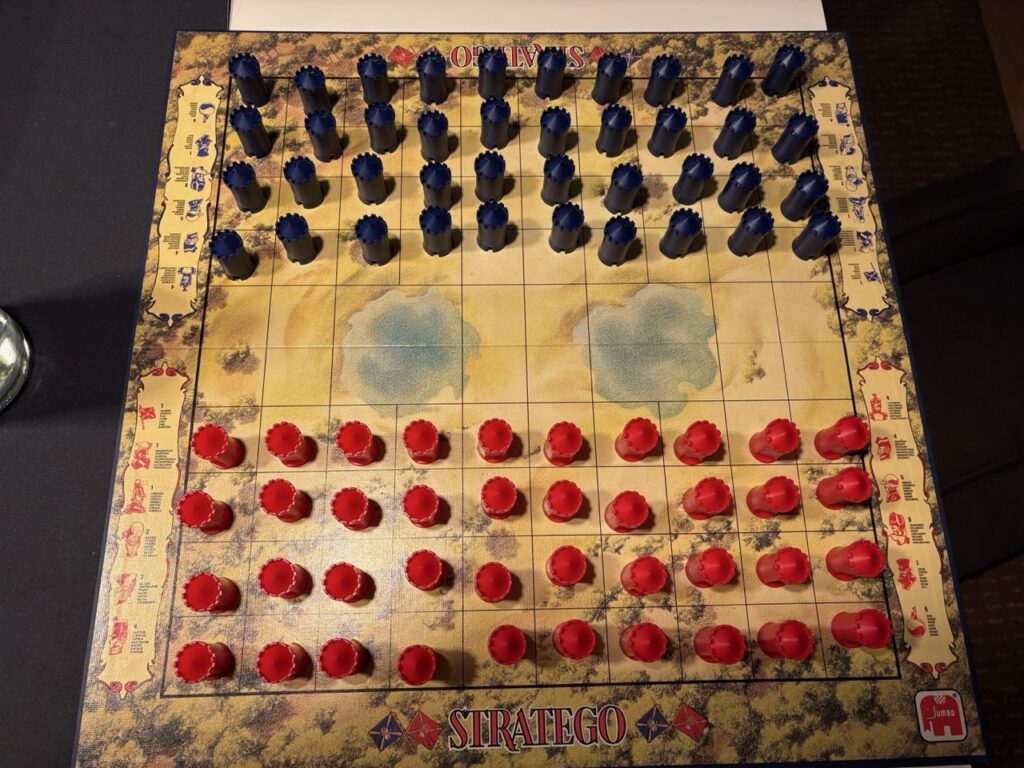
Das Schlachtfeld steht zum Duell bereit.
Spielprinzip
Die Spielfläche gibt sich schachähnlich mit 10 × 10 Feldern. Beim Spielaufbau platzieren die beiden Spielenden ihre jeweils 40 Figuren auf ihrer eigenen Seite auf zehn Feldern mit vier Reihen. Die Figuren sind an militärische Ränge angelehnt. Es gibt einen Feldmarschall, Hauptmänner, Unteroffiziere und weitere. Dabei gibt es eine strikte Schlagreihenfolge. Der Feldmarschall, schlägt alle Figuren. Der Vier-Sterne-General ist unterhalb des Marschalls angesiedelt und kann daher nur von diesem geschlagen werden. Dann folgt der Drei-Sterne-Oberst und so weiter.
Es gibt noch ein paar Sonderfiguren: die Fahne, die Bomben und den Spion. Ziel des Spiels ist es, die unbewegliche Fahne der gegnerischen Armee zu finden oder die andere Seite zur Aufgabe zu zwingen, wenn kein Zug mehr möglich ist. Dies kann passieren, sobald man nur noch unbewegliche Figuren hat. Neben der Fahne gibt es noch die Bomben, die fest an ihrem Platz verharren. Berührt man mit einer Figur die Bombe, wird die Figur aus dem Spiel genommen. Nur Mineure (sonst relativ unten in der Hackordnung) können die Bomben entschärfen. Die interessanteste Figur ist der Spion. Er wird von allen Figuren geschlagen, aber er ist die einzige Figur, die den Feldmarschall schlagen kann.
Die Reihenfolge der ersten Garde
Wie laufen die Züge nun ab? Nach dem Spielaufbau stehen sich zwei Armeen gegenüber. Die Figuren werden so gedreht, dass die Spielenden von der eigenen Armee die Vorderseite – also den Rang – sehen können und von der gegnerischen Armee nur die blanke Rückseite. Immer abwechselnd wird eine Figur orthogonal um ein Feld gezogen. Dabei ist jede Richtung erlaubt. Ein Überspringen von Figuren ist nicht möglich. Landet man bei dem eigenen Zug auf einer gegnerischen Figur, zeigen sich beide gegenseitig die Vorderseite und es wird aufgrund des Ranges entschieden, welche Figur das Spielfeld verlassen muss. Danach wird die überlebte Figur wieder mit der Vorderseite wie vorher abgestellt. Dadurch muss sich die gegnerische Person ab jetzt merken, was sich hinter dieser Figur verbirgt. Sind beide vom selben Rang, müssen beide Figuren das Feld verlassen.
Beim Aufbau lohnt es sich eine Trennwand aufzubauen.
Unboxing und Varianten
Ich habe viele Versionen von Stratego gespielt. In der für mich schönsten Version bestehen die blauen und roten Spielfiguren aus Plastik-Türmchen, die auf einer Seite begradigt sind und dort mit weißen Linien die Ränge darauf gedruckt haben. Außerdem gibt es ein Inlay bei dem die Figuren einsortiert werden. Die Spielbretter sind immer ganz schön gestaltet.
Früher hatte ich selbst noch ein Spiel mit Figurplatten, die in einen Ständer gestellt wurden. Das geht grundsätzlich auch, führt aber bei einer unsachgemäßen Berührung dazu, dass sie sich ungewollt umdreht.
Capture the Flag – ist das Ziel.
Solltet ihr Stratego noch nicht in eurem Besitz haben und es wieder neu erwerben, dann findet ihr in der aktuellen Version noch Kampfkarten („Battle Cards“). Dabei werden weniger Figuren genutzt. Die Karten erlauben besondere Züge, andere Angriffe und so weiter. Obendrein sind in der neuen Version wahlweise noch drei Figuren als weibliche Figuren spielbar. Das gilt im Übrigen auch für die 65‑Jahre-Jubiläums-Edition.
Es gibt noch eine Mini-Version mit nur zehn Figuren. Ich dachte, dass es sich dabei um eine Reisevariante handelt, und war sehr enttäuscht beim Auspacken. Tatsächlich fehlt mir bei der Variante auch die taktische Tiefe. Das ist gleich wieder aus dem Haus ausgezogen.
Es gibt noch Junior-Varianten mit Dinos oder Disney-Motiven. Meiner Meinung nach braucht es das nicht, aber das muss jede Person selbst entscheiden.
Bewertung
Stratego hat eine unerwartete taktische Tiefe. Je häufiger das Spiel auf dem Tisch landet, desto besser wird das eigene Spiel. Schon beim Aufbau gibt es viel zu entscheiden. Wird die Fahne eher frei platziert oder von Bomben umschlossen? Sind die höheren Ränge an vorderster Front oder sichern sie die Fahne? Stellt man die Bomben so auf, dass sie einen beim Ausspielen behindern?
Für Eltern ist vielleicht die größte Herausforderung, dass man den Mitspielenden nicht so einfach gewinnen lassen kann. Vielleicht liegt es an dem Brettspiel-Haushalt: Bei uns gewinnt immer die Person, die am besten spielt. „Keine Gnade“. Wir haben Stratego schon über zehnmal gespielt und mein Sohn hat noch keine Partie gegen mich gewonnen. Aber man merkt, dass er jedes Mal geschickter und taktischer spielt. Und es vergeht kein Kampf, nachdem er nicht sofort eine Revanche fordert.
Die Regeln hat er super schnell verstanden. Es kommt zugute, dass die Ränge auf dem Spielbrett abgedruckt sind und er sich zu Beginn nicht merken musste, wer wen schlägt. Mittlerweile weiß er das auswendig.
Ersetzt Stratego nun Schach? Nein, das würde ich nicht sagen, aber es ist ein guter Einstieg. Es hat eben andere Aspekte, wie Bluffen und die Notwendigkeit, dass man sich die Figuren des Gegenübers merken muss.
Ich war schon früher ein großer Fan von dem Spiel, obwohl ich sonst keine Kriegsspiele in meiner Sammlung mag. Ähnlich wie Scotland Yard wurde Stratego im Familienkreis wieder entstaubt und erfährt seinen zweiten Frühling. Für mich war es immer schon ein geniales Spiel. Es inzwischen mit meinem Sohn zu erleben, ist einfach nur grandios. Angesichts dessen zu Recht ein goldener Meeple.
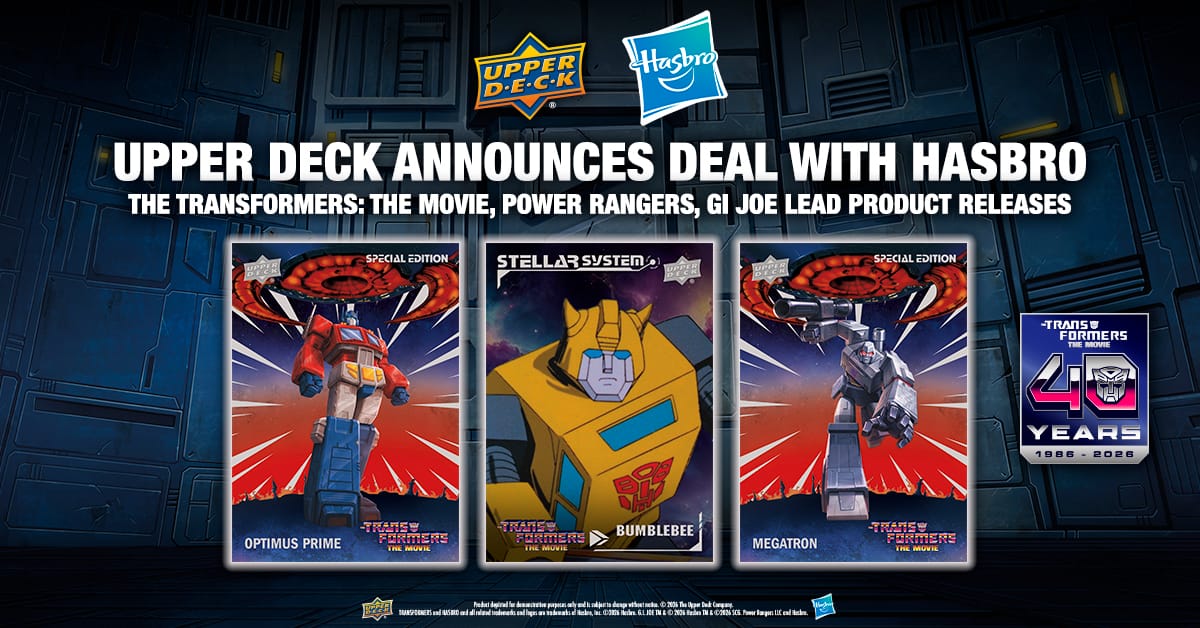
Upper Deck hat ein mehrjähriges Lizenzabkommen mit Hasbro geschlossen. Das meldete ICv2 am 26. August 2026. Die Vereinbarung erlaubt Upper Deck, Sammelkarten und laut eigener Ankündigung auch Tabletop-Spiele zu mehreren Hasbro-Marken zu produzieren: Transformers, Power Rangers, G.I. Joe, M.A.S.K. und Jem and the Holograms.
Den Auftakt macht im September 2026 ein Kartenset zum 40-jährigen Jubiläum von „The Transformers: The Movie“. Die Transformers 40th Anniversary Special Edition erscheint laut Verlag exklusiv bei Target in den USA, mit Basisset, einer Stellar-System-Einsteckserie und autografierten Karten von Peter Cullen, der Synchronstimme von Optimus Prime. Später im Jahr soll unter der Marke Fleer zusätzlich ein 100-Karten-Set folgen, dessen Insert-Serie „From Screen to Page“ Artwork aus der IDW-Comicserie zeigt.
Was der Deal für deutsche Sammler bedeutet
Der Deal betrifft zunächst den US-Markt, das erste Set ist ein Target-Exklusiv. Einen deutschen Vertriebsweg nennt Upper Deck bislang nicht. Transformers und Power Rangers sind hierzulande dennoch bekannte Marken, auch wenn die Sammelkarten selbst vorerst eine US-Angelegenheit bleiben.
Offene Frage: Was wird aus Renegades Lizenzen?
Seit 2020 ist Renegade Game Studios Hasbros Partner für Tabletop-Spiele zu denselben Marken, darunter Transformers, G.I. Joe und Power Rangers. Erst im Juni 2026 kündigte Renegade neue Rollenspiel-Ausgaben genau dieser drei Lizenzen an. Ob und wie sich Upper Decks neuer Deal mit den bestehenden Tabletop-Lizenzen von Renegade überschneidet, sagt bislang keines der beteiligten Unternehmen öffentlich.
Damit bleibt vorerst offen, ob Upper Deck ein reiner Sammelkarten-Partner wird oder Renegade auf dem Tabletop-Feld künftig Konkurrenz bekommt.
Magic: The Gathering‘s record-breaking growth continues despite a surge of high-profile competitors, with the TCG soaring past $500m in quarterly revenues for the first time in its 33-year history.
That powerful rise has been built upon the already hugely popular TCG’s expansion into licensed crossovers through its Universes Beyond line since 2021, which has seen it bring out sets for franchises including The Lord of The Rings, Final Fantasy and Avatar: The Last Airbender.
The game’s success now underpins Hasbro’s fortunes, with Magic’s strong performance repeatedly leading the line in the company’s quarterly results – as well as offsetting underperformance in other parts of the business.
Magic’s revenue grew 32% in Q2 of this year compared to the same period in 2025 according to Hasbro’s latest results report, reaching a record $545m on the back of strong sales of Secrets of Strixhaven and Marvel Super Heroes – the latter of which the company described as a “record-breaking debut”.
That result means Magic alone outstripped Hasbro’s entire consumer products segment – which includes Nerf guns, Transformers and Peppa Pig toys – which recorded revenues of $463m in the same period, up 5% year-on-year.
The consumer products segment made an operating loss of about $14.5m in Q2, compared to an operating profit of $270m from Wizards of the Coast, the business arm which includes Magic, Dungeons & Dragons and its digital games such as Monopoly Go!.
The company said the cyberattack reduced second-quarter revenue by an estimated $25m while generating $11m in direct costs as order processing, shipping and invoicing were disrupted, particularly on the consumer products side. Hasbro said those operations had now returned to normal, although it expects to incur additional costs related to the incident in future periods.
Hasbro CEO Chris Cocks
Hasbro CEO Chris Cocks said in the results report, “With strong indications for our remaining releases and line of sight to continued growth in 2027, the Magic flywheel is firing on all cylinders.”
Wizards revenue was also up 27% across the first six months of 2026, with Magic revenue climbing 34% thanks to continued growth across tabletop and digital products, Universes Beyond releases, Secret Lair products and back catalogue sales.
That continued growth comes despite the emergence of several high-profile challengers in the trading card game market over the past few years, including Disney Lorcana, Star Wars: Unlimited, Altered, Flesh and Blood and One Piece Card Game – as well as the ongoing power of fellow TCG veterans Pokémon and Yu-Gi-Oh!.
Magic’s performance was strong enough for Hasbro to increase its full-year guidance, with the company now expecting total revenue growth of between 5% and 7%, up from its previous forecast of 3% to 5%.

 Anmelden