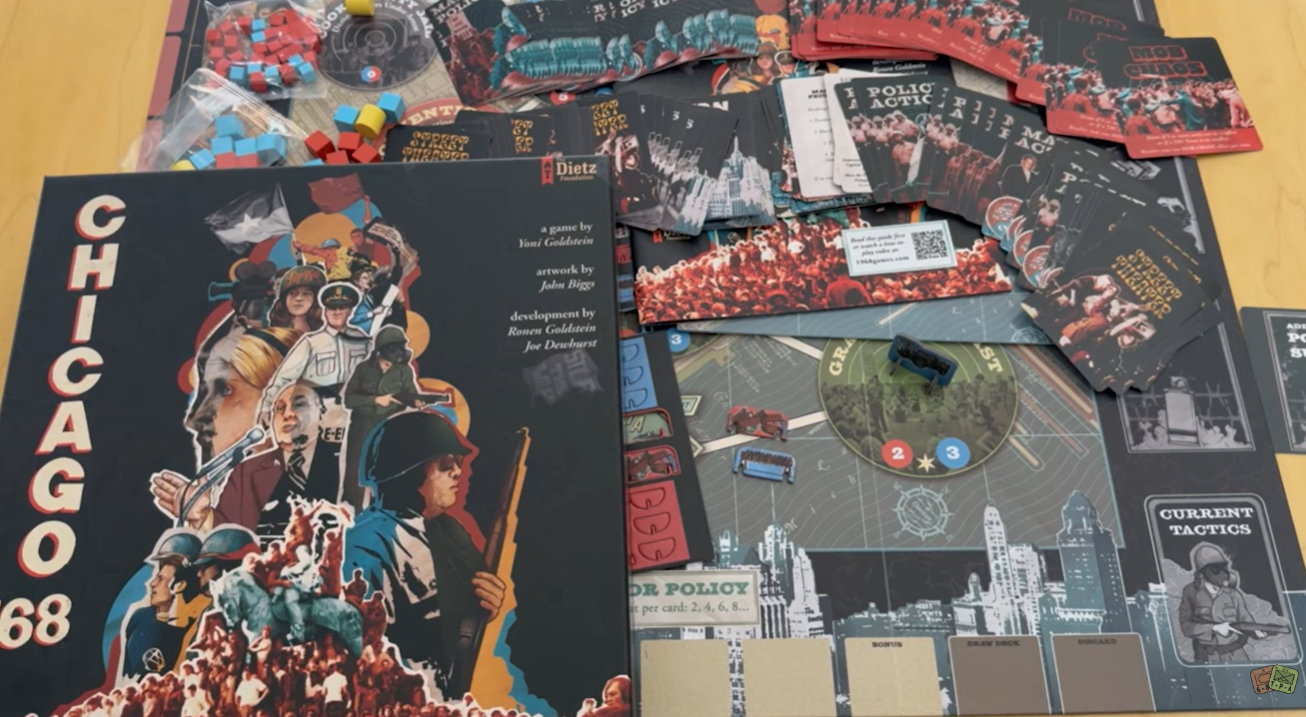
Chicago ’68 is a game about the riots during the Democratic National Convention in Chicago, set against the social upheavals of America in the sixties. After the Summer of Love, the Summer of Tear Gas. On one side: the Youth International Party (aka The Yippies) and the National Mobilization Committee to End the War in Vietnam (aka the MOBE), on the other: Mayor Daley, the Chicago Police Department and the National Guard. The game unfolds over the course of three days during the Democratic National Convention – from the 26th to the 29th of August, culminating in the nomination of a presidential candidate. There are two victory conditions: one is to gain the most media exposure favorable to your side and the other is to influence the delegate vote and bolster your political aims. The Demonstrators may pivot between these two objectives while the Establishment, although more powerful, must fight and win on both fronts.
Chicago ‘68 supports 1 – 4+ players, featuring asymmetrical card actions and tableau activation. Typical duration of play is about 45 minutes per player.
I love a different style and focus of wargame. A game that takes a look at an important but somewhat obscure or rarely addressed historical topic, such as espionage or intelligence, and creates a gaming experience tailored around the events to highlight and evoke the difficulties and tension that would have been present. In January 2026, GMT Games announced such a game in Checkpoint Charlie, which is a solo or cooperative game focused on SIS espionage missions in Berlin in the 1960’s designed by Russell Brown. We have posted an interview with Russel and it was very well received and he has now agreed to create a series of History Behind the Cards to highlight the events of the 1960’s Cold War struggle in West Germany but also to share aspects about the game play and how it models the history.
*Note: The cards highlighted in this series and their event text, as well as any pictures used showing any of the various components, are still in the design and development process and as such event effects and text might still change prior to final development and publication.Also the art and layout of the cards are only for playtest purposes at this point and the game will enter the art department as it nears publication.
History Behind the Cards – Checkpoint Charlie from GMT Games – Card #8: Loudspeaker Wars
The Berlin Wall in the 1960’s was an interesting place. When approaching from the west (actually the south if you were at Checkpoint Charlie), you could walk right up to the wall and peer over. There are stories of East Berliners parking their cars against the wall because a small strip on the western side was actually still in Soviet Territory, and the West Berlin police couldn’t give them a parking ticket. If you were an East Berliner, approaching within fifty meters of the wall would probably get you shot. In either case, if you were close enough to the wall to see over it, you were likely to see propaganda from the other side. Most of this was billboards and banners on the eastern side, but the west had its fair share of slogans supporting democracy and the allies.
The Loudspeaker Wars card commemorates the times when this war of propaganda became audible as well as visual. An ongoing battle between vans equipped with high-powered speakers began when East Germany rolled them up to the wall and began blasting propaganda at deafening volumes. When formal complaints failed, the west responded with their own loudspeakers at the wall, making it almost impossible to carry on a conversation anywhere near them. This became known as the “Noise Offensive,” or the “Loudspeaker Wars.” It continued, on and off, for years.
In Checkpoint Charlie, this card makes intelligence operations at the wall very difficult (removing all Intel Cubes there) and also attracts a crowd of gawkers in the form of a Demonstrations Marker. In addition, if Mayor Brandt is active in the mission, he immediately moves to the wall to take part in the back and forth.
In the next article in this series, we will take a look at Daily Military Train.
In my opinion, this game looks extremely interesting and I am very much excited to learn more about it. I am appreciative to Russell and his efforts to bring us these cards and to write these entries to share with our readers. I am also very glad that this topic is being covered in a game and look forward to playing this one day soon.
September has been really, really busy for me. We attended the Gaming the American Revolution Camden 250 Event in Camden, South Carolina and work was pretty busy as well. As such, I just feel like I have been unable to really give this post the time needed to make it as good as it can be. Don’t get me wrong…I am still writing it but I am not spending as much time searching this month. I also was unable to find a sponsor for the post so we are foregoing that this month as well.
This month, I was able to find 15 games to share. I was also able to find 5 games being offered on Crowdfunding through Kickstarter.
1. Battlegroup Clash: Baltics 2nd Printing from Sapper Studio
James Buckley is a name we all know in the wargaming space. He has worked with publishers like PHALANX and Nuts! Publishing and also is now a burgeoning designer as he published his first game in 2025 called Battlegroup Clash: Baltics from his new publishing company called Sapper Studio. The game has already sold out and they are currently offering up a 2nd Printing on pre-order
From the game page, we read the following:
Battlegroup Clash: Baltics is a two-to six-player tactical land warfare game that plays in two to three hours. It is a commercially-adapted version of a game recently developed for the British Army to help train its junior officers.
The game is set in Estonia and covers a hypothetical near-future Russian invasion of the country, and attempts by NATO land forces to repulse it. Each side has a maximum force size equivalent to a reinforced battalion, with individual unit sizes being platoons or sections.
It comes with six scenarios and has three play modes and optional rules, allowing for players to vary the level of realism and complexity of play. The Basic mode of play is equivalent to a light complexity commercial wargame. The Standard and Advanced modes are equivalent to a medium-light complexity game.
While the game mechanics and components will be familiar to anyone that has played a hex and counter wargame, there are several unique features about Battlegroup Clash: Baltics:
Preparation & Planning – In the Standard and Advanced modes of the game players will need to draft Orders for their forces. This happens at the start of the game. These Orders drive the actions individual units take in the game. This is a simplified version of the type of planning that would occur in real life. It presents both a challenge and opportunity to players, and greatly enhances the immersion of the game.
Drones and Electronic Warfare – Events in Ukraine have shown how much the use of drones has changed the modern battlefield. Reflecting this, in the game players use UAS drones for reconnaissance and FPV (‘kamikazi’) drones to attack enemy units. Each side can intercept their opponent’s electronic transmissions to improve targeting, and apply tactical Electronic Warfare effects such as jamming the enemy’s drone assets or crippling their GPS navigation.
Real World Mapping – The four maps in the game are based on satellite imagery from key locations in Estonia. Using computer aided design, that imagery has been turned into a highly realistic map. There are no hexes, just grid lines, the same as a real world map. Players must read the map terrain to determine key locations and terrain features, and assess how they fit into their battleplan and objectives.
If you are interested in Battlegroup Clash: Baltics2nd Printing, you can pre-order a copy for £69.00 ($92.38 in US Dollars) from the Sapper Studio website at the following link: Battlegroup Clash: Baltics (2nd printing) | Sapper Studio
2. VEKTYR: The Geopolitical Struggle for Central Asia, 1991-2020 from GMT Games
I love a good geopolitical wargame as well as a good multi-player wargame. And when these 2 are mixed, it can really make for a very interesting gaming experience with diplomacy, alliances, asymmetry and the like. This past month, GMT offered a game that have both in VEKTYR: The Geopolitical Struggle for Central Asia, 1991-2020 that takes a look at the ongoing struggle between the United States, Russia, and China. for influence and control in Central Asia. The game is designed by a new designer named Kyle Farrell so I am very interested in connecting with him to discuss the design and get more information about how it plays and what his vision and basis are for the game.
From the game page, we read the following:
VEKTYR is a 2-3 player geopolitical wargame that simulates the ongoing struggle for influence in Central Asia between the United States, Russia and China.
The game takes players from 1991 after the newly independent Central Asian nations – Kazakhstan, Kyrgyzstan, Tajikistan, Turkmenistan, and Uzbekistan – emerged from the collapse of the Soviet Union through 2020 when multiple international crises accelerated the global shift towards a multipolar world.
The extensive action deck covers over 120 distinct historical occurrences that have shaped Central Asia’s relationship with three global powers – the United States, Russia and China – as well as the rest of the world.
Over the five turns of the game, each player will have to bend history to their will in order to establish influence throughout Central Asia as well as periphery territories in the Caucasus, Türkiye, and Afghanistan. Your mission is to win hearts and minds, catch the ears of the region’s presidents, invest in critical industries and showcase your power’s prowess through military assistance.
In VEKTYR, players will accrue victory points by playing “Scoring” cards, playing event cards that award VP’s, or building pipelines for VP payouts. The game consists of 5 turns: 3 turns within the Post Independence epoch from 1991-2016 and 2 turns within the Central Asian “Renaissance” epoch from 2016-2020. Each turn consists of 6 rounds.
At the start of each turn, each player draws up to a hand size of 7 cards and plays one round in succession until every player has played 6 rounds. All of VEKTYR‘s cards have a dial in their upper left corner noting which global power the card’s event pertains to. Some cards are fully-neutral cards meaning any power can play them, others can be played by 2 of the 3 powers, and others still can only be played by a single power. Whenever a rival plays a card with an event pertaining to you, you’ll have the opportunity to resolve the event during your rival’s round. A delightful mechanic that keeps the game dynamic even when it’s not your go!
Every round, players either use their card’s event or action points to lay influence on the board, seize the ear of the region’s presidents, invest in industries, provide military assistance or build pipeline infrastructure. Much of the game centers around your ability to build influence in the Central Asian provinces as well as periphery countries. Players will use events and action points to gain a strategic foothold in these wide stretches of Eurasia. But how effective will your soft power be in fending off your rivals’ similarly enticing offers?
Also, what have you done for me lately? One of the mechanics that keeps the board fresh in VEKTYR is called “atrophy” and mimics the ephemerality of political popularity. Under this mechanic, at the end of every Turn, each player removes some of their influence from the board, opening up new possibilities for their opponents as they are forced to abandon specific countries or provinces.
I am very much interested in this title and would like to learn more about how it works and how it tries to simulate the complex situation and politics involved.
3. Empire of the Sun: China Expansion from GMT Games
Empire of the Sun is Mark Herman’s card driven design that takes a strategic level look at the entirety of World War II in the Pacific from the attack on Pearl Harbor until the surrender of Japan and is the first card driven game (CDG) to move the system closer to a classic hex and counter wargame, while retaining all of the tension and uncertainty people have come to expect from a CDG. Recently, GMT announced an expansion to the game that deals with the China Theater and the action that took place there between the combatants. The game comes with a new replacement map that will replace the China Front Track as well as some new cards. The game was dreamed up by a few Chinese designers, and fans of Empire of the Sun, named Ji So and Liu Zhijun.
From the game page, we read the following:
Empire of the Sun examines the China theater as a frontline ‘piston’ model that reprises its historical role as an Allied resource need based on the level of Japanese offensive efforts to force its surrender. We are now releasing a new expansion for the core game, which you will need to play this expansion that adds all of the ground and air forces to open up a path not really taken to include the eventual Soviet invasion of Manchuria.
About two years ago, two Chinese gamers contacted me that they had developed a China expansion for Empire of the Sun. I was certainly interested and what you hold in your hands is the product of my collaboration with Ji So, Liu Zhijun, and my developer Francisco Colmenares. What has changed is my original piston model China Front track has been replaced with a map and counters. There are a host of rules to handle this unique theater of operations, but what I have found at their core is how well we have gotten the new module to perform to history and the original track.
What you will find is if the Japanese play cards into China offensives, they will likely capture and control the rail lines plus the coastal ports. Achieving more is possible, and everyone is likely to try, but it is hard to get forward momentum as long as the Allies put some equivalent effort into defending Chungking. This is exactly how the original track worked, but what is very interesting is you more clearly see the connection between the China-Burma-India (hereafter CBI) theater and mainland China. In my various opposed playtests, I have found that in half the games there is some action in China and in others not much happens. I have also found that if the Japanese army strategy is followed, the US makes quicker progress across the Pacific. What this will give you is more control over how you decide to prosecute the war from the Japanese perspective. That said, every so often I have had spectacular success with a surprise Chinese offensive. More options, more strategy, and for me, more interesting game play.
Empire of the Sun: China Expansion comes with 33 new cards (18 Allied and 15 Japanese), a 22”x34” paper map (original map art with the China theater shown in detail), one counter sheet featuring new US, Nationalist Chinese, Communist Chinese, Japanese, and Soviet air, ground, and naval units, replacement player aids with the new rules added for China, PLUS an integrated rulebook with all rules integrated into the original core system. Empire of the Sun: China Expansion is now available for the low, low, low, low price of $35.
4. Pax Romana & Genesis Dual Pack Reprint Edition from GMT Games
I very much love these Deluxe Edition Multi-Packs from GMT Games. They are an insane value with multiple games included in the same box, typically with new components, updated rules and sometimes additional scenarios. A newly announced pack is the Pax Romana & Genesis Dual Pack, which contains 2 classic Ancients games in Pax Romana and Genesis designed by Richard Berg.
From the game page, we read the following:
GMT is proud to bring back into print Richard Berg’s Pax system games, Pax Romana and Genesis in a dual pack format. This printing of Pax Romana will be identical to the 2nd edition published in 2015 with all known errata incorporated along with additional editing where necessary to improve clarity. Similarly, this printing of Genesis will be identical to the 1st edition with the exception that Kingdom Displays will be enlarged to 8 ½ “ x 11”. All known errata will be addressed with additional editing where necessary to improve clarity. The games will share a back-printed mounted map and come in a 3” box.
Components
Pax Romana
One 22″ x 34″ back printed full-color mounted map board shared with Genesis
Three full-color die-cut counter sheets (1/2” counters, 280 counters per sheet)
One smaller full-color die-cut counter sheet (5/8” counters)
One smaller full-color die-cut counter sheet (round counters)
55 Event Cards
Four 8 ½ ” x11″ Player Mats
Two 11” x 17” Player Aid Cards (four sets of the two PACs)
Rule Book
Play Book
Two six-sided dice
Genesis
One 22″ x 34″ back printed full-color mounted map board shared with Pax Romana
Three full-color die-cut counter sheets (840 1/2” counters)
55 Event Cards
Two 11” x 17” Player Aid Cards (five sets of the two PACs)
Five 8 ½” x 11” Kingdom Display Cards
Rule Book
Play Book
Two six-sided dice
Pax Romana
How did Rome get to be Rome? Why did the Glory That Was Greece fade? What stopped Carthage from making an empire of the Mediterranean? Could the Seleucids really have conquered the western world?
These are a few of the questions you can explore in Pax Romana, designed for play by all levels of gamers, from the competition-oriented, one sitting players to the Let’s Recreate History on a grand scale afficionados.
Pax Romana covers the Europe from 300 BC through the end of the 1st century BC, when control of the Mediterranean was in a state of flux with four possible empires. And it does so with a scale and system that is filled with decision-making tension but also highly accessible and easy to play. The emphasis is on strategic operations, from raising armies to colonizing outlying areas, to fighting barbarian incursions, to maintaining political stability at home.
Pax uses a unique marker-oriented play sequence that provides surprise and opportunity, plus a deck of unusual cards that provide the historical background of events and calamities within which the players must operate. Each turn represents 25 years, with the movement of forces and the shifting of power occurring at a proportionately very large scale. Combat takes place throughout the game, but they, too, represent ongoing conflict as much as individual battles. But even here, subtleties are built-in: force composition matters – armies overbalanced by cheap light infantry suffer penalties, while cavalry can single-handedly make the difference between winning and losing – and knowing when and where to make a stand and when to withdraw to safer places can literally decide the fate of a power for an entire generation. And at this scale, of course, the best-laid plans frequently go awry.
Most important for gamers, though, is the wide variety of scenarios Pax provides, from fast-playing, one-sitting two-player games to vivid recreations of the entire era with four players. The game works well with 2, 3 or 4 players, and is designed to be playable solitaire for those interested in the historical view it provides. Scenarios range from The Punic Wars, through the Eastern Med conflicts between the Greeks and the Seleucids, all the way up to the entire 10 turn game, covering 300 years of history. In addition, there are two versions of Pax: the Standard Game, designed for fast play, and the Advanced version, which adds in much tangential history and allows for a more introspective examination of the era.
Genesis
Genesis is a campaign-level game covering the turbulent Late Bronze Age in the Middle East, where kingdoms rose and fell while establishing many of the systems and ways of life that underwrite Western Civilization. Much like its ancestor game, Pax Romana, Genesis is a game that provides the players with the historical dramatis personae and allows them to forge their own empires. It also has a great emphasis on the control of the important trade routes and commercial centers and the building of the spectacular monuments these civilizations left for posterity and wonder.
All the “high”-points of this era are included: lots of gods that have major effect on play (Astarte, Baal, Dagon, Marduk, et al), the rise of chariot warfare … peasants, slaves, and a host of historical kings: Thutmose, Akhenaten, Suppiluliuma, Mullatawi, Tushratta, Hammurabi, Agum III, Shalmaneser, Shamsi-Adad , and many more. . . even Sargon the Great (the world’s first great conqueror (2270-2215 BCE) … along with Sea Peoples, independent kingdoms (Canaanites, Arzawans) and pirates, and guys with great beards (see below):
There are several two-player scenarios for short-time play, an introductory scenario to get you into the system (featuring Sargon), and the big, 5-player multi, included all the major players – Egypt, The Hittites, the Mitanni, Assyria and Babylon – more color than a Crayola Factory and more fun chrome than a ‘57 Chevy. The main scenario can also be played with 3 or 4 players.
Of course, there are the cards (the game is not card-driven but card-augmented), such as:
The Begat Effect: Independent Expansion (2): The card player may move a Peasant unit from a friendly City space to any unoccupied independent City space within 4 spaces of where that Peasant starts. This card may be held in Hand until played.
Baal (2): It’s Time to Pay Baal … and all those priests running those temples. For every Monument he has in a Home Kingdom City, the card player must pay 2$. If he cannot pay, the player must remove the Monuments that he cannot pay for.
The Akhenaten Effect: If you are Egypt and your Pharaoh/King is Akhenaten, you do not pay anything; you simply remove all Monuments in your Home Kingdom cities. This card must be played when drawn.
5. Enemy Coast Ahead: The Dambuster Raid Mounted Map from GMT Games
One of my complaints about wargames is that that boards that you play the games on are paper. These are generally flimsy, have severe folds on them that disfigure the beauty of the boards and also are a bitch to get to lay flat without having humps in them that act as steep terrain and make it hard for me to line up my units. Now, once again, I want to say that I generally am ok with paper maps for multi-map hex and counter wargames where having a nice thick mounted map, or in the case of many maps, is infeasible for storage purposes. But, when the game is a different kind of game, such as Waro (Euro focused wargame), I very much like having a solid mounted mapboard. One of the offerings this month is a step in the right direction to fix a great game with a new Mounted Map for Enemy Coast Ahead.
From the game page, we read the following:
Based on positive feedback to our mounted mapboard releases, we are continuing to offer mounted maps for several of our most popular games as P500 items.
We are now offering a 22 x 34″ mounted map for Jerry White’s Enemy Coast Ahead: The Dambusters Raid. This is intended to ship separately along with the game’s 2nd printing. But note that it will work with either 1st or 2nd printing, so this will work just fine for those of you who want to get a mounted map for your original game. Enjoy!
6. In the Desert 1940–1943: WW2 in North Africa from Dissimula Edizioni Currently on Kickstarter
Several years ago, Sergio Schiavi broke onto the scene with his new company called Dissimula Edizioni with their first Kickstarter called Radetsky’s March: The Hundred Hours Campaign and that game was then followed a few years later by From Salerno to Rome: World War II – The Italian Campaign, 1943-1944 and their third game called Give Us Victories: The Chancellorsville Campaign. They also have a line of smaller, simpler games that started with 1943-1945 from a few years ago that dealt with the war for Italy during WWII. That game was fantastic and they have now worked on the 2nd entry in that series called In the Desert 1940–1943: WW2 in North Africa that is currently on Kickstarter.
From the game page, we read the following:
Between 1940 and 1943, North Africa was the theater of a war fought between the Axis forces and the British Commonwealth; numerically limited armies faced each other in a long sequence of offensives, retreats, and counterattacks. The clashes often took place in the desert, where mobility and the ability to maintain supply lines were as decisive as the strength of the weapons.
Behind the front loomed Malta, a strategic British base and a constant threat to the vital supplies heading toward Tripoli…
The game system used in In the Desert 1940–1943: WW2 in North Africa is derived from 1943–1945, but features significant differences. The game lasts eight turns, during which players alternate their operations by spending Supply Points (SP). Each activation requires careful decisions: commit your forces immediately or preserve them for later operations? Supply is essential: without a clear line to their own bases, units risk remaining engaged and vulnerable. Meanwhile, control of Malta constantly threatens Axis supplies. Special events allow players to alter the situation on the battlefield, recover forces, strengthen attacks, or create new strategic opportunities.
As of October 1st, the Kickstarter campaign has funded and raised $5,461 toward its $3,643 funding goal with 156 backers. The campaign will conclude on Wednesday, October 7th at 4:25am EDT.
7. Napoléon 1870: The Collapse of the Second French Empire from Shakos Currently on Kickstarter
I do love a good Napoleonics wargame and The Conquerors Series from Shakos is really very good as we have played a few games over the years. They have a new volume in that series on Kickstarter that is designed by a tandem of great designers in Brian Asklev (Baltic Empires from GMT Games and 1812: Napoleon’s Fateful March from VUCA Simulations) and Fred Serval (A Gest of Robin Hood and Red Flag Over Paris from GMT Games as well as A Very Civil Whist from PHALANX) called Napoléon 1870: The Collapse of the Second French Empire from Shakos. This game is set in a different period but uses the same system to tell the story of the collapse of the Second French Empire during the Franco-Prussian War of the 1870’s.
From the game page, we read the following:
In 1870, Napoleon III’s Second Empire was on the brink of collapse. After hastily declaring war on Bismarck’s Prussia, the French armies were overwhelmed and surrounded at Metz.
This is your opportunity to write something different.
Napoléon 1870 is the fourth instalment in the Napoleon Series, a series devoted to the great strategists of history. Following on from Napoléon 1806, Napoléon 1807 and Napoléon 1815, Napoléon 1870 brings its own unique challenges to this well-tried and highly acclaimed campaign system.
In Napoléon 1870, two players, assume the role of Napoleon III or Bismarck, making the key decisions that will shape the fate of Europe. In the role of Napoleon, will you manage to escape the trap set by your opponent and avoid being trapped in Metz, or, like Bismarck, will you succeed in taking the French armies by surprise and outflanking them? A variety of scenarios, lasting from 40 minutes to 2 hours and a half, will allow you to rewrite the battles along the borders right up to the final assault on Metz.
Napoléon 1870 is aimed at both seasoned grognards as well as enthusiastic young conscripts keen to understand how history is made. Thanks to a set of simple rules that remain faithful to historical reality, all the key aspects of the campaigns of the Napoleonic era are recreated so that players can engage with them. As events unfold, there will be scope for both subtle bluffing and the brutal use of overwhelming force.
Napoléon 1870 follows the rules of the Napoleon Series (also referred to as the Conquest Series) created by Denis Sauvage, but two designers wellknown to the general public have teamed up to produce this new installment:
• Fred Serval, a specialist in the Second Empire and author of Red Flag over Paris and A Gest of Robin Hood from GMT Games.
• Brian Asklev, an expert in Napoleonic strategy and operations, author of 1812: Napoleon’s Fateful March from VUCA Simulations.
As of October 1st, the Kickstarter campaign has funded and raised $32,894 toward its $17,079 funding goal with 294 backers. The campaign will conclude on Tuesday, October 13th at 2:00pm EDT.
8. Band of Brothers BLACK BULL: British 11th Armoured Division Bull from Worthington Publishing Currently on Kickstarter
There are some series out there that people really love and enjoy playing. This love leads to the series selling well and then expanding as the market is able to continue supporting the games. Band of Brothers from Worthington Publishing is such a series. A tactical level squad based game set in World War II, the series has expanded into several different theaters and has multiple stand-alone expansions. Recently, I saw news that there would be a new volume coming to Kickstarter called Black Bull, which focuses on the exploits of the British 11th Armoured Division during World War II.
From the game page, we read the following:
The Band of Brothers Series returns to Europe with BLACK BULL: British 11th Armoured Division, a new standalone game focusing on one of the British Army’s best-known armoured formations of World War II.
The British 11th Armoured Division was formed in 1941 and adopted the distinctive Charging Bull as its divisional emblem.
The game includes 14 scenarios following the 11th Armoured Division through its campaign in Northwest Europe.
The scenarios put the British player in command of the infantry, tanks and supporting weapons of the Black Bull against German forces in a variety of tactical situations.
As of October 1st, the Kickstarter campaign has funded and raised $19,020 toward its $500 funding goal with 267 backers. The campaign will conclude on Saturday, October 10th at 4:00pm EDT.
9. Aces of Aces: Handy Rotary & Flying Machines Deluxe Editions from Mr. B Games Currently on Kickstarter
A classic reborn is how I would classify the newest edition of Ace of Aces. With very unique mechanics trying to provide the experience of dueling it out with an enemy biplane over the fields of World War I, Ace of Aces is now making a comeback with the Powerhouse Series rebirth all the way from 1981. The newest edition include a look at 2 games in Aces of Aces: Handy Rotary & Flying Machines Deluxe Editions.
From the game page, we read the following:
We’re back with two more Ace of Aces books! We are giving our deluxe treatment to two more books, Ace of Aces: Flying Machines and Ace of Aces: Handy Rotary. We promised these during our Powerhouse Series Kickstarter campaign, and we’re excited to bring them to you now. Just as with our Ace of Aces: Powerhouse Deluxe Edition, these will both be redone in full color with the same slipcase design as the Powerhouse edition.
The Ace of Aces family of games uses two books to simulate a duel in the skies between two fighters in World War I. Using Alfred Leonardi’s innovative matrix system, players choose maneuvers in their book. Each maneuver leads to a page in the book that matches the first-person perspective of the pilot. Players maneuver to line up their planes so they can unload their guns on their opponent. Take too many shots, and you go down in flames!
Each of the Ace of Aces sets includes two books; these are the dogfighting books, as well as a rulebook and chart book, all in a beautiful slipcase! The slipcase also has an extra drawer to store dice and chips.
We’ve updated all the interior graphics with all new artwork. All in full color! These aren’t the final pages, but they are pretty close
As of October 1st, the Kickstarter campaign has funded and raised $162,075 toward its $50,000 funding goal with 1,335 backers. The campaign will conclude on Thursday, October 8th at 6:00pm EDT.
10. Afrika Korps 41 from Trafalgar Editions Currently on Kickstarter
Who doesn’t love a good North Africa wargame? No one says me and I am excited to share with you this new upcoming game called Afrika Korps 41 from Trafalgar Editions. The game is currently on Kickstarter and really looks to be pretty good.
From the game page, we read the following:
The North African desert, 1941. The armored columns of Rommel’s Afrika Korps and the British 8th Army clash in a brutal war of movement for strategic control of the Mediterranean theater.
Afrika Korps 41 puts you in supreme command of this legendary campaign. Featuring an intuitive, deeply challenging, and highly immersive gameplay system, it delivers the true grit and tactical depth of historical conflict—without the dense complexity of traditional wargames.
There are several games that recreate the North Africa campaign in World War II, but Afrika Korps 41 offers a unique experience thanks to its balance between accessibility and strategic depth.
Simple Rules, complex decisions – Unlike other denser wargames, here the rules are easy to learn, but mastering the game requires planing and efficient resource management
Area-based system – Forget about hexes. Movement and territorial control are resolved intuitively with clearly defined strategic areas.
Innovative combat chart – We’ve designed a combat resolution system that moves away from the traditional, offering dynamic and realistic results without relying on complex tables.
Clean map with integrated aids – Key information is incorporated directly onto the game board, facilitating quick reference and speeding up gameplay.
Three difficulty levels – From an introductory mode ideal for new players to advanced levels that will challenge even the most experienced.
Flexible experience – You can play the full campaign or choose between three historical scenarios of 30-40 minutes, in addition to the option of starting the campaign from different key moments of the conflict.
Solo mode – Perfect for those who want to enjoy the game without needing an opponent.
Larger counters (17 mm) – Greater comfort and visibility on the battlefield.
Afrika Korps 41 is designed to offer an immersive, strategic, and dynamic experience, with innovative mechanics that differentiate it from other games about the same campaign.
And the game comes designed with a fully functioning solitaire game mode for those that either prefer to play solitaire or have difficulty finding opponents.
Afrika Korps 41 features an advanced Artificial Intelligence (AI) system designed to deliver the full gameplay experience in solo play, allowing you to command either side (the Axis or the Allies). Both the full campaign and individual scenarios are completely playable without a human opponent, ensuring a tactical challenge that is as tense as it is dynamic.
Forget predictable automation. Our AI makes strategic decisions based on the actual, real-time context of the board. By evaluating the map situation and vital objectives, the system dynamically shifts between two core mentalities:
Offensive Posture (Attacker Mode): The AI aggressively seeks to breach your lines, pushes relentlessly toward strategic objectives, and exploits every single tactical blunder you make.
Defensive Posture (Defender Mode): The enemy digs in smartly, focusing on consolidating key positions, containing your advances, and efficiently deploying their reinforcements.
Infinite Replayability: Thanks to this adaptive behavior, no two solo games will ever play the same. The system immerses you in a war of attrition where your ability to counter the AI’s unpredictable maneuvers is your only path to victory.
As of October 1st, the Kickstarter campaign has funded and raised $12,704 toward its $7,932 funding goal with 151 backers. The campaign will conclude on Friday, October 16th at 6:00am EDT.
New Release
1. Colossus Stumbled: The Second Battle at Kharkov, May 12-23rd, 1942 from Three Crown Games
Three Crown Games is a great little company and their games really cover some great historical topics and also look the part as they are well produced, even though they are poly bag and not boxed games and are just plain desirable. This month, I noticed that they were shipping one of their new games called Colossus Stumbled: The Second Battle at Kharkov, May 12-23rd, 1942 and I very much wanted to share it with you.
From the game page, we read the following:
Colossus Stumbled is the title of the game that handles the first 12 intensive days of the second Battle of Kharkov (nowadays Kharkiv), 12 to 23, May 1942. On 12 May 1942, Soviet forces launched an offensive against the German 6th Army from a salient established during the winter counter-offensive. After a promising start, the offensive was stopped on 15 May by massive airstrikes and the Axis started their counter-offensive ‘Operation Fredericus’, in the region around Kharkov. Its objective was to eliminate the Izium bridgehead over Seversky Donets or the “Barvenkovo bulge” which was one of the Soviet offensive’s staging areas.
If you are interested in Colossus Stumbled: The Second Battle at Kharkov, May 12-23rd, 1942, you can order a copy for 49,50 € ($57.30 in US Dollars) from the Three Crown Games website at the following link: https://www.threecrownsgames.com/product-page/colossus-sumbled
2. Medieval Command: Battle of Varna, 1444 Print & Play from Solo Wargame
Martin Melbardis began his design career with Campaign: Fall Blau from Catastrophe Games. This was a very interesting little dice chucking solitaire game on Operation Barbarossa during WWII. Since that time, he has started his own independent wargame company called Solo Wargame and has designed 10 different and very interesting roll and write wargames on a plethora of subjects including World War I (Trench Tactics), World War II (Operation Barbarossa, Lone Wolf: U-Boat Command and War in the Pacific), Napoleonic Wars (Siege Works) and Ancient Rome (Rome Must Fall). His newest game called Medieval Command: Battle of Varna, 1444 starts a new series and is focused on the Crusade Battle of Varna and looks really interesting.
From the game page, we read the following:
On the fog-shrouded morning of 10 November 1444, the fate of southeastern Christendom hangs by a fraying thread as your heavily outnumbered Crusader army stands before the terrifying mass of Sultan Murad II’s Ottoman host near the Black Sea port of Varna. You are outnumbered nearly two to one; however, your heavy cavalry advantage can make the difference. Medieval Command: Battle of Varna 1444 is a solo Print & Play wargame that simulates the epic last ditch crusade attempt to free the Balkans from Ottoman rule. As the solo player, you play the role of Crusader, while the BOT handles your opponent, the Ottomans. You must master a tight dice-drafting system where GREEN dice power Ottoman attacks and Crusader defenses, while WHITE dice fuel your own offensives. Because you cannot win a war of attrition against these odds, your only hope is to tactically bank your dice to unleash devastating Boosted Actions like a thunderous, multi-die cavalry charge to smash the elite Janissary Wall before your lines crumble and the young King Władysław III is slain in the mud.
Here is a link to a playthrough video from the designer:
3. Thirty Years of Misery: The Thirty Years War 1618-1648 from VUCA Simulations
A couple of years ago, I came across a new designer named Brian Asklev and have done interviews with him covering Baltic Empires from GMT Games and 1812 – Napoleon’s Fateful March from VUCA Simulations. Brian is a pretty sharp designer and I very much like his approach to design as well as the choices in designs that he is doing. His new game is called Thirty Years of Misery: The Thirty Years War 1618-1648. The cover art is amazing, the topic looks great and the approach that he is taking seems to be very novel.
From the game page, we read the following:
Between 1618 and 1648, Europe was consumed by one of the longest and most destructive conflicts in its history. What began as a rebellion in Bohemia soon engulfed the Holy Roman Empire and drew nearly every major European power into a struggle over religion, dynastic ambition, and political supremacy. Millions perished as armies marched across Central Europe, cities were besieged, alliances shifted, and entire regions were devastated.
Thirty Years of Misery places you in command of the major powers that shaped this conflict. Lead the Imperial Habsburgs, the Catholic League, Sweden, or France as you fight to reshape Germany through military campaigns, religious influence, political maneuvering, and strategic diplomacy.
Victory requires more than battlefield success. You must secure electorates, protect your heartlands, influence the religious landscape of the Empire, and achieve your faction’s unique historical ambitions before peace is finally negotiated at Westphalia. Rather than recreating individual battles, Thirty Years of Misery captures the entire strategic conflict across three decades of war.
Every campaign combines:
Military operations
Religious conflict
Political objectives
Coalition warfare
Historical events
Dynamic diplomacy
Each round features a randomized turn order, ensuring that no two campaigns unfold the same way. Players must continually adapt to changing circumstances, unexpected interventions, and opportunities created by both allies and enemies.
4. The Far Seas: German Cruiser Operations at the Onset of WWI from VUCA Simulations
Another new order game from VUCA Simulations this month is The Far Seas: German Cruiser Operations at the Onset of WWI and I am always in for a naval focused wargame. I have not played that many and frankly not that many of the ones that I have played are that good but this one does look intriguing. I have also always been interested in the German efforts to solidify their place around the globe navally and with the founding of colonies in Africa and the South Pacific. So this one looks to fill that niche and looks to be really very interesting.
From the game page, we read the following:
At the outbreak of World War I, eight German cruisers were scattered across the globe—isolated, outnumbered, and cut off from home. What followed was a daring campaign of commerce raiding, evasion, and naval warfare that forced the British Empire to divert vast resources in pursuit.
The Far Seas puts you in command of this asymmetric naval struggle.
Take control of the German raiders or the Allied fleets in a tense operational-level game of hidden movement, search, and decisive engagements.
German player: Plan secretly, strike where the enemy is weak, raid merchant shipping, disrupt supply lines, and attempt the long journey home.
Allied player: Coordinate a superior fleet, protect trade routes, and hunt down elusive cruisers across the world’s oceans.
Every decision matters—overextend, and you risk destruction; hesitate, and the enemy slips away.
The system is built for fast turns, high tension, and meaningful choices:
Hidden movement and intelligence gaps create constant uncertainty
Elegant search and encounter mechanics lead to dynamic engagements
Combat resolves quickly but carries lasting consequences
Modular rules allow you to scale complexity to your preference
The core experience is accessible, yet layered with strategic depth for experienced players.
Beyond the core system, the game integrates historical realities that shaped naval warfare in 1914:
Coaling constraints force long-term planning
Convoy systems create high-risk, high-reward targets
Colonial operations add strategic pressure points
Special events introduce uncertainty and narrative moments
These elements enhance realism while preserving smooth gameplay.
If you are interested in The Far Seas: German Cruiser Operations at the Onset of WWI, you can order a copy for $99.99 from the VUCA Simulations website at the following link: https://vucasimulations.com/products/the-far-seas
5. In Fours to Heaven: The Invasion of Poland 1939 from VUCA Simulations
Last year, while trolling the interwebs, I came upon the In Development section of the VUCA Simulations website and saw a very interesting looking operational level wargame on the German invasion of Poland in 1939 to kickoff World War II called In Fours to Heaven. The subject caught my eye, the title caught my eye and the cover caught my eye and I am very much interested in this one. I know that this campaign is seen as very one sided and that the outcome was predetermined as there was really no way for the Polish army to stand against the might of the German war machine but this one takes a look at the situation and makes it a gameable effort.
From the game page, we read the following:
In Fours to Heaven places you at the operational command level of the German invasion of Poland in 1939—a campaign often considered decided, yet far more complex, chaotic, and uncertain than history suggests.
Will you execute a lightning campaign—or struggle against friction, supply, and coordination breakdowns? Will you delay the inevitable—or collapse under pressure?
This is not a scripted retelling. It is a dynamic operational simulation of the Polish Campaign—driven by uncertainty, command limitations, and morale.
The German player must achieve rapid operational success before time, logistics, and resistance slow the advance.
The Polish player fights a desperate but intelligent campaign of delay, coordination, and survival—where morale becomes a decisive factor.
As usual, thanks so much for reading along and sticking with me this month as I navigated through the many websites and game pages looking for new and interesting games to share.
The August 2026 Monthly Debrief Video, which is the 8th episode in Season 6 of this series, saw us discussing American Revolution Wargames. As you may know, I really enjoy the history of the American Revolutionary War. I have read dozens of histories on the subject, with my favorite being Robert Leckie’s George Washington’s War: The Saga of the American Revolution, and it never ceases to amaze me how a group of ragtag rebels were able to best an entire global Empire in open rebellion. The reason for that was the patriots resolve and their ability to run away when outmatched to fight another day when they had a better advantage and not necessarily because they were better armed, or drilled or disciplined. I think that their desire to truly be free was the main difference but that is up for speculation. I love the games on this subject and have played nearly 20 and I was surprised at the number when we had this discussion.
Also, as usual, we covered the games we played in August as well as the games we plan to play in September and had a short discussion of our plans to attend the Gaming the American Revolution Camden 250 Event in Camden, South Carolina sponsored by GMT Games.
We will remind you here that we are fortunate to be continuing our relationship with Noble Knight Games as the sponsor for our Monthly Debrief Video series. In case you don’t know, Noble Knight Games specializes in hard to find games but also carry all the new releases. But what makes them truly unique is that you can find some of the rarest games, long out of print games, hand made games, imported games from overseas, etc. Thanks to them for their sponsorship and we hope that you will consider them first when looking for the games we cover.
Games tackling subjects ranging from the 1968 Democratic National Convention protests to the 30-year holdout of Japanese WW2 soldier Hiroo Onoda have been named as finalists in this year’s Summit Award, which aims to recognise historical game designs which have attracted new players or introduced new subjects or perspectives to the hobby.
The game puts players in the roles of the gender-defying mollies of early 18th century London, attempting to build community and joy while facing persecution by the Society for the Reformation of Manners.
Chicago ‘68, designed by Yoni Goldstein and published by the Dietz Foundation, was the most-selected title during the Summit Award’s public nomination process this summer.
Chicago ’68, designed by Yoni Goldstein || Photo Credit: Yoni Goldstein
The game explores the protests and police response surrounding the 1968 Democratic National Convention, dividing players between Establishment and Demonstrator factions including the mayor’s office, Chicago Police Department, Yippies and National Mobilization Committee To End The War In Vietnam.
Battlefields of the Napoleonic Wars, designed by Paolo Mori and Alessandro Zucchini and published by Ingenioso Hidalgo, uses four different battlefield maps to recreate engagements from the Napoleonic Wars in sessions lasting between 60 and 120 minutes.
The fourth finalist is Francisco “Pako” Gradaille’s Onoda, a 25-minute solo game published by Salt & Pepper Games which explores the experiences of Japanese soldier Hiroo Onoda, who continued guerrilla warfare on the Philippine island of Lubang until 1974. Judges praised the unusual subject and the way the game asks players to engage with Onoda’s story and decisions.
Onoda, designed by Francisco Gradaille || Photo Credit: Salt & Pepper Games
Winter Rabbit, which draws on traditional Cherokee animal stories and was created as a counterpoint to common colonial themes in games, was runner-up in the 2021 Zenobia Award and won the Light Strategy category at this year’s Origins Awards.
The Summit Award considers games across five criteria – ease of teaching, ease of play, uniqueness of topic, novelty of approach and effectiveness as a historical game.
SDHist, which was launched mainly as a local wargaming group in 2015, is led by wargaming experts including Liberty or Death: The American Insurrection designer Harold Buchanan.
The organisation’s board and board of advisors selected three of this year’s finalists following the public nomination process, which put Chicago ‘68 on the shortlist.
The same groups will select the winner, which is set to be announced at the SDHist Summit convention in San Diego in November.
With this My Favorite Wargame Cards Series, I hope to take a look at a specific card from the various wargames that I have played and share how it is used in the game. I am not a strategist and frankly I am not that good at games but I do understand how things should work and be used in games. With that being said, here is the next entry in this series.
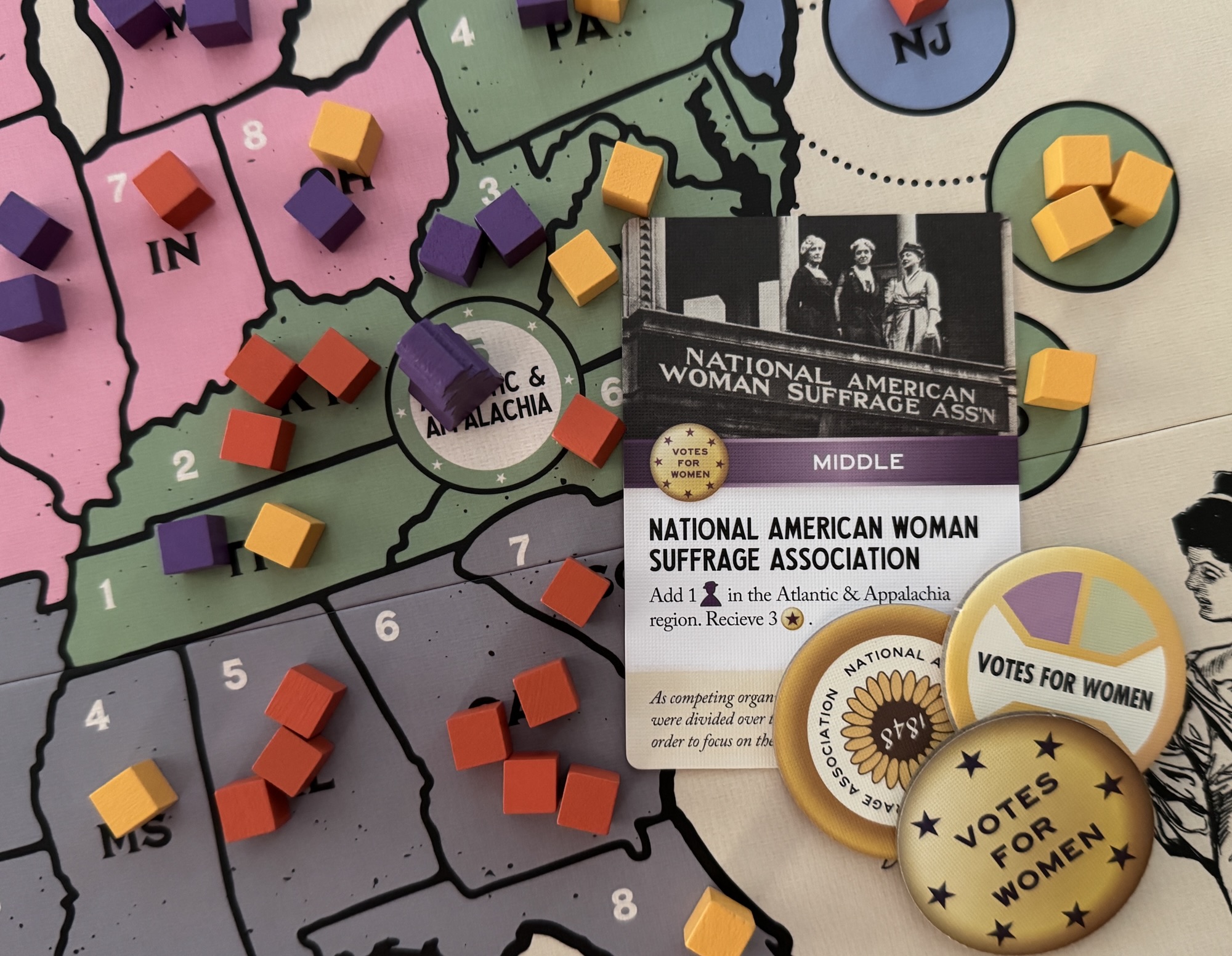
Card #88: National American Woman Suffrage Association from Votes for Women from Fort Circle Games
Votes for Women is a very interesting card-driven game that covers the American Women’s Suffrage Movement from 1848-1920, culminating in the ratification of the Nineteenth Amendment which granted women the right to vote. The game is a 2-player game, that has a fully developed solitaire mode with an “Oppobot” and offers a cooperative mode for those who don’t wish to play as they Opposition. The Suffragist player will have to push Congress to propose the Nineteenth Amendment, and then focus on campaigning to have a minimum of 36 states to ratify the Amendment. The Opposition side will try to prevent Congress from proposing the amendment and failing that to have 13 states reject the amendment.
The game uses cards in a fairly traditional CDG way as there are events that can be be taken or the cards can be played to do things like Campaign, Organize or Lobby Congress. Each card has a specific Card Era that is used to create of the each players’ Draw Decks. Late cards will be on the bottom of the deck, Middle cards will be in the middle of the deck and Early cards will be on the top of the deck. The Suffragist and Opposition decks each have one Start card that will be placed in the player’s hand at the start of the game. Some Event Cards have a prerequisite and some of the cards require a player to roll a 6-sided die and only take the the action on a roll of 3-6. Otherwise, the Event Card is discarded with no effect. The cards in this game are also steeped in historical details, from the name of the events that tie back to specific individuals or happenings, to major moments in the struggle. This game is about the history of the struggle for the right to vote and it is very good!
One of the more interesting aspects about the mechanics of the game is the use of Campaigners to go about trying to influence the attitude of the people and legislators regarding the Nineteenth Amendment through the Campaign Action. When a card is played for a Campaign Action, the player rolls a die, either a 6-sided or 8-sided die depending on what cards have been activated, for each Campaigner they have in play. The player then gets to take the dice and their results, which range from 1-8, and assign a specific die to each of their Campaigners. Each Campaigner may then place the corresponding number of cubes, matching the Campaigner’s color, in the States within the region that the Campaigner is located in. The player may spend a Button to move the Campaigner to a different region, but all of the corresponding cubes must be put into the same region. This is a great way to get a lot of influence out on the board to begin taking control of various States for the final vote in the game. This also is a very efficient way of doing this as you will be rolling 2-3 dice for your Campaigners and then spamming the States. With that in mind, today’s card is the National American Woman Suffrage Association and it provides the Suffragist player with a new Campaigner (purple) to place out specifically into the Atlantic & Appalachia Region that includes the States of Kentucky, Tennessee, West Virginia, Pennsylvania, Virginia, North Carolina, Maryland and Delaware. The card also grants the Suffragist player with 3 Buttons that can be used as described above to relocate a Campaigner from one state to another. This card is very helpful and should be played for the Event 9 times out of 10 and will make a huge difference in the outcome of the game. Once a 2nd or 3rd Campaigner is deployed, I tend to take Campaign Actions rather than some of the less intensive placement options or Events.
The National American Woman Suffrage Association (NAWSA) was an organization formed on February 18, 1890, to advocate in favor of women’s suffrage in the United States. It was created by the merger of two existing organizations, the National Woman Suffrage Association (NWSA) and the American Woman Suffrage Association (AWSA). Its membership, which was about 7,000 at the time it was formed, eventually increased to 2 million, making it the largest voluntary organization in the nation. It played a pivotal role in the passing of the Nineteenth Amendment to the United States Constitution, which in 1920 guaranteed women’s right to vote.
Helen Hamilton Gardener, Maud Wood Park and Carrie Chapman Catt at Suffrage House in Washington, D.C.
Susan B. Anthony, a long-time leader in the suffrage movement, was the dominant figure in the newly formed NAWSA. Carrie Chapman Catt, who became president after Anthony retired in 1900, implemented a strategy of recruiting wealthy members of the rapidly growing women’s club movement, whose time, money and experience could help build the suffrage movement. Anna Howard Shaw’s term in office, which began in 1904, saw strong growth in the organization’s membership and public approval.
After the Senate decisively rejected the proposed women’s suffrage amendment to the U.S. Constitution in 1887, the suffrage movement had concentrated most of its efforts on state suffrage campaigns. In 1910 Alice Paul joined the NAWSA and played a major role in reviving interest in the national amendment. After continuing conflicts with the NAWSA leadership over tactics, Paul created a rival organization, the National Woman’s Party.
Here is a link to our full video review of the game:
As this month’s Wargame Watch posts on the blog, I will have just come back from attending the World Boardgaming Championships in Seven Springs, Pennsylvania where I was able to spend 5 1/2 days of fabulous gaming. I bring that up because this month I just didn’t have the time to do the deep dive that I normally do and only was able to find 27 games (including a new game from our sponsor Nuts! Publishing). I was also able to find 3 games to share being offered on Crowdfunding through Gamefound and Kickstarter.
This month we have a sponsor for the Wargame Watch feature in Nuts! Publishing. Founded in 2011, Nuts! Publishing is a French tabletop and board game publisher established by four wargaming and history enthusiasts. While initially famous strictly for historical and tactical wargames, the company has expanded its catalog to include cooperative, sci-fi, and family-friendly board games, while maintaining a strict selection process for those games they do publish. They are well known for developing popular original titles like Mini Rogue, Diluvium, and 300: Earth & Water, which is a part of their unique small format wargame series called Combat Rations that recently released the 3rd volume in the series called Guerre Eclair. The “Combat Ration” Series is a line of highly accessible, compact wargames designed to be played in about an hour including the 2 previous titles of 300: Earth & Water that delves into the Persian invasion of Greece in 492BC, and Port Arthur that retells the story of the 1905 Russo-Japanese War.
But, they also have a full line of more beefy traditional wargames including such titles as Urban Operations, Saigon 75, Stalingrad Roads, This War Without an Enemy, We Are Coming, Nineveh and Phantom Fury.
In addition to their own unique games, they also hold licenses to translate and distribute highly acclaimed international games for the French market, such as One Deck Dungeon, War of the Ring and the UndauntedSeries.
Their newest wargame release is called Guerre Eclair designed by Yasushi Nakaguro and is a part of the Combat Rations Series. Guerre Eclair is a remake of the 2019 game called The Rise of Blitzkrieg from Bonsai Games and is a card-driven game for 2 players lasting around 45 minutes. The setting is World War II in 1940 as the Germans unleashed their new Blitzkrieg tactic to invade France. The attacking Germans hide their intentions by choosing a conquest goal of either taking the Maginot Line, conquering Paris or controlling the ports at Dunkirk. Dice are rolled for combat and the highest 2 dice totals determine the outcome and if doubles are rolled losses to units will be inflicted. The French and British really cannot afford to lose many units as they don’t have a lot but neither can the Germans. The game is simple but fairly meaty with lots of decision points and we had a great time with it, as we have had with the other games appearing in the series.
Here is what Florent had to share on their upcoming slate of games:
In May, we released Guerre Eclair the third game in the CombatRations series and work on the next titles in the line is well underway (specifically Norway 40, followed by Bulge 20 – Yes, by Joe Miranda previously published by Victory Point Games). Urban Operations 2nd Edition is now available in stores worldwide. Please note that an upgrade kit is available on our website for owners of the 1st Edition.
Upcoming releases in early 2027 include The Coldest Winter, a card-driven game about the 1939–40 war between Finland and the Soviet Union (designed by Timo Pohja; art by Nils Johanssen), followed by Supremacy 2050, in which the world’s four major powers clash between 2020 and 2050 (designed by Pierre Razoux; art by Domhnall Hegarty).
Finally, we will launch two crowdfunding campaigns in 2027. The first will be for the second edition of Sword of Rome, covering the rise of Roman power in the 3rd and 4th centuries BC (designed by Wray Ferrell; art by Nicolas Roblin and Gabriel Pardon). The second will feature Nemto a cooperative sci-fi wargame (designed by Hermann Luttman; art by Nicolas Roblin and Christian Benavides).
Quite a variety of eras and gameplay styles!
Here is a link to an interview we did with one of the owners, designer and main bottle washer Florent Coupeau while attending Essen Spiel 2025:
Here also is an older video we did with Florent while attending SDHistCon 2024 where we discussed the excellent Combat Rations Series and Guerre Eclair (recently released) and the upcoming Norway 40:
1. Pacific Fleet: Rise & Fall of the Japanese Empire from VUCA Simulations
VUCA Simulations is a newer company on the scene the last several years (really since 2021) and they are coming out with some really great looking games. We have played several of their games and always have a great time with them. One of their newest pre-order offerings is called Pacific Fleet: Rise & Fall of the Japanese Empire designed by Hiroyuki Inose. I love a good Pacific Theater WWII game and this one looks pretty great.
From the game page, we read the following:
The Pacific War was unlike any other conflict of the Second World War. Vast oceans, isolated island chains, carrier task forces, long-range bombers, amphibious invasions, and industrial warfare all combined into one of history’s most complex military campaigns.
Pacific Fleet: Rise & Fall of the Japanese Empire places you in command of this global struggle. Lead the Imperial Japanese forces in their quest to establish dominance across Asia and the Pacific, or direct the Allied war effort as overwhelming industrial power gradually turns the tide. Every carrier strike, convoy, amphibious landing, and production decision shapes the course of the war.
This is not merely a naval game—it is a complete grand-strategic simulation where sea, air, and land warfare are seamlessly integrated into one operational system.
Fight from the opening attacks of December 1941 through the climactic campaigns that determined the fate of the Japanese Empire. Unlike many Pacific games that focus on individual battles, Pacific Fleet presents the entire theatre as one interconnected campaign where logistics, production, intelligence, and operational planning are equally important.
2. Modern Tactics: Afghanistan – British Forces Expansion from VUCA Simulations
We have played a lot of Old School Tactical from Flying Pig Games, which is designed by Shayne Logan. Shayne now has a design with VUCA Simulations that deals with modern warfare in Afghanistan called Modern Tactics: Afghanistan. That was announced on pre-order a while ago and has since been delivered but there is now an expansion of sorts to the game called Modern Tactics: Afghanistan – British Forces Expansion but it is being designed by another designer named Kenneth Tee of People Power from GMT Games fame.
From the game page, we read the following:
The war in Afghanistan was fought village by village, compound by compound, and patrol by patrol. Every operation demanded careful planning, disciplined infantry, close cooperation with allied forces, and constant vigilance against an elusive insurgency.
Modern Tactics: Afghanistan – British Forces Expansion places you in command of the British Army, Royal Marines, Special Air Service, and supporting Afghan forces during Operation Herrick. Experience thirteen new scenarios inspired by real operations fought throughout Helmand Province between 2001 and 2012, introducing new units, mechanics, and tactical challenges to the Modern Tactics system.
Whether conducting a night raid with the SAS, leading Gurkhas into hostile villages, defending isolated platoon houses, or escorting Afghan National Army units through dangerous territory, every mission presents unique tactical and operational decisions.
3. Thirty Years of Misery: The Thirty Years War 1618-1648 from VUCA Simulations
A couple of years ago, I came across a new designer named Brian Asklev and have done interviews with him covering Baltic Empires from GMT Games and 1812 – Napoleon’s Fateful March from VUCA Simulations. Brian is a pretty sharp designer and I very much like his approach to design as well as the choices in designs that he is doing. His new game is called Thirty Years of Misery: The Thirty Years War 1618-1648. The cover art is amazing, the topic looks great and the approach that he is taking seems to be very novel.
From the game page, we read the following:
Between 1618 and 1648, Europe was consumed by one of the longest and most destructive conflicts in its history. What began as a rebellion in Bohemia soon engulfed the Holy Roman Empire and drew nearly every major European power into a struggle over religion, dynastic ambition, and political supremacy. Millions perished as armies marched across Central Europe, cities were besieged, alliances shifted, and entire regions were devastated.
Thirty Years of Misery places you in command of the major powers that shaped this conflict. Lead the Imperial Habsburgs, the Catholic League, Sweden, or France as you fight to reshape Germany through military campaigns, religious influence, political maneuvering, and strategic diplomacy.
Victory requires more than battlefield success. You must secure electorates, protect your heartlands, influence the religious landscape of the Empire, and achieve your faction’s unique historical ambitions before peace is finally negotiated at Westphalia. Rather than recreating individual battles, Thirty Years of Misery captures the entire strategic conflict across three decades of war.
Every campaign combines:
Military operations
Religious conflict
Political objectives
Coalition warfare
Historical events
Dynamic diplomacy
Each round features a randomized turn order, ensuring that no two campaigns unfold the same way. Players must continually adapt to changing circumstances, unexpected interventions, and opportunities created by both allies and enemies.
4. Iwo Jima: Hell on Earth Revised Edition from Neva Game Press
Neva Game Press (formerly Neva Wargames) is a new publisher who appeared on the scene 2+ years ago. When I started seeing their posts on Twitter and Facebook, I was immediately impressed with their interesting topic choices for their upcoming games as well as the fact that they are trying to make small footprint wargames that pack a punch. And the art is also very appealing and brings an aesthetically pleasing and attractive look to their games! Their first release called Iwo Jima: Hell on Earth, which is a solitaire look at the amphibious invasion of the island of Iwo Jima in 1945 at the end of WWII, was both commercially and critically successful and has sold out and now they are bringing back a revised edition for pre-order.
From the game page, we read the following:
Iwo Jima: Hell on Earth is a hex & counter wargame based on this iconic battle. This challenging solitaire wargame puts you in command of US Marine Regiments as they battle entrenched Japanese Battalions during the iconic 36-day Operation Detachment. Each game turn represents approximately four days, condensing the intense conflict into nine turns of strategic decision-making.
In Iwo Jima: Hell on Earth, your mission as the commander of US forces is to conquer the island of Iwo Jima to secure its three airfields and the iconic Mount Suribachi. The game simulates the 36-day battle in nine turns, with each turn representing approximately four days.
Victory is determined at the end of Turn 9 by calculating your Victory Points. You earn VP’s by: Eliminating Japanese units, Capturing key objectives on time and Japanese surrender. You can lose VP’s if: You play too many Special Orders and/or you suffer too many US casualties. Your final VP score will give you an assessment of your performance, ranging from a “pen-pushing job” (1 or less to 5 VP) to an “incredible victory” (19-20 VP).
I think that a new company selling out their first release is probably pretty rare in our hobby but Neva did it and it is partly because a good solitaire game is always in demand and their focus on quality, in both game play and components, speaks to wargamers and word will spread fast once it is out. So what is different in this new Revised Edition?
Because we are heading back to the printers, we saw the perfect opportunity to integrate our community feedback directly into the game. The Revised Edition will feature:
Upgraded Map: A minor visual tweak where hill hex frames are slightly thicker, making them much easier to identify during intense gameplay.
Box Art Variant: A fresh, slight variation of the original box art (while keeping the classic spirit of the original design).
Fully Integrated Updates: All components from our Update Kit (detailed below) will come standard inside the box!
5. Rebels Against Rebellion from Flying Pig Games Currently on Kickstarter
About 18 months ago, while attending Buckeye Game Fest in Columbus, Ohio, we met up with David Thompson to get a quick look at a few of his newest upcoming games at the time including Line of Fire: Burnt Moon from Osprey Games and the very interesting American Civil War game with a twist called Rebels Against Rebellion from Flying Pig Games. I got to play Rebels Against Rebellion and very much enjoyed the game and what it was trying to convey about the lack of support for the secession of Tennessee from the Union as most of the residents of Scott County voted against breaking away during the American Civil War. The game pits the local groups against each other as the Free and Independent State of Scott fights against the local secessionist residents as violent confrontations between Loyalist and secessionist-aligned partisans and outlaws engaged in raids on farms, stealing livestock, and destroying property. Since that time, the game has progressed and has already launched on Kickstarter.
From the game page, we read the following:
Rebels Against Rebellion is a card-driven war game designed by award-winning designers, David Thompson and Trevor Benjamin. The cards in your deck represent the units and locations under your control. Each turn you will play cards to perform actions on the board and to add, remove, and improve the cards in your deck. The player who most successfully spreads their control across Scott County is the winner.
Tennessee’s role in the American Civil War and the Secession Crisis was marked by significant internal divisions between its eastern, middle, and western regions. In early 1861, when South Carolina became the first state to secede from the Union, Tennessee’s legislature resisted the idea. However, following the attack on Fort Sumter in April 1861, Tennessee was forced to readdress its position. On June 8, 1861, a state referendum resulted in a decisive vote to secede.
Despite this formal decision, Tennessee remained divided. In the eastern part of the state, loyalist sentiment was strong. East Tennessee had overwhelmingly voted against secession in the 1861 referendum, while West and Middle Tennessee overwhelmingly supported secession.
As tensions escalated, residents of East Tennessee found themselves forced to take sides, often leading to violent confrontations. Loyalist- and secessionist-aligned partisans and outlaws engaged in raids on farms, stealing livestock, and destroying property. The establishment of local militia groups known as the home guard sought to defend loyalists. These small militias acted in secret, launching surprise attacks on Confederate soldiers and secessionist raiders, but they also faced constant threats from the Confederate army and local secessionist groups.
Of the thirty-one counties in East Tennessee, none voted against succession by a higher margin than Scott County. With a vote of 521 to 19 in favor of rejecting secession, the county’s stance was clear. Local residents so opposed the Confederacy that later in 1861, the county court approved a protest resolution declaring the county’s secession from the State of Tennessee and the creation of a “Free and Independent State of Scott.”
This is the story of the Free and Independent State of Scott during the Civil War.
If you are interested, we did an interview video with David while attending Buckeye Game Fest in the spring of 2025 and you can watch that at the following link for more information on the game:
Because I know that many of you will be paying this one solitaire, Denver did an overview video of the solitaire mode and you can watch that at the following link:
As of August 1st, the Kickstarter campaign has funded and raised $24,531 toward $10,000 funding goal with 450 backers. The campaign will conclude on Tuesday, August 18th at 12:00pm EDT.
6. Lee’s War: The War in Virginia 1861-65 from Worthington Publishing Currently on Kickstarter
One of the subjects that Worthington Publishing does really well is the American Civil War. They have their Civil War Brigade Battle Series that we have enjoyed and they really have a way of making these ACW games playable yet integrating some of the most important historical aspects to keep them grounded in history. Their newest series is focused on the Strategic Level and is supposed to be a 3 volume series. The first entry in the series is called Lee’s War: The War in Virginia 1861-65 and is currently on Kickstarter.
From the game page, we read the following:
Lee’s War is Volume I in what I hope to be a 3 Volume set on the American Civil War. It is meant to show the difficulties each side faced during the war. There is no plan currently for a full war campaign scenario. Players are given scenarios based on the campaigns and complete years of the war. I hope you enjoy playing the short crisp 2 – 3-hour scenarios giving an intense game experience as well as a study in Civil War command.
If this game is successful then Volume II, tentatively titled Grant’s War will be the Western Theater along the Mississippi from 1861 to 1864. Volume III, titled Sherman’s War, will be the Western Theater and the battle for Eastern Tennessee and Georgia from 1861 to 1865.
The game is for 2 or more players but is highly solitaire friendly (one player playing both sides) due to the random nature of certain rules such as Dice Differential and combat die rolls.
Lee’s War is a strategic level hex and counter war game for 2 or more players of the entire American Civil War in Virginia from 1862 – 1865. Leadership is highlighted using counters representing the combat leaders of the war. The destruction of the opposing players forces are the main objectives of the game, followed by the occupation of key cities or rail lines. The political aspects of the war are not reflected in the game per say, however they are reflected in the Victory Conditions. The longer the south drug out the war, and the more Union casualties inflicted, the better the chance that Lincoln would lose the 1864 election, and a peace Candidate (probably McClellan) would end the war with southern independence.
Here is the current 14 scenario list:
First Manassas / Historic 4 turns or optional long game 8 turns (July 1 – August 31, 1861)
The Peninsula Campaign / 10 turns (April 1 – June 15, 1862)
The Peninsula Campaign Plus Seven Days 16 turns (April 1 – July 31, 1862)
Second Manassas / 7 turns (July 14 – August 31, 1862)
As of August 1st, the Kickstarter campaign has funded and raised $27,212 toward its $1,861 funding goal with 304 backers. The campaign will conclude on Saturday, August 15th at 4:00pm EDT.
7. Warfighter: The WWII Eastern FrontSpecial Forces Card Game from Dan Verssen Games Currently on Kickstarter
The Warfighter system from Dan Verssen Games is a card based game designed for 1 to 6 players. You can play solo or cooperatively against the AI to complete World War II squad-level combat missions. One of my favorite parts of the game is at the start of each mission, you will select one or more Player Soldiers, equip them with skills, weapons, and combat gear within the mission’s Resource limit. You then fight your way through hostile territory and engage enemy soldiers, as you attempt to reach and complete your mission objective. Every mission is a stand-alone game. You build your Soldiers, select your Gear, and then run your mission. Within 30 to 60 minutes you will have succeeded or failed. We simply love the system and prefer the WWII focused modules (we really hated Fantasy!) and are very excited to see that they are doing this WWII Eastern Front offering as I think that it will offer a new and interesting view of the history.
From the game page, we read the following:
Warfighter WWII Eastern Front recreates the brutal skirmishes fought across the vast Soviet battlefields of World War II, where Soviet Red Army and German forces clashed for shattered cities, strategic strongholds, and hard-won ground in some of the harshest climactic conditions of the war. You will face fierce resistance from enemy troops, but the battlefield itself, from deep snow and choking mud to bitter cold and broken terrain, can prove equally deadly.
Do you have what it takes to defend the Rodina and drive the invader from our soil?
Warfighter WWII Eastern Front is the latest title in the Warfighter WWII Series, which includes other core sets for the Europe, Pacific, Mediterranean and North Africa Theatres of Operation. The Eastern Front has been an area of interest which we have been discussing for a time, and we began research and design work in January 2025. Now, the game design is complete, and we are ready to present it for crowdfunding support.
A key part of the game is squad building and mission planning. You decide which soldiers go on the mission, and which skills, weapons and gear to equip them with, best suited for the objective you are attacking. You control their actions and resolve all combat against hostiles and events encountered, but do not take too long, as the timer is counting down!
As a solitaire wargame, the game’s hostile response system handles all the enemy decisions and actions which will oppose your squad and thwart your mission plans. You will have to respond to the unexpected events and hostile attacks, as well as challenging weather and terrain, to make it to the objective and complete the victory conditions. Glory for the Motherland! Slava Rodina!
Along with the Eastern Front Core Box, there are seven Expansions which will allow you to extend your gameplay to include more armed forces and battles. The expansions offered with the Eastern Front core box feature Penal Battalions, Airborne, Partisans, as well as the Soviet Winter, Soviet Winter Vehicles and the Raid on Peenemünde.
We have also created the Critical Hit Deck pack, a new type of expansion which introduces critical hits to Soldiers and Hostiles alike, to add some cinematic flair and drama to your stories. All expansions are designed to be playable with the core set, and they add new Soldiers, Missions and Objectives, Gear, Skills, Locations, Hostiles and Events to your gameplay.
As of August 1st, the Kickstarter campaign has raised $24,469 toward its $20,000 funding goal with 151 backers. The campaign will conclude on Monday, August 3rd at 3:00pm EDT.
8. Lee Moves North: Campaigns of Antietam and Gettysburg from GMT Games
Several years ago, Mark Herman designed a unique and simple American Civil War game called Gettysburg that appeared in C3i Magazine #32. That game became the basis for his new Civil War Heritage Series with the first volume being Rebel Fury that focused on five battles from the Chancellorsville and Chickamauga Campaigns and Volume II being Army of the Potomac. Mark has now advanced the series with the upcoming Volume III called Lee Moves North: Campaigns of Antietam and Gettysburg that was announced this past month by GMT Games.
From the game page, we read the following:
Lee Moves North is a standalone game that covers the Confederate invasions that led to the battles of Antietam and Gettysburg. Lee Moves North is the third volume in Mark Herman’s Civil War Heritage Series that began with the Charles S. Roberts Award winning Rebel Fury (Best American Civil Wargame of 2024).
Lee Moves North is a low-complexity, grand tactical simulation that won the James F. Dunnigan Award for Playability and Design. Its unique combat system generates a detailed narrative that perhaps for the first time allows you to fully experience the risk calculus of a Civil War Army General.
If you know how to play Rebel Fury or Army of the Potomac, you can play the one map battles of Antietam and Gettysburg right out of the box. The game comes with 13 scenarios, 7 of which are played on one map to include 4 DOG (the four days of Gettysburg) with the remainder using all or some number of its EIGHT grand tactical maps, plus a standalone Theater scenario. The thirteenth bonus scenario covers Jubal Early’s 1864 invasion that led to the battle of the Monocacy River.
Through Lee Moves North you will experience these famous battles in a way that you have not seen them before. The grand tactical level is about maneuver combinations prior to and during a battle but make no mistake you will also see the brutal nature of Civil War combat. As the general leading an army, you will have player agency over when, where, and how often to attack using the unique Rebel Fury combat system. Following the combat narratives that are in every book that you have ever read on the Civil War you will experience the frustration of seeing your assaults fail more often than they succeed yet the better general is the one whose plans turn this historical reality into victory.
While we have not yet played Army of the Potomac, we have very much enjoyed the system and its first volume Rebel Fury. Here is a look at our video review for Rebel Fury:
If you are interested in Lee Moves North: Campaigns of Antietam and Gettysburg, you can pre-order a copy for $82.00 from the GMT Games website at the following link: https://www.gmtgames.com/p-1253-lee-moves-north.aspx
9. Rowing to Hades: Fast Playing Naval Battles of the Ancient World from GMT Games
Ancients games are always a good time and if that game has naval units, including triremes, Greek fire ships and the like sign me up. This past month, GMT announced this new game from designer Jason Walonoski called Rowing to Hades:Fast Playing Naval Battles of the Ancient World. Jason is a newer designer with his first game called Epipolae: The Athenian Expedition in Sicily, 415-413 BCE, which is a part of the Levy & Campaign Ancients Series. I share that because he knows something about Ancients and I also think that he is a good designer with a good approach.
From the game page, we read the following:
Rowing to Hades is a squadron-level naval wargame set in the ancient era. The era of oars, not sails. Rams, not broadsides.
Inspired by classics such as War Galley (GMT), Trireme (Avalon Hill) and the Commands & Colors system, it will appeal to gamers who want to enjoy quick naval battles at a different scale and complexity level.
A single battle can be completed in 30-60 minutes. There are scenarios for the Greco-Persian and the Peloponnesian Wars as well as a campaign system to link multiple battles together in an afternoon.
A key design goal was to create a fun quick-playing game, not a simulation. Many details are abstracted, while maintaining historical flavor.
Combat is simple and quickly resolved. After all units have moved, they may Ram. If units have not moved, they may conduct Melee.
Attackers roll a base number of dice determined by the unit type (different types of units roll different numbers of dice for ramming and melee), with the number of dice increasing or decreasing for factors like attacking from the rear, using a special maneuver card, or the enemy formation (for example, line abreast, line ahead, or kyklos).
I am very much interested in this one. Tactical level naval combat is something that is very appealing and this one looks to be on the lighter side of the spectrum but offers enough depth that it should be a very interesting experience.
If you are interested in Rowing to Hades: Fast Playing Naval Battles of the Ancient World, you can pre-order a copy for $55.00 from the GMT Games website at the following link: https://www.gmtgames.com/p-1252-rowing-to-hades.aspx
10. Commands & Colors: Ancients 8th Printing from GMT Games
Commands & Colors: Ancients depicts warfare from approximately 3,000 BC to the opening of the Middle Ages in 400 AD, which is quite a spread across time encompassing different strategies, tactics and even technology. CC: Ancients uses the standard card activation system which identifies a number of units that can take actions in one of three areas on the board, including the Left, Center and Right. This card system is standard to the series and really keeps the game light and fun as you sometimes simply cannot control take the actions you need to in order to win the game.
One of the reasons that I like Ancients and how it implements the system is that the scale changes during each of the battles represented. This means that some of the scenarios will have an Infantry unit representing an entire legion of fighters, while in other scenarios a unit may just represent a few warriors. This flexibility makes the game really interesting and you have to learn how best to use each of your units in each of the settings. This really adds to the replayability factor as well because you are learning from each scenario.
The unit variety in this one is interesting as compared to other games in the series such as Battle Cry and Memoir ’44 as each of those volumes had just three types of different units. In Ancients though there are multiple different types or classes of Infantry. Units are rated according to their makeup and in some ways their tactics and are placed in three neat and tidy categories including Light, Medium and Heavy. In the ranks of the Light Infantry, there are the standard Light Infantry, Auxilia, Light Bow and Light Sling for example. In looking at the other types of units there are Cavalry, Chariots, War Machines, Leaders, and the best part Elephants. The game comes with very clear and well done player aids that outline the different abilities of each type of unit and help you with an understanding of their movement, combat dice and any special abilities.
The final best thing about the game is the number of different engagements portrayed and how each of them uses different units and will require you to think on your toes about how best to utilize your assets. The battles covered include Akragas, Crimissos River, Ticinus River, Lake Trasimenus, Cannae, Dertosa, Castulo, Baecula, Ilipa, and Zama. All in all, I find Ancients to be a simple yet fulfilling gateway to the series and would recommend it heartily to anyone interested in getting on board.
From the game page, we read the following:
Commands & Colors: Ancients allows you to re-fight epic battles of the ancient world. Here the focus is on the two rivals for power in the Western Mediterranean – Carthage and Rome. Will you, as Hannibal, triumph over larger Roman armies; or as Scipio Africanus, will you beat Hannibal with newer tactics of your own?
Units in both armies can only move and fight when ordered. The command playing cards supply those orders, providing an element of luck that creates a fog of war and presents players with both challenges and opportunities. You must maximize your opportunities by playing your command cards judiciously. How well you handle the diverse units, their weapons, and the terrain, will determine victory.
Commands & Colors: Ancients contains the battles of Akragas, Crimissos River, Ticinus River, Lake Trasimenus, Cannae, Dertosa, Castulo, Baecula, Ilipa, and Zama.
11. Commands & Colors: Napoleonics 6th Printing from GMT Games
I will be honest with you, when we first played Commands and Colors, I was really leaning toward Ancients as my favorite one. But that all changed once we got the grand daddy of them all on the table in Napoleonics. To me, I really enjoy the added layers of depth to this one. It has six expansions for a reason as they have tried to capture the intricacies of each nation and their unique abilities and fighting styles to make for very highly stylized game.
Of all the C&C games this one is on the richer end of the scale, especially as you add in the expansions. The little bits of chrome make the combats more tactical. You can put your infantry into square formation to counter cavalry charges, but that comes with it’s own sub set of limitations. Each nation has their own special ability, and then each of their units have their own characteristics. An example of which are the Spaniards’ Infantry being straight up not as good as others. They roll dice equal to their number of blocks -1 for example. Each faction has strengths and weaknesses which gives you a little more to think about. Again, nothing overwhelming, and nothing you can’t handle but Napoleonics just has that extra richness and detail that brings the game to life and makes each play feel different from the last.
There are a few new differences in this one. Leaders play a very important role on the battlefield. They don’t add to attack but keep units in formation and from breaking. You must try to keep the Leaders away from the front line because they can become casualties but you need them to keep order on the battlefield as they will allow units to ignore some symbols.
Another major difference is in how units do when they are reduced. In all previous versions of the C&C system, the number of remaining blocks in a unit was not factored into the strength of that unit’s attack. If they had three units left, they would still roll their maximum 2 dice. But now that has changed and I really like this one. The basic attack strength of a unit is equal to the number of its blocks.
The color and the pageantry of a Napoleonics battle is hard to ignore and this one has a lot of substance to the game that the other volumes don’t approach. I will play Napoleonics at any time and relish the chance to learn new strategies and try out new tactics with the multitude of different units found in each expansion.
In the end, Commands and Colors is a fantastic system that has a little bit of everything that will appeal to any wargamer’s taste. I recently played Tricorne and man was that a fascinating experience. We also played the new one from GMT from 2019 Medieval and enjoyed it, and actually really liked some of the new additions, but just were let down by the theme. If you haven’t tried C&C yet, what are you waiting for? Pick a historical period you like and give it a try. You won’t be disappointed!
From the game page, we read the following:
The Napoleonic historical period has always been one of our favorites and was actually the second historical game that we developed using the Commands & Colors system. The Wars of Napoleon rules at first glance may seem more complex than other Commands & Colors games, but if you are familiar with the game system, you are only a few short steps away from taking Command. Even if you have never played before, learning the fundamentals of the game system is straightforward and will be an enjoyable endeavor.
For the game group in Orlando, Wars of Napoleon is one of our favorites. There is a wealth of subtle and bold features that set it apart from other historical periods and it truly embraces the tactical doctrines of France and the various nations that fought against Napoleon.
The Napoleonic period showcases a unique balance between the roles of Infantry, Cavalry and Artillery on the battlefield.
In combat, a unit’s battle strength is directly tied to the number of blocks present in the unit. Therefore, as a unit suffers block loses its combat effectiveness is reduced.
An Infantry unit, by forming square, can reduce the effectiveness of the most gallant Cavalry charge.
Artillery in combined arms combat along with an Infantry or Cavalry melee attack can produce the most devastating results.
As with other Commands & Colors games, the battle dice resolve combat quickly and the Command cards provide a fog of war and will present players with new challenges and opportunities for victory.
When in Command, the battlefield tactics you will need to execute conform remarkably well to the historical advantages and limitations inherent to each Napoleonic Army. For example, as the French Commander you will want to maneuver your infantry units into a position to take advantage of their melee attack dice bonus. While a British Commander will want his line infantry to take up a defensive position and stand and volley fire with a dice bonus. The other major powers also have similar seemingly simple advantages that can impact a battle and will influence your Command style for that army.
The core Wars of Napoleon game will feature French, British and Portuguese troops, while the expansions will showcase one Coalition army that opposed Napoleon.
12. Pacific War: The Struggle Against Japan, 1941-1945 Deluxe Edition 2nd Printing from GMT Games
Both Alexander and I love Empire of the Sun and really enjoy Mark Herman designs. Now I know that Pacific War is not EotS but it definitely was a precursor and led to its design and development. Unfortunately, I did not play the original Pacific War as I was 12 years old and focused on other things (baseball, football) and other games (mainly Dungeons & Dragons and other role playing in my teens). So, this one interests me because it will be a new experience for me.
From the game page we read the following:
Pacific War is a Strategic wargame that takes you from the attack on Pearl Harbor to the climatic summer of 1945… from Australia to China… from Burma to Hawaii… from the defense of Wake Island through the invasion of Guadalcanal culminating in the desperate battles to defend the Japanese Home Islands.
Strategic wargame that covers the entirety of the Pacific Theater of World War II…pretty big game, both in scale and distance. For a game to cover the entire theater, it has to be deep and have various systems to cover all of the different types of actions. Here is an answer on this aspect frog the game page:
For the first time in a Pacific Theater game, size, subtlety, and ease of play has come together in a game of sharp action and historical accuracy. Players can become familiar with the layered Pacific War systems in the solitaire Engagement scenarios, then fight their way through increasingly panoramic Battle, Campaign, and Strategic two player and multi-player Scenarios. As they learn the game’s basic maneuver and combat systems, they will then layer on more advanced systems for Strategic bombing, submarine attacks on merchant shipping, search and detection, amphibious assaults, and extensive Operations driven by their command decisions.
As this game is a reprint and updating of a classic, the first thing I thought about was what has changed in the design? Mark answered this question very well in the game write up on the game page:
So, what will change in the new version? The structure and feel of the design will be unchanged, so if you played it in your youth, you already know how to play. That said, a devoted number of players have been playing this game for 35 years and I have incorporated the best of their feedback into this new and final edition for this title. I am going over each scenario and updating them with information that I did not have available back in 1985. For example, I now have several Japanese translations of their official records that were only published in the last few years. Toward this end, I am adding at least six new campaign and strategic scenarios, so you can experience the entire panorama of the war in a long afternoon .
The key question that I consider when buying a new game is will it hit the table? The owners and reviewers who created the game’s reputation were excited that Pacific War had a layered set of scenarios that incorporated fifteen-minute solitaire learning engagements, two hour battles (such as Coral Sea and Santa Cruz that were used in a decade of tournaments), two to eight hour Campaigns (such as Malaya, Guadalcanal and Breaking the Bismarck barrier), and of course the Strategic scenarios that cover the entire war from a single year to the entire war. Will you ever play the entire war? It’s unlikely (to date I have only done it three times). However, Pacific Waris an operational level game and the Campaign scenarios are the heart and soul of this game system. Most play in an afternoon to completion. So, will it hit the table? Only you can answer that question, but from a time and learning perspective this game will support any time commitment you wish to make, to include the 100+ hour Strategic Scenario.
No cards, as this one is not a Card Driven Game, and lots of counters with 9 counter sheets listed. This is going to be blast and I hope that we get around to playing this game so that I can get a view of the original work from one of my favorite designers.
1. Bohemian Rhapsody – Battles of Wimpen: May 6, 1622 and Hochst: June 20, 1622 from High Flying Dice Games
Paul Rohrbaugh and his company High Flying Dice Games is a designer I love to follow. He is always doing games on smaller or lesser known conflicts and I just find his work to be superb and really draws me in. Recently I saw where he was releasing a new series of games covering the Thirty Years War called Bohemian Rhapsody – Battles of Wimpen: May 6, 1622 and Hochst: June 20, 1622.
From the game page, we read the following:
Bohemian Rhapsody – Battles of Wimpen: May 6, 1622 and Hochst: June 20th, 1622 is a game with 2 battles and both battles were part of the so called “Bohemian Phase” of the Thirty Years War and were one the result of the other. The first took place when the Catholic forces of Tilly and Cordoba surprised the smaller force of George Fredrick of Baden who was trying to cross the river Neckar near Wimpfen. Even if the Protestant forces made their best in the battle, thanks to a favorable uphill position, theywere defeated.
A month and an half later, another part of the Protestant troops moving around the Rhineland, the part commanded by Christian of Brunswick, was stopped by the same catholic army under Tilly and Cordoba near Hochst, while trying to cross the river Main. The ensuing battle was a sort of a draw, as at least a part of the catholic army was able to join the other catholic force under Mansfeld, but at so high a cost in losses, that the Palatinate theatre of the war was de facto closed.
If you are interested in Bohemian Rhapsody – Battles of Wimpen: May 6, 1622 and Hochst: June 20, 1622, you can order a copy for $20.95 from the High Flying Dice Games website at the following link: https://www.hfdgames.com/bohemia.html
2. La Conqueste: The French and Indian War 1754-1763 from White Dog Games
I have really enjoyed my plays of several games designed by R. Ben Madison. He has a knack for including elements of the history into the gameplay while placing the events into the framework of his chosen system, which is usually the States of Siege Series…but not always. His newest offering called La Conqueste: The French and Indian War 1754-1763 from White Dog Games uses the States of Siege Series System and dives into the French & Indian War.
From the game page, we read the following:
Over 270 years ago, France controlled most of North America east of the Mississippi River. The British had colonized only along the Atlantic Coast and wanted to expand further west. Conflict between these two great powers in the New World was inevitable. The immediate issue in the new World was whether the upper Ohio River valley was to be a part of the British Empire, and therefore open for trade and settlement by English colonists, or part of New France. When, in 1754, war broke out between France and England in Europe, it quickly spread to the New World, where it was called the French and Indian War, and where two of the most famous generals in history fought one another: Wolfe and Montcalm.
In this exciting game of that titanic struggle in America designed by R. Ben Madison, you control the forces of New France against England and the British colonies as the epic nine-year long French and Indian War breaks out.
If you are interested in La Conqueste: The French and Indian War 1754-1763, you can order a copy for $60.00 from the White Dog Games website at the following link: https://www.whitedoggames.com/french-and-indian-war
3. Fortress of Oblivion: Iran in the Sasanian Era 224-651 AD from White Dog Games
Another new solitaire States of Siege Series offering this month from White Dog Games takes us to ancient Persia and Iran in the Sasanian Era covering the years of 224-651 AD. This one is also designed by R. Ben Madison and looks to be very interesting.
From the game page, we read the following:
Fortress of Oblivion is an exciting solitaire game by designer Ben Madison that puts the player in the role of the ancient Shahs of Iran during the Sasanian Era, 224-651 AD – or even later, if you survive! You will use the economic, military, and social resources of the Iranian Empire, called “Persia” in the west, to defend your realm against invading foreign armies from the west (Armenians and Romans, later called Byzantines), the east (China, Central Asian nomads, and the mighty empires and petty states of India), and marauding Himyarites and Ethiopians from the south, soon to be routed by your greatest foe: the giant Arab Caliphate!
If you are interested in Fortress of Oblivion: Iran in the Sasanian Era 224-651 AD, you can order a copy for $60.00 from the White Dog Games website at the following link: https://www.whitedoggames.com/fortressofoblivion
4. Santa Cruz 1797 Reprint from Bellica 3rd Generation
One well recieved wargame from 2017 was called Santa Cruz 1797 from Bellica 3rd Generation which was designed by Iván Cáceres. The game covers the British amphibious assault on the fortress at Santa Cruz de Tenerife in Spain and is a card driven siege game. Bellica 3rd Generation is now reprinting this game which has been out of stock pretty much everywhere with a new edition.
From the game page, we read the following:
Early morning on July 25, 1797…A squadron of His Britannic Majesty under the command of Lord Admiral Horatio Nelson set out to assault the fortifications of Santa Cruz de Tenerife. The fight would be desperate and the first light of day would find the
On this occasion, in addition, Nelson lost his right arm due to an impact from a cannon (“El Tigre”) that is still preserved in the Museum of the Castle of San Cristobal, in Tenerife.
Santa Cruz 1797 is a game for two players in which each player has a well-defined role: the British must storm the city and occupy its key points while defeating the Spanish military forces, the Spanish must wait to see where his opponent lands and then launch into a tenacious and aggressive defense to defeat him.
The game is a block wargame and works with a card engine that allows players to act on the opponent’s turn and creates a situation of unparalleled tension and uncertainty until the end of the game.
If you are interested in Santa Cruz 1797Reprint, you can purchase a copy for 50,00 € ($57.00 in US Dollars) from the Bellica 3rd Generation website at the following link: https://bellica3g.com/en/product/santa-cruz-1797/
5. Lone Panther from Mike Lambo
Over the past several years, print and play solitaire wargames have gained a lot of traction in our hobby. A solitaire wargame that is very affordable at $10-$15 and can be purchased and downloaded online. What is not to like? And the name of Mike Lambo has been tied to a lot these games as he has designed 20+ of these titles and has built quite the rabid and loyal fanbase. His newest game is called Lone Panther and can be downloaded from Wargame Vault. I do know that typically these games are sold on Amazon but I have not seen this offering make it there as of yet.
From the game page, we read the following:
The German front in the Italian Po Valley is collapsing. Months of retreat, shattered divisions, and dwindling fuel have left the once‑proud Panzerwaffe reduced to scattered pockets of armour fighting desperately to hold back the Allied advance. In this flat, misty landscape of farms and villages, marshland, narrow roads and orchards, tanks are no longer committed in massed formations. Instead, single vehicles are thrown forward to plug gaps, delay Allied spearheads, or hold a vital crossroads.
You command one such machine, a Panther Ausf. G, operating alone, cut off from its parent battalion and reliant on its crew. Allied forces push north with growing momentum. British armour probes ahead, infantry screens advance through the fields, and fighter‑bombers circle overhead searching for targets of opportunity.
In this final phase of the Italian campaign, a Lone Panther can still shape the battlefield – if its Commander keeps his nerve.
Whilst this game is not a ‘narrative driven’ game as such, with a little imagination it will provide memorable stories. Some events are randomly generated, but the Player always has at least some degree of control over the level of risk they wish to take and how vulnerable they leave their Tank to these Events.
This game is designed to be easy to learn and good fun to play.
This is a solitaire wargame. You play the game, and the enemy is controlled by the game (or the Artificial Intelligence or ‘AI’). You will need at least 7, but preferably 9, standard six-sided dice (not included). There are 10 very replayable missions included with full colour maps and clear instructions.
It is highly recommended that the counters provided on the final page of the game are used to play this game. Simply stick them to card and cut them out. A video demonstrating how generally to do this can be found on the Mike Lambo Games YouTube channel. The easiest way to make these counters is to print or copy them onto an A4 printer label, leave the ink to dry completely, then peel the back and stick to 1-2mm card. Alternatively, any standard paper glue will do such as PVA. You can also find ‘Instructional Playthrough’ videos on the Mike Lambo Games YouTube Channel to see how the game plays.
6. Great War Battles Volume 2: Tankschlacht: Cambrai, 1917 from Revolution Games
World War I is always an interesting war to game. We have played our fair share of WWI games and pretty much enjoyed them all. The Great War Battles Series from Revolution Games is a wargame system designed by Kerry Anderson that simulates World War I engagements at the brigade and regimental level and the newest offering in the series is called Tankschlacht: Cambrai 1917, which is now available for purchase.
The Battle of Cambrai was a massive British offensive on the Western Front in France during World War I and was fought between November 20 and December 7, 1917. The battle is legendary for marking the first large-scale, effective use of massed tanks in warfare.
From the game page, we read the following:
Tankschlacht is the second game in the Great War Battles Series; the first being Death of an Army: Ypres, 1914. Tankschlacht is a brigade/regimental simulation of the Battle of Cambrai, November 20 – December 3, 1917. A two player game where players assume the role of the German and Allied troops as they desperately fight for the valuable position in the line.
7. Blind Swords Series Volume 13Early Threatens Washington: The Battle of Monacacy Junction, July 9, 1864 from Revolution Games
Blind Swords is a series that most all wargamers have heard of and played at least a few games that use the system. We have played several of these games including Shiloh: The First Day and Gettysburg: The First Day in the series from Revolution Games. Recently, they announced a new title in the series called Early Threatens Washington: The Battle of Monacacy Junction, July 9, 1864 designed by Mike Wimple.
From the game page, we read the following:
The Confederate’s 1864 Maryland Campaign, led by Lieutenant General Jubal Early, was designed to draw Union forces away from the siege of Petersburg, Virginia and pose a possible threat to Washington. On the morning of July 9, 1864 Early was in Frederick Maryland, ready to cross the Monocacy River and drive toward a lightly defended Washington. Opposing him was Union General Lew Wallace. Wallace put together a hurried defense using any available troops who delayed the Confederate offensive towards Washington long enough that battle hardened forces from Grant’s Army were able to reach the city and bolster its defenses. These additional forces proved sufficient to repel the threat to the city. Thus, the ensuing Battle of Monocacy Junction has been referred to by many historians as “The battle that saved Washington”.
Early Threatens Washington includes one introductory and two full battle scenarios. The all-day full battle scenario allows players to try various strategies for clearing the Georgetown Pike. Do you try Early’s plan of forcing his way across the Wooden and Railroad bridges while feigning interest in the other crossings or some other, more clever method? The half-day full battle scenario allows players to play out Early’s plan as it actually unfolded, ignoring the morning actions, and focusing on the afternoon climax of the battle. Even though the Union is outnumbered by the Confederates, the situation is balanced and offers tough choices for both players. The thirteenth game in Revolution Games’ popular Blind Swords system, Early Threatens Washington provides an immersive experience of tactical American Civil War combat without a heavy rules load. The game can be enjoyed solitaire, two-player or multi-player.
If you are interested in Blind Swords Series Volume 13Early Threatens Washington: The Battle of Monacacy Junction, July 9, 1864, you can order a copy for $70.00 ($55.00 for a Ziploc edition) from the Revolution Games website at the following link: https://stores.revolutiongames.us/early-threatens-washington-boxed-edition/
8. Stalingrad: Advance to the Volga, 1942 from Revolution Games
I love a good solitaire wargame. And if that game covers the famous Battle of Stalingrad mores the better! A few years ago, they released the first volume in a new Solitaire Area Movement Series called Stalingrad: Advance to the Volga, 1942 designed by Mike Rinella. Mike has done a slew of area movements games, such as Patton’s Vanguard and Last Battle, Ie Shima, and his designs are always interesting and playable.
I have played this one quite a few times, and have also played the follow up version called Manila: The Savage Streets, and the AI and the overall design itself really worked well to create a very interesting and challenging game. In fact, after 4 or 5 plays, I have yet to taste victory. I really have enjoyed my experience with Stalingrad: Advance to the Volga, 1942 as the game is well put together, well thought out and frankly just works. They now have reprinted the game and you can get a copy now after the game was out of print for a year or so.
From the game page, we read the following:
There can be little question Stalingrad was one of the bloodiest and most decisive battles of the entire Second World War. The campaign by the German 6th Army to crush the Soviet 62nd Army and capture the city has been the subject of numerous two-player designs. It is a situation known to most gamers but is presented here in a new and exciting SOLITAIRE format, the first in a series of single-player area movement games by publisher Take Aim Designs. Stalingrad: Advance to the Volga, 1942 puts the player in charge of the attacking and far more mobile German side while the game system handles the defending and largely static Soviet side. No two games will ever be the same. Each turn presents new and unique challenges for the player in the form of random events, uncertain supply deliveries, and unknown Soviet area strengths and defensive strategies.
The primary game is a nine-turn campaign covering the first great German assault on the city during September 1942. The deeper German forces advance, from the city’s less developed periphery to its urban and industrial core, the greater Soviet resistance becomes. The number of German units bled white, effectively out of action, mounts. German determination to secure a rapid victory, represented as “morale” in the game, gradually decreases. The player wins by equaling or exceeding historical German gains and loses if they fail to do so, or if morale falls too low.
Also included is a five-turn “Factory District Scenario” representing the second great German effort in October 1942. The challenge is now even greater: the player must capture all of Stalingrad in order to release divisions in time to cover the German flanks outside the city against the coming Soviet winter offense, which was not far off. With a setup time of less than 15 minutes, low counter density, endless variability, and quick playing time, Stalingrad: Advance to the Volga, 1942 will appeal to every level of player, from the novice to the grognard.
9. Drive on Voronezh, June 28-July 27, 1942 from Legion Wargames
I love Legion Wargames. They are just a solid publisher and Randy Lein is such a great guy. Recently, they started shipping a new game designed by John Theissen called Drive on Voronezh, June 28-July 27, 1942 that deals with combat on the East Front of World War II.
From the game page, we read the following:
The Battle of Voronezh was fought on the Eastern Front of World War II, in and around the strategically important city of Voronezh on the Don river, 450 km (280 mi) south of Moscow, from 28 June-27 July 1942, as the opening move of the German summer offensive that year. The German attack in this sector bit into parts of the Soviet Briansk and Southwestern Fronts with German panzer corps leading the drive.The German assault was conducted by the element of the 4th Panzer Army′s forces of Army Group South under commanded by General Hermann Hoth, who was under strict instructions not to get bogged down in street-to-street fighting.
The armored units of the 4th Panzer Army partly captured Voronezh on 6 July by occupying the western river-bank suburbs, however German troops were subjected to a Red Army counter-attack. The 4th Panzer Army was to be followed by the Sixth Army, and when Voronezh was occupied the former was to wheel south-eastward and move down the right bank of the Don towards Stalingrad as part of Operation Blau. It took two days for infantry divisions from the Army Group South to reach Voronezh to hold the line and free the Panzer troops; Adolf Hitler later came to believe that these two days, when combined with other avoidable delays on the drive south, allowed Marshal Semyon Timoshenko to reinforce the forces in Stalingrad before the 4th Panzer Army could arrive to allow taking of Stalingrad.
Drive on Voronezh covers this opening move in the Fall Blau offensive. The scale of the game is nine miles per hex and two days per turn. The basic units in the game are divisions with special brigades for the Germans and brigades/corps for the Russians. The game uses a basic I Go – You Go system but also includes special event chits that allow players to augment certain combat and movement situations.
If you are interested in Drive on Voronezh, June 28-July 27, 1942, you can order a copy for $46.00 from the Legion Wargames website at the following link: https://www.legionwargames.com/legion_DOV.html
10. Bear Trap: The Soviet-Afghan War, 1979-1989 from GMT Games
A few years ago, GMT announced a very cool looking game designed by Paul Daniels covering the Soviet-Afghan War from 1979-1989 called Bear Trap. The game was described as a block wargame that used a similar system to what was used in the design for Sekigahara: The Unification of Japan.
From the game page, we read the following:
Bear Trap is a quick-playing, low-complexity 2-player block wargame covering the Soviet-Afghan War (1979-1989).
In the Soviet–Afghan war, Insurgent groups—including the mujahideen—fought a guerrilla war against the Soviet 40th Army and the Democratic Republic of Afghanistan (DRA) government. The game begins shortly after “Operation Storm-333” was executed at the end of 1979—in this coup, Hafizullah Amin (General Secretary of the People’s Democratic Party of Afghanistan) was killed, and Babrak Karmal, a Soviet loyalist, replaced him. By putting the Brezhnev Doctrine into practice, the Soviets sought to prop up the sympathetic local government and “solve the Russian Ice-lock Problem” while the Insurgents sought to expel the secularist government and foreign invaders.
Although the two sides in this conflict were fundamentally different in a variety of ways, they also faced some parallel challenges. For instance, they struggled to maintain loyalty. For the Soviets and the DRA, the DRA armed forces merely offered an opportunity for a paycheck, and there were cases where conscripts in the Soviet Army defected to the Mujahideen (e.g. Kazbek Hudalov). For the Insurgents, propaganda, threats, and promises to family drew would-be combatants away, as did injuries suffered from landmines and attacks on villages. Both sides also struggled to puncture the fog of war, not being able to secure reliable intel about force deployment and strength. And both faced various challenges around supply, communication, and coordination. Both sides needed to react to shifting strategies and developments over this decade long Cold War proxy war, where the landscape upon which it was fought presented many unique challenges.
Bear Trap is a spiritual successor to Sekigahara—building on the same core system. In both games, each player has their own deck of cards; players spend cards from their hand to activate areas or in combat to commit units to battle. This means fans of Sekigahara will find learning Bear Trap easy, but the feel and experience of the games are highly divergent. In addition to the difference in topics covered, other differences include:
In Bear Trap, forces are represented by blocks, stickered side hidden from the opponent, and the orientation of a block determines its disposition (i.e. the orientation of a block dictates whether it’s mobilized, fortified, disordered, poised to offer fire support to a battle initiated by friendly units, or ready to ambush enemy units). The orientation of a block also determines which battles it can join, whether card play is required to commit it to battle, and whether it can be moved or activated.
Bear Trap features an area-based map, rather than the point-to-point style found in Sekigahara.
The sequential combat system popularized in Sekigahara is utilized in Bear Trap, adapted to suit the setting. This includes the use of ‘loyalty challenges,’ making Bear Trap simulate the proneness of (for instance) Afghan forces to defect.
Bear Trap is, like Sekigahara, first and foremost a 2-player game—but Bear Trap includes a unique solo mode, built around a card assisted flowchart bot.
Bear Trap has fewer blocks than Sekigahara, and each player has fewer card types (‘suits’) in their decks.
Bear Trapintroduces ‘strategy’ cards—powerful event cards. Although it would be misleading to label Bear Trap a deck-building game, players will add 2 cards from a pool specific to their side each time they reshuffle their deck.
Bear Trap is not a “clone” of Sekigahara—they are very different games with differences in topic, feel, and mechanism, despite having an underlying shared game system. Bear Trap is also a more asymmetric game than Sekigahara. AlthoughBear Trap is a slight step up in complexity (relative to Sekigahara), the mechanics remain simple, and Bear Trap can be completed in 2-3 hours.
11. Fields of Despair: France 1914-1918 2nd Printing from GMT Games
Fields of Despair: France 1914-1918 is a medium weight 2 player hex-based strategic level block war game set on the Western Front of World War I. Players take control of either the Allies, including France, England, Belgium, the United States and an abstracted Russia or the mighty Central Powers fighting the war not only on land, but also at sea, and most importantly and probably one of the better and more interesting parts of the game, in the air all while having to focus on and make tough decisions about your economic and technological progression.
Fields of Despair uses a very unique and revolutionary block system designed to maintain the confusion and uncertainty of the Fog of War throughout the entire game. The reason that I consider this system revolutionary is that in most block games, the combat values of individual blocks usually range from one to four, so as you scan the battlefield and after a quick calculation in your head you can come up with a pretty good guesstimate of what force power is arrayed against you, while in FoD the combat value of blocks ranges from zero (dummy blocks) all the way to a maximum of twenty. This difference in value ranges alone has completely changed the block wargame and has created a very strategic game that can be quite deceptive and difficult to play well. The reason for this deception is that you can build up one block in a hex to 20 when in other block games this would require 4 or 5 blocks that have tipped your hand and help your opponent to gauge your strategy and react more effectively to counter that. But, this deception does have its limits as air reconnaissance, one of the best parts of the design, allows players to scout out the strength of units and remove that deception. But, you cannot simply scout with no opposition as your opponent can place their air units in that hex you are scouting to initiate aerial dogfights that will ruin your recon attempt.
Movement in the game is also very straightforward and simple and can be used as a deceptive tool as well in addition to the use of dummy blocks. Players are allowed to “make change” during the movement phase, which means a larger block can be broken apart into 2 separate blocks or can even be done in reverse by consolidating a few smaller blocks into a larger force. So after the movement phase, you will not be 100% confident in your enemy’s strength and will have to sometimes just throw your hesitancy out the window and attack. The Fog of War also isn’t lost after first contact with the enemy. Blocks remain hidden even when enemies occupy the same hex and stay hidden until one player decides to allocate an air squadron for reconnaissance or sends his men across no man’s land to attack.
I love that this game is so unique with the Strategic Reorganization element as well as the continuous battle for reconnaissance with the airplanes. I have played several block wargames and the way this is handled is very revolutionary and I am sure will be replicated in future block wargame designs. I also am very impressed with the tightness of the rules and how easy they were to understand and apply. For an ambitious wargame covering the entirety of the Western Front of World War I, a 24 page rule book was a shocker. But it is done very well and has very few rules problems.
If you are interested in Fields of Despair: France 1914-1918 2nd Printing, you can order a copy for $108.00 ($69.00 if you hurry and place your order before they ship in mid-August) from the GMT Games website at the following link: https://www.gmtgames.com/p-686-fields-of-despair-2nd-printing.aspx
12. Small Battles of the American Revolution Volume I: The Battle of Cowpens from GMT Games
While attending the World Boardgaming Championships 2 years ago, I was able to meet up with Dave Stiffler (acting as Developer on the project) and Bruno Sinigaglio who is the designer to get an early look at the upcoming debut release in the Small BoAR Series called The Battle of Cowpens.
I didn’t get any pictures because they didn’t have the components along to show but learned a lot about the design and how it changes the Battles of the American Revolution Series from GMT Games. First off, the scale is the major difference as it is 1/8th of the scale used in the normal series. This means 25 yard hexes and 2-3 men per counter. They also have included both rifle fire and musket fire which is a change as musket fire is simply an abstracted part of the close combat mechanic in BoAR. They also have added some new mechanics to account better for things like morale and being shaken or even shattered.
I have known about this game for a few months, actually nearly a year or so, but am very excited to see this one added to the P500 and hope that the reception is great and that the game does well because I would like to see more small battles covered in future volumes.
From the game page, we read the following:
Two critical battles were considered turning points in the American Revolutionary War: the Battle of Saratoga in New York and the Battle of Cowpens in South Carolina. The Battle of Cowpens was a catalyst to a series of events that led eventually to the surrender of the British at Yorktown. Small BoAR Volume I, The Battle of Cowpens, puts players directly into the milieu of this decisive contest.
The goal of the Small BoAR design concept is to include small yet critical battles that otherwise do not fit the scale of the historically simulating and highly successful Battles of the American Revolution (BoAR) system designed by Mark Miklos. This new system, aptly termed Small Battles of the American Revolution (Small BoAR), was designed by Bruno Sinigaglio working closely with Mark Miklos to preserve the continuity and popularity of the original Battles of the American Revolution game system.
Although extremely important to the history of the Revolutionary War, the Battle of Cowpens involved slightly over 1000 participants per side. In the Battles of the American Revolution system, which represents 100 men per strength point, this would equate to only ten or so combat factors per side. The scale for the battle of Cowpens, on the other hand, is 12 men per strength point, or one-eighth that of the BoAR system. The map scale is also correspondingly reduced to 25 yards per hex from the BoAR scale of 200 yards per hex. The time scale is approximately four minutes per turn as compared with one hour per turn in BoAR.
I think that one of the best parts of this new series, aside from the size and scope of the battles covered being smaller, is that they have not just rested on their laurels and reproduced the BoAR System but have added new mechanics and elements to better deal with these battles and to model the smaller scale battles.
Although Army Morale, the game-within-the-game in BoAR, is faithfully preserved in Small BoAR, and the Small BoAR sequence of play resembles that of BoAR and will look familiar to anyone who has played games in the original series, certain novel elements appropriate to the new scaling have been added. These include:
The ability to designate cavalry units in reserve
Artillery Fire conducted both offensively and defensively
Simultaneous ranged musket Fire as a complement to ranged rifle fire
A Cavalry Reserve Phase where units designated in Reserve may charge after the normal Close Combat Phase
And Opportunity Card Management
As mentioned earlier, I had the honor of sitting down with Bruno Sinigaglio and Dave Stiffler to discuss this new series and The Battle of Cowpens. Here is a link to that video interview:
If you are interested in Small Battles of the American Revolution Volume I: The Battle of Cowpens, you can order a copy for $75.00 ($48.00 if you hurry and place your order before they ship in mid-August) from the GMT Games website at the following link: https://www.gmtgames.com/p-1140-the-battle-of-cowpens.aspx
13. Twilight Struggle 20th Anniversary Hall of Fame Edition from GMT Games
As if you don’t know but Twilight Struggle is a 2-player game simulating the forty-five year ideological struggle known as the Cold War between the Soviet Union and the United States which can be played in 2-3 hours. The entire world is the stage on which these two countries “fight” to make the world safe for their own ideologies and way of life. The game starts right after the end of World War II in the midst of the ruins of Europe as the two new “superpowers” of the world squabble over what is left and ends in 1989, when only the United States remained standing.
I remember my first impressions of Twilight Struggle was that it needed some graphic design improvements and the game just didn’t grab me visually but that was all erased the first time we played as the topic and the mechanics just really spoke to me. This game was our gateway to the CDG mechanic and I still have a real soft spot in my heart for it. Well, this month I got my wish and this new edition of TS with upgraded art is now on the P500.
From the game page, we read the following comments and a bit about the history of Twilight Struggle on the new offering:
“Twilight Struggle is my all-time favorite game. It is a brilliant first design by the team of Jason Matthews and Ananda Gupta. It takes the card-driven genre of games like We The People, Hannibal: Rome vs. Carthage, and Wilderness War to its highest peak. Every game is different and the game gets better and better as you become more familiar with the individual cards. You are surprised as hidden combos are revealed game after game. Every turn is filled with tension as you try to figure out the best way to play the hand of cards you’ve been dealt. Gaming simply doesn’t get any better than this”. – Alan R. Moon
That quote from legendary designer Alan Moon, spoken not long after Twilight Struggle was released in 2005, helped sell out the game’s first print run and introduced thousands of gamers to Twilight Struggle. Fortunately, they mostly shared Alan’s opinion of the game and they told their friends. Soon, a groundswell of play and support for the game ran rampant across the gaming community as tens of thousands of players immersed themselves in the tense competition and compelling storytelling of Twilight Struggle. As a result, Twilight Struggle was the #1 ranked game on BGG for over five years, something no other game has achieved.
Soon there was a digital version of the game for Steam and tablets, introducing hundreds of thousands of additional gamers to GMT’s most commercially and critically successful all-time game and supporting a total of twelve sold-out versions of the boardgame. And over those years, the awards rolled in, reflecting the joy and challenge that Twilight Struggle brought to so many gamers: BGG Golden Geek Game of the Year, IGA Game of the Year, Charles Roberts Awards, and more.
Then, in the summer of 2024 at its Origins convention, GAMA (Game Manufacturers of America) bestowed on Twilight Struggle its most prestigious award, inducting Twilight Struggle into the GAMA Hall of Fame. Designers Ananda Gupta and Jason Matthews attended the awards ceremony and jointly accepted the honor on their behalf and for all of the Twilight Struggle team at GMT.
As we now approach the 20th anniversary of the game’s release, and in light of the recent Hall of Fame honor, we are thrilled to announce a new edition of our most successful game. We invite you to check out Twilight Struggle 20th Anniversary Hall of Fame Edition.
So what exactly is new and different about this edition:
Twilight Struggle 20th Anniversary Hall of Fame Edition adds even more beauty and play options to the original game. Here are some of the additions you’ll see in this new Edition:
A brand new game box by the incomparable Terry Leeds
A double sided map with a new Terry Leeds map on the front and the familiar Deluxe Edition Mark Simonitch map on the back
The Turn Zero and Alternative Space Race variants included.
A new alt-history scenario, “Red Sun Rising” with new cards.
A collection of promotional cards including the Kickstarter Promo Packs #1 and #2 and a selection of promo cards from foreign editions of Twilight Struggle
A background booklet including retrospective essays from the designers
We cannot think of a better way to commemorate the Cold War, this vital piece of world history, than with our freshest and richest version of Twilight Struggle to date.
Here is a comment from Gene Billingsley about this game offering:
We’re really proud of Jason and Ananda and what they and their brilliant game have meant to GMT over these past 20 years—and for all of the TS team that helped to make their design vision a reality. And we’re so honored and really happy that Twilight Struggle was inducted into the GAMA Hall of Fame at Origins this past summer. That is a rare honor. So, to celebrate both the 20th Anniversary of Twilight Struggle and it’s HoF induction, we are adding a new Twilight Struggle 20th Anniversary Hall of Fame Edition to our P500 list this month. As you can see from the artwork, this is a beautiful new edition, featuring a new box and mounted map from Terry Leeds (with the Mark Simonitch map on the back side) as well as all new card fronts (we’re keeping the backs standard so there’s no problem mixing in cards from other versions). It’s also chock-full of a lot of new or hard-to-find play value, with a new scenario and a variety of cards and other game add-ons all in one new package.
With the recent advances in art and production, I have often longed for GMT to retouch some of their best games and give them the art and components that they deserve. It looks like this might be the first step in that direction and I would argue there are other great games that deserve a similar treatment including Here I Stand, Labyrinth, Wilderness War and others.
14. Falling Crescent: The British Offensive: September-October 1918 from Compass Games
More WWI is never a bad thing. Particularly when that game focuses on a front that doesn’t get a lot of love in the wargaming world. But Falling Crescent is such a game that focuses on the British offensive against the Turks in Palestine in the fall of 2018.
From the game page, we read the following:
Falling Crescent is an operational-level game of the British offensive of September-October 1918 against the Turks in Palestine. One player controls the Turkish, German, and Bedouin forces, and the other, British, French, and Arab guerilla forces. A three-player version, commanding the Arabs separately is also included.
After lasting for centuries, the Ottoman Turks’ hold on Palestine is at risk. British forces and Arabs in revolt threaten to bring down the Ottomans and their Crescent flag. The game is one of skill, in which it is entirely possible to change the course of history. This game proves to be an interesting challenge as modifications to the design, such as strategic and operational cards, bring a new feel to the classic model also built-in!
In designing Falling Crescent, designer Roger Nord brought out the flavor of encirclement and surrender, of charging cavalry and elusive Arab guerillas. The Palestine campaign is one of history’s last great cavalry actions. In this fluid scene, local plans can often go astray unforeseen developments may hinder or even alter command plans. The players’ cards, new to this edition, add their part to the fortunes of war with reactive tactics and shifting events.
The game’s pace is swift, and we believe players will enjoy it as a World War I game devoid of attrition and stalemate. Especially in the use of cavalry and air, they will see a hint of things to come in 1939-1940, when a later war will no longer be fought with horses and canvas biplanes, but with treaded armor and screaming dive bombers.
I am very much looking forward to this one. Games on this subject and with this scale are pretty rare and the comment in the description about “one of history’s last great cavalry actions” definitely has my attention!
As usual, thanks so much for reading along and sticking with me this month as I navigated through the many websites and game pages looking for new and interesting games to share.
Finally, thanks once again to this month’s sponsor Nuts! Publishing!
I am nearing the end of my time here at WBC and I’m starting to get a bit sad. I have tomorrow but I will be leaving 1 day early on Saturday and just am not ready for it to be over. I have had a great time, played a lot of games, 13 by my count, and also seen old friends and made new ones. I have also done 6 videos but have had some technical difficulties with the camera as the batteries keep prematurely dying even though they have been fully charged. Bit I have made great memories and I am happy with that.
Today, we got in a full 6-player game of the excellent Imperial Elegy from VUCA Simulations. Imperial Elegy: The Road to the Great War 1850-1920 is a card driven game that blends diplomacy, warfare, and statecraft and feels a bit akin to games like Here I Stand and Virgin Queen from GMT Games. Grand scale sweeping epics that play multiplayers and take a day to play. Players play as 1 of 6 unique major powers in the game including Germany/Prussia, the United Kingdom, France, Austria-Hungary, Russia and the Ottoman Empire.
The game is somewhat of a sandbox style game as you have so many options and choices about what to do during the course of the game. Obviously, your faction has some direction about what you should be doing but really it is up the player to spend their resources how they will to accomplish their ultimate goals and score Victory Points. I truly love that aspect about this game and as we played we saw that sandbox and the asymmetry between the various factions. Particularly at the start, each country has some specific goals that they have drawn from the National Goals Deck that are a source of Victory Points, in fact a major source of Victory Points, and players will need to prioritize these cards and decide which ones to attempt to go after from the start. With only 7 turns, they will have to make progress on these National Goals if they have any hope of actually achieving them.
I have now played 3 times and very much like the grand scale of the game. It is a tad long, todays game took us about 11 hours to play, and I am starting to have concerns with the ability of France and Germany to team up and dominate the game and the Great War. I played as France today and did fairly well scoring 9 VP’s from my National Goals and doing really well in Africa and Asia with colonies as well as breaking into Mexico. I was getting 8 cards near the end of the game because I had done well in my colonial keys and my stability. This gave me lots of options with my cards and I also built up a sizeable army with 5 full Armies on the board and 5 reserve armies with 5 squadrons on the high seas and several naval bases in the east, Africa and the Mediterranean.
I think the game is a tad bit long. This is because players have at least 5-7 cards each and the Battles are very long and are their own little sideshow with a war budget and multiple movements and attacks allowed. I like the game. Love it in fact but am beginning to think it is just going to be hard to get to the table often. Here I Stand is similar in scope and scale and uses the same system but can be played in 6-9 hours versus 10-14 hours for IE.
In the end, France, Germany and the Ottomans were teamed in the Triple Entente while UK and Russia formed the Triple Alliance even though Austria and Italy were left out in the cold. The TE won the game as they just had too much muscle. I look forward to the next time I can play but it might be a while.
I was then able to watch a few minutes of play of the new upcoming Here I Stand Series game called TheNight Watch: European Global Conflicts 1618-1648 from GMT Games, which focuses on the Thirty Years War. Just a prototype of the game but it looks epic and those playing seemed to enjoy it!
I was able to then go down to the vendor hall and bought quite a few games including The Alamo from Art of Wargames (solitaire), Sails at War from B2M Games, Year of the Rat Vietnam 1972 Deluxe Edition from Decision Games, Fortress of Oblivion from White Dog Games (solitaire), Le Conqueste from White Dog Games (solitaire), Model’s Counterattack from Dissimula Edizioni, On To Berlin from Multi-Man Publishing and Strike Counter Strike from Multi-Man Publishing. I was gifted a new copy of Assault Red Horizon ‘41 Revised Edition from Assault Games. Lots of great stuff to explore over the next several months.
I then met up with Bob Tkach designer of the upcoming Above the Trenches: The Fokker Scourge 1915-1917 from Flying Pig Games coming to Kickstarter this fall. This is a 2-player aerial dogfighting wargame that combines tactical, operational, and strategic elements of World War I air combat on the Western Front into a fast playing and fun game. The game focuses on the early years of WWI aerial warfare and the German-versus-British air battles.
The players will have to deal with the strategic board that has sector based objectives that will provide Victory Points and then place out their air units on the operational board where they will focus on height and positioning of observation balloons and fighters to protect them and finally will duel using cards on the innovative and very interesting combat wheel system for tactical positioning.
The players will draw a hand of technology cards, maneuver cards, speed cards and ace cards that all have numbers and some written events and will then play them to move the plane counter around the wheel and its various areas to take shots with front or rear based guns, avoid contact by maneuvering out of harms way and then starting over until one side or the other wins.
This game is not just about the dogfighting but players will be faced with the management of their squadrons, taking out of service planes to upgrade and repair them, give training to pilots to learn new skills and also to build new and upgraded planes.
A very fun and exciting game. As I was playing, I could really fell the excitement and tension building and very much loved what this one was trying to do. After playing, I was able to shoot a 30 minute video with the designer Bob and his developer Rich and I could feel their passion for the subject and the game.
After finishing up, I then met up with Uwe Wallentin from Sound of Drums to get a look at their upcoming lineup of games which includes many great looking titles such as Neither King Nor God Expanded Edition,No Retreat! The Russian Front Designer’s Edition, Battles of Napoleon Volume II: QUATRE BRAS 1815 / WARTENBURG 1813, Iron Cross Army Group North and Iron Cross Kharkov.
Uwe is a great guy and Sound of Drums is doing a great job of designing playable games with fantastic graphic design and artwork. I very much enjoyed our chat and we did a 30 minute video that’ll be up later on the channel.
That was it and I landed in bed around 10:30pm and need to get some rest for our final day tomorrow where we are playing Here I Stand from GMT Games.
We met Akar Bharadvaj while attending SDHistCon in 2023 and played his award winning design Tyranny of Blood: India’s Caste System Under British Colonialism, 1750-1947 and very much enjoyed the experience and talking with him about game design. Since that time, he has been working on another designer called Chalice of Poison: The Iran-Iraq War, 1980-1988 from GMT Games, which was announced in March on their P500. Chalice of Poison is the first volume in a new series that models complex conflicts not only as clashes between adversaries in the air, land, and sea, but also as political struggles within the regimes and military forces fighting it. We reached out to Akar and he was more than willing to share.
*Keep in mind that the design is still undergoing playtesting and development and that any details or component pictures shared in this interview are for prototype purposes and will definitely change prior to final publication as they enter the art department.
Grant: Akar welcome to our blog. First off please tell us a little about yourself. What are your hobbies? What’s your day job?
Akar: Thanks, Alex and Grant! It’s great to be here. I live in sunny Arlington, Virginia, just across the river from our nation’s capital. Besides board games, I enjoy travel, museums, graphic design, bad movies, comedy shows, and nice meals. As for my day job, I work as professional wargame designer. I work on teams that make analytic games and tabletop exercises to help policymakers think through challenging issues related to international relations. That said, Chalice of Poison is solely a personal project, and does not reflect my day job or the views of my employer.
Grant: What motivated you to break into game design? What have you enjoyed most about the experience thus far?
Akar: I’ve always enjoyed board games since I was a kid, and have gotten into historical games in the last 15 years or so. I flirted with the idea of designing my own for years, but then I actually decided to design one in 2020 when I heard about the Zenobia Award, which is a competition and mentorship program for historical games on underrepresented topics. I was looking for a good project to distract me from the ongoing pandemic, so I entered the contest on a lark, not expecting it to go anywhere. But Zenobia did a great job of helping me walk gradually through the game design process, and before I knew it, I was hooked. When the award project finished, I learned that I had won first place. But more importantly, I had discovered a new passion.
My two favorite things about game design are the creative process and the people. I find the creative process immensely satisfying. I get to analyze systems, experiment, and iteratively solve problems and improve a process, and there’s few consequences to failing! If I find that a design doesn’t work, I can just move on to another one, and hopefully return at some point in the future. It’s a beautiful process, and one that actually feels a lot like playing a game.
I also love the people I’ve met through game design. I’ve made lots of designer friends through various cons, and it’s always a delight playing games with them, talking about game design, and just chatting. I always leave cons full of inspiration and ideas, and it’s largely due to all the great people in this field.
Grant: What was it like winning the 2021 Zenobia Award for Tyranny of Blood? Where does this game stand at the present time?
Akar: Winning the award was one of the greatest moments of my life. As I mentioned earlier, I started designing the game just to see what it was like, and I didn’t expect it to go anywhere. (If I knew there would eventually be interest, I would’ve designed a simpler game as my first one!) So, I was pleasantly surprised when I learned that I won, and was excited at how much interest it received.
For those who do not know, Tyranny of Blood is about changes to the Indian social structure under British colonialism, through the lens of the caste system. I designed a fully playable game during the Zenobia Award process, but like so many first designs, it had a bit of a “kitchen sink” approach, and had far too many layers placed on top of each other.
I realized that the game had lots of great elements, but it had some flaws at its core, and so I needed to redesign lots of it. The topic is a difficult one, both ethically and in terms of complexity, so I needed to get the game right to do justice to the subject matter and avoid creating something offensive. On top of all that, the rapid prototyping during the Zenobia process left me exhausted (in a good way). So, I decided to take a break from it, and work on other games in the meantime to improve my game design skills before I can return to Tyranny. Now that Chalice is in development, I can return to that project. That said, it’s been a while, so I need to read through my notes and remember all the nuances of the topic.
While attending SDHistCon in November 2023, we played Tyranny of Blood with Akar and had a great time. We shot the following video interview at the time and you can watch that at the following link:
Grant: What is your upcoming game Chalice of Poison about?
Akar: Chalice of Poison is about the Iran-Iraq War, which took place in the 1980’s. The game focuses on the interplay between external conflict and internal regime stability. You play as one of the two countries, and you are trying to improve your military effectiveness so that you can win the war, without making your military so effective that it becomes a threat to your own regime. Players can win the game if they capture certain objectives in the war, or they can lose if their regime collapses due to political challenges.
The actual combat resolution and prosecution of the war is only one part of the game; the other part is managing your regime and ensuring it does not fall to internal threats, whether that be generals who instigate a coup d’etat or dissident groups fighting against your government.
Grant: What should the name convey to players about the history of the Iran-Iraq War?
Akar: The phrase “chalice of poison” comes from a quote from Iran’s then-Supreme Leader Ayatollah Ruhollah Khomeini. When he signed the ceasefire agreement in 1988 that ended the war, without any major concessions despite all the bloodshed, he described it as “more deadly than drinking from a chalice of poison.”
Additionally, I found the evocative phrase to be an appropriate name for a game about accepting risk and making sacrifices to achieve objectives. The game is full of hard decisions that seem enticing at first, but end up doing internal damage.
On a lighter note, ever since Tyranny of Blood, I’ve been trying to give each of my designs a name that sounds like a heavy metal album.
“Taking this decision is more deadly than drinking from a chalice of poison.” ~ Ayatollah Khomeini, on accepting the ceasefire that ended the Iran-Iraq War
Grant: What is the new series called? What type of games might be included?
Akar: I haven’t been able to find that perfect name yet, despite coming up with a long list of ideas. So, the series doesn’t yet have a name. If anyone has an idea, I would love to hear them! Please sound off in the comments.
The system best models historical conflicts where major dynamic changes occurred within the halls of state power and the military command structure, rather than with territorial exchanges on the battlefield. So, future games in the series could model other conflicts where weak states fought each other while dealing with significant internal tensions. There are no shortage of those throughout history, from the modern Middle East to 1960’s Vietnam to Ancient Rome.
Grant: What games have you used as inspiration for your design?
Akar: I tend to prefer historical games that include strong political dynamics over straightforward wargames. So, a major point of inspiration has been the Great Statesmen Series, to include Congress of Vienna, Versailles 1919, and Churchill. Those games do an excellent job of demonstrating the interplay between peace negotiations and warfare, and it inspired a lot of the ideas I had about war being played in two phases, and how the two interact with each other. Instead of the connection between fighting war and negotiating peace, I focused on the connection between fighting war and improving military effectiveness. From a purely user experience perspective, I enjoy the tactile feel of placing cubes on cards that was in Versailles 1919, and the mechanic seemed to work well in this game.
Additionally, the war mechanics are loosely based on the States of Siege Series, though with a lot of complexity added. That system offers a simple push-pull model for combat, which I employed for a 2-player tug-of-war. I needed a fairly simple mechanism at the core, so that I could layer many other mechanics on top of it without overwhelming players.
Lastly, one of the solitaire modes is inspired by Mark Herman’s Peloponnesian War, a genius solitaire game where players face off against a bot, but if they begin to defeat the bot by too much, they then switch sides and have to fight against everything they set up in previous turns.
Grant: How have you used and followed the academic research of Dr. Caitlin Talmadge?
Akar: Dr. Talmadge’s 2015 book The Dictator’s Army explores the question of why some authoritarian regimes, especially so-called “strongman regimes,” are ironically so bad at fighting war. Her research delves deeply into 2 case studies: Iran versus Iraq, and North versus South Vietnam.
Her argument is that the factors that reduce the threat of coups also reduce military effectiveness at fighting adversaries. The ideal military promotes based on merit, trains troops robustly, incentivizes open and honest communication, and empowers junior officers to improvise within reason. Conversely, strongman regimes tend to do the opposite: promoting based on sycophancy, avoiding training, incentivizing lies and secrecy, and making all decisions through an inefficient centralized command structure. These traits help dictators feel more secure, but they make militaries less flexible to deal with changing circumstances.
This argument underpins the core argument of Chalice of Poison. The main thrust of the game is reforming your military to improve each of those four factors, but at a cost to your own political power.
Grant: What is important to model or include in a game about the Iran-Iraq War?
Akar; A game on the Iran-Iraq War needs to provide a very specific incentive structure, by which players feel the hubris of thinking a quick victory is possible, but also a deep sense of desperation when things go poorly. It also requires mechanics for dealing with internal stability within each country, and being able to affect stability in the adversary’s country. Lastly, such a game must afford players the latitude to take a wide variety of actions; the story of the Iran-Iraq War is two countries quickly falling into a stalemate, and then experimenting with a large number of strategies and unsavory steps to break the stalemate and achieve victory.
Grant: What challenges did you encounter in the design? How have you overcome them?
Akar: I had to design the game carefully to reflect some misperceptions that the actual historical figures had. We know now that the Iran-Iraq War was an enormous catastrophe for both countries, but the game had to give players some false hope that the game could end at any turn. As such, I had to implement a variable game length, with victory conditions that contract as the game progresses. I had to pace the game well so that players always feel like they’re on the verge of victory (or collapse), and I think the game is nearly there.
The early iterations for the game were very mathy, with a lot of dice roll modifiers and additions to provide bonuses for military reform. It wound up not being fun; either players would have their eyes glaze over due to the excessive math, or they would try to calculate every little decision and descend into analysis paralysis. Instead, I replaced all the bonuses with card play mechanisms, which thematically worked, because it gave players more flexibility to deal with bad situations. I replaced most of the math with a simple card color-matching system.
The game has a unique action costing system that requires players to push their luck, carefully budgeting their political power or else risk losing it all (and the game). I learned that most players instinctually spend their full action allotment, so if I give them 10 points, they want to spend 10 points! So, I had to add in some “brakes” to stop new players from losing the game immediately.
I had 2 additional in-game challenges that I needed to solve. One was how to depict the more unsavory aspects of the conflict, such as chemical weapons and human wave attacks, which were historical atrocities, but necessary to tell the story of this conflict. Typically, a game would have a penalty or cost for doing such things, but in the actual historical case, neither country actually suffered a penalty for these actions until well after the war. Additionally, I needed to balance the game a bit more, to give the losing side a chance. I quickly realized that both of these challenges could actually solve each other. I created a “Desperate Measures” mechanic that allows the losing side to catch up a bit, but at a moral cost.
Grant: What is the scale of the game? Force structure of units?
Akar: The game plays at the political and strategic level, so it is pretty abstract. It models the conflict along up to six fronts: the air, three or four different ground fronts, and the naval front. Each one has an abstracted military strength represented by zero to six wooden chevrons. Each side has one air force, one navy, and three different ground forces: the elite guard, the regular army, and the paramilitary. Each of these five forces has a commander in charge of it. That is as complex as the game’s force structure gets; it does not model more specific units or officer ranks.
Grant: What is each player’s overall goal in the game? What does this mean?
Akar: Each player is trying to win the war while preserving their regime.
Winning the war means capturing a certain amount of territory. Most spaces on the map contain stars representing the relative importance of that space. A player advances on the War Progress Track one space for each star captured. Additionally, the War Progress Track includes an Objective counter that starts at 10, but decreases as the game goes on, representing war-weariness and a reduction in expectations for what players define as “victory.” If a player’s War Progress meets or exceeds the current Objective, that player wins the war (and the game). Of note, a player can potentially win even with zero points, which reflects what happened in real life.
Preserving the regime means holding onto political power cubes within the Regime pool on the board. If the Regime pool has zero cubes in it, the player’s regime falls and that player loses. Cubes move out of the Regime pool when players reform their military, improve their commanders, face problems with dissidents, or fight against a coup d’etat. The fewer cubes in the Regime pool, the higher the risk of internal problems erupting.
Grant: How do players go about developing a professional army that values competence and skill?
Akar: Players start with a “coup-proof” military that is pretty ineffective at fighting, but they can expend political power, and thereby accepting risk to their regimes, to make reforms.
Grant: What actions are available to players to reform their military?
Akar: Players have four major actions they can take. They can coordinate to allow commanders to communicate openly with each other and their underlings, empower their forces in the field to make decisions for themselves, promote commanders based on competence instead of personal loyalty or family ties, and train existing commanders to be better at fighting. Each of these actions has four different levels; players can upgrade the actions to improve their effectiveness, but at a cost of political power.
Grant: What are the costs of this process? How do players manage these threats?
Akar: The costs of each action comes in political power cubes. Each action starts at level zero, which does not cost anything, but is not very useful. Players can make reforms, which essentially upgrades each of these actions one step at a time, up to level four. Upgrading to a higher level requires placing that number of cubes on that card. Actually taking actions usually has an additional cost in power cubes.
Players need to “push their luck” to best achieve reforms gradually. Doing too much too fast is a recipe for disaster. Players can spend a large number of cubes each turn, but they will not necessarily get them all back at the end of the turn. Reforming too quickly can threaten regime stability. To protect against these threats, players will need to go slow, keeping enough political power behind to stabilize their regimes, but inaction can also be risky if it means losing the war.
Grant: What is the Turn Sequence?
Akar: The game has up to 9 turns, each representing a year from 1980 to 1988. Each turn has 4 phases:
In the Planning Phase, players issue hidden orders for six fronts to carry out this turn.
In the Action Phase, players reform their militaries so that they can improve the likelihood that these orders are successful.
In the Battle Phase, players resolve orders, change territorial control, fight dissident groups, and learn lessons for future battles.
Finally, in the Unrest Phase, players face internal threats, to include popular outcry, dissident groups, and coup attempts.
Grant: How are hidden orders issued?
Akar: Each front has a space for an order tile, which players place face-down during the Planning Phase, so that they are secret from the other player. Each order tile has four options, which are chosen by how players rotate their tile:
Attack allows players to start a battle against the adversary, and to advance into their territory if they have a stronger force after the battle.
Defend allows players to fight against an attacker at an advantage, and to bring in a small amount of reinforcements, but does not permit advancement.
Subjugate (Air and Ground only) allows players to fight a battle against dissidents.
Attack Tankers (Navy only) allows players to threaten the adversary’s political power.
Regroup allows players to bring in a large amount of reinforcements, but not to fight in any battle that occurs.
Air and Naval forces have one order tiles each, but Ground forces have three different order tiles, representing the three different ground forces in the game: the Guard, Regular Army, and Paramilitary. The more elite the ground force, the earlier it gets to execute its order and deal damage, which gives it a slight advantage in combat.
Grant: How is combat handled?
Akar: Combat strength is a function of 3 different factors:
The Order tile, which represents orders from on high, determines whether a battle occurs, and if it does, which order the forces use to deal damage.
The Commander card, which represents high-level military leadership, determines the damage the front will do that turn. Each commander has a hit value for each of three battle suits: Fervor, Discipline, and Leadership.
The Battle card, which represents forces in the field, determines which suit on the Commander is used to deal hits on the opposing force. A new Battle card is drawn during each battle.
For each hit defined in the previous step, players remove one military strength, represented by wooden chevrons, from that front. If an attacking front is stronger than the opposing front, it may advance and capture enemy territory, for some bonuses.
In each battle where one side deals more damage than the other, the active Commander learns a lesson about how to fight, which changes his stats. Of note, not every lesson is a good one; some lessons can actually make the Commanders worse at fighting; for instance, if it makes them complacent or arrogant.
Grant: What elements of unrest confront the players? How do they handle these challenges?
Akar: Unrest comes in 3 forms, during the Unrest phase:
Public outcry occurs if a player does not attack in a given turn. This removes a political power cube from the game.
Dissidents represent groups that threaten the regime’s power. The strongest dissident group on the map each turn has a massive negative effect, the second strongest has a moderate penalty, and the other three have a slight penalty. If left unchecked, the dissident groups can cause major chaos, but any troops dedicated to fighting dissidents are necessarily not fighting the adversary, so balance is important.
Coup attempts may break out if a commander has more political support than the regime. Each commander has a number of cubes on the card, which corresponds to his risk to the regime and typically corresponds with his competence. If a commander (or a group of commanders allowed to coordinate) has more cubes than the regime, a coup attempt may break out, and then the player will have to fight battles against the rebellious commander(s).
Grant: How does the design use cards?
Akar: The game has 4 types of cards:
Action cards allow players to choose from among four different military changes each turn, as listed above. Players can “reform” or upgrade these actions to have more of an effect, at the cost of political power.
Personnel cards represent the major figures involved in the conflict. They are dual use cards:
When horizontal, they are Commander cards, meaning that the person on the card now Commands forces. These Commanders each have different strengths across three suits (discipline, fervor, and leadership), which dictate how much damage they do each turn.
When vertical, they are Battle cards, meaning that they are forces in the field who are actually fighting the enemy. Battle cards dictate which suit on the Commander deals damage in a given fight.
Dissident cards represent the negative penalties from the five dissident groups that are in the game. Each turn, during the Unrest phase, players draw one of these cards, which determines what effect they have. The strongest dissident group this turn has a major penalty, the second-strongest has a moderate penalty, and the other three groups have a small penalty.
Grant: What is the layout of the board? What do the point to point tracks represent?
Akar: The War Map is a point-to-point map, which was a necessary design choice because the terrain along the Iran-Iraq border only allows approaches through specific narrow corridors, to avoid marshes, mountains, and other rough terrain. Additionally, the amount of land that each side managed to capture in the war was miniscule, so having a map to scale made little sense.
The map has different squares representing ground territory and sea locations. Black squares are Iraqi-controlled at game start, and red ones are Iranian-controlled. Each space has icons: stars are Victory Points, representing strategically and symbolically important areas; circles are Economy, representing oil infrastructure and sea lanes, and hexagons show the presence of dissident groups.
Beyond the map is a series of tracks representing the current turn, the strength of each country’s economy, and the current war progress (i.e., the winning side’s victory points and current objective).
Additionally, each side of the board has an area to show each regime’s current political power and active military commanders.
Grant: How is victory achieved?
Akar: The most important spaces on the board have stars on them, which represent victory points. Every time a side captures a starred space, the War Progress counter advances that many spaces. (Of note: this value is zero-sum, so only the War Progress of the winning side is marked; if the winning side flips, the counter flips to show that the other side is winning.)
Additionally, an Objective counter, marked with a dove, represents the current victory condition. The game begins with the Iraqi side having maximalist objectives, but as the game progresses, each side is willing to scale down their goals and definition of “victory.” So, the Objective counter moves left each turn, and additionally moves due to player actions.
If the War Progress counter ever meets or exceeds the Objective marker at the end of the Battle Phase, the game ends and that side is the winner! Of note, a side can even win with zero victory points, which probably was the real-world historical outcome.
Additionally, if a side ever runs out of Political Power cubes from their pool at the end of the Unrest Phase, that regime collapses and loses the game. If the other side still has cubes, then they win the game! If both regimes collapse on the same turn, then both players lose and Henry Kissinger wins the game.
Grant: What do you feel the game models well?
Akar: The game does a great job of building tension, fostering an alternating sense of hubris and desperation, and encouraging experimentation through trying different combinations of actions until one comes out ahead. All of these factors were present in the actual history, so I am excited that the game design reflects these traits.
Grant: What are you most pleased about with the design?
Akar: I am pleased about the game’s originality. I don’t know of another game that shows the competing priorities of internal political stability and external military effectiveness quite in this way. I would be most excited if I (and eventually, other designers) could employ this system to explore other conflicts through history, or perhaps even outside of history.
Grant: What other designs are you contemplating or already working on?
Akar: As I mentioned earlier, I’m hoping to return to Tyranny of Blood, my game about the Indian caste system, and finally finish it. This one is the furthest along, but I have other games that I’m in the early stages of designing.
I’m hoping to adapt the Chalice of Poison system for a 3-4 game about the Vietnam War, tentatively called Riding the Tiger. My idea so far is to add some more asymmetry to the system. The South Vietnam player will likely play similarly to the two sides in Chalice, as an unstable strongman regime prone to coup attempts. The United States player will not face coup attempts, but will have to deal with popular support and an election every four turns. The North Vietnam player will have to manage its politburo, attempting to exert influence over the southern revolutionaries and balance between its Chinese and Soviet patrons (and their competing priorities for Vietnam).
I have another game concept, tentatively called Iron and Cardboard, about intra-alliance dynamics and competition among the Warsaw Pact nations as they rebuild from the destruction of WWII under Soviet domination.
Lastly, I have a concept called Pillars of Fire about competition and conflict among Iran, Iraq, and Saudi Arabia from 1979 to 1991. It will be asymmetrical, based on the 3 different systems of government (revolutionary theocracy, strongman dictatorship, and conservative monarchy), which will vie for dominance of the region. Chalice actually began as the military module of Pillars before it took on a life of its own, but I think the grand strategy of this rivalry is worth exploring in its own game.
An Impossible War: The First Carlist War in the North, 1834-1838 from Bellica Third Generation is a block wargame that recreates the First Carlist War in the North of Spain which was a civil war between the Carlists who supported the succession of the late king’s brother Carlos de Borbón and the progressive and centralist supporters of the regent Maria Christina acting for Isabella II of Spain who were referred to as the Liberals. The game uses blocks representing units but also includes counters and uses cards. I was able to play the game about a month or so ago with Francisco Ronco who owns the publishing company Bellica Third Generation and very much enjoyed the game and how it represented this interesting struggle.
In Action Point 1, we took a look at the Game Map, discussing the point-to-point movement configuration, the various spaces and the delineation of the Carlist versus the Liberal Zones, as well as explained the use of the Rest of Spain smaller map. In Action Point 2, we examined the units available to both sides and covered the importance of Supply. In Action Point 3, we took a closer look at the Carlist Uprising Phase and what it means for the game. In Action Point 4, we examined the activation system and the use of Action Point Markers. In this Action Point, which is the conclusion to the series, we will take a look into how Battles work, focusing on the tactical aspect of combat with the use of the Battle Board.
Battle
One of my favorite parts of the game is the Battle mechanic. With Battle, I very much enjoy the use of the Battle Board but also like that there are several different types of combat. Battles focus on asymmetric combat rather than massive open field engagements and are typical of the First Carlist War. These Battles boil down to 3 primary types including Skirmishes, Battles and Assaults and each type have their benefits and uses and one of the important things about the game is the need to learn their best uses and then how to perform them. If both sides have at least 3 Infantry or Cavalry units in a contested space, then there is a Battle. Also if 1 or both sides has less than 3 Infantry and Cavalry units in the space, or only has Cavalry units, then there will be a Skirmish. And finally, in order to launch an Assault on a Fortress, the besieging player must have a Field Artillery unit of any value in the enemy Fortress space.
But before we take a look at these different types of Battle, I want to cover the Combat Cards. Combat Cards provide background events and assist tactical maneuvers without running the game on their own. Each player holds a distinct 36-card deck (Liberal or Carlist) representing historical, operational, and tactical modifiers. These cards simulate unpredictable elements, like sudden skirmishes, political shifts, or logistical hurdles. The Liberal Player generally leads larger, but lower-quality forces plagued by supply issues. Their Combat Cards tend to focus on maintaining order, quelling uprisings on the Rest of Spain Map and chasing Carlist expeditions. The Carlist Player will command smaller, high-quality troops. Their Combat Cards focus on exploiting superior mobility, terrain knowledge, and sudden strikes. Since this is an “impossible” war featuring guerrilla tactics, siege warfare, and frequent skirmishes rather than massive battles, the cards adapt to these asymmetric scenarios.
There are 3 types of cards found in the decks, including Event Cards, Operational Cards and Tactical Cards. Event Cards are played immediately when drawn and provide both positive and negative benefits to the players. Operational Cards can be played when the conditions stated on the card are met, during the player’s own Player Phase or sometimes during the opponent’s Player Phase. Tactical Cards can be played in combat as stated on the card. Each player can use a maximum of one tactical card in each Skirmish, Battle Round or Assault Round.
At the beginning of a player’s Player Phase each Turn, that player will take the top card from their draw deck. If it is an Event Card then it is applied immediately. If it is not an Event Card, the card is kept in the hand so that the other player cannot see it. A player can have up to 8 cards in their hand and these can be played as indicated on the card itself.
These cards are very well done and keep the game very interesting and tense as you just don’t know what type of cards your opponent has that they can spring on you in combat. These cards alter the conditions of the battle and cannot be planned for but must be kept in mind as players enter conflicts. From adding defenses that absorb hits (such as the Stone Walls Tactical Card) or provide additional Effectiveness Rating to units in battles when they are firing (such as the False Retreat Card), these cards make a difference and keep the game feeling like a game.
Now that we have looked at the cards, let’s now take a quick look at the various forms of Battle. A Skirmish consists of just 1 single round of fire. First the defender will fire and applies all hits to the attacking units, then the attacker will fire and applies hits to the defending units. There are no morale rolls in the game. In a Skirmish a player fires with a maximum of 3 Infantry and Cavalry units. The player must choose which units will fire with several limitations. maximum of 1 Cavalry unit in rough terrain and a maximum of 2 Cavalry units in open terrain. A player always fires with all Artillery units.
The Battle Board operates as a dedicated, zoomed-in tactical area where the details of combat are resolved. When opposing blocks meet on the main strategic map, units are moved to this board to fight out the encounter safely separated from global troop movements. When a Battle begins, players move their hidden army blocks from the main map onto the Battle Board. Depending on the terrain where the battle takes place (such as rough terrain for a city or plains for the countryside), players deploy their units into specific zones on the board. The Flanks are outside positions that trap or outmaneuver the enemy. The Front Line are the units taking the direct hits and dealing the damage to the enemy and the Reserve is where extra units are kept on standby to join the battle as losses are suffered.
Combat on the Battle Board happens in rounds. As a block wargame, the number of dice rolled by any unit is based on the number of pips shown on the block and the to hit number is equal to or less than their Effectiveness Rating printed on the block. Modifiers may be added from terrain or from the play of Combat Cards. Dice are then rolled and hits are determined with the defending units taking losses by reducing their pips by rotating the block counterclockwise. It is as simple as that.
The big difference in the types of Battle are the duration. A Skirmish last only 1 round while a Battle can last up to 3 rounds. The Battle ends immediately when 1 of the following situations arises. If the Battle lasts the full 3 round, when the 3rd Battle Round ends the defending player remains in the space and the attacking player retreats. There is no Rout or Pursuit A player has no Infantry units in the front line. The other player wins, gains 1 VP, and causes a Rout by the losing side, which will then retreat. Or, a player decides to retreat voluntarily in the End of Battle Round phase. The other player wins and can carry out Pursuit.
The Battle mechanic in An Impossible War captures perfectly the frustration of asymmetry in both competing sides and their troops. The name of the game is specifically reference to the the Liberals’ massive, clunky numbers versus the Carlists’ nimble, guerrilla style of warfare. 2 different armies with 2 different philosophies has created a situation where neither side can feel comfortable with the war and their chances at winning it. I frankly think that the designer David Gómez Relloso did an exceptional job at creating this asymmetry and creating a highly playable and engaging game. If you didn’t know, I chose to add An Impossible War to my Top 10 Wargames of 2025!. It landed at #8 on the list, and probably would have scored higher had I had a chance to play the game further and experience all of the parts of the design.
I also was able to shoot a fairly short video summary of my game play with Francisco Ronco who is the owner of Bellica Third Generation and you can watch that at the following link:
Shownotes
Redebedarf. Das Podcastformat ohne Format. Manchmal gibt es einfach Anlässe, Erfahrungen und Beobachtungen zur Spielszene die nur in einem kurzen Podcast untergebracht werden können. Das tun Georgios Panagiotidis und Peer Sylvester mit Redebedarf.
1978! Ein besonderes Jahr. Mit besonderen Filmen, besonderen Menschen die das Welt der Licht erblickt haben und vielleicht auch mit besonderen Spielen! Nach unserem Blick auf die Top 10 aus 1978 in der letzten Folge, beweisen wir heute, dass 1978 auch echte Spieleklassiker erschienen sind.
Heute stelle ich euch 2 Spiele die einzelne Runden haben die flott runtergespielt sind. Eins davon für Solo Spieler und eines für mehrere.
Für Northwood!
Worum geht es?
Wir verhandeln mit Adeligen – das Stichspiel
Was ist das Ziel?
So viele Herrscher wie möglich überzeugen.
Warum macht das Spaß?
Wie viele Stiche schafft man mit der Hand, wenn man welchen Herrscher besucht? Welche Fähigkeit will man lieber unter den Verbündeten haben? Kann sich das ausgehen oder wird man scheitern.
Besonderheiten
Man startet jede Partie mit 4 Verbündeten. Zieht seine Starthand und wählt das erste Königreich das man besuchen will. Die haben unten eine Zahl von 0-7 angegeben und einen Herrscher. Der Herrscher hat eine Farbe und eine Spezialfähigkeit. Unser Ziel ist es ihn zu „überzeugen und alle haben ein Lieblingsthema über das sie reden wollen“. Konkret gesagt. Die Zahl unter dem Königreich gibt an wie viele Stiche man exakt machen muss um erfolgreich zu sein. Die Farbe des Herrschers gibt Trumpf an. Danach deckt man eine Karte vom Nachziehstapel auf. Die Farbe muss bedient werden, wenn möglich. Das geht solange bis die Hand leer ist. Dann überprüft man ob man die Bedingung erfüllt hat. Entweder wird der Herrscher entfernt, weil man es nicht geschafft hat oder man besucht das nächste Königreich Was hat man von einem Sieg … je nach Zahl des Königreichs erhält man Sterne (wobei 0 und 7 die meisten bringen) und man kann den Herrscher einmal anstatt eines der Verbündeten einsetzen. Apropos Verbündete. Vor jedem Stich darf man einen davon einsetzen. Die lassen uns extra Karten ziehen, abwerfen den Nachziehstapel anschauen usw. Jeden der 4 darf man einmal pro Königreich verwenden.
Meine Meinung
Was gefällt mir am Spiel nicht?
Wie soll ich es am besten sagen. Es fühlt sich stellenweise nicht wie ein Stichspiel an. Ich weiß es ist blöd aber dadurch dass man nie der erste beim ausspielen und immer gegen den restlichen Stapel spielt, hat man nicht dasselbe Feeling wie wenn man ein Stichspiel mit mehreren Leuten spielt.
Was sind solala Punkte?
Die Verbündeten erlauben einem unterschiedlichste Dinge aber dadurch, dass man den Effekt durchführt bevor man die nächste Karte aufdeckt, spielt doch der Zufall eine große Rolle.
Anfangs war ich wegen der Karten etwas skeptisch, weil ich sie etwas dünn fand. Eigentlich hält man sie aber nie in der Hand, von daher ist das nicht so wichtig.
Einen hab ich noch. Es ist ein Highscore Spiel. Wenn ich aber anhand der verbleibenden Königreiche schon weiß, dass ich meinen Highscore nicht knacken kann, starte ich dann gleich neu oder spiel ich um die „Ehre“ weiter. Darauf hab ich noch keine Antwort.
Was gefällt mir?
Ich finde die Illustrationen voll gelungen und ich mag das Thema eigentlich sehr.
Es gibt unterschiedlichste Verbündete die man haben kann und etliche Kombinationen die man anstreben kann.
Es gibt auch noch eine ganze Kampagne mit 16 Szenarien. Für die Größe und den Preis der Box bekommt man schon viel.
Kommen wir zum meinem Fazit. Hier muss man unterscheiden je nachdem was man vom Spiel erwartet. Erwartet man quasi eine Patience mit einem Stichspielüberbau und etlichen Sonderkarten? Manchmal gewinnt man, manchmal verliert man. Ist halt so. Dann kann ich es voll empfehlen. Ich habe aber meine Probleme damit. Ich habe nicht das Gefühl, dass ich so taktieren kann wie ich gerne würde. Man spielt immer gegen 3/4 der anderen Karten. Das ist schon eine Hausnummer und es kann so viel passieren. Es macht es auch verdammt schwer die eigene Hand einzuschätzen, da man immer nur Farbe bedient und nie selbst ausspielt. Es kann also durchaus passieren, dass die hohen Karten die nicht Trumpf sind wenige bis keine Stiche machen, da die irgendwo am Boden des Stapels liegen. Trotzdem gebe ich das Spiel nicht auf, sondern versuche mit Regelvarianten, dem Herr zu werden. Was auch schon einiges aussagt.
Anhang
Autor: Will Su Illustrationen: Will Su Verlag: Leichtkraft Erscheinungsjahr: 2024 Spieleranzahl: 1 Dauer: ca 20min Preis: ca 16€
L.A.M.A.
Was ist das Ziel?
Bei Spielende die wenigsten Minuspunkte haben
Warum macht das Spaß?
Es ist so einfach und Karten auf den Tisch knallen macht einfach Laune.
Besonderheiten
Das Spiel besteht aus mehreren Durchgängen. In jedem Durchgang bekommt man 6 Karten auf die Hand und eine liegt im zentralen offenen Ablagestapel. Ein Durchgang geht so lange, bis entweder alle ausgestiegen sind oder eine Person alle Handkarten abgelegt hat. Was zuerst eintritt. Wer dran ist legt entweder eine Karte ab. Diese Karte kann entweder den gleichen Wert oder einen Wert haben der genau um 1 höher ist. eine Lama ist wie eine (fiese) 7 und auf eine Lama kann man nur ein weiteres Lama oder eine 1 legen. Wer nichts ablegen kann bzw. nicht mag kann entweder eine Karte vom Nachziehstapel ziehen oder steigt aus. Wenn man aussteigt schreibt man die restlichen Handkarten als Minuspunkte. Doppelte Werte zählen aber nicht. Dh. 3 4er sind trotzdem nur 4 Minuspunkte. Lamas sind 10 Minuspunkte. Wer alle Karten ablegt darf 1 Chip zurücklegen. Dh. 1 oder 10 Punkte.
Meine Meinung
Was gefällt mir am Spiel nicht?
Da habe ich eigentlich keine Punkte.
Was sind solala Punkte?
Da weiß ich eigentlich auch nichts.
Was gefällt mir?
Ich finde das Spiel richtig gelungen. Ich weiß gar nicht warum ich es mir erst vor kurzem geholt habe, denn eigentlich ist es genau in meiner Abteilung. Mein Lieblingssatz. Es ist so simpel. Ich werde das Spiel auch sehr mit UNO vergleichen, weil mM nach der Vergleich passt. L.A.M.A. ist regeltechnisch nicht komplexer aber in meinen Augen mit interessanteren Entscheidungen. Soll heißen. Sehr einfaches, lockeres Spiel, dass sich gut runter spielen lässt und auch einen schöne Prise Zufall hat aber da gibt es dann die große Entscheidung die man so teilweise einschätzen kann aber wo es immer wieder zu Überraschungen führt.
Der große Unterschied zu UNO ist die Frage: Wann steigt man am besten aus? Ja klar, weniger Minuspunkte zu machen wäre schon nicht schlecht aber wie wenig ist wenig, wenn man das versucht mit dem einzuschätzen was die anderen haben könnten … aber viel viel besser wäre es einen 10er Chip wieder zurücklegen zu können…aber man glaubt gar nicht wie schnell man Punkte oben hat wenn man Karten nachziehen muss und danach lächelt einen dieses belämmerte Lama an. Riskiert man das?
Das ist der zentrale Reiz … und man muss sich schon selbst bremsen, nicht automatisch weitere Karten zu ziehen, wenn man nichts passendes hat. Ich habe auch schon Partien erlebt wo ein Spieler mit der Starthand sofort ausgestiegen ist, weil sie insgesamt nur 4 Minuspunkte auf der Hand hatte aber dann hat jemand anders seine komplette Hand runtergespielt und ist Punkte losgeworden. Flott und emotional aber es spielt sich nicht automatisch runter. Hat bis jetzt allen mit denen ich es gespielt habe, sehr gefallen und wir haben es in den letzten Monaten schon ein paar Mal verschenkt.

 Anmelden