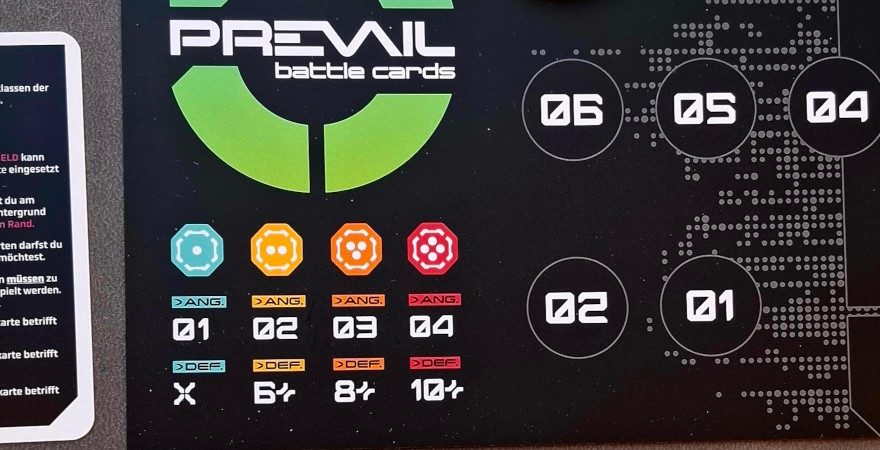
Wenn in naher Zukunft Mensch gegen Maschine kämpft, stecken wir mittendrin. Beim knallharten Kartenspiel Prevail holen wir die Kohle aus dem Feuer und möchten am Ende ganz einfach mit ein wenig Energie überleben. Ein düsteres Szenario. Das Kartenspiel aus der
Italian board game creator Paolo Mori has picked up his second designer of the year prize in the space of five months thanks to Lucca Comics & Games – one of Europe’s biggest comics and tabletop gaming festivals.
The win comes just a few months after Mori was named game designer of the year in Italy’s ioGioco Awards, in which Toy Battle also took the prize for best two-player game.
Mori has been a published game designer for 20 years, with his highest-profile creations including Ethnos, Libertalia and Pandemic spin-off Fall of Rome.
A statement from Lucca’s judges – which this year included Spiel des Jahres president Harald Schrapers – said, “The two-year period from 2024 to 2026 saw Mori move with rare ease between diverse genres, from historical wargaming, approached in both accessible and more traditional, simulation-based formats, to international family games, and even a foray into narrative puzzles that took his style into entirely new territory.
“In every case, the author has maintained his signature style of essential rules, rich decisions, and a mechanical balance that never fails. Equally significant is the fidelity with which Mori treats his historical and cultural sources, be they meticulously reconstructed wartime events or literary materials transposed into a gaming environment with respect and precision, a trait that makes the setting an integral part of the gaming experience, never merely a framework.
“This variety of registers is accompanied by a remarkable ability to appeal to diverse audiences, from the most demanding historical simulation enthusiasts to the casual gamer. This approach has made its games effective tools for spreading gaming culture, broadening the target audience for modern board games.
“The jury recognizes Paolo Mori as an author who exemplifies the maturity achieved by Italian game design on the international scene.
“The continuity of his output, the versatility demonstrated throughout his career, and the ability to innovate without losing expressive coherence constitute a significant contribution to the evolution of contemporary gaming language.”
The prize was launched by Lucca Comics & Games and board game designer association SAZ Italia in 2024, with Barrage, Tiletum and Nucleum co-designer Simone Luciani taking the inaugural prize.
Rather than rewarding a single game, the international award considers designers’ bodies of work over its reference period, with judging criteria including originality and innovation, sensitivity to current player and market trends, prolificacy and the ability to work successfully across different styles.
This year’s jury also included Fabio Cambiaghi, former Gioco dell’Anno president Paolo Cupola, SAZ Italia representative and game designer Stefania Niccolini and last year’s winner Grard.
Mori also has history with Lucca’s separate Gioco dell’Anno prize, having won the inaugural edition of the award in its current form in 2013 with Rise of Augustus.
This year’s five finalists for that prize have also now been revealed, with Spiel des Jahres winner Bomb Busters, designed by Hisashi Hayashi, up against Mitch Wallace’s Art Society, Simone Luciani and Roberto Pellei’s Echoes of Time, Reiner Knizia’s Rebirth and Brett Myers and Dave Chalker’s Thunder Road: Vendetta.
The shortlist was whittled down from 50 eligible games, with the winner due to be announced on stage during the Lucca Comics & Games festival, which runs from October 28 to November 1.
The current Gioco dell-Anno award succeeded Lucca Games’ long-running Best of Show award, whose history stretches back to 1993.
Recent Gioco dell’Anno winners include Botanicus in 2025, Planet Unknown in 2024 and Challengers in 2023.
With this My Favorite Wargame Cards Series, I hope to take a look at a specific card from the various wargames that I have played and share how it is used in the game. I am not a strategist and frankly I am not that good at games but I do understand how things should work and be used in games. With that being said, here is the next entry in this series.
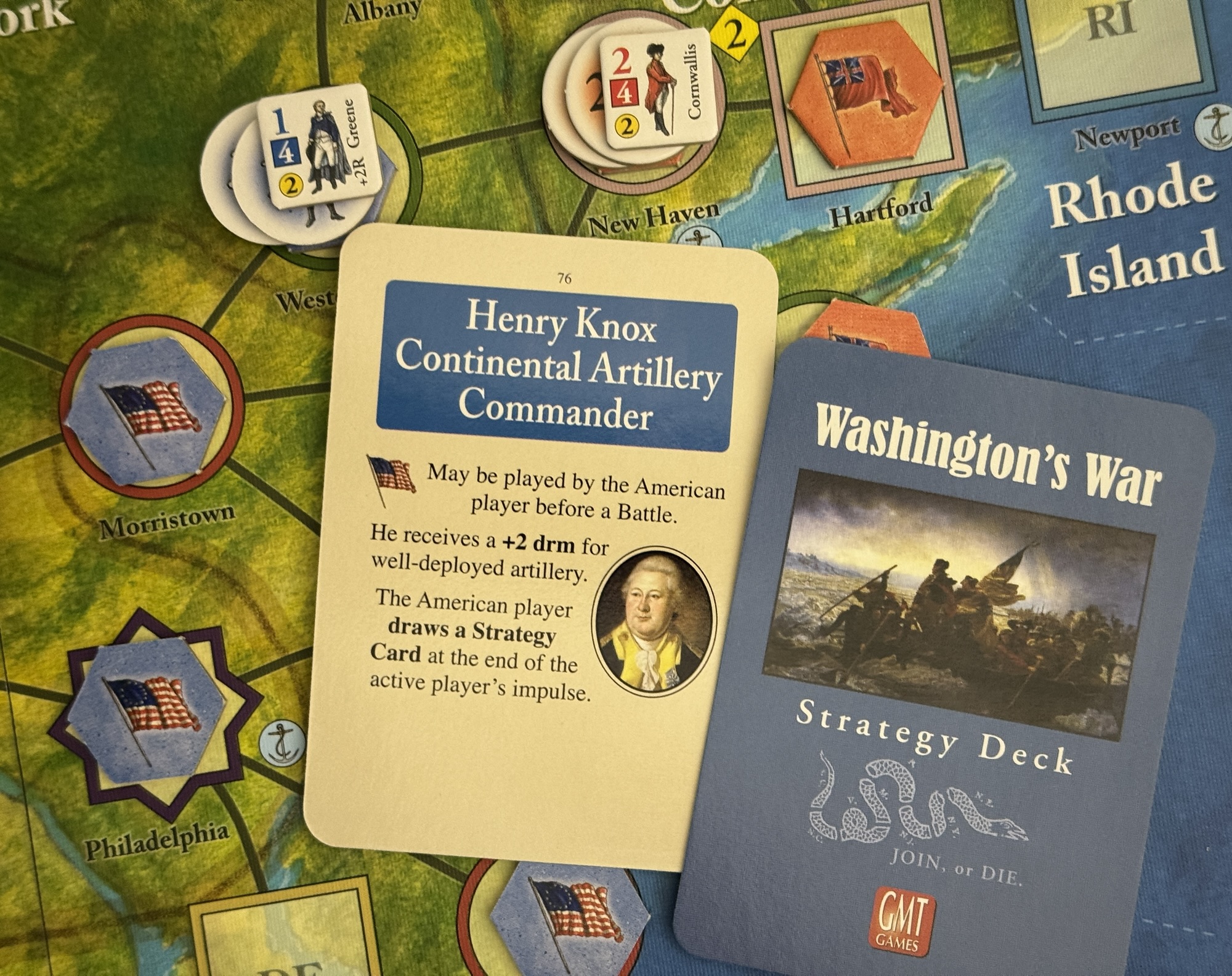
#96: Henry Knox Continental Artillery Commander from Washington’s War from GMT Games
Washington’s War is a war game, make no mistake about that. But, it is virtually impossible to win the game by focusing only on the field of battle. For that to happen, the Patriots need to completely drive the British forces out of the 13 colonies or the British need to wipe the American forces off the map. Both are extremely difficult and I would be surprised if any more than 1 out of 30 games ended in such a way. Rather, the ultimate goal of the game is to have political control of the colonies. If at the end of the game the Patriots control 7 colonies, while holding the British to control of less than 5, they win. If not, the British win. Simple as that. So, you can see that battle is not the main goal but control is. And more importantly political control.
I really like this about the design and feel that the real core of the American Revolution was the groundswell of patriotism and the desire to live free from the shackles of an overseas monarch who cared little for the American way of life. This desire led great men of the time to sacrifice themselves, their livelihood and their families to further the true cause of liberty and build a truly free and democratic nation where individual liberty and freedom was prioritized over anything else. And yes, I realize that this nation was not perfect, not without contradiction but the concept of liberty helped to form a country that would lead to the ultimate freedom of all people.
Washington’s War is a Card Driven Game, and as such, relies on cards to provide to players the actions needed to play the game. The cards contain OPS Points which can be used to drive various actions, including such things as activating leaders, who in turn will then move with forces to attack, and also contain written text in the form of events. These events can be played only by the side they are intended for and if drawn and played by the opposing side, they can only be thrown away while granting a few possible actions, such as placing or removing Political Control markers.
In Washington’s War, the Strategy Card Deck contains several different type of cards of which one is Battle Cards. Battle Cards are special event cards that provide a powerful +2 Die Roll Modifier (DRM) during combat and allow the user to draw a replacement card at the end of the turn. All of the Battle Cards offer a +2 DRM but each of them are tied to a different historical character or event. In this instance, the card’s effects reflect the work of Henry Knox who was a prominent Continental Artillery Commander during the Revolutionary War. There are only 9 total Battle Cards in the 110-card deck with the Patriot side having 5 cards, while the British side only has 4. I also want to point out that when these cards are used, they allow the using player to draw a replacement card at the end of the active player’s turn, keeping your hand size strong and not forcing you to sacrifice a card. And due to the fact that they swing combat odds significantly and also replace themselves with a draw, they are heavily prized and typically are saved in a player’s hand for those critical campaign-deciding clashes.
Henry Knox was an American military officer, politician, bookseller, and a Founding Father of the United States. Knox, born in Boston, became a senior general of the Continental Army during the Revolutionary War, serving as chief of artillery in all of George Washington’s campaigns. Following the war, he oversaw the War Department under the Articles of Confederation from 1785 to 1789. Washington appointed him the nation’s first Secretary of War, a position which he held from 1789 to 1794. He is well known today as the eponym of Fort Knox in Kentucky.
During the siege of Boston, the idea arose that cannon recently captured at the fall of forts Ticonderoga and Crown Point in upstate New York could have a decisive impact on its outcome. Knox is generally credited with suggesting the prospect to Washington, who placed him in charge of an expedition to retrieve them even though Knox’s commission as an officer had not yet arrived. Reaching Ticonderoga on December 5, 1775, Knox commenced what came to be known as the “noble train of artillery”, hauling 60 tons of cannon and other armaments by horse-drawn and ox-drawn sleds across some 300 miles of ice-covered rivers and snow-draped Berkshire Mountains to the Boston siege camps.
The region was lightly populated and Knox had to overcome difficulties hiring personnel and draft animals. On several occasions, cannon crashed through the ice on river crossings, but the detail’s men were always able to recover them. In the end, what Knox had expected to take just two weeks actually took more than six, and he was finally able to report the arrival of the weapons train to Washington on January 27, 1776. Historian Victor Brooks writes that this was “one of the most stupendous feats of logistics” of the entire war, and Knox’s effort is commemorated by a series of plaques marking the Henry Knox Trail in New York and Massachusetts.
The cannon were immediately deployed to fortify the Dorchester Heights recently taken by Washington. The battery’s position over Boston harbor led the British to evacuate Boston for Halifax, Nova Scotia. With the siege ended, Knox undertook the improvement of defenses in Connecticut, Rhode Island and New York in anticipation of a possible British assault. In New York he became friends with Alexander Hamilton, commander of the local artillery. He also established a close friendship with Massachusetts general Benjamin Lincoln.
A team of oxen hauls captured artillery toward Boston as part of the 1775-76 “Noble train of artillery”.
Here is a link to our full video review of the game:
Niedliche Spielzeuge treffen in epischen Schlachten aufeinander. Die Strategie der Spielzeuggenerale ist einfach: Entweder zwei Truppen aus der Reserve holen oder eine Truppe in der Schlacht einsetzen. Auf in den…
An Impossible War: The First Carlist War in the North, 1834-1838 from Bellica Third Generation is a block wargame that recreates the First Carlist War in the North of Spain which was a civil war between the Carlists who supported the succession of the late king’s brother Carlos de Borbón and the progressive and centralist supporters of the regent Maria Christina acting for Isabella II of Spain who were referred to as the Liberals. The game uses blocks representing units but also includes counters and uses cards. I was able to play the game about a month or so ago with Francisco Ronco who owns the publishing company Bellica Third Generation and very much enjoyed the game and how it represented this interesting struggle.
In Action Point 1, we took a look at the Game Map, discussing the point-to-point movement configuration, the various spaces and the delineation of the Carlist versus the Liberal Zones, as well as explained the use of the Rest of Spain smaller map. In Action Point 2, we examined the units available to both sides and covered the importance of Supply. In Action Point 3, we took a closer look at the Carlist Uprising Phase and what it means for the game. In Action Point 4, we examined the activation system and the use of Action Point Markers. In this Action Point, which is the conclusion to the series, we will take a look into how Battles work, focusing on the tactical aspect of combat with the use of the Battle Board.
Battle
One of my favorite parts of the game is the Battle mechanic. With Battle, I very much enjoy the use of the Battle Board but also like that there are several different types of combat. Battles focus on asymmetric combat rather than massive open field engagements and are typical of the First Carlist War. These Battles boil down to 3 primary types including Skirmishes, Battles and Assaults and each type have their benefits and uses and one of the important things about the game is the need to learn their best uses and then how to perform them. If both sides have at least 3 Infantry or Cavalry units in a contested space, then there is a Battle. Also if 1 or both sides has less than 3 Infantry and Cavalry units in the space, or only has Cavalry units, then there will be a Skirmish. And finally, in order to launch an Assault on a Fortress, the besieging player must have a Field Artillery unit of any value in the enemy Fortress space.
But before we take a look at these different types of Battle, I want to cover the Combat Cards. Combat Cards provide background events and assist tactical maneuvers without running the game on their own. Each player holds a distinct 36-card deck (Liberal or Carlist) representing historical, operational, and tactical modifiers. These cards simulate unpredictable elements, like sudden skirmishes, political shifts, or logistical hurdles. The Liberal Player generally leads larger, but lower-quality forces plagued by supply issues. Their Combat Cards tend to focus on maintaining order, quelling uprisings on the Rest of Spain Map and chasing Carlist expeditions. The Carlist Player will command smaller, high-quality troops. Their Combat Cards focus on exploiting superior mobility, terrain knowledge, and sudden strikes. Since this is an “impossible” war featuring guerrilla tactics, siege warfare, and frequent skirmishes rather than massive battles, the cards adapt to these asymmetric scenarios.
There are 3 types of cards found in the decks, including Event Cards, Operational Cards and Tactical Cards. Event Cards are played immediately when drawn and provide both positive and negative benefits to the players. Operational Cards can be played when the conditions stated on the card are met, during the player’s own Player Phase or sometimes during the opponent’s Player Phase. Tactical Cards can be played in combat as stated on the card. Each player can use a maximum of one tactical card in each Skirmish, Battle Round or Assault Round.
At the beginning of a player’s Player Phase each Turn, that player will take the top card from their draw deck. If it is an Event Card then it is applied immediately. If it is not an Event Card, the card is kept in the hand so that the other player cannot see it. A player can have up to 8 cards in their hand and these can be played as indicated on the card itself.
These cards are very well done and keep the game very interesting and tense as you just don’t know what type of cards your opponent has that they can spring on you in combat. These cards alter the conditions of the battle and cannot be planned for but must be kept in mind as players enter conflicts. From adding defenses that absorb hits (such as the Stone Walls Tactical Card) or provide additional Effectiveness Rating to units in battles when they are firing (such as the False Retreat Card), these cards make a difference and keep the game feeling like a game.
Now that we have looked at the cards, let’s now take a quick look at the various forms of Battle. A Skirmish consists of just 1 single round of fire. First the defender will fire and applies all hits to the attacking units, then the attacker will fire and applies hits to the defending units. There are no morale rolls in the game. In a Skirmish a player fires with a maximum of 3 Infantry and Cavalry units. The player must choose which units will fire with several limitations. maximum of 1 Cavalry unit in rough terrain and a maximum of 2 Cavalry units in open terrain. A player always fires with all Artillery units.
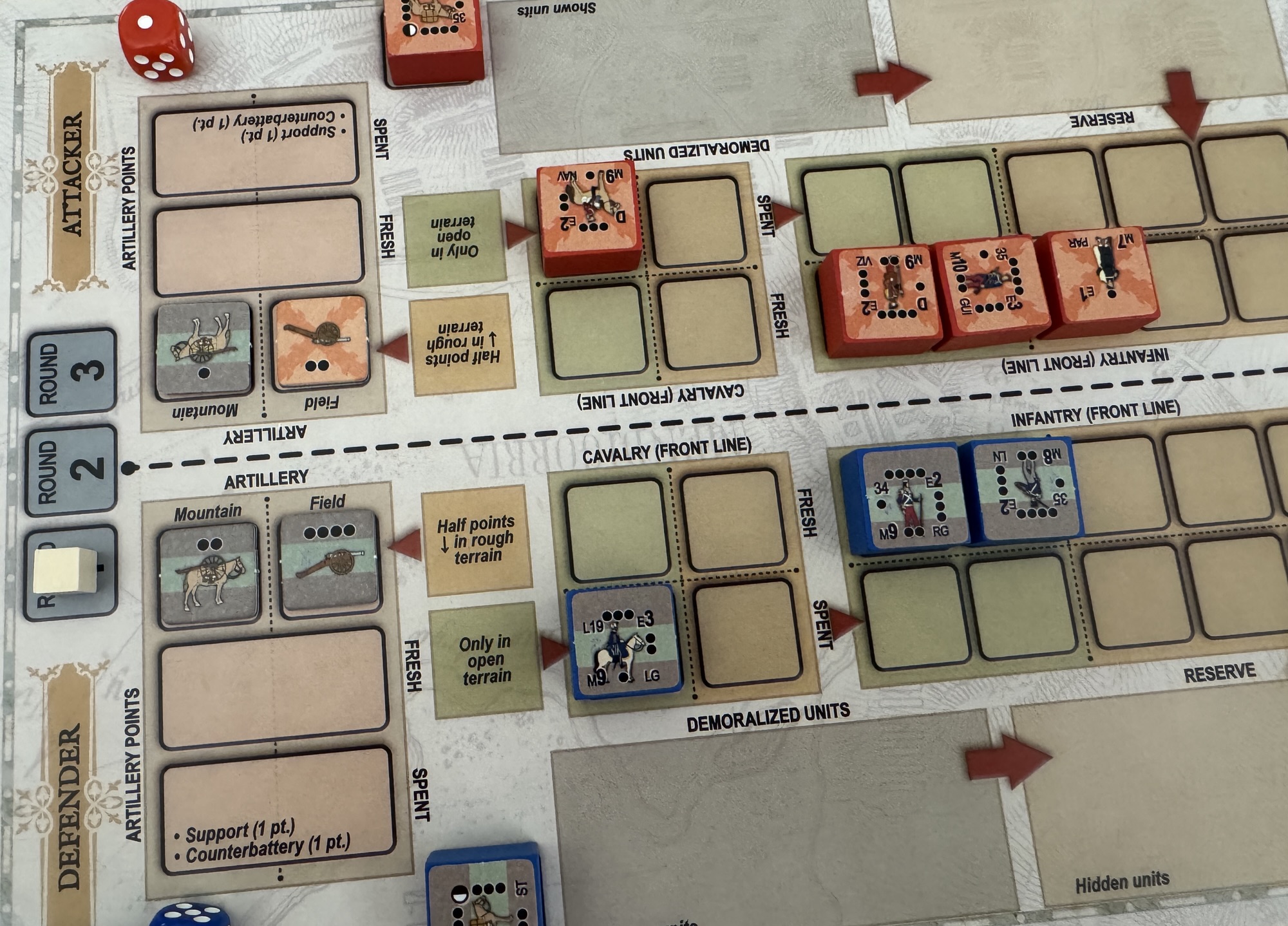
The Battle Board operates as a dedicated, zoomed-in tactical area where the details of combat are resolved. When opposing blocks meet on the main strategic map, units are moved to this board to fight out the encounter safely separated from global troop movements. When a Battle begins, players move their hidden army blocks from the main map onto the Battle Board. Depending on the terrain where the battle takes place (such as rough terrain for a city or plains for the countryside), players deploy their units into specific zones on the board. The Flanks are outside positions that trap or outmaneuver the enemy. The Front Line are the units taking the direct hits and dealing the damage to the enemy and the Reserve is where extra units are kept on standby to join the battle as losses are suffered.
Combat on the Battle Board happens in rounds. As a block wargame, the number of dice rolled by any unit is based on the number of pips shown on the block and the to hit number is equal to or less than their Effectiveness Rating printed on the block. Modifiers may be added from terrain or from the play of Combat Cards. Dice are then rolled and hits are determined with the defending units taking losses by reducing their pips by rotating the block counterclockwise. It is as simple as that.
The big difference in the types of Battle are the duration. A Skirmish last only 1 round while a Battle can last up to 3 rounds. The Battle ends immediately when 1 of the following situations arises. If the Battle lasts the full 3 round, when the 3rd Battle Round ends the defending player remains in the space and the attacking player retreats. There is no Rout or Pursuit A player has no Infantry units in the front line. The other player wins, gains 1 VP, and causes a Rout by the losing side, which will then retreat. Or, a player decides to retreat voluntarily in the End of Battle Round phase. The other player wins and can carry out Pursuit.
The Battle mechanic in An Impossible War captures perfectly the frustration of asymmetry in both competing sides and their troops. The name of the game is specifically reference to the the Liberals’ massive, clunky numbers versus the Carlists’ nimble, guerrilla style of warfare. 2 different armies with 2 different philosophies has created a situation where neither side can feel comfortable with the war and their chances at winning it. I frankly think that the designer David Gómez Relloso did an exceptional job at creating this asymmetry and creating a highly playable and engaging game. If you didn’t know, I chose to add An Impossible War to my Top 10 Wargames of 2025!. It landed at #8 on the list, and probably would have scored higher had I had a chance to play the game further and experience all of the parts of the design.
I also was able to shoot a fairly short video summary of my game play with Francisco Ronco who is the owner of Bellica Third Generation and you can watch that at the following link:
It’s long been said that we’re the foremost experts in knowing which way the awards winds blow, so we’re putting our talents to use guessing, nay, predicting, nay, deciding who the winners in the Golden Geeks are going to be. Before we geek out, we talk about Chronicles of Crime: 2400, Quarto, and Shackleton Base: A Journey to the Moon.
If you don’t want to miss an episode, please subscribe on Apple Podcasts/Google Podcasts/Stitcher/Spotify, or add our RSS feed to your favourite app. Reviews and subscriptions really help us and would be greatly appreciated! To download the episode directly, click here.
If you’d like to discuss anything in the episode, please do so in the comments below, visit our BoardGameGeek guild, join our Discord, or Facebook Group! Any feedback is also always helpful. If you’d like to show your support for the show, we also have a Patreon with some fun rewards, and a merch store!
Timecodes:
04:07 – Chronicles of Crime: 2400 12:00 – Quarto 16:13 – Shackleton Base: A Journey to the Moon 30:16 – Golden Geeks 2025
Thank you to Heart Society for generously letting us use What’s On Your Mind, Kid? from their album Wake the Queens.
The definitive 2021 ranked list of the best Harry Potter board games. Harry Potter was a series of books that became one of the biggest film franchises in history. No film series better represents witches, magic and wonderment like this series that follows groups of kids and their work their way through a wizarding magic school and make it into the real world, where all of this exists. There were 8 original Harry Potter movies and so far 3 subsequent Fantastic Beast movies. These are the top 20 best Harry Potter board games.
Clue: Harry Potter Edition makes the list of the best Harry Potter board games because it a solid use of the IP in a gaming franchise. There is nothing special here, really just the characters and worlds from Harry Potter inserted into a game of Clue, but if you are going to play this classic, this is certainly an exciting theme to do it through.
The mystery you love to solve again and again is even more intense! Clue is back with a modern twist, and you have to find out who is responsible for murdering the host at a millionaire’s mansion or a boardwalk. Get the scoop on the updated rooms, weapons and guests, and start detecting! Was it Plum with the wrench in the bedroom? Or Green with the pistol in the kitchen? Narrow down what you know and make your accusation! If you’re right about the location, weapon and suspect, you’re the mystery winner! For 2 – 6 players, games last about 45 minutes.
Trivial Pursuit Harry Potter makes the list of the best Harry Potter board games because if you want to have a Harry Potter trivia game, why not do it with the most iconic name in the business. If you are looking to play something that really gets at actual knowledge of the franchise, this option is going to be for you.
Test your ultimate trivia knowledge of Harry Potter! Harry Potter fans can test their knowledge of all 8 Harry Potter movies with Trivial Pursuit: World of Harry Potter Ultimate Edition. Move around the board with House Mascot movers as you answer questions and collect ‘wedges’ in this full sized collectible edition. Includes 1800 questions to challenge the ultimate Harry Potter fan. For 2 – 8 players, games run around 60 minutes each.
Time’s Up!: Harry Potter makes the list of the best Harry Potter board games because bringing together The magical universe of Harry Potter meets the frantic and hilarious guessing of Time’s up! This title lets you think about the characters you love in a way you would have never imagined.
Time’s Up! is a charades-based party game. Before the game begins, each player looks at several cards featuring famous fictional characters and chooses some of them. Each player’s cards are shuffled to form a deck, and this deck of famous names is used for each of the game’s three rounds. n each round, team members take turns trying to get their teammates to guess as many names as possible in 30 seconds. For 4 – 18 players, games run about 90 minutes each.
#17 | Harry Potter Tri-Wizard Tournament – Capture The Cup Game
Harry Potter Tri-Wizard Tournament – Capture The Cup Game makes the list of the best Harry Potter board games at a higher spot because while it does get at some full elements from the franchise, at the end of the day, it is just a rethemed version of the children’s game Trouble. It does it well but there is nothing new here.
Muggles and wizards alike will be enchanted by this magical game! It features fast-action Pop ‘N’ Race play as you race around the Triwizard hedge maze to capture the Triwizard Cup! Be careful – action spaces cause you to draw a card that can help or hurt your chances. The first player to get all of his/her movers home is the winner and Triwizard Maze champion. For 2 – 4 players, games last approximately 30 minutes.
Harry Potter Trading Card Game makes the list of the best Harry Potter board games because of the depth of content. While it has been discontinued it deserves points for its use of the franchise. Trading card games are very deep and require lots of tact and ambition. This one from the creators of Magic the Gathering delivered, but they couldn’t quite get the momentum they needed.
Each player’s 60-card deck is fronted with a wizard or witch “character” card, and contains spells, creatures, items, and the “lesson” cards needed to put them into play. Damage to the character is tracked by simply discarding off the draw deck, and first person to run out of cards loses. Damage is dealt with spells or creatures, and can be targeted to other creatures, or directly to the opposing character. Sets include Quidditch Cup, Diagon Alley, Adventures at Hogwarts and Chamber of Secrets. For 2 players, games typically run around 20 minutes each.
Harry Potter: Magical Beasts Board Game makes the list of the best Harry Potter board games at this higher-up spot because it is a good in to the universe but there are better games out there. With this one you will collect clues to track down creatures inside and outside Hogwarts.
The objective is to obtain four cards that correspond to one beast. Each turn, a player will roll the dice which will correspond to the number of spaces a player moves. When a player lands on a tile that indicates a type of a card (Color, Size, Location or M.O.M Classification), they get to take one card from that pile. The card is then placed facedown. Should you obtain another card of that type, you place the new card on top of the other card. For 2 – 4 players, games run about 40 minutes.
Harry Potter Whomping Willow Game makes the list of the best Harry Potter board games because this title is an interesting take on interacting with one of the key aspects from the franchise. This is a children’s dexterity game but it has enough bite that players of all ages, especially Harry Potter fans, should enjoy.
Recuse Harry Potter’s and Ron Weasley’s luggage from the Whomping Willow’s branches using nothing but your flying car. In the Time Trial, each player competes individually to use their flying cars to remove luggage from the tree, racing against the game’s internal clock. Any number of players can take part in the Time Trial. In Collection mode players play simultaneously and in Free-For-All Mode players challenge competitors to collect the most pieces of luggage from the tree.
Talisman: Harry Potter makes the list of the best Harry Potter board games because it combines the familiar gameplay of the fantasy adventure game Talisman with the familiar characters from the Harry Potter book series. This is another licensed product but it is not just a reskin, mechanics from the property make it into the game in a very satisfying way.
Lord Voldemort awaits the most competent of witches and wizards for a fateful demonstration of bravery or obedience in Talisman Harry Potter. Take on the daring roles of members of the Order of the Phoenix or Death Eaters in a fleeting race to gain access to the Dark Lord himself. Meet and present him with one of the Deathly Hallows as a dutiful Death Eater… or use it to defeat the leader once and for all. For 2 – 6 players, games run approximately 90 – 120 minutes.
#12 | Golden Snitch: Snitch Snatcher – The Quidditch Game
Golden Snitch: Snitch Snatcher – The Quidditch Game makes the list of the best Harry Potter board games because it is a title that brings you into the world of Quidditch. Using dice rolling, grid movement and take that, this game does a good job of representing the physical game.
Will you be the first to catch the Golden Snitch? It’s Gryffindor vs. Slytherin in this fast-paced wizarding game of Quidditch. Outmaneuver the opposing team with authentic Quidditch tactics. Use spells and potions to confound and outwit your opponent. Each high-flying game is a battle of strategy and magic. The goal is simple, be the first to catch the Golden Snitch. For 2 players, games take about 20 – 40 minutes each.
Harry Potter: A Year at Hogwarts makes the list of the best Harry Potter board games because it lets you become the student. You just received your letter to enter the most famous School of Witchcraft and Wizardry “Hogwarts” directed by the greatest wizard of all time Albus Dumbledore. This is a wonderful journey into that world.
Play along as your favorite character and relive the whole saga in Harry Potter: A Year at Hogwarts. The three game modes allow you to choose the best possible gameplay experience according to the age of the players, desired length of play, and your favorite passages from the saga. Compete with students from Gryffindor, Ravenclaw, Hufflepuff, and Slytherin, and earn the most points towards the House Cup, carrying out missions in and around Hogwarts. You can play alone, in a team, or with every wizard for themselves. For 1 – 8 players, games run 20 – 45 minutes.
Harry Potter: Spellcasters makes the list of the best Harry Potter board games because it is as close as you are going to get to getting into the physical and dexterity world of trying to cast spells. Out of all the Harry Potter board games out there, this is the one that will actually have you waving the wand around trying to get it done.
Spellcasters is a charade game with a magical spin. There are Spell cards and Guessing cards that mirror each other. The Spellcaster draws a card, keeping it hidden from view. Using the wand, they follow the spell drawn out on the card. When a player guesses right, the Spellcaster keeps their Spell card. The first person who points at the correct Guessing card wins the card and becomes the next Spellcaster. Each spell has a special challenge on the back that the new Spellcaster will have to endure while they’re practicing their magic. Whoever collects the most total cards (Spell and Guess cards combined) is the winner. For 3 – 8 players, games run 10 – 30 minutes each.
Fantastic Beasts: Perilous Pursuit makes the list of the best Harry Potter board games because It takes a unique part of the series and puts it into an interesting press-your-luck dice game. Based on the original game Rollers, the package is taken to new heights with all the interesting stories inserted.
In Fantastic Beasts: Perilous Pursuit, players take on the role of Newt, Tina, Jacob and Queenie on an exciting adventure as they try to return all the beasts to Newt’s suitcase before they draw the attention of the non-magical community. To do this, they need to collect sets of dice to take actions that allow them to shield each other, draw cards, and most importantly, get the beasts back into his suitcase before havoc ensues. For 2 – 4 players, games last 45 – 60 minutes.
Munchkin Harry Potter Deluxe makes the list of the best Harry Potter board games because who wouldn’t want to take the great story and characters into an iconic dungeon crawler. Munchkin: Harry Potter lands the witches and wizards of Hogwarts in the world of Munchkin, with players needing to kick down doors, grab treasure, and level up as usual.
Munchkin is the mega-hit card game about dungeon adventure . . . with none of that stupid roleplaying stuff. You and your friends compete to kill monsters and grab magic items. And what magic items! Don the Horny Helmet and the Boots of Butt-Kicking. Wield the Staff of Napalm . . . or maybe the Chainsaw of Bloody Dismemberment. Start by slaughtering the Potted Plant and the Drooling Slime, and work your way up to the Plutonium Dragon . . . For 3 – 6 players, games run 60 – 120 minutes.
Codenames: Harry Potter makes the list of the best Harry Potter board games because the game does a great job of bringing all the story and characters into the Codenames duet party game atmosphere. As far as licensed products being plopped into another existing product, this is a great match.
The game is a fun, easy-to-learn cooperative word and picture deduction game for Harry Potter fans of all game levels. Players help their teammates locate secret Agents who are concealed among a grid of Harry Potter references. Use only one-word clues to guide guessers to the right spots, or hidden Death Eaters will cost them the win. This co-op game is a great challenge for Harry Potter fans of all levels. Work together with multiple players on each team to increase your chances of locating all of the secret Agents. For 2 players, games last about 15 minutes.
Harry Potter: House Cup Competition makes the list of the best Harry Potter board games because it smartly ports the theme into a worker placement game. Here you will have to send students to complete challenges and use knowledge to win the Hogwarts house cup all through the premise of this nifty strategy game.
Welcome to another year at Hogwarts School of Witchcraft and Wizardry. The House Cup calls for the brightest students to compete. In Harry Potter: House Cup Competition, use gained knowledge and magic to learn lessons and complete challenges. Players send iconic characters like Harry Potter, Cedric Diggory, Cho Chang, and Draco Malfoy out on the game board to enhance their skills. The player who earns the most points for their House will be named the House Cup Champion!
Funkoverse Strategy Game Harry Potter makes the list of the best Harry Potter board games because out of all the character modules available, this one brings great “magic” to the game and great characters to utilize the Funkoverse system. This lets you take your favorite characters and go head-to-head in four exciting game scenarios.
Use your characters’ unique abilities to gain points and achieve victory! Each turn, you select one of your characters and perform two actions. Each character has access to basic actions like moving and challenges as well as several unique abilities that may be performed only by spending ability tokens. Each character in Funkoverse is unique, so players are encouraged to try out different combinations of characters and items in order to discover their favorite synergies and powerful strategies for all four game scenarios. For 2 – 4 players, games run 20 – 60 minutes each.
Harry Potter Miniatures Adventure Game makes the list of the best Harry Potter board games because it is the best option to allow players to immerse themselves in J.K. Rowling’s Wizarding World like never before via a miniatures/skirmish setting. All your favorite characters and settings are available to you.
During the game, players must outmaneuver their opponents across beautifully illustrated game boards representing many of the iconic locations from the Wizarding World, such as Hogwarts, the Chamber of Secrets, and the Forbidden Forest. Players must explore these environments, resolving Challenges and Quests in order to secure victory. For 2 – 6 players, games last 30 – 90 minutes.
Harry Potter: Death Eaters Rising makes the list of the best Harry Potter board games because it captures the difficulties and terrors Harry Potter, Ron Weasley and Hermione Granger face during their fifth year at Hogwarts as they scramble to persuade the wizarding world of Voldemort’s return. If you were looking for the title that will let you battle the evils of Harry Potter, this is a great option.
He-Who-Must-Not-Be-Named has returned! Lord Voldemort and his Death Eaters are a mounting threat to Hogwarts and the wizarding community, compelling everyone to combine their strengths against the dark villains. In this cooperative game, players must summon witches and wizards from Dumbledore’s Army, the Order of the Phoenix, and Hogwarts to retaliate against evil Death Eaters and protect the Wizarding World from the Dark Lord’s corruption for good. For 2 – 4 players, games run 60 or so minutes each.
Harry Potter: Hogwarts Battle makes the list of the best Harry Potter board games because this is a great cooperative deck-building game that leaves it up to four students to ensure the safety of the school by defeating villains and consolidating their defenses. This really brings the magic of the film home in a great board game package.
In the game, players take on the role of a Hogwarts student: Harry, Ron, Hermione or Neville, each with their own personal deck of cards that’s used to acquire resources. By gaining influence, players add more cards to their deck in the form of iconic characters, spells, and magical items. Other cards allow them to regain health or fight against villains, keeping them from gaining power. The villains set back players with their attacks and Dark Arts. Only by working together will players be able to defeat all of the villains, securing the castle from the forces of evil. For 2 – 4 players, games run 30 – 60 minutes.
#01 | Harry Potter: Hogwarts Battle – Defence Against the Dark Arts
Harry Potter: Hogwarts Battle – Defence Against the Dark Arts takes the top spot on the list of the best Harry Potter board games because it has mastered the magic battle style that helps make the franchise so special. This comes 3 years after the original Harry Potter Hogwarts Battle. That is also a great games, as you will see on this list, but this new stand-alone version does a great job of building off of that. They are different, with this one being a competitive deck-building game versus a cooperative one, and though it is tough choice, this version edges the original out.
In this fast-paced game, players take turns playing cards, taking actions and acquiring new cards to build a more powerful deck as their defensive skills improve. With the noticeable rise in Dark Arts activity, Headmaster Albus Dumbledore has authorized practical Defence Against the Dark Arts lessons to ensure that students are prepared to defend themselves. Under the supervision of Hogwart’s teachers, students will cast Spells and Hexes, use Items, and gain Allies to stun their opponents and protect themselves from evil forces. Stun your opponent three times to win. For 2 players, games run 30 – 60 minutes each.

 Anmelden