❌

Normale Ansicht

My Favorite Wargame Cards – A Look at Individual Cards from My Favorite Games – Card #98: The Balkan Wars from Imperial Elegy: The Road to the Great War 1850-1920 from VUCA Simulations

Von: Grant
13. Oktober 2026 um 14:00

With this My Favorite Wargame Cards Series, I hope to take a look at a specific card from the various wargames that I have played and share how it is used in the game. I am not a strategist and frankly I am not that good at games but I do understand how things should work and be used in games. With that being said, here is the next entry in this series.

#98: The Balkan Wars from Imperial Elegy: The Road to the Great War 1850-1920 from VUCA Simulations

Imperial Elegy: The Road to the Great War 1850-1920 is a massive card driven game that blends diplomacy, warfare, and statecraft and feels a bit akin to games like Here I Stand and Virgin Queen from GMT Games, which are both grand scale sweeping epics that play multiplayers and take a day to play. Players play as 1 of 6 major powers in the game including Germany/Prussia, the United Kingdom, France, Austria-Hungary, Russia and the Ottoman Empire. The game is quite grand and ambitious as it covers 70 years near the end of the Victorian Era and the Progressive Ear and sees quite a lot of global change and competition between the great powers of the time. The game is a Card Driven Game and uses Action Cards as a type of currency to spend for their Command Points or the printed event to take actions such as recruiting armies and navies, industrialize, moving fleets and armies around the globe, influencing minor powers and establish colonies in Africa, India and the Pacific Ocean. The cards are all tied to the history of the period but the game can be played very much as a sandbox allowing players to explore strategies by trailblazing new horizons or following history.

Before we dive into today’s chosen card The Balkan Wars, I want to first make sure you know about Mandatory Event Cards in the game and how they work as they work slightly differently from normal Action Cards. Mandatory Event Cards are all lime green colored and bear a large block “M” just under the CP Value listed in the upper left hand corner. Mandatory Events, as the name suggests, must be played for their events. However, when playing a Mandatory Event Card, players trigger the event and also receive the CP to spend on various actions. The events on Mandatory Event Cards are always resolved first before the CP are utilized. If a Mandatory Event Card is discarded, the event will immediately trigger. There is no way around these cards and they are included in the game to drive the action historically and interject the various special circumstances that drove the rise and decline of these Victorian Age empires. The player that discarded the card resolves the event as if they were the active player. If two such Mandatory Event Cards are discarded in the same impulse the events are resolved in turn order.

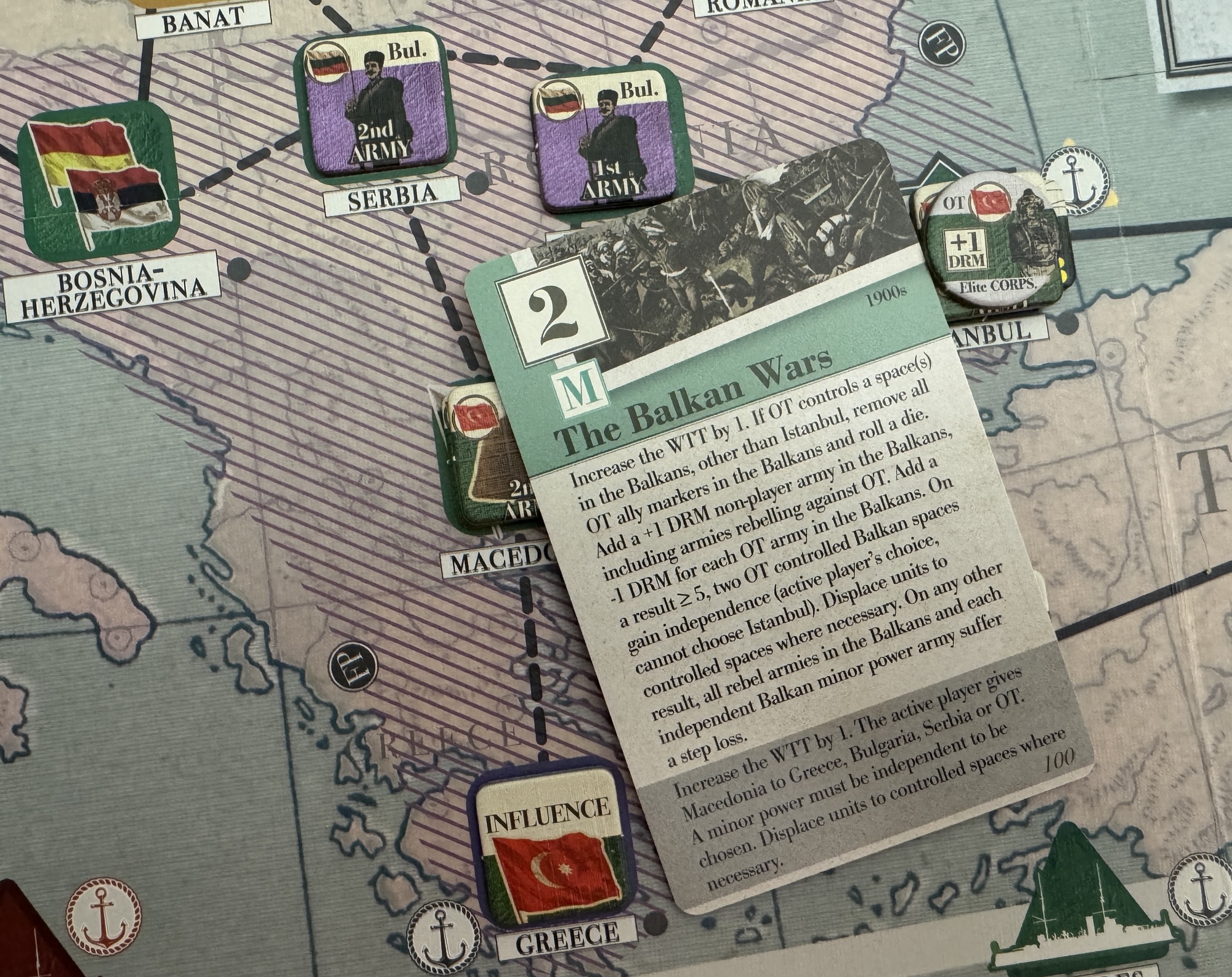
Some of the events that occurred historically prior to 1914 were ultimately precursors to The Great War in many ways. The Balkan Wars were two conflicts fought in 1912 and 1913 that stripped the Ottoman Empire of almost all its remaining European territory and directly set the stage for World War I. The Balkan Wars saw similar levels of carnage as machine guns and artillery equipped with hydraulic recoil mechanisms were used in large numbers. Politically, they highlight the volatile nature of international politics in the Balkan Peninsula and are included as a Mandatory Event to ultimately drive up the World Tension Track on a path toward the outbreak of World War I. When played, the World Tension Track will increase by +1 and if the Ottoman player controls any territory in the Balkans other than Istanbul, or has Diplomatic Influence with countries, they will have a chance to lose their control there as a result of the chaos of the First and Second Balkan Wars. If these checks fail, and they will incur a -1 DRM for each Ottoman Army that is located anywhere in the Balkans, non-player armies will be placed in those locations and will increase the difficulty for the Ottomans to gain a foothold in this area. According to the designer Michael Lorino, mechanically this event causes all kinds of trouble in the Balkans, as intended. Similar to the Mandatory Event Card Empire of the Sun, the original event was a bit more involved and had players fight an actual war. In an effort to keep the game in the playable zone, he decided to abstract these wars through a die roll.

I very much enjoy the concept of a Mandatory Event, although they are never convenient for someone at the table as they typically have negative effects for at least 1 faction. But I very much like the approach taken here with The Balkan Wars with the -1 DRM for control of a territory and its thematic connection with the Ottoman Empire’s presence in the region generating tension and setting off these Balkan Wars.

A Bulgarian postcard depicting the Battle of Lule Burgas.

The Balkan Wars were two conflicts that took place in the Balkan states in 1912 and 1913. In the First Balkan War, the four Balkan states of Greece, Serbia, Montenegro and Bulgaria declared war upon the Ottoman Empire and defeated it, in the process stripping the Ottomans of their European provinces, leaving only Eastern Thrace under Ottoman control. In the Second Balkan War, Bulgaria fought against the other four combatants of the first war. It also faced an attack from Romania from the north. As a result of these wars, the Ottoman Empire lost the bulk of its territory in Europe. Although not involved as a combatant, Austria-Hungary became relatively weaker as a much enlarged Serbia pushed for union of the South Slavic peoples. The Balkan Wars set the stage for the July Crisis of 1914 and was a prelude to the First World War.

We have put out several pieces of content covering Imperial Elegy and find it to be a fantastic game. These include written posts and videos. You can visit those by following the links below:

Unboxing Video:

Video Review:

Summary of Solitaire Bots presented by our friend James:

Written First Impressions Post on the blog: https://theplayersaid.com/2026/05/06/first-impressions-imperial-elegy-the-road-to-the-great-war-1850-1920-from-vuca-simulations/

In the next entry in this series, we will take a look at Truman Doctrine from Twilight Struggle: The Cold War, 1945-1989 from GMT Games.

-Grant
My Favorite Wargame Cards – A Look at Individual Cards from My Favorite Games – Card #93: German Home Card Otto von Bismarck from Imperial Elegy: The Road to the Great War 1850-1920 from VUCA Simulations

Von: Grant
09. September 2026 um 14:00

With this My Favorite Wargame Cards Series, I hope to take a look at a specific card from the various wargames that I have played and share how it is used in the game. I am not a strategist and frankly I am not that good at games but I do understand how things should work and be used in games. With that being said, here is the next entry in this series.

#93: German Home Card Otto von Bismarck from Imperial Elegy: The Road to the Great War 1850-1920 from VUCA Simulations

Imperial Elegy: The Road to the Great War 1850-1920 is a massive card driven game that blends diplomacy, warfare, and statecraft and feels a bit akin to games like Here I Stand and Virgin Queen from GMT Games, which are both grand scale sweeping epics that play multiplayers and take a day to play. Players play as 1 of 6 major powers in the game including Germany/Prussia, the United Kingdom, France, Austria-Hungary, Russia and the Ottoman Empire. The game is quite grand and ambitious as it covers 70 years near the end of the Victorian Era and the Progressive Ear and sees quite a lot of global change and competition between the great powers of the time. The game is a Card Driven Game and uses Action Cards as a type of currency to spend for their Command Points or the printed event to take actions such as recruiting armies and navies, industrialize, moving fleets and armies around the globe, influencing minor powers and establish colonies in Africa, India and the Pacific Ocean. The cards are all tied to the history of the period but the game can be played very much as a sandbox allowing players to explore strategies by trailblazing new horizons or following history.

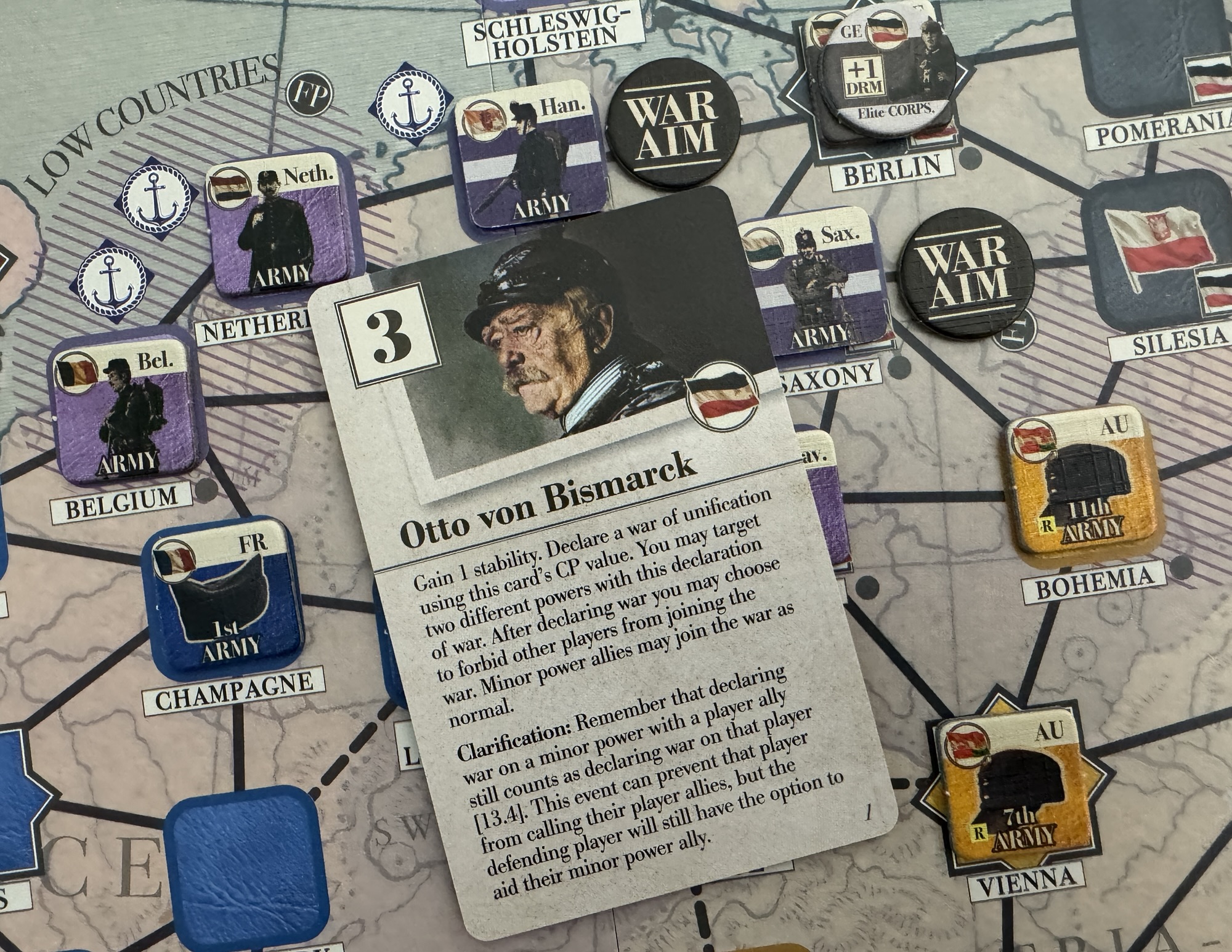
In Imperial Elegy: The Road to the Great War 1850-1920, the Otto von Bismarck Card is a powerful and extremely important German Home Card. Rather than being shuffled into the common Action Card Deck, it belongs exclusively to the Prussian/German player’s unique toolkit to represent the historical trajectory of German state-building. The card is mechanically tied to the first few turns of the grand 7-decade timeline and acts as a get started quickly card for the German player as they begin the long and somewhat difficult task of attempting to unify the Germanic peoples under one banner. The German player can choose to execute it on Turn 1 to abstractly simulate Bismarck’s rapid real-world rise to power and kickstart early diplomatic maneuvers or wars. Playing as Germany, the player should be focused on attempting the Unification of Germany and will most likely choose the Unification National Goal card as a standard at the beginning of games. The Bismarck Home Card is the primary historical vehicle used to achieve this unification and simulates driving the annexations or alliances needed to claim crucial minor regions including Saxony, Schleswig-Holstein, Denmark and Alsace Lorraine. And like standard Action Cards in Imperial Elegy, the card presents a choice. The German player can either choose between using its high Command Point (CP) Value of 3 for a massive push focusing on industrial development or military actions, or using the card for its printed Event text. One of the really nice parts of the card is the way that it effects Stability in the game. Stability is a core national resource and rating that measures a major power’s internal political health, structural integrity and capacity to wage war or absorb setbacks such as economic downtown and social upheaval. Typically, when you declare war, your Stability will degrade but not in the case of a War of Unification. And with Bismarck, Germany will gain 1 Stability when they declare a War of Unification. This is such a powerful effect for the early game as it will allow the German state to build up their capacity and increase Stability to be able to perform later in the game.

1871 portrait of Otto von Bismarck, the first Chancellor of the German Empire. He is depicted wearing his signature Prussian military uniform, including the distinct Pickelhaube (spiked helmet).

Otto Eduard Leopold, Prince of Bismarck, Duke of Lauenburg, known as Otto von Bismarck, was a conservative German statesman who masterminded the unification of Germany in 1871 and served as its first chancellor until 1890, in which capacity he dominated European affairs for two decades. He had previously been Minister President of Prussia from 1862–1890 and Chancellor of the North German Confederation from 1867–1871. He provoked three short, decisive wars, against Denmark, Austria, and France.

Following the victory against Austria, he abolished the supranational German Confederation and instead formed the North German Confederation as the first German national state, aligning the smaller North German states behind Prussia, and excluding Austria. Receiving the support of the independent South German states in the Confederation’s defeat of France, he formed the German Empire – which also excluded Austria – and united Germany.

With Prussian dominance accomplished by 1871, Bismarck skillfully used balance of power diplomacy to maintain Germany’s position in a peaceful Europe. To historian Eric Hobsbawm, Bismarck “remained undisputed world champion at the game of multilateral diplomatic chess for almost twenty years after 1871, and devoted himself exclusively, and successfully, to maintaining peace between the powers”. However, his annexation of Alsace-Lorraine (Elsaß-Lothringen) gave new fuel to French nationalism and Germanophobia. Bismarck’s diplomacy of Realpolitik and powerful rule at home gained him the nickname the “Iron Chancellor”. German unification and its rapid economic growth was the foundation to his foreign policy. He disliked colonialism but reluctantly built an overseas empire when it was demanded by both elite and mass opinion. Juggling a very complex interlocking series of conferences, negotiations and alliances, he used his diplomatic skills to maintain Germany’s position.

A master of complex politics at home, Bismarck created the first welfare state in the modern world, with the goal of gaining working-class support that might otherwise go to his Socialist opponents. In the 1870s, he allied himself with the low-tariff, anti-Catholic Liberals and fought the Catholic Church in what was called the Kulturkampf (“culture struggle”). He lost that battle as the Catholics responded by forming the powerful German Centre Party and using universal male suffrage to gain a bloc of seats. Bismarck then reversed himself, ended the Kulturkampf, broke with the Liberals, imposed protective tariffs, and formed a political alliance with the Centre Party to fight the Socialists. A devout Lutheran, he was loyal to his king, Wilhelm I, who argued with Bismarck but in the end supported him against the advice of his wife Queen Augusta and his heir Crown Prince Frederick William. While Germany’s parliament was elected by universal male suffrage, it did not have much control of government policy. Bismarck distrusted democracy and ruled through a strong, well-trained bureaucracy with power in the hands of a traditional Junker elite that consisted of the landed nobility in eastern Prussia. He largely controlled domestic and foreign affairs, until he was removed by the young new headstrong Kaiser Wilhelm II. He retired to write his memoirs.

This historic image shows Chancellor Prince Otto von Bismarck (center) with diplomatic envoys and plenipotentiaries of the Federal Council (Bundesrat) inside the Berliner Reichstag in 1889.

We have put out several pieces of content covering Imperial Elegy and find it to be a fantastic game. These include written posts and videos. You can visit those by following the links below:

Unboxing Video:

Video Review:

Summary of Solitaire Bots presented by our friend James:

Written First Impressions Post on the blog: https://theplayersaid.com/2026/05/06/first-impressions-imperial-elegy-the-road-to-the-great-war-1850-1920-from-vuca-simulations/

In the next entry in this series, we will take a look at Hamet’s Army Created from The Shores of Tripoli from Fort Circle Games.

-Grant

Discussion Thread: In-Game Retribution…is that a thing that is acceptable?

Von: Grant
12. August 2026 um 14:00

I am going to start this new feature on the blog called Discussion Thread where I pose a question or a situation and seek your input and comments on the issue to gain greater understanding and to encourage thoughtful feedback. I think this will only be successful if we get lots of opinions and queries so please speak up and let me know your thoughts. Big or little. Nothing is out of bounds. I also feel that this series will be a bit therapeutic for me and my mental health. I am not sure how often I will post these type of things but wanted to see how it goes and also to share something that happened to me recently in a game that got my gears a grinding.

*All names have been changed or omitted to protect the privacy and identity of those involved.

But first, I am going to have to set the scene for you. As you know, we really enjoy attending conventions and playing large multi-player wargames such as Here I Stand, Virgin Queen, War Room, Alliance and many other titles. Over the years, we have absolutely had a blast at these conventions and they are the best places to play these large 5+ player wargames. Recently, while attending the World Boardgaming Championships in Seven Springs, Pennsylvania. This year I attended alone, as Alexander was on vacation in the south of France with family, and I was able to coordinate a full 6-player game of the amazing Imperial Elegy: The Road to the Great War 1850-1920 from VUCA Simulations. This game was released in late 2025 and we have since played it 3 times, including this play at WBC. Imperial Elegy is a is a card driven game that blends diplomacy, warfare and statecraft and feels a bit akin to games like Here I Stand and Virgin Queen from GMT Games. Like those games, IE is a grand scale sweeping epic that play multiplayers and take a day to play (literally 12-14 hours to see the game through to the bitter end). The game covers the dying throes of the colonial and imperial powers of the 17th and 18th century as they deal with local colonial uprisings, attempts to unify fractured countries, build alliances for protection and to aid in their own expansion and economic concerns of population growth and industrialization. Players will take on the roles of 1 of 6 unique major powers in the game including Germany/Prussia, the United Kingdom, France, Austria-Hungary, Russia and the Ottoman Empire. This is a really deep and involved game and frankly after 3 plays I am finally grasping what it is that I should be focused on, how to go about building alliances and the benefits that I must get from those to have a chance at survival. But I am still learning and have only played as the German/Prussian Empire and France, so there is a lot yet to learn and explore.

While playing a 6-player game at WBC recently, I was the French. Previously I had played as the German/Prussian Empire and this was going to be a new experience where I could see what another faction was about and begin to understand their motivations, goals and objectives. A fellow player, who was playing as the UK, which is a natural ally of the French, saw my taking of some actions that didn’t sit well with him and he was actively trying to find ways to punish me for doing what he didn’t agree with. Keep in mind he never said anything about his reasoning at the time of taking the action, because it made zero sense at the time in the state of the game, nor did it make any sense in the game for the UK’s long term strategy. It was simply odd and I was searching for understanding as to why he would choose to do what he did.

In the game, I had just agreed with Germany to voluntarily give up Alsace Lorraine because I had no way to prevent him from coming in and destroying my 1 army there. He had 2 full armies, one of which had an Elite Corps. as well as an adjacent army supporting it on the board. So I decided I would sue for peace and try to avoid a prolonged battle that would waste my resources and that would ultimately, at least in my opinion, lead to me losing the location. The German/Prussian Empire is trying to unify their country and must control a certain number of countries on the board marked with a German flag, of which Alsace Lorraine is one. As a concession with the German player, I was able to convince him to give me 2 cards from the deal, which were randomly drawn as you cannot simply give over a specific card, and they were both 1’s. Bummer. But, I now had 2 extra cards to perform a few more actions that turn and that was a good trade off for me.

I was planning to go hard into colonies in Africa, Asia and even into North America to get to 6 Colonial Keys to accomplish one of my National Goals and to gain an extra +1 Card and +1 Manpower. I had already made good progress by taking Algeria and gaining traction in Morocco in North Africa and controlled 1 of the spaces on the Africa sub map.

That’s when he played a 3 Ops Card called Folie de Grandeur for the event which allowed him to place a revolt in a French controlled colony in Africa, Asia or North America and he went behind me to take out Algeria which meant I would have to go back and move an Expeditionary Force there and spend 3-4 impulses to Pacify it and get it back under my control. It sucked. The event also forced me to lose a Stability and take a -1 Card marker. This was a devastating and mean card to play at that time.

I asked him why he would play this card, as we were moving toward becoming allies and had discussions about how things should and could go, and I had done nothing to him but had been simply trying to do what France should do by going into City of Light points, intervening in Italy and their unification and building colonies. I was admittedly a bit upset and kept pestering him about his reasoning through the whole game. He said at the time he played that card, he had a good hand with several large Ops cards and didn’t need the extra 3 from this card (I call BS as you can always use more Ops). Plus I actually watched his final card plays that round and he didn’t have good cards but had a middling hand with several 2 OPs cards. I was taking notes.

So we played out the game and he actually screwed me over later with another stupid event (man there are a ton of those Mandatory little events that make taking colonies very dicey) and he was absolutely not in the game at all. He had only scored 2 VP from his National Goals and had only a few colonies with just 2 in South Africa. Later that evening over dinner, I asked him again why and told him his reasons used at the table were BS. He said to me straight faced that I had pissed him off with my move with Germany and he was punishing me. Punishing me? In a game that I am still exploring to learn and understand the buttons to push and levers to pull. As mentioned, I have only played 3 times with Germany/Prussia and France. He was PUNISHING me! Are you kidding me?!? Geeze. This has still bothered me to this day and I wanted to share to have you either talk me down off the ledge or give me some reasoning to make it all make sense.

I want to clarify that this person is a good friend. We have played games together for years and we are always mixing it up. I plan to continue playing games with him and I am sure will have many other experiences to share over the years.

So what are your thoughts? Was I misguided in my angst? Did I take it too personally? Was he justified in his actions? What do you do when you have a situation like this in a game? Thanks for reading and for sharing your thoughts. I will come up with a few more of these posts over the next few months to share and I hope to see lots of comments and reaction.

In the meantime, we have put out several pieces of content, including written posts and videos. You can visit those by following the links below:

Unboxing Video:

Video Review:

Summary on Solitaire Bots presented by our friend James:

Written First Impressions Post on the blog: https://theplayersaid.com/2026/05/06/first-impressions-imperial-elegy-the-road-to-the-great-war-1850-1920-from-vuca-simulations/

My Favorite Wargame Cards – A Look at Individual Cards from My Favorite Games – Card #85: Hydraulic Recoil: https://theplayersaid.com/2026/07/07/my-favorite-wargame-cards-a-look-at-individual-cards-from-my-favorite-games-card-85-hydraulic-recoil-from-imperial-elegy-the-road-to-the-great-war-1850-1920-from-vuca/

-Grant

World Boardgaming Championships 2026 Daily Debrief Series – Day 6

Von: Grant
31. Juli 2026 um 05:20

I am nearing the end of my time here at WBC and I’m starting to get a bit sad. I have tomorrow but I will be leaving 1 day early on Saturday and just am not ready for it to be over. I have had a great time, played a lot of games, 13 by my count, and also seen old friends and made new ones. I have also done 6 videos but have had some technical difficulties with the camera as the batteries keep prematurely dying even though they have been fully charged. Bit I have made great memories and I am happy with that.

Today, we got in a full 6-player game of the excellent Imperial Elegy from VUCA Simulations. Imperial Elegy: The Road to the Great War 1850-1920 is a card driven game that blends diplomacy, warfare, and statecraft and feels a bit akin to games like Here I Stand and Virgin Queen from GMT Games. Grand scale sweeping epics that play multiplayers and take a day to play. Players play as 1 of 6 unique major powers in the game including Germany/Prussia, the United Kingdom, France, Austria-Hungary, Russia and the Ottoman Empire.

The game is somewhat of a sandbox style game as you have so many options and choices about what to do during the course of the game. Obviously, your faction has some direction about what you should be doing but really it is up the player to spend their resources how they will to accomplish their ultimate goals and score Victory Points. I truly love that aspect about this game and as we played we saw that sandbox and the asymmetry between the various factions. Particularly at the start, each country has some specific goals that they have drawn from the National Goals Deck that are a source of Victory Points, in fact a major source of Victory Points, and players will need to prioritize these cards and decide which ones to attempt to go after from the start. With only 7 turns, they will have to make progress on these National Goals if they have any hope of actually achieving them.

I have now played 3 times and very much like the grand scale of the game. It is a tad long, todays game took us about 11 hours to play, and I am starting to have concerns with the ability of France and Germany to team up and dominate the game and the Great War. I played as France today and did fairly well scoring 9 VP’s from my National Goals and doing really well in Africa and Asia with colonies as well as breaking into Mexico. I was getting 8 cards near the end of the game because I had done well in my colonial keys and my stability. This gave me lots of options with my cards and I also built up a sizeable army with 5 full Armies on the board and 5 reserve armies with 5 squadrons on the high seas and several naval bases in the east, Africa and the Mediterranean.

I think the game is a tad bit long. This is because players have at least 5-7 cards each and the Battles are very long and are their own little sideshow with a war budget and multiple movements and attacks allowed. I like the game. Love it in fact but am beginning to think it is just going to be hard to get to the table often. Here I Stand is similar in scope and scale and uses the same system but can be played in 6-9 hours versus 10-14 hours for IE.

In the end, France, Germany and the Ottomans were teamed in the Triple Entente while UK and Russia formed the Triple Alliance even though Austria and Italy were left out in the cold. The TE won the game as they just had too much muscle. I look forward to the next time I can play but it might be a while.

I was then able to watch a few minutes of play of the new upcoming Here I Stand Series game called The Night Watch: European Global Conflicts 1618-1648 from GMT Games, which focuses on the Thirty Years War. Just a prototype of the game but it looks epic and those playing seemed to enjoy it!

I was able to then go down to the vendor hall and bought quite a few games including The Alamo from Art of Wargames (solitaire), Sails at War from B2M Games, Year of the Rat Vietnam 1972 Deluxe Edition from Decision Games, Fortress of Oblivion from White Dog Games (solitaire), Le Conqueste from White Dog Games (solitaire), Model’s Counterattack from Dissimula Edizioni, On To Berlin from Multi-Man Publishing and Strike Counter Strike from Multi-Man Publishing. I was gifted a new copy of Assault Red Horizon ‘41 Revised Edition from Assault Games. Lots of great stuff to explore over the next several months.

I then met up with Bob Tkach designer of the upcoming Above the Trenches: The Fokker Scourge 1915-1917 from Flying Pig Games coming to Kickstarter this fall. This is a 2-player aerial dogfighting wargame that combines tactical, operational, and strategic elements of World War I air combat on the Western Front into a fast playing and fun game. The game focuses on the early years of WWI aerial warfare and the German-versus-British air battles.

The players will have to deal with the strategic board that has sector based objectives that will provide Victory Points and then place out their air units on the operational board where they will focus on height and positioning of observation balloons and fighters to protect them and finally will duel using cards on the innovative and very interesting combat wheel system for tactical positioning.

The players will draw a hand of technology cards, maneuver cards, speed cards and ace cards that all have numbers and some written events and will then play them to move the plane counter around the wheel and its various areas to take shots with front or rear based guns, avoid contact by maneuvering out of harms way and then starting over until one side or the other wins.

This game is not just about the dogfighting but players will be faced with the management of their squadrons, taking out of service planes to upgrade and repair them, give training to pilots to learn new skills and also to build new and upgraded planes.

A very fun and exciting game. As I was playing, I could really fell the excitement and tension building and very much loved what this one was trying to do. After playing, I was able to shoot a 30 minute video with the designer Bob and his developer Rich and I could feel their passion for the subject and the game.

After finishing up, I then met up with Uwe Wallentin from Sound of Drums to get a look at their upcoming lineup of games which includes many great looking titles such as Neither King Nor God Expanded Edition, No Retreat! The Russian Front Designer’s Edition, Battles of Napoleon Volume II: QUATRE BRAS 1815 / WARTENBURG 1813, Iron Cross Army Group North and Iron Cross Kharkov.

Uwe is a great guy and Sound of Drums is doing a great job of designing playable games with fantastic graphic design and artwork. I very much enjoyed our chat and we did a 30 minute video that’ll be up later on the channel.

That was it and I landed in bed around 10:30pm and need to get some rest for our final day tomorrow where we are playing Here I Stand from GMT Games.

Hope to see you back tomorrow night!

-Grant

My Favorite Wargame Cards – A Look at Individual Cards from My Favorite Games – Card #85: Hydraulic Recoil from Imperial Elegy: The Road to the Great War 1850-1920 from VUCA Simulations

Von: Grant
07. Juli 2026 um 14:00

With this My Favorite Wargame Cards Series, I hope to take a look at a specific card from the various wargames that I have played and share how it is used in the game. I am not a strategist and frankly I am not that good at games but I do understand how things should work and be used in games. With that being said, here is the next entry in this series.

#85: Hydraulic Recoil from Imperial Elegy: The Road to the Great War 1850-1920 from VUCA Simulations

Imperial Elegy: The Road to the Great War 1850-1920 is a massive card driven game that blends diplomacy, warfare, and statecraft and feels a bit akin to games like Here I Stand and Virgin Queen from GMT Games, which are both grand scale sweeping epics that play multiplayers and take a day to play. Players play as 1 of 6 major powers in the game including Germany/Prussia, the United Kingdom, France, Austria-Hungary, Russia and the Ottoman Empire. The game is quite grand and ambitious as it covers 70 years near the end of the Victorian Era and the Progressive Ear and sees quite a lot of global change and competition between the great powers of the time. The game is a Card Driven Game and uses Action Cards as a type of currency to spend for their Command Points or the printed event to take actions such as recruiting armies and navies, industrialize, moving fleets and armies around the globe, influencing minor powers and establish colonies in Africa, India and the Pacific Ocean. The cards are all tied to the history of the period but the game can be played very much as a sandbox allowing players to explore strategies by trailblazing new horizons or following history.

As you might imagine, the game contains combat and wars of both unification and conquest as each of these empires attempt to grow and expand their borders and the game can end with the outbreak of the Great War. These combats are referred to as Land Battles or Sea Battles. Combat is a very well designed part of the game and involves lots of maneuvering of troops on the board to get into position to have a powerful 2 unit stack be the lead attack but also to be supported by adjacent armies providing strength in the land battle. Each nation has a limited number of armies and also has access to what are referred to as Elite Corps and Expeditionary Forces that can be used to supplement goals of conquest. These Elite Corps units are represented by circular counters and are placed atop an army counter they are attached to and provide a +1 Dice Roll Modifier in combat.

When the game hits the 1880’s, which is turn 4, the Hydraulic Recoil Mandatory Event Card will be added to the deck. When this card is drawn and played, the Mandatory Event will go off and become a permanent change to how combat works. First off, the asterisk and double asterisk printed on the Combat Results Table will now be in effect. The asterisks referenced are summarized as follows from the rules:

Only apply the * and ** portions of the combat results if the Hydraulic Recoil Mandatory Event has been played. *The victor may opt to inflict +1 loss to both sides. ** Both sides take +1 loss.

But other than just the additional losses and choices about how best to use them, there are other big changes that come as a result of the Hydraulic Recoil Mandatory Event. After its play, machine guns give non-rebel units a minimum die roll of a 3 in Land Battles (in other words, rolls of 1 or 2 are now 3’s). But also anytime an Elite Corps and its +1 DRM is used in a land battle, that unit will be eliminated. This automatic elimination cannot be taken as a loss inflicted by the CRT but is in addition to those losses. Big guns equipped with new hydraulic recoil mechanisms were, by far, the number one killer during the Great War, and machine guns made most pre-war tactics obsolete. Coupled together these two technologies made combat much more deadly and far less “swingy”. These mechanics are meant to model these technological shifts on a strategic level.

The hydraulic recoil mechanism in machine guns was pioneered by inventor Sir Hiram Stevens Maxim in the 1880’s. He developed it as part of his 1883 and 1884 patents for the world’s first fully automatic, recoil-operated machine gun called the Maxim gun. The Maxim gun has been called “the weapon most associated with imperial conquest” by historian Martin Gilbert and was heavily used by colonial powers during the “Scramble for Africa”. Afterwards, Maxim guns also saw extensive usage by different armies during the Russo-Japanese War, the First and Second World Wars, as well as in contemporary conflicts.

The Maxim gun featured one of the earliest recoil-operated firing systems in history. Energy from recoil acting on the breech block is used to eject each spent cartridge and insert the next one. Maxim’s earliest designs used a 360-degree rotating cam to reverse the movement of the block, but this was later simplified to a toggle lock. This made it vastly more efficient and less labor-intensive than previous manually operated rapid-firing guns, such as the manually cranked Mitrailleuse of 1851, the Gatling gun of 1861, the Gardner gun of 1874, or the Nordenfelt gun of 1873. The Maxim gun is water cooled, allowing it to sustain its rate of fire far longer than air-cooled guns. The extra weight and complexity this added, however, made it heavier and less flexible in use.

Trials demonstrated that the Maxim can fire 600 rounds per minute (equal to 60 riflemen at the time). Compared to modern machine guns, the Maxim is heavy, bulky, and awkward. A lone soldier can fire the weapon, but it was usually operated by a team of men, usually 4 to 6 in number. Apart from the gunner, other crew are needed to speed reload, spot targets, and carry and ready ammunition and water. Several men are needed to move or mount the heavy weapon.

The Maxim gun was greatly influential in the development of other machine guns, and it has multiple variants and derivatives, such as the Vickers, PM M1910 and MG 08. Some are still in service to the present-day, such as in the Russo-Ukrainian War.

In the next entry in this series, we will take a look at LRRP from Fire in the Lake: Insurgency in Vietnam from GMT Games.

-Grant

❌