❌

Normale Ansicht

My Favorite Wargame Cards – A Look at Individual Cards from My Favorite Games – Card #90: Mob from Time of Crisis: The Roman Empire in Turmoil, 235-284 AD from GMT Games

Von: Grant
18. August 2026 um 14:00

With this My Favorite Wargame Cards Series, I hope to take a look at a specific card from the various wargames that I have played and share how it is used in the game. I am not a strategist and frankly I am not that good at games but I do understand how things should work and be used in games. With that being said, here is the next entry in this series.

#90: Mob from Time of Crisis: The Roman Empire in Turmoil, 235-284 AD from GMT Games

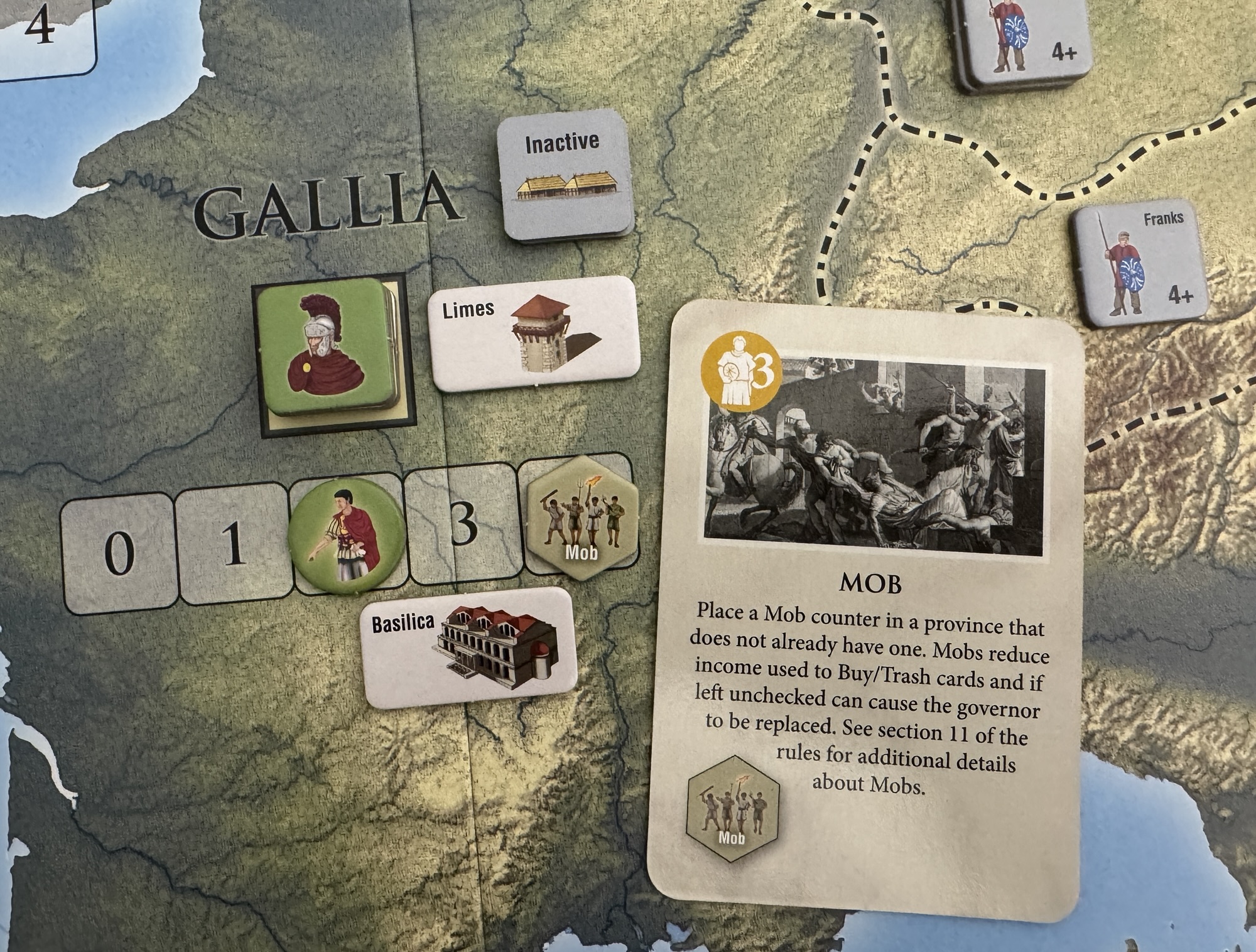
I really love Time of Crisis from GMT Games. This is a very light, introductory wargame that is just plain fun to play. I have been playing it a ton on the Rally the Troops! online platform and really enjoy it no matter what the outcome of those games are. One card that I enjoy using is called Mob, which is a 3 value Populace Card that really can be a devious way to usurp your enemies. Populace cards are intended to be used to increase the support level for your reign in various local senates, recruit militias to assist in the defense of the local populace, to remove Mob counters through the process of holding games and to build various improvements that provide various benefits such as a Basilica, Amphitheater or Limes. You will be unable to control your local provinces without the support of the people and the Populace cards will help you to build that support. But with the Mob card, this is an offensive focused Populace card that can be used to begin undermining your opponents hold on provinces.

When played, the card allows you to place a Mob counter in a province on the board that doesn’t currently have a Mob counter. Mob counters represent rioting and instability in the provincial capital of a province. The Mob in the province will reduce its income generation by the number of Mob counters in the province but also will grow if not dealt with. During the Support Check Phase, if the number of Mob counters in a province equals or exceeds the province’s support level the Governor is replaced with a Neutral Governor with a support level of 1. During the End of Turn Phase, one Mob counter is added to each governed provinces that already has a Mob counter and no Amphitheater. The presence of an Amphitheater doesn’t stop Mob counters from being added from the play of the Mob card but will stop them from growing. Remember, one of the maxims of Ancient Rome was bread and circuses, which is panem et circenses in Latin. It was coined around 100 AD by the Roman poet Juvenal in his Satires. The phrase criticizes how the Roman public traded their political freedom and civic duties for free grain and massive public spectacles.

The Mob card can be quite effective as it reduces the income of your opponents which is used to to purchase additional and more powerful cards but also forces them to spend their card values on suppressing the mobs, through military force with the Suppress Mob action or through placation with the Hold Games action. Both will be a thorn in the side of your opponents and will cause them to have to change their plans temporarily to deal with the issues you have caused them. A fun and delightful “take that” type of card.

Mobs in ancient Rome were powerful, volatile groups of urban plebeians, freedmen and workers who heavily influenced politics, food supplies and public safety. Driven by economic hardship, political gangs, and grain shortages, these crowds routinely rioted, burned government buildings and forced emperors or senators to heed their demands. Ancient Roman writers, politicians, and historians viewed the urban mob (plebs) with a mixture of fear, contempt and fascination, often describing crowds as volatile, lawless and easily swayed by demagogues. One of the more well known quotes from history comes to us by way of Titus Livy when he said, “Indeed, that is the nature of crowds: the mob is either a humble slave or a cruel master.” Livy also wrote: “As for the middle way of liberty, the mob can neither take it nor keep it with any respect for moderation or law.”

1799/1810 copperplate engraving titled The Death of Clodius (or Clodius killed by Milo’s mob) was drawn by the Polish-born French artist Silvestre David Mirys (1750–1810) as part of his series Figures de l’histoire de la république romaine.

If you are interested, I wrote a full review for Time of Crisis and you can read that at the following link: https://theplayersaid.com/2017/09/04/the-most-recent-fruits-of-wargame-hybridization-a-review-of-time-of-crisis-the-roman-empire-in-turmoil-235-284-ad-from-gmt-games/

We also posted a full review video and you can watch that at the following link:

In the next entry in this series, we will take a look at DoD Contractors from Andean Abyss: Insurgency and Counterinsurgency in Colombia from GMT Games.

-Grant
My Favorite Wargame Cards – A Look at Individual Cards from My Favorite Games – Card #88: National American Woman Suffrage Association from Votes for Women from Fort Circle Games

Von: Grant
05. August 2026 um 14:00

With this My Favorite Wargame Cards Series, I hope to take a look at a specific card from the various wargames that I have played and share how it is used in the game. I am not a strategist and frankly I am not that good at games but I do understand how things should work and be used in games. With that being said, here is the next entry in this series.

Card #88: National American Woman Suffrage Association from Votes for Women from Fort Circle Games

Votes for Women is a very interesting card-driven game that covers the American Women’s Suffrage Movement from 1848-1920, culminating in the ratification of the Nineteenth Amendment which granted women the right to vote. The game is a 2-player game, that has a fully developed solitaire mode with an “Oppobot” and offers a cooperative mode for those who don’t wish to play as they Opposition. The Suffragist player will have to push Congress to propose the Nineteenth Amendment, and then focus on campaigning to have a minimum of 36 states to ratify the Amendment. The Opposition side will try to prevent Congress from proposing the amendment and failing that to have 13 states reject the amendment.

The game uses cards in a fairly traditional CDG way as there are events that can be be taken or the cards can be played to do things like Campaign, Organize or Lobby Congress. Each card has a specific Card Era that is used to create of the each players’ Draw Decks. Late cards will be on the bottom of the deck, Middle cards will be in the middle of the deck and Early cards will be on the top of the deck. The Suffragist and Opposition decks each have one Start card that will be placed in the player’s hand at the start of the game. Some Event Cards have a prerequisite and some of the cards require a player to roll a 6-sided die and only take the the action on a roll of 3-6. Otherwise, the Event Card is discarded with no effect. The cards in this game are also steeped in historical details, from the name of the events that tie back to specific individuals or happenings, to major moments in the struggle. This game is about the history of the struggle for the right to vote and it is very good!

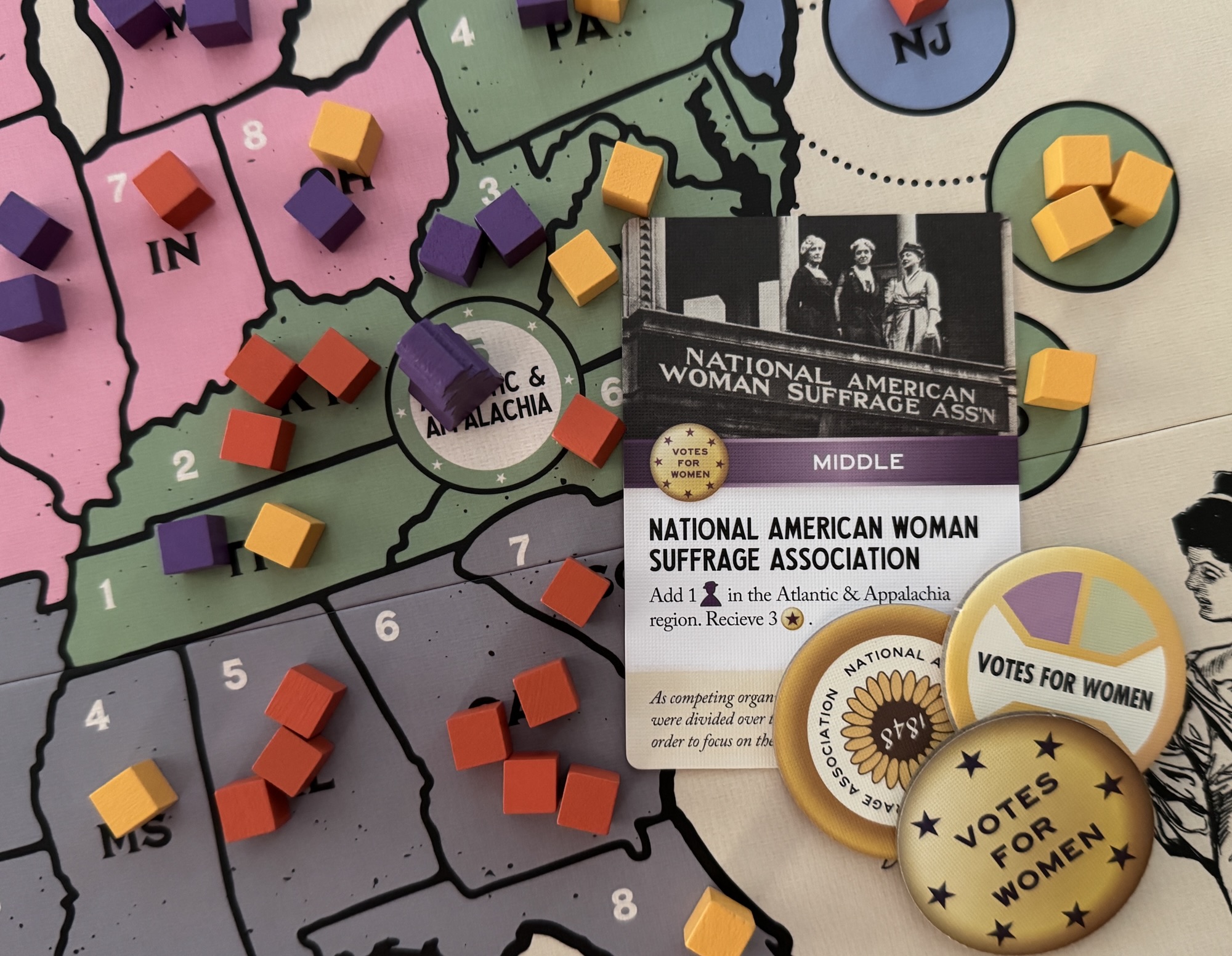
One of the more interesting aspects about the mechanics of the game is the use of Campaigners to go about trying to influence the attitude of the people and legislators regarding the Nineteenth Amendment through the Campaign Action. When a card is played for a Campaign Action, the player rolls a die, either a 6-sided or 8-sided die depending on what cards have been activated, for each Campaigner they have in play. The player then gets to take the dice and their results, which range from 1-8, and assign a specific die to each of their Campaigners. Each Campaigner may then place the corresponding number of cubes, matching the Campaigner’s color, in the States within the region that the Campaigner is located in. The player may spend a Button to move the Campaigner to a different region, but all of the corresponding cubes must be put into the same region. This is a great way to get a lot of influence out on the board to begin taking control of various States for the final vote in the game. This also is a very efficient way of doing this as you will be rolling 2-3 dice for your Campaigners and then spamming the States. With that in mind, today’s card is the National American Woman Suffrage Association and it provides the Suffragist player with a new Campaigner (purple) to place out specifically into the Atlantic & Appalachia Region that includes the States of Kentucky, Tennessee, West Virginia, Pennsylvania, Virginia, North Carolina, Maryland and Delaware. The card also grants the Suffragist player with 3 Buttons that can be used as described above to relocate a Campaigner from one state to another. This card is very helpful and should be played for the Event 9 times out of 10 and will make a huge difference in the outcome of the game. Once a 2nd or 3rd Campaigner is deployed, I tend to take Campaign Actions rather than some of the less intensive placement options or Events.

The National American Woman Suffrage Association (NAWSA) was an organization formed on February 18, 1890, to advocate in favor of women’s suffrage in the United States. It was created by the merger of two existing organizations, the National Woman Suffrage Association (NWSA) and the American Woman Suffrage Association (AWSA). Its membership, which was about 7,000 at the time it was formed, eventually increased to 2 million, making it the largest voluntary organization in the nation. It played a pivotal role in the passing of the Nineteenth Amendment to the United States Constitution, which in 1920 guaranteed women’s right to vote.

Helen Hamilton Gardener, Maud Wood Park and Carrie Chapman Catt at Suffrage House in Washington, D.C.

Susan B. Anthony, a long-time leader in the suffrage movement, was the dominant figure in the newly formed NAWSA. Carrie Chapman Catt, who became president after Anthony retired in 1900, implemented a strategy of recruiting wealthy members of the rapidly growing women’s club movement, whose time, money and experience could help build the suffrage movement. Anna Howard Shaw’s term in office, which began in 1904, saw strong growth in the organization’s membership and public approval.

After the Senate decisively rejected the proposed women’s suffrage amendment to the U.S. Constitution in 1887, the suffrage movement had concentrated most of its efforts on state suffrage campaigns. In 1910 Alice Paul joined the NAWSA and played a major role in reviving interest in the national amendment. After continuing conflicts with the NAWSA leadership over tactics, Paul created a rival organization, the National Woman’s Party.

Here is a link to our full video review of the game:

We also published an interview on the blog with the designer Tory Brown and you can read that at the following link: https://theplayersaid.com/2020/09/07/interview-with-tory-brown-designer-of-votes-for-women-from-fort-circle-games-currently-on-kickstarter/

In the next entry in this series, we will take a look at Frederick Douglas from For the People 25th Anniversary Edition from GMT Games.

-Grant

❌