
Normale Ansicht

History Behind the Cards – A Look at Checkpoint Charlie from GMT Games – Card #3: Demonstrations

Von: Grant
22. Juli 2026 um 14:00

I love a different style and focus of wargame. A game that takes a look at an important but somewhat obscure or rarely addressed historical topic, such as espionage or intelligence, and creates a gaming experience tailored around the events to highlight and evoke the difficulties and tension that would have been present. In January 2026, GMT Games announced such a game in Checkpoint Charlie, which is a solo or cooperative game focused on SIS espionage missions in Berlin in the 1960’s designed by Russell Brown. We have posted an interview with Russel and it was very well received and he has now agreed to create a series of History Behind the Cards to highlight the events of the 1960’s Cold War struggle in West Germany but also to share aspects about the game play and how it models the history.

*Note: The cards highlighted in this series and their event text, as well as any pictures used showing any of the various components, are still in the design and development process and as such event effects and text might still change prior to final development and publication. Also the art and layout of the cards are only for playtest purposes at this point and the game will enter the art department as it nears publication.

History Behind the Cards – Checkpoint Charlie from GMT Games – Card #3: Demonstrations

West Berlin, and West Germany as a whole, spawned a number of large, very active student demonstration organizations in the late 1960’s. These were generally in response to a perceived return to very traditional German authoritarian government, and specifically as a reaction to former members of the Nazi party, like Chancellor Kiesinger, serving in the Bonn government.

However, during the slightly earlier time period of Checkpoint Charlie (early 1962 to late 1963), demonstrations were not as organized. They were spontaneous and in response to specific events, like the Speigel Affair (Card #16) and President Kennedy’s Visit (Card #7). As with those later, more organized movements, they consisted primarily of young Germans, and the universities acted as catalysts and staging areas. Even during the period of this game, marches and demonstrations were common enough to warrant an event card.

As a side note, Chancellor Keisinger, who’s Nazi affiliation spawned some of those later protests, was replaced as Chancellor of West Germany in 1969 by Willie Brandt, who was mayor of West Berlin during the period of Checkpoint Charlie. Mayor Brandt has his own token in the game and plays a role in a few of the missions.

The Demonstrations Event Card places a special Demonstrations marker in one of the West Berlin locations on the map. Demonstrations could last for hours, or even days, so this marker generally remains on the City Map for the rest of the mission. East Berlin locations are not eligible because the Stasi secret police, along with the confinement imposed by the Berlin Wall, had effectively suppressed any open opposition in the East. In game terms, the Demonstrations marker provides some cover for assets, increasing their chances of passing both detection and compromise saves.

In the next article in this series, we will take a look at Faceoff with the Soviets when East German police placed barbed wire barriers to stop East Germans from defecting.

In my opinion, this game looks extremely interesting and I am very much excited to learn more about it. I am appreciative to Russell and his efforts to bring us these cards and to write these entries to share with our readers. I am also very glad that this topic is being covered in a game and look forward to playing this one day soon.

We published an interview with the designer Russell Brown on the blog and you can read that at the following link: https://theplayersaid.com/2026/02/23/interview-with-russell-brown-designer-of-checkpoint-charlie-from-gmt-games/

You can catch up on the posts in this series to date by following the below links:

Card #1: Cousins Operation

Card #2: Cuban Missile Crisis

If you are interested in Checkpoint Charlie, you can pre-order a copy for $48.00 from the GMT Games website at the following link: https://www.gmtgames.com/p-1211-checkpoint-charlie.aspx

-Grant

My Favorite Wargame Cards – A Look at Individual Cards from My Favorite Games – Card #86: LRRP from Fire in the Lake: Insurgency in Vietnam from GMT Games

Von: Grant
14. Juli 2026 um 14:00

With this My Favorite Wargame Cards Series, I hope to take a look at a specific card from the various wargames that I have played and share how it is used in the game. I am not a strategist and frankly I am not that good at games but I do understand how things should work and be used in games. With that being said, here is the next entry in this series.

#86: LRRP from Fire in the Lake: Insurgency in Vietnam from GMT Games

The COIN Series uses cards in a very different way from other CDG’s. These cards are not necessarily the driver of the action but more assistive to the actions of the players by setting eligibility and also providing powerful events. The Event Cards are more often than not, very powerful. They either give you a continuing bonus on future Operations and Special Activities (as in the case of the volumes that include the various Capabilities) or allow you to take Operations and Special Activities more times that round than you would normally have been able to had you not chosen the Event and more often than not, at no cost! Also, because of the power of the cards and their ties to one or more factions, you can take the Event which allows you a huge advantage, only to see that very powerful Event reversed with the next Event or with a regular Operation. This is very frustrating but is one of the major reasons that I love the card-assisted element of the COIN Series. Today we are going to take a look at the LRRP Event Card.

The LRRP Event Card, with LRRP standing for Long-Range Reconnaissance Patrol, allows the US player to place 3 Irregulars outside the South then conduct a free Air Strike, that also allows for the removal of Bases first. Keep in mind that Irregulars are US Special Forces pieces, which are the hexagonal shaped cylinders not ARVN Rangers. “Outside the South” means any Laos or Cambodia Provinces. Seems pretty pedestrian but it is important to note that this card changes the rules when played as normally all other units in a space must be removed before Bases can be removed. A very powerful card that typically will be played by the US player when it comes up. But keep in mind that Air Strikes are a dual edged sword as you get rid of pesky enemy pieces but it will result in shifts of Support/Opposition but can also Degrade the Trail. On the bottom of the card, the text allows the VC or NVA to ambush these LRRP”s and remove 3 Irregulars from the map to Casualties. Then it gives an added benefit of shifting each space these removed Irregulars were in 1 level toward Active Opposition.

Image courtesy of Boxxer’s Blog.

A Long-Range Reconnaissance Patrol, or LRRP, is a small, well-armed and nimble recon team that is tasked with patrolling deep into enemy territory to identify or destroy key targets and gain recon on the enemy. The concept of scouting forces such as LRRP’s dates back to ancient warfare but also has been used in more modern and contemporary wars such as the French & Indian War where specialized Rangers, such as Rogers’ Rangers, were tasked with raiding Indian settlements, disrupting supply lines and reporting back to command on troop disposition and movement.

In Vietnam, veteran or specially trained forces often augmented with Vietnamese irregulars usually carried out Long Range Reconnaissance Patrols into enemy territory. The Studies and Observation Group (SOG) was the ground element of the US air war against the Ho Chi Minh Trail as illustrated by Project Tiger that spotted for and marked enemy trail activity for elimination by US air assets.

Here is a link to a very interesting summary of an LRRP and its mission on a Vietnam veteran run blog called Boxxer’s Blog: From the seat of a motorcycle: LRRPs: “—doing the impossible for the ungrateful.”

In the next entry in this series, we will take a look at Proletarian Revolution from The Republic’s Struggle: Battle for the Republic, Spain 1931-1939 from NAC Wargames.

-Grant

History Behind the Cards – A Look at Checkpoint Charlie from GMT Games – Card #1: Cousins Operation

Von: Grant
25. Juni 2026 um 14:00

I love a different style and focus of wargame. A game that takes a look at an important but somewhat obscure or rarely addressed historical topic, such as espionage or intelligence, and creates a gaming experience tailored around the events to highlight and evoke the difficulties and tension that would have been present. In January 2026, GMT Games announced such a game in Checkpoint Charlie, which is a solo or cooperative game focused on SIS espionage missions in Berlin in the 1960’s designed by Russell Brown. We have posted an interview with Russel and it was very well received and he has now agreed to create a series of History Behind the Cards to highlight the events of the 1960’s Cold War struggle in West Germany but also to share aspects about the game play and how it models the history.

*Note: The cards highlighted in this series and their event text, as well as any pictures used showing any of the various components, are still in the design and development process and as such event effects and text might still change prior to final development and publication. Also the art and layout of the cards are only for playtest purposes at this point and the game will enter the art department as it nears publication.

History Behind the Cards – Checkpoint Charlie from GMT Games – Card #1: Cousins Operation

The British SIS wasn’t the only intelligence agency operating in Berlin in the 1960’s, not by a longshot. The Potsdam Agreement of 1945 had divided Germany into allied occupation zones, with West Berlin itself divided into British, French and American sectors for administration and military presence, but those boundaries in no way restricted the activities of intelligence organizations in the city. The US Central Intelligence Agency had the largest presence.

The remarkably close relationship between US and British intelligence was formalized in 1946 under the British-US Communications Intelligence Agreement (BRUSA). It became the UKUSA agreement in 1955, including Canada, New Zealand and Australia (the “Five Eyes”), and still stands today. The term “cousins” was used within the British and American intelligence communities to refer to their counterparts from the other agencies, in reference to their longstanding Special Relationship. There were notable examples of not just coordination, but cooperation among the agencies, like Operation Gold – a joint operation in the 1950’s to tunnel beneath the city and tap into the landline communication of the Soviet Army headquarters in Berlin.

This relationship was formalized in the rules of a much earlier version of Checkpoint Charlie, with a specific step in the turn sequence when SIS assets could call upon the CIA for assistance, though with increased risk of detection. However, even with liaison officers and daily intelligence briefings between the two agencies, it was impossible to inform the other service of every aspect of day-to-day activities, let alone coordinate at a task level, so I removed that interaction.

This card represents a CIA operation in one of the locations in the city that has come to the attention of the KGB and was unknown to SIS case officers. This card places a marker that makes it more difficult for SIS assets to operate in the location, as indicated by the negative detection save modifier, and also draws a KGB Agent closer to that location.

In the next article in this series, we will take a look at the Cuban Missile Crisis and how the status of Berlin, even though it is located halfway around the world, effected things on the world stage.

In my opinion, this game looks extremely interesting and I am very much excited to learn more about it. I am appreciative to Russell and his efforts to bring us these cards and to write these entries to share with our readers. I am also very glad that this topic is being covered in a game and look forward to playing this one day soon.

We published an interview with the designer Russell Brown on the blog and you can read that at the following link: https://theplayersaid.com/2026/02/23/interview-with-russell-brown-designer-of-checkpoint-charlie-from-gmt-games/

If you are interested in Checkpoint Charlie, you can pre-order a copy for $48.00 from the GMT Games website at the following link: https://www.gmtgames.com/p-1211-checkpoint-charlie.aspx

-Grant
First Impressions: New Cold War: 1989-2019 from VUCA Simulations

Von: Grant
08. Mai 2026 um 14:52

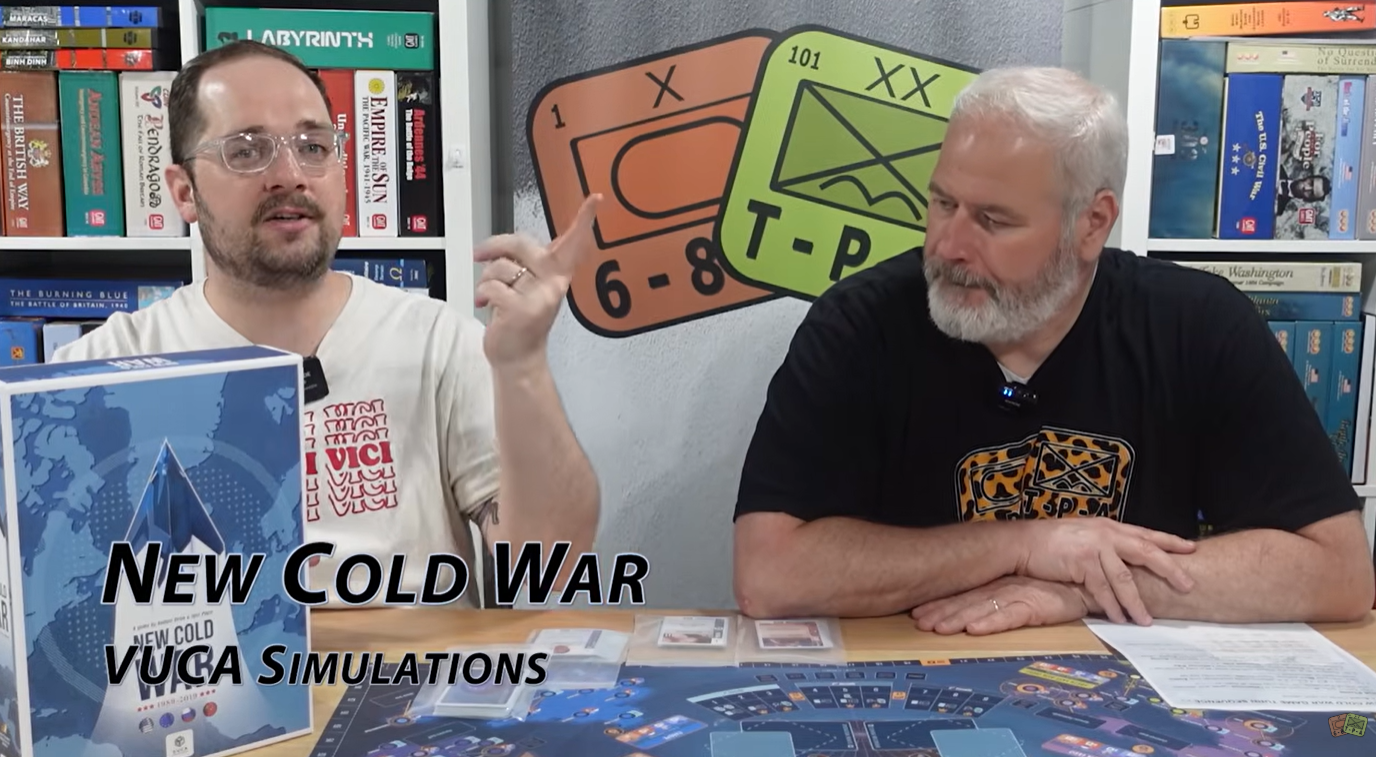
New Cold War1989-2019 is a Card-Driven Game based in the most important geopolitical events from 1989 to 2019. Players lead one of the four great powers (Russia, China, US, EU) in their fight for the new world order. Initially, the confrontation is between the red bloc, consisting of Russia and China and the blue bloc, comprising the United States and the European Union. However, each player must also prioritize their own strategy, as only one power can emerge victorious at the end of the game. Therefore, this game starts with cooperation between allied powers in the early stages but becomes entirely competitive as the moment of final victory approaches.

New Cold War utilizes a Card-Driven game mechanic. Players strive to attain victory by gaining international prestige, dominating the media and increasing their control of countries and different regions of the world. Other key factors to manage include military force and United Nations Security Council vetoes. Players’ strategies are determined by a series of hidden objectives they must pursue to achieve victory.

The game accommodates three or two-player versions and includes a solitaire mode through a system of bots.

We published an interview with design team of Andoni Orive and Igor Plaza on the blog and you can read that at the following link: https://theplayersaid.com/2025/05/19/interview-with-andoni-orive-and-igor-plaza-designers-of-new-cold-war-1989-2019-from-vuca-simulations/

I also wrote a fairly in-depth First Impressions style post for the blog and you can read that at the following link: https://theplayersaid.com/2025/05/09/first-impressions-new-cold-war-1989-2019-from-vuca-simulations/

-Grant

❌