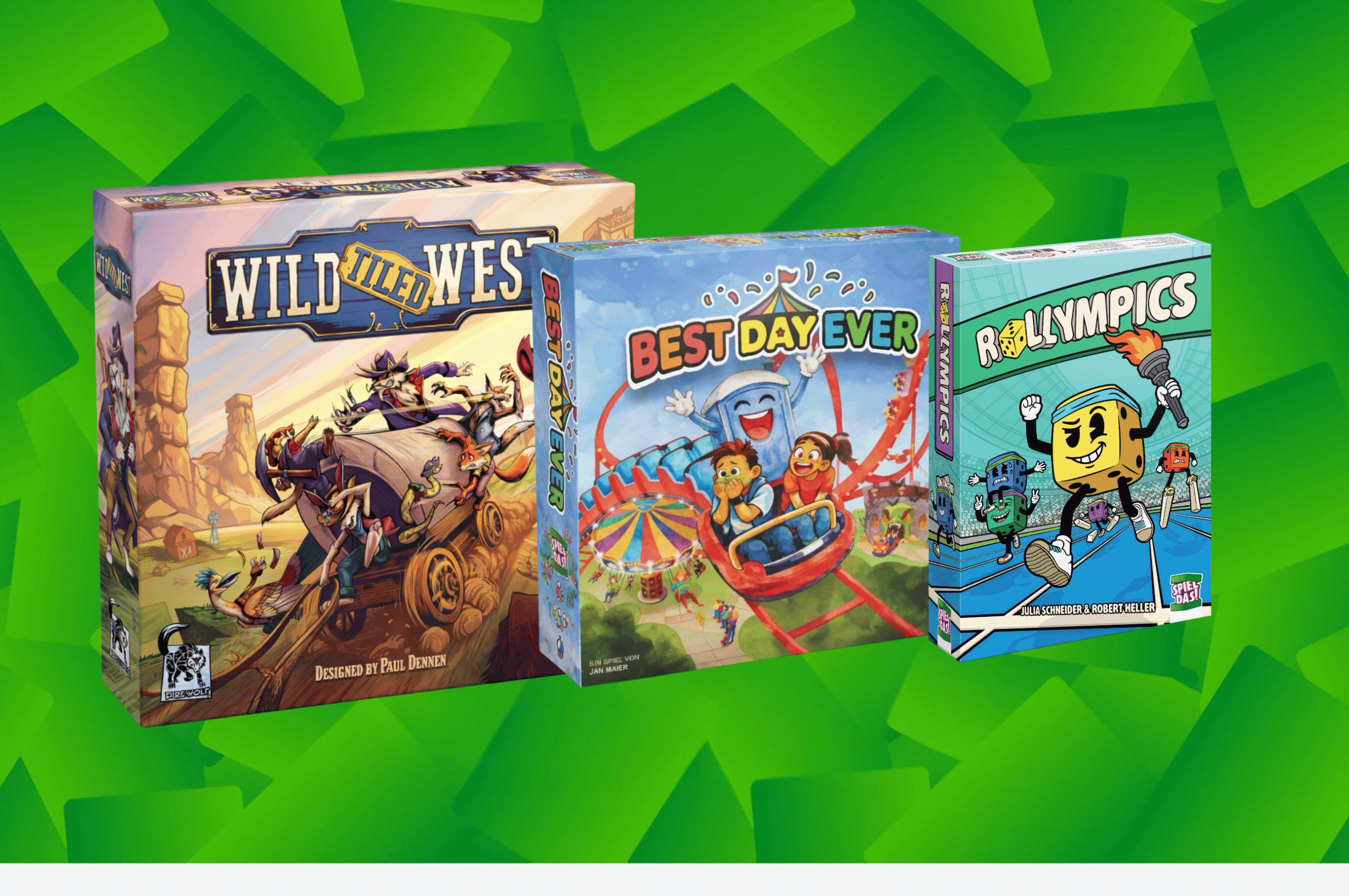
Wir haben in diesem Jahr noch eine Menge vor! Neben den bereits angekündigten Titeln „Hop’n’Roll“ und der Erweiterung zum Verkaufshit „Panda Royale“ kündigen wir heute drei neue Spiele an: Ob die nächste Party, den Spieleabend in der Familie oder Vielspieler:innen; hier ist für alle etwas dabei!🤩
Vom Erfolgsautoren PAUL DENNEN
Zwei Titel aus unserem Verlag: Mit Nachwuchsautor:innen arbeiten wir besonders gerne zusammen!
Nachschub für SPIEL DAS! Fans
Mit ROLLYMPICS erscheint der neue Partyspielhit für bis zu 5 Personen, der nicht nur alle Fans von „Ninja Academy“ begeistern wird. Diesmal stehen bei den Minispielen Würfel im Mittelpunkt. Diese werden gestapelt, gerollt, balanciert. Aber auch bluffen, schnelle Reaktion und Interaktion sind gefragt! Mit über 20 Würfeln und mehr als 20 Challenges bietet das Spiel nicht nur ansprechendes Material, sondern auch Abwechslung!
3-5 Personen ab 8 Jahren / Spieldauer ca. 20 min / voraussichtlich ab Juli
In BEST DAY EVER lädt Nachwuchsautor Jan Maier zu einem rasanten und humorvollen Tag für bis zu 6 Personen im Freizeitpark ein. Zwischen Achterbahn, Karussell und entspannten Pausen im Park plant ihr euren Tag mit möglichst vielen Attraktionen, um Zielkarten zu erfüllen. Alle spielen gleichzeitig, sodass kaum Downtime entsteht. Doch haltet auch die eigene Übelkeit und den rechtzeitigen WC-Besuch im Blick. Ein Familienspiel voller Witz und Tempo für.
2-6 Personen ab 8 Jahren / Spieldauer ca. 45 min / voraussichtlich ab Oktober
In WILD TILED WEST geht’s in den rauen Alltag des Wilden Westens! Durch geschicktes Platzieren von Landschaftsplättchen errichten die Mitspielenden ihre eigene Grenzstadt, nutzen Gebäudeeffekte und setzen sich gegen Banditen zur Wehr. Entwickelt wurde das Spiel von Paul Dennen, bekannt für erfolgreiche Titel wie „Clank!“. Es verbindet Drafting mit kniffligem Tile-Placement zu einem taktischen Erlebnis. Auf BoardGameGeek erreicht das Spiel eine Bewertung von 7,6: für Vielspieler:innen und Westernfans gleichermaßen ein Must Have!
1-5 Personen ab 13 Jahren / Spieldauer ca. 45-60 min / voraussichtlich ab Oktober
… und immer auf dem Laufenden!
Folge uns in den sozialen Netzwerken und verpasse keine Neuigkeiten!
The overall blog statistics are pretty meaningless – both last year and this year are skewed by WordPress sending my Farewell 2024 – Historical Fiction! post out to a bajillion people (from Dec 26 to Jan 8), which makes it easily the most popular post of each year (providing more than a fourth of my total views this year). If you factor that out, 2025 has been a good year on the blog, but slightly behind the (organic) record of 2023.
The posts doing particularly well have been the usual suspects, that is, the Most Anticipated Historical Board Games post in January, and the evergreen strategy posts for several games published over the last year. It was nice to see that a few of my research-intensive posts in the American Revolution and the Wallenstein series also did well.
Most of my readers come from the United States (also skewed by the Historical Fiction anomaly, but not entirely), as well as other Anglophone (UK, Canada, Australia) or European (Germany, the Netherlands, Spain, and France) countries. Especially the Dutch have made a leap up… maybe because of my post on the history of Amsterdam? Welkom, anyway.
New arrivals in the top 10 of the countries from which most views stem are Sweden and Poland in a joint Baltic effort.
If you compare views with population numbers, there are possibly no more loyal readers of this blog than the fine people of Ireland, closely followed by Hong Kong, whose views eclipse those of huge countries like Japan, Brazil, or India. The Irish have been devoted to history, board games, and history in board games for some years now, for which I am grateful. The Hongkongers are new in their excitement for the blog – welcome! If you are from Hong Kong, leave a comment below!
I can only speculate what brought people to this blog (but maybe you can enlighten me with a comment, especially if read this blog, but don’t comment often or ever). Here is, however, what I think was the finest which I published this year – as per usual, with six instead of three entries, and without crowning a winner. Let’s go!
Most of the history articles on this blog are about what people in the past did – the politicians, merchants, soldiers of times past. Yet I also like to dwell on what they thought, and thus I’m very happy to have written this post on the political philosophy of the American Revolution, its core value of liberty, and the promise and limitation of that idea. It was also an opportunity to engage with the still-compelling documents of the Revolution – Common Sense and the Declaration of Independence.
It’s been a wild year politically. Almost forgotten by now is the Great Tariff Rollercoaster of April 2025, in which the American federal government announced tariffs on imports from almost all other countries and then engaged in a flurry of raising, lowering, and holding off on them that made everyone’s head spin. By now, the 145% tariff on Chinese goods imported by US buyers is long gone, but at the time it seemed like an existential threat to US board game companies manufacturing their games in China (so, almost all of them), and given that the current US administration will still be in office for another three years, one worth revisiting.
This blog often gives me the opportunity to learn about new subjects. Wallenstein was one of them. I approached the post about his life with not more than a general knowledge about his role in the Thirty Years’ War… and then was sucked into a research rabbit hole in which I read over 2,000 pages about the guy. The result is a four-part series and the longest, most detailed board game assisted biography I have ever written about anyone.
…and this blog also allows me to re-visit topics and games with which I have engaged for years (and sometimes decades) now. Frederick II of Prussia is such a person, and Friedrich (Richard Sivél, Histogame) such a game. Reflecting on their insights on Frederick’s campaigns, the command and control exercised, and Frederick’s psychology was a delight.
Amsterdam is one of the iconic cities of the world. It is a symbol of art, commerce, and progress, and unique in its canal-structured urban layout. Unsurprisingly, these characteristics have also inspired board game designers. I have told Amsterdam’s 750-year history through the lens of the many board games set in Amsterdam – which gives a glimpse into what the city stands for in the popular imagination. As both this and my earlier Venice post were so much fun to write, I should do more city histories!
One of my brighter new ideas was to link historical board games to period music. Of course, that works particularly well from the 20th century on – the age of the music record. I started with an immersive playlist for your next game of Weimar (Matthias Cramer, Capstone Games/Skellig Games/Spielworxx), full of everything that was hot at the time – from traditional songs to jazz, from movie tunes to workers’ songs. It will surely not remain the only such playlist.
And thus concludes the year 2025 on this blog. I hope you had as much fun reading it as I had writing.
I wish you all an excellent year 2026, full of joy, health, and success!
The opening sequence of Martin Scorsese’s Taxi Driver depicts a New York with enough grit that you can feel it on your teeth. It’s a feral hour of the night. DeNiro’s sedan is cruising down a street awash in the radiant soul of the city. There’s a shot of the vehicle’s quarter panel. Beads of…
Looking for something comic related for that fan in your life for the holidays? Then consider the board game, Corps. of Discovery from Off the Page Games.
In this episode, Jamey Stegmaier and I chat about the various trends we’re seeing in the current game design landscape. We talk about solo and 2-player games, open worlds, licensed IPs, and more!
In this episode, Jamey Stegmaier and I chat about the various trends we’re seeing in the current game design landscape. We talk about solo and 2-player games, open worlds, licensed IPs, and more!
My game design book, Find the Fun, recently came out, and in this episode, I do a brief synopsis and give you the audio version of the first three chapters.
My game design book, Find the Fun, recently came out, and in this episode, I do a brief synopsis and give you the audio version of the first three chapters.
In this BGDL rewind from June of 2020, Corey Konieczka breaks down his entire design process.
Corey has several games ranked in the top 100 games of all time, and it was incredibly insightful to learn about how he brings a game to life. We chat about his path into the industry, his prototyping process, the challenges of working on IPs like Star Wars, when to walk away from a design, and more!
In this BGDL rewind from April of 2020, Ignacy Trzewiczek, founder of Portal Games and designer of Robinson Crusoe, discusses his company’s motto: Games that tell stories.
We go in-depth into Ignacy’s design process, talk about his most popular games, and get to the heart of what it looks like to create games that have players leaving the table with a story to tell.
In this episode, I break down some game design productivity hacks that have been helping me lately, and I’m specifically talking about a concept called “habit fields.”
This was a presentation I gave recently for Board Game Design Pro, so if you find it useful and want more helpful content like it, be sure to check out BGDP here. You’ll find all sorts of skill sessions on designing, crowdfunding, and publishing games!
And if you use coupon code “33today” you’ll receive 33% off the membership price
In this episode, Leo Taylor, designer of games in the Risk, Clue, and D&D universes, breaks down his “key pillars of game design” as we chat through the many questions designers should think through as they dive into a new game design.
In this episode, Leo Taylor, designer of games in the Risk, Clue, and D&D universes, breaks down his “key pillars of game design” as we chat through the many questions designers should think through as they dive into a new game design.
In this episode, Joe Slack and I talk about how we’ve both been able to piece together lots of different revenue streams in the gaming industry to be able to make a full-time living from game design.

 Anmelden