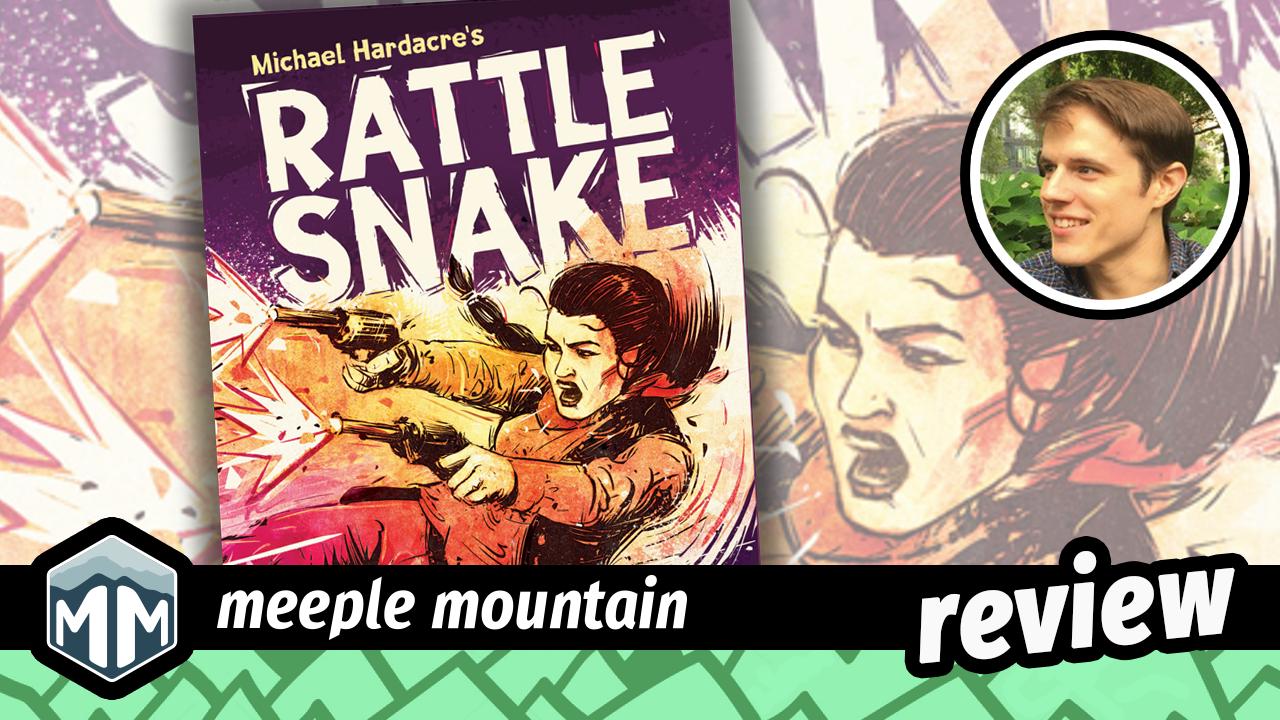
Michael Hardacre’s Rattlesnake, a two-player card game about a gun fight in the wicky-wicky-wild Wild West, is a fabulous marriage of setting and mechanisms. This thing is lean, mean, and jumpy. More sting than a scorpion and more bite than a…well, you know. It is tense enough that the components list should include brow sweat. And it’s so small! For form factor, this no-frills set of cards—with a gun token for flavor—is my favorite thing to come along sinceHigh Tide. There’s nothing quite like a big game in a small box.
The goal of the game is simple enough: kill your opponent. Well, I shouldn’t say “kill.” Pokémon has taught us that death isn’t always the end result of [checks notes] running out of health. Strictly speaking, your goal is to hit your opponent four times. Death is not the dictated outcome. Maybe all those hits grazed you. Maybe they missed organs. Maybe your opponent rushes you off to a hospital, where the gangrene can do its slow, ante-antibacterial work. I’m not a historian.
With this My Favorite Wargame Cards Series, I hope to take a look at a specific card from the various wargames that I have played and share how it is used in the game. I am not a strategist and frankly I am not that good at games but I do understand how things should work and be used in games. With that being said, here is the next entry in this series.
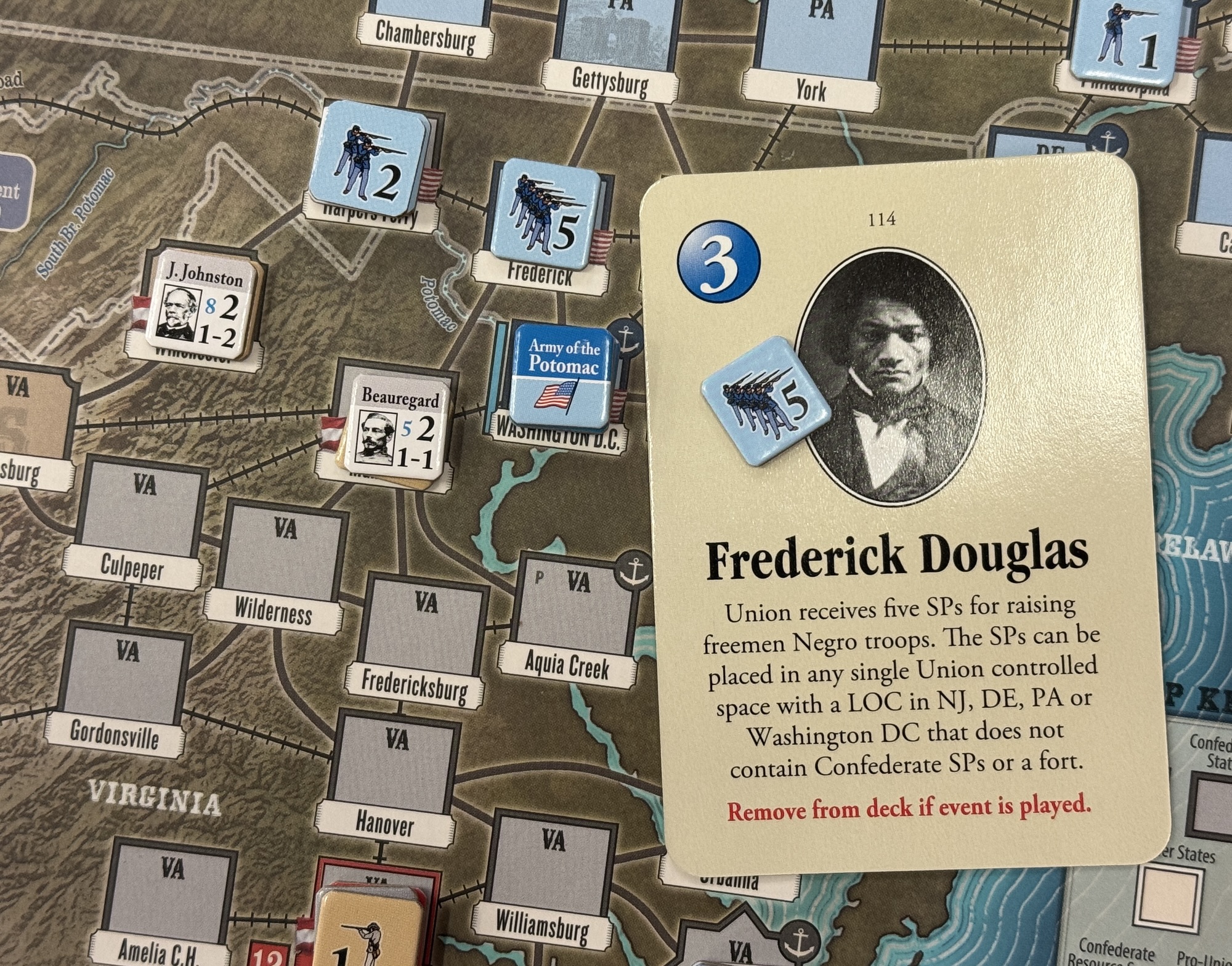
#89: Frederick Douglas from For the People 25th Anniversary Edition from GMT Games
For the People is a strategic level Card-Driven wargame about the whole 4+ years of the American Civil War covering the conflict from Texas to Pennsylvania, from the firing on Fort Sumter to the end of the war at Appomattox Court House. Players take on the role of either President Abraham Lincoln or President Jefferson Davis and command armies, promote and relieve generals, conduct amphibious assaults, dispatch cavalry raids, and even battle incompetency and political intrigue among members of your own cabinet.
As a Card Driven Game, For the People includes a deck of strategy cards that are used for conducting campaigns and incorporating the many events and personalities of the war. The Confederate player can build ironclads, naval mines (torpedoes), submarines, conduct overseas purchases and work towards foreign intervention. The Union player can build up his naval blockade, his ironclad fleet, fight draft riots, secure the Border States and issue the Emancipation Proclamation. The cards are used in the classic sense of a CDG for either the Operations Points to fuel various actions or for the printed event. According to the designer Mark Herman, “The cards are designed to present the player with his political and operational options. The use of Strategy Cards as political instruments will slow the operational tempo of military operations. The converse is also true. Both sides spent the first year of the war, 1861, mobilizing and organizing their war efforts.
The game is extremely interesting and I recently had my first experience with it and very much enjoyed what it was that I was doing even though I really had little idea about my proper strategy for the Union and what it is that I should be focused on in the game.
The Frederick Douglas card from For the People really is a bit misnamed. While Frederick Douglas was a major influence for abolitionist activities as well as progressive thinking amongst the politicians of the North, the card really should have been named for the Negro soldiers who gave so much, their lives, their backs and their families, to volunteer and fight on the side of the Union during the American Civil War. The card’s text reads “Union receives five SP’s for raising freemen Negro troops. The SP’s can be placed in any single Union controlled space with an LOC in NJ, DE, PA or Washington, D.C. that does not contain Confederate SP’s or a fort”. This card gives a huge boost to the Union side especially if it comes up early in the game as Union SP’s on the board are spread out and defense of Washington is not as stout as it needs to be. In my recent play, I got this card in my opening hand and was able to place the 5 SP into Frederick, Maryland to add to the already existing 5 SP there. Along with the Army of the Potomac and its SP stationed in Washington, D.C. this effectively discouraged the CSA from invading the North and attempting to go for a capture of the capital. You will notice that the card is a 3 OP’s card, which is very valuable in and of itself, as most of the Union Generals at the start of the game, with the exception of Burnside, have a 3 Strategy Rating and require a 3 OP’s card to activate.
The issues of emancipation and military service were intertwined from the onset of the Civil War. News from Fort Sumter set off a rush by free black men to enlist in U.S. military units. They were turned away, however, because a Federal law dating from 1792 barred Negroes from bearing arms for the U.S. army (although they had served in the American Revolution and in the War of 1812). In Boston disappointed would-be volunteers met and passed a resolution requesting that the Government modify its laws to permit their enlistment.
The Lincoln administration wrestled with the idea of authorizing the recruitment of black troops, concerned that such a move would prompt the border states to secede. When Gen. John C. Frémont in Missouri and Gen. David Hunter in South Carolina issued proclamations that emancipated slaves in their military regions and permitted them to enlist, their superiors sternly revoked their orders. By mid-1862, however, the escalating number of former slaves, the declining number of white volunteers, and the increasingly pressing personnel needs of the Union Army pushed the Government into reconsidering the ban.
As a result, on July 17, 1862, Congress passed the Second Confiscation and Militia Act, freeing slaves who had masters in the Confederate Army. Two days later, slavery was abolished in the territories of the United States, and on July 22nd President Lincoln presented the preliminary draft of the Emancipation Proclamation to his Cabinet. After the Union Army turned back Lee’s first invasion of the North at Antietam, MD, and the Emancipation Proclamation was subsequently announced, black recruitment was pursued in earnest. Volunteers from South Carolina, Tennessee, and Massachusetts filled the first authorized black regiments. Recruitment was slow until black leaders such as Frederick Douglass encouraged black men to become soldiers to ensure eventual full citizenship. Volunteers began to respond, and in May 1863 the Government established the Bureau of Colored Troops to manage the burgeoning numbers of black soldiers.
By the end of the Civil War, roughly 179,000 black men (10% of the Union Army) served as soldiers in the U.S. Army and another 19,000 served in the Navy. Nearly 40,000 black soldiers died over the course of the war. Black soldiers served in artillery and infantry and performed all noncombat support functions that sustain an army, as well. Black carpenters, chaplains, cooks, guards, laborers, nurses, scouts, spies, steamboat pilots, surgeons, and teamsters also contributed to the war cause. There were nearly 80 black commissioned officers. Black women, who could not formally join the Army, nonetheless served as nurses, spies, and scouts, the most famous being Harriet Tubman, who scouted for the 2nd South Carolina Volunteers.
In the next entry in this series, we will take a look at Mob from Time of Crisis: The Roman Empire in Turmoil, 235-284 AD from GMT Games.
There was a run there, between the aughts and the teens of the current century, when Victory Point Games published multiple of the best solitaire board games ever. Banger after banger. Then it was sold and chopped up for parts.
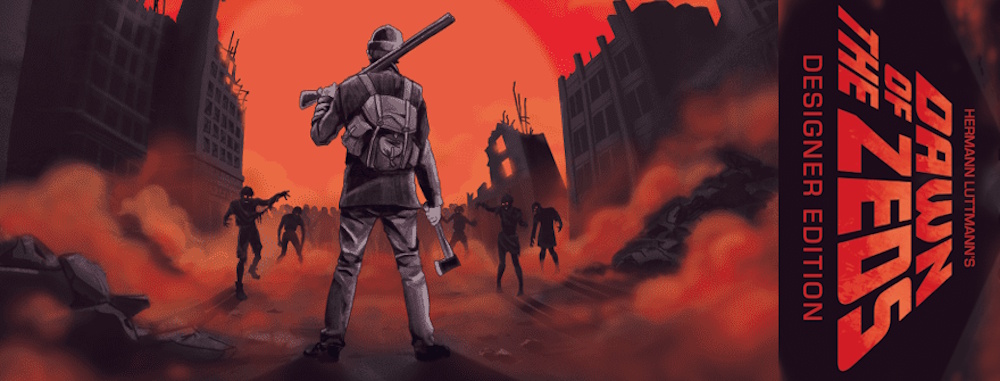
Perhaps the best title to emerge from that golden age was Hermann Luttmann’s Dawn of the Zeds. This baby merged the strategic considerations of the States of Siege line with some cinematic flair. So much cinematic flair that its overstuffed third edition aped not only the dramatic beats of cinema but also the notion that it was a movie being directed by the player. A tonal mismatch if ever there was one.
Here’s the good news: Hermann Luttmann is back with a new version of Dawn of the Zeds. Dubbed the Designer Edition, and divorced from the vultures who gobbled up Victory Point, it’s a revamp of the system from top to bottom. It isn’t as good as I remember. It’s better.
The heroes we need. And deserve. And got. Cool.
Unlike any number of internet specialists, I have no idea what a “real” zombie apocalypse would look like. But the scenario presented by Dawn of the Zeds feels real enough, at least in the moment. It begins on the periphery, slowly, Farmingdale’s outlying communities stubbornly refusing to listen to reason. Then the levy breaks and the tidal wave comes all at once. Defenders panicking over the radio. Refugees crowded on the interstate. Infections concealed among the survivors, ready to bloom into a fresh horde of killers. It isn’t long before the bodies are piling against the barricades.
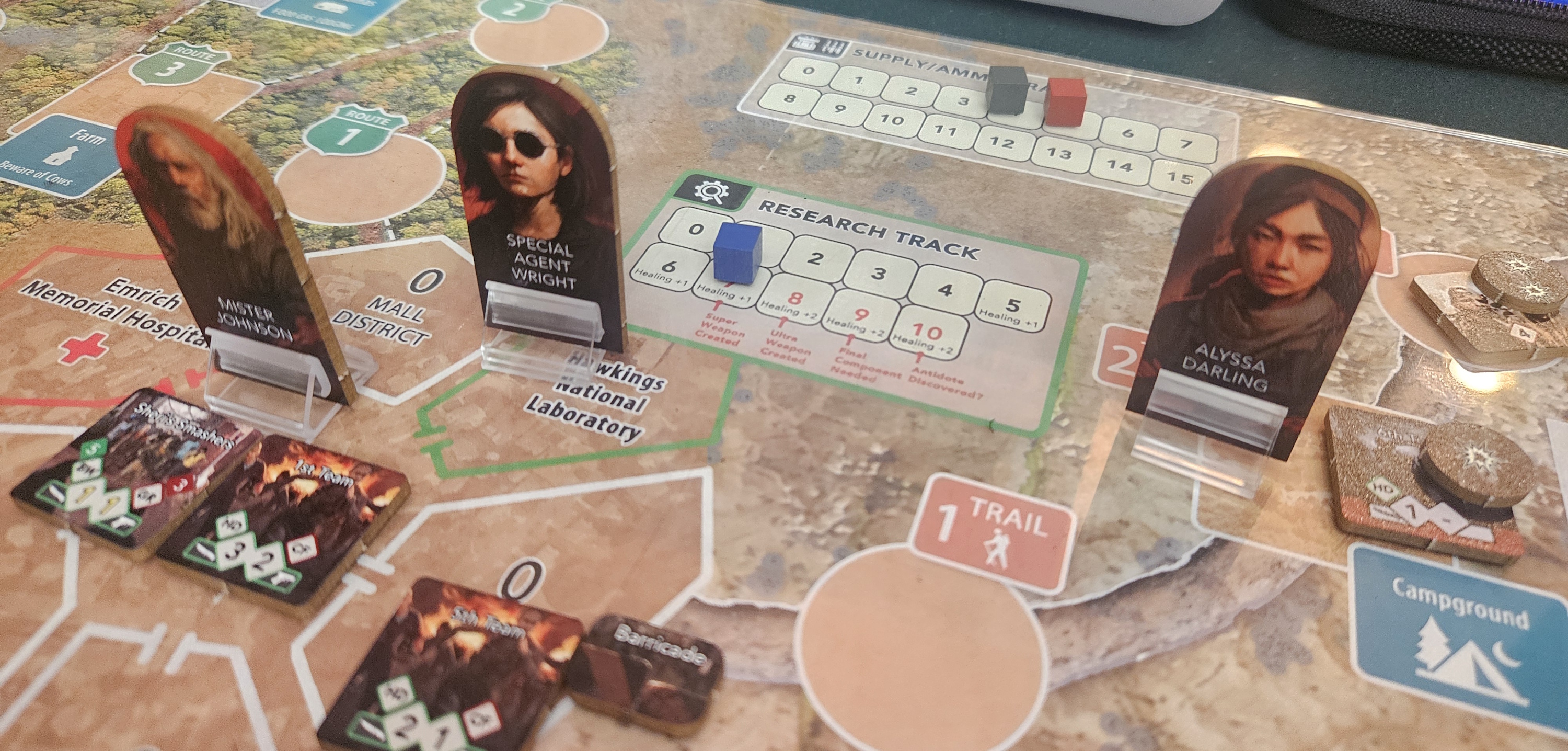
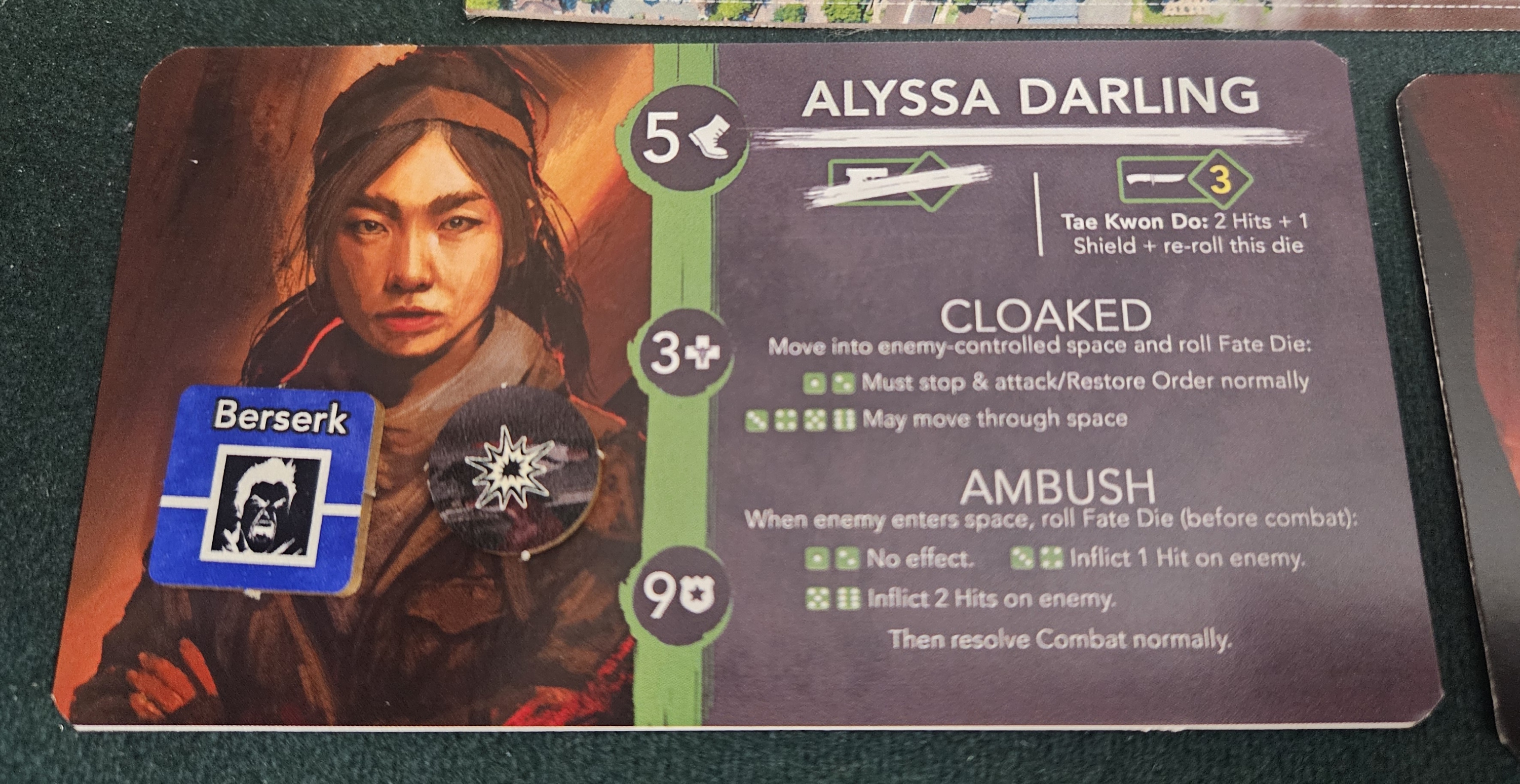
Drawing on its lineage from the States of Siege system, Dawn of the Zeds offers a bird’s eye perspective that lends it a certain credence. At a tangible level, you play as a specific group of survivors. There’s some wiggle room there, including a multiplayer mode, but the classic setup is four heroes selected at random from a generous pool. These heroes, to put it bluntly, are not created equal. One session might provide Professor Agee, already on the cusp of inventing an antidote, and Captain Piazza, the sniper whose ranged attacks and booby traps make her a force of nature at any range. Then the next will give you Pickles the dog. Poor dumb Pickles. He’s the best boy. Just not, you know, the best at zombie invasions.
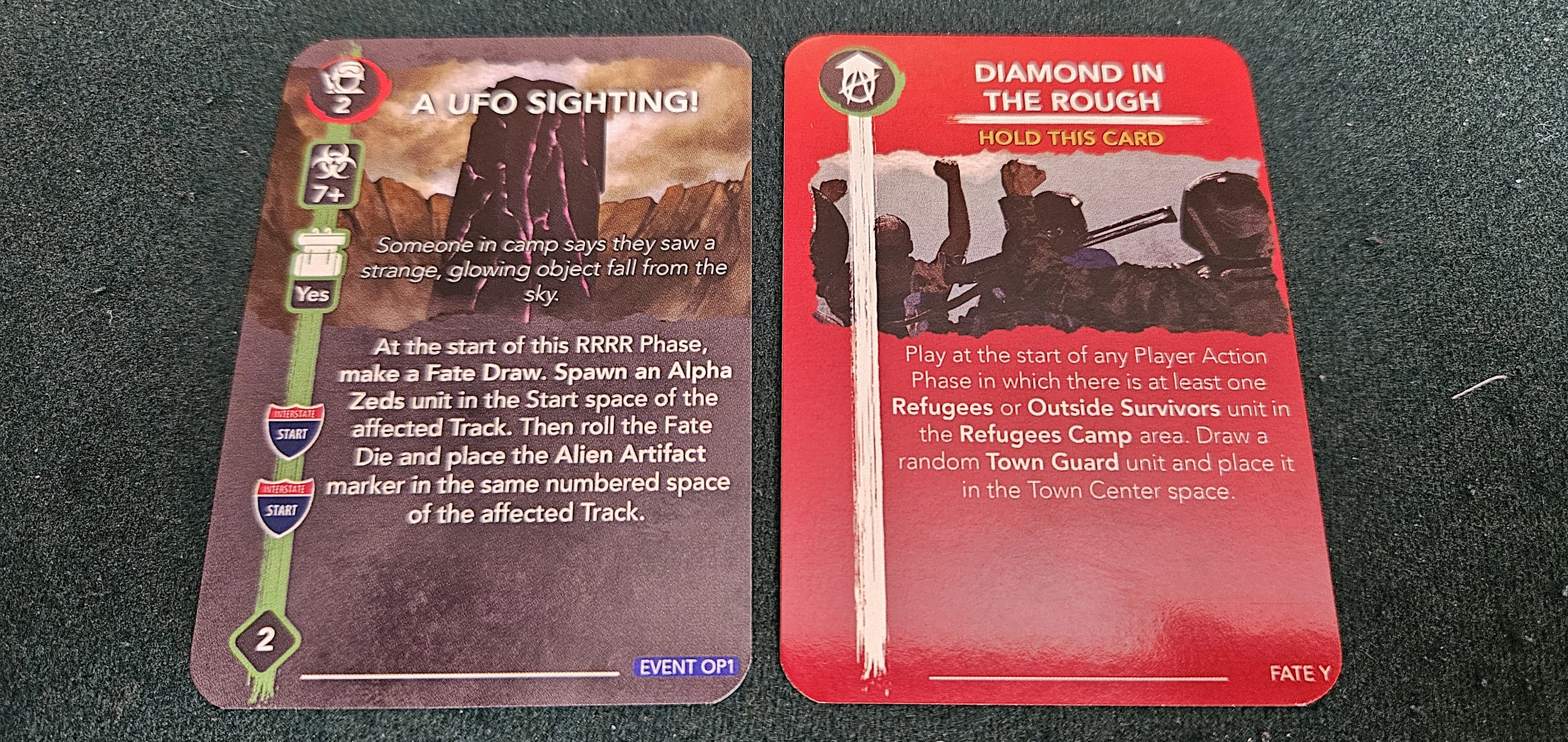
But these inequalities — some might call them “imbalances” — are not only to be expected from Dawn of the Zeds; they’re the whole reason it works. Better get used to it, in any case. Every round begins with an event card that dictates not one but four phases. One of them, the RRRR phase, is really four phases folded into one, letting you usher refugees to safety, shove raiders across the countryside, and invite any passing Army Rangers to help your community. There’s a fourth R in there, but I’ll be damned if I can remember what it stands for. Compared to that, the actual action phase, which usually sees your characters taking a measly one action each, is often brisk. Certainly you’ll wish you had more time. What do you mean Emily Orozco, golf pro, can drive balls into an oncoming horde or shuttle defenders around in her golf cart, but not both?
The sense that you’re drowning in a rickety submarine, four new leaks springing each turn while you only have enough hands to patch three, has been the default state of solitaire and cooperative gameplay ever since Matt Leacock standardized it in Pandemic. But where Dawn of the Zeds excels is at making that formula feel more natural than elsewhere. Flipping an event card doesn’t merely present a problem; it hits you with a full-spectrum crisis. Whether refugees can retreat. The threshold for yet another outbreak that will bring new zombies onto the board. How far you can stretch your tins of beans. Whether your heroes can muster some extra oomph today, that little bit of extra effort to earn a more generous action allotment.
There’s nothing quite like an event deck.
Not least of all, which lanes will come under assault today. This being a glorified States of Siege game, the entire map is divided into four lanes that spiral around and eventually terminate at Farmingdale. If any zeds reach the town, it’s game over.
So you play football. Or tug of war. Some calorie-burning metaphor is appropriate. Each lane has its own tendencies, not to mention spaces that are crucial to your survival but which will very quickly succumb to the horde. The suburbs are defensible but populated with noncombatants who must be protected lest they turn into zombie chow. The interstate is mostly open but for the town’s nuclear plant. The mountains and farmlands both feature zones where food and ammunition can be harvested more readily, if only you can hold them. It doesn’t help that zombie territory must be painstakingly reclaimed lest any future zeds spawn that much closer to your town center.
For the most part, this turns Dawn of the Zeds into a game of fire response. One of your outlying settlements’ defenders falls too soon, so you send loony old Mister Johnson and his shotgun to help bushwhack the zeds back a few steps. Supplies are dwindling, so it’s time for Big Wheels Carter to plow through the crowd with his big rig to bring a few crates back home. Injuries are piling up, so Agent Carter retreats from the front lines to help out in the hospital. Too many zombies are at the gates, so Pickles runs out and ignores the zombies, but also doesn’t really help behind the lines either. Good job, Pickles. Who’s the best boy?
Fortunately, there are plenty of tools to aid in these efforts. Barricades can be erected. Refugees can be rearmed and turned into zed-killing professionals. Antidotes and super-weapons can be manufactured. Indeed, it’s now pretty rare to not leave at least one hero back in town, at least for the first half of the session, just to keep a handle on the hospital and laboratory.
The Designer Edition’s biggest change… dice.
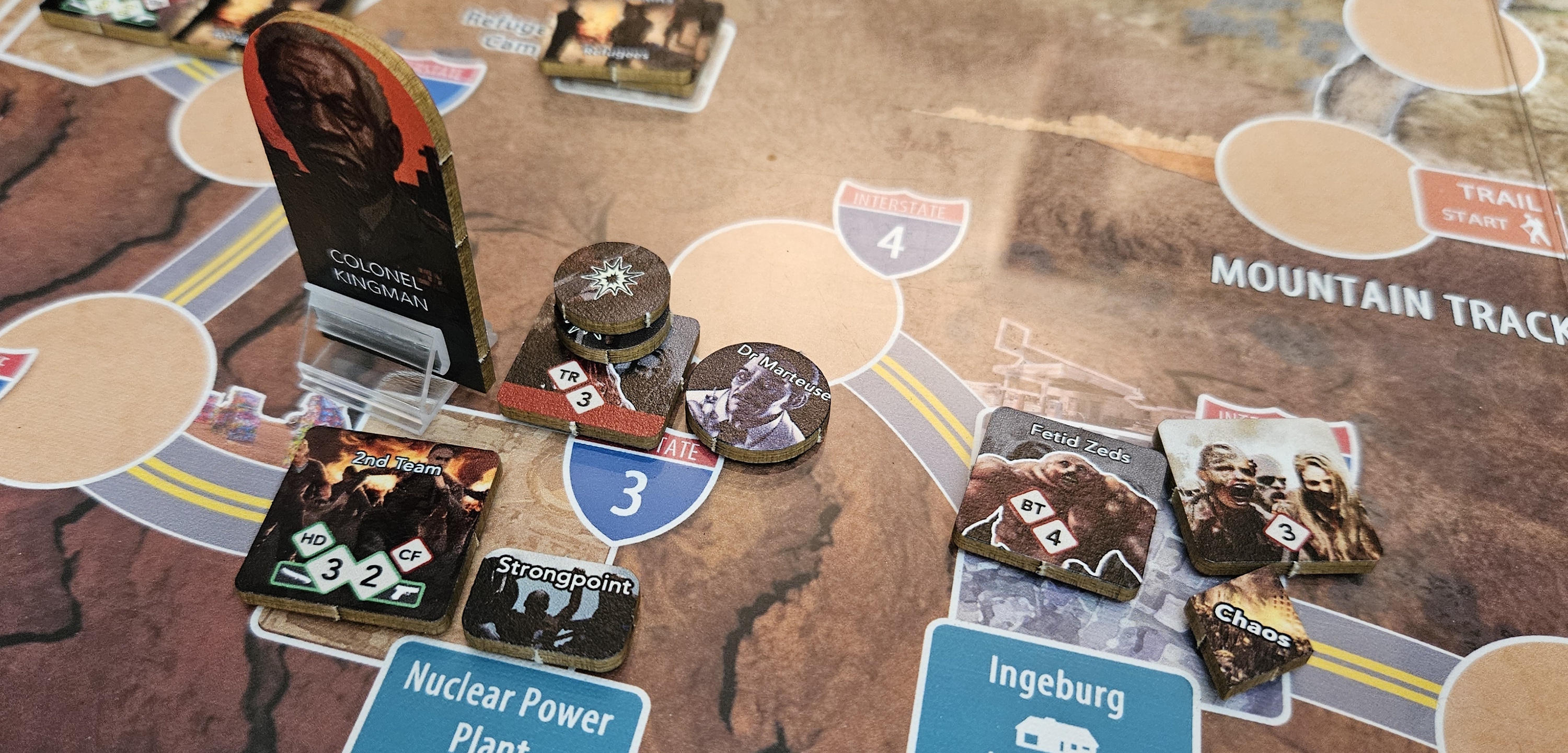
In the meantime, the underlying logic has changed somewhat from the game’s previous incarnations. Since its earliest days, Dawn of the Zeds betrayed its wargaming roots by employing old-school combat results tables. The dreaded CRTs. Anytime zeds entered a space with humans, you would compare their relative values, then check those values against a table that would tell you the outcome. It was a question of sums. My defenders have two strength, plus one for defending a named location, plus another for that supporting unit, plus two for Colonel Kingman’s enhanced barricade… against the combined zed strength of three plus four… now check the table… and that means we inflict two hits and the zeds retreat one space, but we take two hits in return. Wait, since Deputy Schmidt is on the scene, we get a positive shift on the table. Even better. Except, wait, we were looking at the ranged table when we were in hand-to-hand combat.
In other words, the combat system was functional, but not always very exciting.
It seems Luttmann has learned a few tricks in the years since the third edition, perhaps courtesy of experiments like The Plum Island Horror. The CRTs are out. And I mean all the way out. Nowhere to be seen. Instead, zeds now deal a static attack value — usually two to five — that can be blocked with shields, while human forces roll dice to inflict injuries or trigger special abilities.
The consequences are far-reaching. First of all, hero abilities are more manageable. In the third edition, heroes had half a dozen abilities each, all written in long-form text, all necessary for using them to their fullest capacity. Now heroes have two passive abilities plus perks that trigger when they get the right results on their dice. It’s tidy by comparison, preventing those obnoxious “oh shoot, I forgot to do this one thing” moments that were so common in previous editions, but also ensuring everybody feels like their own member of the team.
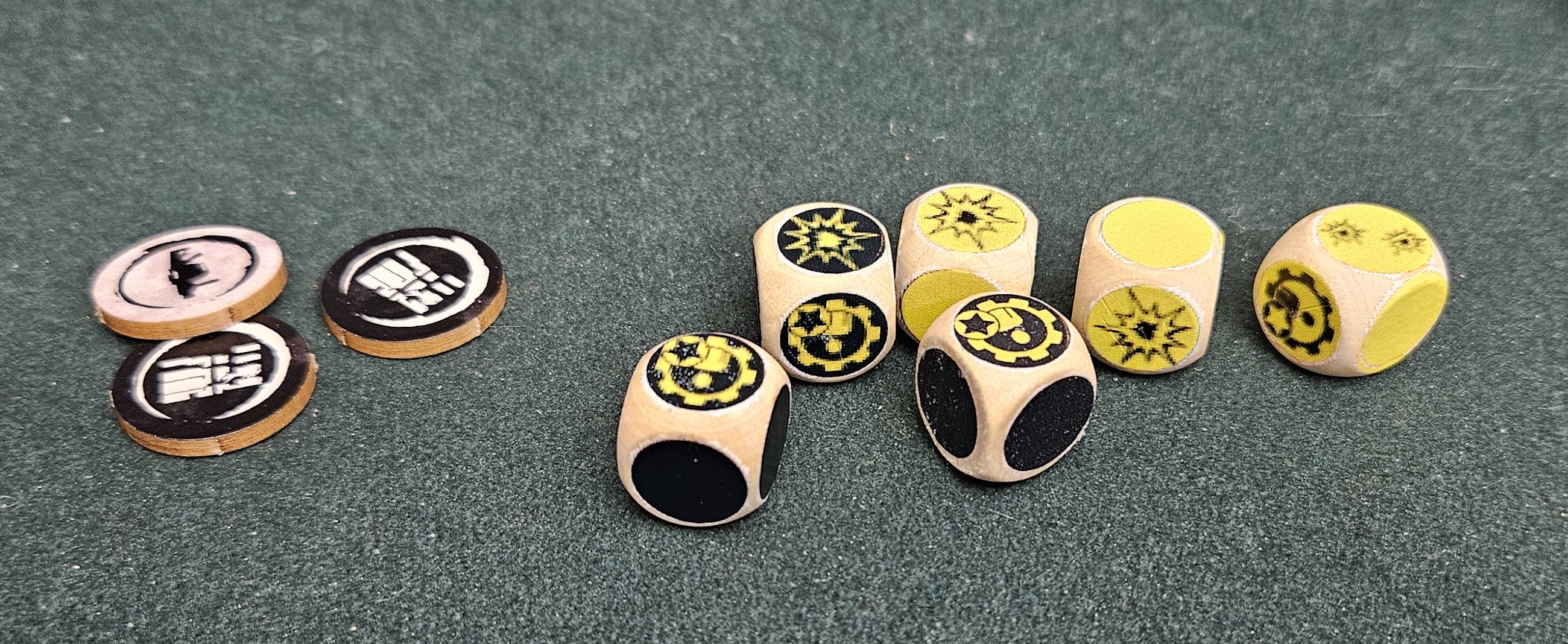
More importantly, combat is no longer something that can be summed out in advance. No longer can you park the right cluster of heroes and town defenders on a space and trust the CRT to provide. Sometimes you’ll roll five dice and flub the whole set. Other times Pickles will pounce on a pair of chits and somehow obliterate the entire stack with his lone yellow die. This can be frustrating, and there’s a whole optional reroll system in there for those who are, like me, little brats about bad tumbles. But this also pushes the game in a direction that’s more organic, more freewheeling, with unexpected twists and turns. It feels more like a series of triumphs and catastrophes and less like we’re pausing every thirty seconds to look at another dang chart.
It helps, too, that combat now includes little moments of player agency, especially where retreats are concerned. Previously, the CRT was everything. Injuries, retreats, the CRT might as well be God handing down tablets from Mount Sinai. Now it’s up to you whether to retreat from a space to ignore an injury or suck it up and hold your ground. This still won’t save a squad from a total overrun, but it’s a nice decision to leave in the player’s hands. Will you absorb a few extra losses to hold onto that important district, or cut your losses and hopefully outrun the zeds? It’s a toughie.
Want to ambush a zombie horde?
To be clear, Dawn of the Zeds is still a cluttered design in some ways. There are still tables, just not combat results tables. You check separate rubrics to see if your hero succeeded at foraging, healing, or researching the zombie virus. Chits still show little letter codes that designate their special abilities. Above all, there are still absolute heaps of special modifiers that might be applied to units. What’s the difference between flaming zeds, smelly zeds, and beta zeds? That isn’t the start of a joke. Those are actual traits that might be added to a chit to modify the threat it poses to Farmingdale’s defenders.
For the most part, though, the beauty of the Designer Edition is that it hits the sweet spot between complexity and ease of entry. It’s a little easier than before, both complexity- and difficulty-wise. But for all its streamlining, there’s still texture here. Flaming zeds are incredibly dangerous, but they’re also self-damaging. Smelly zeds repel your defenders if they share a space after combat. Beta zeds move faster and hit harder. Now that you know those ones, what about infected vermin, dirty zeds, smart zeds? Most of these traits won’t appear in a single session. But the beauty of this system is that they might. This is still a kitchen sink design, but it’s a kitchen sink design by a kitchen sink designer who’s come to really know his kitchen sinks.
And what a kitchen sink it is. After all these years, I had some trepidation going back into Dawn of the Zeds. Like its comrades in the old Victory Point Games catalog, it was a product of its time. That second edition, arguably the high-water mark for the old versions, shipped in a folio-sized ziplock. Its cutouts smelled of wood smoke from the workshop laser cutter. The rules were scattered and frenetic, a little homebrew. Opening the box for this edition, I wasn’t exactly thrilled to discover that that’s apparently how Luttmann’s brain functions.
But even after all this time, Dawn of the Zeds feels fresh. Fresher, actually, now that the States of Siege titles are a thing of the past rather than regular attendees of the alternative wargaming scene. The closest comparison from the past few years is The Plum Island Horror, but while that game has left a few visible fingerprints on this one, the two are more like cousins than siblings. All in all, this has the hallmarks of the same game Luttmann designed fifteen years ago. It’s still weathered and wild-eyed, the buttons of its overcoat still loose, but it’s every bit as indomitable as ever.
“You’re under arrest, Dr. Mabuse!”
At least I hope it is. Some part of me wonders if Dawn of the Zeds has grown too far out of step with the modern hobby scene. It’s challenging and woolly and random. Even more random thanks to the dice combat.
But it’s also one of the most exciting and interesting solitaire games of its age. Once a week over the past month or so, I’ve sat with it in the evening, watching my defenders fail or rally, my heroes dart from one peril to the next. And it was perhaps the most relaxed I’d been in as much time. It felt like coming home. Not to the janky and over-stuffed version that I’d grappled with when I reopened the third edition last year. Instead, a version that was still expansive in what could happen, but more manageable and vivid in the moment. The past as I remember it rather than the past as it was.
Even when Pickles showed up only to promptly hurl himself into an unwinnable fight. Especially then. Good boy, Pickles. Good game, Dawn of the Zeds.
A complimentary copy of Dawn of the Zeds: Designer Edition was provided by the publisher.
(If what I’m doing at Space-Biff! is valuable to you in some way, please consider dropping by my Patreon campaign or Ko-fi. Right now, supporters can read the next installment in my series Talking About Games, this time tackling the topic of what makes a good list! Naturally, the piece includes a list.)
Australia’s biggest gaming convention is growing its tabletop exhibition space yet again amid the ongoing global boom in TCGs.
Pax Aus has featured tabletop games since the Melbourne-based con was launched in 2013, with the segment having grown over the years to take up a significant share of the show’s floor space.
The convention’s event director Lauren Luciani told BoardGameWire Pax Aus is expanding its dedicated tabletop hall by 7% for this year’s show, which takes place from October 9 to 11 – adding that even with that extended footprint, a waiting list had emerged for tabletop exhibitors.
Luciani said about 70% of exhibitors from last year’s show were returning for 2026 – although she would not reveal overall exhibitor numbers, or even an overall attendance for last year’s event, describing both figures as “confidential”.
Pax Aus’ announcement of this year’s show was once again dominated by major TCG publishers, underscoring the huge and growing popularity of a swell of different collectible card games over the past few years.
Asmodee ran a large booth at last year’s show, while other stands included board game distributors Let’s Play Games and Asmodee-owned VR Distribution (which rebranded to Asmodee in Australia last September), as well as a first-ever appearance from Warhammer publisher Games Workshop.
Other board game publishers with dedicated booths were few and far between in 2025, however, with much of the remaining tabletop section made up of retailers and a handful of stands for media outlets.
The event does include a large area for indie game developers on both the video and tabletop sides, however, called Pax Rising – expected to host more than 80 independent creators this year.
The Pax Rising section of Pax Aus 2025
That segment also includes an Indie Showcase competition to highlight games from Australia’s independent design scene.
When asked by BoardGameWire whether Pax Aus now sees TCGs as the primary growth area for the convention, Luciani said, “The trading card game category continues to experience significant growth globally, and PAX Aus is committed to reflecting the interests and passions of our community in the content and experiences we deliver.
“While TCG will have a strong presence at this year’s event, there are still a number of tabletop announcements to come, and attendees can expect a diverse range of tabletop gaming experiences on offer.”
This year’s event will include a segment where fans can meet Australian game designers Jay Bendixen, Ryan Boucher, Natalie Delaney-John and Cam Jasson during special sessions for Gretchen’s Garden and That Dicey Word Game.
Pax Aus also appears to be attempting to broaden its appeal to the collectibles market. eBay Australia returns as presenting sponsor of the Tabletop Hall for a second consecutive year, expanding its presence with the debut of eBay Live, live-streamed collector content and a dedicated Collectors Club programme.
Australia remains a long, expensive trip for European and North American attendees, of course. But for international publishers weighing whether the expense of exhibiting in Australia can be justified, Luciani argued that the value extends beyond direct sales.
“PAX Aus provides tabletop exhibitors with access to one of the largest and most engaged gaming communities in Australia,” she said. “Beyond direct sales opportunities, exhibitors benefit from brand exposure, community building, hands-on product experiences and the ability to engage with both existing fans and new players.
“As tabletop gaming continues to grow, PAX Aus remains a unique platform for publishers, retailers and creators to showcase their products alongside the broader gaming culture that brings tens of thousands of fans together each year.”
I’m going to hop into this review and almost completely agree with Andrew’s review of Nature. I don’t have that much to add to his assessment. I’ve played Evolution, Oceans, and now this, and I like what this series does mechanically, I think it provides a sharp, competitive experience that scales well with player count, and offers the possibility of drama without requiring players to understand a billion card interactions to jump in and start kicking each other in the teeth.
I’ll cover what the upcoming Climate module adds to the experience, and then I’ll play around in my ivory tower and conclude with some thoughts about edutainment products. I’m going to assume you have a sense of how the game works.
Get cooked (or frozen)
The Climate module for Nature adds variability to the amount of food that appears each round. Because of the game’s modeling of timescale, it’s doing big chunks of time between each round, so you have some pairing of the setting of the game with a mechanism. When the climate tracker moves toward an ice age or a scorching age, there will be less food available for everyone to compete over, and there is a new survival mechanism that every player will…
Crowdfunded eurogames from smaller board game publishers had a banner year at the latest Dice Tower Awards, accounting for half of the wins at the high-profile prize ceremony.
The biggest success of the night was Kinson Key Games’ Galactic Cruise, which was crowned game of the year in addition to picking up gongs for best strategy game and best game from a new designer.
Galactic Cruise, designed by TK King, Dennis Northcott and Koltin Thompson
Fellow indie publisher Paverson Games was also a standout winner in this year’s Dice Tower Awards, with its classical music-inspired title Luthier picking up awards for best theme, best production and best game from a small publisher.
Other crowdfunded titles honoured by the awards were mid-weight euro Critter Kitchen for best artwork thanks to the work of Sandara Tang, and 20 Strong: Tanglewoods Red for best solo game – the latter the only one which raised money through Gamefound rather than Kickstarter.
The string of crowdfunded successes is significant given the notable shifts which have taken place on Kickstarter and Gamefound in recent years, with a rise in larger publishers using the sites, and more campaigns focused around big-budget releases, miniatures heavy projects, deluxified components and major licensed IP.
CMYK scored a second success in this year’s awards with Hot Streak, which won best party game, while Stonemaier Games took the most innovative game prize with Vantage and Tag Team won best 2-player game.
Presented annually during Gen Con, the Dice Tower Awards are among the board game hobby’s highest-profile jury-voted honours, given the winning titles gain exposure with the veteran reviews giant’s more than 360,000 YouTube subscribers.
Winners are selected from the previous year’s games by a panel of more than 60 Dice Tower contributors, reviewers and content creators. The awards celebrates its 20th anniversary next year.
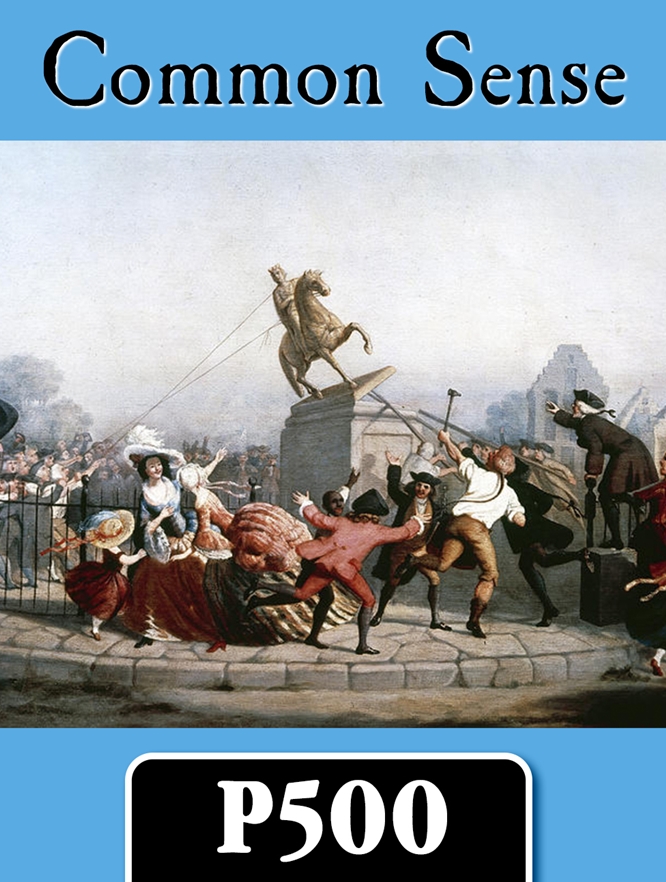
In November 2024, while attending the SDHistCon, we sat down with designer Sam London to play his upcoming game called Common Sense (it was originally called Absolved from All Allegiance), which was announced on GMT Games P500 last year. The game is an American Revolutionary War Strategic Level game that uses trick taking and is a struggle over the Will to Fight Track that measures the level of commitment by both sides to the fight. We recently reached out to Sam to get some more details to share about the design and he was very glad to oblige our request.
*Keep in mind that the design is still undergoing playtesting and development and that any details or component pictures shared in this interview are for prototype purposes and will definitely change prior to final publication as they enter the art department.
Grant: Sam welcome back to the blog. How are your other announced game projects coming along?
Sam: Thanks for having me back! Things are going well. I am hands off on Firefight Tactical at this point. All of the content art is complete and we are just working on things like rulebook layouts. I am very much looking forward to getting it out the door and into people’s hands. Microverse has most of the art complete. I am doing a few tweaks to the bot still to get it to a point I am happy with it, but in truth it is not tracking far behind Firefight Tactical. They both have been wonderful experiences from a development and production stand point and I cannot speak highly enough of the various teams I have worked with at GMT on these games.
Grant: How have you changed as a designer over the past few years?
Sam: This is an awesome question and I am grateful to be asked it as it forced me to do some introspection. To explain I will have to make some references to film making. As I have stated previously I have been designing games for a couple of decades at this point and only started trying to get my designs out there after Covid. The truth is that while this gave me lots of opportunities to refine my design chops, it was ultimately just me learning in a bubble. Coming into the hobby as a designer rather than a gamer, I fancied myself as a sort of auteur designer. For those not familiar with the term in the context of film making, this is an approach to creative endeavor where everything is made to conform precisely to one person’s specific vision. After getting to work with so many fantastic people, decidedly outside of my bubble, I have taken a bit of a 180. While I still own the ultimate vision, I now recognize that the odds that I understand the optimal route to get to that destination are unlikely, and that pretending I do will often result in an inferior game. This isn’t to say that I am going to incorporate every bit of feedback I receive into my designs. It does mean that I am more able to recognize weaknesses in my designs as conceived and solicit feedback from others to get around my blind spots.
Grant: What specific lessons have you learned about design?
Sam: The big one would be about systems pruning. Most people, myself included, understand academically that design complexity for complexity’s sake is not good. Putting that principle into practice, especially retroactively, is far more challenging. Every mechanism in the game has to serve the player’s enjoyment without making the cost of entry too daunting. This can often mean cutting mechanisms that I am particularly passionate about, but for which I am the sole audience (or close to it). This is especially difficult for me because I consider myself a systems designer, and I virtually always approach the mechanics of a design first.
Grant: What is your newest project Common Sense about?
Sam: Common Sense: An American Revolution, 1775-1783 is a card driven strategic level wargame covering the American Revolution. It attempts to offer a comprehensive view of the conflict, all the way from the battlefield to the halls of the Continental Congress and British Parliament.
Grant: Why was this a subject that drew your interest?
Sam: I always knew I would want to do an American Revolution game. The problem was that I needed a system that would fit my thesis of the conflict. A few years back I was working on a Barbarossa game and every step of the way I was thinking I would rather do that system in the American Revolution. The more passionate I became about that, the more I started to flesh out the system in ways that didn’t make sense for Barbarossa. Eventually that game ended up in the trash bin and Common Sense got my attention instead. I think the American Revolution is such a fascinating subject because it’s a real David and Goliath story. I of course am keenly aware that in reality it was more of David vs Goliath while Goliath is arm wrestling another giant while also trying to solve a Rubik’s cube, but there is still a lot of inherent heroic optimism to that history. Also, everyone loves a good underdog story.
Grant: What is your design goal with the game?
Sam: My design goal for the system was to see how much personality I could give to the belligerents without making their asymmetries require too much rules overhead. We have all played asymmetrical games where you feel like after you read your rulebook you need to read the other player’s rulebook to have a comprehensive understanding of the game. Here, while there are some mechanisms that are specific to each side, the asymmetry is more in terms of each player’s strategic concerns rather than their tools to execute upon them. All of these relate back to this unifying concept of “resolve” which is an abstraction that allows us to relate the varying strategic concerns into a single mechanism.
Grant: How did you focus on creating asymmetry on each side? What are some basic examples of these differences?
Sam: As noted above, I viewed each side in terms of what was unique about their concerns and what was unique about their tools to address them. For the British as an example, they are tremendously constrained by supply. It isn’t just a supply line (though it is that too), it’s a currency they spend to move and battle with units. Obviously historically supply was a concern for the Colonials as well, but it did not hamstring them to the same degree, so the Colonials don’t have to worry about it at all. What’s more, this opens up strategic opportunities for the Colonial player to attack the British in other areas to force the British player to split their limited resources. An example for the Colonial player is Attrition Combat. Each time the Colonials battle in a space they control on their turn, they have the option to resolve Attrition Combat, in which they cede control of that space to the British but as a result can resolve the battle without risking return fire. At the beginning of the game this must be used strategically and sparingly, but as certain key personalities in the Colonial Deck, from George Washington to Francis Marion enter play it becomes far more powerful.
Grant: How does the game use trick taking? Why was this a good choice for your vision of the game?
Sam: I am actually trying to get away from that term, as I think it causes people to think that Common Sense is a lighter game than it is. It invokes pithy card games rather than sweeping strategic affairs played out on a map. The final rulebook will likely make no reference to standard trick taking terms. I chose it as a core mechanism though for a variety of reasons. One I will cover in a future question, but the other reason is because I became very interested in the question of card balance. If I have a card driven game with a variety of card effects, and I want them to vary in their power, they have to be balanced in some way. The most common way this is handled in game design is to make them have a proportionate cost to play using some in-game currency. I was more interested in making the powerful cards more difficult to play. In fact, I wanted to take a step beyond that and say that not only are they more difficult to play, but they are never guaranteed. This gave me a simple way to inject far more personality into the cards and make some have a tangible weight to them when they manage to enter play. “Ha ha, I play King George. You’re in trouble now.” Trick taking was a natural fit for this as the rules overhead for it is comparatively light and the cards come with their own intrinsic value based on the ease with which they can be used to win tricks.
Grant: What is the makeup of the cards? Can you share a few examples with us and explain their use?
Sam: Each year players will begin their turn with a ten card hand. They can perform a strategic mulligan of up to 5 cards each year. This is not in case a player got a “bad hand” but rather so they can try to postpone getting cards that do not fit their strategic objectives at the start of the year. The year is then played out over a series of ten “clashes” in which the initiative player plays a card face up and then the other player does the same. The initiative player’s card sets the suit for the clash and the non-initiative player must follow the suit of that played card if able. Then the player who played the card with the higher initiative value (ties going to the non-initiative player) resolves their card.
In this example (all placeholder art at this point in the game’s development by the way), the Colonial player has initiative and plays the Artemis Ward card into the clash who is a 6 value of the Battle suit. The British player then plays Battle of Quebec into the clash which is a 7 value of the Battle suit. Battle of Quebec then resolves.
The British player immediately gains a supply (the orange wagon in the upper right corner). This is a special bonus effect present on some cards. The equivalent effect for the Colonials is to go up on the Continental Congress Track. They now have the option to cancel the resolution of the card to perform any one of their available actions. If they choose to continue to resolve the card they resolve its event first. Battle of Quebec’s event is of the type “special action,” which offers additional effects to the action on the card. In this case, if the Battle action is used to resolve a battle north of the Winter Line, the Colonial player must reroll all their successful hit dice once. The last piece is the yellow star under the Battle suit icon which indicates Battle has “advantage” over the Special suit. This means that if the non-initiative player does not have a card of the clash’s suit to play into the clash, any Battle card will always beat a Special card.
Grant: What different suits are included? What use does each have for players?
Sam: There are three common suits which are universals and one special suit which is player specific. The three common suits are March, Battle, and Recruit. March is used to move armies about the board, Battle is used to fight, and Recruit is used to get more units to fight with. There are asymmetries in how these resolve but the goals of their use are the same, which is why they are considered the common suits.
Grant: What is different about the Special Suit? How does it benefit players?
Sam: The Special suit is different for a couple of reasons. First all of the actions contained in the Special suit cards are unique to that player. The Colonial player can train their militia units into the Continental Army and negotiate with the French, eventually bringing in and performing actions with French pieces once they enter the conflict. The British player can recruit, move, fight, and raid with Native units and move and battle with the British navy. A lot of the flavor of the two sides are contained in the Special suit. The other thing that is different about the suit is that the Special suit allows you to resolve any combination of these actions. For example a Battle x 3 card allows you to resolve up to three Battle actions. A Colonial Special x 3 on the other hand will allow them to perform a mix of any 3 train and French actions which offers flexibility.
Grant: What is the purpose of the Resolve Track?
Sam: I mentioned the Resolve Track earlier when I was describing how most of the asymmetrical concerns of the players coalesce into a singular concept. The Resolve Track serves three purposes. Firstly, it is the game clock. While the game can end in the event that you completely resolve the year 1783, it will more commonly end when the British and Colonial Resolve markers cross. Each player’s Resolve marker starts on opposite ends of the track and moves towards the other end as they lose resolve. Once they cross, the year is completed and final scoring occurs.
Grant: How do players manipulate this track? What benefits or detriments does it provide to players?
Sam: This is where the other functions of the Resolve Track come in. The second purpose is that many of the points for determining final score and victory come from the Resolve Track. Finally, resolve has a tremendous impact on both sides’ ability to recruit new units, the Colonials in particular. This is another demonstration of the game’s asymmetries actually, as the Colonials are far more impacted by resolve loss both from a scoring perspective and a recruitment perspective than the British. In regards to how the track is manipulated, common track manipulations only cause a loss of resolve. There are several ways resolve is regained, but they are all due to specific card effects. The British primarily lose resolve by losing British Regulars in battle and by being overcommitted to the American conflict at the expense of their other global conflicts. They can also lose resolve by overusing Hessian mercenaries, who are good and reliable but cost money that parliament is loath to spend. The Colonials on the other hand will lose resolve mostly due to the British seizing control of colonies, Winter Attrition, and failure of the Continental Congress to offer a believable alternative as a governing power to the crown.
Grant: What is dynamic about the initiative system?
Sam: I said I would come back to this when I was describing why I went with trick taking as a core mechanism. Essentially, you are the active (initiative) player for as long as you continue to win subsequent clashes. For the duration the other player is what I would consider a “reactive” player. They still have choices to make of course, for example which card to play into clashes, whether to resolve combat as a siege or not in fortified spaces, how much supply to commit to a protracted battle, etc. The point however is that while by sheer odds you are guaranteed to eventually get your turns in, the duration of the runs of turns is strongly connected to the skill of the player and their familiarity with the game. This is very much a game where a player will become far better after repeated plays. The other cool thing about this is that the events on cards require skill and forethought to combo them together. You may have the thought that if cards A, B, and C resolve in order you will have all but won the game, only to lose the clash for card C and have to pivot. This dynamism does a lot to keep the game fresh and challenging rather than thinking “I have cards A, B, and C so I already know how I will play this out.”
Grant: What different unit types does each player have access to? How does each type benefit them?
Sam: Again pursuing asymmetry I wanted to give each unit type its own character. Each unit has a potency and a resilience but this is just the tip of the iceberg. Militia are able to pop up virtually anywhere and are able fire first in battles where they are the aggressor, but they are poorly trained and can’t leave where they are recruited unless they are picked up by an army. British navies can contribute to naval sieges and amphibious assaults while they are also required end points for British supply lines. French regulars are able to operate as a distinct force while also being able to launch coordinated actions with the Continental Army, offering them incredible command flexibility. British Field Artillery is powerful, but is unable to retreat quickly when the battle is lost, meaning it will be commandeered by the Colonials (and may exchange hands several times over the course of the war). There are also Continental Army, Native Warband, Hessian Mercenary, French Navy, Tory Loyalist, Colonial Artillery, and British Ranger units. Each has its own complement of traits to figure out how to employ them optimally.
Grant: How does combat work in the design?
Sam: As I have alluded to, there are a variety of special combat resolutions possible like Attrition Combat, Sieges, Naval Bombardment, Raids, and Surprise Attacks. I will just be describing the standard battle procedure here though. Each unit has a number of dice they grant during battles. The British player will have to pay a supply for each unit they want to activate to gain dice this way. Players then roll all their dice simultaneously. Dice come in three flavors, red, white, and blue (see what I did there?). Red dice hit on 3 or better, blue on 4 or better, and white on 5 or better. No matter the die color, a 6 counts as 2 hits. The other player then takes as many dice as they have incoming hits (at this point color doesn’t matter) and rolls them. For each 6 they roll, they discard the lowest die among their rolled dice. They then go from their lowest rolled die to their highest, assigning dice to their units if possible. Each unit has a limited range of dice values they can be assigned which represents their morale. For example, the British and French Regulars are a professional army and so they can only be assigned 1s and 2’s. The Colonial Militia and Tory Loyalists on the other hand can be assigned anything from a 1 to a 4. After all dice have been assigned or there are no more rolled dice that can be assigned to any units legally, all units with a die assigned to them are eliminated. Then, if the resolving card grants additional Battle actions, the initiative player can choose to either resolve another round of battle in this space, or not, potentially beginning to resolve another battle in a different space. If no further battle rounds will occur in the current space, the total number of casualties is compared. If one side took fewer casualties and did not control the space, they gain control of the space. Then, if the side that took more casualties lost at least as many units as half the size of their army (stack), they are forced to retreat from the space.
Grant: What is the British Commitment Check? How does it work?
Sam: The British player uniquely tracks the number of clashes they win each year on their own “British Perception” Track. At the end of the year, they add their current level on this track to the number of British Regular and Navy units outside of the American Colonies available to fight the French and the Spanish. If this total is less than 10, they lose 1 level of resolve for each point of shortfall. This means that if they have run the table the entire year, they are free to overcommit to the colonies, thematically because the optics are good back home. If however they have a rough year, they may have to hold some forces back to avoid the war being cut short by Parliament because opinions have turned against it.
Grant: What is the Continental Congress Level? How does it work?
Sam: On average, every card in the Colonial deck is one initiative value lower than every card in the British deck. However, every card in the Recruit suit grants the Colonial players levels on the Continental Congress Track. Levels can be spent from the track as cards are played to increase the initiative value of the played card. The problem is that at the end of the year, the Colonial player is expected to have an ever increasing level on the Continental Congress track or they will lose resolve equal to the shortfall. This obligation is an even bigger potential headache for the Colonial player as the Continental Congress isn’t just a track on the board, it’s also a piece on the map. If the Continental Congress is forced to relocate (retreat) because their current space falls into British control, the Continental Congress levels reset to 0. Done later in the war this can be devastating to the Colonial player. Even worse, if the Continental Congress would have to retreat, but it has no valid place to do so since it is surrounded by British Controlled spaces, the Congress surrenders and the Colonial player loses the game outright with no points counted.
Grant: I have seen where you describe the game as a sandbox. What does this mean and how does it benefit the design?
Sam: I think this can best be demonstrated by the card I showed earlier, Battle of Quebec. Now of course, the Battle of Quebec occurred when Richard Montgomery and Benedict Arnold attempted to siege Quebec City on December 31, 1775. The Colonials suffered heavy losses and were soundly defeated by the elements as well as the British. Nowhere in that card does it specify that the battle needs to occur on a specific date, or at a specific location, just that it must be north of the Winter Line for the event to have an effect. There have been plenty of times in playtests where the card has been resolved in 1775 in Canada, but also many times where it hasn’t. This approach enables me to inject historicity into the game without shackling the player to recreate historical decisions. I think many historical gamers want experiences where they can recreate history, but they are not obligated to do so. Roughly paraphrasing what Gene Billingsley said about the game, “all the events are there, all the major players, and the outcomes, even though potentially very different from history, are entirely conceivable.” Put differently, it’s like the game hands you a toy box filled with American Revolution action figures to play with as you will. There will of course be some players who will miss some rigidity holding them to a more strictly historical course. However, I think this sandbox approach offers an opportunity to sink your teeth into the history and better appreciate the moving parts by seeing the different ways they could have fit together.
Grant: What are some general strategies for both sides?
Sam: From a general strategy perspective things are very historical. The British want a quick war. The fastest way to do this is to take the more valuable northern colonies which will tank the Colonial resolve and secure most of the significant strategic locations. By doing this they can force the Continental Army to suffer brutal winters away from the cities and put enough pressure on the Continental Congress that their resolve rapidly drains and they are forced to surrender. The Colonials want the opposite. They just want to hold out long enough using delaying tactics to organize a proper army, get the French into the war, and retake whatever key fortified locations they ceded to the British in the early war so they can force the British to the bargaining table.
Grant: What is the layout of the board?
Sam: Again, this map is placeholder art. The game uses point to point movement, with some spaces representing precise fortified locations and some representing large tracts of land (even entire colonies in some cases). Spaces are grouped into colonies that each have an associated hit to Colonial resolve if they are lost. There is also a British “in Europe” area and a number of tracks tied to the various game mechanics.
Grant: Why did you feel point to point movement was best?
Sam: The only two contenders here were point to point vs area based movement. Given the level of abstraction the system uses, any sort of hexed based representation was never an option. I decided to go with point to point because the game’s focus is really on the narrative more than anything else. An area based map would have forced me to have the visual importance of areas be at least somewhat to scale by the size of the colony. Instead by doing point to point I can give a colony as many spaces and fortifications as are thematically appropriate for the importance of that colony in the actual conflict.
Grant: What type of an experience does the game create?
Sam: The game is punchy. It is very competitive and intentionally so. You are only able to achieve so much on a given turn, and at the end of each turn you have another clash and a chance for your opponent to seize the initiative. The elation when the other player plays a card out and you realize you can beat it and put out Benjamin Franklin when you thought you weren’t going to get a turn for at least 2 more clashes is fantastic. It also plays very quickly for a game of its weight. Most games between players who know how to play will be under 2 hours.
Grant; What are you most pleased about with the design?
Sam: I would say three things. First, because it’s top of mind as I just finished it, the solo play. I knew how I wanted the solo to feel, but I wasn’t quite sure how I was going to make it happen mechanically. I will be putting out some videos soon showing how it works, but suffice it to say for the moment that I am very pleased with it. Second, every game I design, I design to create stories at the table. If it always tells the same story it isn’t memorable. If there are never any surprises it isn’t memorable. Common Sense succeeds in both of these areas to a tremendous degree. Each time I catch up with a player I have played Common Sense with before they are able to remind me of our whole game by invoking strange or exciting moments from our game a year ago like it happened yesterday. Finally, when I design a new game I generally try to think about what aspects of it are specific to the topic and which could be modified slightly to make it work for other topics. I have my own plans for a Vietnam War version of this system that I am very excited about. What surprised me though was how many great designers have been inspired by the system and want to do their own designs with it. At the moment I am only at liberty to say that Ananda Gupta wants to do a French Revolution game with the system, which is such an incredible honor since Twilight Struggle is the primary inspiration for it.
Grant: What other designs are you working on?
Sam: I am always working on something. I have a non-historical game I am working on that has been picked up but I cannot talk about it yet. I have a train game that I may be able to talk about more publicly soon and an American Civil War game that I will be debuting at HistCon North. Oh, and I have a Sengoku Jidai wargamer’s party game that I am tooling around with. There are more, but that’s enough of a teaser. Thanks for the interview!
Thank you Sam for your thoughts on your game and for the effort you have obviously put into it. Having played the game while attending SDHistCon ta few years ago, I can say that we had a great time with the game, felt all of the aspects you discussed and very much enjoyed the way cards were played, how the initiative kept with the winner and the various frustrations of the asymmetry of each of the sides. I think that this one will be a winner and I look forward to playing it further in the future!
For a bit more information, we posted a quick video interview with Sam while at SDHistCon and you can view that at the following link:
In den vergangenen sieben Tagen sind auf Board Game Arena drei neue Titel erschienen. Sie reichen vom ruhigen Riffbau über einen kompakten Gartenausflug bis zum Zweipersonen-Duell auf hoher See. Zwei davon benötigen ein Premium-Abo, eines lässt sich kostenlos spielen.
Reef Gardens
Reef Gardens ist seit dem 7. August auf der Plattform verfügbar. Für diesen Titel wird ein Premium-Abo benötigt. In dem Legespiel von Jeffrey D. Allers (dlp games, 2025) baust du als Meeresschützer Korallenriffe wieder auf, bevor Zeit und Budget ausgehen. Manchmal musst du bestehende Riffe abbauen, um mit dem gewonnenen Forschungsgeld neue Flächen zu bepflanzen.
Mechanisch verbindet das Spiel Gebietsmehrheiten, offenes Drafting und das Umschließen von Flächen mit klassischem Plättchenlegen. Es ist für 2 bis 4 Personen ausgelegt und dauert laut Verlag rund 50 Minuten. Auf BoardGameGeek liegt der Titel bei 6,8 von 10 Punkten aus 122 Bewertungen, bei einem Gewicht von 2,3 von 5. Der Verlag empfiehlt es ab 10 Jahren.
Under the Leaves
Under the Leaves ist seit dem 5. August spielbar. Das Spiel lässt sich ohne Abo spielen. In dem Legespiel von Trevor Benjamin und Brett J. Gilbert (2025) legst du Gartenplättchen aus, lockst Bienen und Kolibris an und entdeckst kleine Lebewesen unter Blättern, Pilzen und Pfützen. Wer am Ende die meisten Teile im eigenen Garten sammelt, gewinnt.
Das Spiel setzt auf Plättchenlegen, das Verketten von Feldern und Verbindungen zwischen den Gartenteilen. Es ist für 2 bis 4 Personen ausgelegt und dauert etwa 25 bis 40 Minuten. Auf BoardGameGeek steht der Titel bei 7,4 von 10 Punkten aus 417 Bewertungen, bei einem Gewicht von 2,0 von 5. Eine deutsche Ausgabe erscheint bei Frosted Games unter dem Titel „Wuselige Wiesen".
The Isle of Cats Duel
The Isle of Cats Duel ist seit dem 3. August auf der Plattform. Für diesen Titel wird ein Premium-Abo benötigt. Das eigenständige Zweipersonenspiel von Frank West (The City of Games, 2024) überträgt das Katzenrettungs-Thema von „The Isle of Cats" auf ein reines Duell. Statt Karten zu draften, bewegst du dich mit einer Oshax-Katze über die Insel und bestimmst so, welche Katzen, Schätze und Lektionen dir und deinem Gegenüber offenstehen.
Im Kern geht es um Plättchenlegen und Mustergestaltung: Du passt die einzigartigen Katzenplättchen auf dein Boot und hältst dabei die Familien zusammen. Das Spiel ist ausschließlich für 2 Personen und dauert rund 30 Minuten. Auf BoardGameGeek erreicht der Titel 7,5 von 10 Punkten aus 597 Bewertungen, bei einem Gewicht von 2,3 von 5. In der Ankündigung auf der Plattform wird zusätzlich die Erweiterung „Puss in Boats" genannt.
Three Sisters is a traditional companion planting technique where corn,
climbing beans and winter squash (e.g. pumpkins) are planted together, and each of them
provides benefits to the other two. The game Three Sisters is a
roll-and-write game about agriculture and farming. Everyone has his own player
sheet. Dice are rolled every round to determine the possible actions. You
Back to the history of New York City! We have begun with the city’s origin before the founding of the United States and left off in the 1880s in the last post – when New York was undeniably the economic and cultural center of the United States. Today, we are covering New York in its most iconic form as a moloch of steel, concrete, and millions of people. A chronological narrative will not help us here. Instead, we adopt a thematic approach and look the economy, construction, infrastructure, and culture which made New York from the late 19th to the mid-20th century the model city of high modernity.
If you want to read more posts like this – for example, the next instalment in the New York series – I strongly recommend you subscribe to the blog: All new posts in your inbox right when they go live!
New York had been America’s most dynamic hub for trade and manufacturing for decades. Yet the city’s riches had been shared unequally, just like the risks in producing them. In the late 19th and early 20th century, New York’s working class grew more assertive and found more political support to improve their lives: For example, the three Tenement House Acts of 1867, 1879, and 1901 mandated such luxuries as windows in every apartment and toilets in every building.
The 1909/1910 textile worker strikes led to improved pay and shorter hours. Just one year later, the Triangle Shirtwaist Factory in Lower Manhattan burned down and 146 garment workers died – many of them unable to escape through the staircase because management kept the doors locked during shifts. The fire catastrophe led to a public outcry against such practices and New York state introduced better workplace and fire safety regulations.
The garment workers were in some ways emblematic for the New York working class – most of them were young immigrants (especially Jewish and Italian). In another, they represented a shift – almost all of them were women, and their struggle for better working conditions mirrored the force of the American women’s movement in the political arena.
In one way, however, they represented New York’s present, but not its future: The industrialization of the 19th century had turned New York into the largest manufacturing hub of the world. Yet manufacturing, the physical production of goods, ran out of steam when the improved productivity provided most people in the United States with most of their basic needs. Eager customers were thus not to be taken for granted anymore. Instead, they had to be wooed and their desires – for items of whose existence they had recently been still ignorant – awakened. New York became a hotbed for the growing advertisement industry (with which Madison Avenue is synonymous until today) as well as for shopping (here, Fifth Avenue is the symbolic street). Our age of trends, shopping as a leisure activity, and overconsumption cannot be imagined without New York.
In the 19th century, foreign capital had funded the expansion into the American West, but now the capital flows reversed: American capital was instrumental in financing the Allies’ Great War effort. At the end of the Great War, America was for the first time a net creditor nation. Its role in the international financial system expanded after the war as American loans enabled defeated Germany to pay its reparations to the Allies (who, in turn, paid off their American war loans). At the same time as New York took London’s place as the premier finance hub in the world, America at large withdrew from the world under a renewed isolationism and the xenophobia which came with the Red Scare after the Bolshevik Revolution.
Political upheaval did not stop the investment craze of the 1920s: When a bomb exploded in Wall Street in 1920 and killed 30 people, stock trading resumed normally the next day – much in contrast to 1920 Wall Street (Perepau Llistosella, Looping Games), where the bombing marks the end of the game (and players hope to have made all their profits by then).
The New York-based financial system was robust enough to withstand such external shocks, but it collapsed under its own contradictions: The stock market boom of the 1920 led to ever more capital pouring into the New York Stock Exchange (at the expense of all other forms of investments, for example the American overseas loans on which the global financial system was now based). The spectacular gains fueled a debt-based speculation bubble which burst in October 1929. The inadequate response by central banks which did nothing to combat the contraction of the monetary supply led to an extended, global economic crisis – the Great Depression.
Unemployment and poverty plagued New York much like the rest of the world in the 1930s. The city bounced back through ambitious public works initiated by the energetic new mayor Fiorello LaGuardia (many of them funded by New Deal funds in a cross-party cooperation between the Republican LaGuardia and the Democratic president Franklin D. Roosevelt). Still, New York’s economy only recovered when demand for manufactured goods skyrocketed because of World War II: The industrial giant rose one last time. One example of New York’s awesome productive capacity may suffice: From 1941 to 1945, the New York Navy Yard built more warships than all of Japan combined. The United States won World War II because of their industrial productivity, and New York was the beating heart of it.
Construction: Upwards
New York had always grown. From the 1880s on, the city grew in a heretofore barely used dimension – upwards. The twin innovations of the elevator and steel frame construction allowed for building heights which had been considered impractical, if not impossible, before. While New York was not the pioneer of these technologies – that merit belongs to Chicago – they were accepted in Manhattan on a scale not known before. Ever more “skyscrapers”, as the tall buildings were soon to be known, sprang up between the Hudson and the East River, giving the city a characteristic look from far away. New York’s skyline has been continually changing, but since then, it has always been dominated by skyscrapers – as has been the image of the city in the public imagination.
Board games are no exception. No theme is as prevalent in games about New York as the construction of skyscrapers. Some are specific, like Flatiron (Isra C./Shei S., Ludonova) which has players build the eponymous Flatiron Building together, but many could be set in any city with tall buildings – but as they are about tall buildings, their designers and publishers think they fit best for a New York setting: Manhattan (Karl-Heinz Koch, Fagus) is a variant of Acquire (Sid Sackson, Avalon Hill) to which the third dimension is added. New York City (Stefan Feld, Queen Games) is a remake of Rialto (Stefan Feld, TMG) – just that the struggle for majorities in Venetian districts of the original, fought with councilmembers, has been replaced by a struggle for majorities in New York boroughs, fought with – you guessed it – skyscrapers.
The skyscrapers got ever taller: The first steel frame buildings in the 1880s and 1890s were well below 100 meters. In 1909, the Singer Building (187m) was the first structure in New York to exceed the height of Europe’s church spires – the first time that the world’s tallest building stood in New York. The city would retain that honor until the 1970s with a succession of ever taller skyscrapers.
The most iconic one was the Empire State Building whose construction was begun in October 1929 – just weeks before the stock market crash. It became the most visible sign of the economic crisis: Even five years after its completion in 1931, half of the Empire State Building’s office space remained empty. Like the rest of New York, it recovered by the 1940s. It would remain the world’s tallest building until it was overtaken by another New York icon in 1973 – the twin towers of the World Trade Center.
Infrastructure: Transport and Leisure
New York did not only grow vertically. Originally, the city had been confined to Manhattan Island and gradually expanded into what became the Bronx. In 1898, New York merged with its neighbor Brooklyn (itself America’s third-largest city at the time) as well Queens county and Staten Island to become a massive metropolis of more than three million inhabitants.
This sprawling moloch, however, was initially still centered on Manhattan, as most people worked there and thus couldn’t live too far away: In 1900, more than half of New Yorkers lived in Manhattan. That changed with the construction of the New York subway from 1900 on. New York was late to embark on such a project (London had started in the 1860s), but it was undertaken with the characteristic boldness of the city and soon became the largest in the world.
Thus, the geography of the city changed: New Yorkers could work in Manhattan, but commute every day from one of the other boroughs. As land there was a lot cheaper, a residential construction boom set in, and by the 1920s, Brooklyn had become the most populous borough of New York.
The growth of the city required its transport and leisure infrastructure to keep up. One man would become synonymous with it from the 1920s on: Robert Moses, starting out on the Long Island State Park Commission in 1924, became responsible for all kinds of parks, beaches, roads, bridges, and tunnels for both the state and the city of New York over the next decades.
These projects shaped the face of New York: The parks, both in the center and on the outskirts, provided very real benefits in one of the largest, most densely settled cities in the world. And the transport projects took inspiration from the new trend of motorized individual transport – and reinforced it.
Large-scale engineering projects like these go beyond the mere technical aspects. Moses’s creations were shaped by his ideas about how society should look like. For example, already his very first project – Jones Beach State Park on Long Island – outlined his ideal: It provided New Yorkers with a beautifully designed leisure park on the seashore. They arrived there after a pleasurable drive on the new parkways through lush greenery – by car, as no train or subway station was built in Jones Beach, and the bridges crossing the parkway were too low for buses to pass through. This lack of public transport meant that Jones Beach was exclusively accessible for the middle classes.
An even more striking example is Riverside Park in Manhattan along the Hudson River. Around a third of the park is in the predominantly Black neighborhood of Harlem, two thirds in the predominantly White Morningside Heights and the Upper West Side. These southern two thirds were liberally sprinkled with dozens and dozens of playgrounds, the third in Harlem only received one – and here, the iron lattice at the toilets was “decorated” with little ape sculptures.
As you can see, Robert Moses was not quite a nice guy. We’ll see more of him in the next post in this series!
Culture: Roaring Twenties
America’s new, more assertive role in the world after World War I also increased global interest in the country’s cultural output. American literature developed a new confidence, and American jazz became the hottest new music around the world. New York as America’s cultural center both attracted established artists (like the jazz musicians Duke Ellington and Louis Armstrong who both made the city their home in 1923) and produced its own original creations (like the Harlem Renaissance, which marked the first time that a movement of Black American writers and visual artists left their imprint on the wider American cultural consciousness).
One of the institutions of the 1920s New York cultural scene has gotten its own board game: 1923 Cotton Club (Pau Carles, Looping Games). The historical Cotton Club was founded in Harlem in 1923 and soon became the venue to see many of the finest jazz musicians – an attraction not only for regular New Yorkers, but also for the celebrities of the time. That, in turn, made the club even more attractive… well, not for everyone. While the performers on stage were Black, the club would not admit Black patrons (except for the rare Black celebrity). That is not explicitly addressed by the board game, but attentive players will notice that the almost all of the artists which can perform at the players’ clubs are Black, almost all of the celebrities which may attend the club (and are the chief source of points) are White – as are the gangsters.
“Gangsters?” you may ask. “In a game about running a nightclub?” Yes, as we are in the age of the prohibition of alcohol in the United States. This fleeting episode (1920 to 1933), and the massive expansion of organized crime which came with it, is almost as irresistible to board game designers as the construction of skyscrapers. Sometimes, it is only the corollary to another activity (like in 1923 Cotton Club).
Of course, all these mafia games could be set elsewhere. After all, alcohol was prohibited everywhere in the United States. New York, however, is irresistible as the biggest city, where presumably also the biggest crimes are committed. It is no coincidence that both Superman and Batman, those heroes of the Golden Age of Comics, fight their mastermind criminal enemies in fictionalized versions of New York (Metropolis and Gotham, respectively). Apropos: Age of Comics: The Golden Years (Giacomo Cimini/Sónia Gonçalves, Lirius Games) allows players to run a comic book publisher, develop ideas, print, and sell comic books… and of course, they do so in New York.
For a concise introduction, especially focused on local politics, see Lankevich, George J.: New York City. A Short History, New York University Press, New York City, NY/London 1998.
If you want a treatment which is both more in-depth and more journalistic (and lavishly illustrated) and don’t mind its history practically ending around 1970, see the book version of the 17-hour PBS documentary from 1999: Burns, Ric/Sanders, James/Ades, Lisa: New York. An Illustrated History, Knopf, New York City, NY 2001.
It’s always great to see games from Asia make it stateside. As someone who is half Asian, I’ll always be drawn to games from my home continent. But in a time of crazy tariffs and international uncertainty, there’s a lot of gold that never gets its spotlight over here in the States.
Formosa Formosa, which literally translates to “beautiful Taiwan” in Portuguese, fortunately fell into my hands at the GAMA (Game Manufacturers Association) Expo this year. Designer Kirk Beiser is an expat living in Taiwan who happened to pack a few copies in his suitcase for the long flight to Louisville, Kentucky.
With events like the Tokyo Game Market and Asian Board Games Festival showcasing fantastic titles, we’re often on the outside looking in. Different cultural upbringings shape different ways of thinking and often lead to games that feel unlike much of what we see from Western designers. We can only hope more make their way stateside, whether through new distribution channels or smuggled over in luggage!
Toss and Tour
Formosa Formosa is a “toss-and-write” game in which every component is used, including the box itself. Players take turns until the final round, with the number of rounds scaling based on the player count so everyone receives an equal number of turns.…
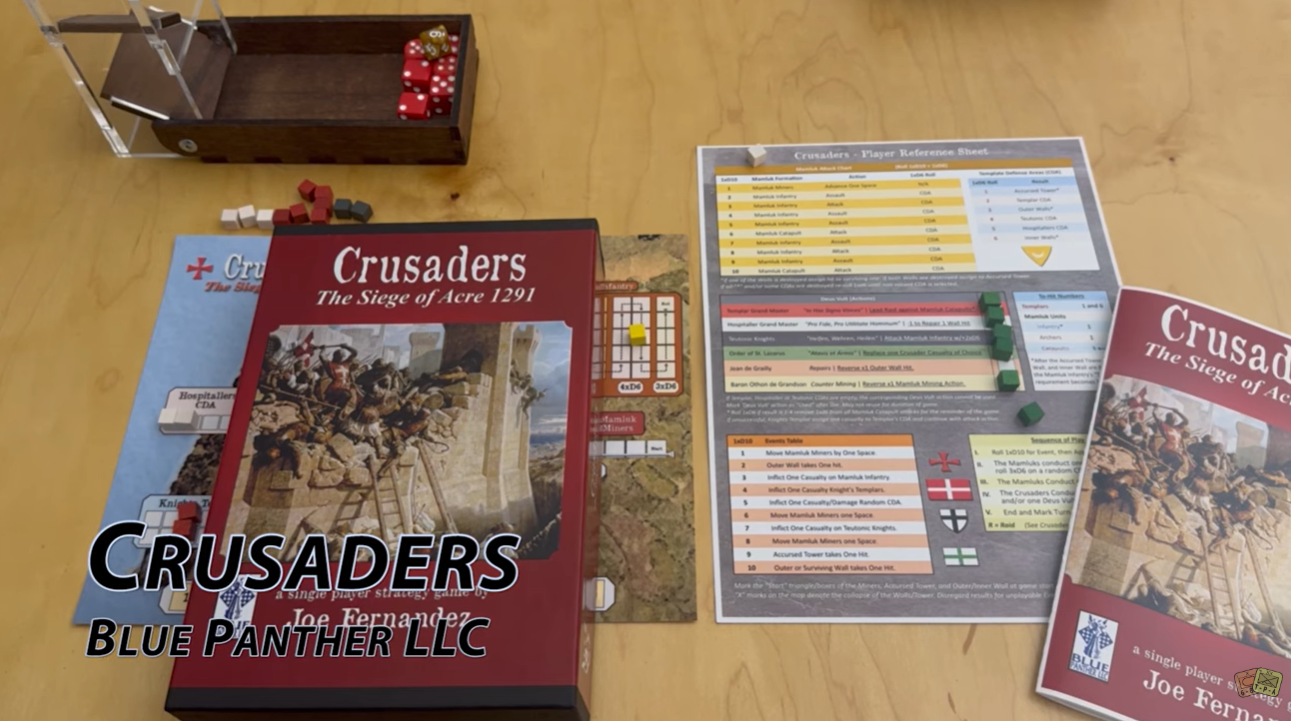
Dive into history and heroism with Crusaders: The Siege of Acre 1291, a solitaire wargame that lets you experience the last stand of the Knights Templar and the Crusaders in the Holy Land.
Relive the courageous stand of some 15,000 Crusader soldiers, Knights Templars, Teutonic Knights, and Hospitallers as they defend Acre, a critical port city in the Holy Land, against a massive Mamluk army of some 80,000 soldiers armed with siege engines and catapults in the century after the Ninth Crusade.
Fighting was brutal. Mamluk archers and catapults rained missiles on the walled city, infantry conducted relentless assaults against its perimeter while miners attempted to breach the defenses of the stronghold from below. From behind its ramparts, the Crusaders repelled attack after attack while leading raiding parties outside of the city as the immense Mamluk army tightened the noose of the defending Crusaders.
When the dust settled, the city of Acre was overun by the Mamluk army. Crusaders and citizens were killed as the remnants of the Crusader army fled back to Europe while the legendary Order of the Knights Templars retreated to the island of Cyprus. The Crusaders lost their last major stronghold of the Crusader Kingdom of Jerusalem, never to return. Can you hold Acre?
Gen Con 2026 – Thunderworks Games Gen Con 2026 is over (as well as the fall school kick-off) and I’ve come back up for air, just in time to ramp up the annual Gen Con run-down here at OpinionatedGamers. Will … Continue reading →
Von den fünf Verrückten von Heldbergs Games kommt ein weiteres schräges Spiel namens Yubitsume. Verrückt sind sie nach eigener Einlassung, und schräg, ja, das passt auch. Denn bei Yubitsume geht…
Fellow Meeple Mountaineer Andrew Holmes recently published a review covering Unmatched: The Witcher - Realms Fall and Steel & Silver, and his opening comment mentioned that we at Meeple Mountain differ on our opinions of the Unmatched franchise. But that makes sense as different reviewers covering differently themed sets are going to land differently on their thoughts.
(The correct opinion is that Unmatched is awesome)
However, Andrew is right that Unmatched is a great system because of its simplicity, quick pace, and heavily contrasting roster of fighters. And like him, I’m the ideal demographic, but for different reasons. The original game, Star Wars: Epic Duels, was played dozens upon dozens of times by my friends in middle school and me. We even found custom heroes online and printed them out, and though they were wildly unbalanced, it was a blast nonetheless.
Fans of Unmatched will recognize Bruce Lee as a highly sought-after expansion, being the first single-character pack and, at times, running upwards of $250 on the secondary market. Fortunately for those patient enough, Bruce Lee has returned in both an affordable and memorable set, going toe-to-toe with the famous boxer Muhammad Ali. I wasn’t alive during their height of fame, but their quotes, stories, and larger-than-life personas live on through pop…
Battles in the East (BITE) is a series simulating World War II Eastern Front battles. The system rules are an evolution of the SPI classics Panzergruppe Guderian, Army Group South and Cobra. Unit integrity bonuses include Soviet Corps and vary to show the increasing Soviet cohesion and decreasing German cohesion as the war progresses. HQ units provide higher level combat support and supply advantages to corresponding units in range. BITE also incorporates standardized scales (unit size, distance, time) for easy comparisons. While the series rules allow players to play many games with the same core rules, the scenario rules add unique situational elements of each battle. Each volume includes two battles from one year with two copies of the charts and tables as well as scenario rules and set-up cards for easy reference. Battles in the East Volume 2 offers a strategic simulation of pivotal 1941 Eastern Front conflicts, including the fierce battles at Uman and Tula.
Snow muffled every footstep until the only sounds were distant birds and the steady crunch beneath our boots. The silence stretched in every direction: left to right, ahead and behind, as well as all the way up into the thermosphere. We were far away from anywhere. Yet, we knew we were safe. As the darkness settled all around us, we could finally see it: the Borealis: Arctic Expeditions by Dariusz Mindur from Lucky Duck Games with art by Rodrigo Camilo Alves De Almeida, Kevin Sidharta, Inês Toczyska and Ariadna Żytniewska.
Vier Legespiele in jeweils vier Sätzen vorgestellt: Dieses Mal geht es im Mini-Quartett um Titel aus demselben Genre. Die Titelbild-Collage zeigt Cover-Ausschnitte von Frosted Blooms, Massenweise Monster, Railroad Tiles und Wispwood (von links oben nach rechts unten). Jedes einzelne Spiel entfaltet seinen ganz eigenen Reiz. Mir haben alle hier vorgestellten Neuheiten aus dem Jahrgang 2025/26 gut gefallen.
Frosted Blooms
Statt ausschließlich geschlossene Tulpenfelder mit den Landschaftsplättchen zu legen, lassen wir Lücken. Je größer die Freiflächen sind, desto wertvollere Verbesserungen wie Scheunen oder Windmühlen passen hinein. Dieses innovative Prinzip erfordert beim Planen und Platzieren der Teile eine Denkweise, die sich zunächst fremd und falsch anfühlt. Doch ich lerne schnell, von alten Mustern abzuweichen – ohne die persönlichen Wertungen und das Wettrennen beim Erfüllen zentraler Aufgaben aus den Augen zu verlieren.
Frosted Blooms | Kennerspiel | Elznir Games | Bruno Cathala und Ludovic Maublanc | 1 bis 4 Personen | ab 8 Jahren | 25 Minuten | Spielanleitung | Meine Bewertung: ★★★ (gut)
Massenweise Monster
Wer baut die beste unterirdische Geisterbahn? Neun Plättchen mit Streckenabschnitten lege ich nach und nach in meine Mine, um am Ende Tunnelverbindungen mit gut zueinander passenden Monstern zu haben. Der reizvolle Auswahlmechanismus für Plättchen lädt zum Zocken ein und hält die Frage „Geht mein Plan auf?“ lange offen. Die unterschiedlichen Wertungen für die neun Monsterarten wirken anfangs sperrig, schenken trotz leichter Unwuchten aber auch taktische Vielfalt auf leichtem Niveau.
Massenweise Monster | Spiel für alle | Lookout Spiele, Asmodee | Michael Luu | 2 bis 5 Personen | ab 10 Jahren | 20 Minuten | Spielanleitung | Meine Bewertung: ★★★ (gut)
Railroad Tiles
Der wunderschöne Zeichenstil mit warmen mediterranen Farben überschminkt, dass es bei Railroad Tiles um kühle Netzwerkplanung geht. Über acht Runden schafft jeder von uns seine eigene Plättchen-Landschaft mit Straßen, Bahnstrecken und Städten, die sich am Ende möglichst kompakt und ohne viele offene Wegenden präsentieren sollte. Zudem ist Timing nötig, um Autos, Loks und Fahrgäste dann auch einsetzen zu können, wenn sie zur Verfügung stehen. Optionale Aufgabenplättchen und Solo-Herausforderungen runden dieses klug designte Legespiel ab.
Railroad Tiles | Spiel für alle | Horrible Guild, Heidelbär Games | Hjalmar Hach und Lorenzo Silva | 1 bis 4 Personen | ab 8 Jahren | 45 Minuten | Spielanleitung | Meine Bewertung: ★★★ (gut)
Wispwood – Wald der Lichter
Erst 4×4, dann 5×5 und schließlich 6×6 – in jeder der drei Runden lege ich meine Plättchen in ein größeres Raster. Die Besonderheit dabei ist, dass ich alle Irrlichter aus der vorherigen Runde behalte und sie dabei auch noch genauso liegen lassen muss. Nur die Baumplättchen, die ich in jedem Zug zum Auffüllen in einer durch das gewählte Irrlicht vorgegebenen Anordnung platzieren muss, werden zwischen den Runden abgeräumt. Die Rundenwertungen belohnen in diesem sowohl schönen wie herausfordernden Legespiel vor allem die Personen, die mit gutem Vorstellungsvermögen planen.
Wispwood – Wald der Lichter | Kennerspiel | CGE, Heidelbär Games | Reed Ambrose | 1 bis 4 Personen | ab 10 Jahren | 45 Minuten | Spielanleitung | Meine Bewertung: ★★★ (gut)

 Anmelden