

Normale Ansicht

World Boardgaming Championships 2026 Daily Debrief Series – Day 6

Von: Grant
31. Juli 2026 um 05:20

I am nearing the end of my time here at WBC and I’m starting to get a bit sad. I have tomorrow but I will be leaving 1 day early on Saturday and just am not ready for it to be over. I have had a great time, played a lot of games, 13 by my count, and also seen old friends and made new ones. I have also done 6 videos but have had some technical difficulties with the camera as the batteries keep prematurely dying even though they have been fully charged. Bit I have made great memories and I am happy with that.

Today, we got in a full 6-player game of the excellent Imperial Elegy from VUCA Simulations. Imperial Elegy: The Road to the Great War 1850-1920 is a card driven game that blends diplomacy, warfare, and statecraft and feels a bit akin to games like Here I Stand and Virgin Queen from GMT Games. Grand scale sweeping epics that play multiplayers and take a day to play. Players play as 1 of 6 unique major powers in the game including Germany/Prussia, the United Kingdom, France, Austria-Hungary, Russia and the Ottoman Empire.

The game is somewhat of a sandbox style game as you have so many options and choices about what to do during the course of the game. Obviously, your faction has some direction about what you should be doing but really it is up the player to spend their resources how they will to accomplish their ultimate goals and score Victory Points. I truly love that aspect about this game and as we played we saw that sandbox and the asymmetry between the various factions. Particularly at the start, each country has some specific goals that they have drawn from the National Goals Deck that are a source of Victory Points, in fact a major source of Victory Points, and players will need to prioritize these cards and decide which ones to attempt to go after from the start. With only 7 turns, they will have to make progress on these National Goals if they have any hope of actually achieving them.

I have now played 3 times and very much like the grand scale of the game. It is a tad long, todays game took us about 11 hours to play, and I am starting to have concerns with the ability of France and Germany to team up and dominate the game and the Great War. I played as France today and did fairly well scoring 9 VP’s from my National Goals and doing really well in Africa and Asia with colonies as well as breaking into Mexico. I was getting 8 cards near the end of the game because I had done well in my colonial keys and my stability. This gave me lots of options with my cards and I also built up a sizeable army with 5 full Armies on the board and 5 reserve armies with 5 squadrons on the high seas and several naval bases in the east, Africa and the Mediterranean.

I think the game is a tad bit long. This is because players have at least 5-7 cards each and the Battles are very long and are their own little sideshow with a war budget and multiple movements and attacks allowed. I like the game. Love it in fact but am beginning to think it is just going to be hard to get to the table often. Here I Stand is similar in scope and scale and uses the same system but can be played in 6-9 hours versus 10-14 hours for IE.

In the end, France, Germany and the Ottomans were teamed in the Triple Entente while UK and Russia formed the Triple Alliance even though Austria and Italy were left out in the cold. The TE won the game as they just had too much muscle. I look forward to the next time I can play but it might be a while.

I was then able to watch a few minutes of play of the new upcoming Here I Stand Series game called The Night Watch: European Global Conflicts 1618-1648 from GMT Games, which focuses on the Thirty Years War. Just a prototype of the game but it looks epic and those playing seemed to enjoy it!

I was able to then go down to the vendor hall and bought quite a few games including The Alamo from Art of Wargames (solitaire), Sails at War from B2M Games, Year of the Rat Vietnam 1972 Deluxe Edition from Decision Games, Fortress of Oblivion from White Dog Games (solitaire), Le Conqueste from White Dog Games (solitaire), Model’s Counterattack from Dissimula Edizioni, On To Berlin from Multi-Man Publishing and Strike Counter Strike from Multi-Man Publishing. I was gifted a new copy of Assault Red Horizon ‘41 Revised Edition from Assault Games. Lots of great stuff to explore over the next several months.

I then met up with Bob Tkach designer of the upcoming Above the Trenches: The Fokker Scourge 1915-1917 from Flying Pig Games coming to Kickstarter this fall. This is a 2-player aerial dogfighting wargame that combines tactical, operational, and strategic elements of World War I air combat on the Western Front into a fast playing and fun game. The game focuses on the early years of WWI aerial warfare and the German-versus-British air battles.

The players will have to deal with the strategic board that has sector based objectives that will provide Victory Points and then place out their air units on the operational board where they will focus on height and positioning of observation balloons and fighters to protect them and finally will duel using cards on the innovative and very interesting combat wheel system for tactical positioning.

The players will draw a hand of technology cards, maneuver cards, speed cards and ace cards that all have numbers and some written events and will then play them to move the plane counter around the wheel and its various areas to take shots with front or rear based guns, avoid contact by maneuvering out of harms way and then starting over until one side or the other wins.

This game is not just about the dogfighting but players will be faced with the management of their squadrons, taking out of service planes to upgrade and repair them, give training to pilots to learn new skills and also to build new and upgraded planes.

A very fun and exciting game. As I was playing, I could really fell the excitement and tension building and very much loved what this one was trying to do. After playing, I was able to shoot a 30 minute video with the designer Bob and his developer Rich and I could feel their passion for the subject and the game.

After finishing up, I then met up with Uwe Wallentin from Sound of Drums to get a look at their upcoming lineup of games which includes many great looking titles such as Neither King Nor God Expanded Edition, No Retreat! The Russian Front Designer’s Edition, Battles of Napoleon Volume II: QUATRE BRAS 1815 / WARTENBURG 1813, Iron Cross Army Group North and Iron Cross Kharkov.

Uwe is a great guy and Sound of Drums is doing a great job of designing playable games with fantastic graphic design and artwork. I very much enjoyed our chat and we did a 30 minute video that’ll be up later on the channel.

That was it and I landed in bed around 10:30pm and need to get some rest for our final day tomorrow where we are playing Here I Stand from GMT Games.

Hope to see you back tomorrow night!

-Grant
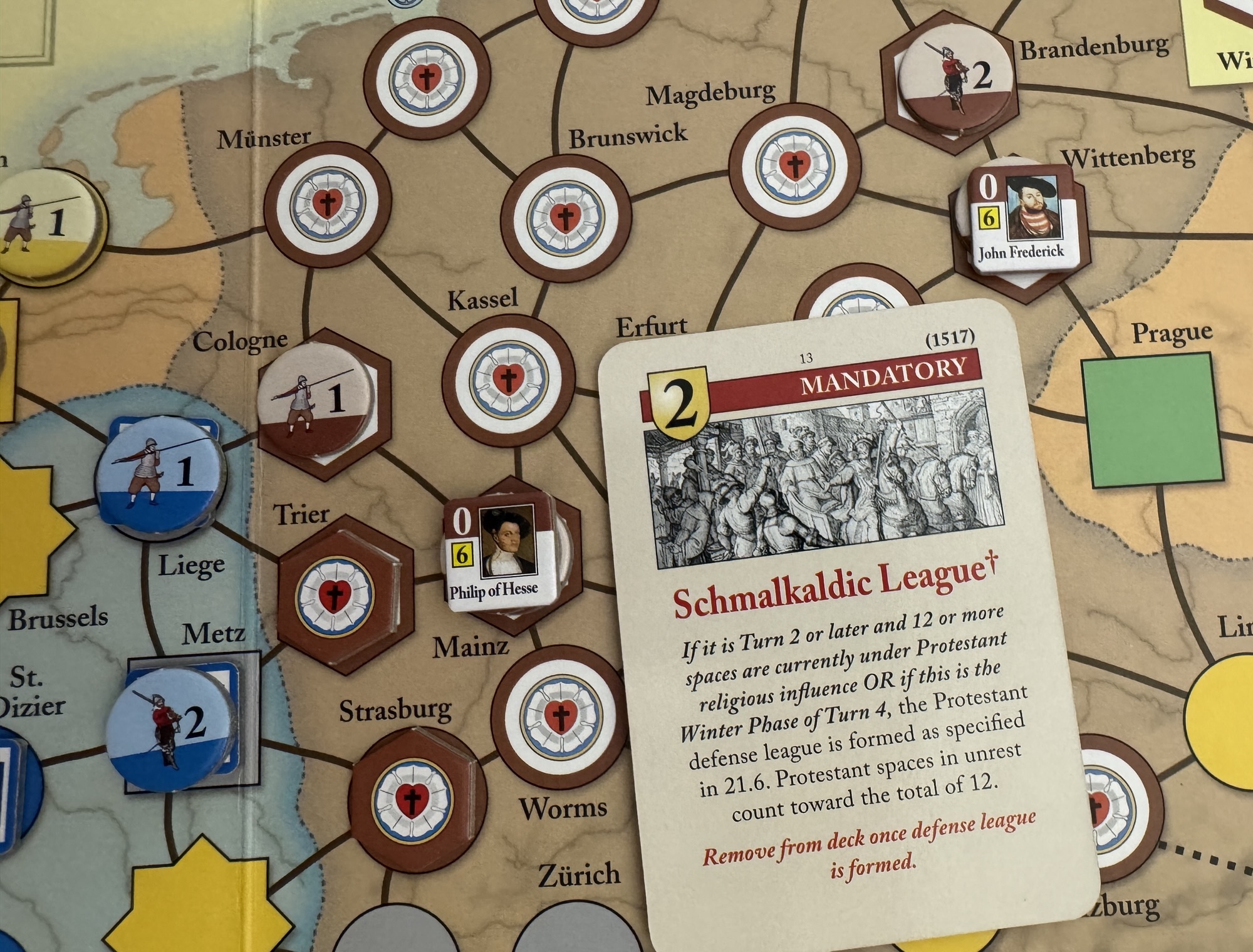
My Favorite Wargame Cards – A Look at Individual Cards from My Favorite Games – Card #77: Schmalkaldic League from Here I Stand: Wars of the Reformation, 1517-1555 from GMT Games

Von: Grant
12. Mai 2026 um 14:00

With this My Favorite Wargame Cards Series, I hope to take a look at a specific card from the various wargames that I have played and share how it is used in the game. I am not a strategist and frankly I am not that good at games but I do understand how things should work and be used in games. With that being said, here is the next entry in this series.

#77: Schmalkaldic League from Here I Stand: Wars of the Reformation, 1517-1555 from GMT Games

Here I Stand: Wars of the Reformation 1517-1555 is an experience packaged in a game that attempts to boldly cover the political and religious conflicts of early 16th Century Europe. The game focuses on the struggle of religious reformers such as Martin Luther, John Calvin and Ulrich Zwingli as they battle the Papacy for changes in their views of God and religion. But it is more than just the Holy War as it deals with the other European countries involved in the affairs of the time including France, England, the mighty Hapsburg Empire and the Ottoman Empire in the east. They all played a role in the process of the Reformation and the design brilliantly weaves this all together into an interesting and engaging experience. The game also covers other plot lines and events of the period, including wars, marriages and ascendancies to thrones, using a unique Card Driven Game (CDG) system that models both the political and religious conflicts of the period.

Today, I want to take a look at a very interesting Mandatory Event card that really shakes things up for the Protestant player in the Schmalkaldic League. This Mandatory Event basically transforms the Protestant player and changes their focus slightly as they now become somewhat of a military power. I use the term “military power” here lightly as they really are not that powerful and this event is really more of a wet blanket thrown onto their spiritual bonfire as they now will have to worry about gearing up for attacks from their neighbors to try and take away their victory points through wresting control of their Electorates from them, which grant extra Victory Points. The Schmalkaldic League Mandatory Event is only triggered when the Protestant has religious influence in 12+ spaces from Turn 2 on, or if not, then automatically by the end of Turn 4.

The Protestant player gaining the ability to create and command military units, including both regulars and mercenaries, is somewhat of a boon as you can now move your troops around the board gaining additional dice for Conversion attempts if those units are adjacent and also the electorates under Protestant religious control, specifically those marked as Protestant home spaces, instantly come under Protestant political control and grant 2 VP for each Electorate up to a maximum of 12 VP total if all 6 are under control. Talk about a turning point…albeit a turning point with some difficulties. The leaders granted to the Protestants are also not very good and do not gain extra dice during combat and frankly cannot command large armies. These leaders include John Frederick and Philip of Hesse.

John Frederick I of Saxony by Lucas Cranach the Younger.

Frankly, I try my best to hope and pray that the Schmalkaldic League card doesn’t come out during the first 4 turns and then will be triggered only during the Winter Phase of Turn 4. This gives the Protestant player some time to expand and attempt to get all of those important VP generating Electorates under their control to set themselves up nicely. But once it happens you will find that you are spending your scarce resources in the form of Command Points on things like recruiting units, moving those units and preparing for attacks. This takes away from your ability to focus solely on spreading the faith and can be a real drag on that effort. But, you take the good with the bad in this game and I have learned to deal with it over the years and turn it into something that benefits me.

The Schmalkaldic League was a military alliance of Lutheran principalities and cities within the Holy Roman Empire during the mid-16th century. It received its name from the German town of Schmalkalden, where the group was founded in 1531. Although created for religious motives soon after the start of the Reformation, its members later came to have the intention that the League would replace the Holy Roman Empire as their focus of political allegiance. While it was not the first alliance of its kind, unlike previous formations, such as the League of Torgau, the Schmalkaldic League had a substantial military to defend its political and religious interests.

The League’s members agreed to provide 10,000 infantry and 2,000 cavalry for their mutual protection. They rarely provoked the Holy Roman Emperor Charles V directly but confiscated church land, expelled bishops and Catholic princes and helped spread Lutheranism throughout northern Germany.

Martin Luther planned to present to the League the Smalcald Articles, a stricter Protestant confession, during a meeting in 1537. He attended the critical meeting in 1537 but spent most of his time suffering from kidney stones. The rulers and princes even met in the home at which Luther was staying. Though Luther was asked to prepare the articles of faith that came to be known as the Smalcald Articles, they were not formally adopted at the time of the meeting, but in 1580, they were included in the Book of Concord.

In the next entry in this series, we will take a look at Hamburger Hill from Fire in the Lake: Insurgency in Vietnam from GMT Games.

-Grant

Book Review: The Third Reich (Roberto Bolaño)

05. April 2026 um 17:48

This is a board game blog. Board games are a medium which can help us understand – for example, they can provide a uniquely active perspective on history. Yet which other medium can provide a fresh perspective on board games? – This is where novels come in handy. Today, we’re going to look at The Third Reich (Roberto Bolaño), a study in obsession as well as gaming and history.

Spain in the 1980s. Udo Berger, a young German, has just arrived in a small seaside town for a vacation with his girlfriend Ingeborg. Yet Udo’s mind is not on the beach. He has just won the national championship at the wargame The Third Reich (clearly based on Rise and Decline of the Third Reich (Don Greenwood/John Prados, Avalon Hill)) and plans to use his vacation to write an article on his new strategy for the Axis. Ingeborg, however, has more traditional vacation activities in mind, and so they spend some of their swimming, tanning, and partying, through which they befriend another German couple, some locals, and the enigmatic paddleboat renter who is only known as El Quemado (The Burned One) for the burn marks which cover his body. When the vacation comes to an end, Udo remains in Spain, supposedly to help in the case of an acquaintance lost at sea windsurfing… yet the real reason is the game of Third Reich which he plays against El Quemado.

Covers of the book mostly fall into two camps: Either they depict wargames or beach scenes. The former is probably truer to the content of the novel, but the latter provides the jarring contrast between text and image on the cover which encapsulates Udo Berger’s divided life. Image ©Picador.

Chilean novelist Roberto Bolaño wrote the novel in 1989. Since he turned his hand-written first draft into a typoscript (and later typed the first 20% into his first computer), it is assumed that he wanted to eventually publish it, but he didn’t do so before his death in 2003. When the novel was found among his papers, it was posthumously published in 2010. In addition to the original Spanish (El Tercer Reich), the book has been widely translated. I read the German translation.

Warning: Spoilers for the plot of The Third Reich ahead – but frankly, this is not a book you read for plot, you read it for the vibes.

Obsession: Conquest, Validation, Control

Udo Berger is wargame-obsessed, but the book is not a study of how an outsider has outsider fixations. On the one hand, Berger’s obsession with conquest and domination sets him by no means apart from his peers – just that they usually direct their respective urges to amorous exploits. On the other, our protagonist does not only want to conquer in the game either. In addition to his girlfriend, he also pursues the hotel manager Frau Else (who has been his crush when he was vacationing in Spain as a teen), and the underage chambermaid Clarita. And maybe most of all, Berger is fixated on being respected by his wargame peers, which he can only imagine obtaining by finding strategies (and publishing articles about them) which will obliterate all conventional wisdoms about the game.

As Berger is acutely aware of his lack of linguistic sophistication, he decides to practice by writing a diary during his vacation (which is what we read in the novel). The development of this diary reflects the changes in the writer: Originally, his daily entries are very structured (one per day, headlined by the date), and mostly concerned with banal reports on what he did, what he ate, and what he has in mind for the game/article). As Berger is drawn more and more into his duel with El Quemado, the diary gets more confused: He jumps from one level of narration to another within the same paragraph, extensive passages are solely dedicated to what’s happening in the game (down to which counters are placed on which individual hex numbers on the board), and the chapters are not only named after the dates, but also entitled “With El Lobo and El Cordero [his Spanish acquaintances]”, “Spring 1942” or “My Favorite Generals”.

Berger’s inability to focus also dooms his conquests (ludic and erotic): He sets out to prove that opening a second front early is not a liability, but an asset, and enthusiastically reports early in the game to a friend at home that it’s “Blitzkrieg on all fronts”. Yet as he conducts an amphibious assault of Britain at the same time as he invades the Soviet Union, his forces are overstretched and his Axis collapses before the historical date. And broadcasting his erotic attention over Ingeborg, Frau Else, and Clarita, does not further his relationship with either of them.

As things slide out of his grip, his attitude to control changes: Initially, Berger is fixated on the superior strategy. He notes down the exact moves – which corps need to occupy which hex in which turn to win. This chess-like approach collapses after the turning point of the game: Once El Quemado begins his counter-attack, Berger mentions for the first times that there are die rolls in the game (and how they favor his opponent) – not unlike many board gamers I have seen.

Gaming and History

Besides the main theme of obsession, the novel also offers many glimpses on gaming, history, and the relation between the two.

Berger arrives in Spain with his life compartmentalized between the gaming and the “normal” part – his girlfriend and the office job. This compartmentalization is already eroding with his plan to write the strategy article (which immediately chafes against the confines of a conventional vacation – the hotel employees are bewildered by his request for a large table to be set up in his room, and Ingeborg demands he come to the beach) and fully collapses over the course of the book, when he even unilaterally extends his vacation to play the game (and gets fired for it).

The shadow of history hangs over Berger. Our protagonist does not only play games about World War II, he also reads “patriotic” literature of the era, knows about the lives and deeds of the German generals (especially those of the SS), and the only of his wargamer friends for whom he has a certain reverence is a veteran of World War II. Despite this clear fascination for the history of Nazi Germany, Berger twice disavows being a Nazi himself (having been asked by El Quemado and Clarita). Once he even calls himself an “opponent of the Nazis”, but does not expound on it. His personal politics do not factor into the novel – Berger, having been born around 1960 in democratic, liberal, prosperous post-war Germany enjoys the luxury of only engaging with history at his leisure. He thus remains at the surface of it…

…unlike his gaming opponent. El Quemado comes from South America, and it is rumored among his Spanish acquaintances that the scars he bears are the result of torture (by one of the many right-wing regimes which took power in the 1970s). History has thus seeped into his body and gives him the strength to withstand the ludic assault of the experienced player Berger.

Bolaño himself was arrested after the 1973 coup in Chile and, to his own wonder, was released after eight days without having been tortured (he ascribed it to two of the detectives having attended school with him). He then emigrated to Spain where he worked odd jobs in the tourism industry like El Quemado.

Another allusion to Chile is made in a much-misunderstood scene: On September 11, everyone is out at the beach to celebrate the Catalan national holiday. Yet when a plane flies overhead, an eerie sense of dread overcomes the spectators. Many reviewers see this as a revision which Bolaño must have made after the September 11, 2001 terrorist attacks (or, as an odd coincidence) – but I think the likeliest reason for the scene is that the coup in Chile began on September 11, 1973 with the rebelling air force bombarding the presidential palace in Santiago.

Verdict

Roberto Bolaño’s The Third Reich starts with the innocent concept of a beach vacation. As it grows darker, the novel develops a hypnotic pull. The author’s own deep knowledge of wargames allows him to paint a vivid picture of the game itself – and of the hold it can have over its players.

❌