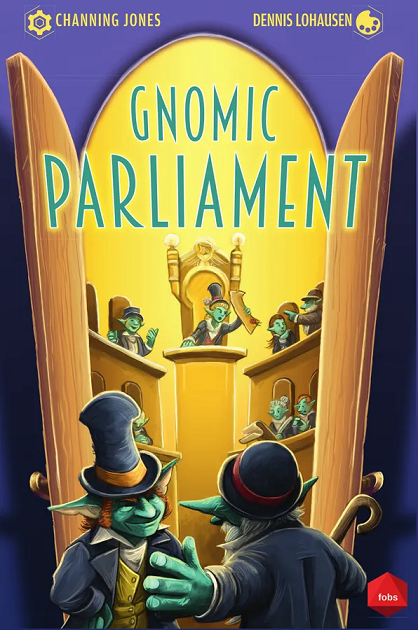
Fobs Games put Tiefe Taschen out in the world back in 2016. It’s one of my favorite designs, uniquely presenting a tense affair of dynamic negotiation. It’s worthy of the word “brilliant”. By this virtue alone, I was interested in Gnomic Parliament. It’s the German publisher’s second release, arriving at the end of 2025. I…
Any man who must say “I am the king” is no true king.
Peter checks out Kings of War for the first time with the new 4th Edition!
It’s a brand new year – the 14th! – for the Esoteric Order of Gamers, and I’m kicking it off with a new project – Kings of War by Mantic Games! Will this be your new favourite game of fantasy battles? Stick with me over the coming weeks as I unbox, build, paint and play (and of course, make a rules summary for) this rank and flank fantasy tabletop miniatures game.
Making high quality tabletop gaming content at the EOG takes time and money. Please consider becoming a Patreon supporter or making a donation so I can continue this work! Thankyou!
Step into the role of a United States Postal Inspector and work your way through three cases of increasing difficulty, each inspired by a real-life crime.
Another year has passed, and it's once more time to announce the winner of Tabletop Games Blog's highly sought-after and extremely prestigious Top Table Award of 2025. The top slot for this year will join the hall of fame alongside previous years' board games that made it to the number 1 spot on the podium. The winner of the 2025 award will be in the company of Charms, Enemy Anemone, Pax Pamir: Second Edition and others.
Why, hello there. How have you been? It’s been a few months. I’m doing well, enjoying my retirement from the blogosphere. I’m not really back, I just wanted to pop in and give my annual recap of all the new-to-me games played in 2025. Plus, I’ll be picking the winner of the prestigious Spiel des Jesse award at the end. Thanks for joining me!
We’ll start with the new-to-me games. I’ll be providing a rating for each on my patented Yeah-Meh-Bleah scale (which, for legal reasons, I probably should let you know is NOT actually patented).
12 Days: A card game based around the 12 Days of Christmas song. It’s interesting, but becomes very much about luck in the end. The art is nice. RATING: Meh+.
12 Patrols: A print-and-play game that really ends up being a puzzle as to how to place your pieces in order to satisfy demands. It’s a very pretty game, and an interesting concept, but luck is definitely a factor and can frustrate the experience. RATING: Meh+.
14ers: A card game about climbing the highest peaks in Colorado. Actually, it’s more a game about upgrading your hiker, but summiting those peaks gets you actions to add using an interesting tuck mechanism. I’ve only played it online so far, but enjoyed it. RATING: Yeah.
Abstract: A print-and-play game where you’re rolling dice and arranging colors to create your art. There’s variable scoring conditions from game to game. I only played solo, but you can compete for the highest score, even though there’s no competition. Not bad. RATING: Meh+.
Ambagibus: A print-and-play tile placement game where’s you’re basically building a maze. It’s a puzzle, but there’s not a lot to it. You need a lot of luck to win. RATING: Meh.
Bag of Chips: A light speculation game that comes packaged in a chip bag. It’s kind of silly, but good enough for what it is. RATING: Meh.
Beer and Pretzels: A super light tossing game where you’re just trying to score points by getting your stuff in a circle to show their numbers. Not really desperate to try again. RATING: Meh-.
Bites: Another speculation game where you’re trying to collect items you think will score the most points. Beautiful production, and a pretty good game that I was unaware of before trying it. RATING: Yeah.
Bring Your Own Book: Players try to find lines in their own books to fit a certain prompt. It’s a concept that is more interesting than, say, Apples to Apples, but still has the shortcomings of being a subjective judging game. Still, one of the better ones of that genre. RATING: Meh-.
Call To Adventure: Epic Origins: An adventure game where you’re throwing runestones to get the symbols you need for success. It’s a very interesting game. I’ve only played one game of the campaign so far, but enjoying it. RATING: Yeah.
Canvas: A card-crafting style game where you’re creating art by putting transparent cards into sleeves. There’s drafting, there’s variable scoring conditions, and there’s the puzzle of trying to make your art worth more. It’s really good. RATING: Yeah!
Clank! In! Space!: I love the original Clank, but this was my first time trying the space version. It was a lot of fun, and I like the modular system in place. I wish I had gotten to play more during the year. RATING: Yeah!
CuBirds: This is a game I had played online, but I don’t think I ever really got it until playing it in person. It’s an interesting set collection game with an interesting draft system. I like it, and my wife loves it (possibly because she beats me all the time). RATING: Yeah.
Daybreak: A cooperative game that won the 2024 Kinderspiel des Jahres. It’s all about trying to combat climate change. There’s a lot going on, and you’ve really got to communicate with your fellow players. I only played solo, but it would be good to play with others. RATING: Yeah!
Deadly Doodles: Basically a flip and write game where you’re making a path through a dungeon, trying to kill monsters and collect treasure. I was expecting something very different than what I got – the only “doodling” was drawing lines through the dungeon. In the end, it felt like a weak imitation of Railroad Ink. RATING: Meh.
Earth: With the buzz around this, I was expecting something I liked more. In the end, I thought it was more bloated than in needed to be. It’s got fairly simple mechanisms, but just so many moving parts that I wasn’t crazy about it. Also, didn’t like the solo mode – it felt rushed. RATING: Meh+.
Everdell: Finally increased my Geek Cred by playing this game. It’s good – I liked the system of taking things at your own pace and deciding when to recall your workers. As cool as the tree looks, I can see that thing being very annoying. RATING: Yeah.
Evergreen: From the designer of Photosynthesis, which is a game I disliked. And even though this is another tree game using a similar sun mechanism, I liked this one a lot more. Not quite as mean. RATING: Yeah.
Faraway: A reverse scoring game where you’re going on a journey, then coming back to fulfill quests with things you have collected. It works really well, I wish I had gotten to play more. RATING: Yeah!
Flamecraft: Dragons! The shops worked very well, but it felt like the game had a few too many parts for what was essentially a recipe fulfillment game. RATING: Yeah.
Flyin’ Goblin: It was fun to catapult goblins. However, the game didn’t quite work for me. Part of the problem was probably that we got an important rule wrong, but I still don’t think it was quite my game. RATING: Meh.
Gloomhaven: Buttons and Bugs: I still haven’t played the original Gloomhaven, but did play this tiny version for one player because my local library has a copy. It was fun, very small, but good. I’ll need to check it out again sometimes. RATING: Yeah.
Green Team Wins: My mom always wants to be green, so we got her a copy of this for her birthday. I’m not much of a party game guy, but this one does the “game” part pretty well. RATING: Yeah.
The Guild of Merchant Explorers: This game is VERY BEIGE. But I really liked it. It’s another one I got from the library, and has some really clever mechanisms. It’s almost, but not quite, multiplayer solitaire. RATING: Yeah!
Home Alone: It’s a one vs. all game, and works pretty well thematically. It seems pretty heavily weighted towards Kevin, which makes sense, but can be frustrating. RATING: Meh+.
Imperial Settlers: Got this in a math trade. I’ve only played solo so far, but I’ve enjoyed what I have played. It’s not terribly complicated once you figure out the basic mechanisms. My biggest problem with the game is that the text on the cards is very small. RATING: Yeah.
LANTERN: Another print-and-play. There are some very interesting things going on here, and it was surprisingly strategic for a quick dice-roller. RATING: Yeah.
The Lord of the Rings: Duel for Middle-Earth: This LOTR themed version of 7 Wonders Duel is really good, the components are just weaker than I was hoping for. RATING: Yeah!
Make That Most Magnificent Thing: A kid’s game about building contraptions. Actually, I shouldn’t say game – it’s an exercise in creativity, but there’s not really any game in there. You’re just grabbing pieces, putting something together, showing it off, then arbitrarily assigning ribbons that don’t count for points and maybe don’t carry over from round to round? The rules are very vague. RATING: Bleah as a game, meh as an activity.
Meadow: A drafting game about building up your meadow. I really enjoyed it – there are clever mechanisms, nice art, and a pretty good solo mode. RATING: Yeah!
Monumental: A big, beautiful civilization-themed deck-building game with a modular board. There’s a lot to do on a turn, which can lead to a lot of downtime. Many moving parts, but overall enjoyable. RATING: Yeah.
Mountain Goats: I had played this previously on yucata.de, but had my first physical play, so I’m counting it. It’s a very simple push-your-luck kind of game with dice and goat. It’s fun. RATING: Yeah.
Noodle Knockout!: This is my son’s game. It’s got a good dexterity element to it, but not much game. RATING: Bleah.
Oh My Pigeons!: This is really not my kind of game. Too much take that, too random. The pigeons are cute and the game is quick, but that’s about it. RATING: Bleah!
River Valley Glassworks: A pretty set collection game with glass floating down a river. The scoring concepts are a little tough to get your head around, but it’s fun. RATING: Yeah.
So Clover! I’m still not one for party games, but this was good. The deduction here is excellent. I’d classify it as more of an activity than a game, but it’s solid. RATING: Yeah.
Spots: Probably my biggest surprise of the year. This is a dice rolling recipe fulfillment style game where you’re just trying to fill in the spots on your dogs. Different actions every game, and it produced one of the best in-jokes my family has had this year (Doog is Doog). RATING: Yeah!
Super Mega Lucky Box: Basically Bingo with more strategy. There’s not much else to say for it – I like it more than Bingo. RATING: Yeah.
Switchbacks: A small and light placement game where you’re just trying to get numbers in a row. It’s fairly simple, and a good quick game. RATING: Yeah.
Tales of the Arthurian Knights: This updated version of Tales of the Arabian Knights moves the system to the Arthurian legend. It’s much more forgiving than the original with longer stories. It also has a cooperative mode, which is exclusively how we play it. RATING: Yeah!
That’s Not a Hat: A party game that’s about memory. It’s very simple, and I can see how people who like party games might like it. Not for me. RATING: Bleah.
Tiny Epic Galaxies: This is only the second Tiny Epic game I’ve tried, and I was able to check this one out from the library. I’ve only done the solo mode, and I liked it, though it took me a bit to get my head around the rules. RATING: Yeah.
Trailblazers: Another library game that’s about building trails. It’s very puzzly and takes some luck to get to your goals. My wife really disliked it, but I enjoyed it. RATING: Yeah.
Trogdor!! Probably my second biggest surprise this year. I am very familiar with Homestar Runner and TROGDOR!!, but had never had a chance to play this game before. It was honestly kind of a dumb game, but fun. There’s a lot of luck involved. RATING: Yeah.
Urbion: Never played the original game, but the second edition is out now and I enjoyed it. It’s a game about balance, and very well implemented. RATING: Yeah!
We’re Doomed: A game about trying to escape the end of the world. I will say this game was pretty funny, but in the end, it’s just too mean and lucky for me. RATING: Bleah.
Wingspan Asia: A 1-2 player version of Wingspan. It adds an interesting new layer to the system with the duet board. My biggest complaint is that there weren’t enough eggs. Only played once, I need to explore some more. RATING: Yeah.
Wordsnap: Scrabble, but with interlocking tiles and no board. It’s a good puzzle for people who like word puzzle, but I don’t know that it adds too much more to the genre other than the components. RATING: Meh.
And now, on to the nominees for this year’s Spiel des Jesse. Long time fans may know the criteria already, but here it is again for anyone new to this space: any game is eligible for the award if I played it for the first time during 2025, and as long as I played it at least twice. This cuts out a few games that probably would have made the nomination list, including Daybreak, River Valley Glassworks, and Everdell, among others. From the games that were eligible, here’s my shortlist:
Canvas (2021; designed by Jeff Chin and Andrew Nerger; published by Road to Infamy Games)
The Guild of Merchant Explorers (2022; designed by Matthew Dunstan and Brett J. Gilbert; published by AEG)
The Lord of the Rings: Duel for Middle-Earth (2024; designed by Antoine Bauza and Bruno Cathala; published by Repos Production)
Meadow (2021; designed by Klemens Kalicki; published by Rebel Studio)
Spots (2022; designed by Alex Hague, Jon Perry, and Justin Vickers; published by CMYK)
Tales of the Arthurian Knights (2024; designed by Eric Goldberg and Andrew Parks; published by WizKids)
This was a tough year to decide – all of these are great games, but I don’t know how much any one of them stood out over the others. Still, there can only be one, and I think that this year it will be…
image by BGG user Asia_Rebel
I really like the drafting in Meadow, and the way the cards interact to form new combos and scoring opportunities. It’s a beautiful game, plays well multiplayer and solo, and I like it a lot. So, that’s my pick, and it joins Argent: The Consortium (2014), Colt Express (2015), Burgle Bros (2016), Clank! (2017), Azul (2018), Rhino Hero Super Battle (2019), Roll Player (2020), The Isle of Cats (2021), Mandala (2022), Fantasy Realms (2023), and Lost Ruins of Arnak (2024) in the exclusive club of previous Spiel des Jesse winners.
Time to crawl back into my hole. Thanks for joining me for this annual recap. Right now, I plan to come back in June or July to do my annual Spiel des Jahres picks, but who knows. Thanks for reading!
Why, hello there. How have you been? It’s been a few months. I’m doing well, enjoying my retirement from the blogosphere. I’m not really back, I just wanted to pop in and give my annual recap of all the new-to-me games played in 2025. Plus, I’ll be picking the winner of the prestigious Spiel des Jesse award at the end. Thanks for joining me!
We’ll start with the new-to-me games. I’ll be providing a rating for each on my patented Yeah-Meh-Bleah scale (which, for legal reasons, I probably should let you know is NOT actually patented).
12 Days: A card game based around the 12 Days of Christmas song. It’s interesting, but becomes very much about luck in the end. The art is nice. RATING: Meh+.
12 Patrols: A print-and-play game that really ends up being a puzzle as to how to place your pieces in order to satisfy demands. It’s a very pretty game, and an interesting concept, but luck is definitely a factor and can frustrate the experience. RATING: Meh+.
14ers: A card game about climbing the highest peaks in Colorado. Actually, it’s more a game about upgrading your hiker, but summiting those peaks gets you actions to add using an interesting tuck mechanism. I’ve only played it online so far, but enjoyed it. RATING: Yeah.
Abstract: A print-and-play game where you’re rolling dice and arranging colors to create your art. There’s variable scoring conditions from game to game. I only played solo, but you can compete for the highest score, even though there’s no competition. Not bad. RATING: Meh+.
Ambagibus: A print-and-play tile placement game where’s you’re basically building a maze. It’s a puzzle, but there’s not a lot to it. You need a lot of luck to win. RATING: Meh.
Bag of Chips: A light speculation game that comes packaged in a chip bag. It’s kind of silly, but good enough for what it is. RATING: Meh.
Beer and Pretzels: A super light tossing game where you’re just trying to score points by getting your stuff in a circle to show their numbers. Not really desperate to try again. RATING: Meh-.
Bites: Another speculation game where you’re trying to collect items you think will score the most points. Beautiful production, and a pretty good game that I was unaware of before trying it. RATING: Yeah.
Bring Your Own Book: Players try to find lines in their own books to fit a certain prompt. It’s a concept that is more interesting than, say, Apples to Apples, but still has the shortcomings of being a subjective judging game. Still, one of the better ones of that genre. RATING: Meh-.
Call To Adventure: Epic Origins: An adventure game where you’re throwing runestones to get the symbols you need for success. It’s a very interesting game. I’ve only played one game of the campaign so far, but enjoying it. RATING: Yeah.
Canvas: A card-crafting style game where you’re creating art by putting transparent cards into sleeves. There’s drafting, there’s variable scoring conditions, and there’s the puzzle of trying to make your art worth more. It’s really good. RATING: Yeah!
Clank! In! Space!: I love the original Clank, but this was my first time trying the space version. It was a lot of fun, and I like the modular system in place. I wish I had gotten to play more during the year. RATING: Yeah!
CuBirds: This is a game I had played online, but I don’t think I ever really got it until playing it in person. It’s an interesting set collection game with an interesting draft system. I like it, and my wife loves it (possibly because she beats me all the time). RATING: Yeah.
Daybreak: A cooperative game that won the 2024 Kinderspiel des Jahres. It’s all about trying to combat climate change. There’s a lot going on, and you’ve really got to communicate with your fellow players. I only played solo, but it would be good to play with others. RATING: Yeah!
Deadly Doodles: Basically a flip and write game where you’re making a path through a dungeon, trying to kill monsters and collect treasure. I was expecting something very different than what I got – the only “doodling” was drawing lines through the dungeon. In the end, it felt like a weak imitation of Railroad Ink. RATING: Meh.
Earth: With the buzz around this, I was expecting something I liked more. In the end, I thought it was more bloated than in needed to be. It’s got fairly simple mechanisms, but just so many moving parts that I wasn’t crazy about it. Also, didn’t like the solo mode – it felt rushed. RATING: Meh+.
Everdell: Finally increased my Geek Cred by playing this game. It’s good – I liked the system of taking things at your own pace and deciding when to recall your workers. As cool as the tree looks, I can see that thing being very annoying. RATING: Yeah.
Evergreen: From the designer of Photosynthesis, which is a game I disliked. And even though this is another tree game using a similar sun mechanism, I liked this one a lot more. Not quite as mean. RATING: Yeah.
Faraway: A reverse scoring game where you’re going on a journey, then coming back to fulfill quests with things you have collected. It works really well, I wish I had gotten to play more. RATING: Yeah!
Flamecraft: Dragons! The shops worked very well, but it felt like the game had a few too many parts for what was essentially a recipe fulfillment game. RATING: Yeah.
Flyin’ Goblin: It was fun to catapult goblins. However, the game didn’t quite work for me. Part of the problem was probably that we got an important rule wrong, but I still don’t think it was quite my game. RATING: Meh.
Gloomhaven: Buttons and Bugs: I still haven’t played the original Gloomhaven, but did play this tiny version for one player because my local library has a copy. It was fun, very small, but good. I’ll need to check it out again sometimes. RATING: Yeah.
Green Team Wins: My mom always wants to be green, so we got her a copy of this for her birthday. I’m not much of a party game guy, but this one does the “game” part pretty well. RATING: Yeah.
The Guild of Merchant Explorers: This game is VERY BEIGE. But I really liked it. It’s another one I got from the library, and has some really clever mechanisms. It’s almost, but not quite, multiplayer solitaire. RATING: Yeah!
Home Alone: It’s a one vs. all game, and works pretty well thematically. It seems pretty heavily weighted towards Kevin, which makes sense, but can be frustrating. RATING: Meh+.
Imperial Settlers: Got this in a math trade. I’ve only played solo so far, but I’ve enjoyed what I have played. It’s not terribly complicated once you figure out the basic mechanisms. My biggest problem with the game is that the text on the cards is very small. RATING: Yeah.
LANTERN: Another print-and-play. There are some very interesting things going on here, and it was surprisingly strategic for a quick dice-roller. RATING: Yeah.
The Lord of the Rings: Duel for Middle-Earth: This LOTR themed version of 7 Wonders Duel is really good, the components are just weaker than I was hoping for. RATING: Yeah!
Make That Most Magnificent Thing: A kid’s game about building contraptions. Actually, I shouldn’t say game – it’s an exercise in creativity, but there’s not really any game in there. You’re just grabbing pieces, putting something together, showing it off, then arbitrarily assigning ribbons that don’t count for points and maybe don’t carry over from round to round? The rules are very vague. RATING: Bleah as a game, meh as an activity.
Meadow: A drafting game about building up your meadow. I really enjoyed it – there are clever mechanisms, nice art, and a pretty good solo mode. RATING: Yeah!
Monumental: A big, beautiful civilization-themed deck-building game with a modular board. There’s a lot to do on a turn, which can lead to a lot of downtime. Many moving parts, but overall enjoyable. RATING: Yeah.
Mountain Goats: I had played this previously on yucata.de, but had my first physical play, so I’m counting it. It’s a very simple push-your-luck kind of game with dice and goat. It’s fun. RATING: Yeah.
Noodle Knockout!: This is my son’s game. It’s got a good dexterity element to it, but not much game. RATING: Bleah.
Oh My Pigeons!: This is really not my kind of game. Too much take that, too random. The pigeons are cute and the game is quick, but that’s about it. RATING: Bleah!
River Valley Glassworks: A pretty set collection game with glass floating down a river. The scoring concepts are a little tough to get your head around, but it’s fun. RATING: Yeah.
So Clover! I’m still not one for party games, but this was good. The deduction here is excellent. I’d classify it as more of an activity than a game, but it’s solid. RATING: Yeah.
Spots: Probably my biggest surprise of the year. This is a dice rolling recipe fulfillment style game where you’re just trying to fill in the spots on your dogs. Different actions every game, and it produced one of the best in-jokes my family has had this year (Doog is Doog). RATING: Yeah!
Super Mega Lucky Box: Basically Bingo with more strategy. There’s not much else to say for it – I like it more than Bingo. RATING: Yeah.
Switchbacks: A small and light placement game where you’re just trying to get numbers in a row. It’s fairly simple, and a good quick game. RATING: Yeah.
Tales of the Arthurian Knights: This updated version of Tales of the Arabian Knights moves the system to the Arthurian legend. It’s much more forgiving than the original with longer stories. It also has a cooperative mode, which is exclusively how we play it. RATING: Yeah!
That’s Not a Hat: A party game that’s about memory. It’s very simple, and I can see how people who like party games might like it. Not for me. RATING: Bleah.
Tiny Epic Galaxies: This is only the second Tiny Epic game I’ve tried, and I was able to check this one out from the library. I’ve only done the solo mode, and I liked it, though it took me a bit to get my head around the rules. RATING: Yeah.
Trailblazers: Another library game that’s about building trails. It’s very puzzly and takes some luck to get to your goals. My wife really disliked it, but I enjoyed it. RATING: Yeah.
Trogdor!! Probably my second biggest surprise this year. I am very familiar with Homestar Runner and TROGDOR!!, but had never had a chance to play this game before. It was honestly kind of a dumb game, but fun. There’s a lot of luck involved. RATING: Yeah.
Urbion: Never played the original game, but the second edition is out now and I enjoyed it. It’s a game about balance, and very well implemented. RATING: Yeah!
We’re Doomed: A game about trying to escape the end of the world. I will say this game was pretty funny, but in the end, it’s just too mean and lucky for me. RATING: Bleah.
Wingspan Asia: A 1-2 player version of Wingspan. It adds an interesting new layer to the system with the duet board. My biggest complaint is that there weren’t enough eggs. Only played once, I need to explore some more. RATING: Yeah.
Wordsnap: Scrabble, but with interlocking tiles and no board. It’s a good puzzle for people who like word puzzle, but I don’t know that it adds too much more to the genre other than the components. RATING: Meh.
And now, on to the nominees for this year’s Spiel des Jesse. Long time fans may know the criteria already, but here it is again for anyone new to this space: any game is eligible for the award if I played it for the first time during 2025, and as long as I played it at least twice. This cuts out a few games that probably would have made the nomination list, including Daybreak, River Valley Glassworks, and Everdell, among others. From the games that were eligible, here’s my shortlist:
Canvas (2021; designed by Jeff Chin and Andrew Nerger; published by Road to Infamy Games)
The Guild of Merchant Explorers (2022; designed by Matthew Dunstan and Brett J. Gilbert; published by AEG)
The Lord of the Rings: Duel for Middle-Earth (2024; designed by Antoine Bauza and Bruno Cathala; published by Repos Production)
Meadow (2021; designed by Klemens Kalicki; published by Rebel Studio)
Spots (2022; designed by Alex Hague, Jon Perry, and Justin Vickers; published by CMYK)
Tales of the Arthurian Knights (2024; designed by Eric Goldberg and Andrew Parks; published by WizKids)
This was a tough year to decide – all of these are great games, but I don’t know how much any one of them stood out over the others. Still, there can only be one, and I think that this year it will be…
image by BGG user Asia_Rebel
I really like the drafting in Meadow, and the way the cards interact to form new combos and scoring opportunities. It’s a beautiful game, plays well multiplayer and solo, and I like it a lot. So, that’s my pick, and it joins Argent: The Consortium (2014), Colt Express (2015), Burgle Bros (2016), Clank! (2017), Azul (2018), Rhino Hero Super Battle (2019), Roll Player (2020), The Isle of Cats (2021), Mandala (2022), Fantasy Realms (2023), and Lost Ruins of Arnak (2024) in the exclusive club of previous Spiel des Jesse winners.
Time to crawl back into my hole. Thanks for joining me for this annual recap. Right now, I plan to come back in June or July to do my annual Spiel des Jahres picks, but who knows. Thanks for reading!
Still enjoying The Great British Baking Show as a cozy watch. But even if you don’t watch it, here’s a great phrase — “A total bag of pants” (meaning a disaster). Has entered my lexicon and I’m experimenting with all the “<container> of <garment>” combos. And also watching Prue Leith (an 80 year old proper British Matriarch type, but with an Austin Powers 60’s flair) innocently ask things like “Tell us about your beaver,” or “I am interested in your large nuts” never gets old. Sadly only have a series or two left to watch.
Maybe
The 9th Configuration — An insane 70s movie (although released in early 80) set in a military insane asylum where the inmates apparently have access to a Hollywood prop department to enact whatever crazy stuff they want. Written, Produced and Directed by William Blatty (fresh of The Exorcist) so the studios were willing to let him do whatever he wanted. Some great scenes and mostly great but nonsensical dialogue. I had to watch it in chunks. Definitely a noble failure and not a cookie cutter movie.
Grantchester — A Masterpiece Mystery that is definitely ripping off Father Brown1. (Except that the priest is Anglican? Church of England? In any case, Not Catholic and it’s post WW-II instead of WW-I). But I like Father Brown and this is close enough for me. But as the series goes on it gets less about the mystery of the week and more about the main character(s) being miserable, and lost a fair chunk of the joy2. (Netflix only has the first four of the ten(!) seasons).
In the Mouth of Madness — A (90s) rewatch of which I remembered almost nothing. Attempts to capture Lovecraftian dread, but the execution isn’t quite there. Some genuinely creepy moments but also too reliant on “repeated dream awakenings” and re-used footage. Amazing to think that John Carpenter did this a decade after The Thing, because the monster effects are a step down; less is more would have been so much better here3. But …. any schlock horror movie is elevated by David Warner & Jürgen Prochnow looks very anti-christ-like. Clever ending, but “ah, that’s clever” clever instead of a gut punch. I think it works better if you simply lop off the last few minutes.4
The Long Kiss Goodnight — (90s Rewatch, pt II). Shane Black makes another Shane Black movie. Action movie? Check! Partners who don’t like each other? Check! Banter? Christmastime? Checkity Check! Sadly this isn’t up the the heights that Lethal Weapon started, but its not bad.
Nobody Wants This (S2) — A reasonable ‘comfort food’ romcom/sitcom. Sometimes veers into cringe, but it understands that a romcom/sitcom must be funny (and heartwarming) so that both Mr. and Mrs. Tao will watch.
Under the Skin (book) — Read this after watching the movie (see Sep-Oct). Good, but in a very different way (books can show inner monologues, movies are visual). I think that the near silence of the movie was a good choice, but that necessitated changing the story to make it much more ambiguous. Note — Not for the squeamish.
Wick is Pain — Documentary on the John Wick Franchise. Reasonable if you liked the franchise. What impressed me was seeing stunts that I said “Obvious CGI” in the theater and then discovering that the CGI was only for the environment, not the stunt itself, which was real. (The building fall at the end of John Wick 2)
Maybe Not
Turned Off / Not Recommended
“Oh, Hi!” — I saw this recommended by Marginal Revolution. The plot is that a young couple go on a weekend vacation, find some bondage equipment, he gets tied up and (after sex) reveals that he doesn’t consider this a serious relationship, at which point she leaves him tied up and tries to convince him that she is girlfriend material. BUT nobody is sympathetic. She’s crazy. (It’s established that she considered stabbing her last boyfriend). “Leave him tied up” isn’t played for laughs, and isn’t funny. On the other hand, she’s right. You don’t go on a weekend trip alone after dating for four months and expect her to think it’s a fling. In Re: “Crazy girl” vs “Idiot Boy” I find both guilty. Turned off at the 30 minute mark (or less), tried to continue a few times. Failed. Now re-reading Marginal Revolution I realized that “better than expected retelling of…” isn’t necessarily an endorsement.5
Tenet — This finally showed up on streaming and … man; was Christopher Nolan trolling us the entire time6? “What if I just didn’t have a plot at all, but did as much cool stuff as possible?” Turned off before the hour mark; tried again and couldn’t get through another few minutes. It’s like a Bond movie with truly excellent set pieces and locations. (Off-brand Bond but not skimping on quality). Plus Time-travel special effects. But when you break it open it’s just Nelson Munz “Hah hah!”-ing you, the sucker audience.
OK, its an actual series of books on its own that started a few years ago, and the author’s father was formerly the Archbishop of Canterbury, but still … ︎
After finishing season 4 I realize that part of that was the requirements to switch the lead actors. ︎
Such as the people in an oil painting moving. If they never moved on camera and if you thought they had but weren’t sure, it would have been creepier. ︎
For example — Sam Neill’s character “sees” the carnage in the hallway (a ‘less is more shot’, where you see vague shadows and hear screams), realizes the door keeping him the sanitarium is busted … and then chooses to retreat to his room & close the door. ︎
But then I see it’s on his years best film list, so uh, whatever. ︎
No, mostly he’s pretty good. I guess this was just a misfire. ︎
Still enjoying The Great British Baking Show as a cozy watch. But even if you don’t watch it, here’s a great phrase — “A total bag of pants” (meaning a disaster). Has entered my lexicon and I’m experimenting with all the “<container> of <garment>” combos. And also watching Prue Leith (an 80 year old proper British Matriarch type, but with an Austin Powers 60’s flair) innocently ask things like “Tell us about your beaver,” or “I am interested in your large nuts” never gets old. Sadly only have a series or two left to watch.
Maybe
The 9th Configuration — An insane 70s movie (although released in early 80) set in a military insane asylum where the inmates apparently have access to a Hollywood prop department to enact whatever crazy stuff they want. Written, Produced and Directed by William Blatty (fresh of The Exorcist) so the studios were willing to let him do whatever he wanted. Some great scenes and mostly great but nonsensical dialogue. I had to watch it in chunks. Definitely a noble failure and not a cookie cutter movie.
Grantchester — A Masterpiece Mystery that is definitely ripping off Father Brown1. (Except that the priest is Anglican? Church of England? In any case, Not Catholic and it’s post WW-II instead of WW-I). But I like Father Brown and this is close enough for me. But as the series goes on it gets less about the mystery of the week and more about the main character(s) being miserable, and lost a fair chunk of the joy2. (Netflix only has the first four of the ten(!) seasons).
In the Mouth of Madness — A (90s) rewatch of which I remembered almost nothing. Attempts to capture Lovecraftian dread, but the execution isn’t quite there. Some genuinely creepy moments but also too reliant on “repeated dream awakenings” and re-used footage. Amazing to think that John Carpenter did this a decade after The Thing, because the monster effects are a step down; less is more would have been so much better here3. But …. any schlock horror movie is elevated by David Warner & Jürgen Prochnow looks very anti-christ-like. Clever ending, but “ah, that’s clever” clever instead of a gut punch. I think it works better if you simply lop off the last few minutes.4
The Long Kiss Goodnight — (90s Rewatch, pt II). Shane Black makes another Shane Black movie. Action movie? Check! Partners who don’t like each other? Check! Banter? Christmastime? Checkity Check! Sadly this isn’t up the the heights that Lethal Weapon started, but its not bad.
Nobody Wants This (S2) — A reasonable ‘comfort food’ romcom/sitcom. Sometimes veers into cringe, but it understands that a romcom/sitcom must be funny (and heartwarming) so that both Mr. and Mrs. Tao will watch.
Under the Skin (book) — Read this after watching the movie (see Sep-Oct). Good, but in a very different way (books can show inner monologues, movies are visual). I think that the near silence of the movie was a good choice, but that necessitated changing the story to make it much more ambiguous. Note — Not for the squeamish.
Wick is Pain — Documentary on the John Wick Franchise. Reasonable if you liked the franchise. What impressed me was seeing stunts that I said “Obvious CGI” in the theater and then discovering that the CGI was only for the environment, not the stunt itself, which was real. (The building fall at the end of John Wick 2)
Maybe Not
Turned Off / Not Recommended
“Oh, Hi!” — I saw this recommended by Marginal Revolution. The plot is that a young couple go on a weekend vacation, find some bondage equipment, he gets tied up and (after sex) reveals that he doesn’t consider this a serious relationship, at which point she leaves him tied up and tries to convince him that she is girlfriend material. BUT nobody is sympathetic. She’s crazy. (It’s established that she considered stabbing her last boyfriend). “Leave him tied up” isn’t played for laughs, and isn’t funny. On the other hand, she’s right. You don’t go on a weekend trip alone after dating for four months and expect her to think it’s a fling. In Re: “Crazy girl” vs “Idiot Boy” I find both guilty. Turned off at the 30 minute mark (or less), tried to continue a few times. Failed. Now re-reading Marginal Revolution I realized that “better than expected retelling of…” isn’t necessarily an endorsement.5
Tenet — This finally showed up on streaming and … man; was Christopher Nolan trolling us the entire time6? “What if I just didn’t have a plot at all, but did as much cool stuff as possible?” Turned off before the hour mark; tried again and couldn’t get through another few minutes. It’s like a Bond movie with truly excellent set pieces and locations. (Off-brand Bond but not skimping on quality). Plus Time-travel special effects. But when you break it open it’s just Nelson Munz “Hah hah!”-ing you, the sucker audience.
OK, its an actual series of books on its own that started a few years ago, and the author’s father was formerly the Archbishop of Canterbury, but still … ︎
After finishing season 4 I realize that part of that was the requirements to switch the lead actors. ︎
Such as the people in an oil painting moving. If they never moved on camera and if you thought they had but weren’t sure, it would have been creepier. ︎
For example — Sam Neill’s character “sees” the carnage in the hallway (a ‘less is more shot’, where you see vague shadows and hear screams), realizes the door keeping him the sanitarium is busted … and then chooses to retreat to his room & close the door. ︎
But then I see it’s on his years best film list, so uh, whatever. ︎
No, mostly he’s pretty good. I guess this was just a misfire. ︎
The overall blog statistics are pretty meaningless – both last year and this year are skewed by WordPress sending my Farewell 2024 – Historical Fiction! post out to a bajillion people (from Dec 26 to Jan 8), which makes it easily the most popular post of each year (providing more than a fourth of my total views this year). If you factor that out, 2025 has been a good year on the blog, but slightly behind the (organic) record of 2023.
The posts doing particularly well have been the usual suspects, that is, the Most Anticipated Historical Board Games post in January, and the evergreen strategy posts for several games published over the last year. It was nice to see that a few of my research-intensive posts in the American Revolution and the Wallenstein series also did well.
Most of my readers come from the United States (also skewed by the Historical Fiction anomaly, but not entirely), as well as other Anglophone (UK, Canada, Australia) or European (Germany, the Netherlands, Spain, and France) countries. Especially the Dutch have made a leap up… maybe because of my post on the history of Amsterdam? Welkom, anyway.
New arrivals in the top 10 of the countries from which most views stem are Sweden and Poland in a joint Baltic effort.
If you compare views with population numbers, there are possibly no more loyal readers of this blog than the fine people of Ireland, closely followed by Hong Kong, whose views eclipse those of huge countries like Japan, Brazil, or India. The Irish have been devoted to history, board games, and history in board games for some years now, for which I am grateful. The Hongkongers are new in their excitement for the blog – welcome! If you are from Hong Kong, leave a comment below!
I can only speculate what brought people to this blog (but maybe you can enlighten me with a comment, especially if read this blog, but don’t comment often or ever). Here is, however, what I think was the finest which I published this year – as per usual, with six instead of three entries, and without crowning a winner. Let’s go!
Most of the history articles on this blog are about what people in the past did – the politicians, merchants, soldiers of times past. Yet I also like to dwell on what they thought, and thus I’m very happy to have written this post on the political philosophy of the American Revolution, its core value of liberty, and the promise and limitation of that idea. It was also an opportunity to engage with the still-compelling documents of the Revolution – Common Sense and the Declaration of Independence.
It’s been a wild year politically. Almost forgotten by now is the Great Tariff Rollercoaster of April 2025, in which the American federal government announced tariffs on imports from almost all other countries and then engaged in a flurry of raising, lowering, and holding off on them that made everyone’s head spin. By now, the 145% tariff on Chinese goods imported by US buyers is long gone, but at the time it seemed like an existential threat to US board game companies manufacturing their games in China (so, almost all of them), and given that the current US administration will still be in office for another three years, one worth revisiting.
This blog often gives me the opportunity to learn about new subjects. Wallenstein was one of them. I approached the post about his life with not more than a general knowledge about his role in the Thirty Years’ War… and then was sucked into a research rabbit hole in which I read over 2,000 pages about the guy. The result is a four-part series and the longest, most detailed board game assisted biography I have ever written about anyone.
…and this blog also allows me to re-visit topics and games with which I have engaged for years (and sometimes decades) now. Frederick II of Prussia is such a person, and Friedrich (Richard Sivél, Histogame) such a game. Reflecting on their insights on Frederick’s campaigns, the command and control exercised, and Frederick’s psychology was a delight.
Amsterdam is one of the iconic cities of the world. It is a symbol of art, commerce, and progress, and unique in its canal-structured urban layout. Unsurprisingly, these characteristics have also inspired board game designers. I have told Amsterdam’s 750-year history through the lens of the many board games set in Amsterdam – which gives a glimpse into what the city stands for in the popular imagination. As both this and my earlier Venice post were so much fun to write, I should do more city histories!
One of my brighter new ideas was to link historical board games to period music. Of course, that works particularly well from the 20th century on – the age of the music record. I started with an immersive playlist for your next game of Weimar (Matthias Cramer, Capstone Games/Skellig Games/Spielworxx), full of everything that was hot at the time – from traditional songs to jazz, from movie tunes to workers’ songs. It will surely not remain the only such playlist.
And thus concludes the year 2025 on this blog. I hope you had as much fun reading it as I had writing.
I wish you all an excellent year 2026, full of joy, health, and success!
The overall blog statistics are pretty meaningless – both last year and this year are skewed by WordPress sending my Farewell 2024 – Historical Fiction! post out to a bajillion people (from Dec 26 to Jan 8), which makes it easily the most popular post of each year (providing more than a fourth of my total views this year). If you factor that out, 2025 has been a good year on the blog, but slightly behind the (organic) record of 2023.
The posts doing particularly well have been the usual suspects, that is, the Most Anticipated Historical Board Games post in January, and the evergreen strategy posts for several games published over the last year. It was nice to see that a few of my research-intensive posts in the American Revolution and the Wallenstein series also did well.
Most of my readers come from the United States (also skewed by the Historical Fiction anomaly, but not entirely), as well as other Anglophone (UK, Canada, Australia) or European (Germany, the Netherlands, Spain, and France) countries. Especially the Dutch have made a leap up… maybe because of my post on the history of Amsterdam? Welkom, anyway.
New arrivals in the top 10 of the countries from which most views stem are Sweden and Poland in a joint Baltic effort.
If you compare views with population numbers, there are possibly no more loyal readers of this blog than the fine people of Ireland, closely followed by Hong Kong, whose views eclipse those of huge countries like Japan, Brazil, or India. The Irish have been devoted to history, board games, and history in board games for some years now, for which I am grateful. The Hongkongers are new in their excitement for the blog – welcome! If you are from Hong Kong, leave a comment below!
I can only speculate what brought people to this blog (but maybe you can enlighten me with a comment, especially if read this blog, but don’t comment often or ever). Here is, however, what I think was the finest which I published this year – as per usual, with six instead of three entries, and without crowning a winner. Let’s go!
Most of the history articles on this blog are about what people in the past did – the politicians, merchants, soldiers of times past. Yet I also like to dwell on what they thought, and thus I’m very happy to have written this post on the political philosophy of the American Revolution, its core value of liberty, and the promise and limitation of that idea. It was also an opportunity to engage with the still-compelling documents of the Revolution – Common Sense and the Declaration of Independence.
It’s been a wild year politically. Almost forgotten by now is the Great Tariff Rollercoaster of April 2025, in which the American federal government announced tariffs on imports from almost all other countries and then engaged in a flurry of raising, lowering, and holding off on them that made everyone’s head spin. By now, the 145% tariff on Chinese goods imported by US buyers is long gone, but at the time it seemed like an existential threat to US board game companies manufacturing their games in China (so, almost all of them), and given that the current US administration will still be in office for another three years, one worth revisiting.
This blog often gives me the opportunity to learn about new subjects. Wallenstein was one of them. I approached the post about his life with not more than a general knowledge about his role in the Thirty Years’ War… and then was sucked into a research rabbit hole in which I read over 2,000 pages about the guy. The result is a four-part series and the longest, most detailed board game assisted biography I have ever written about anyone.
…and this blog also allows me to re-visit topics and games with which I have engaged for years (and sometimes decades) now. Frederick II of Prussia is such a person, and Friedrich (Richard Sivél, Histogame) such a game. Reflecting on their insights on Frederick’s campaigns, the command and control exercised, and Frederick’s psychology was a delight.
Amsterdam is one of the iconic cities of the world. It is a symbol of art, commerce, and progress, and unique in its canal-structured urban layout. Unsurprisingly, these characteristics have also inspired board game designers. I have told Amsterdam’s 750-year history through the lens of the many board games set in Amsterdam – which gives a glimpse into what the city stands for in the popular imagination. As both this and my earlier Venice post were so much fun to write, I should do more city histories!
One of my brighter new ideas was to link historical board games to period music. Of course, that works particularly well from the 20th century on – the age of the music record. I started with an immersive playlist for your next game of Weimar (Matthias Cramer, Capstone Games/Skellig Games/Spielworxx), full of everything that was hot at the time – from traditional songs to jazz, from movie tunes to workers’ songs. It will surely not remain the only such playlist.
And thus concludes the year 2025 on this blog. I hope you had as much fun reading it as I had writing.
I wish you all an excellent year 2026, full of joy, health, and success!
As I was listening to an episode of the Ludology podcast recently, one focused on games and health, I started to think about how much the people we play with influence our gameplay experience. Selecting board games based on the audience is much more important than we may like to believe. Get it wrong, and you have one player rebelling and playing opposite to expectations, another disengaging completely, and the overall mood shifting from playful enjoyment to uncomfortable tension. In this article, I want to discuss how a mismatch can impact the enjoyment of the whole group, alter the tone of reviews, and even affect playtest outcomes.
I love a good ancient game. The Greeks and Romans provide not only ample literary and archaeological sources (which are the basis for any decent scholarship, and consequently, for games which take their history seriously), but also the right touch of drama to go with it. Yet while everyone know about the drama of the Greeks defying the Persian Empire or Rome’s struggle with Hannibal, late antiquity gets short shrift in popular media, games included. Time of Crisis does its part to remedy that, shedding light on the crisis of the third century in the Roman Empire which saw no fewer than 19 emperors in the fifty years the game covers (with several dozen co-emperors, emperors of secessionist empires, and anti-emperors who never gained legitimacy on top).
My red legions have moved into Italia and proclaimed me emperor. I am directly threatened by Blue’s strong army in Gallia, and might also get in conflict with Green which has invested into the infrastructure of Macedonia and Thracia. Yellow has been playing their own game, carefully building a large, but thinly defended dominion on the southern shores of the Mediterranean. From the implementation on Rally the Troops!
Time of Crisis is by no means a simulation. However, it does give you an idea of the sheer chaos of civil war, external invasions, social and economic upheaval, and quasi-constant usurpation… and it does so in a very entertaining way, daring you to wreck the Roman Empire in an enjoyable short evening.
Julius Caesar takes two players to the final years of the Roman Republic, when Caesar and Pompey struggled for mastery of Rome. While the rules are the same for both sides, they play very differently: Caesar commands high-quality veterans of his Gallic campaigns, concentrated in Gaul (both transalpine and cisalpine), whereas Pompey’s more numerous, but greener troops are spread out all over the Mediterranean. Caesar will thus have an edge attacking… and attack he must, as the initial score (measured by control of objective cities) is 7-1 in Pompey’s favor.
Caesar has successfully taken Italy, Egypt, and parts of the Greek east. Now Pompey must threaten Massilia (on the southern coast of Gaul) or Byzantion and Antichia in the east. From the implementation on Rally the Troops!
That does not mean, though, that Pompey is only digging in. Pre-emptive movements to take victory cities and move to more defensible positions are indispensable, and the edge of Caesar’s attacks can often be blunted by spoiling attacks or distractions elsewhere… and should Caesar take the lead, Pompey must take more risks and go on the offensive anyway. Either way, Julius Caesar is always a thrilling experience.
Here I Stand is no newcomer to these lists. In fact, it has been on there a record five times already, winning in 2018 and 2020. I guess that means that Here I Stand is doing a few things right… for example:
Accessibility: Yes, I know. The game has a 48-page rulebook and takes all day. But for all that, as long as you have one person knowing the rules well, newbies can be eased into the game because the first turn is a bit of a “try out the mechanics of your faction” phase and there are several powers whose field of operations (geographical and thematical) is limited in the beginning (the Protestants, England, and the Ottomans). I played a six-player game early this year in which there were three newbies and they competed just fine.
Diplomacy: A tricky thing in games. Some games only let you do all kinds of non-binding deals (and then people normally don’t do them because the stakes for betrayal are so high). Others only allow very specific, strictly binding things, which also restricts diplomacy a lot. Here I Stand has found the happy middle ground of making some things binding, but not others, and giving most powers something they can trade to any other power (sometimes only a juicy card event played in their favor).
Ratching Up Tension: It’s no rocket science, but I love the way that Here I Stand makes the game tenser with every round. You need 25 VP to win, and most of them come from the control of “keys” (that is, objective cities) – so, whenever you gain one, another player loses one. Yet there are also other victory points which are permanent (ranging from winning a war over discovering something in the New World to disgracing an opponent debater)… and thus the overall VP count rises and rises, until “The Papacy might score 25 VP this round, let’s hold them back” has given way to “England, the Protestants, and the Ottomans might score 25 VP this round, and the Hapsburgs threaten a military auto-win”. It is exhilarating!
The Big Picture: Here I Stand has a thousand little pieces (literally and figuratively) – Tyndale, the translator of the English bible, the conquest of the Incas, the corsairs of Algiers. Yet all these little stones form a magnificent mosaic. Playing the game you will realize how things that you never connected in your mind influenced each other – for example, if Tyndale holds his own in the difficult early stages of English Protestantism, that might encourage the Papacy and the Hapsburgs to end the intra-Catholic war with France. The Hapsburgs might then invest more in the New World, and a successful conquest might give them the means to take the offensive in the Mediterranean against the corsairs and fleets under the banner of the Ottoman sultan. I love when a game makes these connections.
The yellow Hapsburg fleets converge on Barbarossa, the Sultan’s admiral.
And what were the historical board games that you most enjoyed this year? Let me know in the comments!
I love a good ancient game. The Greeks and Romans provide not only ample literary and archaeological sources (which are the basis for any decent scholarship, and consequently, for games which take their history seriously), but also the right touch of drama to go with it. Yet while everyone know about the drama of the Greeks defying the Persian Empire or Rome’s struggle with Hannibal, late antiquity gets short shrift in popular media, games included. Time of Crisis does its part to remedy that, shedding light on the crisis of the third century in the Roman Empire which saw no fewer than 19 emperors in the fifty years the game covers (with several dozen co-emperors, emperors of secessionist empires, and anti-emperors who never gained legitimacy on top).
My red legions have moved into Italia and proclaimed me emperor. I am directly threatened by Blue’s strong army in Gallia, and might also get in conflict with Green which has invested into the infrastructure of Macedonia and Thracia. Yellow has been playing their own game, carefully building a large, but thinly defended dominion on the southern shores of the Mediterranean. From the implementation on Rally the Troops!
Time of Crisis is by no means a simulation. However, it does give you an idea of the sheer chaos of civil war, external invasions, social and economic upheaval, and quasi-constant usurpation… and it does so in a very entertaining way, daring you to wreck the Roman Empire in an enjoyable short evening.
Julius Caesar takes two players to the final years of the Roman Republic, when Caesar and Pompey struggled for mastery of Rome. While the rules are the same for both sides, they play very differently: Caesar commands high-quality veterans of his Gallic campaigns, concentrated in Gaul (both transalpine and cisalpine), whereas Pompey’s more numerous, but greener troops are spread out all over the Mediterranean. Caesar will thus have an edge attacking… and attack he must, as the initial score (measured by control of objective cities) is 7-1 in Pompey’s favor.
Caesar has successfully taken Italy, Egypt, and parts of the Greek east. Now Pompey must threaten Massilia (on the southern coast of Gaul) or Byzantion and Antichia in the east. From the implementation on Rally the Troops!
That does not mean, though, that Pompey is only digging in. Pre-emptive movements to take victory cities and move to more defensible positions are indispensable, and the edge of Caesar’s attacks can often be blunted by spoiling attacks or distractions elsewhere… and should Caesar take the lead, Pompey must take more risks and go on the offensive anyway. Either way, Julius Caesar is always a thrilling experience.
Here I Stand is no newcomer to these lists. In fact, it has been on there a record five times already, winning in 2018 and 2020. I guess that means that Here I Stand is doing a few things right… for example:
Accessibility: Yes, I know. The game has a 48-page rulebook and takes all day. But for all that, as long as you have one person knowing the rules well, newbies can be eased into the game because the first turn is a bit of a “try out the mechanics of your faction” phase and there are several powers whose field of operations (geographical and thematical) is limited in the beginning (the Protestants, England, and the Ottomans). I played a six-player game early this year in which there were three newbies and they competed just fine.
Diplomacy: A tricky thing in games. Some games only let you do all kinds of non-binding deals (and then people normally don’t do them because the stakes for betrayal are so high). Others only allow very specific, strictly binding things, which also restricts diplomacy a lot. Here I Stand has found the happy middle ground of making some things binding, but not others, and giving most powers something they can trade to any other power (sometimes only a juicy card event played in their favor).
Ratching Up Tension: It’s no rocket science, but I love the way that Here I Stand makes the game tenser with every round. You need 25 VP to win, and most of them come from the control of “keys” (that is, objective cities) – so, whenever you gain one, another player loses one. Yet there are also other victory points which are permanent (ranging from winning a war over discovering something in the New World to disgracing an opponent debater)… and thus the overall VP count rises and rises, until “The Papacy might score 25 VP this round, let’s hold them back” has given way to “England, the Protestants, and the Ottomans might score 25 VP this round, and the Hapsburgs threaten a military auto-win”. It is exhilarating!
The Big Picture: Here I Stand has a thousand little pieces (literally and figuratively) – Tyndale, the translator of the English bible, the conquest of the Incas, the corsairs of Algiers. Yet all these little stones form a magnificent mosaic. Playing the game you will realize how things that you never connected in your mind influenced each other – for example, if Tyndale holds his own in the difficult early stages of English Protestantism, that might encourage the Papacy and the Hapsburgs to end the intra-Catholic war with France. The Hapsburgs might then invest more in the New World, and a successful conquest might give them the means to take the offensive in the Mediterranean against the corsairs and fleets under the banner of the Ottoman sultan. I love when a game makes these connections.
The yellow Hapsburg fleets converge on Barbarossa, the Sultan’s admiral.
And what were the historical board games that you most enjoyed this year? Let me know in the comments!
This feels strange. I’m usually late with my yearly list, taking my sweet time until January or February to catch up on all of the noteworthy releases. This was a quieter year. Some would say weaker than most. There are still several standout titles, and it did prove a bit of a struggle to narrow…
Josef Mengele’s life can be neatly divided in two parts. The first saw him rise to prominence in Nazi Germany for his medical research on “racial hygiene” and his subsequent human experiments at the Auschwitz concentration camp. After 1945, Mengele faded into obscurity, living a simple, but comfortable and unperturbed life in South America. Betina Anton covers both from a multitude of perspectives, including a plethora of interviews with the survivors of Mengele’s cruel experiments as well as those who knew him in Brazil, and even a documentary find of Mengele’s private letters. The book thus adds especially to the under-researched second half of Mengele’s life, giving a full picture of the casual and organized support for Nazis in hiding.
Mengele’s quiet life in South America contrasts starkly (and purposefully) with the continued suffering of his victims and their dependents, as well as with his own much more dramatic life before the end of the war, making you ask yourself how the world could allow such a man to go scot-free.
Geoff Mortimer: Wallenstein. The Enigma of the Thirty Years’ War
I have writtena lotabout Wallensteinthis year. Obviously, that means I have also read a lot about him, and no book better than Geoff Mortimer’s biography. Despite its subheading, the book is concerned with dispelling the Wallenstein myth, created by his opponents after his death and re-interpreted (affirmatively or negatively) by historians for centuries. Instead, Mortimer presents Wallenstein as a not uncommon man of his time whose actions were rooted in his concern for the safety of his estate, and, when it came to choosing sides, his imperial-Catholic loyalty. Wallenstein was thus tied to the emperor, but needed peace to have his fiefs (gained from emperor Ferdinand’s expropriations in Bohemia and Mecklenburg) confirmed for good. When Ferdinand lost trust in Wallenstein, he was turned from a beneficiary to a victim of the same method – murdered and expropriated.
And my favorite historical non-fiction read of 2025 was…
Christopher Duffy: Frederick the Great. A Military Life
Frederick II of Prussia remains of the most fascinating historical personalities to me – as a politician, a writer, and, of course, as a general. Duffy’s biography focuses on this last aspect and does so in admirable depth and clarity. Of course, Frederick’s wars are covered (on a tactical, operational, and strategic level), but also his activities as a military administrator and organizer. It is in these latter fields where Duffy finds most fault with Frederick, whom he credits with having inherited the finest military force in Europe upon his accession and leaving his own successor a mediocre army. While Duffy thus does not shy away from pointing out Frederick’s mistakes and oversights, he also presents him as a very capable commander, whose battle plans were both daring and practical, whose rapid marches allowed him to contend with three great-power foes at the same time, and whose strategic resilience made him last long enough until his enemies’ exhaustion forced them to make peace with him – all of this in smooth, flowing prose, and with 50 detailed maps of all major battles and campaigns.
What were your favorite history books read in 2025? Let me know in the comments!
Josef Mengele’s life can be neatly divided in two parts. The first saw him rise to prominence in Nazi Germany for his medical research on “racial hygiene” and his subsequent human experiments at the Auschwitz concentration camp. After 1945, Mengele faded into obscurity, living a simple, but comfortable and unperturbed life in South America. Betina Anton covers both from a multitude of perspectives, including a plethora of interviews with the survivors of Mengele’s cruel experiments as well as those who knew him in Brazil, and even a documentary find of Mengele’s private letters. The book thus adds especially to the under-researched second half of Mengele’s life, giving a full picture of the casual and organized support for Nazis in hiding.
Mengele’s quiet life in South America contrasts starkly (and purposefully) with the continued suffering of his victims and their dependents, as well as with his own much more dramatic life before the end of the war, making you ask yourself how the world could allow such a man to go scot-free.
Geoff Mortimer: Wallenstein. The Enigma of the Thirty Years’ War
I have writtena lotabout Wallensteinthis year. Obviously, that means I have also read a lot about him, and no book better than Geoff Mortimer’s biography. Despite its subheading, the book is concerned with dispelling the Wallenstein myth, created by his opponents after his death and re-interpreted (affirmatively or negatively) by historians for centuries. Instead, Mortimer presents Wallenstein as a not uncommon man of his time whose actions were rooted in his concern for the safety of his estate, and, when it came to choosing sides, his imperial-Catholic loyalty. Wallenstein was thus tied to the emperor, but needed peace to have his fiefs (gained from emperor Ferdinand’s expropriations in Bohemia and Mecklenburg) confirmed for good. When Ferdinand lost trust in Wallenstein, he was turned from a beneficiary to a victim of the same method – murdered and expropriated.
And my favorite historical non-fiction read of 2025 was…
Christopher Duffy: Frederick the Great. A Military Life
Frederick II of Prussia remains of the most fascinating historical personalities to me – as a politician, a writer, and, of course, as a general. Duffy’s biography focuses on this last aspect and does so in admirable depth and clarity. Of course, Frederick’s wars are covered (on a tactical, operational, and strategic level), but also his activities as a military administrator and organizer. It is in these latter fields where Duffy finds most fault with Frederick, whom he credits with having inherited the finest military force in Europe upon his accession and leaving his own successor a mediocre army. While Duffy thus does not shy away from pointing out Frederick’s mistakes and oversights, he also presents him as a very capable commander, whose battle plans were both daring and practical, whose rapid marches allowed him to contend with three great-power foes at the same time, and whose strategic resilience made him last long enough until his enemies’ exhaustion forced them to make peace with him – all of this in smooth, flowing prose, and with 50 detailed maps of all major battles and campaigns.
What were your favorite history books read in 2025? Let me know in the comments!
As another year draws to a close, it's time to pause, look back, and take stock. As has become something of a tradition, this article shares with you my 2025 gameplay experience, some stats about the blog, my event attendance, a summary of the blog's finances and a brief look ahead to 2026. It's as much for my own record as it is for anyone who wants to know more about what 2025 has been like for me and the blog. Just don't expect any grand conclusions or dramatic discussions.
One of my more recent discoveries… and it is all about discovery itself: You want to discover the other player’s secret identity, which you do by catching up to them on the circular track. Of course, your opponent wants the same, and so both of you try to go as fast as they can by enlisting the most helpful of your suburban neighbors (all of which are anthropomorphic animals) to your cause. Yet you must always select two cards from your hand for recruiting, place one of them face-up and the other face-down – and then your opponent gets to select one of them (and discover if they made the right choice).
The numbers on the cards signify how many steps you take according to how many copies of the card you have – the Sentinel (Aufpasser) starts slow, but is great with 3+ copies, for the Double Agent (Doppelagentin), 2 copies is the sweet spot, and while the Daredevil (Draufgänger) might be helpful initially, enlisting the third of them will lose you the game.
Can you bait them with the great face-up card and take the even better face-down card for yourself? Or can you trick them into thinking that this is just what you want them to do, so they select the face-down card which turns out to be utter trash? Such are the thoughts of retired agents.
Let’s not even get into the intricacies of the instant victory (by enlisting enough codebreakers) or instant defeat (by enlisting too many daredevils), or the special equipment you can buy from the black market in the advanced version. Agent Avenue has you outwit, outbluff, and sometimes outluck your opponent in 10 to 20 breezy minutes.
I have sung Heat’s praises in general in the farewell post on new-to-me games. Here, let me expand on the Schwerpunkt of its mechanics – heat management. Heat represents the strain on your car. In game terms, that’s heat cards clogging up your hand. They cannot be played (ugh) and not even discarded (double ugh), thus costing you both raw power and flexibility. The only way to get rid of them is to shift down and let your machine recover in low speeds… while watching everybody else get ahead of you.
While you can crash your car (from stress rather than heat), the upturned yellow car was the doing of a player with the flair for the dramatic.
So, should you avoid heat at any cost? – No! You will to take a certain amount of it to win. Sometimes you need to crank up your speed quickly, sometimes you want to boost a movement to put yourself in a position where you can slipstream past opponents. If you have a low-gear stretch soon after taking on the heat, you might be able to shed the heat before it did any damage. The intriguing gamble of how much heat you can incur and how to get rid of it without sacrificing speed is the heart of Heat.
And my favorite non-historical game of the year was…
The Catan Card Game has a special place in my heart. It was the first board game I ever played with my friend F., and after F.s death left only M. and me as two sides of our original Magical Triangle, the Catan Card Game turned into a mainstay of our meetings. We used to play the Expanded Basic Game but tried the Tournament Game this year – which means instead of having all the cards from the base game and potential expansions at your (aleatory) disposal, players use a pre-constructed deck of 33 cards.
My university deck could not pick up steam quickly enough against the raw productive and commercial power of my opponent’s deck.
That provides plenty of personalization. We used a university-based deck and one which aims for fast city construction and trade dominance – two very different approaches which both worked well (one victory per deck). And the joy of playing is complemented with the joy of deck construction. I already have some ideas on my mind for a future deck.
And what were your favorite non-historical games this year? Let me know in the comments!
One of my more recent discoveries… and it is all about discovery itself: You want to discover the other player’s secret identity, which you do by catching up to them on the circular track. Of course, your opponent wants the same, and so both of you try to go as fast as they can by enlisting the most helpful of your suburban neighbors (all of which are anthropomorphic animals) to your cause. Yet you must always select two cards from your hand for recruiting, place one of them face-up and the other face-down – and then your opponent gets to select one of them (and discover if they made the right choice).
The numbers on the cards signify how many steps you take according to how many copies of the card you have – the Sentinel (Aufpasser) starts slow, but is great with 3+ copies, for the Double Agent (Doppelagentin), 2 copies is the sweet spot, and while the Daredevil (Draufgänger) might be helpful initially, enlisting the third of them will lose you the game.
Can you bait them with the great face-up card and take the even better face-down card for yourself? Or can you trick them into thinking that this is just what you want them to do, so they select the face-down card which turns out to be utter trash? Such are the thoughts of retired agents.
Let’s not even get into the intricacies of the instant victory (by enlisting enough codebreakers) or instant defeat (by enlisting too many daredevils), or the special equipment you can buy from the black market in the advanced version. Agent Avenue has you outwit, outbluff, and sometimes outluck your opponent in 10 to 20 breezy minutes.
I have sung Heat’s praises in general in the farewell post on new-to-me games. Here, let me expand on the Schwerpunkt of its mechanics – heat management. Heat represents the strain on your car. In game terms, that’s heat cards clogging up your hand. They cannot be played (ugh) and not even discarded (double ugh), thus costing you both raw power and flexibility. The only way to get rid of them is to shift down and let your machine recover in low speeds… while watching everybody else get ahead of you.
While you can crash your car (from stress rather than heat), the upturned yellow car was the doing of a player with the flair for the dramatic.
So, should you avoid heat at any cost? – No! You will to take a certain amount of it to win. Sometimes you need to crank up your speed quickly, sometimes you want to boost a movement to put yourself in a position where you can slipstream past opponents. If you have a low-gear stretch soon after taking on the heat, you might be able to shed the heat before it did any damage. The intriguing gamble of how much heat you can incur and how to get rid of it without sacrificing speed is the heart of Heat.
And my favorite non-historical game of the year was…
The Catan Card Game has a special place in my heart. It was the first board game I ever played with my friend F., and after F.s death left only M. and me as two sides of our original Magical Triangle, the Catan Card Game turned into a mainstay of our meetings. We used to play the Expanded Basic Game but tried the Tournament Game this year – which means instead of having all the cards from the base game and potential expansions at your (aleatory) disposal, players use a pre-constructed deck of 33 cards.
My university deck could not pick up steam quickly enough against the raw productive and commercial power of my opponent’s deck.
That provides plenty of personalization. We used a university-based deck and one which aims for fast city construction and trade dominance – two very different approaches which both worked well (one victory per deck). And the joy of playing is complemented with the joy of deck construction. I already have some ideas on my mind for a future deck.
And what were your favorite non-historical games this year? Let me know in the comments!
Beasts has been released by Pandasaurus Games, Bezier Games has announced Zombie Princess, and Dungeons & Dragons is getting a crocheting book (yes, really!).

 Anmelden