Normale Ansicht

A Study in Personal Pickiness

20. März 2026 um 02:03

Nikola Tesla and the Fantastic Displaced Hand

I adore Martin Wallace’s A Study in Emerald. The first edition most of all, although even the second edition, with its overly pruned foliage, will do in a pinch. I’ve talked about these games, and their spiritual sequel, multiple times. In some ways, the original Study was one of my first glimpses into the strength of board gaming as fable, as serious historical examination made easier to stomach thanks to its drapery. Like clothes over a mannequin; like speculative fiction describing theory of mind.

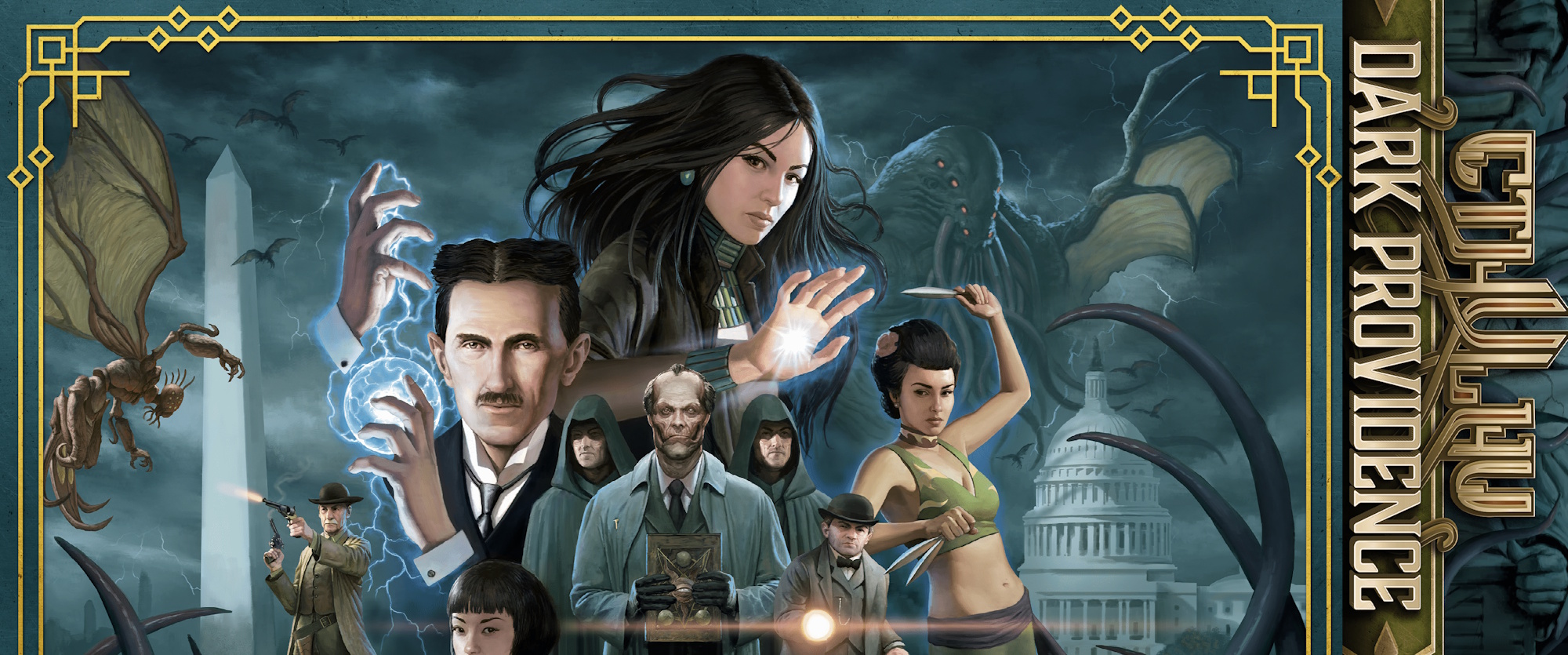
Cthulhu: Dark Providence, co-designed by Wallace and Travis R. Chance, is a remake of Study’s first edition. It’s a very good game. An excellent game. As a design artifact, it improves upon Study in fascinating and crucial ways. I’d be happy to introduce it to anyone who wants a glimpse into what board games can accomplish.

And yet, I can’t help but miss the original. There’s some rosy nostalgia at play. Of course there is. But I’m also longing for that original game’s fangs. And no, I’m not talking about how this edition swaps out the vampires for red-eyed knockoffs.
"I apologize if my bell summoned you."

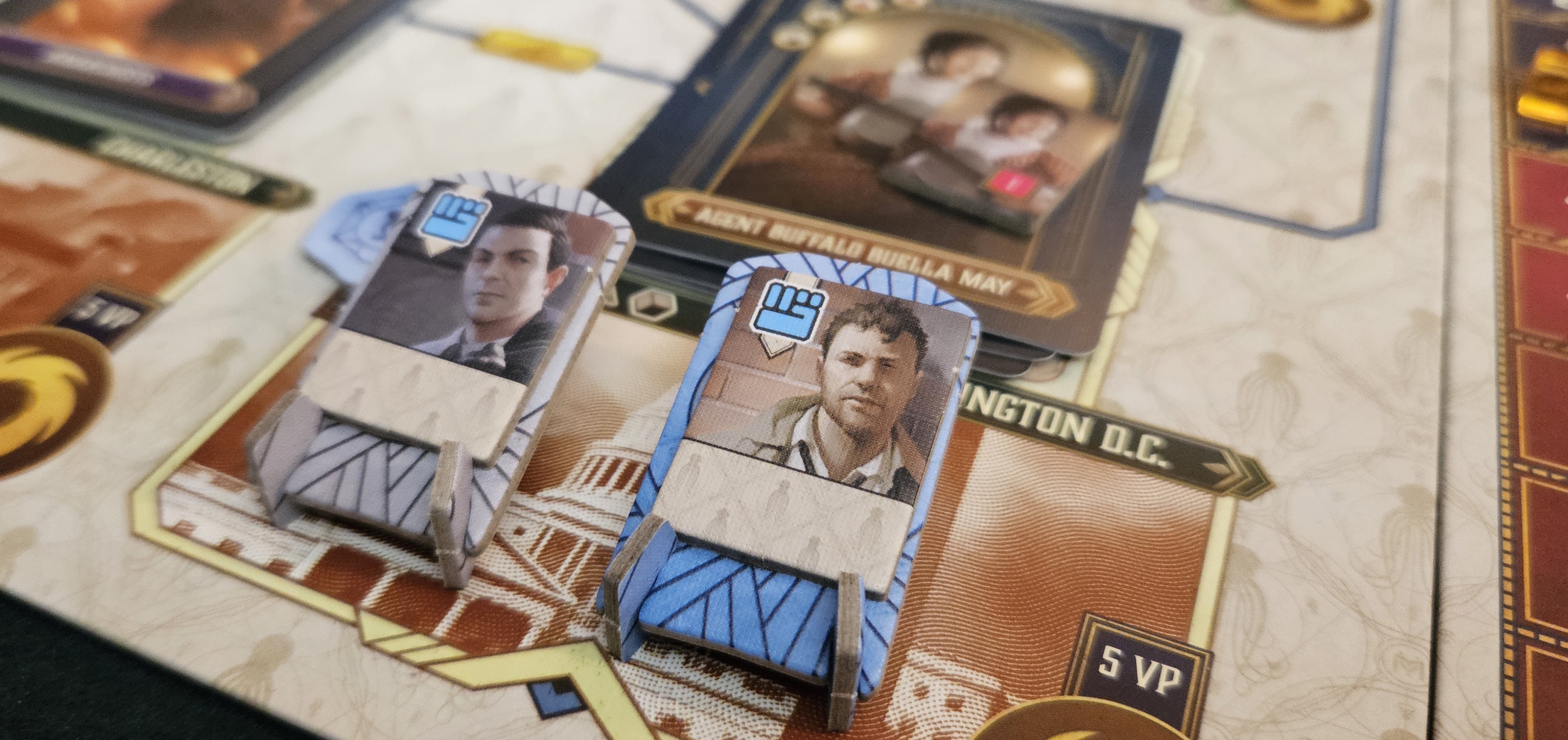
Greg from Succession and some alcoholic detective vie for the affections of a woman.

Let’s begin with the basics. Cthulhu: Dark Providence is set across the eastern portion of the United States during the Great Depression. People are hungry. Jobs are scarce. Ancient monsters rule the country. Literal monsters, not the nativist politicians who historically used people’s poverty and fear to drum up power. And those monsters are doing their best to pry open portals to otherworldly dimensions.

There’s a certain madness to American politics, always has been, so the idea that overly-tentacled beings that are simultaneously phallic and yonic would prey upon that unique American desperation to bring about an emerald-hued apocalypse is, if not exactly realistic, not the most far-fetched piece of horror fiction out there. This segmented reality informs the design itself. Put another way, Cthulhu: Dark Providence is hard to sum up. It’s a deck-builder. It’s an auction. It’s a social deduction game. It’s about revolution. It’s about trying to go insane on purpose. It’s about concealing yourself from the world. It’s about becoming your fullest self.

In gameplay terms, it’s about taking two actions per turn and clawing desperately at any sense of progress. When Dark Providence opens, everybody receives a role. Broadly speaking, there are two sides: the investigators, who hope to shut the monsters out of our world, and the cultists, who labor to bring humanity into their sticky embrace. These roles are hidden, but not quite as social-deduction-y as newcomers might expect. Concealment is a useful tool, but not a crucial one. There’s a good chance that everybody at the table will understand the broad strokes of everyone else’s objectives within the first half-hour. Still, that uncertainty is helpful. It staves off direct action. If nobody knows which side you support in the “Should we welcome the ancient god who promises to have us sprout penises from our eye sockets?” debate, nobody is likely to have you assassinated.

Much of the time, this produces a multi-act structure. In the game’s early stages, everybody’s motions are tentative, exploratory. Your agent — the avatar of yourself — travels from city to city, spreading influence and gradually picking up cards. Maybe you expand your network of agents. Maybe you tuck St. Louis into your back pocket. Maybe you join the Freemasons or conduct experiments with electricity or come into possession of a book with strange runes stamped into the leather binding. These are added to your deck, albeit slowly.

From there, little vignettes begin to form. Sometimes these are explicit, drawn via the game’s abundant actions. Somebody closes a portal for good, signaling their intention to rid the world of outside influence. Someone else starts appointing fish-people to local school boards, tipping their hand that they listen to dodgy podcasts. At other times, the developments are more subtle, such as when somebody’s network of spies and anarchists includes labor reformers and undead magicians. Other times, the changes are structural, the fabric of our reality coming unstitched as the cult moves up a shared track that will award points to everybody on their team.
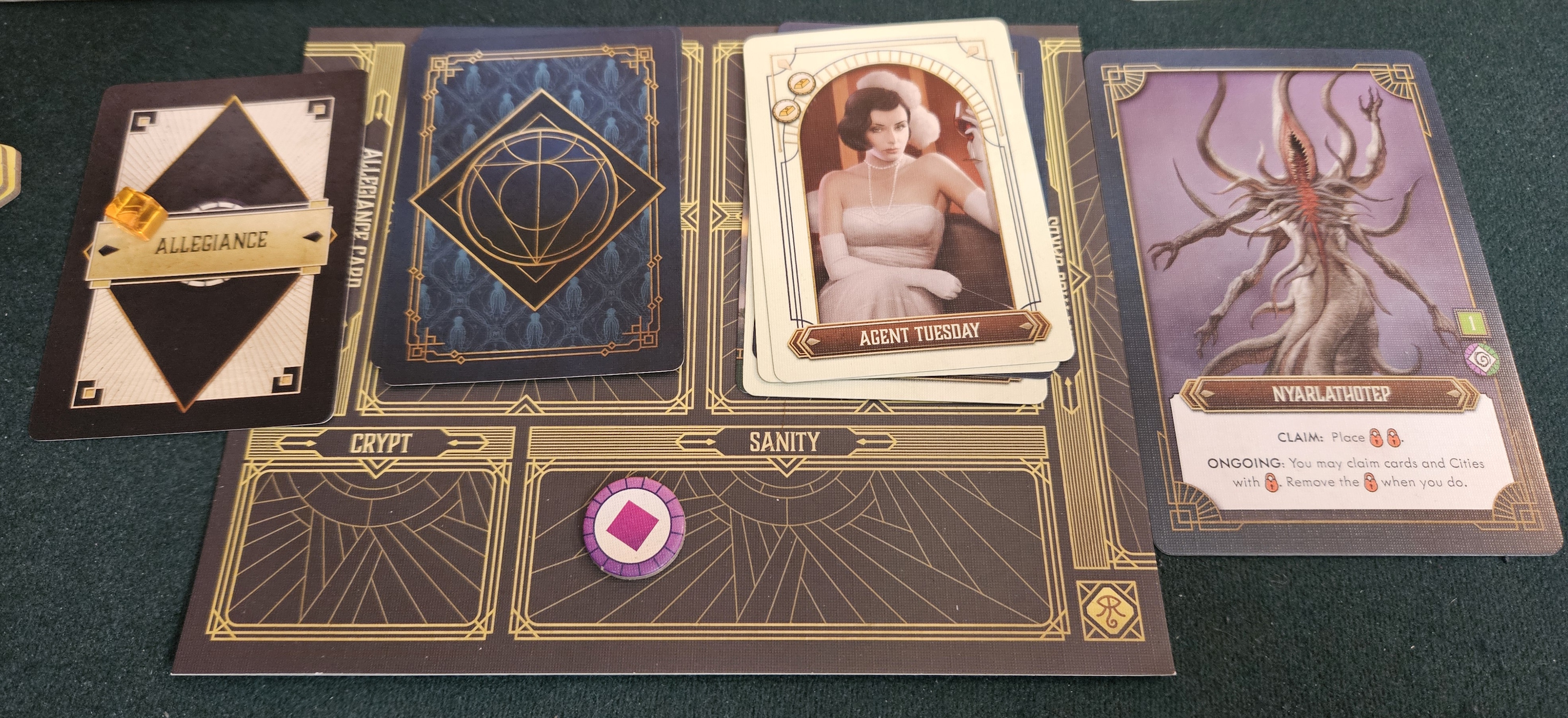
We've come a long way from The Man Who Was Thursday, Agent Tuesday. Two days, to be precise.

“Agent CHOOSE-Day, I presume?”

Team. That’s a funny word in Dark Providence. You’re on a team, always, but also not on a team. I mentioned investigators and cultists. It’s true that there are people who share your worldview and objectives, but this is an individualist’s paradise. Only one player will win in the end. That said, nobody can fully ignore the demands of their faction. Mechanically, the concept is simple enough. When the final tally is reached, the lowest-scoring player forces everybody on their team to lose, no matter how high their score. So while you’re always racing against your comrades, you’re also working to ensure they’re better-off than the peons of the opposing team. As in the original game, it’s deviously clever, forcing players to constantly evaluate their social standing in the absence of clear data.

But this rubric is even more tangled than it first seems. There are also dissidents out there, one of the game’s few additions to the original Study’s formula. Dissidents still occupy a team — they’re dissident investigators or dissident cultists, not true independents, sort of like how libertarians are conservatives who like to look at themselves in the mirror — but their scoring is slightly orthogonal to their faction. The main takeaway is that they lose or win on their own, ignoring the usual rah-rah teamwork portion of the game, but are also uniquely vulnerable to exposure.

These complicating factors make Dark Providence a bear to teach and an even grizzlier bear to learn. In that respect, it’s much like the original. Not that Dark Providence hasn’t undergone development. A few nips and tucks make it simpler, on the whole. For example, both games feature quite the cast of potential recruits, but where A Study in Emerald also included an entire pile of duplicates to fuel a double-cross system that was dramatic but also sometimes frustrating to trigger properly, Dark Providence just ditches the whole idea. Once you own an agent, they’re on your side. That is, unless somebody drafts the right card to switch an agent’s allegiance, but that’s a visible threat rather than the lingering face-down tokens of the original game.

On the whole, then, Dark Providence is more akin to a second edition than the actual second edition of A Study in Emerald ever was. Its cardplay is intact, with that trademark Wallace gumminess where cards stick around rather than cycling easily in and out of hand. Its social questions are intact, and indeed are even denser than before, requiring teamwork and competition and backstabbing all at once. The networks of agents and ruffians are back.

Even the original game’s surprising detours with zombies and vampires return, albeit with a fresh coat of paint. Still, the effect is the same. While you’re playing one game, merrily conquering cities and scrounging for points, suddenly the proceedings take on a dark turn as fish-folk begin conquering New York City or your best agents transform into red-eyed phantoms. Just as the original Study was playful and unexpected, so too is Dark Providence. You’re never sure how a session will shape up.
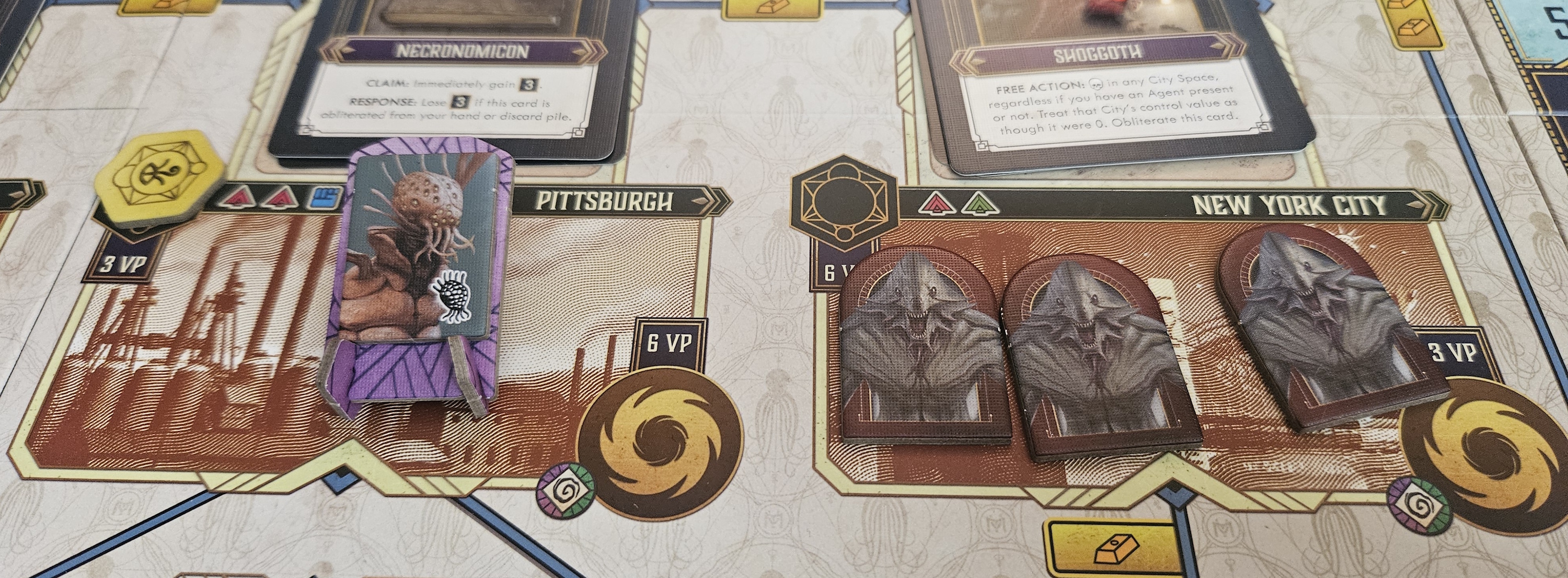
It's the BYU–Utah Holy War.

Their team rivalries are intense.

On its own, these strengths mark Dark Providence as a worthwhile successor to A Study in Emerald, especially given that game’s long absence from print, not to mention the, ah, squickier aspects of its provenance. While Neil Gaiman’s short story was an excellent companion piece to the original game, I doubt anyone is going to miss his name on the cover.

This isn’t to say it’s an entirely perfect production. The standees for holding the agent tokens are duller in color than they should have been, flimsy enough that I had to glue them together, and while their canted angle might be nice for a solitaire game, they’re hard to visualize from any direction but head-on.

As for the more structural changes to the factions… time will tell. The short version is that I’m eager to keep exploring what Dark Providence has to offer. Dissidents may well improve the game’s deduction, encouraging players to unmask one another more often. I have my doubts, as the penalty for being revealed as a dissident feels like a slap on the wrist, but with experienced players Study often featured rather slender scoring margins. Maybe it will prove enough of an incentive to shake up the original game’s dynamics. Either way, this is a (mostly) handsome and (largely) faithful recreation of the original.

Where it steps amiss for me — and maybe only for me, such is the pocket nature of this complaint — is in the game’s handling of its subject matter. A Study in Emerald arose from Wallace’s interest in anti-monarchical bomb-throwers, the anarchists and revolutionaries who took it upon themselves to punctuate the divine right of kings with sticks of dynamite. Smartly for the 2010s, Wallace reasoned that a game about blowing up the continent’s royalty might be considered in poor taste, hence the veneer of emerald paint. The game’s heroes weren’t trying to blow up Queen Victoria; their target was Gloriana, a god from beyond the stars. The pontiff of Rome was not the Pope, but Rhogog. Cairo had no shah, but rather, duh, the resurrected pharaoh Nyarlathotep.

Despite this veneer, A Study in Emerald played like a who’s who of 19th- to 20th-century social theory. One minute you’d recruit Emma Goldman and Élisée Reclus; the next you might watch as Leon Czolgosz assassinated an eldritch spider rather than President William McKinley; eventually, Peter Rachkovsky would lead the Okhrana in a crackdown against a revolutionary cell headed by Prince Kropotkin. That these historical figures rubbed shoulders with Sherlock Holmes and Professor Moriarty only deepened the sense of place, giving the game the hue of allegory.
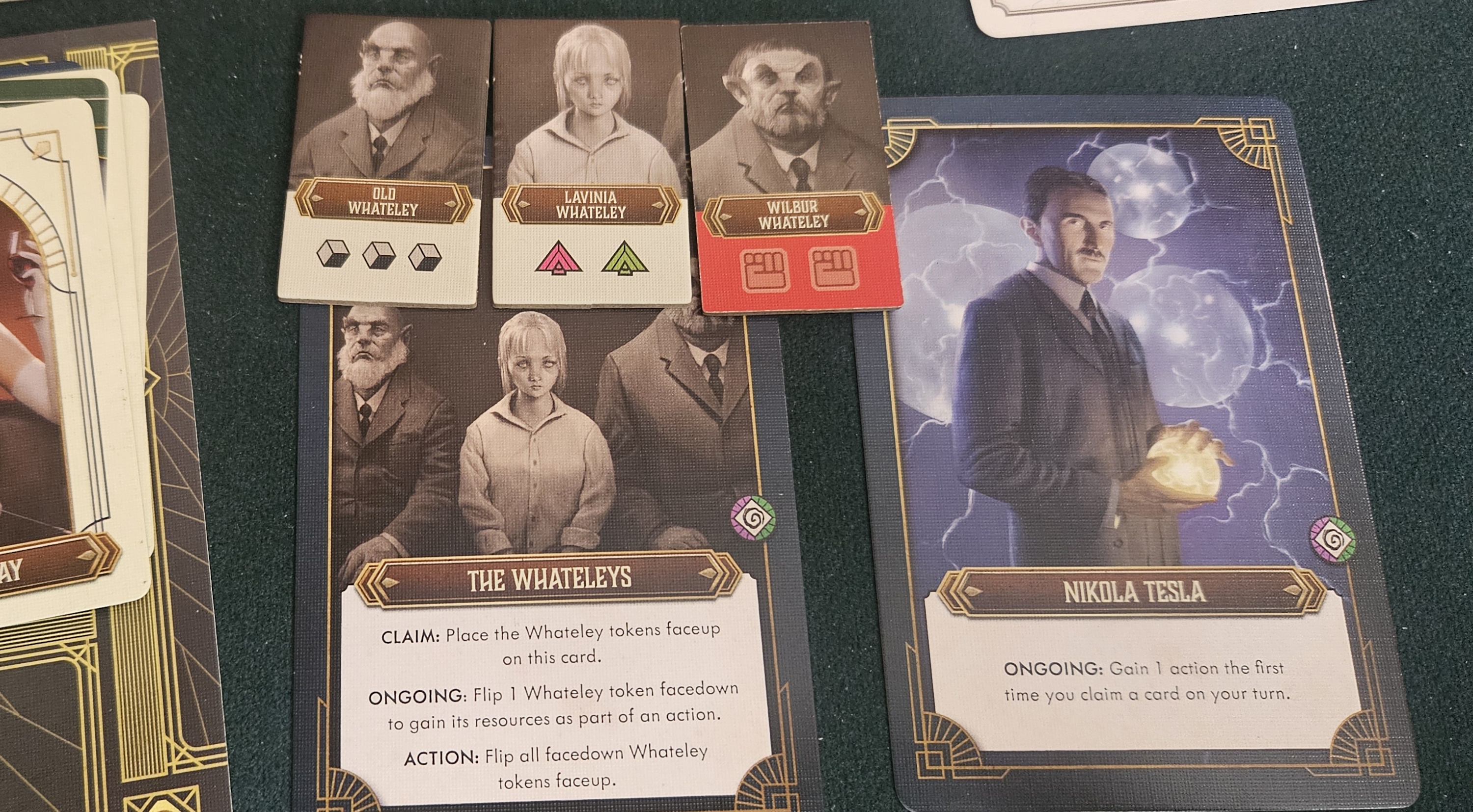
Not sure this is historical Tesla, though.

Historical figures rub shoulders with fictional characters.

By contrast, the Great Depression of Dark Providence is thinly drawn. What few historical touchstones it levies are mostly limited to gangsters (Arnold Rothstein, a misspelled Stephanie St. Clair), lawmen (J. Edgar Hoover, Eliot Ness, Wyatt Earp), or entertainers (Harry Houdini and Lillian La France, also misspelled), among a few scattered others. Unlike the historical figures of A Study in Emerald, which were united by the dueling social movements of the time, Dark Providence instead leans into the tropes that often accompany Lovecraftian fiction.

There are references, but most of them are confined to the Cthulhu Mythos. Every slouching shoggoth and brain-stealing mi-go is present, of course, but so are figures like Herbert West, Henry Armitage, and the Whateleys. When it comes to the Great Depression in the United States, even as a fictionalized depiction the game is sanitized of, well, everything. There are no labor movements. There are no suffrage movements. There are no Italian immigrants becoming enthusiastic Galleanisti. There is no Harlem Renaissance. There are no veterans’ organizations massing into the Bonus Army. There are no businessmen flirting with fascism by forming the Business Plot. Even the Prohibition stuff is thinly drawn, absent the original game’s clever inversions, putting figures like Eliot Ness on the side of resistance. (Yeah. Sure.)

The effect is to withdraw Dark Providence from the realm of historical fiction and slip it into the same category as most Lovecraftian board games, where figures like Nikola Tesla might wander into the frame, but not with any sense for their lived perspectives or accomplishments. It would feel right at home alongside any number of Fantasy Flight’s Arkham Horror titles or their many derivatives, full of tommy guns and long overcoats and men whose cigarettes dangle precipitously from their lips, but also sharing those same titles’ disinterest in what those characters or symbols stood for. It’s like setting Shakespeare in 1920s gangland Chicago. Fine for community theater, but disappointing as a sequel to a historical drama.

Again, it’s fine. No, really. Dark Providence is still a heck of a game. It’s just that, sans any broader context, the entire thing feels less grounded than its granddaddy. The irony is that, given how the hobby has advanced in the intervening thirteen years, it would be possible to design a game about anarchism without the veil of allegory Wallace draped over A Study in Emerald. Dark Providence flees the other direction, dulling its teeth for the sake of… I couldn’t tell you. To make the game less political, maybe. To lean into the Lovecraft thing. Unfortunately, the main side effect is that the setting feels generic.
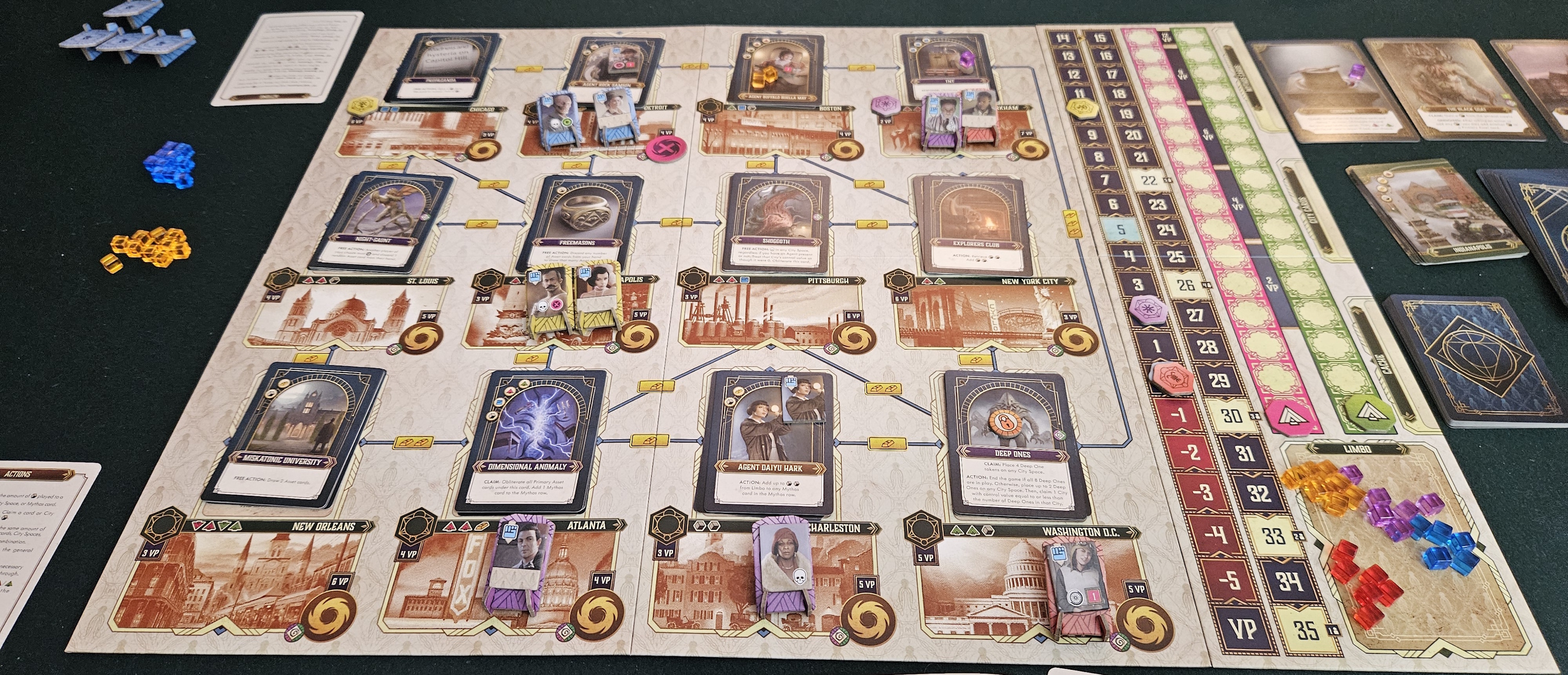
Here's another pain point: Why are the cities connected on the card market rather than the city spaces? This is always confusing during play.

At times, it’s a sprawling game.

To be clear, however, even a blunted version of A Study in Emerald is sharper than any number of other Lovecraftian outings, and Cthulhu: Dark Providence is a formidable remake. It’s cleaner around the edges while still retaining the original game’s weirdness. In some ways I even consider it the better-rounded experience, especially where the deduction is concerned. The result is many things: a game out of time, a color out of space, an experience that still has yet to be emulated as widely as it deserves.


(If what I’m doing at Space-Biff! is valuable to you in some way, please consider dropping by my Patreon campaign or Ko-fi. Right now, supporters can read about which films I watched in 2025, including some brief thoughts on each. That’s 44 movies! That’s a lot, unless you see, like, 45 or more movies in a year!)

D’ough

18. März 2026 um 20:12

Cyrano?

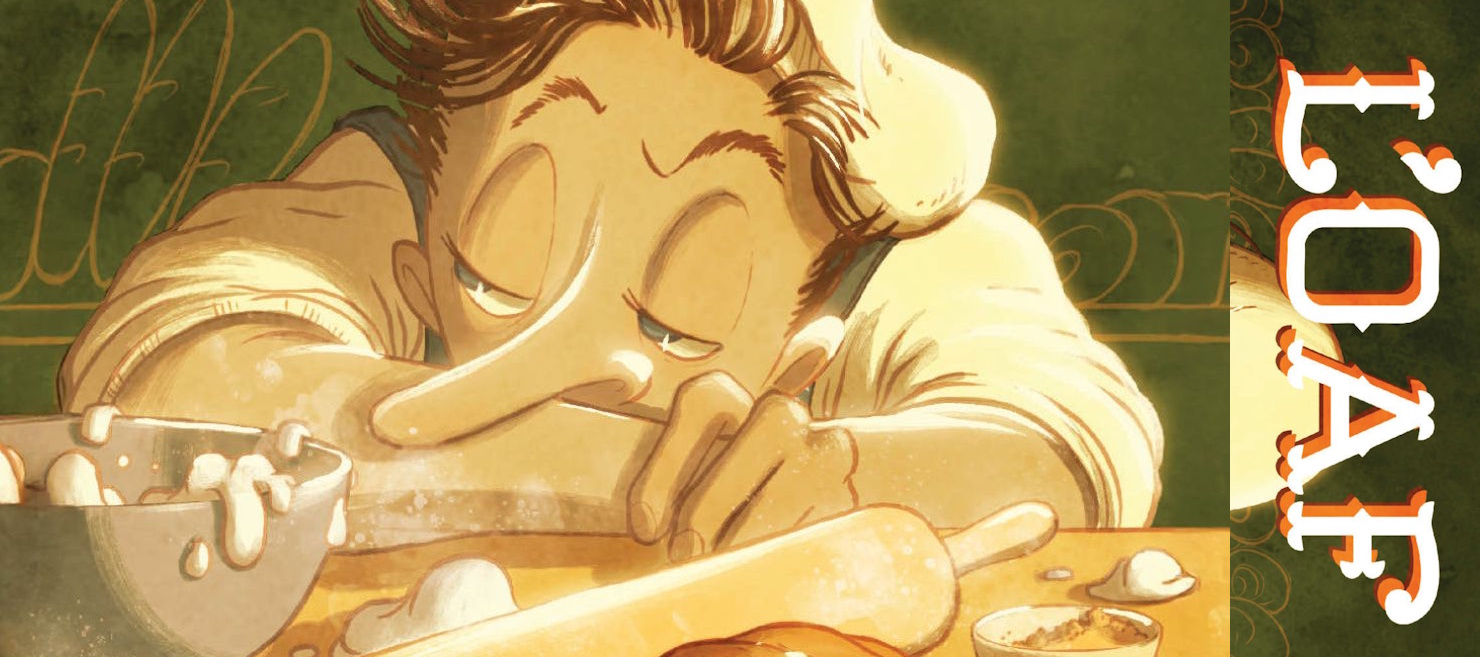
L’oaf is that rarest of gifts: a board game that makes me laugh, and not because it includes any actual jokes. Designed by Bart de Jong, it opens with perhaps the most relatable conceit ever put to cardboard, a dead-end job players are working in order to make ends meet, but one they’re not overly interested in completing beyond the bare minimum. Not quite by accident, it’s about many things — the false enthusiasm of managers, the vast gulf between owners and employees, the oppression of tedium. As if by magic, none of those headier topics break the spell.

Little games are the tops.

Pretty much everything.

In the case of L’oaf, this particular dead-end job is a bakery. Tasked with baking a neighborhood’s daily bread, every round begins with an order. Four loaves per player. Six loaves per player. Eight loaves?! What is this? Are we getting paid any extra for baking twice as many loaves as two days ago? No? Then where is the incentive to knead all this dough? I’m about two loaves away from developing a repetitive strain injury!

The incentive, of course, is the damoclean threat of losing one’s income. If you’re American, add your health insurance to the noxious batter. Either way, it’s all stick, no carrot.

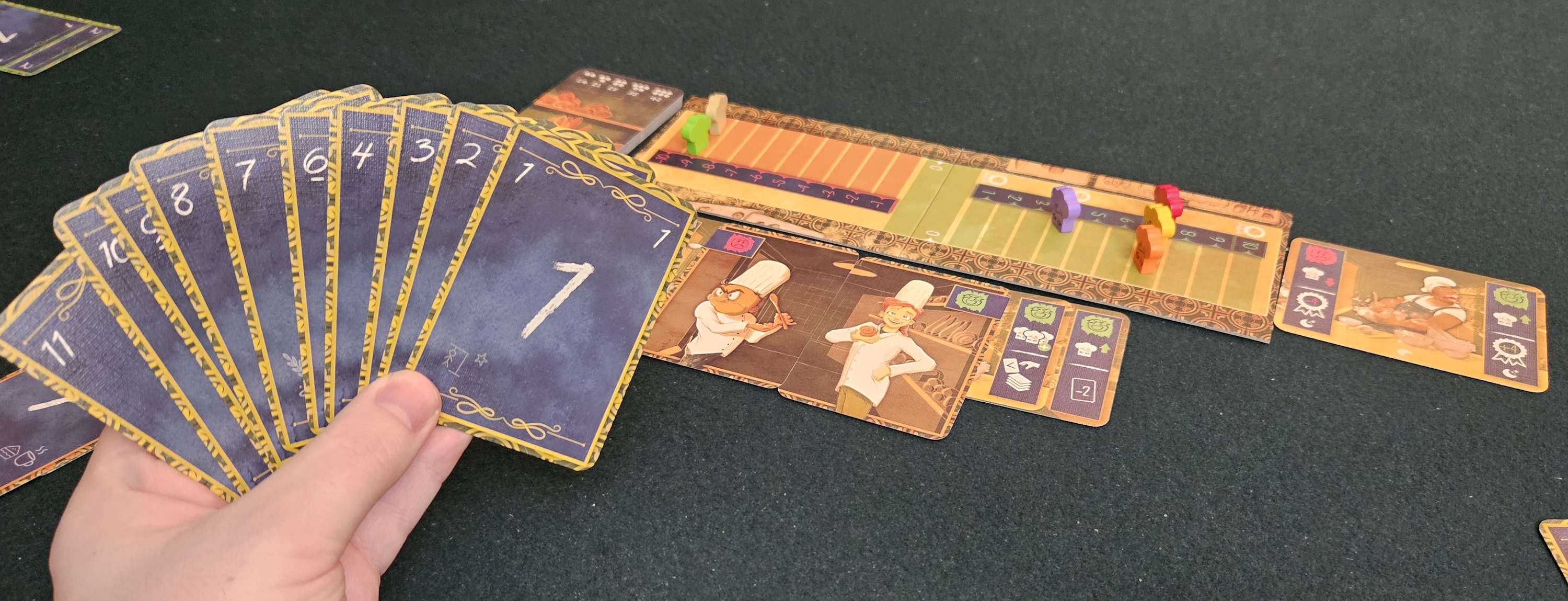
To wit, every round becomes a fraught proposition. You need to bake those loaves. But you also don’t want to put in too much effort to a job that doesn’t award any commensurate value. Everybody at the table holds an identical deck of numbered cards, ranging from zero to eleven, from which they deploy a single digit. This is how much effort they’re putting in for the day. Those cards are flipped and tallied.

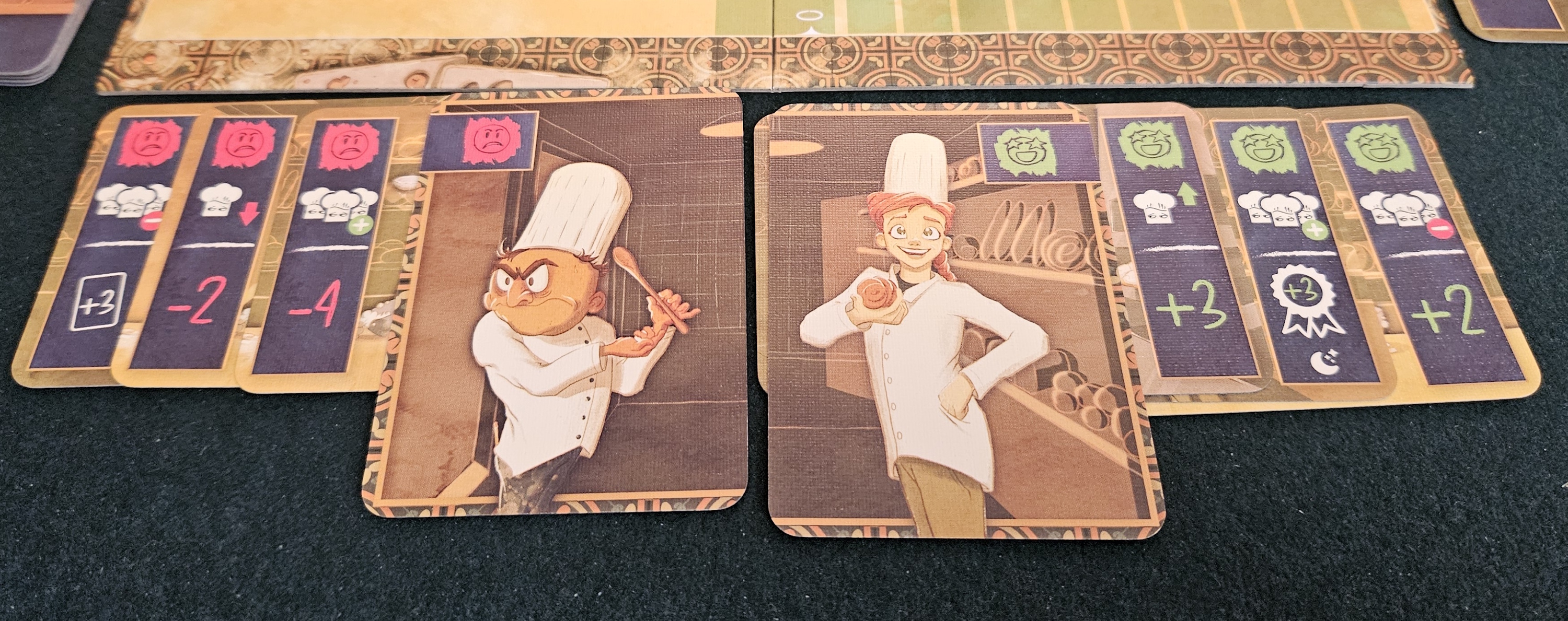
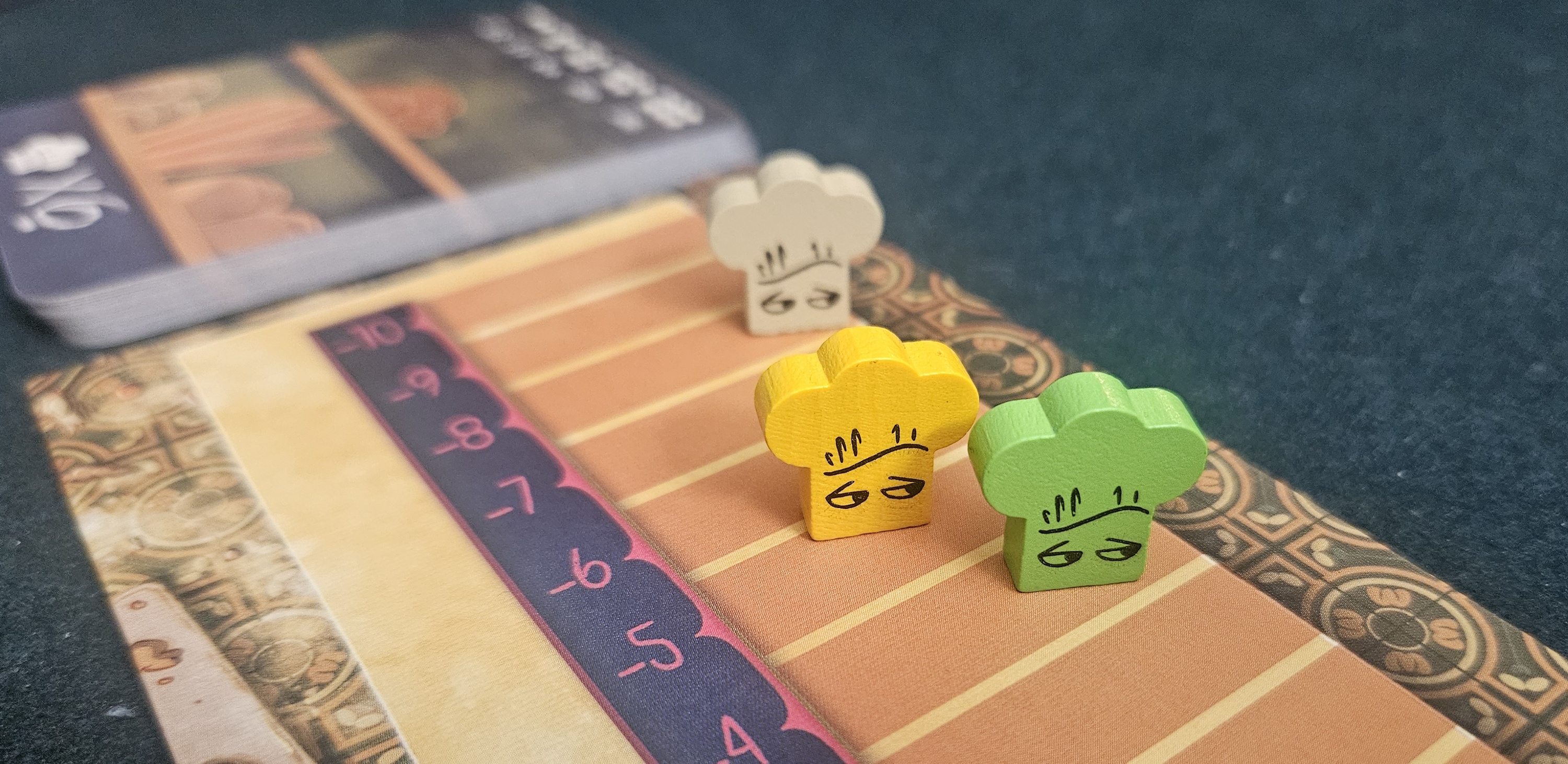
But this is where de Jong shows his cleverness. If your bakers managed the order, great. The highest contributor ticks up on the reputation track, earning a pat on the head for all their extra effort. If not, somebody is going to take the fall… but only the worst slacker. There’s plenty of wiggle room in the middle.

This is important, because while you earn a few points for moving up on the reputation track, most of your final score comes from the cards you never played. The cards ranked ten and eleven? Crucial components in any slacker’s toolkit.

Actually, the boss is undercover. Raccacoonie is under one of those hats.

I wish these bosses would go undercover.

There are a few wrinkles that prevent players from racing to the bottom.

First, that daily order comes paired with an outcome. Depending on the day — and whether you’re playing with the advanced cards, which I heartily recommend everybody shuffle into the mix right away rather than neutering the game’s range of possibilities — there might be a benefit to putting in that effort. Say, the baker with the highest reputation gets to swap out a card from their hand with one they’ve played before. Or maybe everyone on the negative side of things can improve their standing in the boss’s eyes. That sort of thing.

Second, your boss is tracking all those successes and failures. L’oaf only ends once you’ve tallied five outcomes in the same category. Which is to say, you aren’t quite sure when the game will conclude. More importantly, depending on whether your bakery has a run of good or bad days, the scoring criteria are slightly modified. If the bakery fulfills more orders than it misses, everybody scores the cards in their hands. But if not, everyone with a reputation in the red is fired. No scoring for you.

This transforms L’oaf into quite the mind game. Sure, you want to slack off. But you also need to keep this job. But that means putting in effort tactically, not all the time. But that risks losing face with management if everybody else puts in more effort than you. But if everybody is putting in more effort, that means you probably won’t get fired anyway, so you might as well preserve your strength. But if somebody notices you slacking, they might slack, too.

It’s quite the pickle. In gameplay terms, L’oaf develops a certain tidal motion, players adjusting and compensating for one another, putting in more effort, then pulling back, then failing, then succeeding, and back again. It isn’t uncommon for the game to go the full distance, your boss’s angry-meter and pleased-meter both on the verge of maxing out. Which is to say, it’s surprisingly tight. At least I was surprised. A game about slacking off? Psh. I would never. Until, within a single twenty-minute play, it becomes apparent just how fine-tuned the whole experience is.

Somehow we all got fired. Didn't see that coming.

Check out these utter kings and queens.

And how familiar, too. L’oaf doesn’t only work because it’s tuned to such a precise degree. Nor does it work only because it produces such cautious predictions about how far you can strain your relationships before they snap. No, it works because it captures the long afternoons of a summer job. You know the one. The one you got up early for, the one that took out more than it gave back. Unless you’re one of those aliens who puts maximum effort into everything. In which case, by all means, return to that diet of point salads. Enjoy your fiber. You can poop a car.

For the rest of us, L’oaf is a lovely little thing. Tense, smart, relatable. Funny, too. More than once, the entire table has burst out into laughter when somebody slacked at exactly the wrong moment, their reputation dropping precipitously. Or burst into a smarmy cackle as they barely fulfilled an order and still came away rosy in the boss’s eyes. This is the good stuff. I hope Bart de Jong was sometimes late in getting a revision back to his publisher.


A complimentary copy of L’oaf was provided by the designer.

(If what I’m doing at Space-Biff! is valuable to you in some way, please consider dropping by my Patreon campaign or Ko-fi. Right now, supporters can read about which films I watched in 2025, including some brief thoughts on each. That’s 44 movies! That’s a lot, unless you see, like, 45 or more movies in a year!)
Space-Cast! #54. Shazain!

17. März 2026 um 19:44

Wee Aquinas has seen a flag before, but a chill comes over him when he considers what it might represent here.

Governance and Liberty — in translation, those are the titles of Shasn and Azadi, Zain Memon’s peculiar but timely board games about politics. Today, we’re joined by Memon himself to discuss both titles, plus the function of play as our most ancient form of education, the value of cynicism and evil in games, and what else the auteur has been working on lately.

Listen here or download here. Timestamps can be found after the jump.

TIMESTAMPS

00:50 — introducing Zain Memon, his work in film, and his transition to board games
13:30 — the “party game” of Shasn
21:45 — is there value in portraying cynicism or evil in games?
26:38 — games, one of our most ancient forms of education
31:22 — moving from Shasn to Azadi
42:49 — Macaraccoon
47:30 — representing resistance and revolution in Azadi
52:13 — Zain’s many forthcoming projects


(If what I’m doing at Space-Biff! is valuable to you in some way, please consider dropping by my Patreon campaign or Ko-fi. Right now, supporters can read about which films I watched in 2025, including some brief thoughts on each. That’s 44 movies! That’s a lot, unless you see, like, 45 or more movies in a year!)
💾

“Cozy” Is a Four-Letter Word

16. März 2026 um 23:45

"Cozy Lebensraum," the grumpy voice inside me shouts, like nobody's favorite hang.

I’m deeply suspicious of “cozy.” For much the same reason I’m suspicious of “nostalgia,” come to think of it. In the mouth of business executives, “cozy” becomes something we already own, or at least already have within our grasp, now repackaged and sold back to us as a subscription service. A monthly box of curated snacks. Ten ideas for cozymaxxing your nostalgia shelf. And that’s before we even consider the way institutions and politicians propose that coziness and nostalgia are the way things “used to be,” before someone came along to take away our picnics and crime-absent streets. What if we could go back to the Way It Was? What if all it took was getting rid of a few undesirables?

In other words, I am way too cranky to be Cozy Stickerville’s target audience. “More like Cozy Fascistville,” I probably frumped to myself. Then I learned it was designed by Corey Konieczka. Then I figured it might be a nice thing to play with my twelve- and six-year-old daughters. Then, as the undertow of commercialism swept my legs out from under me, it appeared in my shopping cart, one click away from arriving at my doorstep within three to five business days.

Then, those three to five business days later, it was winning me over.

We never found it.

Looking for a hidden object.

Cozy Stickerville strikes me as a very Corey Konieczka design. Aesthetically, it bears so little in common with The Mandalorian, Star Wars: Rebellion, and Runewars as to make such a statement nonsensical. But I’m not talking about visuals. I’m talking about the maximalism of the thing. The maximalism contrasted with the sheer action economy.

I’ll explain.

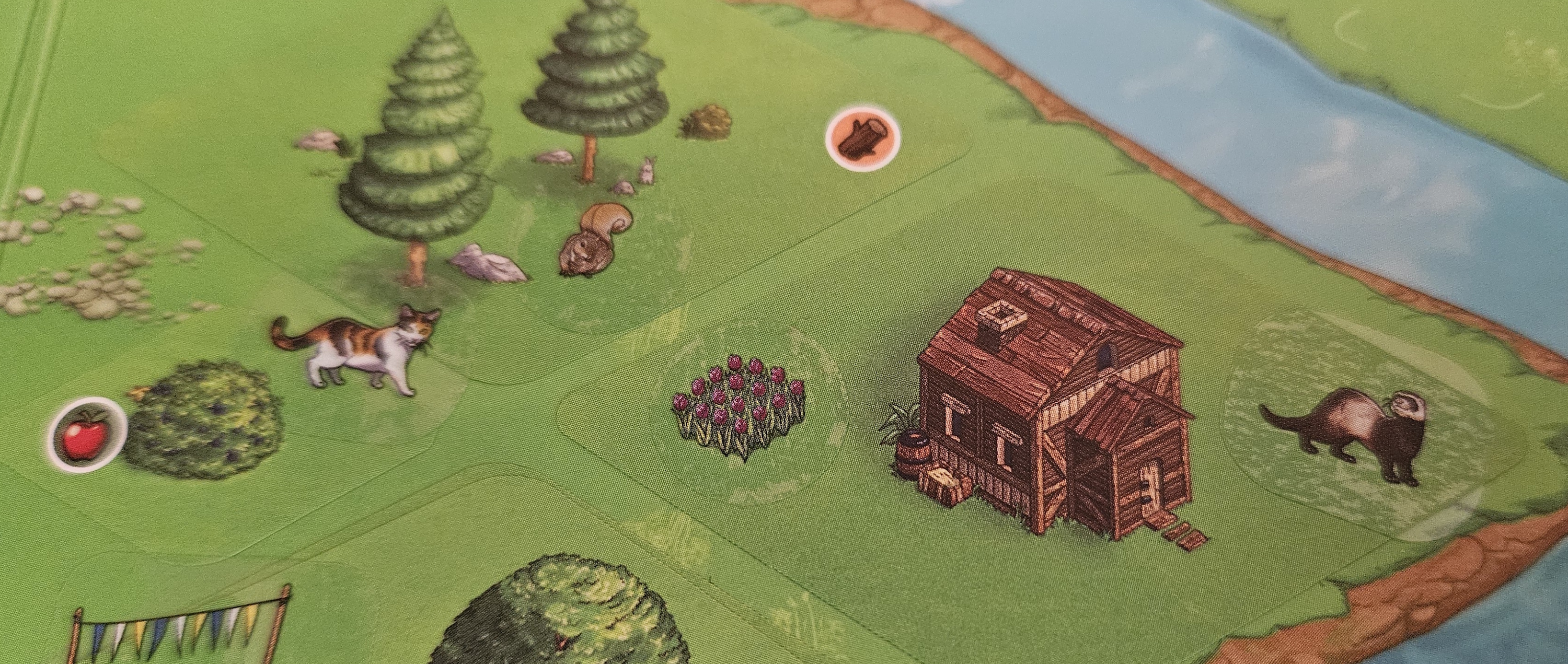
Cozy Stickerville opens on a cozy not-yet-village. Gifted a tract of land by a distant and condescending father — hoo boy, does this game have daddy issues — you immediately take it upon yourself to transform this tract of riverland into a home. Or, in game terms, to affix eight stickers onto a grid, creating a pastoral scene right out of a Western. (Back when there was room for everybody, the cranky part of my brain intones. I tell it to shush. My kids are right there, man.)

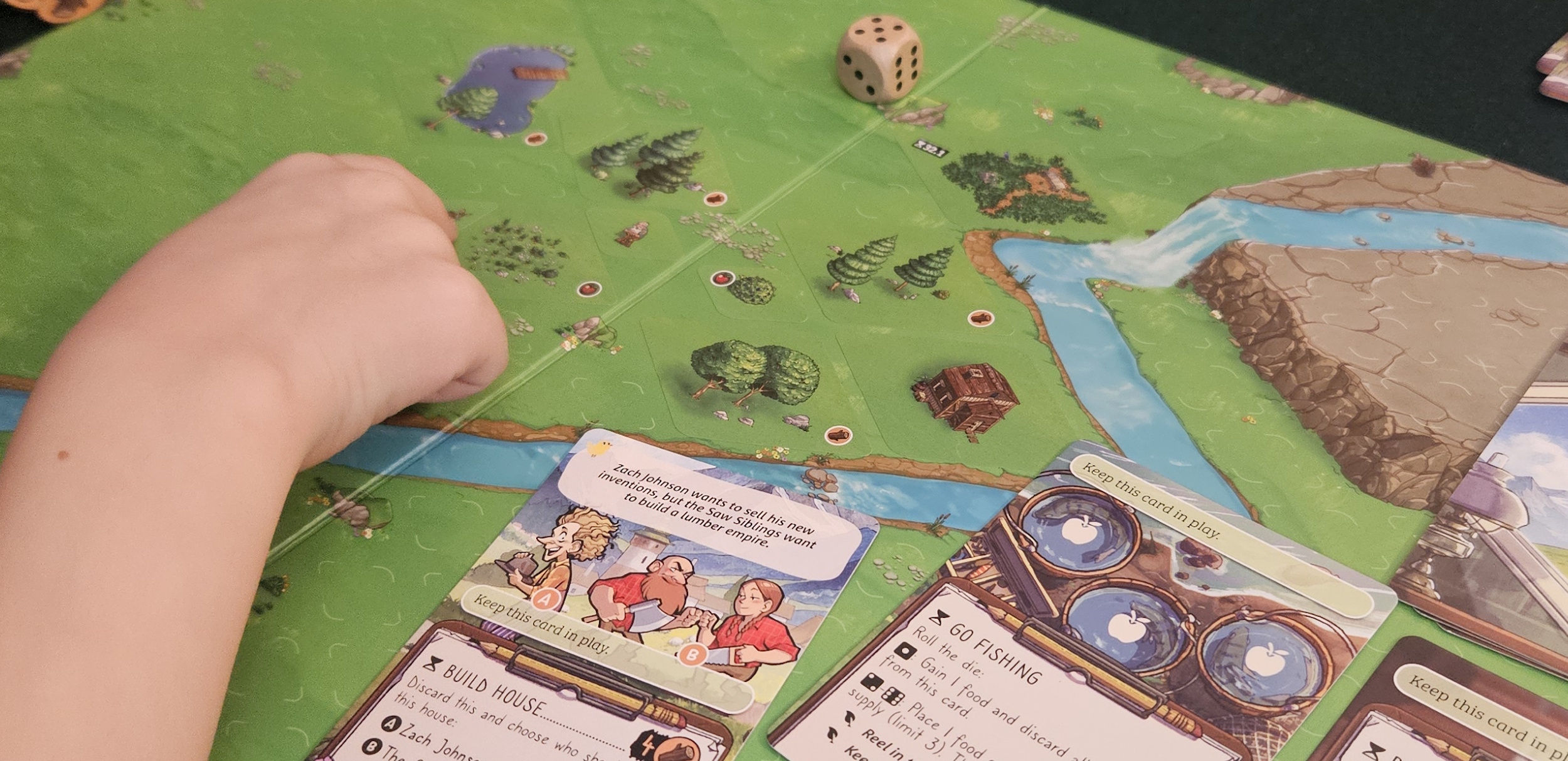
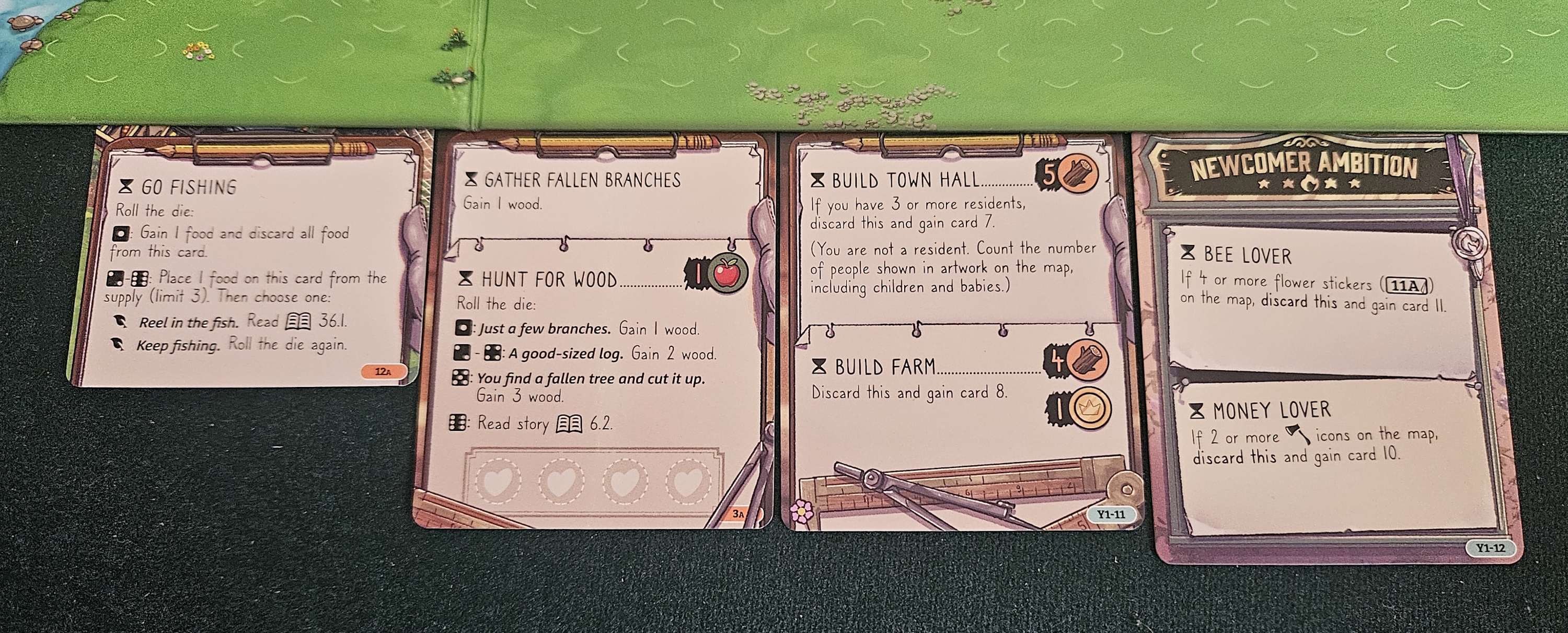
From there, Cozy Stickerville slips into a comfortable routine. A cozy routine, one might say. Every turn consists of the metronome rhythm of resolving an event card and then resolving an action. These resolutions are steadfast in their simplicity. Events generally present a decision. Build this or build that. Answer A or answer B. Fulfill a need right now or put it off till later. The actions are more diverse primarily in their range. Some appear on the stickers as entries in a little storybook. Others appear on cards. Most of the time, they also present straightforward options. Gather wood from the ground or spend food to possibly gather some extra. Build a house for an eccentric inventor or build a house for some woodcutters. Plant flowers or pave a road.

Despite this simplicity, the actions very quickly display a wonderful range of possibilities. It isn’t only that stickers will be added, first to the board and then atop other stickers. It’s that their addition unfurls new adventures. Sometimes Cozy Stickerville turns into a hidden object search. Other times, it becomes a resource optimization game. There are branching paths to a spelunked cave, uncovered over many in-game weeks. An observatory on the hill becomes a chance to peek at celestial objects; a post office transforms into a test of how well we’ve come to know our neighbors.

That’s what I mean when I say it feels like a Konieczka design. It has that economy of action but maximalism of discovery that have always been the hallmarks of his design. It feels large inside, certainly larger than I expected of a game about putting stickers on a grid.

As loathe as I am at the tendency to turn everything into a property... I wouldn't mind a sequel or two.

Potential actions are easily tracked.

Even the format feels generous.

Over the course of ten sessions, each no longer than half an hour, your village takes shape. Some of that shape is more or less what you would predict from a game called “Cozy Stickerville.” In our town — Happy Riverside Valley, if you care to know the name my girls came up with — we opened a bird-watching tower and animal refuge, a pet shop and a newspaper. We ran for office. We flirted with capitalism, but in a way that wasn’t too destructive. Only two copses of trees were felled, and only one lump of trash came to occupy the area. We dumped it right next to the big golden statue we had erected of ourself, a statement on how it didn’t resemble the way we imagined our unseen avatar.

But at points, Konieczka presents challenges and setbacks. Cozy challenges, to be sure, cozy setbacks. But challenges and setbacks all the same. When we borrowed money from a shady lender, the interest kept coming due at exactly the wrong moment. When we encouraged one character to date another, we were reminded, gently, cozily, that we could instead pursue the romance for ourselves. “Ew!” my girls moaned. When we failed to build a fire station… well, that was the one moment that maybe struck a little too close to my six-year-old’s heart. In real time, we invented the myth of the Farm Upstate, where all ferrets go to live after their house burns down.

These aren’t spoilers, as such. Not really. Mostly, they’re emergent properties, the result of one sticker placed atop another. Or else they’re the common-sense outcome of taking shady loans, engaging in pranks rather than doing your yard chores, or chopping down all of a valley’s trees. Cozy Stickerville sticks to obvious morals, but at least it sticks to them. Is it a spoiler to say that things turn out all right in the end? That you will be vindicated of your father’s disdain? That you will place more stickers on this sticker-grid? The storytelling rarely deposits us in expected places. It’s the trails and switchbacks it travels that are the delight.

BOARD GAME ADDICT is not an option.

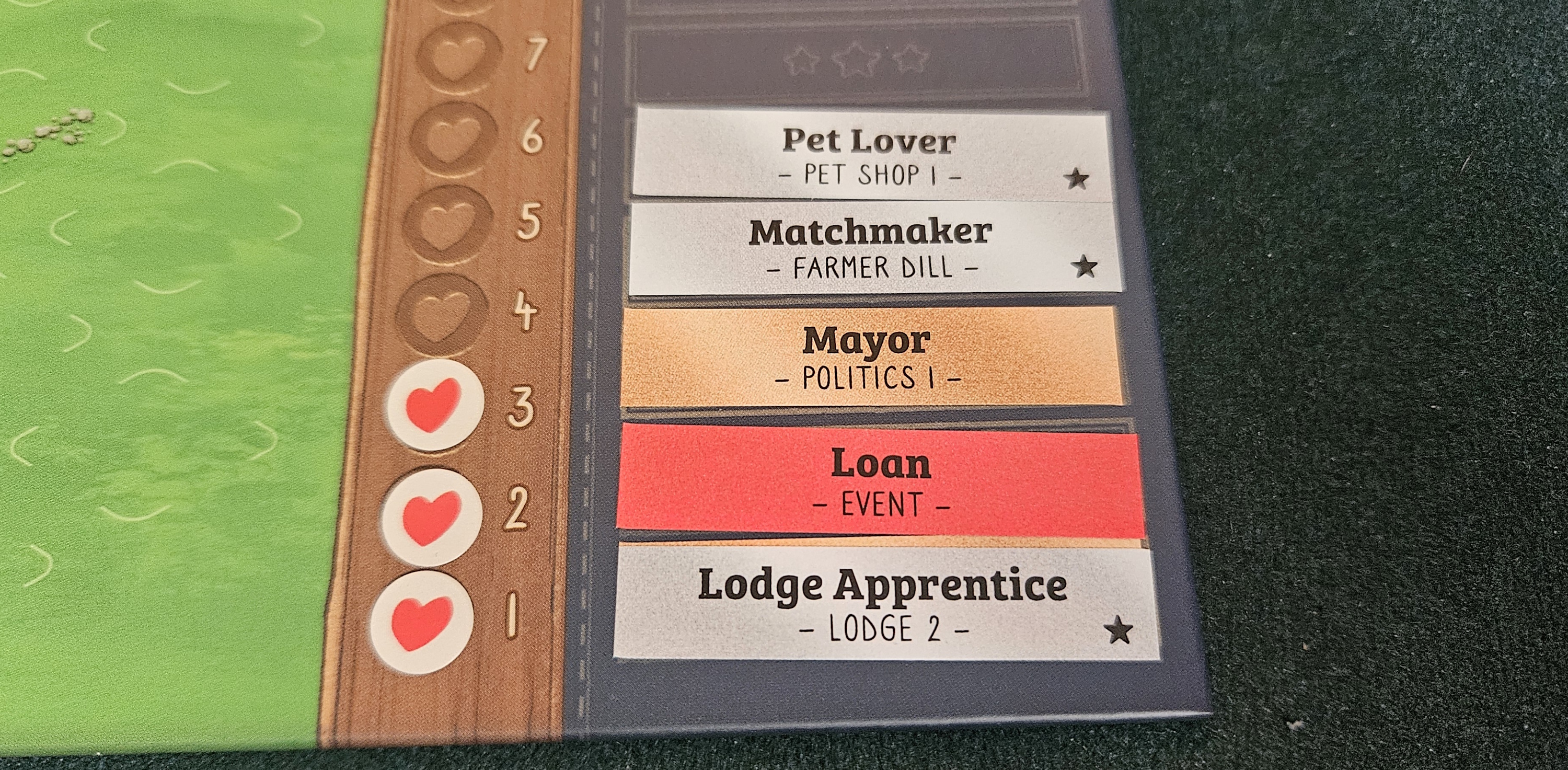
Some of the many milestones your village might unlock.

And then, when it’s done, the game permits a second outing. This one is more constrained than the first, flipping the board to its reverse side and using most of the remaining stickers. All those decision cards must be made in the other direction, building the inventor’s house rather than the cabin for the woodcutters, making dialogue choice B instead of choice A, pursuing the agenda you left by the wayside on your inaugural play.

For a legacy game, a format that is often rightly criticized for producing waste, Cozy Stickerville proves only marginally more wasteful than your average children’s stickerbook. I’m not going to pretend it has limitless miles in its soles. There’s no playing the game once it’s finished, unlike some legacies, and the hours contained within are relatively brief.

But those hours and precious ones. I rarely have any trouble getting my kiddos to play board games, but Cozy Stickerville swiftly became such a highlight of our evening routine that it eclipsed all other contenders. My children cooed over their pets, debated where to place every berry bush and flower patch, and quibbled over whether to establish a summer camp or a candy shop. They decoded secret texts with all the reverence of archaeologists and positioned inhabitants with an eye for the view from their bedroom windows. More than once, in between sessions, they discussed which story threads they would pick up next or asked me to open the box so they could study their town. Even before we had finished our first ten-year campaign, upon learning that we could only play the game twice, they asked if they could contribute some of their own money to buying a second copy. Now they insist we should frame the board, spaced halfway between their bedrooms so they can appreciate equal ownership over it.

On the one hand, this doesn’t exactly beat the accusations that Cozy Stickerville is commercialism in a box. But on the other…

Look. I know what our hobby is about for most people. We buy stuff and we sell stuff and hopefully in the middle we enjoy the memories and moments and messages these things create. There’s so much crass commercialism out there, all those boxes of miniatures with barely-developed rules, all the FOMO and churn and Cult of the New.

On the scale of worst offenders, Cozy Stickerville doesn’t even rate. It’s unapologetically cozy, but it also makes good on its word. This is coziness not as a symptom of a culture in decline, or not only that. This is coziness as a shared moment between families. This is coziness as something bespoke and human-crafted, as opposed to slopped from the mouth of the slop monster. This is the coziness of a six-year-old in my lap, eyes glittering as she debates whether to place her kitty near that berry bush or chasing the naughty goose in the lake.

For Konieczka's next effort, might I offer "Not Especially Cozy And In Fact Increasingly Funky Sticker Generation Ship"?

Stickers over stickers! What will they think of next?

I still don’t know whether we’ll buy a second copy. I hope not. Too much of a good thing can spoil its memory. But for those two campaigns, I’m grateful to have bought and played this thing. Because Cozy Stickerville is a reminder that “cozy” is a four-letter word — but so is “love.”


(If what I’m doing at Space-Biff! is valuable to you in some way, please consider dropping by my Patreon campaign or Ko-fi. Right now, supporters can read about which films I watched in 2025, including some brief thoughts on each. That’s 44 movies! That’s a lot, unless you see, like, 45 or more movies in a year!)
❌