Normale Ansicht

No (Okay, Some) Ragrets

07. August 2026 um 21:24

hope you're into tentacles

As a natural melancholic, the idea of being drawn to the sea — to drown one’s regrets, whether figuratively or bodily — makes me glad there isn’t a significant body of water within six hundred miles. It isn’t that suicide holds appeal for its own sake. Rather, it’s a fire door in the back, rigged with an alarm but duly located in case of an emergency. Sometimes, when an elderly person goes missing in the mountains, I wonder if they disappeared because of forgetfulness, as the silver alerts would have us believe, or because they could no longer stop remembering.

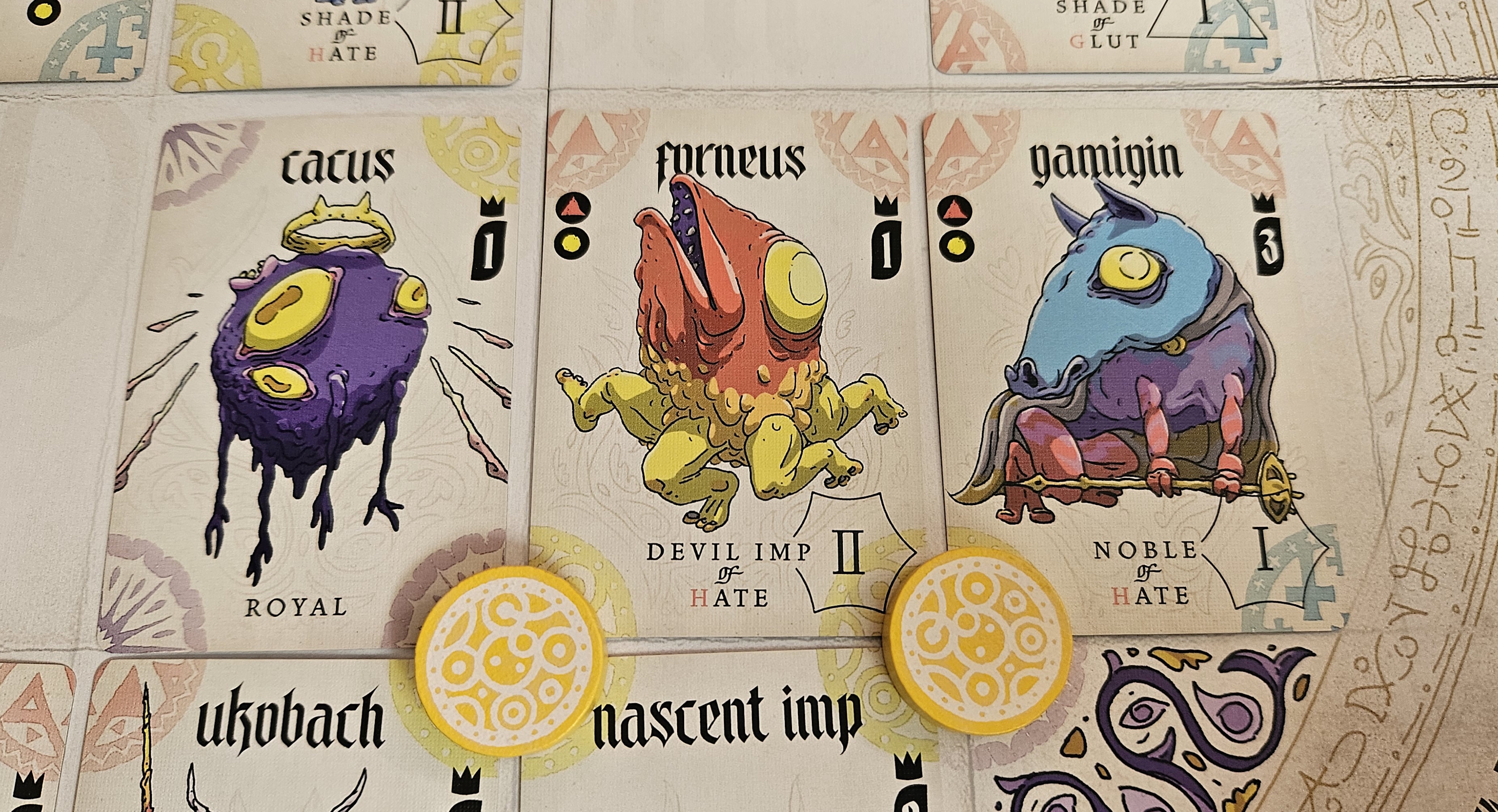
Deep Regrets, like Judson Cowan’s forthcoming Personal Demons, wears its metaphor on its sleeve only to collar it in gameplay. Perhaps we went to the sea to forget, to scrape our hull free of the barnacles that have accreted there, only to find ourselves fouled with a fresh catch. To mount an escape is to be caught.

Okay, now I’m being melancholic. At least it’s a good fit for Cowan’s intended topic.
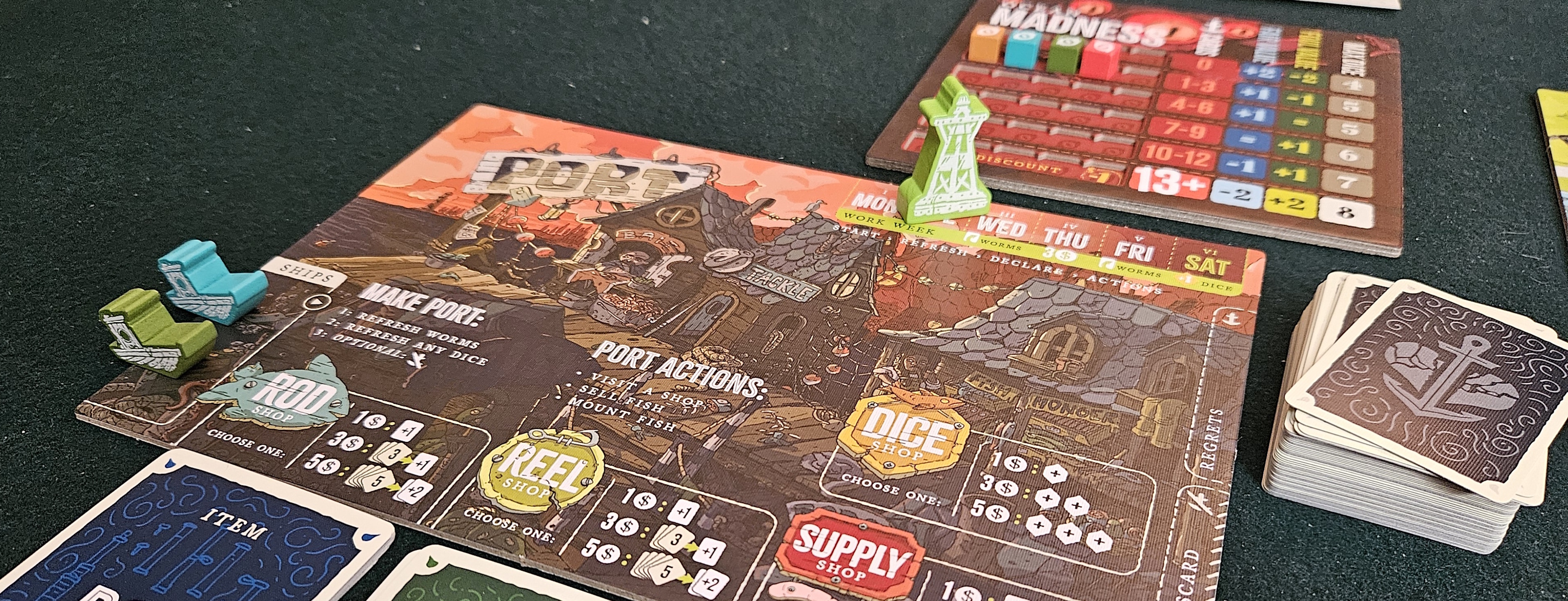
unfortunately, it isn't possible to win by hanging out in port all the time

Hanging out in port.

“On the surface” is a loaded term for Deep Regrets. That’s because Deep Regrets is about surfaces and what lies beneath them. In terms of character, the surface reading is that you’re a fisherman. Not the catch-and-release kind, but rather the my-livelihood-is-disappearing-with-the-depleting-abyss kind.

Which is what drives your bayman to trawl ever deeper. As the shoals close to the surface grow thin, you seek more benthic prey. It’s a solitary practice, both thematically and at the table. Turns don’t exist in complete isolation from those of your peers; this isn’t a total multiplayer solitaire experience. But as we will see, there’s a lidless membrane between you and your peers that’s never quite breached.

For the most part — on the surface — Cowan plays it straight. The entire game could be described in that hobbyist shorthand that sounds alien to outsiders. Fishing is a press-your-luck minigame that expends dice and other resources to land the best fish. Every turn is framed around either a day at sea or one in harbor, trading your catch for equipment. There are subsystems aplenty: permanent and temporary dice, rods and reels with variable benefits, fish both great and small.
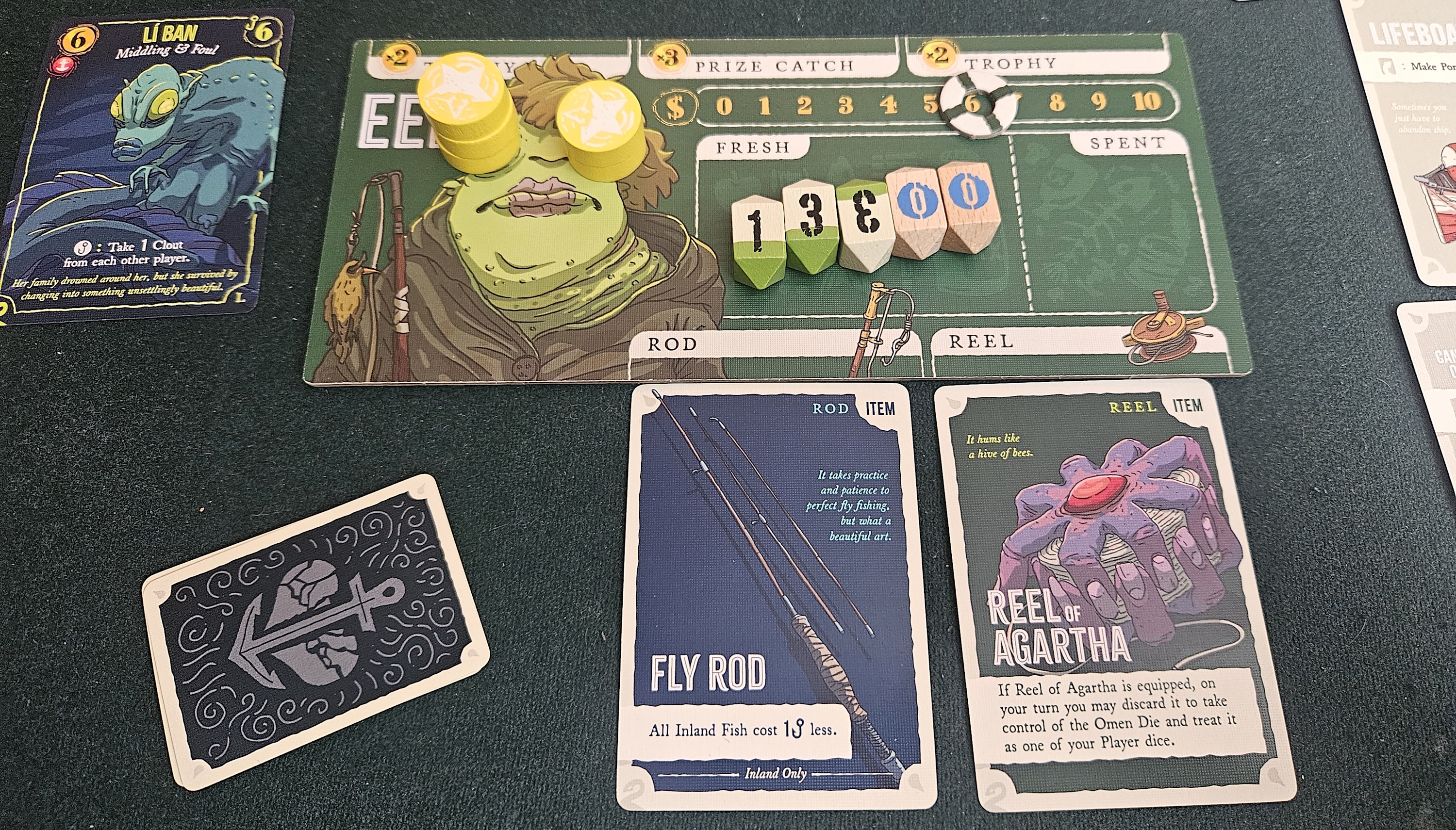
I'm a star

Check out my cool shades. They conceal my squamous nature.

What’s interesting about these systems, though, is what they communicate about both the gameplay and your character.

Starting with gameplay, Deep Regrets is — on the surface — an incredibly chancy plaything. Early on, there are clues one can follow: the shadow beneath the water reveals whether a catch is small, middling, or large, and various depths translate to creatures that are increasingly dangerous to land-based mammals. Your bayman also has access to a few starting tools, such as a can of worms for peeking at a shoal’s face-down card and a lifeboat for beating a hasty retreat to port if your odds at sea turn south.

It isn’t long before it becomes apparent that Deep Regrets isn’t as aleatory as all that. Oh, there’s always a sense of risk. It isn’t uncommon for a cocksure hand to take one risk too many and invite the wrath of something truly monstrous. There are cards in the deck, whether the base deck or one of its multiple expansions, that can very much ruin your day.

Still, there’s so much mitigation at play that it’s hard to regard Deep Regrets as quite as chancy as some have made it out to be. Failing to catch a fish results in grabbing a “dink” — fishing slang, not lifestyle slang — which offers some benefit of its own, whether better fishing or some cash value, to offset the sting of failure. Even a cursory glance at the equipment shop reveals tools that will offset any number of flubs or miscasts. It isn’t enough to strip the game of its uncertainty altogether, but these are hardly uninformed decisions.

This is all good stuff, and would provide plenty to mull over. But, once again, this only brushes the surface.

yum

Not all catches are created equal.

It’s appropriate that where Deep Regrets expands its horizons is via the regret deck, a thick stack piled with all sorts of misgivings and heartbreaks. At regular intervals, your hapless fishers will land something special. A mermaid, perhaps, so shimmering with glory that it breaks your heart to haul her ashore. A leviathan, its mind linking to yours in its lashing final moments. Or maybe you’ll just sell something nasty at the fish market and feel bad about it. Regardless of the cause, these junctures see you drawing a regret.

Regrets matter in two senses. First, the number you hold in your hand determines your character’s current madness. The madder you become, the greater the risks you’ll take at sea and the weirder the creatures you’re willing to sell at market. Second, the sum of those cards determines which player is bitterest upon the game’s completion. This means tossing out your highest-scoring trophy.

What’s curious about regrets, though, is that they aren’t wholly undesirable. True enough, you would rather not have such terrible regrets that you fling your prize charybdis angrily into the sea. But a handful of regrets is… good, in fact. After a few days at sea, it won’t escape your notice that the deadlier deep shoals are packed with strange creatures. It also won’t escape your notice that these can be sold at higher prices and earn greater scores. But only if you’ve gone a little mad. Maybe even very mad. Not so mad that you ruin yourself. But mad enough to take the right risks and mount the right trophies.

Which is to say, Deep Regrets isn’t really about said regrets being bad, at least not always. In much the same way that Personal Demons doesn’t present fears as bad so much as things that need to be confronted, here one is invited to court regret, to dance with it, to dispel its worst excesses through clean living or self-medication or simple caution. Whatever works. But either way, a life without regrets hoists a lower ceiling, victory-wise.

I watched that movie about sailors who ate each other and then lived with the regret their whole lives. Boring. Hannibal Lecter never bellyached and he ate way more people.

Just some of the game’s many regrets.

Laid out like this, Deep Regrets’ messaging might come across as trite. Adolescent. As a species, we’ve told countless stories about how our regrets and failures are crucial stepping stones on the path to adulthood, from Picard being transformed into a timid science officer because he didn’t get shanked as a cocky ensign to the memory-erasing shenanigans of Eternal Sunshine of the Spotless Mind.

But Deep Regrets doesn’t come across as an adolescent musing. Its passage to success isn’t as straight as “regrets good.” Plenty of its regrets are well worth casting off. There’s a certain temporal wiggliness to the process; if you regret losing your arm or sacrificing your sister, I’m not wholly sure what it means when those regrets are discarded. Did we… forget? Get over it? Prevent its having happened through some demersal bargain? No idea. But the effect is one of curated regret, cautious regret, not wholesale acceptance or dismissal.

This makes Deep Regrets interesting rather than perfect. I wish the game had been pacier, but in some spots Cowan’s eagerness seems to have gotten the better of him. After the first few rounds, turns begin to bloat with extra dice, fish, equipment, and dinks. In the end, it isn’t the chanciness that’s the problem; it’s the replete tools for extending a turn and making outcomes more certain. As the game grows longer, its charms wear thin. Eventually, they rupture like aquatic flesh that’s gone too long without refrigeration.

I like to make guests scream when they look at my tumor-wall

Mounting my trophies, buoyed by regret.

Still, Deep Regrets is smarter than it looks. It’s a game that rewards peering beneath the surface, both in terms of gameplay and as a ludic examination of a life lived without too many guardrails. I can say this with complete certainty: I don’t regret the time I’ve spent with it. Not in the slightest.


Complimentary copies of Deep Regrets and its expansions were provided by the designer/publisher.

(If what I’m doing at Space-Biff! is valuable to you in some way, please consider dropping by my Patreon campaign or Ko-fi. Right now, supporters can read the next installment in my series Talking About Games, this time tackling the topic of what makes a good list! Naturally, the piece includes a list.)

Liberation Ludology, Part Three: Nicaragua

06. August 2026 um 01:03

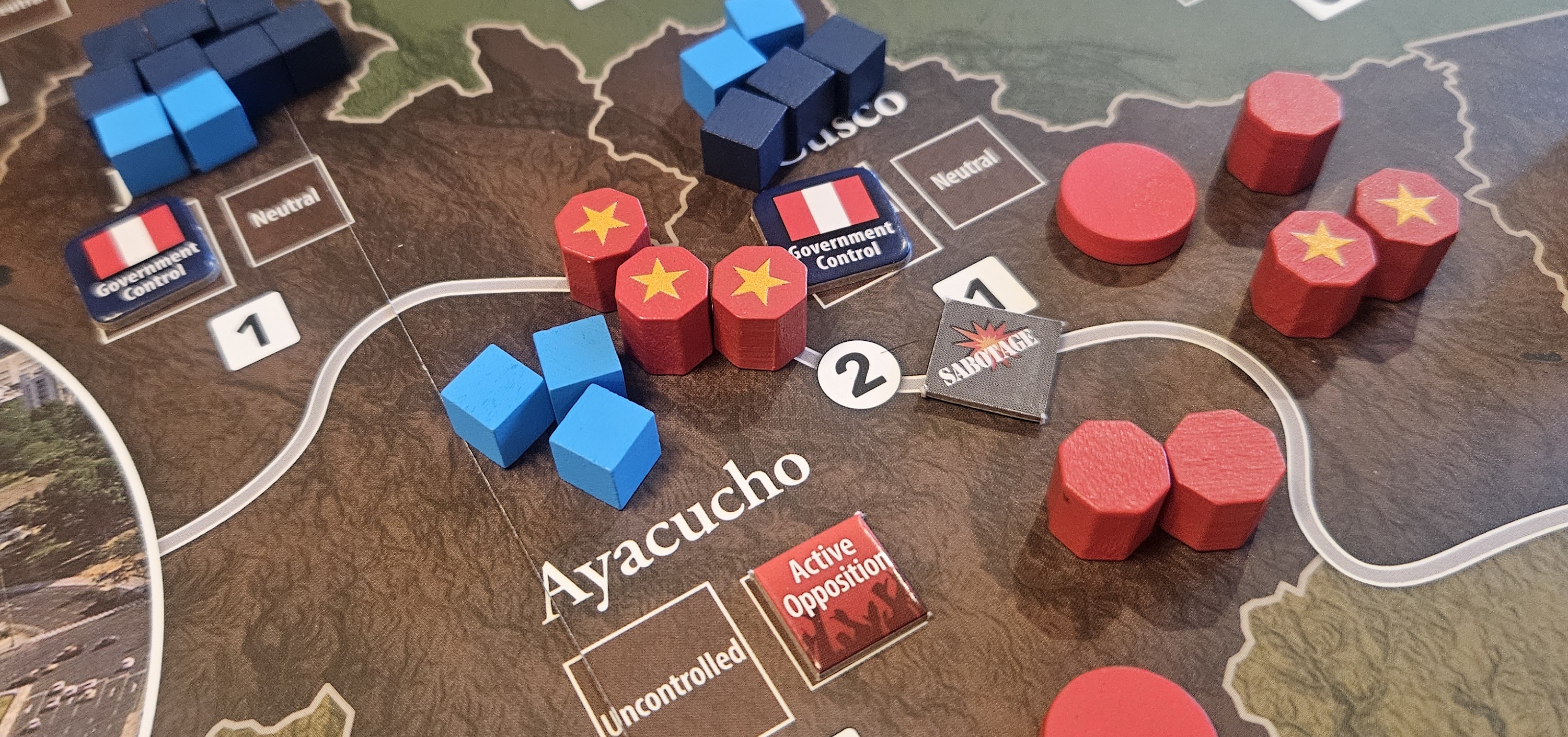
I made the star blue. For FUN REASONS.

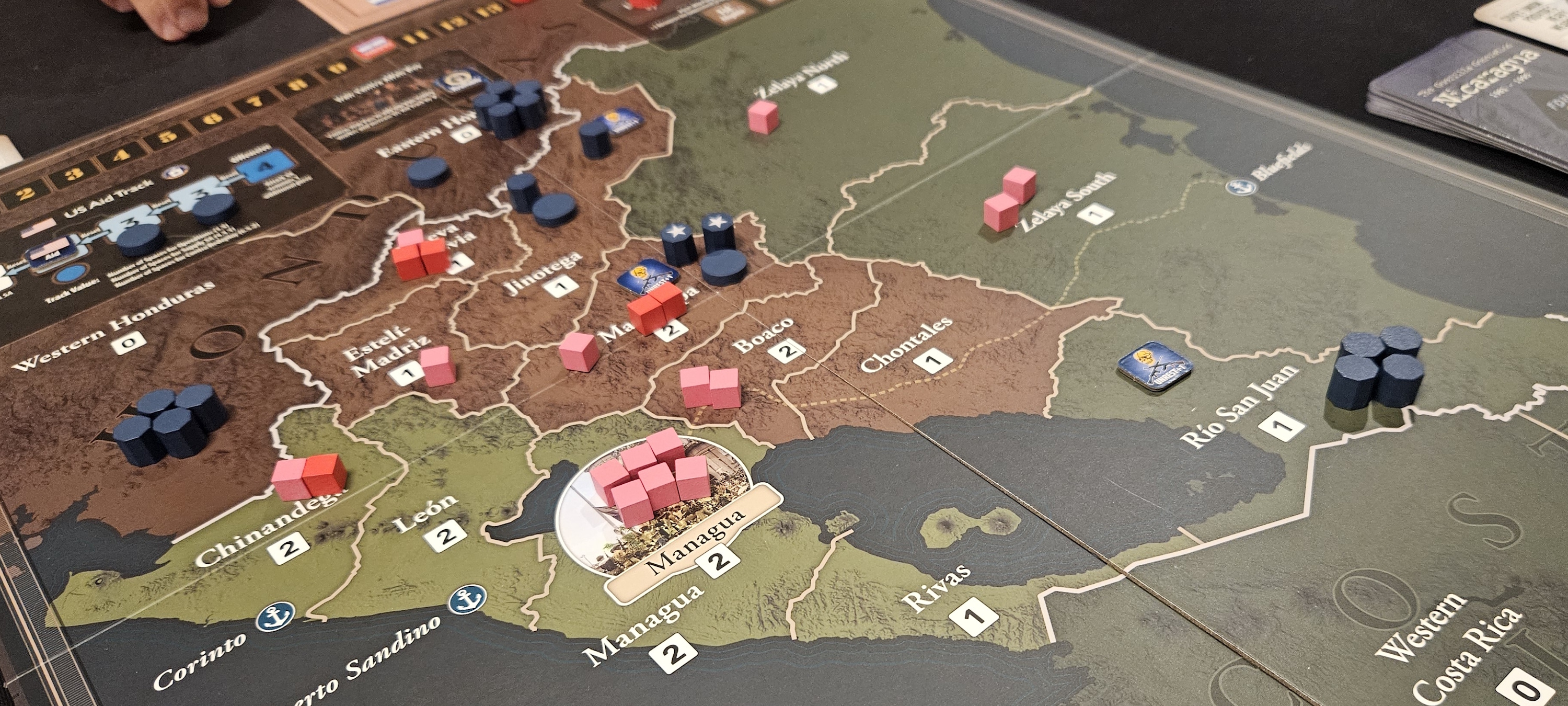
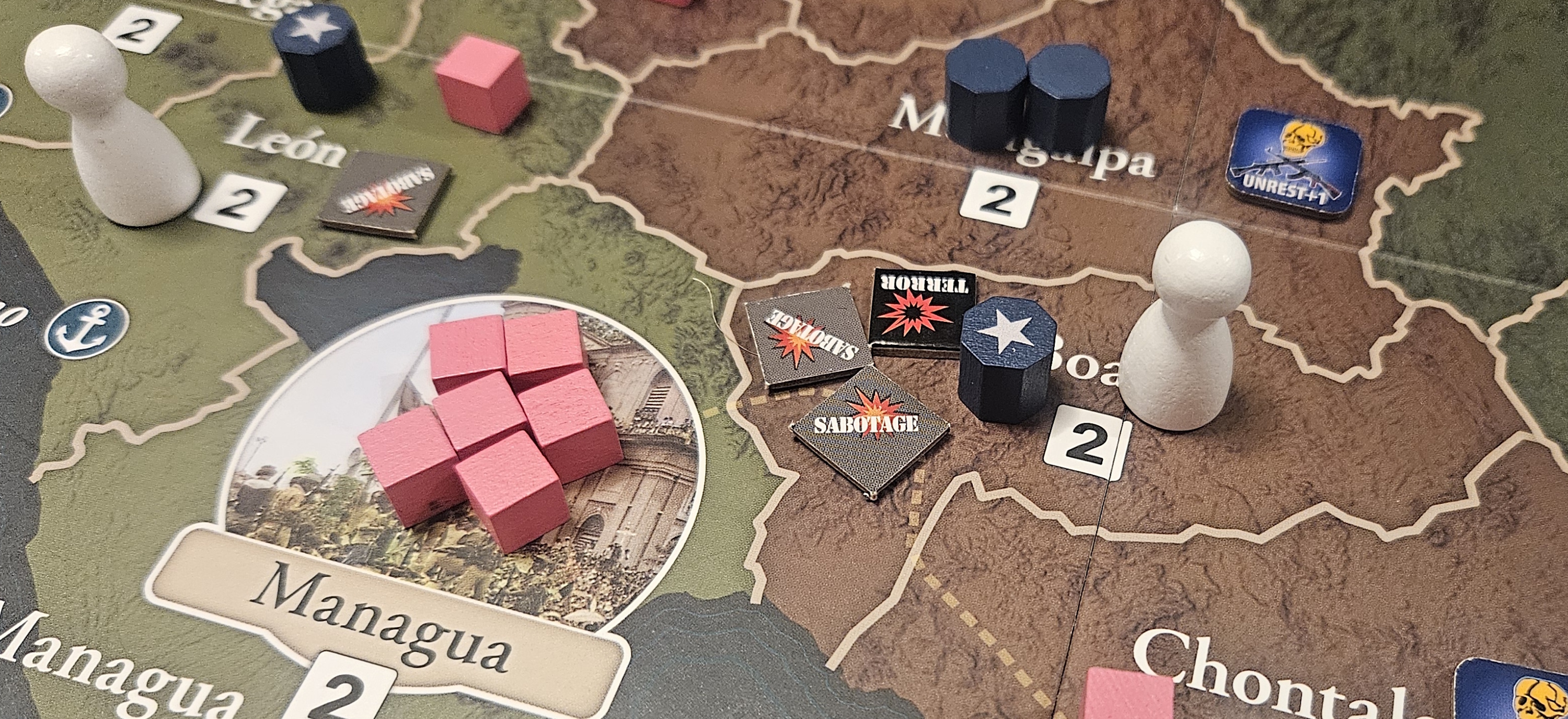
The first thing one notices about the third scenario in Stephen Rangazas’s The Guerrilla Generation is that the script has been flipped. Unlike both the Uruguay and Peru scenarios, which presented the COIN Series’s customary red insurgents facing off against government blues, here the entire color scheme has been inverted. Now the insurgent cylinders are the blue ones, while the government’s troops and police are red and pink. The effect is jarring. More than once, I found myself staring at the wrong side of the faction aid, trying in vain to make sense of the information before me. What do you mean the red side needs to deploy sweep-and-clear operations? Wait, the pinkos have air superiority? When has that ever been the case?

This is Nicaragua, baby. One short year after the socialist Sandinistas ended the Somoza family’s four-decade reign, inheriting an indebted and war-wracked country, the U.S.-backed Contras are pouring over the border from Honduras and Costa Rica. What follows is the most harrowing of the multipack’s scenarios thus far.

I wouldn't wear pink to a firefight.

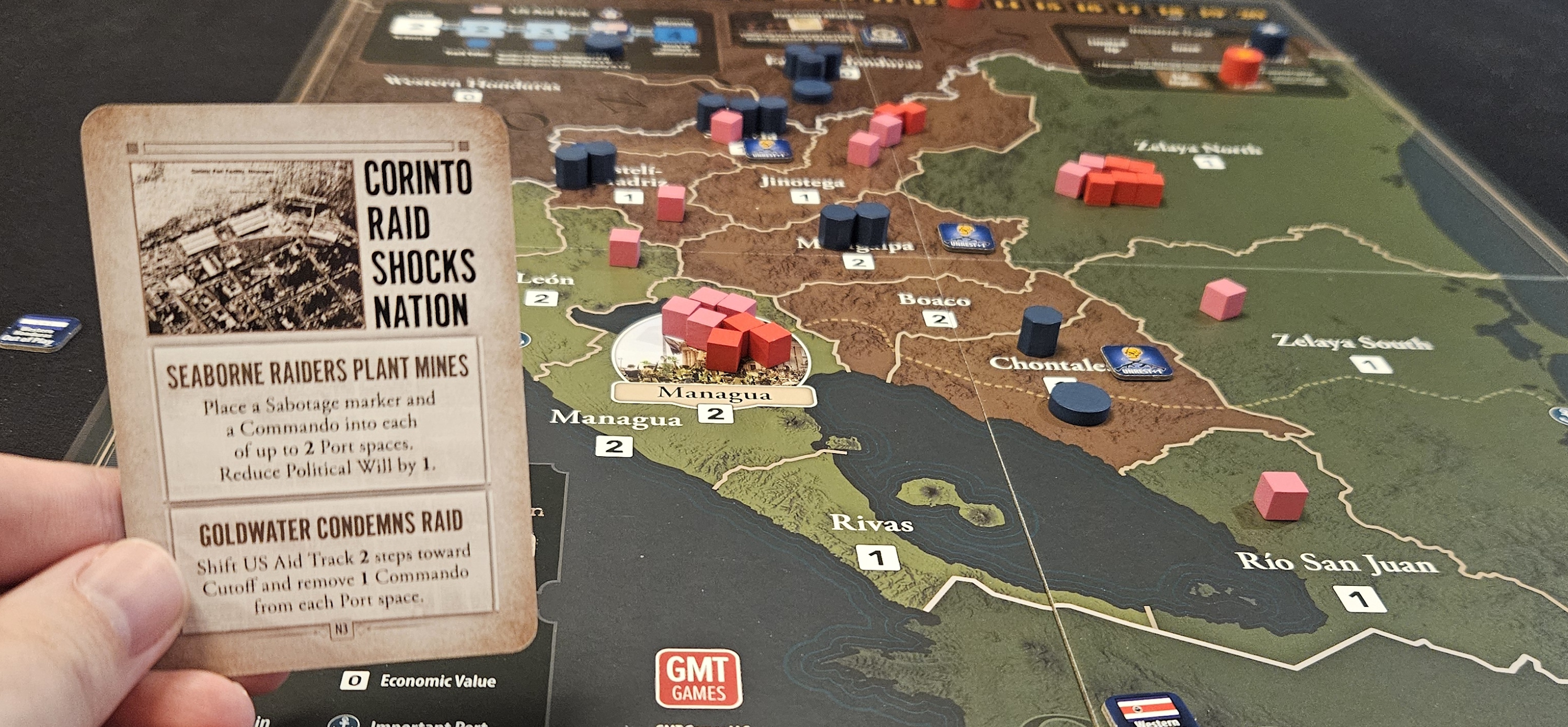
Nicaragua under siege.

As always, the first few turns in a new COIN scenario are testy. Both sides take longer turns than usual, acquainting themselves with the operations that will be their guiding star over the next few hours. (Or, in the case of Rangazas’s scenarios, the next hour to ninety minutes.) Everything is new. The contours of the geography, with its many tropical hiding places and mountainous hard points. The location of any urban centers and their lifelines through the countryside. Any neighboring countries to act as hiding places for roving insurgent forces.

And, in this case, the sudden realization that the Sandinistas are going to have to find a way to afford all this stuff, while the Contras are perpetually flush.

This isn’t the first time in the COIN Series a faction has wielded unlimited spending potential. That distinction traces all the way back to the bottomless pockets of the Coalition in Brian Train’s A Distant Plain. Even this multipack has already showcased a scenario that dispensed with funding altogether.

But what makes Nicaragua so dizzying is that here it’s the insurgents who can act with impunity, not the government. In the background, the Sandinistas are hurrying to repair the damage from the last bad decade of Somozan rule, including the earthquake that leveled much of Managua only for relief funds to quietly route into el presidente’s personal bank account. Now they’re making good on their promises: literacy campaigns, schools, hospitals. Also no small measure of native repression, in case you’re thinking everything is rosy. So when it comes to the CIA shenanigans in Honduras, the Contras with their limitless materiel, the commandos laying nautical mines in the harbors, the U.S. embargo squeezing the entire economy, there simply isn’t enough cash to go around.

It wouldn’t matter so much if everything weren’t so damned expensive. When the scenario opens, the Sandinistas are desperately undermanned. This makes sense in context. All those bright-red troops and hot-pink police have been hastily retrained from the previous conflict’s insurgent cylinders. This leaves much of the country unprotected, especially around the fringes. The only solution, especially early on, is to spend, spend, spend. Spend to train more police. Spend to garrison them in the countryside. Spend to sweep into insurgent hotbeds. Spend to send in the soldiers with the big guns. Even with the multipack’s briefer campaigns, hovering around only eight cards per propaganda round, it isn’t uncommon for a government player to find themselves skint with a good few turns before the next infusion of income.

Don't worry, I sent in the helicopter boys.

That’s a little too close to home for comfort.

The only reprieve comes from the Contras themselves. Once again, Rangazas uses the limited tools of Volko Ruhnke’s COIN System to carve out some impressive evocations of insurgent warfare. Unlike the other insurgents we’ve seen thus far, the Contras are not locals. Or, well, they’re locals, former members of Somoza’s national guard or disillusioned revolutionaries, but they aren’t locals the way the Tupamaros were locals to Montevideo or the Shining Path were locals to Ayacucho. The Contras are roving death squads. Their targets aren’t only military, but also the schools and hospitals and agricultural collectives currently being set up by the Sandinistas. Their targets are economic. And therefore civilian.

Which means the Contras don’t have roots in local communities. They can establish bases in Nicaragua, but these are closer to waystations than actual recruitment centers. All their actual recruitment occurs in neighboring countries, in the safe harbors of Honduras and Costa Rica. They aren’t wholly untouchable across these borders; the Sandinistas can lob artillery strikes into foreign territory, risking erosions to their legitimacy, and depending on the whims of the event deck might mount small incursions. But their foreign-backed status informs everything about how the Contras behave. They deploy in foreign territory, then infiltrate into Nicaragua via mountain passages and jungle paths. Once there, they mount attacks and sabotage infrastructure — the customary insurgent tactics — only to melt back across the border at regular intervals.

This produces a starkly different type of gameplay from the usual COIN fare. The Contras work according to their own circadian rhythm, there and back again, in offensives and dispersions, rather than claiming territory long-term. When a campaign ends, they can maintain a certain number of toeholds in-country, but not so many that they won’t have to yield something hard-fought.

More importantly, this gives the Sandinistas some breathing room. Border security is a priority, and not an impossible one. Urban centers have always been tough nuts to crack, but Managua’s central position makes it uniquely secure among COIN capitals. It isn’t unthinkable, for example, that the Sandinista player might opt to empty it of protection altogether. A risky proposition, but one that might put its manpower to better use in more vulnerable sectors.

Meanwhile, the geography takes on real significance. Given its operational focus, the COIN Series has always taken a satellite perspective of territory, more about regional tendencies than individual strongpoints. Here, one immediately grasps the various inroads the Contras might take toward destabilizing the socialist regime. Harbors on the coast are vulnerable, but are more readily policed. The mountains are good hiding spots for entrenched death squads, but access can be blocked with some well-placed army divisions. Perhaps the tenderest pressure point is the harbor on the country’s Atlantic coast, far from Managua and surrounded by jungle. But the Contras also struggle to project that far. It’s a pickle all around.

I don't remember who was playing as the Contras, but they sure seem to be bodying the Sandinistas here.

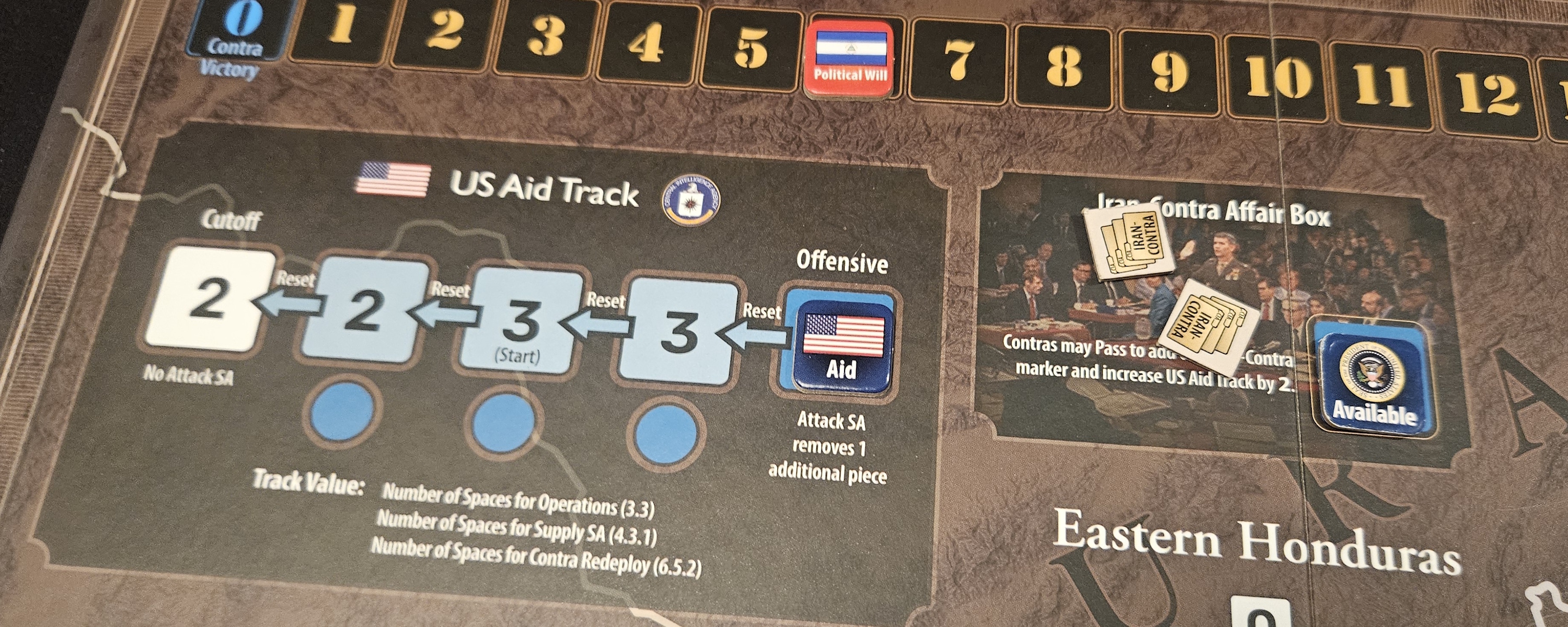
Come get your yankee dollars!

Of all its pickles, however, none are more vinegary than the looming gaze of the continental hegemon. The United States is never absent from either side’s thoughts. While the Contras don’t have to worry about actual resources, they are subject to American pocketbooks. Depending on the current status of U.S. aid, their operations can target between two to four regions at a time. This encourages the Contras to spend at least a portion of their attention attending to their paymasters, whether through the event deck or by occasionally passing to beg for more attention.

The Sandinistas, for their part, must also keep an eye on the Yankees. There’s no avenue for directly tanking funding to the Contras; the inner workings of a corrupt American presidency are far above the Sandinistas’ ability to influence. But there are ample cards in the deck for applying international pressure. This makes the Sandinista player somewhat reliant on the sequencing of the event deck, but it also prevents their operations from becoming rote. More than most of Rangazas’s scenarios across both The Guerrilla Generation and The British Way, and indeed more than most of the main COIN volumes, Government players must consider every possible avenue for undermining their opponent. Where these titles usually present their government factions as clear frontrunners in terms of wealth and manpower, here they feel fragile and outmanned. They’re the region’s big dog, but their hookworms are funded by the most powerful empire in human history.

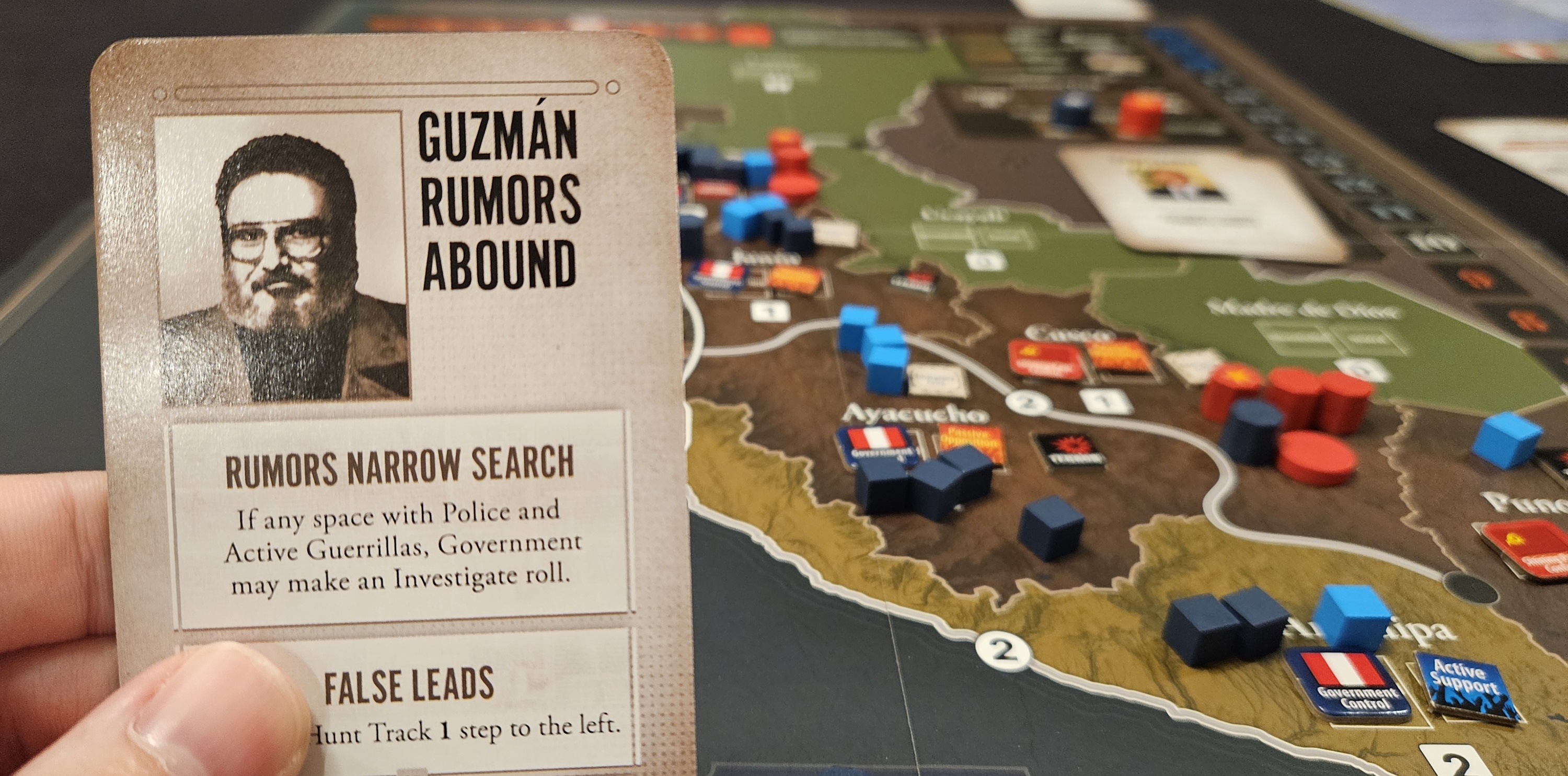
Which makes the Iran–Contra Affair such a big deal. Whenever the Contras require extra help, they can pass to bump up the aid track. The price is an extra evidence token in the Iran–Contra box. This isn’t guaranteed to trigger; in fact, it’s even less likely than the People’s Prison being uncovered in Uruguay or Abimael Guzmán being captured in Peru. But if Reagan does happen to get caught funding a violent insurgency that wantonly targets civilians, the ramifications are considerable. With no further ability to increase their funding, there’s a very real chance the Contras will wither on the vine.

Where the previous two scenarios existed in isolation, this draws greater attention to the specter of American involvement in Latin American politics. There’s the wider situation to consider. For The British Way, Rangazas connected all four scenarios via a meta-campaign that traced the larger anti-colonial movement against the British Empire. The Guerrilla Generation includes a similar option, one that’s both more focused and more ambitious. This campaign, called Resisting Reagan, allows players to tackle both this scenario and the next one side by side. It’s a massive undertaking, requiring familiarity with both scenarios and an additional set of campaign rules.

Which is why it will have to wait for its own chapter in this series. Hey, I can only do so much at a time. Look at the bright side: bonus fifth part! Yay!

(Right? Yay?)

"Not nice."

You’ve gotta be doing something wrong if Barry Goldwater denounces it.

All told, Nicaragua is not only the strongest of the three scenarios we’ve played in this multipack, and not only one of Rangazas’s best uses of this long-running system about counterinsurgencies, but one of the best expressions of the wider COIN Series, period. It draws clear delineations between its besieged (and increasingly problematic) revolutionary government and the foreign-backed commandos raising hell in the countryside, presents a novel gameplay scheme in the constant ebb and flow of its insurgents, and, perhaps most importantly, draws the player’s attention outward to the wider problems of American imperialism besetting the titular guerrilla generation on all sides. As my play partner put it, this might be the first COIN scenario that he would request we play again.

But another session in Nicaragua will have to wait for Resisting Reagan. First, we need to examine the multipack’s fourth and final scenario, and the one most personal to me: El Salvador.


A complimentary copy of The Guerrilla Generation was provided by the publisher.

(If what I’m doing at Space-Biff! is valuable to you in some way, please consider dropping by my Patreon campaign or Ko-fi. Right now, supporters can read the next installment in my series Talking About Games, this time tackling the topic of what makes a good list! Naturally, the piece includes a list.)
Quilt for Kitten

04. August 2026 um 21:24

I always mispronounce the title. "Blan" like in "bland." Then "cat." Bland Cat.

Nutgoo.Lee’s Blancat made my seven-year-old cry. I know. That’s a movable bar. She was tired from a long day of playing in the sun, but she wanted to try the “kittie quilting game” anyway. It ended in tears. That’s on me, not Blancat, and certainly it isn’t on Nutgoo.Lee.

But here’s the thing: she practices at Blancat. She sits on her own at the table and studies the little templates and does her best to craft the quilts. She’s played plenty of other board games. She even has her favorites. Right now, that means Barbecubes and A Gentle Rain. Tactile stuff, not all that far removed from Blancat, but simpler, with lighter stakes. This is the first game I’ve seen that’s made her studious. The first game that’s meant to be challenging. Her intensity makes me wonder if there’s something here that I didn’t see right away. They say children let you see the world through new eyes. It seems the same goes for board games.

*not usable for retaining body heat

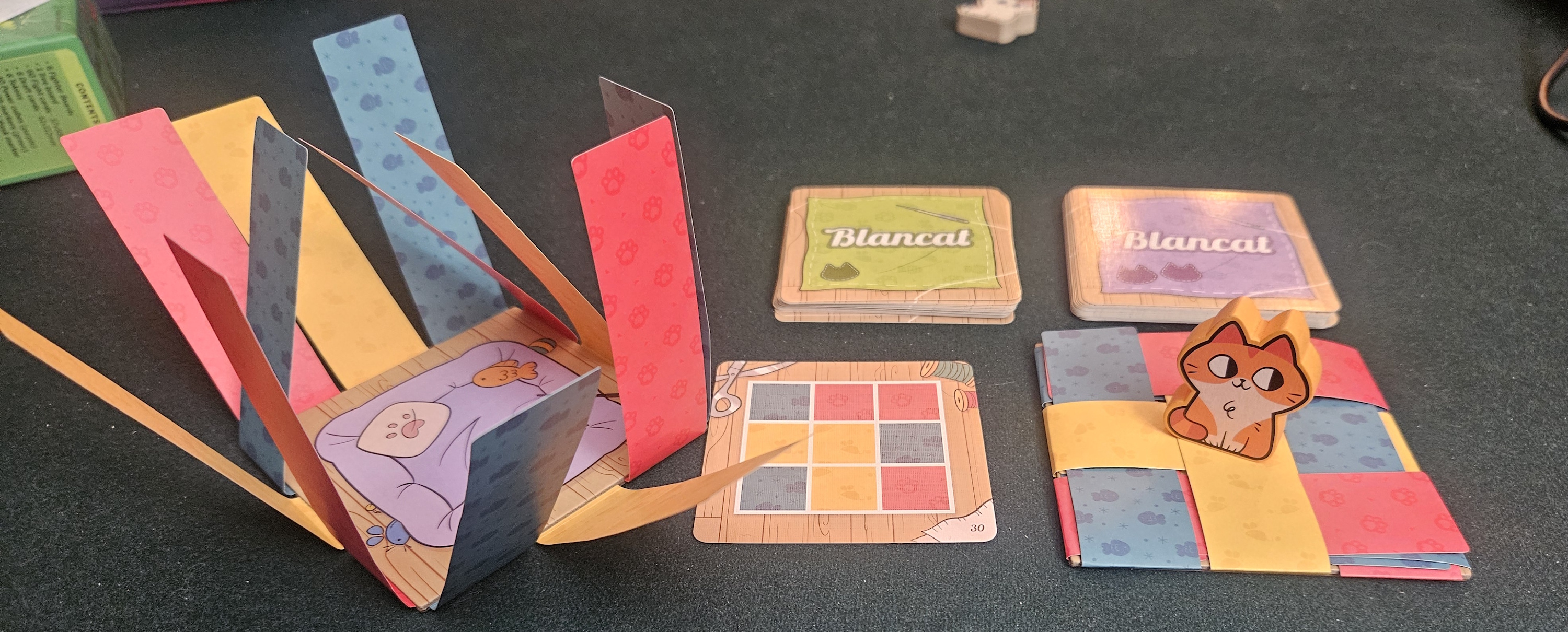
Everything you need to make a blanket.

Blancat is about making blankets for cats. It’s a simple concept. You draw a card that shows a pattern. Everybody races to make the pattern, folding strips of stiff paper over and under one another. Upon completing your blanket, you grab a kitten. Last one out is a rotten egg. Then you play again. Nominally, there’s a scoring system. Honestly, we’ve never bothered. It’s the sort of game you play until the little ones want to do something else.

I’m not opposed to simplicity. Indeed, simplicity is often a synonym for elegance. But there’s a tendency in this hobby to hoist a ceiling over certain games. Too simple and the game is for kids. Too small and we’ll cap its rating at 7/10 on BGG. It doesn’t matter whether this is our most-played game of all time. It’s still not a serious game. Because it’s small. Because it’s simple.

Blancat is both small and simple. But watching my seven-year-old play it, I can tell you it’s the most serious exercise ever devised.

There's the cat she's chosen to claim once she's done. And Blancat doesn't even advertise itself as a solitaire game.

Blancat works for kids, but the advanced templates are surprisingly hard to craft.

There are two types of patterns, separate decks that offer vastly different degrees of challenge. The easy deck fits the description. As long as you have the gross motor skills of a toddler, you’ll get there.

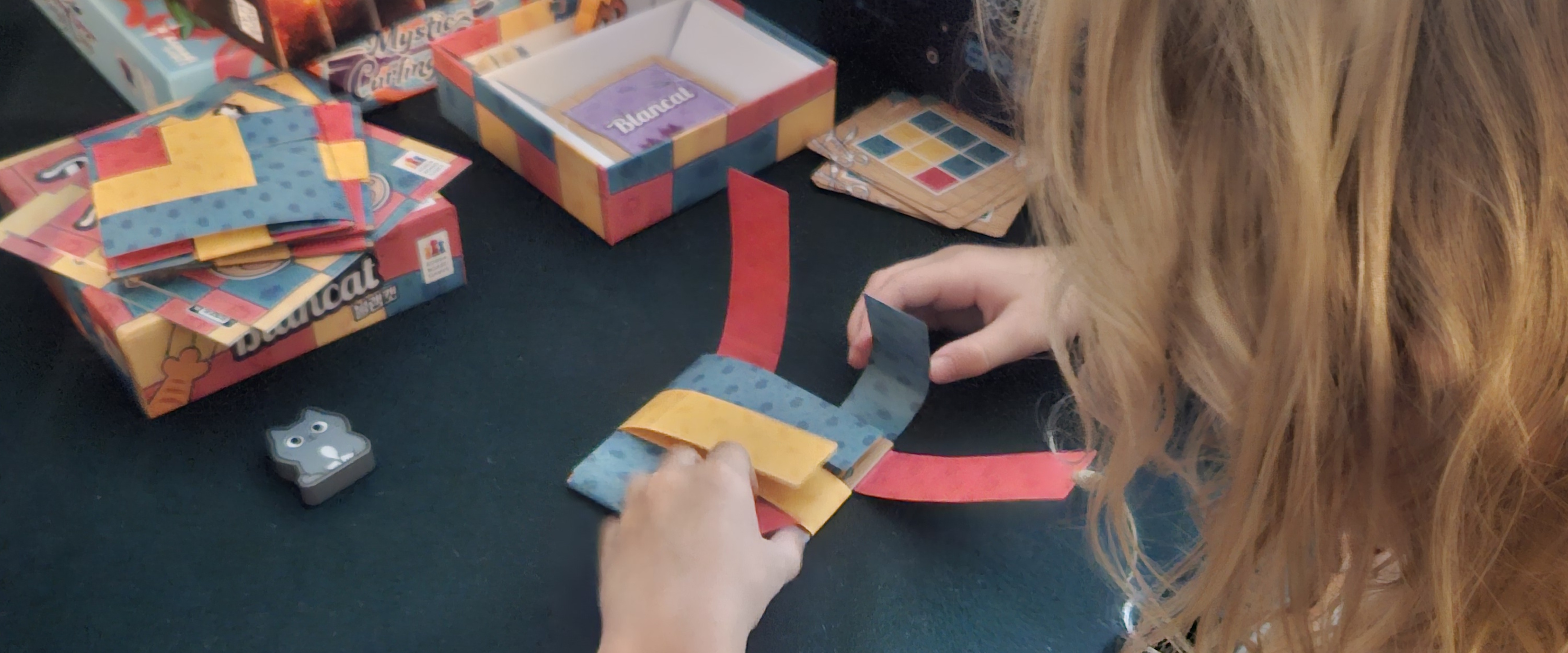
But the hard deck is nasty. It isn’t enough to just fold down those strands willy-nilly. A successful pattern takes forethought. Blue over yellow. Red tucked between two strands, then folded upward. Blue back through the yellow and the red… wait. How exactly is this supposed to work? For twelve cardboard flaps, there’s surprising tactility at play. A strand that seemed like it went here might suddenly need to go there. A ribbon that was previously buried might become crucial, necessitating a last-second excavation. I’ve had easier times sewing actual quilts, and that’s no boast.

There’s an element of muscle memory to these challenges. It’s like playing with a Rubik’s Cube. At first, you’re just fiddling. Only later do you develop the sense for how to move things around. Eventually, it becomes second nature. To such a degree, in fact, that the whole thing stops being impressive and becomes an exercise in rote execution. When’s the last time you were impressed with somebody solving a Rubik’s Cube? I had a friend who could solve one while bouncing on a trampoline. Ten or fewer bounces, I think.

no buttholes. cowards.

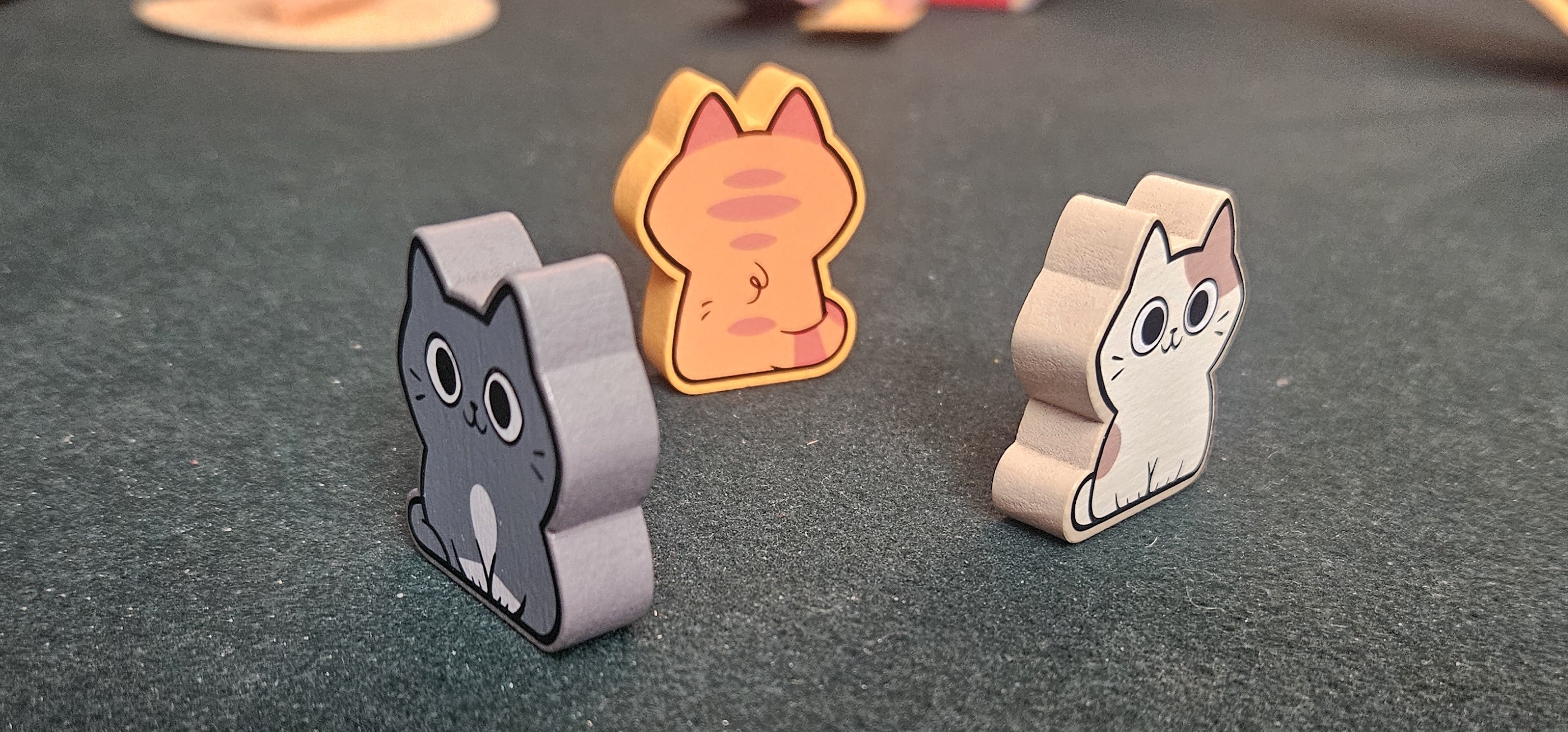
Three little kitties.

Of course, it’s all relative. Put that Rubik’s Cube in the hands of a child. Now we’re cooking. Because Blancat isn’t rote for my seven-year-old. Not yet.

For adults, Blancat is about speed. Such speed that I worry those little paper flaps will tear. Such speed that it’s like watching my high school friend take the highest, laziest bounces on the trampoline, so high and lazy he could spin that Rubik’s Cube a dozen times before his feet returned to the mesh. It was fun trick to watch, the once.

But with her? With my youngest kiddo? For her, it isn’t about speed. It’s about deliberation. It’s about thinking through this new logic. It’s also about kittens, because she loves kittens. But when she’s in that zone, the strands worked in her little fingers, even the kittens become secondary. She stops grabbing them for a hug. Instead, she’s all focus, weaving one flap over the other, pausing in confusion when something doesn’t line up, reversing her decisions, reassessing.

Watching her play Blancat is like watching her grow up in time-lapse. Her brain making new connections in real-time. Her fingers growing more limber. Her sense of self forming a new confidence. It makes my sternum watery. To see her. To feel such awe at her. To wonder at the span of us, our human family, striking flint into tinder, the spark igniting liftoff for a rocket ship. We grow up so fast.

Aw.

Snug as a bug in a rug.

Blancat. That’s what we’re talking about.

Is it a good game? I have no idea. I think it is. For what it is. For a game that’s simple and small, but also surprisingly large. For a game that’s one thing to adults and another thing entirely to children. For a game about folding strips of paper ribbon over and under one another. For a game with wide-eyed kittens on its cover.

Honestly, I don’t really care about all that. What I care about is the way my child studies its ribbons, folding and folding, and then, when the pattern is done, reaches out and plucks a wooden cat from the table, and places it atop the quilt, and then, in a voice so quiet I can tell it’s reserved for herself alone, whispers in triumph, “Meow.”


A complimentary copy of Blancat was provided by the publisher.

(If what I’m doing at Space-Biff! is valuable to you in some way, please consider dropping by my Patreon campaign or Ko-fi. Right now, supporters can read the next installment in my series Talking About Games, this time tackling the topic of what makes a good list! Naturally, the piece includes a list.)
Clammy Scythe-on-Expeditions Action

03. August 2026 um 22:23

DUDEL OF MELOCCH (I'd play that)

I won’t pretend to know what’s happening in Duel of Meloch. When we first got a glimpse of this world via Scythe, it was an alt-history Great War mechs-n’-boiled-barley affair. Then Expeditions rolled around and the whole thing took on a determinedly Strugatsky Brothers flair, all strange zones and alien meteors and zombified hussars. Now there’s a foreign entity named Meloch who’s thrown the previous games’ heroes into a time warp, resulting in one last excursion that just so happens to be a grudge match between two of Jamey Stegmaier’s most iconic gameplay systems.

Do these disparate threads make a lick of sense? Not to this philistine. But even as the gameplay mostly gets me shrugging, I can’t help but find the result compelling. It’s a pickle.

I forgot to take a picture of the other, better map. But rest assured, it's better. Mostly because it's more open.

Scythe. Expeditions. This mat ain’t big enough for the both of us.

At a sky-high level, Duel of Meloch does precisely as its subtitle proposes. This is Scythe vs. Expeditions, and so snugly fitted that while a few minor alterations are necessary to make its hand-me-down trousers and blouses cohere into a single uniform, for the most part these changes dissolve into the aether after all of two minutes. This isn’t a different, third game that just so happens to use the components from Scythe and Expeditions. It’s Scythe and Expeditions, side by side, and sometimes right in each other’s faces, both humming along as Stegmaier intended.

How does it work? Well, again, it’s Scythe and Expeditions, so they work like Scythe and Expeditions. The former, called the Scythian, is playing an economic game. They escort workers across the landscape, have them harvest wheat and oil and so forth, and then spend those resources to build mills and armories and additional mechs. The latter, the Explorer, is more solitary. Occupying a single mech, they trawl across the map in search of cool artifacts and various helpers, then use those assets to manage a hand of cards and attack corruption tokens. Visually, the Scythian puts themself out there. You see their workers and factories and mechs spread across the land. The Explorer, on the other hand, tends to keep their resources closer to the vest. More tangibly, this means glancing at their board to see how many quests and upgrades they’ve completed.

What’s most impressive is how smoothly these systems merge. Some fun has been poked at Stegmaier for his games’ shared iconography. Even as recently as two months ago, the new edition of Euphoria once again used those objective stars as their centerpiece, giving the game the appearance of a spreadsheet, one at odds with its more vivid original incarnation. But those duplicated icons have never seemed more forward-thinking than here. In fact, the one discernible place where the icons differ — combat strength — is so jarring that it comes across as an intrusion into the game’s visual language.

It’s funny, in other words, to pine for even more generic visual language, but there we have it. Take that, doubters. Myself included. Without those duplicates, Duel of Meloch would have been a true ocular nightmare. Instead, it’s as crisp as can be expected from such an experiment. Especially if it’s true, as Stegmaier asserts, that these systems were never planned to be combined.

Is the Scythian a Scythian? (No. Scythians looked totally different. But that would be neato.)

Scythe’s double-action system is as interesting as ever.

The gameplay itself is conducted at two levels: the micro, consisting of your own turn — which, for the last time, is either Scythe or Expeditions, depending on which side of the equation you’re commanding today — and the larger macro perspective that sees those sides coming into collision.

This being Duel of Meloch, it’s that latter collision that’s the real draw. And it’s… fine. The Explorer moves faster in terms of kilometers per turn, while the Scythian draws borders and eventually outnumbers their rival in terms of sheer mechpower. This mostly matters for combat. The Explorer punches harder máquina a máquina thank to its dual brands of combat strength; the Scythian brings numerical superiority to bear. To help these tussles along, combat is imported more or less intact from Scythe. Both sides bid via private dials, then modify their strength with combat cards. These cards have received some adjustment in the form of a new deck, but not so much that returning players will require explanation.

The inherent limitation of these bouts is similar to those of Scythe: namely, there really isn’t much reason for the Explorer and the Scythian to jostle. Duel of Meloch isn’t a duel so much as a race. There’s a shared objective board, and both sides are hustling to tick off its various boxes. This also acts as a showcase for the games’ shared iconography, even when those icons translate to slightly different things. For example, the Scythian might be asked to raise their popularity to ten, while the Explorer tries to accomplish three quests. Both of these goals use the heart icon, and both represent an outward-facing perspective, making them a natural leg of this particular relay. The same goes for other criteria: loot some number of coins, defeat corruption tokens or expand across a certain number of hexes, strap upgrades to your mech or roll out all your reinforcements.

Or win in combat.

Depending on which side of the objective bar you’re using, you’re encouraged to win either one or two battles. Like every other objective, however, this locks off access to that objective for your rival. The result is usually at least one big battle. Beyond that, it’s usually a better use of your time to sprint toward the next objective. Sure, there’s some possibility of disruption, since defeating a rival sends them back to their home base. But the Explorer moves so quickly, and the Scythian eventually fields so many units, that these setbacks are fairly minor in the scheme of things. Depending on the current state of the board, they might even delay the victor more than the vanquished.

Unfortunately, the rock coasters for holding down the corners of the bendy mat are not included.

The shared iconography makes evaluating objectives a snap.

In other words, these aren’t exactly the fine-tuned interactions of Root or Vast. Or, crud, even the more Euro-tinted interactions of something like Crescent Moon. Players are mostly left to noodle in their respective corners, gathering the workers, resources, and cards they need to succeed. Then, either once or twice per session, they’re invited to poke their rival, only to retreat back to their personal workshop for the remainder of the duration.

This isn’t bad so much as uninteresting. In a vacuum, there’s nothing wrong with multiplayer solitaire. The problem, rather, is that everything about Duel of Meloch, from its setting to that promissory tagline, scream out for greater friction. The game itself is a collision. Of systems. Of outlooks. Of occupants trapped in an alien entity’s playpen. But for a collision, there’s very little in the way of combustion or shattered glass. It feels like something is missing, an undelivered invitation to actually look up from your private tableau to see what your opponent is up to. Flashpoints on the map. King of the hill. A reason to drive the Scythian away from the upgrade-bestowing city or prevent the Explorer’s access to those corruption tokens. Anything.

Instead, what Duel of Meloch offers is a buttery smooth merger that doesn’t seem to know what to do with itself. It’s bad practice for a reviewer to theorize about what could have been, but some part of me yearns to see Duel of Meloch as a more ambitious experience. Why limit ourselves to two players? Why not two per side, one Scythian and one Explorer, the first for building and defending our base, while the other roves into contested territory and sabotages rival efforts? Such a game would be different than this one… but not as different as it would have sounded before I actually played Duel of Meloch. Such is the expert craftsmanship behind these systems and their combination.

Riverboat mech! That's cool. I always wonder how much of a role the artwork is playing in making me want to like these games more than I actually do.

The explorer is… exploring, one supposes.

As it stands, Duel of Meloch is a fine piece of engineering. But it’s like a windup car without a racetrack to hurtle itself along. The parts are there. The motor winds with such a satisfying tick and whines so beautifully when the knob is released. It hurtles forward with such enthusiasm. But this is one mech that could have been soaring loops instead of walking in circles.

So, for now, it remains a curiosity. Perhaps there’s some value to the game as an expansion, especially for the Scythe/Expeditions devout. For the rest of us, Duel of Meloch stands more as a monument to its designer’s cleverness than as a plaything worth exploring on its own merits.


A complimentary copy of Duel of Meloch was provided by the designer/publisher.

(If what I’m doing at Space-Biff! is valuable to you in some way, please consider dropping by my Patreon campaign or Ko-fi. Right now, supporters can read the next installment in my series Talking About Games, this time tackling the topic of what makes a good list! Naturally, the piece includes a list.)
Space-Cast! #58. Postmarks

30. Juli 2026 um 21:13

Ah, thinks Wee Aquinas. Mammon.

For over five years (but fewer than seven), Postmark Games has published high-quality, low-cost print-and-play games. Oh, you need examples? How about roll-and-move titles like Voyages, Aquamarine, and Waypoints? Or ditties like Battle Card, Scribbly Gum and Koala Rescue Club? Or even 52 Realms: Adventures? Now the company is working on their first coin-flip title, Master of Coin. For today’s Space-Cast!, we’re joined by Rory Muldoon, half of the Postmark team, to discuss the beginnings, current status, and future of the company. How does one build a business on games that players print for themselves? Maybe we’ll find out!

Listen here or download here. Timestamps can be found after the jump.

TIMESTAMPS

2:06 — the origins of Postmark Games: when Rory met Matthew
11:33 — the first game
15:20 — roll-and-moves: Voyages, Aquamarine, and Waypoints
24:52 — licensed games: Battle Card, Scribbly Gum, and Koala Rescue Club
31:55 — Postmark’s compact form factor
40:19 — playing card games: 52 Realms: Adventures and 52 Duels
51:48 — from the customer’s perspective
58:28 — the current title: Master of Coin


(If what I’m doing at Space-Biff! is valuable to you in some way, please consider dropping by my Patreon campaign or Ko-fi. Right now, supporters can read the next installment in my series Talking About Games, this time tackling the topic of what makes a good list! Naturally, the piece includes a list.)
💾

Tagging In

29. Juli 2026 um 19:58

not included: Arthur

Not that long ago, my twelve-year-old daughter listed Tag Team as her favorite title of 2025. When I asked her whether that was still the case, she replied, “I like other games more, but I still like Tag Team.” There we have it, I guess.

Except now there’s a second set, Arthur’s Legacy, that can be played standalone with its own six fighters or merge with the original ten to create infinite possibilities. Or 120, which might as well be infinite. How does it stack up? Honestly, I think it might be the stronger of the pair.

I like the notion of themed sets. I wasn't actually sure what the original set was *about*. Myths, I guess?

Two of the set’s six characters.

For those coming in late, Arthur’s Legacy keeps the Tag Team formula fully intact. Both players pick two fighters and shuffle their decks together. Then you take those fighters’ two starting cards, one apiece, and order them as you like. When battle kicks off, these cards resolve simultaneously: my first card and yours, then our second cards together.

What happens next is where the game shines. We both take a trio of cards from our larger decks, pick one, and slide it into our battle decks. The order of our previous cards must be preserved, but our new attack (or block or heal or defense or whatever else) can be added before, after, or in the middle of our previous cards. Now we have a battle deck that’s three cards deep. We resolve another clash. Then we add a fourth card. Another battle. Now a fifth card.

We continue adding cards to our battle deck and duking it out until a fighter is KO’d, at which point the game is over. Along the way, our decks grow outward, but only in manageable increments. It’s so simple that one designer friend, in the midst of theory-crafting his own auto-battler, was shocked at its lack of adornment. Which isn’t to say the game is shallow. It’s just that it’s subtle, capable of being played sloppily or carefully, and reliant more on memory and yomi than on flashy stratagems.

My worry, when it came to expansions, was that the design team would clutter what was otherwise such an elegant piece of work. Even in the original set, a few of the fighters were decidedly more complicated than the others. In some cases, this could distract from the actual battle, adding an unnecessary cognitive load over the top of the cards and their all-important ordering.

Here’s the good news: while Arthur’s Legacy is somewhat slimmer than the initial Tag Team, with only six fighters rather than the original ten, this is probably the stronger ingress for newcomers. Instead of bumping up the complexity, Corentin Lebrat, Gricha German, and their added co-designers have kept the powers meaningful and punchy. If anything, the new characters are easier to handle than many of the previous set’s fighters.

In spite of that, I'm a little wary of the forthcoming set. Maybe because I don't care for other fighting games or tie-ins, and that's apparently the third box's entire identity.

Drafting from a selection of three cards.

Naturally, each fighter has its own gimmick. The Dragon sprouts scales that act as makeshift armor, reducing opposing attacks but shedding them in the process. Percival grows more powerful with added cards, performing lots of little n-value attacks that encourage you to focus on his combos, but at the risk of neglecting his partner. Basically he’s self-obsessed, but for good reason. Morgan’s whole thing is dead simple: her gift of foresight lets her see which card her opponent is drafting before she makes her own selection. And the Green Knight offers a miniature game of press-your-luck. He heals fully every round, but many of his abilities lower the ceiling on his actual life pool. This makes him difficult to whittle down, but also prone to killing blows. Prolonged bouts are not his friend.

The last two fighters are a little more complicated, but, again, not by much. My personal favorite is Merlin. He comes with a little sideboard that’s kin to a skill tree. Certain cards let him upgrade his skills, gaining blocks or attacks or heals. These then trigger thanks to other cards, resulting in attack/heal/block combos that are incredibly powerful. Then again, because they only trigger on rare cards, they become fragile and easy to preempt. Arthur’s Legacy continues Tag Team’s tradition of including occasional cards that cancel their foe’s ability outright, meaning a well-timed counter can leave Merlin with his smock down. Or blown up. Whichever way an awkward smock goes.

Lastly, there’s Excalibur. This one is tricky. The gist is that it’s a low-health, high-finesse fighter, almost guaranteed to shatter midway into the match. But rather than ending with a KO, the duel continues with an invulnerable Excalibur. The downside is that Excalibur’s cards now add a “broken” trigger. In nearly every case, these injure Excalibur’s partner. But there are a couple that are even more potent when shattered, like one that damages everyone at the table, or another that lets Excalibur’s partner make an unblockable attack. Perhaps more importantly, this upsets the previous status quo. The order of cards is thrown into disarray, with attacks that previously targeted Excalibur suddenly rendered ineffective. It’s tough to play, but incredibly rewarding at the same time.

he fell into a hair stylist's chair

Where is Merlin, for I much desire to speak with him?

In nearly every regard, Arthur’s Legacy is an excellent follow-up to one of last year’s strongest two-player titles. It’s a little slimmer than I would have preferred, but it hits the right spot in terms of rules load and complexity. Most importantly, it preserves the system’s elegance. Indeed, it doubles down in that regard. These characters have a clear identity, feel distinct without risking obvious power gaps, and make strong additions to any duo, whether paired with the original or on their own.


A complimentary copy of Tag Team: Arthur’s Legacy was provided by the publisher.

(If what I’m doing at Space-Biff! is valuable to you in some way, please consider dropping by my Patreon campaign or Ko-fi. Right now, supporters can read the next installment in my series Talking About Games, this time tackling the topic of what makes a good list! Naturally, the piece includes a list.)

Revealing the Medium’s Secret

28. Juli 2026 um 22:37

I thought Houdini's last act was dying of appendicitis literally two years before the discovery of penicillin, but what do I know?

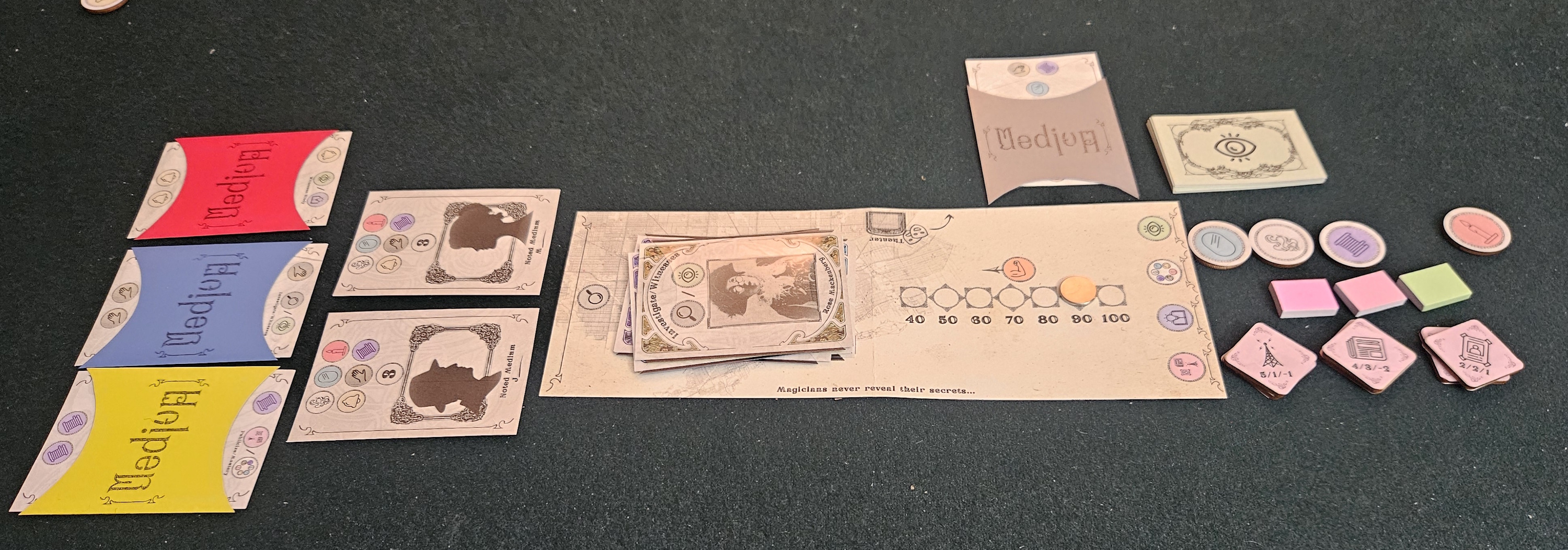
Houdini’s Last Act feels like a magic trick. And not only because designers Chris Zinsli and Suzanne Zinsli (no relation) (okay, maybe there’s some relation, but it’s rude to assume) provide an actual card-shuffling trick as an intermission.

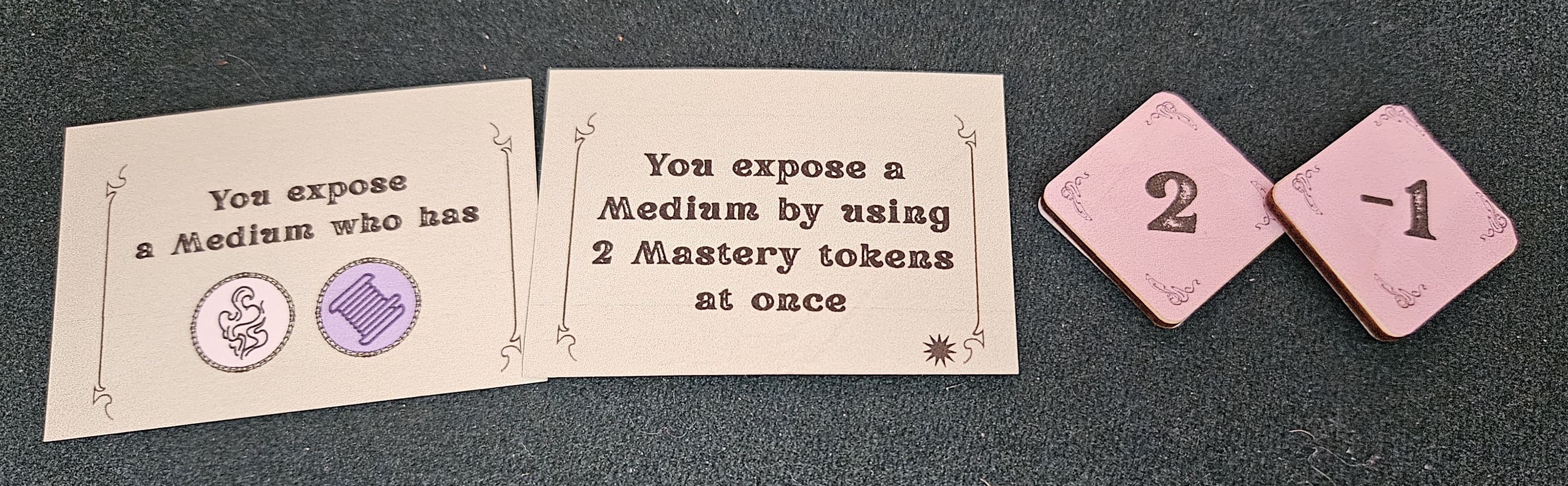
Set during the final years of the escapist’s life, the game’s apprentices — of which there must always be precisely four — are here to assist Houdini in exposing various spirit mediums as frauds and hucksters. It’s a noble objective, protecting the bereaved from those who would take advantage of them. But it’s also a testy proposition, one liable to end in disaster. Thus the game’s core tension: Will you work toward the show’s success? Or look after your own self-interest?

The components, despite being hand-cut, are lovely. The little books are my favorite. I want to put a flipbook cartoon into one of them as a surprise.

Preparing for the final show.

As a plaything, Houdini’s Last Act is tightly wound. There are two discrete acts, divided by the aforementioned magic trick, and it’s necessary to see them in motion to really understand what sleight of hand the Zinslis are getting up to. In other words, this is one magic act it pays to see twice. Which is no big thing, considering the entire game takes maybe half an hour to complete.

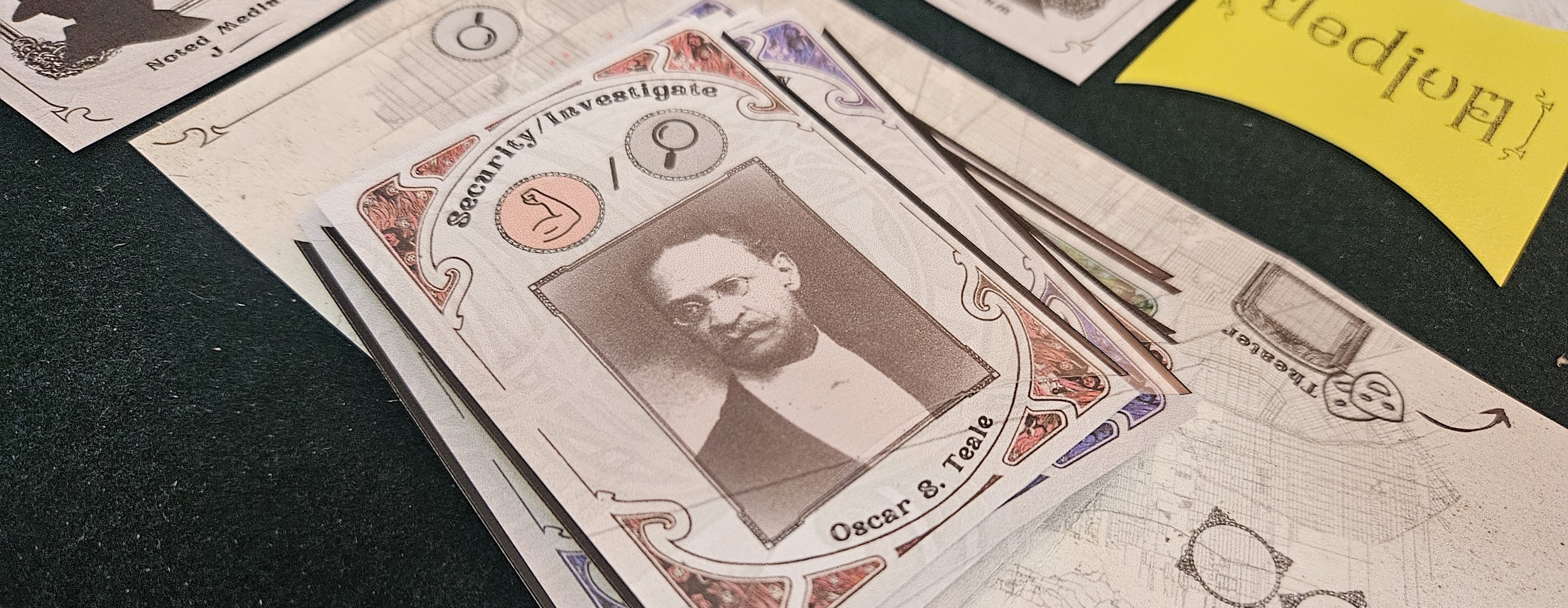
First come the preparations. Going around the table, everybody spends cards to get ready for the big show. There’s more to do than can all be handled at once, ranging from overseeing the show’s security and promoting it via pamphlets and airwaves to preparing yourself by mastering various magical techniques.

What’s interesting about the game is that each of these preparations is spring-loaded in its own way. Promoting the show, for instance, sees you claiming a private token that reveals whether the local public is on your side or feeling antagonistic. Positive numbers mean your show is more likely to succeed, while negative digits might mean… well, the other thing.

weird that they all have the same name

Just some of the frauds you might expose.

From there, the cards are (magically) shuffled and dealt back to the apprentices. Now it’s showtime. There’s still time for a few last-minute preparations, but for the most part this phase of the game is an icon-matching affair where you attempt to demonstrate the techniques the local mediums are using to defraud the public. It’s useful to cooperative tightly with your fellow apprentices. As with a death-defying escape act, any number of details might go wrong and spell disaster for the entire act.

It isn’t really until the final tally that the game’s legerdemain becomes apparent. Which is, incidentally, why I recommend any prospective players give it two tries back to back.

The first question is whether the show succeeds or fails. This is a mathematical question, the one portion of the game that feels more like bookkeeping than a careful balancing act. Provided all the mediums have been defrocked, there’s still the question of the event’s security — which sets the baseline score your team is required to beat — versus the product of those defeated mediums times the show’s publicity.

Look, the details don’t matter. The point is that you multiply one number against another, then check that result against a third number. If the show was a success, everybody wins. Otherwise, everyone reveals a personal goal card. And now the real chicanery is afoot.

that's the thing with cards, really

Every card can be used in multiple ways.

At heart, Houdini’s Last Act is a game about confidence. The confidence of its masters and apprentices and mediums, but also the confidence of its players, in themselves and one another. Because all those actions, the earlier ones in the preparation phase as well as those taken during the show itself, are slow-motion bets that your work will pay off. And depending on what you saw earlier, if you happened to publicize the event and saw which way the winds were blowing, or even if you just don’t think your crew can handle quite so much debunking in one sitting, your confidence might not be overflowing.

That’s where your personal objectives come in. If the show fails, the game switches tracks and checks the goals you’ve been tending this whole time. Maybe you want to expose a particularly skilled medium personally, ensuring your own legacy on the stage. Or maybe you’re more cynical, angling for the show to fail spectacularly. Either way, apprentices who aren’t feeling especially good about the tour’s odds can claim additional goal cards. But this is a dangerous proposition, threatening to sow discord. Wait, why did you draw another goal? Do you know something I don’t? Are we a team or what?

Even small doubts can have a corrosive effect. All it takes is one draw at the wrong time and suddenly everyone is thinking twice about overseeing security or learning stage techniques. Instead, they’re checking their little green objective cards and making weird decisions. Like insisting that we debunk more mediums than we can strictly handle, or getting flustered when somebody else claims the wire-work mastery token, or drawing two new goals in a row.

I check my hidden goal card: "Finish the Great American Novel." Uh, no problem, I think, and play my very first action to draw something else.

Some of the things you might know… and keep to yourself.

To be clear, Houdini’s Last Act never becomes more than a bite-sized experience. Even played twice in a row, it probably won’t consume a full hour. There are certain limitations to what can be accomplished in such a short span of time. Sometimes a longer duration is a boon. When it comes to ambiguous behaviors on the part of fellow players, a game this short doesn’t provide much room to observe whether people are acting squirrelly.

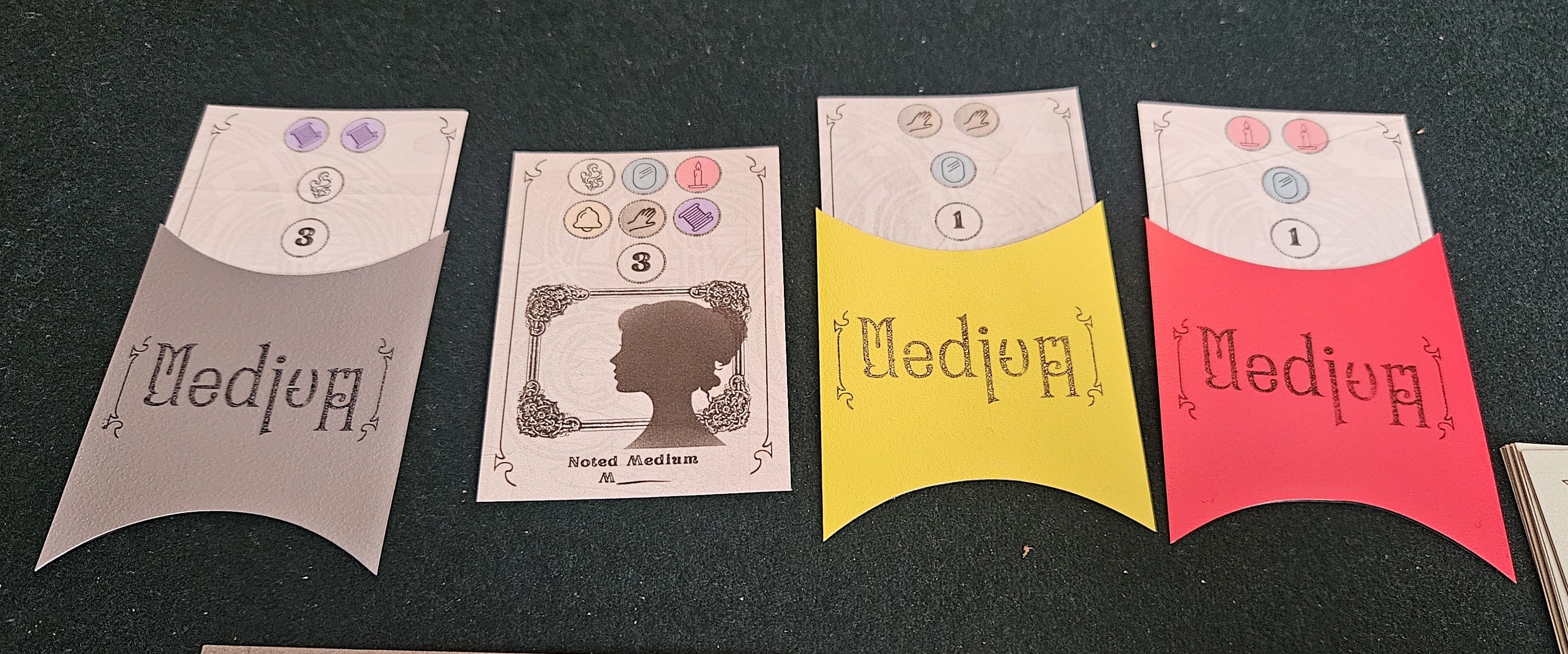
But the magic trick is that it doesn’t matter, at least not as much as it might have otherwise. Houdini’s Last Act works because it’s charming in all the right places. The way the sleeves are designed to let the cards slide one way or the other to reveal hidden information. The cardplay, which is simple but never shows even the slightest pound of extra weight. Putting on a successful show is genuinely challenging, enough so that pursuing a side hustle or two seems wise. Even the little magic trick in between acts is amusing, a ritual that takes so little time that you might as well go through the motions rather than dealing out the cards normally.

The result is a game that punches well above its weight. Not unlike the little escapist himself, come to think of it. For such a small thing, there’s some real verve here, a commentary on magic as showmanship and mystery versus hucksterism and superstition, about personal goals versus collaborative efforts, about we silly humans who love to be tricked so badly that we grow addicted to it.

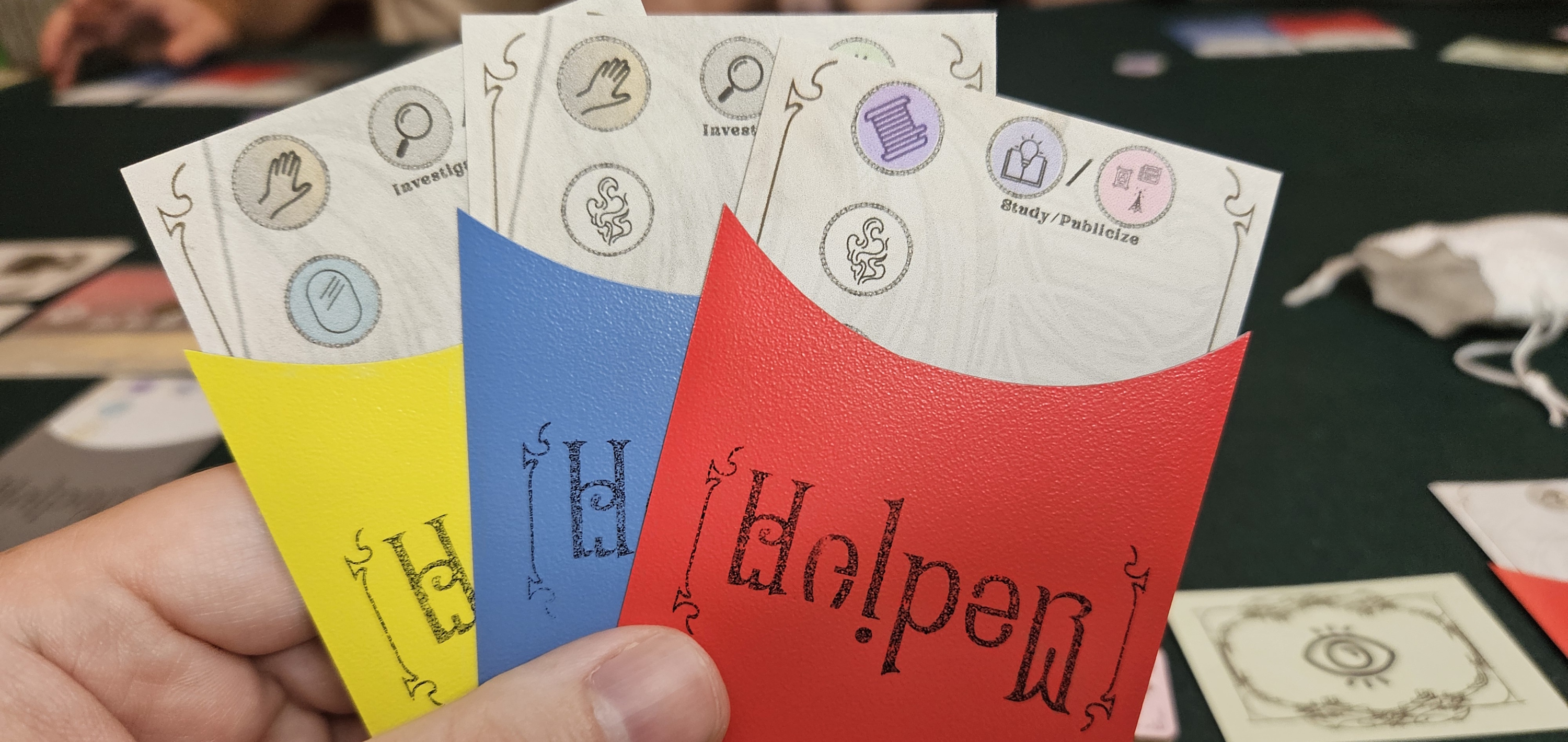
The double-perspective text is neat, but I think I can read it upside-down better than right-side-up.

Improving your skills means revealing extra icons on your cards.

Which is, perhaps, the final flourish of this particular offering. Like all figures from history, Harry Houdini had his textures. But he also stuck by his principles, especially where it came to debunking those who took advantage of the bereaved. He sacrificed friendships over it — most famously with Sir Arthur Conan Doyle, that faerie-believing dork. As an offbeat and enjoyable expression of history, Houdini’s Last Act is a suitable tribute indeed, a brief foray into a world where magic and reason brushed shoulders and left audiences entertained.


A complimentary copy of Houdini’s Last Act was provided by the designers.

(If what I’m doing at Space-Biff! is valuable to you in some way, please consider dropping by my Patreon campaign or Ko-fi. Right now, supporters can read the next installment in my series Talking About Games, this time tackling the topic of what makes a good list! Naturally, the piece includes a list.)
Doing Our Best

27. Juli 2026 um 21:16

Tag yourself. I'm the one who, in high school, was absolutely smitten with this girl, but she was sort of aloof and I was awkward, so I wanted to have my arm around her in the dance picture, but I was too afraid, so I just sort of put my arm behind her, but then the picture developed and made me look like I had my hand right on her ass. Which is to say, I'm the second one from the left.

There’s a tagline on the box of The Witches of Willowspur, the latest game by Jenna Felli, that I appreciate deeply. “Doing their best,” it reads. It’s a reference to the titular witches, the daughters of wicked witches who, as a clique of misbehaving teens, have decided to get up to some good by releasing Prince Murray — the very same Murray the A**hole Frog who troubled the waters of his own title — from his shapeshifted form as… well, as a frog. Presumably not as an a**hole. There’s no counterspell for that malady.

“Doing their best.” It’s such a warm and reassuring phrase. This is a cooperative game about teenage rebellion and about teenagerhood more broadly, about finding one’s own goodness despite a world that would rather hammer you into a very different shape. Presumably Felli also did her best in crafting the game. I so very much wish it had resulted in something more playable.

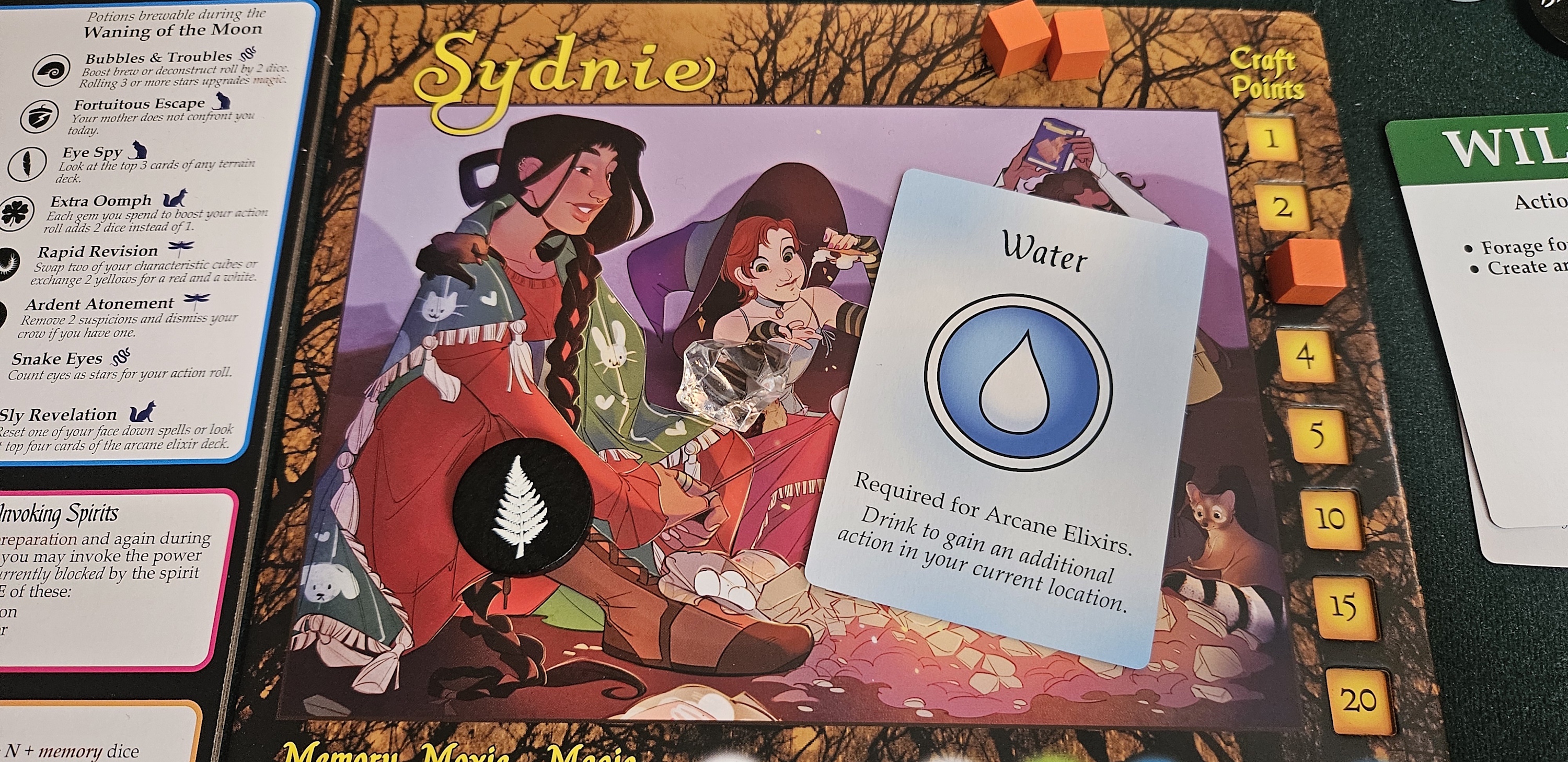
Also pictured: water. Which is a card and not a token, for some reason.

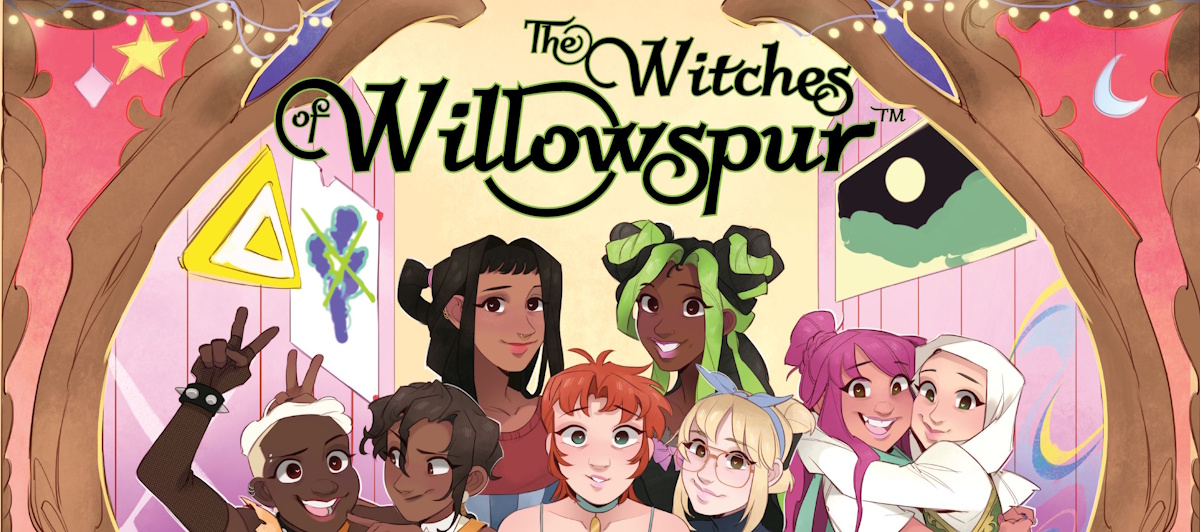
The witches are warm and wonderful.

Before we get into all that, I want to whisk us to a more distant vantage. The Witches of Willowspur is the first of Felli’s games that fully inhabits a shared world, at least without some measure of insider knowledge. Where her previous title made us despise the appearance of that blasted frog, this rulebook implores us to appreciate the Prince’s plight. To show some measure of understanding for someone who, let’s face it, is a bit of an asshole.

Enter the witches. There are ten in all, and it’s hard not to feel warmly toward them. There’s a lot to be said about their portrayal here; their diversity, their inclusivity of gender, the way each of them is introduced in company to produce glimpses of iron-bound friendship. Zara wears a headscarf that also houses her familiar. Abigehl holds herself with a rigidity that speaks to someone still learning to command her body. Sydnie has a stillness that’s always contrasted with the perpetual motion of her besties. Kate seems like the normie of the pack, which also marks her as the group mom. In them, I see people I knew in my own youth. People I still know, in some cases.

Which also speaks to the way even something like a board game, a narratively fluid medium very much unlike more set forms such as television or film or novels, can speak truth about the way we behave and commune and interact. One gets the sense that these teenage witches are good not in spite of their rebellion, but because of it. That’s the case with most teenage rebellion, or at least that’s how I’ve come to see it. I remember when my grandfather told me that he thought of my dad as having been a cold boy in his teenage years, distant, annoyed by family dinners and adult wisdom. And then, how, in a moment of sudden clarity and unexpected defensiveness for a father I was in my own period of rebellion against, I discovered myself coming to dad’s defense. He wasn’t cold; he was studious and dedicated and wanted to make the best of himself and, yes, sometimes getting together for dinner was an intrusion into those processes. I surprised grandpa, and surprised myself, and never bothered to tell dad about it, because such direct support is not something the men of our culture are permitted to share with one another.

GAH! THE BIRDS!

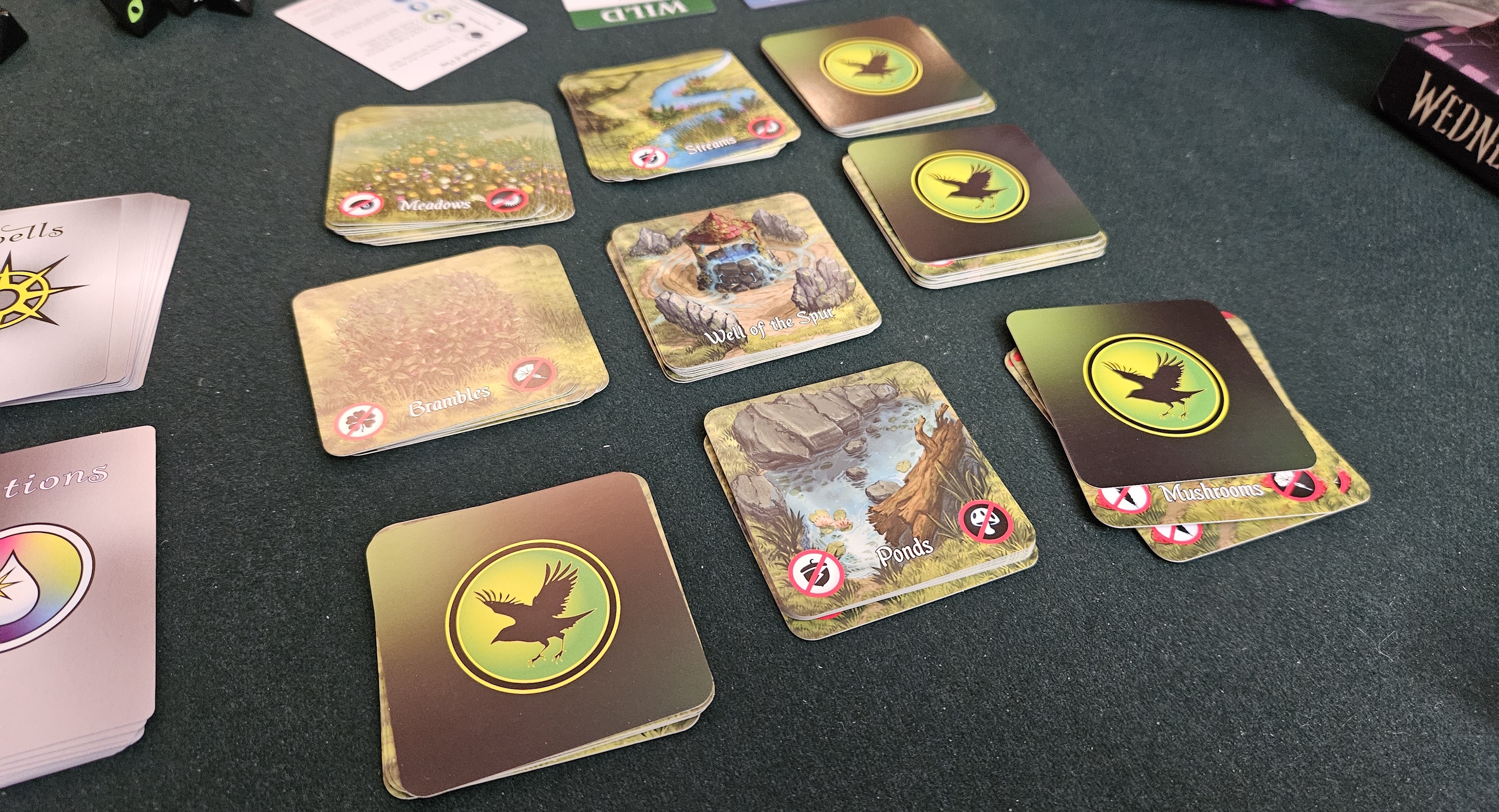
Foraging in the wild for ingredients.

Which brings us to the young Witches of Willowspur. Murray may be an asshole, but even an asshole probably shouldn’t be doomed to a lifetime as an amphibian. So these girls have decided to prove themselves through rebellion. They are not saving the world. They’re saving an entitled jerk, but that’s probably as far as their cantrips and familiars will permit at the moment. It’s practice, in other words, for the greater task of building communities and families, for the necessary rebellions that will come later.

Felli imbues this struggle with deft touches. It’s hard not to see the fingerprints of someone who cares deeply for this particular tale. Most of the game is concerned with questions of process: where our kids will focus their efforts today, whether they’ll work as a gang or labor apart, how to swap a crystal for some nightshade. All the while, however, the presence of the coven’s mothers looms large over the proceedings. It is the shadow of parenthood, the very same our protagonists are hoping to evade.

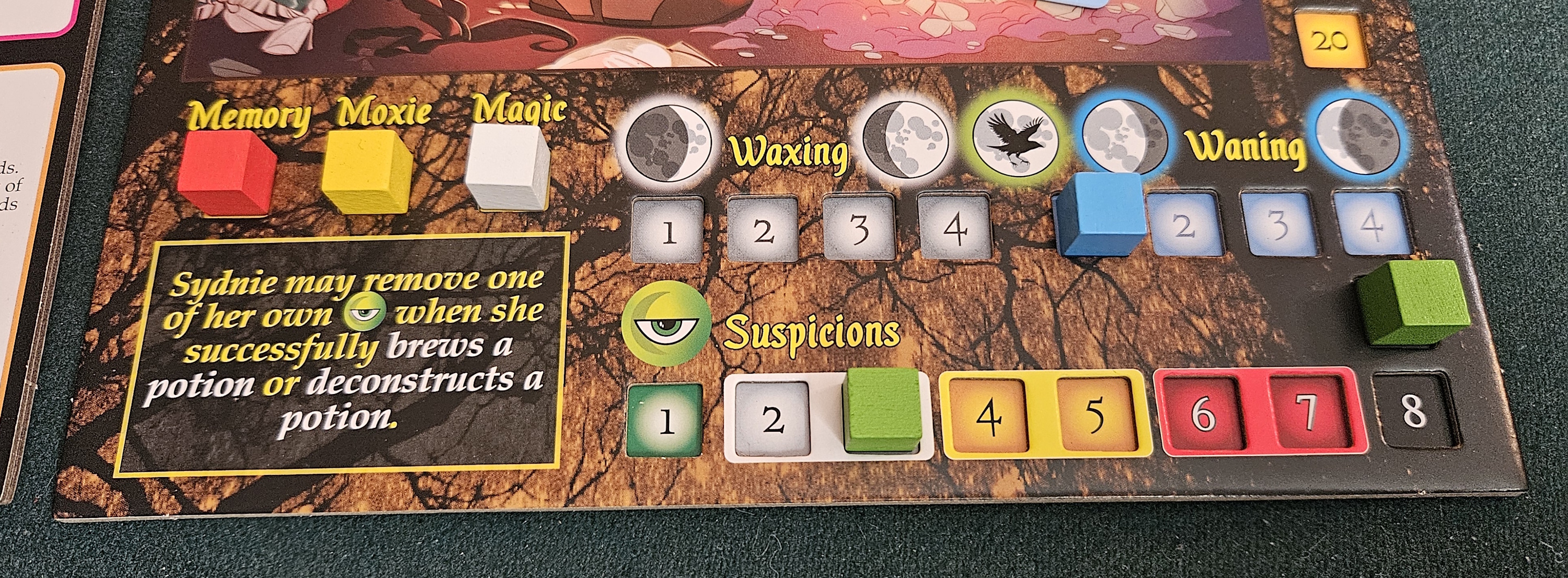
For example: when foraging for ingredients in the wild, the girls’ mothers have instructed ravens to watch for misbehavior. Normally the girls go out, roll some dice, and hopefully uncover the right ingredients for their brews and elixirs, or at least bottle some enchanted water. But when one of those raven cards is revealed, or even when the dice roll amiss, these carefree activities are intruded upon. Your mother’s suspicion ticks upward, perhaps resulting in a guardian raven of your own or a sentence of confinement in your room.

In our last session, we only found spells in dragonfly and cat suits, which was a severe hindrance to our spellcasting talents.

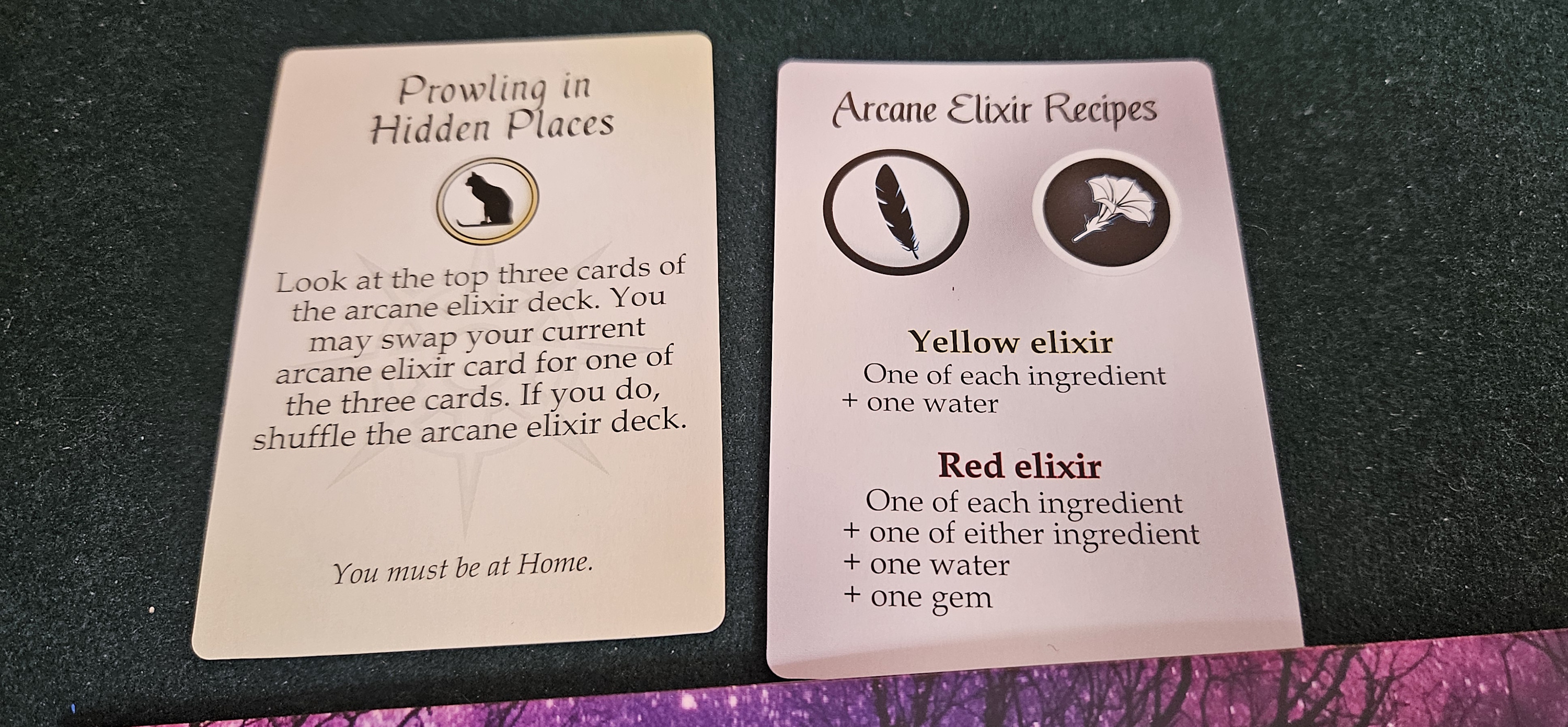
Spells and potions are admirably powerful.

But here’s the part that’s so relatable: your mother’s suspicion is tiered. There’s no difference between two and three suspicion, or four and five, or six and seven. The only thing that matters is when you pass one of those thresholds. Which means that, in being caught misbehaving, you’re encouraged to misbehave a little more. To press your luck, in game terms. But also in terms of teenage psychology. Because when you’re getting lectured, maybe that’s as bad as it’s going to get. You can make amends later, beg forgiveness, do chores around the house. In the moment, the mere reality of the punishment is enough to egg you into greater misdeeds.

Other touches are similarly adept. There’s the sheer potency of the game’s magic system, with its potions that can alter your luck outright and spells that ought to be cast as often as possible. Of course, these are paired with limitations of their own, but these once again open the umbrella of your mothers’ oppressive sheltering. Chugging an unnecessary potion in order to bypass the spirit ward that’s blocking the spell you’re hoping to cast is the perfect analogy for teenagers passing physical notes because their parents can read the text messages on their phone watches. The Witches of Willowspur is about slipping through the fractures that manifest in every parental monitoring system, given enough time and correspondence between dedicated teens.

Which only makes it all the harder to talk about the ways the game slips through fractures of its own. It’s a little heartbreaking, to be honest.

just the worst

Parents suck, huh?

The earliest offender is the rulebook. Felli has always produced dense tomes of rules, and her games are nontraditional enough that they must be seen in motion to comprehend. Here, though, the instructions are a vertiginous mixture of thematic notes, roundabout instructions, and variable-stuffed formulae.

It doesn’t help that the resultant actions are similarly jumbled. Most actions require rolls, but not all, and those rolls will sometimes demand little adjustments according to your witch’s skill level in one of three traits. Those traits begin at zero rather than one, but then a formula will ask you to add one to the results, raising one’s eyebrows over why the bottom-level trait wasn’t listed as one to begin with to save on the extra operator in the formula.

As for the rolls, these are fraught things, nearly as likely to raise your coven’s mothers’ suspicions as produce successes. Except some actions require successes where others might benefit more from teamwork, while others still are performed without any sense of risk at all. The results are certainly textured, but to such a degree that we were forced to constantly refer to both the reference chart and the rulebook when the former neglected to include a crucial piece of information.

And then there’s the disconnected nature of the whole thing. Each witch has their own tracker for the day and the phases of the moon, but these would have been better served as a shared track in the center of the table. As it stands, a minor oversight on one player’s part results in a temporal mismatch that leaves everybody confused. The same goes for the whole location-visiting nature of the gameplay. It’s basically worker placement, except everyone uses their own set of cards to designate whether they’ll spend the day at home, in town, or exploring the wilds, necessitating constant updates where a quick glance at a shared board would have saved time and headache.

It isn't as bad as it looks... but that's only because it looks real bad.

Um.

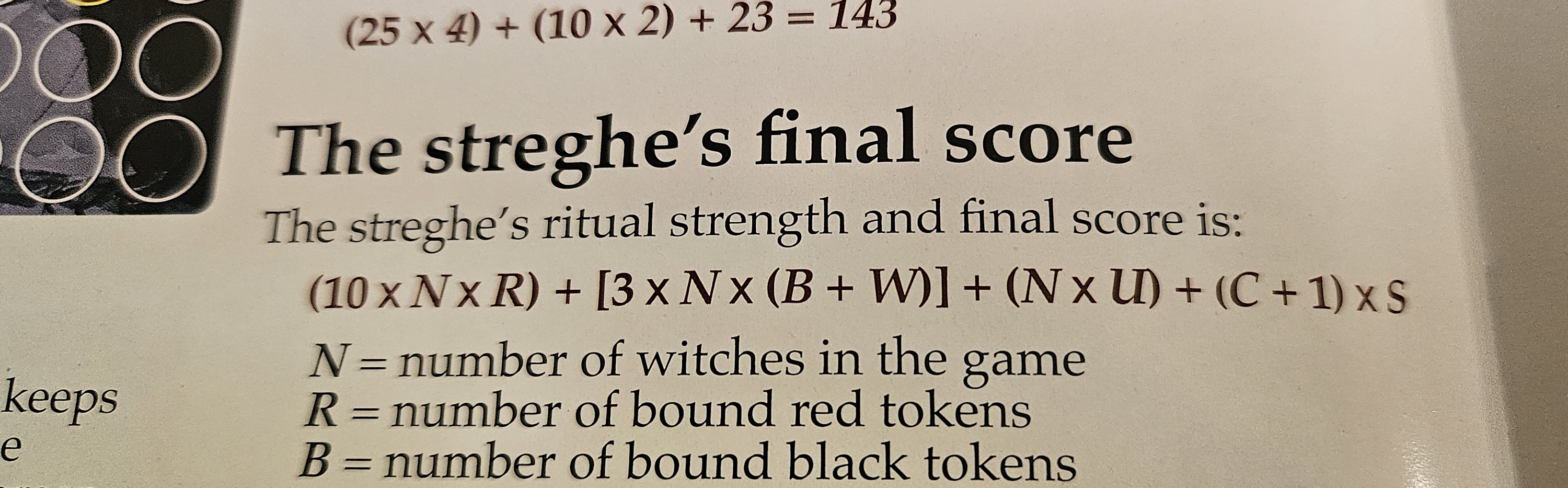
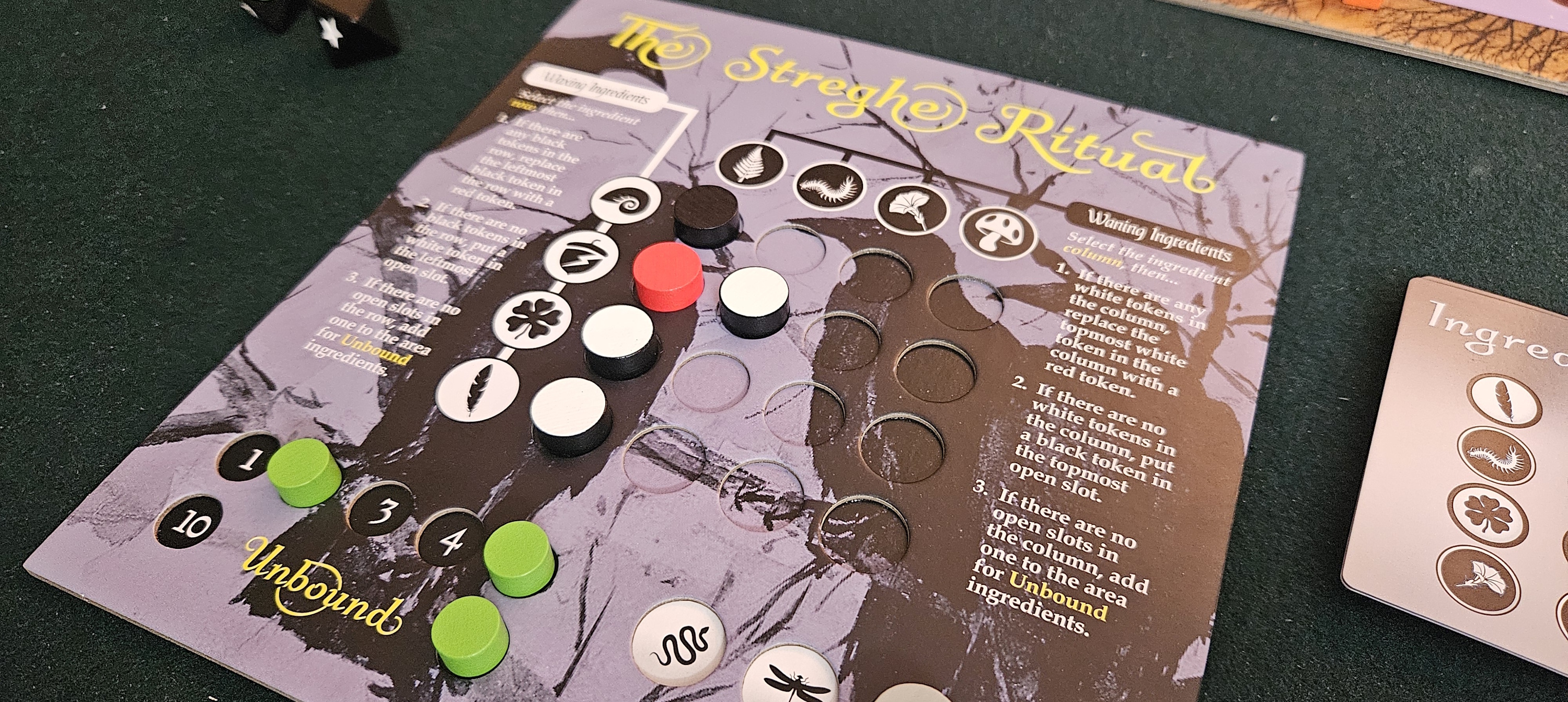
As for the actual objective of this whole shindig, The Witches of Willowspur presents a board where your mothers’ ongoing ritual against Prince Murray is tracked… except this bears little direct import on your own progress. There are a few methods for altering what’s happening over there, but there’s never really a case where, say, some adjustment to the ritual forces your witches to alter their plans. Ultimately, it’s a way to generate a score that you must beat through brewing potions, casting spells, and leveling up your skills, all of which produce their own numeric value, the opposite of violating a hex or brushing through a circle of salt. The game trundles on and on, then ends with dueling mathematical formulae rather than a confrontation. It’s as damp a conclusion as I’ve seen.

There are diagnoses I could offer. How a game this ambitious needed wider development, an outsider’s hand to pare away the dead branches, a stronger sense of internal consistency.

Really, though, the whole thing strikes me as tragic not because it’s a failure of design, but because it clutters such a keen portrait of adolescence on the cusp of adulthood. Playing The Witches of Willowspur, I find myself recalling my own youthful rebellions that were also my earliest attempts at goodness. Through illustrations and certain in-game activities, Felli captures those efforts in all their complexity, then fumbles at giving them the conclusive outcome they deserve.

Our witches, after all, are not rejecting their mothers’ lessons; they’re still practitioners of the dark arts. But in seeking to use those lessons for a more robust purpose than mere troublemaking, they embrace the renewed necessity that is youthful activism. We’re often told that age brings wisdom, but it also brings complacency, and often when an adult calls a particular cause “childish,” they fail to realize that they have identified the real nut of the problem. Some things are so obviously wrong that even a child can see it. So wrong that only an adult can persuade themselves to shroud its wrongness in nuance.

When I first saw this, I assumed we would be putting our own tokens on there to do cool things! Instead, nah, it says you need to beat 207 or something.

The ritual binding mostly serves to establish a score to beat.

In the end, The Witches of Willowspur is remarkable in its ability to capture some sliver of that hopeful adolescence. Win or lose, the witches are doing their best. I imagine Felli did her best, too, just as I’m doing my best to write about it, and you’re doing your best to understand it. Have we succeeded? Not as a board game, not all the way. Maybe not as a review, either.

Still, we come back to the reassurance of that line. Those of us who want to do good are doing our best. It’ll have to be enough. If it isn’t, nothing will be.


A complimentary copy of The Witches of Willowspur was provided by the designer/publisher.

(If what I’m doing at Space-Biff! is valuable to you in some way, please consider dropping by my Patreon campaign or Ko-fi. Right now, supporters can read the next installment in my series Talking About Games, this time tackling the topic of what makes a good list! Naturally, the piece includes a list.)
Playing with Cellulose Fiber

24. Juli 2026 um 23:06

Uh oh, did I list these in increasing order of goodness? YES. YES I DID. FOR I AM THE DECIDER OF GAMES, AND ALL SHALL KNOW MY LOGIC.

Paper! Despite the meddling of the internet, it’s still everywhere. There’s a good chance you have some in your very own home. In fact, it’s probably within arm’s reach right now. Coming for you. Fluttering closer. Ready to give you a stingy cut on the fingertip.

But for all its sins, paper is good for a few things. Making board games happens to be one of them. And today, I’m going to talk about three paper games I’ve been playing this week.

they're called colts, but that's super weird

A crane chick.

Rock Paper Crane

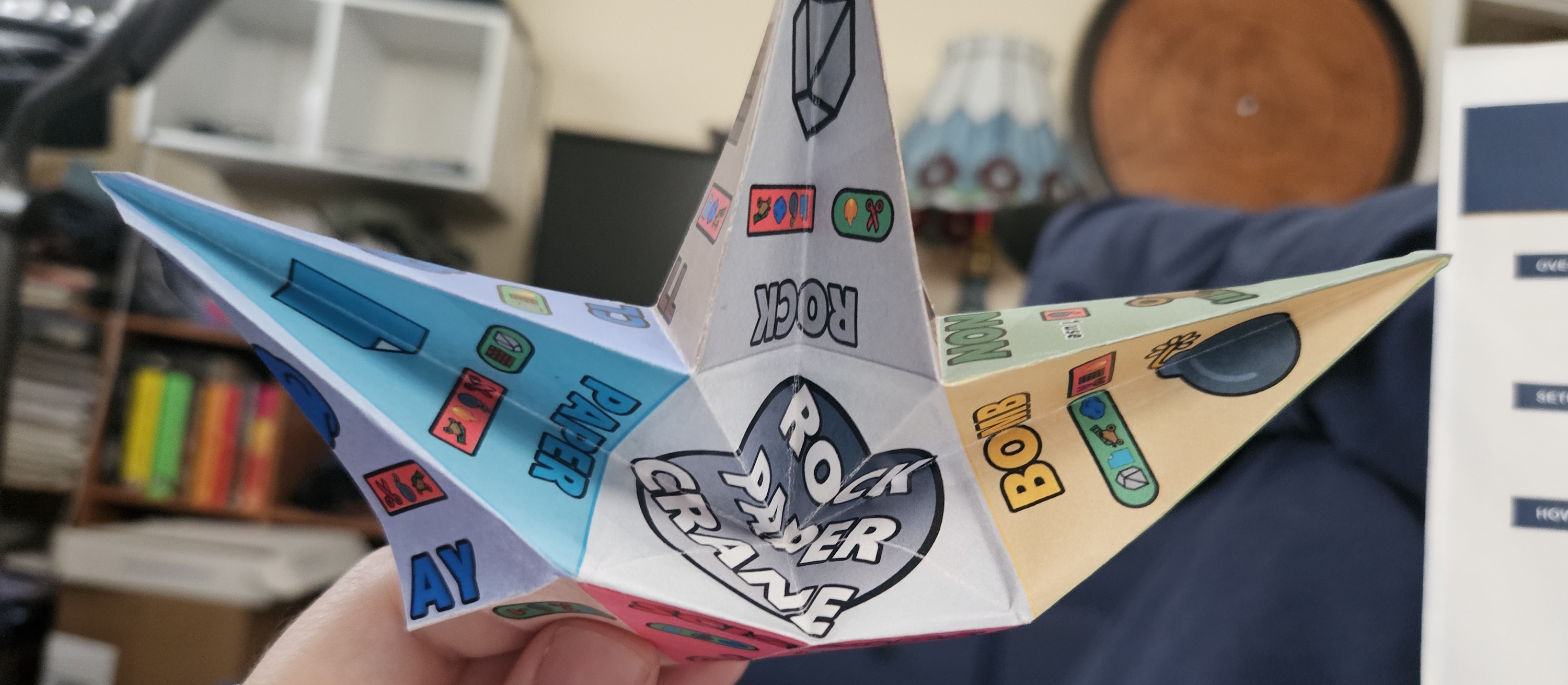
Rock Paper Crane bills itself as the world’s first-ever origami card game. True to its word, its construction requires you to craft the first couple of steps for making an origami crane.

Okay, so that’s the first problem. I dabbled in origami once. But I also happened to be six years old. Also, my little sister ruined my collection of nice origami papers, so I decided to spite her by never going back to the hobby or informing her or really imposing even the slightest imposition on her in any way. Which is to say, I finally fumbled together those first few steps. But the magic is in the fingers, not the voice, so as I labored to instruct my wife in how to shape her crane, I may have uttered the phrase, “You need to tuck in that piece, you’ve got it all popped out and flabby,” to which she replied, with a rather elevated voice, “You’re all popped out and flabby!”

So. Um. Be careful who you play Rock Paper Crane with.

I don't remember the next step. Nor will I ever.

Crane, interrupted.

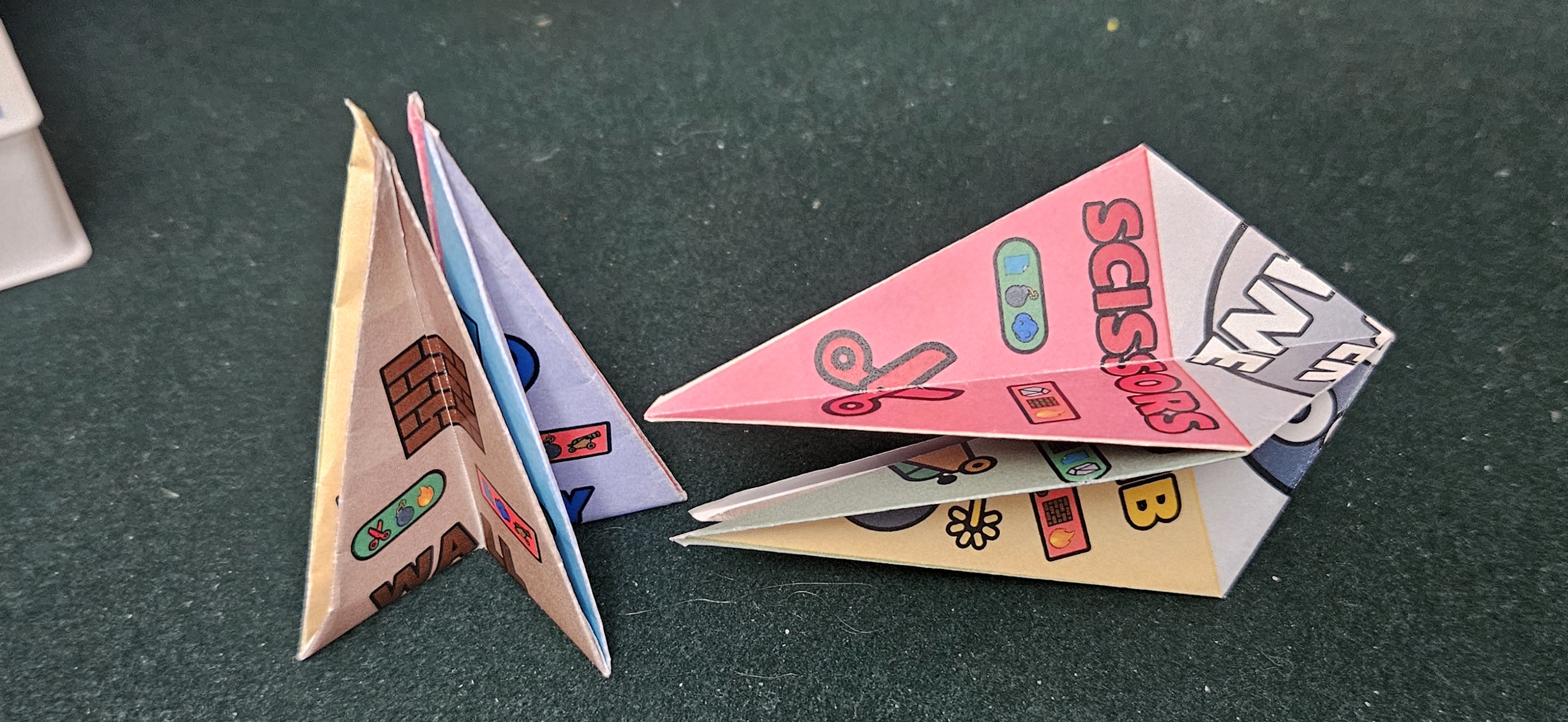
Once assembled, Rock Paper Crane is Rock Paper Scissors with extra steps. For one thing, there’s an extra piece, the bomb. For another, winning a throw means you upgrade one of your sides. (Pause for origami.) Rock becomes wall. Paper becomes clay. Scissors become fire. That sort of thing.

Your objective, ultimately, is to win four throws, which will bring you one step closer to a finished crane. More importantly, you will have won the game. Or lost it, which is just as good, because, like I said, Rock Paper Crane is Rock Paper Scissors with extra steps.

Did I finish my crane? Nope. I couldn’t remember past those first two steps. Honestly, it’s pretty amazing that I got this far at all. Maybe I could have looked up the next instructions. But I swore an oath to never finish an origami ever again, and I’m true to my word. Take that, Mary.

Hm. Can I use this game to teach my children how to operate my kingdom long after I have departed this mortal realm?

Putting coins on paper.

Master of Coin

Master of Coin is the eighth title from Postmark Games that I’ve played, and this time Rory Muldoon and Matthew Dunstan are ditching the dice and the cards. Their replacement? Coins, of course. It’s right there the title.

As you might expect, Master of Coin makes good on its conceit by requiring you to flip so many coins that your fingers will start to smell rather pockety indeed. Covering a single year in the history of a small kingdom, you begin each month by picking up some number of coins — the exact quantity varies by season — and flipping them to determine how many heads and tails you have to work with.

Early on, your options are finite. A few basic buildings, some technologies, and any leftover orphans packed off to the army. But it isn’t long before the gameplay begins to accelerate. Once completed, you can clear a building of its coins to activate its ability, whether to unlock better structures, develop your nation’s economic infrastructure, obtain perks in war and peace, or maybe construct monuments that unlock better scoring benefits. Crucially, some abilities let you “lock” coins, sliding them a few millimeters upward on your sheet. From that point on, when you clear the corresponding structure, any locked coins stay in place.

As a concept, Master of Coin is solid. Consider the army. When it’s time to march on neighboring provinces, you pick up all the coins in your army and give them a flip. Heads become indicators of conquest, while tails are failures. But there are so many ways to massage the odds. Certain buildings, like the catapult, can be cleared to produce guaranteed successes in battle. Or there are techs, like gunpowder, that let you shift a coin from tails to heads, saving you in the nick of time. All this is to say that there are ample ways to get ahead. Even if you, as happened to our group, happen to play a session with novelty coins that always flip heads.

aitg

Money is great for conquering distant nations.

Of course, there’s more to be seen. As with previous Postmark titles, Master of Coin isn’t limited to a single map. The game is on Kickstarter right now, and according to the campaign there will be five scenarios in all, each adding a year to the story of this wealthy kingdom and its unfortunate neighbors.

Unlike those previous Postmark titles, however, I’ve only tried the first scenario, so I’m unable to furnish a full review at this time. The good news is that what I’ve played has been exemplary. Very quickly, I was surprised that my kingdom’s main limitation didn’t lie with having too little money, but rather in keeping too many coins tied up in other projects. The kingdom only has access to twenty coins, you see, and two of those are reserved for tracking the month and any possible events. It isn’t long before you’ll need to make some tough decisions, forsaking certain appendages of your financial project altogether to double down on whatever has become most important.

Anyway. After not being all that enthralled with Postmark’s playing card games, Master of Coin feels like a return to form, capturing some of the tight but expressive playspace of titles like Voyages and Waypoints. I’m excited to see how this one develops.

With rice. Maybe butter. Kidding! I don't like rice.

I love little fingers.

Color Jam

When’s the last time you colored by numbers? Being a parent to a recent kindergartner means it hasn’t been as long as it might have been otherwise, but this still isn’t a regular occurrence of my daily life.

Until Color Jam. Designed by Gene Koo and Joe Kell, and illustrated by Erin Laue, Color Jam is about coloring by numbers. And contrary to my expectations going in, it’s wonderful.

But first, a note. Color Jam is being published by Lunarpunk Games, the indie imprint operated by Xoe Allred and Matthew Hocker. If you’re elbows-deep in the indie scene, this might already tell you something about the game. Foremost, Color Jam doesn’t have the usual victory conditions. Nor does it really have goals, at least not goals of the foreordained variety. You’re here to make your own fun, set your own benchmarks, and, hopefully, come away charmed.

This is the future liberals want.

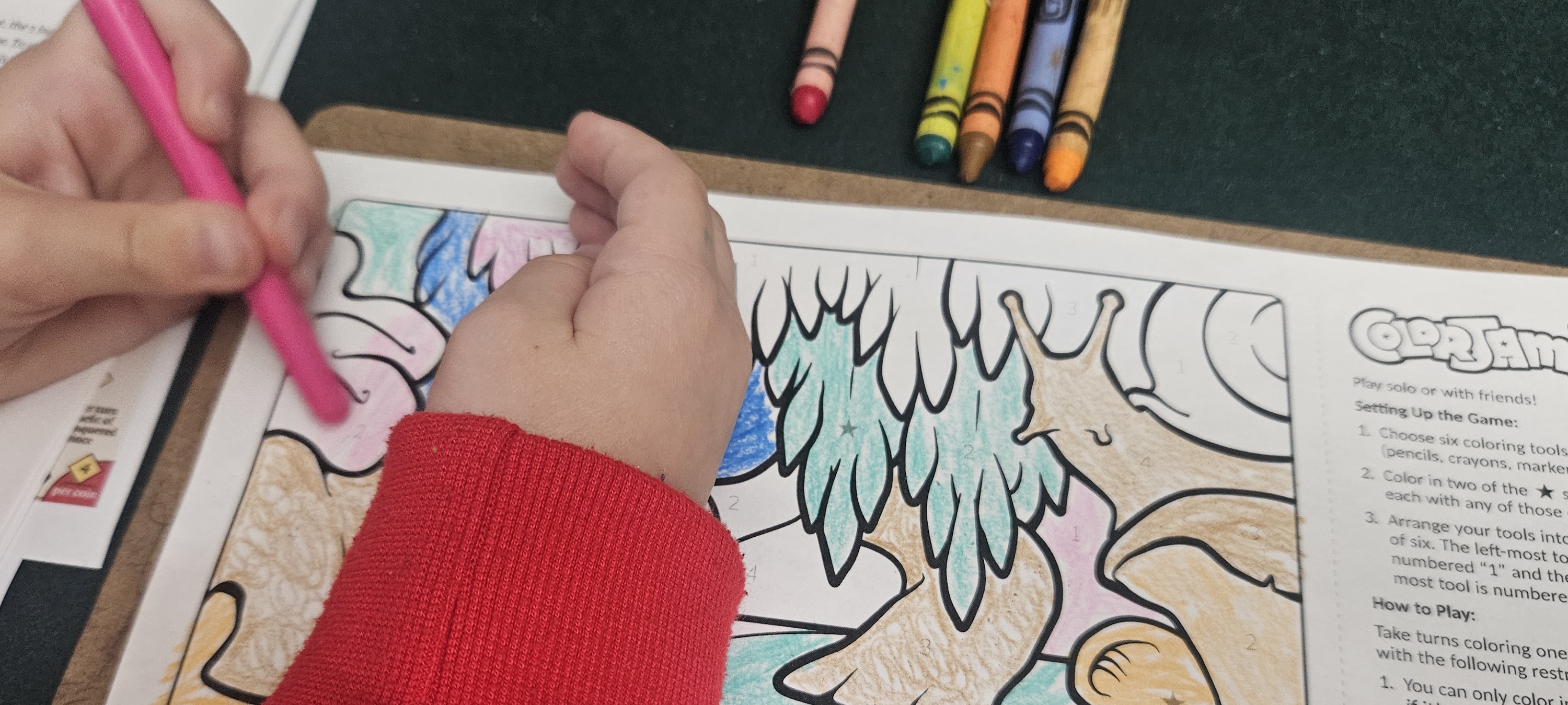
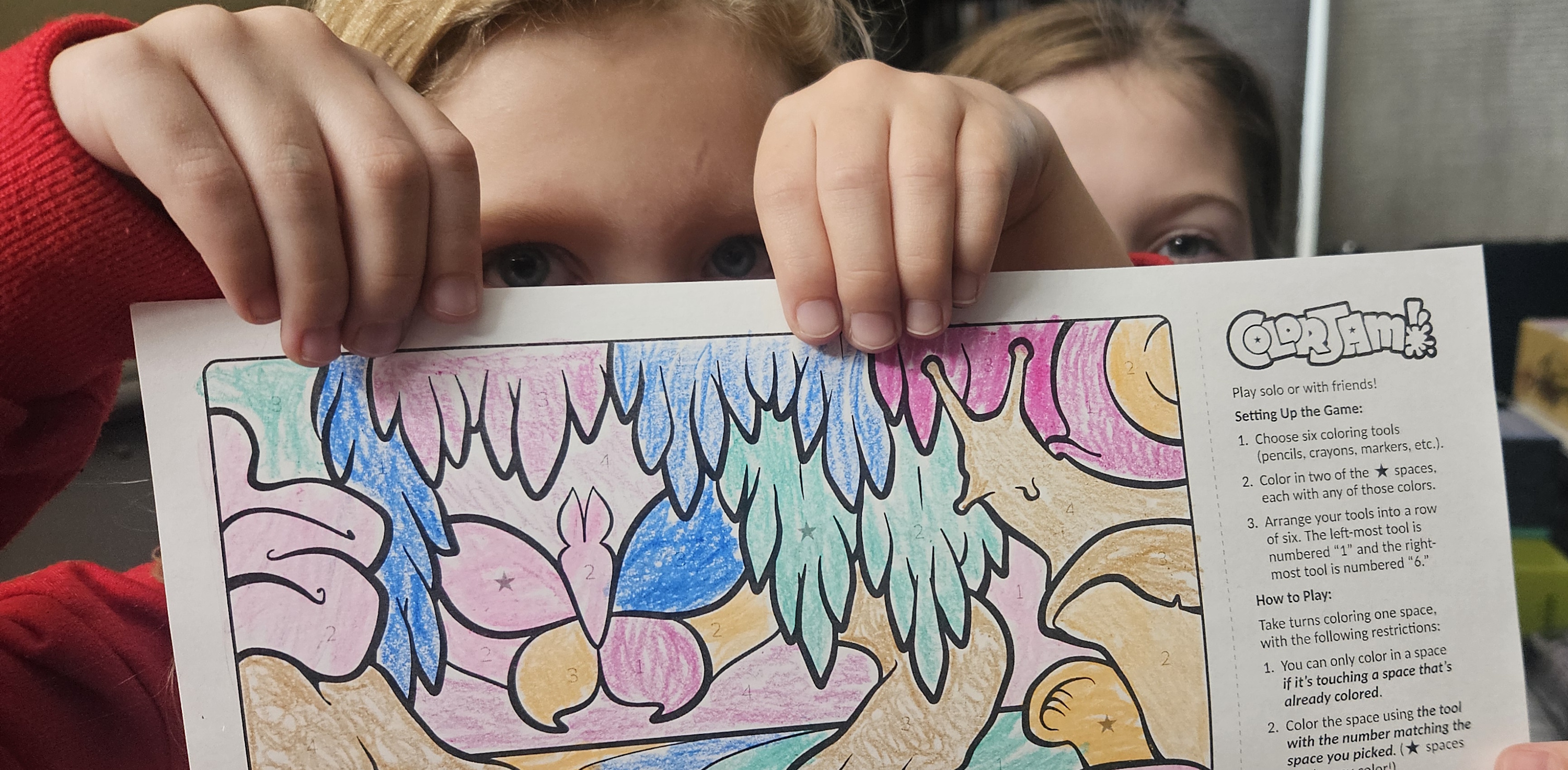
I am inordinately proud of my art.

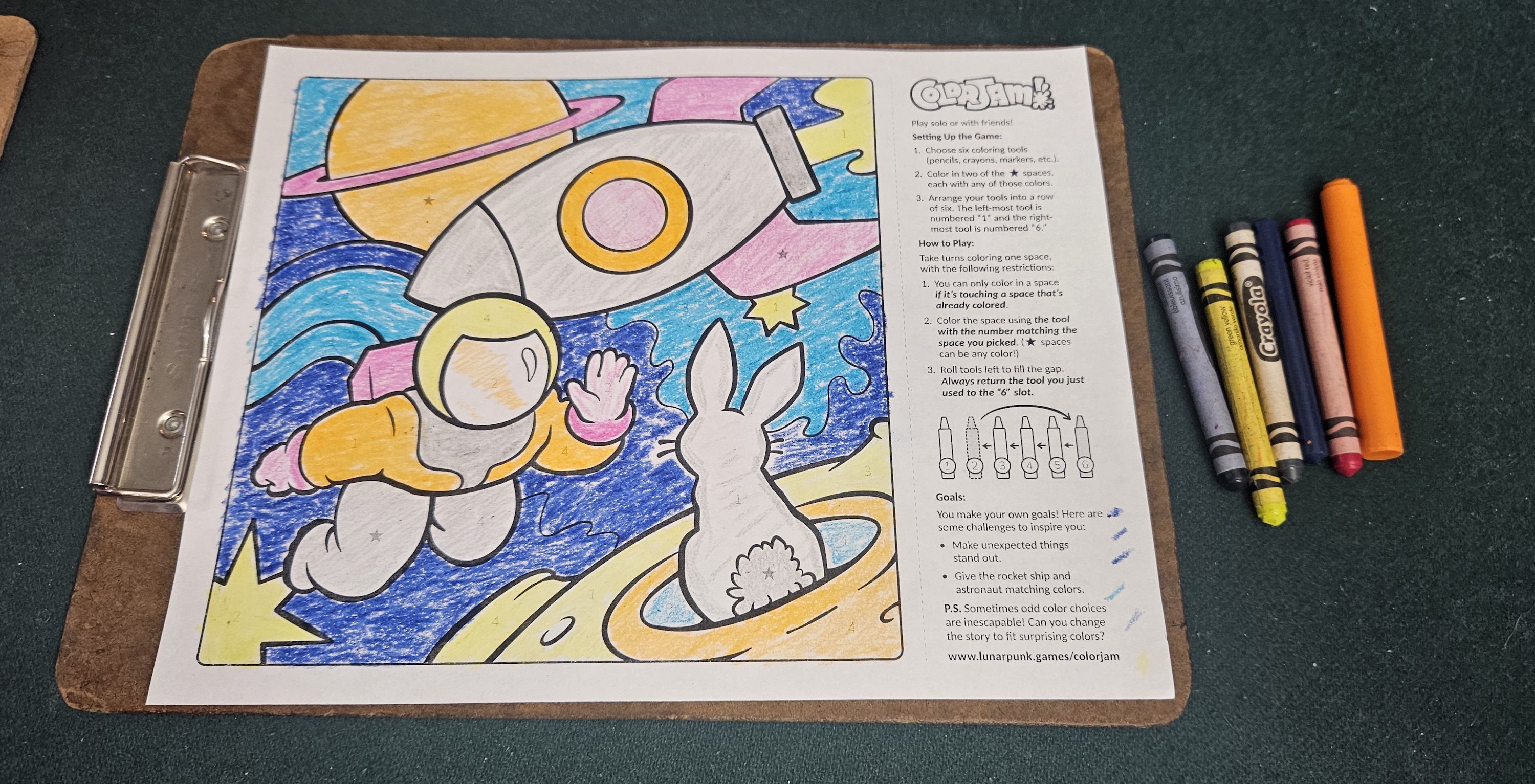
The basic idea is as simple as it gets. You take a picture and six crayons. Then you color in two of the spaces with stars in them. There are always four options, giving you some range to where you begin on the page.

From that humble beginning, you start to color in the entire thing. But there are limitations. Beautiful, expansive limitations. For one thing, you can only color a cell next to something you’ve already filled in. More importantly, those six crayons? You put them in order, numbered one to six. When you color a space, you use the corresponding crayon. Then — and this is where the game starts to breathe — you take that crayon and shift it to the last place.

Now, this might not sound like much. But it transforms Color Jam from an elementary school project into something unexpected. You might want consistency. The wings of a butterfly to align, perhaps. But the right crayon might not be available. Or, when the right crayon comes up again, maybe you’ll want it for something else.

What do you do? Well, you get creative. Maybe this butterfly is prismatic, like a jeweled brooch, its colors vibrant but mismatched. The colors can become revelatory, streaks of the unexpected in what might have otherwise been an ordinary picture. Or maybe you start to plan ahead, counting the crayons down until the right one is ready for another scribble, transforming the page into a low-stakes logic puzzle. Or perhaps you get artistic. You can do a lot with shading, with the strokes of a crayon, with the application of a smudge or a smear. Two spaces that both use orange don’t need to look the same. This isn’t the paint bucket in an image editor. You can do whatever you like.

One day this picture will be worth no cents, because a robot will have ripped it off to make slop.

The artists.

More than that, Color Jam is flexible. It’s possible to play solitaire, one person making every decision. But it’s also possible to play as a group. I played with both of my daughters, and everybody got a say in the creation of our picture. Over which crayons we pulled from the bucket. Over the turn order. Eventually, over how to account for colors that wouldn’t quite fit where we wanted them.

The most unsurprising thing about Color Jam, but which bears repeating, is that it’s simply delightful. It’s soothing to play, but thinkier than one might expect from a distance. We played together, and then we all played apart. And then Summer came home and wanted to play as well, so we did that, too. In each case, we came away having crafted something wonderful, whether in collaboration or on our own, whether according to strict logic and long-term thinking or creative storytelling, and felt all the richer for it.

Color Jam will be on Kickstarter sometime in the next month or so.


Access to the files and/or complimentary copies of Rock Paper Crane, Master of Coin, and Paper Jam were provided by the designers.

(If what I’m doing at Space-Biff! is valuable to you in some way, please consider dropping by my Patreon campaign or Ko-fi. Right now, supporters can read the next installment in my series Talking About Games, this time tackling the topic of what makes a good list! Naturally, the piece includes a list.)
Yawpz

24. Juli 2026 um 01:44

I'm the little kaiser-kisser on the right, sipping tea with my peers across the lines, oblivious to the carnage around me.

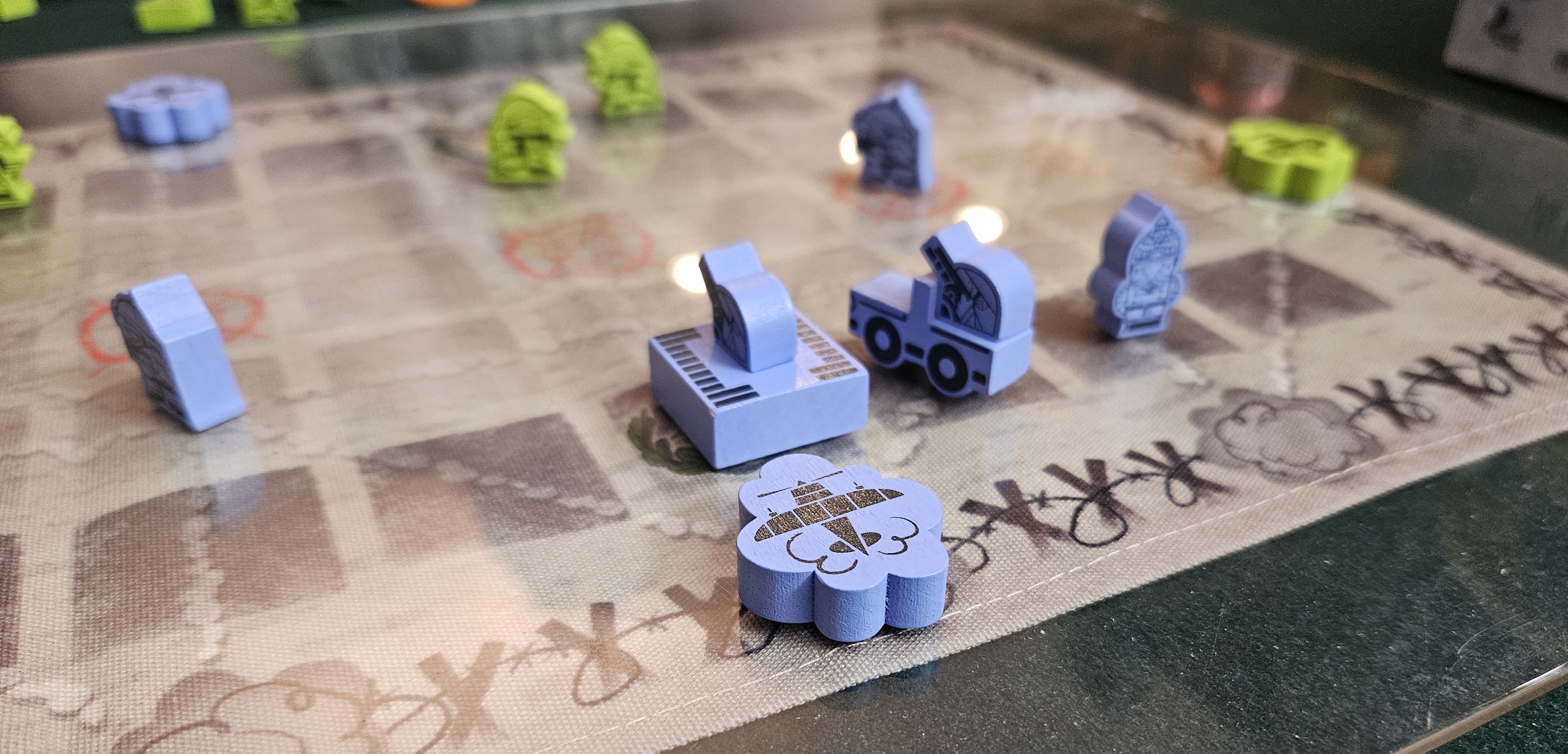
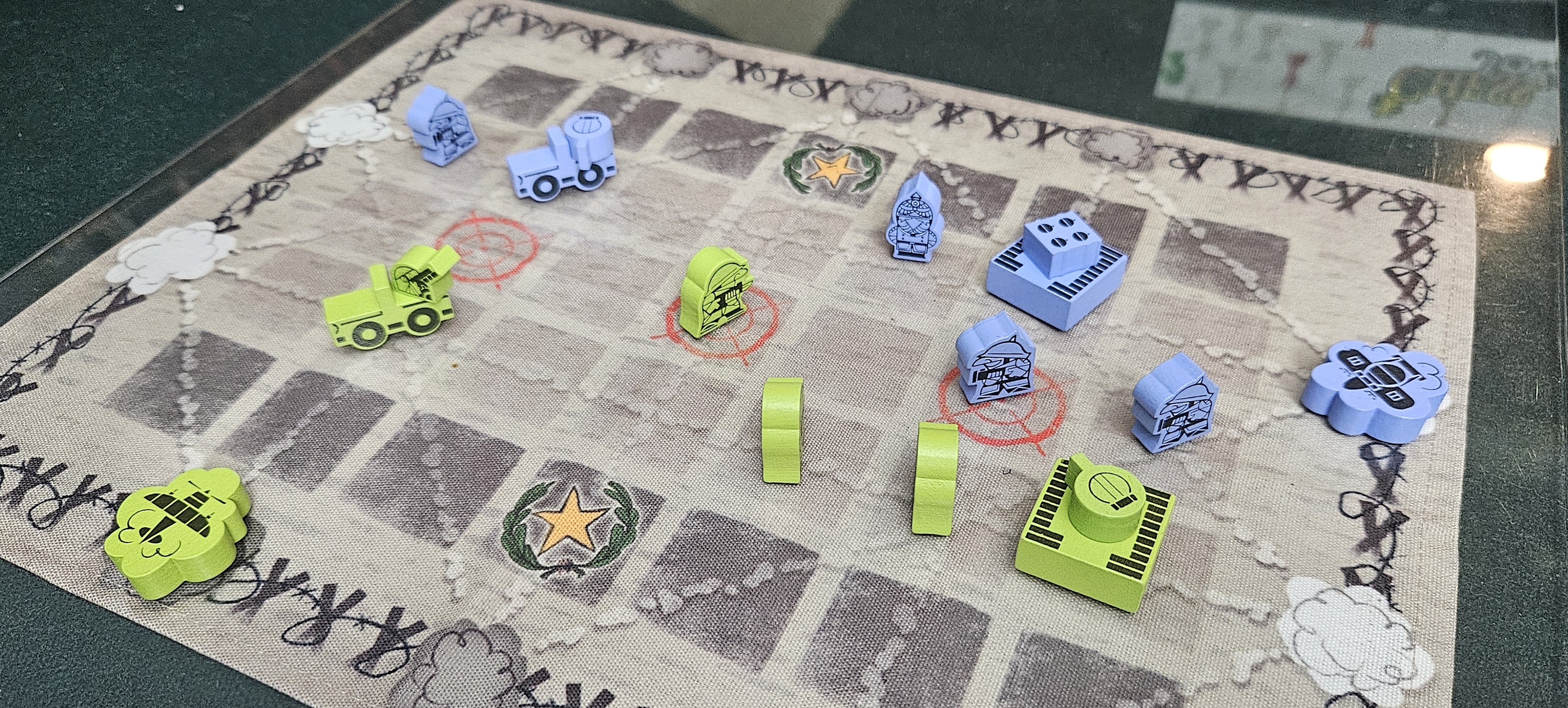
This might sound funny, but the game that kept springing to mind while playing Gruntz, the tiny-as-it-gets wargame by Carter Scott, was none other than Kurt Vonnegut’s GHQ. Like that ancient (but now resuscitated) title, Gruntz is about a pair of World War-era armies bashing it out on the field. They’re both highly attritional, encouraging a tit-for-tat gameplay that’s either enthralling or exhausting depending on your tolerance for swapping one piece for another.

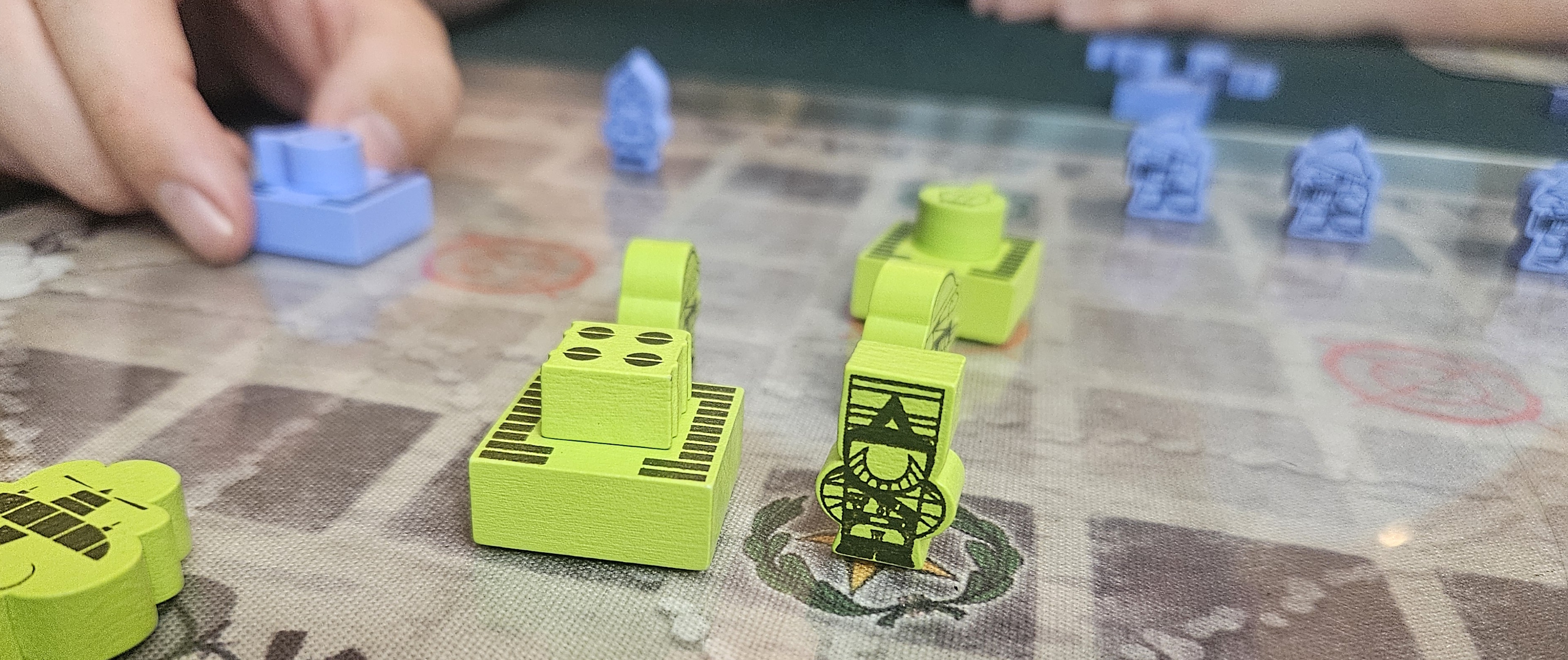
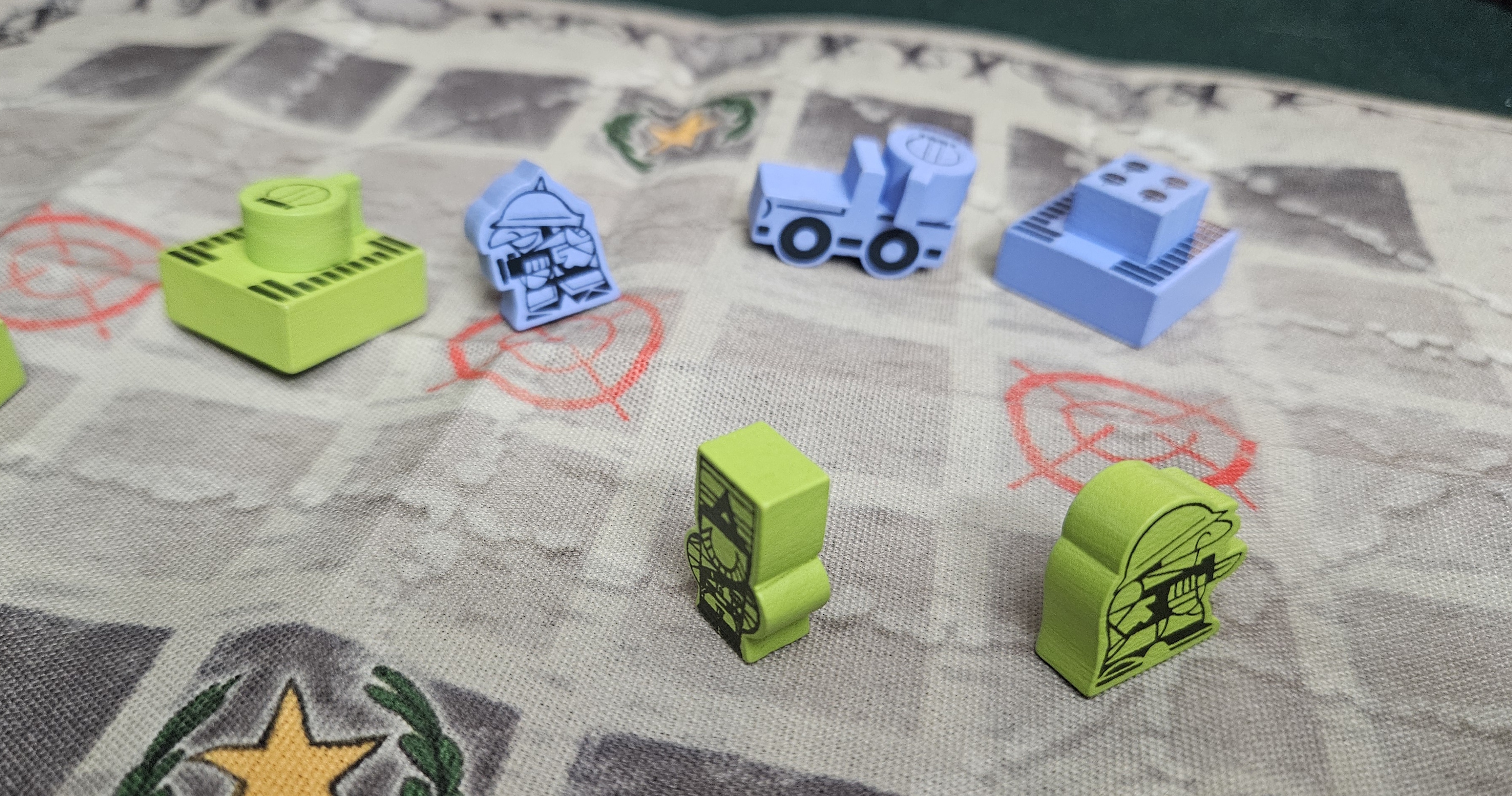
More than that, they’re both games about both movement and reinforcement. It isn’t enough to position your troops smartly. You also need to know when — and what — to call up from the rear. In the case of Gruntz, that sometimes means snapping a range of equipment onto a chassis to create a custom-built war machine.

This is never not cool. Because magnets, baby. I’m always in a mood for magnets.

This game would benefit from a soundboard of growly but cute tank, truck, and biplane noises.

Screening my fighter with plentiful anti-air.

The parallels don’t stop there, although I’m hell-bent on preventing this from becoming a comparison piece between two board games that are similarly under-known and probably wouldn’t appreciate the association anyway. Still, there’s something to be said about the way these titles portray their miniature battlefields. Where GHQ was a pale representation of Vonnegut’s WWII battlefields, dominated by artillery and armor, with infantry more or less serving as a screen for the good stuff, Gruntz is more timeless. Which is a polite way of saying that it isn’t quite as distinctive, history-wise, despite the visuals and hardware looking a little more Great War.

Perhaps the best place to start would be with the units. Infantry — the titular gruntz — represent a never-ending supply of bodies. Really, that’s their main trait: when killed, they bounce back into their general’s reserve rather than disappearing permanently from the table. They’re also useful for capturing control points, and can be moved en masse thanks to a captain who’s the spitting image of a gentleman officer in the midst of a war that’s very quickly eliminating the aristocracy at a pace that leaves every revolution red-faced with envy.

Those control points are the game’s biggest advantage over something like GHQ. Controlling two of the map’s three points at the end of a turn will award a star; controlling all three is worth two stars. Reaching three stars means victory, so there’s a strong incentive to usher your boys forward, even if it means they’ll get chewed up on the following turn.

To oblige said chewing, there are ample instruments. Both sides have access to quite the range of hardware. There are planes, both fighters and bombers, which tootle along wisps of contrail over the main battlefield, and are especially keen to obliterate anyone foolish enough to position their manpower in a straight line. These are matched on the ground by vehicles, which are built of two components, chassis and attachment. The chassis, whether armor or truck, either trundles or sprints across the battlefield, while providing more or less protection. The attachments, meanwhile, offer anti-air capabilities — more of an area denial strategy than an actual threat, it should be noted — a cannon for defeating anything in range, or a transport for depositing infantry closer to enemy lines.

By mixing and matching the best attachments, you can assemble the right tools for the current crisis. That’s the idea, anyway. Most of the time, armor gets the cannons and trucks become speedy transports. It’s a case of play mirroring life, a bit like how evolution tends to produce crabs because armor and pincers present obvious competitive benefits.

The ability to move a unit twice in a row is deadly. Maybe broken? Although I also feel that not being able to do it would make the game a little too considerate of relative ranges to be playable.

Tanks checking their ranges.

Very much unlike GHQ, which allowed its generals to divvy up their moves and reinforcements as they saw fit, Gruntz employs a stricter formula. Either you move twice and deploy once or move once and deploy twice. This ensures a steady stream of troops will enter the battlefield, and also that many of those troops will be demolished before the last clouds of smoke have blown clear.

Its most conspicuous absence is artillery. This is its biggest departure from something like GHQ, not to mention easy historical placement. Put simply, this is not simulationist fare. Units capture their peers in the manner of chess, by moving onto them, rather than pelting their targets from a quarter-mile out. The effect, then, is approximate to playing with little green army men, all bayonets and glory rather than ignoble death from afar.

To be clear, this isn’t a complaint so much as an errant thought. For all its symmetry, Vonnegut’s attempt reflected the unfairness of the war he took part in, the absence of rules, the capriciousness of the howitzer and the carpet bomb. Writing about the former war, Hemingway described modern combat as dying like a dog for no good reason.

In Gruntz, your gruntz die for good reason. The stakes are crystal clear. To defeat someone, you move into range of the counter-attack. This imbues the process with a necessary attrition. Of course, you try to avoid losing troops. A well-positioned flak cannon can stave off a bomber; a tank in the right spot can discourage an infantry push. But this isn’t a game about decapitating the serpent so much as trading bites with it, fang for fang and venom for venom, until one side is too exhausted to continue.

Then again, it does a better job of evoking a broken no man's land. Any time your grunt tips over, it's a leg sprain. Back to the hospital.

The fabric mat is a pain to deal with.

There are always back-of-mind benchmarks for combinatorial titles like this, and these exchanges make Gruntz feel more like Checkers than Chess, more about constant trades than graceful maneuvers. The one exception would be the aircraft, which glide over entire lanes and columns. A bomber is one of the few things that can ruin a tank’s day, which makes its appearance rather potent indeed. This can lead to interesting bottlenecks, anti-aircraft guns strangling any viable avenues of approach, only to grow obsolete the moment the threat has subsided.

The entire thing is full of misdemeanors like that. Obsolete units. A playmat that’s too creased to allow the gruntz to stay upright. The ease with which reinforcements appear, all but necessitating a protracted first act to clear out the chaff and force both sides to prioritize a few units. These are shortcomings, not outright game-breakers, but that only makes them more galling.

And then there’s the expansion. Allplay does this thing where they sell premium pieces separately from the main game. In most cases, it’s a positive practice. Those who want the metal bits can pay a few dollars more, while those of us who are fine with cardboard punch-outs can settle for the more affordable core box. It’s a smart middle ground.

Here, though, there’s an entire expansion that’s omitted from the main box despite only requiring a pair of reminder sheets and five cardboard tokens. Supplies, it’s called, and it adds — you guessed it — little supply markers. These can be spent to activate special abilities, like charging all your gruntz forward at once, making a crucial extra move with a vehicle, or swapping a now-obsolete AA gun for a big stonking cannon.

On its own, the Supplies expansion improves my opinion of the game considerably. It’s exactly what Gruntz needs to shine, adding a crucial but rules-light layer of resource management atop the game’s straightforward rules. Using a bomber to drop a bunch of paratroopers is incredibly cool, not to mention game-swinging; the limitation, naturally, is that your opponent also has access to their own cache of supplies. Without the expansion, Gruntz is handsome and interesting, but deeply flawed. With it, the flaws are still present, but dulled sufficiently that it becomes one of the more formidable precious-scale battlefield games out there.

Yes, you caught me, this is not from actual gameplay. But look in the plexiglass: CHESS JOKER looks on, smirking. "I am not the only mixed review this week," it says.

The view from on high.

All told, Gruntz is a strange offering, especially for Allplay’s small box line. Its direct conflict and zero-chance combat make it more confrontational than one might expect. This is no feel-good trick-taker or Peter Hayward deduction game. There will be blood. Or at least scrapings of green and blue crayon across the pavement.

Despite its shortcomings, however, I feel kindly toward Gruntz. It doesn’t have the pedigree of GHQ, and its diminutive scale may preclude it from broader adoption. But there’s something here, a certain sangfroid, some marginal strategy, that makes me want to get better at maneuvering its dweeby little guys and chonky tanks and turbulent aircraft. I want to stroll my captain into the enemy base for a more elegant win. I want to figure out how to keep its gun-trucks alive long enough to swing a battle. Is the depth there? I have my doubts. But it feels like something is lurking there, beneath the fabric.

Also… it has magnets. How do they even work? We may never know. Like I said, put magnets in your game and I’ll give it higher marks than otherwise. That’s a Space-Biff! promise.


A complimentary copy of Gruntz was provided by the publisher.

(If what I’m doing at Space-Biff! is valuable to you in some way, please consider dropping by my Patreon campaign or Ko-fi. Right now, supporters can read the next installment in my series Talking About Games, this time tackling the topic of what makes a good list! Naturally, the piece includes a list.)
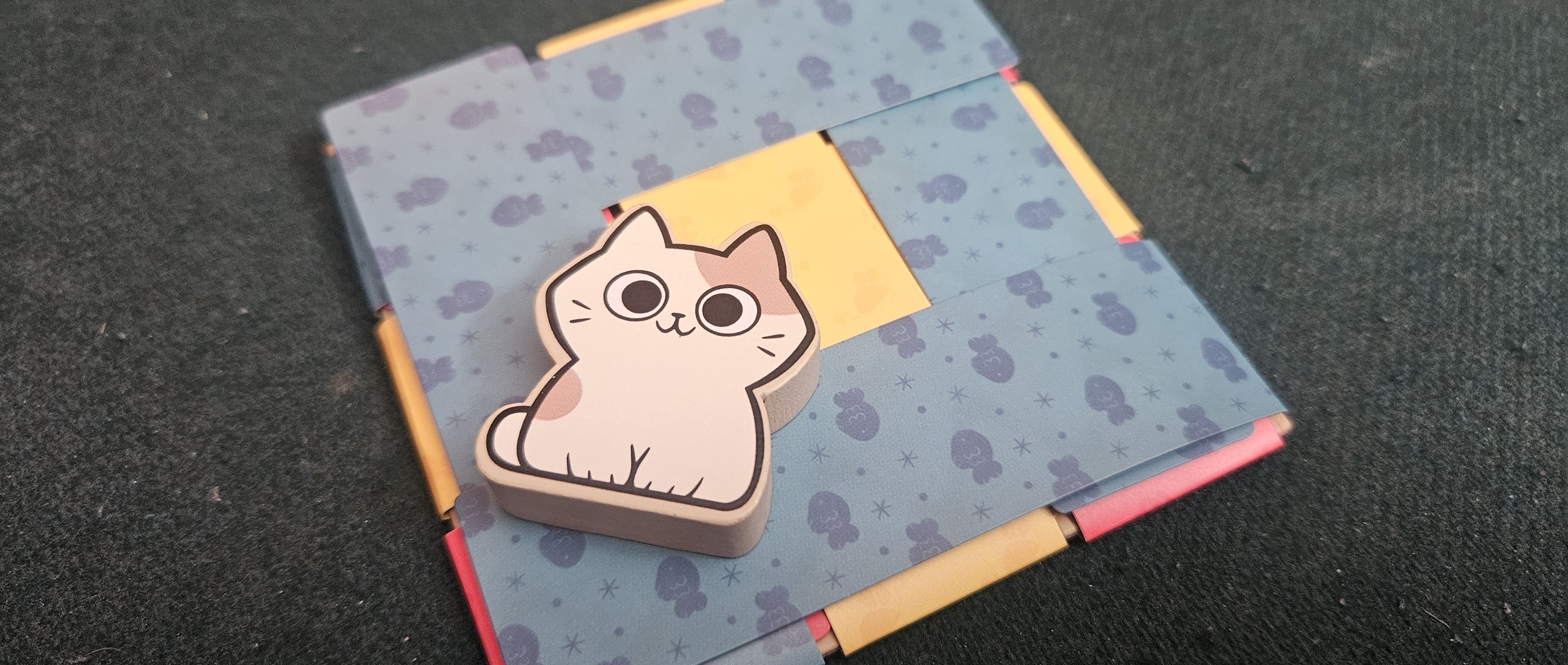
Afterlife for Auction

23. Juli 2026 um 01:01

I don't know what my eyes think this says, but it isn't the game's title. REAUNI REOVNOONING, maybe.

I find Realm of Reckoning, the latest title by Max Anderson, Zac Dixon, and Austin Harrison, to be fascinating. There’s the cosmological angle: an afterlife fallen into disrepair, now pieced back into working order through the clashing imperatives of feuding factions. Personally, I’d be a fanatical member of the Eat As Much Cake As You Like Without Getting Tummy Sick sect.

But more even than that, it carves out a new space in the whole “dudes on a map” genre. (Are we still saying that?) There are fingerprints of the greats all over the design. A splash of Blood Rage, some Inis, even a little bit of Arcs. It’s something of a mashup, and not every part works as smoothly as the others, but the result is a gripping struggle over an ashen landscape.

second-stage biblical afterlife here

Clashing over the broken prairie of the afterlife.

Right away, there’s nothing typical about Realm of Reckoning. The factions are presented in gaudy colors. Or perhaps they’re only gaudy because the terrain is so smudged and dismal.

For all its aesthetic ruin, it’s really a rather simple space. The entire battlefield consists of five territories, each connected with a different flavor of influence. There are also five flavors of pillar, themselves coded to the assistance of gnomic wardens and tide-turning mercenaries, but maybe that’s more information than you strictly need to understand what’s going on here.

As for the rest of it, Realm of Reckoning structures itself around three rounds of drafting. This is where its similarities to Blood Rage seem most apparent, although if Veiled Fate, Pillars of Fate, and Scales of Fate are anything to go by, the folks at IV Studio really like their three-act structures. Each age is structured much the same: a hand of cards is dealt out, everyone picks one to resolve, and then the rest are passed around to repeat the process until there’s nothing left, at which point there’s a final battle before a quick tally of points.

It’s clean. At that mile-high remove, anyway.

the garden gnomes are an incredible investment. trust me.

Cards, both for action and battle, are drafted one at a time.

Down in the grit, affairs are a little more complicated.

Consider the cards. There are two types in the draft. The vast majority are action cards. These confer some resource — coins, wardens, soldiers for the battlefield, mercenaries to be spent and discarded — followed by a choice of where to tuck the card under your faction mat. This latter choice is more loaded than it initially appears, moving your marker along the corresponding influence track, but also providing icons that, at least on the first play, don’t bear immediate import.

The other type of card is the reckoning. There are only two of these shuffled into each age’s hand of cards. Their rarity marks them as major flashpoints. This is because reckonings trigger a battle in the indicated region. Not at the end of the round or even upon completing the current hand of drafted actions, but immediately, at the exact moment that the player who drafted it would normally take their resources and move along their chosen influence track.

Even when these reckonings are anticipated, such as when you’ve seen them coming from a hand of cards you passed along, they always come across as an intrusion. The usual cycle of gathering and positioning is interrupted. Now everyone picks up a dial and tallies in a number. This is how much they’re willing to spend to win. Four. Six. Eleven. More. Battles escalate as the game progresses, the result of all those extra arms everyone’s been amassing.

I don't really get into the artifacts in this review, but they're kinda important too. Oh nooooo. I didn't explain every detail. Throw a fit. OooooooOOOooo.

Some of the many things you’ll collect in Realm of Reckoning.

To be honest, the battles themselves are a mixed bag, the game at its strongest and weakest.

Strongest, because they’re nail-biters. Rather than simply winning or losing, players are vying for placement on a rewards card, a clever turn that might dictate how strongly you feel about the current contest. It’s even possible to accept a negative reward to avoid spending your bid, a maneuver that’s sometimes smarter than it might sound.

But battles are also frustrating. They’re a little too complicated for their own good. IV Studio has a reputation for games that contain “complicated counting,” and these tallies certainly qualify. Soldiers can be spent for a point of strength. Wardens also provide a point, but only if they match a pillar in the contested territory, and even then they can be spent instead to produce a bump of three. Mercenary cards matter, although again there’s some pillar-matching to consider, and coins too, although these are spent in increasing increments. Oh, and your influence in that region. It’s easy to forget that one, especially if you’re currently benefiting from that region’s power-boosting artifact.

All of this is to say that bids are fraught indeed, slowing the game dramatically but also producing… well, drama. High drama. Revealing one’s bid is as tense as it gets, as good as any round-robin antes in Inis. These are the hinges upon which Realm of Reckoning turns. Slowly, sometimes, with no small amount of creaking and groaning, but still.

I choose you, Lady Liberty!

Picking your reward for a reckoning.

For my part, I’m willing to accept the shortcomings of these reckonings for the boons they provide. The drama, yes, but also the way they feed into the game’s consideration of victory. Everything in Realm of Reckoning is building toward these moments of revelation.

And here, the revelation matters. Some players will claims points or cards or coins. Extra soldiers. Maybe a warden. But the real prize is the chance to designate which victory condition will score at the conclusion of every round hereafter. One player — usually the highest bidder in the reckoning but not always — takes a shrine, a statue that looks comically like Lady Liberty herself, and plops it onto one of the victory markers.

There’s no shortage of options. There are spaces for military domination over specific territories; others for economic advantage in coin or hired help. Some initiate struggles against your neighbors. Others provide groundswells of points that everyone can benefit from with some effort.

This is also where those icons come into play. The ones from earlier, on the cards, tucked beneath your player mat. You might find yourself racing to collect sets of gems, or vying to command the most purses of gold, or cursing because a rival chose to emphasize the closed-eye icon rather than the open peepers. Whatever the selection, it informs the game from that moment forward. It’s a little bit like Arcs in that regard, the players choosing what matters and then clashing over it, except these are permanent alterations. Early selections, before the factions have specialized, become exploratory, triggering multiple times before the game ends but also allowing players to adjust, while those added later are hotly contested because their outcome is less prone to adjustment.

What would you choose as the scoring criteria for your own afterlife? I'd go for cuddles with babies. Just the best.

Victory conditions are selected over the course of the struggle.

Perhaps there’s an irony to be dredged from all this fuss. For the second time, Realm of Reckoning hinges on a bunch of complicated counting.

But this is also where the designers manage to carve out their own niche in a crowded genre. And, as niches go, it’s closer to an alcove than a toehold. There’s such a variety to the objectives that there always seems to be something worth pursuing. There’s even a spot that awards points to whomever’s sitting in last place — a whole catch-up system, but one that asks the players whether they would like to switch it on or leave it untouched.

It’s smart, although in a way that demands its own attention rather than simply aping what’s gone before. Sure, it has drafting like some other titles. But where Blood Rage evoked a heavy boot smashing into your nose, where Inis was all tribal politics, where Arcs is… a lot of things, Realm of Reckoning is about currencies and auctions. Players gather resources to spend them, but only as carefully as possible, and then the outcomes of those auctions become longer-term auctions for absolute victory. In that respect, it feels like a smoother, more contemporary version of a lesser-known map-battler called Mezo. But, again, Realm of Reckoning provides such an emphasis on who can most cleverly accrue and spend coins of various denominations that it feels entirely new again.

Entirely new. Sometimes slow, especially at higher counts, and sometimes a little too tally-heavy. But still new, and smart, and bound up in calculations that feel shrewd rather than merely arithmetic.

I guess I could talk about visual representations of afterlife, and how this actually does a pretty good job of capturing what Hades should look like... but look, that's for nerds.

War in heaven. Or hell. I dunno.

I can hear what you’re asking through the screen. “Dan, does this say anything about the afterlife?” Sorry, but no. It does not.

But it does say something about how great it is to smash somebody through superior tallies and bids. Combat in Realm of Reckoning isn’t visceral. Strictly speaking, you’re inflicting the casualties on yourself, not the other way around. But this is one smart cookie, ultra smooth in practice, and a delight to handle. It takes a play or two to get a handle on its particulars, but this is one afterlife worth pursuing — and then remaking in your own image.


A complimentary copy of Realm of Reckoning was provided by the publisher.

(If what I’m doing at Space-Biff! is valuable to you in some way, please consider dropping by my Patreon campaign or Ko-fi. Right now, supporters can read the next installment in my series Talking About Games, this time tackling the topic of what makes a good list! Naturally, the piece includes a list.)

Joker’s on You

21. Juli 2026 um 20:44

The jester hat in the corner of the logo looks like a three-legged lady doing the can-can.

Say one thing for Carl Chudyk, he’s always swinging for the fences. His latest, Chess Joker, is full of wonderful ideas. At its most basic: what if we took the game-altering jokers from Balatro, say half a thousand of them, and transformed Chess, that ancient game of strategy and discipline, into a cast-iron bathtub filled with jelly beans and marmalade and one or two razor blades just for fun.

At its best, Chess Joker lives up to that promise. The problem is that it isn’t often at its best.

I like the colors!

This is chess.

Picture Chess. I don’t have to explain Chess to you people, do I? Knights, bishops, queens. Castling and checkmates. Years ago, some dork with taped eyeglasses and a collared shirt buttoned all the way up to the top pulled an untimely en passant and you haven’t played the game since.

Chess Joker is Chess.

But it’s also Joker.

The Joker portion of Chess Joker works like this. At the end of your turn, you draw a card. On your next turn, this offers a new possibility. Like, say, letting you warp one of your pawns sideways two squares. Or moving a bishop like a knight. Or swapping one of your bishops with an opposing piece on the same-color of square. Or placing your queen on h5, no matter what’s in that space right now.

Now, the thing about these cards — these jokers — is that they award points for their shenanigans. The tougher their effect is to pull off, the more points they award. The examples above were low-scoring opportunities. 25 to 50 points. Others are more potent. For 100 points, you might be asked to move your queen to capture an enemy piece (easy) and then capture both an enemy piece and your own piece next to wherever the queen ended her turn (uh oh). For 150: warp whatever piece is currently seated on g5 to any open square. For 200: take any piece that was captured last turn and return it to an empty square by one of your bishops.

I like the little icons that make tallying the score easier. That's a nice touch.

This is a chess joker.

Cutely, these points are called Elo, just like the system invented by Arpad Elo to improve on the previous Harkness system for ranking chess players. While it’s possible to win by checkmating your opponent, it’s also possible — and far more likely, for reasons I’ll discuss momentarily — to win by amassing 800 Elo points.

As you can probably already tell, higher points are significantly tougher to earn than lower denominations. Most of the time, they require preparation in advance. That your queen is already poised to capture; that anybody is seated on g5; that your opponent doesn’t preempt your card. That last point is major. Because jokers are visible to both contestants at the table. And they cycle every turn whether you accomplish them or not. This gives Chess Joker a loose, improvisational air. One that is, naturally, rather the opposite of ordinary Chess.

There’s more to Elo. Reducing your opponent to three or fewer pieces means earning 25 points per turn. On the flipside, putting your opponent in check means awarding them 25 points, discouraging snitty little sequences of checks lest you trickle them closer to victory. And most cards can be “masqueraded,” substituting the stated piece for something else, but at a penalty that reduces the card’s scoring to 25, the lowest possible quantity.

These rules make sense, given the chaotic nature of Chess Joker’s gameplay. Each rule comes across as a patch on a system that would otherwise break down under its own permissiveness. Jokers make putting the rival king in check a trivial matter, thus checks become counterproductive. With pieces dying left and right — again the result of jokers that often eradicate troops outright — the masquerade becomes necessary to prevent the bulk of cards from not having any effect in any given session’s back half.

QUEEN SPARKLES

This is a chess joker scoring pile.

Which is to say, when I called the gameplay “chaotic,” a better word might have been “sloppy.” Indeed, Chess Joker isn’t only a variant of Chess; it’s a repudiation of its deliberate nature. Nearly everybody knows how to play Chess, but most people do not, in fact, play Chess. Because it can be slow and boring and cerebral. Chess Joker is the version that’s fast and reactive and goofy.

As such, it actually shines brighter the more one departs from the headspace that classic Chess demands. Who cares if you lose that knight to only take a pawn? The next flip from the deck might eliminate the poor guy anyway. As long as you earn 75 Elo there’s no good reason not to make the exchange.

To be clear, this can be wild and exciting. I’d even go so far as to call it transgressive, like some ancient taboo has been violated under your fingertips. Because it has been. Over and over again, Chess Joker smears mud on the face of sacred statuary. Don’t want to get into a tit-for-tat exchange of checks and counter-checks? Just don’t. Teleport your queen to the enemy back row. March an entire block of seven pieces forward a single step to menace five enemies with the same move. Warp so many pawns forward that you’re suddenly fielding four queens. Anything is possible at Zombocom… pardon me, in Chess Joker.

Look at me, talking myself into liking Chess Joker more than I actually do. The thing is, I’ve played some wonderful sessions of Chess Joker, full of laugh-worthy reversals and absurd escalations and plenty of board states that would never in a trillion simulations occur in an ordinary match. But I’ve also had some real stinkers. Strings of draws that do very little. Rival jokers that chew through my lines. Moments where the game’s brilliance decides to hide behind its nonsense, like a wise old trickster god giving life-altering advice only to spin around and flatulate in your face.

At this point, I've played maybe... thirty? fifty? chess variants. Deck-building chess! Gravity chess! So many RPG chesses! And so far, my impression of all of them is that they're amusing for a bit, but lack much staying power.

This is an outro image.

The twist, which you surely saw coming, is that most of those sessions are one and the same. There’s no separating them. The good and the bad mashes together. There are hundreds of jokers in the box, and only a fraction appear per game. But with one peeling from the deck every turn, there’s no end to the disruption. Every turn might reveal something amazing or something… not. Not amazing. Not interesting. Not even amusing. And there’s nothing quite like the disappointment of concluding an anarchic volley with something ordinary.

In the end, Chess Joker is a fine experiment. It’s silly and amusing. At times, it even approaches brilliance. In crafting his own variant, Chudyk has joined one of tabletop’s oldest conversations, and for the most part his hooting is as worthy a thesis as any of the others that have been proffered over the centuries. “What if Chess was stupid as hell?” he seems to ask. Sure, yeah. What if it was. I dig it. For a while. And then the question grows obnoxious, and Chess Joker spins out of control yet again, and I’m left wondering if there’s a curated selection of these jokers that makes for a more controlled experience, and somehow we’ve circled back to preferring Chess. The trickster god leans forward from where he’s been dancing on the table, tweaks my nose, and disappears in a puff of confetti.


(If what I’m doing at Space-Biff! is valuable to you in some way, please consider dropping by my Patreon campaign or Ko-fi. Right now, supporters can read the next installment in my series Talking About Games, this time tackling the topic of what makes a good list! Naturally, the piece includes a list.)

Delver’s Dilemma

20. Juli 2026 um 21:37

I suppose it's appropriate that the only box image they uploaded to BGG was tiny. Since the game is also tiny, I mean.

Brumble Quest is a peculiar inclusion in Plaid Hat’s catalog. Unlike their other touchstones, whether expandable duelers like Ashes and Summoner Wars or comedy adventures in the vein of Forgotten Waters, it’s a diminutive thing with minimal components, a ten-minute playtime, and — oh yeah — it only sells in sync with big conventions. Fortunately, that means during conventions, not at them; online ordering is still a possibility for those of us unable or unwilling to make the annual pilgrimage to Indianapolis.

For such an odd duck, though, it’s… kinda great? Designed by J. Arthur Ellis, Brumble Quest is a prisoner’s dilemma game for pretty much any number of players. Minimum three. But as many as fifty out of the box. With a projector and laser pointers, theoretically it could go even higher.

Ah, the CAVE of WONDERS (I hear this in Jafar's voice. I can't even remember if he says that in the movie.)

It’s all location location location.

Down at its roots, Brumble Quest is familiar enough. Every round seeds three new locations onto the table. At the count of “One, Two, Three, Brumble” — I know, it’s cheesy — everyone points at the location they intend to visit. Depending on the outcome, players then take home some quantity of loot and/or suffer an injury.

There are two things that set it apart. First, the production. Rather than gussying itself up with a whole to-do, Brumble Quest is as minimal as they come. In lieu of tokens for loot and wounds, each player receives a peel-off hero from a pad, then folds its corners to track their current wealth and health. The rules are compressed onto a single card, front and back, and takes so little time to internalize that it’s closer to hopping into a childhood classic than learning something new. As for the locations, there are only fourteen. That’s a slender deck indeed, all but guaranteeing you’ll see repeats within a session.

But the second point is that the locations are nicely diversified, even if there aren’t many to play with, and really it’s the way they combine and conflict and, even at times, pre-solve their own conundrums, that make the game so special.

I’ll give an example. Let’s say the current trio is the Lonesome Peak, the Shadow Wastes, and the Cursed Prison. That first location provides four gems, but you’ll take damage if you visit it unless it’s the least visited destination. The Shadow Wastes are even more tempting: five gems, and you avoid damage if everyone is pointing there but one player. But then there’s the Cursed Prison, a locale very unlike the others. It subtracts a gem, but everyone at the table will suffer a wound unless at least one adventurer goes there.

No time to think. One. Two. Three. Brumble. (Ugh.)

I somehow picked the plainest character of the entire sheet of fifty.

Measuring health and loot is done by folding a paper tracker. Cheaper than tokens!

The beauty of these social conundrums lies in their clarity. The stakes are always perfectly clear, barring an unfortunate misunderstanding. But this clarity is sharply contrasted with the slow departure of objectives at the table, not to mention the sheer uncertainty of human behavior.

For instance, how does the previous scenario alter if you’re the player with the least remaining health? How about the most? What if your score is meager so you’re trying to drive everyone else into an early grave? Sure, all things being equal, everyone should do the optimal thing, right? But get together a half-dozen players and it becomes clear pretty quickly that “the optimal thing” may be a matter of interpretation.

And, sure, sometimes the game coughs up a problem that really does feel solved. More than once, I’ve looked down at a trio and thought, wow, why would anybody ever go to that one spot? But, again, people are unpredictable. Almost as often as Brumble Quest seems to proffer a solved dilemma, someone at the table has appeared hell-bent to un-solve it.

The result is a pleasantly crisp little thing. There are no character abilities, no sudden reversals. Some locations might bump your health up a notch, but that’s a rare outlier. For the most part, it’s you, your friends, and pockets that grow heavier while your blood supply gets lighter. That’s it. Honestly, anything else would clutter the experience.

Gettin' squeezy.

These fellas had better’ve washed.

Barring the addition of extra junk, this is nigh-perfect in its restraint. Maybe Plaid Hat won’t be able to help themselves. Last I checked, the second edition of Summoner Wars was up to thirty factions. (Yes, I have all of them.) (Yes, they are amazing.) (No, I probably won’t have time to write about them.)

Then again, maybe not. As I understand it, Brumble Quest may soon have peers, other teensy-tiny boxes that provide their own miniature siblings. For this game in particular, I’m hard-pressed to imagine it getting any better. This is a true pocket game, slender enough it could have been compressed into one of those plastic Button Shy wallets. I expect it’ll make for a good candidate at our family dinner this weekend.


A complimentary copy of Brumble Quest was provided by the publisher.

(If what I’m doing at Space-Biff! is valuable to you in some way, please consider dropping by my Patreon campaign or Ko-fi. Right now, supporters can read the next installment in my series Talking About Games, this time tackling the topic of what makes a good list! Naturally, the piece includes a list.)

Blorpassonne

16. Juli 2026 um 04:11

of course I did a high-effort header for a game I won't remember in two weeks

In my quest to find activities that will hold the interest of children with a five-year age gap, I routinely find myself playing board games that normally wouldn’t register more than a fraction of my attention. Blorp!, for example.

What is Blorp!, you ask? Apart from being a noise my offspring produce when they don’t want to empty the dishwasher or hang up their towels, a blorp is apparently the answer to what Dr. Seuss would animate for a David Cronenberg flick. These are queasy creatures in three colors that communicate by, uh, farting confetti at one another. Garth Kaufmann, who both designed and did the illustrating, sure has a knack for tongues, eyeballs, and tendrils, I’ll tell you that much.

and I think this game is about their mating season.

Blorps are, um, they’re, like, these blobs that, um, they live in a briny solution and, uh

Blorp! is a tile-laying game. In the vein of many tile-laying games, it traces its DNA back at least to Carcassonne, with its mutable borders, emphasis on joining like-minded edges, and the need to complete one of the titular creatures in order to score it.

But the similarities end there, the byproduct of considerable mutation in the intervening generations. Perhaps foremost, Blorp! assigns each player their own arrangement of confetti-stuffed monsters. There’s no sharing blorps. Not that you’d want to.

Speaking broadly, your objective is to make very large blorps. One of each color, in fact. Completed blorps score a point per tile, but your largest blorps double that value. Which still doesn’t ensure that high of a tally, but keeps the kiddies in the running. Special tiles, such as floating spores, earn points when hemmed in on all sides, while trumpets and confetti…

Okay. Look. Trumpets and confetti might require some explanation.

Making a big blorp isn’t as easy as it sounds. Often, the only tiles available on the table will be better-suited to pinching off a blorp than pushing out an even bigger one. So you tie the knot, but where does that leave you? With a nuggety, low-scoring blorp, that’s where.

sex ed

Blorps communicate via confetti trumpets.

Enter trumpets. By sticking these things into your blorps’, ahem, orifices, and then directing them to toodle in one another’s direction, you can expand its size even across the buoyant saline that is their substrate. In the image above, there are two red blorps that have merged into one through apocalyptic toodling, with a third that might join the bacchanal if only it gets finished in time.

That isn’t all of it. Some tiles show puffs of confetti. Trumpets can re-route through these, making it possible for blorps to congeal despite the absence of a straight vector between them. It’s even possible to use trumpets to trace blorp adjacency — blorpjacency, a term I just invented — through other-colored blorps. I haven’t actually made this work, but it’s there for real blorp-maxxers.

Probably it sounds like I despise Blorp!, but that isn’t the case. It’s a fine game. Clever, even, at times, with the trumpets that blast into each other’s mouths and make weird adjacencies a genuine possibility. My kids find it amusing. We’re required by blorp law to comment upon each grotesque feature. Sometimes my seven-year-old will decline to take a beneficial tile because it scares her. I get it, kid. Rather than focusing on her score, she tries to gather as many of the green blorp appendages, the ones that seem to be sharting ball-pit balls into the aether. She thinks that’s a hoot.

And it is a hoot, if more for the sheer improbability of its illustrative style than because the tile laying is particularly interesting. And it isn’t as though the game is so competitive that pursuing a sideline in ball collecting presents that much of a ding to anybody’s score. Which makes the game a good enough choice for the kiddos.

Until the novelty of those blorps wears thin, anyway.

nor for this

I don’t have one for this.

I can feel it coming. That moment of escape. The first couple of times, the girls were eager to see what other misshapen lumps they might schlorp together. After only those two plays, they’re more hesitant. I hope the end is in sight. Despite liking Blorp! well enough, there are better games out there, even if they’re slightly more competitive or tricky. Even if they don’t feature monsters with misplaced holes. Especially then.


A complimentary copy of Blorp! was provided by the publisher.

(If what I’m doing at Space-Biff! is valuable to you in some way, please consider dropping by my Patreon campaign or Ko-fi. Right now, supporters can read the next installment in my series Talking About Games, this time tackling the topic of what makes a good list! Naturally, the piece includes a list.)

Buried

14. Juli 2026 um 23:01

In a sense, this game is the opposite of ruins. We aren't excavating the ruins. We're adding more stuff to the ruins. Which is more like, I dunno, a junkyard or a county dump.

Ruins, the card-building, card-shedding game by John D. Clair, served to answer a question that’s been niggling at the back of my skull since I first played Mystic Vale almost a decade ago. Namely, why don’t I like these things?

Not John D. Clair games, to be clear. I like plenty of his games. Rather, these of his games, the ones about sliding inserts into sleeves to build custom cards. At a notional level, it’s a solid concept. Plenty of digital card games let you modify your cards. By using inserts and sleeves, these titles circle some of that bespoke nature back to its origin point. Yet none of Clair’s experiments with the form, whether Mystic Vale, Dead Reckoning, Unstoppable, or now Ruins — which is based on an earlier title, Custom Heroes — has really landed with me.

I now know why. It isn’t the sleeving that’s the problem. It’s that Clair doesn’t exhibit much trust in his own sleeves.

Tell the truth: did you realize these cards all had the same rank?

Custom cards are cool.

To start at the beginning, Ruins is a shedding game, which means that every round is a race to empty one’s hand of cards. You dump them either one at a time or as matching sets, and then one-up the competition with better offerings, around and around, until players’ hands start depleting. Going out first earns more points than going out later.

It’s such a basic setup that adding modifiers is one of those “oh duh” ideas, perfect in its simplicity. And Clair’s approach to drafting those modifiers is superb. The gist is that everybody begins with three resource tokens — campfires, but don’t worry about that, the setting is nonsense — which they can spend on various inserts. Most nudge the card’s rank upward. What was once a card with a value of nine becomes a fourteen, later the fourteen becomes a nineteen, that sort of thing. There are other abilities as well. Like, say, turning a card into a wild rank, ready-made for pairing with other cards. Or letting a card clone itself. Or rekindling your spent campfires. Or drawing and discarding extra cards in hope of picking up something that matches better with your hand. Or, only a few times per game, marking a card as permanently yours, ready to be plucked from a rival’s hand at the start of a new round.

This transforms Ruins into a highly reactive experience. Normally in a shedding game, somebody will play a tough set — for example, four 5s — and you’ll glance at your hand and go, “Oh, that’s impossible to follow, I’ll pass for now.” Shedding, like trick-taking, is generally more about long-term planning than moment-to-moment play. In Ruins, that tendency is flipped on its head. Up against that tough set, you’ll look at your hand and then at the market and go, “Okay, if I buy that +3 and that +6, and attach them to these other cards, now I can follow my opponent’s play by dropping four 13s.” You’re still playing the long game, since big plays tend to deplete your resources, not to mention burn options out of your hand. But the play is highly responsive, standing in contrast to what is customarily a more measured form of play.

At its best, this is exciting and immediate, and even at this level sometimes Ruins gets away from itself. Stuffed with modifiers, cards eventually become little math problems. It’s one thing to note that a card’s value is 11 plus 4. But how about 11 plus 4 plus 8 plus 7? Now keep those values sorted across all the cards in your hand. Now adjust those values by the modifiers in the market. By the game’s third round, the slowdown is noticeable. So much for “exciting and immediate.”

Even so, this core concept would make for a fine shedding game. It’s punchy. Lean. Feels distinct from other shedders. I’d even call it the best use of Clair’s inserts-in-sleeves gimmick.

Shame how he kept packing it with extra servings.

but no shoe inserts. poor plantar fascists.

The market offers all sorts of inserts.

For whatever reason, Clair determined that Ruins wasn’t done baking. The modifiers weren’t enough, so more stuff kept getting tossed in. Even as the game’s sleeved cards grew heftier with each added insert. Even as the deck’s bulk become noticeable with each shuffle. Even as its mathematical load grew more tedious. Even as the game’s cognitive load bulged outward with its overloaded sleeves.

So, for instance, we get cards that aren’t only moddable, but reversible. At the start of each round, you’re allowed to flip a card over to its opposite side. This tweaks its rank and perhaps adds a special ability. Okay, fine. This can help mitigate a bad draw.

But then there are all the special abilities, some of which slow down play even further. Like the insert that forces somebody to draw an extra card. Or the one that sees you drawing and discarding to fine-tune your hand. Early on, these are fine and dandy. Later on, when people are constantly pausing to evaluate their options, they become downright irritating.

But then there’s the skipping rule. Whenever somebody plays an exact duplicate of what was played before them, the next player in sequence must auto-pass. In a game that often revolves around passing, that can prove fatal. To get technical about it, this problem is compounded for a couple of reasons. First, Ruins sees card ranks ballooning at their upward ranges thanks to all those inserts; but second, thanks to the ability to modify cards on the fly, it’s often possible to craft a response that will force a pass. These combine to give leading players a strong edge. And if there’s anything Ruins did not need, it was a tendency to favor leading players even more.

But then there’s the way everybody but the final player needs to shed their entire hand. What happens when someone accomplishes this goal? The next person in clockwise order becomes the next leading player. In the game’s latter stages, when cards have gone through said ballooning and holding the lead has been thoroughly strengthened, it isn’t uncommon for this order to calcify. Player A goes out, the lead passes to Player B, Player B goes out, the lead passes to Player C, and so forth. There’s potential for disruption there, but the range of modifiers is so wild that it becomes nigh impossible to hit the right targets anymore.

But then — and this is the last one, I promise — there’s that awful conclusion. Ruins doesn’t just keep score. Oh no. Instead, it only ends when somebody reaches enough points and then goes out first in the next round. Barring that, Ruins asks for a final tiebreaker round solely between those who have reached its highest threshold. I hope you like waiting. I don’t. At least not enough to sit through another sluggish round of Ruins that I’m not even involved in.

Just have people earn points. My gawrsh.

I genuinely don’t know what’s going on with this score track.

I know some of these points are overly technical, and I apologize for that. But I’m trying to illustrate a point. The point being that Ruins began with a crackerjack idea, only Clair kept adding more and more stuff, some of it useful and interesting, but much of it ill-considered and sluggish. Eventually, its basic idea got buried. The effect was not unlike lighting a battery of firecrackers — and then dumping a load of gravel over the top of the whole show.

There’s a good inserts-in-sleeves game in here. There was a good inserts-in-sleeves game in Dead Reckoning and Unstoppable. Someday, I hope Clair trusts those good inserts-in-sleeves games rather than burying them.


A complimentary copy of Ruins was provided by the publisher.

(If what I’m doing at Space-Biff! is valuable to you in some way, please consider dropping by my Patreon campaign or Ko-fi. Right now, supporters can read the next installment in my series Talking About Games, this time tackling the topic of what makes a good list! Naturally, the piece includes a list.)

Clatter and Write

14. Juli 2026 um 04:58

"A real beaut beaut you got there, huh?" —Matt Damon, playing the Portuguese cartographer who named Taiwan, with a sexually aggressive Bostonian accent

When the Portuguese charted the island of Taiwan, they named it Ilha Formosa, “beautiful island.” That’s the background behind the board game Formosa Formosa, which — and I’m not sure designer Kirk Beiser is aware of this — translates to “beautiful beautiful.” Kind of like when somebody calls a monster a were-person, which just means man-person, except “beautiful beautiful” is even more duplicative.

Appropriately, Formosa Formosa doubles down on its namesake. Designed by someone who has lived in Taiwan for fifteen years, printed in Taiwan, and ultimately about Taiwan, this is a drop-and-write game that’s as charming as it is combo-heavy.

I throw up my shoulders, attempting to intimidate the other players into forgetting their move.

This is how I look when a drop doesn’t go my way.

Welcome to Taiwan. Island of scenic waterfalls, breathtaking hikes, soaring shrines, and… dirty beaches. I’m not one hundred percent sure what we’re doing in Formosa Formosa, but it seems like a combination of sightseeing trip, litter collection, and greenhouse gas management. Travel across the island, but not too often. Visit the surrounding islets, but only sparingly. Hold your emissions while enjoying this scenic vista. Yes, those emissions as well, sir or madam.

For all its silliness, this isn’t all that far out for the genre, which often suffers from some disconnect where settings are concerned. And the puzzle it produces is a solid one, even when we interrupt our vacation to enthusiastically hoover up so much litter that we earn another jaunt up the nearby mountain.

At its most basic, Formosa Formosa is about ticking boxes. So far, so very roll/flip-and-write.

Right away, though, Beiser carves out a somewhat more unique identity than most of his game’s mechanical peers. Rather than rolling dice or flipping cards, selecting actions is all about chucking a bunch of cubes into the box lid. This produces a menu of potential destinations across the island’s four compass directions.

These destinations matter because you only occupy a single space at a time. You might, for example, be sitting pretty in the south, waiting for another chance to visit a shrine, only for the toss to result in a resplendency of activities everywhere but where you’re stationed. Bah, you might say. Bah and ruin, another hike. Another damnable waterfall. More beaches to clean.

More beach cleanups for me? What are the odds?

Dropped cubes determine which actions are available in which regions.

Except… therein lies the game’s central conundrum. You can travel to another locale, although this produces points-draining pollution. But you can also fulfill other activities, like the aforementioned beach cleanup or perhaps some island-hopping — itself a rather polluting activity — in order to generate bonus actions. These bonuses might then check off that all-important shrine. Or, after some consideration, see you abandoning that objective altogether for something more productive.

The result is a pleasant experience, one where every tick matters, but doesn’t matter so much that it detracts from the twenty or so minutes that it takes to complete the game. Clever players can parlay those cubes into self-replicating turns, one free action spilling into another. These sequences are breezy to track, certainly easier than some of the flip-and-writes we’ve covered here, while still allowing for the occasional turn where somebody absentmindedly chews on the end of their dry-erase pen (yuck) while contemplating their next mark.

If I haven’t made it clear, Formosa Formosa is a light experience all around. It occupies the same design space as any number of shorter something-and-writes, more about the joy of getting to pen three or four marks on the board instead of only two, rather than, say, mathing out the best possible move or even preempting the input. Because here there is no preempting the input. Sometimes a region will receive no cubes at all. Other times, nearly everything will cluster together in one spot. That’s the game, and while it lends a certain soothing air to the experience, one where no decision is your fault and the best you can do is ride it out, it shouldn’t be mistaken for decision-dense.

Still, there’s a lot to like here. The clever use of both the lid and the box bottom, one for the drop and the other for assigning the resultant spill to an action menu. The animal pawns that are used for tracking your location. The tension between shared contests and a personal goal. Again, this isn’t extreme tension. It’s a pleasant friction at best, a gentle tickle. But it’s enough to offer Formosa Formosa as an ultra-light clatter-and-write that doesn’t overstay its welcome.

I leave bus bonuses for others. Usually petrified gummy worms stuffed deep into the seats. True Christian charity.

Bus bonus!

Ultimately, Formosa Formosa offers a nice experience. It’s a bit straightforward, even somewhat forgettable. Like a back rub, I suppose, or a comfort movie. But also like a back rub, it’s warm and tingly and pleasant, and it’s a great deal more fun to chuck some cubes than roll dice or flip cards. For all I won’t remember it in a month, I’m happy to accept one in the moment.


A complimentary copy of Formosa Formosa was provided by the publisher.

(If what I’m doing at Space-Biff! is valuable to you in some way, please consider dropping by my Patreon campaign or Ko-fi. Right now, supporters can read the next installment in my series Talking About Games, this time tackling the topic of what makes a good list! Naturally, the piece includes a list.)
Liberation Ludology, Part Two: Peru

10. Juli 2026 um 07:18

This is the article that gets somebody to argue I'm pro Shining Path. Whee.

When last we visited Stephen Rangazas’s The Guerrilla Generation, we looked at a localized urban insurgency in Uruguay, one that failed to bring about a socialist revolution, but eventually, after a period of military rule, saw former revolutionaries elevated to government positions, including the presidency itself.

Today’s scenario casts a wider net, not to mention a more tangled one. When the scenario opens in 1980, Peru has only recently emerged from its own period of ideologically complicated military dictatorship. Riven by debt and poverty, Peru now has a freshly elected civilian government that’s reluctant to give the military too much latitude, while a philosophy professor named Abimael Guzmán has just launched one of the most vicious insurgencies in Latin American history: the Shining Path.

LoCs are back! Along with me not being sure what purpose they serve other than as a distraction from constant terror campaigns!

Welcome back to the countryside, comrade.

For long-time enthusiasts of the COIN Series, Peru finds itself on something closer to home turf than the Uruguay scenario. Unlike that country’s Tupamaros, the Shining Path has adopted the lessons of Che Guevara’s successful revolution in Cuba rather than merely his ideology. We’re back to observing the foco theory, in other words. This is a rural insurgency, with cells operating in far-flung locales where the government struggles to project force, pressuring the capital of Lima from the outside rather than from within.

As such, many of the series’ hallmarks are back in full force. Lima is but one theater of many, its highways radiating like tender arteries for any revolutionary to squeeze or sever. The countryside itself is broad, with rich but heavily policed coastal provinces, rocky highlands where even professional soldiers struggle to root out dissidents, and swaths of jungle that, let’s face it, nobody cares much about. This, in turn, necessitates a degree of bookkeeping. Control between the Government and the Shining Path must be constantly adjusted, while the relative support and/or opposition of the local population for the current regime in Lima is always under negotiation.

In other words, Peru looks a whole lot like COIN.

For the most part, it plays a lot like COIN as well, both procedurally and ideologically. Both sides receive more or less the same operations that Volko Ruhnke enshrined way back in Andean Abyss. The Government divides its time between protecting its vulnerable underbelly — mostly meaning its coastal provinces, highways, and Lima — and mounting sweep-and-assault operations meant to identify and then eradicate guerrilla forces. The Shining Path, meanwhile, tries to shore up its influence in its natural home territories in the highlands, and then infiltrate into those vulnerable territories to launch terror campaigns. Both sides are concerned about funding, both in securing their own and choking off any for their opponent.

spoiler: he never shows... wait a minute, is that Guillermo del Toro? Has anybody ever seen him in the same room as Guzmán? Suspicious.

Waiting for Guzmán.

Where the scenario takes a more interesting turn is in the specifics of how it models this particular conflict, a strength that Rangazas has demonstrated previously in The British Way.

Let’s start with the Government. Like their peers in Uruguay, there’s some reluctance to let the military off the leash, although here there are plenty of troops on the map from the very beginning. In this case, certain military activities can only be taken in emergency zones, special designations limited to highland regions under threat from the Shining Path. Normal protections don’t apply in these zones, allowing the military to conduct reprisals against civilians, but also to form rondas campesinas, peasant patrols, which act with training, arms, and above all official recognition. These rondas begin “underground,” much like the series’ portrayal of insurgent cells, but can eventually flip to their active side to assist the Government in various ways. These two options, reprisals and rondas — stick and carrot — form the backbone of the Government’s strategy in the Shining Path’s staging grounds, but carry their own limitations. Namely, rondas take a long time to set up, while reprisals risk turning those armed peasants against their benefactors. All the while, Peru is deeply impoverished, risking total bankruptcy if the Government isn’t choosy about which battles it fights.

The Shining Path, on the other hand, finds itself in a testy situation where every action risks backfiring against its long-term goals. To fund their activities, they must implement local councils, but these disrupt village traditions and generate support for the Government. To foster opposition, then, the Shining Path must conduct terror campaigns, but these encourage the locals to form rondas. This produces a vicious cycle, with communist councils necessitating terror necessitating additional councils. Each solution begets new problems, round and around, threatening the insurgency with a death spiral if they don’t keep on top of it.

Compounding this problem, the Shining Path is far more centralized than most of the insurgencies examined by the COIN Series. This provides both advantages and downsides. Importing the double-sided People’s Prison disc from the previous scenario, a single Shining Path base is secretly Abimael Guzmán’s center of operations. If this base survives the current campaign, the Shining Path receives some free actions, a last-minute boon that can swing the tide in their favor right before the game checks for victory.

At the same time, their centralized leadership means the Shining Path must play more defensively than usual. There’s always the threat that the Government will capture Guzmán, a process of gradual investigation hastened by uncovering the location of Guzmán’s base. Capturing Guzmán doesn’t end the scenario outright, but it deals a serious blow to the Shining Path and bolsters the Government’s legitimacy on the scoring track, mirroring the historical outcome.

My mom insists they took a bus tour of Lima. My dad doesn't remember. So... that's my funny alt-text.

The contrast between urban and rural environments is again emphasized.

This entire armory of double-edged swords provides Peru with quite the volatile mix, one where even stable situations aren’t wont to survive for very long under rival scrutiny — or even one’s own attempts to remain in power. As with the other scenarios designed by Rangazas, both in The Guerrilla Generation and The British Way, the main question on my mind is how closely this represents the situation that developed historically, not only in terms of events that actually occurred, but also as a possibility-space for investigating the reasons why these insurgencies and government policies succeeded or failed.

Peru, it should be noted, is a tricky case. Much of the Government’s material support against the Shining Path came not from the United States, but the Soviet Union; its earlier military dictatorship was both nationalist and left-leaning before a successive coup shifted its comportment rightward; and then there’s the eventual self-coup by President Alberto Fujimori, a political earthquake that only receives a cursory mention on an event card. The limited scope of its portrayal in The Guerrilla Generation elides many of those complexities.

To be clear, I’m not pining for some wishy-washy bothsidesism. At times, the Peruvian Government was brutal. So was the Shining Path, uncommonly so, departing from every other Latin American insurgency by exceeding government casualties over the course of the conflict. Personally, the most interesting figures in the conflict are the rondas campesinas, who often struggled to chart a course that would assure them the greatest independence not only from insurgents but also from government oversight. The scenario limits them to markers of expanded Government combat efficiency in the highlands, which short-sells the difficult position they found themselves in. It would have been nice to see their struggle represented more thoroughly.

Then again, none of this is anything new. Wargames have long struggled with the question of how to portray atrocity. More often than not, designers opt to omit them altogether. With the COIN System, Rangazas inherits a model that was crafted to demonstrate approaches to counterinsurgency, only to later deepen its ideological ambitions. For the most part, Rangazas has proven himself capable of overcoming the system’s limitations to reveal the particulars of a wide range of conflicts. But with Peru, the cracks are showing, and they’re ideological more than procedural. Its version of the Shining Path is so inherently corrupt that its essential activities are attended by considerable downsides, while the Government may elect to curb its more vicious impulses and instead focus on civilian outreach. One side has very little agency; the other, an improbable amount.

Score: -4 in the Shining Path's favor. Take that, history!

In this alternate history, the Shining Path has dominated the entire country.

What emerges, then, is more descriptive than exploratory. As a scenario, it demonstrates how the Shining Path raised funds through drug trafficking and rural councils, how the country’s impoverished state made it possible for them to squeeze the government toward bankruptcy, how it struggled to spread the revolution into population centers, and how its centralized command was both a source of strength and its ultimate downfall. As for the Government’s reflexive atrocities against indigenous populations, its political infighting, and its vacillating support for the rondas… well, that stuff is mentioned on event cards, if not quite as explicitly modeled.

On the whole, what emerges is a sound, if incomplete, sky-high snapshot of an insurgency that is still technically operative today, if dramatically reduced in strength and territory. And next time, we’ll see the script flipped as a revolutionary government faces an anti-communist insurgency with considerable foreign backing.


A complimentary copy of The Guerrilla Generation was provided by the publisher.

(If what I’m doing at Space-Biff! is valuable to you in some way, please consider dropping by my Patreon campaign or Ko-fi. Right now, supporters can read the next installment in my series Talking About Games, this time tackling the topic of what makes a good list! Naturally, the piece includes a list.)

Wingspan for Mandy

07. Juli 2026 um 19:41

aw! it's a pocket, see? a birb pocket

Wingspan but smaller, simpler, and shorter” isn’t half-bad as pitches go. That’s precisely the niche Wingspan Pocket carves out for itself. In every way that matters, this is Wingspan, Elizabeth Hargrave’s 2.6 million bestseller, all birds and combos and speckled eggs, but slimmed down to a blue-footed booby’s webbed footprint.

I’m convinced that it might even be better than the original. For the doubters, it’s certainly shorter.

They aren't the most natural of friends, these birds.

A compact, single-tiered tableau of birds.

Like the best exercises in compressing a game to a more portable version, Wingspan Pocket captures the appeal of the original while also nipping and tucking the experience down to its most essential components. Gone, for example, are the player boards. Gone is the dice tower; it would look silly without any dice. Gone are the resource tokens, traded for the reverse side of each card, adding decisions to the market by way of shuffled grains, worms, fish, and berries.

The remainder represents Wingspan at its most essential. The cards, of course, as those are the main feature. You can’t have Wingspan without the wingspans. The speckled eggs have also returned, occupying as much box space as the cards themselves. Where would Wingspan be without the eggs? According to Wingspan Pocket, nowhere anybody wants to be.

Between the cards and eggs, Hargrave recreates the magic of the original game at a fraction of the size. It’s an impressive exercise in minimalism. Where the original game could occupy upward of an hour to play — maybe longer with the wrong player count and indecisive players — this one hovers closer to thirty or forty minutes. The slimmer card pool doesn’t even feel like a limitation thanks to how the cards regularly randomize between their resource and bird sides.

That same trimness goes for the rules as well. Wingspan could occupy quite a bit of tabletop real estate. The biggest difference with the pocket version is that the original game’s three tiers have been reduced to a single row. Thanks to the market, it isn’t quite small enough to squeeze onto your average in-flight tray table, at least not without some overlap, but it could fit comfortably atop a hotel desk or picnic table.

Honestly, I don't miss the food dice even a little bit. This method still provides some randomization, but doesn’t get stuck on useless snacks as often.

The market offers cards as both birds and food sources.

One’s collection of birds, meanwhile, is handled with tremendous ease. If anything, it now feels closer to the exploration from Connie Vogelmann’s spinoff title, Wyrmspan. Using a wooden feather to mark your place, you walk from left to right, triggering each bird in turn. The first card is always your nest. This allows you to either play a new bird, lay a few eggs, or draw a pair of cards from the market.

From there, each bird gets its moment with the feather, and this is where the game shines brightest. The cards have been streamlined from Wingspan’s previous incarnations, pruned of end-game scoring abilities and rulebook-flipping outliers. Instead, there are two mainstays: activation abilities, which trigger when you land on them with your feather, and ongoing abilities, usually in the form of discounts.

In both cases, their effects are crisp and legible. Of course, this forthrightness serves a greater purpose, encouraging everyone to build a strong tableau. While Wingspan Pocket is more easygoing than its parent, it’s no slouch as a race to wring as many points as possible from a maximum of six birds. There are micro-economies to manage, usually revolving around eggs, a healthy hand, and maybe some tucked cards. Certain actions, like laying eggs or picking up some meager offerings from the market, feel like miniature defeats when the right birds might allow you to get them for free. I was also pleased to see that predators had returned, letting players hunt cards from the market based on their relative wingspans. It’s notably simpler, but there’s still room to tinker. Or to glare jealously at what your rivals have built to work with.

I don't recommend these to Mandy Patinkin. Not on the first play.

Optional objectives further shake up the formula.

For some, this streamlining may prove overly enthusiastic, and I doubt it will do anything to persuade the doubters. The closest analogue is a single round of Wingspan. There are optional goals, but these are triggered once rather than swapped out across the game. That single tableau of six birds is slender, theoretically capable of bringing the game to an end within a half-dozen rounds. At times, I was surprised at how quickly a session concluded.

But I take this as a good sign. At no point did Wingspan Pocket overstay its welcome. It was akin to a friend dropping by to return a tupperware from the other night, chatting for a few minutes on the doorstep, and then leaving before the conversation had a chance to grow stale.

To be clear, I’m not trying to damn Wingspan Pocket with faint praise. It isn’t good only because it only inflicts itself for a few minutes. It would be good at twice the duration. It would be good if it were three times this size. It would be good if it were Wingspan.

Far more than that, however, it’s good for the way it preserves its core experience for a new audience. My seven-year-old is smitten with Wyrmspan for its dragons, but our draconic sessions require me to two-hand the whole thing while she breaks ties between the decisions I’ve presented to her. Wingspan Pocket, by contrast, is fully within her control. There are elements she’s grappling to fully understand; for all their simplicity, these birds still require some degree of skill to combine. But she can trace her row from side to side. She can translate the icons into a functional language. She can identify which birds are affordable or beyond her immediate reach. She’s playing the game on her own, rather than half-spectating.

But she loves dragons more. Get on it, Stonemaier. I am so tired of two-handing Wyrmspan.

My seven-year-old loves it.

That’s no small thing. As someone who has loved Wingspan and its offshoots since its release seven years ago, that’s the kernel of this game’s appeal. It cuts across boundaries. It’s slight enough that it doesn’t take major headspace to play, but offers just enough density that someone can dig in and build something truly monstrous. It’s gentle and affirming, yet carries sharp enough talons to let a raptor rip into a sparrow.

Wingspan Pocket preserves that. In many ways, it does something better. Where the original game required upkeeps and phases and a rulebook that traumatized a famous actor, this is Wingspan as a bird gliding motionless in the sky, elegant and at ease. We don’t see the work that went into its effortless glide. We don’t see the long evolution of pneumatized bones. We don’t see the rapid flapping that lets it take flight. Nor do we see the hardscrabble hunt for calories.

That, to me, is what Wingspan Pocket represents. This is a mercilessly developed and hawkishly fine-tuned experience. It works as a race between falcons or as a lazy Sunday activity with downy fledglings. I think I prefer it to the original. Now do the dragons, please.


A complimentary copy of Wingspan Pocket was provided by the publisher.

(If what I’m doing at Space-Biff! is valuable to you in some way, please consider dropping by my Patreon campaign or Ko-fi. Right now, supporters can read the next installment in my series Talking About Games, this time tackling the topic of what makes a good list! Naturally, the piece includes a list.)
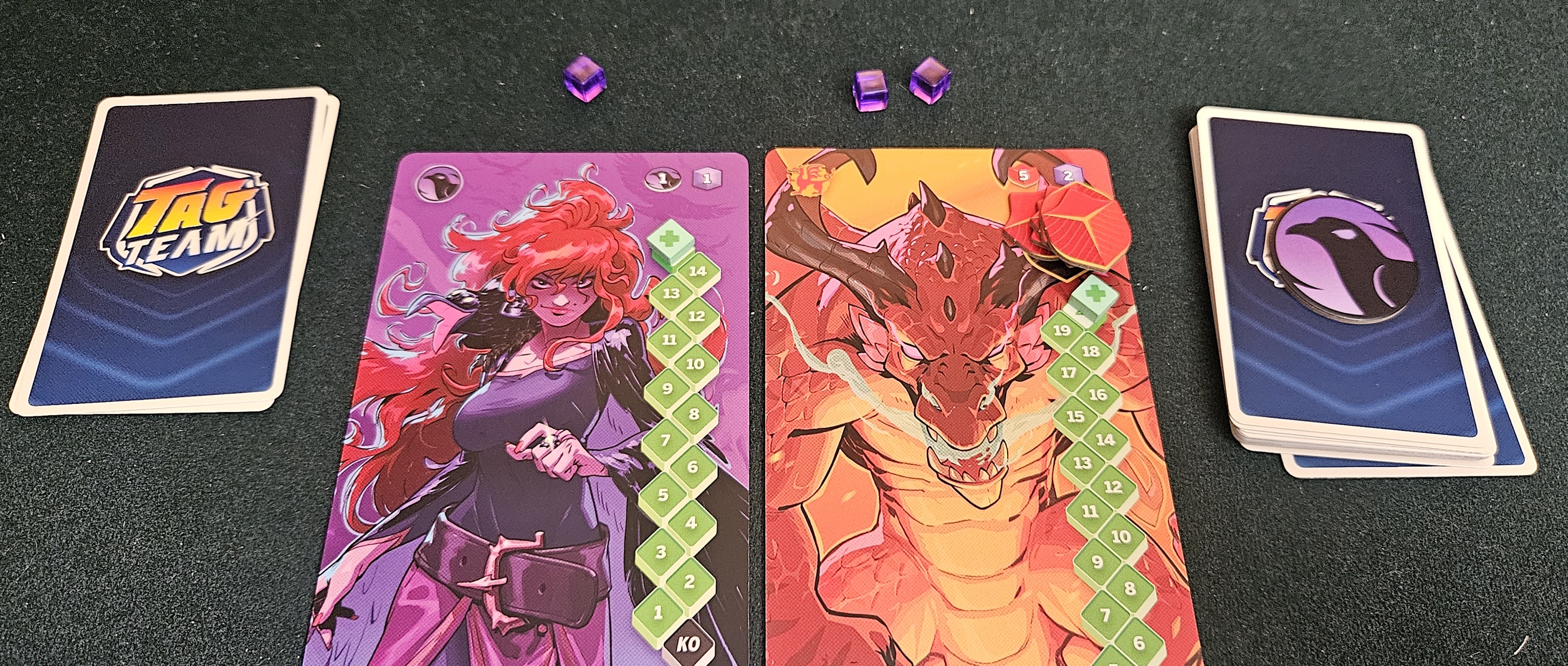
Media Masters

06. Juli 2026 um 20:08

Sequel suggestions: THEATER KIDS / BOARD GAME NAME REMEMBERER / OPERA SLUT

I’m not the biggest fan of trivia games. Especially those that require players to know a specific answer, and a hundred times those that sporadically stuff me into a locker with an unexpected sports question. “Who soiled his pants while stealing two consecutive homers during the 1914 Cinnamon Bakeaway summer camp?” the question will ask. “Nobody could possibly know that,” I begin, only for my father to scream “Mickey ‘The Dugout Dog’ O’Queefe!” for ten thousand points.

Book Club and Movie Night are teensy-tiny trivia games by Peter Hayward. Each session lasts five minutes, sometimes a run of cards will produce an impossible question, and they’re titles that will prompt the most obnoxious person in your gaming group to insist they’re activities rather than games. For all that, they’re the rarest of beasts: trivia games that put creativity and lateral thinking on the same footing as raw factoid retrieval.

The Sun Also Rises! < me trying to show off but failing completely

Name a book!

Rather than walk through the rules, let’s open with a demonstration. Movies. We’re guessing movies. So we draw a card. It says “punching.” What’s a movie that includes punching?

Rocky. Sure. Plenty of punching.

Now we draw another card. “Scene set in a city,” it reads.

At this point, we need to take stock. Does Rocky have a scene set in a city? Well, yeah. The whole thing. Philadelphia. There’s a statue. The city even renamed the steps.

So we take that card, “Scene set in a city,” and we move it into the “Movie Doesn’t Have” column. Now we need to come up with a movie that does have punching but doesn’t have any scenes in a city.

Knockaround Guys!” shouts my friend who always remembers weird movies like Knockaround Guys. That sounds about right. We spend a minute debating whether there’s a city scene near the beginning, but none of us can remember because Knockaround Guys came out in 2001 and it wasn’t a good movie to begin with, apart from that one scene where Vin Diesel really works over that redneck. Eventually we decide that, fine, Knockaround Guys works.

Another card. “Character goes underwater.” Uh oh. Pretty sure nobody goes underwater in Knockaround Guys. (Although maybe. We can’t remember. Knockaround Guys came out in 2001 and none of us saw it more than once. Nobody did.)

So what’s a rural punching movie where somebody goes underwater? Sinners. Of course. Props to Geoff with the contemporary cut.

Fourth card. “Celebration or holiday.” Now the group starts to fracture. Because while Sinners isn’t a holiday movie, it can be argued that the juke joint is a celebration of freedom, and that one scene is a celebration of African heritage, and now we’re debating what “celebration” means in the context of “celebration or holiday.” It matters. Because if we decide that Sinners includes a celebration, our next movie can’t have a celebration, which is a lot easier than naming a rural punching underwater holiday movie.

Phantom Menace, somebody offers, making assumptions about how we’ll rule on the celebration thing, only to be roundly denounced by all the other nerds.

Uncut Gems, my pedantic friend says, which is always a treat. He says it counts for “underwater character” because Adam Sandler is underwater to loan sharks, which is pretty funny and we’re considering it, but then we remember that the whole thing is obviously set in a city. We’d kinda forgotten about that card.

Finding Dory, says the person with kids. Apparently the octopus punches something, and while the movie is basically set in Monterey, there’s some wiggle room whether the fictional version of the Monterey Bay Aquarium should be considered a city or a greater unincorporated beachfront region. Also, since we still haven’t settled the “celebration” issue, this would retroactively put that card in the negative column.

The timer goes off. That’s five minutes.

Constantine II!

Name a movie!

Hopefully this demonstration has been helpful. Here are my takeaways.

Perhaps foremost, this is a pedantic sort of game, one where every definition means what it means right until the moment when it behooves someone to argue that it doesn’t. “One-word title.” Hyphenated or not? “Adaptation.” Isn’t almost everything in Hollywood an adaptation? “Break-up.” Does that include friendships? “Snow.” You know somebody’s going to insist that cocaine counts. Personally, I think we all know what “snow” means. But then I propose a movie in Antarctica and now we’re debating whether pack ice really qualifies as snow. Fair enough. The good news is that it’s cooperative, so players don’t often come to loggerheads. You draw a card, squabble over its meaning a bit, and then move onto the next thing.

For all that, the experience it offers is often rather uneven. Sometimes you’ll hit upon a run of cards that’s too easy, and by extension too boring. In the next session you’ll be asked to only name movies with a stand-up comedian in a lead role. Or a book in epistolary form. Or to exclude media with “and” or “the” in the title. My least favorite? Only picking books whose author has an initial in their name. Hope you want to hear a lot of Christian fantasy author suggestions.

Books are harder than movies. Not only because it’s easier to watch a movie than read a book, so most people’s pool of options will be substantially deeper, but also thank the visual nature of the medium. Whether a movie includes a cat is easy enough to answer, even if it strains our gray matter. Recalling whether a book refers to a named character’s death is… well, it’s harder to conjure. At least for me.

For the most part, these textures are compelling, but it would be inaccurate to pretend they don’t sometimes lead to frustration. Riffing on movies is a delight. The same goes for books. But suddenly stretching to recall books-within-books when you’re four cards deep… well, it depends. Everything in Movie Night / Book Club depends.

There’s also a part of me that balks at the games’ size. These are slight things, roughly the size of a deck of playing cards, but at 40 and 34 cards for books and movies respectively, their variety is thinner than I would have preferred. And, look, their real value is in how those cards combine with one another. Even with the same three or four cards, their order can matter, and the appearance of even one other card can make a huge difference. But it’s disappointing all the same to draw a duplicate after only a few sessions.

The Sun Also Rises!

Name a book!

All told, then, Movie Night and Book Club are mixed bags. They’re snack-sized games, good for filling a few minutes, nice as stocking stuffers, but also not especially ambitious or groundbreaking. I hate to say it, but just this once: the absence of a “sports” card from Movie Night might be one of the most telling indications that this party game isn’t quite up to snuff.


Complimentary copies of Book Club and Movie Night were provided by the publisher.

(If what I’m doing at Space-Biff! is valuable to you in some way, please consider dropping by my Patreon campaign or Ko-fi. Right now, supporters can read the next installment in my series Talking About Games, this time tackling the topic of what makes a good list! Naturally, the piece includes a list.)
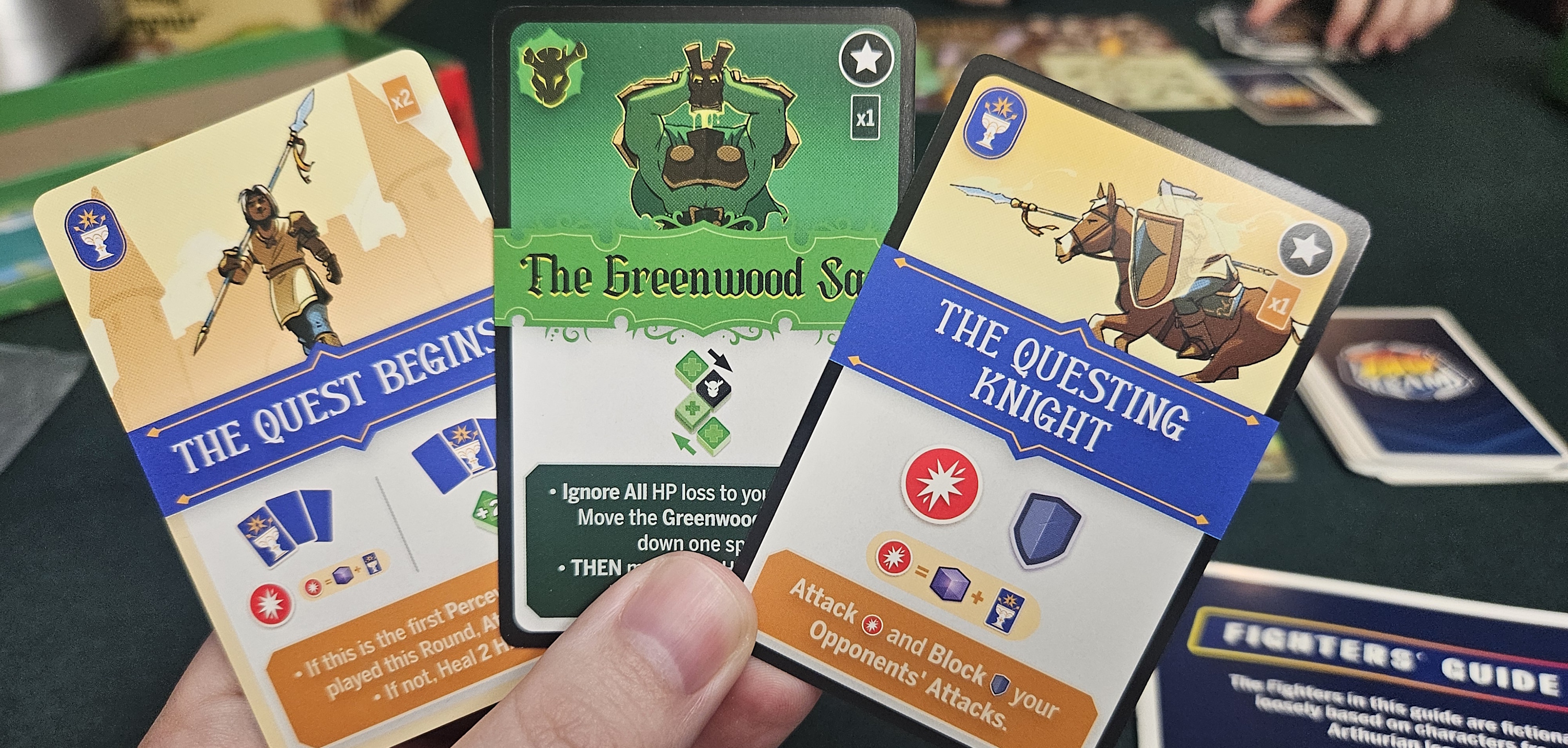
Therapeia Infernalis

03. Juli 2026 um 19:32

see, I can wrongly combine ancient languages too

The first time I opened up to a medical professional about some childhood trauma, it was like surgically excising a living thing from behind my breastbone. That experience — the galloping pulse, the ventricle-deep ache, the sensation that something alive and malicious was digging in its claws to stay rooted — made it easy to see how one might disavow ownership of those emotions and assign them to supernatural entities. Demons rather than one’s own untilled memories.

That, it seems, is the connection being made by Judson Cowan as well. Personal Demons is Cowan’s chaser to the successful Deep Regrets. Where that game used fishing for eldritch horrors as a stand-in for, well, deep regrets, Personal Demons is about calling demons to your own private summoning circle in order to dispel them. Or to confront them? To host a tea party for them? Look, it may be an apt metaphor, but it isn’t always a perfect one.

You might think you know what Forneus is about, but you'd be wrong. His name means "oven" and he teaches rhetoric. (This isn't even a joke.)
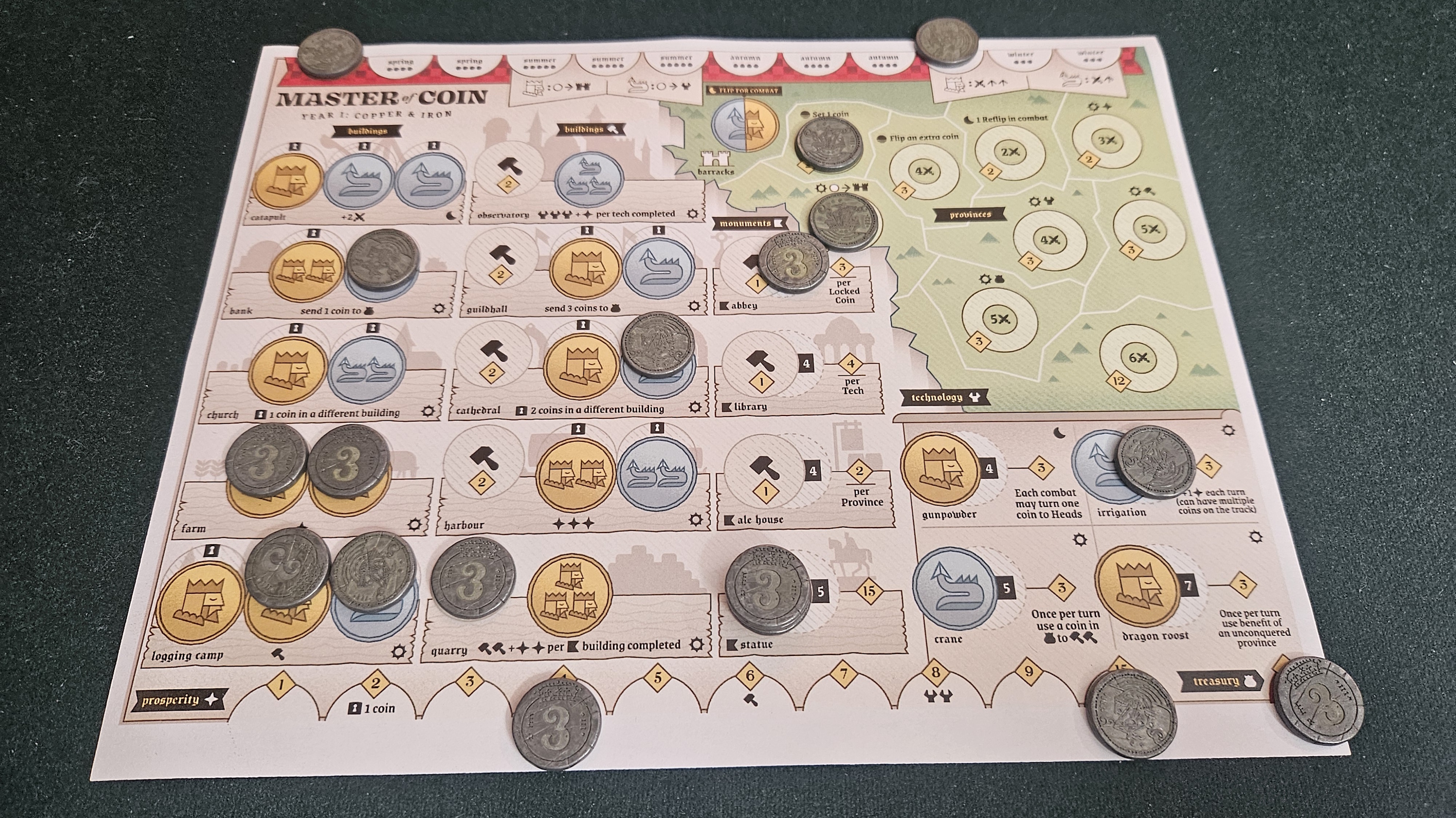
Check out the squishy li’l guys responsible for my bad behavior.

Here’s how to summon a personal demon.

Pick a card. This is a drafting game, so a fresh hand of cards will always be there to offer its selection of underworld beasties. Take care to pick the right one. Some require a certain number of seals, little colored tokens that sit within your circle, before they can be birthed into our world. All confer their sin of choice, hate or want or glut, so be sure to select the one you’re currently attempting to sin-max.

Once picked, you need to decide where in the circle to summon it. The main concern here is the demon’s corners. There are three colors to consider — four with the wild color that can match with anything — each mapping to liminal, infernal, and abyssal seals. If the corners of four cards line up, you stamp a seal on it. This is useful for summoning tougher demons, but also for scoring every adjacent demon. Which means it’s your main objective. Seals beget points and then are broken, flipping to their cracked side rather than remaining pristine and white. Fortunately, even cracked seals can be used for summoning further demons.

Right away, though, Judson pulls a few tricks that make Personal Demons a little more interesting than it would have been otherwise. After putting a demon on your board, you’re also allowed to take an action. These cost some amount of sin, hence the gluttony and hatred, but allow you to place other cards. The smallest are fragments. These cost only a few morsels of sin and confer a tiny card that occupies only half of a slot, hopefully pairing with demons like partners at a dance. For a greater fee, royals appear, usually offering a bunch of wild-color seal matches.

And then, for the greatest fee of all, you can summon a huge demon. Maybe even a colossal demon. But we aren’t ready for that yet.

not unlike real confidence

Confidence cards provide a range of abilities.

After the success of Deep Regrets, it seems like Cowan has gotten this stuff down to a science. Much like how that game found its audience partially by leaning into its fish-oil aesthetic, Personal Demons is full of the squicky and squamous. The same goes for the game’s underlying metaphor. Deep Regrets was a bit hand-wavy about the relationship between the sea, chthonic aberrations, and one’s leaden heartaches, but it worked thanks to a certain earnestness, not to mention the fact that it wasn’t especially judgemental. Maybe it helped that winning was often reliant on having as many regrets as possible, not keeping them under control.

Here, the tools of your infernal therapy are plain enough, but drawn with enough gusto (and gothic lettering) that it sells the idea without banging it into a migraine.
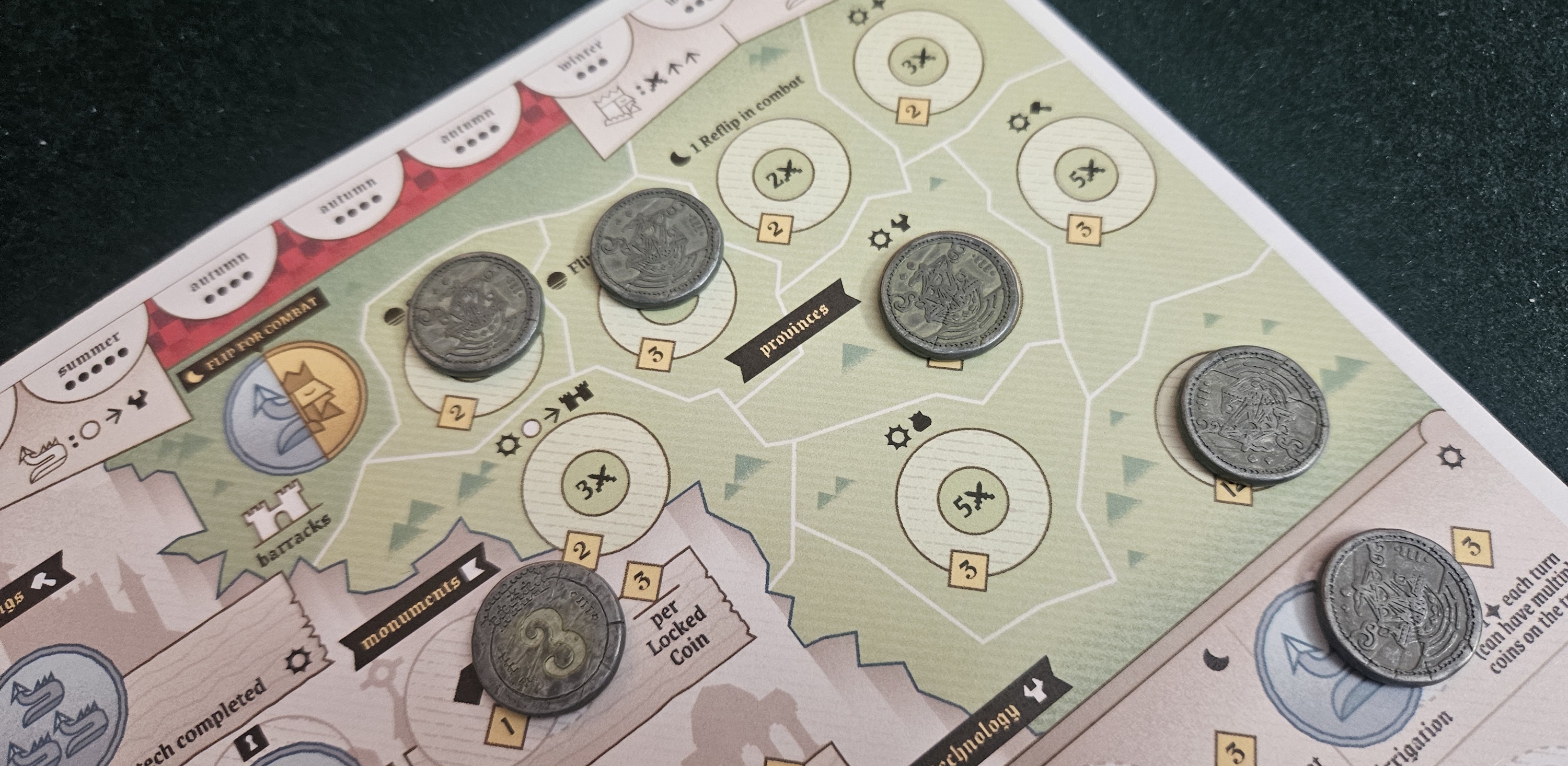
First, everyone begins with a fear on their board, an obnoxious card that takes up space, awards very few points, and only has seal markers on two of its four corners. You can confront this fear at any point, but doing so once you’ve filled your summoning circle with enough of the right seals awards a heap of points. So whatever your fear, whether existential (death, irrelevance) or faintly silly (clowns, bees), it tends to stick around. Digging its claws into your soft tissues until the right time.

Is there a right time? Should that fear be confronted now? Or can it wait a while, hanging around until you’re ready? I wish I knew. Maybe there isn’t a single correct answer. That’s the game, man.

Meanwhile, players also draw special cards that offer new abilities. These are called courage cards — a bit cloying, in my opinion — and they appear at regular intervals, such as at the conclusion of the round or whenever somebody confronts a larger demon. There are scoring perks in there, and freebie seals, and some let you rotate certain demons upside-down to better match their seals.

Somewhat ironically, much of our knowledge about early modern demonology can be traced through Johann Weyer, who compiled his list of demons not out of an actual belief in their efficacy, but to expose witchcraft as delusional, and therefore to denounce witch-hunting as cruel and unnecessary. His book helped end witch trials in the Netherlands... and then became a major source for later works on summoning demons.

Larger demons must be placed over ordinary demons.

The game’s biggest moments, of course, are when those larger demons plop onto the field. They’re expensive, both in terms of seals and expended sin, and can only be placed atop a foundation of other demons. There’s probably some metaphor at work, about how the work of facing down one’s demons is done bit by bit, rather than all at once. Then again, I’ve been accused of reading too deeply into these things, so don’t mind my speculations. Sometimes a demon is a demon. (More often, it’s epilepsy.)

It’s an interesting game. At every level, really. The card-placing puzzle is solidly done, and it captures the joy of amassing a menagerie of ugly fellas. Every placement is accompanied by real tradeoffs, especially when it comes time to burn off some sins. For all that, I wonder how quickly it will wear out its welcome. It doesn’t have infinite depth, and it isn’t long before its demons are reduced to the backdrop for its seals and sins. My first play was enthralling. My third, which saw me filling out a “perfect board” with every single seal placed, was markedly less so.

What interests me more, I suppose, are the simple processes it produces. Personal Demons is methodical. Repetitive. Every round assigns somebody to act as the group leader. They walk the table through the steps. Choosing a card. Placing it. Flipping it face-up, naming its sins, stamping it with a seal. I’ve sat in therapy circles, both as a participant and as a volunteer, and there are connections to the summoning circles of old. The words we say. The mantras. The prayers. The dark things that are brought up out of the soil. The purifying fire, hot enough to burn. The glimpses into the abyss. None deeper or blacker than the hole within the self.

"I wanna believe in demonology but not practice theurgy" —everybody

I’ve been told the final boards won’t be quite so bump-prone.

Does Personal Demons bottle that magic? I think so. A little bit. In its rhythms. In its good-natured acknowledgement that this stuff is painful, but that it can be darkly funny, too. We’d rather imagine a teeming world under our feet than recognize our own face in the puddle. What’s that old joke? A man would rather write the Démonomanie than go to therapy. Personal Demons tells us we can do both. Jean Bodin would have thrown a fit.

Or maybe it’s just a pretty good card-drafter and symbol-matcher. That’s fine. In such a case, I’ll always have the butt-demon. His lemony backside roundly scandalized my daughters. Now I’ll put the box back on the table and tilt it so they’ll catch sight of his dimples in the morning. When they’re older, I’ll repay my mischief by funding their therapy.


A prototype copy of Personal Demons was temporarily provided by the designer/publisher.

(If what I’m doing at Space-Biff! is valuable to you in some way, please consider dropping by my Patreon campaign or Ko-fi. Right now, supporters can read my first-quarter update of 2026: the best board games, movies, books, and more!)

❌