Every so often, a game system not only gets a second try, but entirely wallops its original incarnation. That’s the case with Quinn Brander’s Rebuilding Chicago, which remakes Rebuilding Seattle with such aplomb that I called it “pretty much perfect.” (I called it that to myself, right now, so I could quote it.) For today’s Space-Cast!, we’re joined by Quinn to discuss how he improved a game that’s still on store shelves, what some folks might prefer about the original, and the little touches that go into making a successful sequel.
Listen here or download here. Timestamps can be found after the jump.
TIMESTAMPS
3:45 — introducing Rebuilding Seattle and Rebuilding Chicago
7:11 — the origins of a hybrid city-builder and polyomino game
10:15 — a dual-layer polyomino puzzle
16:45 — modeling happiness and amenities
19:27 — balancing an in-game market
22:53 — using events to manage tempo
34:43 — why decide to revisit a game system?
45:37 — Gone to Gaia
(If what I’m doing at Space-Biff! is valuable to you in some way, please consider dropping by my Patreon campaign or Ko-fi. Right now, supporters can read my first-quarter update of 2026: the best board games, movies, books, and more!)
Star Trek: Captain’s Chair ist ein asymmetrisches Deckbauspiel im Star-Trek-Universum. Jeder Spieler übernimmt die Rolle eines bekannten Captains und führt dessen Crew durch Missionen, diplomatische Kontakte, wissenschaftliche Entdeckungen und militärische Konflikte. Zur Auswahl stehen unter anderem Picard, Sisko, Burnham, Shran,
Geoff Engelstein was influential in bringing Takashi Ishida’s Magical Athlete to the United States in 2003. It’s unsurprising that Geoff, alongside his children Brian and Sydney, have tapped into the spirit of that phenomenal race game, pairing its traditional roll and move structure with several new flourishes. In fact, there is so much of that…
Quinn Brander’s Rebuilding Chicago is one of the best polyomino-placement games I’ve ever played. That’s the lede, and I will not bury it. Even moreso than its predecessor, Rebuilding Seattle — not to be confused with Raising Chicago, which I do pretty much every time I say the game’s title aloud — this is a tight, smart, and addictive approach to city-building and competitive brinkmanship. The more I play it, the more I want to keep coming back.
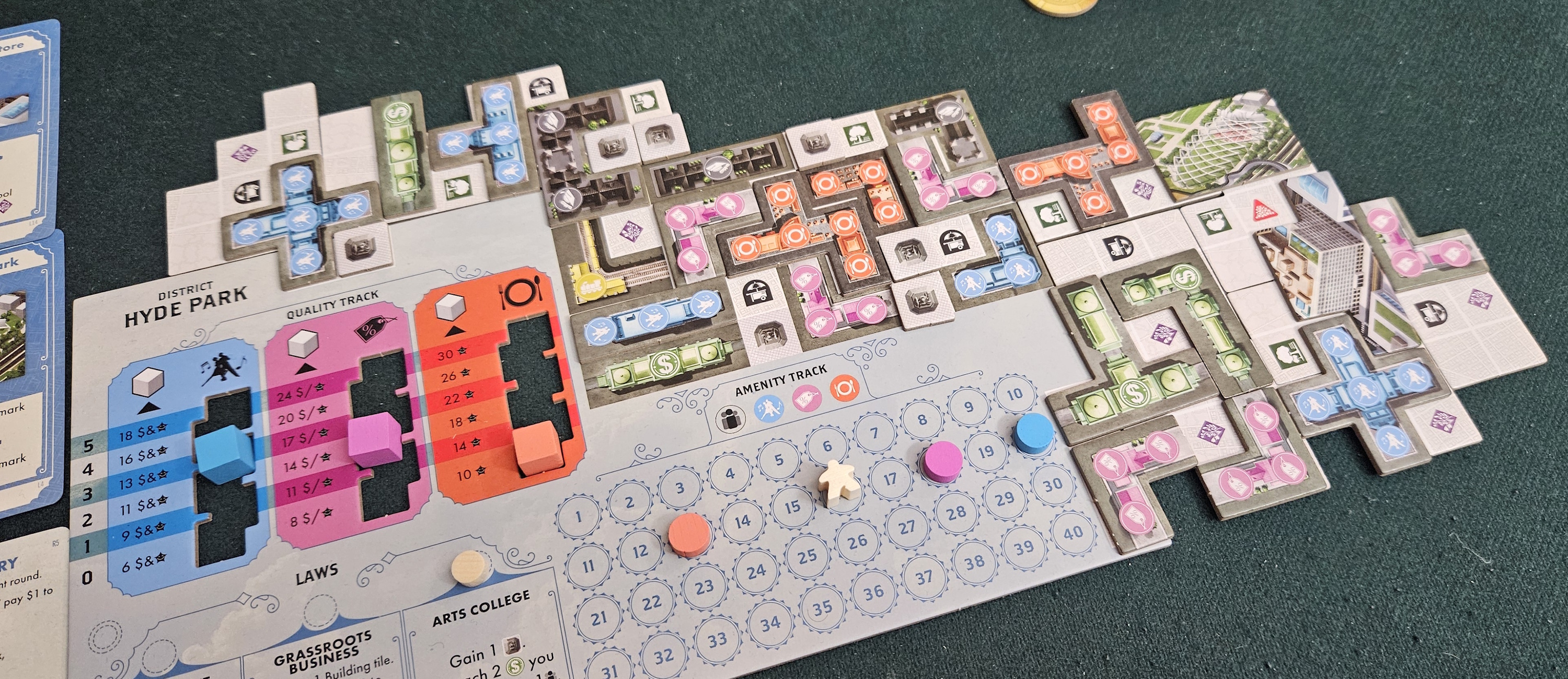
The player boards are also where you build your district.
Lest this become a comparison piece with Rebuilding Seattle, let’s nudge the parallels out of the way. Yes, this is more or less the same system. But where Seattle had some baggy Ozempic skin wrapped around its bones, Rebuilding Chicago sees Brander screwing down every edge and flap until all that remains is a taut cable that bears so much more weight than its predecessor.
We begin with the usual tale. Chicago has burned down. Cow in the shed, fire fire fire, a hot time in the old town tonight. Now it’s up to you to transform the rubble into not only into a place people can inhabit, but one they might visit from afar. A World’s Fair city. A city that stands for a thousand years. Or at least a little over a century, barring any further catastrophe.
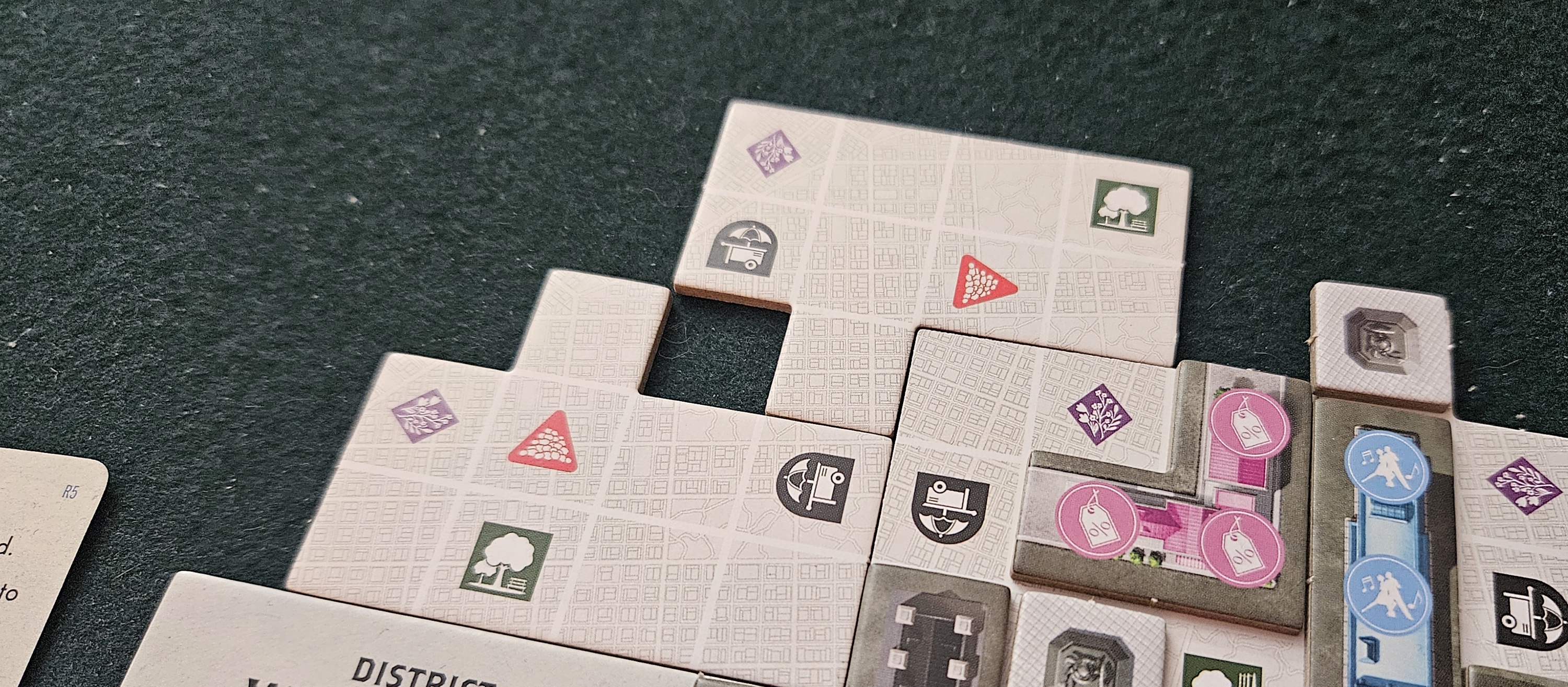
Right away, there’s a confidence to the whole thing. Your player board, festooned with trackers and laws only you can pass, also shows the first portions of your city district. Cleverly, this district is fragmented. There’s the main area, filled with food carts and gardens and public parks — a lot of rubble, too — where you will place the structures that govern your city’s progress. But there are also two smaller areas, way off to the left and right. You’ll bridge to these areas eventually, but until you do so they’re unavailable, just collections of spun-off decay that must be reached eventually lest they produce an eyesore from afar.
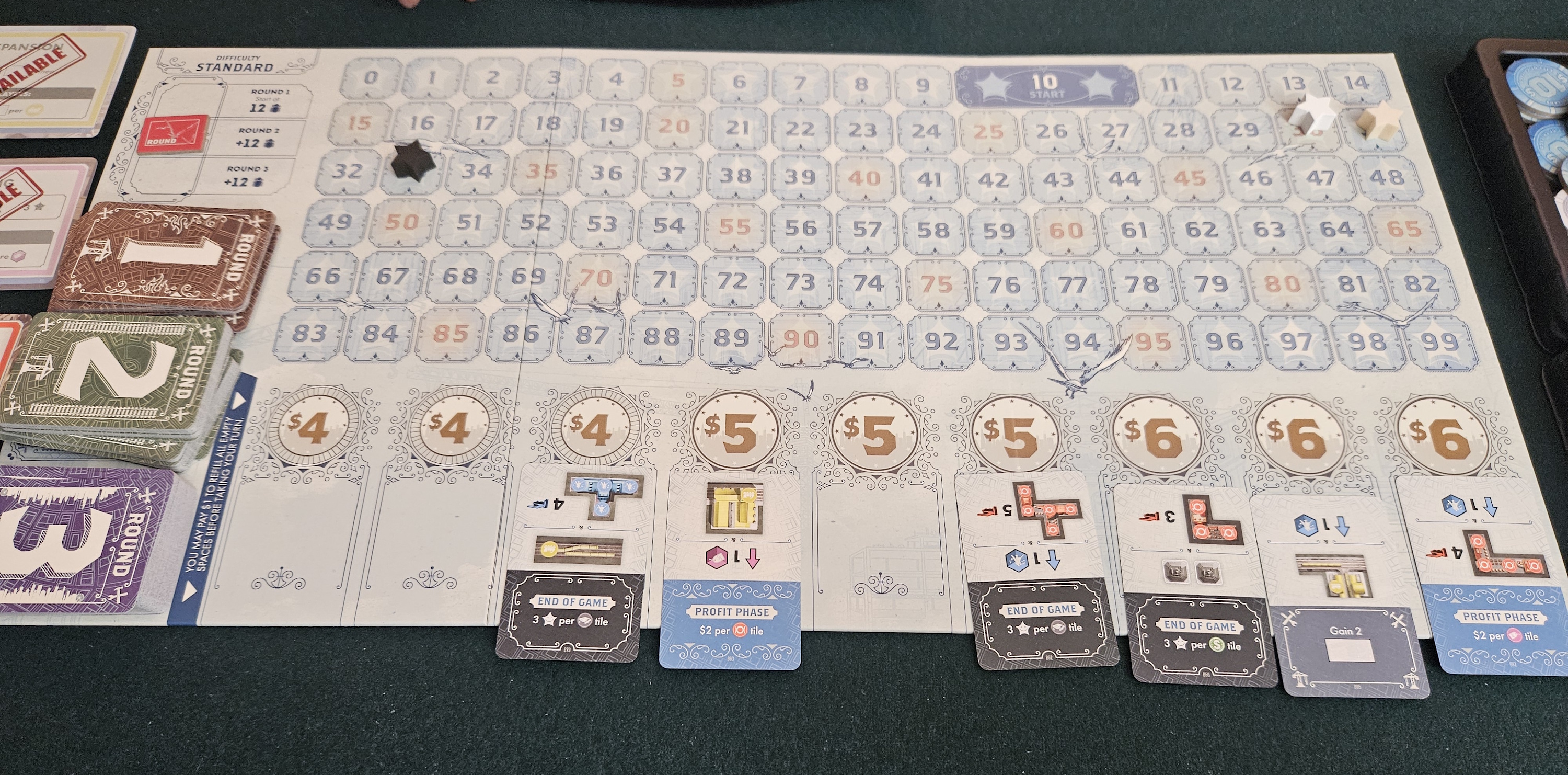
The card offer and scoring board is printed in base 17 for some reason.
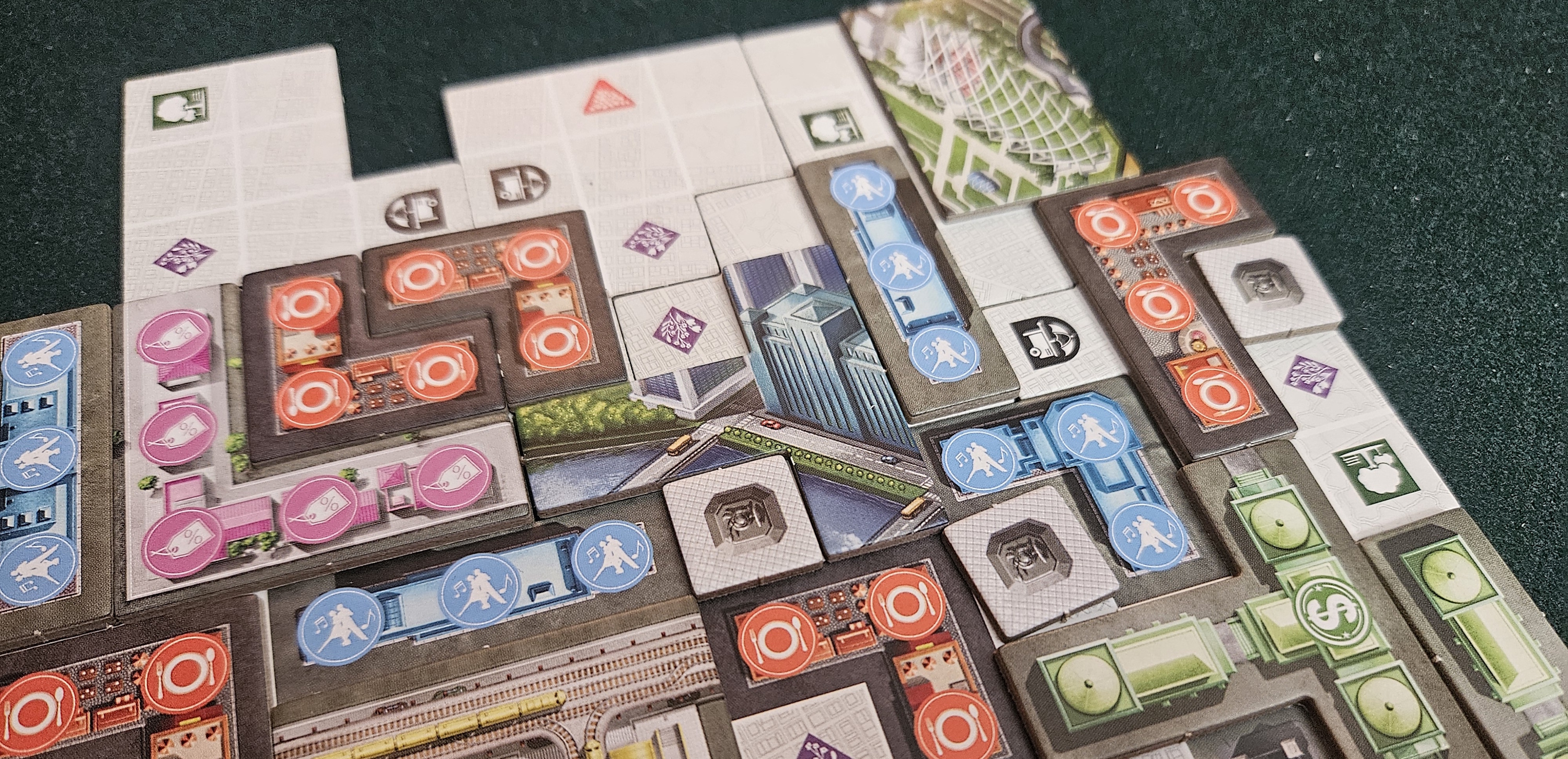
Rebuilding Chicago, then, is a polyomino game in two layers. Underneath it all are suburbs, oddly shaped pieces that don’t always fit together easily, each providing the same icons that dominate your main board. Once adjoined to the rest of your city, these then provide the foundation for everything else.
It’s a little bit like building one jigsaw atop a different, mismatched jigsaw, with certain pieces you’d rather not cover because all those hot dog stands will provide income at regular intervals. But given how tight the game’s geography tends to be, sacrifices will have to be made. It isn’t uncommon, for instance, for your pitiless district councilperson to glean the benefit of those local hotspots, only to then immediately eminent domain them into new shopping centers.
There are seven types of structure in all, but three of them are given outsized attention: shopping, nightlife, and dining. These are your amenities, and unlike the banks and train stations and everything else, they’re given special trackers for both their quantity and quality. This is crucial, because at certain points someone, whether yourself or one of your rival district bosses, will trigger these amenities to score. When that happens, you check their position on your trackers against how many dissatisfied citizens are living in your district, subtract any shortfalls, and then earn victory points and hard-earned cash on the result.
Those gaps in your city are entirely legal.
In addition to your ongoing construction projects, Rebuilding Chicago contains a whole series of interlocking systems, but never so many that the game becomes complicated to cluttered.
To start, there’s the drafting. You select buildings, bonuses, amenity perks, and everything else via a market draft. Each card offers both structures and some other bonus, forcing players to make hard decisions almost every turn. Meanwhile, the market doesn’t refresh unless you pay some cash to do it. This can feel restrictive at times, especially when you’re scraping the till for every last nickel, but also prevents the table from churning through the decks — of which there are three, one per era of the city — until they get precisely what they want.
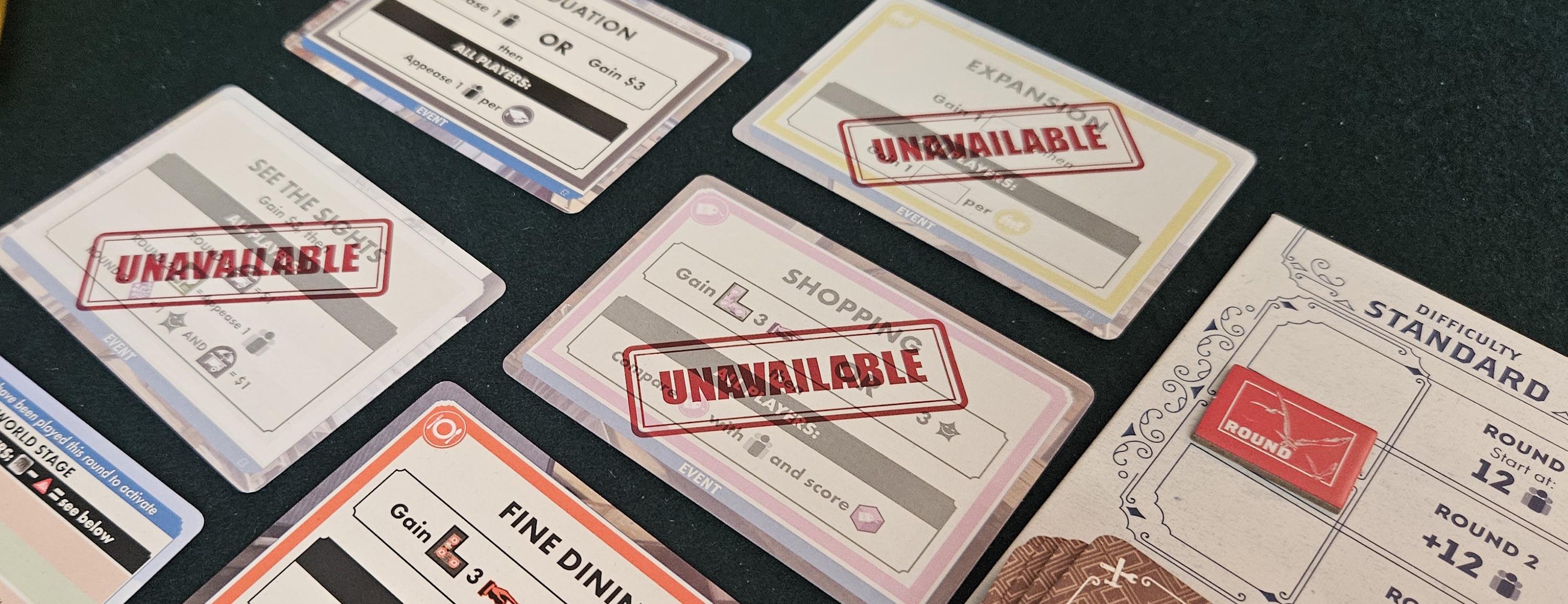
Overlaid atop everything else is an event system that’s purposely frustrating in all the right ways. Claiming an event awards some minor bonus to the triggering player, while also applying a broader effect to everyone at the table. In many cases, though, the best outcome is to let some other rube trigger them so you can benefit without having to spend the turn.
These events run the gamut: new suburbs, cash for hot dog stands, scoring checks, even occasional bids to ensure your city is visible on the world stage. There are subtleties aplenty to consider, especially since events tend to be scattered among the usual card-drafting and city-building, producing little windfalls that punctuate the action. The result is a circadian rhythm that propels the game through both ups and downs. Sometimes players are flush with cash, other times events provide necessary infusions. It’s significantly more organic than the systems found in some tableau-builders, where everyone has resources until they don’t. Here, everybody is involved until the last event has been claimed. Then it’s time for the next round.
Events are powerful, and dictate the duration of the round.
Perhaps best of all, Brander’s vision of a city on the rise is pleasantly nuanced. The amenities are the clear show-stealers, with their periodic checks and windfalls. But every project receives its due in some manner. Trains allow access to distant suburbs, making expansion all the easier, although at times the additional responsibility can prove overwhelming, especially in the game’s early stages. Schools reduce the number of grumpy citizens, making it easier to appease your population via amenities. Financial institutions make money, special landmarks trigger sweeping bonuses that can alter your approach to scoring, and even single-square monuments serve to beautify your urban landscape and pave over unsightly messes.
It helps, too, that each player is given control over their own district, complete with its own starting benefits and unique laws, the game’s term for special abilities you can trigger once per round. The Loop, with its easy access to transportation, tends to expand rapidly, while River North feels a little more scrappy and Lincoln Park is thick with cash potential. There are six districts in all, and rather than settling for my usual three plays I couldn’t help but give them all a try, observing how Brander invests his system with distinct puzzles despite making only the barest of tweaks. My personal favorite, Hyde Park, leans into the education strategy to quell its citizen-grousers, but there are other approaches, all valid, with their own advantages and drawbacks.
Which is to say, it’s a stunningly rich system for so few rules. Perhaps that’s to do with how it always returns to its core considerations: the draft and how your rivals can steal precisely what you were looking for, the events that might occur one turn shy of their maximal benefit, and above all those wonderful skylines, all Tetris pieces and larger landmarks and monuments spackled into the cracks. This is one of those rare games that asks to be looked at for a moment, to be beheld, before everything gets sorted back into the box.
Hey, I’ve been to there.
In the end, Rebuilding Chicago realizes the promise of Rebuilding Seattle and then some. Where that game played it loose with every detail, this one cinches up its suspenders. The result is a mighty fine game in every regard. As a drafter, as a race, as a series of accidental or snitty thefts between players, as a positional puzzle to use every last acre of a city in metamorphosis. Here’s to a second round with each of those half-dozen districts.
A complimentary copy of Rebuilding Chicago was provided by the publisher.
(If what I’m doing at Space-Biff! is valuable to you in some way, please consider dropping by my Patreon campaign or Ko-fi. Right now, supporters can read my first-quarter update of 2026: the best board games, movies, books, and more!)
Considering how often the supervillains incarcerated at Arkham Asylum mount successful escapes, we’d do better to confine them inside a Chuck E. Cheese. At least that way they’d have to contend with food poisoning and sticky benches.
Still, the idea behind DC Breakout: Arkham Asylum is a strong one. Designed by Geoff, Sydney, and Brian Engelstein, this is another entry in the “wacky race” genre, marking it as the fourth such title in the past year. How does its coterie stack up against bun bangers, slippery bananas, and underdog brontos? I’ll put it this way: in any other race, it might have won a medal.
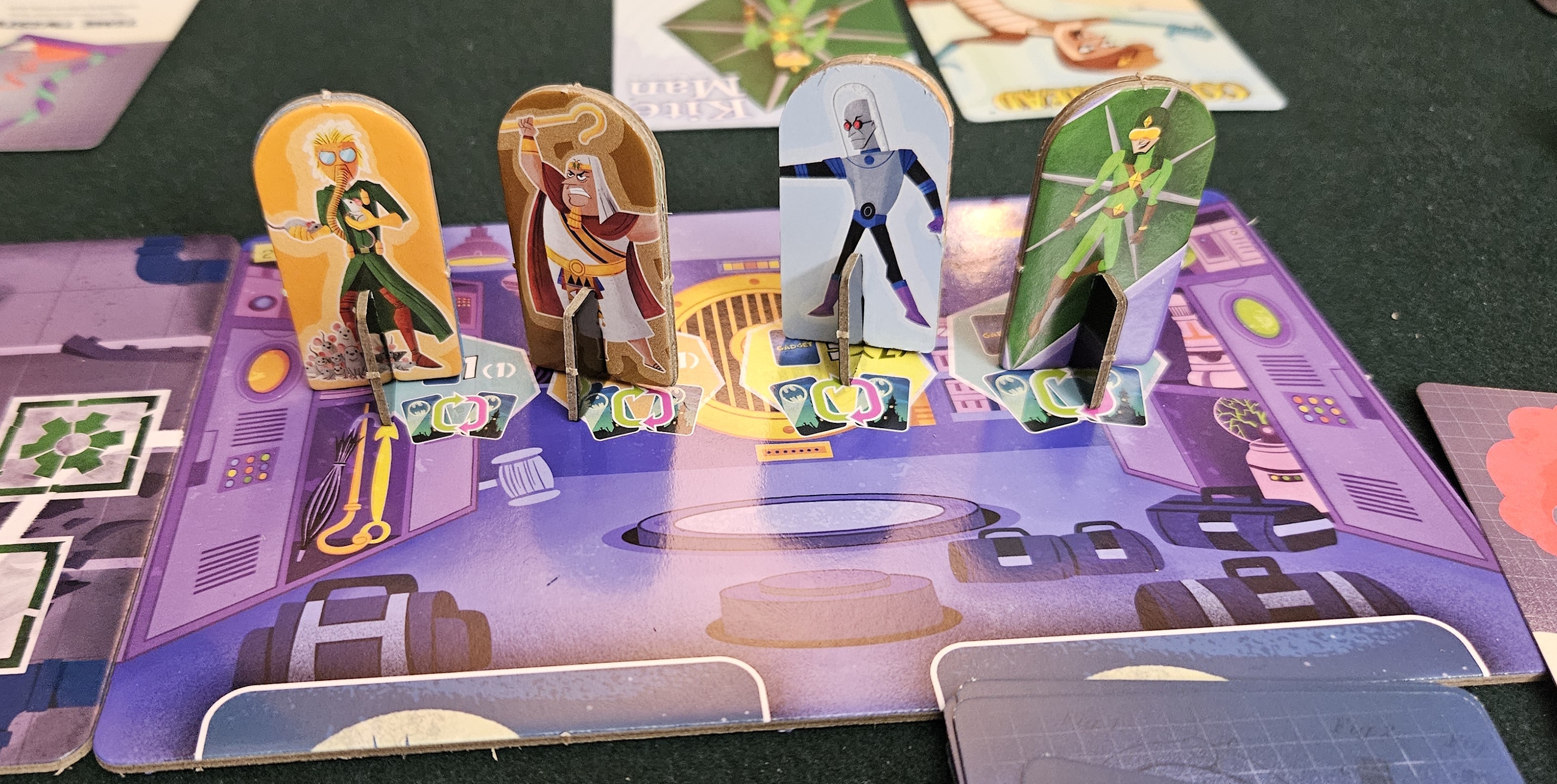
Me, a comics agnostic: oh hey, I can name two of these people.
DC Breakout opens with one heck of a great idea. Rather than having everybody out for themselves, what if our supervillains decided to work together? Not all together, obviously. These are the bad guys. If cooperation was their strong suit, they’d have stomped the Bat decades ago. But two at a time? A three-legged race? Evil duos temporarily setting aside their differences to escape the slammer? Sure. They can do that.
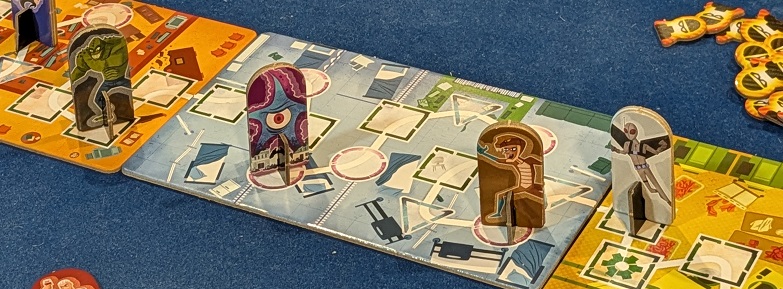
I wouldn’t be surprised if the game’s pitch was that you’re playing Magical Athlete with two characters at a time, because that’s pretty much how events proceed. During setup, everybody receives a hand of supervillains. There will be two races, with the winner of the first receiving some advantage in the second race. Now you pick your duos and head for the starting line.
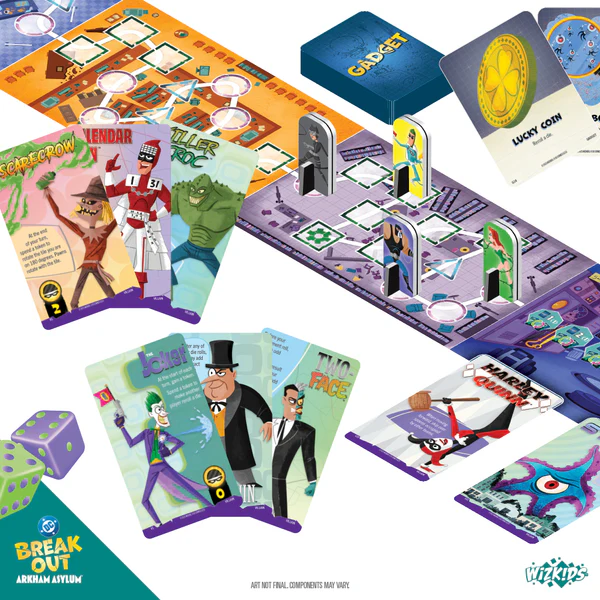
As openers go, this is as good as they come. There are heaps of villains to choose from. Forty. That’s the number. Forty villains, each with their own ability. It helps, too, that Batman’s rogue’s gallery is probably the most recognizable in comics history. This gives the Engelsteins room to play, but even more importantly ensures that the abilities are able to map to what we expect of any given character.
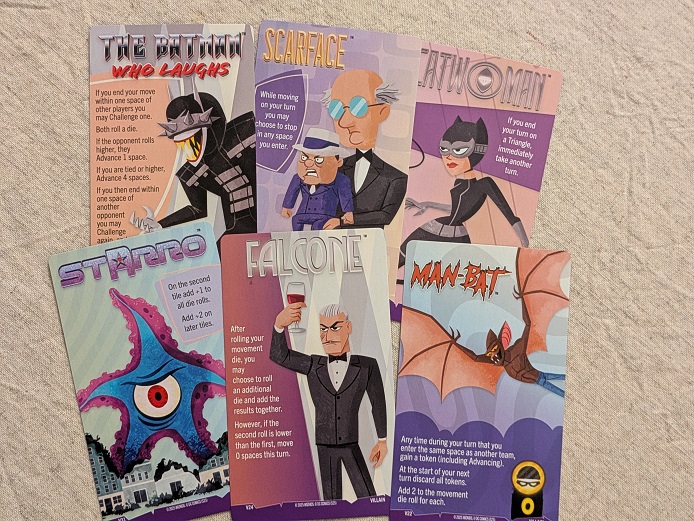
More or less, anyway. Some are more familiar than others. The Riddler, for instance, turns his movement roll into a bluffing game. Sure. That’s Riddler shit. Talia al Ghul can flip her die to its opposite side. Sure. She’s tricky. Hugo Strange lets other players reroll their dice, but earns extra movements whenever they take him up on the offer. Sure. He’s always manipulating people to get ahead. Scarecrow rotates the tile he’s on, flipping the leader to the reverse and anyone in the rear forward. Sure. That’s his fear toxin causing hallucinations.
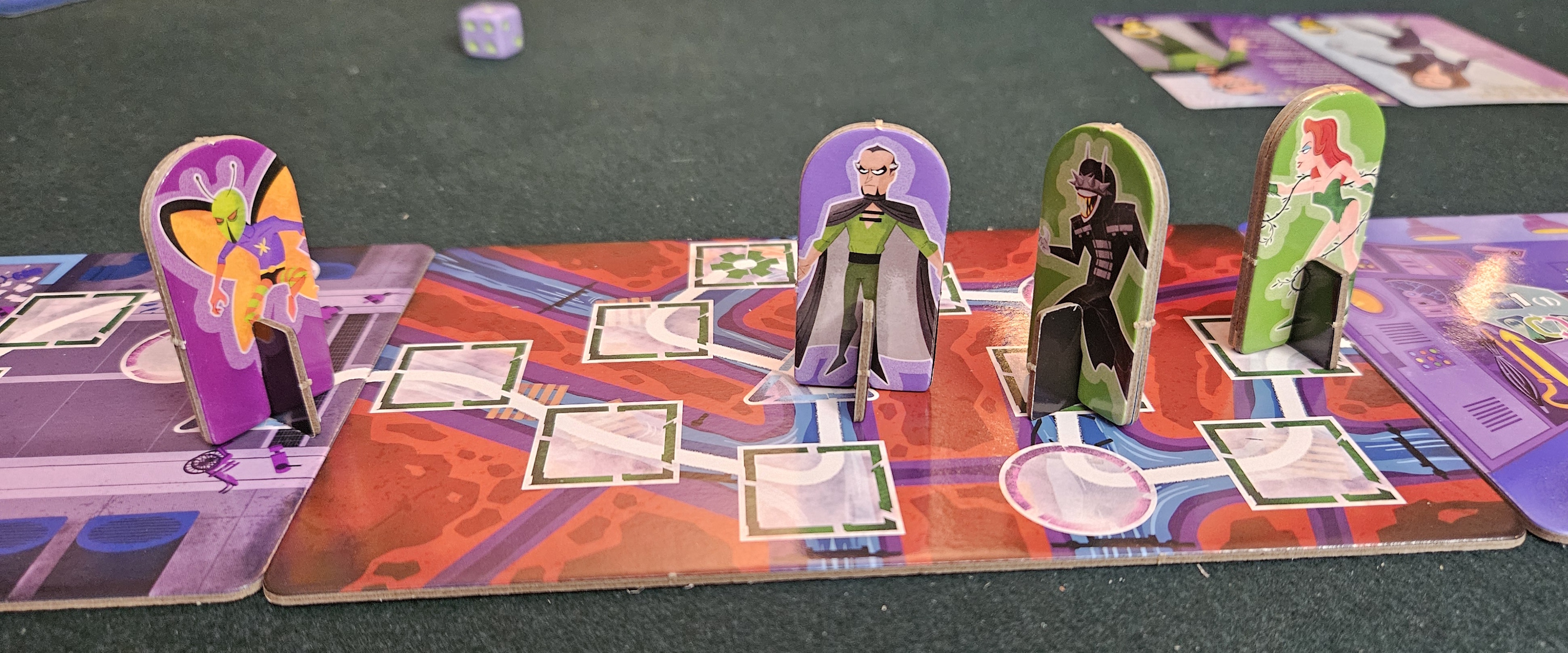
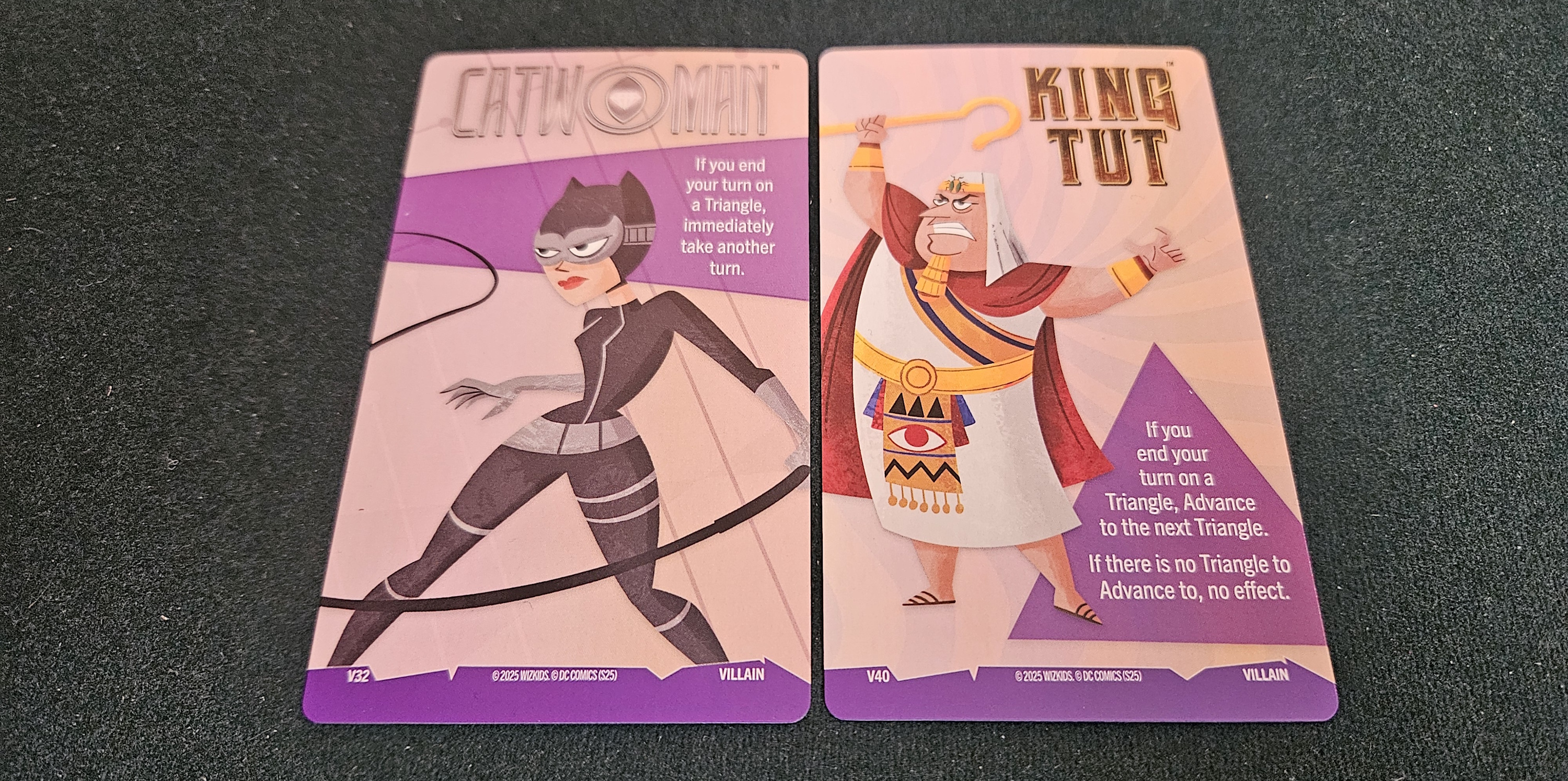
Others are less direct. Catwoman takes an extra turn when she ends on a triangle space. That one requires some explanation. Basically, Arkham Asylum is a series of shaped rooms. Most are squares, fewer are circles, and fewer still are triangles. So Catwoman is there to play the odds, hoping to land on the rarest of spaces in order to leap forward again. Which, yeah, that’s kinda Catwoman-ish, I suppose. Close enough.
Watch your back, cat! He intends to stick you into a canopic jar!
But what does it mean when Cluemaster moves another team forward to add one to his roll? Or when the Penguin massages his die roll up or down by one pip? Or when Killer Moth… look, I’m not going to pretend to know who Killer Moth is. But what about Condiment King? Why does he get extra movement when he’s trailing? Is this a condiment thing? Is pickle relish associated with losing? Don’t answer that.
Of course, what these abilities mean is that there’s only so much creativity that can be crammed into the system presented here. Fair enough. Not every supervillain can be transformative. For every Joker, there’s gonna be an Egghead. Except the joke’s on us, because the Joker is sort of a bummer in this one. He forces other teams to reroll. I guess the Joker is about chaos. Still, that’s not exactly what I was hoping for from the Clown Prince of Crime.
To be fair, there’s a huge range of abilities on display. Some villains use henchmen. Calendar Man, for example. He starts with one henchman, and can set his die to however many henchman he has at the current moment. If he does, he adds another henchman. Aha! He’s progressing through the days of the month! Good thing we locked him up. Poison Ivy, meanwhile, spends her tokens to force rival duos to move toward her instead of toward the finish line. Cleavage! The strongest of the fundamental forces.
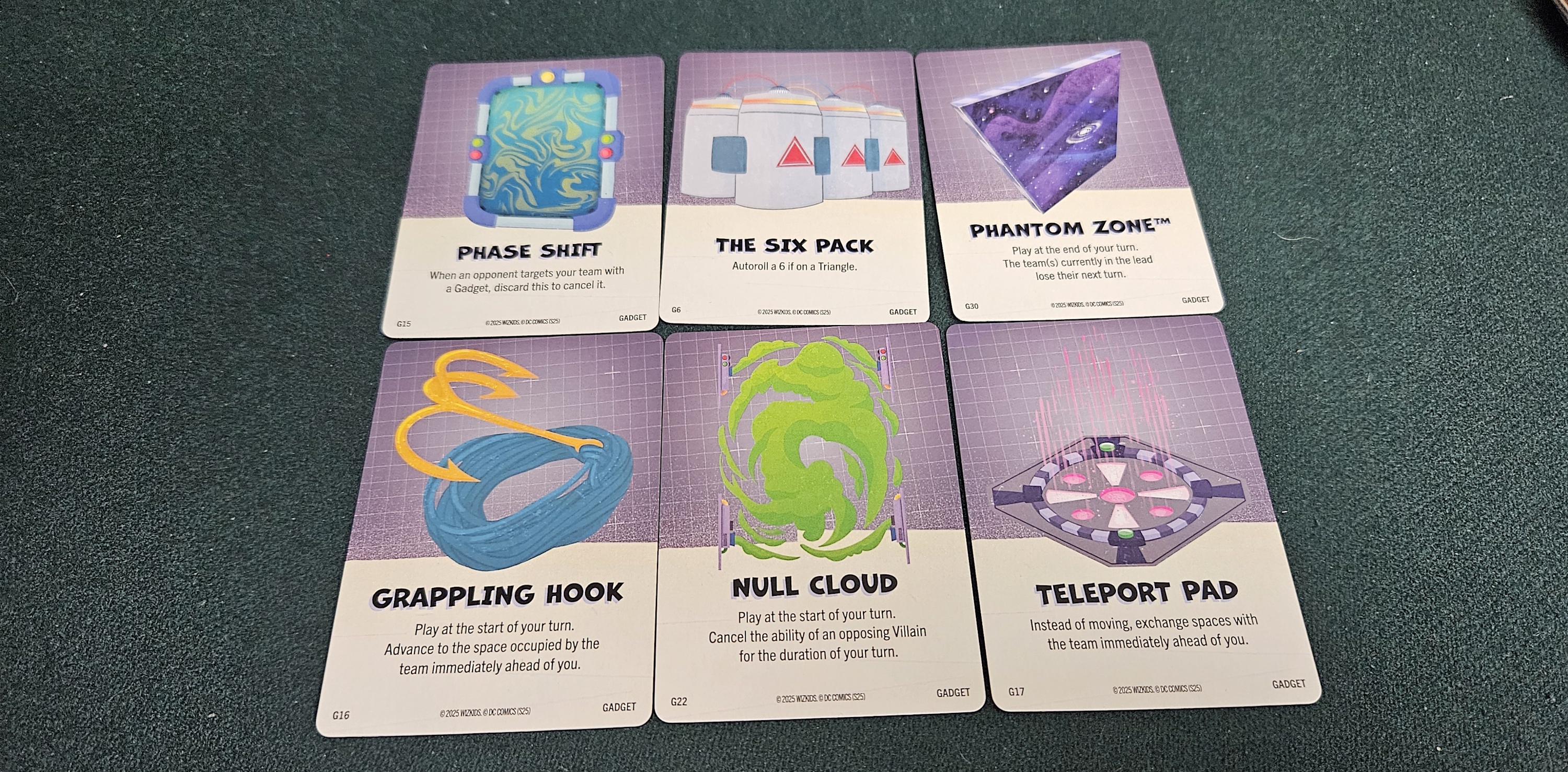
Simultaneously, there are gadgets to consider. Gadgets are single-use powers that can be earned whenever you stop on an armory space or by earning a solid placement in the first race. There are quite a few of these. Fewer than the number of villains, but still, for a deck without any duplicates, there’s a solid range to potentially draw.
Which brings us back around to that core idea. Two villains. A handful of gadgets. A simple roll-and-move race to the exit. What could possibly go wrong?
Gadgets allow you to break the game even further.
It’s tempting to say “plenty,” but the more honest answer is that DC Breakout: Arkham Asylum is surprisingly solid. It’s just that it isn’t as solid as its competitors in this unexpectedly crowded field.
At heart, DC Breakout is about breaking the game. With the right combination of villains and tools, it’s possible to… well. I’ve watched as one duo created a near-unbroken loop of extra turns. Another duo was able to reuse items and draw a bunch from the gadget deck, permitting a series of teleports and adjusted rolls that was so unfair that its rivals were still way back at the starting line when it was peeling out toward Gotham City. These races were “unfair.” Hilariously so. Infuriatingly so. But they were also the result of previous prep work. Sacrifices in the first race to acquire extra gadgets. Or the opposite, a hard-fought initial race in order to acquire better tools and a boosted villain draft.
Or, right, dumb luck. DC Breakout is full of that. Again, fair enough. That’s the genre.
But what’s interesting to me is the way this game’s chance feels more chancy than the chance in something like Magical Athlete. Not only more chancy, but more irritating. Perhaps it’s the veneer of skill overlaid atop the dice rolls. Or maybe it’s the way gadgets intrude into the regular process of play. A bad roll is a bad roll. But when you get a good roll and another player deploys an item that overturns it? Or worse yet, flips the entire map around so that they’re in the lead? I’m not going to get mad about it. But a scrunchy face? Sure, I’ll make a scrunchy face. Wacky races, as a genre, are full of bullshit moves. But there’s bullshit and then there’s bullshit. DC Breakout is full of the latter.
Which is fine, as these things go. Part of the game’s fun lies in not only getting lucky, not only in building the right supervillain pairs, not only, even, in managing the micro-decisions that occur during the race. But also in bullshit-proofing your team from rival shenanigans. Some of those unsexy abilities start to look mighty tempting when you realize they boast a stronger immune system to outright cancellation. Most of my best combos, for instance, have arisen from characters I was only dimly aware existed. Cameos from video games, footnotes or curiosities, late-night fan-wiki deep-dives, those were often the characters I needed to leap forward to victory.
The winner of the first escape leads the second.
The result is a game that’s sometimes very good and sometimes so lopsided that it stops being interesting at all. When multiple players are breaking the game in sync, busted powers firing all over the place, it’s a hoot. But when one duo skip-teleports to the finish line while everybody else huddles around the office water cooler, the problem isn’t that the game is unfair. It’s that it’s boring. It’s like watching a race between a prize stallion and a certain unnamed sciatic board game reviewer. Also, the prize stallion just played a gadget that made the sciatic board game reviewer run backwards for ten seconds. Whee.
Which is to say, there are moments of real brilliance here. The range of abilities in the game’s generous cast. The delight of watching a guy with a ketchup nozzle defeat a mobster who was so uninventive that he named himself after his matte facewear. Even just the idea of pairing racers to become even more idiosyncratic and game-breaking. There’s a ton of good stuff in DC Breakout.
But it’s a game whose peaks don’t always justify its troughs. Not only in relation to Magical Athlete, Hot Streak, and Dino Racer — in relation to itself.
A complimentary copy of DC Breakout: Arkham Asylum was provided by the publisher.
(If what I’m doing at Space-Biff! is valuable to you in some way, please consider dropping by my Patreon campaign or Ko-fi. Right now, supporters can read my first-quarter update of 2026: the best board games, movies, books, and more!)

 Anmelden