
Normale Ansicht

Light Seeker Game Review

From the rulesheet: “A curse has cast a shadow over the valley, causing the inhabitants to run from the villages and the animals to flee their nests. From the top of a ridge, a mysterious creature named Buh has noticed the desolation and decided to bring the light back. As they stroll through the valley, Buh uses their magic to seek out and restore the light. As darkness recedes, wildlife and the village’s inhabitants begin to return and revel in the sun’s life-giving warmth once again.”

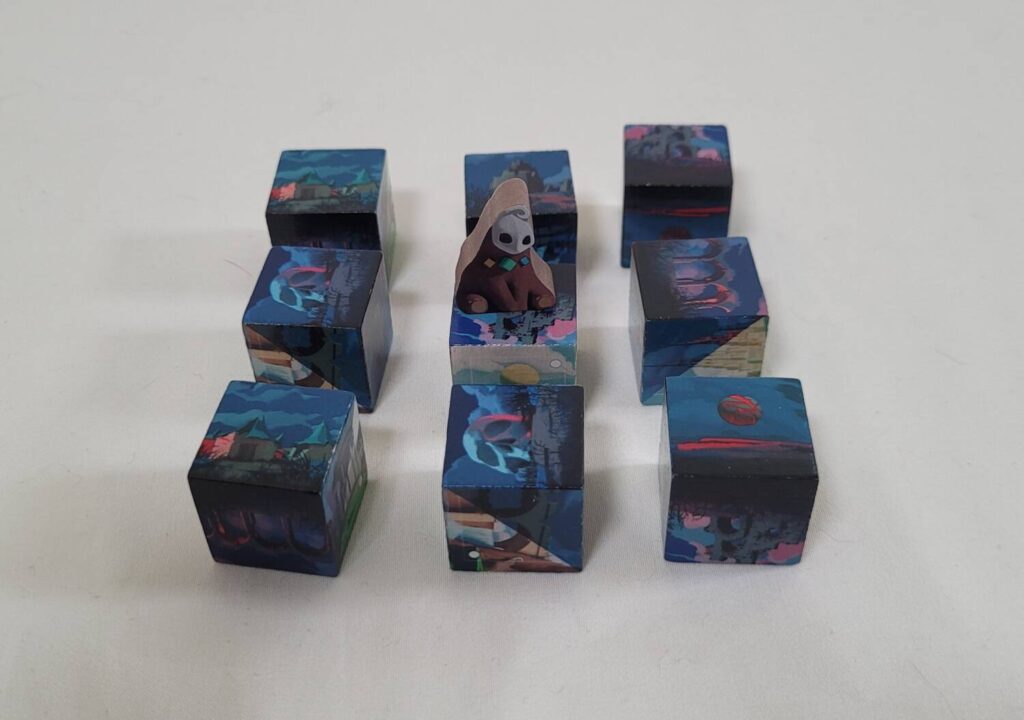
Light Seeker is a two-player strategy game composed of 9 wooden cubes and a single meeple, called the ‘Buh meeple’ (which sort of resembles a cartoon badger). Each wooden cube has a number of dark sides, bright sides, and a couple of half-bright/half-dark sides. At the start of the game, the cubes are arranged into a 3x3 grid, dark sides up. The Buh meeple is placed atop the centermost cube.

On a player’s turn, they will be performing two actions from a list of two possible action types. The same action can be repeated if the player wishes. The two possible actions are ‘slide cube’ or ‘tilt cube’. Sliding involves moving a cube from its current spot to an orthogonally adjacent location without…

The post Light Seeker Game Review appeared first on Meeple Mountain.

Spokes Game Review

Full disclosure: I know nothing about the world of velodrome racing (aka indoor cycling); other than they ride bicycles, really fast, at angles that would make a mountain goat sweat. But the brightly colored artwork for Spokes, the new release from Radical 8 Games, drew me in. And while you might not be able to judge the game by its cover, you can guarantee that it will get my attention.

I don’t know anything more about the sport after several plays of Spokes, but I can tell you that I had a lot of fun. Let me tell you about it!

The track is calling. Are you ready?

In Spokes, 1-6 players speed around an oval track, trying to be the first to complete 3 laps. You accomplish this by moving along routes, composed of colored bars (spokes), initially placed randomly on the track. Move as far as you can on a single color, before ending your turn.

Each player has a personal board that guides and restricts your movement for a turn. On your turn, you move the spoke marker cube on your player board one, two, or three places clockwise.

The post Spokes Game Review appeared first on Meeple Mountain.
My Shelfie Game Review

Buy My Shelfie from Amazon.com

While I consider myself an avid board gamer, I also feel like that label is a bit of a conundrum. I prefer medium-weight (based on BoardGameGeek’s complexity rating scale) games, but my collection primarily consists of light to medium light-weight games. Many of those in my collection fall into the party category with simple player actions, and minimal scoring complexity.

This odd contrast between preference and reality stems from the groups that I typically game with, as they prefer lighter experiences. Unintentionally, this has led me to being somewhat of a gateway game connoisseur.

My Shelfie checks a few important boxes for what makes a great gateway game: connection to a well-known classic game, easy-to-understand mechanics, and a relatively short playtime. The big question is, does the rest of the game hold up, or does it teeter off the shelf and fall apart?

A Classic Connection

In My Shelfie, players compete to earn the most points by filling their ‘bookshelf’ with ‘items’. Each player's bookshelf is a vertically displayed grid that holds up to 30 items. After seeing the bookshelf setup, some players will already see the connection to the well-known classic game Connect Four. While the bookshelf holds square items instead of…

The post My Shelfie Game Review appeared first on Meeple Mountain.
Tricky Treats Game Review

Here’s something spooky: I don’t own any Halloween-themed board games…not a single one. Now, I’m excited to say that I own one I’ll keep handy for at least the next few pumpkin seasons.

Tricky Treats, a family-weight title published by Cranio Creations last year, hit my table for a couple plays recently. Although I picked this up in Germany right before Halloween, other, buzzier titles hit my table first, so I didn’t play Tricky Treats this past Halloween and let the game sit for a while.

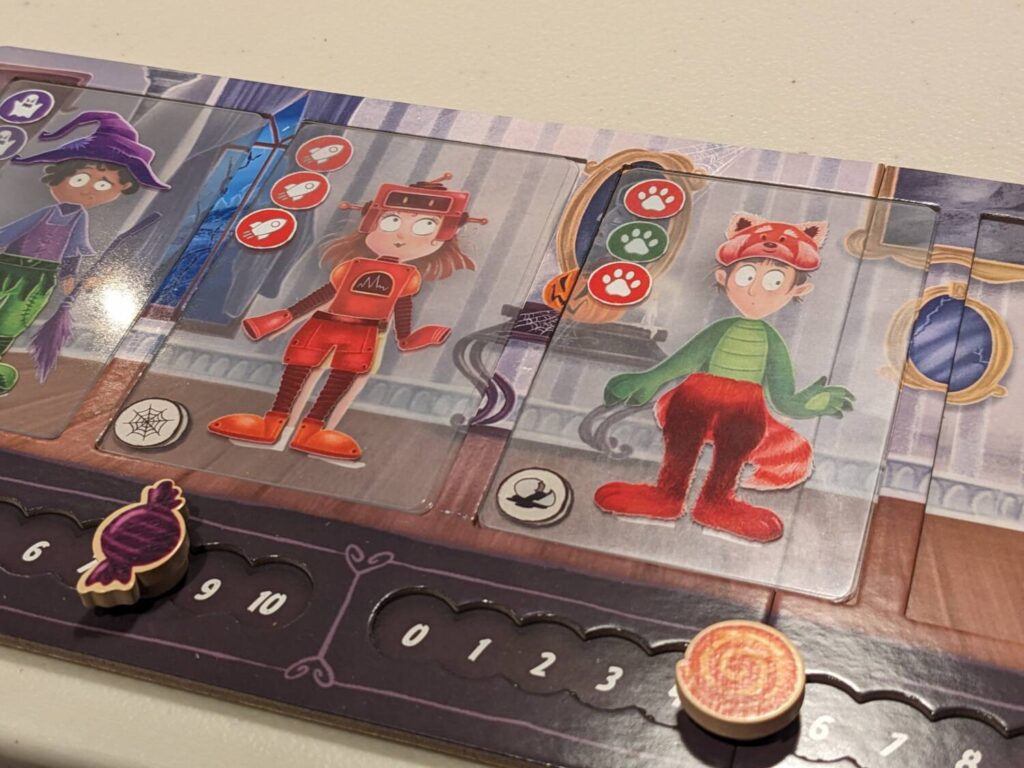
After breaking the game out with my family, then with my review crew, I’m a bit surprised that Tricky Treats is not getting more buzz. The game is a solid family title, with a fun gimmick that reminded both myself and other players of another recent title featuring transparent cards.

Do You Have 20 Minutes?

Tricky Treats is a set collection, card drafting game for 2-4 players that plays in about 30 minutes, longer if you are playing with my nine-year-old, who loves to take his sweet time as he makes his way through each turn of any game, not just this one.

Players manage a small posse of five kids getting ready for Halloween. There’s a grid of nine “treat” houses where…

The post Tricky Treats Game Review appeared first on Meeple Mountain.
Last Lantern Game Review

Polyomino Play

I’m a fan of polyomino tile-laying, and it always amazes me to see new ways the mechanic is used in board games. Some of my personal favorites include A Feast for Odin, Caverna: The Cave Farmers, and Planet Unknown. Here, we have a cooperative spin on polyomino tile-laying with a push-your-luck element to boot. Count me in!

I had a chance to meet the folks from WWBG at a couple of different conventions last year. They’re a small but mighty publisher out of Taiwan whose passion for their games is unlike anything I’ve seen in the industry.

Their goal is to bring more Asian designs to the Western market, and some of their releases so far, such as Lone Wolves and Castle Raisers, are already a solid testament to that mission.

Learning the Lantern

Last Lantern plays out over seven to nine rounds, with players working together to place tiles in their canopy in an effort to cross the goal line.

Each round, players silently and independently select a location on their lantern wheel, which determines the familiar token and tile they’ll take. However, if multiple players choose the same location, they’ll have to discuss and decide who gets what. Familiars are collected into sets and can…

The post Last Lantern Game Review appeared first on Meeple Mountain.
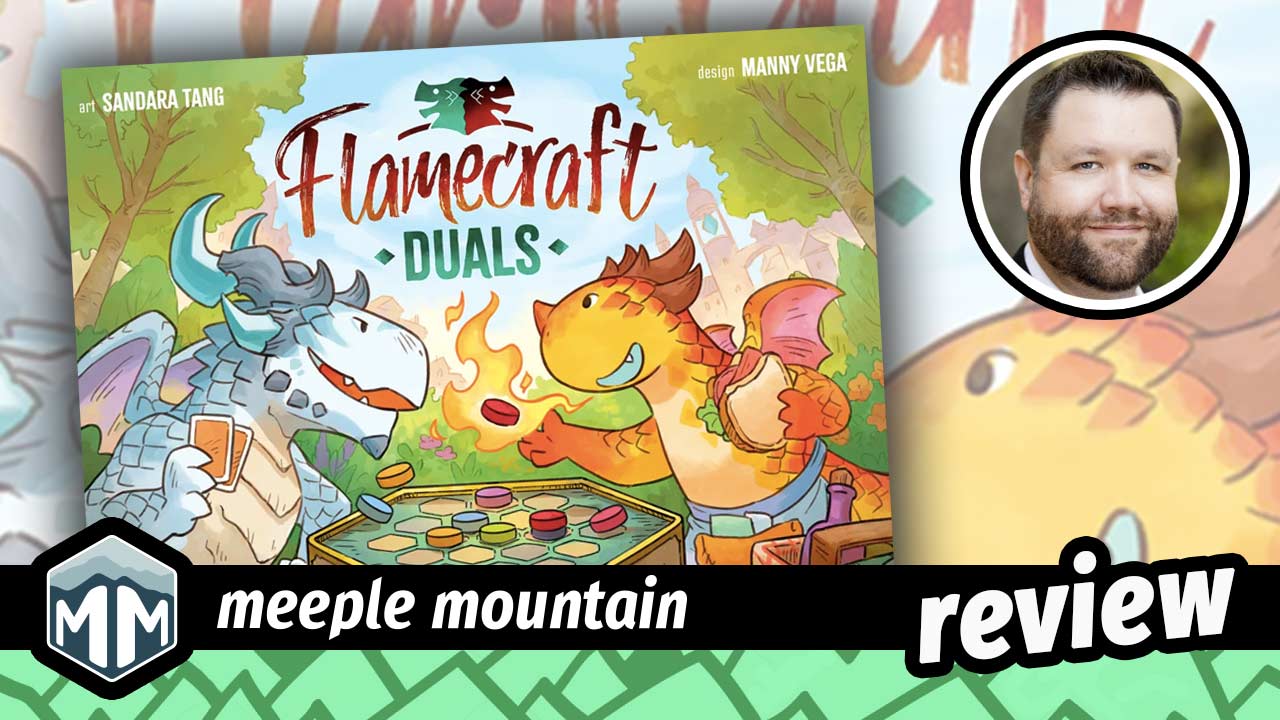
Flamecraft Duals Game Review

While “cozy” may not be a formally recognized game genre, at least according to BGG, there’s no denying the appeal of games that fall into this unofficial label. Regardless of being an official category or not, Flamecraft Duals makes a strong case for being king of the cozy crusade.

Designer Manny Vega, artist Sandara Tang, and publisher Cardboard Alchemy are all back in this follow-up to the massive 2022 hit, Flamecraft. While there’s certainly some shared DNA between Flamecraft Duals and Flamecraft, new mechanics, reduced player count, and a significantly smaller game lead to a fresh, rewarding experience.

Teaching an Old Dragon New Tricks

While Flamecraft is designed for 1-4 players and mostly revolves around worker placement, Flamecraft Duals is built for 1-2 players and focuses on tile placement and pattern building/matching.

Gameplay consists of players taking turns pulling one dragon token out of a bag and placing it onto a shared gameboard. Placement rules are simple: You can place your dragon token onto an empty space or onto a space with no more than two dragons (stacks can’t go above three).

After placing a token, players can ‘fire up’ the dragon they placed and attempt to complete one of the patterns on their two available shop cards, which grant end game points.

The game end is triggered when…

The post Flamecraft Duals Game Review appeared first on Meeple Mountain.
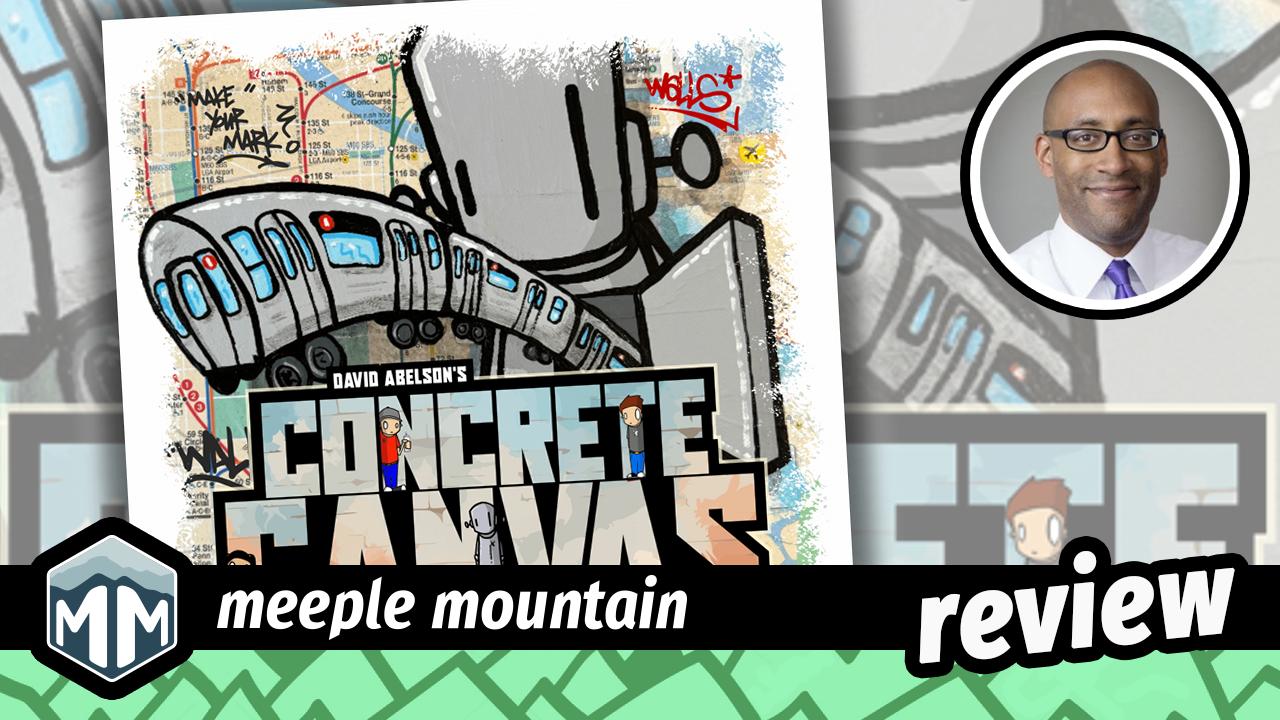
Concrete Canvas Game Review

“I LOVE the style of this artist,” my 12-year-old said while admiring some of the painting cards from the upcoming limited movement and order fulfillment game Concrete Canvas, available on crowdfunding right now.

I had to agree. The art, by real-life street artist Chris RWK, is fantastic, and this style carries into the playable character tokens, the subway tiles used to dictate each player’s movement, and the milk crate player boards used to store paint cans as players move their tokens around New York City in an attempt to tag more locations than their opponents.

Designer David Abelson’s game does a great job of capturing the look and feel of something straight out of Beat Street, or any of the other break-dancing, street jive 80s films I grew up on. Even video games like Jet Grind Radio (or Jet Set Radio, depending on where you grew up) feel like an influence here.

Then the game starts…when Concrete Canvas reveals itself to be the opposite of dynamic.

Up and Down

Concrete Canvas is an order fulfillment, area majority game for 2-4 players. Players will spend most of their turns moving one of their two character tokens through different parts of New York via subway tiles that are adjacent to…

The post Concrete Canvas Game Review appeared first on Meeple Mountain.
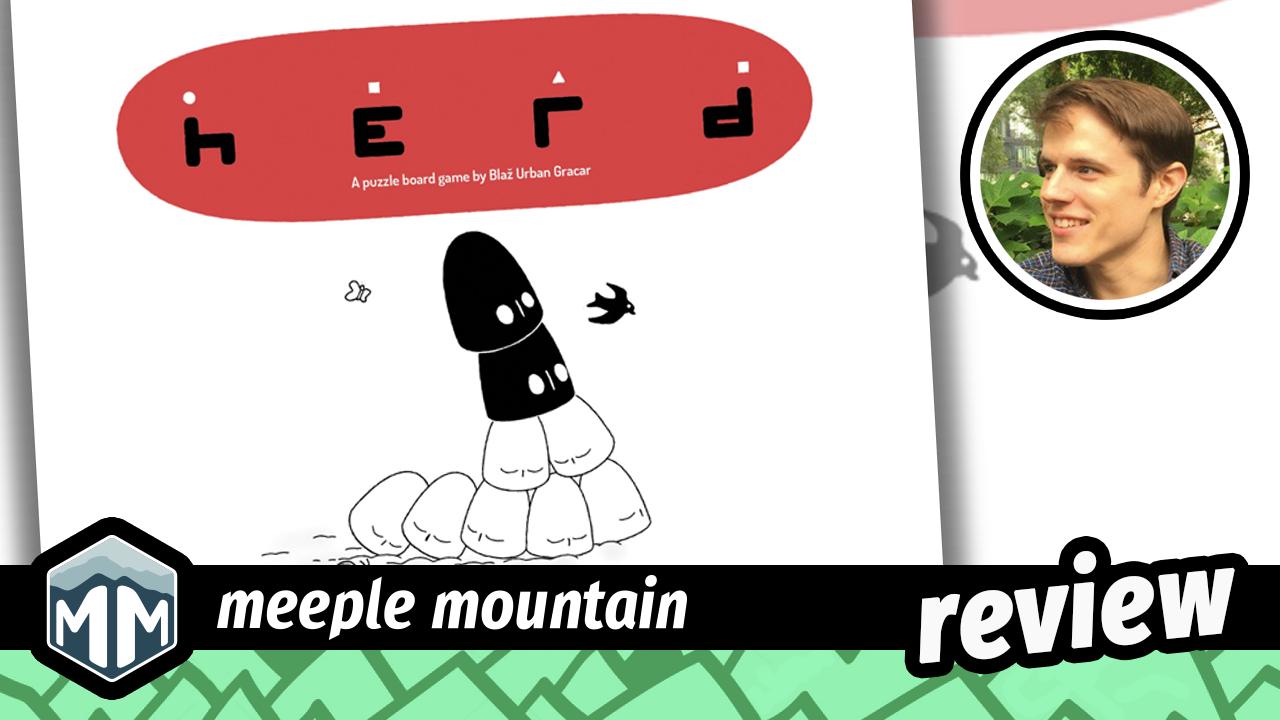
Herd Game Review

I have more than once mentioned puzzle-maker extraordinaire Blaž Gracar's work in the same breath as releases from Rush Hour purveyor Thinkfun. I have rarely mentioned them together as a matter of direct comparison. These are different products for different audiences. Gracar makes pencil-and-paper puzzle books that are only for the sweatiest adults, while Thinkfun cranks out charming toyetic brain teasers that keep children well-and-truly occupied. The connection comes from Gracar’s gift for imbuing his puzzles with a sense of discovery that brings me back to my childhood, when I had a massive collection of Thinkfun games under my bed. With the release of Herd, Gracar’s publisher Letibus and Thinkfun now warrant direct comparison.

Rather than drawing lines or shading in boxes, Herd has you shifting Shepherds around a grid. These delightful, hollow black cones have wonderful neutral facial expressions and a pronounced indifference to your failures. It’s a good thing, because in trying to get them from a designated Point A to a designated Point B, you will fail often. And fail. And fail again.

A lone black cone sits on an empty grid.

Herd is a patient exercise, though I wouldn’t necessarily call it meditative. There is a flow state to be found in moving the pieces about,…

The post Herd Game Review appeared first on Meeple Mountain.

❌