❌

Normale Ansicht

Panorama Game Review

I’ll be honest with you. Panorama had built up a bit of a negative reputation around the metaphorical halls of Meeple Mountain prior to its release. When Justin Bell and I played the prototype with publisher Scorpion Masqué at Spiel 2025, I thought it was fine, not something I’d play, and Justin...well, I would say Justin didn’t have much to say about it, but he did, and all of it negative. Phrases like “entirely arbitrary” were thrown around. I’m sure his opinion had nothing to do with the fact that he got walloped.

After Scorpion Masqué provided Justin with a review copy of Panorama during GenCon this year, the game quickly found its way to me. He handed it over wrapped in a bag, like an illicit parcel. His raised eyebrow and sidelong glance said, “Better you than me.” I wasn’t thrilled.

Turns out the joke’s on Justin, and I have to eat crow, because Panorama has proven to be a delight. I have yet to play it with anyone—Justin aside—who didn’t enjoy themselves. People have been so fond of it, in fact, that “Can we roll that back?” has been a frequent response to finishing a first game. Even I, despite my initial indifference, have had a great time.

A tableau consisting of…</p>
<p>The post <a href=Panorama Game Review appeared first on Meeple Mountain.
Aspens Game Review

Aspens is a two-player game of arboreal expansion and domination. Each player is given a bag of trees. On a player’s turn, they will roll the game’s two dice to determine the limitations of their actions. One die controls how many trees each of the players receive from their bags, and the other controls in which direction they are able to expand their holdings. On their turn, a player may expand outwards (filling in more spaces with their own trees), bolster their current holdings (increasing their odds of receiving new trees when the dice are rolled), or some mixture of both. Their goal is to get as many of those trees onto the playing field as they can so that when final calculations are performed at the end of the game, they’ll occupy more real estate than their opponent and thereby win the game.

This, of course, is an oversimplification of the game (although, as you’ll soon see, not much of one). If you’re just interested in what I think about the game, feel free to skip ahead to the Thoughts section. Otherwise, read on as we talk about how to play Aspens.

Setup

First, assemble the game board. The board is divided into seven segments. When fully assembled, you’ll be left with a vaguely cross-shaped playing area composed…

The post Aspens Game Review appeared first on Meeple Mountain.

Perennial Game Review

Growing Your Garden

In Perennial, your job is to grow the best prairie garden using tools and tiles. It's a tile-placement game with set collection, drafting, pattern building, and end game bonuses tied to how well you've placed your tiles. Are you thinking you've seen this before? Maybe in Cottage Garden, or Pergola? 

You haven't. 

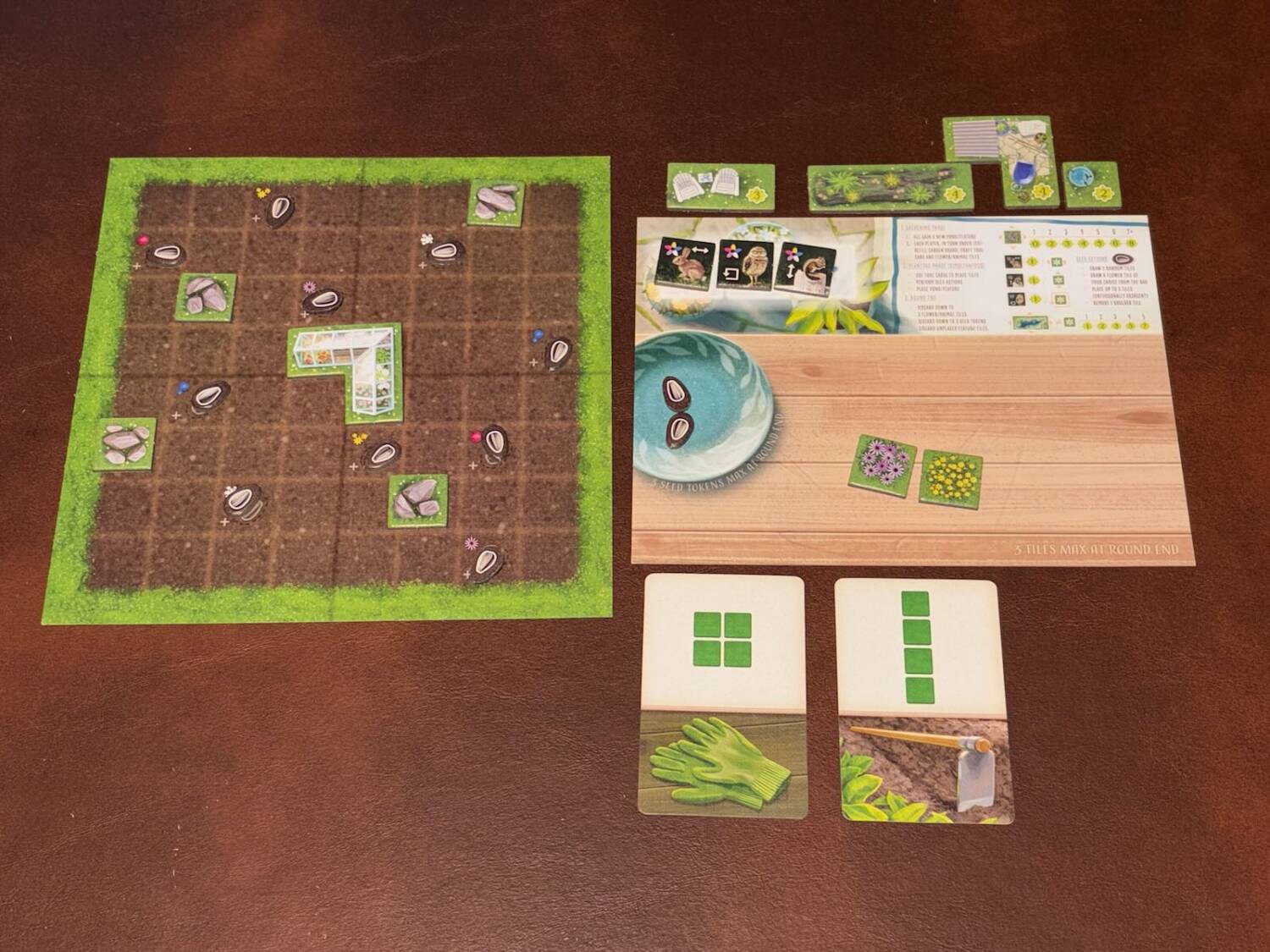
Oh, sure. The game starts in a standard fashion: Each player is given a Garden Board on which to place tiles, and a Workshop Board to store resources. The Garden Board is seeded with boulders which act as obstacles that you must build around, and actual seeds which can give you benefits later in the game. A greenhouse polyomino is placed in the middle as an anchor point for your first tile placement (and it acts as another obstacle). A square Central Drafting Board is randomly filled with Flower Tiles and Animal Tiles. Four Tool Cards are placed around the edges of the square. The Pond/Feature cards are shuffled and placed near the board, and the top one is turned over to reveal the first tile. Each player is given four Pond/Feature polyomino tiles that must be placed, one per round according to the card drawn from the deck. 

[caption id="attachment_333238" align="aligncenter" width="1500"]Individual Player Components…

The post Perennial Game Review appeared first on Meeple Mountain.

Oasis: New Life on a Distant World Game Review

My view of criticism is that, when done well, it is generative and contextualizing to the form it critiques. Having the privilege of reviewing and analyzing games comes with a degree of responsibility. Don’t misunderstand me—there is zero responsibility to a corporation, a designer, and anyone else who has made the business of games their business. My responsibility is to the mysterious and magical mental maneuver that allows a game to become more than pieces and rules and become something that facilitates agreement between people. Lofty, I know.

In my mind, players of games are akin to guests. Sure, a guest can be a big ol’ jerk, but when you’re playing a game, you’re stepping into an experience that is supposed to connect you to other people, to new ideas, interesting decisions, new concepts. You’re not a line item in a budget spreadsheet.

This perspective, coupled with some professional jealousy (I think I have some really cool game designs of my own that are worth sharing) can lead me to be seemingly harsh about a game that another critic might deem “acceptable” or “fine.” But I’m not that other critic. Enormous amounts of resources go into the creation of a mass market game, and when the product is derivative…

The post Oasis: New Life on a Distant World Game Review appeared first on Meeple Mountain.

❌