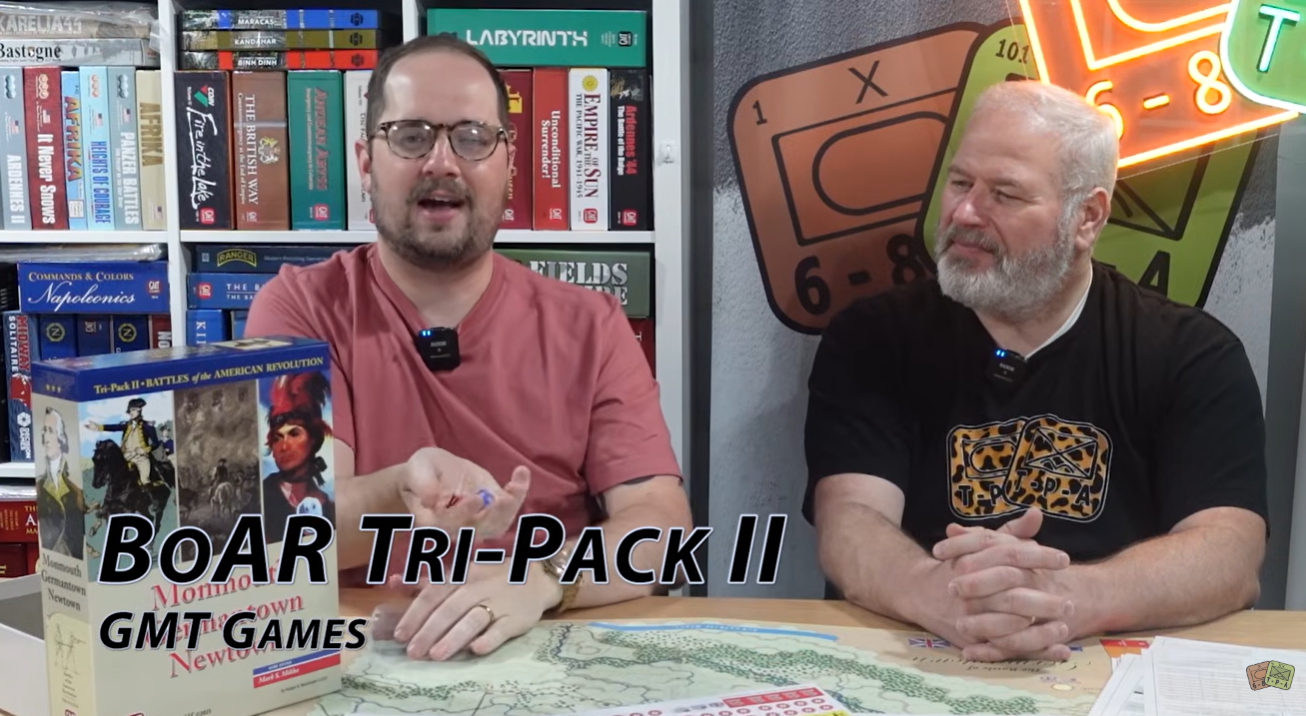
Battles of the American Revolution Tri-Pack II: Monmouth, Germantown and Newtown is the second compilation of earlier releases from GMT Games’ Battles of the American Revolution Series. These are tactical level battles at the regimental level with a map scale of approximately 200 yd/hex. We played Germantown and shot the following video review to share our thoughts on the game.
A few months ago, I started a new feature on the blog called Discussion Thread where I plan to pose a question or a share a situation and seek your input and comments on the issue to gain greater understanding and to encourage thoughtful feedback. The response to the first post about In-Game Retribution was positive and there were a lot comments and opinions shared followed by a not so successful post on Zones of Control. I now wanted to do another post in the series and focus on the all too common problem that non-wargamers have with the word Wargame and misinterpreting or misunderstanding what it actually is.
The most common misconception about a board wargame is that it is simply a casual, luck-based mainstream game such as the likes of Risk or Monopoly, that cheapens or treats lightly the historical period covered and those who participated in the event and who fought and gave their lives. Conversely, some people hold that wargames are an inaccessible, dry academic simulation meant only for hardcore military personnel or history professors. Many non-wargamers assume that “wargame” simply means moving plastic armies around a world map and rolling dice to conquer territories. But in reality, traditional board wargames, such as hex and counter games, prioritize historical operational mechanics, logistics, supply lines and terrain modeling over casual social dice-rolling. They also do a credible job at attempting to recreate the outcomes of these battles by ensuring that various elements are accurate including terrain features, weather, commanders and the make-up and skill of troops involved. Finally wargames are a serious matter. No one who plays them takes them lightly nor do they not consider the history covered.
So the reason for me writing this post came from something that I experienced last weekend while attending the Gaming the American Revolution Camden 250 Event in Camden, South Carolina. At this event, which was sponsored by GMT Games, about 100 gamers showed up to play games on the American Revolutionary War from GMT Games including titles such as Washington’s War, Liberty or Death, the upcoming announced Common Sense and the various games from the Battles of the American Revolution Series. As a part of the convention, which was held at the Revolutionary War Visitor Center at Camden, there was a 4-hour tour set up that took participants to see the Camden battlefield, located about 8 miles out of the city limits, and the Hobkirk’s Hill battlefield located in Camden. This tour was expertly lead by the South Carolina Battlefield Preservation Trust Executive Director Rick Wise who was very knowledgeable and entertaining to listen to. You could really feel his passion for the American Revolution as well as the role that these battles in South Carolina and the Southern Theater held in the wider war and the eventual surrender of Lord Charles Cornwallis and his army at Yorktown, Virginia.
The Kershaw-Cornwallis House at Camden, South Carolina.
But, when he spoke on a few different occasions he brought up the fact that we were wargamers and that we were gathered to “play” games. This statement is not incorrect as we are all wargamers and were there to play games together. He also said that we needed to understand and keep in mind that there were soldiers who fought, bled and died to win independence and establish the great American nation. I felt like he was really preaching to the choir here with this group as everyone was there for the gaming and the recognition of the history tied to that gaming. Also many attendees were former military and had also served. Finally, I think almost every one in attendance participated not only in his 4-hour guided tour, but also walked the grounds of the Camden Visitors Center to take a look at the redoubt there as well as the Kershaw-Cornwallis House that was used by Lord Charles Cornwallis and Lord Francis Rawdon as an active HQ during the occupation of Camden from 1780-1781. In addition, many attendees came to South Carolina early to visit other battlefields in the area such as Cowpens, King’s Mountain, Waxhaws and Eutaw Springs. I bring this up because of Rick’s tone, and I am not sure that it was valid or necessary in speaking to this crowd, was assuming that as wargamers we were trivializing or taking lightly the gravity of the history involved in the games we were playing. I know that he was not trying to offend or belittle us and our focus but simply wanted to drive home his point of the sacrifices that were made and that we were playing out in a game with dice.
A recreation of a British redoubt found on the Revolutionary War Visitor Center at Camden grounds.
Well, I want to point out a few things about these wargames. They are not trivial but are focused on the actual historical details of the period and the battles involved. Wargames are built upon a few stalwart truths…the people who participated and the terrain upon which they fought and died. These are both hallmarks of every single wargame that I have ever played. The designers take these battles seriously and do hours upon hours of research and investigation to make sure that they have the details correct. For example, with the Orders of Battle or OOB’s, they find the names of each formation, typically named after their commanding officer, and in smaller scale games the names of actual soldiers who were there. These details are listed on the counters and have an impact in the game play itself. But, sometimes the names don’t have an impact and are just added to bring the battle to the view of the players and to hammer home the human element. The designers want players to understand who was involved, how they fit into the larger battle, who their leaders were and even adding in small historical details to make the game grounded in the history. The Battles of the American Revolution Series does this exceptionally well.
A picture of the setup for the Battle of Cowpens from GMT Games, which is the first entry in the Small Battles of the American Revolution Series.
The detail about the makeup of the soldiers involved, as well as their relative strengths and weaknesses, are on full display and are central to us as wargamers gaining insight into the conditions under which they fought, the issues that they would have experienced and the challenges that their commanders would have dealt with in directing their efforts. I like that one of the more interesting parts that is included in this makeup typically is a unit’s morale or their willingness to continue fighting in the face of mounting casualties and fatigue. Numbers are typically assigned for things like morale by designers after reading the histories and taking into account the performance and standing of these troops. More veteran troops typically have higher morale than green or relatively less experienced troops. These factors and attributes are all based on the history and are typically designed as a simulation of the event, or at least as the most realistic and plausible recreation of the event that can be made. And that is the appeal. Understanding the situation from the participants point of view and seeing how it turned out and why. I have played dozens upon dozens of wargames and have always thought about the soldiers and their sacrifice. How did they do what was done? Where did their bravery come from in the face of overwhelming odds? How could they have possibly held up to the better trained and better equipped professional armies of the British? For me, the soldiers are the reason that I play these games. And I assume the same for many of you.
An example of the named counters, based on historical formations, found in the Battles of the American Revolution Series.
I understand why the average person doesn’t understand wargaming and I get that the word “game” is found in what we do. To the average person, the word game is associated with lighter fare such as Risk, Trouble or Sorry, which are games where you can laugh and joke about things and focus on having a good time and experience with your family and friends. But wargames are more than that…they are a look into the past. A look that includes the gory details, the challenges and the difficulties….and they are made as an homage to the past. Just as books are written to commemorate and outline the details of these battles, wargames are made to serve a similar purpose. To teach, to instruct, to challenge and to test the meddle of players to see if they can meet or exceed historical outcomes or even flip the script and turn history upside down with a totally different outcome. And they are made to be enjoyable but in a different way to the games I mentioned earlier. I love playing games with friends, being with them for hours upon hours, getting to know them, better understanding them and better understanding the history. I would deign to say that I even enjoy playing wargames and do have a good time with them. But I always do keep in mind the history and the soldiers and their sacrifice.
What are your thoughts on this topic? Did I miss the mark in my response? Am I being too sensitive? Thanks for reading and for sharing your thoughts. I will come up with a few more of these posts to share and I hope to see lots of comments and reaction.
What a great time we have had at this convention! 2 fulls day of gaming in a fantastic historical setting here in Camden, South Carolina. But it hasn’t just been gaming though. Today started with a 3+ hour tour of the Camden battlefield and a demonstration at the Battle of Hobkirk’s Hill as well.
Rick Wise who is the Executive Director of the South Carolina Battlefield Preservation Trust gave us a 90 minute tour and discussion on the battle fought at Camden on August 16, 1780. The Patriots led by Horatio Gates and Baron DeKalb fielded about 4,000 muskets versus around 2,200 British soldiers led by Lord Charles Cornwallis and Lord Rowdon. The battle resulted in a major British victory with Cornwallis’ force suffering just over 300 casualties while Gates’ suffered almost 2,000.
Rick had a British Brown Bess musket and a French Charleville musket used by the Patriots that we were able to see fitted with bayonets and wielded by 2 lucky volunteers. These would have been truly terrifying to stand against and when wielded by trained soldiers were deadly weapons.
He also shared with us that archaeologists discovered the skeletal remains of 14 soldiers at the battlefield alongside period artifacts like musket balls and buttons.
Forensic and artifact analysis identified 12 Continental soldiers from Maryland and Delaware, one North Carolina Loyalist militia member (who was also Native American), and one British soldier from the 71st Regiment of Foot (Fraser’s Highlanders). They also were able to reveal that some of the Continental soldiers were teenagers, including two young men aged 16 to 19. It was truly sobering to see their unmarked grave and to find out that several were so young. Honor and bravery as well as the desire for freedom knows no age and these soldiers truly gave their lives for a cause they believed in.
There also was a nice monument to the sacrifice of de Kalb who commanded the American right wing during the engagement leading the premier units of the Delawareans and Marylanders. When the left and center of the American line disintegrated, de Kalb’s force had to beat a retreat before becoming completely surrounded. During this juncture of the fighting, the Baron’s horse was shot out from under him and he was thrown to the ground. Before he could gain his feet, he was hit with three musket balls and bayoneted multiple times by approaching British soldiers. The wounds would prove to be mortal.
Captured shortly thereafter by the British, the wounded general was picked up by General Lord Charles Cornwallis on his way to the rear. The British general, upon seeing de Kalb said the following: “I am sorry, sir, to see you, not sorry that you are vanquished, but sorry to see you so badly wounded.” Showing respect to the Baron though, Cornwallis reportedly, oversaw the dressing of the German’s wounds by his own surgeons. de Kalb would die 3 days later of his wounds.
We then made our way to the site of the Battle of Hobkirk’s Hill and were instructed by a US Army artillery officer on the use of Continental cannon. I was lucky to be chosen to act as the rammer or spongeman and very much enjoyed the activity where we trained to load and fire the cannon in under 15 seconds.
Here is a video of the firing of a musket but you will have to wait for the cannon video to come out on the YouTube Channel.
Such a great experience and I was very glad we took the time to participate in the tour. We then returned to the gaming area and setup BoAR Newtown from GMT Games.
I have wanted to play this for a while now as it is a unique and specialized entry to the BoAR Series. Newtown feels quite different from standard BoAR titles mainly because it replaces traditional line-infantry tactics with combat rules for the Indians that are very different.
The Movement and Activation System simulates the decentralized, individual nature of Indian warfare, where small war parties act on their own initiative rather than rigid command structures which is represented with a chit pull mechanic. In the chit pull cup are each of the Indian formations along with a single combat chit. When formations are pulled they can move and if the combat chit is pulled only those formations that have already moved and are adjacent to Patriot units may then attack. Formations pulled after this bit can move but cannot fight. This was very chaotic and created some task challenges for Alexander.
The Indians are lined up behind fortifications at the start of the game and will await the approaching Patriot troops from the protection of these improvements.
The game also includes Opportunity cards that adds a layer of hand management and tactical unpredictabilityas the cards act as one-off events or provide bonuses. The game also includes custom rules for Indian honor, ferocity, evasion and their specific resolve when facing artillery fire and have a chance to break. Just a very interesting game and I am glad that we played it.
To end the evening we got the chance to sit down with designer Bruno Sinigaglio and play his new game called Small BoAR The Battle of Cowpens.
The aim of the Small BoAR design concept is to include small and critical battles that otherwise do not fit the scale of the Battles of the American Revolution (BoAR) system designed by Mark Miklos. This new system was designed by Bruno Sinigaglio working closely with Mark Miklos to preserve the continuity and popularity of the original system. It feels very familiar to the original but takes the scale in a new direction. From 25 yard hexes vs 200 yards in BoAR, the scale change gives players the chance to try new tactics with rifle and musket fire as these are now up to 8 hexes range for rifles and 3 hexes for muskets while artillery is now up to 24 hexes.
The game also highlights the importance of cavalry and their tactics as their proper use on the battlefield can lead to devastating results.
We had a great time with this one and while we only played 5 full turns there is more to explore and we can’t wait to get our hands on a copy. We have been told it should be releasing in mid to late October.
That was it for today and we are now finished with the gaming portion of the trip. Tomorrow we are going to leave early and travel to 3 battlefields in the area on our way to Columbia and the airport in Buford’s Massacre in the Waxhaws, King’s Mountain and Cowpens.
Day 2 dawned early with a morning gathering at the Camden Revolutionary War Visitor Center to receive instruction on the days events and schedule. As you can see in the picture below, there were about 50 gamers who showed up early to get a good start on the gaming.
We entered the gaming hall and I was very surprised as it was very nice and cozy and felt roomy with lots of tables setup to choose from. We chose a corner in the back and began setting up to play Battles of the American Revolution Oriskany from the American Revolution Tri-Pack #2 from GMT Games.
There were a lot of different games being played including BoAR, Washington’s War, Liberty or Death and Common Sense as well as a BoAR Eutaw Springs tournament going on.
Bill Simoni and designer Trevor Bender playing in the Eutaw Springs tournament.
A demo of the upcoming Common Sense by designer Sam London.
Washington’s War.
Liberty or Death.
We decided to play the historical scenario for Oriskany which is a 6-turn game focusing on the August 6, 1777 ambush as General Nicholas Herkimer’s relief column is trying to make their way up the Military Road to Fort Stanwix.
The game starts with the British player having to set up their units in an ambush that has to be connecting contiguous units adjacent to the Patriots and they get an Ambush marker placed on them which will grant a 1 column shift to their attack if they can successfully make the ambush roll.
Alexander didn’t roll well so several of his units were detected and lost their element of surprise. You can see that 3 of his units lost their Ambush markers and this would prove to be a boon to the Patriots.
We spent the next 3-4 turns beating ourselves as our planned attacks were not working well and we basically rolled poorly and did damage to ourselves. Very odd but it was fun. But the best part of the system is the Tactics cards that create a bluff type of mind game.
The Tactics cards options are split into tiers with the 4 basic tactics always eligible to be chosen whereas advanced maneuvers require a commanding leader present and sometimes specific adjacent vacant hexes to execute. Common tactical choices include attacking in echelon, turning flanks, frontal assaults or attempting to withdraw. I very much enjoy this aspect because it adds a psychological tension that castes players to anticipate and bluff. Just a really neat addition to the game.
In the end, Alexander’s British and Indian allies ended up killing 2 of my leaders and also reduced 3 of my units and I was unable to advance the relief column to the point needed. He won the scenario with 4 VP to my zero. We had fun and I am glad we had a chance to play this one.
A leaderless rabble was defeated.
We then got in a game of Liberty or Death which is my 2nd favorite volume in the COIN Series.
I played as the Indians and Alexander took the French. I worked on building Villages and then started Plundering the Patriots of their resources. Meanwhile the French did a great job of getting into the war early by the end of 1777 and then worked well with the Patriots to attack the British in New York and New York City driving them out of both. This put a great deal of pressure on the Indians as I had to continually Raid into these areas trying to keep their level of Opposition low.
In the end, Alexander’s French earned victory at the end of 1779 (5th deck) with the finals scores being French -5, Indians (Grant) -10, Patriots (Shane) -10 and British (Mark) -15.
I saw something I have not seen before as my Indians got skipped multiple times on my turns due to Brilliant Stroke cards, Winter Quarters and some inopportune passing. Just weird that I lost 3-4 turns and also got into a cycle of only getting Limited Commands due to the eligibility on cards.
We next took a few minutes to walk around the grounds at the Camden site. My favorite part was the redoubt.
The British redoubt.
I was very interested in the ditch in front of the redoubt wall and its formidable defense as sharpened wooden stakes called fraises are placed horizontally projecting straight out from the earthen parapet. Their primary purpose was to prevent attacking infantry from climbing up the exterior wall.
We had a long discussion about how effective these would have been as infantry would have to run this gauntlet to get at the defenders all the while taking rifle fire and cannon fire. Just diabolical really.
Once inside there are several protected covered areas for storage of arms and supplies as well as to offer some additional protection to defenders.
Just a really cool experience being able to get inside this fortification and experience the history.
We ended the night with a group dinner at a local brewery. We sat with our friend Bill Simoni and Mike from My Own Worst Enemy.
Tomorrow we are taking part in a 3+ hour guided tour of the Camden battlefield as well as nearby Hobkirk’s Hill. We are then going to play a few games including BoAR Newtown and possibly the new Small BoAR Cowpens.
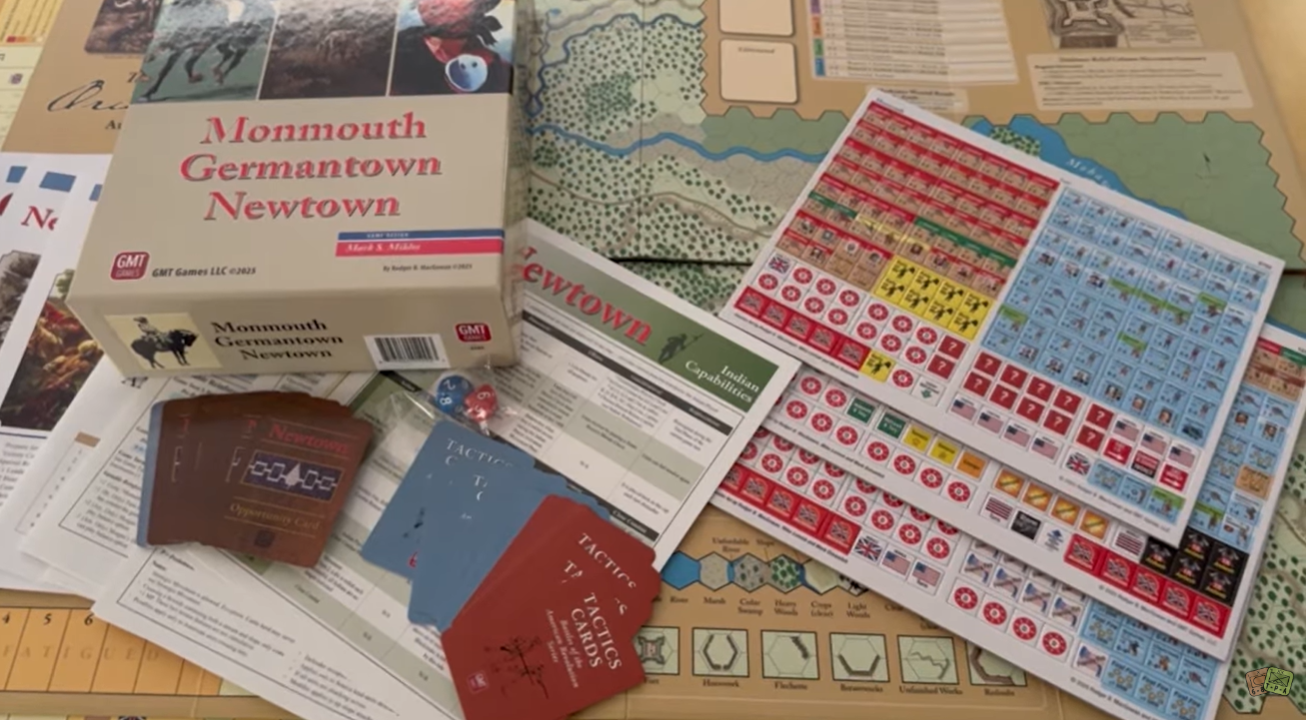
Battles of the American Revolution Tri-Pack II: Monmouth, Germantown and Newtown is the second compilation of earlier releases from GMT Games’ Battles of the American Revolution Series. These are tactical level battles at the regimental level with a map scale of approximately 200 yd/hex.
Additions to the original releases include:
maps are hard-mounted
packaged in a GMT “deep box”, which is a 3″ box
rules and player aids printed in color
all replacement counters that have been issued since the games’ original releases
a new one page matrix-style play aid to assist the First Nations player in Newtown
Joel Toppen’s Solitaire Tactics Card play aid
a significantly upgraded Germantown rulebook addressing errata and ambiguities

 Anmelden