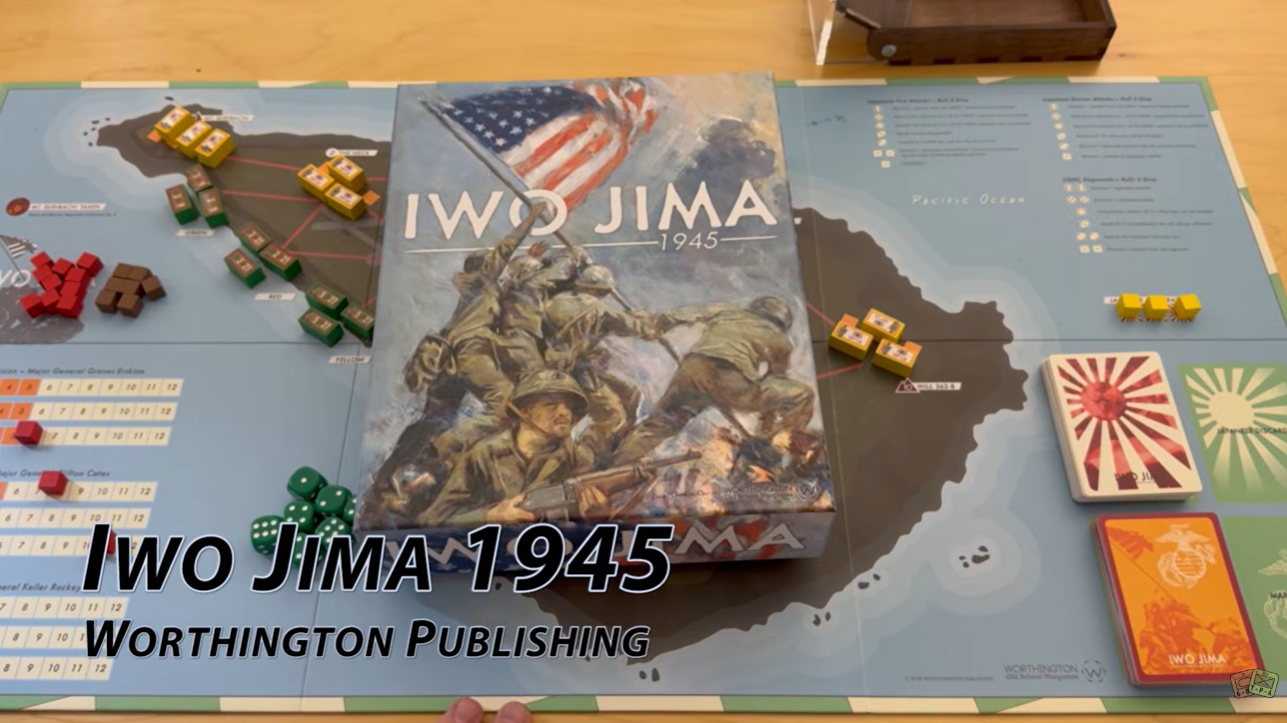
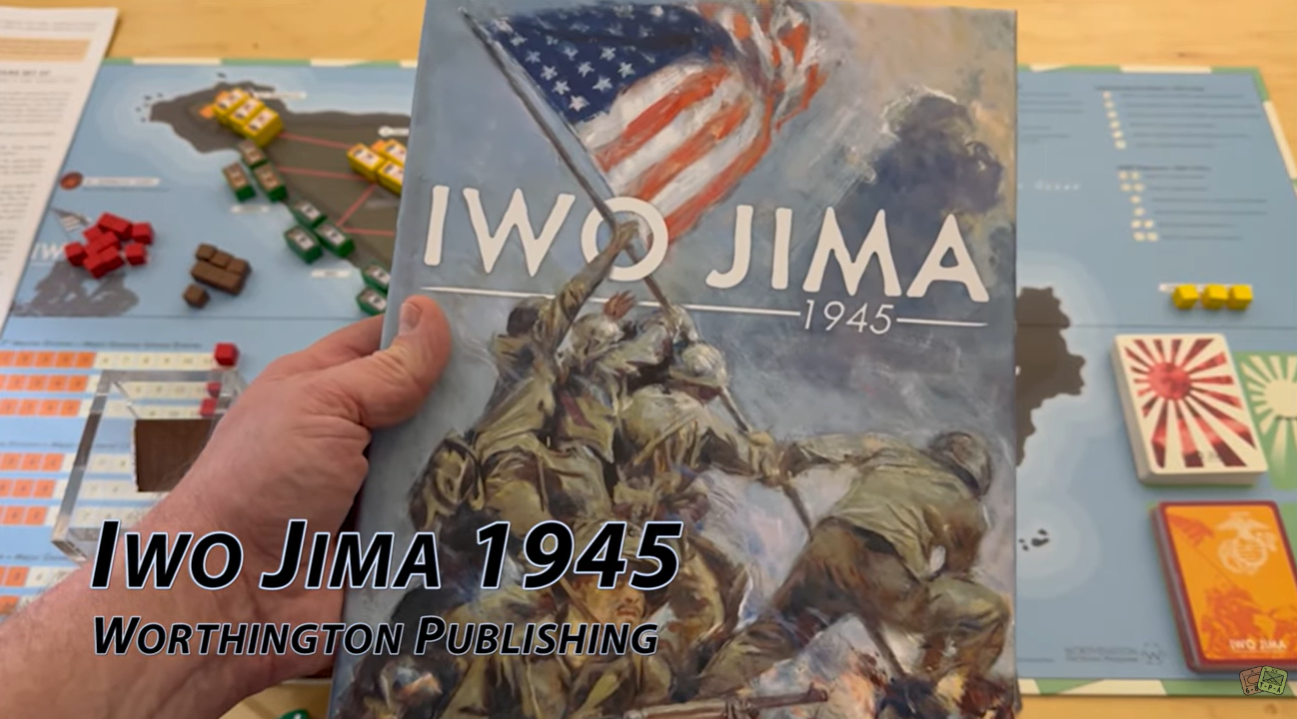
A few years ago, Worthington Publishing published their first game in the Island Fight Series called Tarawa 1943. That game was awesome and was truly difficult to win, as it should be. Now, they have published the 2nd volume in the series called Iwo Jima 1945 that covers the only island assault during the Pacific war that the attacking US forces would suffer worse casualties than the Japanese defenders. On February 19, 1945 the USMC would land 30,000 marines on the island against a Japanese defensive force that numbered roughly 21,000 Japanese soldiers. Facing a Japanese commander who had learned valuable lessons from the losses on other Japanese islands, the USMC would eventually land over 70,000 marines and suffer over 25,000 casualties during the 36 day campaign.
In this solitaire game, the player takes on the role of the USMC commander leading the invasion of Iwo Jima. The game system, driven by cards, will simulate the strategies of the Japanese defenders, often referred to as the Japanese AI, adding a layer of historical authenticity to your gaming experience. If you have played Tarawa 1943, you will be familiar with the system.
Battles of the American Revolution Tri-Pack II: Monmouth, Germantown and Newtown is the second compilation of earlier releases from GMT Games’ Battles of the American Revolution Series. These are tactical level battles at the regimental level with a map scale of approximately 200 yd/hex. We played Germantown and shot the following video review to share our thoughts on the game.
Continuing along in this series devoted to the best looking boards found in the wargaming world where I will highlight the art and layout of a different board in a wargame that we have played to show you the various talents of the artists and graphic designers involved. In my humble opinion, a well designed and attractive board can make all the difference in the world to me enjoying a wargame. Don’t get me wrong, the game has to be good, but if it’s also good looking it always is a better experience. A board can draw me in. Can make me feel that I’m there. Can set the stage for the thematic immersion that we all crave. And I have found many of these type of boards and I want to make sure that I share them with you.
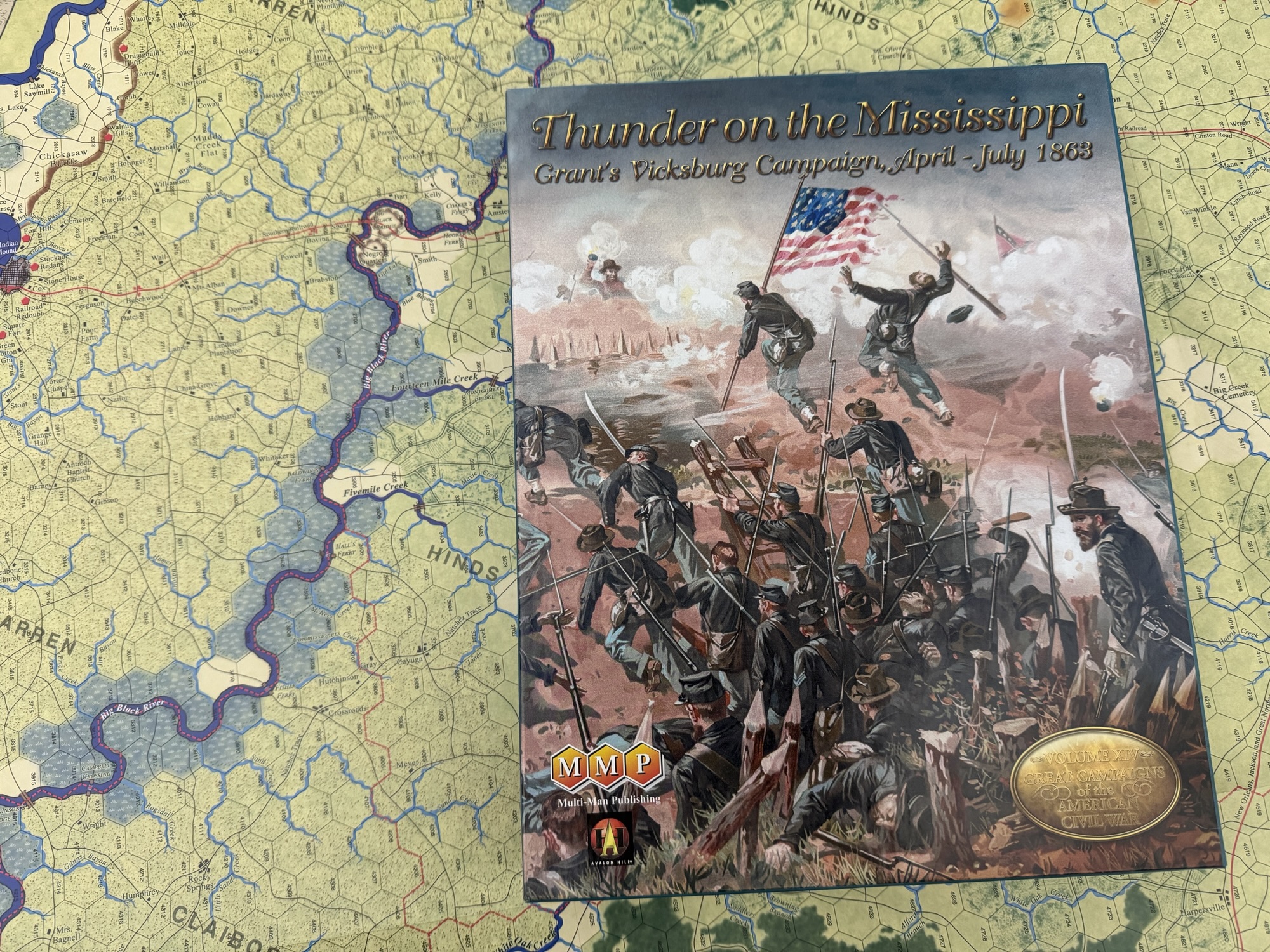
In this entry in the series, we will be taking a look at the fantastic looking board for Great Campaigns of the American Civil War: Thunder On the Mississippi: Grant’s Vicksburg Campaign, April-July, 1863 from Multi-Man Publishing. The board is illustrated by the very talented Charlie Kibler whose work on the Great Campaigns of the American Civil War Series dates back to its creation in 1992. He has done a ton of great looking boards including The Battle for Normandy (2009) from GMT Games, The Day Was Ours: First Bull Run (2021) from Revolution Games, Border Reivers (2023) from GMT Games recently as well as a slew of Advanced Squad Leader boards stretching back through the years and a lot of series games for GMT Games such as Great Battles of the American Civil War and Great Battles of the American Revolution. We have already highlighted a few of his boards in the past like Storm Over Jerusalem from MMP and Battles of the American Revolution Volume II: Brandywine from GMT Games. He is very effective at creating great looking terrain and weaving in very nice details to highlight the main functions of the board and I very much like the simplicity and accurateness of his boards.
The board consists of 2 separate 22″x 32″ full-color map sheets that when combined create a large playing surface. The borders of the board include off-board information that is related to the geography and locations in and around Vicksburg. When I first saw this, I wasn’t really quite sure how to take it but after playing and also thinking about this decision, I really like how it was used to frame up or provide a significant visual contrast to the main game board. The brown coloring really contrasts well with the colorful terrain features and create a clear distinction for the players. I initially thought this was a poor decision and felt that it was a missed opportunity but it works really well.
Here is a closeup of this part of the board so you can get a good feel for what I am talking about.
I always like to look at the game title box/area of the board and find these to be really great insights into the mindset and approach of the artist. On the board for Thunder on the Mississippi, we see Charlie used a washed out period look map for the background of this area. The really interesting part is how it transitions from the non-colored portion of the board title box to the game board itself. There is no connection between the 2 and the elements found on the board are not carried over or connected to the period map. I would maybe have liked to see there be a connection for an immersive approach but I understand that this was not the purpose of the use of the period map.
In Thunder on the Mississippi, there are 2 new terrain features unique to the Vicksburg region introduced including loess hills and coastal bluffs. Loess has not been featured before in GCACW Series games. Each loess hex is depicted with many small tan dots superimposed on an olive base color. This stippling gives it a sandy feel and I think really works well as loess is a fine-grained, powdery soil, a wide belt of which runs on the east side of the Mississippi on a southwest – northeast axis. Because loess is highly susceptible to erosion, it is marked by sharp, irregular ravines, many of which were so overgrown with vegetation as to be nearly impassable to military units.
In the game, loess hexes are identical to woods hexes in terms of Movement Point costs and MP penalties to enter a friendly-occupied hex. Also, loess hexsides untraversed by roads or railroads exert a restricted ZOC the same as woods hexsides similarly untraversed. I think that the type of terrain, and what it does to the units that enter, really mimics the soft soil type as it is always hard to run in sand. I very much like the color used as well and it serves to set this specific terrain type apart from the rest of the board. Here is a look at the western portion of the West Map that is up against the Mississippi River.
The other new terrain feature is that of coastal bluffs, which has also not been featured before in the series. Each coastal bluff hexside has a downhill side in which the light brown bluff line-pattern is uneven and an uphill side in which the bluff line-pattern is smooth. I know that it might be a bit hard to see in the below picture but the downhill side is found on the left side while the uphill side is on the right. Think of it this way…the uphill is simply a straight line border while the downhill side reflects the ravines from erosion and is made up of multi-length lines pointing out. I very much like this new terrain and also think that Charlie did a great job with the distinction even though it is a bit hard to distinguish from afar.
And that brings me to the portion of the board that I think is my favorite. Not because it is some revolutionary technique but because of the power and permanence that is offers the board, acting as an anchor and a framing of the action to be played out on it, and that is the Mississippi River itself. There is no real use of stylized marks or special features shown on the board but it is just a thick and dark blue line that meanders through the countryside. But the dark blue really gives a sense of size and scope and I very much feel that it is important to the board and what is to transpire on it.
I also very much like how Charlie decided to keep in the exact layout of the river and shows its many twists and turns and oxbows that are found along its length.
The board for Thunder on the Mississippi is really a visual masterpiece. It provides great transition from terrain type to terrain type, frames up the board itself very well and uses very smart and poignant color choices, including the loess terrain color and the dark blue of the Old Man, all to create a fantastic canvas upon which to play out this titanic struggle and key turning point of the American Civil War.
If you are interested, here is a link to our video review:
The next board that we will take a look at in the series is The Marianas Campaign: Volume One: Saipan – The Bloody Rock from Compass Games.
Here are links to the previous entries in the series:
A few years ago, Worthington Publishing published their first game in the Island Fight Series called Tarawa 1943. That game was awesome and was truly difficult to win, as it should be. Now, they have published the 2nd volume in the series called Iwo Jima 1945 that covers the only island assault during the Pacific war that the attacking US forces would suffer worse casualties than the Japanese defenders. On February 19, 1945 the USMC would land 30,000 marines on the island against a Japanese defensive force that numbered roughly 21,000 Japanese soldiers. Facing a Japanese commander who had learned valuable lessons from the losses on other Japanese islands, the USMC would eventually land over 70,000 marines and suffer over 25,000 casualties during the 36 day campaign.
In this solitaire game, the player takes on the role of the USMC commander leading the invasion of Iwo Jima. The game system, driven by cards, will simulate the strategies of the Japanese defenders, often referred to as the Japanese AI, adding a layer of historical authenticity to your gaming experience. If you have played Tarawa 1943, you will be familiar with the system.
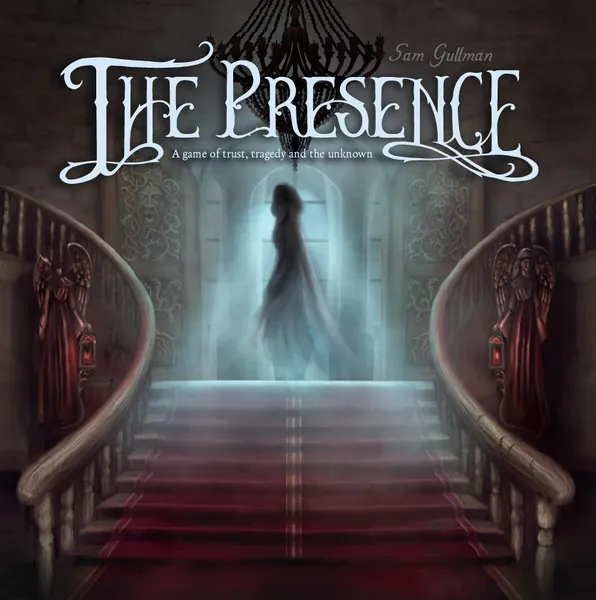
You’re stuck in a foreign place. It’s a prison of walls and darkness and fear manifest. Do you trust the unknown formless hand? Do you expose your vulnerability for a glimpse of truth? Do you recoil or do you meet The Presence? The Presence is a ghost story. It’s an indie work that draws obvious…
“The Rangers keep the Valley safe, looking out for trouble and helping people wherever they can. They are wonderful human beings.” – Ren Kobo, Earthborne Rangers Rulebook
Disclosure: finished the campaign
Earthborne Rangers was one of the games that had been on our radar for quite a while. Many campaign games are also legacy games, which are often not replayable and happen to have many components that aren’t compostable. The components of EBR are compostable, but it’s also a replayable campaign game. For some time we’d wanted to play GMless RPGs with just the two of us; we tried, but it was difficult and we felt we needed more guidance. It seemed that EBR could scratch that itch, giving us some structure without being so restrictive that we couldn’t create our own narrative. Additionally, the art style is beautiful and captures the ecopunk vibe that we like (and we both love green). So we were very excited when we were able to get our hands on it.
Earthborne Rangers is a deck-building/construction game that relies on cards for the world building. Most of the game consists of cards. While there is a map that shows the location, there’s no board to place your character, and having minis isn’t necessary. It is quite similar to a tabletop RPG. But unlike many TTRPGs, players don’t have to rely on the GM to decide whether an action is permissible. The rules are all set up in the game. While TTRPGs offer more flexibility in terms of what a player can do, in EBR, players get to choose the personality and the aspects or the stats of their character and don’t have to rely on dice to randomly generate the stats.
The prologue got us hooked very quickly. During the prologue each player first chooses a number of personality cards, followed by cards representing their ranger’s background and specialty. One of us chose a Forager-Shaper and the other chose an Artisan-Artificer. While we weren’t able to update them regularly during the game, you can check our character sheets here and here. The resulting ranger deck slowly changes over the course of the campaign, as there are opportunities to engage in some further deck building.
The prologue also walks players through the setup process that repeats at the beginning of each day/session. First, players set up their individual areas and draw a starting hand of six cards. This is followed by shuffling the challenge deck, the function of which we’ll explain later. Next come the location, weather and mission cards. We really like these cards as they really help with the immersion (we’d recommend checking out the soundtrack if you want your game session to be more immersive). These are determined by the current state of the campaign, which is noted down on a campaign tracker. If you’re curious, check out our campaign tracker, but be warned: it contains plenty of spoilers.
Then comes the potentially most consequential part, building the path deck, which contains the flora and fauna, the beings, the people, and some structures/ruins. This will include cards based on the path that was used to arrive at the current location, specific or general cards based on that location and sometimes additional cards related to a mission or the weather. What we like about the path deck is that it makes the world come alive and it gives more variety to the game as who/whatever you encounter when you draw a path card is random even though its construction is determined by the factors mentioned earlier. Finally, there are arrival setup instructions on the back of the location card, which shape the initial conditions the rangers find themselves in.
One of the path cards
After setup, rangers take turns until everyone has decided to rest for the round. On their turn, each ranger can either play a card from their hand, perform a test or decide to rest. The test or the card that a ranger can perform or play is dependent on the available energy, the type and the amount of which is determined by the aspect, in their energy pool and the path card that they want to interact with. In the first few sessions we were trying to use all the energy in the energy pool effectively, but it gets tricky as the campaign and the days progress; we asked ourselves (and each other) whether we should use them all before we rest or just rest even if there are some left in the pool. We really like this mechanism since while at the beginning it seems that being efficient with your resources means using most of them before resting, eventually we would have to consider whether not using them all and drawing a ranger card during the refresh stage (the stage after resting) might be the better option. But this also means having to draw another path card, which could bring more risks and might have to be dealt with.
When a ranger performs a test, they have to draw a challenge card, which contains a challenge icon (mountain, crest, or sun). Some path cards, weather cards, mission cards, and location cards contain challenge effects, which are triggered if the challenge card drawn has the corresponding challenge icon. The challenge card also determines if the effort used is deducted, added, or stays the same. We feel that the challenge cards are the ones that create the tension as you don’t know whether it’s going to trigger some negative or postive effects. Depending on the location, weather, path card and the mission cards in play, drawing a challenge card may speed up fatigue. Fatigue is when a ranger sets aside a card facedown from the ranger deck without using it. If the ranger is forced to fatigue a card but they don’t have any cards left in the ranger deck, they need to end the day. We haven’t played all the specialties and backgrounds yet, but we think that Shapers have a huge advantage when it comes to decreasing randomness and mitigating fatigue since they have more options not to perform tests during their turn; they could, instead, play a card, which doesn’t require drawing a challenge card to clear or help clear a path.
Challenge Cards
Clearing a path card is one of the most important things to do in the game because it unlocks and helps progress some missions. But a ranger doesn’t have to clear every path card in play. How to clear a path card depends on the type of path card and the conditions written on the card to clear it. If the card is a being, a flora, or a fauna, it can either be cleared by harm or progress. We would always try our best to clear using progress if it’s a being. We were talking about the choice of using the term “harm” and what it means in the game. This is the part of the narrative that we wanted to be very much our own. We sometimes just define “harm” as disturbance. Sometimes we say that the fruits were harvested and the plants were disturbed, which what harm means in the context of flora. Sometimes when a companion causes a harm to the prey, it just means that they “shooed” it. We interpret the term depending on which context it was done. The narrative and the system are not too restrictive so that there is some space for us to add our own spin on things.
The results of our choices also didn’t feel punishing mechanically and let us freely choose based on what we think is the right thing to do. Without going into too much detail, there was a mission where we needed some prey. One of the preys happened to be not a living prey. When we read the entry after clearing the mission, we were so relieved that we got it. When we finally cleared the mission, the reward wasn’t something we found valuable, but we enjoyed curating the narrative based on which preys we got. We’re being vague here, but you’ll know once you’ve chosen and completed that mission. What we also find very interesting and really love is that clearing a being with harm may seem to require less resources than clearing it with progress, but every ranger has some Spirit (the aspect that provides energy needed to clear with progress) and is capable of compassion, but not every ranger has the means (cards) to cause harm.
Our Final Thoughts:
Earthborne Rangers is the type of game that we were looking for when we were looking for a more structured GMless RPG. It’s not a TTRPG, but it is also not a typical card game. There were times during the campaign where we hoped to not encounter Quisi (one of the characters of the Valley who is endearingly fatiguing) anymore, but we still enjoyed the journey a lot. The art style, the interaction between the mechanics and the theme, the balance between randomness and choice, and most especially having the space to create a world that is uniquely our own, are the things that make EBR one of the best games we’ve played together.
What we like:
art style
immersion
narrative
balance between choice and randomness
ecosystems
not mechanically punishing choices
stage for the theater of the mind
compostable components
What we do not like:
using paper bands for cards instead of wrapping them
not much variety in the individual path decks
What Kaysee also likes:
the aspects
What Max also likes:
finding combinations of cards with interesting effects
What Max also doesn’t like:
if you get very unlucky, the day could end too early
Title: Earthborne Rangers (2023)
Game Design: Andrew Fischer, Brooks Flugaur-Leavitt, Andrew Navaro, Adam Sadler, Brady Sadler
Illustration: Joe Banner (II), Evan Simonet
Publisher: Earthborne Games

 Anmelden