❌

Normale Ansicht

Call for Playtesters: Rubicon and Basileus Designed by Douglas Walker

Von: Grant
27. Oktober 2026 um 13:00

From time to time, we assist designers with getting the word out for them as they are looking for playtesters for upcoming designs. Recently, I was contacted by Douglas Walker who is working on 2 designs, one named Rubicon and the other Basileus, and was in need of assistance. He has created a Discord server for potential playtesters called “Doug Walker Playtest Server.” Here is the invite, which won’t expire: https://discord.gg/gSsQRWjPWp.

Doug has provided the following descriptions of the games:

Rubicon is a strategy game about political competition in the late Roman Republic. It is 133 B.C. The Republic of Rome overshadows the Mediterranean world, but internal discord threatens to derail its growing empire. Two political factions vie for dominance—the aristocratic and conservative “Optimates” and the populist and revolutionary “Populares.” The fragile consensus holding together Rome’s elites erodes as conflict grows ever more violent.

In Rubicon, players control a faction of Roman senators belonging to either the Optimate or Popularis faction. More than one player belongs to each faction—but only one player may win the game. Players use their political influence to win elections, gain glory in war, and shape the laws of the Republic to suit their ideology and interests. Rubicon involves simultaneous blind bidding, negotiation and hand management. A thematic push-your-luck mechanic involves violating the unwritten customs of the Republic to unlock powerful actions, at the risk of provoking a deadly pushback. Winning requires carefully balancing cooperating with one’s faction partners to advance shared objectives, such as passing laws, while simultaneously competing with them to advance the glory and reputation of one’s own characters.

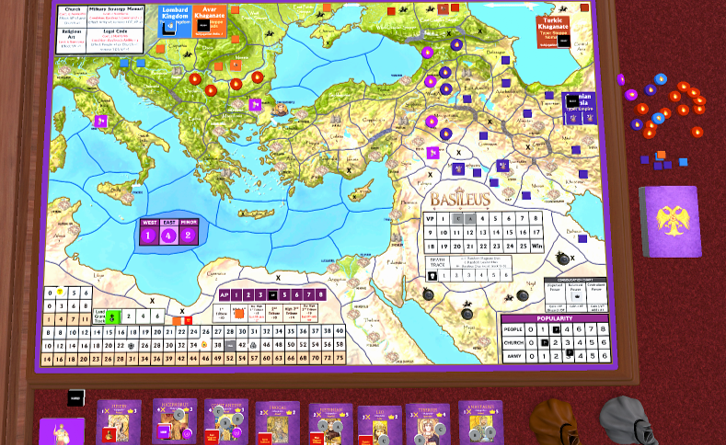
It is A.D. 568, and you live in the East Roman Empire (also known as the Byzantine Empire.) Three years ago, the great emperor Justinian died and was succeeded by his nephew. As the heirs of Caesar Augustus and Constantine the Great, the emperor—or “Basileus”—enjoys total control of the Byzantine state. Yet it is clear that Justinian’s repeated attempt to reconquer lost territory in the west has overextended the empire. He succeeded in re-taking North Africa, Sicily, and Italy—but at an enormous expense in both money and soldiers. Wealthy landowners and small farmers alike are burdened by taxes. The “powerful ones” or “magnates”—men who are educated, own land, and serve the government as high-ranking officials or generals—are unhappy. Justinian’s prestige made him untouchable while alive, but his successor enjoys no such immunity.

Basileus is a card-driven strategy game for three players that simulates politics, war and diplomacy in the East Roman Empire in the 500’s AD. Players take one of two roles: one player—the “Ruler”—controls the emperor (Basileus), while the other two players—the “Magnates”—control both the wealthy and powerful Roman courtiers and non-Roman nations. Players take two actions per turn. There are a certain number of actions available every turn, while strategy cards give extra event and action possibilities to the Magnates. Action cards are chosen simultaneously and resolved in a semi-random order, making gameplay quick and unpredictable. Victory points are awarded for winning battles, conquering territory, and completing literary or artistic achievements. But there’s a catch: the Basileus-Player automatically gains a certain number of victory points each turn. The Magnates must try to make life difficult for the Ruler by lowering the Basileus’s popularity, devastating the Roman economy, leading foreign nations to victory over Roman armies, and building up disloyal characters. If they get lucky, they can initiate a rebellion against the Basileus, depose him, switch roles with the Ruler to become the new Ruler. The Ruler player must try to ensure that the Basileus remains popular with the Romans and successfully defends against foreign threats. But in a world where any failure can be interpreted as divine punishment, the margin for error is razor-thin. Basileus is a tense game where success can be fleeting and danger lurks just around the corner.

Feel free to explore these games and sign up for testing at the following link: https://discord.gg/gSsQRWjPWp

We wish Doug well with these projects and hope that both of these games make it to market in the future as I always love a good game on Rome.

-Grant

Collecting and Analyzing Playtest Data with Robert Longtin

29. September 2021 um 13:44

Robert Longtin, professional data analyst, discusses all angles of playtest data.

We talk about what data to collect, when to collect it, how to collect it, how to analyze it, and more.

Learn more about Robert’s games HERE.

The post Collecting and Analyzing Playtest Data with Robert Longtin appeared first on Board Game Design Lab.

💾

Collecting and Analyzing Playtest Data with Robert Longtin

Von: gabe
29. September 2021 um 13:44

Robert Longtin, professional data analyst, discusses all angles of playtest data.

We talk about what data to collect, when to collect it, how to collect it, how to analyze it, and more.

Learn more about Robert’s games HERE.

The post Collecting and Analyzing Playtest Data with Robert Longtin appeared first on Board Game Design Lab.

💾

How to Process Feedback with John D’Angelo

20. Januar 2021 um 12:19

John D’Angelo, desinger of Runelords, discusses how to receive, process, and utilize feedback.

Whether you’re talking to playtesters, gamers, members of your target audience, or anyone else, it’s important to know how to take in feedback, and it’s vital to know how to use it to make your games better.

And be sure to check out John’s game, Runelords, on Kickstarter HERE.

The post How to Process Feedback with John D’Angelo appeared first on Board Game Design Lab.

💾

How to Process Feedback with John D’Angelo

Von: gabe
20. Januar 2021 um 12:19

John D’Angelo, desinger of Runelords, discusses how to receive, process, and utilize feedback.

Whether you’re talking to playtesters, gamers, members of your target audience, or anyone else, it’s important to know how to take in feedback, and it’s vital to know how to use it to make your games better.

And be sure to check out John’s game, Runelords, on Kickstarter HERE.

The post How to Process Feedback with John D’Angelo appeared first on Board Game Design Lab.

💾

The Secret Sauce of Game Design with Peter C. Hayward

25. März 2020 um 16:33

Peter C. Hayward is back on the show, and we’re delving into the secret sauce of his personal design process. Hint: It all hinges on blind playtesting.

Peter is a designer, developer, and publisher, so he has the benefit of seeing games from lots of different angles.​​

The post The Secret Sauce of Game Design with Peter C. Hayward appeared first on Board Game Design Lab.

💾

The Secret Sauce of Game Design with Peter C. Hayward

Von: gabe
25. März 2020 um 16:33

Peter C. Hayward is back on the show, and we’re delving into the secret sauce of his personal design process. Hint: It all hinges on blind playtesting.

Peter is a designer, developer, and publisher, so he has the benefit of seeing games from lots of different angles.​​

The post The Secret Sauce of Game Design with Peter C. Hayward appeared first on Board Game Design Lab.

💾

How to Be a Great Playtester with Peter C. Hayward

20. März 2019 um 13:10

Peter C. Hayward, founder of Jellybean Games, discusses how to be a great playtester.

Peter often gets paid by publishers to playtest games and probably playtests more games than anyone you know. He’s got great advice on what it looks like to be the most helpful playtester at the table.

Be sure to check out Peter’s new game on Kickstarter HERE.

The post How to Be a Great Playtester with Peter C. Hayward appeared first on Board Game Design Lab.

💾

How to Be a Great Playtester with Peter C. Hayward

Von: gabe
20. März 2019 um 13:10

Peter C. Hayward, founder of Jellybean Games, discusses how to be a great playtester.

Peter often gets paid by publishers to playtest games and probably playtests more games than anyone you know. He’s got great advice on what it looks like to be the most helpful playtester at the table.

Be sure to check out Peter’s new game on Kickstarter HERE.

The post How to Be a Great Playtester with Peter C. Hayward appeared first on Board Game Design Lab.

💾

Playtesting Pro Tips with Jay Cormier

06. März 2019 um 13:30

Jay Cormier, designer of Belfort and tons of other games, discusses tons of ins and outs of playtesting.

Jay has been designing games for over 15 years and has a ton of experience and advice on how to get to the best game possible. 

And be sure to check out Jay’s playtest journal on Kickstarter HERE.​​

The post Playtesting Pro Tips with Jay Cormier appeared first on Board Game Design Lab.

💾

Playtesting Pro Tips with Jay Cormier

Von: gabe
06. März 2019 um 13:30

Jay Cormier, designer of Belfort and tons of other games, discusses tons of ins and outs of playtesting.

Jay has been designing games for over 15 years and has a ton of experience and advice on how to get to the best game possible. 

And be sure to check out Jay’s playtest journal on Kickstarter HERE.​​

The post Playtesting Pro Tips with Jay Cormier appeared first on Board Game Design Lab.

💾

Creating an Online Playtesting Group with Daniel & Connie Kazmaier

12. Dezember 2018 um 14:05

Daniel and Connie Kazmaier discuss how they put together a rather large online playtesting group for their game, Chai.

They have nearly 800 playtesters in their group and go into how they’ve nurtured and developed it.

The post Creating an Online Playtesting Group with Daniel & Connie Kazmaier appeared first on Board Game Design Lab.

💾

Creating an Online Playtesting Group with Daniel & Connie Kazmaier

Von: gabe
12. Dezember 2018 um 14:05

Daniel and Connie Kazmaier discuss how they put together a rather large online playtesting group for their game, Chai.

They have nearly 800 playtesters in their group and go into how they’ve nurtured and developed it.

The post Creating an Online Playtesting Group with Daniel & Connie Kazmaier appeared first on Board Game Design Lab.

💾

Playtesting with Assad Quraishi

12. September 2018 um 14:25

Assad Quraishi, designer of Genesis: Battle of Champions, talks about playtesting.

Assad is a professional user interface designer and has a ton of insight on testing.

Resources mentioned in the show:

Here is some info about James Bach:
And for James Whittaker

The post Playtesting with Assad Quraishi appeared first on Board Game Design Lab.

💾

Playtesting with Assad Quraishi

Von: gabe
12. September 2018 um 14:25

Assad Quraishi, designer of Genesis: Battle of Champions, talks about playtesting.

Assad is a professional user interface designer and has a ton of insight on testing.

Resources mentioned in the show:

Here is some info about James Bach:
And for James Whittaker

The post Playtesting with Assad Quraishi appeared first on Board Game Design Lab.

💾

❌