Fans hochwertiger Spiele des Verlags dlp aus Herzogenrath dürfen sich auf den Herbst freuen. Wenigstens zwei eigene Spiele und darüber hinaus ein paar aus dem Partnerprogramm werden zur SPIEL ’26…
The June 2026 Monthly Debrief Video, which is the 6th episode in Season 6 of this series, saw us discussing Nostalgia and its effects on the wargaming hobby. I think that nostalgia is generally a good thing but it definitely can be something that holds the hobby back. Too much nostalgia tends to keep us away from new and emerging games and systems and in general can be a suppressor of innovation and progression.
Also, as usual, we covered the games we played in June as well as the games we plan to play in July.
We will remind you here that we are fortunate to be continuing our relationship with Noble Knight Games as the sponsor for our Monthly Debrief Video series. In case you don’t know, Noble Knight Games specializes in hard to find games but also carry all the new releases. But what makes them truly unique is that you can find some of the rarest games, long out of print games, hand made games, imported games from overseas, etc. Thanks to them for their sponsorship and we hope that you will consider them first when looking for the games we cover.
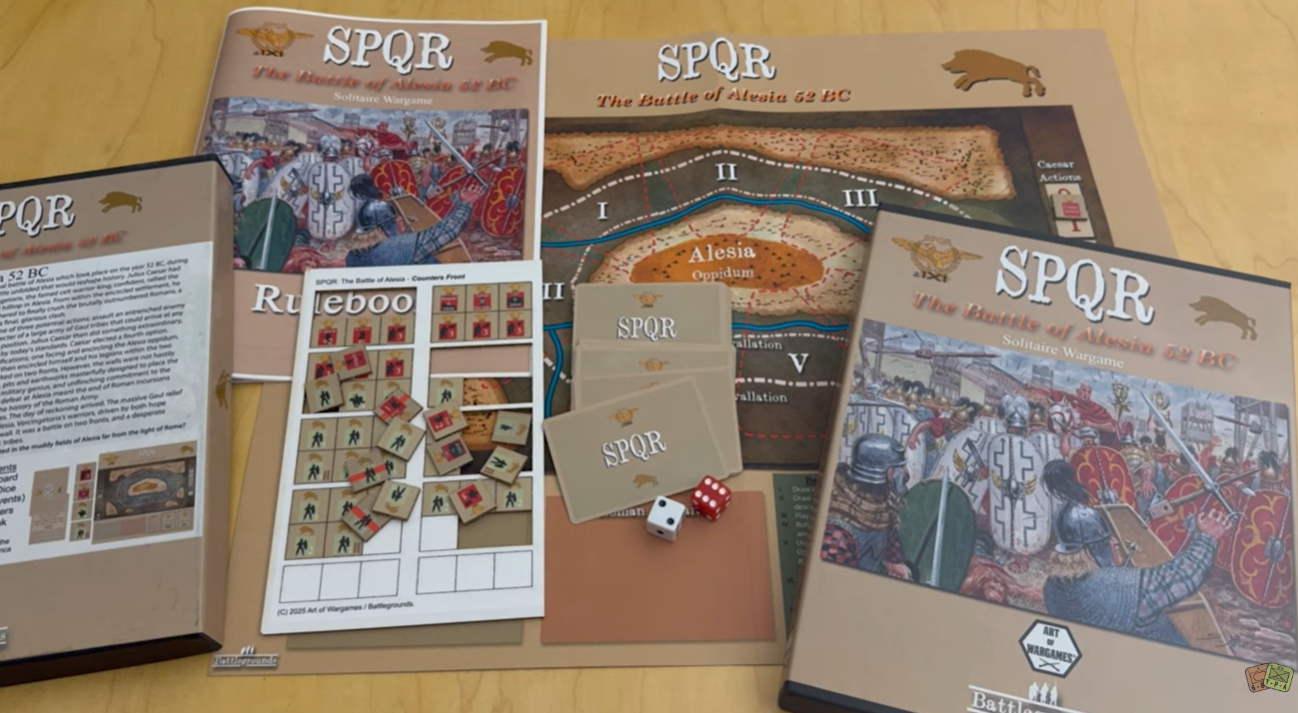
In SPQR: The Battle of Alesia 52 BC, you recreate the historical final battle of Alesia which took place in the year 52 B.C., during Caesar’s Conquest of Gaul. In the heart of the Gaul region, a battle unfolded that would reshape history. Julius Caesar had been carving a bloody path through the Gaul lands.
Vercingetorix, the famed and confident Celtic warrior-king, rallied the scattered tribes of Gaul into a desperate stand on a fortified hilltop in Alesia. From within the encircled settlement, he watched as a vast Gaul relief army of some 250,000 men gathered to finally crush the brutally outnumbered Romans, a storm cloud promising a final, glorious clash.
Will you lead the Roman Legions to glorious victory? Or will you face annihilation in the muddy fields of Alesia? The choice is yours…
With this My Favorite Wargame Cards Series, I hope to take a look at a specific card from the various wargames that I have played and share how it is used in the game. I am not a strategist and frankly I am not that good at games but I do understand how things should work and be used in games. With that being said, here is the next entry in this series.
#82: Good Omens from The Wars of Marcus Aurelius: Rome 170-180CE from Hollandspiele
TheWars of Marcus Aurelius: Rome 170-180CE is a solitaire only game that uses cards similarly to a CDG to simulate the strategic level struggle of the Romans led by Marcus Aurelius to stave off the invasions of Germanic tribes and Sarmatian raiders as they encroach on Roman territory across the Danube River. That’s the history. And it is really well integrated. The game play is very fun, strategic, with lots of decision points about what to do and what cards to use, and it is really challenging.
In the game, the Roman player has a deck of Roman Cards that can be used for the printed events for various effects or that can be discarded to take any number of actions such as attack a Barbarian army or Off-Map Conflict enemy, advance the marker on the Imperium Track, add two Level 1 Forts to any eligible map spaces, flip one Level 1 Fort to a Level 2 Fort among several other actions. Sometimes the printed events in the game are just more powerful than discarding a card for just 1 action so you have to pay attention to this economy and make sure you get the most out of your cards. Now, keep in mind, sometimes discarding a good card whose ability is not right for the current situation you find yourself in is part of the game but you have to use these cards wisely to do well in the game.
The game uses two separate decks of cards including the Barbarian Deck (Green) and The Roman Deck (Red). Both of the decks are made up of 50 cards each but each have very different purposes. The Barbarian Deck is used to determine the actions of the invading Germanic tribes as well as events that effect the war effort including mutinies, plague and the will of the people. While the Roman Deck provides the resources and events that are used by the Roman player to mount a defense against the invasions and to fight back each of the different barbarian tribes. There are unique cards called Late War Cards in the deck that will be held out until the start of the 175CE turn at which time they will be mixed in with the cards to form a new Late War Deck. There are also special cards that are marked with an asterisk that if played for the event will be discarded from the game to form what is called a History Pile.
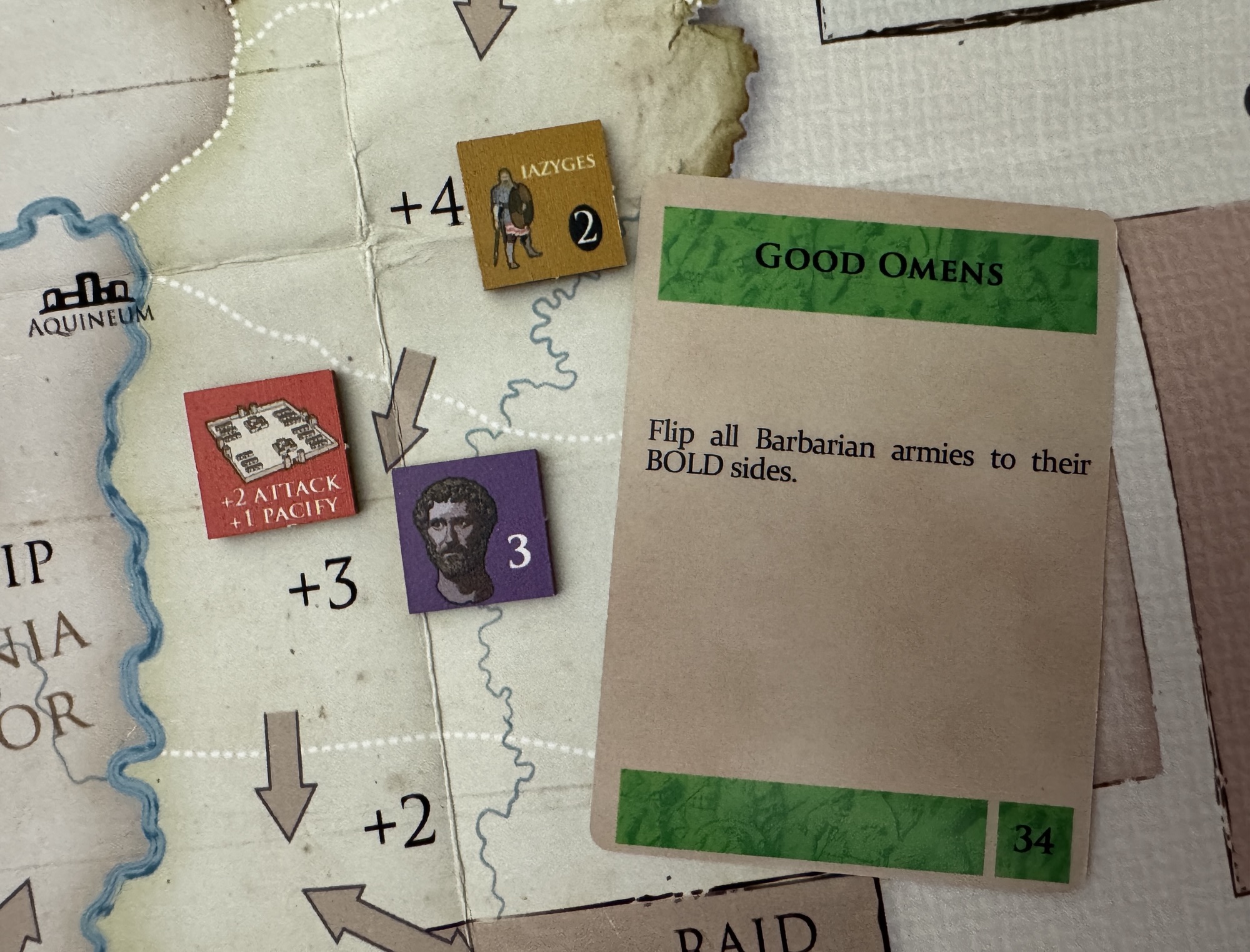
In this entry, we will focus on our first Barbarian Card from the game, as almost all of these cards are really bad for the player, called Good Omens. The “Good” portion of the card’s name doesn’t refer to the Romans but is a benefit for the Barbarians. This card can undo the hard fought victories of Marcus Aurelius and his commanders as its effect is immediate and cannot be cancelled like a Barbarian Surge effect can be by discarding a card. The Good Omens Barbarian Card will immediately cause the player to flip all of the Barbarian armies to their Bold side. Well that doesn’t sound so bad you say? Well, remember that each of the Barbarian army counters is double sided with one side being their Bold side and the other their Demoralized side. On their Bold side, the army is at its strongest with its Combat Value being higher than on the Demoralized side. In our pictures, you can see that the Iazyges army counter has a 4 Combat Value on its Bold side while the Combat Value on the Demoralized side is 2 less at just 2 Combat Value. During combat, or even due to some of the events on the Roman Cards, if a Roman army defeats a Barbarian army, their counter will be flipped from their Bold side to their Demoralized side and they will also have to retreat backward 1 space. I know that the difference here is only 2 but that is in essence gaining a +2 to the Barbarians Combat Value and in a game where the differences between the 2 armies can be just 1 or 2 or even no difference at all, this makes a huge difference and can sometimes feel like you are having to climb a mountain to overcome these Barbarian foes.
Ancient peoples believed deeply in their gods and traditions and would watch for signs in the heavens or from other sources when making key decisions about many things including military campaigns. Good omens would be seen positively as they believed that their decision was favored by the gods and that they would have a good outcome. The Romans believed these things as well but unlike the highly structured Romans, who read omens by sacrificing animals or watching birds fly, barbarian armies like the Germans and Celts relied on signs from nature or even from dreams. These signs when seen would boost morale and gave tribes the psychological edge they needed to fight the powerful armies of the Romans. Germanic tribes believed sacred groves and rivers were portals to their gods and if they were fighting near these places they would take greater strength. Weather was also seen as a major sign and roaring winds, dark storms or rivers that suddenly flooded were viewed as the gods fighting on their side.
The most famous “omen” came from the Battle of the Teutoburg Forest in 9 AD, which occurred over 100 years before the events of the game. A fierce storm, combined with the clever planning of the Germanic leader Arminius, allowed Germanic tribes to completely trap and wipe out 3 Roman legions. The Romans viewed the loss of their legionary eagles and this devastating defeat as a terrible omen for their empire’s future.
Hermann (Arminius) at the Battle of the Teutoburg Forest in 9 AD by Peter Janssen.
I shot a playthrough video for the game and you can watch that at the following link:
I also followed that up with a full video review sharing my thoughts:
With this My Favorite Wargame Cards Series, I hope to take a look at a specific card from the various wargames that I have played and share how it is used in the game. I am not a strategist and frankly I am not that good at games but I do understand how things should work and be used in games. With that being said, here is the next entry in this series.
#80: Rome Offers Settlement from Barbarians at the Gates, The Decline and Fall of the Western Roman Empire 337 – 476 from Compass Games
Barbarians at the Gates, The Decline and Fall of the Western Roman Empire 337 – 476 from Compass Games is a Card Driven Game for two players set during the final hundred plus years of the Western Roman Empire as the Barbarian tribes in the north came down with a vengeance as they clashed with civilization and carved out their place amongst it. The time period covered in the game is from the death of Constantine the Great (337 AD) to the deposition of the last Western Roman Emperor by Odoacer in 476 AD. The Roman player will command the Roman Legions loyal to the failing central authority and those Germanic peoples who have settled peacefully inside the Roman Empire, while the Barbarian player leads Usurper Emperors, and controls the migrations of the Germanic peoples, who are the Barbarians at the Gates. This game is really quite good and feels very much like a wargame even though it is a Card Driven Game. There are lots of opportunities for troop movement, combat and maneuver. And I really liked that. The game is a Card Driven Game and the use of cards is all important and very well done. Each player has their own unique deck of cards that are used and these cards are sometimes removed from those decks when played for an event and also new cards will be added to the deck after each turn. The cards played during a player’s impulse which are not used for the Event are then used for their Operation Points value. These Operation Points can be used for many purposes including Activating a leader, Forced Marches, Raiding, Reinforcement, Migration and Successful Usurpation.
The real trick to the cards is to plan out how you are going to use them to your advantage but also how best to use them. Activating Leaders is very important as you can then move them to attack, defend, change control of areas and other actions. Activating a leader depends on their strategy rating (the lower the strategy rating, the better). When a leader activates from a card, they receive a number of Action Points which can be used for movement (1 over highway, 2 over rough or river connections, 3 over strait or for naval movement), continuation after battle (a kind of advance after combat), changing control over unfortified spaces and sieges of fortified spaces. But the cards also are very mean spirited. What do I mean by this? Well, in our first play, I was carefully using my cards to build up my armies to fend off the initial attacks of the Barbarian hordes. I also had begun to build somewhat of a super stack as well to attempt to foray into England and take on the Barbarians there. As I did this building up, I was unaware of the nasty nature of some of the cards. Some of the cards, both for the Barbarians and Romans, allow a play that will turn a single leader and their entire stack into either a Usurper or a Pacified Barbarian Settlement. Both are equally nasty and you have to keep in mind that you can have your best armies simply taken from you and turned to your enemy.
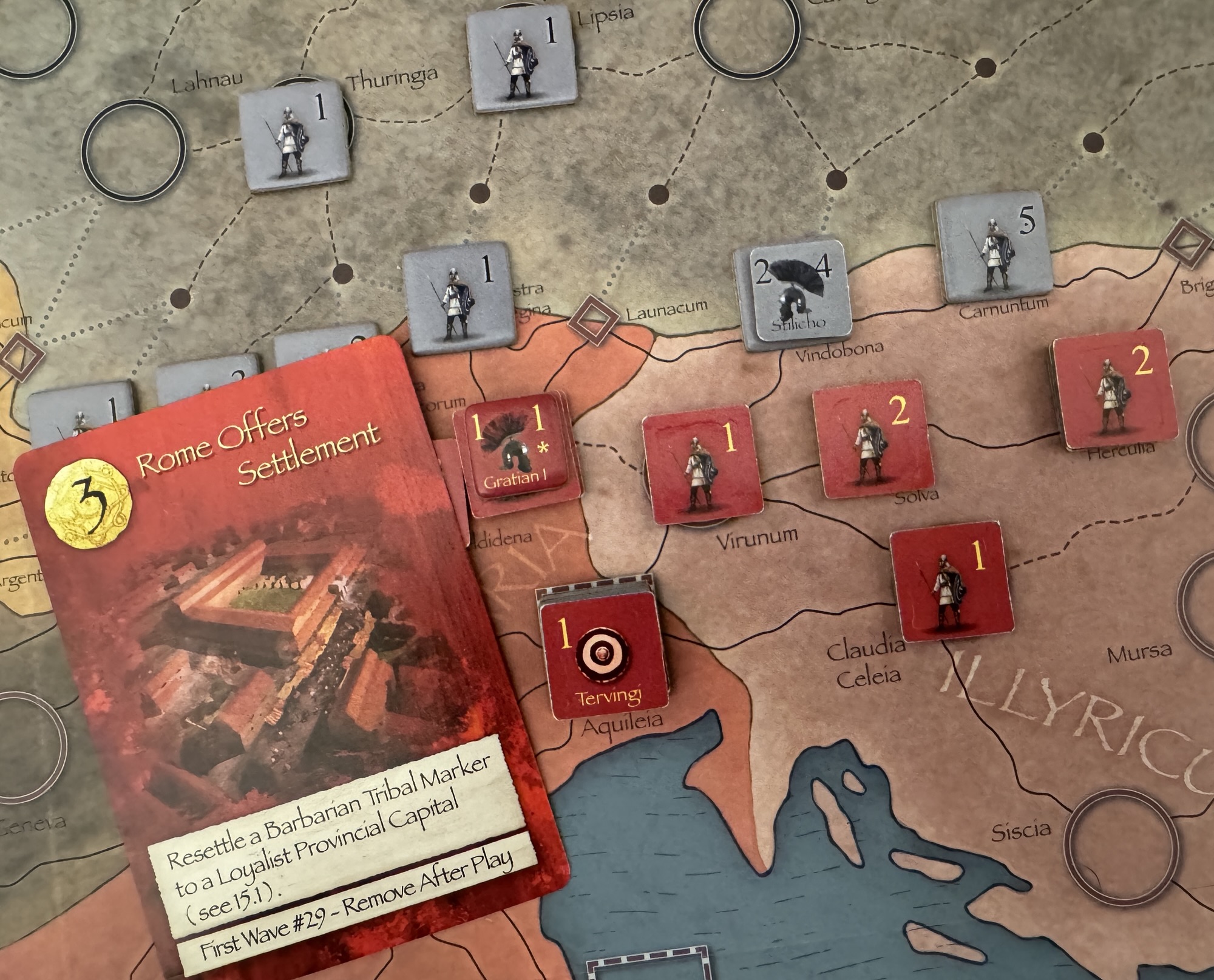
And this concept of taking your best armies away from you, either as the Roman player or the Barbarian player, is well demonstrated with the play of the Rome Offers Settlement card. This card literally allows the Romans to resettle a Barbarian Tribal Marker, along with any combat units with the marker to a Loyalist Provincial Capital. The play of this card at the right (or wrong) time can lead to serious issues on the front lines. Playing the Rome Offers Settlement card simulates foederati diplomacy, allowing the Roman player to integrate migratory tribes into the empire and to gain access to additional manpower to defend the frontier. The mechanical effects include that the selected Tribe will now be aligned with Rome and becomes allied to the Romans. This will lead to the Barbarian Control Marker being removed from the target tribe’s space on the Tribal Alignment Track. The real benefit is that the Roman armies don’t have to risk loss and time in fighting the Barbarians targeted but also provides somewhat of a defensive buffer as the settled tribes will serve as a guard on the frontier, protecting specific Roman provinces and providing a strategic military advantage against other hostile invaders. This card is very important and can be considered essential for the Roman player, as allying with these tribes limits barbarian raiding opportunities and provides crucial resources needed to survive later waves of invasions. Also the preservation of army strength gives an immediate benefit to other ongoing campaigns against other invading tribes. I love this card and the concept from history that it attempts to inject into the gameplay.
Foederati were peoples and cities bound by a treaty, known as foedus, with Ancient Rome. During the Roman Republic, the term identified the socii, but during the Roman Empire, it was used to describe foreign states, client kingdoms or barbarian tribes to which the empire provided benefits in exchange for military assistance. The term was also used, especially under the empire, for groups of barbarian mercenaries of various sizes who were typically allowed to settle within the empire.
The term foederati had its original usage and meaning extended by the Romans’ practice of subsidizing entire barbarian tribes such as the Franks, Vandals, Alans, Huns and the Visigoths, the last being the best known, in exchange for providing warriors to fight in the Roman armies. Alaric I began his career leading a band of Gothic foederati. At first, the Roman subsidy took the form of money or food, but as tax revenues dwindled in the 4th and the 5th centuries, the foederati were billeted on local landowners properties, which became identical to being allowed to settle on Roman territory. Large local landowners living in distant border provinces on extensive villas, which were largely self-sufficient, found their loyalties to the central authority, which were already conflicted by other developments, further compromised in such situations. As loyalties wavered and became more local, the empire then began to devolve into smaller territories and closer personal fealties.
A 20th-century depiction of Alaric parading through the streets of Athens after conquering the city in 395 AD.
Here is a look at our unboxing video:
We also did a video review and you can watch that at the following link:
Back to our board game assisted biography of Fabius Cunctator! In the first part, we’ve seen where Fabius came from, how his career was already illustrious before Hannibal’s invasion, and how he was then called to Rome’s highest emergency office – the dictatorship. Today, we’re covering the turning point of the war against Hannibal, Fabius’s later campaigns, and his final years – as always, with board games.
If you want to read more posts of this kind, I strongly recommend you subscribe to the blog – all new posts in your inbox right when they go live!
“The Man, Who by His Delaying Restored the State to Us”
After Fabius had laid down the dictatorship, the consuls returned to the traditional method of Roman warfare: Lucius Aemilius Paullus and Gaius Terentius Varro were ready to offer battle to Hannibal once more. Hannibal’s third major battle in Italy ended for the Romans even worse than the clashes at the Trebia and Lake Trasimene: At Cannae, the Roman center advanced, their wings gave way, and the entire army was caught in the double envelopment. Rome lost 50,000 soldiers in a single day, including consul Paullus.
The catastrophe at Cannae made Fabius the obvious choice to lead Rome. While he did not take any formal office immediately, his authority, encouragement, and – once more – attention to religious rites calmed the Romans and rekindled their belief in victory.
Fabius was now at the height of his political, military, and religious authority – and he used them. The Romans elected Marcus Claudius Marcellus and Lucius Postumius Albinus as consuls for 215. When the latter was killed in action before he could assume the office, the college of augurs (of which Fabius was a member) vetoed the by-election of Tiberius Sempronius Gracchus, citing religious reasons against having two plebeians as consuls. Instead, the patrician Fabius was chosen to be consul alongside Marcellus. Fabius would be co-opted into the second important priesthood, the college of pontifices, expanding his religious authority even further.
The two consuls of 215 were both seasoned commanders – just what Rome needed in such dire times. At least Fabius would have thought so. When the elections for the consuls of the year 214 were almost completed, Fabius as the presiding magistrate annulled the elections, claiming that the chosen candidates were no match for Hannibal. The elections were held again, and this time, Fabius and Marcellus were returned for another year (contrary to the Roman prohibition of consecutive terms in office).
In any case, Fabius and Marcellus worked well together. They contained Hannibal in 215 in southern Italy, allowing him no more successes in peeling off Roman allies. In 214, Marcellus went on the offensive in Sicily, while Fabius continued to shadow Hannibal’s army and punish Rome’s unfaithful allies. Their division of labor had them soon known as “the sword [Marcellus] and shield [Fabius] of Rome”. When their terms ended in 213, both of them were confirmed as pro-consular commanders.
As Hannibal’s forces dwindled away, his attempt to destroy the Roman alliance system was failing. Even those cities which had joined him were slowly retaken by the Romans. Marcellus conquered Syracuse, the biggest city on Sicily, in 212. Fabius went for a prize of similar importance, besieging Capua, the biggest Italian city after Rome. Hannibal knew he could not defeat Fabius with his shrunken army. Instead, he tried to save his last major ally by marching on Rome, hoping to lure Fabius away from Capua.
Fabius, however, was as phlegmatic as ever and called Hannibal’s bluff by continuing to siege Capua. Rome held, Capua fell. Hannibal’s war was all but lost. The edge of the Carthaginian invasion had been blunted by Fabius’s patience and tenacity, until Rome’s almost-inexhaustible supplies of soldiers allowed it to take the initiative. Fabius’s contemporary, the poet Ennius described him as the “man, who by his delaying restored the state to us”.
The Last Campaigns
Hannibal had lost, but Rome had not yet won. The cities who had broken faith with Rome in Italy had to be re-taken. Rome still had need of Fabius. He was elected consul once more for 209, and also named princeps senatus (“first of the Senate”), an honorary title which by tradition would have been bestowed on the most senior senator who had served as censor.
Bedecked with these honors, Fabius set out against Tarentum, the last major city in Italy which still supported Hannibal, while other Roman generals kept Hannibal busy. Fabius secretly negotiated with the leaders of the city. They broke with Hannibal and opened the city gates to the Roman army – but Fabius had them slaughtered to veil that he had gained the city by treason.
Not a good time to be Tarentine. From Hannibal & Hamilcar.
Tarentum was plundered. Fabius had a colossal statue of Hercules brought to Rome and placed it next to a statue of himself on the capitol, emphasizing his connection to the divine ancestor which he claimed.
Eclipsed
Hannibal was still in Italy, but Rome was firmly on the offensive. The young Publius Cornelius Scipio invaded Spain and expelled the Carthaginians and proposed to invade the Carthaginians’ African seat of power. While Fabius still argued for a defensive strategy which would contain Hannibal, his word did not count for as much as it used to: He may have been the nominally most influential senator, but his strategy had outlived itself. It had been necessary lest Rome suffer defeat, but it could not deliver the ultimate victory.
Scipio found support in the senate and sailed to Africa. Hannibal was promptly recalled by the Carthaginians and made his way back to Africa as well. Scipio met Hannibal at Zama and defeated him in a bloody battle of attrition. Carthage sued for peace soon after. Fabius did not live to see it. He had died a few weeks before the battle of Zama.
Plutarch’s biography of Fabius (which prizes unity of character over historical accuracy) can be found in an English translation here.
Polybius’s Histories which deal with the rise of Rome in the Mediterranean including the Second Punic War are online in an English translation here.
Fabius has found remarkably little attention by modern biographers. If you read German, I recommend this short, but insightful piece on him: Beck, Hans: Quintus Fabius Maximus. Musterkarriere ohne Zögern [Quintus Fabius Maximus. Model Career without Delaying], in: Hölkeskamp, Karl-Joachim/Stein-Hölkeskamp, Elke: Von Romulus zu Augustus. Große Gestalten der römischen Republik [From Romulus to Augustus. Great Characters of the Roman Republic], Beck, Munich 2000.
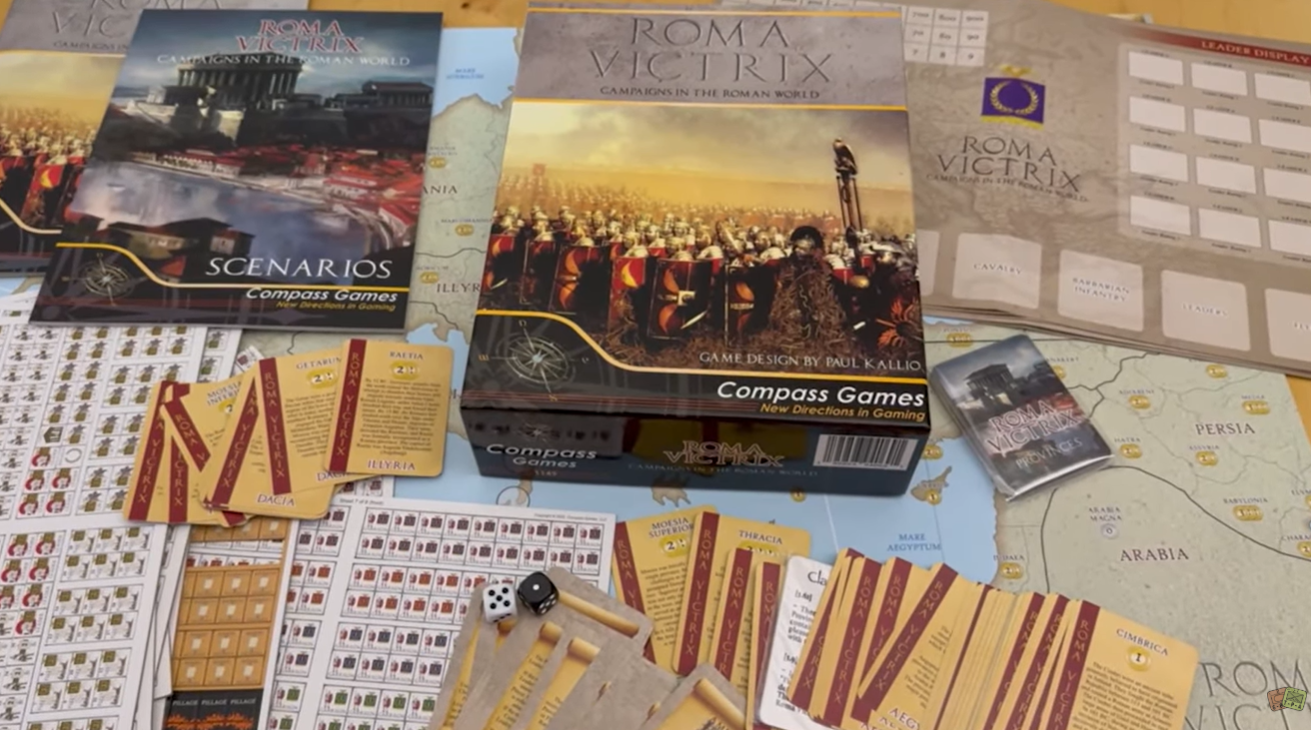
Roma Victrix is a grand strategic, moderate complexity wargame covering a time period ranging from 218 BC to 533 AD in twenty separate historical and hypothetical scenarios.
Roma Victrix is a game which endeavors to re-create the conflicts between Rome and her neighbors to achieve and maintain that dominance. A simple interactive sequence of play guides each player through the process of revenue collection, recruiting and maintaining military forces, conducting land and naval operations, diplomacy, field battles and sieges. Special rules are included to emphasize the importance and effects of leadership, cavalry superiority, mobility and attrition. Random events are also represented, adding an element of unpredictability to even the best laid plans and the likelihood that no scenario will ever play the same.
We have done quite a few board game assisted biographies on this blog. Today, we are going farther back in time than ever to cover the life & games of the Roman statesman whose life is half shrouded in myth: Quintus Fabius Maximus Verrucosus. You might know him as Fabius Cunctator – Fabius the Delayer. Without further delay, we’ll get right into the first part of his life – his origins, early career, and, when he was already one of the pre-eminent Roman statesmen of his time, the defining event of his life: The war against Hannibal in which he took on an extraordinary office. Let’s go!
If you want to read more posts of this kind, I strongly recommend you subscribe to the blog – all new posts in your inbox right when they go live!
You may have wondered about Fabius’s long name above. This is a good opportunity to look at Roman naming customs, which tell us a little about Fabius, and a lot about the Romans. Quintus was his given name (the Romans used only around 20 given names for boys, and the five most common names (Quintus being one of them) already made up more than three quarters). Fabius was his family name, marking him as a member of the gens Fabia. The three remaining names were various kinds of nicknames – Maximus (“the greatest”) was a name he had inherited from an ancestor, Verrucosus (“the warty one”) he had received himself for a wart on his upper lip, and Cunctator (“the Delayer”) he earned for… well, we’ll get to that.
The Romans were big on family, and so the second name would have been the most important one to them. We’ll thus stick to calling our protagonist Fabius. He might have been even prouder of his family than the average Roman, as his was the patrician gens Fabia, one of Rome’s great aristocratic families. From his birth around 280-275 BCE on, Fabius was thus destined for a political and military career.
We do not know much about his early life. Fabius’s ancient biographers assert that he was deliberate to the point of slowness, but this seems like projecting his later fame of “delaying” back to his youth to maintain unity of character. In any case, Fabius was anything but slow in his career.
Young Roman nobles were expected to gain some military experience. Fabius could do so in the First Punic War, a protracted struggle (264-241 BCE) with Carthage over the control of Sicily and Sardinia. Rome won, mostly due to the almost bottomless manpower from which it could recruit – in addition to the city itself, Rome had founded many colonies all over Italy, and was allied to almost every other city on the Italian mainland. Fabius’s insights into generalship and Rome’s system of alliances would come in handy later.
Well-born Roman men with ambitions could not but go into politics. The Republic offered several elected offices for which they competed. Usually, these were taken one after another in a fixed sequence (the cursus honorum (“course of honors”)), but the rules were not as fixed in Fabius’s 3rd century BCE as they would become later. Thus, Fabius was elected to the lowest office (the quaestorship, responsible for financial administration) twice (first in 237), but, after climbing the second rung on the ladder (the aedilate), he skipped the third (the praetorship) altogether. Instead, he ran the highest office (the consulate) only four years after his quaestorship. The people of Rome elected him consul for the year 233. Fabius had fulfilled all ambitions which a regular Roman noble could have.
Yet Fabius was not content to be just any Roman noble. While his domestic pursuits were unremarkable – he unsuccessfully opposed a law introduced by the tribune of the plebs Gaius Flaminius which distributed lands in northern Italy to military colonists – he defeated the Ligurians during his consulate and was awarded a triumph for it. That was an extraordinary honor, rarely bestowed. Given that his victory was won against a rather minor enemy, that spoke of Fabius’s political clout.
The triumph was the greatest honor that could be bestowed on a victorious Roman general – and it affirmed the Roman belief in the righteousness and victoriousness of their cause.
Fabius left his consulate as one of the first men in Rome. He consolidated his political power even further, attaining the censorship (an office elected only every five years and correspondingly rare, even amongst former consuls) in 230 BCE, and, in contradiction to traditions prohibiting the repetition of high offices, became consul again in 228. Then, he used his good contacts to the Greek world to ensure that Romans could, for the first time, participate in the Isthmian Games. Two consulates and a censorship would ensure Fabius’s political primacy for the rest of his life.
Ten years after the end of his second consulate, Hannibal invaded Italy.
Invasion: Hannibal in Italy
Carthaginian-Roman relations had remained difficult after the end of the First Punic War. With Rome in control of the islands, the Carthaginians had diverted their energy to Spain. Their leading family, the Barcids, had carved out a large and prosperous colonial empire there. To avoid conflict with Rome, the two empires agreed on a division of spheres of influence. When the Carthaginians clashed with the city of Saguntum, it applied to Rome for help. The Romans resolved to aid Saguntum, even though the city lay in Carthage’s sphere of influence. Some of the ancient authors report that Fabius led a senate faction which favored negotiations over war with Carthage, others – like the generally reliable Polybius – oppose this interpretation. In any case, the hawks prevailed and war was declared on Carthage. The Romans sent an army to Spain, but the Barcid commander Hannibal seized the initiative by skirting the Roman force and crossing the Alps into Italy. Hannibal defeated a Roman army under Publius Cornelius Scipio (the father of Scipio Africanus) at the Trebia river and allied himself with the Gallic tribes in upper Italy. Fabius counseled that Rome avoid engagement with Hannibal and instead rest on its superior strength to wear him out.
In the second year of the war, the two Roman consuls (one of them Gaius Flaminius, Fabius’s opponent from his first consulate) each awaited the Carthaginian army in defensive positions on either side of the Apennine mountains, ready to support each other. Yet Hannibal snuck through the mountains, got into Flaminius’s back, and annihilated his army in a surprise attack on the shores of Lake Trasimene.
Setup for the Lake Trasimene scenario from Commands & Colors: Ancients (Richard Borg, GMT Games): You can see the Romans pinned against the shores of the Lake when the Carthaginians began to emerge from their covered positions in the hills and forests north of the lake. Image from CommandsAndColors.net.
One of Rome’s consuls was dead, the other cut off from the city by Hannibal’s army. The Romans resorted to this leadership crisis with an emergency measure: There was one office whose holder did not have to consult with a colleague – the dictator. Now was the time for such a man.
Dictator: Fabius vs. Hannibal
Traditionally, a dictator would be appointed by the two consuls. Yet one of them was dead and the other cut off from Rome. The remaining senators took matters into their own hands and had the popular assembly elect Fabius dictator. Having an additional experienced general in a crisis offers some advantages, as the Roman player in Hannibal & Hamilcar (Jaro Andruszkiewicz/Mark Simonitch, Phalanx) can attest: The Dictator event places an additional general (whose requirement of a strategy/battle rating of 3-3 makes it likely that it will be Fabius, as there is only one other general of this kind in the game) in Rome, and, as the advantages of unified command are lost in a game which has unified command (the player) anyway, also gives three combat units as a boon.
Another perspective on the office is found in The Republic of Rome (Richard Berthold/Don Greenwood/Robert Haines, Avalon Hill): As all players represent individual Roman factions, putting a dictator in charge can save the Republic from all too many military challenges – but it also runs the risk of making the dictator too powerful to be contained in the political competition of the republic.
Fabius, for one, was all taken up by the current crisis when he was named dictator. He identified the crisis as not only military, but also psychological: The catastrophe at Lake Trasimene had shaken the Romans’ confidence that they would eventually win through their own courage, the help of their allies, and the benevolence of the gods. Fabius began at the latter end. As the highest public official, he was also responsible for attending to religious rites, and he made sure to give them immaculate attention. His ostentatious piety included vowing large public sacrifices to the gods in the coming season, and personally, he promised to build a temple to Venus Erycina, a goddess associated with the gens Fabia.
The religious aspect of Roman life is rarely well understood by modern, secularized, audiences. Board games also don’t get it right very often. The Republic of Rome includes priesthoods which can be conferred on characters (the historical Fabius was a member of the priesthood colleges of both the augurs and the pontifices), but the in-game effect is abstract – it just increases their voting power. Only the pontifex maximus (Rome’s highest priest, literally the “greatest bridge-builder”) has an additional function, as he can veto political proposals (on the grounds that the omens are not favorable). Omens are also the only way in which religion features in Hannibal & Hamilcar: The Good Omen event allows the player to manipulate a die roll.
Religion, the foundation of ancient culture, as a one-time effect.
The two games thus present two differing interpretations: Republic of Rome’s priests are – much like any other Roman aristocrat, from whose ranks they are recruited – concerned with the political advancement of their faction and will use their religious powers as an other tool in this political competition. Hannibal & Hamilcar’s recipient of “good omens” seems to be in fact blessed by the gods (as the omens can manipulate the impact of crossing a difficult mountain pass or the likelihood that a Carthaginian fleet carries reinforcements over the Mediterranean Sea). Neither the former opportunism nor the latter true belief captures the social and cultural importance of ancient religion (without subscribing to the particular Roman form of polytheism) fully, pointing to a certain blind spot in board games.
Fabius’s religious restoration has found less attention among modern readers than his military response to the crisis at hand. In short, after the defeats at the Trebia and Lake Trasimene, Fabius refused to meet Hannibal in a pitched battle. Instead, his army shadowed Hannibal’s, hoping to chip away at his supplies. Such a gradualist, but tenacious approach continues to be referred to as a “Fabian strategy” until today.
Despite Rome’s bad experiences with field battles against Hannibal, the strategy was unpopular. Romans were used to fighting – and winning – battles. Refusing them smacked of defeatism, if not straight-up cowardice. Fabius’s nickname Cunctator (“the Delayer”) stems from the early days of his dictatorship, and it wasn’t meant as a compliment.
The strategy was also initially not successful. Closely observing Hannibal’s army from unattackable positions did nothing to the counter the desolation the Carthaginians visited on the lands of Rome’s allies whose loyalty to Rome now faded. And the one time when Fabius had Hannibal cornered at the plains of Ager Falernus (in September 217 BCE), the Romans were duped: Hannibal feigned a nocturnal attack on the pass by tying wooden torches to the horns of 2,000 oxen, lightly guarded by some of his troops. which resembled an advancing army at night. The Romans, led by Fabius’s second-in-command Marcus Minucius Rufus, engaged in a confused melee in the dark (against Fabius’s explicit command) while Hannibal slipped away by another route with his main force.
Fabius’s reputation reached its nadir after the battle of Ager Falernus. Minucius Rufus was among the Dictator’s many critics. Fabius’s tenuous political position is evidenced by the senate practically appointing Minucius Rufus his co-dictator with an independent command of part of the army – but both parts were to operate in conjunction. Minucius Rufus eschewed Fabius’s careful positioning of the army on the hills to avoid battle and moved into the plains at Geronium to engage Hannibal. He got his wish… but not the way he wanted: Hannibal’s small force at Geronium turned out to be bait, and the reinforcements which Hannibal had hidden nearby started mauling Minucius Rufus’s army. Fabius swept down from the hills with his army. Now Hannibal was under attack from both sides and retreated. While Minucius Rufus’s army had suffered outsized casualties, the battle had not turned into a third disaster.
With Minucius Rufus taken down a few notches – he had to come to Fabius’s camp after the battle and hail him as his second father for the gift of his life – the challenge to Fabius’s authority was met. Yet Fabius was still not popular, and after his six-month term as dictator expired, he returned to private life.
Plutarch’s biography of Fabius (which prizes unity of character over historical accuracy) can be found in an English translation here.
Polybius’s Histories which deal with the rise of Rome in the Mediterranean including the Second Punic War are online in an English translation here.
Fabius has found remarkably little attention by modern biographers. If you read German, I recommend this short, but insightful piece on him: Beck, Hans: Quintus Fabius Maximus. Musterkarriere ohne Zögern [Quintus Fabius Maximus. Model Career without Delaying], in: Hölkeskamp, Karl-Joachim/Stein-Hölkeskamp, Elke: Von Romulus zu Augustus. Große Gestalten der römischen Republik [From Romulus to Augustus. Great Characters of the Roman Republic], Beck, Munich 2000.
Long-time readers of this blog know my infatuation with Colleen McCullough’s Masters of Rome series. I have been reading the series since 2018 at the appropriately epic pace of one book per year (and last year, I skipped). Masters of Rome reading was always a highlight of my literary year – the high drama, the broad historical canvas painted with a myriad of characters, events, and microplots, and, most of all, McCullough’s readiness to engage the ancients on their own terms, with ever so many pages dedicated to this legislation or that campaign.
McCullough had planned to end the series after the sixth instalment (The October Horse, which covers the years 44 to 42 BCE). Only her fans’ pleas convinced her to write Antony and Cleopatra. Maybe that shows a little bit – the book takes a long time (say, the first 200 pages) to hit its stride, and never quite reaches the heights of previous instalments. Yet that mostly shows how good these books were (peaking with novel #5, Caesar), as this conclusion to the drama of the late Roman Republic was still one of my favorite historical novels in 2025.
Clarissa Oakes (Patrick O’Brian)
I’m continuing my re-read of the Aubrey-Maturin series, that delightful panorama of life at sea (and land!) during the Napoleonic Wars. Among the Aubrey-Maturin novels which I read this year, my favorite was #15 – Clarissa Oakes.
Jack Aubrey and Stephen Maturin want just one thing: Leave New South Wales and its mixture of brutal government (instigating clashes between the officers and men) and anti-Irish fervor (which gets Stephen into trouble). However, when the ship is out at sea, they realize that one of the younger officers has smuggled out a convict from the penal colony – an enigmatic young woman, who is bound to attract the attention of several of the men. No other book in the series makes so good on the premise of the characters being confined to a small ship, unable to avoid each other. And Clarissa, the escapee, is not just a plot device, but a complex and compelling character in her own right.
And my favorite historical novel of this year was…
A Gentleman in Moscow (Amor Towles)
„Where is it now?“, asks the poem which kicks off the book – “it” being purpose. Having been written after the failed Russian revolution of 1905, the poem is widely seen as a call to action and inspires Russia’s revolutionaries… and thus they do not sentence the aristocratic author Count Alexander Rostov to death when he returns to Russia after the October Revolution. Under house arrest at the Hotel Metropol in Moscow, he will spend the next thirty years rethinking and rediscovering his purpose. It will not count as a spoiler that he finds it in putting his abilities to good use and connecting with his fellow human beings – of course he does. Yet the point of the book is not the goal, but the winding way there, told with grace, nuance, and originality.
While the ending might be a bit kitschy, the unique protagonist, the cast of intriguing side characters and the delightful prose made this my favorite historical fiction read of the year.
Have you read any of these books – and, if so, what did you think? And what were your favorite historical novels of the year? Let me know in the comments!
Long-time readers of this blog know my infatuation with Colleen McCullough’s Masters of Rome series. I have been reading the series since 2018 at the appropriately epic pace of one book per year (and last year, I skipped). Masters of Rome reading was always a highlight of my literary year – the high drama, the broad historical canvas painted with a myriad of characters, events, and microplots, and, most of all, McCullough’s readiness to engage the ancients on their own terms, with ever so many pages dedicated to this legislation or that campaign.
McCullough had planned to end the series after the sixth instalment (The October Horse, which covers the years 44 to 42 BCE). Only her fans’ pleas convinced her to write Antony and Cleopatra. Maybe that shows a little bit – the book takes a long time (say, the first 200 pages) to hit its stride, and never quite reaches the heights of previous instalments. Yet that mostly shows how good these books were (peaking with novel #5, Caesar), as this conclusion to the drama of the late Roman Republic was still one of my favorite historical novels in 2025.
Clarissa Oakes (Patrick O’Brian)
I’m continuing my re-read of the Aubrey-Maturin series, that delightful panorama of life at sea (and land!) during the Napoleonic Wars. Among the Aubrey-Maturin novels which I read this year, my favorite was #15 – Clarissa Oakes.
Jack Aubrey and Stephen Maturin want just one thing: Leave New South Wales and its mixture of brutal government (instigating clashes between the officers and men) and anti-Irish fervor (which gets Stephen into trouble). However, when the ship is out at sea, they realize that one of the younger officers has smuggled out a convict from the penal colony – an enigmatic young woman, who is bound to attract the attention of several of the men. No other book in the series makes so good on the premise of the characters being confined to a small ship, unable to avoid each other. And Clarissa, the escapee, is not just a plot device, but a complex and compelling character in her own right.
And my favorite historical novel of this year was…
A Gentleman in Moscow (Amor Towles)
„Where is it now?“, asks the poem which kicks off the book – “it” being purpose. Having been written after the failed Russian revolution of 1905, the poem is widely seen as a call to action and inspires Russia’s revolutionaries… and thus they do not sentence the aristocratic author Count Alexander Rostov to death when he returns to Russia after the October Revolution. Under house arrest at the Hotel Metropol in Moscow, he will spend the next thirty years rethinking and rediscovering his purpose. It will not count as a spoiler that he finds it in putting his abilities to good use and connecting with his fellow human beings – of course he does. Yet the point of the book is not the goal, but the winding way there, told with grace, nuance, and originality.
While the ending might be a bit kitschy, the unique protagonist, the cast of intriguing side characters and the delightful prose made this my favorite historical fiction read of the year.
Have you read any of these books – and, if so, what did you think? And what were your favorite historical novels of the year? Let me know in the comments!
The draft’s back! This time it’s card games, and we’re picking the best of what ought to be a staple of any good collection. We love card games, we love drafting games, and you love winning money, so be sure to vote for whoever you think drafted the best set, and you could win a $100 gift card! Before deal everyone in, we talk about Money!, Venture, and Fishing.
If you don’t want to miss an episode, please subscribe on Apple Podcasts/Google Podcasts/Stitcher/Spotify, or add our RSS feed to your favourite app. Reviews and subscriptions really help us and would be greatly appreciated! To download the episode directly, click here.
If you’d like to discuss anything in the episode, please do so in the comments below, visit our BoardGameGeek guild, join our Discord, or Facebook Group! Any feedback is also always helpful. If you’d like to show your support for the show, we also have a Patreon with some fun rewards, and a merch store!
Timecodes:
03:02 – Money! 12:43 – Venture 20:27 – Fishing 28:39 – Card Games Draft 31:15 – Innovation 32:38 – Race for the Galaxy 34:20 – Hanabi 35:27 – Marvel Champions: The Card Game 36:21 – Dominion 37:47 – SCOUT 39:28 – Glory to Rome 40:58 – The Crew: Mission Deep Sea 41:50 – Arboretum 42:12 – Lost Cities 42:57 – Bohnanza 43:57 – Tichu 45:06 – Skull King 47:00 – Res Arcana 48:07 – That’s Not a Hat
There’s any number of subtle innuendoes we could’ve gone with, but this is what we’re doing I guess. If you haven’t got there yet, we’re talking about games that aren’t just slow rides, but instead leave you gasping for more right as they climax. Before we finish, we talk about No Loose Ends, Eselsbrücke, and The Lord of the Rings: Fate of the Fellowship.
If you don’t want to miss an episode, please subscribe on Apple Podcasts/Google Podcasts/Stitcher/Spotify, or add our RSS feed to your favourite app. Reviews and subscriptions really help us and would be greatly appreciated! To download the episode directly, click here.
If you’d like to discuss anything in the episode, please do so in the comments below, visit our BoardGameGeek guild, join our Discord, or Facebook Group! Any feedback is also always helpful. If you’d like to show your support for the show, we also have a Patreon with some fun rewards, and a merch store!
Timecodes:
01:24 – No Loose Ends 09:08 – Eselsbrücke 19:33 – The Lord of the Rings: Fate of the Fellowship 33:52 – Comings and Goings 37:44 – Games that finish strong 40:17 – Agricola 40:44 – Splendor 41:14 – The Voyages of Marco Polo 44:03 – Terraforming Mars 45:28 – Blood on the Clocktower 46:57 – Innovation 47:49 – Rumble Nation 49:50 – Moon Colony Bloodbath 52:12 – Dominion
Thank you to Heart Society for generously letting us use What’s On Your Mind, Kid? from their album Wake the Queens.
Auf das Spiel Ruhm für Rom wurde ich vor Jahren aufmerksam, aber es war damals schon länger out of print und nur auf dem Gebrauchtmarkt zu meiste extrem hohen Preisen zu bekommen, vor allem wenn man die Erweiterung auch noch haben wollte. Und ich war nicht bereit, diese Preise oft deutlich jenseits der 100 Euro für ein reines Kartenspiel zu bezahlen. Das Grundspiel (auf Deutsch von Lookout) hatte ursprünglich mal 19,90 € gekostet und die Erweiterung Mehr Ruhm für Rom 13,95 €. Auf eBay wurden dafür aber auch schon astronomische Preise von mehreren hundert Dollar bezahlt.
Der amerikanische Ursprungsverlag Cambridge Games Factory wurde 2004 gegründet und Glory to Rome war eines seiner ersten Spiele. Allerdings existiert der Verlag schon über 10 Jahre nicht mehr.
1. Version aus dem Jahr 2005 (Cambridge Games Factory)
Ich hatte das Spiel deshalb eine Zeit lang aus den Augen verloren, bin aber immer wieder darüber gestolpert, vor allem weil es von einigen sehr gelobt wurde. Vor 3 Wochen bin ich dann beim Youtube-Kanal Getting Games auf dieses Video gestoßen Getting Games – Playing with friends
Da spielt Jonathan zusammen mit seinem Kumpel Dave eine Partie Glory to Rome (Originalversion) zu zweit. Nachdem ich mir das Video angesehen hatte, war ich richtig angefixt und wollte das Spiel jetzt doch endlich mal spielen.
Rein von der Optik her hätte ich hier die Version von Lookout Games am liebsten gehabt. Die hat ein comichaftes Artwork, welches mich etwas an Asterix und Obelix erinnert. Aber da lagen bei Kleinanzeigen die Preise (nur für das Grundspiel, welches ursprünglich mal um die 20€ gekostet hatte) bei 75 bis 100 Euro. Und dann hätten mir immer noch die rund 14 Gebäude aus der Erweiterung gefehlt. Wobei 2 der Gebäude (Forum Romanum und Kran) auch in der deutschen Erweiterung „Mehr Ruhm für Rom“ gar nicht enthalten sind.
Ruhm für Rom (Deutsche Version von 2011, Lookout Games)
Nach etwas Stöbern im Netz bin ich auf das Video von Tabletop Turtle aus Kanda aufmerksam geworden: Reviewing Our Custom Glory to Rome! Free Files in the Description! und das versprach eine Lösung. Mike hatte hier eine eigene Version von Glory to Rome „gebastelt“ mit eigenem Artwork, und er stellt diese sogar über Google Drive zur Verfügung.
Und ich war begeistert, dass er nicht nur JPG-, sondern auch PSD-Dateien zum Herunterladen hat, die man mit Photoshop bearbeiten kann. Und das habe ich dann getan. Ich habe die Photoshop-Dateien heruntergeladen und übersetzt. Dabei habe ich mich an dem englischen Text auf den Karten und nicht an der Lookout-Übersetzung orientiert. Nach 1 Woche Arbeit war ich dann und habe die Karten bei meinspiel.de drucken lassen. Da es jedoch 244 Karten sind, ich bei meinspiel aber nur 33, 55 oder 110 Karten auswählen konnte, habe ich mich auf 220 Karten beschränkt und 24 weggelassen.
Hier mal 9 beispielhafte Gebäude (Orte) aus der Version von Mike.
Das finde ich auch nicht so schlimm. Einige der Gebäude gibt es nämlich 6-mal im Spiel, die meisten aber immer nur 3-mal. Und und von diesen Karten habe ich 24 Karten weggelassen, da ich nicht denke, dass diese das Spiel großartig beeinflusst.
Bezahlt habe ich dafür knapp 57 € und musste mir dann nur noch ein Spielertableau basteln, da Mike seines leider nicht als PSD-Datei zur Verfügung gestellt hat. Netter Nebeneffekt: Ich hab meine Photoshop-Skills in den letzten Tagen erheblich erweitert. Hier das Ergebnis.
Die Karten waren schnell gedruckt, auch wenn ich leider ein englisches Wort beim Übersetzen vergessen habe („Wood“ auf der Karte Anlegestelle, siehe oben). Und diese Woche konnte ich es dann zum ersten Mal spielen. Dabei haben wir eine verkürzte Spielvariante aus den Lookout-Regeln verwendet. Hier nimmt man nur die Hälfte der Auftragskarten und wir haben auch nur 3 Bauplätze von jeder Art verwendet.
Unsere Partie zu zweit hat 50 Minuten gedauert und uns beiden so viel Spaß gemacht, dass wir es nächste Woche wieder spielen werden. Ich freue mich auch schon auf Partien zu dritt, viert oder fünft, da ich denke, dass das Spiel dadurch noch deutlich gewinnt. Allerdings benötigt man für die vielen Karten dann auch ordentlich Platz auf dem Tisch.
Glory to Rome – English Black Box Edition (2012, Cambridge Games Factory)
Nun aber noch kurz zum Spielablauf. In Ruhm für Rom errichten wir Rom wieder, welches bei einem Aufruhr im Jahr 64 n. Chr. vom Feuer verwüstet wurde.
Ruhm für Rom ist eines der ersten Multi-Use-Kartenspiele. Eine Karte ist dabei sowohl eine von 6 Rollen (Kaufmann, Arbeiter, Legionär, Architekt …), eines von 6 Materialien (Stein, Marmor …) und auch ein Gebäude (Ort), welches wir errichten können.
In jeder Runde entscheidet der Anführer ob er eine Rolle anführt oder nachdenkt. Bei letzterem zieht er Karten nach. Führt er eine Rolle an, so können die Mitspielenden dieser folgen, wenn sie eine entsprechende Rollenkarte oder einen Senator (Joker) auf der Hand haben.
Ziel ist es, möglichst viel Einfluss zu erlangen, den man durch das Errichten von Gebäuden erhält und Siegpunkte durch Karten in seinem Tresor zu bekommen.
Fazit: Mir gefällt bei Ruhm für Rom besonders, dass er sehr interaktiv ist, oft auch etwas gemein, und das hier keine Downtime aufkommt, da man dem Zug der Mitspielenden immer folgen kann. Es spielt sich sehr gut zu zweit, ich denke aber, dass es mit mehr Mitspielenden noch etwas besser ist. Man braucht für das Spiel ordentlich Platz auf dem Tisch und muss aufpassen, dass man bei den vielen Karten nicht den Überblick verliert. Auch sollte man sich die Effekte der Gebäude immer genau durchlesen. Die können zum Teil sehr mächtig sein und einem auch durchaus overpowered vorkommen. Das macht aber gar nichts, da die Gebäude ja mehrfach vorhanden sind und es genug weitere Gebäude mit mächtigen Effekten gibt.
Von mir bekommt Ruhm für Rom nach unserer ersten Partie eine 8 von 10.
Karten aus der Black Box Edition von 2012 (Bildquelle: BGG, Jonathan Schindler)Karten aus der Lookout Version von 2011 (Bildquelle: BGG, André E)
Zu guter Letzt noch eine Fan-made-Version die ich persönlich auch sehr cool finde. Glory to Rome in einer Asterix-Variante: Asterix reskin von Tor Gjerde
Auf das Spiel Ruhm für Rom wurde ich vor Jahren aufmerksam, aber es war damals schon länger out of print und nur auf dem Gebrauchtmarkt zu meiste extrem hohen Preisen zu bekommen, vor allem wenn man die Erweiterung auch noch haben wollte. Und ich war nicht bereit, diese Preise oft deutlich jenseits der 100 Euro für ein reines Kartenspiel zu bezahlen. Das Grundspiel (auf Deutsch von Lookout) hatte ursprünglich mal 19,90 € gekostet und die Erweiterung Mehr Ruhm für Rom 13,95 €. Auf eBay wurden dafür aber auch schon astronomische Preise von mehreren hundert Dollar bezahlt.
Der amerikanische Ursprungsverlag Cambridge Games Factory wurde 2004 gegründet und Glory to Rome war eines seiner ersten Spiele. Allerdings existiert der Verlag schon über 10 Jahre nicht mehr.
1. Version aus dem Jahr 2005 (Cambridge Games Factory)
Ich hatte das Spiel deshalb eine Zeit lang aus den Augen verloren, bin aber immer wieder darüber gestolpert, vor allem weil es von einigen sehr gelobt wurde. Vor 3 Wochen bin ich dann beim Youtube-Kanal Getting Games auf dieses Video gestoßen Getting Games – Playing with friends
Da spielt Jonathan zusammen mit seinem Kumpel Dave eine Partie Glory to Rome (Originalversion) zu zweit. Nachdem ich mir das Video angesehen hatte, war ich richtig angefixt und wollte das Spiel jetzt doch endlich mal spielen.
Rein von der Optik her hätte ich hier die Version von Lookout Games am liebsten gehabt. Die hat ein comichaftes Artwork, welches mich etwas an Asterix und Obelix erinnert. Aber da lagen bei Kleinanzeigen die Preise (nur für das Grundspiel, welches ursprünglich mal um die 20€ gekostet hatte) bei 75 bis 100 Euro. Und dann hätten mir immer noch die rund 14 Gebäude aus der Erweiterung gefehlt. Wobei 2 der Gebäude (Forum Romanum und Kran) auch in der deutschen Erweiterung „Mehr Ruhm für Rom“ gar nicht enthalten sind.
Ruhm für Rom (Deutsche Version von 2011, Lookout Games)
Nach etwas Stöbern im Netz bin ich auf das Video von Tabletop Turtle aus Kanda aufmerksam geworden: Reviewing Our Custom Glory to Rome! Free Files in the Description! und das versprach eine Lösung. Mike hatte hier eine eigene Version von Glory to Rome „gebastelt“ mit eigenem Artwork, und er stellt diese sogar über Google Drive zur Verfügung.
Und ich war begeistert, dass er nicht nur JPG-, sondern auch PSD-Dateien zum Herunterladen hat, die man mit Photoshop bearbeiten kann. Und das habe ich dann getan. Ich habe die Photoshop-Dateien heruntergeladen und übersetzt. Dabei habe ich mich an dem englischen Text auf den Karten und nicht an der Lookout-Übersetzung orientiert. Nach 1 Woche Arbeit war ich dann und habe die Karten bei meinspiel.de drucken lassen. Da es jedoch 244 Karten sind, ich bei meinspiel aber nur 33, 55 oder 110 Karten auswählen konnte, habe ich mich auf 220 Karten beschränkt und 24 weggelassen.
Hier mal 9 beispielhafte Gebäude (Orte) aus der Version von Mike.
Das finde ich auch nicht so schlimm. Einige der Gebäude gibt es nämlich 6-mal im Spiel, die meisten aber immer nur 3-mal. Und und von diesen Karten habe ich 24 Karten weggelassen, da ich nicht denke, dass diese das Spiel großartig beeinflusst.
Bezahlt habe ich dafür knapp 57 € und musste mir dann nur noch ein Spielertableau basteln, da Mike seines leider nicht als PSD-Datei zur Verfügung gestellt hat. Netter Nebeneffekt: Ich hab meine Photoshop-Skills in den letzten Tagen erheblich erweitert. Hier das Ergebnis.
Die Karten waren schnell gedruckt, auch wenn ich leider ein englisches Wort beim Übersetzen vergessen habe („Wood“ auf der Karte Anlegestelle, siehe oben). Und diese Woche konnte ich es dann zum ersten Mal spielen. Dabei haben wir eine verkürzte Spielvariante aus den Lookout-Regeln verwendet. Hier nimmt man nur die Hälfte der Auftragskarten und wir haben auch nur 3 Bauplätze von jeder Art verwendet.
Unsere Partie zu zweit hat 50 Minuten gedauert und uns beiden so viel Spaß gemacht, dass wir es nächste Woche wieder spielen werden. Ich freue mich auch schon auf Partien zu dritt, viert oder fünft, da ich denke, dass das Spiel dadurch noch deutlich gewinnt. Allerdings benötigt man für die vielen Karten dann auch ordentlich Platz auf dem Tisch.
Glory to Rome – English Black Box Edition (2012, Cambridge Games Factory)
Nun aber noch kurz zum Spielablauf. In Ruhm für Rom errichten wir Rom wieder, welches bei einem Aufruhr im Jahr 64 n. Chr. vom Feuer verwüstet wurde.
Ruhm für Rom ist eines der ersten Multi-Use-Kartenspiele. Eine Karte ist dabei sowohl eine von 6 Rollen (Kaufmann, Arbeiter, Legionär, Architekt …), eines von 6 Materialien (Stein, Marmor …) und auch ein Gebäude (Ort), welches wir errichten können.
In jeder Runde entscheidet der Anführer ob er eine Rolle anführt oder nachdenkt. Bei letzterem zieht er Karten nach. Führt er eine Rolle an, so können die Mitspielenden dieser folgen, wenn sie eine entsprechende Rollenkarte oder einen Senator (Joker) auf der Hand haben.
Ziel ist es, möglichst viel Einfluss zu erlangen, den man durch das Errichten von Gebäuden erhält und Siegpunkte durch Karten in seinem Tresor zu bekommen.
Fazit: Mir gefällt bei Ruhm für Rom besonders, dass er sehr interaktiv ist, oft auch etwas gemein, und das hier keine Downtime aufkommt, da man dem Zug der Mitspielenden immer folgen kann. Es spielt sich sehr gut zu zweit, ich denke aber, dass es mit mehr Mitspielenden noch etwas besser ist. Man braucht für das Spiel ordentlich Platz auf dem Tisch und muss aufpassen, dass man bei den vielen Karten nicht den Überblick verliert. Auch sollte man sich die Effekte der Gebäude immer genau durchlesen. Die können zum Teil sehr mächtig sein und einem auch durchaus overpowered vorkommen. Das macht aber gar nichts, da die Gebäude ja mehrfach vorhanden sind und es genug weitere Gebäude mit mächtigen Effekten gibt.
Von mir bekommt Ruhm für Rom nach unserer ersten Partie eine 8 von 10.
Karten aus der Black Box Edition von 2012 (Bildquelle: BGG, Jonathan Schindler)Karten aus der Lookout Version von 2011 (Bildquelle: BGG, André E)
Zu guter Letzt noch eine Fan-made-Version die ich persönlich auch sehr cool finde. Glory to Rome in einer Asterix-Variante: Asterix reskin von Tor Gjerde
In light of this recent “everyone stay at home” thing, and the “don’t go to conventions because they broke” thing, you might be short on entertainment and I am here to provide! Here be links to all of my games (all three of them) as Mods for Tabletop Simulator and Shop Links for The Game Crafter, so you can play them with your friends online, or buy a physical copy! All of these games were going to be on sale at BABScon, but with that not going ahead and me stuck in Europe, that’s not happening. Anyway:
Thunderdrome is a racing game for 2-6 Wonderbolts (though it’s best with 4). You navigate a randomly generated track with a hand of cards, rationing your high speed cards for the straights, your low speed cards for the corners to avoid damage, managing your slender deck through one or two pit stops, staying close to your rivals on a cramped circuit to earn fan boost, and using that later for extra speed. It’s simple enough to get playing quickly, but there’s still plenty to think about.
Overtime is a simple push your luck game for 3-5 street criminals. Each round, the operator (dealer) deals cards off the top of the deck until everyone’s bailed and taken some loot, or two threats of the same suit show up, meaning everyone still in the round goes bust. At the end of the game, your score is the chips you get from your bravado in staying in each round the longest, plus the best poker hand you can make from the cards you took, because of this game’s other feature: It uses a regular deck of playing cards! So if you really want to, you can ignore the game I designed and just have a pack of Sunjackers playing cards.
Palomino Gold is a social deduction game for 6 to a lofty 12 backstabbing treasure hunters. One player takes on the role of Daring Do, and at the start of the game, everyone burgles the heck out of her. After passing around the cute little mint tin box, in which everyone has a chance to take a role gem of their choice or as much gold as they want, Daring Do has to interrogate the table to find out who took her gold, who’s trying to help her, and who’s actually the police trying to catch her.
Finally, if you’d like to support me but don’t think you can justify spending 30 bucks on a pony-themed board game, or you’re in Europe and the shipping is murder, then you can toss me a few buckaroonies on Patreon, or just drop me a one-time tip on Paypal!
Or if you’re not in a position to be throwing money, just enjoy the games! That’s why they’re on Tabletop Simulator. Amica magnifica, ludum gloriosum.
Two of the greatest commanders of antiquity died in 183 BCE, 2200 years ago. Their names are Hannibal Barca and Publius Cornelius Scipio Africanus – but Hannibal and Scipio will do to refer to them.[1] Their lives have many parallels – long absences from home, an adult life dominated by war in the first and politics in the second part, and finally the experience of being an individual too big to fit into one’s small community. We’ll look at their youth and their fortunes in the war when they were in Carthage’s favor in this article. A second part will cover the second part of the war when Rome struck back and Hannibal’s and Scipio’s years after the war that defined both their lives.
There are many board games which deal with the dramatic events of the second war been Rome and Carthage which I will discuss here. The most prominent one (and the one I will draw upon the most) is Mark Simonitch’s Hannibal: Rome vs. Carthage (Valley Games). I took the pictures of the new edition Hannibal & Hamilcar (Mark Simonitch/Jaro Andruszkiewiecz, Phalanx Games).
Early Years
Hannibal was born in 247 BCE as the son of Hamilcar, Carthage’s most successful general of the First Punic War against Rome.[2] Hamilcar was not good at moving on after the defeat in this war and let this influence his parenting: According to a popular story, he took the nine-year old Hannibal and Hannibal’s little brothers Hasdrubal and Mago to a temple and had them swear never to be friends of Rome. Then he left the city to expand Carthage’s imperial possessions in Spain, taking his eldest son with him. Nine years later, he died in battle against an Iberian tribe. His son-in-law Hasdrubal the Fair (married to Hannibal’s oldest sister and not to be confused with Hasdrubal, Hannibal’s brother) took command. Hamilcar and Hasdrubal the Fair gained possession of the largest part of southern and eastern Spain with all its riches in iron and silver. When Hasdrubal the Fair died in 221 BCE, Hannibal was the new supreme leader of the Carthaginian empire in Spain.
Scipio was eleven years younger than Hannibal. He came from one of the most distinguished Roman noble families and was brought up in the traditional style of Roman aristocracy and prepared for political and military duties. Therefore, he joined the military when he was 17 or 18 – just as war had broken out with Carthage.
Hannibal’s War
Hannibal’s successes in Spain had aroused Roman suspicion. Rome demanded Hannibal stop his advance at the river Ebro. Hannibal, however, disregarded this unilateral meddling in his affairs and proceeded to attack the city Saguntum just beyond the Ebro which sent an embassy to Rome for help. Despite their big words, the Romans left Saguntum in the lurch – a hint of the mixed opinions in the Roman senate. Nonetheless, they demanded that Hannibal leave Saguntum be. Hannibal was unimpressed.
He conquered Saguntum unmolestedly and then took his forces, including 37 war elephants, to Gaul and then further towards Italy. A Roman army – led by Scipio’s uncle Gnaeus Cornelius Scipio – marched to Gaul as well, but Hannibal avoided battle and let Gnaeus make his way to Spain in an attempt to catch Italy underdefended. Although it was already October, he proceeded to cross the snow-covered alps – the most famous, and, at the same time, most overrated of Hannibal’s deeds. Sure, it was a daring feat, but nowhere as ground-breaking as people would make it seem – of course Rome knew that armies could pass the Alps. And yes, it was more difficult since it was already fall, but that was Hannibal’s own fault for waiting in Gaul until the consular army had passed him. Most importantly, while elephants in the snow must be a grand sight to behold, the crossing took great losses on the men, when Hannibal could hardly afford losses for a campaign where he’d have trouble getting reinforcements from home or recruiting on site.
Hannibal crossing the Alps with his army in Hannibal & Hamilcar. Note the dotted and dashed lines – those are passes which might reduce your army size due to attrition.
Nonetheless, the crossing of the alps was the beginning of Hannibal’s glory days. He defeated the Romans under Scipio’s father Publius Cornelius Scipio at the Ticinus (Scipio earned his first respect in this battle saving his surrounded father with a daring solitary charge at the assailants). He killed half of the Roman force in the battle at the Trebia with a skilled attack on both flanks. Finally, he ambushed a Roman force that had neglected its reconnaissance at Lake Trasimene, annihilating it and killing its general, consul Gaius Flaminius.
After these crushing defeats within the span of a year Rome changed for a defensive strategy implemented by Quintus Fabius Maximus Verrucosus, called Cunctator (“the delayer”). Fabius avoided direct engagement in favor of constant skirmishes to wear the invading force down while Rome built up her forces (the “Fabian strategy”). This went against all Roman traditions, and many proud Romans viewed it as downright un-Roman. After one year, the Senate gave Fabius the boot and opted for a more assertive strategy against Hannibal once more. The new consuls went straight for Hannibal with a superior force of 80,000 men against the Carthaginian’s 50,000. One young officer in this Roman army was Scipio. The two armies met at Cannae in southern Italy, and Hannibal did what he had always done – just on a bigger scale this time: The Carthaginian center gave way to lure the Roman infantry forward. At the same time, both the Carthaginian left and right won their engagements and outflanked the Romans. They managed to completely encircle the Roman army, and then it was nothing but a massacre. 70,000 Roman soldiers died. Scipio was one of the few survivors.
Hannibal’s most famous victory in Hannibal & Hamilcar: His double envelopment annihilates the army of the attacking consul Gaius Terentius Varro.
Now the way to Rome was open – but Hannibal did not march on the city, producing one of the big what-ifs of military history. His decision was as controversial then as it is now – Hannibal’s cavalry officer Maharbal fumed “You know how to win, Hannibal, but not how to use a victory!” when he heard of it. In the end, Hannibal may have made the right call – Rome would have been difficult to besiege, and with the momentum of his great victory, Hannibal could bring many cities in southern Italy to his side which had been discontented about their alliance with Rome. The issue remains in contention until today, and board games certainly are no exception: Hannibal – Rome vs. Carthage employs a siege system that indicates that Hannibal would not have had an easy time scaling the walls of Rome, whereas it’s pretty easy for an army to flip cities to your side when there is no enemy to contest it. Hannibal vs. Rome (Rome Package, Reiner Knizia, GMT Games), on the other side of the spectrum, ends when one side moves an army onto the enemy capital – even if there is an enemy army.
The catastrophe of Cannae brought the Fabian strategy back into fashion and Fabius himself back into command. And Hannibal despaired over the Roman resources of manpower. While the Romans couldn’t beat Hannibal, he couldn’t break them, either. And so he kept marching through Italy, trying to convince as many cities as possible to join him. There were never enough. The Romans contented themselves with not losing against his main army and keeping tabs on him. Increasingly, they waged the war as if Hannibal wasn’t even there – Fabius as the “shield of Rome” made sure Hannibal was in check without seeking battle, Marcus Claudius Marcellus, the “sword of Rome” re-conquered cities elsewhere, most famously Syracuse on Sicily.
Marcellus sieges Syracuse in Hannibal & Hamilcar. In the background, Fabius Cunctator keeps tabs on Hannibal’s army.
In Spain, the Carthaginians had been more successful. The Roman army under Scipio’s uncle (later reinforced by Scipio’s father) which had bypassed Hannibal in Gaul was defeated repeatedly in Spain. In 211, Carthaginian forces under Scipio’s brother Hasdrubal annihilated the Roman army in Spain. Both Scipio’s father and his uncle Gnaeus were slain. When the Roman Senate decided to send another army, they chose Scipio as the commander. The young Scipio – still only 25 – became the first Roman to hold a pro-consular command (that is, a command for someone who had been consul, the highest office of the Republic) without ever having been as much as a praetor (the second-highest office). Scipio’s talent – and the Senate’s wish to make this a war of revenge – trumped the venerated rules of the Republic.[3]
For an engaging account of not only Hannibal’s life, but also the larger Barcid family history and their political and military machinations, see Hoyos, Dexter: Hannibal’s Dynasty. Power and Politics in the Western Mediterranean, 247—183 BC, Routledge, Abingdon-on-Thames 2003.
The best Scipio biography is still Scullard, H.H.: Scipio Africanus. Soldier and Politician, Cornell University Press, Ithaca, NY 1970.
Footnotes
1. Carthaginian males have a given name that is generally selected from only a handful of names. To avoid confusion between all the dozens of Hannos or Hasdrubals, they are given a nickname which may become hereditary – Hannibal’s nickname Barca (which means “the lightning”) came from his father Hamilcar Barca’s blitzkrieg exploits in the war against Rome, and it became some kind of family name for them.
Roman naming conventions changed over time. During Scipio’s life, the most famous system of the tria nomina (three names) rose to dominance. Male Roman aristocrats would usually have three names in this system. A praenomen (given name) was selected from a list of only about 20 names – in Scipio’s case, Publius. The family name (nomen gentile) Cornelius was legally the most important, since belonging to a Roman family gave the bearer full citizenship rights. Lastly, the often-hereditary nickname (cognomen) was more and more used as the main name referring to a person – which is why we call Scipio Scipio (and not Publius or Cornelius). He had inherited this nickname from a distant ancestor who must have held public office since scipio refers to the staff that would have been the symbol for office. What about Scipio’s last name Africanus? Well, that’s another nickname. This one, however, Scipio acquired for himself. We’ll get to that in due time.
2. You see how our perspective is Roman here – we call the wars between Rome and Carthage “Punic” wars after the Punic Carthaginians as Rome’s enemies. The Carthaginians might have called these wars the “Roman” wars (just like the Vietnamese call what is known in the western World as the “Vietnam War” the “American War”).
3. Rome never had a codified, written constitution, but there were conventions on how to conduct politics. One of these rules was that all offices had to be taken in the right sequence starting with the lowest. These rules were evolving. Granting Scipio the command started a massive trend to shape the rules to fit ambitious individuals.

 Anmelden