Normale Ansicht

Interview with Volko Ruhnke Designer of 1943: Race to Rabaul from PHALANX

Von: Grant
15. Juni 2026 um 14:00

PHALANX does some really great games and they have 2 new games that have recently been placed on pre-order in a 2-pack called Pacific War Games (you can order them separately). This package includes 1943: Race to Rabaul designed by Volko Ruhnke and Tora Tora Tora! designed by Wataru Horiba. I have reached out to Volko Ruhnke to discuss his 1943: Race to Rabaul, which is part of the Keep ‘Em Rolling Series of logistics focused wargames that includes titles such as 1944: Race to the Rhine and 1941: Race to Moscow, and he was more than willing to share.

If you are interested in 1943: Race to Rabaul, or its sister game in the Pacific Wargames package called Tora Tora Tora!, you can pre-order copies on the Gamefound pre-order page at the following link: https://gamefound.com/en/projects/phalanx/pacificwar-games

Grant: Volko welcome back to the blog. What is your new upcoming game 1943: Race to Rabaul?

Volko: 1943: Race to Rabaul will be the next volume in Phalanx Games’ “Keep ‘Em Rolling” Series, following up on 1944: Race to the Rhine and 1941: Race to Moscow. Also set in World War II, this time you are supplying forces moving and fighting across the South Pacific–with the twists that players are fighting each other and have to manage sea, air, and land operations.

Grant: You have designed logistics focused games in the past such as the Levy & Campaign Series. How has that experience lead you to the Keep ‘EM Rolling Series?

Volko: I’ve always enjoyed wargames that include placing, moving, consuming, destroying actual supply bits on the map–going back at least to The Gamers’ Standard Combat Series AFRIKA. In Levy & Campaign, I wanted to show that for medieval campaigns, in a simple enough way to be fun rather than tedious. When I later played 1944: Race to the Rhine, I saw that that design accomplished that very well indeed, even made it the focus of play. So I was hooked.

Grant: How did this opportunity come to you?

Volko: Two Septembers ago, I was in Prague for Czech Con hosted by Levy & Campaign Žižka designer Petr Mojžíš, where I got to meet Phalanx co-owner Jaro Andruszkiewicz. He invited me to do a design with his company. I at once knew that it had to be something in their “Race” series. Via my research for Coast Watchers from GMT Games, I already had become fascinated by Japanese logistical challenges and Allied counter-logistics strategy in the South Pacific. So the fit seemed a natural.

Grant: What sources did you consult to get the historical details correct? What one must-read source would you recommend?

Volko: I had already done a lot of reading for Coast Watchers. The source that really laid out the Japanese perspective on their difficulties in reinforcing the front line was Kengoro Tanaka’s Operations of the Imperial Japanese Armed Forces in the Papua New Guinea Theater. I also picked up Breaking the Bismarcks Barrier, an official US Navy history of the campaign. My favorite general Pacific War history source is Ronald Spector’s Eagle Against the Sun (as I briefly had the opportunity to study history under Professor Spector at George Washington University.)

Grant: What is your overall design goal and thesis for Race to Rabaul?

Volko: In the South Pacific of 1943, the Allies were far more savvy than just piling their firepower and men directly against the well-fortified Japanese positions. Instead, they wore them down with air strikes over time, while blockading them by air and sea. The key challenge to the Japanese defense was the inability to get enough supplies and men through the growing Allied air and then sea superiority to reinforce–and even just feed the Japanese forces holding the line. In1943: Race to Rabaul, you manage that logistical and counter-logistical struggle on each side.

Grant: How tough was working within the constraints of an existing system?

Volko: I find it easier overall to start with an existing system that I know works and build from there (as I did with classic-CDG Wilderness War and the scenarios and C3i Magazine campaign that I’ve done within Combat Commander). The key challenges for me in bringing the Phalanx “Race” system to the South Pacific were expanding it to opposed play necessary to capture the critical counter-logistical aspect – and to a maritime environment – sea, air, amphibious and land warfare – all with the eye to adding just a dose of added complexity.

Grant: How does the vastness and remoteness of the pacific affect logistics? How did you model this?

Volko: The environmental problem that the Japanese faced and the Allies exploited in the South Pacific was that nearly all logistics came by sea, so air interdiction ruled. There were land campaigns in New Guinea’s interior. But the jungle and ridge terrain there required air lift or coastal transport to build up. And by 1943, the Allies increasingly dominated the air war. Race to Rabaul requires you to move your troops, ammunition, and food across sea–you can’t just march your corps forward. For the more constrained Japanese, that means launching Convoys that the Allies might detect and strike.

Grant: What was most important to model in the game? What about inter-service rivalry?

Volko: That Japanese challenge moving anything and the Allied effort to stop it is most characteristic of the design. But perhaps its most impactful addition to the “Race” system is opposed combat. Rabaul taps the same principle of counting supply bits to determine combat outcomes. But with 2 opposed players, playing cards to hope to out wit each other, as well as land and amphibious attacks, the combat subsystem in this volume is necessarily more involved. For non-wargamers, that is probably a hindrance. But for wargamers, it may make Rabaul even more up their alley than the earlier games. Inter-service rivalry comes to the fore in Rabaul when you have 3 or 4 players. Each side has two Commander roles, “racing” along either the east or west half of the map. Each represents the Japanese or Allied army or naval dominance of the New Guinea and Solomons campaigns, respectively. Whichever player (not side) reaches its goal first wins the game–so you can choose to cooperate with the other Commander on your side or not!

Grant: How does the logistics support differ between the Allies and the Japanese?

Volko: I’ve mentioned the Japanese use of Convoys and Allied Convoy Strikes above. The Allies have that easier–their abundance of transports is assumed wherever they have Air Cover. The problem is that they must take ground and build Air Bases to extend that Air Cover and Convoy Strike range forward. The Allies also get more abundant Men &Material–generally more bits per action at their Supply Bases than the Japanese get at theirs. But, as in the earlier “Race” games, here the Allies must work their Logistics Level up to add to that capacity. The Japanese also have an advantage stalwart austerity in feeding their troops: the Japanese, unlike the Allies, never lose their last Troops piece in a space due to lack of Food, they garden!

Grant: What was the process of taking a series designed for land based campaigns into one involving amphibious supply and operations?

Volko: I had to add some complication to show the maritime environment. Instead of one type of connection between spaces, Race to Rabaul has Land, Sea, and Straight. Instead of just Trucks (and in Moscow Trains), Rabaul has Japanese Freighters, Destroyers and Barges and Allied Landing Craft. Because you have to transport soldiers not just supplies across water, Rabaul has Troops bits instead of Fuel, and Troops become key to feeding requirements, building Air Bases, fortifying, and, naturally, combat. Allied amphibious landings can be disastrous if defeated with the sea at their backs. And air power looms far larger int he naval environment, with Commanders controlling up to 6 Air tokens instead of Rhine’s 1 each.

Grant: What other challenges does each side face in obtaining their goal?

Volko: The Japanese defenders are essentially playing for time, as each Logistics step that the Allies need to trigger will award Japanese medals for holding the Bismarcks Barrier. But just those Japanese medals probably won’t be enough: the Japanese Commanders need to find openings to strike and cause Allied Troop losses as well. That takes timing and will cost Japanese Men & Material or Air tokens–possibly accelerating the Allied drive that will break the Bismarcks Barrier and stop those medal awards for good. The Allied attackers need to manage the troops, supplies, and cards to take Japanese positions efficiently to reduce the number of enemy medals for those Logistics steps. But rushing too much will result in risky attacks–even a potentially disastrous failed invasion–not to mention exposure to Japanese Banzai counterattacks. Pushing Allied Men & Material forward needs to occur even while the Allies keep up the pressure on Japanese convoys and bomb Japanese positions to counter their defensive buildup and digging in.

Grant: What is the layout of the game board and the purpose of the different boxes?

Volko: The board shows 2 tracks, in effect: MacArthur (green player) is racing up the New Guinea coast on the west half, while Halsey (blue) is racing up the Solomon Island chain on the east. These work like the colored areas in the earlier “Race” games, except that each track has a human opponent trying to stop you: Imamura (gold) against MacArthur, and Kusaka (white) against Halsey. The various boxes serve as pools for each side’s Men & Materiel bits and Fleets of Convoys or Landing Craft. Boxes also track what is just temporarily removed or spent rather than out of play (off the board). An Allied Logistics track works very much like those in the earlier games, showing how much each Allied Commander has developed the logistical infrastructure, affecting how many M&M they get per action, how many Air tokens they have, and how many cards they hold.

1943: Race to Rabaul game board art by Donal Hegarty.

Grant: What is the general Sequence of Play?

Volko: The Sequence of Play is quite basic–first the Japanese take actions, then the Allies do. As in the other games, Commanders each get 2 core actions from a menu, plus Bonus actions from cards, in this case at most 1 of the latter.

But before each Japanese turn, there is a free Delivery step in which Convoys drop off cargo. That wrinkle in the sequence means that (mostly) there will be an Allied turn in between Japanese Convoy Launch (an action) and Delivery, so a chance for the Allied players to strike the Japanese ships. The exception is certain Japanese Bonus action cards representing particularly successful “Tokyo Express” runs and the like. Logistics steps, when (mostly) the Allies trigger them, always occur after Allied actions. There are a couple Japanese cards that can force a Logistics step, representing intervention by Japanese fleet commander Yamamoto. Victory is instantaneous, whenever any Commander takes their 12th medal or–far less likely–a Japanese Supply Base such as Rabaul falls.

Grant: How many players is the game designed for?

Volko: The game handles 2, 3, or 4 players. We always have Japanese and Allied players opposing each other, as both logistics and counter-logistics feature. With 4 players, each takes a Commander: the 2 Commanders on a side can help each other with longer-range strikes and intelligence, or they can withhold help or even sabotage each other if their ally is pulling ahead and getting too close to winning. With3 players, one takes both Commanders on a side and must win with both, facing 2 players each as a single Commander. The single player can be either on the Japanese or Allied side, either works. With 2 players, you can either each command a side–the 2 Japanese Commanders versus the 2 Allied–or you can pick either half of the map–New Guinea alone or the Solomons–and play a shorter game with just 1 Commander each side.

Grant: What different commanders do players have a choice to play as? How do they differ?

Volko: The paired Commanders personify not only the conditions in New Guinea and the Solomons, respectively, but also the bureaucratic friction between Army and Navy on each side.

-MacArthur in New Guinea is also the theater commander so gets say in any internal Allied dispute such as order of actions. As an Army General, he has more land assets such as Artillery cards and a related Special Ability to redraw them, more suitable anyway to the New Guinea “track” that involves some interior fighting. Also, MacArthur alone can use Airdrops to seize jungle airstrips.

-Halsey in the Solomons has more Naval Shelling, Cruisers against Japanese Convoys–also his Special Ability–plus Guerrillas but correspondingly less Artillery and attack Divisions. Halsey late in the campaign needs to be the most careful not to get the last of his Divisions beaten up and withdrawn.

-Facing MacArthur, General Imamura represents the overall Japanese Army’s focus on New Guinea and the overall Japanese priority on that axis over the Solomons chain–so that player is the senior partner on the Japanese side. Imamura has more Troop and Ammo unit cards at his disposal and a Special Ability that can redraw them. He has his own Bonus action cards like Supply Road and Barge Assault.

-Admiral Kusaka facing Halsey has an edge in Carrier Pilots–his Special Ability–naval advantages like Long Lance torpedoes, but also the defensively crafty Army General Sasaki, who held up the Allies bloodily on New Georgia.

Grant: How is victory achieved?

Volko: As in the other “Race” games, capture of a Supply Base–here an Allied Commander advancing to either Rabaul, Madang in New Guinea, or Kavieng in the islands–ends the game immediately in an Allied Commander win. But, as in those games, that rarely will occur: the main way to win is to be the first of the 4 Commanders to gather 12 medals along the way.

Grant: What different scenarios are included?

Volko: The game includes 4 scenarios, each of different length. They all end with capture of a Japanese Supply Base or with a 12th medal. They run different play lengths by starting at later and later points in the South Pacific campaign:

-TheFull Campaignbegins with the Japanese still to make their final push on the Kokoda track and Guadalcanal in late 1942. The Allies must battle their way to Buna in Papau before heading up the New Guinea coast, while throwing the Japanese off Guadalcanal before driving up the Solomons chain.

-CARTWHEEL begins with the Allies preparing their historical 1943 drive to conquer or encircle Rabaul. Buna and Guadalcanal are cleared and serving as Allied bases, but the great Allied offensive has not yet launched.

-POSTERN begins with MacArthur primed for the historical September invasion to capture the Japanese New Guinea base of Lae and Halsey’s forces having just fought across New Georgia in the central Solomons.

-Finally, CHERRY BLOSSOM is a small learning scenario for just 2 players on the Solomons half of the board, representing the moment that Halsey is about to invade the Japanese bastion island of Bougainville.

Grant: What do you feel the game models well?

Volko: Phalanx’s “Race” system does so well highlighting the need to gather and push supplies forward in a mobile mechanized campaign–especially one in which the defender is largely on the run. Race to Rabaul I hope similarly succeeds in showing that the overwhelming Allied logistical edge over the Japanese in the South Pacific by 1943 was alone not enough against tenacious, dug-in defenders. The Allies succeeded as they did by smartly targeting Japanese logistics first, and only then throwing ground forces at the enemy bastions. To me, this design makes that counter-logistics approach vivid. I hope players will agree!

Grant: What are you most pleased about with the design?

Volko: I’m pleased with how the one-sided “Race” concept ported here to a full wargame, force on force, and that some added map features, pieces types, and combat rules brought the Phalanx system to “tri-phibious” warfare. The game is more complicated than either 1944: Race to the Rhine or 1941: Race to Moscow, to be sure, but remains more accessible than my usual design space such as Levy & Campaign or Recon Series. (I think so, anyway.)

Grant: What other designs are you contemplating or already working on?

Volko: Jaro of Phalanx, who commissioned this design from me, and I have chatted back and forth about a wide range of settings for a possible next “Race” volume from me. I have a good idea what that would be, if players end up digging Rabaul. But it would be premature to raise particular expectations as yet.

Thank you for the intriguing questions!

If you are interested in 1943: Race to Rabaul, or its sister game in the Pacific Wargames package called Tora Tora Tora!, you can pre-order copies on the Gamefound pre-order page at the following link: https://gamefound.com/en/projects/phalanx/pacificwar-games

-Grant

New York in History and Board Games, #2

14. Juni 2026 um 18:00

Back to the history and board games of New York City! Last time, we’ve looked at the city’s humble beginnings all the way to the destruction wrought on the city by the Revolutionary War. Today, we’ll cover the first century of New York City as a city in the United States – how it established its primacy in the country, how it was at the same time very attractive and a horrible place to live in, and how it took shape as a modern metropolis. As always, board games will guide us.

American Capital

When Britain had recognized American independence in 1783, the young country gave itself a constitution – the Articles of Confederation. The United States were organized on strictly confederative principles. New York City became the capital. The advocates of broad independence for the states and minimal federal government, however, lost ground over the next few years as the United States struggled to deal with the post-war challenges, chiefly the states’ tremendous debt. Thus, over ferocious public debate, a new constitution was adopted in 1787, and according to it, a strong chief magistrate elected – George Washington, the first president, who was inaugurated in 1789 at City Hall, New York.

One of the fiercest proponents of a strong federal government was New Yorker Alexander Hamilton who became the nation’s first secretary of the treasury. In this role, Hamilton advocated for further government centralization, especially in regards to financial and economic affairs, based on his experience in the commercial hub New York. Hamilton succeeded in having the federal government take over the remaining states’ debts, but his opponents – chiefly rural southerners – demanded a price: The federal capital would move away from New York. Philadelphia would fill the role temporarily, before a new capital to be constructed in a southern swamp would be ready – the future Washington, D.C.

Even though New York City ceased to be America’s capital, it was still the prime center of American capital. In 1792, the New York Stock Exchange was founded. Its location – Wall Street – is synonymous with finance until today. The city’s booming harbor also attracted more and more commerce. By 1804, New York City had overtaken Philadelphia as the largest city in the United States at around 70,000 inhabitants. As growth did not slow down, the city’s leadership embarked on a scheme which must have seemed megalomaniac at the time: In 1811, they adopted a development plan which laid a regular grid of avenues and perpendicular streets over Manhattan Island, encompassing areas large enough to house a million people at the contemporary population density. That was the blueprint for modern New York City.

New York’s growth, however, was not pre-ordained. It relied chiefly on the city’s status the nation’s premier port. Yet as the United States grew westward, New York lay farther and farther away from many of the new towns and states. Goods could only flow to or from the Great Lakes or the Great Plains by arduous land journeys – or down the Mississippi. New Orleans, located at the mouth of the great stream, seemed poised to take over New York’s role as America’s port. That’s when the governor of New York state, DeWitt Clinton, proposed an ambitious engineering scheme: Nature might not have connected New York City with the great inland waterways of America. But men could. The 350-mile Erie Canal, completed in 1825, connected the Hudson River with Lake Erie and thus allowed uninterrupted ship transport from New York all the way to the western frontier states.

1842 – a good year to do business in New York. Cover of Packet Row, ©White Goblin Games.

Packet Row (Åse Berg/Henrik Berg, White Goblin Games) is set in the bustling port of New York in the 1840s. Players need to find the right combination of trade goods (so, supply), contracts (demand), and ships to grow rich as merchants. Money alone will not be enough for victory: The game embodies the ethos of the magnates of the 19th century, which held that wealth came with responsibility for the community. Thus, the money earned in Packet Row needs to be spent on projects which benefit the city (say, the university) for victory points.

When the Erie Canal was completed in 1825, 89% of New Yorkers had been born in the United States. By 1860 that number had fallen to less than half. Let’s take a look at this great social and political transformation.

Immigration, Death, and Politics

New York’s status as America’s port made it incredibly attractive for immigrants: Its booming trade hungered for willing workers, and even if immigrants had different dreams – say, farming on the wide prairie – they would probably arrive by ship in New York. In the mid-19th century, an astounding 70% of all European immigrants to the United States entered the country through New York. The absolute numbers are even more breath-taking: In the decade after the Great Famine, a million Irish alone arrived in New York, along with German, English, and Scottish immigrants.

Despite this massive population influx, New York City had only around 800,000 inhabitants by 1860. That was partly because many immigrants moved on further inland, but also because of the astonishing mortality: For example, during the year 1856, 4% of all adults and 20% of all children in New York City died. The cramped living quarters in which most immigrants found themselves and the inadequate medical infrastructure made New York a fertile breeding ground for all kinds of epidemics, while the high cost of living forced the immigrants into long working hours at often dangerous jobs.

Under these circumstances, it is no surprise that the immigrants turned to anyone who promised them a helping a hand. And as they were so many (and usually gained citizenship after two years of residence), courting them became a viable electoral strategy. Fernando Wood became the first New York mayor whose election had been largely achieved by his success with Irish-American and German-American voters. His recipe for success – mobilizing various immigrant communities – would be copied for decades by his successors in Tammany Hall, the local Democratic Party’s political machine which traded patronage for votes.

The mapboard of Tammany Hall breathes the spirit of 19th and 20th century maps and public education campaigns. ©Pandasaurus.

Tammany Hall (Doug Eckhart, Pandasaurus) is centered on this political strategy: The basic move which players take is to select one immigrant token (Irish, German, English, or – inspired by the later 19th century – Italian) and place it in one of the wards of New York. That gives the player both some influence with the respective immigrant community and some potential strength on the ground in that ward, come the next election. Whichever player wins most wards in an election round becomes mayor of New York and thus gets to dole out City Hall jobs to their allies.

Tammany’s success in the 1850s was based on organizing various disparate communities. The Civil War brought ruptures to this alliance: Mayor Wood called for New York City to secede from the Union and become a “free city” in order to maintain trade relations with the treasonous southern states. The majority of Tammany Democrats, however, were staunchly in favor of the Union, but less enthusiastic about the cause of abolitionism. Thus, many of the German immigrants (often veterans of the 1848/49 revolution) abandoned the party in favor of the Republicans, and the German-Irish voting bloc split (although it would remain firmly united in its opposition to the temperance movement).

The split caused a Republican-led fusion ticket to win the mayoral election of 1862. It would be a short break from Tammany rule, as the new mayor faced growing racial tensions: On July 13 1863, protests against the continued draft erupted in violence. For the next three days, a mob (mostly consisting of Irish-Americans from the Lower Manhattan slums) rampaged through the city, targeting Black neighborhoods. The Draft Riots would only be put down once regiments returning from Gettysburg reached the city. Many Black New Yorkers left the city afterward, so that they amounted to barely over one percent of New York City’s population in 1865.

Event card “Draft Riots in New York” from For the People (Mark Herman, GMT Games): Even though For the People is a political game at heart, the effect is strictly military here (the Union player removes some strength points (units), presumably to deal with the riots in NYC) – speaking to the unlikeliness of the riots effecting some kind of political sea change in New York (let alone the Union). Image ©GMT Games.

Tammany rule was restored in the 1864 mayoral election… not that it mattered much who exactly the mayor was, as long as he was a loyal follower of the Tammany machine. The unbridled access to power allowed the Tammany leader William “Boss” Tweed to become one of the richest men in New York – and public money also lined the pockets of many public servants and private contractors (especially in the construction business). The most outrageous example of this corruption was the construction of the County Courthouse. Tweed himself bought a quarry to supply the marble for the project at egregious prices, and the subcontractors had a field day, too, billing amounts like $360,000 for one carpenter’s month of labor or $7,500 per individual thermometer. The Courthouse’s final cost ran up to $13 million – almost twice the price of the contemporary Alaska Purchase!

Tweed, however had cranked the levers one too many times. Even New York Democrats (at least those set aside by him) distanced themselves from him. A court found Tweed guilty of embezzlement and sentenced him to a year in prison. He escaped and made his way to Spain, but was discovered and extradited to the United States, where he would die in prison. Tammany would rule New York politics for almost another century due to the machine’s continued ability to organize new immigrants (Italians and Eastern European Jews in the late 19th and early 20th centuries), but the worst excesses of its corruption ended with Boss Tweed. Indeed, for a 20th century New Yorker, it would be almost impossible to imagine how political office could be mostly sought to enrich a few powerful individuals and their willing helpers.

The Dawn of the Modern Age

New York City in the mid-19th century was squalor and corruption, but it was also the place where the innovations of the modern metropolis first took shape. The explosive population growth and the crowded living conditions were countered with a massive park development – Central Park, until today New York’s finest place to breathe fresh air and surround yourself with the peace of grass and trees. Construction lasted from 1857 to 1876.

Tesla vs. Edison: War of Currents (Dirk Knemeyer, Artana) is not only about engineering projects, but also about stock market investments… a very New York-coded game! Image ©Artana.

New technology also sprung from New York – literally and figuratively. When Thomas Edison looked for the first city in which to broadly distribute electricity, New York was the obvious choice. And the transformational impact of the railroad on America would not have been possible without the finance hub New York raising and directing the capital for the investments. So, all of you 18XX gamers, you can thank New York!

Mapboard of 1846: The Race for the Midwest (Tom Lehmann, GMT Games): On the left part, you see a box called “Stock Market”. It might as well be called New York.

Finally, in 1886, New York City received its most iconic landmark: The people of France gifted the United States a large statue, symbolizing liberty, the chief value of the American Revolution. Once the Americans had succeeded at funding the pedestal for the statue – encouraged by campaigns of the New York newspapers – the Statue of Liberty was proudly displayed in New York harbor, welcoming newcomers and promising them a free life. In the words of Emma Lazarus, whose poem adorns the a plaque inside the pedestal of the statue:

Not like the brazen giant of Greek fame,

With conquering limbs astride from land to land;

Here at our sea-washed, sunset gates shall stand

A mighty woman with a torch, whose flame

Is the imprisoned lightning, and her name

Mother of Exiles. From her beacon-hand

Glows world-wide welcome; her mild eyes command

The air-bridged harbor that twin cities frame.

“Keep, ancient lands, your storied pomp!” cries she

With silent lips. “Give me your tired, your poor,

Your huddled masses yearning to breathe free,

The wretched refuse of your teeming shore.

Send these, the homeless, tempest-tost to me,

I lift my lamp beside the golden door!

The Statue of Liberty is such an icon that it got its own promo card in 7 Wonders: Duel (Antoine Bauza/Bruno Cathala, Repos Production) – even though your definition of antiquity must be very wide to include the Statue of Liberty. But nothing is impossible in board games!

Great statues of the ancient world: Zeus, Colossus, Liberty. Image ©Repos Production.

In the years after the Statue of Liberty was erected, New York shape-shifted… upwards. The age of the skyscraper began, and nowhere more so than in Manhattan. But that’s a story for next time!

Games Referenced

Packet Row (Åse Berg/Henrik Berg, White Goblin Games)

Tammany Hall (Doug Eckhart, Pandasaurus)

For the People (Mark Herman, GMT Games)

Tesla vs. Edison: War of Currents (Dirk Knemeyer, Artana)

1846: The Race for the Midwest (Thomas Lehmann, GMT Games)

7 Wonders Duel: Statue of Liberty Promo Card (Antoine Bauza/Bruno Cathala, Repos Production)

7 Wonders: Duel (Antoine Bauza/Bruno Cathala, Repos Production)

Further Reading

For a concise introduction, especially focused on local politics, see Lankevich, George J.: New York City. A Short History, New York University Press, New York City, NY/London 1998.

If you want a treatment which is both more in-depth and more journalistic (and lavishly illustrated) and don’t mind its history practically ending around 1970, see the book version of the 17-hour PBS documentary from 1999: Burns, Ric/Sanders, James/Ades, Lisa: New York. An Illustrated History, Knopf, New York City, NY 2001.

Sword & Sorcery

Von: Horst
28. März 2026 um 08:00

Der Pen-and-Paper Killer?

Als ich merkte, dass es immer schwerer wird eine Rollenspiel-Gruppe für Dungeons & Dragons oder ähnliche Systeme zu finden beziehungsweise die Zeit für Vor- und Nachbearbeitungen zu knapp wird und irgendwie auch kaum eine Kampagne zu einem würdigen Abschluss gelangt, musste etwas Neues her. Das war für mich die Zeit als ich Descent – Die zweite Edition gekauft habe. Da musste ich schnell erkennen, dass die Vorbereitungszeit, die man vorher alleine gemacht hat, nun gemeinsam damit verbringt komplizierte Landschaften aufzubauen und komplexe Regeln zu erläutern. Außerdem gab es in meiner Edition noch den einen Overlord gegen den Rest. Während im Rollenspiel die spielleitende Person für einen unvergesslichen Abend sorgt, ging es bei Descent um Sieg oder Niederlage der Heldengruppe oder des Overloards. Dann kam die Rückbesinnung auf die Kindheit und Hero Quest ist wieder eingezogen. Einfach und schnell sollte es sein. Einfach ein bisschen Dungeon Crawler Feeling. Hero Quest bleibt zwar für mich persönlich ein Kultspiel, aber es ist doch arg in die Jahre gekommen und sehr weit weg von dem Rollenspiel-Gedanken. Durch die App-Unterstützung können wir wenigstens auf der selben heroischen Tischseite sitzen.

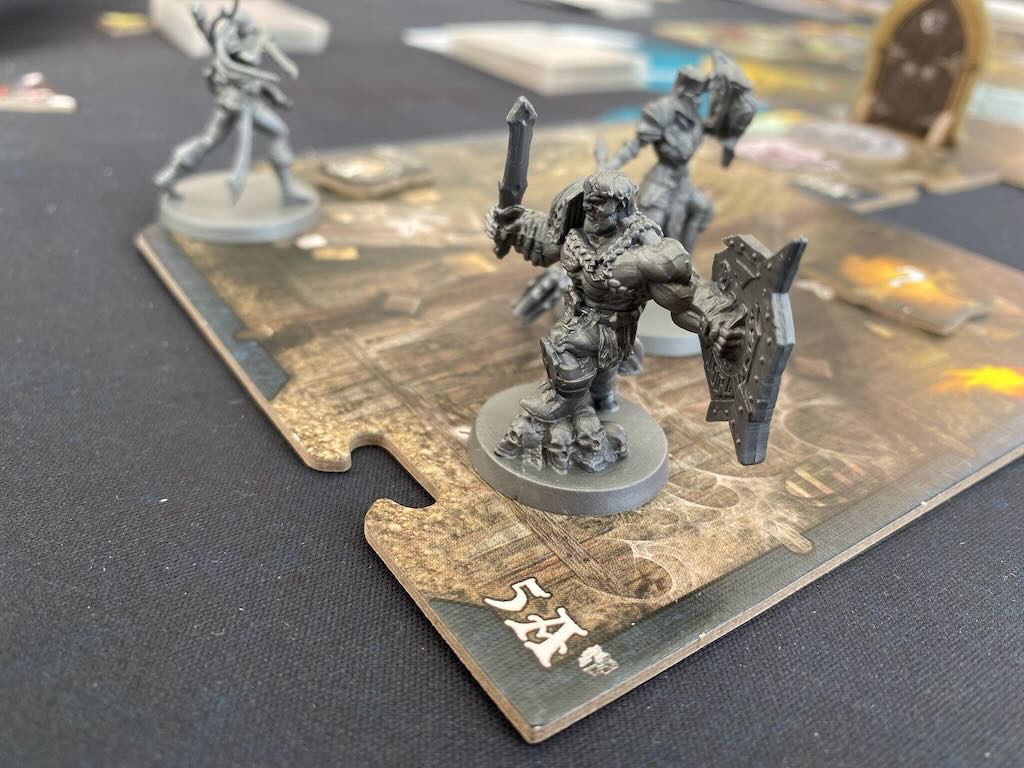
Ich spiele dann mal einen Barbaren.

Timo ist derweil wieder komplett auf dem Pen-and-Paper-Trip und ich kann den Wunsch gut nachvollziehen. Ich könnte eine ewige Debatte mit mir selbst führen, was so viel besser (und was so viel schlechter) beim Rollenspiel im Vergleich zum Brettspiel ist. Auf jeden Fall nährt der Wunsch nach einem guten Ersatz immer noch mein Herz. Gloomhaven habe ich ausgelassen, Frosthaven spiele ich dank Bill. Aber das epische Spiel ist eben wieder auch ein Commitment auf lange Zeit. Schließlich war es Timo, der Sword & Sorcery mit leuchtenden Kinderaugen an den Spieltisch angeschleppt hat. Und eines kann ich vorweg sagen, so viel Licht und Schatten, Freude und Leid hab ich lange nicht mehr bei nur einem Brettspiel erlebt.

Steckbrief

SpielSword & Sorcery: Die alten Chroniken
VerlagAsmodee (Ares Games)
Veröffentlichung2021
IdeeSimone Romano, Nunzio Surace
IllustrationMario Barbati, Fabrizio Fiorentino und weitere
Rating (BGG)8.3
Komplexität (BGG)4.31 (Expertenspiel)
SpielweiseKooperativ
MechanikenDungeon Crawler, Rollenspiel-like (Würfel, Charakter-Leveln,…)

Spielprinzip

Unsere Charaktere sind Geistergestalten und erwachen inmitten ihrer Welt ohne Erinnerung und ohne ihre besonderen Fähigkeiten. Später erfahren wir, dass wir einst große Krieger und Kriegerinnen waren und uns nichts so schnell aufhalten konnte. Nun als frisch geschlüpfte Ex-Geister können wir froh sein, dass wir passende Kleidung und Waffen unser eigen nennen dürfen. Mit den zusätzlichen Erweiterungen können wir darüber hinaus noch Freund- und Liebschaften untereinander auswürfeln. Rein regelmechanisch können wir uns dann besser unterstützen. Ansonsten spielt sich der Akt der Libido primär in den Gedanken der Mitspielenden ab, da dies auf nüchternes Würfelgeklappere reduziert wird.

Dungeon von oben. Jedes Setting ist komplett anders.

Die Hintergrundgeschichte weist auf eine böse Elfen-Königin hin, die das gesamte Unterreich in ihren Händen hält und das nötige Feingefühl im Umgang mit ihren Untergegeben (oder gar uns) vermissen lässt. Die ambitionierte Rettung der Unterwelt geht über elf Szenarien, von denen je nach Absprung nicht alle, aber mindestens neun gespielt werden.

Grundsätzlich bewegt sich die Gruppe über eine Landkarte in der Untergrundwelt von Abenteuer zu Abenteuer. Manchmal werden diese mit einem Besuch in einer Stadt unterbrochen. Hier lässt sich das eroberte Geld in Ausrüstung stecken, neues Geld erspielen, ein bisschen Hintergrundstory einsammeln oder auch einen Vorteil für das nächste Abenteuer erarbeiten. Die Städte lockern das Gemetzel etwas auf, fühlen sich für mich oft nach langweiligen Zeitfressern an. Das wäre in der Regel nicht so schlimm, wenn nicht schon ein Szenario mindestens drei Stunden Zeit in Anspruch nehmen würde. In unseren Szenarien haben wir meist über fünf Stunden gespielt. 5-Minute Dungeon ist das nicht gerade. Da ist dann eine eingeschobene Stadt nach einer so langen Partie oftmals ermüdend.

Aber der Reihe nach. Diese epische Spiel bedarf einer ausführlicheren Erläuterung. Beginnen wir also im …

… Dungeon

Würfel und Gruppen-Erfahrungspunkte.

Denn darum geht es in den Abenteuern. In einem Kampagnenheft wie es auch aus Frosthaven bekannt ist, beschreibt einen Startaufbau. Dazu werden meist nur ein paar der sehr schön illustrierten Plättchen auf den Tisch gelegt und ein zweiter Stapel zur Seite parat gelegt. In der Aufbauanleitung werden auch Monsterchips platziert. Die werden bei Sichtlinie umgedreht und zeigen an, wie viele und welche Art Monster erscheinen können. Aus einem eigens für das Abenteuer aufgebauten Monsterdeck werden diese dann gezogen. Durch die zufällig platzierten Monsterchips ist jedes Erleben immer wieder anders. Ähnlich verhält es sich mit Schatztokens und dazugehörigem Deck. Der vermeintliche Wiederspielwert bezieht sich dabei nicht nur auf ein theoretisches Irgendwann-spiele-ich-das-nochmal, sondern — und das ist gelungen — auch bereits bei einem gescheiterten Versuch. Das ist schon mal ein dicker Pluspunkt für S&S.

Werfen wir einen tieferen Blick in das Gewölbe. Die großen Dungeon-Plättchen kommen in der Regel nur bei einem bestimmten Abenteuer ins Spiel, da sie auf das Szenario angepasst illustriert sind. Es gibt also nicht wie in anderen Vertretern einen dichten Einheitsbrei und viel Phantasie, dass ein See auch ein Eismeer sein könnte. Die kleineren Teile sind oftmals Lückenteile. In den Szenarien geht es dabei recht kreativ zu. So muss beispielsweise auch mal eine Brücke zwischen den Plättchen durch eine kleine Quest „gebaut“ (aka freigespielt) werden oder es kann ein optionaler Geheimgang entdeckt werden, der eine Abkürzung mit anderen Platten gebaut ergibt.

Sword & Sorcery kommt komplett ohne App aus. Die Abenteuer sind trotzdem sehr unterschiedlich und abwechslungsreich im Aufbau. Übrigens lassen sich alle Quests auch ohne Kampagne spielen. Dafür gibt es immer eine kleine Anleitung, welche Gegenstände oder Fähigkeiten die Gruppe haben sollte.

Helden und Steigerung

Apropos Gruppe. Neben dem Dungeon sind die Charaktere natürlich das Zweitwichtigste. In der Grundbox Die antiken Chroniken sind vier Charaktere dabei, die zusammen eine klassische Party bilden. Wir haben die meisten Szenarien zu dritt bestritten und bestanden aus so etwas wie ein Krieger, Klerikerin und Waldläuferin. Spannend ist noch, dass sich die gesamte Gruppe für eine Gesinnung, wie aus Dungeons & Dragons bekannt, einigen muss. Die Gesinnung sorgt nicht nur für unterschiedliche Charakterentwicklung, Nutzbarkeit von Gegenständen und Ausgangsfähigkeiten, sondern einige Entscheidungen und Abläufe in den Szenarien sind abhängig von der Gesinnung. Manchmal ist dadurch der Weg vorgeben oder es wird anstrengender mit einer bestimmten Gesinnung. Wir haben die chaotische Truppe genommen. Bei einigen Entscheidungen oder Prüfungen, waren wir am Überlegen, ob das eine gute Idee für den Start war.

Heldenhaftes Tableau. Links Ausrüstung. Rechts Effekte, die sich mit der Zeit wieder aktivieren.

Innerhalb der Kämpfe gibt es Seelenränge, die wir als Gruppe bekommen. Diese lassen sich ausgeben, um bei einzelnen Charakteren einen Stufenanstieg durchzuführen. Der wird dann auch sofort ausgelöst, was manchmal auch bitter nötig ist. Beim Stufenanstieg werden Charakter-individuell die Lebenspunkte, Anzahl Aktionen und möglicherweise Anzahl an Talenten und Fähigkeiten freigeschaltet. Die beiden zuletzt genannten Verbesserungen werden wieder durch Karten symbolisiert, die ab dann genutzt werden können. Während die Talente aus einem gemeinsamen Pool stammen, sind die Fähigkeiten abhängig von der Klasse und der gewählten Gesinnung. Mein chaotischer Krieger entwickelte sich immer mehr zum wahren Monsterschreck, der bei etwas Würfelglück die Wände mit einem Angriff rot einfärben konnte.

Der Charaktertod ist Teil unserer Geistergeschichte. Wir sterben nicht, sondern werden als Geister wieder-„geboren“ und müssen zu einem Altar im Dungeon, um wieder unsere irdische Hülle anzunehmen. Dabei verlieren wir allerdings eine Charakterstufe. Ja, richtig gelesen. Eine ganze Charakterstufe. In dem Grundspiel kann man sich nur bis Stufe vier hocharbeiten und in einem Abenteuer bin ich drei mal hintereinander gestorben. Da kommt Frust auf. Wir waren uns nicht ganz sicher, ob wir taktisch schlecht gespielt hatten, Fortuna zu oft Pause gemacht hat oder die Level wirklich Bein hart sind. Gegen Ende unseres Ausflugs in die Unterwelt haben wir dann einmal handgewedelt, dass wir keine Stufen verlieren (offizielle Regel zur Erleichterung). Da war dann mein Charakter so stark, dass ich überall die Wände mit dem Blut der Monster bestrichen habe.

Monster

Monster!

Fast enttäuschend wenig unterschiedliche Figuren sind in der Box enthalten und bereits nach wenigen Abenteuern hat man alle mal auf der Spielfläche gehabt. Aber die haben es trotzdem in sich. Zum Monster mit seinem ganzen Areal an Spezialeigenschaften können noch zusätzliche Karten gezogen werden, die dann noch mal die extra Würze in der blutroten Sauce werden. Es machte auch Spaß, dass man bei steigender Kampagnenerfahrung die Monster von ihren Grundangriffen her immer besser kannte und schon klar war, welches als erstes angegriffen wird.

Die Monster kommen mit einer eigenen Spielkarte, die die Regeln erläutert. Daher die Regel, dass die Person, die ein Monster aufdeckt oder als erstes sieht, die Karte bekommt und nun das Monster zu verwalten hat. Das ist eine sehr ratsame Regel, da es viele Effekte und Dinge zu berücksichtigen gibt.

Mehr Monster! Verschiedene Farben, verschiedene Stufen.

Wer auf so eine Art von Management überhaupt nicht steht, hat es schwer bei S&S. Für die Rollenspielenden unter uns werden die Monster deutlich vielschichtiger als bei stumpferen Umsetzungen. Auch wenn ich mittlerweile deutlich tiefer in Frosthaven eingetaucht bin, ist die Monstertiefe bei S&S deutlich höher.

Story

Zu Beginn ist die Story noch etwas konfus. Liegt vielleicht auch an der Genre-untypischen Verdrehung, dass die Elfen mal nicht die Lieben sind. Die Story ist grundsätzlich gut, ist aber stereotypisch in Gut und Böse unterteilt. Was ich persönlich gut fand, dass der aktuelle Fortschritt in der Geschichte sich in den Missionen widerspiegelt. So hatten wir Mission, wo wir einem Nicht-Spielercharakter Begleitschutz gebend, mal Gegenstände durch den Dungeon schleppen, während wir angegriffen waren.

Leider ist auch die eigentliche Story der Helden und Heldinnen eher unrepräsentiert. Wir erwachen als Geister und waren früher einmal krasse Charaktere? Warum ist das so? Was war die Hintergrundgeschichte vom Krieger? Warum konnten wir zu Geistern werden? Es wird zwar aufgelöst, aber da wäre meiner Meinung mehr drin gewesen.

Bewertung

Sword & Sorcery ist ein wahres Heavy Metal Rockfestival. Fantasy-Gemetzel in bester D&D Manier. Unsere Charaktere sind stereotypische Archetypen, die einzelnen Abenteuer in ihrer Länge nicht hinter einer Rollenspiel-Session verstecken. Fluch und Segen zu gleich. Innerhalb eines Abenteuers gibt es keine Speicheroption. Dafür sind die Abenteuer sehr unterschiedlich in ihrer Missionsvielfalt gestaltet. Selbst ein reines Überlebensszenario kann auf einmal spannend werden, wenn man in einer Arena landet und plötzlich vor der Wahl steht einen NSC vor dem tobenden Publikum zu töten oder zu verschonen. Für genügend Twists wird gesorgt.

Wir sind eingesperrt (beziehungsweise ausgesperrt).

Genauso abwechslungsreich sind auch die Dungeonaufbauten. Das liegt insbesondere an dem fast verschwenderischen Gebrauch der Dungeon-Platten. Gerade die großen sind nur für ein besonderes Abenteuer gedacht. Durch die stimmige Illustration kommt tolle Stimmung auf.

Wo Schwert ist, ist auch Zauber würde mein Krieger sagen. Oder allgemeiner formuliert wo Licht ist, ist auch Schatten. Der Charaktertod und erneute Wiedergeburt als Geist ist Teil des Spielkonzeptes. Leider verliert der Charakter dadurch eine Stufe — mit allen Konsequenzen. Dadurch wird es leichter gleich wieder zu sterben. Wer möchte, kann dies zumindest mit einer offiziellen Regelerleichterung umgehen. Tatsächlich hat diese Erfahrung das Spiel für uns unterschiedlich getrübt. Dem einen hat die Herausforderung gefallen und es als Ansporn für bessere Taktik und Zusammenarbeit gesehen, während es auf der anderen Seite des Spieltisches zu traurigem Kopfschütteln geführt hat.

Ferner ist es genauso unbefriedigend, dass man in einem Abenteuer reichlich Geld gescheffelt hat und damit ein Rüstung oder Waffe aufbessern kann. Leider gilt dies nur für ein Abenteuer. Gewöhnt euch also nicht allzu lange an den Glanz der neuen Rüstung. Rüstungen ist ein gutes Stichwort: gute Rüstungen geben mehr Verteidigungswürfel. In der Praxis hilft es kaum, um kleinen Schaden zu verhindern. Man darf nämlich nie alle Würfel würfeln, sondern gegen jeden potentiellen Schaden immer nur einen. Damit gibt es kaum Gelegenheit das Würfelglück mit mehr Würfel auszugleichen. Viele kleine Gegner mit mehr Schaden sind damit oft tödlicher als nur ein einzelner großer Mob.

Am Ende muss dann noch die Spielzeit eines Szenarios betrachtet werden. Durch das taktische Stellungsspiel, viel Symbolik und den Spezialfähigkeiten der Monster dauert ein Szenario einfach lang. Die erprobten Rollenspielenden lächeln nur Müde bei Spielzeiten von vier Stunden plus und hocken das nach Feierabend bis ein Uhr morgens locker ab. Die Brettspielenden überlegen sich dafür ein Wochenende in weiter Ferne einzuplanen.

Am Ende bleiben bei mir zwei silberne Schwerter übrig. Wer für Dungeons im wahrsten Sinne des Wortes gern durch die Hölle … äh… Höhlen … geht, lange Spielzeiten kein Abbruch darstellen und darüber hinaus auch mit dem Heldentot zu leben gelernt hat (okay der war schlecht), findet in Sword & Sorcery einen neuen Endboss.

Ich freue mich schon, wenn wir es in auf dem Teburu-Brett noch ein weiteres Mal antesten werden.


(c) Copyright Asmodee
Grafik(en) und Bild(er) von Horst Brückner

Diese Rezension ist unentgeltlich durchgeführt worden und spiegelt meine persönliche Meinung wider.


Bildergalerie

The Woman’s Hour / Votes for Women (Book & Game, #5)

08. März 2026 um 18:15

It’s Women’s Day! A great opportunity to look pair a book and a game on the American women’s suffrage struggle: The Woman’s Hour (Elaine Weiss) and Votes for Women (Tory Brown, Fort Circle).

Check out my previous Book & Game posts here:

Eastern Front: Russia’s War and No Retreat! The Russian Front

Reformation Era: Four Princes and Here I Stand

The Second Hundred Years’ War: The Rise of the Great Powers 1648—1815 and Imperial Struggle

Prussia in the Seven Years’ War: Frederick the Great. A Military Life and Friedrich

The Book & Game

The Woman’s Hour was published in 2018 by Viking Press. It focuses on the campaigns for and against Tennessee to ratify the 19th Amendment which enshrined women’s suffrage in the US constitution – as the 36th, and decisive, state to do so.

Votes for Women was published in 2022. It is Tory Brown’s first published board game. The card-driven game can be played in a solo or cooperative mode with the player(s) representing the American suffrage movement from 1848 to 1920 against an automated opposition, or with two to four players facing off against each other (half of them for, the other against women’s suffrage). In either case, the suffrage players must win 36 states (either by shoring them up decisively during the game, or in the final vote on ratification of the federal amendment) to win.

Connections & Conclusions

At first look, book and game seem to have very different scopes. After all, Votes for Women sets in with the Seneca Falls Convention (at which women’s suffrage was first voiced as a political demand in the United States) in 1848 and covers the following 72 years, whereas The Woman’s Hour begins with the arrival of activists Carrie Chapman Catt, Sue White, and Josephine Pearson at the Nashville station in the sweltering summer of 1920. Yet as the narrative progresses, background stories are woven into the tapestry – on the context of the 1920 presidential election, suffragists’ previous efforts to gain voting rights for women in the states and to lobby for a federal amendment, the women’s suffrage movement’s relationship with abolitionism, and all the way back to Seneca Falls (and a little bit of Abigail Adams’s “Remember the Ladies”). If you have played Votes for Women, you will recognize many of the people and events on the cards from the early and middle periods of the game when reading The Woman’s Hour.

The Seneca Falls Convention is the Start card for the suffragist player with which any game of Votes for Women kicks off, following the tradition laid out by protagonist Elizabeth Cady Stanton that this was the starting point of the American women’s suffrage movement.

What unites book and game is their focus on procedural politics. Historical change does not simply happen, nor is momentarily decided upon. Instead, it is brought into effect by the “strong, slow drilling into hardwood boards with passion as well as sound judgment” (Max Weber). The drills used come in both cases from the toolbox of political activism:

The Woman’s Hour details how suffragists (suffs) and anti-suffragists (antis) lobbied the Tennessee lawmakers, how they organized in associations and clubs to channel their activists’ time, funds, and energy, and, of course, how they campaigned for public opinion to win the hearts and minds of the American people with newspaper articles, public speeches, great processions, and all kinds of civil disobedience.

Votes for Women makes these the three actions from which the players choose on a given turn: Lobbying (for and against the 19th Amendment in Congress), organizing (to gain the crucial buttons which are the currency for some powerful in-game effects and die re-rolls), and campaigning (which spreads influence cubes and thus eventually decides if enough states come out in favor of ratification of the 19th Amendment or not).

Early in the game: There are still a lot of orange Opposition cubes, but the women’s suffrage movement has made some inroads (yellow and purple cubes). The large round buttons represent the movement’s organizational strength, the white columns (one already placed on the track under the picture of the Capitol) the willingness of Congress to pass the women’s suffrage amendment.

As we’ve mentioned civil disobedience already: The women’s suffrage movement was no monolithic bloc. One of the great dividing lines was that of styles: The more conventional part of the movement, organized in the late 19th and early 20th century in the National American Women’s Suffrage Association (NAWSA) led by Carrie Chapman Catt, paid close attention to appear as respectable as possible (knowing full well that their demand for equal suffrage was enough of a provocation to the male public opinion of the time). Others adopted a more radical style, inspired by the British suffragettes: The Women’s Party, led by Alice Paul (and represented in Tennessee by Sue White) referred to the president as “Kaiser Wilson” in reference to the German war enemy, burned him in effigy, and (successfully) provoked the police into arresting activists over minor infractions. The dainty young women and respectable matrons who served some prison time then embodied the injustice of depriving women of their vote.

The Woman’s Hour details these fractions within the movement, as NAWSA and the Women’s Party led entirely separate campaigns for Tennessee’s ratification of the 19th Amendment. While infighting was avoided, the reader is left to wonder if the movement could have been more effective if not for these parallel structures – or if the split between a more moderate and a more radical wing was able to compel a broader spectrum of audiences by working in parallel.

Votes for Women depicts the multifaceted character of the women’s suffrage movement by splitting the suffragist player into campaigner figures and influence of cubes of two colors (yellow/gold, the traditional color of the American women’s suffrage movement, and purple, a color which Alice Paul had coopted from the British suffrage movement). As several Opposition event cards target the highest concentration of one or the other color, the Suffragist player is well-advised to aim for an even spread of colors in the individual states.

The pluralism of the women’s suffrage movement is exemplified by the two colors… and a plethora of Opposition events which target only one or the other.

Votes for Women also tackles another split in the women’s suffrage movement which is outside the scope of The Woman’s Hour – that on strategy. After the initial push for women’s suffrage as a part of a great campaign for equal suffrage regardless of sex and race had failed in the aftermath of the Civil War, the suffragists disagreed on how to proceed: Some pushed for a federal amendment to the Constitution (like the 15th Amendment had codified the voting rights of black men), others wanted to win voting rights in the individual states first. While the struggle for women’s voting rights was eventually won with the ratification of the 19th Amendment in Tennessee, the voting rights advances in the individual states had laid the groundwork: Wyoming had established women’s suffrage as early as 1869, Montana sent Jeannette Rankin as the first woman to Capitol Hill, and by 1917, women in 19 states – mostly in the West and Midwest – had won the right to vote (sometimes only in a limited fashion, like voting in local elections).

Votes for Women’s stance is that it needs both – after all, the game is lost for the suffragist player if their lobbying fails to get the federal amendment through Congress, but to win, they need the strength amassed in dozens of local campaigns to have the amendment ratified in enough states. The game, however, makes a statement about timing: While it is possible for the suffragist to have Congress pass the 19th Amendment in the mid-game already, that is a decidedly risky strategy which gives the Opposition a lot of opportunity to snatch individual states and rack up the necessary 13 rejections which mean the failure of the amendment. The ideal move for the suffragist is to build up the strength in the states as much as possible before pushing Congress into action as late as possible. While that is not without its risks (Opposition can still try to throw wrenches in the wheels of congressional action), it spreads them more evenly between federal and local action.

As mentioned above, equal suffrage spread from the American West and Midwest. It had a much harder time in the Northeast and in southern states – like Tennessee. The southern states were not only more conservative in general, suffragists also faced specific obstacles there: Many southern whites remained committed to the cause of white supremacy after the defeat of the Confederacy in the Civil War. Enfranchising women would give the right to vote to black as well as white women, and in the mind of the white supremacists, white women would be much less likely to actually exercise it (be it because they, as “proper” women, would rely on their men to represent them, or because they would not go to a polling station where they might meet with Black Americans). Others, while generally in favor of women’s suffrage, resented the method: After the Civil War, the 13th, 14th, and 15th Amendments had enshrined certain rights (including male voting) for Black Americans in the Constitution. Federal amendments were thus unpopular with many southern whites.

As The Woman’s Hour details, this provided for a lot of traction for the anti movement in Tennessee. Activists like Nina Pinckard and Josephine Pearson railed against carpet-bagging outsiders swooping down from the North to meddle with Tennessee’s affairs, warned of impending “negro domination”, and appealed to the chivalry of southern men to rescue their women from being thrown into the dirty cesspit of politics. That they themselves were knee-deep in that cesspit – after all, they were political activists! – bothered them as much as modern-day “tradwives” are bothered by the fact that their plea for women to be submissive to and dependent on their men is at odds with their often successful social media enterprises.

Somewhat counter-intuitively, many women opposed women’s suffrage on moral or political grounds. Votes for Women does a great job in showing the multi-facetedness of the anti movement beyond the male political and business establishment.

Inherent contradictions aside, the antis’ arguments needed to be countered by the suffs. Many of the white suffragists were willing to make rhetorical or substantial compromises: One of NAWSA’s most-cited statistics in the Tennessee campaign was that the number of white women in the south exceeded that of black men and women combined. Enfranchising women, so the more-or-less subtle subtext, would thus not threaten white supremacy – it might even strengthen it. In the end, the tacit agreement was like that found after the Reconstruction amendments designed to protect Black Americans’ rights in the South: The women’s suffrage amendment made its way into the constitution. Yet voting rights were overseen by the individual states, and federal institutions looked the other way about the blatant disenfranchisement of black voters in the South until the Voting Rights Act almost half a century later.

Neither The Woman’s Hour nor Votes for Women shies away from this uncomfortable part of the women’s suffrage movement: The protagonists of the movement are not portrayed as infallible saints in the book. While they held wildly progressive views for their time on women’s suffrage, their stances on issues of race and class were often more in keeping with those of their contemporaries. They also made tactical mistakes, like Carrie Chapman Catt railing against outsiders trying to influence Tennessee – a charge that was immediately turned against her, a Northerner herself, and restricted her visibility for the remainder of the campaign. And most of them were willing to make compromises for the cause of women’s suffrage – sometimes with themselves (Carrie Chapman Catt supported the US effort in World War I against her pacifist convictions lest the women’s suffrage movement be branded unpatriotic), and sometimes at the expense of others. In short, they were human.

Would the 19th Amendment have passed in Tennessee if the suffragists had been less willing to assuage the fears of southern whites about “black domination”? – Probably not – maybe another state could have become the decisive 36th then, but all likely options had been exhausted before.  Did the Black Americans in the South, men and women, suffer from the continued disenfranchisement after 1920? – Undoubtedly.

The South is notoriously tough for the suffragists. Placing a ton of cubes there (plus some additional perks) is a tempting proposition.

Suffragist players in Votes for Women face the same strategic and ethical question (of course, with infinitely lower stakes): One of the most powerful cards in the game is The Southern Strategy which places an immense amount of suffragist influence in the South (representing the union between suffragists and white supremacists). It does open the suffragist for some counter-plays from the opposition, though. Savvy suffragist players might hold the card from turn to turn to play it as late as possible, as an uncounterable stratagem in the final struggle for women’s suffrage. Victories won that way have an odd aftertaste, I assure you.

Since Votes for Women has been released, it’s been in the top 5 of games I have played most often. And while I rarely re-read books, especially non-fiction (because there are always intriguing new books to read), I have come back to The Woman’s Hour and have now both read the physical book and listened to the (excellent) audiobook production. Besides all their worthy exploration and analysis of history, that speaks to both the game and the book being excellently crafted, incredibly engaging pinnacles of their respective medium.

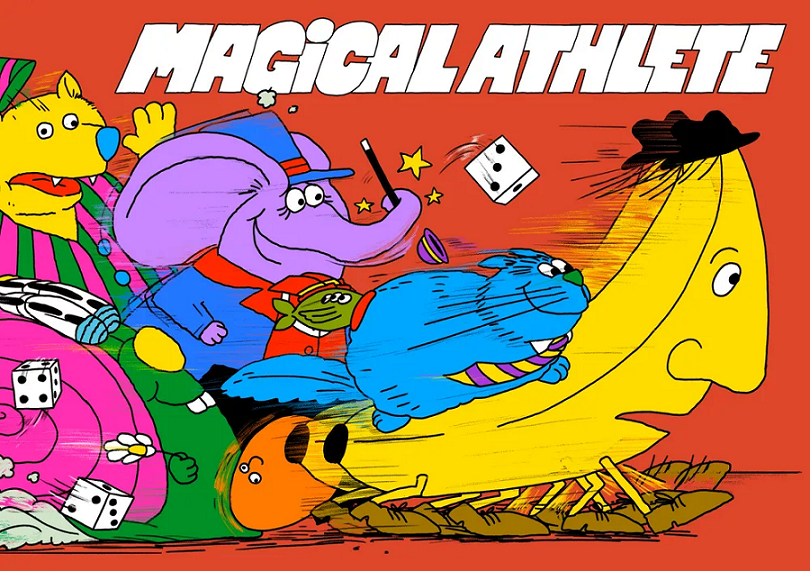
Going the Distance – A Magical Athlete Review

16. September 2025 um 15:00
Takashi Ishida’s Magical Athlete is a quirky game about a cast of misfits in a foot race. First released in 2003 by Z-Man Games, its oddball nature and prototype-level production resulted in a large shrug from audiences. It was the typical Tanga title, dumped on a deep discount website and banished to the shelves of…

Read more →

❌