❌

Normale Ansicht

La Patisserie Rococo

25. April 2026 um 08:00

Ein rauschendes Gartenfest bei bei König Ludwig dem XV? Es braucht nur noch die besten Patisserien aus Paris am Hofe damit dies zum Erfolg führen kann. Und wer wenn nicht du, sollte dies sein? Naja, vielleicht eine der anderen Mitspielenden.


Bei dem Spiel müsst ihr Rezepte, Rohstoffe und Zutaten erwerben, anschließend die Kuchen backen, optional dekorieren und ausliefern. Außerdem könnt ihr immer noch neues Personal einkaufen oder kündigen. Und zu guter Letzt noch eigene Servicekräfte und wohlgesonnene Adlige einschleusen. Das alles sind eigene Aktion. In den vier Runden habt ihr aber nur ungefähr fünf Aktionen … ach ja und zu wenig Geld (zumindest am Anfang).

Der Kaufreiz war für mich ganz klar die Erst-Erfahrung mit dem großen Ableger Rococo, wo wir noch die Ballsäale ausschmücken und insbesondere die Herrschaften in prächtige Gewänder stecken. Einziger Nachteil: das Spiel zieht sich ganz schön.

Was bleibt nun von der Welt aus Zucker und Marizpan übrig, wenn wir mal unter die dicke Glassur schauen?

Steckbrief

Spiel La Patisserie Rococo
Verlag Skellig Games (Eagle-Gryphon Games)
Veröffentlichung 2026
Idee Stefan Malz, Louis Malz
Illustration Fabrice Weiss
Rating (BGG) 7.2
Komplexität 3.20 (Kennerspiel)
Spielweise kompetitiv
Mechaniken Hand Management, Set Collection, Area Majority, Deck Building, Multi-Use Cards

Eindruck von der Bühne

Erstaunt bin ich immer noch von der Regelerklärung. In knapp 25 Minuten kann ich das Spiel erklären ohne große Nachfragen. Die Aktionen lassen sich logisch in einer guten Reihenfolge erläutern, so dass es dann auch schnell losgehen kann. Auch die Spielzeit hält sich für ein klassisches Kennerspiel im Zaun.

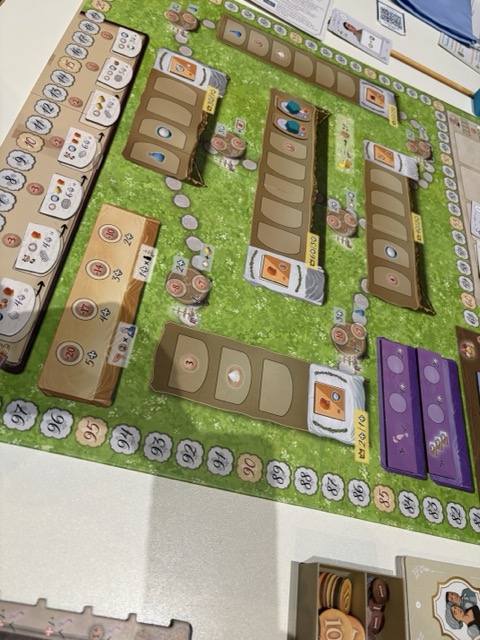
Klassik. Das ist leider auch das Artwork. Auf dem Tisch ausgebreitet bekommt weder das Spielbrett noch die lieblosen Karten der Aushilfen und Meister so richtig etwas fürs Auge geboten. Schade eigentlich, denn bekanntlich isst das Auge mit. Gerade im Vergleich zu Rococo (egal ob der klassischen oder bei Skellig Games erschiene Deluxe-Version) erinnert La Patisserie im Charme eher an alte Klassiker. Ich denke da an meine Lieblinge wie Auf den Spuren von Marco Polo oder Mombasa. Obwohl diese tatsächlich alle Facettenreicher in der Illustration sind. Ich kann nur vermuten, dass der Kaufpreis hier bewusst gerade im Vergleich zu dem Namensgebenden Haupttitel gering gehalten werden sollte.

Sowohl von der Spielmechanik und dem soliden Grübelfaktor lässt euch das Spiel keine Madelaines im Backofen verbrennen. Für mich kommt das Thema gut durch: Rezepte besorgen, mit Rohstoffen haushalten, Deckbuilding nicht vernachlässigen und Siegpunkte auf dem Spieltableau vor den Mitspielenden blockieren respektive sichern. Alles für die Gunst am Hofe aka Siegpunkte am Ende. Der Aufbau gibt mehr als ausreichende Variabilität, um jede Partie abwechslungsreich zu gestalten.

Meine Erfahrung mit dem Erstling ist bereits einige Backzyklen her, aber ich habe es grübliger und mit mehr Downtime in Erinnerung.


Groupie auf Tour

Letzter Blick aufs Rezeptbuch! La Patisserie ist mehr als ein gehobenes Familienspiel oder ein leichtes Kennerspiel: damit für mich ein perfektes Gateway-Spiel. Also ein Spiel, um Familienspielende in den nächsten Schritt der komplexeren Spiele einzuführen.

Es ist leicht zu lernen und bedarf Übung, um es zu meistern. Mangel an allem ist die Regel. Wer also partout nicht damit leben kann, dass nicht jede Aktion in einer Runde gespielt werden kann oder den Mangel an Ressourcen mit ewiger Grübelei verbringt, sollte die Finger aus dem Mehlsack ziehen.

Am Ende ist klar: wenn ihr Rococo bereits besitzt und es oft genug auf den Tisch kommt, bleibt lieber beim Nähen. Solltet ihr aufgrund des Kaufpreises immer einen Bogen um die Nähmaschine gemacht haben, ist das nun die Chance einen fluffigen Ableger mit gleicher Spielmechanik in die Backstube zu bekommen.

Persönlich bereue ich es primär aufgrund des Artworks nicht den Haupttitel gekauft zu haben, sondern die preiswertere Backvariante. Nichtsdestotrotz ist es ein tolles Spiel. Da ich es nun schon habe, werde ich es behalten. Einige Runden sind schon gespielt und die Mechanik überzeugt mich immer wieder. Würde Rococo aktuell einen goldenen Rock-Meeple bekommen, vergibt das verwöhnte Brettspielauge bei La Patisserie im Ersteindruck den silbernen Rock-Meeple. Die Reise geht weiter. Ups, ich muss schnell ein paar Küchlein ausliefern gehen …

Björns Meinung

Ich mag das Thema sehr gern, und deshalb hatte ich schon Bock, das Spiel auszuprobieren, als Horst es mitgebracht hatte. Die gesamte optische Präsentation ist wirklich alles andere als eine gute Konditortorte, aber Euros müssen ja nicht schön aussehen, um Spaß zu machen. Insgesamt fand ich es nach einer Partie aber zu seicht für meinen Geschmack. Für ein Einsteiger-Euro ist es etwas zu fizzelig und für ein Kenner-Euro geht es nicht tief genug. Es schwebt so ein wenig dazwischen und findet sicher auch die passende Zielgruppe, denn ein schlechtes Spiel ist es auf keinen Fall. Mit einer besseren Präsentation hätte man sicher auch größeres Interesse wecken können. Vor allem finde ich dadurch 75 € als UVP etwas hochgegriffen. Für mich verdient das Spiel ebenfalls einen silbernen Rock-Meeple.


Bills Meinung

Ich muss es gleich am Anfang zugeben, das Spiel hat mich wie sein großer Bruder Rococo thematisch einfach kalt gelassen. Das allein muss ja nichts bedeuten, gerade in der jüngeren Vergangenheit durfte ich mit einigem Wohlgefallen einige Titel spielen, die mich trotz vorher uninteressant wirkendem Thema vollends überzeugt haben und nun sogar mit Neugierde auf den bis dahin unbeliebte Inhalt blicken lassen. Dennoch beginnt so ein Titel auf diese Weise natürlich nicht gerade mit dem besten Start. Als es nun tatsächlich auf den Tisch kam habe ich vor allem wegen der geliebten Mitspieler die es gerne ausprobieren wollten nichts dagegen gehabt.

Wie Björn schon sagt muss ein Euro-Game nicht mit Schönheit glänzen und Patisserie Rococo versucht augenscheinlich auch eher vor allem mit einer guten Mechanik als mit einem schönen Bühnenbild zu überzeugen. Da mir persönlich aber neben gut vernetzten Gameplay auch Optik und Thematik wichtig sind, konnte es keinen Blumenstrauß gewinnen. Versteht das bitte nicht falsch, es ist kein schlechtes Spiel das sicher viele Menschen glücklich machen wird, nur leider bin ich niemand davon. Es wird daher keinen Weg in mein Regal finden aber mitspielen würde ich es sicherlich, selbst wenn ich versuchen würde vorher die eine oder andere Option in den Raum zu werfen. Daher verdient es von mir, wenn überhaupt, einen bronzenen Meeple.

Konzertmitschnitte


(c) Copyright Skellig Games

Bannerhintergrund von mareneinfeldt (über Pixabay)

Grafik(en) und Bild(er) von Horst Brückner

Das Spiel habe ich privat erstanden. Diese Rezension ist unentgeltlich durchgeführt worden und spiegelt meine persönliche Meinung wider.
BGB Podcast #355 – Anticipation Auction: Games of 2026

26. Februar 2026 um 11:41


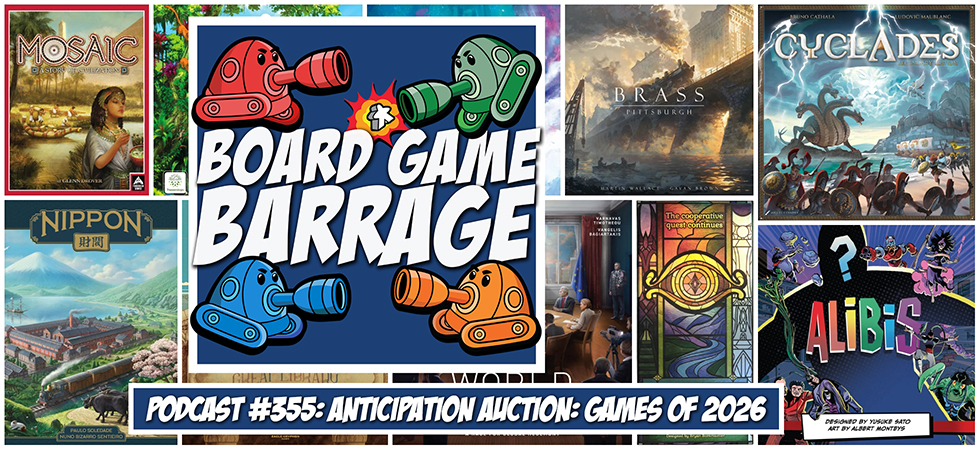
I think it’s fair to say that we crushed this last year (although some of us better than others), so it’s only correct and right that we should return to do it again. What are the best games of 2026 going to be? Well, only we know, but we’re willing to part with that information. Get your fat stacks ready. Before we set ourselves up for failure, we talk about Alibis, Mosaic: A Story of Civilization, and Cyclades: Legendary Edition.

Please submit your favourite games for our Listener Top 20!

If you don’t want to miss an episode, please subscribe on Apple Podcasts/Google Podcasts/Stitcher/Spotify, or add our RSS feed to your favourite app. Reviews and subscriptions really help us and would be greatly appreciated! To download the episode directly, click here.

If you’d like to discuss anything in the episode, please do so in the comments below, visit our BoardGameGeek guild, join our Discord, or Facebook Group! Any feedback is also always helpful. If you’d like to show your support for the show, we also have a Patreon with some fun rewards, and a merch store!

Timecodes:

03:02 – Alibis
09:18 – Mosaic: A Story of Civilization
23:25 – Cyclades: Legendary Edition
36:27 – Anticipation Auction 2026
41:18 – The Game Makers
44:25 – Cozy Stickerville
46:39 – Brass: Pittsburgh
50:35 – The Lord of the Rings: The Two Towers – Trick-taking Game
54:04 – Revenant
56:21 – World Order
59:31 – Dark Pact
1:02:28 – The Great Library
1:03:56 – Spirited
1:05:25 – Realm of Reckoning
1:08:55 – Avalon: The Riven Veil
1:12:57 – La Pâtisserie Rococo
1:14:24 – Nippon: Zaibatsu
1:17:24 – Rewild: South America
1:18:44 – Movers & Shakers

Thank you to Heart Society for generously letting us use What’s On Your Mind, Kid? from their album Wake the Queens.

The post BGB Podcast #355 – Anticipation Auction: Games of 2026 appeared first on Board Game Barrage.

Immersive Imperial Struggle Playlist (Board Game Playlists, #2)

25. Januar 2026 um 16:46

You love board games. You probably also like music. Let’s combine the two into an immersive playlist for Imperial Struggle (Ananda Gupta/Jason Matthews, GMT Games). Have it gently play in the background during your next session of Imperial Struggle for the full period immersion!

First things first: Here’s the playlist!

Before we dive into the content of the playlist, some general observations:

  • Of course, there was no music recording in age of Imperial Struggle, so all the songs in the playlist have been recorded in the 20th or 21st century.
  • The playlist is only 1:45 hours long, so you might need to listen to it several times during your game… unless France stomps over Britain in the first turns.
  • The playlist is thematically sorted. That helps you find similar songs, but makes for somewhat monotonous listening (until you come to the next group of songs). I therefore recommend you turn shuffle on.

Now, what awaits you in the playlist?

#1-3: Religious (classical) music

Imperial Struggle begins after the age of the great confessional wars in Europe, but religion still played an important role in people’s lives, from the lowliest peasants all the way up to kings. Their week culminated in a Sunday service and their year was interspersed with religious events. Composers wrote pieces specifically for a religious holiday (like Bach’s “Christmas Oratorio” from which #2 is taken), or were dedicated to comprehensive religious teaching (like Händel’s “Messiah”, premiering on Easter 1742 in Dublin, from which #3 is taken).

#4-12: Secular (classical) music

The Baroque saw music as universal. Religious and secular followed the same conventions, and thus the same composers wrote pieces for the church and for worldly courts, like Baroque grandmaster Johann Sebastian Bach (Toccata and Fugue in D minor, #4 and Cello Suite No. 1 in G Major, #6) or Georg Friedrich Händel (Sarabande from Suite No. 11, #5). The classical (in the narrower sense) music from the mid-18th century on left this universal view behind. Composers now focused on either one or the other, with most of them following the more fashionable and more lucrative secular path.

Some composed for a court whose lavish entertainments always required music (like the 1773 wedding of the French prince Charles Philippe, the later king Charles X, for which François Francœur arranged the music from which #9 is taken – thus the title Symphonie du Festin Royal (Symphony of the Royal Feast)). Others became freelance musicians (like Mozart, who could (for some years) live of the proceeds of his concerts and operas, #10-12).

#13-16: Folk songs

Not everyone went to a church where the latest compositions were played on Sundays, and of course most people were far removed from attending any court festivities, let alone royal weddings. But people made and listened to music. The easiest, most affordable way to do so was to sing. The 18th century is rich with folk songs, some originally written at the time (like Frère Jacques (“Brother James”), #15 or “Ye Jacobites by Name”, #16), others older, but first put down to paper at the time (Au Claire De La Lune (“By the Light of the Moon”, #13, and Over the Hills, and Far Away (#14)).

#17-23: Patriotic songs

We’ve heard in #16 already how political events seeped into popular songs. Others were written specifically to rouse patriotic feeling, an emotion which came into its own in the 18th century: “Rule, Britannia” (#17) expressed confidence and pride in the Royal Navy to protect British freedoms, “The British Grenadiers” (#18) praised the courage of their counterpart by land.

That these songs could be re-interpreted and turned against their original intent shows “Free America” (#19), written in 1770, which uses the same tune as “The British Grenadiers”, but its lyrics extol America’s freedom (which turned out to be freedom from Britain).

Finally, national anthems also came first into existence in the 18th century: Brits sang “God Save the King/Queen” (#22 – I took the liberty of choosing a not-quite-traditional version). France only got its first anthem (La Marseillaise, #23) with the French Revolution which bookends Imperial Struggle… at least until Ananda Gupta and Jason Matthews get around to do a Revolutionary and Napoleonic Wars expansion!

Thanks to Jason for suggesting songs #5, #14, and #21!

If you like immersive playlists, I’ve done one for Weimar: The Fight for Democracy (Matthias Cramer, Capstone Games/Skellig Games/Spielworxx)!

If you want to dive a bit deeper into the times of Imperial Struggle, here’s a book recommendation.

And if you’re looking for strategic direction in Imperial Struggle, I’ve also got you covered.

What’s your favorite song from this playlist? Let me know in the comments!

❌