Thanks to SD Toys for providing a review copy of this game.
It’s been a little while since I’ve gotten a review copy of a game – part of that is by design, it’s been really nice taking a break and not feeling the pressure of needing to write something up. But I’m still planning to do occasional reviews when someone reaches out to me, so here we go with
image by BGG user WordSnap
WordSnap is a 1-4 player word game published by SD Toys. It consists of 100 flexible, interlocking letter tiles in an octagonal tin. To set up the game, you just mix the tiles up face down, then each player draws eight. Players draw a tile and reveal, with the one closest to Z going first.
If you’ve ever played Scrabble, you know how this game plays – on your turn, you play a word of at least two letters and score the points listed on the letters. The first player plays in the middle of the playing surface, and all subsequent words have to build off something already out on the table. Because of the design of the tiles, you can build words horizontally, vertically, or diagonally. Once you’ve played, you draw back up to eight tiles. You can always opt to use your turn to discard some tiles and redraw. Once all tiles have been drawn and someone is out, or if no more words are possible, the game is over. Players deduct tiles in their hand from their final score, and the player with the most points wins.
WordSnap is a very standard word game, and has a lot of similarities to Scrabble. And so, I’m going to frame this review by looking at what distinguishes it from that classic.
Scrabble has a board, WordSnap does not. Scrabble has a 15×15 board, which gives you 225 possible places to put words. That seems like a lot, but it can quickly get crowded when words get to the edge. WordSnap is only limited by the size of your table, and it will sprawl. The tiles are much bigger as well, so space can definitely be an issue. Still, I think the boardless nature of WordSnap is a good thing. Plus, it means you can build words diagonally, which is fun.
Scrabble pieces are subject to scattering, WordSnap pieces are not. If you bump the table while Scrabble is possible, it’s very likely that the pieces are going everywhere. Unless you have a board with an overlay to keep the tiles in place, and even then, a good knock would still mess things up. WordSnap has interlocking pieces, so that will never be a problem.
Scrabble games can be very long. So can WordSnap, though there is a Speed Mode. As the board (playing space) gets more and more words in both games, it can be difficult to decide what the best play is. WordSnap does have a Speed mode, where you can use their app timer as a kind of chess clock to time your turns. For that matter, there’s also a solo mode that’s basically just trying to play out all the tiles as quickly as you can. So, there is a way to speed things up. I would imagine serious Scrabble players also have rules like these in place.
It’s worth noting that the WordSnap app is really just a timer. I wish it also had the capability to keep score.
Both games reward large vocabularies. If you’re good at finding big words, you’re going to be better at both games. Or, if you’re better at word games in general, you’re going to do well. If your opponent is only making 3-4 letter words, and you’re consistently finding 5-6 letter words, you’re going to be doing better.
Both games have a significant luck of the draw factor, though WordSnap might have a bit more of it. If you’re drawing nothing but vowels, you’re going to have problems in both games. Letter distribution is very similar in the two games, though Q and Z are the only ones in WordSnap where there’s only one letter. WordSnap also has four wild tiles as opposed to two in Scrabble, and these are also the double word scorers. With Scrabble, you know exactly where the multipliers are and can strategize around them. In WordSnap, you draw them, so that increases the luck of the draw factor.
IS IT BUZZWORTHY? There’s nothing really new here in terms of gameplay. If you’re not really a fan of Scrabble, or games of that ilk, there’s not much here that would convert you. However, I do think the construction of the pieces makes this a worthy alternative to Scrabble. So if you’re looking for something that isn’t Scrabble, I’d give this one a look.
Thanks again to SD Toys for providing a review copy of this game, and thanks to you for reading!
Thanks to SD Toys for providing a review copy of this game.
It’s been a little while since I’ve gotten a review copy of a game – part of that is by design, it’s been really nice taking a break and not feeling the pressure of needing to write something up. But I’m still planning to do occasional reviews when someone reaches out to me, so here we go with
image by BGG user WordSnap
WordSnap is a 1-4 player word game published by SD Toys. It consists of 100 flexible, interlocking letter tiles in an octagonal tin. To set up the game, you just mix the tiles up face down, then each player draws eight. Players draw a tile and reveal, with the one closest to Z going first.
If you’ve ever played Scrabble, you know how this game plays – on your turn, you play a word of at least two letters and score the points listed on the letters. The first player plays in the middle of the playing surface, and all subsequent words have to build off something already out on the table. Because of the design of the tiles, you can build words horizontally, vertically, or diagonally. Once you’ve played, you draw back up to eight tiles. You can always opt to use your turn to discard some tiles and redraw. Once all tiles have been drawn and someone is out, or if no more words are possible, the game is over. Players deduct tiles in their hand from their final score, and the player with the most points wins.
WordSnap is a very standard word game, and has a lot of similarities to Scrabble. And so, I’m going to frame this review by looking at what distinguishes it from that classic.
Scrabble has a board, WordSnap does not. Scrabble has a 15×15 board, which gives you 225 possible places to put words. That seems like a lot, but it can quickly get crowded when words get to the edge. WordSnap is only limited by the size of your table, and it will sprawl. The tiles are much bigger as well, so space can definitely be an issue. Still, I think the boardless nature of WordSnap is a good thing. Plus, it means you can build words diagonally, which is fun.
Scrabble pieces are subject to scattering, WordSnap pieces are not. If you bump the table while Scrabble is possible, it’s very likely that the pieces are going everywhere. Unless you have a board with an overlay to keep the tiles in place, and even then, a good knock would still mess things up. WordSnap has interlocking pieces, so that will never be a problem.
Scrabble games can be very long. So can WordSnap, though there is a Speed Mode. As the board (playing space) gets more and more words in both games, it can be difficult to decide what the best play is. WordSnap does have a Speed mode, where you can use their app timer as a kind of chess clock to time your turns. For that matter, there’s also a solo mode that’s basically just trying to play out all the tiles as quickly as you can. So, there is a way to speed things up. I would imagine serious Scrabble players also have rules like these in place.
It’s worth noting that the WordSnap app is really just a timer. I wish it also had the capability to keep score.
Both games reward large vocabularies. If you’re good at finding big words, you’re going to be better at both games. Or, if you’re better at word games in general, you’re going to do well. If your opponent is only making 3-4 letter words, and you’re consistently finding 5-6 letter words, you’re going to be doing better.
Both games have a significant luck of the draw factor, though WordSnap might have a bit more of it. If you’re drawing nothing but vowels, you’re going to have problems in both games. Letter distribution is very similar in the two games, though Q and Z are the only ones in WordSnap where there’s only one letter. WordSnap also has four wild tiles as opposed to two in Scrabble, and these are also the double word scorers. With Scrabble, you know exactly where the multipliers are and can strategize around them. In WordSnap, you draw them, so that increases the luck of the draw factor.
IS IT BUZZWORTHY? There’s nothing really new here in terms of gameplay. If you’re not really a fan of Scrabble, or games of that ilk, there’s not much here that would convert you. However, I do think the construction of the pieces makes this a worthy alternative to Scrabble. So if you’re looking for something that isn’t Scrabble, I’d give this one a look.
Thanks again to SD Toys for providing a review copy of this game, and thanks to you for reading!
This edition of Off the Shelf will look at small deck-building game that I first learned through an app. It’s called
image by BGG user KlydeFrog
Star Realms is a 2014 two-player game designed by Robert Dougherty and Darwin Kastle, published by Wise Wizard Games (originally White Wizard Games, but rebranded in 2021). Dougherty and Kastle are champion Magic: The Gathering players, and had a goal to make an affordable strategy game. Star Realms is a space combat game where players are building their fleet and trying to blow their opponent out of the sky.
As with most deck-builders, players begin the game with a starter deck. In this case, it consists of eight Scouts (with one purchase power each) and two Vipers (one attack each). Players also get 50 Authority, which is their health for the game. It can be tracked using cards in the game, or on a piece of paper. The trade deck, which consists of 80 cards is shuffled and five cards are laid out in a trade row players can buy from. Additionally, some Explorer cards are set to the side, which can be purchased for 2 and give 2 purchase power (plus 2 attack if you trash them). The start player draws three cards from their deck, and the second player draws five.
image by BGG user Ryalyn
On your turn, you can play all cards from your hand. Attack points go into an attack pool you can use against your opponent, while purchase points can go to buying new cards for your deck. Attack points can be split between any bases your opponent has in play and their Authority as you see fit. More on bases in a bit. When you purchase cards, they go directly into your discard, and you can buy as many as you want on a turn. Each card is immediately replaced on the trade row when you buy it.
Cards in this game come in four different factions: Trade Federation (blue), Blobs (green), Star Empire (yellow), and Machine Cult (red). If you play multiple cards of one faction, you often get a bonus – cards become stronger and do more damage, or give you more money, or let you draw cards, or give you other benefits. So it’s good to try to get cards from the same faction, but having cards from other factions is OK too. Some cards also have abilities that are triggered when you trash them from your deck. Then you don’t have the cards anymore, but you’ve got a powerful one-time blast of something to use.
Some of the cards are bases, and when played, they stay on the table. These can be attacked as normal, and each has its own defense. You have to completely destroy one for your attack to work, however – if you send three attack against a four defense base, it doesn’t do anything. Some bases are outposts, and these will absorb damage. In other words, you have to destroy them first before you destroy other bases or attack your opponents’ Authority. If you have attack left over after attacking one of these bases, it can be applied to another base, or even to the player themself (as long as they don’t have another outpost in the way).
When a player is done with their turn, they discard all cards played, all cards purchased, and any that might be left in their hand for whatever reason. Then, they draw a new hand of five and it’s their opponent’s turn. If there aren’t enough cards in their deck to draw five, they shuffle their discard and use that as the new deck. Play continues like this until one player has brought their opponent down to 0 Authority. They win.
image by BGG user Menaveth
I believe I got my copy of Star Realms for Christmas in 2014. I played the physical version a few times over the next few months, but I haven’t played the physical version since 2015. Most of my plays have come on the app, which I don’t count for play logs.
One of the best thing about Star Realms is its portability. It’s a whole game in a small package, just coming in a tuck box. It’s easy to carry around, and it’s just cards, so there’s nothing else to deal with. There are a good amount of cards in the box, and there are of course expansions if you just want more. I don’t have any of the expansions, but I might be interested in getting at least the ones that let me play solo sometime.
Gameplay is basic deck-building stuff. It deviates from the Dominion model in that you are allowed to play every card from your hand and buy as much as you want to. Also, it’s attack-based rather than VP-based, which makes more sense considering the theme here. But, other than that, you’re putting newly purchased cards into a discard pile, reshuffling that when your draw deck runs out, and trying to build synergies between the cards so you can do maximum damage.
The four suits of the game are really helpful in building combos, especially since a number of them have extra actions you can do if you play another card of that suit. And the suits all have general tendencies you can focus on. The Blobs are primarily focused on combat. The Star Empire is also combat-focused, and also have the benefit of making your opponent discard cards. The Trade Federation gives you money to spend. The Machine Cult helps you thin your deck. It’s likely that you won’t have a deck full of one of these types of cards, but it’s good to kind of focus on something so you have a better chance of triggering those extra abilities.
The Base mechanism in play here, where certain cards just stay out on the table, adds an interesting layer to the game. Especially because a lot of the bases act as shields, preventing the player’s main authority count from being attacked until they themselves are destroyed. Plus, these bases can be used to make combos, which makes them very strong and desirable to get out.
The game uses a trade row, which is another way it differs from Dominion – this is more like Ascension. It does lead to some luck of the draw – if you buy a card only to reveal something extremely good your opponent can snatch up on their turn, it can be frustrating. But, luck of the draw goes both ways.
Thematically, the game has a pretty good storyline behind it that I hardly ever think about. It’s red cards, blue cards, green cards, and yellow cards, and I’m just trying to hit my opponent as hard as I can while preventing them from hitting me. It’s a combat game, so you’re fighting, which never seems to bother me as much in a two-player game as with larger player counts – it doesn’t feel like you’re ganging up on someone, you’re just playing the game. And that’s fine.
I do like Star Realms a lot, and writing this up has me wanting to play it again. I’ve got it ranked #16 on my current Off the Shelf rankings out of the 46 games covered so far.
Before we look at this expansion, the first question is what does S.H.I.E.L.D. stand for? Well S.H.I.E.L.D. orginally stood for Supreme Headquarters, International Espionage and Law enforcement Division but after 1991 It stood for Strategic Hazard Intervention Espionage Logistics Directorate but in the MCU, some cartoons and the TV series it stands for Strategic Homeland Intervention, Enforcement and Logistics Division.
This Expansion comes with the super spy who is Nick Fury as well as Maria Hill who is the Director of S.H.I.E.L.D both are very powerful Allies and leaders. Nick Fury Alone is so sneaky it is worth trying out more crafty ways and see if you can undermine the enemy and win without them realising your antics.
In this multi-part scenario you are trying to rescue some Scientists who have been abducted and find the mole within S.H.I.E.L.D. The baddies begin with Black Widow and Belova but lead onto M.O.D.O.K. when you can rescue the scientists Then just as you think you are through and can return home for a rest you have to contend with the Thunderbolts, a team of Anti-Heroes led by Citizen V, whose abililties have a lot of interesting outcomes and are not just your regular minions but hard hitting villians in their own right.
The great thing is this box comes with six different modular sets featuign Thunderbolts you can use in this scenario giving this set excellent replayability. This also has the opening that future products may come with Elite Thunderbolt minions that can also qualify fdor this scenario giving more options. As for the final villian, the mole within the board, well you are just going to have to play the game to find out who that is.
This expansion will stretch your mind and make you think about how you will choose your heroes and how you will use them.Happy Gaming!
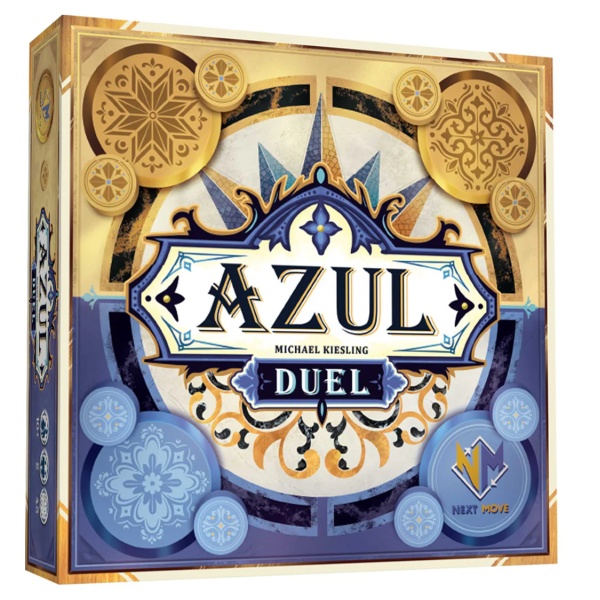
Usually when games bring out there two player version it is a more simplistic shorter version of the game. However, in this case it is a more complex version which while still being beautiful has more compexity and is a very clever game.
As well as the single tiles that you use in Azul there are packs of cards with four different tiles on each of them and when you draw one you place it on the board and then choose one from the four placed tiles, you take the choosen one and place it on the correct side of your player board and it is placed by you to gain the most points you can from the tile.
There are 75 acrlylic tiles, 2 player boards, 4 scoring markers, 4 player tokens, 20 bonus chips, 1 score board, 5 factories, 18 dome plates, 1 tower (easy to assemble) and 1 beautiful draw string bag for the acrylic tiles.
This is a great game and the complexity added just makes it that much greater and oh so much more playable as a game. I highly recomend this game if you enjoy a little more umph to your gameing experience.
From version 5.7 it is possible to create a QR code to share your play(s). Let friends* scan the code direct from your phone or send the image or link whichever way you like!
Creating a QR code for sharing play(s) works exactly like sharing play files, just choose the option “Share via QR code” instead.
After a weekend of lots of communication with our hosting provider Cloud services (Cloud sync and Score Sheet templates) are working again. If you encounter any problems please let us know!
As an apology for the extended outage and any inconvenience, we’ve added 14 days to all active Cloud sync subscriptions.
What went wrong?
On Friday March 28th in the afternoon (UTC) our Cloud services stopped working in the app. The services were up and running again at March 30, 22:53 UTC.
Our hosting provider placed our domain into protective mode, the most common cause for this is a DDoS attack. After adding extra preventative measures to our domain the protection was lifted, and all services resumed.
With these new measures we are working on making these services more resilient in the future.
When I heard that this game was coming out I worried that it was goimg to be too similar to Wingspan and Wyrmspan, However, I needn’t have worried. as it is enough like Wingspan to learn fast how to play it, yet the game is so different once you start to play it that It feels like it is it’s own game.
I felt that the game play was more straight forward and easier than Wingspan to play. yet with the complexity of the bonuses it has a complex intricacy and beauty all of it’s own. All who played the game there with me and there was five of us in total, we all thoroughly enjoyed our game and the feel of the of it was superb.
You have to put the fish at the correct depth (there are symbols on the cards) and as you place it it has a cost of either fish, eggs or young fish on it. Also your card gives a benefit which might be as you place the card, when it gets activated, (on a dive) or at the end of the game. You can choose to dive one of three columns and gain the benefits of them with any bonuses from any of the bonus fish placed in that column.
This is a really nice game that plays well. There are exquisite pictures of the fish and it comes with cardboard discs of eggs, young fish and of schools of fish, there is a pack of wooden tokens which can be gotten to upgrade your game components, this makes a wonderful improvement.
Amy and Dusty Droz join me to talk about how they’ve built an extremely profitable publishing business in a relatively short amount of time. We talk about tariffs, fulfillment, audience, budgeting, customer service, and a whole lot more!
In this episode, Jamey Stegmaier and I chat about the various trends we’re seeing in the current game design landscape. We talk about solo and 2-player games, open worlds, licensed IPs, and more!
In this episode, I chat with Andrew Lowen, from Crowdfunding Nerds, about how to make people aware your game exists.
Also, be sure to check out Andrew’s crowdfunding marketing course, and if you sign up through my affiliate link, you’ll not only get a ton of resources to help you market your game but also a FREE one-hour coaching call with me. https://crowdfundingnerds.com/bgdl/
My game design book, Find the Fun, recently came out, and in this episode, I do a brief synopsis and give you the audio version of the first three chapters.
We want to thank our wonderful volunteers who worked very hard on translating the app into Korean!
This is the 15th language in BG Stats after: Chinese (simplified), Czech, Dutch, English, Finnish, French, German, Icelandic, Italian, Polish, Portuguese, Spanish, Swedish and Ukrainian!
Activating a different language in the app Go to Settings –> App Settings –> Language
We are very grateful for all our translators for not only translating the app, but also for their continued support with translating new features!
Other improvements
This update also contains an improved Game Collection screen showing all details. And of course, as always, some bug fixes, visual and other improvements, you can see all details in the Version history
We’ve been assessing the merits of political leaders in (more or less) democratic countries on this blog for a few years now – UK prime ministers, US presidents, German chancellors. Today, we’re returning to German presidents, looking at Friedrich Ebert. And which game could be more appropriate for him than Weimar (Matthias Cramer, Capstone Games/Skellig Games/Spielworxx)?
The Rating System
Some caveats ahead: The presidents will be rated by the knowledge of their time. If they or their contemporaries could not have known about the effects of something, I will not use my hindsight to mark it as a mistake of theirs. The assessment is focused on their conduct as president.
Now, to the system itself: There are three policy field categories (foreign, domestic, and economic policy) and three more general ones (vision, pragmatism, integrity). A president can earn from one to five stars in each category (for a total sum of up to 30). In detail, the president is assessed as follows:
Foreign policy: Did the president increase German influence in the world and the security of Germans at home? Did the president wield German power responsibly and with positive results for the regions affected?
Domestic policy: Did the president increase the liberty of Germans to express themselves and to participate in the political process? Did the president promote domestic security and shape the framework for fair justice dealing with offenses?
Economic policy: Did the president facilitate the prosperity and economic security of Germans (including in the mid- and long-term)? Was the president’s economic policy based on mutual benefit of those involved or did it unduly burden one side?
Vision: Did the president have an idea of what Germany and Europe (the latter counting for more in times of German influence being great) should look like beyond the immediate future? Did the president’s policies steer Germany (and, if applicable, Europe) in this direction?
Pragmatism: Did the president succeed in seeing their policy through from inception to completion? How well did the president manage the support from parliament, society, the administration, the media?
Integrity: Did the president understand the office as a means to benefit themselves, special interest groups, the entire country, or another community? Did the president respect the boundaries of the office?
Note: If you have read my UK prime minister or US president ratings, you will remember that I rated them on the global impacts of their vision as well. As the rating system is only really applicable to democratic leaders and no democratic German leader ever had the chance to conduct a truly global policy, I only assess their vision on national and European grounds.
In all other ratings (UK prime ministers, US presidents, German chancellors) the subject’s life after holding the office is also assessed (for they are still seen as ex-office holders, but as a secondary consideration). This does not apply here, as – spoiler! – both Weimar Republic presidents died in office.
In Ebert’s special case, I will not only assess his conduct as president, but also as chancellor before, as he held the post at a time when Germany did not have a head of state.
Ebert’s Life
From Saddler to Chancellor
Friedrich Ebert was born on February 4, 1871, as the son of a tailor. He learned the trade of a saddler and became involved with the workers’ movement during his journeyman years. In 1891, he settled down in Bremen, where he ran a pub while working for the trade union. Ebert’s political work in the trade union and the Social Democratic Party (Sozialdemokratische Partei Deutschlands, SPD) assumed ever more importance. He was elected to the Bremen city council (1899) and became a full-time trade union secretary. In the following years, Ebert rose to national prominence: He was elected to the SPD national party committee (1905) and to the Reichstag, the national parliament of Germany (1912). One year later, he became one of the leading Social Democrats in Germany when he was elected co-chairman of the SPD.
The Social Democrats faced their crucible at the outbreak of World War I. Ebert successfully advocated supporting the government’s war efforts (instead of attempting to forge an international workers’ coalition against the war). In the later years of the war, more and more Social Democrats took up a strict anti-war stance, forming up as Independent Social Democrats (Unabhängige Sozialdemokratische Partei Deutschlands, USPD). Ebert maintained his previous stance and kept most of his allies within the party (now known as Majority Social Democrats (Mehrheitssozialdemokratische Partei Deutschlands, MSPD), yet tried to mediate between workers protesting and striking against the war and the government (notably during the January Strike of 1918).
When the military situation looked grim for Germany in fall 1918, de facto military dictator Erich von Ludendorff resigned and pushed for a new government to assume responsibility for the impending defeat. Ebert joined a parliamentary government and became its interim chancellor on the day that emperor William II was forced to abdicate. Two days later, Germany and the Allies agreed on the Armistice which ended the fighting on the Western Front.
Many socialists, especially from the USPD, now pressed for a full-scale political and social revolution based on the workers’ and soldiers’ councils sprouting up everywhere. Ebert, who abhorred the Russian Revolution, wanted to bring about gradual change which would transform Germany into a democracy by parliamentary means. The sweep of revolution brought MSPD and USPD together in an uneasy government alliance. The opposition between moderate and radical socialists provides the basis for the SPD and KPD (Kommunistische Partei Deutschlands – Communist Party of Germany) players’ relationship in Weimar (all forms of radical socialism are subsumed under the umbrella of the KPD (which was historically only founded in January 1919) in the game). The USPD is a minor party in the game which can be aligned with either SPD or KPD (starting in the latter’s camp) and which provides more gumption for actions in the street and sizable parliamentary bonuses in the early game.
The USPD gives additional seats in parliament in the first four rounds of the game as well as a bonus point in the reserve each round (on the board to the left of the card). If the SPD can wrest the party away from KPD control early, that usually results in a large democratic majority under SPD leadership.
In the heady first days of the revolution, MSPD co-chairman Philipp Scheidemann proclaimed the German Republic (Ebert had opposed it and wanted Germany to become a parliamentary monarchy). The new government also proclaimed wide-ranging individual liberties and promised sweeping economic and social reforms (ranging from the eight-hour work day over housing programs to social security) as well as democratic elections in which both men and women would have the right to vote – here Ebert and the USPD agreed in substance, yet not in process: The USPD regarded the consent of the workers’ and soldiers’ councils as enough legitimation; Ebert insisted to carry out the reforms through a parliamentary process. Ebert outfoxed the USPD by having the Reich Councils’ Congress agree to hold parliamentary elections at the earliest possible date.
While Ebert outmaneuvered his rivals on the left, he also secured his right flank. Millions of German soldiers streamed back from the frontlines after the armistice. They needed to be demobilized in an orderly fashion, and, most of all, the threat of a military coup against the nascent republic needed to be warded off. Ebert thus struck a bargain with the army’s conservative leadership: The army would not act against the republic. In return, the new government would forgo the democratization of army structures. The deal already paid off for Ebert by December 1918: When the conflict of the government with the left-leaning People’s Naval Division over outstanding pay and the choosing of its commander escalated, Ebert had the Division dissolved by armed force. The same fate awaited the singularly ill-prepared Spartacus Uprising of January 1919.
A revolution makes for strange bedfellows: Social Democrat Ebert is inspecting German troops in the illustration of the “Pact with the Old Powers” event card. The event is extremely powerful under the right circumstances. Note that the SPD player could also use it to suppress a right-wing insurgency!
When the National Assembly had been elected in January 1919, Ebert’s MSPD was by far the strongest party. Its allies, the Catholic Zentrum (Center), and the progressive-liberal DDP (Deutsche Demokratische Partei, German Democratic Party) also fared well at the ballot box. Due to the armed unrest in Berlin, the National Assembly was convened in the quiet provincial town of Weimar, thus providing the common name for the first German republic (and, consequently, also for the alliance of SPD, Zentrum, and DDP – the “Weimar Coalition”). The Assembly elected Ebert the first president on February 11, 1919.
The Parliamentary President
The National Assembly established wide-ranging rights for the president in the constitution. Yet Ebert interpreted these as powers to be used in emergencies. In his view, the president was a steward whose role was to guard the constitution and integrate the nation. Thus, Ebert only rarely got involved in the day-to-day business of the cabinet, now headed by Philipp Scheidemann – for example, when the Allies presented Germany with the Treaty of Versailles, Ebert remained publicly non-committal.
Even when the republic as such was threatened, the president was not always the first to respond: The right-wing power grab by Wolfgang Kapp and Walther von Lüttwitz was stopped by a general strike. While Ebert’s name appeared on the pamphlet calling for the strike, it is likely that he was in fact not involved in the move. Ebert’s main contribution to the failure of the coup was of a different kind: When the coup leaders occupied Berlin, the federal civil service refused to do their bidding. Even though most of the civil servants had been hired under the emperor and felt attached to the monarchy, they had come to respect Ebert and would not enable the coup against his lawful government.
The 1920 parliamentary elections dealt the (M)SPD and its allies a heavy blow. They lost their parliamentary majority. Ebert advocated for a “grand coalition” which would include not only the parties of the Weimar Coalition, but also the pro-business, national liberal DVP (Deutsche Volkspartei, German People’s Party). His counsel was not heeded. Instead, Zentrum and DDP formed a bourgeois minority government.
Ebert was the most imposing political figure of the early Weimar Republic. While his integrative approach did much to wed the more moderate workers to the Republic (they would remain its most steadfast defenders till the very end), his suppression of revolutionary activities also alienated the more radical workers… thus the “Red Emperor” event card (showing Ebert at his presidential desk) can cut both ways, placing either an SPD- or a KPD-aligned worker marker on the society track.
As the government had no parliamentary majority, the president might have assumed a greater role. Ebert, however, maintained his interpretation of the presidency as a stewardship, detached from party politics and the day-to-day decisions of the cabinet. In economic and social matters, Ebert retained his representative role, mediating at times in collective bargaining struggles. In foreign policy, the president’s constitutional role was larger, and while Ebert generally supported the general foreign policy of the bourgeois minority governments, he was left out of the actual decision-making. In the meantime, Ebert tirelessly lobbied for cooperation among all democratic parties. It took a plunge into catastrophe for the young republic to heed his counsel.
When Germany reduced the reparation payments to the Allies in January 1923, France occupied the industrial heartland on the Ruhr. The German government called on the workers of the Ruhr not to collaborate with the occupation force in extracting the reparations in kind (“passive resistance”). That required the government to pay out ersatz wages to millions of people, accelerating inflation to a ludicrous degree. By August 1923, prices compared to January had multiplied by 100 (!), and France was still occupying the Ruhr. With Ebert’s support, all democratic parties from the SPD to the DVP formed a grand coalition under chancellor Gustav Stresemann.
Stresemann ended the ruinous passive resistance. While economically sound, this blow to German national sentiment caused backlash: The Bavarian state government declared a state of emergency, aiming to build a new authoritarian system in Bavaria (equivalent to the establishment of a right-wing regime in Weimar) and then exporting it to the Reich as a whole. In response, SPD-KPD state governments formed in Saxony and Thuringia (both in the path for a “March on Berlin” from Munich).
Once more, Ebert suppressing a leftist challenge to the republic. The Reichsexekution placed Saxony and Thuringia under federal control.
Ebert used the constitutional emergency powers granted to the president to depose the Saxon and Thuringian state governments. Federal troops quelled the unrest there before any uprising had even materialized. Yet while the army would march against leftist challenges to the republic, it was notoriously unwilling to confront right-wing movements (as Ebert knew from the Kapp-Lüttwitz coup). Thus, while Ebert formally put the army’s commander Hans von Seeckt in charge of Bavaria, he did not order any concrete action. In the end, the authoritarian government of Bavaria was overthrown from the fringe of the right-wing movement – Germany’s erstwhile military dictator Ludendorff and an ambitious demagogue named Adolf Hitler took the key government players captive and called for a march on Berlin. It was stopped within its first kilometer by 130 policemen. After that, the authoritarian government collapsed. The republic had been saved.
Lots to deal with: The Weimar Republic was close to collapse in 1923 – in game terms, approaching its seventh threat marker in the Deutsches Reich box.
While the Weimar Republic stabilized, Ebert fought for the dignity of his office. He had been smeared by enemies of the republic from the beginning of his term. When Ebert had visited a beach town in 1919, a local photographer had snapped a picture of him in swimming trunks. The monarchists bought that picture and kept circulating it, often contrasting the half-naked president with one of the emperors of the old Germany in full regalia.
The nationalist DNVP begins the game as the weakest of the four parties. One strategy for them is to erode the democratic majority – for example, by attacking the SPD’s parliamentary standing with the President in Swimming Trunks event.
Ebert’s detractors also attacked his conduct. Most famously, they attacked him for his role in the January Strike in 1918. A court found those calling Ebert a “traitor to his country” for his participation in the strike guilty of defamation, but added that they were factually correct – symptomatic for the monarchist leanings of the Weimar courts, still staffed with jurists from the ancien régime. The court’s ruling was only overturned in 1931. Ebert would not live to see it. He had put off surgery for appendicitis due to the trial and died of the resulting peritonitis on February 28, 1925. He was only 53 years old.
Ebert’s death is a watershed moment in a Weimar game. As long as the Ebert token occupies the Reichspräsident spot, the presidency is neutral, and nobody gains any benefits from it. When Ebert dies, an election is held in which the parties’ popularity with the voters is measured. Each party fields a candidate. The two candidates with the most votes advance to the second round, in which the two parties whose candidates have been eliminated can pledge their votes to any of the remaining candidates. That is a crucial moment to make deals, to forge alliances, to exact promises in return for the votes, and, more often than not, to pivot away from an ally who has become too strong. (I have seen my Social Democratic candidate defeated by a very grand coalition of the other three parties – Nationalists, Conservatives, and Communists.) From then on, the party holding the presidency can play a card both for the event/actions and for a debate once per round, effectively giving the party one more party card (which, as you typically only draw three of them per round, is huge). This less restrained approach to the presidency reflects the presidential activism of Ebert’s successor Paul von Hindenburg.
Even though foreign policy was the area in which the president’s role was constitutionally confirmed, Ebert followed rather than led. While he – much like his head of government Philipp Scheidemann – personally found the terms of the Versailles Treaty unacceptable, he stayed on when Scheidemann resigned, displaying a keen sense of duty and order. Ebert supported the various governments in their unpopular, but necessary fulfilment of the stipulations of the Versailles Treaty and their orientation toward the western powers. At times, he was entirely sidelined, as when chancellor Joseph Wirth and foreign minister Walther Rathenau forged the Treaty of Rapallo with the Soviet Union.
Ebert’s achievements in this realm lie during his tenure as chancellor. His Proclamation (Nov 12, 1918) ushered in an unprecedented era of personal liberty and social equity, exemplified in the commitment to freedom of the press and women’s suffrage. Ebert’s integration of the army into the new republic avoided a civil war. Later, his uneven use of force dealing with the uprisings of 1923 was pragmatically understandable, but failed to conciliate the political right with the republic or make the army more accountable to the political leadership.
The Proclamation of November 12, 1918 laid the foundation for the eight-hour work day, a milestone for the working population of Germany. An overlooked contribution of Ebert’s to economic development is his advocacy for the “grand coalition” – only this broad alliance could bring about the far-reaching currency reform which ended hyperinflation in 1923. That Ebert’s calls to alleviate the social hardships which came as a side effect to the currency reform went unheeded by the bourgeois minority government which followed the grand coalition is symptomatic for the limited power of the presidency in the realm of economic and social policy.
Ebert has often been criticized from the left as too cautious, not able or not willing to dream big. And indeed, in hindsight his thought and practice seems much less imaginative than his critics’ utopias of socialist republics based on grassroots councils. Yet in 1918, the thought of a liberal, parliamentary Germany – the realization of the dream of 1848 – was revolutionary, and, most importantly, it was achievable. Ebert helped to bring about the German democracy and guided it into calmer waters during his tenure.
Rating: 5 out of 5.
If Ebert (pictured in the background of the election poster) played Weimar, he’d select this agenda card every round.
Pragmatism
Ebert made it possible for the bourgeois politicians, the army, and the civil service to get along with a Social Democratic government. While this was an impressive feat in itself, his pleas for cooperation were often not heeded – neither from his own party nor from those he sought as allies. His natural inclination to compromise veils his deft handling of his political opponents: The USPD joined the provisional government on equal footing in November, yet ended up entirely outmaneuvered by January – its moderates falling in with Ebert’s call for elections as soon as possible, its radicals reduced to a singularly ill-advised attempt at armed uprising.
Ebert is the rare politician who, presented with the opportunity to make wide-reaching decisions with a free hand, refused it. His belief that a freely elected parliament must make the important choices guided him during the revolution. Later, Ebert understood himself as a steward of the republic, a president of all Germans, and was unwilling to use his office for the gain of particular individuals or groups. He used the wide-ranging emergency powers assigned to the president in the constitution only when presented with a grave crisis. His thoughtful wielding of power becomes ever more apparent in comparison with his successor’s liberal use of the emergency powers which contributed to the fall of the republic.
Friedrich Ebert took on the highest duty in tumultuous times. He wielded power responsibly, with the best of intentions, and remarkable success. His restraint and willingness to compromise were admirable in themselves, but sometimes emboldened the enemies of the republic he had helped to create.
How would you rate Ebert? Let me know in the comments!
Further Reading
For a short introduction to Ebert (and all other German chancellors in history), see: Sternburg, Wilhelm von (ed.): Die deutschen Kanzler. Von Bismarck bis Merkel [The German Chancellors. From Bismarck to Merkel], Aufbau, Berlin 2007, pp. 187—210 [in German].
The standard scholarly biography remains Mühlhausen, Walter: Friedrich Ebert. 1871—1925. Reichspräsident der Weimarer Republik [Friedrich Ebert. 1871—1925. Reichspräsident of the Weimar Republic], Dietz, Bonn 2007 [in German].
For the broader context, see: Herbert, Ulrich: A History of Twentieth-Century Germany, Oxford University Press, Oxford 2019.
Nine score and seven weeks ago, I have inaugurated a new irregular series on my blog assessing the merits of UK prime ministers (illustrated through the lens of a single board game each). The rating system seemed robust enough to apply it to other countries/leaders (at least if they are more or less democratic). Thus, we branched out to American presidents, German chancellors, and even a German president. Today’s subject is another US president – Abraham Lincoln, our first rated subject from the 19th century. And which game could be more appropriate for him than the first real political-military game of the American Civil War – For the People (Mark Herman, GMT Games)?
The Rating System
Some caveats ahead: The presidents will be rated by the knowledge of their time. If they or their contemporaries could not have known about the effects of something, I will not use my hindsight to mark it as a mistake of theirs. The assessment is focused on their conduct as president, but includes their life after holding the office (in which they will still be regarded in the public eye as (ex-)presidents).
Now, to the system itself: There are three policy field categories (foreign, domestic, and economic policy) and three more general ones (vision, pragmatism, integrity). A president can earn from one to five stars in each category (for a total sum of up to 30). In detail, the president is assessed as follows:
Foreign policy: Did the president increase US influence in the world and the security of Americans at home? Did the president wield US power responsibly and with positive results for the regions affected (the latter counting for a greater deal in times of US power being great)?
Domestic policy: Did the president increase the liberty of Americans to express themselves and to participate in the political process? Did the president promote domestic security and shape the framework for fair justice dealing with offenses?
Economic policy: Did the president facilitate the prosperity and economic security of Americans (including in the mid- and long-term)? Was the president’s economic policy based on mutual benefit of those involved or did it unduly burden one side?
Vision: Did the president have an idea of what the United States and the world (the latter counting for more in times of US influence being great) should look like beyond the immediate future? Did the president’s policies steer the United States (and, if applicable, the world) in this direction?
Pragmatism: Did the president succeed in seeing his policy through from inception to completion? How well did the president manage the support from Congress, society, the administration, the media (the latter counting for more in more recent years)?
Integrity: Did the president understand the office as a means to benefit himself, special interest groups, the entire country, or another community? Did the president respect the boundaries of the office?
Lincoln’s Life
Beginnings on the Frontier
Abraham Lincoln was born on February 12, 1809, as the son of Kentucky frontier farmers. The family moved around often during his childhood – first to Indiana, then Illinois. Lincoln received little formal education. He worked on his father’s farm and as a hired laborer from his youth on. However, he loved reading and yearned to escape physical labor by self-improvement – thus, he jumped at the chance to work as a store clerk (and later, store owner), postmaster, and, finally, taught himself law from books and passed the bar to practice as a lawyer.
Lincoln ran for the Illinois state legislature in 1832 and was narrowly defeated – as he proudly noted later, it was his only defeat in a popular election. Two years later, he was successful. During his eight years in the state house, Lincoln focused on supporting the infrastructural development of the state – railroads, canals, and the state bank to finance these projects.
The dominance of the Democratic Party in Illinois left little room for Whigs like Lincoln to be elected to national office. Lincoln thus waited until it was his turn in the Whig party candidate rotation to try for the US House of Representatives in 1846. Lincoln went to Washington where he attacked Democratic president James K. Polk’s war against Mexico. The Whig rotation meant that he could not run for re-election. Lincoln resumed his law practice and gloomily assumed his political career was over.
Lincoln vs. the Expansion of Slavery
The Mexican-American War ended in a resounding success for the United States – and in an expansion of slave-holding territory in the south which upended the Missouri Compromise of 1820. Instead of being bottled up in the south, slavery now seemed on the advance. The proponents of the “peculiar institution” saw their chance to export it to the territories, new states, and enforce their customs in the free states of the north as well. The possible expansion of slavery electrified its opponents as well, and the territories in the west – especially Kansas – soon became embroiled in a violent struggle over their status as slave-holding or free.
Lincoln was elected to the Illinois state legislature again in 1854, but declined to take his seat to stand for election to the US Senate (then elected by state legislatures). As he failed to obtain a majority, he struck a pact with anti-slavery Democrat Lyman Trumbull and had him elected on a cross-party coalition of Whigs and Trumbull’s small faction of anti-slavery Democrats. A political re-alignment was near.
When the new Republican Party formed, united in its opposition to slavery, Lincoln abandoned the sinking ship of the Whig Party. He stood again for election to the US Senate in 1858, this time against Democratic heavyweight Stephen A. Douglas who had made his fame as the evangelist of “popular sovereignty” – the position that the federal government should neither allow the expansion of slavery to the new states and territories nor ban it, and instead leave the decision to be decided in local referenda. Lincoln followed the immensely popular Douglas on his campaign trail and got him to stand in a series of debates against Lincoln. While Lincoln lost the Senate election once more, the debates elevated him to national standing as a moderate opponent of slavery with great intellectual and rhetorical capabilities.
Elected by the People
Lincoln’s moderate stance – he opposed the expansion of slavery, but did not call for its abolition in the slave states of the American South – was a liability in the new Republican Party if they just wanted to make a statement for their supporters. Yet when the dominant Democratic Party which had won six of the last eight presidential elections fractured over the question of slavery (Douglas’s platform of Popular Sovereignty gained a majority, but not the required two thirds of the delegates; the southern proponents of federal enforcement of slavery outside of the South bolted from the Democratic convention and nominated John C. Breckinridge as their own candidate), it became an asset – for the Republicans now played for victory. Lincoln was nominated as the Republican candidate, beating the party’s more radical heavyweights such as Governor Salmon P. Chase (Ohio) or Senator William H. Seward (New York). As the pro-slavery field fractured even further (John Bell ran as the candidate as the Constitutional Union Party which had the same views on slavery as the southern Democrats, but opposed their flirt with secession), the Republicans were suddenly the frontrunners. While Lincoln only won 40% of the popular vote in the election of November 6, 1860, he was ahead in all the populous free states of the north which gave him an easy victory in the electoral college (180 of 303 votes). John Bell had carried three states for 39 electoral votes with only 13% of the popular vote; Stephen Douglas only 12 electoral votes even though his 29% of the popular vote placed him second behind Lincoln. Yet he had been crushed in the north by Lincoln, and in the south by John Breckinridge who had only received 18% of the popular vote, but carried eleven slave-holding states in the south for 72 electoral votes.
Lincoln was only a moderate opponent of slavery, but that was still likely to mean that he would end the federal practice to enforce slavery in the new states and territories as well as the free states (as when fugitive slaves were returned from the free states to their erstwhile masters). That thought put southern slaveholders in a frenzy. South Carolina declared its secession from the United States on December 20, 1860. Six other states followed suit in the next weeks. The seven proclaimed a new country, the Confederate States of America, on February 4, 1861 – one month before Lincoln had even taken office.
Any attempts to save the Union before Lincoln’s accession failed. Lincoln himself made a conscious effort not to provoke the southerners, he was also fiercely aware that their position was that of a political minority, having just been soundly defeated by the electorate, and that he could not act “as if I repented for the crime of having been elected, and was anxious to apologize and beg forgiveness.” Constitutional Unionist Senator John C. Crittenden proposed to enshrine slavery in the US constitution to allay the fears of the slavers. These constitutional amendments could not gain a majority in Congress, as the Republicans were unwilling to use their electoral victory to enact their defeated opponent’s platform, and the southern Democrats were bent on secession.
Entering the White House, Lincoln found a mess. His predecessor James Buchanan, a pro-slavery Democrat, had done nothing to prevent secession or reign in the secessionists. Parts of his administration had even helped the secessionists before their terms in office ended. Lincoln himself dared not act to boldly to quash the secession as he (falsely) believed that the majority of southern whites supported the Union and would rise up against the secession. As that did not happen, the only committed Unionists in the South were representatives of federal institutions – most notably, the army. The secessionists seized army installations, where they could, and sieged them, where they couldn’t: The shots fired at Fort Sumter, a fort in the harbor of Charleston (South Carolina) which its commander refused to hand over to the secessionists, marked the beginning of armed insurrection to the United States – the American Civil War. Encouraged by the brazen action further south, four more states (including the all-important Virginia) joined the Confederacy.
Limited War to Save the Union
Lincoln now walked a dangerous tightrope. The secession could only be put down by military force, but he needed to apply it in a way which would not make the Union look the aggressor lest the slave states which were still in the Union (Missouri, Kentucky, and Maryland) seceded as well. Lincoln managed these border states with a deft hand. In Missouri, the local unionists and the US forces overcame the secessionists. Lincoln left Kentucky deliberately alone until a Confederate invasion swayed the state in favor of the Union (and US forces defended it against the Confederacy). Maryland, the most crucial of the three for its position (it provided the only connection of Washington, D.C., to the rest of the Union), was put under tight control by the US military. Lincoln dispensed with the writ of Habeas Corpus to allow for a more effective control of secessionists there.
With the border states secured, the Union needed to put down the Confederacy. That proved to be a daunting task: While the Confederacy was far inferior in terms of manpower and industrial production, it only needed to hold out long enough for the war to become so unpopular in the North that the Union would seek a negotiated end to it. The Union, on the other hand, had to force the Confederacy into surrender by destroying its armies and taking its territory. This asymmetry is reflected in the victory conditions of For the People: The Union player can only win (the campaign game) by dragging Confederate Strategic Will all the way down from 100 to 0. The Confederate player, on the other hand, has other avenues of victory: Having more than twice the Strategic Will of the Union player will do, as will lowering Union Strategic Will under 50 in fall of 1864 – when Lincoln would be up for re-election.
Lincoln was thus on a timer. The Union needed to win decisively, and soon. Yet the first offensive toward the Confederate capital Richmond (Virginia) was repelled. Lincoln consequently approved a massive expansion of the army, the naval blockade of the south, and a multi-pronged approach into the Confederacy (not only in the east, but also through Kentucky and along the Mississippi River) – preparations for a long war.
Lincoln studiously avoided any infractions against slavery in the early phase of the war (and when his generals, such as 1856 Republican presidential candidate John C. Frémont, overstepped their authority in that regard, sacked them). Yet as no southern Unionist movement arose to challenge the Confederacy, Lincoln’s belief in the unionist leanings of the white Southerners dwindled. By 1862, he had grown convinced that the still undecided war had broken out to serve a larger purpose – the end of slavery. Thus, he slowly racked up anti-slavery measures. Slaves taken from Confederate owners were treated as contraband of war, not to be returned. Slavery was abolished in D.C. (with the former slaveowners compensated), and banned in the territories. And by late 1862, Lincoln had changed his views on the relationship between slavery and the Union altogether: He no longer thought that respecting slavery would convince the South to re-join the Union, but that attacking slavery would weaken the Confederacy internally and sap its external sources of support and would thus help to end the war and restore the Union.
Total War: Emancipation and Union
A more sweeping statement on slavery was thus necessary. With one military disappointment after another (excepting Ulysses S. Grant’s victories in the west), it would look like an act of desperation, though. Lincoln needed a success. The marginal Union victory in the battle of Antietam (which repelled a Confederate offensive on Union territory) on September 17, 1862, was as good as it would get – and so Lincoln proclaimed that the insurgent states had until January 1, 1863, to re-join the Union. Otherwise, all slaves living in states in rebellion would be freed. Of course, that had no immediate effects – after all, the thus emancipated slaves were in territories under Confederate control – but it forced the Confederacy to increase the effort to keep their slaves from running, and it effectively precluded the European powers Britain and France (pro-Confederate from the point of view of their economies and power politics, but strictly anti-slavery) to recognize the Confederacy.
The Emancipation Proclamation is a crucial event in For the People as well (which sets the game apart from earlier Civil War games, which focused almost exclusively on the movement of armies and made at best cursory references to slavery). It is one of the very few mandatory events – if the conditions are met (a Union battle victory), it must be played for the event. While it lowers the Strategic Will of the Union (reflecting the unwillingness of many northerners to fight a war for the Black people of the South), it hurts the Confederacy much more – not only in terms of Strategic Will (a further penalty will be applied henceforth every round), but also by removing some military forces (which, presumably, either are kept back to guard plantations, or cannot be supplied anymore as the fleeing slaves shrink the southern economy).
Lincoln was also done with his earlier attempt at limited war in another respect: US forces in the crucial eastern theater had been commanded by General George B. McClellan since July 1861. McClellan had mishandled them at almost every opportunity, and even when he succeeded (such as Antietam), he squandered his advantage by failing to pursue. Even his political value to Lincoln – McClellan was a high-profile Democrat – could not save him now. Lincoln sacked him, continuing his search for a general who would act aggressively, deliver battle to the Confederacy, and victory to the Union – going in succession through Ambrose Burnside, Joe Hooker, and George G. Meade.
Sacking McClellan is something that a Union player at For the People might also want to do – while McClellan’s battle rating of 0-2 (offense/defense) is not too bad, his strategy rating of 3 means his forces can only be moved when spending a powerful 3-value card – bad for any US president who means to go on the offensive! Yet McClellan’s high political value (10) makes it painful for the player to relieve him of his command, as it will incur a steep Strategic Will penalty.
McClellan where loved to be most – in command of the Army of the Potomac, the Union’s main force on the eastern theater.
1863 would mark the turning point of the war. The Confederacy meant to undermine Union morale by another large-scale incursion into Union territory. On July 1, 1863, the Confederate and Union main armies clashed at Gettysburg. After three days of bloody battle, the Confederacy retreated. One day later, Grant took Vicksburg (Mississippi) and thus put the entire Mississippi River under Union control, cutting the Confederacy in half.
Yet the war remained unpopular in the North. Only two weeks after the victories of Gettysburg and Vicksburg, riots against the draft broke out in New York. Lincoln had the draft momentarily suspended and quietly resumed a month later.
With only one more year until the presidential election, time was running out for Lincoln. The Democratic Party of the North, always split between the supporters of the war to re-establish the Union and its opponents, adopted a pro-peace platform… and selected George McClellan, whose incompetence had done so much to prolong the war, as their candidate. Lincoln had no problem securing his nomination (his control of the Republican Party was by now complete) and left it to the convention to select his running mate. They opted for Andrew Johnson, a Democrat who supported the war.
If the Union did not win great victories in 1864, Lincoln’s chances for re-election were slim. Yet there were reasons to be optimistic: Lincoln had placed Grant in command of the eastern theater, whereas Grant’s former subordinate William T. Sherman now headed the forces in Tennessee, ready to invade Georgia. Grant slowly wore down the Confederate forces in Virginia which could not bear the attrition. In the meantime, Sherman had taken Atlanta – a psychologically invaluable success which shifted the electorate’s mood in Lincoln’s favor – and marched on Savannah. Lincoln was re-elected with 55% of the popular vote and 212 of 233 electoral votes.
Now the great tasks of restoring the Union and abolishing slavery had to be brought to conclusion. While Grant and Sherman kept advancing, Lincoln worked to turn emancipation from a wartime measure to a constitutional right: The 13th Amendment would end slavery in the United States. The amendment showed not only Lincoln’s acumen in dealing with Congress, but also how much the country had changed – Lincoln had lost the 1858 Senate election on a much more moderate position than what was now to become part of the US Constitution. In his second inaugural address, Lincoln interpreted the war as a punishment for the nation’s original sin of slavery, but expressed hope for the nation to move forward together.
The Confederacy collapsed under Grant’s and Sherman’s campaigns. Confederate General in Chief of the Armies, Robert E. Lee, surrendered on April 9, 1865, with other commanders following suit. The Reconstruction of the South with the eventual goal of its re-admission to the Union and the integration of the former slaves into American society were now Lincoln’s chief tasks. Yet before he could begin to deal with the requirements of peace, he was murdered by the Confederate sympathizer John Wilkes Booth on April 14, 1865.
The Rating
Foreign policy
Lincoln left foreign policy largely to Secretary of State William H. Seward, yet intervened where necessary (for example, when the seizure of British mail ship Trent which carried Confederate envoys threatened to spark a crisis or even British intervention, Lincoln calmed the storm by releasing the envoys). He successfully forestalled foreign recognitions of the Confederacy (except by fellow slave-state Brazil), let alone military intervention on behalf of the Confederacy.
Lincoln recognized slavery as the chief obstacle to liberty in the United States. First tentatively, then boldly did he abolish the practice, resulting in the freedom of four million people. While he has been attacked for his alleged infractions on individual freedoms (most notably the suspension of Habeas Corpus), Lincoln used these measures in moderation. That Lincoln never even considered postponing the 1864 election (which he full well knew could end both his presidency and his policies) because of the war is the strongest testament to Lincoln’s deep respect for the rule of law.
Lincoln regarded economic policy as the prerogative of Congress and did not interfere with it. His own economic policy was concerned with the organization and financing of the war effort, in which he was largely successful (even though it must be said that the economic basis of the Union was much stronger than that of the Confederacy).
Rating: 4 out of 5.
Vision
Lincoln’s vision of the United States was that of a country which was no longer “a house divided against itself.” While his own preference would have been to contain slavery and let it extinguish by itself in the South, the secession both enabled and required him to take firmer measures. Besides ending slavery, Lincoln laid the foundations during the Civil War for the United States to be a unified country, largely centrally administered, rather than a collection of individual states, and thus prepared the country’s 20th century predominance. Not least of all, Lincoln’s unmatched rhetorical prowess allowed him to interpret political events in memorable language which shapes American thinking until today.
Lincoln was a Washington outsider. Before his presidency, he had only spent two years in federal politics. Still, he quickly developed a productive working relationship with Congress and his cabinet – all the more remarkable as Lincoln’s Secretaries were not selected for their loyalty and subservience, but came from the heavyweights which had competed for the 1860 presidential nomination (including Secretary of the Treasure Chase and Secretary of State Seward). Lincoln’s legacy is remarkable as well: He established the nascent Republican Party as the dominant political force which would win twelve of the next 16 presidential elections.
Lincoln respected the boundaries of his office and did not attempt to extend his influence into areas which were thought to be Congress’s province. The goodwill he extended to people of the most diverse backgrounds and convictions is legendary. Lincoln placed himself at the service of the Union – a nation he came to understand as larger than before, including four million heretofore disenfranchised slaves.
Rating: 5 out of 5.
Overall
Abraham Lincoln faced challenges like no other American president. The secession and Civil War were both a struggle for survival of the United States against those who would not accept the democratic process and a moral crucible which would resolve the awkward question of slavery after 80 years of failed attempts to skirt it. Lincoln met these challenges head on and with resounding success. He jumps to the top of the ranking – and it’s not even close.
How would you rate Lincoln? Let me know in the comments!
Further Reading
For an accessible biography of Lincoln, see Gienapp, William E.: Abraham Lincoln and Civil War America. A Biography, Oxford University Press, Oxford 2002.
For a “biography of the mind” of Lincoln, situating him in the intellectual currents of his time, see Guelzo, Allen C.: Lincoln. A Very Short Introduction, Oxford University Press, Oxford 2009.
For an overview of how Civil War games treat the causes of the war, slavery, and emancipation, see Wallace, Alfred: The War in Cardboard and Ink. Fifty Years of Civil War Board Games, in: Kreiser Jr., Lawrence A./Allred, Randal: The Civil War in Popular Culture. Memory and Meaning, University Press of Kentucky, Lexington, KY 2014, pp. 175—89.
You know the drill: We’re assessing a (democratic) leader, illustrated with a single board game! Today’s subject is another German chancellor – Konrad Adenauer, the first chancellor of the Federal Republic of Germany. And which game could be more appropriate for him than Wir sind das Volk! (Richard Sivél/Peer Sylvester, Histogame) plus the 2+2 expansion?
Some caveats ahead: The chancellors will be rated by the knowledge of their time. If they or their contemporaries could not have known about the effects of something, I will not use my hindsight to mark it as a mistake of theirs. The assessment is focused on their conduct as chancellor, but includes their life after holding the office (in which they will still be regarded in the public eye as (ex-)chancellors).
Now, to the system itself: There are three policy field categories (foreign, domestic, and economic policy) and three more general ones (vision, pragmatism, integrity). A chancellor can earn from one to five stars in each category (for a total sum of up to 30). In detail, the chancellor is assessed as follows:
Foreign policy: Did the chancellor increase German influence in the world and the security of Germans at home? Did the chancellor wield German power responsibly and with positive results for the regions affected (the latter counting for a greater deal in times of German power being great)?
Domestic policy: Did the chancellor increase the liberty of Germans to express themselves and to participate in the political process? Did the chancellor promote domestic security and shape the framework for fair justice dealing with offenses?
Economic policy: Did the chancellor facilitate the prosperity and economic security of Germans (including in the mid- and long-term)? Was the chancellor’s economic policy based on mutual benefit of those involved or did it unduly burden one side?
Vision: Did the chancellor have an idea of what Germany and Europe (the latter counting for more in times of German influence being great) should look like beyond the immediate future? Did the chancellor’s policies steer Germany (and, if applicable, Europe) in this direction?
Pragmatism: Did the chancellor succeed in seeing their policy through from inception to completion? How well did the chancellor manage the support from parliament, society, the administration, the media (the latter counting for more in more recent years)?
Integrity: Did the chancellor understand the office as a means to benefit themselves, special interest groups, the entire country, or another community? Did the chancellor respect the boundaries of the office?
Note: If you have read my UK prime minister or US president ratings, you will remember that I rated them on the global impacts of their vision as well. As the rating system is only really applicable to democratic leaders and no democratic German leader ever had the chance to conduct a truly global policy, I only assess their vision on national and European grounds.
Adenauer’s Life
Early Years
Konrad Adenauer was born on January 5, 1876, in a Rhenish bourgeois family. He and his brothers were the first in the family to attend a university. After a few years working in public service and at a law firm, Adenauer turned to local politics. As he had a foot in both confessional/political camps (his own family was devoutly Catholic, his wife came from one of the old liberal Protestant families), Adenauer secured a broad majority for his election as Deputy Mayor of Cologne in 1906.
Adenauer rose quickly in municipal administration, both by his diligent, energetic service and his family connections – his wife’s uncle Ludwig Wallraf had been elected Lord Mayor in 1907. When Wallraf was called to serve in the Reich administration in 1917, Adenauer was elected Lord Mayor of Cologne.
Lord Mayor of Cologne
His years at the helm of the city were turbulent. Just a year after his election, the double quake of Germany’s defeat in World War I and the German Revolution of 1918/19 sent shockwaves through the country. Adenauer himself put out tentative feelers to France, if the west of Germany could become an independent country (giving the French a buffer state to Germany). The Allies, however, forged a different agreement in their negotiations at Versailles. During the crisis year of 1923, Adenauer made another attempt at Rhenish separatism, which faltered as the crises were resolved by Gustav Stresemann’s government.
Adenauer was an energetic Lord Mayor whose legacy can still be seen and felt in Cologne – the “green belt” of parks around the city center (formerly a ring of fortifications), the university, and one of the bridges over the Rhine are his creations. He used a pragmatic government style, adding to his own power base of the Catholic Zentrum (Center) party whichever other factions would give him a majority for his projects – Liberals, Social Democrats, and in the case of the bridge even the Communists.
Adenauer’s many expensive projects put Cologne in a financial squeeze when the Great Depression reduced revenue and cut off access to international credit. He applied himself to bettering the city’s financial situation with mixed success.
When the Nazis took power in 1933, they removed him from his post. Adenauer, now aged 57, entered private life. For the next twelve years, he would distance himself both from the Nazis and the anti-Nazi resistance.
The Path to the Chancellorship
In 1945, the Allies had need of men like Adenauer – experienced in government, not a Nazi, and a reliable proponent of democracy and market economy. He was reinstated as Lord Mayor of Cologne. His tenure, however, was cut short, when the British authorities (in whose occupation zone Cologne lay) found out about his contacts with the French on the matter of – once more – establishing a separate Rhenish state.
Letting go of the mayorship was not too hard for Adenauer. It freed him up for the work of establishing a new party which was to shed the confessional limitations of the old Zentrum in favor of an all-Christian approach – the CDU (Christlich-Demokratische Union, Christian Democratic Union). Adenauer also was tapped to head the Parliamentary Council working on the Basic Law, a quasi-constitution for the new German state to be founded. Adenauer, never much of a conceptual thinker, was barely involved in the drafting, yet his political acumen was instrumental in forging the compromises behind the Basic Law.
When the Soviet Union lifted the Berlin Blockade in May 1949, the path for a German state made out of the three western occupation zones was free. The first free elections in the new Federal Republic of Germany gave no one a clear majority, but Adenauer’s CDU (plus its Bavarian allies, the CSU [Christlich-Soziale Union, Christian Social Union] came in first. In a tactically masterful campaign, Adenauer convinced his party (and then its partners) not to form a “grand coalition” with the Social Democrats, and instead govern with several smaller bourgeois parties (the liberal FDP [Freie Demokratische Partei, Free Democratic Party] as well as the nationalist DP [Deutsche Partei, German Party]). Adenauer himself was elected Chancellor on September 15, 1949.
Foreign Policy Successes
Adenauer’s first task as Chancellor was the re-integration of (West) Germany into the international community. As a first step, he negotiated the Petersberg Agreement (1949) with the Allied High Commissioners which granted the new West German state limited sovereignty. His further negotiations with the Allies were crowned by the General Treaty (1955) which made West Germany a sovereign country for most intents and purposes – special rights for the four Allied powers (Soviet Union, United States, United Kingdom, France) notwithstanding. Consequently, West Germany would have an army again, and become a member of NATO.
Adenauer’s approach of integration through giving up control did not only work for regaining sovereignty, but also in European affairs: France’s anxiety about the German heavy industry (and the French desire to gain access to more coal and steel) resulted in the formation of the European Coal and Steel Community which placed the heavy industry of the two countries (plus Italy and the Benelux countries) under supranational control – the first international agreement of that kind, and the first step toward the European Union.
While Adenauer used the opportunities presented to him, he also recognized the traps: Thus, when Stalin offered German reunification as a neutral country (with only the vaguest allusions to the nature of such a unified Germany) in 1952, Adenauer refused to take the bait and dismissed the note in concert with the Western Allies.
Wir sind das Volk! embraces ambiguity – many events can be beneficial to both sides, depending on how they are played. Yet the Stalin Note card is unambiguously a “red” event, from which only the USSR and East Germany benefit. If you are playing one of the Western powers, do it like Adenauer and play the event for the action points before the Eastern powers snatch it!
All this time, Adenauer had to contend with the opposition of the nationalist Germans and the SPD who felt that the Chancellor had become an instrument of the Western Allies, both of them grossly misjudging Germany’s negotiation position. Adenauer’s shrewd realism prevailed.
Adenauer was skilled at fusing values and interests in negotiations. While he was personally committed to German reparations to the newly-founded state of Israel for Nazi Germany’s persecution and murder of the European Jews, he did not just announce them. Instead, he had the negotiations on them run in parallel to those on Germany’s foreign debt (mostly from Marshall Plan loans, but also still from the reparations after World War I). The moral impetus of the negotiations with Israel carried over to the debt negotiations, as only an economically strong Germany could give meaningful support to the Jewish state, and so a large part of the debt repayments were postponed or cancelled altogether.
Stepping out of the shadow of the war was not only a question of reparations. Millions of Germans had been taken prisoner by the Allies. Most of them were released in the years immediately after the war, but the Soviet Union kept several thousand in camps until Adenauer negotiated their release in 1955. While he did not encounter much resistance from Soviet leader Khrushchev, the “Return of the Ten Thousand”, as the contemporary writers called it (borrowing from Xenophon) was often cited as Adenauer’s prime achievement by the Germans who lived through his administration – a symbolic end to the war.
An ambiguos event: The release of the German prisoners of war removes unrest in West Germany and increases West German prestige, but it also adds 1 to the budget of the USSR (due to the economic agreements made) and tilts the balance between the superpowers in favor of the USSR.
The Domestic Agenda
Millions of Germans had lost their homes and livelihoods in the war – be that by destruction or when they were expelled from the German East. If and how these losses should be compensated was the subject of intense public debate. Adenauer opted for a tax of fifty percent of the value of property of owners who had not suffered any losses, payable in instalments over thirty years (Lastenausgleich [Burden Equalization]). The funds raised were paid out in various programs to those who had suffered material losses. While there was intense resentment on the part of property owners from the relatively untouched German West, the scheme helped integrate the millions of refugees while preserving the pre-war social order.
In the meantime, the West German economy had taken off – fuelled by the European integration as well as the increased demand for German consumer goods as the outbreak of the Korean War oriented the American economy towards war materiel, but also because the economic course of Adenauer’s administration proved successful: A generally liberal market economy was tempered by sporadic government intervention (soziale Marktwirtschaft [social market economy]).
Adenauer’s second large social project concerned retirement pensions. Retirees, already not particularly well off on the whole, had not partaken in the dynamic wage growth of the 1950s. They remained poor in an ever-wealthier society. Adenauer (against the position of the cabinet majority) pushed for pensions to be paid out of the premiums of the currently-employed (instead of those the retirees had paid themselves). When the reform was implemented in 1957, pensions were significantly increased and old-age poverty all but eliminated.
The chancellor’s willingness to atone for the crimes of his country’s past in foreign policy contrasted with his selection of staff and ministers at home: Hans Globke, whose work at the Ministry of the Interior’s Office of Jewish Affairs during Nazi times had seen him actively involved in the legal discrimination and persecution of Jews, continued his career as Chief of Staff at Adenauer’s chancellery. Adenauer’s Minister for Displaced Persons, Refugees, and War Victims, Theodor Oberländer, had even participated in Hitler’s Beer Hall Putsch of 1923 and had later advocated for the ethnic cleansing of Poland. Both selections were controversial, but Adenauer kept faith with them – Oberländer had to resign under public pressure in 1960, Globke stayed on until Adenauer’s own resignation.
Adenauer masterfully parlayed his domestic and foreign policy successes into ever-larger electoral victories in 1953 (when CDU and CSU had the majority together with the DP, but joined with the FDP in addition as well) and 1957 (when CDU and CSU won a one-party majority for the first and only time in the history of German democracy). Both times, Adenauer’s skill and ruthlessness as a campaigner were instrumental in the victories.
The Decline
After 1957, Adenauer seemed to lose his touch. His negotiations ensuring German re-armament had been masterful, but there was a gaping hole between the ambitious plans for the German army and the haphazard way in which a much more modest force was established. At the same time, Adenauer kept calling for Germany’s nuclear armament, a demand which was sure to be rejected by the Western Allies and exploited by the Soviets as a sign of the return of aggressive German militarism. Adenauer’s casual, sometimes careless treatment of the subject (he referred to tactical nuclear weapons as nothing more than an “advancement in artillery”) also increased the fear of a new, even more devastating, war within the German population.
At the same time, Adenauer’s erstwhile foreign policy acumen – and willingness to confront the Soviets – seemed to have withered. When Khrushchev threatened West Berlin again from 1958, Adenauer was half disinterested, half willing to give in. Only French, and later American firmness on the matter prevented West Berlin being turned into a neutral “free city.” Adenauer’s detached behavior – most evident after the building of the Berlin Wall in 1961 – contrasted starkly with the principled stand of Willy Brandt, Mayor of West Berlin, and Adenauer’s Social Democratic challenger in the 1961 elections.
It was somewhat surprising that Adenauer even stood for reelection in 1961 – after all, he was alreadyy 85 at the time. Two years before, he had toyed with abandoning the chancellorship and succeeding Theodor Heuss as Federal President – an office which had been designed to be largely ceremonial in the constitution, but which Adenauer wanted to turn into the political center of gravity (following de Gaulle’s example) of Germany. After Adenauer’s ambitions had damaged the office of the president, the plan was dashed by his own party, which was increasingly less willing to put up with everything Adenauer decreed.
Once more, Adenauer’s CDU/CSU won the elections, but the significant losses at the ballot box meant Adenauer had to form a coalition with the FDP again – and to promise that he would step down during the term. Before that came to happen, Adenauer and the ebullient civil society of the German democracy had their starkest clash: When news magazine Der Spiegel (The Mirror) reported on the botched rearmament, Adenauer authorized his minister of defense Franz-Josef Strauß (CSU) to push for charges of treason against the editor and journalists of the magazine. The newsroom was searched for evidence and several journalists arrested – a gross violation of the freedom of the press. Unsurprisingly, the charges had to be dropped.
Adenauer’s last initiative was an improvement of the relationship with Germany’s western neighbor France. Since the founding of the German nation-state less than a century before, the two countries had fought three devastating wars (plus countless wars between France and the German principalities before Germany’s national unification). If there was someone to bridge this “inherited enmity”, it was Adenauer – after all, he had sounded out the French about founding a French-aligned separate Rhenish state no less than three times before he took over national office, and he had cultivated a good relationship with French president Charles de Gaulle since 1958 (based on both men’s instinctive feeling that they did not receive everything that was due to them from their Anglo-American allies). Adenauer and de Gaulle concluded the Élysée Treaty in January 1963, proclaiming the friendship between the two countries (which has since taken root in a plethora of local initiatives and city twinnings). De Gaulle’s and Adenauer’s goal to challenge Anglo-American leadership of the West with the Franco-German alliance, however, failed, as Adenauer’s party only accepted the treaty once it was couched in a preamble stressing the importance of the transatlantic relationship and support for the United Kingdom joining the budding integrated Europe.
At this point, Adenauer had lost his party. While he tried to maneuver for a succession to his liking, the party’s parliamentary group was not willing anymore to accept his authority. Of the four men considered chancellor material, they selected the one least to Adenauer’s liking – Minister of the Economy Ludwig Erhard. Adenauer resigned on October 15, 1963.
While retired from the chancellorship, he remained party chairman of the CDU. He spent his last years writing his memoirs and – behind the curtain as well as publicly – undermining his unloved successor, whose resignation in 1966 he still lived to see. Konrad Adenauer died on April 19, 1967, aged 91.
The Rating
Foreign policy
Foreign policy was always Adenauer’s focus – he even acted as his own Foreign Secretary from 1951 to 1955. The immense successes of the early years – Germany’s shedding of its pariah status, its firm integration into the West, and the foundations for European integration – are arguably the most impressive feat in the history of German foreign policy. Yet Adenauer’s later foreign policy seemed fickle and his resolve weakened. The chaotic nature of the rearmament process also wasted potential for increased security. Even his last success – the Élysée Treaty – was a mirage, as the personal (instead of institutional) framework of the agreement was quickly dashed by his successor.
Konrad Adenauer was the first chancellor of the newly democratic Germany. Yet his own position to democratic values was distanced, at times tactical. The reappearance of former Nazi officials in high government positions and his unwillingness to confront the Nazi crimes domestically meant that wrongs continued to go unchecked – for example in the law courts, which, supported by Adenauer’s government, quickly re-established their old personnel. Adenauer saw personal liberties as subject to the state’s (or the government’s interests) – most clearly evidenced in the Spiegel scandal. The societal climate of Adenauer’s Germany fell behind the more liberal Weimar Republic decades before.
Rating: 1 out of 5.
Economic policy
The best economic course was subject to intense debate in the mid-20th century: Adenauer’s own party adopted a platform of nationalizing banks and heavy industry in 1946; most of the cabinet members (including the pro-business FDP and Minister for the Economy Ludwig Erhard) favored a pure private-business market economy. Adenauer steered a middle course against tough opposition, establishing a dynamic market economy tempered by comprehensive social reforms. This admirably successful model has since shown weaknesses of its own (especially due to the demographic development), but none that could have been apparent at the time of its creation.
Rating: 5 out of 5.
Vision
Adenauer was a tactician rather than a strategist, seizing opportunities as they arose. Yet in 1949 he was the right man for the time whose unorthodox thinking was just right for the situation. Thus, he was able to establish many of the fundamental tenets of the new state which persist until today – from integration into the West and a particularly close relationship with France to the commitment to Israel. He also shaped the way in which politics are conducted in Germany – then as now focused on the chancellor.
When Adenauer’s name was mentioned as a potential first chancellor and his fellow CDU members wondered if he was not too old at 73, Adenauer told them that his doctor had assured him he would still be fit for office for “another two or three years”. In the end, he ruled Germany for 14. During that time, he dominated the political process in the country in an almost-continuous loop of parlaying political success into electoral victories and electoral victories into domination over issues and allies alike. Only in his very last years did his grip over party and electorate wane – as evidenced by his weaker electoral performance in 1961 and his party choosing the successor he liked the least.
Adenauer’s electoral success was not only due to his eager adoption of the new methods of polling and his deft use of electoral promises – he was not beneath regularly smearing his opponents, from personal attacks (like mentioning Willy Brandt’s birth out of wedlock) over absurd exaggerations (“All Paths of Marxism Lead to Moscow,” a dig at the (strictly anti-communist!) Social Democrats) to outright inventions (Adenauer was fond of alleging that SPD candidates had accepted bribes from East Germany). At the same time, he used the German intelligence service to spy on the SPD leadership. At one point, he even funneled government money into a campaign (at the referendum for the future of the Saar). Still, in the politically fluid years of the early Federal Republic of Germany he never attempted to outright undermine democracy.
Adenauer combines stunning successes with great political and personal flaws. If Adenauer had stepped down from the chancellorship in 1957, he would go down as one of the greatest democratic leaders in history. His lackluster last years in office tarnished the greatness exhibited before, and so he places slightly behind the very top.
How would you rate Adenauer? Let me know in the comments!
Further Reading
For short overview essays on all German chancellors from Bismarck on, see Sternburg, Wilhelm von: Die deutschen Kanzler. Von Bismarck bis Merkel[The German Chancellors. From Bismarck to Merkel], Aufbau-Verlag, Berlin 2006 (in German).
For a classic, albeit somewhat hagiographic biography, see Schwarz, Hans-Peter: Adenauer (two volumes), DVA, Stuttgart 1986/1991 (in German).
The combative counter-point to Schwarz, depicting Adenauer as a shrewd tactician rather than a visionary saint, is Köhler, Henning: Adenauer. Eine politische Biographie [Adenauer. A Political Biography], Propyläen, Frankfurt am Main/Berlin 1994 (in German).
For the context of Germany’s tumultuous history, see Herbert, Ulrich: A History of Twentieth-Century Germany, Oxford University Press, Oxford 2019.

 Anmelden