How easily can you provide LEGO building instructions, when you can’t touch the bricks? How quickly can you build a shape when you can’t actually see it? Find out in this unique brick-building party game.
In mid-2024, I had a hankering to design an asymmetric dueling game. However, I was daunted by the task of essentially designing two different games that existed in the same world and could have meaningful overlapping tensions. I quickly realized the obvious: Scythe and Expeditions are already different games that exist in the same alternate history and already have overlapping elements.
I then got really excited about the idea: The kid in me who debated which superheroes would win in a fight now wondered the same thing about Scythe’s engine building, hordes of units, and combat focus vs Expeditions’ hand management, 1 single giant mech, and abundance of actions. Who would win in a duel?
However, there was a branding problem: We make games that scale from at least 1-5 players at Stonemaier Games. We’re missing players 3, 4, and 5 in a 1-2 player dueling game.
Fortunately, we’ve had some experience in that realm thanks to Wingspan Asia, which is a 1-2 player standalone game that also expands Wingspan. Its position as an expansion solves the player count branding issue.
Duel of Meloch is a 1-2 player standalone game, and it expands both Scythe (including its new faction and player mat, completely new deck of 60 combat cards, 3 new Factory cards, and 6 new encounter cards) and Expeditions (including its new mech, character, companion, and 30 new discovery cards).
Wingspan Asia also accomplishes something more subtle: If you own other Wingspan stuff, you already own expansions to Wingspan Asia. We’re adding utility to products that customers already have.
Could we do the same thing with Duel of Meloch for two different games, both Scythe and Expeditions?
As it turns out, we can! All existing Scythe factions, player mats, encounter cards, and factory cards are compatible with Duel of Meloch, as are all existing Expeditions mechs, characters, companions, and discovery cards (items, meteorites, and half of the quests). There are only 10 locations in Duel of Meloch’s smaller map, so if you’ve shuffled in your Expeditions cards and draw a quest for locations 11-20, you just discard it and draw another.
In this way, if you already own Scythe and/or Expeditions, you already have a bunch of expansion content for Duel of Meloch. You don’t need any of that–everything you need to play the game is included in Duel of Meloch–but it adds more utility to stuff you may already have. Plus, if you have Scythe, you can even play Scythe vs Scythe duels (same with Expeditions vs Expeditions).
The only sacrifice is that I couldn’t add any Scythe components that specifically reference elements unique to Expeditions (like corruption), and vice versa (like objectives). Fortunately, there’s a lot of overlapping iconology between Scythe and Expeditions, so even with that design constraint there are many areas of tension in Duel of Meloch as you race to place 4 stars:
The Map: I wanted the map to be small enough that players would almost constantly play cat-and-mouse with each other (while still having a little space for engine building). So I designed two map layouts, each set in a new region–specific to the new characters–with 10 locations and 2 lakes. It’s a natural rubber playmat that fits perfectly in the game box.
Triumph Track: I love tug-of-war elements in dueling games, and my version of this is in the new double-sided Triumph Track. Each side has 8 categories like combat, coins, power, etc, along with some that are related but not exactly the same between Scythe and Expeditions (e.g., upgrades vs melded meteorites). So while the Scythe player is racing to, for example, reach 10 popularity, the Expeditions player is racing to solve 3 quests. If you see that I’m pulling ahead in a certain category, you may try to get in my way or bluff that it’s important to you, or you might just let me pursue that category while you focus on others.
Encounters: Scythe and Expeditions use encounters in different ways. There are 9 map tokens in Duel of Meloch, with 6 random tokens used each game. If Scythe gets to a token first, they use it to draw an encounter card; if the Expeditions mech gets there first, they flip it over and gain the benefit on the back.
Other Tracks: Both players might see a few cards (encounter or discovery) that force the opponent to decrease each token on tracks by 1. The Scythe player has a popularity and a power token on a track; the Expeditions player tracks power and guile on their mech mat.
Combat: This isn’t purely a combat game, but fights can break out! Scythe has the upper hand in that they can play 1 combat card per combat unit; however, the Expeditions mech (which can only play 1 combat card) has a movement range of 3 locations, so they can swing in for an unexpected combat. The combat cards are also much more versatile now, with combat abilities that create parity and non-combat discard benefits.
Meloch Cards: When one player places a star on the Triumph Track, the opponent gets to draw a Meloch card and gains a small bonus from it (a choice of two). They actually place the card on top of previously revealed Meloch cards to gain 1 or more small bonuses. In this way, if you’re somehow running away with the game, I get bigger and bigger boosts as I try to catch up.
I’m really excited about the versality and cross-compatibility of Duel of Meloch, and I’d love to hear your thoughts about the concept. It will be on our webstore on July 15 with shipping to follow later in July (along with copies at Gen Con and a retail release later in August).
A couple of years ago, I reviewed a little party game called Smug Owls from Runaway Parade Games. It has remained in my collection, and several family members often request to play it. So when I saw Bullseye from the same design duo of Mike Belsole and Grace Kendall, my interest was immediately piqued! The […]
After a so-so run with Masters of Crime: Incognito—the fourth game in the KOSMOS one-shot mystery game series—I waited a few months before attacking the fifth game, Masters of Crime: Mosquito. My wife and I carved out a Friday night, grabbed a laptop, and sent the kids off to bed early. Would Masters of Crime continue a downward trend with Mosquito, or would the road to recovery be lined with gold?
I’m happy to report—so, so happy to report—that Masters of Crime: Mosquito sits comfortably alongside the other three exceptional MoC titles, Vendetta, Rapture, and Shadows. And, like Shadows, Mosquito has an ace up its sleeve, by serving as both a murder mystery AND an adventure game by extending into two solid halves that features plenty of puzzles in a wide range of difficulties alongside a story that riffs on many great films of the last 30-40 years.
KOSMOS now sells all five of these titles as a five-pack. While Incognito is a bump in the road, it’s still worth buying all five of these titles at once if you are new to the series. Masters of Crime is the best one-shot cooperative mystery series on the market.
I’ll share a few thoughts below in this spoiler-free review.
Masters of Crime: Mosquito Game Review appeared first on Meeple Mountain.
I love a different style and focus of wargame. A game that takes a look at an important but somewhat obscure or rarely addressed historical topic, such as espionage or intelligence, and creates a gaming experience tailored around the events to highlight and evoke the difficulties and tension that would have been present. In January 2026, GMT Games announced such a game in Checkpoint Charlie, which is a solo or cooperative game focused on SIS espionage missions in Berlin in the 1960’s designed by Russell Brown. We have posted an interview with Russel and it was very well received and he has now agreed to create a series of History Behind the Cards to highlight the events of the 1960’s Cold War struggle in West Germany but also to share aspects about the game play and how it models the history.
*Note: The cards highlighted in this series and their event text, as well as any pictures used showing any of the various components, are still in the design and development process and as such event effects and text might still change prior to final development and publication.Also the art and layout of the cards are only for playtest purposes at this point and the game will enter the art department as it nears publication.
History Behind the Cards – Checkpoint Charlie from GMT Games – Card #1: Cousins Operation
The British SIS wasn’t the only intelligence agency operating in Berlin in the 1960’s, not by a longshot. The Potsdam Agreement of 1945 had divided Germany into allied occupation zones, with West Berlin itself divided into British, French and American sectors for administration and military presence, but those boundaries in no way restricted the activities of intelligence organizations in the city. The US Central Intelligence Agency had the largest presence.
The remarkably close relationship between US and British intelligence was formalized in 1946 under the British-US Communications Intelligence Agreement (BRUSA). It became the UKUSA agreement in 1955, including Canada, New Zealand and Australia (the “Five Eyes”), and still stands today. The term “cousins” was used within the British and American intelligence communities to refer to their counterparts from the other agencies, in reference to their longstanding Special Relationship. There were notable examples of not just coordination, but cooperation among the agencies, like Operation Gold – a joint operation in the 1950’s to tunnel beneath the city and tap into the landline communication of the Soviet Army headquarters in Berlin.
This relationship was formalized in the rules of a much earlier version of Checkpoint Charlie, with a specific step in the turn sequence when SIS assets could call upon the CIA for assistance, though with increased risk of detection. However, even with liaison officers and daily intelligence briefings between the two agencies, it was impossible to inform the other service of every aspect of day-to-day activities, let alone coordinate at a task level, so I removed that interaction.
This card represents a CIA operation in one of the locations in the city that has come to the attention of the KGB and was unknown to SIS case officers. This card places a marker that makes it more difficult for SIS assets to operate in the location, as indicated by the negative detection save modifier, and also draws a KGB Agent closer to that location.
In the next article in this series, we will take a look at the Cuban Missile Crisis and how the status of Berlin, even though it is located halfway around the world, effected things on the world stage.
In my opinion, this game looks extremely interesting and I am very much excited to learn more about it. I am appreciative to Russell and his efforts to bring us these cards and to write these entries to share with our readers. I am also very glad that this topic is being covered in a game and look forward to playing this one day soon.
Pirate King Designer: Frankie Bu Publisher: Gigamic Players:2-5 Age: 8+ Time: 20 minutes Played with review copy provided by publisher Prove your worth and become the Pirate King by facing challenges that will test your luck. In Pirate King!, every … Continue reading →
Literal minutes before I sat down to write this review, my daughters ran into the room to ask where their rubber snake had gone. When I professed ignorance, they scrambled from the room while hissing loudly, “Mommy must have hidden it!”
That would make my wife the Night Terror from Playthings, the latest board game by design collective Jasper Beatrix. Like the rest of the collective’s catalog, Playthings sits somewhere on a sliding scale between imaginative play and fuzzy rules. When I first tried it with adults, I wasn’t sure it worked. Later, with kids aged twelve and six, it became as magical as leaving a booby trap for Santa Claus, equal parts childlike wonder and childlike mischief.
Setting traps for Santa Claus the Night Terror.
At heart, Playthings is about becoming a child again. You live in a big house, as large as you remember it from childhood, with ceilings that seem impossibly tall and dark corners that are inky enough to conceal living shadows. One of those shadows is the Night Terror, a meddlesome spirit that hides toys.
So, naturally, you do what any clever child would do. You set traps for the Night Terror. Maybe, if you can get away with it, you even stay up late to catch the shadow red-handed.
I’ve always had a soft spot for games that literalize their actions, that ask players to physically conduct whatever activities their tabletop avatars are supposedly undertaking in the moment. One of my favorite gaming moments of all time happened when a friend tossed a flashbang through a doorway at some unsuspecting terrorists, only for it to ping off the doorframe to blind and deafen our entire squad, not to mention raise the terrorists’ suspicions. Because the game in question was SEAL Team Flix, the unforced error had not come courtesy of a die roll or card flip, but because of a friend’s crooked finger pelting a disc directly into a centimeter-tall cardboard wall.
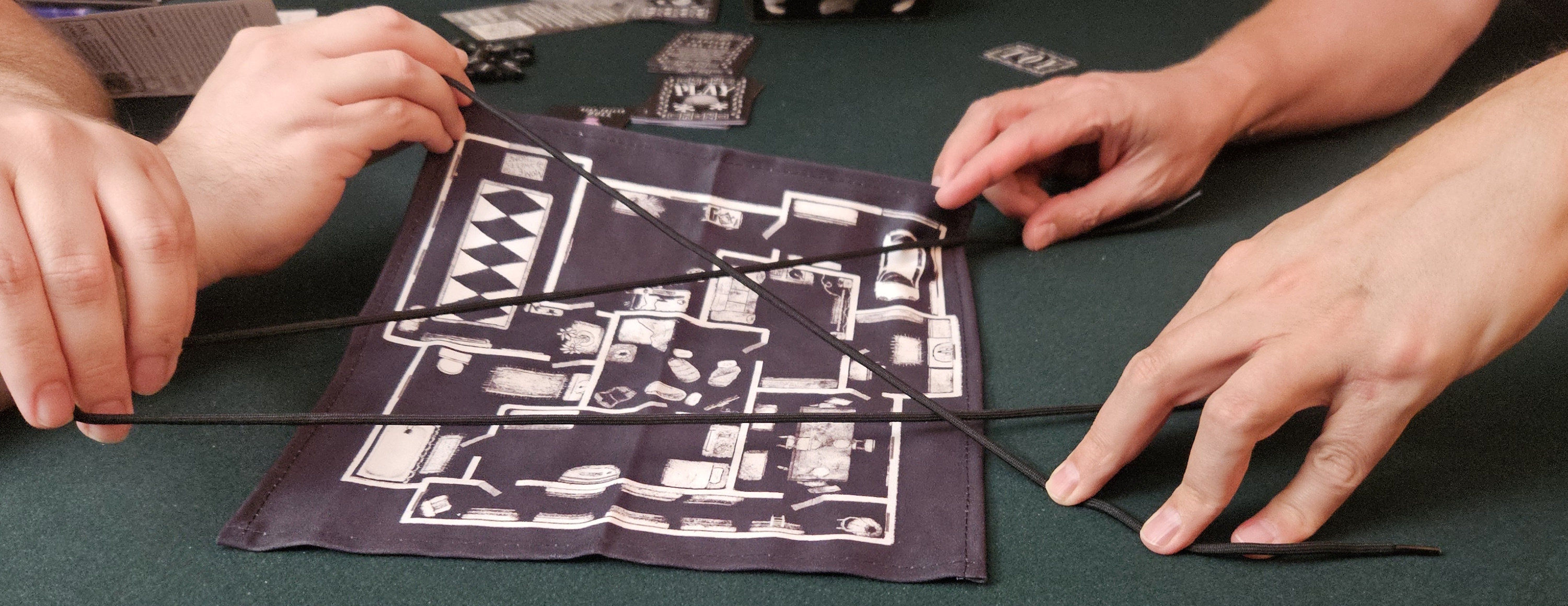
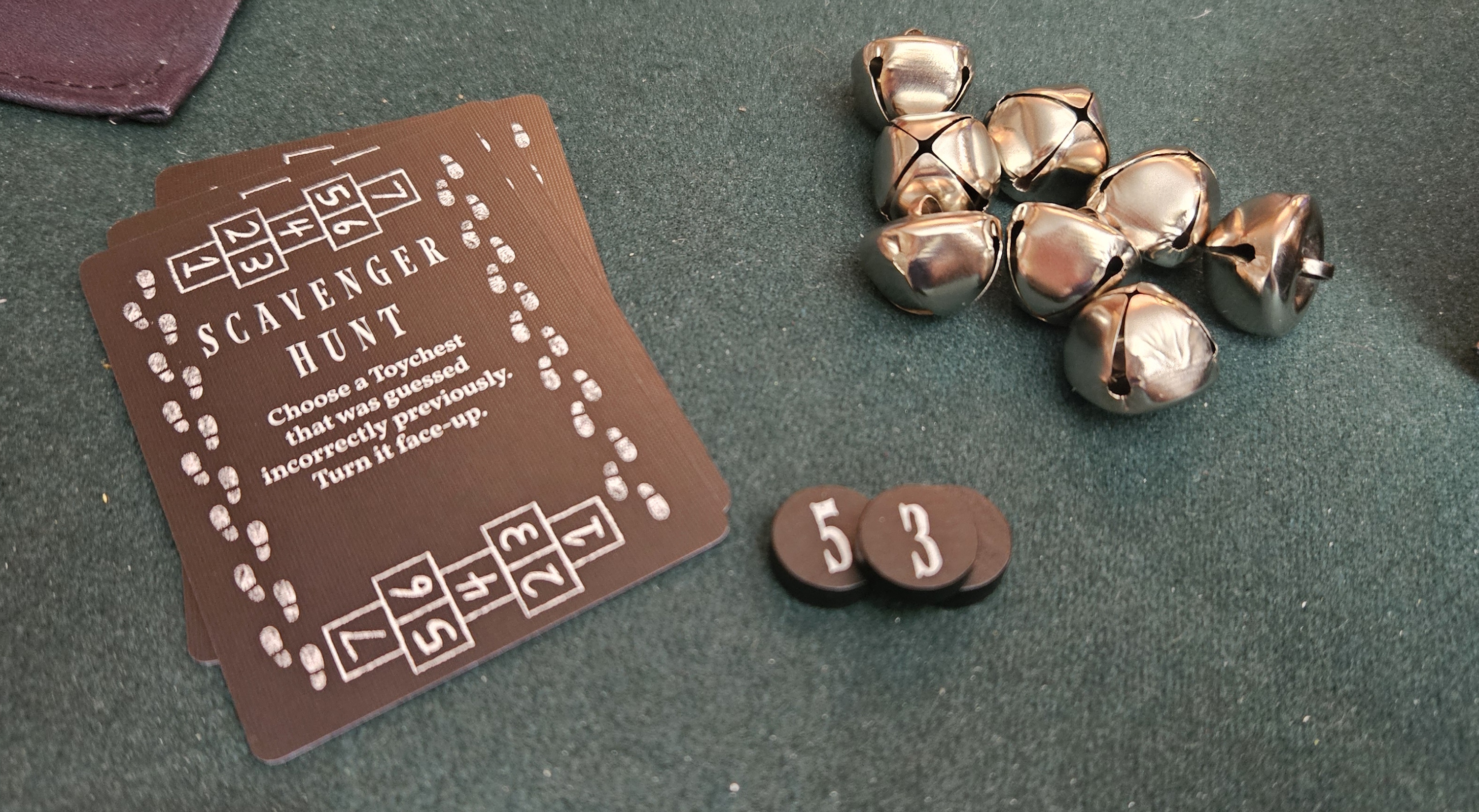
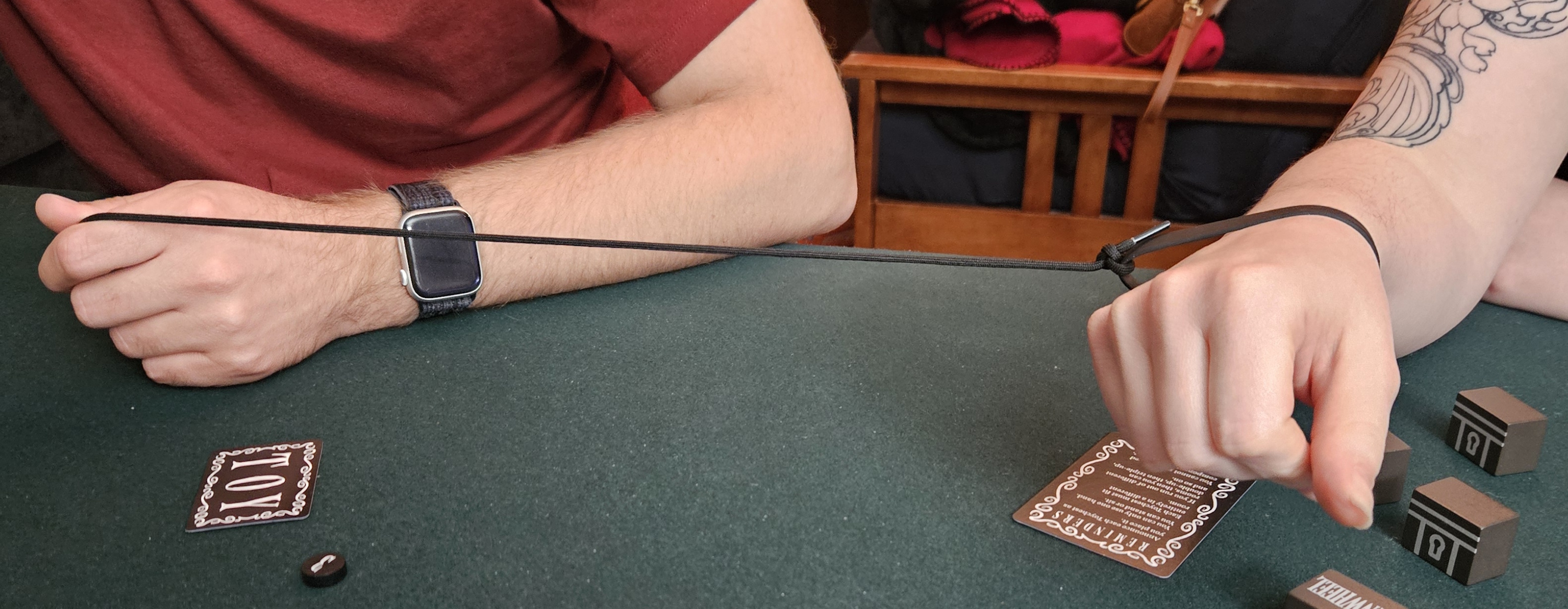
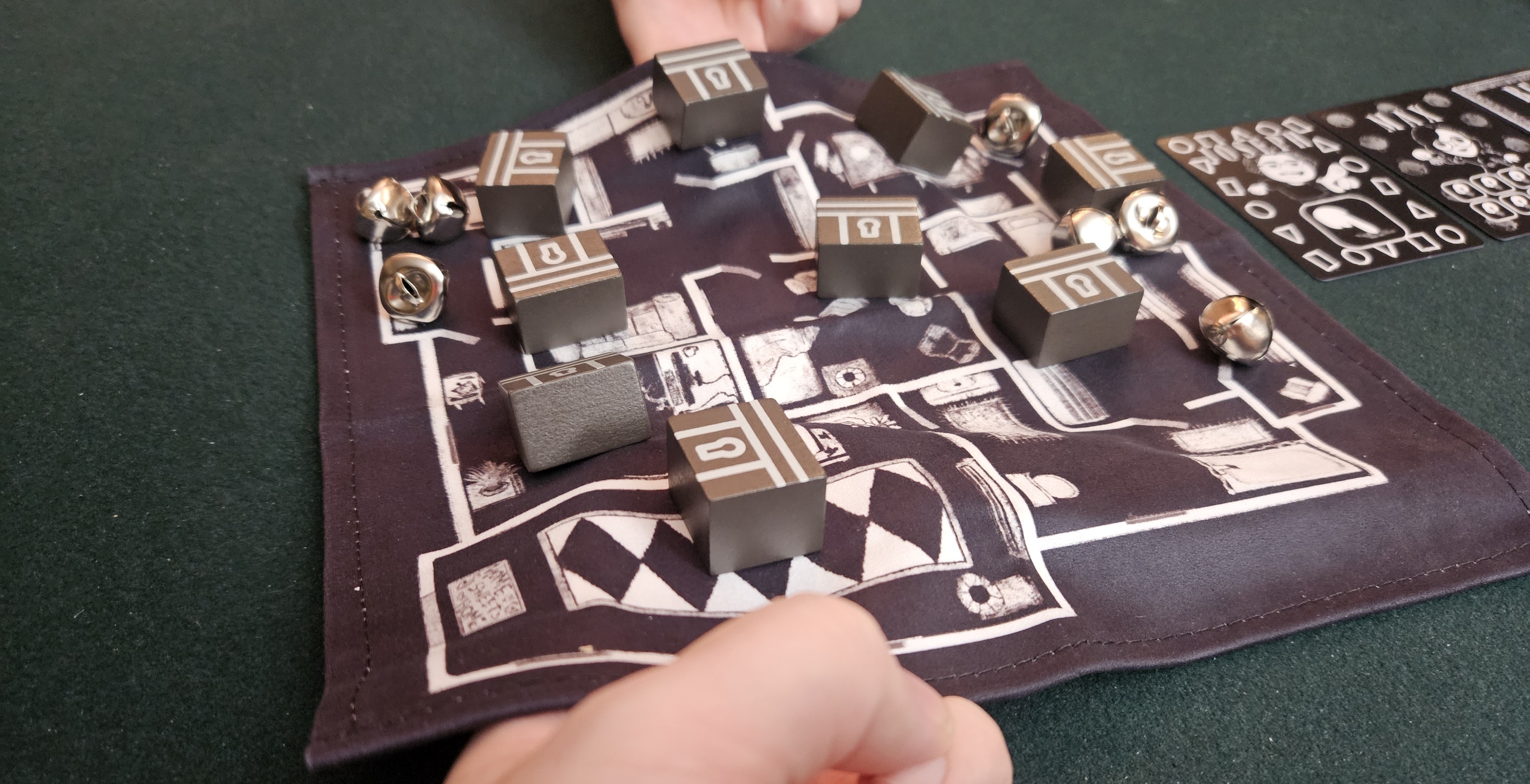
Everything in Playthings is thus literalized. Laying a trap consists of… well, take your pick. Stringing triplines across the board. Scattering jingle bells across the floor. Sliding a finger under the cloth mat to feel the reverberations of the Night Terror’s pitter-patter. You’re Kevin McCallister, hellbent on catching the Easter Bunny.
Where is your toy?
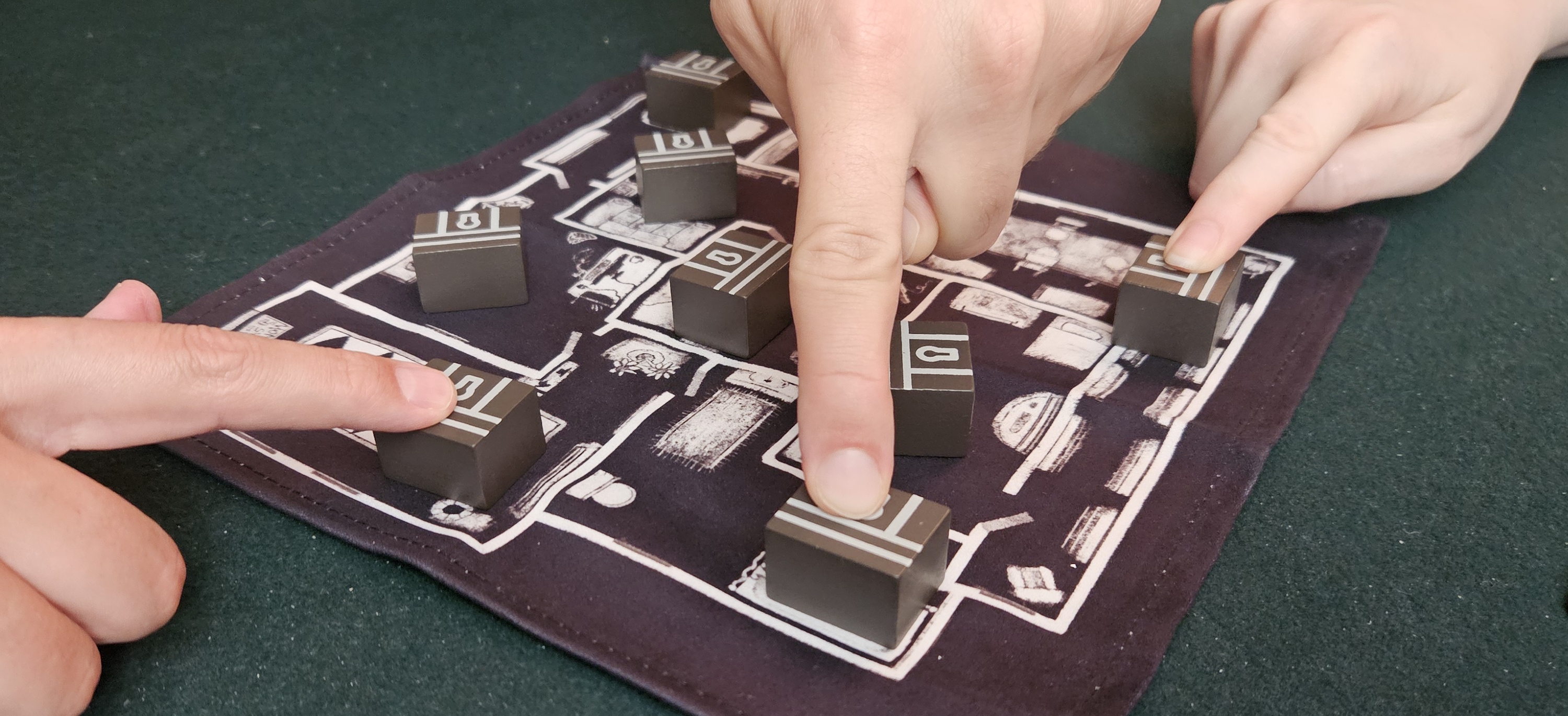
The Night Terror, then, places the toy chests while the kids close their eyes. There are nine in total, and while there are a few general rules to abide by, as with all Jasper Beatrix games the margins between those rules are sometimes runny and gray.
An example. The rules state that the Night Terror needs to state the current toy while placing it. “Bouncy ball,” they might say. But at what point do they say it? When they pick up the chest? Right as they place it? Somewhere in between? Is there a time limit to how long they can hold onto the block, or can they let the seconds stretch into discomfort? Can they tap it against the mat, against somebody’s hand, against the box that somebody has used to block off half the house, and then move it to another locale? Can they intrusively slide their finger up and down mine, the way Geoff did, the pervert finally given free reign?
This might seem like a weakness in the rules. To some degree, it is. I didn’t appreciate having my fingers fondled, and even non-pest rules lawyers will find plenty of wiggle room for interpretation and debate.
But this doesn’t have to be a problem. It’s just that Playthings is a little more reliant on making sure everybody is on the same page. It has that in common with plenty of TTRPGs. Not only in its regard for consent and setting topical boundaries, but in establishing who you’re playing with. How your group views the magic circle. Whether it’s okay to “play along” with a game, or demand that its every ruling and clause are ironbound.
Assistance comes in many forms.
Because let me tell you, Playthings is a big damn hoot with the right people.
Let’s rewind. So the kids lay their traps. Then the Night Terror scatters their toys around the house.
And then there’s the hunt. The kids search for their toys. Much as with the booby traps, which are drawn from a deck, there are little aids to this process. You get your first guess for free, working with your fellow children to uncover the most toys. This is desirable not only when “playing along,” but because the entire group earns bonus points for every toy they discover together. So you say, “Hey, I think your doll might be over here,” or “I heard a bell over there when the Night Terror put down your train.” And then everybody places a finger on the chest they think holds their toy. If they’re right, they earn a couple points.
After that, the leftover children get an extra nudge in the form of another card. Maybe a scavenger hunt flips a single chest face-up. Or hopscotch has you toss some tokens onto the mat, hold a string between them, and reveal every chest it touches. Or hide and seek lets you shove your hand under the mat and wriggle it around until a single chest spills its contents.
Whatever the specifics, these little games are a delight. They recall childhood not only in their descriptions, but via their half-logic, the way a young child might strike upon a peculiar solution to an imagined problem. It isn’t enough to make the toy hunt easy, not by any means, but it’s one more data point among many. Hopefully enough to find your toy.
Or you could just peek.
Leashed!
That’s right. Peeking is allowed. When the Night Terror announces your teddy bear, you can peer through your fingers or squeeze a glimpse through your eyelids. It’s entirely possible to see exactly where your toy is placed, like a kid who’s successfully powered through to midnight. Oh. So that’s the mystery. Santa Claus is [redacted].
But there are downsides. After the toy hunt has wrapped up, the Night Terror begins a guessing game. One by one, they guess whether each child peeked or not. If the Night Terror is correct, they earn some points. Better yet, if they catch a peeker, they steal those points directly from that player. It’s only after they’ve visited each player or made a wrong guess that they stop.
This, after everything else, the booby traps and little games, the guesswork and teamwork and maybe even confidence work plied against your fellow players, is the core experience that draws Playthings together. Like those other elements, this is another literalized expression of the game’s internal sense of play. Because it’s so hard to not peek. When the Night Terror announces your toy, it takes real willpower to not sneak the smallest look. For a kid, it’s almost impossible, like setting out a birthday present in one of those tissue-stuffed bags and leaving the room unattended.
Playthings permits the transgression. Encourages it, even. Because the available tools are imperfect. The traps can be circumvented or triggered prematurely. The schoolyard games only reveal tidbits. So the best solution, always, is to witness the terror with your own eyes. To uncover the identity of the monster. To pin that elf to his shelf and escape his tyranny once and for all. Just make sure you don’t get caught in the process.
And then the round is over. You continue with a new Night Terror. Once everybody has had a chance as the monster, points are tallied. That’s the game.
Some traps are better than others.
What a weird, wonderful, childlike, fuzzy-around-the-edges oddity this is. It isn’t my favorite Jasper Beatrix title, but depending on the group, scratch that, it actually might be. When I played with adults, they wheedled with the rules and asked too many questions and one of them got inappropriately handsy with my index finger. But when I played it with my kiddos, they howled with laughter. They learned shrewd new tricks. They demanded that they wanted to be the next monster. Now I have been informed by two very excited children that we are going to play it again tonight with the Night Terror herself.
Er. Mommy. I mean Mommy. We’re going to play it again tonight with Mommy. I hope she sees the beauty of this thing. The simple joy of how freely it plays.
A complimentary copy of Playthings was provided by the designer/publisher.
(If what I’m doing at Space-Biff! is valuable to you in some way, please consider dropping by my Patreon campaign or Ko-fi. Right now, supporters can read the next installment in my series Talking About Games, this time tackling the topic of what makes a good list! Naturally, the piece includes a list.)

 Anmelden