Anmelden
TTGDA: Please Credit Designers for Their Work
23. Juli 2026 um 22:00
A plea from the Tabletop Game Designers Association

A plea from the Tabletop Game Designers Association
Have you ever been on the fence about buying or backing a game? You’re following along, you’ve watched some playthroughs and reviews, you have trust in the publisher, and you can afford the price. The game intrigues you, but you’re just not sure yet. What questions do you ask to put you over the edge?
For example:
Recently I’ve faced this conundrum with a few games. Sometimes simply being on the fence is indicative to me that the game might not be the right fit. But there are plenty of games that I was hesitant to explore and ended up loving, so I try to keep an open mind.
This type of decision is highly subjective, but I’m curious if publishers can do certain things to help on the product page:
I try to do a few of these things in our infographics (see below), but I’m realizing that there’s a lot of “over the edge” questions not answered in this format. What do you think about these questions and how publishers can help to answer them when you’re on the fence?

Also read: The 10 Reasons I’ll Back a Kickstarter Project
If you gain value from the 100 articles Jamey publishes on this blog each year, please consider championing this content! You can also listen to posts like this in the audio version of the blog.
Following up the earlier post, I’ve now played a twice (once just the Frontier game, once the full Counterstrike game).
The Frontier Game (aka “only the regular cards, mostly”)
The Counter Strike Game (Fight the Aliens!):
A group I know in Boston has already banned a card.
This is my fourth Nucleum article.
If you’ve followed my thoughts on the three other Nucleum products I’ve covered—the base game, Nucleum: Australia, and Nucleum: Energy Research Institute–it’s pretty clear that I think Nucleum is the second-best route/network building gaming system in my collection after the Brass games.
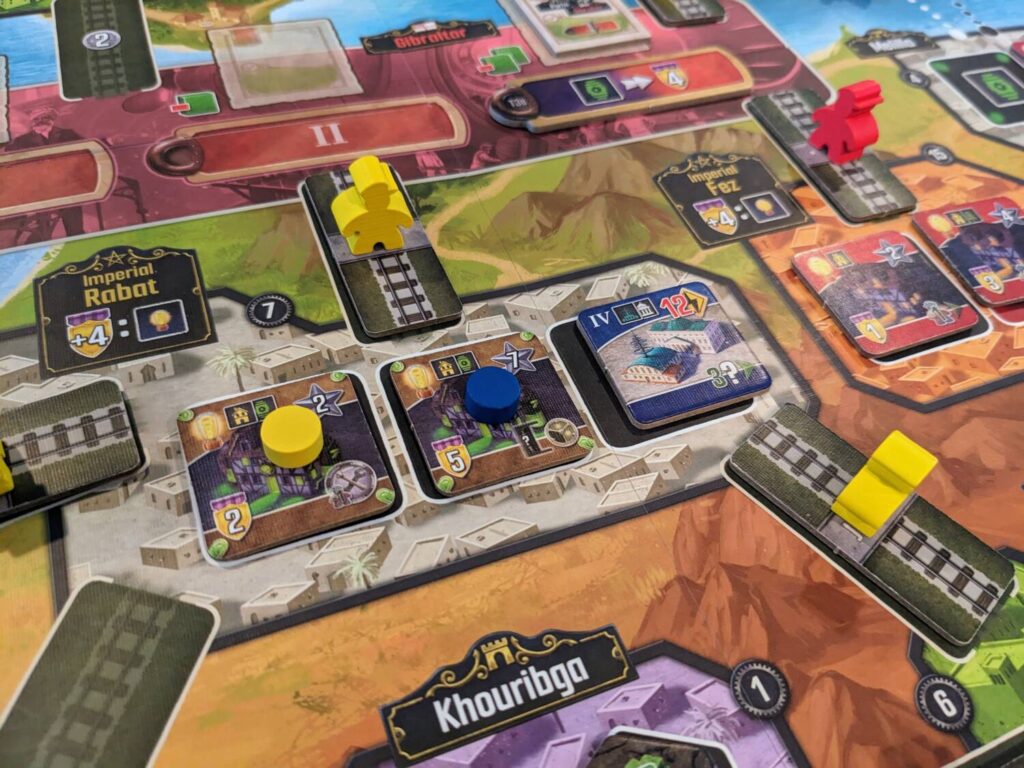
And, in a world where I already love Nucleum, Nucleum: Gibraltar might be the system’s best content. It combines the things I love about the base game, adds juicy new building tiles to the mix alongside new contracts and special powers, and then does what I didn’t think would be possible: Gibraltar’s map is the best combination of Nucluem’s design powers all in one place.
“I think this is the best map now,” said two players who joined me for separate plays, players who have extensive experience with both the base map as well as Australia. I was pretty sure that was my feeling as well after my first play, but winner’s bias set in and I wanted to try again to make sure that’s where I really landed.
The answer? Yep. Nucleum: Gibraltar is the system’s best map!
There are three new elements on display in Nucleum: Gibraltar: the new map,…
The post Nucleum: Gibraltar Game Review appeared first on Meeple Mountain.
Are you searching for something to watch in the doldrum days of summer reruns? Do you find yourself endlessly scrolling through the options on multiple streaming services looking for something that catches your eye? Do you then settle on a show that you’ve seen a hundred times already when the scrolling gets to be too […]


With this My Favorite Wargame Cards Series, I hope to take a look at a specific card from the various wargames that I have played and share how it is used in the game. I am not a strategist and frankly I am not that good at games but I do understand how things should work and be used in games. With that being said, here is the next entry in this series.
The Republic’s Struggle is a thematic Card Driven Game that tells the story of the historical events that took place in Spain after the resignation to the throne of King Alfonso XIII, and the proclamation of the II Spanish Republic in 1931. With the creation of the new regime, the struggle for power between the different social, political and ideological sectors increased, which gave rise to continuous changes of political power, alterations of public order, armed uprisings and violent acts, carried out by the numerous ideological factions of the moment; which culminated in 1936, in a failed military uprising. The failure of this coup d’état was the origin for the Spanish Civil War.
The Republic’s Struggle is based on Twilight Struggle from GMT Games and uses the same concepts of area control while adding in some actual combat with units represented on the board. During the game, the Republican player and the National player, will be able to recreate events of the period to increase their popularity in the localities by carrying out political propaganda, recruiting troops or militias, generating revolts or assaults, establishing diplomatic relations or carrying out bombardments. All this will be done by playing their hand of cards in an alternative way, either by using the events or by playing the action points or icons to perform any of the other actions available to the players.
One of the interesting parts of the design is that each player has what is referred to as a Special Card that is included in their hand from the start of the game and can be played during their turn. These cards don’t count towards the maximum number of cards that each player can have in their hand at the beginning of each turn. The 2 cards are Military Uprising, which is given to the Nationalist player and Proletarian Revolution, which is given to the Republican player. These cards are single-use event cards and can only be used during the first 4 turns of the game, or in other words during the period referred to as Phase 1 – The Republic. If, after this phase, these cards have not been played, they must be discarded and removed from the game. Both players can choose to use their Special Card in an Action round, instead of using one of the cards from their hand. These cards are played like the rest of the Operation Cards either using their Operations Value or applying the effects of the printed Event. Once played, the card will be removed from the game so it is use it or lose it.
Both cards are very powerful but have some fairly difficult criteria that must be met to fully realize the value of the printed Event. In the case of our featured card Proletarian Revolution, the top part of the card first gives the player the chance to downgrade the European Status Quo Track by 2 levels. The European Status Quo Track allows players to appeal to and in some ways manipulate the stance of the other European Nations regarding their view on the Spanish Civil War. It also is the determining factor in how Victory Points are awarded for the crucial Armed Actions aspect of the game. At the end of each turn, if the number of Armed Actions carried out by a player equals or exceeds the current level of the European Status Quo, that player will score 3 Victory Points. Also, as long as the European Status Quo Track is set on level 2, players cannot carryout any action using the Operations Points of cards played to advance in the Diplomatic Relations Track. So this is another tied result to the card as if the level is 1, no cards can be played to advance the Diplomatic Relations Track.
But, remember I said that to fully realize the effects of the card, the Republican player would need to control Barcelona, Madrid, Valencia and every Naval Base Location or every Air Base Location. If this is the case when the card is played, then the Republican player will earn an automatic victory. Frankly, this is next to impossible, but has a sliver of possibility depending on how diligent and attentive the Nationalist player is as well as the hand of cards that are drawn by the Republican player. If they draw certain other events, as well as have a hand full of higher Operations Point value cards, they can make a run at this but it is not necessarily recommended. The card also has a very useful secondary use as if the condition isn’t met, they will get to place out on the board 1 combatant cube, representing one of their combat units, and also remove all of the influence of the Nationalist player in the Catalonia and Valencia Regions. This literally means all of the Nationalist influence in these regions which each has several locations. In order for the card to be used in this manner though the Republican player will have had to previously play the Defense Committees card.
The proletarian revolution in the Spanish Civil War refers to the widespread social revolution that erupted in the summer of 1936. Triggered by the failed military coup of July 17, workers spontaneously armed themselves, taking control of factories, collectivizing agriculture, and establishing anti-fascist militias primarily in Catalonia, Aragon, and Andalusia. When General Francisco Franco and conservative military officers attempted to overthrow the democratically elected Second Spanish Republic, the working class retaliated by launching a massive wave of grassroots social reorganization. This proletarian movement aimed to permanently dismantle capitalist structures and the influence of the conservative elite and the Catholic Church.
In major industrial hubs like Barcelona, workers’ committees seized factories, transport networks, and public utilities, shifting control directly to the trade unions. In the countryside, particularly in the region of Aragon, peasants seized large agricultural estates. They abolished private property and reorganized land into self-sustaining collectives operating under libertarian socialist or communist principles. Instead of relying on a traditional military hierarchy, fighting forces were formed as democratic workers’ militias led by trade unions and political parties like the CNT (anarcho-syndicalist) and the POUM (Marxist).
The suppression of the revolutionary movement divided the Republican forces. Deprived of its radical grassroots momentum and lacking support from Western democracies, the Republican cause lost ground to Franco’s well-equipped Nationalist army (which was heavily backed by Nazi Germany and Fascist Italy). The Spanish Revolution was ultimately defeated in 1939, leading to the collapse of the Second Republic and the beginning of Franco’s 36-year dictatorship.
Here is a link to our full video review of the game:
In the next entry in this series, we will take a look at National American Woman Suffrage Association from Votes for Women from Fort Circle Games.
-Grant
I find Realm of Reckoning, the latest title by Max Anderson, Zac Dixon, and Austin Harrison, to be fascinating. There’s the cosmological angle: an afterlife fallen into disrepair, now pieced back into working order through the clashing imperatives of feuding factions. Personally, I’d be a fanatical member of the Eat As Much Cake As You Like Without Getting Tummy Sick sect.
But more even than that, it carves out a new space in the whole “dudes on a map” genre. (Are we still saying that?) There are fingerprints of the greats all over the design. A splash of Blood Rage, some Inis, even a little bit of Arcs. It’s something of a mashup, and not every part works as smoothly as the others, but the result is a gripping struggle over an ashen landscape.
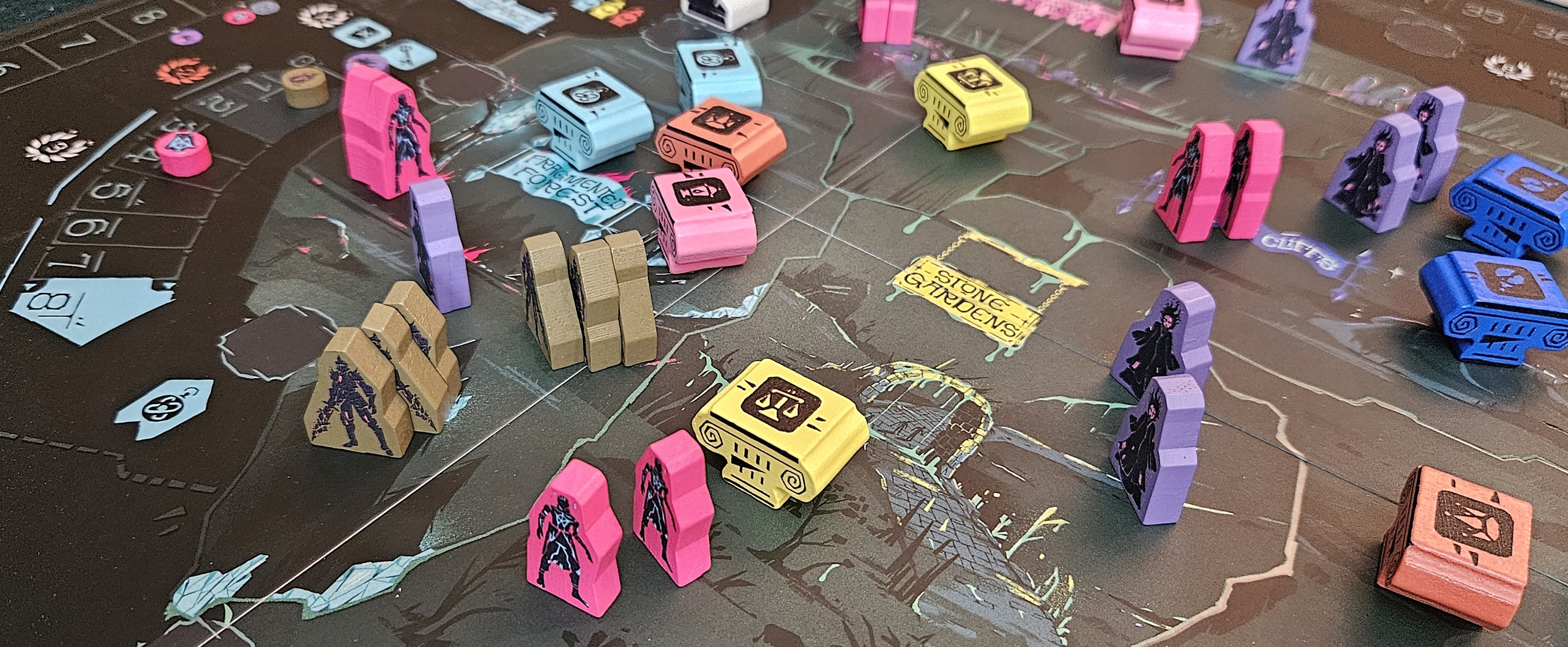
Clashing over the broken prairie of the afterlife.
Right away, there’s nothing typical about Realm of Reckoning. The factions are presented in gaudy colors. Or perhaps they’re only gaudy because the terrain is so smudged and dismal.
For all its aesthetic ruin, it’s really a rather simple space. The entire battlefield consists of five territories, each connected with a different flavor of influence. There are also five flavors of pillar, themselves coded to the assistance of gnomic wardens and tide-turning mercenaries, but maybe that’s more information than you strictly need to understand what’s going on here.
As for the rest of it, Realm of Reckoning structures itself around three rounds of drafting. This is where its similarities to Blood Rage seem most apparent, although if Veiled Fate, Pillars of Fate, and Scales of Fate are anything to go by, the folks at IV Studio really like their three-act structures. Each age is structured much the same: a hand of cards is dealt out, everyone picks one to resolve, and then the rest are passed around to repeat the process until there’s nothing left, at which point there’s a final battle before a quick tally of points.
It’s clean. At that mile-high remove, anyway.
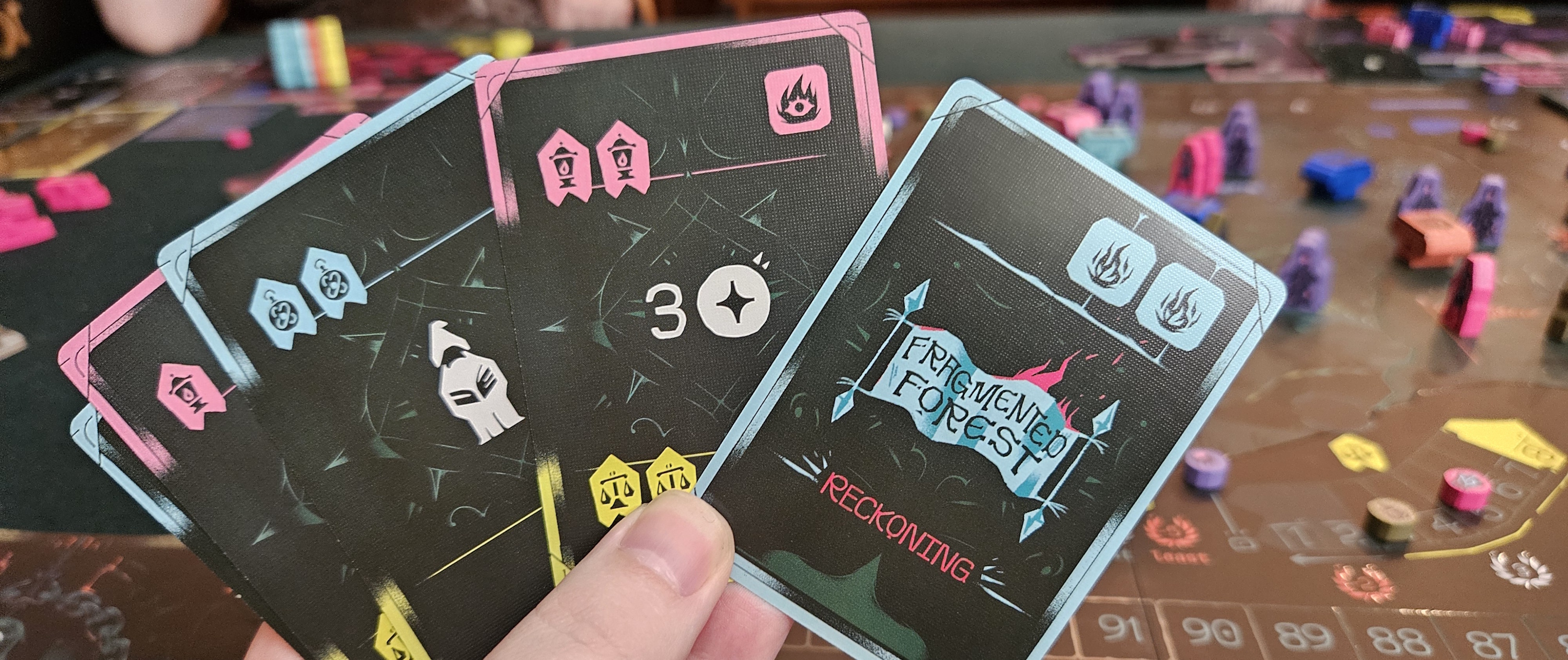
Cards, both for action and battle, are drafted one at a time.
Down in the grit, affairs are a little more complicated.
Consider the cards. There are two types in the draft. The vast majority are action cards. These confer some resource — coins, wardens, soldiers for the battlefield, mercenaries to be spent and discarded — followed by a choice of where to tuck the card under your faction mat. This latter choice is more loaded than it initially appears, moving your marker along the corresponding influence track, but also providing icons that, at least on the first play, don’t bear immediate import.
The other type of card is the reckoning. There are only two of these shuffled into each age’s hand of cards. Their rarity marks them as major flashpoints. This is because reckonings trigger a battle in the indicated region. Not at the end of the round or even upon completing the current hand of drafted actions, but immediately, at the exact moment that the player who drafted it would normally take their resources and move along their chosen influence track.
Even when these reckonings are anticipated, such as when you’ve seen them coming from a hand of cards you passed along, they always come across as an intrusion. The usual cycle of gathering and positioning is interrupted. Now everyone picks up a dial and tallies in a number. This is how much they’re willing to spend to win. Four. Six. Eleven. More. Battles escalate as the game progresses, the result of all those extra arms everyone’s been amassing.
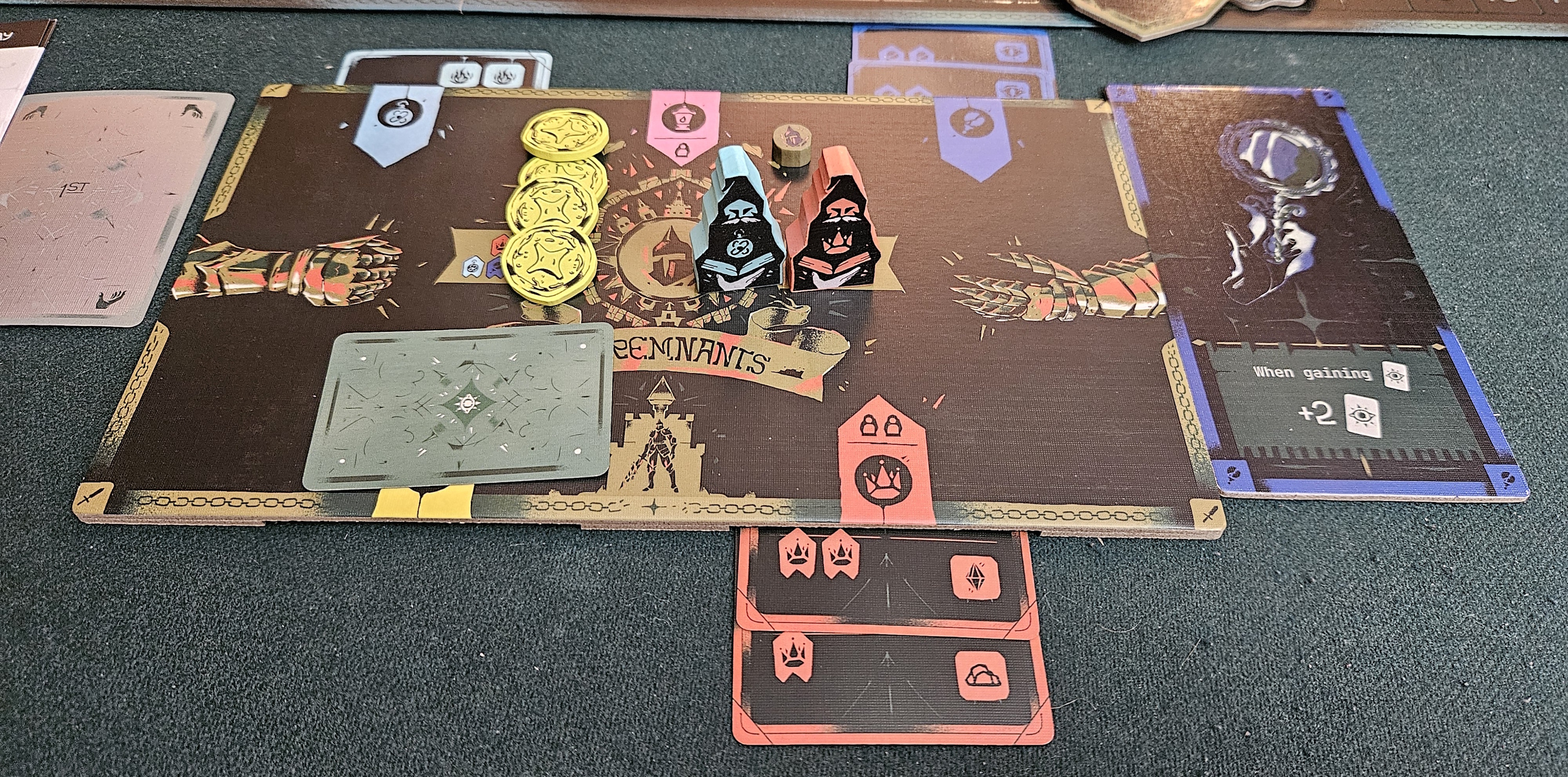
Some of the many things you’ll collect in Realm of Reckoning.
To be honest, the battles themselves are a mixed bag, the game at its strongest and weakest.
Strongest, because they’re nail-biters. Rather than simply winning or losing, players are vying for placement on a rewards card, a clever turn that might dictate how strongly you feel about the current contest. It’s even possible to accept a negative reward to avoid spending your bid, a maneuver that’s sometimes smarter than it might sound.
But battles are also frustrating. They’re a little too complicated for their own good. IV Studio has a reputation for games that contain “complicated counting,” and these tallies certainly qualify. Soldiers can be spent for a point of strength. Wardens also provide a point, but only if they match a pillar in the contested territory, and even then they can be spent instead to produce a bump of three. Mercenary cards matter, although again there’s some pillar-matching to consider, and coins too, although these are spent in increasing increments. Oh, and your influence in that region. It’s easy to forget that one, especially if you’re currently benefiting from that region’s power-boosting artifact.
All of this is to say that bids are fraught indeed, slowing the game dramatically but also producing… well, drama. High drama. Revealing one’s bid is as tense as it gets, as good as any round-robin antes in Inis. These are the hinges upon which Realm of Reckoning turns. Slowly, sometimes, with no small amount of creaking and groaning, but still.
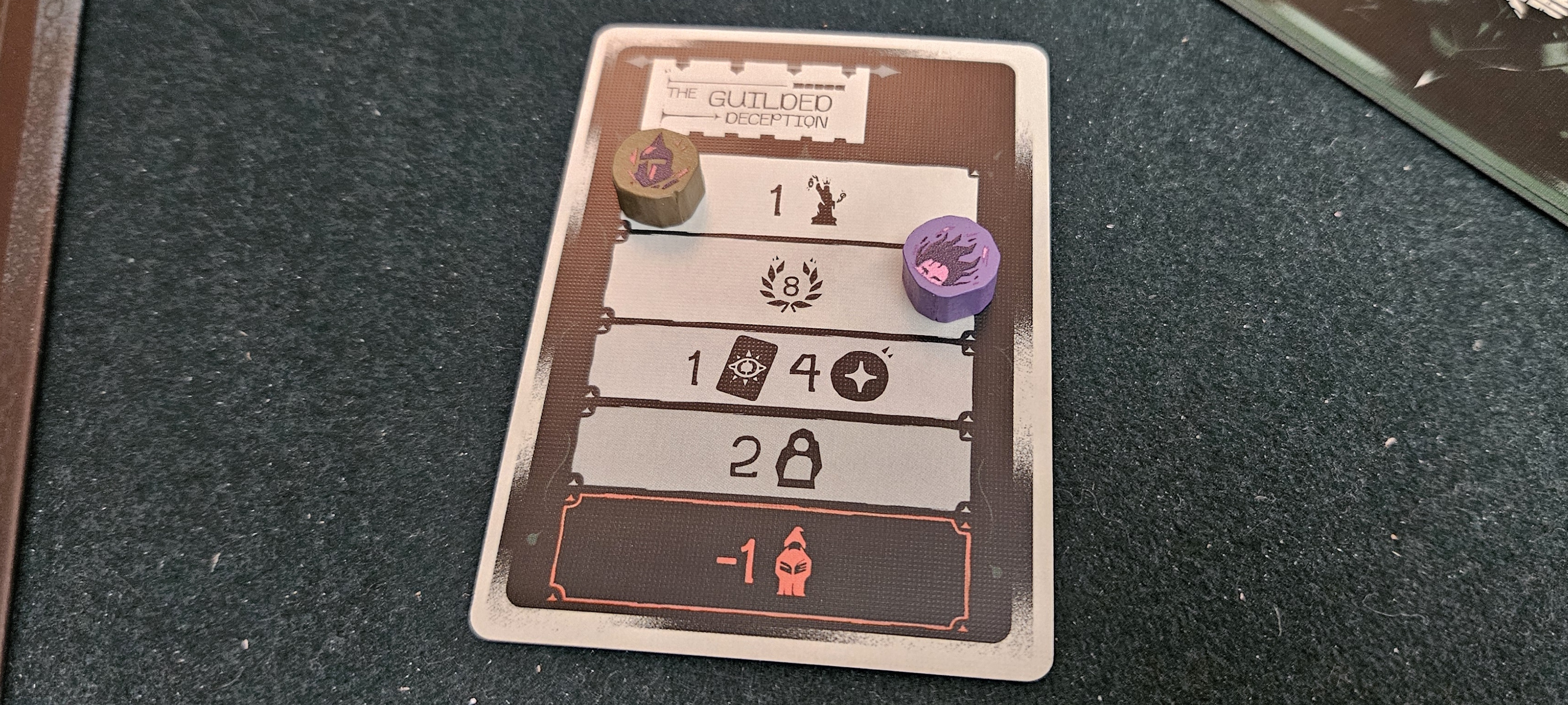
Picking your reward for a reckoning.
For my part, I’m willing to accept the shortcomings of these reckonings for the boons they provide. The drama, yes, but also the way they feed into the game’s consideration of victory. Everything in Realm of Reckoning is building toward these moments of revelation.
And here, the revelation matters. Some players will claims points or cards or coins. Extra soldiers. Maybe a warden. But the real prize is the chance to designate which victory condition will score at the conclusion of every round hereafter. One player — usually the highest bidder in the reckoning but not always — takes a shrine, a statue that looks comically like Lady Liberty herself, and plops it onto one of the victory markers.
There’s no shortage of options. There are spaces for military domination over specific territories; others for economic advantage in coin or hired help. Some initiate struggles against your neighbors. Others provide groundswells of points that everyone can benefit from with some effort.
This is also where those icons come into play. The ones from earlier, on the cards, tucked beneath your player mat. You might find yourself racing to collect sets of gems, or vying to command the most purses of gold, or cursing because a rival chose to emphasize the closed-eye icon rather than the open peepers. Whatever the selection, it informs the game from that moment forward. It’s a little bit like Arcs in that regard, the players choosing what matters and then clashing over it, except these are permanent alterations. Early selections, before the factions have specialized, become exploratory, triggering multiple times before the game ends but also allowing players to adjust, while those added later are hotly contested because their outcome is less prone to adjustment.
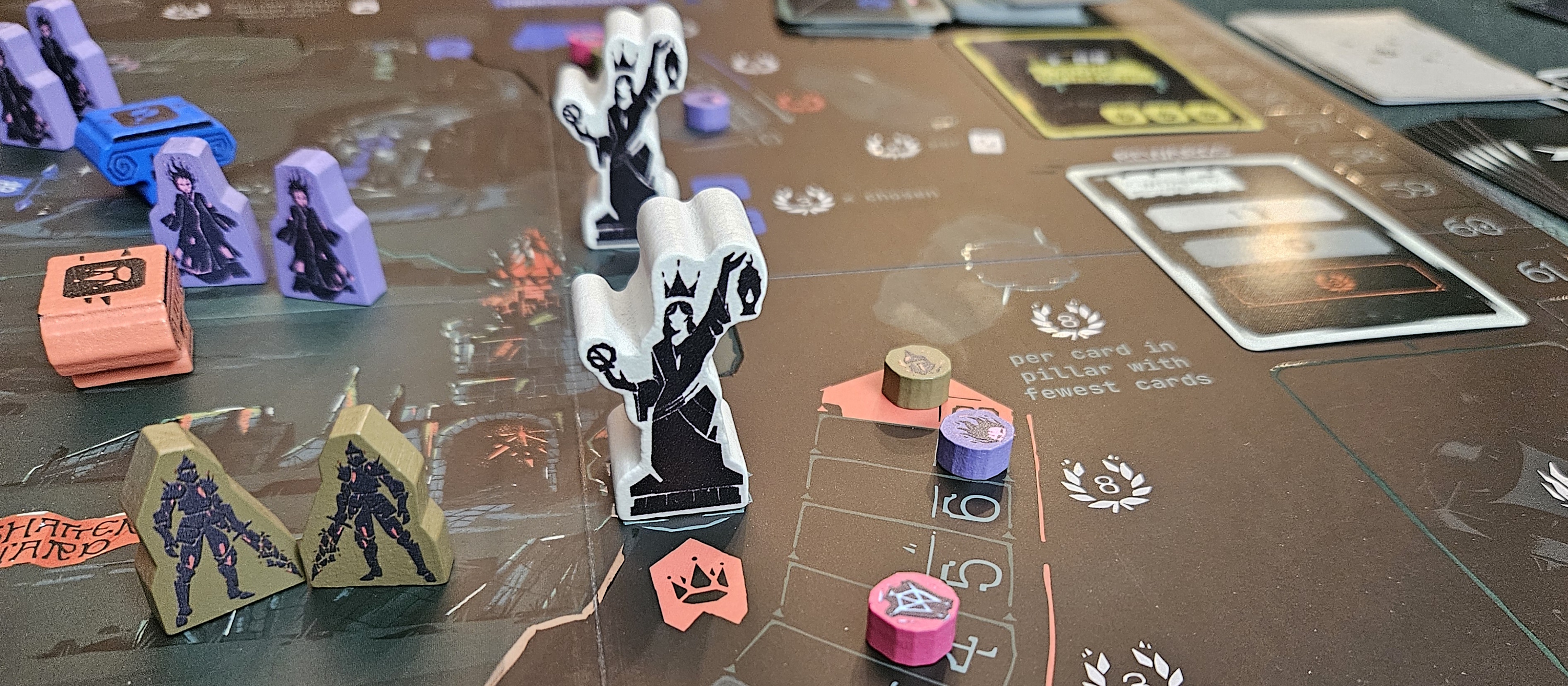
Victory conditions are selected over the course of the struggle.
Perhaps there’s an irony to be dredged from all this fuss. For the second time, Realm of Reckoning hinges on a bunch of complicated counting.
But this is also where the designers manage to carve out their own niche in a crowded genre. And, as niches go, it’s closer to an alcove than a toehold. There’s such a variety to the objectives that there always seems to be something worth pursuing. There’s even a spot that awards points to whomever’s sitting in last place — a whole catch-up system, but one that asks the players whether they would like to switch it on or leave it untouched.
It’s smart, although in a way that demands its own attention rather than simply aping what’s gone before. Sure, it has drafting like some other titles. But where Blood Rage evoked a heavy boot smashing into your nose, where Inis was all tribal politics, where Arcs is… a lot of things, Realm of Reckoning is about currencies and auctions. Players gather resources to spend them, but only as carefully as possible, and then the outcomes of those auctions become longer-term auctions for absolute victory. In that respect, it feels like a smoother, more contemporary version of a lesser-known map-battler called Mezo. But, again, Realm of Reckoning provides such an emphasis on who can most cleverly accrue and spend coins of various denominations that it feels entirely new again.
Entirely new. Sometimes slow, especially at higher counts, and sometimes a little too tally-heavy. But still new, and smart, and bound up in calculations that feel shrewd rather than merely arithmetic.
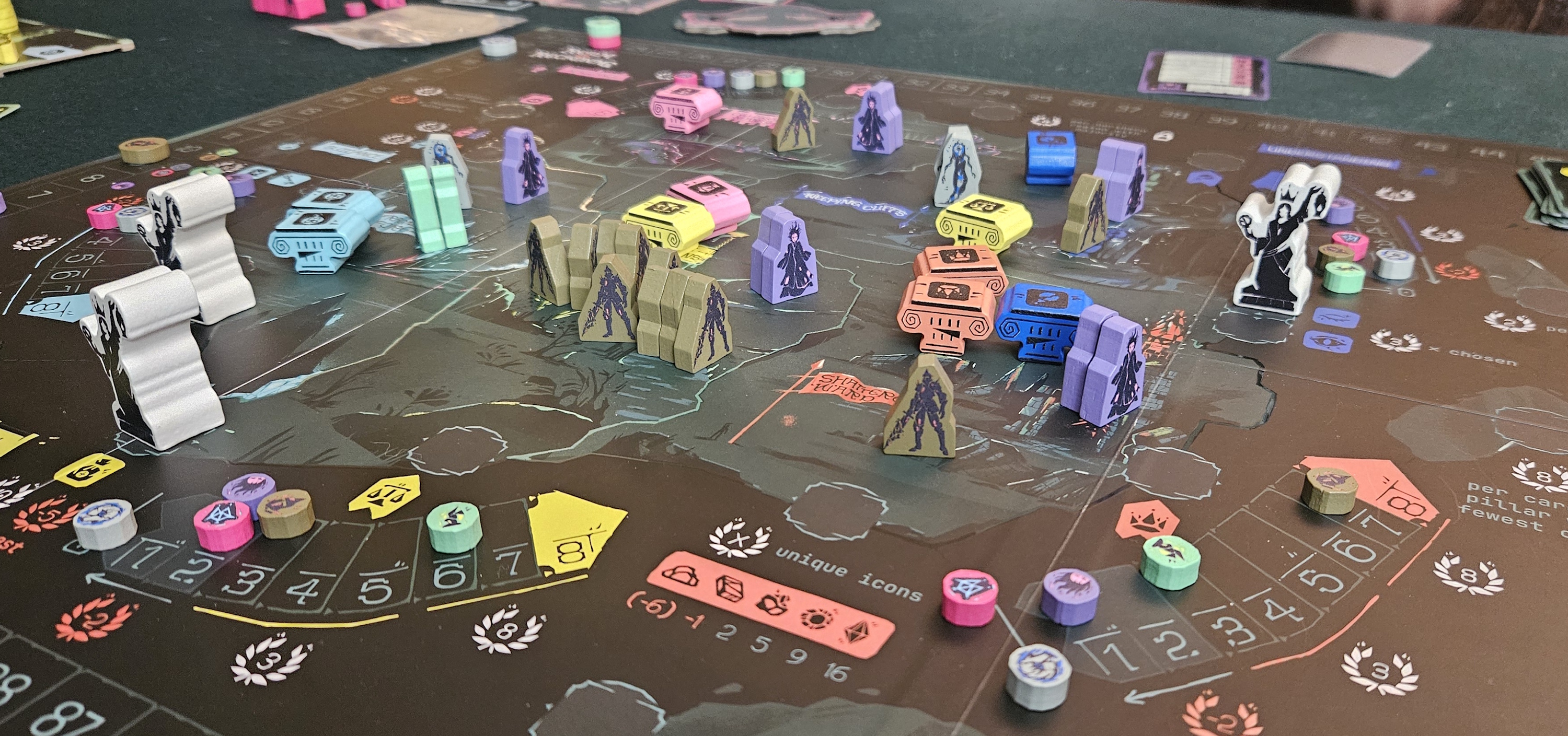
War in heaven. Or hell. I dunno.
I can hear what you’re asking through the screen. “Dan, does this say anything about the afterlife?” Sorry, but no. It does not.
But it does say something about how great it is to smash somebody through superior tallies and bids. Combat in Realm of Reckoning isn’t visceral. Strictly speaking, you’re inflicting the casualties on yourself, not the other way around. But this is one smart cookie, ultra smooth in practice, and a delight to handle. It takes a play or two to get a handle on its particulars, but this is one afterlife worth pursuing — and then remaking in your own image.
A complimentary copy of Realm of Reckoning was provided by the publisher.
(If what I’m doing at Space-Biff! is valuable to you in some way, please consider dropping by my Patreon campaign or Ko-fi. Right now, supporters can read the next installment in my series Talking About Games, this time tackling the topic of what makes a good list! Naturally, the piece includes a list.)
More new regiment boxes for Armoured Clash – Check them out!
Now you’ve seen the new Commonwealth and Crown heavy regiment boxes, allow me to show you two more, this time for the Enlightened and Union factions. Both small boxes contain some very tasty new units to beef up your armies. Enjoy!