❌

Normale Ansicht

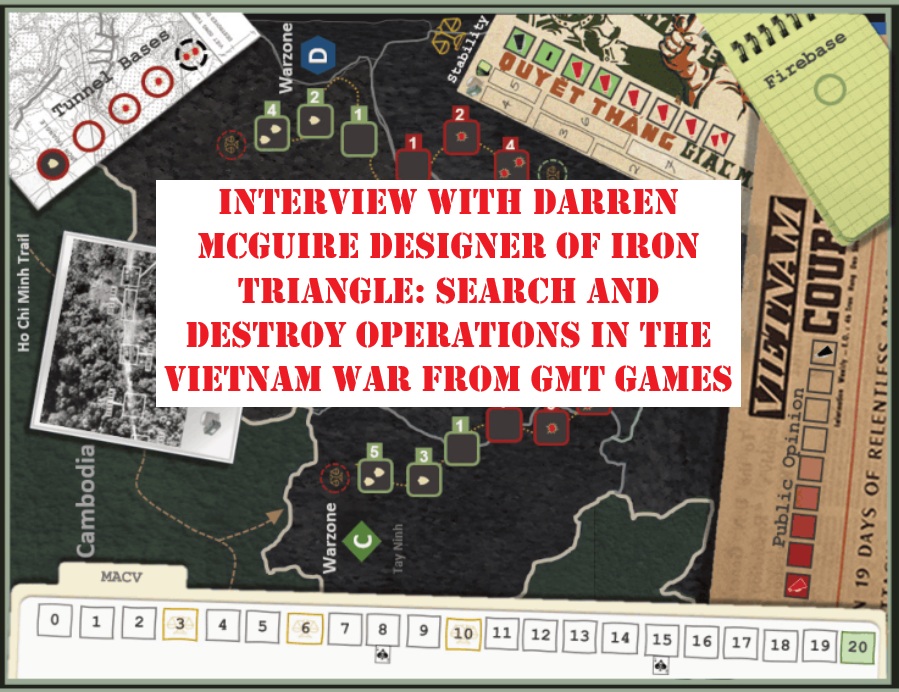
Interview with Darren McGuire Designer of Iron Triangle: Search and Destroy Operations in the Vietnam War from GMT Games

Von: Grant
05. Oktober 2026 um 14:00

A new series, and we have seen how well series have done at GMT Games, a new designer and a new concept to wargaming (lane battler), I think that this game has great potential and it happens to be focused on one of my most favorite wars to game – the Vietnam War. Iron Triangle: Search and Destroy Operations in the Vietnam War is designed by Darren McGuire and takes a look at the struggle between the United States military and the Viet Cong insurgents as they fight over control of three key “lanes” or regions. I am very much excited about this one and reached out to designer Darren McGuire for some additional information.

*Note: The pictures used in this interview showing the various components and cards, are still in the design and development process and as such rules, event effects and text might still change prior to final development and publication. Also the art and layout of the cards are only for playtest purposes at this point and the game will enter the art department as it nears publication.

Grant: Darren welcome to our blog. First off please tell us a little about yourself. What are your hobbies? What’s your day job?

Darren: Hi Grant, I live not too far from Glasgow in Scotland, which is a board gamer’s delight, by which I mean, plenty of rainy days and dark evenings. By day, I work as a Quantity Surveyor (Cost Engineer) on major water infrastructure projects, dealing with cost control, commercial management and contractual disputes, so it’s excitement all round! Away from work, my wife and four children keep me more than busy.

As you may have guessed, my main hobby is board gaming, which has now expanded into board game design. Unfortunately, my best ideas seem to arrive in the middle of the night rather than at my desk. When I’m not thinking about games, you’ll usually find me following Glasgow Celtic, the best football (soccer) team in the world…well, Scotland at least. Other interests include noodling away on my guitar and getting out for the occasional hike.

Grant: What motivated you to break into game design? What have you enjoyed the most about the experience thus far?

Darren: I am relatively new to board gaming, having played regularly for only four or five years. My growing interest in historical games was sparked by Rodney Smith’s discussion of Cuba Libre in the Discovering the COIN series. After learning and playing the game, and later watching a documentary on the Cuban Revolution, I became fascinated by how game mechanics can represent the political, military and social dimensions of historical events.

This experience led me to appreciate game design not just as entertainment but as a way of communicating history. My interest in creating games developed further through roleplaying games, particularly the Basic Roleplaying system, which inspired me to write and run a Second World War-themed scenario. Seeing others enjoy something I had created was highly rewarding and encouraged me to pursue game design more seriously.

What I enjoy most about design is the iterative process, watching an idea evolve through testing, refining it based on feedback, and carrying lessons learned from one project into the next.

Grant: What is your upcoming Game Iron Triangle about?

Darren: Iron Triangle is a 2-player card battler game about the struggle between US and Viet Cong forces in the III Corps region of South Vietnam during the Vietnam War. Players compete across a series of Operations while also managing the wider military, political and social factors that shaped the conflict.

The US player must balance military success with the need to maintain stability and support for the South Vietnamese government. The VC player, meanwhile, seeks to undermine government authority through guerrilla warfare, hidden infrastructure, and the careful preparation of the Tet Offensive. While battles are fought over individual Operations, success ultimately depends on how effectively players manage resources, control territory, influence Public Opinion and pursue their broader strategic objectives.

Rather than focusing solely on military confrontation, Iron Triangle aims to capture the asymmetrical nature of the war, where political legitimacy could be just as important as success on the battlefield. The result is a fast-paced experience in which decisions can have consequences beyond the immediate fight.

Grant: Why was this a subject that drew your interest?

Darren: I have always been fascinated by David versus Goliath conflicts, where a seemingly weaker side challenges a much stronger opponent. The Vietnam War particularly captured my interest because it was a conflict I initially knew very little about. Like many people, my early perceptions were shaped largely by Hollywood films, but after becoming interested in historical conflict through board gaming, I began to realize there was far more nuance and complexity to the war than popular culture suggests. The more I explored the subject, the more intrigued I became by the political, military and human factors that shaped the conflict.

Grant: What is your design goal of the game?

Darren: My goal is to create a fun and engaging game that feels thematic within what is traditionally quite an abstract genre. I want the mechanics and player decisions to reflect the realities of the conflict, so that the theme is expressed through gameplay rather than simply through artwork or historical flavor text.

Beyond providing an enjoyable experience, I hope players come away with a greater appreciation of the unique challenges faced by both sides in this part of the Vietnam War. The conflict was not decided solely by battlefield success. Political support, public opinion, hidden infrastructure and competing strategic priorities all played important roles. Capturing these tensions within an accessible and entertaining game has been one of the central objectives of the design.

Grant: What from Search and destroy missions in Vietnam was most important to model?

Darren: Two aspects were at the forefront of my mind. The first was capturing the cat-and-mouse nature of search and destroy operations through the card play. These missions were rarely straightforward engagements; instead, they involved a constant struggle to locate, pursue and evade the enemy.

Equally important was ensuring that the tactical outcomes of these operations were connected to their wider political and societal consequences. In Vietnam, success on the battlefield did not always translate into strategic success. Capturing that tension between military achievement and its broader impact on public opinion, political will, and the course of the war was therefore a key design objective.

Grant: What sources did you consult about the details of the history? What one must read source would you recommend?

Darren: The principal sources I consulted were:

  • The Vietnam War: An Intimate History by Geoffrey C. Ward and Ken Burns
  • Vietnam: An Epic Tragedy, 1945-1975 by Max Hastings
  • The Tunnels of Cu Chi by Tom Mangold and John Penycate

Of these, I would recommend The Tunnels of Cu Chi as essential reading. The book argues that the Cu Chi tunnel network became one of the most powerful symbols of Viet Cong resilience and ingenuity, demonstrating why overwhelming American military superiority alone could not guarantee victory. That theme had a significant influence on the design of the game. Mechanics such as tunneled cards, Tunnel Bases, and the creation and use of caches are intended to reflect the hidden infrastructure that enabled the Viet Cong to survive, recover and at times overwhelm a conventionally stronger opponent. Capturing this asymmetry between military power and insurgent resilience was one of the central goals of the design.

Grant: What is the goal of the game?

Darren: The VC player seeks to undermine the local population’s trust in the South Vietnamese government. To achieve this, they must win Operations, carefully manage their resources, and, most importantly, plan and execute a successful Tet Offensive.

The US player, meanwhile, has two paths to victory. The first is through attrition, exposing and neutralizing enemy forces. The second is through pacification, placing pacification chits on regional tracks to strengthen government influence. Whichever strategy they pursue, they must contend with the fallout of scorched-earth tactics, maintain control of pacified areas and disrupt the enemy’s Tet Offensive preparations whenever possible.

Grant: What is the layout of the board?

Darren: The operations are divided across three regions, with players contesting one operation in each region during every round. Running alongside these battles is a strategic layer represented on the board, which tracks the overall situation across the theatre. This includes the level of control within each region, regional stability, public opinion, and refugee generation. As a result, success in individual operations can have far-reaching consequences, forcing players to balance short-term military objectives against their broader strategic and political impact.

Grant: What are the “lanes” and how do they work?

Darren: The three lanes represent the key operational regions north of Saigon: War Zone C, War Zone D and the Iron Triangle. Each lane contains a dedicated deck of Operation Cards representing historical Search and Destroy missions conducted in that region during the period.

During each round, players will contest one Operation from each region, fighting simultaneous battles across all three lanes. The outcome of these Operations will influence the wider conflict, affecting the various tracks and areas of the main board. Success on the battlefield can shift regional control, impact public support, alter available resources and shape each side’s broader strategic objectives.

Grant: How does the game use cards? How are the player decks asymmetrical?

Darren: Each player commands a unique deck of cards representing the units, tactics and capabilities available to their side. These cards are committed to Operations, where players compete for control and the rewards those Operations provide. Every card has a strength value and a special action that can be utilized when played.

The game’s real asymmetry lies in how the VC player can deploy their cards. VC cards may be played in one of three states: Exposed (face-up), Concealed (face-down) or Tunnelled (face-down and rotated). This system forces the VC player to balance protection against flexibility. A Tunnelled card, for example, is much harder for the US player to expose and inflict attrition upon, but it requires additional effort from the VC player to reveal and activate its ability.

These mechanics give the VC player multiple strategic options. They can bluff with hidden forces, launch surprise attacks, prepare units for future engagements or hide powerful cards for the decisive end-of-round reveal. The US player, meanwhile, is rarely certain of the strength or composition of the forces they are facing, creating a constant risk that an attack may not go as planned.

To counter this uncertainty, the US player can resort to scorched-earth tactics, exposing and neutralising enemy forces through attrition. However, this approach has consequences. Such actions generate refugees, a resource that can ultimately be exploited by the VC player to advance their own objectives.

The card system is therefore central to how the game’s theme is reflected in its mechanics. Through hidden information, bluffing and the constant tension between searching for the enemy and avoiding detection, it captures the cat-and-mouse nature of the conflict and the uncertainty faced by US forces throughout the war.

Grant: What different type of cards are included?

Darren: There are several types of cards in the game. The Operation Decks form the core of the conflict, with each card detailing the rewards available for successfully completing that mission. These rewards can include gaining regional control, destroying enemy caches or bases, reducing public opinion or generating refugees, all of which contribute to the wider strategic situation on the main board.

Each faction also has its own unique deck containing units and tactics, with cards featuring different strength values and special abilities. These decks reflect the contrasting approaches employed by the US and VC forces and provide players with meaningful tactical decisions throughout the game.

Currently in development are Commander Cards, which can be employed throughout the course of the game. Each commander provides powerful advantages but also introduces specific drawbacks, requiring players to carefully consider who is best suited to lead their forces at any given stage of the conflict.

Also in development is a dedicated solo mode, being designed by Joe Dewhurst. This system includes a bespoke bot deck for each faction, aiming to deliver a challenging and thematic opponent that captures the strategic priorities and character of both sides.

Grant: Can you show us a few examples of cards and describe how they work?

Darren: Here are a few examples that highlight the key decisions and interactions players will encounter during a round.

Operation Cards

Players battle over three Operation cards during each round. The rewards gained depend on the final Strength differential between the opposing sides.

For example, on the Operation shown above, if the VC player ends the round with a Strength differential of 3 or more, they move the control marker on the Warzone C Region Track one space toward Saigon and remove one US Firebase.

Action Cards

Infrastructure symbols indicate that the Operation takes place in a populated area. When the US player uses Scorched Earth actions, such as Zippo Raids, Refugees are generated as a result of the destruction.

In this example, the Zippo Raids Card generates two Refugees for each Infrastructure symbol shown on the Operation Card and allows the US player to destroy two Caches from the VC supply.

The card also gives the US player the option of playing it rotated to its lower-strength Pacification side. When played this way, the US player may place one Pacification chit on a Region Track if the Tet Offensive has not yet occurred, or two Pacification chits if it has.

This creates an important strategic decision for the US player. They can use the card’s high Strength value to help win the Operation, potentially generating Refugees that the VC can later exploit, or they can focus on Pacification to reduce the effectiveness of VC Tax actions and move closer to their alternative victory condition.

The Ambush Card from the VC Deck illustrates the different states in which a card can be played. It may be played face-down (Concealed or Tunnelled) or face-up (Exposed).

The Attrition symbol represents a key objective for the US player, who seeks to expose and exploit these cards as part of their Attrition victory condition. The US Activation symbol indicates that the card’s action may also be triggered when it is exposed by a US card effect.

This gives the VC player meaningful agency. They can play the card face-up to gain the action immediately, play it face-down and activate it later in the round, or use it as a bluff to lure the US player into exposing it.

These are just a few examples of how the decks interact. The game includes numerous ways for players to influence and counter each other’s cards. K9 Units can negate the US Activation effect, Hueys can move cards and place Firebases, Tunnel Rats can flush out Tunnelled cards and locate Caches, Booby Traps can eliminate Tunnel Rats and Supply cards can place Caches on Operations to increase Strength.

Together, these layered interactions ensure that every card choice can have lasting consequences, creating a tense and highly interactive contest between the US and VC players.

Grant: How are the cards concealed by the VC player? What does this represent?

Darren: VC cards feature symbols indicating whether they can be played face up, face down, or either. Face-down cards represent concealed forces, while rotated cards represent units operating through tunnel networks.

The VC player must use Action Cards, such as Manoeuvre, to flip or rotate cards already committed to a lane. This creates a constant balancing act between revealing powerful effects, such as Ambushes and Night Raids, and protecting the valuable Attrition symbols contained on those cards.

These mechanics also enable bluffing. For example, a low-value Booby Trap Card can be tunnelled, encouraging the US player to believe it is a high-strength Support Card with significant Attrition potential. The uncertainty forces the US player to carefully consider where to commit resources and when to challenge concealed threats.

The VC player must also decide whether to play a card face up and immediately benefit from its effect but exposing it to US attack, or instead commit it face down from the outset and save its reveal for a decisive moment later in the round. This flexibility reflects the hidden nature of VC operations and rewards careful planning and deception.

Grant: What challenges for the US are created by this concealment?

Darren: Attrition is a key US victory path, but many VC Attrition symbols remain hidden on concealed or tunnelled cards. To succeed, the US player must reveal and engage these forces while making difficult decisions with incomplete information, risking costly overcommitment if hidden threats prove stronger than expected.

Military operations can expose VC units, destroy bases and uncover caches, but they often generate Refugees, which the VC can exploit to gain cards, add Tet tokens or reduce Regional Stability. As a result, the US player must constantly balance immediate military success against longer-term political consequences. These mechanics create a tense contest of information and deception, with the VC concealing their strength while the US works to uncover and eliminate hidden assets before they can affect the wider war.

Grant: What is the Tet Offensive draw bag? How is it built?

Darren: The Tet Offensive was the watershed moment of the Vietnam War. Although it did not bring the conflict to an immediate end, it fundamentally altered US strategy and set the conditions for the gradual withdrawal of American forces. Capturing the importance of this moment was a key design goal.

The Tet Bag is one of the most important systems in the game. Following recent design changes, it no longer acts as a simple end-game decider but instead serves as a mechanism that can greatly influence the course of the war. At the start of each round, the VC player secretly decides whether to launch the Tet Offensive by selecting one of two cards: one commits to the Offensive and the other acts as a bluff. This creates uncertainty from the outset of the round, as the US player must react without knowing whether a major offensive is truly imminent. The VC player may retract their decision during the round, but doing so becomes increasingly expensive as the cost in Caches rises with each turn that passes.

The bag begins with three US tokens and two VC tokens, but its contents constantly evolve throughout the game. The VC can add tokens through Infiltrate actions and by exploiting Refugees created by US operations. The US player, meanwhile, can remove tokens through Round-Up actions and through Attrition in an attempt to limit the impact of any future Offensive.

The primary way for the VC to influence the draw is through the accumulation of Caches. These can be generated through Tax Actions or received as end-of-round supply from the North. When the offensive is launched, the number of available Caches determines how many Tet tokens can be added to the bag, while Tunnel Bases deployed to region tracks act as multipliers, increasing the number of tokens generated from those Caches. Control of key regional spaces provides additional opportunities, with certain track positions allowing a player to add Tet tokens at the end of a round if the Offensive is launched.

If the VC player commits to the Tet Offensive, the appropriate tokens are added to the bag at the end of the round and five tokens are drawn at random. Each VC token drawn reduces Public Opinion by one step, while each US token drawn increases Attrition by one step. This can create a dramatic swing in the strategic situation. Even if neither victory condition is immediately met, the outcome of the draw can significantly alter the state of the war and shape the decisions available to both players in subsequent rounds.

The timing of the Offensive is therefore a critical consideration. The VC player must decide whether to launch early with limited preparation or delay in order to strengthen the bag’s odds while risking discovery or disruption. The US player, meanwhile, must balance efforts to contain the insurgency on the ground against the need to manage the growing threat represented by the Tet Bag. This creates a constant strategic tension that mirrors the historical conflict.

Grant: What is Public Opinion? How is it changed?

Darren: Public Opinion represents the local population’s perception of the South Vietnamese Government and, by extension, the effectiveness of the US-backed war effort. Managing Public Opinion is crucial, as it forms one of the key strategic battlegrounds in the game.

The primary driver of Public Opinion is Regional Stability, which is determined by the position of Control markers on the regional tracks. As the VC expands its influence and gains control across a region, Stability declines, reflecting a population that increasingly doubts the government’s ability to maintain order and security. Conversely, government control and stability reinforce confidence in the existing regime.

Beyond regional control, both players have additional means of influencing Public Opinion. The VC can erode support for the government by achieving decisive victories in key Operations, demonstrating its strength and undermining confidence in official authority. A successful Tet Offensive can also significantly damage Public Opinion, representing the political shock caused by the scale and visibility of the attacks.

The US player is not without tools of their own. Through Pacification actions, they can improve conditions within contested areas, securing spaces on the regional tracks and creating opportunities to increase Public Opinion. By achieving key objectives and restoring Stability, the US player can demonstrate progress and strengthen support for the South Vietnamese Government.

Grant: What is urban infiltration?

During the build-up to the Tet Offensive, the Viet Cong infiltrated towns and cities across South Vietnam, embedding cadres among the local population. These operatives remained hidden until called upon to conduct terror attacks, sabotage missions, or support the wider offensive once it began. Their ability to operate covertly within urban areas was a key factor in the scale and surprise of the 1968 Tet Offensive.

This aspect of the conflict is represented in the game through a dedicated VC Action card. When played, the card allows the VC player to add a Tet token to the Tet Bag, reflecting the gradual preparation and expansion of the underground network in advance of the Offensive. While the immediate effect may seem modest, repeated use of these actions can significantly alter the balance of the eventual draw.

Grant: How are bases used and what benefits do they bring?

Darren: Bases are another important asymmetrical element of the game. While both factions use bases to influence control of the battlefield, there are significant differences between VC Tunnel Bases and US Fire Bases that reflect their distinct approaches to the war.

In general, bases are deployed to a Regional Track adjacent to a Control marker through the use of Action Cards. Once in play, they allow a player to either reinforce their position or exploit success in an Operation.

A base can be placed defensively on a Region Track between the player and the Control marker. In this position, it acts as a buffer against enemy advances. If the opposing player wins an Operation and would move the Control marker towards their side of the track, the base absorbs one of those control shifts before being removed and returned to its home space. This allows players to protect hard-won gains and makes regional control more difficult to reverse.

Alternatively, a base can be deployed aggressively between the Control marker and an opponent’s side of the track. This represents a player anticipating success and positioning assets to exploit a breakthrough. If the Operation is won, the Control marker effectively leapfrogs the base, allowing it to advance further than it otherwise would. In this role, the base accelerates territorial gains, helping a player press their advantage.

When a VC Tunnel Base is used offensively, it is flipped to its exposed side, representing increased activity and a greater risk of detection. Exposed bases are significantly easier for the US player to locate and destroy.

This creates an important strategic dilemma for the VC player. Tunnel Bases are not only valuable for influencing regional control but also contribute to the Tet Offensive system by acting as multipliers for Tet tokens generated through Caches. Committing them aggressively can produce short-term gains on the board, but doing so risks losing assets that could have a major impact on a future Tet Offensive. The VC player must therefore balance the need to consolidate territorial gains against the benefits of preserving their network for a decisive political strike later in the war.

Grant: What role do refugees play in the game?

Darren: Refugees represent one of the key consequences of the counterinsurgency strategies employed during the war. Population displacement was frequently used to separate the VC from the rural population and disrupt their support networks, creating both military opportunities and political challenges.

The US player has access to powerful Scorched Earth Action Cards. These are high-strength cards that can be used to destroy VC Caches and generate Attrition, helping the US pursue one of its victory conditions. However, such operations can also displace civilians, creating Refugees as local communities are caught up in the fighting.

When a Scorched Earth Card is played, Refugees are generated based on the concentration of the local population in the targeted area, represented by infrastructure symbols on the Operation cards. For each Refugee generated, a Refugee token is placed in Saigon.

While these operations can successfully disrupt VC activity, the resulting Refugees create opportunities for the VC player. On their turn, Refugee tokens can be spent in several ways:

  • Recruit – Draw additional cards,
  • Infiltrate – Add a Tet token to the Tet Bag, helping prepare future offensives.
  • Destabilise – Reduce Regional Stability, further undermining confidence in the South Vietnamese Government.

This creates a difficult strategic dilemma for the US player. Aggressive operations may achieve important military objectives by destroying enemy resources and inflicting Attrition, but they can also generate conditions that the VC can exploit for political and organisational gain.

To counter this, the US player has access to Resettlement Action Cards, which reduces the number of Refugees in Saigon. These actions represent efforts to restore stability, provide support for displaced civilians, and mitigate the wider consequences of military operations.

The Refugee mechanic reinforces one of the game’s central themes: success on the battlefield does not always translate into strategic success. Players must consider not only the immediate impact of their actions, but also the longer-term political and social consequences that can shape the course of the war.

Grant: How is victory achieved?

Darren: For the VC, victory is achieved by reducing Public Opinion to the bottom space of its track. This is accomplished through the rewards gained from winning Operations and by successfully planning and executing the Tet Offensive.

The US player has two possible routes to victory. The first is Attrition, achieved by exposing VC forces, revealing Attrition symbols on their cards, and capitalising on those symbols. Successfully pacifying individual regions and repelling the Tet Offensive also support this strategy.

The second route is Pacification. If the US player can fill all the spaces on the lower half of each regional track with Pacification chits, they have successfully stabilised the countryside and strengthened support for the South Vietnamese government. Achieving this level of security and political control results in a US victory.

Grant: What type of experience does the game create?

Darren: The aim is to create a fast-paced and tense experience in which both players must balance the military, political and social aspects of the conflict. While Operations provide the focus for direct confrontation, victory depends on managing a range of competing priorities rather than simply overpowering an opponent.

The game is not intended to be a straightforward tug-of-war over territory. Players must constantly weigh short-term gains against long-term objectives, deciding when to commit resources, when to accept setbacks, and when to focus on the wider strategic situation. Success comes from understanding how the different systems interact and adapting to an ever-changing battlefield, creating a game that rewards careful planning while still maintaining a constant sense of pressure and uncertainty.

Grant: What are you most pleased with about the design?

Darren: I am most pleased with how I have taken a relatively abstract style of game and made it as thematic as possible, capturing not only the military aspects of the conflict but also the political and social factors that shaped it. I am also very happy with the recent design changes, which have expanded the game’s scope and increased the decision space for both players. In particular, turning the Tet Offensive into a flexible strategic option rather than a fixed endgame event has created more meaningful choices for the VC player, while adding greater uncertainty and tension throughout the game. Overall, these changes have made for a richer and more engaging experience without losing sight of the historical themes I wanted to explore.

Grant: What other designs are you working on?

Darren: I have several other card battler designs at various stages of development, covering topics such as the Eastern Front, the Arctic Convoys of the Second World War, the Napoleonic Wars, and the Russo-Chechen War, the latter of which served as a precursor to Iron Triangle. Each design approaches its subject in a very different way, and I am hopeful that the lessons I have learned during the development of Iron Triangle will help me refine and strengthen these projects.

I’d just like to finish by saying thanks for taking the time to reach out and for the opportunity to talk about Iron Triangle.

If you are interested in Iron Triangle: Search and Destroy Operations in the Vietnam War, you can pre-order a copy for $41.00 from the GMT Games website at the following link: https://www.gmtgames.com/p-1215-iron-triangle-search-and-destroy-operations-in-the-vietnam-war.aspx

-Grant
Best 3 Games with…Sieges!

Von: Grant
16. September 2026 um 14:00

One of the more interesting topics to play a wargame on is that of a sustained siege. I am not talking about a game that has a siege mechanic that is used over the course of the game but a game that is based wholly around a specific historical siege. A siege requires a lot of different takes to be included in a wargame to make it work including things such as supplies, manpower, defenses such as walls, trenches and other fortifications, siege engines, morale and the ability and will to continue the fight. I really have very much enjoyed the siege based wargames that I have played over the years and I wanted to share 3 of my favorites in this post. So, without further adieu, here are my Best 3 Games with…Sieges!

I want to make one thing clear. I love the States of Siege Series of games and have played dozens of them. But I don’t consider those games in the same vein as these siege focused games that I am sharing.

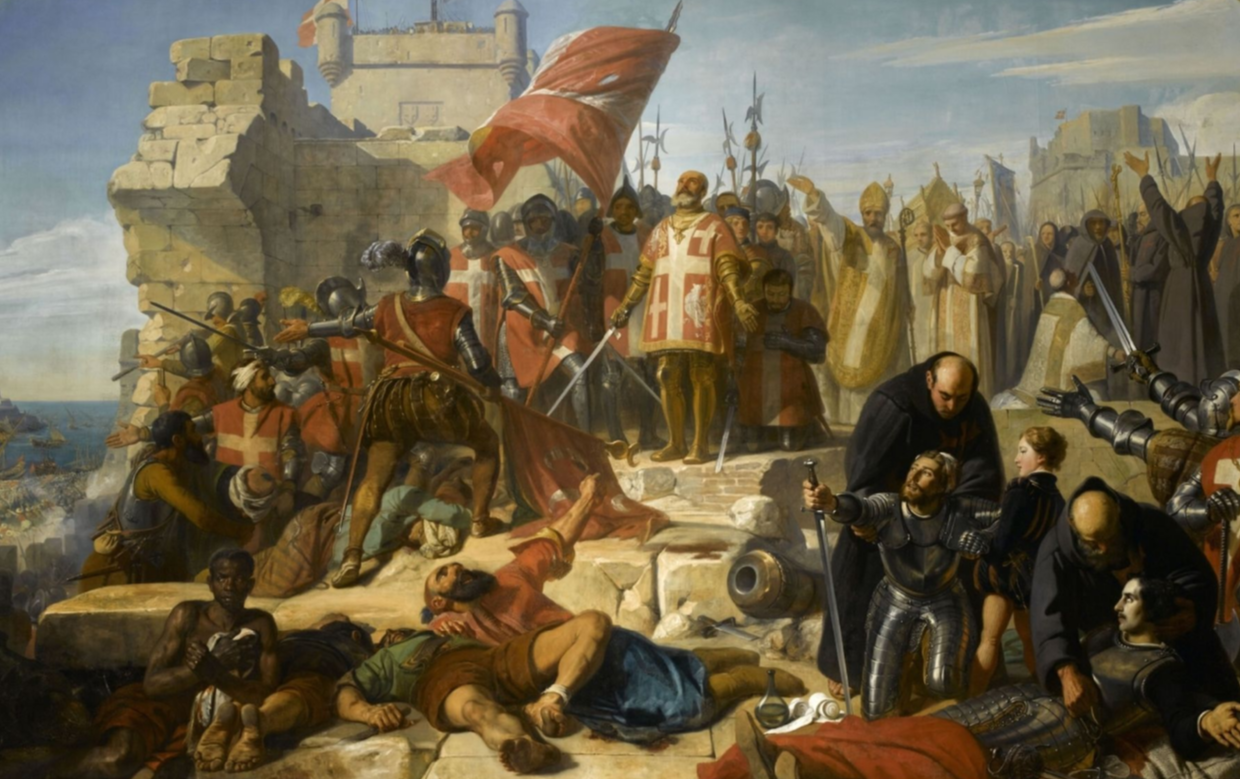
*The image used as the featured image for this post is called Lifting of the Siege of Malta painted by Charles-Philippe Lariviere.

3. Freedom! from PHALANX

Freedom! is a card driven siege game that pits the Greek freedom fighters and the besieging imperial forces of the Ottomans against each other. The siege is of the Greek Holy City of Messolonghi during the Greek War of Independence in 1825-1826. Freedom! features asymmetrical play with the goal of the invading forces being to manage to get inside the city before the end of the game or to force the citizens to abandon the cause by dropping their morale to zero while the defenders, on the other hand, try to withstand the siege and protect the city long enough for the invaders to abandon their attempt either by deciding to leave on their own or by having their morale dropped to zero. The actions of the players are driven by the cards in their hands, which highlight actual events and personalities of that time, while the combat is dice-driven to allow for quick and exciting game-play.

The rebel player is largely focused on grinding out a victory by surviving over the course of 6 rounds and are simply trying to hang on, unless of course they can somehow reduce the morale of the besieging units enough to where they give up and go home. However, nothing about this is a grind for the defending player and that is a problem that can be endemic with siege games. You as the defender, are as much a part of the action and must try to follow your own plan whenever possible to get a win. In other asymmetric siege games, the defender is often just reacting to the aggressor’s moves. As the insurgents, it never feels like you are simply reactionary and just along for the ride.

The really interesting thing about this one is that that there are actually two maps that are used to play the game. One of the maps shows the actual city and the forces involved in the siege while the other shows the surrounding areas, highlighting the support that each of them provides to both players. The art is gorgeous and this one is a game that we had a really good experience with. There also is a solitaire module that you have to buy separately but it works very well and provides an opportunity to play this game when you can’t find an opponent.

Players will find that they are competing for a number of nearby Greek regions on the board and there will be a tug-of-war played out by using various support actions that are focused on cutting off your opponent’s supplies. This is what I liked most about Freedom! It’s not just a continual back and forth trying to knock out your enemy’s units but there are multiple paths to victory, and all of them seem to be viable. By lowering your opponent’s morale and cutting them off from the supplies they need, you completely change their plans. Of course, there is nothing to stop you from pushing aggressively against the enemy’s walls.

Each side of the conflict really gives a different feel to the game and creates a new experience once you switch sides. As the Ottomans, you are generally going to undertake aggressive maneuver and attacks in an attempt to push forward and put pressure on the defenders and their walls of security. But when you play the Greeks there is a real feeling unpleasant feeling of desperation, which only gets worse with the arrival of Turkish reinforcements.

Here is a look at our unboxing video so you can get a good look at the components: 

Here is our video review used for the Kickstarter campaign so you can understand our thoughts on the game:

If you are interested in Freedom!, you can purchase a copy for €69,00 ($80.00 in US Dollars) from the PHALANX website at the following link: https://phalanx.co.uk/games/freedom-board-game/

2. Storm Over Jerusalem: The Roman Siege from Multi-Man Publishing

The Storm Over Area Impulse Series has been around for a while and includes games such as Storm Over Arnhem (1981) from The Avalon Hill Game Company, Storm Over Stalingrad (2006) from Multi-Man Publishing and Storm Over Dien Bien Phu (2014) from Multi-Man Publishing amongst several others. The hallmark of the series is relatively low complexity for a wargame and a very simple combat system that calculates total attack versus total defense and adds a roll of 2d6. The losses from combat can be absorbed by either retreating from the attacked areas or destroying units. The game system has mostly been used to model more modern wars including the Franco-Prussian War, World War II and the French conflict at Dien Bien Phu in Vietnam.

Storm Over Jerusalem: The Roman Siege is a 2-player wargame that simulates the Roman siege of Jerusalem during 70 AD. One player controls the mighty Roman forces, who are truly master of siege warfare with their siege towers, ballista, battering rams and onagers, and the other player controls the Judean forces, which are divided into 2 separate factions with different leaders. The game is 8 turns long, but can be shortened by the play of a few event cards, at the end of which time the winner is determined by calculating victory points that come from overall losses, holding of certain VP areas and keeping the Romans out of the city.

We were very impressed by the game and its overall clarity of rules, quality components and interesting tactical choices and really had a good time learning and playing it. The Judeans are obviously outclassed by the powerful and skilled Roman Legions but they have several of their own tricks to use to hold out long enough to win the day. There is a lot to like here and I am really glad that we decided to give the system a try. There were some changes specially made to introduce the style of Ancient sieges to the Storm Over Series and this is where the game really shines. The Siege Towers were an evolution of the trenches found in Storm Over Dien Bien Phu game and are very important to the Roman efforts. The walls historically were such a physical presence in the city, and were a major impediment to the Roman efforts, that they had to come up with rules to cover them. The walls provide a defensive modifier against Roman Attacks and Assaults. This Defense Value starts at +4 and can be reduced over time by successful Roman Assaults. Since Judean units have a defense of 7 or 8 the bonus provided by the walls of +4 really helps hold onto areas. Once a wall is damaged from a successful attack though, the defensive modifier can be rebuilt by the Judean player but can never be increased to its full value of +4.

The Roman player also has specific cards (Catapult, Onager, and Battering Rams) that can be used to damage or breach the walls. Once breached, the walls don’t provide any defensive bonus and allow Roman troops to flood into the city. We found that the Romans tried to focus on a specific area of the walls and made their attacks there first in order to bring the maximum attacks possible each round to force the Judean player to have to spend their time and actions on fixing the walls and bringing up reinforcement to replace those lost in retreats. To repair a wall section, the Judean player can discard a card and use the Repair Value of that card to repair walls in an area. This action though requires a fresh unit in that area to be flipped to spent to complete the repair. Walls can only be repaired back up to +3, not the original +4. You can’t rebuild them completely.

I really enjoyed our play of Storm Over Jerusalem. The game was beautifully put together, with fantastic components, but also had some really amazing details and depth to the gameplay. This one is a winner and really has me interested in the other games in the series. I know that this game had a siege focus, which is not necessarily in each of the other games, but I really liked the simple combat system, great card play and very interesting tactical choices that were there for players to have to make.

Here is a link to our full unboxing showing off the beautiful components:

Here also is a link to our full video review:

If you are interested in Storm Over Jerusalem: The Roman Siege, you can order a copy for $86.00 from the Multi-Man Publishing website at the following link: https://mmpgamers.com/index.php?main_page=product_info&products_id=355

1. Dien Bien Phu: The Final Gamble from Legion Wargames

Dien Bien Phu: The Final Gamble from Legion Wargames is a 2-player wargame about the decisive battle of Dien Bien Phu in 1954 that not only ended the French Indochina War but also had political repercussions far outside the region itself. One player represents France and her colonial troops. The other player represents the armed force of Viet Minh, the communist/nationalist independence movement of Vietnam. This game is not a traditional wargame and has different victory conditions than normal and also some unique and interesting supply rules. The Viet Minh win by forcing the French troops to surrender and France wins by not surrendering.

The board covers the former village of Dien Bien Phu and surrounding areas. There is a small submap of the French strongpoint Isabelle further south in the valley. There are several groups of French strongpoints scattered around the map, each one with a female name, which are all named after the commander de Castries’ mistresses, according to lore. The map is divided into three divisional sectors. Each sector has several zones that represent Viet Minh trenches winding from the map edge towards the center of the map. Each hex represents 150 meters and each game turn covers three days. There are 21 turns in the game, but historically, it ended after 19 game turns with a Viet Minh victory. The scale allows stacking of three French units in a hex, but there are no stacking limits for Viet Minh battalions, which creates a chess like feel.

French supply is a bit of a mini-game within the game. As this battle took place far out in the wilderness of Vietnam and both sides had to adjust to the limited flow of supplies that could be brought forward, through the air to the French, and through vast forests to the Viet Minh. Supplies tend to be a lot less than wished for. There are several supply tracks on the map showing how much ammo, food & bullets, fuel & spares, medicine as well as the amount of truck transport available for the French. The process for doing this supply phase is really pretty interesting and fun. Each game turn air transports will bring in a mix of supplies together with replacements and reinforcements. This is done on a chart with a grid where a mix of supply markers are placed together with eventual reinforcements and replacements. Weather will then decide what will arrive and what will abort back to Hanoi. The French player will never know for sure what type of supplies and how much will arrive and has to take that into account as they plan out their turns. And this is one of the best parts of the game and kept me thinking about the struggle with keeping my efforts going with the French. This one is not an easy game for either side and I think that it keeps the game very balanced and interesting to play.

Here is a link to our full video review:

If you are interested in Dien Bien Phu: The Final Gamble, you can order a copy for $54.00 from the Legion Wargames website at the following link: https://www.legionwargames.com/legion_DBP.html

A few other games that I have played on the subject of sieges, and that I very much liked, were games such as Halls of Hegra from Tompet Games, 1565 Siege of Malta from Worthington Publishing, 414 BC Siege of Syracuse from Worthington Publishing, Keep Up the Fire! Deluxe Edition from Worthington Publishing, Castle Itter: The Strangest Battle of WWII from Dan Verssen Games, Siege Works: A Napoleonic Siege Roll & Write from Solo Wargame, Crusaders: The Siege of Acre 1291 from Blue Panther/Art of Wargames, Castelnuovo 1539 from Draco Ideas and The Alamo Remembered from Victory Point Games.

What are your favorite siege based wargames?

-Grant

Wargame Watch – What’s New & Upcoming – September 2026

Von: Grant
01. September 2026 um 14:00

The year is quickly fading as we are nearing the start of the 4th quarter of 2026. Man the year has just gone by so quickly and I still have so many great games awaiting us to give them the attention they deserve. But there are always new games and they are also equally deserving. This month, I was able to find 19 games to share (including 6 games from our sponsor). I was also able to find 3 games being offered on Crowdfunding through Kickstarter and Gamefound.

If you missed the August Wargame Watch, you can read that here at the following link: https://theplayersaid.com/2026/08/03/wargame-watch-whats-new-upcoming-august-2026/

Again this month, we have a sponsor for the Wargame Watch post in Neva Game Press. This is Neva’s 3rd time sponsoring this post and they are very busy as they have a ton of new games upcoming. Neva Game Press is a new publisher who appeared on the scene 2 years ago. When I started seeing their posts on Twitter and Facebook, I was immediately impressed with their interesting topic choices for their upcoming games as well as the fact that they are trying to make small footprint wargames that pack a punch. And the art is also very appealing and brings an aesthetically pleasing and attractive look to their games!

Big Experiences, Small Footprint: New from Neva Game Press

At Neva Game Press, we believe great games don’t require massive boxes. Our ‘Hardcover Book’ box policy delivers premium components and deep, innovative mechanics in a shelf-friendly format—without compromising playability. We recently rebranded from Neva Wargames to Neva Game Press to reflect our expansion into thematic titles, though our commitment to wargaming remains stronger than ever.

End-of-Year Releases

We are closing 2026 on a high note with two major releases. After the rapid sell-out of Iwo Jima: Hell on Earth—the first volume of our Blind Valor Series—we are thrilled to bring it back as a Revised Edition, and we are grateful for the community’s support. We are also releasing an Iwo Jima: Hell on Earth Update Kit for owners of the original 1st Edition. Finally, we are launching our new tactical wargame, Peking: 55 Days of Fury—the first volume in our Breach Point Series.

Peking immerses 1–2 players in the 1900 Boxer Rebellion for a tense, 90-minute experience. Whether defending the International Legations or leading the attack, you’ll need to master our unique fog-of-war mechanic and hybrid system (featuring event cards and operation points split into two phases) to secure victory.

You can pre-order these titles via our Pre-orders section at the following link: https://nevagamepress.com/pre-order/

Looking Ahead to 2027

Our commitment to the community continues with an ambitious slate for 2027, featuring: Valls: Battle of the Goi Bridge, Spartacus: Rome under Threat, 1806: The Elbe Campaign and Reformation: Fire and Faith.

Discover all the details on our Upcoming Releases page: https://nevagamepress.com/upcoming-releases/

Pre-Order

1. The Great Anglo-Boer War: The Battle for South Africa 1899-1902 from Cadet Games Currently on Kickstarter

A few years ago, I came across this interesting looking wargame from a new company Cadet Games called They Were Soldiers: Battle of the Ia Drang Valley that was heading to Kickstarter at the time. The game was a 2-player turn-based operational level design based on the battle for LZ X-Ray during the larger Battle of the Ia Drang Valley in Vietnam, 1965. Since that successful campaign, Cadet has designed and completed several other successful campaigns including Nguyen Hue ’72: The 1972 Easter Offensive in Vietnam, Linebacker II: The Historic B-52 Strikes Against North Vietnam, Armies & Alliances: Arnhem ‘44 – Operation Market Garden and Armies & Alliances: Blitzkrieg ’40 – The Battle for France.

They recently announced their next Kickstarter project that would take their system to the Anglo-Boer War called The Great Anglo-Boer War: The Battle for South Africa 1899-1902. The game is currently on Kickstarter and appears to be a very important addition to the many games on the period.

From the game page, we read the following:

The Great Anglo-Boer War is a grand-strategic level game of the war between the British Empire and the Boer Republics in South Africa from 1899 to 1902. The Boers were armed like no other adversary the Empire had ever faced. By October 1899, war had become inevitable—and both sides were equipped for the first ‘modern’ conflict. Both sides had rifled breech-loading artillery, machine guns, bolt-action magazine rifles, trenches, barbed wire, and more.

The war started as a conventional contest but morphed into the first modern guerrilla war of the 20th century. In the end, the Empire overwhelmed the Boers, but by 1910 all of South Africa (including the contested republics of 1899) was granted self-government as a Crown Dominion, with Louis Botha as the Prime Minister. The Boers can be said to have lost the war but won the peace. A fascinating bit of history but an even more interesting study in military history.

The game places you in the position of the military commanders of both armies. Political events are largely beyond your control, but may influence what you are allowed to do. There are three scenarios – the Conventional War, the Guerrilla War, and the Grand Campaign Game. The full campaign is THE ULTIMATE BOER WAR EXPERIENCE – from the first desperate siege defenses of 1899 to the treaty of Vereeniging (or maybe not?) – and everything tactical and otherwise in between. Battles, blockhouses, farm-burnings, evasions, escapes, raids, concentration camps, sieges, drives, armoured trains, 1-pdr automatic “pom-poms”, surrenders, entrenchments, typhoid, barbed-wire, native spies, night marches, supply wagons and more. If it was part of the real Boer war – it is in the game. If you know about the war – this is the one you’ve been hoping someone would make, and if you are learning about it – this IS THE GAME for that. With a 44×34 map at 9 miles/hex scale, monthly game turns and an accurate order of battle, this is a game that truly does justice to the topic.

We published an interview with one of the developers named Kevin Talley and you can read that at the following link: https://theplayersaid.com/2026/08/31/interview-with-kevin-talley-developer-for-the-great-anglo-boer-war-the-battle-for-south-africa-1899-1902-from-cadet-games-currently-on-kickstarter/

If you are interested in The Great Anglo-Boer War: The Battle for South Africa 1899-1902, you can back the project on the Kickstarter page at the following link: https://www.kickstarter.com/projects/647106057/the-great-anglo-boer-war?

As of September 1st, the Kickstarter campaign has raised $7,389 toward its $12,900 funding goal with 86 backers. The campaign will conclude on Tuesday, October 20th at 1:38pm EDT.

2. Combat! Vietnam from Compass Games

This month we had another pretty big downloading of new pre-order games from Compass Games that I have affectionately referred to in the past as “Pre-Order Palooza”. This one was not their normal 6-10 new titles but there were 4 new games offered and they all looked very good. The first game that I am highlighting here is the next volume in the highly thought of Combat! Series of solitaire wargames. These games represent man to man combat where typically each of the counters on the board represent a single soldier. They have focused exclusively on World War II previously but now they have announced this new game set during the Vietnam War called Combat! Vietnam. I have yet to play any of the previous volumes in the series, even though I own 4 of them, but they are high on my want to play list and I am very much interested in this system because I love Tactical level games, very much enjoy man to man combat in games and also enjoy games that are set in during the Vietnam War.

From the game page, we read the following:

Combat! Vietnam is a stand-alone solitaire game of man-to-man combat in the Vietnam War, covering the years from 1965 to 1972. This game depicts the countless small actions that were fought during those years, with the player commanding a squad of American, Communist, or South Vietnamese soldiers. In the 11 scenarios, the fighting rages across the widely varied terrain of Vietnam, from dense jungles to city streets.

The comprehensive Random Scenario Generator (and Campaign Game) further expands your gaming possibilities. With this tool, players can generate a limitless supply of unique scenarios for Combat! Vietnam.

Combat! Vietnam also includes Armor rules, allowing the player to relive iconic scenes such as T-54 tanks charging south during the Easter Offensive or Marine Patton tanks battling through Hué.

If you are interested in Combat! Vietnam, you can pre-order a copy for $105.00 from the Compass Games website at the following link: https://www.compassgames.com/product/combat-vietnam-pay-later/

3. Viking Dawn: A Game of Viking Exploration & Expansion 800-1040 A.D. from Compass Games

The 2nd game from Compass Games today is a good one. And I know that because I have played it. But, our friend Gregory M. Smith is a solitaire game designing genius and has done many of these solo, narrative driven style wargames that we have all enjoyed for hours on end while we have been unable to find an opponent or just because we want to play a game on our timeline. We have interviewed him many times for his games such as Zeppelin Raider, Interceptor Ace, The Hunted, Western Front Ace, Amerika Bomber, Defending America, American Tank Ace, British Tank Ace, Rebel Tide, Sinking Yamato and most recently for a magazine wargame called B-52D Linebacker II. But Greg is a versatile designer and also has done many great 2-player games as well. He always has something cooking in his game design kitchen and recently we spoke with him about his new design with Kevin McPartland called Viking Dawn: A Game of Viking Exploration & Expansion 800-1040 A.D. from Compass Games. I was able to play this 1-4 player game while at the World Boardgaming Championships last month and you can read about my experience at the following link: https://theplayersaid.com/2026/07/27/world-boardgaming-championships-2026-daily-debrief-series-day-3/

From the game page, we read the following:

Viking Dawn is a low-complexity strategic game, with rules for two, three, or four players, each controlling a faction of Vikings (Norse, Swede, Dane, and optionally Geat). Inspired by SPI’s game Conquistador! from the 1970’s, Viking Dawn has exploration, trade (both internal and external), and minor leaders. The game also contains rules for solitaire play with the Danes or Norse.

Faction descriptions:

Norse – closest to the New World, they have the additional advantage of two Explorers, Erik the Red and Leif Eriksson.

Danes – closest to the lucrative raiding and settlement targets of England, they also have the advantage of having several early leaders.

Swedes – although further from England, they are closest to several Russian settlement areas, and river portage routes to the east and Constantinople.

Geats – ostensibly the weakest faction, as they must pay tribute to the Swedes for protection, they have the best trading advantage in the game.

Players compete to raid lucrative settlements and explore the world with longships and warbands. Each faction has named historical leaders, who have an impact on combat and exploration. Players may trade with each other or nonplayer-controlled areas and establish settlements. Includes rules for settlements gaining independence, leader burials, and establishment of the Varangian Guard.

We published an interview with Greg Smith on the blog and you can read that at the following link: https://theplayersaid.com/2026/08/24/interview-with-gregory-m-smith-designer-of-viking-dawn-a-game-of-viking-exploration-expansion-800-1040-a-d-from-compass-games/

If you are interested in Viking Dawn: A Game of Viking Exploration & Expansion 800-1040 A.D., you can pre-order a copy for $54.00 from the Compass Games website at the following link: https://www.compassgames.com/product/viking-dawn-pay-later/

4. Tunnel Rats: The Vietnam War Underground from Compass Games

Game 3 in this month’s mini-Pre-Order Palooza from Compass Games is another very interesting looking game set during the Vietnam War called Tunnel Rats: The Vietnam War Underground. This game is a solitaire game, which I think makes a lot of sense historically and thematically and actually gets me very excited for the possibilities, and I very much look forward to seeing how this one works. I have great hope for this one. The designer is Lisa Smedman who has done several recent popular solo games including Trench Raid.

From the game page, we read the following:

Tunnel Rats is a single-player game set during the Vietnam War. You will control two American “tunnel rats” who have been tasked with exploring an underground tunnel complex created by the Viet Cong. This complex is made up of tiles representing tunnels and underground rooms in which the enemy may be lurking. In this claustrophobic environment, the tunnel rats need to be as quiet as possible to avoid alerting the enemy. Tense firefights and hand-to-hand combat feature a unique initiative system, and encounters are fast and furious.

With a procedurally generated map, nine tunnel rat characters to choose from, and a variety of weapon and equipment load-outs, each “run” will provide a new and dynamic challenge. Your team’s objective will vary, shifting the focus of play depending upon which lieutenant is in command of the team. Tunnel Rats also includes rules for campaign play, allowing surviving tunnel rats to gradually hone their skills over time – if they survive.

Be on your guard, as the tunnel rats never know what they will encounter down in “the black”. It might be a hidden punji stake pit, a Viet Cong command center filled with valuable documents, a venomous snake slithering along a tunnel, or a water trap they must swim through without drowning!

If you are interested in Tunnel Rats: The Vietnam War Underground, you can pre-order a copy for $54.00 from the Compass Games website at the following link: https://www.compassgames.com/product/tunnel-rats-the-vietnam-war-underground-pay-later/?sfw=pass1788184209

5. Against the Reich Deluxe Edition from Compass Games

Game 4 from the Compass Games mini Pre-Order Palooza is a classic hex and counter operational level wargame set in World War II called Against the Reich Deluxe Edition designed originally by Joseph Balkoski.

From the game page, we read the following:

In June of 1944, the world held its breath as land and naval forces of six Allied nations launched the largest amphibious assault ever attempted. The long-awaited second front, the Western Front, was finally open. The Allies had to force the unconditional surrender of Nazi Germany by crossing the great Rhine River into the Reich itself. Adolf Hitler was confident that the battered but undefeated Wehrmacht could hold two enormous fortified zones (the Atlantic and Westwalls) and repulse any attempt to cross into the German homeland. Against the Reich is the first game in years to cover the entire Western Front campaign. The players are in the positions of Eisenhower and Hitler, making the grand decisions that control the course of the campaign.

  • A Quick-Playing Simulation: Designer Joseph M. Balkoski, whose specialty is the Western Front, has provided an accurate, realistic simulation that plays like a game. With short and long campaign games, you can choose the length of the simulation.
  • Headquarters and Supplies are Realistically Linked: Players must decide where to concentrate their resources. Limited supplies make the placement of headquarters and depots a critical factor in the campaign.
  • Choice of Invasion Sites: The Allied player must decide where to invade – do you strike a lightly defended area and accept a long, grinding ground campaign, or strike close to the Rhine and risk quick destruction?
  • Historical Overview: Russel F. Weigley, author of Eisenhower’s Lieutenants, the definitive history of the Western Front, has analyzed the strategic options facing Eisenhower and Hitler – and the players.
  • Loaded with other Features: A short “Battle of the Bulge” scenario, Second Invasion, Flooding Holland, Port Repair, The Roer Dams, Rail Movement, Mediterranean Front Reinforcements, Amphibious and Airborne Assaults, and much more.

If you are interested in Against the Reich Deluxe Edition, you can pre-order a copy for $54.00 from the Compass Games website at the following link: https://www.compassgames.com/product/against-the-reich-deluxe-edition/

6. Enlightenment Empires: Power and Politics in Eastern Europe, 1725-1795 from GMT Games

One of my favorite parts about historical wargaming is that I get exposed to and am able to learn about some of the more obscure parts of our world’s history. Now you might be saying to me that the subject of power politics in Eastern Europe form 1725-1795 is not obscure and I think that you would be correct if I was from Eastern Europe. But as I am from the United States, this is not a period or locale that we learned much about in grade school. That being said, I am very much interested in this concept and history and am glad to see Brian Asklev taking another crack at a topic that focuses on some of the history from his neck of the woods. When Enlightenment Empires: Power and Politics in Eastern Europe, 1725-1795 was first announced a few weeks ago, I was immediately interested because I do love games where several nations have to compete economically, politically, diplomatically and through force of arms. I also recently played Brian’s Baltic Empires at WBC and very much enjoyed that game and this one appears to be in a similar style and uses the very interesting Dramatis Personae cards to inject historical characters with their abilities into the game play.

From the game page, we read the following:

Enlightenment Empires is an approachable 2-5 player strategy game about conflicts between the states of Central and Eastern Europe region during the Enlightenment era, a transformative period of political upheaval, large-scale warfare, and constant struggles for power. Players will have to develop their economy, decide their internal policies on the ideas of individual liberty and effective governance, secure trade deals and financial assistance within the context of the global rivalry between Britain and France, and finally build armies to become the dominant power of Central and Eastern Europe. Russia, Poland-Lithuania, Prussia, Austria, and the Ottoman Empire will fight for hegemony, using variable victory conditions that reflect their respective historical objectives.

Building on the solid foundation provided by Baltic Empires, highlights of Enlightenment Empires include:

  • Five new asymmetric factions with unique abilities and objectives, including a new “Constitution” objective reflecting the pinnacle of Enlightenment political ideals.
  • Another highly thematic deck of historical Dramatis Personae to constitute your royal court, now also including random events that can disrupt players’ plans…or present them with new opportunities.
  • A simplified, yet still deep and political, economic system that forces players to make tough decisions regarding their state’s internal policies (serfdom, noble privileges, and military spending) and its diplomatic relations to the superpowers of the period, England and France.
  • The same streamlined battle system based on custom dice per unit type, now modified by military reforms.
  • More detailed minor powers that players may form alliances with.
  • Variable player counts (from 2 to 5 players), with scenarios ranging from a tight duel to a tense multiplayer conflict replete with alliances and betrayals.

If there is a word that could define the whole of 18th century, it would be the Enlightenment. The philosophical thought that applied reason to all spheres of life guided the social and political developments of the 1700s, and intellectuals, scientists, politicians, and rulers alike acted either in support of it or against it. And while in Western Europe the republican ideals of enlightenment brought about the French Revolution, in Central and Eastern Europe enlightenment became a tool for state-building for the absolutist monarchs, including the Holy Roman Emperor and Archduke of Austria Joseph II, King Frederick II of Prussia, or Empress Catherine the Great of Russia. The mid-18th century period was formative for these powers, with Prussia and Russia continuing to struggle to establish their dominance in the region, while Austria and the Ottoman Empire fought to preserve their status, and the weakened state of Poland-Lithuania struggled to reform its constitution before meeting an unlucky demise. Three of the traditional “pentarchy“ of Great European Powers (namely, Russia, Prussia, and Austria) were Eastern powers that achieved this status during the 18th century. Their dominance in the region was forged by the work of bureaucrats and reformers, as much as by the soldiers and generals on the fields of the Seven Years‘ War.

Keep in mind that these type of games can sometimes be very complex and have lots of moving parts. And I am not saying that this doesn’t have them but Brian has said that the game is very approachable.

Enlightenment Empires presents these political and military conflicts in a fun and accessible format, while also doing justice to the fascinating history of the region during this period. The game features five asymmetric factions with different strengths, internal political conditions, military forces, and historical objectives, along with the capacity to develop their states by conducting reforms along (or against) Enlightenment ideals, investing in economic infrastructure, and recruiting key historical characters that offer unique game effects. The game also includes several scenarios for variable player counts and durations, offering additional flexibility and replayability.

If you are interested in Enlightenment Empires: Power and Politics in Eastern Europe, 1725-1795, you can pre-order a copy for $79.00 from the GMT Games website at the following link: https://www.gmtgames.com/p-1256-enlightenment-empires-power-and-politics-in-eastern-europe-1725-1795.aspx

7. The Last Hundred Yards Volume 6: The Forgotten Hell from GMT Games

If you didn’t know we really enjoyed The Last Hundred Yards as well as Volume 2: Airborne Over Europe. The system is extremely interesting for a tactical game and uses some novel elements in regards to how victory points are scored including a focus on time to complete missions as well as the casualties incurred. Really an excellent system with lots of crunch and potential! Now, even though there are a total of 5 other volumes that have been released, Mike Denson has forged ahead with the next entry in the series which gives us a look at the operations in New Guinea and the Northern Solomon Islands during WWII with The Last Hundred Yards Volume 6: The Forgotten Hell.

From the game page, we read the following:

The Last Hundred Yards: The Forgotten Hell is Volume 6 in The Last Hundred Yards Series. This game examines the Allied campaigns against Japan in 1942, focusing on U.S. operations on Guadalcanal and Australian fighting in Papua New Guinea. 

In New Guinea, Australian militia and the Australian Imperial Force troops fought a brutal and desperate delaying campaign along the Kokoda Track from Port Moresby to Buna, Battling through jungle, mountains, rain, mud, hunger, disease, and exhaustion, they resisted repeated Japanese advances and flanking attacks. Their stubborn defense slowed the enemy, shielded Port Moresby, and eventually helped reverse the campaign. At Milne Bay, Australian forces pushed the Japanese back and shattered the belief that the Imperial Japanese Army was invincible. 

On Guadalcanal, U.S. Marines and Army troops fought equally savage battles, destroying Ichiki’s force at Alligator Creek and later assaulting entrenched Japanese positions around Mount Austen. There, the enemy used caves, rocky ridges, and concealed strongpoints to prolong the struggle.

Together, these engagements reveal the intensity of jungle warfare in the Southwest Pacific, where endurance, small-unit leadership, and relentless attacks under terrible conditions shaped the early Allied offensive against Japan. These actions also showed how terrain, logistics, and morale could decide campaigns as surely as firepower across the battlefields of the Solomons and New Guinea alike.

If you are interested in The Last Hundred Yards Volume 6: The Forgotten Hell, you can pre-order a copy for $47.00 from the GMT Games website at the following link: https://www.gmtgames.com/p-1255-the-last-hundred-yards-volume-6-the-forgotten-hell.aspx

8. Shenandoah: Jackson and Sheridan in the Valley, 1862 – 1864 (Stonewall in the Valley and Sheridan in the Shenandoah) from Multi-Man Publishing

A BIG and well respected American Civil War operational system is what Great Campaigns of the American Civil War (GCACW) is and the newest volume in the series is called Shenandoah: Jackson and Sheridan in the Valley, 1862 – 1864. One of the things that I very much appreciate about this system is the fact that they use some of the best art out there for their covers.

From the game page, we read the following:

Shenandoah: Jackson and Sheridan in the Valley, 1862 – 1864 is the latest design in the award-winning Great Campaigns of the American Civil War (GCACW) Series. It contains both a complete redesign of the Stonewall in the Valley (SIV) game covering Stonewall Jackson’s 1862 valley campaign and a completely new game module Sheridan in the Shenandoah that depicts Sheridan’s 1864 valley campaign. The game is designed by Joe Balkoski (the original GCACW Series creator) and Chris Withers. The original SIV game maps have been upgraded to contain the latest GCACW map features, with map design executed by artist Charlie Kibler—whose work on the series dates to its creation in 1992.

Shenandoah: Jackson and Sheridan in the Valley, 1862 – 1864 uses the latest version of the GCACW Standard Basic Game Rules, which also apply to all other games in the series, and these rules are now printed at an increased 11-point font size instead of 9-point. After more than a quarter-century of refinement, these rules are extremely well organized and relatively easy to learn, even for series newcomers. The Advanced Game rules cover situations specifically applicable to these unique campaigns such as “The Burning” that depicts the desolation of the valley by Union cavalry in 1864.

Stonewall in the Valley includes one new Basic Game scenario, the four original Basic Scenarios rebalanced, and the original Advanced Game campaign scenario extensively revised:

  • The Battle of Kernstown (March 23, 1862; 1 turn): Introductory scenario on the battle of Kernstown – ideal for beginners.
  • My Last Council of War (March 10 to March 23, 1862; 14 turns): Heavily outnumbered, Jackson moves south from Winchester thru Strasburg to Mt. Jackson. A Union force of three divisions follows to Strasburg while sending two divisions out of the Valley to reinforce McClellan. Jackson races back north and attacks the remaining Union division at Kernstown but loses the battle.
  • God Blessed Our Arms at McDowell (April 30 to May 11, 1862; 12 turns): Historically, Jackson moves west from Staunton and causes the Union force at McDowell to retreat north to Franklin. He briefly pursues them but then returns to the Valley. This scenario postulates what might have happened had Ewell’s division and Banks’ two divisions become involved in the McDowell campaign instead of holding fast in their camps in the south of the Valley.
  • Rebel Blitzkrieg (May 21 to June 2, 1862; 13 turns): Jackson and Ewell advance north on the Luray Pike and surprise the small Union force at Front Royal. A Union division entrenched at Strasburg to the west belatedly discovers it is in danger of being cut off and just beats Jackson north to Winchester. Jackson defeats the Union at the first battle of Winchester and pursues to Harpers Ferry. Meanwhile strong Union forces are moving in behind Jackson from both the east and the west. Jackson turns south, marching to Strasburg and then Mt. Jackson and barely avoids the trap.
  • Our Beautiful Valley Will be Cleansed (June 6 to June 11, 1862; 6 turns); Two Union columns, separated by the Shenandoah River, pursue Jackson south from Strasburg. Fremont’s force engages the Confederates at Harrisonburg and then two days later battles them at Cross Keys. Meanwhile Shields’ division advances into Jackson’s rear and almost captures his wagon train. Jackson turns his army from Fremont to Shields and defeats Shields in the battle of Port Republic causing both Union forces to pull back north.
  • Jackson’s Shenandoah Valley Campaign (March 7 to June 19, 1862; 105 turns): The entire Valley campaign is covered in this scenario. Both sides typically have forces moving all over all three maps in exciting maneuvers and with forces coming and going due to external events. The scenario plays quite fast due to lulls where sets of 5 turns are skipped. The original advanced rules have been simplified, and the scenario has been extensively playtested and re-balanced.

Sheridan in the Shenandoah includes twelve Basic Game scenarios and two Advanced Game campaign scenarios, all extensively playtested:

  • Second Winchester (June 13 to June 15, 1863; 3 turns): Ewell’s corps leads the Confederate army thru the Valley to invade Pennsylvania and routed the Union division at Winchester. The Rebels cut off the Union retreat and captured most of the Union division. The route was now clear for Lee’s invasion of the north.
  • The Battle of New Market (May 15, 1864; 1 turn): Introductory scenario on the battle of New Market – ideal for beginners.
  • Piedmont (June 4 to June 6, 1864; 3 turns): Picking up the after Sigel’s debacle at New Market, Union General David Hunter marches south from Winchester. With Breckinridge, Confederate hero of New Market, aiding Lee at Cold Harbor, defense of the Valley falls to a ragtag collection of troops that are rushed to the area under General W. E. “Grumble” Jones. The forces battle at Piedmont, Jones is killed, the Rebels are routed, and the Union captures Staunton.
  • In the Valley Again (July 23 to August 5, 1864; 14 turns): Early’s army moved back into the Valley in mid-July after retreating from the outskirts of Washington, D.C. On July 23, Confederate scouting revealed that Early was only opposed by Crook’s forces and not the VI and XIX corps, which had returned to D.C. Early attacked Crook at Kernstown and routed the Union forces which retreated across the Potomac. Confederate infantry destroyed the B&O RR at Martinsburg and threatened to invade north. Two Confederate cavalry brigades advanced north towards Chambersburg, burned it, and were chased by 2 Union cavalry divisions. Meanwhile, the VI and XIX corps had been recalled to the Valley, but then along with Crook’s force, moved east to protect against an assumed invasion again by the Confederates. The Union force soon countermarched back to Harpers Ferry and the Confederates retreated south.
  • Second Kernstown (July 24, 1864; 1 turn): A simple scenario covering the second battle of Kernstown – ideal for beginners.
  • Sheridan Takes Command (August 10 to August 14, 1864; 5 turns): Sheridan took command of all forces in the region on August 7th. His orders were “wherever the enemy goes let our troops go also”. The plan was to trap the Confederate infantry in the northern valley, but Early knew the danger and moved south just ahead of the Union. Both sides marched rapidly south until the Confederates setup a strong line at the Fisher’s Hill. Sheridan prepared to attack but halted his plans when a strong force under Anderson entered the Valley at Front Royal.
  • You Must Be Cautious (August 17 to August 21, 1864; 5 turns): With the Union infantry camped along Cedar Creek and the Confederates entrenched in a strong line at Fisher’s Hill just to the south, Sheridan learned of the approach of Kershaw’s division. This elicited a new directive from Grant warning Sheridan he “must be cautious and act on the defensive until movements … force them to detach” troops. Therefore, Sheridan conducted a night march to Winchester. From there the Union briefly defended at Berryville and then at Charlestown. The Confederates pursued and eventually tried to bring on a battle at Charlestown. However, Sheridan was cautious and followed the new defensive strategy and disengaged to retreat into a strong, compact line at Halltown, just in front of Harpers Ferry.
  • Third Winchester (September 19, 1864; 1 turn): This scenario depicting the third battle of Winchester is only one turn but still features lots of maneuver and combat.
  • From Winchester to Fisher’s Hill (September 19 to September 22, 1864; 4 turns): This scenario encompasses two significant battles in the valley campaign. The Union army attacked the Confederate defensive line just east of Winchester and eventually drove the Rebels back to Winchester. This final Confederate line collapsed, and they retreated south all the way to a formidable defensive position at Fisher’s Hill, just south of Strasburg. The Union pursued and then rolled the west flank of this line and routed the Confederates.
  • Early’s About Played Out (September 23 to September 26, 1864; 4 turns): After the battle of Fisher’s Hill the Confederates retreated south. The Union pursued with their entire army, but the action for the next few days was limited to cavalry and rear-guard skirmishes. The Confederates safely made it to Brown’s Gap, while the Union infantry stopped at Harrisonburg and Union cavalry started burning the countryside.
  • Tom’s Brook (October 9, 1864; 1 turn): This solitaire scenario is filled with cavalry action and is an excellent learning scenario for beginners.
  • The Battle of Cedar Creek (October 19, 1864; 1 turn): While this is only a 1-turn scenario it is filled with the action that took place in the battle of Cedar Creek. The Confederate player starts with a Night March and a Surprise Attack. The Union responds with a special “Sheridan’s Ride” action to enable counterattacks.
  • Sheridan Moves South (September 19 to October 20, 1864; 32 turns): This scenario spans the battles in the campaign from when Sheridan attacked the Confederates at Winchester, to when the Confederates were defeated at the battle of Cedar Creek. This campaign can be easily played in a weekend.
  • The Last Valley Campaign (July 21 to October 20, 1864; 92 turns): This scenario encompasses the entire campaign from when Early’s army returned to the Valley after his raid on Washington, to when he was defeated at the battle of Cedar Creek. There is maneuver and combat all over all three maps in this scenario. The action often starts with a Confederate offensive and advance to the Potomac. The Union then gets significant reinforcements to launch counteroffensives.

If you are interested in Shenandoah: Jackson and Sheridan in the Valley, 1862 – 1864, you can pre-order a copy for $75.00 from the Multi-Man Publishing website at the following link: https://mmpgamers.com/shenandoah-jackson-and-sheridan-in-the-valley-1862-1864-p-470

9. Okinawa: The Last Battle of WWII Reprint from Best with 1

I love a new and interesting way to tell the story of a key battle and I found a very interesting one called Okinawa: The Last Battle of WWII from Best with 1 earlier this year. This is a solitaire only game and for each game the player will draw four objectives from a possible 12 that you must survive and capture before time runs out. On your turn, the player will roll special dice and then spend those to take actions such as movement, attack and take special actions from different unit action cards that will be set up in a square from from 1 to 10. The numbers coincide with the dice of the attacking Japanese and as the player moves through the rondel they will be able to activate and use their different soldiers to attack the Japanese defenders or use their special abilities to gain tokens that can be used for rerolls or healing of wounds

I think that the best part of the game is the concept of resource management as you have to use the dice appropriately to move and fight and also to manage your troops as you can upgrade certain cards as you pass the midway point of the round as well as when special actions are granted via the special resource chits. Upgrading units is very important as this will unlock things like heavy weapons in the form of bazookas, a Sherman tank and planes to be able to take out the Japanese armor units defending the island. The game is about efficiency of movement and doing the most with what you have. The dice determine what you can and can’t do and movement is optional as you don’t have to move unless you feel it is advantageous. But remember, that you have to defeat the defenders and the various objectives to be able to advance to your final objective and sitting in one space too long is not advisable.

The different units have various functions including attack, such as the Rifleman, Machine Gun Team and Sniper but also have secondary functions to remove the fog of war, heal your damaged units or gain additional resources. The Japanese defenders are well hidden and also have various defenses such as pill boxes and caves that will require the player to defeat these before moving to attack the units located inside.

In the end the game is about defeating the Japanese defenders while doing so in a set amount of revolutions around the rondel setup. This can be as few as 2 times around or as many as 4 and knowing when to use your resources to reroll your dice, as you either didn’t get the run of consecutive numbers you were looking for or just need a specific number, you will run out of resources quickly and you must plan them out as best you can to win the game. This one is really fun and I have played it about a dozen times winning about 70% of the time. The game plays in about an hour and the action is fast and furious and you are immediately beset by the staunch Japanese defenders and must act quickly.

Here is a link to our unboxing video:

Here is a link to my playthrough video:

Here also is a link to my video review:

If you are interested in Okinawa: The Last Battle of WWII Reprint, you can pre-order a copy through the Hero Bound Gamefound Campaign on the Add-Ons page found at the following link: https://gamefound.com/en/projects/gabe-barrett/herobound-solo-game-of-the-month#/section/addons

You do not have to buy the Hero Bound game but can order the game as an Add On.

10. Tank Clash: Eastern Front from Ameba Games

I love to highlight these little campaigns that I find on Kickstarter and this month there is a new company, or at least that I am not familiar with, called Ameba Games that is offering a small game called Tank Clash: Eastern Front. This games appears to be the 2nd game in the series with the 1st being called Tank Clash: Western Front.

From the game page, we read the following:

Tank Clash is back with new iconic World War 2 tanks!

The Red Army is spearheaded by the powerful Soviet armoured units like the T34, SU100 and IS2. Germany pins its hopes on the last of the panzer divisions to halt the Soviet advance. The Wehrmacht fields its fearsome tanks like the Stug III, Nashorn and Tiger II for the coming battle.

The stage is set for the largest clash of late-war heavy armour.

Tank Clash: Eastern Front is a standalone tactical tank warfare game for 2 players, designed for both newcomers and seasoned strategists. Easy to learn yet rich in tactical choices, it combines its signature checkers-style armour tracking system with dice rolling and hand management for intense skirmish battles.

Already own Tank Clash: Western Front?  

Built with modularity in mind, Eastern Front is fully compatible with its predecessor. Combine both games to command 12 unique tank types across expansive battlefields with up to 4 players. Eastern Front’s new features – including new missions, battlefield tokens, event cards and enhanced gameplay elements can also be incorporated into Western Front for an even richer combat experience.

I know what you might be thinking, as the art is a bit cartoony, but I am going to give this one a chance. I think that any wargamer likes to use tanks and this one appears to be focused on these metal monsters and I am going to give it a go. Plus the components are really nice, including some very well made poker chips that are used on the board, and frankly the price of $40 is probably worth what you re getting.

If you are interested in Tank Clash: Eastern Front, you can back the project on the Kickstarter page at the following link: https://www.kickstarter.com/projects/ameba/tank-clash-eastern-front

As of September 1st, the Kickstarter campaign has funded and raised $9,054 toward its $3,928 funding goal with 108 backers. The campaign will conclude on Wednesday, September 16th at 9:00pm EDT.

New Release

1. A Hellish Fight: The Battle of Fort Sumter – 1863 from High Flying Dice Games

I love lesser gamed subjects. Or even sometimes games that have never seen the light of day and never touched certain subjects. It is always nice to play something unique and interesting while learning new parts of history. High Flying Dice Games does this exceptionally well as they have made their living on doing lesser (or even totally) unknow battles in their small format games. This month they have released a game that focuses on the 2nd siege of Fort Sumter in Charleston, South Carolina in 1863 called A Hellish Fight: The Battle of Fort Sumter – 1863. This one looks pretty interesting and appears to focus on the iron clad battles and bombardment of the ruins of the fort that were still held by the Confederates.

From the game page, we read the following:

Following the capture of Fort Wagner on September 7th, and the protracted bombardment of Fort Sumter by the Union navy’s ironclads as well as army land batteries, an assault to take the fort’s ruins was planned. Admiral Dahlgren and General Gilmore both felt that securing Fort Sumter’s capture would not only lead to Charleston’s surrender, but send a clear signal that the Confederacy’s days were numbered.

If you are interested in A Hellish Fight: The Battle of Fort Sumter – 1863, you can order a copy for $18.95 from the High Flying Dice Games website at the following link: https://www.hfdgames.com/sumter.html

2. Guadalcanal: The Battle for Henderson Field, Oct 23-26, 1942 from Dan Verssen Games

The Valiant Defense Series designed by David Thompson has been one of my favorite solitaire wargame series of the past nearly 10 years. Each of the volumes in the game address very specific situations and always have a very interesting take with fun mechanics, great art and fantastic production. The torch for the series though has been passed to a new designer in Vincent Cooper. He has designed Volume 5 Guadalcanal: The Battle for Henderson Field, Oct 23-26, 1942 and it has finally fulfilled off of Kickstarter.

From the game page, we read the following:

Take command of the valiant Marines of the 1st Marine Division, supported by Soldiers of the 164th Infantry Regiment, desperately defending Henderson Field against waves of Japanese troops. Guadalcanal: The Battle for Henderson Field is a solitaire and cooperative tactical wargame published by Dan Verssen Games (DVG) as Volume V in the Valiant Defense Series.

Here is a bit of a designer diary/commentary from the designer Vincent Cooper:

This all started about 3 1/2 years ago when I first played Pavlov’s House. I say played. I ‘played’ the game for about 10 minutes…and then I sat there in stunned disbelief at how a game could be sooooo good!!!!

By the time I finished there were two very clear ideas for games fully formed. I contacted DVG to see if there was any interest and they put me in touch with David Thompson. I didn’t hold much hope. There was no reason for him to trust his IP to me, a person he didn’t know.

But I gave it a try and David, it turns out, is one of the nicest people you can ever come into contact with. After some back and forth, the idea for Guadalcanal – The Battle for Henderson Field was born (not, in fact, one of the original ideas, but we’ll see what the future holds for them…).

The game has been through various stages of development and now stands ready to KS!! 🙂 I will be giving more details in the future about the various variant play options, but have no fear: This will keep you scratching your head looking for the right decision for MONTHS!!

Art by the supremely talented Nils Johansson 🙂 🙂 🙂

Thank you to all the play testers, and in particular Glenn Saunders, Shane Freshwater and Martin Fenwick Charlesworth 🙂 🙂 Much more to come from out design team in the near future!!!

We published an interview with the designer Vincent Cooper on the blog and you can read that at the following link: https://theplayersaid.com/2024/07/29/interview-with-vince-cooper-designer-of-valiant-defense-series-volume-v-guadalcanal-the-battle-for-henderson-field-oct-23-26-1942-from-dan-verssen-games-coming-to-kickstarter-july-30th/

If you are interested in Guadalcanal: The Battle for Henderson Field, Oct 23-26, 1942, you can order a copy for $79.99 from the Dan Verssen Games website at the following link: https://dvg.com/products/guadalcanal?_pos=1&_psq=Guadalcanal&_psid=70d962a51&_ss=e

3. Road to the Rhine from Compass Games

A few years ago, Road to the Rhine designed by Frank Chadwick was announced and it is now ready to ship.

From the game page, we read the following:

In the cataclysmic battle of the Falaise Pocket, the Allied forces defeated the German army and drove them back across France in disorder. In the south of France, American and French troops of the 6th Army Group have stormed ashore and driven the remnants of the German 19th Army north toward the border.

Road to the Rhine covers the Allied pursuit of the German Army following the Normandy breakout through fierce fighting at the West Wall and bridging the Rhine River. The campaign game covers the period from September 1944 through April 1945, while separate shorter scenarios include Operation Market-Garden and the Battle of the Bulge. The game includes two battle games (one-turn scenarios), two longer scenarios, and one full campaign game. The game also includes extensive designer notes from original game designer Frank Chadwick and a historical play-through of the Bulge battle game.

Road to the Rhine is another classic by Game Designers’ Workshop, re-mastered by Compass Games. Originally designed by Frank Chadwick, this edition pays tribute to the classic by honoring the original game system while introducing many enhancements for gameplay purposes. In terms of presentation, we upgraded all components, including completely new full-color maps, new reinforcement and new unit displays, expanded turn and supply tracks, enhanced charts, a rulebook with incorporated errata, and larger counters.

This one does have two 22″x34″ maps but with only 2 countershafts so it is large in scope but not necessarily in scale as it appears to be fairly low counter density. One to keep an eye on though as it is designed by Frank Chadwick and is a remastering of the classis GDW release in 1979.

If you are interested in Road to the Rhine, you can order a copy for $69.00 from the Compass Games website at the following link: https://www.compassgames.com/product/road-to-the-rhine/

As usual, thanks so much for reading along and sticking with me this month as I navigated through the many websites and game pages looking for new and interesting games to share.

Finally, thanks once again to this month’s sponsor Neva Game Press!

-Grant

Vietnam’s Road to Essen board game design contest back for second year, with longer runway aimed at turning publisher interest into deals

24. August 2026 um 13:23

Road to Essen, a competition designed to showcase Vietnam’s burgeoning tabletop design scene at the world’s biggest board game fair, has returned for its second year – with organisers changing things up in the hope of helping turn publisher interest into commercial deals.

The contest was launched last year by Vietnamese board game publisher Everjoy Publishing and its global arm Everjoy Global, in an attempt to help designs from Vietnamese creators break out internationally.

Entrants receive access to workshops and playtesting, while later-stage contestants receive mentoring and jury feedback, with selected games ultimately presented to the international industry at the giant Spiel Essen board game fair in Germany.

Thinh LeHuu’s co-operative card game July, themed around Vietnam’s seventh lunar month and its Hungry Ghost festival, was named the inaugural champion last year from about 160 entries – winning over a judging panel that included Cascadia designer Randy Flynn with its “clever gameplay, polished design and cultural message”.

The 2026 competition is now under way with a theme of ‘Vietnamese Culture’, encouraging designers to draw on areas including the country’s history, legends, beliefs, festivals, folk arts, cuisine, crafts and architecture.

Rulebook cover for July, designed by Thinh LeHuu

But there is a significant change to the timetable this time around: rather than taking the winner to Spiel just weeks after the competition concludes, organisers have scheduled their next international showcase for Spiel Essen 2027.

Claire Ton, head of the organising committee for Road to Essen 2026, told BoardGameWire, “It’s a deliberate decision to give the work its best possible shot.

“A winner chosen in late 2026 can’t have a polished, publisher‑ready game on the Essen floor a few weeks later – and a rushed debut serves the designer least of all.

“Aiming this edition at SPIEL 2027 gives the winning team close to a full year to develop the game, act on the judges’ feedback, line up a publishing or distribution partner, and arrive ready to actually do business.

“It also lets us plan the Vietnamese presence at the fair properly. Getting a Vietnamese game to Essen was never really the goal – getting it there ready to sell is.”

The extra development period addresses one of the main barriers Road to Essen was created to tackle: getting games from Vietnam’s rapidly-growing community of local designers into a form that can be presented effectively to publishers and distributors outside the country.

Everjoy Global co-founder and CEO Ionah Nguyen told BoardGameWire in 2025 that Vietnam had experienced a roughly 400% increase in locally-designed games entering its market in just two years – but said designers continued to face a lack of international publishing and distribution connections, language differences, unfamiliarity with global supply chains and the cost of attending overseas shows.

Almost a year later, Ton told BoardGameWire, “The first edition did exactly what a first edition should: it put Vietnamese design in front of the world and proved there’s real appetite for it.

“We brought the games to SPIEL Essen 2025 and the response was genuinely exciting – our winning title, July, drew particular attention.

“That interest is now powering the next stage. Most of our finalists are deep in development, sharpening their games with everything they took from our international judges and from the fair floor.

“We’re building deliberately for lasting outcomes rather than quick headlines – the first publishing deals to come out of Road to Essen should be the right ones, and we’d rather bring a title to market ready to succeed than rush it out early.

“There’s a lot moving beneath the surface, and the next year is where it starts to show.”

Ton added, “We’re in the relationship‑building phase, and it’s an encouraging one. A lot of conversations were sparked at Essen – publishers wanting to understand the scene, see what’s emerging from Vietnam, and stay close to what comes next.

Thinh LeHuu collects his champion award at the Road to Essen competition in 2025

“What’s promising is that this feels less like one‑off interest in a single title and more like the early groundwork of lasting partnerships, which is exactly what a young design ecosystem needs to grow.

“The titles generating the most conversation share a clear profile: culturally distinctive, visually striking, and easy to pick up and play. Our focus this year is turning that momentum into concrete meetings and, ultimately, deals.”

That intermediary role directly addresses one of the problems Nguyen identified when Road to Essen launched: many Vietnamese designers lacked direct connections to international publishers and distributors.

She told BoardGameWire last year, “There’s no shortage of creativity in Vietnam. What we lack are bridges.”

But there are signs outside the competition that Vietnamese designers are beginning to find international publishing routes.

Vietnamese designer Huy Pham’s Yotei has been picked up by Rebirth publisher Mighty Boards, which launched a Kickstarter for the game in April before demoing it at Gen Con this summer.

Mighty Boards edition of Yotei, designed by Huy Pham

Meanwhile Bunny 100 – designed by Hoang Vo and originally published by Everjoy Publishing – has secured a European release through Italian publisher DV Games.

Those developments come as designers elsewhere in Asia have had a striking 12 months in achieving recognition in the European market.

Japanese designer Hisashi Hayashi’s Bomb Busters won the Spiel des Jahres in 2025, while Indonesian designer Martin Ang’s JinxO – published as Dito! in Germany by Game Factory – scooped the award this year, becoming the first Southeast Asian-designed game to win the prize.

Ton said Vietnamese games’ biggest sales numbers nevertheless remain overwhelmingly driven by the country’s domestic market rather than exports, telling BoardGameWire research suggested Vietnam’s board game market reached about $100m last year at a roughly 10% growth rate.

She said, “Importantly, more of that is original Vietnamese design rather than imports, supported by a fast‑growing creator community and better retail distribution.”

Several Vietnamese-designed games are now reporting sales in the tens or hundreds of thousands of copies – like Bunny 100, Zodiac Rush and Galactic Super Beasts – thanks to the snowballing domestic market.

Ton told BoardGameWire, “The vast majority of those numbers come from Vietnam itself – and I’d argue that’s the most important part of the story, not a limitation.

“It proves there’s a large, real domestic market here: a home audience big enough to make original Vietnamese design commercially viable on its own. That’s the foundation everything else is built on.

“Export is the newer chapter – Bunny 100 into Europe through DV Games and across several Asian markets – and it’s growing, but the headline sales figures today are a signal of domestic strength first.”

This year’s contest will have an overall prize pool of about 500 million Vietnamese Dong – roughly $20,000 – split between the winner and a set of other award finalists.

They include awards for fan favourite board game, best visual design, most innovative board games, the game with most commercial potential, and best cultural representation – as well as categories for best junior creator (aged six to 15) and outstanding teen designer (ages 15 to 18).

The submission period for this year’s awards end on November 15, with the grand prize winner receiving full sponsorship to attend Spiel Essen 2027, along with an exclusive publishing opportunity with Everjoy Publishing.

The post Vietnam’s Road to Essen board game design contest back for second year, with longer runway aimed at turning publisher interest into deals first appeared on .

My Favorite Wargame Cards – A Look at Individual Cards from My Favorite Games – Card #86: LRRP from Fire in the Lake: Insurgency in Vietnam from GMT Games

Von: Grant
14. Juli 2026 um 14:00

With this My Favorite Wargame Cards Series, I hope to take a look at a specific card from the various wargames that I have played and share how it is used in the game. I am not a strategist and frankly I am not that good at games but I do understand how things should work and be used in games. With that being said, here is the next entry in this series.

#86: LRRP from Fire in the Lake: Insurgency in Vietnam from GMT Games

The COIN Series uses cards in a very different way from other CDG’s. These cards are not necessarily the driver of the action but more assistive to the actions of the players by setting eligibility and also providing powerful events. The Event Cards are more often than not, very powerful. They either give you a continuing bonus on future Operations and Special Activities (as in the case of the volumes that include the various Capabilities) or allow you to take Operations and Special Activities more times that round than you would normally have been able to had you not chosen the Event and more often than not, at no cost! Also, because of the power of the cards and their ties to one or more factions, you can take the Event which allows you a huge advantage, only to see that very powerful Event reversed with the next Event or with a regular Operation. This is very frustrating but is one of the major reasons that I love the card-assisted element of the COIN Series. Today we are going to take a look at the LRRP Event Card.

The LRRP Event Card, with LRRP standing for Long-Range Reconnaissance Patrol, allows the US player to place 3 Irregulars outside the South then conduct a free Air Strike, that also allows for the removal of Bases first. Keep in mind that Irregulars are US Special Forces pieces, which are the hexagonal shaped cylinders not ARVN Rangers. “Outside the South” means any Laos or Cambodia Provinces. Seems pretty pedestrian but it is important to note that this card changes the rules when played as normally all other units in a space must be removed before Bases can be removed. A very powerful card that typically will be played by the US player when it comes up. But keep in mind that Air Strikes are a dual edged sword as you get rid of pesky enemy pieces but it will result in shifts of Support/Opposition but can also Degrade the Trail. On the bottom of the card, the text allows the VC or NVA to ambush these LRRP”s and remove 3 Irregulars from the map to Casualties. Then it gives an added benefit of shifting each space these removed Irregulars were in 1 level toward Active Opposition.

Image courtesy of Boxxer’s Blog.

A Long-Range Reconnaissance Patrol, or LRRP, is a small, well-armed and nimble recon team that is tasked with patrolling deep into enemy territory to identify or destroy key targets and gain recon on the enemy. The concept of scouting forces such as LRRP’s dates back to ancient warfare but also has been used in more modern and contemporary wars such as the French & Indian War where specialized Rangers, such as Rogers’ Rangers, were tasked with raiding Indian settlements, disrupting supply lines and reporting back to command on troop disposition and movement.

In Vietnam, veteran or specially trained forces often augmented with Vietnamese irregulars usually carried out Long Range Reconnaissance Patrols into enemy territory. The Studies and Observation Group (SOG) was the ground element of the US air war against the Ho Chi Minh Trail as illustrated by Project Tiger that spotted for and marked enemy trail activity for elimination by US air assets.

Here is a link to a very interesting summary of an LRRP and its mission on a Vietnam veteran run blog called Boxxer’s Blog: From the seat of a motorcycle: LRRPs: “—doing the impossible for the ungrateful.”

In the next entry in this series, we will take a look at Proletarian Revolution from The Republic’s Struggle: Battle for the Republic, Spain 1931-1939 from NAC Wargames.

-Grant

John F. Kennedy (Presidential Ratings, #3)

12. November 2023 um 17:46

Two years ago, I have inaugurated a new irregular series on my blog assessing the merits of UK prime ministers (illustrated through the lens of a single board game each). The rating system seemed robust enough to apply it to other countries/leaders (at least if they are more or less democratic). Thus, we branched out to American presidents and a German chancellor. Today’s subject is another US president – John F. Kennedy, an almost mythological figure despite – or because? – his short tenure. And which game could be more appropriate for him than 13 Days: The Cuban Missile Crisis (Asger Harding Granerud/Daniel Skjold Pedersen, Jolly Roger Games)?

The Rating System

Some caveats ahead: The presidents will be rated by the knowledge of their time. If they or their contemporaries could not have known about the effects of something, I will not use my hindsight to mark it as a mistake of theirs. The assessment is focused on their conduct as president, but includes their life after holding the office (in which they will still be regarded in the public eye as (ex-)presidents).

Now, to the system itself: There are three policy field categories (foreign, domestic, and economic policy) and three more general ones (vision, pragmatism, integrity). A president can earn from one to five stars in each category (for a total sum of up to 30). In detail, the president is assessed as follows:

Foreign policy: Did the president increase US influence in the world and the security of Americans at home? Did the president wield US power responsibly and with positive results for the regions affected (the latter counting for a greater deal in times of US power being great)?

Domestic policy: Did the president increase the liberty of Americans to express themselves and to participate in the political process? Did the president promote domestic security and shape the framework for fair justice dealing with offenses?

Economic policy: Did the president facilitate the prosperity and economic security of Americans (including in the mid- and long-term)? Was the president’s economic policy based on mutual benefit of those involved or did it unduly burden one side?

Vision: Did the president have an idea of what the United States and the world (the latter counting for more in times of US influence being great) should look like beyond the immediate future? Did the president’s policies steer the United States (and, if applicable, the world) in this direction?

Pragmatism: Did the president succeed in seeing his policy through from inception to completion? How well did the president manage the support from Congress, society, the administration, the media (the latter counting for more in more recent years)?

Integrity: Did the president understand the office as a means to benefit himself, special interest groups, the entire country, or another community? Did the president respect the boundaries of the office?

Kennedy’s Early Life

John Fitzgerald Kennedy was born on May 29, 1917. Both his paternal and maternal ancestors had played important roles in business and politics within the community of Boston’s Catholic Irish Americans – and his grandfather John Fitzgerald and father Joseph Kennedy (Sr.) envisioned that the next generation could break out of this religious/ethnic niche onto the national stage. Their hopes, however, did not rest on “Jack,” as the family called him, but on his older brother Joseph (Jr.). While Joseph (Jr.) seemed to succeed at everything he touched, Jack developed a rebellious streak at school and suffered from frail health (particularly back and intestinal problems) from a young age on.

Jack enjoyed the opportunities his privileged background offered to him: He enrolled at Harvard University and travelled through Europe. His contacts there – his father was Franklin D. Roosevelt’s ambassador to the United Kingdom – provided him with a wealth of information on the brewing crisis in Europe, which coalesced into his senior thesis attacking British appeasement policy (finished in 1940, when World War II had already begun). One year later, Japan attacked the United States at Pearl Harbor.

Britain and France had tried to attempt Nazi Germany with the Munich Agreement. One year later, they were at war with Germany anyway. This failure of appeasement informed John F. Kennedy’s foreign policy stance through his life.

Jack, still unsure about his own path in life, had entered the United States Naval Reserve just weeks before the attack. He now zealously took up his service in the hopes that his military prowess would support Joseph (Jr.)’s later political career. While his physical state would have still prevented him from a frontline role, his father pulled some strings to have him assigned to the command of a patrol torpedo (PT) boat, one of the few parts of the Navy enjoying success against the Japanese early in the war.

From April 1943 on, Jack commanded PT-109 in the South Pacific. In August of that year, his boat collided with a Japanese destroyer and was cut in half. Jack and his crew swam to an island several miles away from the wreckage, with Jack towing one of the injured sailors by the strip of a life vest he held between his teeth. They swam out to find help in the following days, until they encountered a native with a canoe whom they entrusted with a message to bring to the American forces nearby. The stranded were rescued after seven days on the island, and the story immediately garnered lots of press attention. Jack became a war hero.

As Jack had injured his back again during the collision, he spent most of the rest of the war receiving medical treatment and was decommissioned in March 1945 already – half a year after Joseph Jr. had died flying an experimental plane in the European theater of operations. Jack was now the heir to the Kennedy ambitions.

The Congressman

After a brief stint in journalism, Jack Kennedy ran for Congress in 1946 and was elected to the House of Representatives in a working-class, Catholic Boston district. Despite these local advantages, his election made some waves – after all, Kennedy’s Democrats had received a shellacking elsewhere, owing to the unpopularity of sitting president Harry S. Truman. While Kennedy was aware that his influence in the House was limited, he used his position to travel the world and get more foreign policy experience, and – helped by his large staff, paid for with his father’s financial assistance – ingratiate himself with the local voters. The House was only to be the first step for him.

In 1952, Kennedy ran against the incumbent Henry Cabot Lodge to represent Massachusetts in the Senate. While Lodge could rely on his experience and the momentum (the Republicans would win the presidential election of 1952 both nationally and in Massachusetts), Kennedy ran the more dynamic campaign. It was a family affair: His mother and sisters organized events focusing on women voters, his younger brother Robert managed the campaign, and his father bankrolled everything. Kennedy won a close race, and, at age 34, he was a United States Senator.

Many politicians have waved and smiled, but rarely has anyone done it as charmingly as John F. Kennedy.

Once more, the Senate was only supposed to be a stepping-stone. Not least importantly for a man who wanted to become president, Kennedy got married during his time in the Senate – to the glamourous Jacqueline Bouvier (Kennedy). Jack Kennedy did not introduce any remarkable legislation during his time in the Senate (and spent a good deal of time in treatment for his worsening back, taking ever more medication, and even receiving last rites at one point). He did, however, gain some national stature and made sure the voters looked upon him favorably. When the Democrats selected their presidential ticket in 1956, Kennedy ran for Vice President, but was narrowly defeated on the third ballot by Estes Kefauver. This setback might have been to Kennedy’s advantage: Democratic presidential nominee Adlai Stevenson and Kefauver went down in the worst electoral showing for a Democratic ticket in decades. The unscathed Kennedy won his own Senate reelection with the biggest landslide in Massachusetts history two years later.

The stage was set for his presidential campaign. Once more, Robert managed the campaign and Joseph Sr. funded it. Senate Majority Leader Lyndon B. Johnson was Kennedy’s toughest opponent for the Democratic nomination, yet the Texan’s appeal outside of the South was limited. Kennedy clinched the nomination and made Johnson his running mate. They faced off against sitting Vice President Richard Nixon and Kennedy’s old rival Henry Cabot Lodge on the Republican ticket. In one of the closest races of American history (the two tickets were separated by a mere 113,000 votes nationwide), Kennedy’s charm (and funds) prevailed. At age 43, John F. Kennedy was the youngest person ever to be elected President of the United States.

Early Presidential Setbacks

Kennedy dedicated himself chiefly foreign policy – by inclination, but also because the bipartisan coalition of conservative Democrats and Republicans in Congress blocked his legislative initiatives for housing, health, and tax reforms. He had inherited several crises from his presidential predecessor Dwight D. Eisenhower. Closest to home was the Cuban revolution, during which Fidel Castro had not only deposed the US-aligned dictator Fulgencio Batista, but also nationalized the assets of US enterprises. The Eisenhower administration had started planning the overthrow of Castro by an invasion of Cuban exiles, which were to be supported by CIA and US forces if necessary. Kennedy distanced himself from the planning process, but approved the operation anyway. The results of the landing in Cuba’s Bay of Pigs were disastrous. Not only did the invasion fail, it also damaged the goodwill which the nations of Latin America held toward the new president, and made Castro actively seek Soviet support to maintain his rule.

The Bay of Pigs invasion damaged American leadership in the world and narrowed foreign policy options as the United States was now locked into hostility with Cuba.

A few months after the Bay of Pigs fiasco, Kennedy first met with Soviet leader Nikita Khrushchev in Vienna. Kennedy took a rhetorical beating (and Khrushchev threatened action over the divided city of Berlin). Yet while Khrushchev was concerned over the ongoing exodus from East German via Berlin, he did not want to risk war, and so he authorized the building of the Berlin Wall instead (to the relief of Kennedy). Kennedy signaled the willingness of the United States to secure the rights of the West Berliners, and thus strengthened American ties with its European allies. All the while, Kennedy worked on a military build-up to reduce US dependence on its nuclear arsenal – in his words, to give him a “wider choice than humiliation or all-out war,” the beginning of what would be called the “Flexible Response” doctrine.

Soviet plays for Berlin had been common since the immediate post-war era. In Khrushchev’s earthy language: “West Berlin is the testicle of the West. When I want the West to scream, I squeeze West Berlin.”

The military buildup was helped along by economic recovery. Unemployment receded and growth picked up while inflation was low. Then some of the large steel firms hiked their prices right after the unions had agreed to a very modest, non-inflationary pay raise. Kennedy met the challenge head on, having the FTC investigate the price fixing, the IRS launch a tax probe, and the Department of Defense announce that it would only buy from companies which had not raised prices. The firms quickly rescinded the price hike.

Civil Rights and Cuban Missiles

Civil rights were the dominant domestic issue of the day. While Kennedy insisted that Black Americans were given more opportunities and visibility in public service, he was not willing to spend political capital to advance their cause outside of the federal government. On a day-to-day basis, he was mostly concerned with the problems racial discrimination presented to his foreign policy (for example, in reaching out in the new post-colonial nations of Africa) – both the discrimination itself and the protests against it, which in Kennedy’s eyes created disharmony.

Kennedy’s attention was soon to be grabbed by foreign policy anyway: Khrushchev, emboldened by Kennedy’s weak showing in Vienna, had found a willing partner in Castro to establish a strategic balance by stationing nuclear weapons on Cuba (in Khrushchev’s own colorful imagery, “planting a hedgehog in Uncle Sam’s underpants”). That would have left the United States vulnerable to Soviet medium-range missiles. When a U-2 spy plane took pictures of the missile site, the most dangerous two weeks of the Cold War began. Kennedy almost continually met with closest advisers to explore possible responses. Initially, most of them favored an unannounced airstrike on the missile sites (possibly followed by a full-scale invasion) before the missiles were ready. Kennedy thought such a course of action would not only taint the reputation of the United States (as Pearl Harbor had done for Japan), but also entail a high risk of escalating into full-scale nuclear war with the Soviet Union. Instead, he opted for a “quarantine” – ships entering or leaving Cuban waters would be stopped and searched by the US Navy. In the meantime, he and Khrushchev exchanged letters and public announcements. Tensions ran high when US ships forced Soviet nuclear-armed submarines to surface with depth charges and when an American plane was shot down over Cuba on October 27, 1962 (“Black Saturday”). Sobered by these near-brushes with nuclear war, Kennedy and Khrushchev agreed that the missiles would be removed from Cuba (in exchange for the secret removal of the older American missiles in Turkey, which Kennedy had wanted to remove anyway).

The Cuban Missile Crisis was resolved with both superpowers’ reputation intact, yet in practice Kennedy got what he wanted without giving anything away that he would have liked to keep.

After the Cuban Missile Crisis, Kennedy pursued a policy of détente with the Soviet Union. He established a direct communications connection between the White House and the Kremlin, and in summer 1963, concluded the first nuclear test ban treaty with the Soviets.

In the meantime, the Civil Rights situation became ever more urgent. Universities now turned into flashpoints of the struggle for equal rights – federal marshals and troops had to protect James Meredith’s right to enroll at the University of Mississippi as the first black student there ever; Alabama governor George Wallace personally barred the door of the enrolment office to black would-be students at the University of Alabama. The clashed between federal and state forces, Civil Rights protesters, and segregationists escalated – state police used dogs and fire hoses on peaceful Civil Rights protesters, and segregationists bombed black churches and killed protesters. Kennedy could not evade the issue any longer. Strengthened by his successful resolution of the Cuban Missile Crisis, he threw the weight of the presidency behind the Civil Rights movement (while still urging them not to act too radically): He announced a legislative program which would provide equal access to public schools as well as the ballot box.

As his Civil Rights package went into Congress, Kennedy had to deal with another foreign policy issue: The United States had taken an ever greater role in Southeast Asia as the former colonial power France withdrew from the region. By the early 1960s, the United States propped up the deeply unpopular Southern Vietnamese regime of Ngo Dinh Diem against the challenges of Communist North Vietnam to reunify the country on their terms. An ever-growing force of American “military advisers” flowed into the country – during Kennedy’s tenure alone, their number expanded from 1,000 to 17,000. As Diem grew both more authoritarian and less effective, Kennedy authorized American tacit support for a military coup against him.

While Kennedy still explored options for Vietnam (ranging from sending more troops to pulling them out entirely) and his Civil Rights legislation was far from complete, his presidential tenure ended abruptly: On November 22, 1963, John F. Kennedy was assassinated while on a trip to shore up political support in Dallas. The circumstances of the assassination remain contested. He was only 46 years old.

The Rating

Foreign policy:

Kennedy’s tenure began with the Bay of Pigs disaster and ended with the crisis in Vietnam out of which America’s greatest military defeat would develop. There were, however, no US combat forces in Vietnam when Kennedy was in office, and we can only speculate if he might have failed as abjectly in resolving the issue as his successors. In between these bookends, Kennedy’s foreign policy was successful – he made the American toolbox to deal with security crises more flexible, strengthened the relationship with the European allies and reached out to the newly decolonized nations of Africa, resolved the single greatest challenge of the Cold War (the Cuban Missile Crisis) both peacefully and advantageously for the United States, and initiated the détente with the Soviet Union which would permanently lessen the risk of nuclear war.

Rating: 4 out of 5.
Kennedy’s only summit with Khrushchev was a failure, but the young president learned from it and pursued a pretty successful foreign policy afterward.

Domestic policy:

Kennedy was a latecomer to the dominant domestic policy issue of the day. While he supported Civil Rights verbally and in the federal government, he saw it otherwise as a distraction which would drain political capital from more important tasks like foreign policy. Only when the situation in the South had made a massive federal intervention inevitable did Kennedy rise to the occasion. He was unable to pass Civil Rights legislation before his death.

Rating: 2 out of 5.
Only late in his tenure did Kennedy realize that responding to protests was not necessarily a nuisance, but could provide momentum for policymaking.

Economic policy:

As with Civil Rights, Kennedy was no successful legislator in matters of economic policy. The cross-party conservative coalition in Congress defeated his early initiatives. Yet the American economy was fundamentally sound and did not need major legislation. When presented with the biggest economic challenge – the steel price hike – Kennedy met it firmly, and the specter of inflation fueled by corporate greed was defeated.

Rating: 4 out of 5.

Vision:

Kennedy came to the presidency by personal ambition rather than ideological conviction, and his approach to the office was decidedly tentative. He held varying positions on the same topic over time – from Vietnam to Cuba – and shifted his priorities ad hoc (for example with Civil Rights). In his short tenure, he did not develop any policy hallmark – yet it is conceivable that détente with the Soviet Union might have become just that.

Rating: 2 out of 5.

Pragmatism:

Here Kennedy’s performance is ambiguous. On the one hand, Kennedy’s skill as a legislator were minimal. He never got a good grasp on Congress (despite his own fourteen years of experience there) and was unable to secure any major legislation. On the other hand, Kennedy’s winning personality ensured popular support for himself (even when his policies failed, for example the Bay of Pigs invasion). He thrived in the modern politics-media environment to whose establishment he contributed – as the winner of the first televised presidential debate as well as the inaugurator of the free-flowing, question-and-answer presidential press conference.

Rating: 3 out of 5.
Kennedy was a gifted communicator, and beloved by the electorate. He has both the highest average job approval of any US President since polling began in 1945 (70%), and the highest floor (never polling below 56% approval, which is better than most presidents’ average).

Integrity:

During the 1960 presidential election campaign, many of Kennedy’s political opponents alleged that he would be beholden to his Catholic and Irish-American brethren, or even a puppet of the Pope. None of this turned out to be true. Nonetheless, Kennedy regarded politics a little too much as a family business – naming his brother-in-law Sargent Shriver head of the Peace Corps and his brother Robert Attorney General (a practice which has since been made unlawful). 

Rating: 2 out of 5.

Overall:

In the words of Kennedy’s biographer Robert Dallek, his life was “unfinished.” So was his presidency. Public opinion, of course, is not bound by the confines of historical scholarship, and in this sphere, Kennedy lives large as the promise of a youthful, vigorous, optimistic America, not yet tainted by the disaster of the Vietnam War, or the Watergate Scandal. Historical scholarship, however, is left to assess Kennedy’s short, and sometimes contradictory time in office. Here Kennedy shows himself to be a president whose flashes of brilliant leadership (most notably during the Cuban Missile Crisis) are not the norm, but the exception in an overall solid presidency.

All leader ratings so far:

  1. Abraham Lincoln 28/30
  2. Franklin D. Roosevelt 25/30
  3. Friedrich Ebert 25/30
  4. Winston Churchill 25/30
  5. Robert Walpole 24/30
  6. Willy Brandt 23/30
  7. Konrad Adenauer 22/30
  8. Harry S. Truman 21/30
  9. John F. Kennedy 17/30
  10. Hermann Müller 17/30
  11. Wilhelm Marx 17/30
  12. Ludwig Erhard 12/30
  13. Paul von Hindenburg 10/30

How would you rate Kennedy? Let me know in the comments!

Further Reading

Dallek, Robert: An Unfinished Life. John F. Kennedy 1917—1963, Little, Brown and Co., Boston, MA 2003.

As always when it comes to American presidents of the 20th century, see the respective chapter in Leuchtenburg, William E.: The American President. From Teddy Roosevelt to Bill Clinton, Oxford University Press, Oxford 2015, pp. 386-424.

For a quick introduction to the Cuban Missile Crisis, see Hershberg, James G.: The Cuban Missile Crisis, in Westad, Odd Arne/Leffler, Melvyn (eds.): The Cambridge History of the Cold War. Volume 2. Crises and Détente, Cambridge 2010, pp. 65—87.

A detailed treatment of the crisis can be found in Fursenko, Aleksandr/Naftali, Timothy: „One Hell of a Gamble“: Khrushchev, Castro, and Kennedy, 1958—1964, John Murray, London 1997.

❌