Normale Ansicht

Interview with John Lapham Designer of A More Perfect Union: The Struggle to Ratify the Constitution from Catastrophe Games Coming to Kickstarter Soon

Von: Grant
13. Juli 2026 um 14:00

While attending Buckeye Game Fest in spring 2024, we met with a new designer named John Lapham. John had with him a new game called A More Perfect Union and we got a chance to play the game and chat about it with him. A More Perfect Union is a 2-player card driven game that simulates the public debate over the ratification of the Constitution that took place across the United States from 1787-1789. The game uses the same system as Twilight Struggle and 1960: The Making of the President but felt very fresh and unique to the situation. Catastrophe Games is planning a Kickstarter campaign in the near future and we reached out to John to see about getting some more insight into the design and he was more than willing to share.

If you are interested in A More Perfect Union: The Struggle to Ratify the Constitution, you can back the project on the Kickstarter page at the following link: https://www.kickstarter.com/projects/campaign-fall-blau/a-more-perfect-union-a-game-about-the-us-constitution?

Grant: John welcome to our blog. First off please tell us a little about yourself. What are your hobbies? What’s your day job?

John: Thanks so much for having me, Grant. My main hobbies will surprise no one – gaming and history. I also enjoy hiking, cooking, and theater. As for my day job, that is in the past. I’m retired now. Before that, I had jobs in both the legal and educational professions.

Grant: What motivated you to break into game design? What have you enjoyed most about the experience thus far?

John: I wanted a game on this topic and no one else seemed willing to oblige me—although Jason Matthews and Christian Leonhard came close with Founding Fathers. I enjoyed the beginning and end of the experience. I love historical research and pondering messy interpretive narratives and historical hypotheticals. So, I was not surprised by how much I enjoyed the front end of the design processWhat surprised me was how much I enjoyed the collaboration that occurred near the end of the project, and the practical and artistic challenges of turning an idea into an actual, physical gameI had no experience with that process and enjoyed learning about it.

Grant: What is your upcoming game A More Perfect Union about?

John: A More Perfect Union is about the political struggle to ratify the U.S. Constitution in the thirteen states from 1787-1789. The game employs the popular card-driven mechanics of such well-known games as Twilight Struggle and 1960: The Making of the President

Grant: Why was this a subject that drew your interest?

John: It was the subject of some of my earliest graduate school research in the late 1980’s (yeah, don’t ask, I’ve been around the block more than a few times). As a history educator, I was drawn to less well-known stories, involving people and events that popular and school histories have neglected. This is one such story, and it is an important one that has enduring relevance for understanding much of American history and our current turbulent moment.

Grant: What is your design goal with the game?

John: I had two main goalsI wanted the game to offer a window into the history of that moment and to spark interest in the topicI also wanted it to be a fun, tense game that could be played in a couple hours but with enough complexity and variability to invite repeated plays.

Grant: What from the Constitutional Convention was most important to model?

John: Ok, that’s a hard one. I cannot give you just one. Several things were important to me.

First, I wanted the game to capture the intense war of words that occurred in the nationwide debate. America was on the leading edge of the first wave of mass media made possible by high literacy rates and the printing press. Americans of the period were highly literate, avid consumers of news, and intensely interested in politics. Ninety different newspapers and hundreds of presses across the country printed thousands of essays, letters, and pamphlets over the course of the debate.

Second, I wanted the game to capture the importance of political strategy in terms of grabbing and holding onto the initiative in the debate through the scheduling of the thirteen state conventions, as well as exploiting the momentum gained from successful outcomes in those conventions.

Third, I wanted to express the tension and uncertainty felt by the delegates during the actual conventions themselvesDelegates often went into these conventions uncertain of their outcomes.

Finally, and perhaps most importantly, I wanted players to come away with an understanding of the immense challenges faced by the new nation to come together and form a strong union that did not threaten the individual liberty that Americans prized at this time. It is in large part the work of the Anti-Federalists that delivered the country its Bill of Rights, a fact that is perhaps too often overlooked or forgotten by modern Americans.

Grant: What sources did you consult about the details of the history? What one must read source would you recommend?

John: Tremendous digital resources are available on the ratification debate thanks to the phenomenal work done by the Center for the Study of the American Constitution at the University of Wisconsin-Madison (https://csac.history.wisc.edu/). I encourage anyone interested in this topic to explore their website and the treasure trove of material available there.

For a more curated collection of primary source material, the Library of America has published an excellent two-volume collection of many of the most important essays, speeches, newspaper articles, pamphlets, and private letters, The Debate on the Constitution, which also includes a detailed chronology and biographical information on the participants in the debates.

For a single, narrative history of the entire series of events, the best choice is Pauline Maier’s Ratification: The People Debate the Constitution, 1787-1788, published in 2010. Reading that book was the last nudge that I needed to start designing the game.

Grant: What is the goal of the game? How do players go about trying to sway States to their way of thinking?

John: Fortunately for me as a designer, the main goal of the game was set out for me in the Constitution itself, which required nine states to ratify it to become binding on those statesThus, the Federalists win the game immediately if nine states ratify the constitution without recommended amendments, and conversely the Anti-Federalists need five state conventions to reject the Constitution to win immediately. If enough states thread the needle of compromise and ratify the Constitution with recommended amendments, then victory is determined by the weight of the states on each side of the ledger.

The primary tools to convince voters in the states are direct campaign efforts, which involve the use of the campaign points in particular states, and the play of publication eventsPublication events address one of three broad sets of issues that animated the debate – commerce, states rights, and individual rights. Each state in turn has a rating that reflects how important each of those sets of issues is to its voters. As a result, the effect of a publication will be more or less, depending on the state in which it appears.

Grant: What is the layout of the board?

John: The board includes several broad features – a map of the thirteen states with a state information and holding box for each state, turn and round tracks, a convention track, a state status track, and a table of information.

Grant: What information is contained in each State Box?

John: Each State Box has a number that reflects the maximum number of combined player cubes that can be present in the state, icons showing if either player starts with cubes in the state, numerical ratings for each of the publication issues, the convention value, and the momentum value of the state, and a spot for the state’s status marker, which shows if the state has scheduled or held its convention. Finally, the state boxes are color coded to show the section of the card deck in which the state’s convention card is seeded.

Grant: What are the 5 different words and corresponding values in these boxes mean? How are these elements connected to the cards?

John: The words “Commerce, States, and Individual” relate to the three publication issues and the numbers (0,1, or 2) next to them reflects the effect that a publication on that issue will have in the state – either adding or removing that number of player cubes in the state. The word “Convention” refers to the convention value of the state and the number next to that is the number of campaign points (CP) a player must expend either to call an early convention in the state or to attempt to take control of the State Status Marker through legislative maneuvering. The word “Momentum” refers to the campaign bonus a player will earn if they win the state’s convention.

The issues ratings connect directly to the publication event cards. The Convention ratings connect to the expenditure of CP gained from card play. The Momentum rating does not connect to the cards but instead relates to the outcome of the convention in the state.

Grant: What is the purpose of the State Factors Table and the State Issues Table?

John: This table summarizes in one place the information contained in the individual State Boxes, and it groups the states by their color codes to show players when they will draw the State Convention Cards over the course of the game.

Grant: What is the Back Room? What role does this play in the game?

John: Each player has a Back Room in which they can place a maximum of two cards. Cards in the Back Room are not part of a player’s hand, cannot be played during a player’s action round, and are not discarded at the end of the turn. Players can access the cards in their Back Room at three times – (1) during the card draw phase of each turn, when they can freely remove or add cards to the Back Room, (2) at the start of any convention, when they can remove, but not add, cards from their Back Room, and (3) during an action phase by playing a card for the sole purpose of adding or removing cards from their Back Room.

The Back Room plays two main roles in the game: (1) it provides a means by which players can hold onto powerful events that are not yet ripe to play – often convention events for conventions that will happen on a future turn, and (2) it provides a way to avoid playing a strong opponent’s event at an inopportune time.

Grant: How does the game use cards? 

John: This a classic Card-Driven-Game. Each player is dealt a hand of cards each turn and plays one card each round either to spend the Campaign Points provided by the card or to implement an event described on the card.

Grant: What different types of cards are there? What is the purpose of these different types?

John: There are five different types of cards: State Convention Cards, Publication Events, Convention Events, Reaction Events, and General Events.

Each state in the game has a State Convention Card, which are mandatory events that must be played in the turn in which they are drawnThey grant the player cubes in the state and control of the State Legislature, and they schedule the state’s convention by placing the state’s status marker on the Convention Track.

Publication Events publish and distribute a publication addressing a particular issue in a particular state that and a few of its neighbors. Most of these events will specify the state in which they originate and the issue that they address. A few allow the player to pick the state and/or issue for the publication.

Convention Events can be played for their event only during a convention and will have some effect on the outcome of that convention.

Reaction Events are played in response to some other game effect.

General Events are a catch-all for any other type of event.

Grant: Can you share a few examples of cards and explain their use?

John: Sure, here is an example of a State Convention Card:

Each state has one of these cards and they all work the same way.

  • These cards trigger the scheduling of State Conventions. 
  • They must be played on the same turn they are drawn and cannot be discarded or placed in a player’s Back Room.
  • They are seeded in a particular quarter of the draw deck at the start of the game, as indicated by the colored banner in the upper right corner of the card
  • When played, you move the indicated state’s Status Marker from the map to Box 1 on the Convention Track and mark it with a cube of your colorThis represents that you are in control of the state legislature and can spend CP to call an early convention in this state on a later turnIn addition, you may add or remove 2 cubes in the state.

Here is an example of a Publication Event:

These are the most involved events in the game but like the State Convention Cards they all work the same way. So, once you’ve done it a few times, it becomes straightforward. 

  • The red star identifies this card as an Anti-Federalist Event.
  • The “3” in the star shows that this card is worth 3 CP. 
  • The newspaper icon under the star shows that this card is a publication event, as do the words in the white banner running along the left side of the card.
  • When played for the event, publications are distributed in a number of states equal to the CP value of the card. In this case, that means 3 statesThe first state the publication must be distributed in is the state identified by the postal code in the title of the cardIn this case, it must be distributed in VirginiaIn addition, the publication may be distributed in two additional states that are adjacent to Virginia for a total of 3 states
  • The issue addressed by this publication is individual rights, which is indicated in text at the bottom of the cardThe issue controls how many cubes the player will add or remove from each state based on that issue’s value (from 0-2) in each state. The individual rights value in Virginia, Pennsylvania, and North Carolina is 2, but it is only 1 in MarylandThat means that this publication with add or remove 2 cubes in Virginia, Pennsylvania or North Carolina, but will only add or remove only 1 cube in Maryland.

Grant: What happens if you play an opponent’s event? What type of thinking and strategy does this create?

John: Generally, the event triggers, although the player gets to decide whether the event happens before or after they use the card for campaign points. There are two ways to mitigate powerful opponent events. They can be played during the Initiative Phase of the turn to bid for initiative without triggering the event, although doing so often reduces the player’s chance of winning the initiative for the turn, which is costly in its own right. They can also be stored in the player’s Back Room for possible play on a future turn when the event might be less damaging. This too is costly as the Back Room can hold only two cards and those spaces can also be used to save your own events for a future turn when they will be more effectiveThematically, in both instances you are spending time and energy managing a potential problem rather than advancing your own agenda.

Grant: What is the general Sequence of Play?

John: Each turn has the following phases:

Card Draw – Slightly more involved than a standard CDG because each turn you can change the cards in your backroom, which is often a challenging decision.

Initiative Phase – This phase sets the initiative and the first player for the turn.

Action Phase – The heart of the game when players alternate playing cards from their hands.

Convention Phase – State Conventions are resolved or move closer to resolution.

Voter Apathy Phase – Some voters lose interest and players remove some cubes from the map.

Grant: What is a Convention and how does it work? What is the outcome of this process?

John: A Convention is when a state makes its final decision as to whether it will ratify the Constitution. Thematically, this is the moment that elected delegates meet, debate, and vote on the Constitution. To model the drama of these events, players have a final opportunity to play cards that can affect the outcome. After that, the player’s cube totals in the state are compared. If the Federalists have the most cubes, the state ratifies the ConstitutionIf the Antifederalists have the most, the state does not ratify. If the two factions have an equal number of cubes, the state ratifies with recommended amendments.

Grant: How does Campaigning work?

John: Each state has a set number of votersThis number puts a cap on the number of combined player cubes that may be placed in that state. Players can think of it this way: the voters in each state can have one of three states of mind – undecided, Federalist, or AntifederalistAt the start of the game, most voters are still undecided, which is reflected by the fact that only a few cubes are placed on the board during setup. Campaigning involves the expenditure of Campaign Points (CP) to persuade these votes to change their mind, represented by placing or removing cubes in the statesIt costs 1 CP to place a cube in a stateIt costs 2 CP to remove a cube from a state. If a state is already at its cube limit, the player will first have to spend points to remove an opponent’s cube before they can place their own cube. Thus, to replace an opponent’s cube with one of your own costs 3 CP. Cards range in CP from 1-4. So many cards will not grant the player enough CP to replace an opponent’s cube with one of their own.

Grant: How is victory achieved?

John: The Federalists gain an immediate victory if nine states ratify the Constitution without amendments. Conversely, the Antifederalists win if five states reject the Constitution. If neither player achieves these conditions before the end of the final turn of the game, at least one state has ratified the Constitution with recommended amendments. Victory at that point is determined by comparing the values of the states in each section of the State Status Track. Each state has a value that represents its political and economic importance – the larger the state the more it is worthEach player gets full credit for each of the states in their column and the Antifederalists get partial credit (the Convention value) for each state that ratified with recommended amendmentsThematically, this represents a compromise situation, where the Constitution is ratified but with amendments. The stronger the opposition to the original Constitution, the more impactful those amendments will be. Strong amendments represent a partial victory for the Antifederalists. Historically, the Antifederalists efforts resulted in the adoption of the first ten amendments to the Constitution, including the Bill of Rights.

Grant: Which side has the tougher challenge to meet their goal?

John: The challenges faced by the two sides are different, but I hope they are roughly equal in difficulty.

Grant: What are some basic strategies the Federalist and the Anti-Federalist players?

John: The Federalists need to strive to win states quickly and build on that early momentum. They may need to consider making aggressive moves early in the game to take states off the board. They also must stay competitive is as many states as possible. They can only afford to lose four states, and the deck is stacked against them in two states – North Carolina and Rhode Island. The Antifederalist player has a wider range of strategic choices. They can focus on winning outright victory in one or two of the early states in an effort to reach the five states they need for an automatic victory, or they can build up their strength in several of the more valuable states that hold their conventions later in the game and improve their chances of winning the game on the basis of points at the end of the game. They cannot afford to compete with the Federalists in every state. They need to pick their battles carefully.

Grant: What type of an experience does the game create?

John: My hope is that it offers players challenging strategic and tactical decisions and creates dramatic moments of high tension where careful planning or bold action can alter the course of the game.

Grant: What are you most pleased about with the design?

John: Overall, I am pleased with the way it models the challenges and choices faced by the historical actors. With respect to the game play, I particularly like the Initiative, Back Room, and Convention mechanisms.

Grant: What other designs are you working on?

John: I’m working on a four-player game about the labor movement in Chicago, during the late 19th-century, and a solitaire game about the Civil War in which the player takes on the role of Lincoln and has to prosecute the war as commander-in-chief, while also navigating the challenges of domestic policy and political campaigning.

While attending Buckeye Game Fest in spring 2024, we met John Lapham and shot a video interview discussing the game and its mechanics:

If you are interested in A More Perfect Union: The Struggle to Ratify the Constitution, you can back the project on the Kickstarter page at the following link: https://www.kickstarter.com/projects/campaign-fall-blau/a-more-perfect-union-a-game-about-the-us-constitution?

-Grant

Special zur Burg 2026

Von: Markus
04. Juli 2026 um 09:50

Extrablatt, Extrablatt: Brett & Pad verbringen ein fantastisches Wochenende auf der Burg. Extrablatt: Markus steigt bei dem Podcast The Boardgame Theory als offizielles Mitglied ein. Extrablatt: Alexander Zverev gewinnt in einem wahnsinnigen Match endlich einen Grand Slam. Halt, Stopp! Bevor ich jetzt alle Highlights und News des vergangenen Wochenendes hier verkünde, bleiben wir mal bei...

Der Beitrag Special zur Burg 2026 erschien zuerst auf Brett und Pad.

Spiel doch! Friedrichshafen 2026

28. Juni 2026 um 17:57

I’ve said it before, I’ll say it again: Small local board game fairs and conventions are great. You get board gaming fun in a manageable dose of one day, without long trips and expensive accommodation. In many cases, they’re also not quite as full – which means no waiting times and instead just 100% of the good stuff. In that spirit, I attended Spiel doch! in Friedrichshafen (Germany). Here’s how it went.

If you want to read more convention reports like this, I strongly recommend you subscribe to the blog – all new posts in your inbox right when they go live!

Spiel doch! [Just play!/Why don’t you play?] is a new-ish affair: Its western German original was first held in 2015 in Duisburg (and has since moved to Dortmund). It has branched out to the south in 2023 (Friedrichshafen). The name of the fair also indicates who the target audience is – casual gamers who might not have sold their soul to board gaming entirely (yet). That means the focus is on playing – a good part of the fair grounds is dedicated to tables at which you can play ganes (either your purchases r copies from their ample library of games (which you get to check out for free).

Ever saw the Night Witches fight Louis XIV’s musketeers? – Now you can!

Of course, there are also opportunities for publishers and local board game stores to present their goods (and even some new designs). There’s a lot of variety between the sellers – some focus on the bestsellers, others have a more eclectic collection where you might find a rarer gem. For example, I got a copy of A Battle Through History (Erik Burigo/Pär Sundström/Marco Valtriani, Pegasus) as a gift for a friend who is a big Sabaton fan.

Dice, dice in all colors of the rainbow.

In addition to the games, you’ll also find a lot of board game accessories and other items of interest to the nerdy crowd drawn by a board game fair.

Some great pins to wear for game night!

As said, though, the heart of the fair is the big free play area. We had the chance to give Dungeon Legends (Przemek Wojtkowiak, Rebel Studio) a try: Our team of knight, scout, and smith cleared the underground of monsters, kept the castle safe, and eventually extinguished the fire which was the main challenge of our legend.

The bluish hue of the game mat makes the orange fires which we had to fight in our legend pop even more. Great visual design!

We enjoyed the straightforward deck building and the visual style of the game – but I must say that learning the rules was a bit of a challenge. Whose idea was it to list the actions you can take in the middle of the rule book and then describe how you perform them in an icon overview on the second-to-last-page of the scenario book?

The best thing about Spiel doch!, however, may be that it goes beyond buying and playing games, as two particular highlights for me attest: The booth of the European Society of Game Collectors presents rare games through the ages – this year, all of them aerospace-themed.

Some older aerospace-themed games. The one in the left foreground was co-funded by the German Research and Testing Agency for Flight and Space Flight.

And the Fondation Suisse de Déminage (Swiss Foundation for Demining) sells donated board games at reasonable prices with all proceeds going to demining efforts in Ukraine. I picked up a copy of Versailles 1919 (Geoff Engelstein/Mark Herman, GMT Games) – sunflower table mats not included in the game.

Have you been to any cool local fairs or conventions recently? – Let me know in the comments!

Tom and Jennifer attend QuestCon 2026 

Tom Franklin

Over the June 5-6 weekend, QuestCon 2026 took place just outside of Raleigh, NC, about four miles from my house. Honestly, I didn’t realize there were that many board gamers in my area. I knew statistically there must be some, but enough to put on a game-playing convention? Nah.

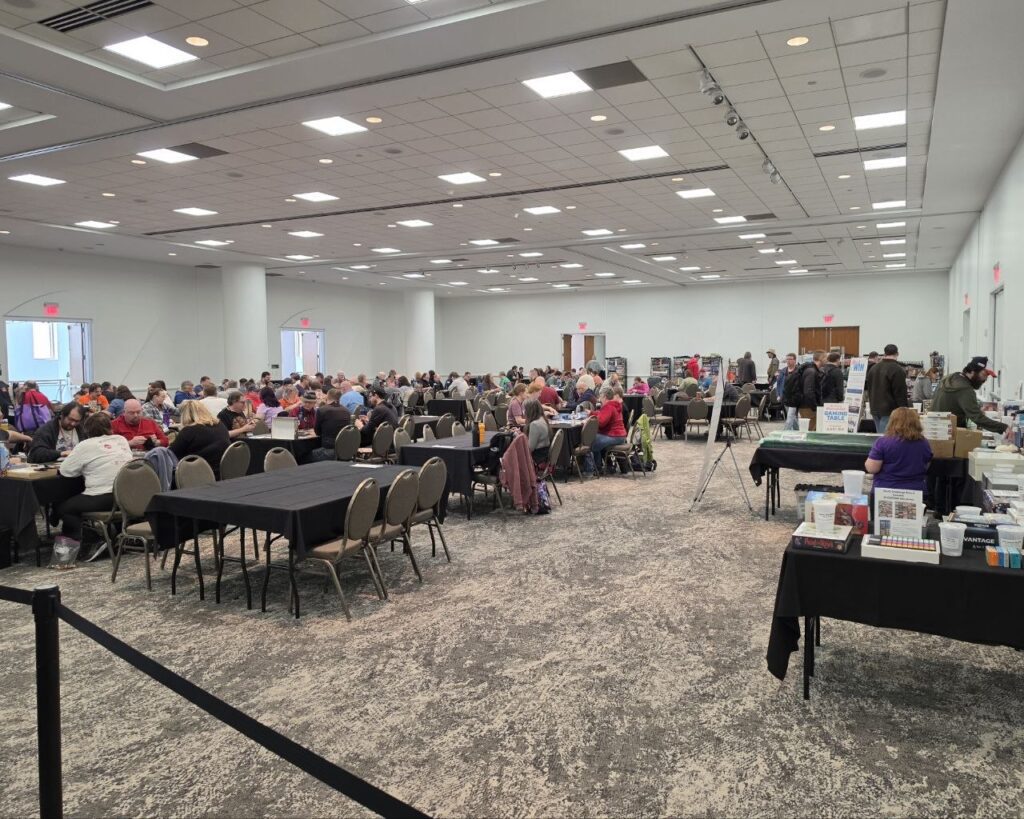
[caption id="attachment_331942" align="aligncenter" width="1024"]Roomful of Garner-area gamers. Apparently, I was wrong.[/caption]

I’ve been playing board games with the same group of friends for over 15 years. As a result, I haven’t looked elsewhere to find if there were other gamers in the area for a long time. Years ago, I checked out MeetUp, but going to a stranger’s house to play a game that might interest me (or at least didn’t involve dice) didn’t feel worth the time.

Turns out, over the years, that MeetUp group has been building. Meeting two Friday evenings a month, they claim to be the largest board game MeetUp group in North Carolina. They’ve been running a weekend gaming convention for the past few years that I had never heard of. Meeple Mountain’s founder, editor-in-chief, and all-around nice guy, Andy Matthews, sent me a message ‌from Nashville, telling me about a convention right in my metaphorical backyard.

When I arrived, I met my new…

The post Tom and Jennifer attend QuestCon 2026  appeared first on Meeple Mountain.

boardgame.digital mit AMA von Ben & Frosted-Team

Von: Michael
11. Juni 2026 um 20:41

Diese Woche startet die Fussball-WM und auch wir können verkünden, dass wir uns mit euch in die Spiele stürzen wollen. Für Brettspielende unter Umständen interessanter könnte ab morgen, Freitag, 12. Juni 2026 ab 18 Uhr nämlich die boardgame.digital sein. Veranstaltet von Geekpunkt lädt diese virtuelle Brettspielmesse nämlich zum virtuellen Brettspielwochenende – und Frosted Games ist mit dabei. Bis Sonntag, 22 Uhr habt ihr im Rahmen dieser Veranstaltung dann die Gelegenheit, mit uns zumindest virtuell unsere Neuheiten zu spielen und kennen zu lernen. Und das sogar bei noch nicht erschienenen Spielen wie TIR NA NOG, aber auch bei dem gerade erschienenen WUSELIGE WIESEN. Lasst euch von unseren Spiele-Angeboten auf der Board Game Arena und auf unserem Discord überraschen und wetteifert mit der größten deutschen Brettspiel-Community „League of Geeks“ virtuell vor Ort auf bga. Holt euch zudem die aftergame APP, um keine Aktionen zu verpassen. Geplant ist neben den Spielerunden unter anderem am Samstag auch ein AMA ASK ME ANYTHING am Samstag mit Ben Schönheiter und weiteren Mitarbeitenden aus dem Frosted Games Team sowie ein Panel rund um die Grafik bei Brettspielen am Sonntag. 

Die boardgame.digital sieht sich dabei nicht als Ersatz für eure klassischen Brettspielrunden, sondern möchte ein darüber hinausgehendes Angebot für die Brettspiele-Community unter einem gemeinsamen Label – der boardgame.digital – bieten und zusätzliche Möglichkeiten schaffen, Menschen unabhängig von Wohnort, Mobilität oder sozialen Hürden zusammenzubringen. Im Mittelpunkt stehen virtuelle Spielrunden vor allem auf Board Game Arena, können aber grundsätzlich auch plattformoffen und künftig auch von Spielenden selbst angeboten werden. Über den Technikpartner aftergame können Besucher Spielrunden einfach erstellen, finden und sich direkt anmelden. Ergänzt wird das Ganze durch Livestreams, Sonderaktionen, Talks, Community-Events und weitere Inhalte rund um Brettspiele. Kurz gesagt: Wie eine echte Convention oder Brettspiel-Wochenende … nur diesmal ganz ohne von zu Hause weg zu müssen!

Alles zu den Spielrunden von Frosted Games erfahrt ihr in Kürze hier und natürlich über die Event-Webseite, die APP und die Spielerunden auch über bga. Auf Board Game Arena werden diesmal nämlich alle Frosted-Spielerunden exklusiv stattfinden. Wir wollen euch zudem auf unserem Discord auf dem Laufenden halten und für Rückfragen zur Verfügung stehen.
boardgame.digital – Die virtuelle Brettspiel-Convention
boardgamearena.com
discord.com/@frostedgames

Unsere Events (Auswahl/Links führen zu discord!!)

FREITAG

Auftakt auf der Discord-Bühne mt Michael, Dennis, Jens und Co ab 18 Uhr – wir spielen WUSELIGE WIESEN und TIR NA NOG

SAMSTAG

AMA mit Ben und Frosted Team ab 14 UHR

Brettspielen Live mit Michael und Basti/Geekpunkt (twitch.tv) ab 19 Uhr

SONNTAG

Brettspielen Live mit Hesy auf bga und auf der Discord-Bühne ab 13 UHR

boardgame.digital – Brettspielgrafik Live mit Anna und Basti (twitch.tv) ab 16 UHR


Der Beitrag boardgame.digital mit AMA von Ben & Frosted-Team erschien zuerst auf Frosted Games.

Andy Goes to Geekway 2026

Geekway has been on my bucket list for years and years. A well-regarded board game convention only a handful of hours from my home in Nashville, and the birthplace of the “play and win” library? It seems like a no-brainer. I was finally able to attend, and now I’m adding my thoughts to those of Kevin Brantley, who attended Geekway in 2025.

Full disclosure: in addition to being a gamer, I’m also a convention organizer with ten years of running Nashville Tabletop Day under my belt. While I did want to do some gaming, my main reason for attending this event was to observe the Geekway team and processes to find ways to improve my own event. So be aware my thoughts about the event are going to be colored by “event organizer glasses”.

Arrival and Initial Thoughts

Geekway runs from Thursday morning to Sunday evening, although I could only attend Friday afternoon to Sunday. After arriving in St. Louis, checking into my hotel, and driving over to the St. Charles Convention Center, I arrived at the gaming hall around 1pm.

Registration

Registration was smooth, with pre-printed badges displaying a barcode (more on that later). The badges were full-color, double-sided, pre-printed, laminated, and came with a high quality lanyard. By the time I arrived on Friday, they were already…

The post Andy Goes to Geekway 2026 appeared first on Meeple Mountain.

Kevin and Joseph Go to Gaming Hoopla 2026

Hoopla: Hoopla is an informal noun referring to excited, noisy commotion, bustling activity, or extravagant, sensational publicity (often referred to as hype or ballyhoo). It often implies unnecessary fuss or exaggerated attention surrounding a person, event, or product. 

Kevin

A Softer Side of Gaming Conventions

Last year, I attended about six gaming conventions, mostly on the larger side of the spectrum: Gen Con, PAX Unplugged, and the like. These conventions are huge, multi-day, overly stimulating showcases of everything the gaming world has to offer. If the massive vendor hall isn’t competing for your attention, then it’s the organized events, publisher presentations, or state-of-the-industry talks. It’s exhausting and invigorating all at the same time. I often come home from these large-scale carnivals with no voice and an empty wallet.

But what if I told you there’s a softer version of a gaming convention? One without long queues for the new hot game, a sugar-water refill, or even the restrooms? Now, what if I said the attached hotels were affordable, the schedule was packed, and you could still buy stuff?

Well, friends, I have an event you may want to pencil into your calendar for next year.

Gaming for a Good Cause

Nestled in the Baird Center in Milwaukee,…

The post Kevin and Joseph Go to Gaming Hoopla 2026 appeared first on Meeple Mountain.

I Went to AdeptiCon Without an Army

For the past several years, the last weekend of March meant one thing: I was in Anaheim for WonderCon. San Diego Comic-Con’s slightly smaller, slightly more relaxed sibling. The routine was comfortable. Fly in, badge around my neck, wander the floor, admire the cosplay, sit in on a panel or two, and eat something from a food truck that probably violated at least three municipal codes.

This year I broke the pattern. Instead of Anaheim, I booked a week in Milwaukee for AdeptiCon,  the annual gathering of the tabletop miniatures faithful, recently relocated from Chicago to the Baird Center. About 12,000 attendees. Wall-to-wall wargames. And me, showing up without a painted army to my name.

That last part turned out to matter more than I expected.

A Convention That Knows Exactly What It Is

AdeptiCon is not trying to be everything, and it makes no apologies for that. It is a miniatures wargaming convention, full stop. If you love tabletop miniatures, building them, painting them, deploying them in anger across a felt-covered battlefield, this is your Super Bowl. If you don’t, you may find yourself wondering where the panels, cosplay contests, and celebrity signings wandered off to.

The big systems dominate the floor: Warhammer, Warhammer 40,000, Star Wars: Shatterpoint,…

The post I Went to AdeptiCon Without an Army appeared first on Meeple Mountain.

The Woman’s Hour / Votes for Women (Book & Game, #5)

08. März 2026 um 18:15

It’s Women’s Day! A great opportunity to look pair a book and a game on the American women’s suffrage struggle: The Woman’s Hour (Elaine Weiss) and Votes for Women (Tory Brown, Fort Circle).

Check out my previous Book & Game posts here:

Eastern Front: Russia’s War and No Retreat! The Russian Front

Reformation Era: Four Princes and Here I Stand

The Second Hundred Years’ War: The Rise of the Great Powers 1648—1815 and Imperial Struggle

Prussia in the Seven Years’ War: Frederick the Great. A Military Life and Friedrich

The Book & Game

The Woman’s Hour was published in 2018 by Viking Press. It focuses on the campaigns for and against Tennessee to ratify the 19th Amendment which enshrined women’s suffrage in the US constitution – as the 36th, and decisive, state to do so.

Votes for Women was published in 2022. It is Tory Brown’s first published board game. The card-driven game can be played in a solo or cooperative mode with the player(s) representing the American suffrage movement from 1848 to 1920 against an automated opposition, or with two to four players facing off against each other (half of them for, the other against women’s suffrage). In either case, the suffrage players must win 36 states (either by shoring them up decisively during the game, or in the final vote on ratification of the federal amendment) to win.

Connections & Conclusions

At first look, book and game seem to have very different scopes. After all, Votes for Women sets in with the Seneca Falls Convention (at which women’s suffrage was first voiced as a political demand in the United States) in 1848 and covers the following 72 years, whereas The Woman’s Hour begins with the arrival of activists Carrie Chapman Catt, Sue White, and Josephine Pearson at the Nashville station in the sweltering summer of 1920. Yet as the narrative progresses, background stories are woven into the tapestry – on the context of the 1920 presidential election, suffragists’ previous efforts to gain voting rights for women in the states and to lobby for a federal amendment, the women’s suffrage movement’s relationship with abolitionism, and all the way back to Seneca Falls (and a little bit of Abigail Adams’s “Remember the Ladies”). If you have played Votes for Women, you will recognize many of the people and events on the cards from the early and middle periods of the game when reading The Woman’s Hour.

The Seneca Falls Convention is the Start card for the suffragist player with which any game of Votes for Women kicks off, following the tradition laid out by protagonist Elizabeth Cady Stanton that this was the starting point of the American women’s suffrage movement.

What unites book and game is their focus on procedural politics. Historical change does not simply happen, nor is momentarily decided upon. Instead, it is brought into effect by the “strong, slow drilling into hardwood boards with passion as well as sound judgment” (Max Weber). The drills used come in both cases from the toolbox of political activism:

The Woman’s Hour details how suffragists (suffs) and anti-suffragists (antis) lobbied the Tennessee lawmakers, how they organized in associations and clubs to channel their activists’ time, funds, and energy, and, of course, how they campaigned for public opinion to win the hearts and minds of the American people with newspaper articles, public speeches, great processions, and all kinds of civil disobedience.

Votes for Women makes these the three actions from which the players choose on a given turn: Lobbying (for and against the 19th Amendment in Congress), organizing (to gain the crucial buttons which are the currency for some powerful in-game effects and die re-rolls), and campaigning (which spreads influence cubes and thus eventually decides if enough states come out in favor of ratification of the 19th Amendment or not).

Early in the game: There are still a lot of orange Opposition cubes, but the women’s suffrage movement has made some inroads (yellow and purple cubes). The large round buttons represent the movement’s organizational strength, the white columns (one already placed on the track under the picture of the Capitol) the willingness of Congress to pass the women’s suffrage amendment.

As we’ve mentioned civil disobedience already: The women’s suffrage movement was no monolithic bloc. One of the great dividing lines was that of styles: The more conventional part of the movement, organized in the late 19th and early 20th century in the National American Women’s Suffrage Association (NAWSA) led by Carrie Chapman Catt, paid close attention to appear as respectable as possible (knowing full well that their demand for equal suffrage was enough of a provocation to the male public opinion of the time). Others adopted a more radical style, inspired by the British suffragettes: The Women’s Party, led by Alice Paul (and represented in Tennessee by Sue White) referred to the president as “Kaiser Wilson” in reference to the German war enemy, burned him in effigy, and (successfully) provoked the police into arresting activists over minor infractions. The dainty young women and respectable matrons who served some prison time then embodied the injustice of depriving women of their vote.

The Woman’s Hour details these fractions within the movement, as NAWSA and the Women’s Party led entirely separate campaigns for Tennessee’s ratification of the 19th Amendment. While infighting was avoided, the reader is left to wonder if the movement could have been more effective if not for these parallel structures – or if the split between a more moderate and a more radical wing was able to compel a broader spectrum of audiences by working in parallel.

Votes for Women depicts the multifaceted character of the women’s suffrage movement by splitting the suffragist player into campaigner figures and influence of cubes of two colors (yellow/gold, the traditional color of the American women’s suffrage movement, and purple, a color which Alice Paul had coopted from the British suffrage movement). As several Opposition event cards target the highest concentration of one or the other color, the Suffragist player is well-advised to aim for an even spread of colors in the individual states.

The pluralism of the women’s suffrage movement is exemplified by the two colors… and a plethora of Opposition events which target only one or the other.

Votes for Women also tackles another split in the women’s suffrage movement which is outside the scope of The Woman’s Hour – that on strategy. After the initial push for women’s suffrage as a part of a great campaign for equal suffrage regardless of sex and race had failed in the aftermath of the Civil War, the suffragists disagreed on how to proceed: Some pushed for a federal amendment to the Constitution (like the 15th Amendment had codified the voting rights of black men), others wanted to win voting rights in the individual states first. While the struggle for women’s voting rights was eventually won with the ratification of the 19th Amendment in Tennessee, the voting rights advances in the individual states had laid the groundwork: Wyoming had established women’s suffrage as early as 1869, Montana sent Jeannette Rankin as the first woman to Capitol Hill, and by 1917, women in 19 states – mostly in the West and Midwest – had won the right to vote (sometimes only in a limited fashion, like voting in local elections).

Votes for Women’s stance is that it needs both – after all, the game is lost for the suffragist player if their lobbying fails to get the federal amendment through Congress, but to win, they need the strength amassed in dozens of local campaigns to have the amendment ratified in enough states. The game, however, makes a statement about timing: While it is possible for the suffragist to have Congress pass the 19th Amendment in the mid-game already, that is a decidedly risky strategy which gives the Opposition a lot of opportunity to snatch individual states and rack up the necessary 13 rejections which mean the failure of the amendment. The ideal move for the suffragist is to build up the strength in the states as much as possible before pushing Congress into action as late as possible. While that is not without its risks (Opposition can still try to throw wrenches in the wheels of congressional action), it spreads them more evenly between federal and local action.

As mentioned above, equal suffrage spread from the American West and Midwest. It had a much harder time in the Northeast and in southern states – like Tennessee. The southern states were not only more conservative in general, suffragists also faced specific obstacles there: Many southern whites remained committed to the cause of white supremacy after the defeat of the Confederacy in the Civil War. Enfranchising women would give the right to vote to black as well as white women, and in the mind of the white supremacists, white women would be much less likely to actually exercise it (be it because they, as “proper” women, would rely on their men to represent them, or because they would not go to a polling station where they might meet with Black Americans). Others, while generally in favor of women’s suffrage, resented the method: After the Civil War, the 13th, 14th, and 15th Amendments had enshrined certain rights (including male voting) for Black Americans in the Constitution. Federal amendments were thus unpopular with many southern whites.

As The Woman’s Hour details, this provided for a lot of traction for the anti movement in Tennessee. Activists like Nina Pinckard and Josephine Pearson railed against carpet-bagging outsiders swooping down from the North to meddle with Tennessee’s affairs, warned of impending “negro domination”, and appealed to the chivalry of southern men to rescue their women from being thrown into the dirty cesspit of politics. That they themselves were knee-deep in that cesspit – after all, they were political activists! – bothered them as much as modern-day “tradwives” are bothered by the fact that their plea for women to be submissive to and dependent on their men is at odds with their often successful social media enterprises.

Somewhat counter-intuitively, many women opposed women’s suffrage on moral or political grounds. Votes for Women does a great job in showing the multi-facetedness of the anti movement beyond the male political and business establishment.

Inherent contradictions aside, the antis’ arguments needed to be countered by the suffs. Many of the white suffragists were willing to make rhetorical or substantial compromises: One of NAWSA’s most-cited statistics in the Tennessee campaign was that the number of white women in the south exceeded that of black men and women combined. Enfranchising women, so the more-or-less subtle subtext, would thus not threaten white supremacy – it might even strengthen it. In the end, the tacit agreement was like that found after the Reconstruction amendments designed to protect Black Americans’ rights in the South: The women’s suffrage amendment made its way into the constitution. Yet voting rights were overseen by the individual states, and federal institutions looked the other way about the blatant disenfranchisement of black voters in the South until the Voting Rights Act almost half a century later.

Neither The Woman’s Hour nor Votes for Women shies away from this uncomfortable part of the women’s suffrage movement: The protagonists of the movement are not portrayed as infallible saints in the book. While they held wildly progressive views for their time on women’s suffrage, their stances on issues of race and class were often more in keeping with those of their contemporaries. They also made tactical mistakes, like Carrie Chapman Catt railing against outsiders trying to influence Tennessee – a charge that was immediately turned against her, a Northerner herself, and restricted her visibility for the remainder of the campaign. And most of them were willing to make compromises for the cause of women’s suffrage – sometimes with themselves (Carrie Chapman Catt supported the US effort in World War I against her pacifist convictions lest the women’s suffrage movement be branded unpatriotic), and sometimes at the expense of others. In short, they were human.

Would the 19th Amendment have passed in Tennessee if the suffragists had been less willing to assuage the fears of southern whites about “black domination”? – Probably not – maybe another state could have become the decisive 36th then, but all likely options had been exhausted before.  Did the Black Americans in the South, men and women, suffer from the continued disenfranchisement after 1920? – Undoubtedly.

The South is notoriously tough for the suffragists. Placing a ton of cubes there (plus some additional perks) is a tempting proposition.

Suffragist players in Votes for Women face the same strategic and ethical question (of course, with infinitely lower stakes): One of the most powerful cards in the game is The Southern Strategy which places an immense amount of suffragist influence in the South (representing the union between suffragists and white supremacists). It does open the suffragist for some counter-plays from the opposition, though. Savvy suffragist players might hold the card from turn to turn to play it as late as possible, as an uncounterable stratagem in the final struggle for women’s suffrage. Victories won that way have an odd aftertaste, I assure you.

Since Votes for Women has been released, it’s been in the top 5 of games I have played most often. And while I rarely re-read books, especially non-fiction (because there are always intriguing new books to read), I have come back to The Woman’s Hour and have now both read the physical book and listened to the (excellent) audiobook production. Besides all their worthy exploration and analysis of history, that speaks to both the game and the book being excellently crafted, incredibly engaging pinnacles of their respective medium.

Süddeutsche Spielemesse 2025

30. November 2025 um 15:52

Before the fall fair and convention circuit is coming to an end, I had the opportunity to attend Süddeutsche Spielemesse (Southern German Game Fair) in Stuttgart. As when I went last time, it was a pleasant, laid-back experience.

The game fair is part of a conglomerate of hobby and leisure related fairs which are all held over the same long weekend in neighboring fair halls. As the ticket covers all fairs, you are free to explore everything. That’s great if you go as a group or family with differing interests: Your creative-minded daughter can get all inspired at the arts & crafts fair, your animal-loving son will try to make friends with the cats, rabbits, and camels at the animal fair, your gourmet spouse samples their way through the food fair, and then everybody meets at the game fair because you all love board games. Right?

These folks will go to the board game fair later and play Camel Up.

With that setup, Süddeutsche Spielemesse’s target audience is broad, from the hobbyist to the very casual gamer. Consequently, you’ll find a lot of games outside of the hobby board game niche – from classics like chess and go over sports games to role-playing games. The exhibitors are usually either vendors (game test opportunities are rare), clubs looking for new members (like many of the role-playing clubs), or, my favorite, the big gaming island run in the middle where you can just borrow a game and play it free of charge which gives Süddeutsche Spielemesse a certain convention feel.

At this point, it is tradition that the gaming island remains open until 10pm on Friday, allowing for a beautiful evening of gaming. I met with a friend there and we played three different two-player games:

Rival Cities (Andreas Steding, Pegasus)

Northern German cities Hamburg and Altona try to outdo each other – yet while the usual victory point collecting occurs, these only matter if the game runs its full seven rounds. And it is much more likely that one of the cities will decisively outdo the other in one of the four areas of competition (alliances, ships, lawsuits, and prestige) and score an instant victory. With such a plethora of instant victory conditions, you will always feel the thrill of chasing one yourself and being threatened with another by your opponent.

Yes, that’s a concrete floor… all tables were taken already. I report that I am still young and springy enough for this kind of gaming (at least for 45 minutes).

In our game, we both started conservatively, getting a little bit of everything. Then my friend made a play for the alliances and was only one of them short of victory… but I could stave off defeat and counter-punch with ship dominance. I guess more experienced players would be at each other’s throat from the get-go which should make for exciting gaming and high replayability (at a very moderate complexity).

Solstis (Bruno Cathala/Corentin Lebral, Frosted Games)

Two players chart their path up a mountain built from a shared supply of tiles, each of which has a unique combination of a color (indicating its row) and number (indicating its file). Thus, you always know that a tile you took cannot be accessed by your opponent – and vice versa. This kind of very abstract game with almost-perfect information is usually not up my alley, and Solstis proved no different. We were both unenthused by its mix of logical planning and high randomness in the rare case of placing a nature spirit. However, each play only took 10 minutes, so we didn’t spend much time to gain the valuable knowledge of what’s not our jam.

Table time! That’s a pretty solid path up the mountain, and you can see a lot of nature spirits in the middle – but one of them (the red one) is the evil spirit of vengeance.

Agent Avenue (Christian Kudahl/Laura Kudahl, Nerdlab Games)

Maybe our highlight of the fair: Agent Avenue pits its two players against each other as retired secret agents trying to catch each other. To unveil the other’s identity, they enlist their suburban neighbors, all of which are anthropomorphic animals, from daredevil wolves over codebreaker owls to double agent vixens. The recruitment comes by “I cut, you choose” – but as one of the two cards the active player offers to their opponent is face-up, the other face-down, there is a spy-appropriate amount of bluffing and deduction. Pair this with a varied, but not overwhelming amount of instant victory/defeat conditions and card effects, and you have a light, but tense contest which resolves in no time at all (we played three times in 40 minutes).

My green figurine is being pursued by the blue one. So far, my crew of agents is decidedly sub-par – the double agent on the left is only effective when you have two of them (numbers on the left), the sentinel on the right also kicks in at two and three, whereas the daredevil in the middle will lose you the game once you collect three of them.

Any games of these that sound like your cup of tea? Have you attended any cool local conventions or fairs recently? Let me know in the comments!

❌