Shownotes
Nur noch fünfmal schlafen, dann ist es so weit: Die Messe in Essen startet. Unser Weg nach Essen findet allerdings hier schon ein Ende, denn wir haben es wieder geschafft. 45 inhaltliche Folgen sind im Kasten und ausgestrahlt. Hört hier das Abschlussgespräch der beiden Personen aus dem Hintergrund: Spielevater Oli und Johannes vom Ministerium für Brettspielspaß.
Datum der Aufnahme: 14.10.2026
Online seit: 17.10.2026
Feedback
Wer den Beeple Talk unterstützen möchte: Die Freude ist groß, falls Ihr den Podcast bei z.B. Apple Podcasts rezensiert oder bewertet. Für alle jene, die Apple Podcasts nicht verwenden, gibt es die Plattform Panoptikum, auch dort kann eine Empfehlung ausgesprochen und bewertet werden, aber auch ein eigenes Podcasthörerprofil erstellt werden. Und natürlich freuen wir uns auch über Bewertungen auf all den anderen Plattformen, über die Podcasts gehört werden können.
Ganz besonders toll ist natürlich, falls Ihr Euren Mitspielern vom Beeple Talk erzählt.
Über den Beeple Talk
Der Beeple Talk ist mit allen Episoden unter dem folgenden Link erreichbar. Ziel ist es, Episoden mit wechselnden Themen rund um Brett- und Kartenspiele zu machen. Zum Beeple Talk treffen sich regelmäßig einige Mitglieder von Beeple, dem Brettspiel-Blogger-Netzwerk.
Beeple Talk – Der monatliche Podcast von Beeple – https://www.beeple.de
Podcast-Plattformen
Natürlich findet sich der Beeple Talk auf den bekannten Plattformen für Podcasts, insbesondere Apple Podcasts.
Beeple Talk auf Apple Podcasts – https://itunes.apple.com/de/podcast/beeple-talk/id1449578291?l=en.
Der Beeple Talk ist ein kostenfreies Format. Solltest Du für das Hören auf Deiner bevorzugten Plattform eine Gebühr zahlen müssen, so erfolgt dies ohne unsere Zustimmung. Wir sind und bleiben kostenfrei zu empfangen.
Fehlt Dir auf Deiner bevorzugten Plattform der Beeple Talk, freuen wir uns über einen Hinweis.
Beeple Chat
Die Kanäle des Beeple Brettspiel-Blogger-Netzwerks betreiben einen Discord-Server, auf dem sich eine tolle Community täglich über Brettspiele austauscht. Falls Ihr dazukommen möchtet, diesem Link folgen oder eine E-Mail senden.
With this My Favorite Wargame Cards Series, I hope to take a look at a specific card from the various wargames that I have played and share how it is used in the game. I am not a strategist and frankly I am not that good at games but I do understand how things should work and be used in games. With that being said, here is the next entry in this series.
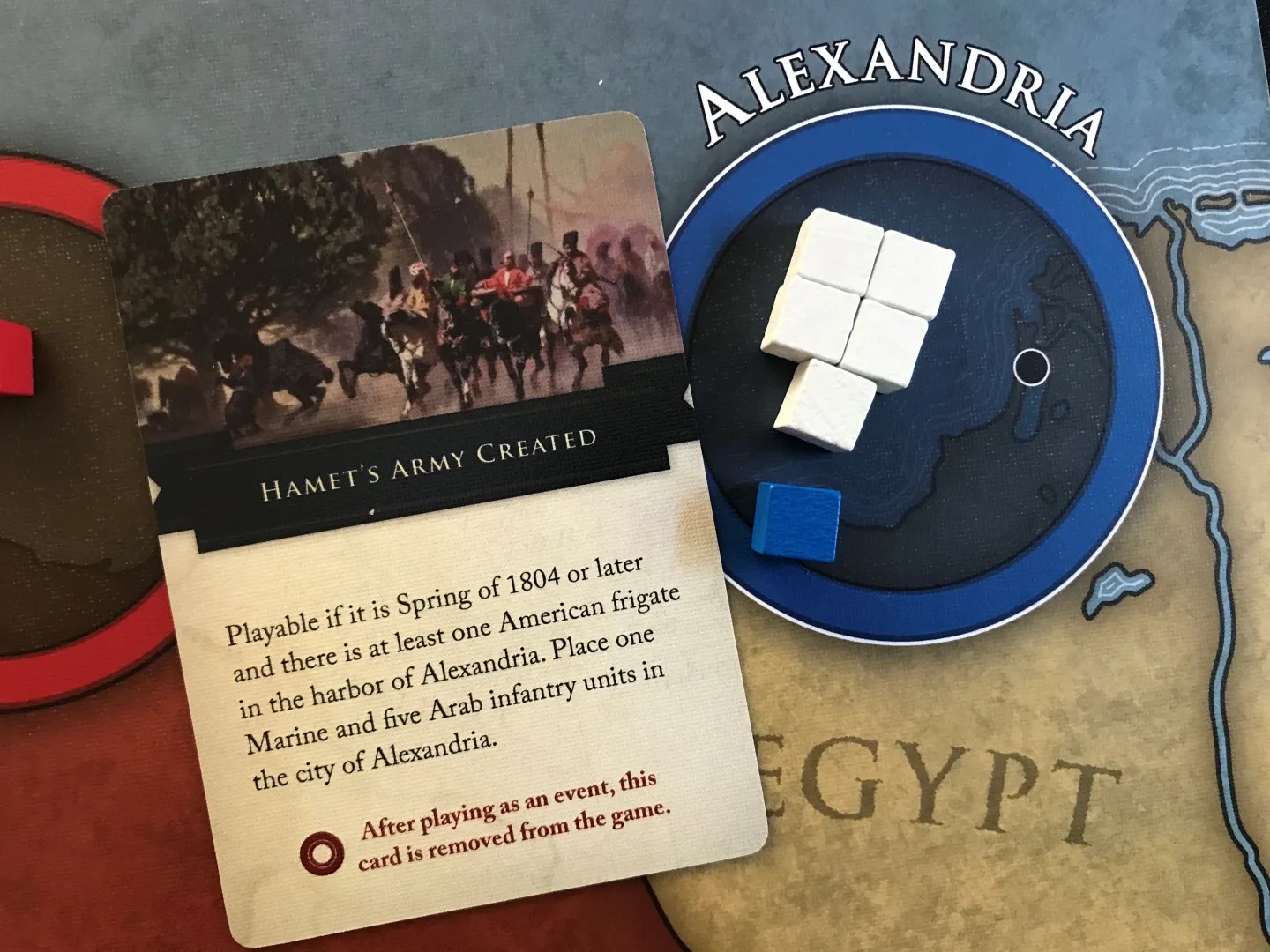
#94: Hamet’s Army Created from The Shores of Tripoli from Fort Circle Games
I have never played a historical wargame on the First Barbary War, which if you didn’t know was one of the first major wars the young United States of America participated in that was situated far outside their sphere of influence in North and South America. Shortly after the end of the American Revolutionary War, commercial vessels of the United States were being attacked and raided by the pirates of the Barbary coast in the Mediterranean Sea. In 1801, newly inaugurated President Thomas Jefferson was eager to put an end to this threat and sent a “squadron of observation” to the Mediterranean to deal with the threat. The Shores of Tripoli covers this conflict and does so using a card driven game mechanic that works really well in this instance. The game is a little deceiving, as at first it appears to be pretty introductory with simple rules and mechanics, but the depth for the game lies in the strategy for each side and the fact that their victory conditions are asymmetric.
While the main combatants in the game are naval units, there are ground units as well that must be used to try and take Tripoli to win the game. The American ground units consist of Hamet’s Army, which is a combined force of Arab and American infantry units that are dedicated to the mission of installing the pro-American Hamet Qaramanli on the Tripolitan throne. These ground units consist of white cubes that represent the Arab Infantry and blue cubes that represent American Marines. In Ground Combat, each Infantry unit rolls one die and it takes one hit for them to be eliminated.
Hamet’s Army will be created if the United States player plays the card Hamet’s Army Created for the Event. There are several conditions to the card being played though as it must be the Spring of 1804 or later and there has to be at least one American Frigate located in the Alexandria harbor. Once played to bring on Hamet’s Army the card is removed from the game and placed in the box. The newly created army will have to fight their way through 2 locations, Derna and Benghazi, for a final confrontation at Tripoli. I think that I very much enjoy this card because it is a necessary step in the game that the player has to plan for and be prepared to play when it does reveal itself. The player must be ready by using a portion of their limited actions to move at least 1 American Frigate to the harbor of Alexandria and then play this card for the printed event. Keep in mind that this is just the start though as there is a long way to go from here and many more things that must be completed to setup the final showdown.
Hamet Qaramanli’s army was a mixed mercenary force of several hundred Arab and Berber fighters, European cannoneers, and Greek infantry led by U.S. Army Captain William Eaton and U.S. Marine Lieutenant Presley O’Bannon during the First Barbary War. The goal of the expedition was to successfully march across the North African desert, capture the city of Derna, and depose the ruling Pasha of Tripoli, Yusuf Qaramanli in favor of his exiled older brother Hamet Qaramanli. In early 1805, the force marched roughly 500 to 600 miles across the Libyan Desert from Egypt to the Tripolitan border. The force consisted of 8 U.S. Marines, a small group of U.S. sailors, 26 Greek volunteers, a company of cannoneers and roughly 1,000 Arab and Berber mercenaries loyal or allied to Hamet. On April 27, 1805, aided by U.S. Navy warship bombardments, the force successfully stormed and captured the strategic port city of Derna in the Battle of Derna. But before Hamet’s army could advance further toward Tripoli, the United States signed a peace treaty with Yusuf Qaramanli, abandoning Hamet’s claim to the throne in exchange for freed American prisoners and an end to tributes.
Lieutenant O’Bannon and Marines advancing toward Tripoli. (Image from Merrill L. Bartlett and Jack Sweetman, The U.S. Marine Corps: An Illustrated History, (Naval Institute Press, Annapolis, MD: 2001), 30–31.)

 Anmelden