“It soon becomes clear why the post was abandoned as whole sections of the station begin dropping into sinkholes!” – Forbidden Jungle Rulebook
Disclosure: bought the game, tried the highest difficulty
We hadn’t really considered playing any board game of the Forbidden Games series, a series of cooperative board games by Matt Leacock, which are supposed to be similar to Pandemic but lighter in terms of complexity and more budget friendly. Our hesitation lasted until one day, its most latest game Forbidden Jungle was on big sale. We thought it could be a good light filler game while searching for a new heavy weight game after successfully finishing one of the most difficult scenarios of Frostpunk: The Board Game. We thought we are so great for beating the scenario of what we consider as one of the most complex co-op board games that there’s no way we could lose in a game like Forbidden Jungle. No way. Until the game brought us back to Earth to face the reality (not really, it was an alien planet).
We lost our first game. And quite a few of the later ones. Almost every time we lost, it felt as if we were thiiiiiis close to winning. While it’s necessary to develop a strategy to beat the game, there is a significant degree of randomness. This sets in right at the beginning, as it’s not possible to choose the character with the special power you want, they are randomly assigned. The randomness can make it difficult to plan ahead. There were many times where we were playing mostly reactively. This is not exactly our favorite style of play, but it can lead to many very suspenseful moments.
The setting/theme
The basic premise seems simple enough. You play as adventurers who have crash landed in an alien jungle. To get home, you have to find a portal. Simple, right? Wrong. It isn’t enough to find the Portal, it also needs to be surrounded by four active Crystals to power it. Discovering these is one thing, getting them into position another. Luckily, there are some discoverable alien machines that can help. Unfortunately for our intrepid crew there is further danger from the local wildlife, which probably wiped out whoever built the machines. These lifeforms occur in three distinct shapes in different stages of their lifecycle. In addition to the fully grown adults, there are also hatchlings and eggs. These do different things, but they are all have a adorably icky design. Eggs are simple, they just lie around until they hatch. Hatchlings start moving around without doing anything else or posing any danger until they grow up. Adults show more varied behavior. They also move, they lay eggs, they spin nets that impede the adventurer’s movement, and they try to eat the face of any human they come across.
Eggos waiting next to the Portal
Escaping the Jungle
So, how does the game work? On each players turn they take up to four actions, choosing from four possible options. You can use an action to move from one tile to the next or from one tunnel tile to another. Another option is to remove one adult, hatchling, egg, or a net from your tile. If you are on an undiscovered tile that is free of any aliens or nets, you can discover what’s hidden in the jungle by flipping it. Finally, if you have already discovered one the machines left behind by the civilization that existed in this place before having their faces eaten, you can use an action to use it. What, then, are those machines? There’s the configurator, which allows you to slide a tile in a straight line, as long as it ends up next to another tile. There’s the destruct switch, which you can use to blow up a tile and everything on it. There’s the compeller, which you can use to move adults and hatchlings from one tile to the next. Finally, there’s the portal, which you can use to go home. If you managed to surround it with four glowing crystals and free it from the aliens and their nets, that is.
Adult Aliens
The Jungle has eyes and… agency?
After a player acts it’s the Jungle’s turn. The player has to draw between two and five Threat cards, based on the current threat level. Most of these either cause the aliens to do their various things or more of them to appear in various places. However, there are three different cards. One simply increases the threat level. A second one increases the threat level and makes you shuffle the discard pile and put it at the bottom of the draw deck. The third is the most interesting one. It causes the tile with the lowest number to collapse along with everything on it, although adventurers can escape to an adjacent tile. The first place to go is always the starting tile, Fool’s Landing. Later on, it’s generally the useful machine tiles that tend to go first. One of the many ways to lose is if all four portals or one of the four glowing Crystals are gone. There have been numerous times where we were almost ready to leave, only for the Portal tile to collapse.
The other ways to lose are if someone has their face eaten by the aliens, if someone is on a collapsing tile without a way to escape, or if you have to place more adults, hatchlings, eggs, or nets than you can. Luckily, during you exploration you can find various pieces of gear to help you avoid these predicaments, such as a jetpack or a time machine.
Our Final Thoughts
Forbidden Jungle is a surprisingly challenging game that combines exploration, crisis (alien) management, and a sliding tile puzzle. But one important thing that we realized after playing it was just because a game is not complex, doesn’t mean that it would be easy to beat. Complexity doesn’t equate difficulty. We’ve tried the highest difficulty of Forbidden Jungle three times, but we never got to escape the jungle. With the highest difficulty of Frostpunk: The Board Game, we won in our third attempt.
While we both like games that aren’t completely deterministic, the randomness in this game is at the higher end of the scale for our taste. And, unlike Frostpunk, we felt we had less agency in Forbidden Jungle, which can be less motivating in terms of trying it out again. Using the destruct switch and blowing up parts of the playing field feels very satisfying and slightly anarchic though.
The tile destroyer
What we both like:
map reduction mechanic
sliding of tiles
colorful and icky alien figures
What we do not like:
high degree of randomness
the type of randomness
not being able to choose your character
What Max also likes:
the biologist character
colorful tiles
Kaysee’s rating: 2.5/5
Max’s rating: 3.5/5
Combined rating: 3/5
Title: Forbidden Jungle (2023)
Game Design: Matt Leacock
Artist: C. B. Canga
Edition: German
Publishers: Gamewright, Schmidt Spiele
Star Wars ist (mal wieder) in aller Munde. Zahlreiche Serien und Filme haben die weit, weit entfernte Galaxis erneut ins Zentrum aller Aufmerksamkeit gerückt und auch am heimischen Rollenspieltisch rast der Falke wieder vorbei. Asmodee startet ins Rollenspielgeschäft und legt einen Klassiker neu auf, beginnend mit dem Einsteigerset.
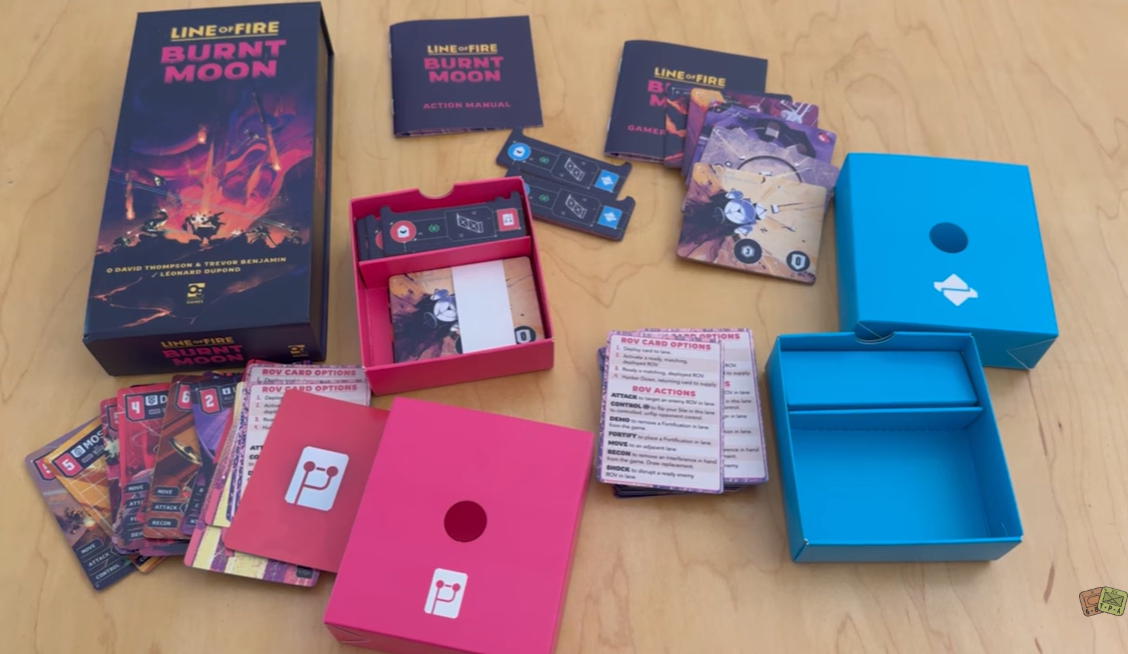
A group of black-hat hackers known as POSIWID plots to hijack the moon Io and hold the entire Jovian power grid to ransom. Standing in their way are the ultra-corporate LFA, the constructors of the lunar energy facilities. Both sides have engaged a fleet of ROV – advanced remotely-operated robots — to battle across the treacherous landscape. The machines are activated. Initiate combat sequence. The battle for Io has begun.
Line of Fire: Burnt Moon is a standalone 2-player card game that fuses the lean deck-building of the award-winning UndauntedSeries with fast-paced lane battling. Sharp decision-making and clever positioning combine in a nail-bitingly tense, endlessly replayable, and lightning-fast experience.
Die zähen und brutalen Orks sammeln sich in riesigen Kriegsscharen und bekämpfen alles, was ihren Weg kreuzt. Diese Horden werden durch die Macht des Waaagh vereint. Mit dem neuen Codex können die Orks direkt in die 11. Edition von Warhammer 40.000 losziehen, um den*die nächstbeste*n Feind*in zu verklopp´n.
“The world of Frostpunk is a hostile and dangerous place, and if you are unable to manage your city well, you will lose.” -Frostpunk Rulebook
Disclosure: Bought the game, survived all the scenarios (see the combinations of scenarios and socities that we’ve tried so far here)
The heatwave in Germany was about to arrive, when we discovered and bought a game called Frostpunk: The Board Game. We were looking for a cooperative game with a complexity rating higher than Spirit Island to play at home, because going out in the scorching heat and getting grilled by the sun wasn’t something we wanted to experience. We wanted to get our minds off of the reality and escape the heat. No better way to do that than to play a highly complex board game about surviving an apocalyptic winter.
Frostpunk: The Board Game is based on the video game Frostpunk, which was inspired by the Polish novel Ice by Jacek Dukaj. Neither of us has read the novel nor played the video game, but we do like stories that are dystopian or post apocalyptic. Frostpunk is not post apocalyptic, though, as players get to experience shaping a society during the apocalypse. It’s a survival game, and the initial setup itself was already a test of our survival skills even before starting the game.
The setup, the societies, and the scenarios
It took more than 4 hours for us to do the initial set up, which included reading the rulebook (and breaks and some showers). The heat wave didn’t just slow us down physically but also mentally. It was weird for us to flip tiles depicting snow and see the snowy white expedition cards, characters wearing winter coats, and the frozen meeple trees while sweating heavily. We were both somewhat confused and immersiveness seemed to be off the table. And the game was actually off the table, as it requires more space than our table has, so we decided to play on the carpeted floor. The confusion and questioning of choices didn’t stop after setting up the game; they continued and evolved as we entered and played the game. The immersion was there, but instead of the cold setting, it was triggered by the moral choices we had to make along the way.
The game has nine scenarios, three of which are significantly more difficult than the others. Each scenario offers different conditions to determine whether our society has survived the apocalypse. Surviving also means surviving each round. A round represents a day. There are nine phases each day from the Dawn Phase to the Nighttime Phase.
The society we chose also determined how difficult it was to survive. There are six different societies to choose from which can either be played in normal or in hard difficulty. These also determine how many citizens and resources we have in the beginning. A society in this game consists of three types of citizens: children, engineers, and workers. Some societies can have an automaton, a gigantic robot, which is not considered a citizen. While a citizen meeple is equivalent to 1-4 or 1-10 citizens of its type depending on how many citizens of the corresponding type there are, an automaton meeple is equivalent to one automaton. Automatons are very strong and it is apparent that the game gives high value to technology.
As we tried different scenarios and societies, we noticed that some societies are more compatible with some scenarios than others. You may check out our record of combinations of societies and scenarios here. We also noticed that it was more difficult for us to adapt to a new society than it was to a new scenario.
Meeples of Frostpunk
Resource management: humans vs automatons
The basic resources for every society in this game are coal, wood, food, and steam cores. Some resources are easier to get than others. Civilians require plenty of resources to keep them safe. Wood is required to build shelters and other buildings. Coal keeps the generator heated. In the beginning it doesn’t take much, but over time more coal will be needed to keep everyone warm, especially after a storm hits. But heating up the generator causes stress. Having too much generator stress may cause it to break down or even blow up, which leads to a game over.
Automatons require a steam core to be built, but they don’t require much resources to use and no resources are required to maintain them as they are apparently quite sturdy, would never malfunction, and would never rebel and kill humans. We noticed that in every society in the game, it is more efficient to have more automatons than groups of civilians as they don’t require food and they don’t get sick. But we often times ended up having more civilian meeples, as we still like humans and it’s difficult to get a steam core. But mechanically we prefer automatons as they are more efficient.
Civilians lose their agency as we gain ours
We had to take turns using the available meeples to gather resources, remove snow from the vicinity, use buildings, or send a group of civilians to an expedition in the first round of the game, the Action phase. Building actions include passing a law, increasing Hope or decreasing Discontent, obtaining additional resources, removing stress from the generator, or developing new technologies.
This phase has a simple worker mechanic where only one meeple can use a building or a space to perform an action such as collecting resources and passing a law. Because there were always more actions that we wanted to do than meeples available, we had to be careful in terms of which actions to perform and tried to avoid performing cold actions as much as possible. Most of the communication between us happens in this phase. We also sometimes had to make sure not to think too much in advance as we wanted to avoid losing track as to whose turn it is.
A cold action causes an adult citizen or a child to get sick. As the number of sick civilians increases, the chance of citizens dying also increases. If the corpse marker reaches 10, we lose the game. Adding coal to the generator helps heat up the tiles and buildings so that the actions of the citizens are heated. It’s also possible to send a worker to an expedition which is not a cold action. This struck us as not very intuitive, since removing snow to reveal a tile is always a cold action yet expeditions are not. We thought maybe the group of people on the expedition has some additional equipment to help them survive, but it still leaves the question why removing snow is colder than going on an expedition far from the generator.
Michael Plower and his gang
Child meeples cannot be typically used to perform actions unless some conditions are met such as having a child citizen card, passing a specific law, and some other spoilery thing. We did our best not to pass that law. Every session we did our best to keep the children safe and comfortable. For one, the mechanics of the game are in favor of taking care of them and we also think that a good society has healthy kids. But sometimes a group of children in the game, specifically a group lead by a child named Michael Plower, who thinks he is an adult, wants to go out, help out, and look for areas with resources even after knowing full well that one of them would get sick. We couldn’t stop them.
Michael Plower
The advisors
Each society has advisors – the role of the players. Since there’s only two of us in our game sessions, our societies had only two advisors. Each advisor has a specific ability that can only be used if a corresponding Hope is active. The game includes responsibility sheets for each advisor, which are supposed to serve as a guide for each phase and make it easier for the players to keep track of the rules by dividing and assigning responsibilities to each advisor. We didn’t find them very useful and decided to not to use them and just refer to the rulebook.
One of us mostly used the Foreman Advisor and the other advisor was chosen depending on the scenario and starting Hope we have. Each player gets an advisor card and five citizen cards. Some of the citizens are children and some of them are workers or engineers. The citizens cards each of us get to have are partially random as we draw six citizens and then choose five of them to keep.
Hope and Discontent
While Frostpunk seems to be a grimdark game, it is not, as hope is important narratively and mechanically represented as Hope. In the game, Hope is very much defined by what tendencies the society can have and what can be activated with it. The three concepts that can be active are Justice, Care, and Motivation. If the society has Motivation, the citizens are more likely to be able to work and perform actions. Having Care means people are more likely to recover when they’re sick. And having Justice may deter people from harming others or causing instability in the society. Losing all the Hope tokens on the board is another way to lose the game. Having Hope as a mechanism in this way means it represents a very distinct interpretation of what hope means.
The flipside of the coin is Discontent, which also has three concepts that can be active, representing a societies darker impulses. Roughly speaking, Greed is the mechanical reverse of Justice, Anger that of Care, and Apathy that of Motivation. Filling the Discontent track predictably also causes a gameover.
Hope and Discontent tokens
The system behind Hope
We find the mechanisms behind Hope to be very interesting and think that it has a very intriguing complexity. There’s a mixture of randomness and choice behind it. Adding Hope means either drawing a Hope token from a bag or activating a Hope token on the board. While the Hope tokens that you get are generally random, the type of Hope token that gets activated is mostly determined by choice. Hope sometimes serves as a resource to spend, as you can get opportunities to exhaust an active hope in order to cure someone, motivate someone to work again, or keep the society content or in-check. There is a degree of ludo-narrative dissonance here, as in reality hope isn’t something that you lose when you do something that has a positive consequence. Hope can also delay or stop things from spiraling out of control. For example, it may decrease the number of sick citizens and prevent them from dying, which would lead to an additional loss of Hope.
There’s plenty more to say about Hope. For instance how its disambiguation or restrictiveness leads to one of the thing it activates being questionable in context of some Morning Cards and some spoilery things. But this (the review) is not just about Hope, it is also about the hopelessness we felt despite having plenty of Hope tokens on the boards, but still not being able to finish a scenario objective. It is also about the suspense of the Morning Phase.
Morning to Dusk
During the Morning Phase we have to draw a card. The suspense comes from the possibility of drawing cards wherein no matter what you choose there’s a negative consequence. The differences between the choices are that some of the consequence may happen during the Dusk phase and some of them may happen soon, and some of them have more negative effects than the others. Not all Morning cards are like that, but it’s our least favorite phase of the day. It is mechanically interesting but practically stressful. We were just looking forward to end that phase and be able to control convince the citizens to be more productive and prevent them from being a danger to themselves.
We also find many of the laws interesting. There are two consequences for each Law and only one of them can randomly be added to the Dusk deck. We find some law consequences to be inconsistent with some possible actions in the game. Without spoiling and giving too much detail, one example is passing a specific law and building a fighting arena where citizens and even automatons were allowed to fight. We only sent automatons to the arena, but neither of the consequences of the law is aligned to what we were trying to do.
We also like the suspense from drawing a card from the Dusk deck especially after prioritizing short term gains during the Morning, knowing that the there’s a possibility that our society is going to get screwed. There are ways to set the Dusk deck in such a way that negative consequences are less likely to happen. Again, without spoiling, we’re just going to say that choices matter a lot in the game, and it gets a bit easier once you know what the consequences of your choices are.
Interaction between theme and mechanics
Despite some possible thematic inconsistencies mentioned earlier, in a game where the theme is well integrated into the mechanics, the rules of the game are still consistent as far as we’ve experienced. The concepts and how they function in the game are clear, so that the players can learn how to use them and what the potential outcomes of their choices are. This allows them to survive in a game in which there are multiple ways to lose. The goal is to survive. The theme can only go so far in terms of how it is integrated into the mechanics of the game and we think that it’s ok in this type of game; the thematic inconsistencies don’t take anything away from the excellent gameplay.
Our Final Thoughts
The heatwave is over in Germany as of this writing. We lost multiple times before we won the first time. Sadly, our first win wasn’t legitimate. We thought at first that if a citizen becomes a victim of a murder and dies, we could also decrease the number of sick citizens. Our reasoning was that maybe the killer was some psycho who kills sick people because they think they’re useless (coincidently at that time there was a news in Germany about a doctor who was found guilty of killing sick people). The game does not allow that.
We were able to have a real win. There’s a high level of satisfaction knowing that we survived all the scenarios despite having to deal with the heat and intensity of the game while consistently trying to keep the children safe. We wanted to be more critical about the game, but the annoying part is that the things that we didn’t like in the early scenarios were resolved in the advanced scenarios as if the designer, Adam Kwapiński, already knew what we wouldn’t like and also what we would like because some of the things that we did like were changed. We think that it’s a way to challenge the players’ playstyle and maybe their belief system.
We are looking forward to playing this game again in the dark cold winter of Germany and see how immersive it’s going to be.
What we both like:
the theme
the mechanical implementation of the theme
the way different mechanisms interact
the intricate system behind Hope
the challenge
sparks conversations about the narrative
the suspense
choice between long-term and short-term effects in the Morning phase
What we both don’t like:
thinking too much in advance may lead to losing track of turns
What Kaysee also likes:
the settings of the advanced scenarios
some scenarios challenging ones playstyle and belief system/encouraging players to adapt
What Kaysee doesn’t like:
some Law consequences
the teardown
What Max also likes:
the big generator
some funny references on the Morning and Expedition cards
What Max doesn’t like:
the last scenario
Kaysee’s rating: 4.5/5
Max’s rating: 4.5/5
Combined rating: 4.5/5
Title: Frostpunk: The Board Game (2022)
Game Design: Adam Kwapiński
Artist: Agnieszka Dabrowiecka
Rulebook: Paul Grogan
Story: Jakub Wiśniewski
Publisher: Glass Cannon Unplugged
Orks sind gewalttätige, grünhäutige Xenos, die Stärke, Lärm und Geschwindigkeit lieben. Im Warhammer 40.000-Universum sind sie eine der ältesten und beliebtesten Fraktionen. Das liegt zum einen an ihrem ikonischen Erscheinungsbild, zum anderen an ihrem satirischen, anarchistischen Hintergrund. Mit Beginn der 11. Edition bekommen diesmal zuerst die Orks das neue Dakkazeug.
Stadtführer klingen für viele nach langweiliger Lektüre. Night City ist allerdings eine Stadt, die von Korruption, Gangs und organisiertem Verbrechen regiert wird. In dieser bleihaltigen Atmosphäre trifft man Menschen, die sich mit Cyberware ausgestattet haben, manche davon bis zur Cyberpsychose. Und dann ist da auch noch der Krater einer Atombombe mitten in der Stadt. Night City 2045 ist ein Stadtführer für Adrenalinjunkies, die sich in dieser Stadt austoben wollen.

 Anmelden