Bloomsbury Publishing hat das komplette Entwicklungsteam seines Brettspiel-Labels Osprey Games entlassen und den Messestand zur SPIEL Essen 2026 (22. bis 25. Oktober) abgesagt. Das bestätigte ein Bloomsbury-Sprecher gegenüber BoardGameWire am 16. Oktober 2026: Alle Beschäftigten, die ausschließlich an Osprey-Brettspielen arbeiteten, hätten das Unternehmen inzwischen verlassen. Die Entlassungen erfolgten bereits Ende September 2026. Osprey Games ist die 2015 gegründete Spielesparte des britischen Verlags Osprey Publishing und bekannt für Reihen wie Undaunted und Imperium sowie für Titel wie „Cryptid“ und „The King is Dead“.
Bloomsbury hatte im Mai 2026 eine „strategische Neuausrichtung“ angekündigt, um sich stärker auf das Buchverlagsgeschäft zu konzentrieren, und bezeichnete den Schritt laut BoardGameWire als „schwierige Entscheidung“. Das Unternehmen sucht nun einen Käufer für den Osprey-Spielekatalog. Laut BoardGameWire schränken Verträge einiger Designer die Weitergabe von Publikationsrechten an Dritte ein. Zu den konkreten Vertragsbedingungen äußerte sich Bloomsbury nicht, diese seien vertraulich.
Bestehende Titel und zwei Neuerscheinungen
Bestehende Osprey-Spiele bleiben laut Verlag „gut bevorratet“ und weiterhin erhältlich, Nachdrucke sind derzeit nicht geplant. Zwei bereits angekündigte Titel sollen trotz der Entlassungen wie geplant noch im Oktober erscheinen: „Undaunted 2200: Revolution“, ein neuer Teil der Deckbuilding-Wargame-Serie Undaunted von David Thompson und Trevor Benjamin, sowie „Upland & Prairie“ von Peer Sylvester.
Die deutsche Verbindung: Giant Roc und die Imperium-Reihe
Für deutsche Spieler ist die ungeklärte Rechtelage auch deshalb relevant, weil Teile des Osprey-Katalogs hierzulande unter Lizenz erscheinen. Die Imperium-Reihe von Nigel Buckle und Dávid Turczi, im Original bei Osprey Games erschienen, hat der deutsche Verlag Giant Roc über mehrere Spieleschmiede-Kampagnen lokalisiert, darunter „Imperium: Klassik“ und „Imperium: Legenden“. Die BGG-Einträge der Reihe führen Giant Roc entsprechend als einen der Lizenznehmer neben Osprey Games selbst. Sollte Osprey den Katalog verkaufen, ist offen, ob und wie sich das auf bestehende Lizenzvereinbarungen wie die von Giant Roc auswirkt.
UK-based Osprey Games has let go of its entire board and card game development team and cancelled its booth at the upcoming Spiel Essen game fair, five months after parent company Bloomsbury began searching for a buyer for the operation.
Osprey revealed in May that multinational book giant Bloomsbury had made the “difficult decision” to sell the board and card game segment as part of a wider “strategic refocusing” on book publishing, which would see Osprey concentrate on its wargame and RPG lines.
Two sources with knowledge of the matter told BoardGameWire at the time that Bloomsbury hoped to find a buyer willing take on the existing board and card game team in addition to its catalogue, which includes acclaimed titles such as the Undaunted and Imperium lines.
But a Bloomsbury spokesperson has now confirmed to BoardGameWire that “all our colleagues who exclusively worked on creating and manufacturing our board and card games have now left the company”.
Multiple sources spoken to by BoardGameWire said those exits were in the form of redundancies at the end of September, although the company declined to say exactly how many staff were affected.
The departures mean Bloomsbury is now seeking a buyer solely for the board and card game catalogue, rather than the department as a whole – but questions remain over exactly how the rights to its portfolio of games could be sold on to a new owner.
Undaunted: Normandy from Osprey Games, designed by Trevor Benjamin and David Thompson
BoardGameWire understands that some Osprey designer contracts include restrictions governing the transfer of publishing rights to third parties, which could complicate the sale efforts – with some agreements seeming to limit transfers to buyers acquiring all or substantially all of the imprint’s titles.
Asked about that situation by BoardGameWire, a Bloomsbury spokesperson said, “The contractual arrangements relating to Osprey Games are confidential, so we’re not able to share details of specific terms or comment on potential outcomes.
“We appreciate that these questions are important to designers and other partners, and we’ll share further information with those directly involved as soon as we’re able to.”
The spokesperson also confirmed that Osprey has multiple unreleased board and card game projects under contract at “various stages of development”, but did not say whether those titles would be published by Osprey or transferred to another buyer.
They said, “As with our published games, we will share information about the future of those projects with the relevant designers as soon as we are able to.”
Osprey’s existing games remain “well stocked”, the spokesperson said, adding that the company had no current plans for reprints “but will continue to review the situation as we move forwards”.
They said, “We remain committed to supporting our fantastic range of board and card games with sales, marketing and licensing efforts and each of our games remains available to purchase.
“Our upcoming games, Undaunted 2200: Revolution from David Thompson and Trevor Benjamin, and Upland & Prairie from Peer Sylvester will be released as planned this month.
“We are, as ever, incredibly grateful to our brilliant in-house team, to our wonderful designers and illustrators, and to everyone who has supported Osprey Games over the years.”
Upland & Prairie from Osprey Games, designed by Peer Sylvester
Osprey Games was launched in 2015 as part of Bloomsbury arm Osprey Publishing, which had a decades-long history of creating military and historical information and reference books before beginning to publish wargaming rulebooks in 2008.
The gaming arm’s early successes included Peer Sylvester’s The King is Dead and The Lost Expedition, as well as popular titles such as Hal Duncan and Ruth Veevers’ design Cryptid and the second edition of Martin Wallace’s London.
Those releases were followed by the high-profile success of the Undaunted series of deckbuilding wargames from David Thompson and Trevor Benjamin and the Imperiumgames from Nigel Buckle and Dávid Turczi.
Osprey also gained a reputation for taking chances on a range of titles with intriguing mechanisms and designs, such as Sylvester’s area control and trick-taking hybrid Brian Boru, highly asymmetric area control title Crescent Moon, card-based strategic wargame Battalion: War of the Ancients and small-box, quick-playing conflict title General Orders: World War II.
The publisher has continued releasing games in the wake of the sale process announcement, including Threaded, Flip Pick Towers and Rattlesnake earlier this year and CRAB RAGE! last month.
Bloomsbury has not specified a timetable for completing the sale, with the spokesperson telling BoardGameWire that conversations were “ongoing”.
They added, “I’m sure you’ll appreciate that this is a very complex situation, and the timelines are based around confidential conversations. We will provide updates when we can do so.”
Osprey parent Bloomsbury, which has a stock market valuation of more than £500m, announced in April that it was “streamlining its structure for further growth” – which included a reorganisation of the company’s editorial divisions and the loss of about 55 jobs. No mention of Osprey was made in the restructuring announcement.
Bloomsbury has seen its profits almost double in the last five financial years, and confirmed at its July annual meeting that it expects annual revenue of more than £350m and was on track for record adjusted pre-tax profits of £49.9m, according to Publishers Weekly.
Upland & Prairie is troublesome. Designed by the peerless Peer Sylvester, gorgeously illustrated and produced, and conceptually adjacent to certain Knizian disc- and tile-laying games, it has the makings of something wonderful.
The problem is that it doesn’t work. With some squinting, I believe I can see what Sylvester was going for. But it’s like looking directly at the sun: uncomfortable, fumbling, all its majesty blinded by sheer directness. I have worked to appreciate what is here. But the more I try, the more irritated I become.
Early moves. Also maybe mid-moves.
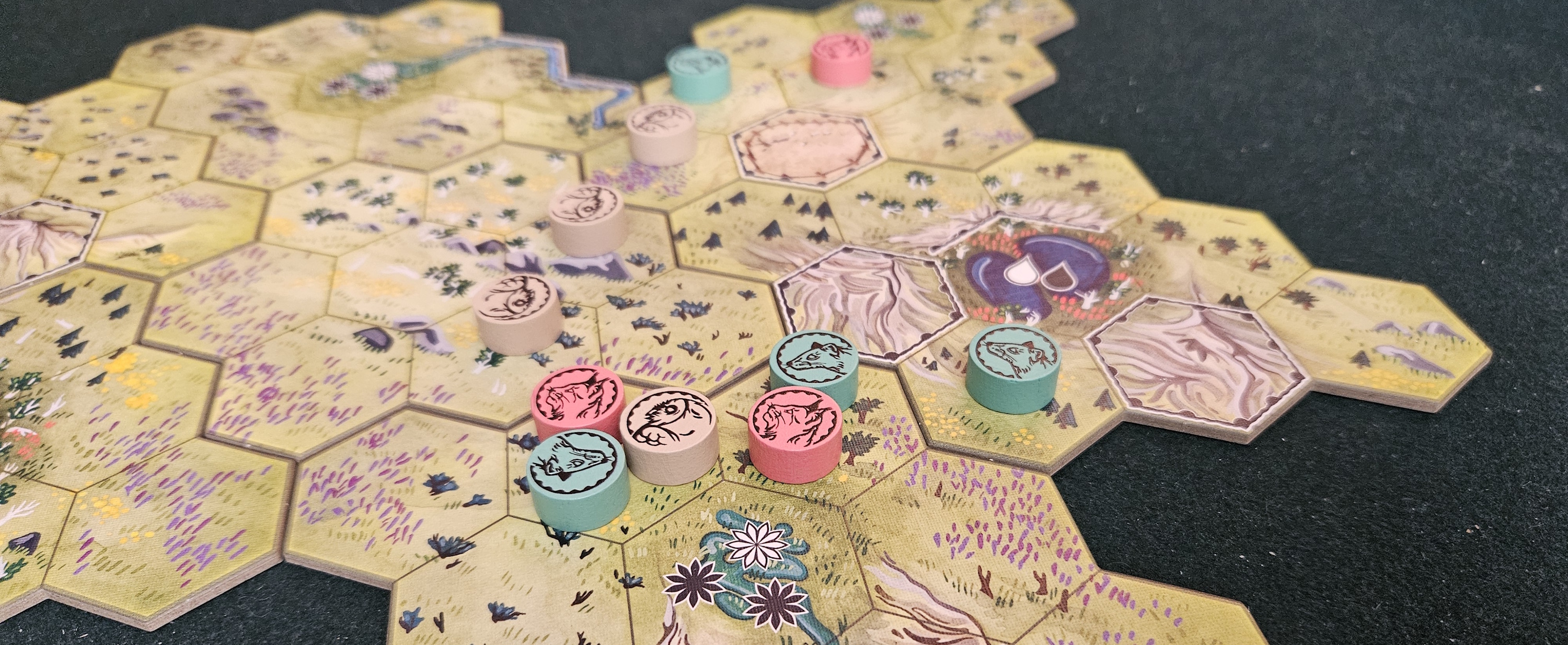
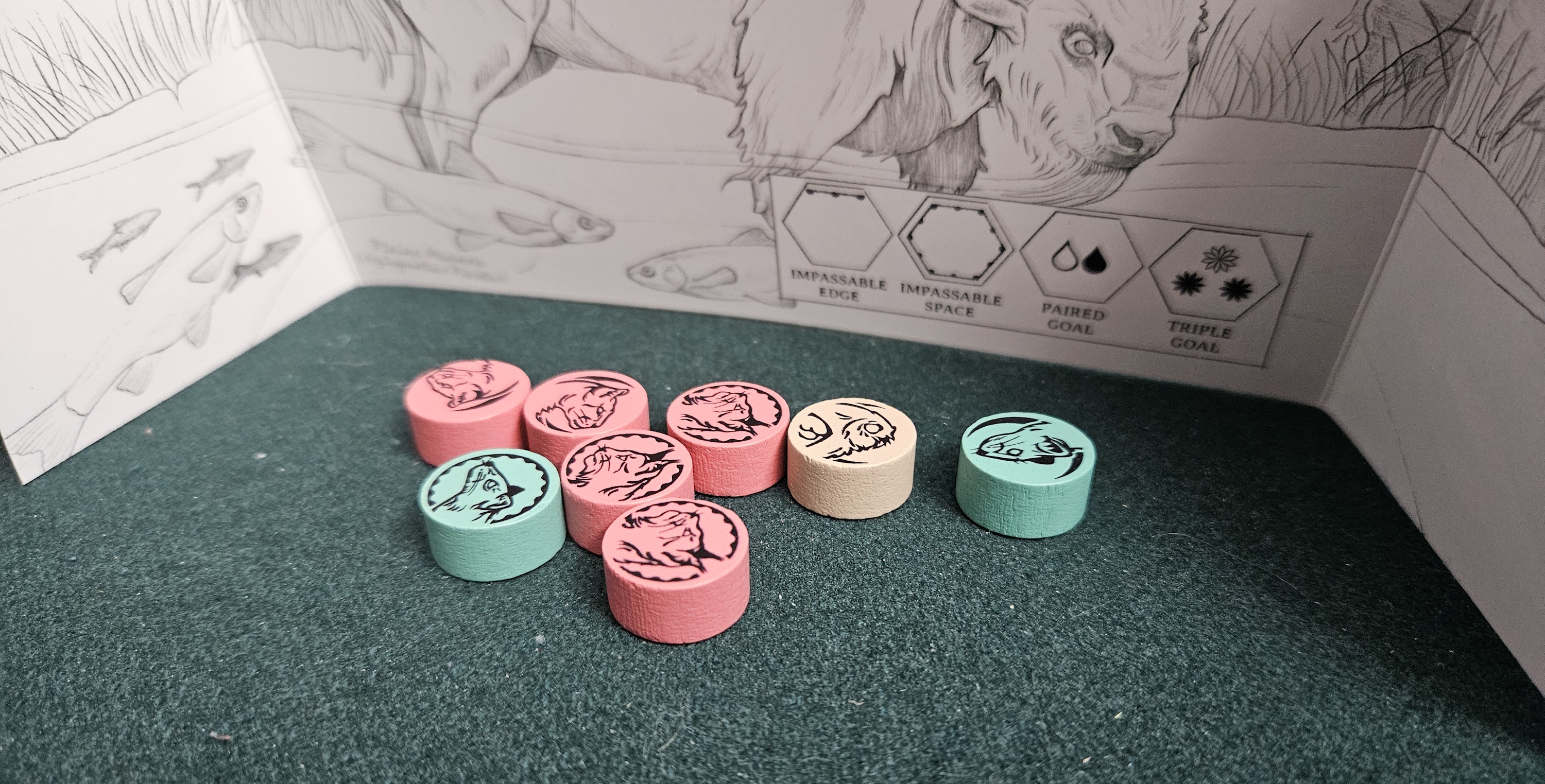
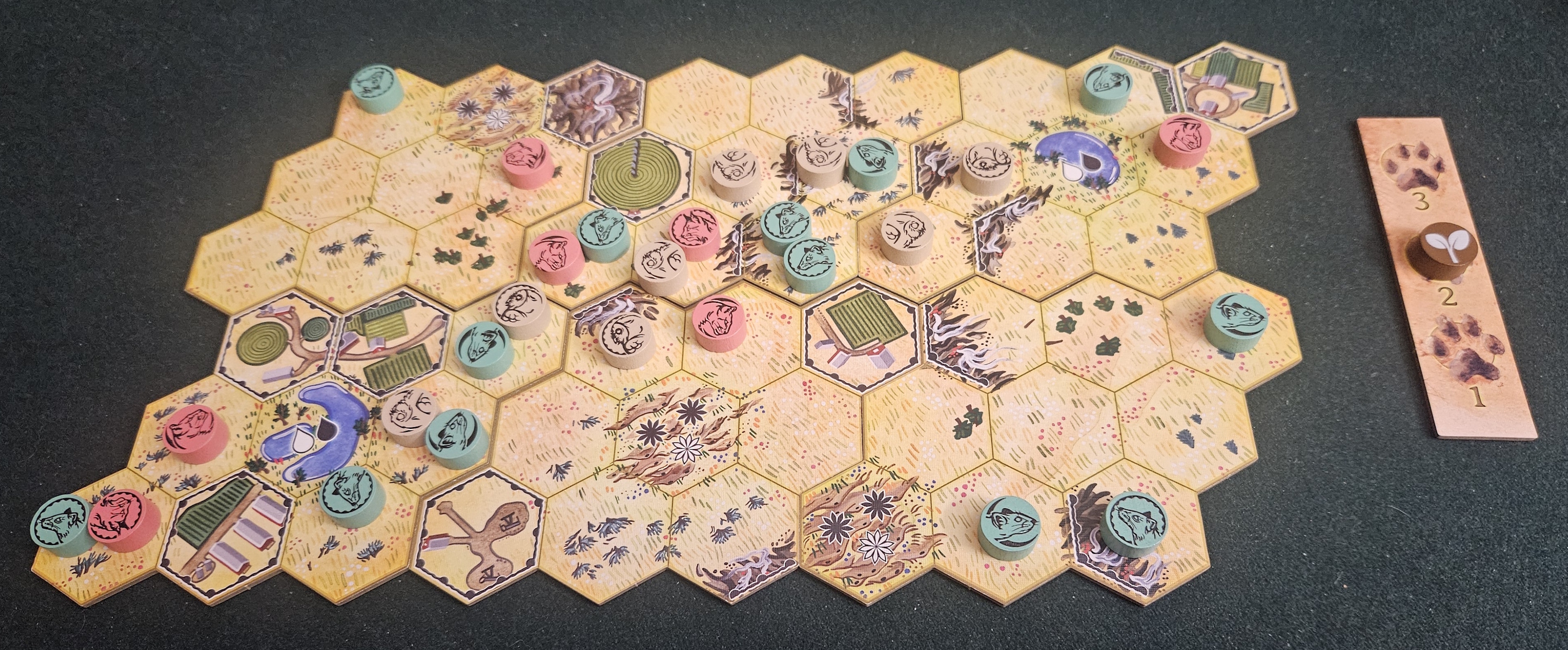
At a soil level, Upland & Prairie is about placing discs in three colors to link together either two or three objective spaces. When this happens — if it happens — the color of that space-linking chain determines which type of token becomes the game’s victory condition. Thus, linking rodents means rodent tokens become the game’s means of success. If the chain is composed of owls, you’re hopefully holding the most brown tokens. Predatory cats… you get the idea.
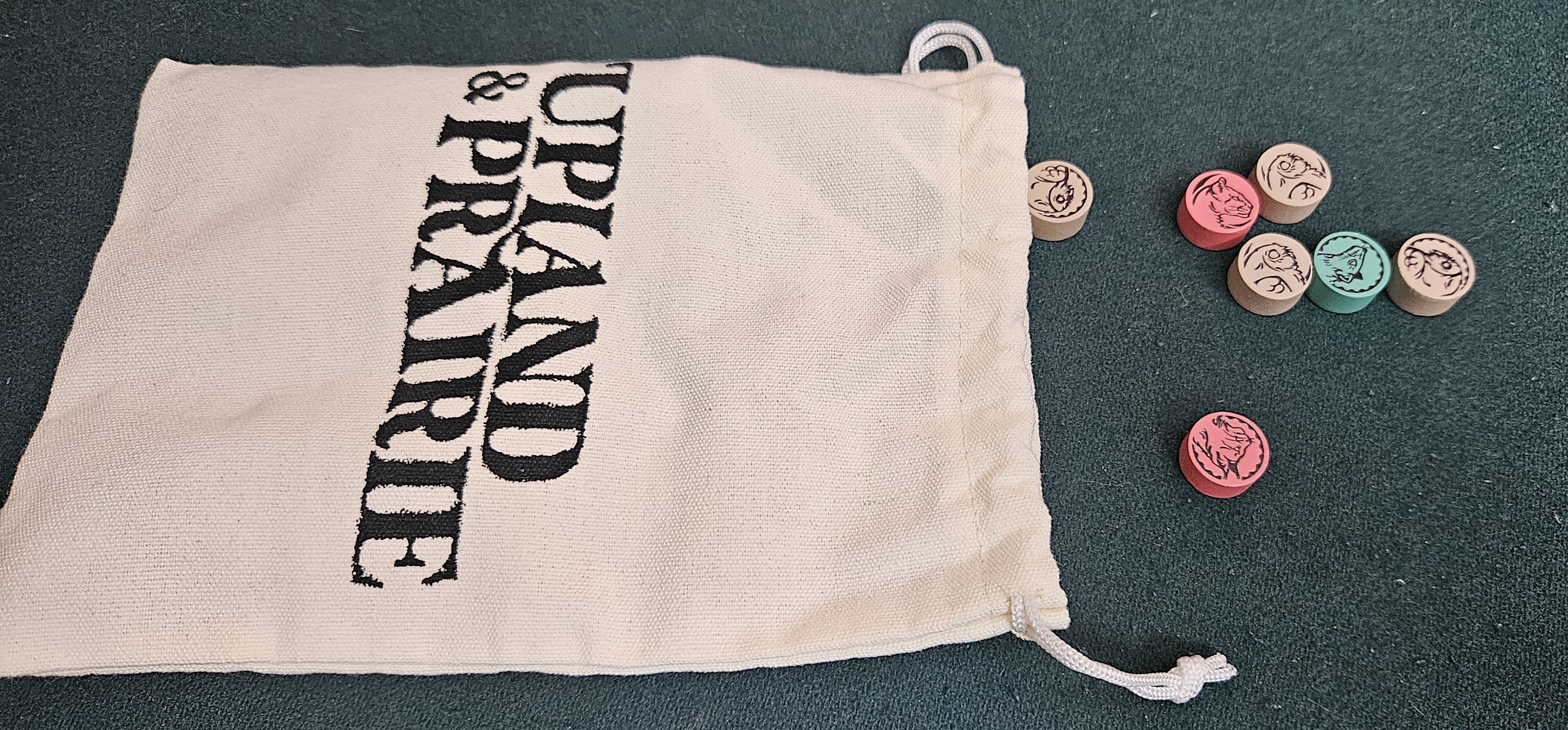
The game’s sole action is dead simple. On your turn, you draw three tokens from the bag. One of these gets placed on the map. Another gets hidden behind your player shield. The third gets tossed back into the bag. Even at its slowest, it’s snappy.
In theory, this exiles players to donkeyspace. If you’re holding the most red tokens, you want the final chain to be red. But placing red tokens means you’re not hoarding red tokens; hoarding red tokens means you’re not placing red tokens. Meanwhile, if an opponent sees you moving to complete the red chain, there’s nothing preventing them from hoarding their own red tokens. It’s a pickle.
Conversely, the game might end with the bag running dry. When that happens, now players are looking to build sets of red, green, and brown tokens. In such on occurrence, hoarding was exactly the wrong thing to do. Now it’s variety you’re after. Choices, choices.
And there certainly are choices. Constrained choices, to be sure. Choices dictated largely by the draw. That’s no problem. They’re still informed choices, and theoretically interesting choices at that. Every little tidbit, every placement, becomes a trickle of water on an arid prairie. When an opponent tucks a ferret (?) into a corner, is that because they’re trying to run out the bag? Or are they just trying to deplete those green tokens because they aren’t holding enough of them? Could this be an opening? Or is it so much static, not a coherent signal?
Now that’s one generous bag!
The foremost issue with Upland & Prairie is one of limitation. Not in the sense that it’s too limited. Rather, that it isn’t limited enough.
There are only three colors. Most of the time, this makes blocking a real problem. Now, in the game’s early stages, blocking is simple enough. If owls are threatening to end the session prematurely — a real possibility, given the tiny size of the map — then I might cut off your parliamentary incursion by placing a mountain lion. Easy enough.
But as the game progresses, other tokens might appear from the bag. These push up a tracker that increases how many tokens a space can hold. Where the game begins with each hex limited to a single disc, eventually it becomes possible to hold a second disc, and then a third. These moments, regulated as they are only by the draw-bag, are significantly harder to manage than ordinary token draws. It’s possible, as in a few of our sessions, that the game will open up its geography very early, in which case you might as well beeline toward the finish line with the color you’re holding the most of. If instead the game lingers a while, then the sudden appearance of a population-expanding token tends to favor the player upon whose turn it appeared. Now any bottlenecks can be pried open, and usually with ease.
Meanwhile, because the map is so small, these swings arrive with such suddenness that there isn’t much one can do to preempt them. Even if I’ve successfully walled off a particular species, a shift on my opponent’s turn — whether that’s one opponent or two, or perhaps two opponents and a partner, all depending on play count — can spell a very swift crumbling to that bulwark.
Hidden discs function as your score.
And then, when the game ends, there’s the very real possibility that it will end in a tie. There are tiebreakers, of course, and as in some of Sylvester’s better titles, The King Is Dead foremost among them, knowledge of the tiebreaker might be all-important.
Here, though, the tiebreakers feel more like concessions than objectives that can be shrewdly managed. In the case of a chain, tied players break their stalemate by who would go next in turn order. For an empty bag, it’s all about who holds the most animals of a single type. That might sound functional enough, but I’ve also seen that tally result in a tie. And the rulebook declines to address this possibility with either a second tiebreaker or a desultory “in this case, players share the win.”
This relates to my earlier issue. Upland & Prairie tends to end in a tie for the same reason that blocking is hard: the whole thing is simply too small. The map, the duration, the limits on placement, all of it. Sessions tend to end either swiftly or slightly less swiftly. There just isn’t enough time to build up a sizeable lead in any particular category. Nor is there room to suss out what an opponent is likely holding. The result is a game that presents pleasantly bite-sized decisions, but never enough of them to amount to a meal.
Big Sky. Tiny board.
It’s a shame, because I understand the desire to build a shorter tile-laying game. The famous Knizias — Tigris & Euphrates, Samurai, Qin, Babylonia — weren’t horrible time-hogs. But, sure, they could take a while to develop their board states.
Unfortunately, Upland & Prairie goes too far in the other direction. It prunes down not just the scope, but also the ability to stretch out, to take an opponent’s measure, to switch gears. Instead of coming across as a compact tile-layer, it feels like a novelty, like a mint-tin version of something more robust. And one that doesn’t succeed at compressing its subject matter, at that. This is no highland, no prairie. It’s a strip of lawn in a cookie-cutter suburb.
A complimentary copy of Upland & Prairie was provided by the designer/publisher.
(If what I’m doing at Space-Biff! is valuable to you in some way, please consider dropping by my Patreon campaign or Ko-fi. Right now, supporters can read the next installment in my series Talking About Games, this time tackling the topic of what makes a good list! Naturally, the piece includes a list.)
Imperium: Horizonte führt die bekannte Imperium-Reihe fort und bleibt dabei dem Grundprinzip der Serie treu. Verschiedene Zivilisationen entwickeln sich über den Verlauf einer Partie weiter und spielen sich durch ihre individuellen Kartendecks jeweils unterschiedlich. Wer bereits Imperium: Klassik oder Imperium:
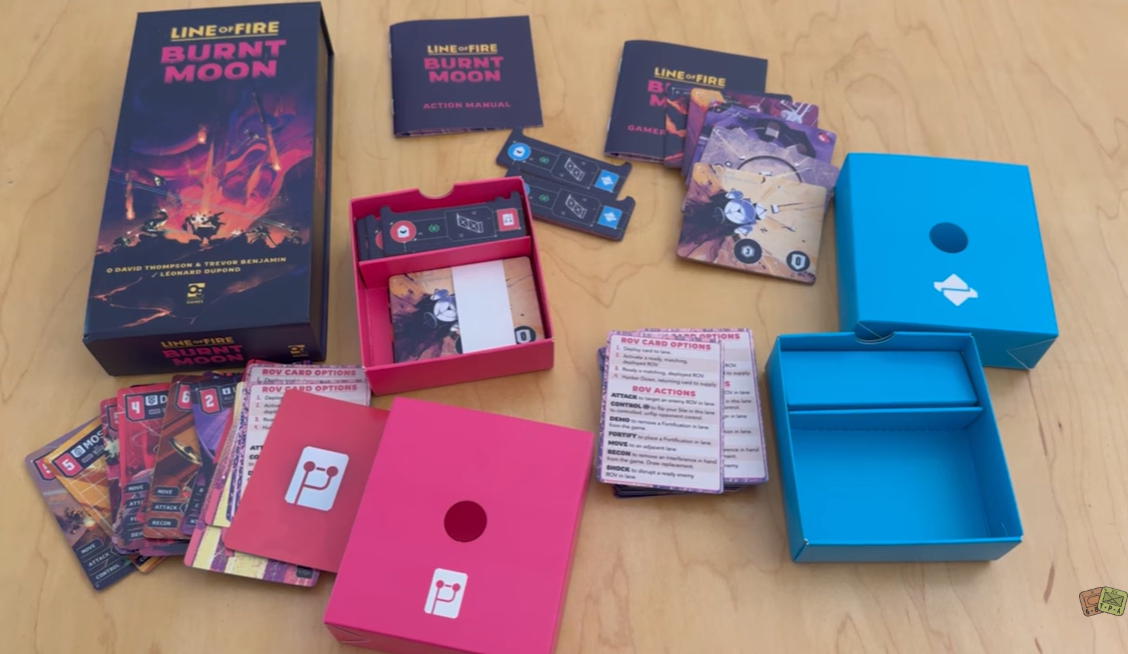
A group of black-hat hackers known as POSIWID plots to hijack the moon Io and hold the entire Jovian power grid to ransom. Standing in their way are the ultra-corporate LFA, the constructors of the lunar energy facilities. Both sides have engaged a fleet of ROV – advanced remotely-operated robots — to battle across the treacherous landscape. The machines are activated. Initiate combat sequence. The battle for Io has begun.
Line of Fire: Burnt Moon is a standalone 2-player card game that fuses the lean deck-building of the award-winning UndauntedSeries with fast-paced lane battling. Sharp decision-making and clever positioning combine in a nail-bitingly tense, endlessly replayable, and lightning-fast experience.

 Anmelden